When the HOA President Pointed Cameras at My Pool, I Learned What Privacy Really Costs
Chapter 1: The Red Light Above Our Backyard Fence
“Dad.”
Amy’s voice changed before I even looked up.
She was standing waist-deep in the pool, one hand shading her eyes as she stared past me toward the rear fence.
“What is that red light?”
I followed her finger.
At first I saw nothing except the weathered cedar boards, the strip of Gary Wilson’s detached garage roof beyond them, and the late-afternoon glare bouncing off the water.
Then something blinked.
A tiny red point above the fence.
Steady for a second. Gone. Back again.
Amy moved toward the shallow end.
“It’s been doing that since I got in.”
I set my phone on the patio table and walked to the fence. From ground level, the roofline hid most of Gary’s garage wall. I had to step onto the low retaining edge beside the flower bed before I could see what the red light belonged to.
A camera.
Black housing. Small rectangular body. Mounted high beneath the garage eave.
Its face was angled diagonally toward our yard.
Toward the pool.
I stayed there longer than I needed to, telling myself there might be another explanation. Maybe the lens was pointed farther left than it looked. Maybe its field of view caught only the alley behind the properties. Maybe the red light meant something other than recording.
I worked as a project estimator. I trusted measurements more than impressions.
So I got a tape measure from the garage.
Amy wrapped herself in a towel and watched me move around the yard, taking photographs from the patio, the shallow end, and the gate. I marked where the camera sat relative to the fence corners and followed the apparent line of sight.
The angle was bad.
Not ambiguous bad.
Bad.
“If it’s aimed where it looks,” Amy said, “it sees most of the pool.”
“Looks aren’t proof.”
She gave me the look she had used since college whenever she thought I was hiding inside technical language.
“Okay,” she said. “Then prove it.”
That was when I found the second camera.
It was farther along Gary’s garage, mounted near the opposite corner. The first one had a broad view across our shallow end. The second sat higher, aimed across the deeper half and part of the patio.
I lowered my phone.
For years I had told Amy that our backyard was the one place in the neighborhood where she did not have to think about other people.
The houses were close enough that privacy was never perfect. Lawn mowers started before breakfast. Dogs barked through fences. People heard each other’s arguments through open kitchen windows.
But the fence mattered.
The pool mattered.
The idea that someone had deliberately mounted cameras above that fence changed the feeling of the yard in a way I could not measure.
Amy looked toward the garage again.
“Did he say anything to you?”
“No.”
“Did the HOA?”
“No.”
She folded the towel tighter around herself.
That bothered me almost as much as the cameras.
Gary was not simply the man next door. He had been HOA president for three years. He liked procedures. He liked advance notices. He sent neighborhood-wide reminders when residents left trash bins visible six hours too long after pickup.
If anyone understood the value of informing people before making something their problem, it should have been him.
I waited until Amy went inside before I walked around the block.
Gary was in his driveway coiling an extension cord beside the garage.
He looked up when I approached.
“Hey, Brandon.”
I pointed toward the eaves.
“When did you put those cameras up?”
“Weekend.”
“You know one of them points into my backyard.”
He did not look surprised.
“They cover the rear access.”
“They cover my pool.”
“They cover the area behind the garages.”
I kept my voice even.
“I stood in the yard and checked the angles.”
Gary set the cord down.
“We’ve had problems.”
“What problems?”
“People cutting through the rear lots. Somebody tried garage doors two streets over. Packages disappearing.”
That was the first thing he said that slowed me down.
I had heard about a garage being opened at night. I had not connected it to Gary’s installation.
“Then point them at your driveway and rear door.”
“That creates blind spots.”
“So my pool isn’t a blind spot?”
His jaw tightened.
“That’s not what I said.”
“It’s what the camera sees.”
Gary folded his arms.
“The cameras are on my property.”
“I’m not arguing where they are.”
“Sounds like you are.”
“I’m arguing where they’re pointed.”
For a moment neither of us spoke.
A car rolled past at the end of the driveway, and Gary lifted one hand toward it as if the ordinary movement proved his case.
“I’m responsible for more than one house around here,” he said.
There it was.
Not neighbor to neighbor.
President to resident.
I could feel my anger hardening, which made me more careful.
“I’m asking you to redirect them.”
“I’ll look at the coverage.”
“That means what?”
“It means I’ll look at it.”
I went home unsatisfied but not yet convinced he was refusing.
That evening, Amy sat at the kitchen island while I loaded the photos onto my laptop. We enlarged each one until the camera housings became pixelated black shapes above the fence.
“You’re going to do the spreadsheet thing, aren’t you?” she asked.
“It’s not a spreadsheet thing.”
“It’s always a spreadsheet thing.”
I almost smiled.
Then one photograph stopped me.
Taken from the deep end, it showed the first camera centered directly above a section of fence where there was no alley, no gate, no access point behind us.
Only water.
Only patio.
Only our yard.
The red indicator glowed in the enlarged image.
Amy leaned closer.
“That’s pretty clear.”
I saved the photograph in a separate folder.
The next morning Gary was getting into his truck when I caught him outside.
“Did you look at the cameras?”
He paused with the door open.
“I did.”
“And?”
“They’re staying where they are.”
No anger. No apology. No uncertainty.
Just a decision.
Then he got into the truck and closed the door.
Chapter 2: Fourteen Days and a Certified Envelope
Before I wrote a single sentence to Gary, I photographed the camera angles again.
Not because I expected them to move overnight.
Because I no longer trusted the dispute to remain a conversation.
I took pictures from five points around the yard, measured the fence height, marked the position of each camera, and printed a simple diagram showing what portions of the pool appeared to fall within their sightlines.
Then I wrote the shortest letter I could.
I did not accuse Gary of spying.
I did not threaten a lawsuit.
I asked him to redirect or narrow the cameras within fourteen days so they no longer captured our private backyard and pool.
At the post office, the clerk slid the certified envelope onto the scale.
“Anything valuable?”
I almost said yes.
Instead I said, “Just documents.”
Gary signed for it the next afternoon.
Three days passed.
Then five.
On the sixth day, I saw him at the mailbox cluster.
“You get my letter?”
“Yes.”
“Are you going to respond?”
“I already told you my position.”
“That was before I sent you the sightline photos.”
Gary shut his mailbox.
“And my position didn’t change.”
He started walking toward his house.
I followed far enough to keep the conversation from becoming a public performance.
“You said there were security incidents.”
“There were.”
“So show me how my pool improves your security.”
He stopped.
“Last month somebody went through two unlocked garages near the rear lane. Another homeowner caught someone checking car doors.”
“That doesn’t answer my question.”
“It answers why the cameras are there.”
“Not why they need to see my yard.”
Gary looked at me for several seconds.
“You’re making this more personal than it is.”
The sentence landed badly.
“My daughter noticed a camera while she was swimming.”
“And nobody is watching your daughter.”
“You can’t ask me to accept that on faith while keeping the camera pointed there.”
His expression changed—not guilt, exactly, but irritation.
“You sent me a certified demand like I’m some contractor you’re putting on notice.”
“I sent it certified so there would be a record.”
“Exactly.”
That was the moment I understood the letter had done something I had not intended.
To me, documentation lowered emotion.
To Gary, it raised the stakes.
By day nine, the response came not from him but from the HOA’s attorney.
The letter was careful.
Exterior security equipment installed on an owner’s property was not, by itself, prohibited under the association rules. The HOA would not order removal merely because another owner objected to the equipment’s existence.
I read the paragraph twice.
My first reaction was anger.
My second was less comfortable.
The attorney had not actually said Gary had unlimited permission to record anything visible from his property.
The letter addressed ownership and installation.
Not impact.
Not privacy.
Not angle.
I went back through my photographs.
For the first time since Amy had spotted the red light, I stopped asking, Can Gary own these cameras?
The stronger question was, What are they allowed to capture?
That afternoon I called the county sheriff’s office and asked, generally, about residential cameras pointed into fenced outdoor living areas. The desk deputy would not give me legal advice, which I expected. He suggested documenting the sightline and making a report if I believed the cameras were intruding into a private area.
I did.
Not because I thought a deputy would arrive and order Gary onto a ladder.
I wanted a dated record.
I also checked municipal rules and state privacy guidance. Nothing I found offered the clean answer I wanted. There were distinctions between observation and recording, visible areas and areas where privacy might reasonably be expected, criminal conduct and civil disputes.
Messy.
That bothered me more than if the rules had simply said no.
I liked clean systems.
Gary seemed to know that.
On the twelfth day he caught me measuring from the patio to the rear fence.
“Still building your case?”
I looked at him over the boards.
“Still pointing your camera at my pool?”
He gave a tired laugh.
“You think I installed thousands of dollars in equipment because I care what happens in your backyard?”
“No. I think you installed it for security and decided my backyard was acceptable collateral.”
His face hardened.
“You don’t get to tell me how to secure my property.”
“And you don’t get to make my property part of your security system without a conversation.”
For a second, I thought he might finally discuss the angle.
Instead he said, “You should think about what happens if everybody in this neighborhood starts demanding exceptions.”
There was his real language again.
Not two neighbors.
Policy. Precedent. Authority.
I went inside before I said something less useful.
On day fourteen, nothing changed.
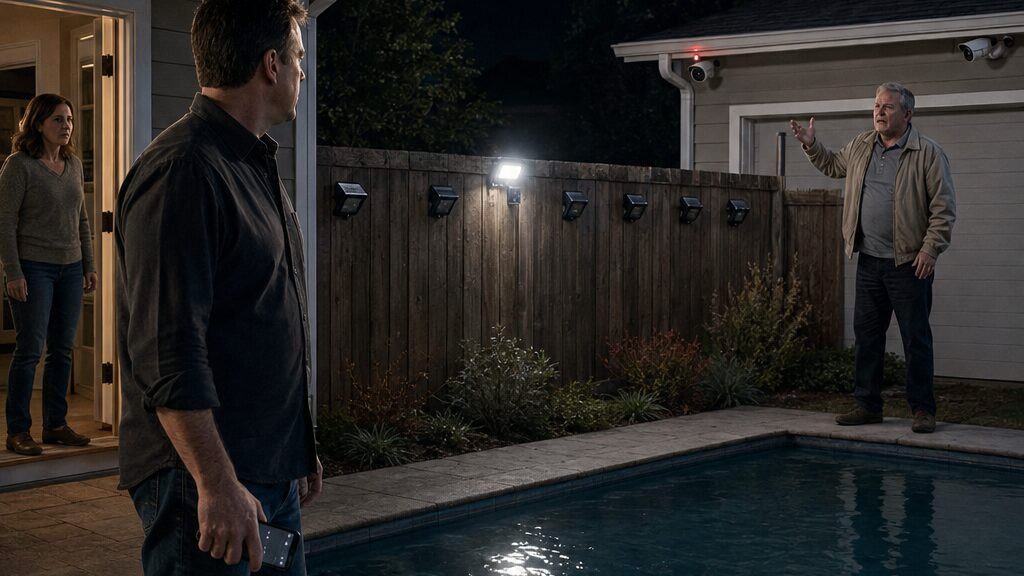
Both red lights still showed above the fence after dark.
Amy was standing at the kitchen sink when I came in from checking them.
“So now what?”
“I could keep pushing the privacy complaint.”
“You are going to.”
“Yes.”
“But?”
She knew me too well.
I opened the drawer where I kept business cards and found one from an electrician who had replaced our exterior panel the year before.
“There are rules for cameras,” I said.
Amy watched me turn the card over between my fingers.
“There are rules for exterior lighting too.”
Her eyebrows lifted.
“Dad.”
“I haven’t done anything.”
“You have the face you make right before you do something extremely technical and extremely annoying.”
I dialed the number.
When the electrician answered, I asked if he installed motion-activated security floodlights.
Chapter 3: Forty-Seven Bursts of White Light
The electrician stood beside my rear fence with a sensor head in one hand and looked at me as if he wanted one more chance to misunderstand the job.
“You really want all six detecting this close to the property line?”
“Yes.”
He glanced toward Gary’s garage.
The two cameras were visible beneath the eaves.
“You’re trying to light your yard, or his?”
“My yard.”
“That wasn’t exactly my question.”
I appreciated that he asked.
I also disliked that he had.
“The fixtures stay on my side. Light aimed down. Everything within code.”
“That part I can do.”
“And the motion zones?”
He rotated the sensor in his hand.
“We can narrow them.”
“How narrow?”
“Narrow enough that passing movement over there doesn’t trigger them constantly.”
I looked toward the first camera.
The red indicator was off in daylight, but I knew exactly where it would appear after sunset.
“Set them to cover the full rear boundary.”
The electrician stared at me for another second.
“Full boundary.”
“Yes.”
He shrugged once.
“Your house.”
By late afternoon, six compact floodlights ran along the fence line.
They were professionally mounted, aimed downward, cleanly wired, and brighter than anything we had previously needed in the backyard.
Amy came outside while the electrician was testing the final fixture.
One light snapped on.
Then another.
Then three together.
The entire rear fence went white.
Amy stopped on the patio.
“Oh.”
The electrician adjusted a sensor.
“Sensitive right now.”
“How sensitive?” she asked.
“A moth could probably set one off if it got close enough.”
Amy looked at me.
I pretended to study the invoice.
The electrician left before sunset.
At 8:41, the first light activated.
I was standing inside by the kitchen window.
A car had turned into Gary’s driveway.
The nearest sensor caught the movement, and two fixtures flared against the fence.
Through the slats, I saw Gary stop.
He looked toward my yard.
The lights went dark thirty seconds later.
At 8:47, they came on again.
Gary crossed from his garage to the back door.
At 8:52, one light fired alone.
I could not see what triggered it.
At 9:03, three came on at once.
Amy walked into the kitchen and found me watching the boundary through the glass.
“You’re keeping count?”
“The system is.”
I showed her the control app.
Seven activations.
She looked at the screen, then at me.
“You seem pleased.”
“I seem informed.”
“You seem pleased and informed.”
At 9:18, another burst washed the fence.
This time Gary opened his back door and stood there until the lights shut off.
I felt a small, sharp satisfaction.
It was not a noble feeling.
But it was real.
For two weeks, I had been the one looking up at a device someone else controlled. I had been the one wondering when it was active, what it could see, whether a movement in my own yard was being recorded somewhere beyond the fence.
Now Gary was looking toward my equipment.
Now he was wondering.
That symmetry felt like justice for about an hour.
At 10:26, Amy stepped outside with a glass of water.
The nearest light snapped on before she reached the pool.
Then a second one.
She stopped.
Waited.
They switched off.
She took three more steps.
Another sensor caught her.
The yard went bright again.
She turned around and came back inside.
“You can turn those down, right?”
“Yes.”
“Are you going to?”
“Not tonight.”
She set the glass on the counter.
“So they’re for security.”
“They are security lights.”
“That wasn’t what I asked.”
I closed the app.
“Gary had fourteen days.”
Amy folded her arms.
“And because he acted like a jerk, we have to live inside an airport runway?”
“That’s dramatic.”
“Go stand by the pool.”
I did not.
She gave a short, humorless laugh.
“That’s what I thought.”
At 11:11, Gary knocked on my front door.
Not the fence.
The front door.
When I opened it, he was wearing sweatpants and a sweatshirt, his face tight with controlled irritation.
“Those lights are triggering every time something moves behind my house.”
“They’re motion activated.”
“I understand what motion activated means.”
“Then what’s the question?”
His eyes narrowed.
“You set them like this deliberately.”
“They’re code-compliant fixtures on my property.”
The sentence came out almost by itself.
Gary heard it too.
His mouth flattened.
“That’s cute.”
“I’m not trying to be cute.”
“You’re trying to make a point.”
“Maybe now you understand the point.”
For a few seconds, neither of us moved.
Then Gary said, “My cameras don’t shine into your windows forty times a night.”
“They point at my pool.”
“For security.”
“These are for security.”
He looked past me toward the side yard, where another fixture had just activated.
“This is retaliation.”
“Then redirect the cameras.”
“You don’t get to dictate my equipment because you built something more annoying.”
“And you don’t get to use your title to decide my privacy matters less than your coverage.”
That stopped him.
Not because he agreed.
Because I had said the part both of us had been avoiding.
Gary stepped backward.
“You want to make this formal?”
“It already is.”
He nodded once.
“Fine.”
Then he walked home.
I locked the door and returned to the kitchen.
Amy was leaning against the counter.
“How did that go?”
“Productive.”
“No, really.”
“He understands the issue.”
“He understood the issue before.”
I did not answer.
By midnight, the activation count had reached twenty-nine.
At 1:14 a.m., another light fired.
At 2:03, two more.
At 3:37, something small moved near Gary’s gutter—a moth, maybe, or a leaf caught in the wrong current—and one sensor flashed on for thirty seconds.
I knew because I was awake.
The lights were bothering me too.
That was the part I had not planned.
At 5:52, I checked the app.
Forty-seven activations.
I stared at the number.
Forty-seven.
It was absurd.
Part of me wanted to laugh.
Part of me knew exactly what the electrician would say if I called him.
Narrow the zones.
Reduce the sensitivity.
Solve the problem.
My thumb hovered over the settings.
Then I thought about the red light above the fence.
Fourteen days.
The attorney’s letter.
Gary telling me the cameras were staying.
I locked the phone and set it face down.
I let the settings remain exactly as they were.
Amy came into the kitchen a little after seven, already dressed for work. She glanced at my face, then at the phone.
“How many?”
“Forty-seven.”
She stared at me.
“You’re changing them today.”
It was not a question.
I poured coffee.
“They’re functioning as designed.”
“Dad.”
“I know what you’re saying.”
“No. You know the words I’m saying.”
That landed harder than I wanted it to.
She picked up her bag.
“I didn’t swim last night because of those lights.”
“You could have.”
“That’s not the same thing as wanting to.”
She left before I could build an argument around the distinction.
For the first time since the cameras went up, the backyard felt like something I had helped ruin.
I stood at the window looking toward the fence.
The morning sun made the floodlights look harmless.
Six neat fixtures.
Professional installation.
Approved equipment.
Technically compliant.
I was still staring at them when the doorbell rang.
A courier stood on the porch holding a large envelope.
The return address belonged to the homeowners association.
Inside was a formal nuisance complaint filed by Gary Wilson.
Attached to it was a printed activation summary.
Forty-seven events.
First night.
Chapter 4: The Complaint That Put Both Men on Trial
The first thing I noticed was not Gary’s name.
It was the number.
He had circled it in blue ink on the activation summary attached to his nuisance complaint.
Forty-seven lighting events between sunset and sunrise, followed by a sentence claiming my fixtures had created “repeated and unreasonable disturbance to the adjoining property.”
I sat at the kitchen table with the complaint spread in front of me.
The certified envelope I had sent Gary two weeks earlier was in the folder beside it.
Two pieces of paper.
His complaint.
My demand.
Both of us had apparently decided paper was safer than talking.
Amy came downstairs carrying her keys.
“You look like you’re preparing a tax audit.”
“Gary attached my activation log.”
She leaned over my shoulder.
“He has your log?”
“The system report was included with the complaint. I gave the HOA a copy when they asked whether the lights had actually been activating.”
“So you gave him the number.”
“I gave the board the number.”
She tapped the page.
“Forty-seven still sounds bad.”
“They’re legal fixtures.”
“That isn’t what I said.”
I pushed my chair back.
The hearing notice gave me four days.
Four days to explain why six lights activating forty-seven times in one night were security equipment rather than harassment.
I had expected Gary to complain.
What I had not expected was for his complaint to look reasonable when reduced to a page.
That morning I drove to the municipal office with the electrician’s invoice, fixture specifications, installation photographs, and the manufacturer’s photometric sheet.
The code officer looked through the packet without much interest.
“They’re aimed downward?”
“Yes.”
“Mounted at this height?”
“Yes.”
“No flashing mode?”
“No.”
“No fixture projects directly into his windows?”
“Not directly.”
He stopped on that answer.
“What does ‘not directly’ mean?”
“They illuminate my fence and yard. Some reflected light reaches his property.”
“Reflected light reaches everybody’s property.”
He handed the specification sheet back.
“From what you’ve shown me, I don’t see an installation violation.”
Relief came first.
Then he added, “That doesn’t mean your association can’t have a nuisance standard.”
The relief disappeared.
“So equipment can comply with municipal code and still be considered a nuisance?”
“Sure.”
He shrugged.
“A barking dog can be legal to own.”
I hated how simple that was.
At home, I opened the HOA covenants again.
I had read the lighting section three times already.
This time I read the nuisance language.
It did not require a code violation.
It referred to repeated interference with another owner’s reasonable enjoyment of property.
Reasonable.
That word again.
I sat back.
For two weeks I had been focused on proving Gary could not hide behind the sentence, It’s on my property.
Now I was preparing to use exactly the same sentence.
Amy came home after dark.
She stood at the back door but did not open it.
“You going out?”
“No.”
“You said you might swim.”
“I changed my mind.”
I looked toward the pool.
The water was still. The lights were off.
“Because of Gary’s cameras?”
She turned to me.
“Because of everything.”
I said nothing.
She nodded toward the fence.
“If I go out there, those things start firing every time I move.”
“They can be adjusted.”
“I know.”
That was worse than if she had accused me.
She knew I could fix it.
I knew she knew.
“I’m trying to make a point,” I said.
“To Gary.”
“Yes.”
“But I live here too.”
I looked down at the papers on the table.
For the first time, the forty-seven activations stopped looking like evidence of how clever the system was.
They looked like evidence that I had been willing to inconvenience my own daughter so Gary would understand how it felt to lose control over a private space.
Amy picked up a glass of water.
“Are you going to turn them down?”
“Not before the hearing.”
She stared at me.
“Why?”
“Because if I change them now, Gary says the complaint worked.”
“So?”
The word hit me with embarrassing force.
“So he thinks he was right.”
“Maybe about the lights he is.”
I looked at her.
She did not soften it.
“That doesn’t mean he’s right about the cameras.”
After she went upstairs, I opened the privacy materials I had printed earlier.
Most of them were less useful than people imagine laws are when they have never had to rely on one.
There was no magic sentence saying a camera could never capture part of a neighboring yard.
But there were repeated references to reasonable expectations of privacy, intentional surveillance, and the significance of fenced outdoor areas depending on circumstances.
Then I found the county guidance I had printed after speaking with the sheriff’s office.
It recommended documenting camera placement, sightlines, and whether a less intrusive position could accomplish the same security purpose.
Less intrusive.
Not no cameras.
Not automatic guilt.
A narrower question.
I pulled up my original photographs.
The first camera was understandable.
If Gary wanted coverage of the rear garage approach, its general direction made sense.
The second was harder to justify.
I traced its angle with a ruler across the printed photograph.
A small adjustment toward Gary’s driveway would preserve most of the useful view while removing nearly all of the pool.
I had known that from the beginning.
The question was whether Gary had known it too.
The next day, I requested the security information Gary had referenced when I first challenged him. The HOA provided a brief neighborhood notice sent the previous month.
Two attempted garage entries.
Several car-door checks.
One package theft.
Real incidents.
Gary had not invented them.
That complicated something in me.
I wanted his reason to be fake because fake reasons are easier to defeat.
Instead, he had a real concern and had responded to it badly.
The same description now fit me.
I went back to the sheriff’s office and completed a formal informational report about the camera angle. The desk deputy made no promise of enforcement.
“This documents your concern,” he said.
“That’s all I’m asking for.”
It was true.
Mostly.
On the evening before the hearing, I arranged my papers into three piles.
The camera sightlines.
The privacy guidance and report receipt.
The lighting documents.
Then I placed Gary’s forty-seven-event attachment on top.
For ten minutes I tried to decide what explanation would make the number sound less intentional.
Sensor calibration.
Full perimeter coverage.
Professional installation.
Security needs.
All technically true.
None completely true.
Amy came through the kitchen.
“You ready?”
“No.”
She looked surprised.
It might have been the first time I had admitted that since this started.
I tapped the activation sheet.
“I could argue these settings were necessary.”
“Were they?”
I looked at her.
“No.”
She nodded once.
“Then don’t.”
After she left, I wrote one sentence on a blank page.
The lights were installed for security, but I also knew the sensitivity would create pressure on Gary, and I chose not to reduce it.
I read it twice.
Then I put the page at the top of my hearing folder.
If that admission destroyed my position, at least it would destroy the position I actually had.
Chapter 5: The Hearing Where Technical Rights Stopped Being Enough
Catherine Brown did not begin by asking whether my lights met code.
She did not ask about Gary’s cameras.
She did not ask for my photographs.
She looked at me across the clubhouse table and said, “Were the lights meant to bother him?”
The room went very still.
Gary sat two chairs to my right with the HOA attorney beside him. Two other board members had copies of both complaints in front of them.
I had spent four days preparing for legal language.
Catherine had reduced the entire problem to nine words.
I could have said no.
I could have explained motion detection zones, exterior security, perimeter coverage, and professional installation until the question disappeared under vocabulary.
Instead I looked at the page on top of my folder.
“Yes,” I said.
Gary shifted immediately.
Catherine did not.
“Yes, what?”
“Yes, partly.”
The attorney leaned forward.
“So you acknowledge the installation was retaliatory.”
“I acknowledge retaliation was part of why I left the sensors as sensitive as they were.”
Gary gave a short exhale that sounded almost like a laugh.
“There you go.”
I turned toward him.
“I also installed them after you refused to redirect cameras that capture my pool.”
Catherine raised one hand.
“One issue at a time.”
She looked back at me.
“Did you know the lights were activating excessively?”
“After the first night, yes.”
“And you could have reduced the sensitivity?”
“Yes.”
“Did you?”
“No.”
There was no satisfaction in saying it.
That surprised me.
A week earlier I would have treated the admission like a tactical gamble.
Now it simply felt accurate.
Catherine wrote something down.
Then she turned to Gary.
“Why were the cameras installed?”
“Security.”
He described the attempted garage entries, the car-door checks, the stolen package. He had dates. He had the original neighborhood notice.
Nothing he said sounded unreasonable.
That mattered.
One board member asked, “Were these cameras part of an HOA project?”
“No,” Gary said. “Personal equipment.”
“So you installed them as a homeowner.”
“Yes.”
“Not under board authority.”
Gary hesitated.
“Yes.”
The distinction seemed small.
It was not.
He had spoken to me from the beginning as if his responsibility for the neighborhood gave the camera placement extra weight.
On paper, he was simply my neighbor.
Catherine looked at my photographs.
“This one is from inside the Miller backyard?”
“Yes.”
“And that red indicator is the second camera?”
“Yes.”
Gary leaned forward.
“It covers the rear approach to my garage.”
I slid my diagram across the table.
“It covers that approach. It also covers most of the deep end of my pool.”
Gary barely glanced at it.
“You don’t know the exact field of view.”
“No. You do.”
That changed the room.
Catherine turned to him.
“Do you have images showing what each camera captures?”
Gary looked at the attorney.
The attorney answered carefully.
“We have not provided recorded images because that raises additional privacy concerns.”
Nobody spoke for a moment.
Catherine said, “I’m not asking for recordings of the Miller property. I’m asking whether Mr. Wilson knows the coverage includes the pool.”
Gary’s jaw worked once.
“It includes part of the yard.”
“How much?”
“Some.”
“How much?”
He looked down at the photograph.
“More than he would like.”
“That isn’t a measurement.”
Gary’s irritation finally surfaced.
“I installed the cameras to maximize coverage. Every time you narrow one angle, you create another gap.”
I understood that argument.
So I opened the diagram I had prepared the night before.
“This is the current approximate direction.”
I laid a ruler across the image.
“If the second camera rotates toward his driveway by roughly this amount, it still covers the garage approach and removes most of my pool from the sightline.”
Gary shook his head.
“You don’t know what it removes.”
“Then show us.”
The attorney touched Gary’s arm lightly.
Gary stopped.
Catherine watched that exchange.
Then she asked the question I had not expected.
“Did Mr. Miller ask you to narrow the view before he installed the lights?”
“Yes.”
“And could the camera have been adjusted?”
Gary did not answer immediately.
The silence lasted long enough that even I stopped feeling pleased by it.
Finally he said, “Any camera can be adjusted.”
“That wasn’t my question.”
His face reddened.
“Yes.”
“Why didn’t you?”
“The current position is better.”
“For security?”
“Yes.”
“Only for security?”
Gary looked at me.
Something in his expression changed.
The polished HOA-president certainty fell away, leaving something more ordinary.
Annoyance.
Pride.
“I had already told him I would review it,” he said. “Then he sent me that certified letter like I was violating some order.”
The room shifted.
Not dramatically.
Nobody gasped.
But Catherine stopped writing.
“You refused to adjust the camera because of the letter?”
“I didn’t say that.”
“You just connected the two.”
Gary rubbed a hand over his jaw.
“I’m saying the letter changed the nature of the conversation. He made it formal.”
“So did your nuisance complaint,” I said.
Catherine looked at me.
I stopped.
Gary leaned back.
“I’m HOA president. If every resident decides they can pressure another owner into changing lawful equipment—”
Catherine interrupted him.
“You being president is not relevant to what you can install on your private garage.”
Gary stared at her.
She continued.
“It may be relevant to how other residents interpret your behavior.”
That landed harder than anything I had said to him.
For the first time, Gary looked less angry than cornered.
I almost felt sorry for him.
Almost.
The hearing moved back to my lights.
The municipal documents showed no apparent code violation.
The electrician’s invoice confirmed professional installation.
Then Gary’s forty-seven-event sheet came out again.
One board member asked, “Do you still maintain this level of triggering is necessary for security?”
This time I did not look at my notes.
“No.”
Gary turned toward me.
“I could reduce it.”
“Could have,” he said.
“Yes.”
I met his eyes.
“I could have.”
The admission took away the argument he had prepared for.
It also took away mine.
Catherine folded her hands.
“So we have two owners with lawful equipment. One owner refuses to narrow a camera that unnecessarily captures a neighbor’s private recreation area. The other owner knowingly leaves security lights configured at a level that causes repeated disturbance.”
Nobody liked hearing it put that way.
Which was probably why it was useful.
The board recessed for twelve minutes.
Gary stood near the window without speaking to me.
I stayed at the table.
When Catherine returned, she read the decision without ceremony.
The board would not sustain Gary’s nuisance complaint on the evidence presented, in part because the lighting installation itself was compliant and because the dispute arose from an unresolved boundary and privacy conflict involving both properties.
Gary’s complaint was dismissed.
For one clean second, satisfaction rushed through me.
I had won.
Then Catherine kept reading.
The board was not ruling that my settings were reasonable.
It was not ruling that Gary’s cameras violated state law.
It was not ordering the cameras moved.
The association was declining to turn one neighbor’s unresolved dispute into enforcement against the other while both were contributing to the escalation.
My satisfaction drained just as quickly as it had arrived.
When the meeting ended, Gary gathered his papers.
“You happy?”
I looked at him.
The easiest answer was yes.
Instead I said, “No.”
He seemed almost offended by that.
“You got what you wanted.”
I glanced at the photograph still lying on the table.
The tiny red indicator floated above the printed fence.
“No,” I said. “I got your complaint dismissed.”
Gary left without answering.
I packed my folder slowly.
The board vote had protected my lights.
It had not protected my pool.
Chapter 6: Winning the Vote Did Not Move the Cameras
The night after the hearing, I stepped onto the patio and saw the red light in exactly the same place.
Same garage.
Same camera.
Same angle.
For all the documents, arguments, and unanimous votes, not one inch of hardware had moved.
One of my floodlights detected me and snapped on.
The yard turned white.
I stood between the two systems—his camera above the fence, my light below it—and finally understood how ridiculous victory could look.
The next few days were quiet in the way neighbor disputes become quiet when neither person has actually surrendered.
Gary stopped acknowledging me at the mailbox.
I stopped checking the HOA portal.
The lights continued firing.
Fewer than the first night, because the wind had settled and there was less movement around the rear properties, but still enough that I noticed.
Amy noticed too.
On Thursday evening she stood beside the closed back door with her swimsuit folded over one arm.
“You’re not going out?”
She looked at me.
“Do you actually want privacy?”
The question irritated me instantly.
“Of course.”
“Or do you want Gary to lose?”
“I already won the complaint.”
“Exactly.”
She put the swimsuit on the counter.
“And the camera is still there.”
I looked through the glass.
The red indicator was visible in the growing darkness.
Amy leaned against the island.
“You keep talking about whether he has the right to do this and whether you have the right to do that.”
“That’s what the dispute is about.”
“No. That’s how you’re fighting it.”
I said nothing.
She pointed toward the backyard.
“I just want to use the pool without thinking about either one of you.”
That one stayed with me.
After she went upstairs, I opened the floodlight app.
Six sensors.
Six sensitivity controls.
All still set almost exactly where the electrician had left them.
I could reduce them in under a minute.
No hearing required.
No permission.
No concession from Gary.
My thumb hovered over the first slider.
The old argument appeared immediately.
If I changed the lights before Gary changed the cameras, he would think the pressure had worked.
Then another thought followed.
So what?
I lowered the first sensitivity setting.
Then the second.
By the third, I stopped feeling as if I were surrendering.
I went outside with a step ladder and adjusted the physical sensor heads so they covered the patio gate, rear door, pool equipment, and the inside edge of the fence rather than reaching for every movement beyond it.
One light came on while I worked.
Only one.
I moved farther along the fence.
It stayed dark.
That felt strange after weeks of treating every activation like a message.
When I finished, I stood near the deep end and waved one arm.
The nearest fixture came on.
I stepped toward the house.
The others remained off.
The yard was protected.
Gary’s yard was not part of the system anymore.
I should have done it days earlier.
The next morning I saw him beside his garage.
He had noticed.
Of course he had.
“The lights didn’t go off much last night,” he said.
“Changed the sensors.”
He looked at me with open suspicion.
“Why?”
“Because they were too sensitive.”
He waited for the second half.
There wasn’t one.
“You admitting the complaint was valid?”
“I’m admitting the settings were excessive.”
Gary looked toward the fence.
“You could’ve done that before the hearing.”
“Yes.”
That answer seemed to bother him more than an argument would have.
He picked up a small tool case.
“So what now?”
I pointed toward the camera above him.
“You tell me.”
His face closed again.
“The board didn’t order me to move anything.”
“I know.”
“The sheriff didn’t order me to move anything.”
“I know.”
“And you still think I should.”
“Yes.”
Gary shook his head.
“Then nothing changed.”
He started toward the garage.
“Gary.”
He stopped.
“I read the neighborhood security notices.”
That got his attention.
“The garage entries. The car doors. The package.”
“And?”
“You had a reason to put cameras up.”
His posture shifted slightly.
It was the first time I had said that without following it immediately with an accusation.
“I never said you didn’t,” I continued.
“You made it sound like I was sitting over there watching your family.”
“I thought you cared more about being right than what the camera actually captured.”
Gary gave a bitter half smile.
“That makes two of us.”
I could have rejected the comparison.
Instead I looked at my newly narrowed floodlights.
“Yeah.”
He glanced at them too.
For a few seconds we were not president and resident.
Just two middle-aged men standing beside expensive equipment we had each defended longer than necessary.
Gary broke the silence first.
“You know what happens when somebody gets hit back here and the camera misses it?”
“You feel responsible.”
“I am responsible.”
“You’re HOA president. You’re not responsible for every garage door in the subdivision.”
His expression hardened, but not completely.
“That’s easy to say when everybody isn’t calling you every time something happens.”
There it was.
Not just authority.
Fear.
If he moved the cameras after publicly telling residents to improve security, he thought he would look like the man who had backed down from his own advice.
I understood it because I had spent a week refusing to adjust my lights for almost the same reason.
“I’m not asking you to remove them,” I said.
Gary looked at me.
“I’m asking you to make the coverage match the reason you installed them.”
“You don’t know that it can.”
“Then let’s find out.”
He frowned.
“What does that mean?”
“I’ll measure the current sightline from my side. You get on the ladder and adjust from yours. We test what the camera can see.”
Gary said nothing.
“If you can cover the driveway and garage approach without capturing the pool, you lose nothing you actually need.”
“And if I can’t?”
“Then at least we’ll know.”
He studied my face as if searching for the trick.
“What do you want in return?”
“Nothing.”
“That’s not true.”
“I already changed my lights.”
“Yes.”
“I’m not changing them back.”
He looked toward the fence again.
The promise sounded more significant out loud than it had in my head.
I had given up my leverage before asking him to give up anything.
Gary seemed to realize that too.
“I’ll think about it.”
“No letters this time.”
His mouth tightened.
“No.”
That afternoon I bought a cheap telescoping measuring rod from the hardware store and dug my laser measure out of the garage.
I laid them on the patio table.
Amy came outside.
“What are those for?”
“I’m going to ask Gary to meet me at the fence Saturday.”
“With measuring equipment.”
“I know how that sounds.”
She smiled for the first time in days.
“No, it sounds exactly like you.”
Friday evening, I walked around to Gary’s driveway.
He was closing the garage.
“Saturday morning,” I said. “Ten o’clock. Bring your ladder.”
He looked at me.
“And?”
“A tape measure if you have one.”
He almost smiled, but did not.
“You really think measuring this is going to fix it?”
“No.”
I looked up at the camera.
“I think one of us has to stop trying to win long enough to find out.”
Gary did not answer.
I went home without asking again.
Saturday morning, at five minutes before ten, I carried my measuring rod into the backyard.
The red indicator still faced the pool.
For the first time, I had no pressure left to apply if Gary refused.
I set the rod against the fence and waited.
Chapter 7: The Camera Finally Turned Toward Home
At 10:02, I heard metal knock against concrete on the other side of the fence.
I looked up.
Gary came through his side gate carrying a folding ladder under one arm and a tape measure clipped to his belt.
No coffee.
No smile.
No apology.
But he had come.
I picked up the measuring rod.
“You’re late.”
“Two minutes.”
“I noticed.”
“I assumed you would.”
That was as close to normal conversation as we had managed in weeks.
Gary set the ladder against his garage and looked over the fence toward my pool.
“I’m not promising anything.”
“I know.”
“And I’m not moving both cameras just because you think the angle looks bad.”
“I know.”
He glanced at the rod in my hand.
“What exactly is your plan?”
“We measure what matters.”
He sighed.
“You really did turn this into a job site.”
“It’s the only language I trust before ten in the morning.”
For the first time, one corner of his mouth moved.
Then it disappeared.
I started at the deep end.
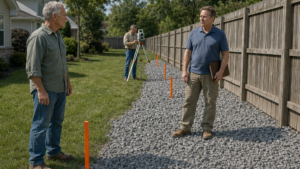
From my side of the fence, I marked the height of the camera relative to the top rail and measured the distance to the pool edge. Gary climbed the ladder and opened the camera app on his phone.
“I can see the rear garage approach,” he said.
“And my yard?”
“Part of it.”
“How much?”
He hesitated.
“Come here.”
I could not see his phone from my side.
So Gary took a screenshot, climbed down, walked around through the side gate, and handed it to me.
I had spent weeks imagining what the camera saw.
The real image was both better and worse than I expected.
The far edge captured Gary’s rear approach exactly as he claimed.
The center covered part of the space behind his garage.
But the right side of the frame held a wide triangle of my backyard.
The deep end of the pool.
Two lounge chairs.
A section of patio.
Enough that Amy had been right from the first afternoon.
Gary watched my face.
“It’s not centered on the pool.”
“No.”
I handed the phone back.
“But it doesn’t need to see any of that.”
He looked at the image himself.
For a moment, he stopped defending it.
That mattered more than if he had apologized.
I pointed toward his driveway.
“If you rotate it left, you lose some of this side.”
“And gain more driveway.”
“Yes.”
“That corner by the garage door becomes weaker.”
“Not if the other camera takes it.”
Gary looked toward the second fixture.
“That one’s angled for the alley.”
“So overlap them.”
He frowned.
“Too much overlap wastes coverage.”
“Some overlap is better than using my pool as empty space.”
He started to answer, then stopped.
The old argument had reached the point where neither of us could pretend it was still about whether the cameras were allowed to exist.
It was about what Gary was willing to give up.
And what I was.
I pointed toward my floodlights.
“I changed every sensor.”
“I noticed.”
“They stay that way.”
“You said that yesterday.”
“I’m saying it again because I want it clear. I’m not asking you to move the cameras and then planning to turn those things back up.”
Gary studied me.
“You could.”
“Yes.”
“So why wouldn’t you?”
Because Amy had stopped swimming after dark.
Because I had spent a week congratulating myself for creating the exact kind of discomfort I was accusing him of causing.
Because being able to do something had become too similar to believing I should.
I did not say all of that.
“Because the old settings were excessive.”
Gary looked away.
The word sat between us.
Excessive.
Not illegal.
Not forbidden.
Not criminal.
Just more than necessary.
It applied too easily to both sides of the fence.
Gary climbed the ladder again.
“Hold the rod where the deep end starts.”
I moved into position.
He loosened the camera mount.
The black housing shifted a few degrees.
The red indicator turned with it.
“Tell me when it clears the pool,” he said.
“You can see it better than I can.”
“I need the reference point.”
I raised the rod.
Gary checked his phone.
“Still catching the corner.”
He adjusted it again.
“How about now?”
“Show me.”
He sent another screenshot.
The pool was almost gone.
A narrow strip of water remained at the edge.
“You can take it farther.”
“I lose the side of the garage.”
“Check the other camera.”
Gary climbed down, moved the ladder, and opened the second camera’s feed.
For the next twenty minutes, we worked without arguing.
Not because the problem had become friendly.
Because measurements gave us less room to perform for each other.
Gary rotated the first camera toward his driveway.
Then he widened the second camera’s coverage slightly toward the garage approach.
The overlap was not perfect.
It did not have to be.
When he handed me the final screenshot, my pool was gone.
The frame caught his driveway, the back corner of his garage, the strip of access between the properties, and a small section of fence.
My fence.
Not my patio.
Not the water.
Not the chairs.
I looked up at the physical camera.
The red indicator no longer faced me.
Gary checked the image one more time.
“I still have the approach.”
“Yes.”
“And the driveway.”
“Yes.”
He looked annoyed by how little he had actually lost.
“That would’ve been useful information a month ago.”
I almost laughed.
“You mean before the certified letter?”
He gave me a flat look.
“Yes.”
I leaned the measuring rod against the fence.
“You could’ve checked then.”
“You could’ve asked without putting me on notice.”
“I did.”
“You asked once.”
“And you told me you’d review it.”
“I did review it.”
“You decided the wider angle was better.”
“It was.”
“For you.”
Gary looked toward the camera.
Then toward the pool.
“Yes.”
The admission came quietly.
No argument attached.
That was the deepest truth we were going to get from him.
Not that he had installed the cameras to watch us.
He had not.
Not that the security concerns were fake.
They were not.
He had simply known his convenience cost us privacy and decided his convenience mattered more because changing course after being challenged felt like losing.
I understood the impulse too well to enjoy exposing it.
“What about the second camera?” I asked.
Gary checked the feed.
It caught a sliver of patio near my side gate.
Not the pool, but more than necessary.
He sighed.
“Give me five minutes.”
The ladder moved again.
When both feeds were adjusted, Gary stood beside me on my side of the fence and looked toward his own garage.
“Happy?”
The old version of me would have corrected the word.
Satisfied, maybe.
Resolved.
Compliant.
Instead I said, “Yes.”
Gary nodded once.
“Good.”
He started gathering his tools.
I expected that to be the end of it.
Then he paused beside the gate.
“For what it’s worth, those break-ins really did have people worked up.”
“I know.”
“Residents were calling me every day. Asking what the board was doing. Asking why we didn’t have better security.”
“I know.”
“I probably overreacted.”
The sentence was so restrained it almost disappeared.
I did not force him to make it larger.
“So did I.”
He looked toward the floodlights.
“I hated those things.”
“I know.”
“Forty-seven times.”
“I know.”
“One of them went off because of a moth.”
“I know.”
That time he did smile.
Barely.
Then he left.
There was no handshake.
No apology at the gate.
No promise that we would become good neighbors again.
That would have felt false.
For the next two weeks, our interaction returned to something more ordinary.
Gary waved once while taking in his trash bins.
I nodded.
The HOA sent a short notice confirming the nuisance complaint remained dismissed.
Nothing else happened.
That was the point.
One evening after sunset, I heard the back door open.
Amy walked onto the patio in her swimsuit.
She stopped near the pool and looked toward the fence.
The nearest floodlight did not activate.
She took another step.
Still dark.
She looked back at me through the kitchen window.
I raised one hand.
She smiled and slipped into the water.
A few minutes later, I went outside.
The yard was dim except for the pool light under the surface.
Beyond the fence, I could see the edge of Gary’s garage roof.
One tiny red indicator glowed against the siding.
But it no longer looked at us.
It faced his driveway.
Amy floated onto her back.
“Better,” she said.
“Yeah.”
I sat on the edge of a patio chair.
For weeks I had thought privacy was something I could prove with angles, letters, statutes, and rules.
Those things mattered.
But the final measure had been simpler.
Could my daughter step into our own backyard without wondering what Gary could see?
Could Gary protect his property without making ours part of his system?
Could I secure my home without making discomfort the point?
The answers had never required one of us to lose everything.
Only enough pride to stop demanding everything.
Across the fence, the red light stayed pointed home.
The story has ended.