The HOA Covered His Property With Gravel—Then the Survey Stakes Exposed What the Board Had Never Approved
Chapter 1: The Morning Jack Found His Yard Buried
Jack Nelson knew something was wrong before he reached the back corner of his yard.
The grass was gone.
Not dead. Not torn up in patches. Gone beneath a wide gray tongue of crushed stone that ran along the wooden fence and curved several feet into ground Jack had mowed for nearly thirty years.
He stopped with one hand still wrapped around his coffee mug.
The gravel looked fresh enough to shine.
Jack set the mug on the porch rail and crossed the yard slowly. His knees complained when he crouched, but he ignored them. He pushed two fingers into the stone until they reached damp soil.
Three inches. Maybe four.
Someone had not spilled a load by mistake. Someone had spread it, graded it, and packed it down.
A tire track crossed what had been grass yesterday.
Jack stood and looked toward the neighboring property.
Dennis Scott was beside his detached garage, coiling an extension cord.
“Dennis.”
Dennis glanced over. “Morning.”
Jack pointed at the gravel. “You know anything about this?”
Dennis followed the gesture as if he had only just noticed it.
“Yeah. Grounds crew finished it yesterday.”
“Grounds crew.”
“Association contractor.”
Jack looked back at the gravel.
He had spent thirty-six years fitting pipe in mechanical rooms where a quarter inch mattered. He had learned early that when something looked wrong, the fastest way to make it worse was to start arguing before you knew exactly what had happened.
So he asked, “Why is association gravel in my yard?”
Dennis set the cord down.
“It’s not really your yard there.”
Jack looked at him.
Dennis walked over, stopping on the new stone.
“The fence is old,” he said. “Always has been crooked through here. This is basically the maintenance edge.”
“Basically.”
“You know what I mean.”
Jack did.
He also knew exactly how dangerous that phrase could become when attached to property.
The fence had been put in when Jack was young enough to work all day beside his father and still have energy after supper. His father had owned the place before Jack did, back when the subdivision behind it was still a combination of field, woods, and a handful of houses.
The line on the east side ran a little over two hundred feet. The fence had never been perfectly pretty, but Jack remembered carrying posts along it in the late eighties. He remembered his father checking measurements twice because, as he used to say, wood rotted but property lines did not.
Jack stepped onto the gravel.
“Where did the contractor get the line?”
Dennis shrugged. “We’ve been dealing with drainage back here for months. The committee approved improving access.”
“Which committee?”
“The grounds committee.”
“You chair that committee.”
Dennis’s mouth tightened slightly. “Yes.”
Jack nodded.
There had been signs before.
A trailer hitch left over the grass for an afternoon.
One of Dennis’s utility-trailer tires resting beyond the fence corner while he unloaded mulch.
A stack of landscape edging that sat on Jack’s side for nearly a week.
Each time Jack had noticed.
Each time he had decided it was not worth becoming the kind of neighbor who measured every inch and sent complaints to management.
Once, he had even heard himself say, “Leave it. He’ll move it.”
Dennis had moved those things.
Eventually.
Jack looked down now at hundreds of square feet of stone and understood what months of “leave it” had purchased.
Dennis kicked lightly at the gravel.
“This should actually help you. Water’s been sitting behind these lots after heavy rain.”
“That doesn’t make it yours.”
“I didn’t say it was mine.”
“You said it wasn’t really mine.”
Dennis exhaled through his nose. “I said the fence has never matched the usable line.”
Jack turned toward him fully.
“The usable line.”
“The maintenance strip.”
“Is there an easement?”
“There’s HOA maintenance authority.”
“That wasn’t my question.”
Dennis’s expression changed—not anger exactly, but impatience. The look of a man who believed the practical answer should end the conversation.
“Jack, nobody took your house. We added gravel to a strip nobody uses.”
“I used it yesterday. It was grass.”
“For what?”
Jack almost answered.
Then he stopped.
That was the trap. The usefulness of the land had nothing to do with ownership.
Instead he asked, “Did the board authorize work on my parcel?”
Dennis folded his arms.
“The drainage work was discussed.”
“That’s not the same thing.”
“You want to call Rachel, call Rachel.”
Rachel Moore managed the association through a property-management company. Jack had spoken to her perhaps four times in five years, usually about dues statements or tree trimming. She was competent, brisk, and very fond of sentences that began with According to policy.
Dennis picked up his extension cord again.
“I’m telling you, this isn’t some land grab.”
Jack looked at the gravel, then at the shallow impressions where the contractor’s tires had crossed his lawn.
“No,” he said. “It’s just gravel.”
Dennis seemed relieved by the answer.
Jack let him be.
He went back inside, washed the dust from his fingers, and stood for a moment in the kitchen with both hands on the counter.
He was angry now.
Not the hot kind.
The slower kind that embarrassed him because it came with memory.
He remembered the trailer tire. The edging. Dennis backing over the corner one afternoon and giving Jack a wave as if the wheel were sitting in a public alley.
Jack had waved back.
Peace, he had told himself.
He had been proud of not making a problem out of small things.
Now a truckload of gravel sat where the small things had been.
He walked into the spare bedroom, opened the bottom drawer of an old metal filing cabinet, and pulled folders forward one at a time.
Insurance.
Roof.
Tax records.
Refinance.
He stopped.
The refinance folder was thicker than the others. He opened it on the bed and found a folded plat tucked behind the closing documents.
At the bottom corner was the name of the surveying company and a date from several years earlier.
Jack unfolded the page carefully.
Thin black lines crossed the paper.
Distances.
Bearings.
Iron pins.
He leaned closer.
Then he reached for his phone.
Chapter 2: The Stakes Fell Inside the Gravel
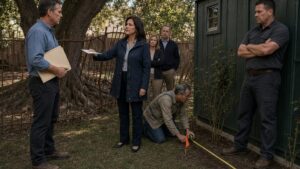
John Adams found the first iron pin beneath two inches of packed dirt and one edge of Dennis’s new gravel.
He scraped the soil away with a narrow hand tool, brushed the metal clean, and said nothing for several seconds.
Jack watched from a few feet away.
“Well?” he asked.
John glanced up.
“It’s where my record says it should be.”
That was all.
John had surveyed the property years earlier when Jack refinanced. He was lean, careful, and unhurried in a way Jack respected. He did not speak in conclusions until his equipment agreed with him.
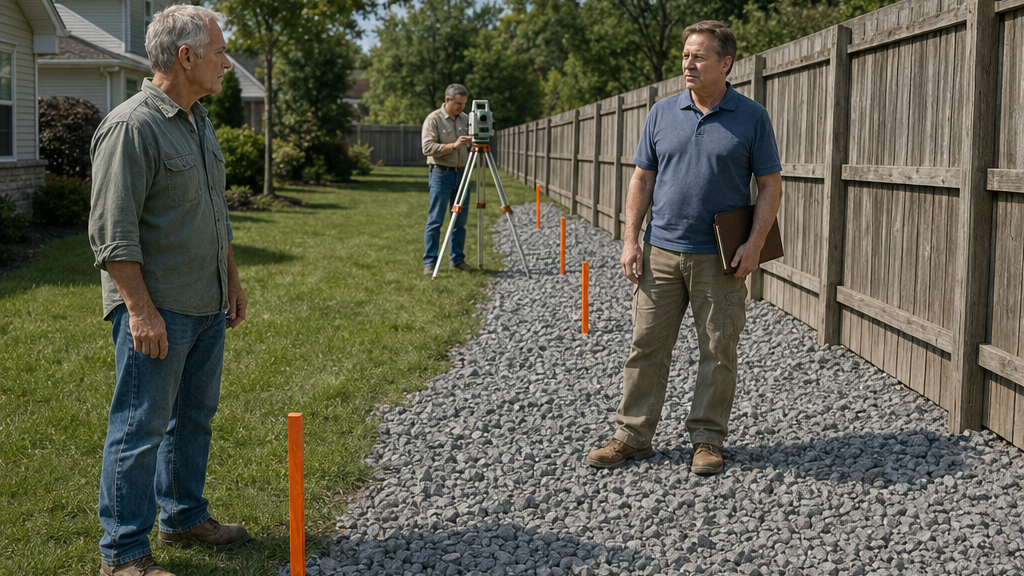
A tripod stood near the back of the lot. John’s assistant moved farther down the line with a prism pole, pausing whenever John called a measurement.
Jack kept his hands in his pockets.
He had been certain when he made the phone call.
Watching professionals measure the land somehow made him less certain.
Memory could be wrong.
Fences could drift.
Pins could be disturbed.
He had spent the morning telling himself that if the survey showed Dennis was right, he would accept it without excuses.
John checked the instrument again.
“Give me another ten minutes.”
Jack nodded.
The wooden fence cast a broken shadow over the gravel.
At the far end of the line, John’s assistant pushed a bright orange stake into the ground.
It landed in the gravel.
Not beside it.
Inside it.
Jack stared.
A second stake went in farther down.
Then a third.
The straight orange markers cut through the gray stone like warning lights.
By the time Dennis appeared, carrying a clipboard with an HOA logo clipped beneath a stack of papers, there were five stakes in the ground.
He slowed when he saw them.
“What’s all this?”
John did not answer. He was sighting through the instrument.
Jack said, “Survey.”
Dennis looked from Jack to the stakes.
“You already had one.”
“I did.”
“So why redo it?”
“Because you said the fence was wrong.”
Dennis stepped closer to the nearest marker.
“That stake can’t be right.”
John finally looked up.
“It’s not a property corner. It’s an offset stake marking the line.”
Dennis pointed toward the fence. “The fence is over there.”
“Yes.”
“So the fence is wrong.”
John’s expression did not change. “I’m not surveying the fence.”
Dennis frowned.
Jack almost smiled, but stopped himself.
John returned to the instrument.
A minute later he called another measurement. The assistant moved six inches and reset the pole.
Dennis turned to Jack.
“We need to be reasonable about this.”
“I’m waiting for him to finish.”
“You know why the work was done.”
“You said drainage.”
“Drainage and maintenance access.”
Jack nodded toward the clipboard. “Is that the work order?”
Dennis shifted it against his hip.
“It’s committee paperwork.”
Jack said nothing.
Dennis took that silence as an invitation.
“We’ve had standing water back here every heavy rain. Contractor complained he couldn’t get equipment through without tearing up the edge. We talked about stabilizing this strip months ago.”
“Who’s we?”
“Grounds.”
“And the board?”
Dennis’s jaw tightened.
“The board knows about the drainage issue.”
John lifted one hand.
“Jack.”
They walked toward him.
John showed Jack the field notes, then pointed along the line of orange stakes.
“Your deed description and the monuments are consistent. Based on what I’m finding today, this is the same boundary we established on the prior survey.”
Jack looked toward the gravel.
“How far over?”
“It varies.”
“At the widest point?”
John measured with his eyes before checking his notes.
“A little more than six feet.”
Dennis gave a short laugh.
“That doesn’t make sense.”
John turned toward him.
“I can give you a copy of the marked plat when I finish. Beyond that, I’m not here to settle a dispute.”
“I’m not disputing your license,” Dennis said. “I’m saying there’s an HOA maintenance area back here.”
“That’s a separate question.”
The words landed harder than if John had accused him of anything.
Jack saw Dennis’s eyes move along the stakes again.
For the first time that day, Dennis looked less certain than annoyed.
John worked another forty minutes.
When he finished, the line was impossible to miss.
Orange flags ran through the gravel from near the fence corner toward the rear of Jack’s lot. On one side: Dennis’s improved access strip. On the other: several feet of the same crushed stone lying plainly within Jack’s property.
Jack stood beside the nearest marker.
All morning he had imagined this moment as satisfying.
Instead he felt tired.
The survey proved the line.
It did not explain why an HOA contractor had crossed it.
Dennis remained near the fence, flipping through the papers on his clipboard.
Finally Jack asked, “Did the board authorize work on this side of those stakes?”
Dennis did not look up.
“The board authorized us to address drainage.”
“That isn’t what I asked.”
“The contractor followed the maintenance edge we’ve been using.”
“Who told him that was the maintenance edge?”
Dennis looked at him then.
“I did.”
There it was.
A complete answer, but not yet a complete explanation.
Jack looked at the stakes.
“Based on what?”
Dennis tapped the papers.
“Based on how this area has been maintained. Based on access. Based on the fence being where it is.”
“The fence you said was wrong.”
Dennis’s face hardened.
“You’re trying to make this sound worse than it is.”
“I’m trying to figure out who had permission to put stone on my land.”
“We had a drainage problem.”
“That can be true and this can still be my property.”
For several seconds neither man spoke.
John began packing his equipment.
Dennis finally said, “Call Rachel.”
Jack did.
Rachel answered on the fourth ring.
He explained the situation without mentioning Dennis’s tone or the months of smaller intrusions. He gave her his lot number, the date of the prior survey, and told her a licensed surveyor was standing on the property now.
Rachel went quiet.
“I’m not in front of the file,” she said. “I know there was discussion about rear drainage.”
“Was work approved on my parcel?”
“I need to check the minutes and the work order.”
Dennis was close enough to hear.
He stared toward his garage.
Jack said, “When can you tell me?”
“Monday morning.”
“That’s two days.”
“The office is closed.”
“Rachel, there’s four inches of gravel on my land.”
“I understand.”
“Do you?”
Another pause.
“I’ll pull the records.”
Jack thanked her and hung up.
Dennis said, “There. She’ll straighten it out.”
Jack looked at the orange stakes.
“Maybe.”
On Monday at 8:17 a.m., Rachel called.
Jack was already dressed and sitting at the kitchen table with the marked survey beside him.
Her voice had lost some of its usual certainty.
“I found the contractor work order,” she said.
Jack waited.
“It references drainage stabilization behind the east-side lots.”
“And my parcel?”
“It doesn’t identify your parcel.”
“Does it authorize work across my boundary?”
Rachel took a breath.
“I cannot find a board vote that does.”
Chapter 3: The Approval Nobody Could Produce
“The problem,” Rachel Moore said, “is that this still may be partly a neighbor-to-neighbor boundary matter.”
Jack placed three photographs on the conference table.
In each one, the bright orange survey stakes cut visibly through the bed of gray gravel.
“The HOA hired the contractor.”
Rachel looked at the photographs without touching them.
“We did.”
“Dennis gave him the line.”
“That appears to be what happened.”
“Dennis chairs your grounds committee.”
“Yes.”
Jack leaned back.
“Which part is neighbor-to-neighbor?”
Rachel’s lips pressed together.
The management office occupied two rooms beside the subdivision clubhouse. Through the wall came the muffled thump of someone moving folding tables. A printer hummed behind Rachel’s desk.
Jack had brought copies, not originals.
The survey.
The old recorded plat.
The photographs.
A single page on which he had written the dates he remembered Dennis leaving equipment across the corner.
Six months ago: trailer tire.
Four months ago: landscape edging.
Three weeks ago: utility trailer tongue.
He had nearly left that page at home.
Reading it in the parking lot had made him uncomfortable.
It looked less like a record of Dennis’s behavior than a record of Jack’s refusal to address it.
Rachel opened the contractor work order.
“Here.”
She rotated it toward him.
The description referred to stabilizing an HOA-maintained rear access and correcting soft conditions near the drainage swale.
No parcel number.
No dimensions.
No survey reference.
No written permission from Jack.
“Who approved payment?” he asked.
“The grounds committee could authorize maintenance below a certain dollar threshold.”
“Could it authorize work on private property?”
“No.”
The answer was immediate.
Jack waited.
Rachel added, “Not without an easement or homeowner authorization.”
“Do I have an easement there?”
“I’m still checking.”
Jack tapped the recorded plat.
“My surveyor says there’s no maintenance easement shown where the gravel crosses.”
“I see that.”
Rachel’s tone made clear she did not enjoy saying it.
The door opened.
Samantha Wilson entered carrying a folder and a travel mug.
Rachel had asked the board treasurer to join them because the drainage work had come from association maintenance funds.
Samantha sat beside Rachel.
“I’ve looked at the invoices,” she said. “Dennis didn’t pay the contractor personally, if that’s what you’re asking.”
“I wasn’t.”
“He did have authority to call out maintenance.”
“On HOA property.”
Samantha nodded slowly. “Yes.”
Jack slid one photograph toward her.
“Those stakes are the boundary.”
She studied it.
“I saw them yesterday.”
Jack noticed that she did not say Dennis was right.
Rachel opened another folder.
“These are grounds committee notes from the last six months.”
The notes were informal—dates, maintenance items, estimates. Jack scanned the page Rachel indicated.
Rear drainage.
Standing water.
Access complaints.
Temporary stabilization.
Nothing about Jack’s lot.
Nothing about moving a boundary.
Nothing about acquiring permission.
“Temporary stabilization,” Jack said.
Samantha rubbed one thumb along the edge of her mug.
“That’s how it started.”
Jack looked at her.
She hesitated.
“We’ve had complaints after storms. Water sits behind Dennis’s property and then tracks toward the next lot. Landscaping crew got stuck once in the spring.”
“So there is a drainage problem.”
“Yes.”
The answer disappointed him in a way he had not expected.
Some part of him had wanted the entire thing to be false.
A made-up emergency.
A neighbor inventing HOA language for convenience.
That would have been cleaner.
Samantha continued.
“We had an estimate for a more permanent correction last year. It wasn’t cheap.”
“How much?”
Rachel glanced at her.
Samantha said, “Enough that we postponed it.”
Jack understood.
Association reserves had already been discussed at the annual meeting. Roof work at the clubhouse. Fence replacement near the entrance. Rising insurance premiums.
A cheap fix would have been attractive.
Jack looked again at the work order.
“So somebody decided gravel was easier.”
Samantha said, “Dennis said he could get the rear edge stabilized for a fraction of the earlier estimate.”
“Did he tell you it would cross my property?”
“No.”
“Did you ask?”
Silence.
Samantha set down the mug.
“No.”
It was the first answer that sounded less defensive than ashamed.
Rachel said, “We need to separate the issues. Ownership is one question. Drainage is another.”
Jack looked at her.
“That’s what I’ve been saying.”
“I know.”
“No. Yesterday it was a neighbor dispute.”
Rachel accepted that without arguing.
Jack gathered the photographs into a neat stack.
“I want the gravel removed.”
Samantha exchanged a glance with Rachel.
“What?” Jack asked.
Samantha spoke carefully.
“If it all comes out before we understand the drainage path, we may put the lower lot back in the same situation it was in—or worse.”
Jack felt his shoulders tighten.
“It’s my land.”
“Yes.”
“So leaving somebody else’s material on it is the solution?”
“No. I’m saying we need to know what happens when it’s removed.”
Jack stood.
For two days he had been waiting for proof because he believed proof would simplify everything.
Now the line was proved.
The HOA had no visible authorization.
And still the gravel might not be as simple as scooping it out.
Rachel said, “I can contact the county stormwater office.”
“Do it today.”
“I will.”
“And send me the work order and committee notes.”
“I can send the relevant records.”
“Send whatever governs the decision.”
Rachel gave him a brief look, then nodded.
Jack left with less satisfaction than he had expected.
At home, he walked to the rear corner again.
The orange flags moved lightly in the breeze.
They had looked like victory markers on Saturday.
Now they looked more like a diagram of the problem.
On one side was what belonged to him.
On the other was what somebody had been trying, badly, to fix.
Dennis came outside but did not approach.
Jack did not wave.
That bothered him.
Not because Dennis deserved friendliness, but because Jack recognized the pattern.
Silence again.
He had spent months using silence to avoid conflict. Now he was using it because conflict had finally arrived.
His phone rang shortly after noon.
Rachel.
“The county inspector can come Wednesday morning,” she said.
“That fast?”
“I sent the photographs.”
“And?”
“He wants to see the grading in person.”
Jack looked toward the gravel.
“Why?”
Rachel paused.
“Because from the pictures, he thinks the contractor may have changed more than the access surface.”
Jack said nothing.
Rachel continued.
“He wants to trace where the runoff was going before the gravel and where it’s being sent now.”
Jack looked past the orange stakes toward the shallow swale behind Dennis’s property.
For the first time, the gravel did not look merely like something laid in the wrong place.
It looked like something that might have moved the problem somewhere else.
“When Wednesday?”
“Nine.”
Jack ended the call and stared at the bright line of stakes.
The survey had answered who owned the ground.
On Wednesday, they were going to find out what Dennis had done to the water.
Chapter 4: The Drainage Problem Was Real
The county stormwater inspector drove a narrow steel probe through the new gravel and stopped when it struck compacted soil beneath.
He pulled it out, moved three feet toward Jack’s yard, and repeated the test.
Then he followed the orange survey stakes with his eyes.
“This grade change crosses the property line,” he said.
Dennis Scott stood with both hands on his hips. “The gravel follows the maintenance route.”
The inspector pointed to the nearest stake.
“That may be the route you’ve been using. It isn’t the same thing as the property line.”
Jack said nothing.
He had already learned that silence could mean too many things. This morning he was using it deliberately. He wanted to hear what Dennis said when the explanations had to survive questions from somebody with no history in the neighborhood.
Rachel Moore had arrived ten minutes earlier with copies of the contractor work order. Samantha Wilson stood beside her holding a folder against her chest.
The inspector walked toward the shallow swale behind Dennis’s lot.
“Show me where the water was sitting before the work.”
Dennis followed him.
“Back here. After heavy rain, it would pool along this low section. Landscapers couldn’t get through without rutting it.”
The inspector crouched near a patch of flattened weeds.
“And where did it drain?”
Dennis pointed downhill.
“Toward the common swale.”
“Eventually.”
Dennis frowned. “Yes.”
The inspector stood.
“Eventually is doing some work in that sentence.”
Jack almost smiled.
They moved farther along the rear lots. The ground dropped slightly toward another homeowner’s fence. Even in dry weather, the soil there held darker patches.
The inspector indicated a shallow depression.
“This area has been carrying water for a while.”
Samantha spoke for the first time.
“That’s what we were trying to fix.”
The inspector looked at her.
“You’re with the board?”
“Treasurer.”
“And the association authorized this design?”
Samantha glanced toward Rachel.
Rachel answered.
“The association authorized maintenance to address access and drainage. We did not approve a design crossing Mr. Nelson’s parcel.”
Dennis shifted his weight.
“It wasn’t supposed to be a major drainage project. It was stabilization.”
The inspector walked back to the gravel, studying the edge.
“Stabilization changes runoff too.”
He pointed with the probe.
“You’ve raised this section and made it less permeable than the grass that was here before. That can move water laterally.”
Dennis said, “We put gravel down, not concrete.”
“Compacted stone still changes how water behaves.”
He traced a line from the gravel toward the lower lot.
“If this edge sheds runoff instead of absorbing some of it, more water could reach that fence during a hard storm.”
Jack looked toward the neighboring yard.
That was not what he wanted to hear.
He wanted the gravel to be wrong in every possible way.
Wrong property.
Wrong approval.
Wrong purpose.
Wrong result.
Instead the inspector continued walking and said, “But you do have a real drainage issue here.”
Dennis looked at Jack quickly.
Not triumphantly.
More like a man who had been holding his breath.
The inspector pressed the probe into the swale again.
“This low section is poorly defined. Water’s spreading before it reaches the common drainage path. That explains the standing water and the soft access.”
Samantha lowered her folder.
“So Dennis wasn’t wrong about the problem.”
“No.”
The inspector looked back toward the gravel.
“The question is whether this was an acceptable solution.”
Jack folded his arms.
“And?”
“I wouldn’t leave it as-is.”
Dennis rubbed his jaw.
“Because of the property line?”
“Because of both issues.”
The inspector explained that simply scooping away everything that afternoon could also create trouble. The contractor had altered the surface enough that restoring the old grade without planning might send water back into the same low area—or toward the lower property.
Jack stared at the orange stakes.
Two days earlier they had looked like a clean answer.
Now they separated one problem from another without solving either.
The inspector took photographs and measurements, then asked Rachel for whatever plans the HOA had for the original drainage easement.
“I’ll send them,” she said.
When he left, nobody moved immediately.
Dennis broke the silence.
“There. That’s what I’ve been saying.”
Jack turned toward him.
“No. You’ve been saying the gravel belongs where you put it.”
“I’ve been saying there was a reason.”
“That’s different.”
Dennis opened his mouth, then closed it.
Samantha walked toward the gravel.
“I should say something.”
Jack waited.
She looked uncomfortable in a way he had not seen at the management office.
“When the first drainage estimate came in last year, it was more than we wanted to spend.”
“How much more?”
“Several times more than this.”
Dennis looked away.
Samantha continued.
“We were already watching reserves. The clubhouse roof had been patched twice. Insurance went up again. People complain when dues increase.”
Jack said, “People also complain when you use their property.”
“I know.”
There was no defensiveness in her voice.
That made the admission harder to dismiss.
She looked toward Dennis.
“He told us he thought he could find a temporary fix.”
Dennis said, “I said I could stabilize the area.”
Samantha nodded.
“And I told him to find something cheaper.”
Jack looked at her.
“Did you ask where?”
“No.”
“Did you ask whether he needed permission?”
“No.”
Rachel said quietly, “The committee should have documented the scope.”
Samantha gave a short, humorless laugh.
“That’s the polite version.”
Jack looked from one to the other.
For the first time he could see how the mistake had been built.
Not by a secret meeting.
Not by a board deciding to take his land.
By small conveniences.
A maintenance complaint nobody wanted to fund properly.
A committee chair confident he understood the property.
A treasurer relieved by a cheap solution.
A manager assuming routine work would stay inside routine boundaries.
Jack recognized the pattern because his part in it looked uncomfortably familiar.
One more thing not worth making difficult.
Then another.
By noon, the inspector had emailed Rachel a preliminary note recommending that no additional material be added and that the association obtain a proper drainage plan before altering the surface again.
Rachel forwarded it to Jack.
He read it twice.
The survey was still on his side.
The HOA records were still on his side.
But removing every stone immediately, without correcting the grade, could create a new problem for someone who had nothing to do with the dispute.
That evening Jack stood near the stakes with a garden rake in his hand and did nothing with it.
He had brought it out almost automatically.
The simplest thing would have been to drag gravel back over the line himself.
Instead he leaned the rake against the fence.
Dennis appeared from behind his garage.
For once he did not carry a clipboard.
He stopped several feet away.
“I talked to the inspector.”
Jack waited.
Dennis looked at the strip of gravel between his driveway approach and the stakes.
“There might be a way to leave some of this without causing trouble.”
“On your side?”
“Mostly.”
Jack heard the word.
“Mostly.”
Dennis exhaled.
“I need about three feet through that corner.”
Jack stared at him.
“For drainage?”
Dennis hesitated.
“No.”
The answer came too slowly to be clean.
Jack looked toward Dennis’s utility trailer beside the garage.
Dennis followed his gaze.
Then he said, “It would make backing that trailer a lot easier.”
Chapter 5: The Shortcut Had Two Purposes
“Just three feet,” Dennis said.
Jack looked at the bright orange stake standing between them.
The survey had settled the line to the inch, and Dennis was asking for three feet as if the last week had been a negotiation over convenience.
“You’re asking me to leave your gravel on my property.”
“I’m asking whether we can work something out.”
“For the trailer.”
Dennis glanced toward his garage.
“For the trailer and access.”
“Now we’re back to access.”
Dennis’s mouth tightened.
Jack stepped off the gravel and onto the remaining grass.
“How long has that been part of this?”
“What?”
“The trailer.”
Dennis kicked a loose stone.
“I’m not saying that’s why the drainage work happened.”
“That wasn’t the question.”
Dennis looked at him.
Jack waited.
Finally Dennis said, “It made sense to solve both problems.”
There it was.
Not a confession dramatic enough for anybody else to care about.
Just a sentence that rearranged the whole dispute.
The drainage problem was real.
So was Dennis’s personal benefit.
Jack folded his arms.
“Did you tell Samantha that?”
“No.”
“Rachel?”
“No.”
“The contractor?”
Dennis hesitated.
“I told him where I wanted the edge.”
Jack felt anger rise again, but this time it carried something else with it.
Clarity.
Dennis had not accidentally benefited from the project.
He had drawn the benefit into the project himself.
“Why there?”
“Because there’s room.”
“There’s room because it’s my yard.”
Dennis shook his head.
“You never used that corner.”
Jack stared at him.
Dennis seemed to realize what he had said.
He tried again.
“I mean, you never seemed bothered by us being over there before.”
“Us.”
“My trailer. The tires sometimes. When I was unloading stuff.”
Jack said nothing.
Dennis continued.
“You saw it.”
“Yes.”
“You never said anything.”
Jack looked at the gravel.
For six months he had kept a mental list of every intrusion.
Now Dennis was giving him the other version of that same list.
Not evidence of escalating disrespect.
Evidence of tolerated behavior.
Jack remembered one afternoon in particular. Dennis had backed the utility trailer too far, leaving one wheel deep in Jack’s grass while he unloaded bags of mulch.
Dennis had called over, “I’ll be out of your way in ten.”
Jack had raised one hand and said, “You’re fine.”
He had meant ten minutes.
Dennis had apparently heard something broader.
Jack rubbed one palm against the side of his jeans.
“That doesn’t give you the property.”
“I know that now.”
“You knew enough to ask if you wanted three feet.”
Dennis looked away.
“That’s fair.”
Jack almost rejected the answer because it came without resistance.
Instead he said, “Why didn’t you?”
Dennis was quiet for a while.
Then he sat on the edge of the trailer tongue.
“Because I figured you’d say no.”
Jack gave a short laugh.
“So you skipped the part where I got to decide.”
“I thought the HOA work made the point kind of irrelevant.”
“Because the drainage was real.”
“Yes.”
“And because you wanted the space.”
Dennis nodded once.
The honesty did not make the decision better.
It made Dennis more understandable, which was somehow more irritating.
Jack looked at the nearest stake.
“When you said the fence never looked right, did you actually believe that?”
Dennis leaned forward, elbows on his knees.
“I believed the used line was the practical line.”
“That’s not an answer.”
“It’s the best one I’ve got.”
Jack waited.
Dennis sighed.
“I knew the fence probably wasn’t the deed line exactly. I didn’t know how far off. I thought the association had been maintaining that strip long enough that it was basically settled.”
“Basically.”
“I know.”
Jack studied him.
Dennis no longer sounded like the committee chair. He sounded like a homeowner who had made a series of assumptions because every assumption made the next one easier.
Jack understood that too well.
He walked toward the stake where a single trailer tire sat just beyond the marker on Dennis’s side.
Months ago, a tire like that would have irritated him for an hour and then disappeared from his mind.
Now it looked like the beginning of the whole argument.
“You thought I didn’t care,” Jack said.
Dennis answered carefully.
“I thought if you cared, you’d say something.”
Jack looked at him.
He wanted to tell Dennis that decent neighbors should not require formal objections before respecting boundaries.
That was true.
It was also incomplete.
Jack had spent years treating directness like aggression.
At work, he had corrected apprentices immediately when a fitting was wrong because bad pipe did not improve if everybody stayed polite.
At home, somehow, he had convinced himself that good neighbors absorbed irritation.
He thought of the handwritten list he had brought to Rachel.
Six months of evidence.
Six months of silence.
“I should’ve told you the first time,” Jack said.
Dennis looked surprised.
Jack held up one hand.
“That does not make this my fault.”
“I didn’t say it did.”
“No. I’m saying it because I’m not going to let you.”
Dennis nodded.
Jack continued.
“I should’ve told you when the trailer crossed. I should’ve told you when you stacked things over here. I didn’t.”
Dennis looked down.
“But you should have asked before you buried my property.”
“I know.”
The words came quietly.
Jack had imagined hearing them all week.
They did not feel like victory.
They felt useful.
Dennis looked at the gravel.
“So what now?”
Jack had already spoken briefly with Rachel about his options.
The HOA attorney could send notices.
Jack could file an encroachment claim.
He could insist on immediate restoration and let the association deal with any drainage consequences separately.
Every one of those choices was available.
What he wanted now was not the most painful outcome for Dennis.
He wanted a result that could not be misunderstood.
“All of it comes out,” Jack said.
Dennis looked up sharply.
“Jack—”
“All of it that crosses the line.”
“The inspector said—”
“I heard him. I’m not saying tomorrow.”
Dennis stopped.
Jack pointed toward the survey stakes.
“You remove everything on this side. Restore my grade according to whatever plan the county accepts. Then if the HOA wants drainage work, access, gravel, anything else, it gets designed inside the easement and approved on paper.”
Dennis stood.
“You’d make us remove it just to possibly put gravel back somewhere else?”
“Yes.”
“That’s wasted money.”
“No.”
Jack looked directly at him.
“What happened here is what wasted the money.”
Dennis’s face tightened.
Jack expected an argument.
Instead Dennis looked along the orange stakes for a long time.
“You’re not leaving me the three feet.”
“No.”
Dennis nodded once.
“All right.”
Jack started toward the house, then stopped.
“One more thing.”
Dennis waited.
“The survey cost me four hundred seventy-five dollars.”
Dennis looked tired now.
“You want me to pay it.”
“I want whoever created the need for it to pay it.”
“The HOA hired the contractor.”
“You gave him the line.”
Dennis said nothing.
Jack went inside.
That evening he wrote a short proposal and sent it to Rachel and Samantha.
Full removal from Jack’s parcel.
Professional restoration of grade.
Reimbursement of the survey.
No replacement work until the drainage design was approved and confined to authorized easements.
No verbal boundary assumptions.
No “maintenance edge.”
No “usable line.”
The next morning Rachel replied that the board would review it with counsel.
Two hours later Dennis sent Jack a single text.
You really want them to tear all of it out first?
Jack read the question, set the phone down, and waited five minutes before answering.
Yes.
Then he added:
After that, build whatever is actually approved.
Chapter 6: Fourteen Days to Put It Back
Jack handed Rachel the letter across the conference table with the survey invoice clipped to the back.
“Fourteen days,” he said.
Rachel read the first paragraph.
Dennis sat two chairs away, arms folded.
Samantha Wilson had a calculator beside her notebook. The HOA attorney joined by speakerphone from Rachel’s laptop.
The letter was not dramatic.
Jack had rewritten it three times to remove anything that sounded like anger.
It identified the encroachment.
Referenced the recorded survey.
Requested removal of the gravel from his parcel.
Required restoration of the original grade consistent with the county’s drainage guidance.
And requested reimbursement of the four hundred seventy-five dollars he had paid to reestablish a boundary the association contractor should never have crossed.
Dennis tapped one finger on the table.
“Fourteen days is tight if we’re waiting on a drainage plan.”
Jack nodded.
“The gravel doesn’t have to disappear tonight. The correction has to be scheduled and underway.”
The attorney’s voice came through the laptop speaker.
“That distinction helps.”
Dennis looked at the computer.
“Can we talk about whether the grounds committee had authority here?”
“We can,” the attorney said.
For the first time all morning, Dennis seemed almost relieved.
Then the attorney continued.
“The committee had authority to approve routine maintenance within existing common areas and recorded easements. I have not found authority for the committee to expand those areas onto privately owned property.”
Dennis leaned back.
“The drainage work was discussed by the board.”
“That does not create an easement.”
Samantha looked down at her notebook.
The attorney said, “It also does not convert informal field assumptions into a legal boundary.”
Jack did not look at Dennis.
He watched the orange flags through the meeting-room window.
Two of them were visible in the distance behind the clubhouse, bright against the gray gravel.
Rachel turned to Samantha.
“Can you walk us through the replacement estimate?”
Samantha opened her folder.
The new proposal had arrived the previous afternoon.
Unlike Dennis’s improvised fix, it did not rely on widening the rear access into Jack’s yard. The contractor would reshape the existing common swale, install a short section of drainage pipe at the lowest point, and stabilize the HOA access inside the recorded maintenance easement.
It solved the standing-water problem.
It also cost considerably more.
Samantha read the number.
Dennis whistled softly.
Jack did not react.
Samantha said, “The reserve can handle it.”
“But?” Rachel asked.
“But it means postponing the decorative fence replacement at the entrance.”
Dennis shook his head.
“People are going to lose their minds over that fence.”
Samantha closed the folder.
“They can look at the old fence another year.”
Dennis gave her a surprised glance.
She met it.
“We tried cheap.”
Nobody answered.
Jack had expected the board’s finances to feel distant from him.
Instead the number made the mistake more understandable again.
Every association meeting he had ever attended contained someone demanding lower dues and someone else demanding faster repairs. Boards learned quickly that invisible drainage work earned less gratitude than visible improvements.
Still, Jack thought, a tight budget did not move a property line.
Rachel placed the new plan beside Jack’s photographs.
The contrast was almost embarrassing.
One contained measurements, easement boundaries, elevations, and drainage arrows.
The other showed gray stone running casually across orange stakes.
“This is what should have existed before work started,” Rachel said.
Dennis rubbed the bridge of his nose.
“Yes.”
Jack looked at him.
The answer was not offered to Jack. That mattered.
Dennis was no longer trying only to win the argument between them. He was admitting the process had failed.
Rachel turned back to the letter.
“I think we can meet fourteen days if the board authorizes the corrective work tonight.”
Dennis said, “You mean authorize removal.”
“And restoration.”
“And then spend again to rebuild the access.”
Samantha said, “Inside the easement.”
Dennis pushed his chair back slightly.
“Everybody keeps saying that like I don’t understand it.”
Jack spoke before he could stop himself.
“You understand it now.”
Dennis looked at him.
The room went still.
Jack regretted the line almost immediately.
It was true, but it was also the kind of truth that did nothing except sharpen somebody else’s embarrassment.
Dennis’s face hardened.
“Yeah,” he said. “I do.”
Jack looked down at his letter.
There it was again.
The temptation to turn being right into permission to press harder.
He had spent the first half of the dispute avoiding necessary words.
Now he had to learn not to overuse them simply because he finally had proof.
The attorney cleared his throat through the speaker.
“There is one more question. Reimbursement.”
Dennis said, “I’ll pay the survey.”
Samantha turned toward him.
“The association contractor created the encroachment.”
“I gave the contractor the line.”
Rachel said, “Dennis—”
“He wouldn’t have put gravel there if I hadn’t told him that was the maintenance edge.”
Jack studied him.
Dennis kept his eyes on the table.
“I’ll pay the four seventy-five.”
The attorney said, “We can document that separately from the association’s corrective work.”
Jack nodded.
“Fine.”
The meeting moved on to the drainage proposal.
Samantha recommended approving it despite the cost. Rachel recommended a new rule requiring recorded easement verification before any contractor changed grading or surface material within five feet of a private boundary.
Dennis objected to the five-foot threshold at first, calling it cumbersome.
Then he looked through the window toward the orange stakes.
“Make it ten,” he said.
Samantha almost smiled.
The board approved the drainage correction that evening.
There was no applause.
Nobody made a speech.
One homeowner complained about delaying the entrance fence.
Another asked whether the new drainage expense would raise dues.
Rachel answered both questions, then moved to the next agenda item.
Jack preferred it that way.
The dispute did not need an audience to become real.
Over the following week, contractors came twice to measure the common swale. A utility-marking crew painted small flags near the easement. Rachel emailed Jack a restoration plan showing exactly where his property would be regraded after the encroaching gravel was removed.
Jack printed it and walked the boundary himself.
The orange survey stakes remained.
He no longer saw them as accusations.
They were reference points now.
A language everyone had finally agreed to use.
On the tenth day, nothing had been removed.
On the eleventh, Dennis’s trailer remained parked beside the garage, carefully inside his own side.
On the twelfth, Jack saw Dennis measuring the space between the driveway and the survey line.
Dennis noticed him watching.
“It’s tight.”
Jack said, “I know.”
That was all.
On the morning of the thirteenth day, Jack woke to the low mechanical growl of a diesel engine.
He went to the back window.
A compact skid-steer sat in Dennis’s driveway.
The bucket was lowered.
Fresh scrape marks showed where it had been unloaded from a trailer.
Dennis stood beside it talking to the operator.
For several seconds Jack could not tell whether the machine had come to pull the gravel back—or push the disputed strip into something more permanent.
Chapter 7: The Line They Could Finally See
Dennis lowered the skid-steer bucket into the same gravel that had started the whole argument.
The steel edge scraped across the compacted stone with a harsh grinding sound, curled underneath it, and lifted a gray load clear of Jack’s property.
Jack stood ten feet away beside the first orange survey stake.
He had expected to feel something larger.
Triumph, maybe.
Instead he watched the machine reverse carefully across Dennis’s side of the line and dump the gravel into a temporary pile.
Dennis was driving.
There was no contractor in the cab.
Jack had seen him beside the machine earlier and assumed he was giving instructions to someone else. But Dennis had climbed in himself, adjusted the seat, and started removing the material one bucket at a time.
The nearest orange flag bent in the wash of air from the engine.
Dennis stopped.
He leaned out of the cab.
“That one in the way?”
“No.”
“I don’t want to hit it.”
Jack almost said, You should’ve worried about that before.
The sentence rose easily.
He let it go.
“Stay on your side of it and you’re fine.”
Dennis nodded and continued.
The distinction was almost absurdly simple now.
One side.
The other.
For weeks they had spoken about maintenance edges, usable lines, fence positions, access, drainage, committee authority, and practical solutions.
The machine did not care about any of that.
Its bucket either crossed the orange stakes or it did not.
By midmorning, a dark strip of soil appeared where the gravel had been lifted away. The grass underneath was ruined, and portions of the grade had been flattened by the original compaction.
Rachel arrived with the restoration contractor shortly before eleven.
The contractor carried the approved grading plan and checked elevations before directing where soil would be added.
Jack walked the boundary with him.
“Nothing crosses the stakes?” Jack asked.
“Nothing.”
The answer came without hesitation.
Jack looked toward Dennis.
Dennis heard it too.
Neither man commented.
The restoration took most of the day.
Gravel was pulled back.
Compacted areas were loosened.
Topsoil was placed where the lawn had been buried.
The shallow transition near the swale was reshaped according to the county recommendation so removing Dennis’s shortcut would not simply force water downhill toward the next homeowner.
Jack watched that part closely.
Several weeks earlier, he would have cared only that his ground was returned exactly as it had been.
Now he understood that exactly as it had been was part of the neighborhood’s drainage problem.
The lawful solution did not require surrendering his property.
It did require acknowledging that his property existed inside a larger landscape.
Late in the afternoon Dennis shut down the skid-steer.
The sudden quiet seemed louder than the engine.
He climbed out stiffly and wiped dust from his forearms.
“Your side’s clear.”
Jack walked the line.
A few scattered stones remained in the dirt. The restoration contractor was raking them out by hand.
Jack looked at the first orange stake, then the second.
The gravel stopped behind them.
Not approximately.
Not practically.
Behind them.
“Looks right,” he said.
Dennis leaned against the machine.
“Should’ve looked right the first time.”
Jack glanced at him.
Dennis stared at the ground.
It was the closest thing to an apology Jack had heard from him.
He decided not to force it into a better one.
Two days later, Dennis knocked on Jack’s front door.
Jack opened it to find him holding an envelope.
“No clipboard?” Jack asked.
Dennis gave a brief smile.
“No clipboard.”
He handed the envelope over.
Inside was a check for four hundred seventy-five dollars.
Jack looked at the amount.
No deduction.
No argument about sharing the cost.
No note attached explaining why someone else might technically be responsible.
“You didn’t have to bring it over.”
“I figured mailing it twelve feet would be stupid.”
Jack looked up.
Dennis was staring toward the street.
Not quite meeting his eyes.
For a moment Jack remembered how badly he had wanted this exact scene when the dispute began.
Dennis paying.
Dennis forced to acknowledge he had been wrong.
Jack had imagined it feeling like a verdict.
Instead it felt smaller and more human.
Useful, like the words Dennis had finally said beside the trailer.
Jack folded the check once.
“Thank you.”
Dennis nodded.
“The drainage crew starts next week.”
“I heard.”
“They’re keeping everything inside the easement.”
“I heard that too.”
Dennis finally looked at him.
“Rachel made sure everybody heard it.”
Jack smiled despite himself.
“She’s good at that.”
Dennis stepped backward from the porch.
Then stopped.
“The trailer still fits.”
Jack raised an eyebrow.
“Barely.”
“Barely counts.”
Jack thought about the old version of himself, the man who would have heard that as a challenge and said nothing until it became resentment.
So he answered.
“Keep the tires on your side.”
Dennis nodded.
“I will.”
The drainage work began the following Monday.
This time there were plans.
Utility marks.
Measured easements.
A board-approved scope.
The crew reshaped the common swale and installed the short drainage section through the existing maintenance area. The equipment remained inside the recorded boundaries even when doing so meant backing out and approaching from a less convenient angle.
Jack noticed.
So did Dennis.
At the next association meeting, Rachel presented a proposed contractor rule.
Any grading, excavation, surface change, or access work near a private lot boundary would require verification of the recorded easement before work began. Projects within ten feet of a disputed or unclear line would require a survey reference or written homeowner authorization.
Jack sat in the back.
He had not planned to speak.
Dennis sat closer to the front with the grounds committee materials.
One board member questioned whether the ten-foot requirement was excessive.
“It could slow routine work,” the board member said.
Rachel acknowledged that it could.
Before she could continue, Dennis spoke.
“Keep it.”
The board member turned toward him.
“Ten feet?”
Dennis nodded.
“If we don’t know where we’re working, we shouldn’t be working yet.”
Nobody applauded.
Jack was glad.
Samantha made a note and moved to the budget impact.
The vote passed.
The entrance fence replacement was postponed until the following year so the drainage correction could be paid from reserves.
Some homeowners complained.
Most forgot about it by the time the next agenda item started.
Jack did not.
He watched Dennis close the grounds committee folder and realized that accountability did not always end with someone being defeated.
Sometimes it meant making sure the person who had caused the problem understood enough to prevent the next one.
The new drainage system got its first real test two weeks later during a hard overnight rain.
Jack checked the rear corner in the morning.
Water moved cleanly through the reshaped swale.
No broad puddle sat behind Dennis’s lot.
Nothing was being pushed onto the lower neighbor’s yard.
And Jack’s restored corner remained his.
The grass had not fully recovered. New seed covered the dark soil, protected by a thin layer of straw.
The orange survey stakes were still there.
All seven of them.
Jack had left them deliberately.
At first he told himself they needed to remain until the drainage work was finished.
Then until the grass began growing.
Then until John Adams could confirm the final work had not disturbed anything.
John returned one Friday afternoon.
He checked the monuments, verified the line, and walked the restored corner with Jack.
“Everything’s where it belongs,” John said.
He pulled one of the orange stakes from the soil.
Jack looked at the empty hole.
“You taking all of those?”
“They’ve done their job.”
Jack glanced toward Dennis’s property.
Part of him wanted the stakes to stay.
They were impossible to ignore.
A bright orange reminder of what had happened.
A warning.
He imagined leaving them until the plastic faded and the wood softened. Dennis would see them every time he backed his trailer. Every contractor would see them. Every visitor would know some line here had once mattered enough to mark.
John reached for another stake.
Jack said, “Hold on.”
John stopped.
Jack looked along the row.
He suddenly understood that keeping every flag forever would turn a measurement into a grievance.
The line did not need to shout anymore.
Everybody knew where it was.
“Go ahead,” Jack said.
John removed the remaining stakes one by one.
At the first corner, however, he installed a small permanent marker flush enough not to interfere with mowing.
No flag.
No bright paint.
Just a fixed point where the record said it belonged.
Dennis came outside while John was packing his equipment.
He looked toward the missing orange stakes.
“They finally coming out?”
“Yep.”
Dennis walked over, stopping automatically on his side of the marker.
Jack noticed that.
Dennis noticed Jack noticing it.
Neither said anything for a second.
Then Dennis pointed toward the small permanent marker.
“That’s the line?”
“That’s the line.”
Dennis nodded.
“All right.”
Jack looked at the restored lawn.
His father’s old fence was still imperfect. The new grass was still thin. The drainage swale behind the lots looked more engineered than it had before, and the subdivision had spent more money than anybody wanted.
Nothing had returned completely to the way it had been.
That was probably for the best.
Jack had spent years believing good neighbors avoided unnecessary conflict.
He still believed that.
What he no longer believed was that silence and peace were the same thing.
If Dennis crossed the line again, Jack would tell him.
Not six months later.
Not after making a private list.
That day.
And if Jack needed something from Dennis, he would ask instead of assuming convenience made it reasonable.
Dennis turned toward his garage.
“Jack.”
“Yeah?”
“I’m backing the trailer out Saturday morning. Might be tight near the corner.”
Jack waited.
Dennis added, “I’ll stay clear.”
Jack nodded.
“Then we’re good.”
Dennis walked home.
Jack remained beside the boundary for another minute.
There was no orange row anymore.
Nothing dramatic marked the place where the argument had happened.
Only a small permanent point set into the ground, exactly where both men now knew it was.
Jack bent, brushed a little loose soil away from its edge, and went inside.
The story has ended.