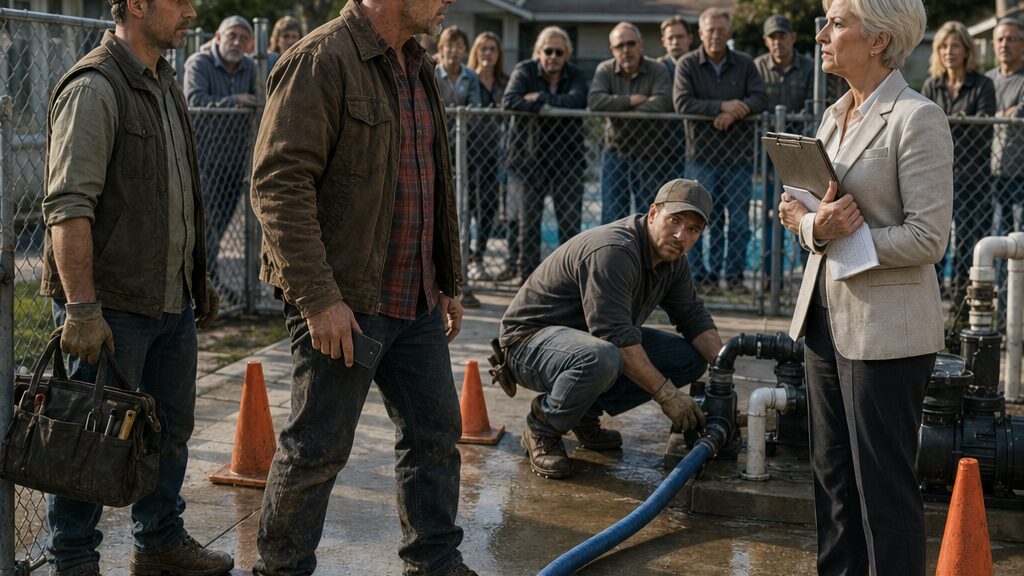
The Man Who Drained the HOA Pool Before It Could Flood His Wife’s Room
Chapter 1: The Pool Was Empty Before Breakfast
“You ruined the neighborhood’s summer,” Nancy Anderson said, pointing past George Harris at the empty pool.
The words carried across the concrete deck before the sun had cleared the roofs. A few early walkers had stopped by the gate. Someone in pajama pants held a coffee mug against their chest. Behind Nancy, the Blue Heron Estates pool sat twelve feet down in its concrete bowl, drained to a slick, murky puddle in the deep end. A plastic chair had tipped sideways on the deck as if even it had stepped back from what happened overnight.
George stood beside the equipment gate in his red plaid shirt, one sleeve dark where it had brushed wet concrete. His boots were stained at the soles. He held a manila folder against his thigh, but he did not open it yet.
Nancy had already opened hers.
She wore a pale jacket buttoned to the throat and carried a clipboard thick with papers. Her white hair was cut neatly above her ears, and her face had the tight, polished look she used at board meetings when she wanted a vote finished before anyone found the courage to object.
“Do you understand what this means?” she said. “Do you understand how many families use this pool?”
George looked at the empty basin. The blue tile ring near the top still showed where the water had been yesterday. Below it, the exposed walls glistened. The smell coming up from the deep end was sharp and chemical, mixed with mud.
“I understand more than you think,” he said.
That made the neighbor with the coffee mug shift closer to the fence.
Nancy heard the movement and raised her voice just enough for the growing group outside the gate. “Mr. Harris accessed common property after hours. He interfered with the pool equipment. He drained an HOA amenity without board approval, without a contractor authorized by the association, and without notice to residents.”
George’s jaw tightened, but he kept his hands still.
“Say the rest,” he said.
Nancy blinked once. “The rest?”
“Say what was under it.”
A murmur moved through the neighbors, not loud enough to become words. George saw Amanda Perez standing near the back of the group in her work blouse, keys hooked on one finger, face pulled between concern and caution. She was the HOA secretary, but she lived two houses down from him. For years she had waved to Lisa from the sidewalk. That morning she did not wave.
Nancy turned slightly so the group could see her expression. “What was under it was association property. Pipes, pumps, drains, wiring. None of which you had permission to touch.”
George looked at the pool again. He had watched the water fall through the dark, faster than it should have, the pump shuddering under his palm as if something inside the system had decided to give way. Now that the damage was visible, it looked worse than he had feared. A drained pool had a way of making one person look guilty. It did not show the wet towel under Lisa’s door. It did not show the baseboard swelling in their converted ground-floor room.
A siren chirped once at the curb.
Two police officers stepped out of a patrol car at the clubhouse entrance. The neighbors parted without being asked. Nancy’s shoulders lifted, as if she had been waiting for a witness with a badge.
George did not move.
One officer stopped at the gate. “Who called?”
“I did,” Nancy said. “I’m Nancy Anderson, HOA president. This man vandalized community property.”
George finally turned from the pool. “That’s not what happened.”
Nancy held up a sheet from her clipboard. “We have a violation notice prepared, and I’ll be asking the board to pursue recovery costs. I also want a report filed for property damage.”
The officer looked from Nancy to George. “Sir, are you George Harris?”
“Yes.”
“Did you drain the pool?”
The question hung there in the easiest shape possible. The neighbors wanted that answer. Nancy wanted it. Even Amanda, standing behind everyone else, seemed to hold her breath.
George could have said no and fought over words. He could have said he lowered the water level, not drained it. He could have said the valve stuck, the pressure jumped, the emergency number went nowhere, the leak had been reported weeks ago. But the pool was empty. A lie would make everything after it smaller.
“Yes,” he said. “I opened the drain.”
Someone near the fence whispered, “Unbelievable.”
Nancy’s mouth hardened into the beginning of victory. “Thank you. He admitted it.”
The officer lifted a hand, not quite stopping her but slowing the rush. “Why?”
George opened the manila folder and pulled out a stack of printed photos. The top one showed the base of his bedroom wall, the paint bubbled above the trim. He held it out, but the officer did not take it right away.
Nancy stepped in. “That has nothing to do with common property.”
“It has everything to do with it,” George said.
“Mr. Harris has been claiming for weeks that the pool is somehow damaging his house,” Nancy told the officers. “The board has not verified that claim. He was told repeatedly not to interfere.”
George looked at the officer. “Ask her for the contractor estimate.”
Nancy’s eyes cut to him.
The officer noticed.
“What estimate?” he asked.
“The one I submitted,” George said. “The one about the return line. The one that said the pressure needed to come down before water pushed farther under my foundation.”
Nancy gave a short breath through her nose. “It was not approved.”
“That wasn’t the question.”
The officer took the photo now. His partner moved toward the fence to keep the neighbors back. Nancy shuffled her papers, and George saw the top page: VIOLATION NOTICE. The date was today. The time printed on it was 6:42 a.m.
The pool had been found empty at 6:18.
“You had that ready fast,” George said.
Nancy held the notice flat against her clipboard. “Because I was notified that you were on camera at the equipment gate last night.”
“I called the emergency line first.”
“You called after you trespassed onto common property.”
George almost laughed, but Lisa’s voice in his head stopped him. Don’t let them make you sound angry. Make them answer.
He swallowed what he wanted to say and pointed to the pool wall near the shallow-end return jet. “There. That line. It’s been leaking underground toward my house. Raymond Clark told you that. I gave you his estimate. I gave you photos. I gave you a written request.”
Nancy said, “The board cannot authorize emergency work because one resident feels anxious about moisture.”
That word did it. Not to George’s voice, but to his face. The officer saw it. Nancy saw it too, and for half a second her confidence sharpened into something defensive.
“Moisture,” George repeated.
The neighbors grew quiet.
From the empty pool, a slow drip echoed into the puddle below.
The officer lowered the photo. “Mr. Harris, I need you to tell me plainly why you drained the pool.”
George looked past Nancy, past the neighbors, toward the row of houses behind the clubhouse. His house sat closest to the pool’s equipment wall. Lisa would be awake by now, sitting on the edge of the bed, one hand on the walker, pretending she had not listened for his boots on the hall tile all night.
He had spent years keeping her name out of neighborhood arguments. He had thought privacy was a kind of protection. This morning, with the pool empty and Nancy holding charges in her hand, privacy felt like a locked door from the wrong side.
He looked back at the officer.
“Because they removed the only thing keeping it out of my house.”
Chapter 2: The First Warning Went Into the Minutes
George’s sock darkened the moment he stepped into Lisa’s room.
He stopped with one hand on the doorframe and looked down. The floor near the south wall had a dull shine to it, not enough to puddle, not enough to prove anything to someone who did not want proof. The baseboard under the window had swollen at the corner again. A thin line of paint had lifted like a blister.
Lisa was still asleep in the adjustable bed, turned toward the lamp, her hand open on the blanket. The walker stood beside her within reach. George had placed it there before midnight, the way he always did, angled so she could grip the left handle first. After the second surgery, the upstairs bedroom had become impossible. They had converted the back den into this room because it had the widest doorway and the shortest path to the bathroom.
It was also the room closest to the pool wall.
George crouched and pressed two fingers to the baseboard. Damp.
He took out his phone and photographed it from three angles. Then he set a paper towel against the trim, waited until the edge darkened, and photographed that too. He did not turn on the overhead light. Lisa hated waking to a problem already in progress.
But she opened her eyes anyway.
“Again?” she asked.
He kept his voice low. “Just a little.”
“That’s what you said last time.”
“Last time it dried.”
“Last time you ran a fan for two days and told me it was for air circulation.”
George looked at her then. She was watching him with the tired patience of someone who loved him too well to believe his easier lies.
“I’m calling someone today,” he said.
“The HOA?”
“A contractor first.”
Her mouth tightened. “George.”
“I’m not asking Nancy Anderson to guess what’s wrong. I want someone who works with drainage to look at it.”
Lisa pushed herself higher against the pillow. “And when he says it’s the pool?”
“Then I’ll give them something they can’t ignore.”
He believed that when he said it.
Raymond Clark arrived that afternoon in a white truck with mud on the tires and a coil of blue discharge hose visible in the bed. He was not the kind of contractor who made a show of confidence. He walked the yard, looked at the grade, checked the soft strip near the fence, and asked George to show him where the pool equipment sat in relation to the house.
The two men stood at the property line, the clubhouse wall on one side, George’s narrow side yard on the other. The pool itself was hidden behind stucco and landscaping, but George could hear children shouting in the water.
Raymond crouched near the damp soil by the fence. He pushed a screwdriver into the ground. It sank too easily.
“How long?” Raymond asked.
“Three weeks since we noticed the wall. Maybe longer underground.”
“After heavy rain?”
“No rain the first time.”
Raymond looked toward the pool equipment enclosure. “Then I’d want that return line checked.”
“It’s HOA property.”
“That’s going to make this fun.”
George did not smile.
Raymond wiped his hand on his jeans and walked the line again. “I can’t diagnose their system from your yard. But if that return line has a crack and the pool’s under pressure, water will follow the path it likes. Your foundation might be that path.”
“How fast?”
“Fast enough that I wouldn’t wait a month for a committee.”
By four o’clock, George had photos, Raymond’s written estimate, and a recommendation for emergency inspection with temporary pressure reduction if the leak was confirmed. The words looked plain on paper. Subsurface erosion. Possible return-line failure. Water intrusion risk. Temporary bypass and controlled drainage advised pending repair.
Plain words, George thought, were hard to argue with.
That evening, he carried the folder to the HOA board meeting in the clubhouse multipurpose room. The space smelled faintly of pool chlorine and dry-erase markers. Folding chairs faced a long table where Nancy Anderson sat in the center, Amanda Perez to one side with a laptop open.
George waited through landscaping complaints, a debate about holiday decorations, and a reminder about trash bins visible from the street. When open comments began, he stood.
“I need an emergency inspection on the pool return line,” he said. “There’s water intrusion along my foundation, and a drainage contractor says the line may be pushing water toward my house.”
Nancy looked up from the agenda. “The pool passed seasonal opening inspection.”
“This is underground. It may not show on opening inspection.”
“Do you have documentation?”
George stepped forward and handed Amanda copies first, because she was the one recording minutes. Then he gave Nancy the folder. Nancy opened it without hurry.
Amanda scanned the first page. Her expression changed before Nancy’s did.
“This says temporary pressure reduction,” Amanda said.
Nancy lifted her eyes. “Pressure reduction means closing or partially draining the pool.”
“It means stopping damage while you inspect,” George said.
A board member shifted in his chair. Someone in the audience whispered about swim lessons. George felt the room begin to measure his house against everyone else’s convenience.
Nancy aligned the pages against the tabletop. “Mr. Harris, common-property repairs require board review, vendor approval, insurance notification, and, depending on scope, reserve allocation. We cannot rush a pool disruption because one homeowner brought in a contractor we did not authorize.”
“My wall is wet.”
“I’m not dismissing your concern.”
“You’re postponing it.”
“I’m following process.”
George looked at Amanda. She typed, but slower than before.
Nancy continued, “The board can add this to the maintenance review for next month. In the meantime, you are not permitted to access pool equipment, alter drainage, attach hoses, or interfere with common property.”
“Next month?” George said.
“Emergency classification requires verification.”
“That’s why I’m asking for inspection.”
“And I am telling you how the association handles requests.”
George heard Lisa in his mind again: Don’t let them make you sound angry. He picked up one copy of Raymond’s estimate and placed it in front of Nancy.
“Then put this in the minutes,” he said. “All of it. The photos too.”
Nancy’s face did not change, but Amanda looked up.
“It will be noted,” Nancy said.
“No,” George said. “Noted is not the same as included.”
A small silence opened in the room. Nancy held his gaze with the calm of someone used to outlasting people.
“We are not attaching unverified homeowner materials to official minutes,” she said.
George gathered the remaining copies with careful hands. “Then write that you refused to attach them.”
Amanda stopped typing.
Nancy’s tone cooled. “Mr. Harris, you’re out of order.”
He almost said more. He almost told the whole room about Lisa’s bed against the damp wall, about the walker by the door, about the way water changed everything when a person could not move quickly. Instead he closed the folder.
“My request is in writing,” he said. “So is your answer.”
He left before his voice betrayed him.
In the parking lot, Amanda caught up with him near his truck. She still had her laptop bag over one shoulder, and she glanced back at the clubhouse before speaking.
“George,” she said quietly. “I entered the warning into the minutes.”
“Thank you.”
“But I don’t see Raymond’s estimate in the meeting packet.”
He looked at her.
She lowered her voice further. “Maybe Nancy is adding it separately. Maybe it’s nothing.”
George held the folder tighter.
“Or maybe,” Amanda said, unable to meet his eyes, “you should keep your own copy of everything.”
Chapter 3: The Crew Came Before the Notice Dried
The worker had already cut the first zip tie from George’s pump line when George reached the gate.
The blue hose sagged against the gravel beside the pool equipment enclosure, half freed from the temporary bracket Raymond had installed two days earlier. One end still ran toward George’s drainage trench. The other lay near the pump housing, glistening where water had pulsed through it before someone shut the valve.
A white utility truck idled by the clubhouse curb. Orange cones stood along the walkway. A second worker carried a toolbox toward the gate as if this were ordinary maintenance and not the removal of the only thing that had kept Lisa’s room dry since Sunday.
George gripped the chain-link gate. “Stop.”
The worker looked over his shoulder. “You need to talk to her.”
Nancy Anderson stood near the shallow end with her clipboard against her chest. She was dressed for a board walkthrough, not a repair site, in pressed slacks and clean shoes. Beside her was a crew supervisor with a folded work order.
George pushed through the gate. “Put the hose back.”
Nancy stepped forward. “Mr. Harris, this equipment is unauthorized.”
“It’s a temporary bypass.”
“It is an unauthorized modification to common property.”
“It is diverting water away from my foundation.”
“It is attached to association equipment without approval.”
George took out his phone and started recording. He kept the screen pointed down enough not to shove it in anyone’s face, but high enough that the hose, Nancy, and the cut tie were all visible.
“I want the removal order in writing before they touch anything else.”
Nancy glanced at the phone. “You were served notice.”
“When?”
“This morning.”
“The crew is already here.”
“The notice was placed on your door.”
George stared at her. “This morning when the crew was already here?”
The supervisor shifted his weight and looked at Nancy, not George.
Nancy removed a paper from her clipboard and held it out. “The association has determined that your temporary pumping arrangement creates liability exposure, affects pool operations, and violates community standards regarding common-property alterations.”
George did not take the paper. “Community standards don’t keep water out of my wife’s room.”
A worker lowered his toolbox to the ground.
Nancy’s eyes flicked toward him, then back to George. “Your personal household situation does not give you authority to alter shared amenities.”
“My household situation is why I asked you for inspection.”
“And the board has not approved your contractor.”
“Raymond’s estimate said this was urgent.”
“Raymond Clark is not an HOA-approved vendor.”
“He’s licensed.”
“That isn’t the same thing.”
George gave a short nod, the kind he used when measuring a board before cutting it. “No. It’s not. Just like an HOA enforcement notice is not a court order.”
Nancy’s face tightened. “Do not obstruct these workers.”
“I’m standing next to equipment that is protecting my house.”
“You are standing on common property.”
“My dues pay for it.”
“So do everyone else’s.”
The words landed exactly where Nancy intended them to land. A few neighbors had gathered beyond the fence, drawn by the idling truck and orange cones. George saw two people from the meeting, a man with a dog, and Amanda Perez near the clubhouse door with her phone in her hand but not raised.
Nancy turned slightly toward the onlookers. “This is precisely why residents cannot take unilateral action. If everyone attached private equipment to association systems, there would be chaos.”
George wanted to say that chaos was water under a bedroom wall. Chaos was Lisa waking up and asking if the floor was safe. But he had held her privacy like a shield for so long that even now, surrounded by strangers, his first instinct was to keep her out of it.
The worker picked up the hose again.
George stepped between him and the pump.
The supervisor said, “Sir, we’re just doing what the work order says.”
“Then show me the work order.”
The supervisor looked at Nancy.
George lifted the phone a little higher. “Show me the work order.”
Nancy handed the paper to the supervisor, who handed it to George with obvious reluctance. George read it once. Removal of unapproved hose and auxiliary pump connection. Restore pool equipment to standard operating configuration. Bill resident account for labor if applicable.
No mention of leak. No mention of Raymond’s estimate. No mention of water intrusion.
George looked at Nancy. “You left out the reason it’s here.”
“The reason is disputed.”
“You didn’t inspect it.”
“We are scheduling review.”
“After you remove the protection.”
“We are restoring the equipment.”
“You’re putting pressure back into a cracked line.”
Nancy’s voice sharpened for the first time. “You do not know that line is cracked.”
“Then why won’t you let someone check?”
“Because the board follows procedure.”
The supervisor cleared his throat. “Ma’am, do you want us to continue?”
Nancy did not answer right away.
George felt the moment balance there. If she paused the removal, she would not be admitting she was wrong. She could call it further review. She could ask for another estimate. She could take one step back and save everyone from what came next.
Instead she said, “Yes. Continue.”
George did not move.
The supervisor’s expression turned tired. “Sir.”
George looked at the cut zip tie on the gravel. Such a small thing. One snip, and the whole setup became easier to dismiss. Not a temporary safeguard. Not a repair measure. Just a loose hose where it did not belong.
Raymond Clark’s truck pulled up hard at the curb before the worker reached for the clamp. Raymond got out without closing the door.
“What are you doing?” he called.
Nancy turned. “Mr. Clark, you are not authorized to perform work on association property.”
“I’m not performing it. I’m trying to keep you from undoing it wrong.”
The supervisor looked relieved to have someone else speak the language of tools. “You installed this?”
“With permission from the homeowner for his side and with a pending emergency request for the pool side.”
Nancy said, “There is no approved request.”
Raymond looked at George. “They sent you a denial?”
George handed him the notice.
Raymond read it, then looked toward the pump housing. “If you close that and put the system back to normal pressure before the return line is checked, you could push more water toward his slab.”
Nancy folded her arms over the clipboard. “Could?”
“That’s the word people use before they pay for the thing they didn’t prevent.”
A neighbor near the fence muttered, “Is the pool dangerous?”
Nancy heard it. Her posture changed. George saw the board president return, the one who counted votes and costs and panic before she counted facts.
“There is no confirmed danger,” she said. “There is an unauthorized modification.”
Raymond stared at her for a moment, then looked at the supervisor. “I’m not touching that system if the HOA is threatening enforcement. I’ve got a license and insurance too.”
George turned to him. “Raymond.”
“I’m sorry,” Raymond said, and he did look sorry. “If they’re ordering it removed, I can’t be the guy in the middle without written authorization. Not with them calling it interference.”
Nancy seized the opening. “Exactly.”
George felt heat rise in his face, but he did not let his voice rise with it. “So you block the repair, remove the temporary bypass, and then say nobody authorized the emergency.”
Nancy’s reply came smooth and practiced. “The board will review all properly submitted materials.”
Amanda stepped closer to the fence. “Nancy, his estimate was submitted.”
Nancy looked at her. “Amanda, this is not the place.”
“It was submitted,” Amanda repeated, softer now, but still loud enough for George to hear.
Nancy’s face went still.
George looked at Amanda, and in that second he understood she was afraid too. Not of water under her floor. Of being the person who said the wrong thing in front of the wrong neighbors and made herself responsible for what everyone had preferred not to know.
The supervisor removed the clamp.
The hose fell from the pump connection with a wet slap against the concrete.
George took one step forward, then stopped himself. If he grabbed it, Nancy would have what she needed. If he shouted, the neighbors would remember the shouting, not the reason.
So he recorded the hose on the ground, the open clamp, the work order in the supervisor’s hand, and Nancy standing beside the pool with her clipboard.
Then he said, “Put this on the record. You removed it after being told what it was protecting.”
Nancy’s eyes held his. “And you were told not to reinstall it.”
By sunset, Raymond’s truck was gone. The crew had loaded the hose and auxiliary pump into the utility truck as billable removal. George stood in the side yard staring at the shallow trench where the hose had been, the soil already darkening in patches near the fence.
That night, Lisa called his name from the converted room.
He found her sitting upright, one hand on the walker, the other pointing toward the floor. Water had found the seam between two boards and was rising through it in a thin, shining line.
George dropped to one knee and pressed his palm against the floor.
It was wet.
Chapter 4: The Night George Opened the Drain
Lisa woke to the sound of towels hitting the floor.
George was on his knees at the threshold of her room, pressing one towel flat with both palms while another soaked dark beside his boot. The lamp on her nightstand threw a weak circle of light across the boards. In that light, the water looked almost harmless, no deeper than spilled tea, except it was coming from under the wall instead of across it.
“George,” she said.
He did not answer at first. He pushed the towel harder against the seam where the floor met the trim, as if pressure from his hands could hold back pressure from underground.
“George.”
“I’m here.”
“I know where you are. Tell me what’s happening.”
He sat back on his heels. His shirt was untucked, his hair flattened on one side from sleep, and his face had that blank, careful look he wore when he had already decided not to tell her enough.
“It started again,” he said.
Lisa reached for the walker. He moved to help her, but she lifted one hand to stop him.
“How much?”
“Not much.”
“Don’t do that.”
The words were quiet, but they struck harder than if she had raised her voice. George looked at the towel under his hands. Water had already climbed halfway across the cotton.
“Enough,” he said.
Lisa swung her feet slowly to the floor. He watched her test the boards with one slipper before putting weight down. The room had been made for safety: wide path to the bathroom, low bed, night-lights along the baseboard, nothing loose underfoot. Now the same floor he had sanded and sealed himself was giving way to a problem no one else wanted to see.
“You need to call them,” Lisa said.
“I did.”
“The HOA?”
“The emergency line.”
“And?”
George picked up his phone from the dresser and tapped the recent calls. Two outgoing calls sat there, one at 12:41 a.m., one at 12:48. Both under a minute.
“Voicemail,” he said.
Lisa took a breath through her nose. “Call again.”
He did. He put it on speaker so she could hear the bright recorded voice thank them for calling Blue Heron Estates after-hours maintenance. For pool, gate, and clubhouse emergencies, leave a detailed message. Someone would respond in the order received.
The beep sounded too cheerful.
George looked at Lisa while he waited for himself to speak. “This is George Harris, lot twenty-eight. Water is entering our ground-floor bedroom from the pool-side wall. The temporary bypass was removed today by HOA order. I’m requesting immediate emergency assistance and authorization to reduce pressure in the pool system before there’s more damage. It is 12:56 a.m.”
He ended the call.
Neither of them moved for a moment.
Then, somewhere beneath the wall, water made a faint ticking sound as it reached another gap in the flooring.
Lisa looked down.
George did too.
“Get the folder,” she said.
“It won’t matter tonight.”
“Get it anyway.”
He brought the folder from the kitchen counter. Inside were the copies he had made, each one clipped in order: photos of the damp baseboard, Raymond Clark’s estimate, the written request, the meeting notes he had typed for himself after Nancy refused to attach the estimate, the removal notice placed on his door after the crew had arrived. He had built the folder like a wall, paper by paper.
Lisa turned the pages with care. She had always been better at reading what people left out.
“This one,” she said, tapping the estimate. “Temporary pressure reduction advised pending repair.”
“They’ll say Raymond wasn’t authorized.”
“He was right.”
“That doesn’t make it permission.”
She looked up at him. “No. But it makes it a warning.”
George took the page from her and stared at the line until the words blurred. He thought of the blue hose lying in the crew truck, the clamp dropped on the concrete, Nancy saying procedure with the certainty of a locked gate.
He stood.
Lisa knew before he said anything. “George.”
“I’m going to document the water.”
“You already did.”
“I’m going to document where it’s coming from.”
“And then?”
He slid the phone into his pocket. “Then I’m going to the pool.”
Her fingers tightened on the folder. “Don’t make it easy for them.”
“They already made it easy. They left me one choice and wrote down that I wasn’t allowed to take it.”
“That doesn’t mean you should give them the picture they want.”
He stopped at the doorway. Pride rose in him first, hot and useless. Then fear, colder. He had spent weeks telling himself that if he stayed calm, stayed private, followed the steps, kept Lisa out of it, the facts would eventually become too obvious to ignore. But the facts were wet under her feet.
“I can’t watch this come into your room again,” he said.
Lisa’s face softened, but not enough to surrender. “Then don’t do something alone just because you’re scared.”
He looked away.
That was the truth he disliked most.
Outside, the pool area was lit by security lamps and the pale glow from the clubhouse windows. The neighborhood had gone quiet. George walked with a flashlight, the folder under one arm, phone recording in his hand. He filmed the side yard first: the damp trench where the hose had been, the dark soil along the fence, the wet line near the slab. He said the time out loud. He said the date. He said the emergency calls had gone unanswered.
At the equipment gate, his hand paused on the latch.
He had never thought of himself as a rule breaker. He paid dues on time. He trimmed the hedge to the specified height. He kept trash bins out of sight. Rules, when they made sense, were what let neighbors live without stepping on one another.
But this rule had become a wall.
He opened the gate.
The pool pump was humming, restored to standard operating configuration. George filmed the pressure gauge, then the return line Raymond had pointed out. Near the wall, where the concrete met the equipment pad, the ground was darker than the gravel around it.
He crouched and touched it.
Wet.
He went back to the house for the moisture meter he used in the garage. At the bedroom wall, it chirped high against the baseboard. At the side yard, higher. At the equipment pad, highest.
He recorded all of it.
Then he stood in front of the pool drain controls with his phone in one hand and the after-hours voicemail still unanswered in the other.
“Lot twenty-eight,” he said into the camera, voice low. “Water intrusion active. Temporary bypass removed by HOA today. Emergency line unanswered three times. I am reducing pool pressure to prevent further water damage to an occupied ground-floor bedroom.”
He waited, absurdly, for someone to step out of the dark and tell him to stop with a better option in hand.
No one came.
The valve resisted at first. George had to grip it with both hands and turn slowly. Somewhere in the system, water shifted with a heavy internal rush. The pump noise changed pitch. He watched the pool surface ripple under the lights.
He did not intend to empty it.
That mattered later. He knew it would matter. It mattered to him even as he worked. He wanted the pressure down, not the pool destroyed. He wanted time until daylight, until Raymond could come, until someone with authority would stand there and see the wet soil for themselves.
The water began to drop.
At first the change was barely visible. Then the tile line showed half an inch, then an inch. George checked the bedroom again. The towel was soaked, but the creeping edge had slowed. He took another video. Lisa watched from the bed, pale and silent.
“Is it working?” she asked.
“I think so.”
“That’s not the same as yes.”
“No,” he said. “It’s not.”
At 2:11 a.m., the valve stuck.
George heard it before he saw it: a hard mechanical knock from the equipment pad, then a stronger rush through the drainage line. He hurried back to the pool. Water moved faster now, pulling toward the deep end drain with a force that made the surface dip and twist.
“No,” he whispered.
He tried to reverse the valve. It moved an inch, then locked. He tried again, harder. The handle scraped his palm. The pump shuddered. He shut off the pump, but the water kept moving through the gravity line, slower now, still steady.
He called Raymond.
The phone rang five times.
“George?” Raymond’s voice was thick with sleep.
“The valve stuck.”
“What valve?”
“Main drain bypass. I was lowering pressure. It won’t close all the way.”
Raymond was awake now. “How low?”
“Dropping fast.”
A pause. “Don’t force it. You break that assembly and they’ll bury you.”
“What do I do?”
“Document everything. Shut what you can shut. Don’t touch anything electrical if water’s moving near the pad. I’ll come at first light.”
“First light might be too late.”
“For the pool, maybe,” Raymond said. “For your house, maybe not.”
George stood with the phone to his ear and watched the waterline sink below the first step.
By dawn, the pool was nearly empty.
The sky had turned gray behind the clubhouse roof. George’s hands ached. His phone battery was down to twelve percent. The towel at Lisa’s door had stopped taking on new water, but the floor was swollen in a narrow ridge near the wall.
He walked back to the pool one more time, hoping the sight would be less damning with daylight.
It was worse.
The basin looked abandoned, exposed, almost wounded. Leaves clung to the sloped floor. The deep end held a cloudy puddle. The blue hose that might have made sense of everything was gone, taken by the crew that had removed it. All that remained was the result.
A car door shut near the clubhouse.
George turned.
Nancy Anderson was walking toward the gate with her clipboard already in her hand.
Chapter 5: Everyone Saw the Empty Pool, Not the Wet Floor
“He drained it because they told him no,” a neighbor said from outside the pool fence.
The sentence moved through the morning crowd faster than anything George had actually said. By the time the police officer handed back the photo of Lisa’s baseboard, George could feel the story hardening around him: angry homeowner, private grudge, ruined pool.
Nancy let it harden. She stood beside the empty basin with her violation notice clipped to the front of her clipboard, answering questions in a calm voice that carried just far enough.
“No one disputes that he had concerns,” she told the officer. “But concerns do not authorize destruction of common property.”
George took the photo and slid it back into the folder. “It wasn’t destruction.”
The officer looked tired already. “Mr. Harris, the pool is empty.”
“I know what it looks like.”
“That matters.”
“What happened before it looked like this matters too.”
Nancy lifted the violation notice. “Then he can present that at the emergency board meeting this evening.”
“After you file charges?” George asked.
“I’m requesting a report.”
“You called it vandalism.”
“Because you accessed locked equipment and drained association property.”
George looked at the officers. “I called the emergency line three times. I have the call logs. I recorded the water under my wall, the pressure gauge, the valve, all of it.”
The second officer, standing near the gate, glanced toward the house beyond the fence. “Can we see the damage?”
Nancy spoke before George could. “With respect, this is an HOA property matter. His private home conditions don’t change the act committed here.”
George turned to her. “You don’t get to decide that.”
For the first time that morning, his voice rose. Not much. Enough that the neighbors stopped whispering.
Nancy’s eyes flicked toward them, then back to him. “And you don’t get to decide to empty a community pool.”
The officer stepped between their lines of sight. “Let’s take this down a notch.”
George hated that phrase. It made conflict sound like equal noise, not one person with wet floors and another with a clipboard. Still, he breathed through his nose and nodded.
The officer came with him to the house. Nancy followed as far as the driveway, then stopped when George turned.
“No,” he said.
“I’m the HOA president.”
“This is my home.”
“If you are using alleged interior damage as justification—”
“My wife is inside.”
That stopped her, but only for a breath.
The officer looked at George. “Sir, it may help if the association representative can verify—”
“No,” George said again.
The word came too fast, too hard. He saw the officer register it. He saw Nancy register it too, and knew he had given her another small piece of the wrong picture: a man hiding something.
From inside, Lisa called, “Let them see the floor, George.”
He closed his eyes.
She stood in the hallway, one hand on the walker, dressed and composed though her face had the drained look of a sleepless night. She had pinned her hair back. Her slippers stopped just short of the warped boards.
Nancy’s expression changed when she saw the walker. Not sympathy, exactly. More like recalculation.
George moved to Lisa’s side. “You don’t have to do this.”
“I know.”
The officer entered first, careful with his boots. George showed him the baseboard, the towel, the moisture meter reading. He showed the videos on his phone: water at the threshold, the unanswered calls, the wet soil near the equipment pad. The officer watched without interrupting.
Nancy stood just outside the doorway, looking over his shoulder.
When the video showed the pressure gauge, she said, “That does not prove the pool caused interior water.”
George paused the recording. “It proves what I saw before I opened the drain.”
“It proves you were at the equipment pad.”
Lisa’s hand tightened on the walker.
George felt the old instinct rise again: shut the door, end the show, protect her from being turned into evidence. But Lisa looked at him in a way that made hiding feel like another kind of surrender.
“Show them Raymond’s estimate,” she said.
He opened the folder and handed the officer the estimate. Nancy leaned in enough to read the top line.
“This is from his contractor,” she said.
“Licensed drainage contractor,” George said.
“Not retained by the association.”
The officer scanned the page. “It says possible return-line failure.”
“Possible,” Nancy said quickly.
“It also says temporary pressure reduction advised,” George said.
“Pending inspection,” Nancy replied. “Which you did not wait for.”
George looked at the wet towel on the floor. “We waited four weeks.”
The officer did not answer. He took notes, but his face did not give George what he wanted. Not belief. Not disbelief. Just procedure.
Outside, more neighbors had gathered near the driveway. George could hear fragments.
“Is she sick?”
“I didn’t know they had water damage.”
“He still shouldn’t have—”
Nancy heard it too. Her posture tightened.
By late morning, the patrol car was still parked at the curb, and the pool had become the neighborhood’s open wound. Children came on bikes and were pulled back by parents. A pool maintenance worker arrived, looked through the gate, and immediately called someone else. Nancy moved between the clubhouse and the deck, phone pressed to her ear, speaking in clipped phrases: unauthorized access, emergency meeting, recovery costs, legal review.
George stayed near his driveway because going back inside felt like retreat and standing by the pool felt like confession.
Amanda Perez approached when Nancy was across the deck.
“I’m sorry,” she said.
George looked at her. “For what?”
Amanda’s eyes moved toward the house. “I didn’t know about Lisa.”
“You weren’t supposed to.”
“That’s not what I meant.”
“I know what you meant.”
She held a folder of her own against her stomach. For a moment he thought she had brought the missing estimate. Instead she only said, “Nancy is calling a meeting tonight. Six o’clock. Fines, contractor recovery, possible suspension of amenities access.”
George almost smiled at that last part. “Suspending my pool access seems efficient.”
Amanda did not smile. “They may try to make you responsible for the full refill and inspection.”
“The line still has to be inspected.”
“I know.”
“Do they?”
She looked toward Nancy. “Some of them do when they’re not sitting at the table.”
George studied her. “Was Raymond’s estimate in the packet?”
Amanda looked down at the folder in her arms. “Not the one sent to the board.”
“You told me you couldn’t find it.”
“I couldn’t.”
“But?”
“But I checked the office email archive after the police arrived.”
George waited.
Amanda’s voice dropped. “It was received by Nancy’s HOA account the day after the meeting. With your photos attached. Raymond copied the general board address too.”
George felt the morning tilt. The missing paper was no longer missing in the way lost things were missing. It had arrived. Someone had chosen where it did not go.
“Do you have it?” he asked.
“Not printed. Not yet.”
“Can you get it?”
Amanda looked back again, and this time George saw the cost on her face. She was not an enemy. She was also not brave by habit. The board table had trained her to keep records clean, not to make them dangerous.
“I can try,” she said.
George thought of all the times he had mistaken quiet people for safe people. Maybe Amanda had done the same with herself.
Inside the house, Lisa called his name. He turned immediately.
She was still in the hallway, holding the folder he had left on the counter. The damp towel was folded now in a plastic grocery bag at her feet.
“Stop protecting me from the truth if it leaves us alone,” she said.
Amanda lowered her eyes.
George crossed to Lisa, but the words were not only for him. They had landed in the driveway, where an officer could hear, where Amanda could hear, where even Nancy, returning from the pool deck, slowed for half a step.
George took the folder from Lisa’s hand. For once, he did not tell her to go inside.
Nancy came up the drive with her clipboard.
“The emergency board meeting is at six,” she said. “You may present your explanation there. Until then, do not touch the pool equipment, do not enter the enclosure, and do not attempt any further self-help measures.”
George looked at Amanda.
Amanda held the folder tighter and said, barely above a whisper, “George. The estimate was received. It was never attached to the packet.”
Nancy turned her head sharply.
George saw the moment the real meeting began, hours before six o’clock.
Chapter 6: The Estimate That Never Reached the Board
“Deliberate damage to common property,” Nancy said, and the room went quiet enough for George to hear the hum of the vending machine near the clubhouse door.
Every chair in the HOA meeting room was full. Neighbors lined the back wall. The drained pool sat beyond the windows like a blue concrete crater, lit by evening floodlights and striped with caution tape. George stood near the side aisle with his folder in one hand and his phone in the other. Lisa had stayed home; he had asked, and this time she had chosen for herself.
Nancy sat at the center of the board table. Amanda Perez sat to her left with the laptop open, but her hands were folded instead of typing. A printed agenda lay in front of every board member. Item one: emergency review of unauthorized pool drainage. Item two: assessment of damages. Item three: resident enforcement action.
There was no item for leaking return line.
Nancy adjusted her glasses. “We are here because an individual resident chose to access locked pool equipment after hours and drain a shared amenity. Regardless of personal frustration, that action created cost, liability, and disruption for every homeowner in this association.”
A few heads nodded. George recognized some of them: people who had been at the fence that morning, people who had not seen Lisa’s floor, people who wanted the pool back before they wanted the truth complicated.
Nancy continued, “Mr. Harris will have an opportunity to speak. After that, the board will consider fines and recovery of emergency service costs.”
George stepped forward before she invited him. “Will the board also consider the repair request I submitted four weeks ago?”
Nancy’s mouth tightened. “You will have your turn.”
“Will it?”
A board member looked down at his agenda.
Amanda opened her laptop.
Nancy said, “The matter before us tonight is your unauthorized action.”
“The matter before you tonight is why I took it.”
“That is your position.”
“No. That is the timeline.”
The word seemed to bother her more than accusation would have.
Nancy folded her hands. “Mr. Harris, if you interrupt again, I will ask you to leave.”
George felt the room watching him, waiting to see whether he would prove Nancy right. His fingers pressed into the folder’s edge. He thought of Lisa standing at the hallway threshold, telling him not to protect her into isolation.
He stepped back. “Then give me my turn.”
Nancy moved through the opening statement, the pool maintenance call, the preliminary refill estimate, the possible inspection fee, the unknown cost of checking the pump assembly. She did not lie. That was what made it harder. She arranged facts into a shape that kept the wet floor outside the room.
When she finally nodded to him, George placed three papers on the front table: Raymond’s estimate, his written request, and the call log from the emergency line.
“I reported water intrusion along my foundation,” he said. “I gave the board photos. I gave the board this estimate. I requested emergency inspection and temporary pressure reduction. The temporary bypass Raymond Clark installed was removed by HOA order. That night, water entered my wife’s ground-floor room again. I called the emergency line three times. Nobody answered. I opened the drain to lower pressure.”
Nancy watched him with the controlled patience of someone waiting for the weak spot.
“You opened the drain,” she said.
“Yes.”
“Without approval.”
“Yes.”
The room shifted.
George let the answer stand. He had no interest in sounding innocent in a way that was not true.
“But before I did,” he said, “I asked for the repair.”
He slid Raymond’s estimate farther across the table.
A board member picked it up. “I don’t remember seeing this.”
Nancy reached for it. “The document was not part of the verified packet.”
Amanda’s chair made a small sound as she pushed back.
Everyone looked at her.
“It was received,” Amanda said.
Nancy did not turn fully. “Amanda.”
“It was received by the HOA account,” Amanda said, voice steadier the second time. “With photos attached. I checked the archive today.”
A murmur ran through the room.
Nancy’s face remained composed, but George saw color rise near her collar.
“That does not mean it was reviewed or accepted as official board material,” Nancy said.
Amanda looked at her screen. “It was sent to your address and copied to the board address. The subject line says Emergency Drainage Estimate for Pool Return Line.”
The board member holding the paper looked from Amanda to Nancy. “Why wasn’t it in the packet?”
Nancy took off her glasses and set them down carefully. “Because it was an unverified estimate from a vendor hired by a homeowner, and because distributing alarming claims about subsurface erosion before verification could have exposed the association to unnecessary panic.”
“Panic?” George said.
Nancy turned to him. “Yes, panic. The pool is a shared amenity. Closing it triggers refund demands, complaints, insurance questions, and likely a special assessment. We cannot run this association on every worst-case scenario brought to us by residents.”
“And if the worst case is under someone’s house?”
“Then we verify it through proper channels.”
“You removed the temporary protection before verifying it.”
“Because it was unauthorized.”
The same circle again. Procedure chasing its own tail while water found the path it wanted.
George looked at the neighbors along the wall. Some avoided his eyes now. Some looked angry in a new direction. But others looked worried, not for Lisa, not yet, but for their dues, their property values, the possibility that the pool had been failing in a way no one wanted to pay for.
Nancy saw that worry and spoke to it.
“Even if there is an issue with a line,” she said, “that does not excuse Mr. Harris’s decision to drain the pool. This board cannot reward self-help. If we do, we invite every resident to bypass approval when they disagree with timing.”
George could not deny the force of that. He hated that she had found the one honest argument and wrapped everything else inside it.
“I’m not asking to be rewarded,” he said. “I’m asking you to stop pretending this started last night.”
Amanda turned her laptop toward the board. “The email timestamp is four weeks ago.”
Nancy’s hand tightened around her pen. “And the board did not approve action.”
“No,” Amanda said. “But the warning existed.”
The room went quiet again, differently this time.
A knock came at the clubhouse door.
Everyone turned.
Raymond Clark stood outside the glass with his cap in one hand and a folder under his arm. He looked like a man who had debated leaving twice in the parking lot and come in anyway.
Nancy’s expression hardened. “This is a closed board proceeding.”
A neighbor near the door said, “There are thirty people in here.”
Raymond opened the door enough to speak. “I’m not here to argue. I’m here because the pool maintenance worker called me after seeing the line.”
Nancy stood. “Mr. Clark, you are not an association-approved vendor.”
“No,” Raymond said. “But I know what a failing return line looks like.”
George felt every eye move between them.
Raymond stepped inside and placed his folder on the nearest chair instead of the board table. “You can fine him if you want. That’s not my business. But if that pool had stayed full last night with the bypass removed, you might not be talking about refill costs.”
Nancy said nothing.
Raymond looked at the board, then at George. “The empty pool may be the only reason the cracked line didn’t fully rupture overnight.”
Chapter 7: The Inspector Asked Who Ordered the Pump Removed
The inspector pointed at the empty clamp on the concrete pad and asked, “Who ordered this removed?”
No one answered fast enough.
The pool deck was still damp in patches from the maintenance worker’s early attempt to rinse silt toward the deep end. Yellow caution tape crossed the gate. The pool itself sat open and hollow, the missing water making every sound too sharp: the scrape of the inspector’s boot, the click of Nancy’s pen, the far-off murmur of neighbors gathered where they could pretend they were not listening.
George stood beside the equipment enclosure with his folder under one arm. He had slept less than two hours. His eyes burned, but his mind was clear in the way it sometimes became after a night when fear had used up all the room for anger.
The county inspector crouched near the pump line. He was a compact man with gray at the edges of his beard and a flashlight tucked behind one ear. He tapped the clamp with one gloved finger.
“This held the temporary bypass?”
Raymond Clark nodded. “Yes.”
The inspector looked at George. “You installed it?”
“Raymond installed it. I hired him.”
“And it was removed when?”
“Two days before I opened the drain.”
The inspector looked toward Nancy. “By whose instruction?”
Nancy held her clipboard against her waist. “The HOA ordered removal of an unauthorized attachment to common pool equipment.”
The inspector wrote that down.
George watched the pen move. Nancy watched it too.
“Was a leak suspected before removal?” the inspector asked.
“Alleged,” Nancy said.
Raymond gave a dry laugh once, without humor.
The inspector looked up. “I asked whether it was suspected.”
Nancy’s lips pressed together. “A homeowner had submitted a contractor’s opinion.”
“And the contractor is here?”
Raymond lifted one hand. “That would be me.”
The inspector’s face did not change. He walked to the pool wall, then down the steps into the shallow end. With the water gone, the returns sat exposed like small dark mouths in the tile. He knelt near one and ran his fingers along the fitting. Then he looked back at the equipment pad, at the line of disturbed gravel, at the damp strip of soil beyond the fence.
“Show me the house,” he said.
Nancy stepped forward. “Is that necessary?”
The inspector looked at her as if she had asked whether gravity was necessary. “If the claim is water movement from the pool system toward the residence, yes.”
George led them across the narrow strip between the pool wall and his side yard. He opened the gate to his property. The soil beside the fence was darker than it should have been. Even in daylight, with the pool down, the ground held moisture like a bruise.
Inside the house, Lisa was waiting in the hallway, upright with both hands on the walker. George had asked her to stay in the kitchen until they were done. She had said no before he finished the sentence.
The inspector paused at the threshold. “Ma’am.”
“Lisa Harris,” she said.
He nodded and put covers over his boots before stepping inside. That small courtesy seemed to steady her more than any apology would have.
George showed him the room. The swollen baseboard. The lifted edge of flooring. The towels in a plastic bag. The moisture readings written on masking tape and stuck beside each spot. He had done that at dawn, because numbers on tape were harder to dismiss than a man pointing at damage.
The inspector checked the wall, then the floor, then the outside grade. Raymond followed quietly, adding only what was asked. Nancy stood in the doorway and did not cross fully into the room.
The inspector touched the lifted seam in the floor. “This increased after the bypass was removed?”
George answered, “Yes.”
Nancy said, “Correlation is not causation.”
The inspector looked up at her. “No. But ignoring correlation is not inspection.”
Lisa looked down quickly, hiding the smallest flash of satisfaction.
Back outside, the inspector returned to the pool equipment. He asked Raymond to explain the temporary setup. Raymond did, pointing to where the blue hose had run, how it diverted discharge toward George’s trench, how it lowered active pressure near the suspected return without fully taking the pool out of service.
“Crude,” the inspector said.
“Temporary,” Raymond replied.
“Both can be true.”
George felt the sentence settle over him. It was the closest thing to fairness anyone official had offered.
The inspector opened the pump housing and checked the valve George had fought in the dark. He tried the handle. It resisted, moved, then caught with a metallic click.
“There,” George said. “That’s where it stuck.”
The inspector tried again more gently. “Worn assembly. Not broken by last night, at least not obviously. Could have stuck under load.”
Nancy said, “But he turned it.”
George did not let Raymond answer for him. “Yes. I turned it.”
The inspector glanced at him. “You understand that was not authorized.”
“I do.”
“And you understand the association may still treat it as a violation.”
George looked at the empty pool, then toward his house. “I understand what they’ll call it.”
“That wasn’t my question.”
George met his eyes. “Yes. I understand.”
The inspector nodded once, not approving, not condemning. “The bypass should not have been installed without coordination. It also should not have been removed without evaluating the water intrusion complaint.”
Nancy shifted. “The HOA cannot allow residents to improvise on shared systems.”
“No,” the inspector said. “But once a resident reports active intrusion and you have a contractor warning about subsurface flow, restoration to normal operating pressure is not neutral. It is a decision.”
Amanda Perez stood near the gate with her laptop bag against one shoulder. She had not been asked to come, but she had arrived with printed emails in a folder and had stayed just outside the official circle. At the inspector’s words, she looked at Nancy.
Nancy’s jaw tightened. “The board was trying to prevent liability.”
The inspector looked at the drained pool. “You may have created a different kind.”
For the first time, Nancy had no procedural phrase ready.
By noon, the inspector had not cleared George. He did not announce that George was right and Nancy was wrong. He did not give the neighbors the simple ending they had gathered to hear. Instead he issued something more dangerous: an interim finding.
The return line needed pressure testing before refill. The area near George’s foundation showed active moisture consistent with pool-side water movement. The valve assembly required repair. The temporary bypass was not a permitted permanent solution, but its removal likely increased immediate risk until inspection could occur.
Likely. Consistent. Interim.
Not enough for triumph. Enough to make denial costly.
George stood at the gate after the inspector left, holding a copy of the preliminary note. Raymond had gone to call his insurance carrier and clear his afternoon schedule. Amanda had retreated to her car, where she sat with the door open, staring at her printed emails as though they had become heavier since she brought them.
Nancy approached without her clipboard for once. She carried a single folded paper.
“Mr. Harris,” she said.
George turned. “If this is another violation notice, give it to the officer.”
“It isn’t.”
She held out the paper. He did not take it immediately.
“What is it?”
“A way to end this before it becomes more damaging for everyone.”
He took it then.
The page was short. No letterhead beyond the HOA name. No apology. It offered waiver of fines related to unauthorized access and drainage, suspension of recovery billing pending inspection, and permission for emergency repair review.
In exchange, George Harris would acknowledge that the HOA had received no verified prior notice requiring emergency action before the night of the drainage.
He read the sentence twice, because the first time his mind refused to accept how neatly it had been written.
Nancy spoke quietly. “You would not be admitting malice.”
“No,” George said. “Just erasing the four weeks before it.”
“This protects you from immediate fines.”
“It protects you from the timeline.”
Her face tightened, but beneath it he saw fatigue. Not softness. Not regret, not yet. A woman cornered by costs, neighbors, minutes, insurance language, and her own decision. For a moment, she looked older than she had at any meeting.
“You don’t understand what happens if this becomes an official failure of maintenance,” she said. “The pool closes indefinitely. Insurance may deny portions. Residents will be assessed. People on fixed incomes will blame the board. They will blame me.”
George folded the paper along its original crease. “So Lisa’s floor was cheaper.”
Nancy flinched, barely.
“That is not what I said.”
“No,” George answered. “It’s just what the paper says.”
He looked toward his house. Lisa stood at the window, one hand on the curtain, not hiding. He had tried to keep her out of this until the story became too small to hold the truth. Now the truth had a price, typed in clean language on HOA paper.
Nancy held out a pen.
George looked at it, then at the waiver in his hand.
Chapter 8: The Pool Stayed Closed Until the Repair Was Real
George placed Nancy’s waiver offer on the board table and said, “I won’t sign away the timeline.”
The room did not erupt. No one clapped. No one shouted. The silence that followed was harder than noise. Every person in the clubhouse understood what the paper meant once it lay there under the fluorescent lights: the HOA was willing to forgive George only if George helped the HOA pretend it had not been warned.
Nancy sat at the center seat, both hands folded in front of her. A week had changed her. The pressed confidence remained, but it no longer sat easily. The pool had stayed closed behind locked gates. A temporary chain looped through the entrance, and a white sign read CLOSED PENDING REPAIR. Children had taped questions to it in marker. Parents had complained. The first estimate for proper excavation had gone out to residents that morning, and the number had moved through the neighborhood like smoke.
George stood across from the board with his folder open. He wore the same red plaid shirt, washed now, the cuff repaired where the valve had torn it. Lisa sat in the front row with her walker beside her knees. He had asked her twice if she was sure. Both times she had looked at him until he stopped asking.
Nancy looked at the waiver, then at him. “That document was an attempt to limit conflict while inspection continued.”
“It was an attempt to limit memory.”
A few neighbors shifted in their chairs.
George did not look back at them. If he did, he might start measuring approval again, and that had never helped him tell the truth.
“The emergency estimate was received four weeks before the pool was drained,” he said. “Amanda printed the email record. Raymond gave his statement. The inspector gave his interim finding. I opened the drain without authorization. I’m not hiding that. But I will not sign a paper saying you had no prior notice.”
Nancy’s mouth opened, but Amanda spoke first.
“The email archive confirms receipt,” she said.
Her voice shook slightly on confirms, but she did not stop. She sat at the secretary’s place with the printed emails stacked beside her laptop, no longer tucked away in a folder. “The estimate should have been included in the board packet or formally rejected with reasons. It was neither.”
A board member rubbed both hands over his face. Another stared at Nancy.
Nancy looked at Amanda with something close to betrayal. “You know why I was cautious.”
Amanda’s eyes lowered for a moment, then rose again. “I know why you were afraid.”
The room changed around that sentence.
Nancy sat very still.
George had expected denial. He had expected more rules, more phrases, more polished resistance. He had not expected Amanda to name what Nancy herself had been circling for weeks.
Nancy turned from Amanda to the room. “Yes. I was afraid.”
The admission did not soften everything. It sharpened some of it.
She took off her glasses and set them on the table. “We had deferred pool-line repairs twice. Not ignored. Deferred. The reserve fund was short after the clubhouse roof work. If we closed the pool at opening season, we were facing an assessment. If we reported possible subsurface failure without verification, insurance questions could have started before we understood the scope.”
George watched her carefully. This was the truth, but not the whole truth. Truth often arrived dressed as explanation.
Nancy continued, “I believed Mr. Harris’s contractor was overstating the risk. I believed slowing the process was responsible.”
Lisa’s walker clicked once as she shifted her hand on the grip.
Nancy heard it. Her eyes moved to Lisa, then away.
“And when the bypass was installed,” Nancy said, “I believed allowing it to remain would create liability.”
George said, “You were told what it was protecting.”
Nancy’s hands tightened. “I was told many things in a situation that had already gone outside procedure.”
Lisa stood.
George turned immediately, but she lifted one hand. Not now. Not for help.
The room watched her rise with effort. She did not move to the front. She did not need to. Her voice was quiet enough that people had to stop shifting to hear it.
“This was never about whether people got to swim that week,” she said. “I’m sorry the pool closed. I’m sorry the repair costs money. But every time this was discussed like an inconvenience, George came home and put towels against my wall.”
George looked down.
Lisa continued, “He should have told you sooner what that room means. I told him not to at first. I didn’t want to become the reason neighbors whispered. I didn’t want my medical history passed around with pool notices.”
Someone in the second row looked away.
“But silence did not protect us,” Lisa said. “It only made it easier for people to call the problem unverified.”
George felt that sentence land where pride had lived.
Nancy did not interrupt.
Lisa sat slowly, and George waited until she was settled before he turned back to the board.
“I don’t want revenge,” he said. “I don’t want anyone pretending I handled everything perfectly. I want the violation withdrawn, the repair approved under inspection, and the record to say the HOA had notice before I opened that drain.”
The board member nearest Amanda leaned toward his microphone. “I move that the violation notice be withdrawn pending final inspection, that emergency repair of the pool return line and drainage protection be approved under county oversight, and that the minutes reflect receipt of the prior contractor estimate and homeowner warning.”
Nancy closed her eyes briefly.
Another board member seconded.
The vote was not dramatic. It was messy and procedural, exactly the kind of thing that had failed George before and now, forced into the open, had to do its work properly. One board member hesitated over assessment language. Another insisted on adding that George’s unauthorized access was not precedent for future resident action. George let that stand. He had not come to be called blameless. He had come to stop being called the cause.
When the vote passed, no one clapped.
A neighbor in the back asked about the assessment. Another asked how long the pool would be closed. The pool maintenance worker explained pressure testing. Raymond described the excavation path and the temporary drainage plan. The inspector’s requirements were read into the record. The room returned, slowly and painfully, to the practical world.
That was where repair lived.
After the meeting, Nancy approached George near the clubhouse door. Lisa waited beside him, both hands on the walker.
Nancy held the unsigned waiver in one hand. “This will be voided.”
George nodded.
For a moment, it seemed she might apologize. Her face moved toward it, then stopped at the edge of what she could say in public.
“I thought I was protecting the association,” she said.
George looked past her through the window, at the locked pool gate and the white sign moving slightly in the evening air.
“You protected the file,” he said.
Nancy absorbed that without answering.
A week later, the pool deck was cut open along the equipment wall. The neat concrete had become a trench, squared off and marked with cones. The cracked return line lay exposed in the dirt, split along one side. A permitted drainage line ran temporarily toward a gravel basin approved by the inspector. Raymond’s blue hose was gone, replaced by rigid pipe, flags, and signatures on forms that had finally moved faster than water.
The pool remained empty.
Not abandoned this time. Opened for repair.
George stood at the fence with Lisa beside him. The sign still said CLOSED PENDING REPAIR, but someone had taped a second notice below it: RETURN LINE REPLACEMENT IN PROGRESS. EXPECTED COMPLETION AFTER INSPECTION.
Lisa read it twice.
“Look at that,” she said. “They learned a longer sentence.”
George laughed once, softly.
Inside their house, the baseboard in her room had been removed. Fans hummed against the wall. The floor would need repair, and insurance would argue, and the assessment letter would still arrive in every mailbox. Nothing about the ending was clean.
But that evening, when Lisa walked from the hallway into the converted room, her slippers crossed a dry threshold.
George walked beside her without reaching for her elbow until she asked.
At the doorway, she paused and looked down at the bare strip where the swollen board had been pulled away.
“You know,” she said, “you can tell people things before the floor gets wet.”
He looked at her.
The old answer rose automatically: I didn’t want them talking about you. He let it go before it reached his mouth.
“I know,” he said.
Outside, beyond their wall, the empty pool waited behind the fence until the repair was real.
The story has ended.