They Tried To Tear Down His Wife’s Ramp Before Cutting The Ribbon On Fifteen Buildings
Chapter 1: The Crew Was Already Cutting The Ramp When Gary Opened The Door
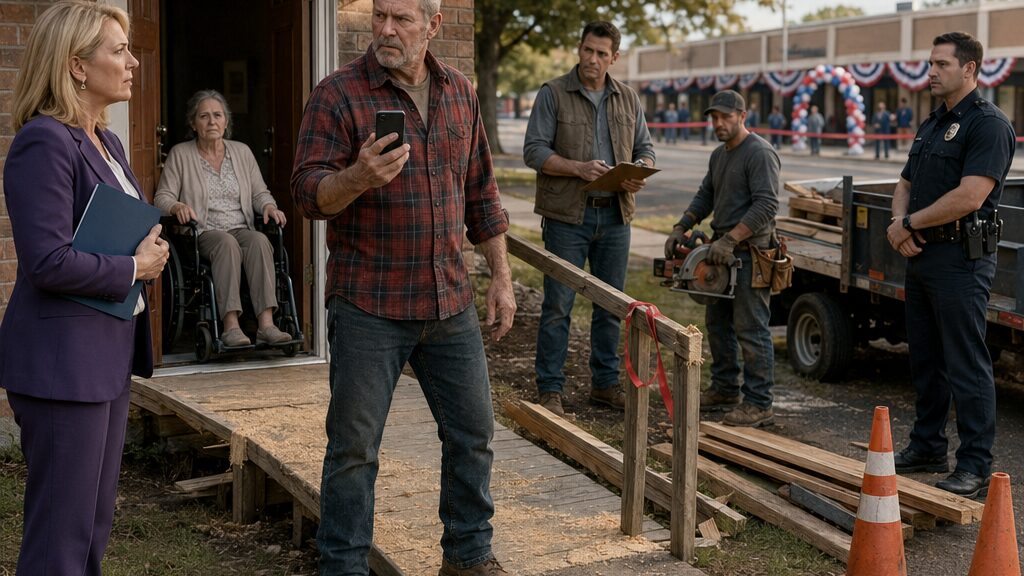
The saw was already in the handrail when Gary Walker opened the front door.
For half a second, his mind refused to understand the sound. Metal teeth screamed against the screws he had driven in by hand two nights before, the vibration traveling through the wood ramp, through the porch posts, into the old brick threshold beneath his boots. A yellow extension cord snaked across his front walk. Orange cones sat in the grass like the place had been declared unsafe by strangers. One man knelt beside the ramp with a drill. Another stood at the bottom landing, prying at a board with a flat bar.
Gary stepped out in his red-and-black plaid shirt, one sleeve still unbuttoned.
“Stop,” he said.
The man with the drill looked up, then toward the driveway.
A white pickup with magnetic company signs sat behind a dark SUV. Beside it, a broad-shouldered man in a work vest studied a clipboard as if the sound of Gary’s door opening had only been another item on his list.
Gary walked down the porch step onto the first board of the ramp. The board flexed under him, half-loosened. At the far end, a strip of red survey ribbon fluttered from the handrail where he had tied it to mark the angle for the permanent railing.
“Turn it off,” Gary said.
The worker released the saw trigger. The sudden silence made the morning feel worse. Somewhere past the hedge, beyond the two-lane road, trucks beeped inside the new commercial district. Fifteen storefronts faced the wide brick walkway where, in three days, the HOA and development board would cut a ribbon under red, white, and blue balloons.
The man with the clipboard came forward.
“Mr. Walker?”
“You’re cutting my ramp.”
“I’m Donald Moore. I’m the site supervisor. We were contracted to remove an unauthorized exterior structure.”
Gary looked at the loose handrail, then at Donald. “Contracted by who?”
Donald did not answer fast enough.
Gary took his phone from his shirt pocket and began recording. His thumb shook once before he steadied it.
“Say it again,” he said. “On camera.”
Donald’s jaw tightened. “We have an HOA enforcement order for removal.”
“Do you have a court order?”
“No, sir. This is HOA property compliance.”
“This is my front walk.”
“The structure extends beyond the approved footprint.”
Gary laughed once, not because anything was funny, but because the alternative was stepping off the ramp and throwing the flat bar into the street. He heard the scrape of Carolyn’s wheelchair inside, then the faint bump of her front wheel touching the threshold.
“Gary?” she called.
He did not turn around. “Stay inside.”
“I heard a saw.”
“I know.”
The second worker lowered his eyes. Donald looked back toward the dark SUV.
The passenger door opened.
Sharon Taylor stepped out in a purple suit sharp enough to look wrong against the sawdust on Gary’s grass. She held a blue folder against her chest, her hair pinned smooth, sunglasses perched above her forehead though the sky was flat and pale. She walked like the yard belonged to the paperwork in her hand.
“Mr. Walker,” she said. “We mailed and posted notice.”
“You sent a crew.”
“We sent notice of enforcement.”
Gary kept the phone up. “When?”
Sharon’s expression stayed composed. “You received notice that the ramp was noncompliant.”
“When did you post it?”
“Mr. Walker, this is not productive.”
“That saw was running when I opened the door. So tell me when you posted notice.”
A marked patrol car rolled slowly to the curb and stopped behind Donald’s truck. The officer got out without hurrying. He glanced at the cones, the workers, Gary’s phone, Sharon’s folder. He did not reach for anything. That made Gary angrier in a colder way. Everyone had arrived with a role already assigned.
Sharon opened the folder and withdrew a page. “The structure violates exterior appearance standards, encroaches onto development common access, and creates an insurance exposure. You were instructed not to proceed without written approval.”
“I filed for approval.”
“Your request was incomplete.”
“You never answered it.”
“We are answering it now.”
“With a saw?”
Carolyn’s wheelchair reached the open door behind him. Gary heard the brake lever click. He hated that sound in that moment. Not because of Carolyn. Because Sharon looked past him and saw exactly what he had tried to keep out of the argument: his wife framed in the doorway, one hand tight around the wheel, her left foot braced on the footplate, her mouth set in the way it got when she refused to be spoken around.
“Mrs. Walker,” Sharon said, softening her voice.
Carolyn did not soften hers. “Why are there men taking my way out?”
The worker with the drill stood. Donald shifted the clipboard under his arm. Sharon’s eyes flicked toward the officer, then back to Gary.
“No one is denying access,” Sharon said. “We are enforcing procedure.”
Gary lowered the phone just enough to look at her without the screen between them. “That ramp is access.”
“It is an unapproved structure.”
“My wife had a stroke. She cannot use those steps safely. I sent the doctor’s letter. I sent the drawing. I sent the contractor’s estimate for the permanent repair.”
“The board cannot approve construction that crosses common access.”
Gary pointed at the ground under the ramp. “That strip has been my access since before those storefronts were drawings.”
“That is not what the current plat shows.”
“The current plat is wrong.”
Sharon gave him a look then, brief and revealing. Not surprise. Irritation, maybe, or worry covered too quickly.
The officer came closer. “Sir, I need everybody to keep space between each other.”
Gary looked at the cut in the handrail. “They already took space.”
“I understand you’re upset.”
“No,” Gary said. “You understand there’s a homeowner standing in his own yard while strangers cut apart the ramp his wife uses to leave the house.”
The officer’s face tightened. “I’m not here to decide the property issue. I’m here to keep things from escalating.”
“Then tell them to stop cutting.”
“I can’t order them off if they’re acting under a civil enforcement notice.”
Gary raised the phone again. “Then I want your name on the recording. I want Donald’s name. I want Sharon’s name. And I want the order in writing before another screw comes out of that rail.”
Donald looked uncomfortable now. “Mrs. Taylor?”
“It’s President Taylor,” Sharon said, not looking at him. Then to Gary: “The removal will proceed today.”
Gary stepped down the ramp and planted himself between the workers and the section still attached to the porch. He did not shove. He did not raise his hands. He stood with the phone at chest height and the boards trembling under his boots.
The officer took one step forward. “Mr. Walker.”
“I’m not touching anybody.”
“You can’t obstruct the crew.”
Gary looked back at Carolyn. Her chair sat at the threshold, where the porch dropped six inches before the ramp began. Without the ramp, she would be trapped behind a piece of architecture so ordinary most people never noticed it.
“You see that?” Gary asked Sharon.
Sharon’s mouth tightened.
“You see the door. You see the chair. You see the cut rail. Now say on camera this is about appearance.”
Sharon slid the top page from the folder and held it out. “This is about compliance, safety, and property control. The board has an obligation to the community.”
“My wife is part of the community.”
“The community includes fifteen new businesses opening this week, traffic flow, insurance review, and accessible pedestrian routes that cannot be obstructed by unauthorized private structures.”
The phrase hit him strangely. Accessible pedestrian routes. She used the word accessible while taking his ramp apart.
Donald said quietly, “We can pause until the paperwork is reviewed.”
Sharon turned on him. “You were hired for removal, not interpretation.”
The worker with the drill bent again, then stopped when Gary did not move.
The officer spoke lower this time. “Mr. Walker, I’m asking you once. Step aside. Do not make this a criminal issue.”
Carolyn’s voice came from the doorway.
“Gary.”
He knew that tone. It was not fear. It was warning. She did not want him taken away over boards and bolts, even if those boards and bolts were the reason she could leave the house.
Gary stared at the red survey ribbon tied to the rail. It snapped in the breeze like a tiny flag surrendering for him.
He stepped aside by exactly one pace.
Then he crouched, picked up the first cut board the worker had set on the grass, and placed it across the porch in front of Carolyn’s wheels.
“No,” he said, still recording. “If you’re going to remove it, you’re going to do it while she watches what you’re taking.”
Sharon’s face changed, not enough for anyone else to call it fear, but enough for Gary to see that the ceremony across the road mattered more to her than the ramp did.
She snapped the folder shut.
“The removal must be completed before the ribbon-cutting,” she said.
Gary looked past her, toward the balloon frames being assembled between the new buildings, and understood that the ramp was only the first thing they needed gone.
Chapter 2: The Notice On The Door Was Dated After The Saw Started
The notice was taped to the inside edge of the porch post where no one leaving the house would have seen it until the crew was already in the yard.
Gary found it after Donald’s truck pulled away with half the handrail and three ramp boards stacked in the bed. The paper fluttered under clear packing tape, its top corner folded by the wind. Carolyn waited in the doorway while he peeled it down with two fingers, careful not to tear the timestamp.
Posted: 8:42 a.m.
His first video showed the saw running at 8:31.
Gary stood on the porch, reading the same line twice, then a third time. His anger did not flare this time. It narrowed.
“Gary?” Carolyn asked.
He held the paper up. “They posted this after they started cutting.”
Carolyn stared at the missing section of rail. Without it, the ramp looked injured, a body part stripped to bone. The red survey ribbon was still tied to the remaining rail, but it hung lower now, as if embarrassed.
“Take a picture,” she said.
“I’m taking ten.”
He photographed the notice on the post, the phone timestamp, the screw holes, the cones Donald had forgotten in the grass, the tire marks where the truck had backed too close to the flower bed Carolyn used to keep alive before the stroke changed the shape of every day. He photographed the board he had laid across the porch, its fresh cut bright against the weathered gray surface.
Inside, the kitchen table became a kind of battlefield. Gary spread out the doctor’s letter, the contractor’s sketch, copies of his HOA application, the certified mail receipt, and the blue folder Sharon had thrust into his hand. Carolyn rolled to the far side of the table and lifted one page before he could stop her.
“I can read,” she said.
“I didn’t say you couldn’t.”
“You were about to.”
Gary closed his mouth.
Carolyn’s right hand moved carefully over the paper. Since the stroke, small tasks took longer, but she had never liked when he watched her do them as if she were a candle in a draft. She read the denial paragraph with a crease between her brows.
“They say it obstructs pedestrian flow,” she said.
“Pedestrians don’t use our porch.”
“They mean the walkway by the storefronts.”
“That’s across the road.”
She looked at him over the page. “Then why are they talking like our house is part of it?”
Gary took the application copy and tapped the date. “I sent this twenty-six days ago. They had ten business days to respond before the accommodation review kicked in. That’s what their own handbook says.”
“You read the handbook?”
“I read what I had to.”
Carolyn smiled faintly, then looked toward the doorway. The smile left.
“We need to get me down,” she said.
Gary’s hands stopped moving.
“The side steps are too narrow,” he said.
“I know.”
“I can carry you.”
“No.”
“Carolyn—”
“No.” She turned her chair slightly so the front wheels faced him straight. “I am not being carried down my own front steps because Sharon Taylor wants clean photographs for a ribbon.”
“It’s just until I fix—”
“It is never just until. That’s how people start making decisions around you.”
The words hit harder than she intended. Or maybe exactly as hard as she intended. Gary looked at the table, at the papers he had organized without asking her what order made sense.
Carolyn touched the doctor’s letter. “This doesn’t say I need a ramp because I’m fragile. It says stairs are unsafe. There’s a difference.”
Gary sat down slowly. “I know.”
“Then stop treating the ramp like something you built for me.”
He looked up.
“It’s something we need,” she said. “For the house. For both of us. I don’t want you fighting like I’m the sad part of the story.”
Gary nodded once, but he could not speak around the pressure behind his ribs.
An hour later, he drove to the HOA office with the papers in a brown folder and the cut board laid diagonally in the truck bed. The office occupied the end unit of one of the new buildings, though the sign on the glass still had temporary vinyl letters: Greenbrook Village Association. Through the windows, he could see balloons in boxes, folding chairs, and a stack of glossy programs for the ribbon-cutting.
A clerk behind the counter looked at his folder, then at his shirt, then at the board visible through the window behind him.
“I need the full file on my ramp application,” Gary said.
“Homeowner records requests require a form.”
“I submitted the request. They removed the ramp before my appeal. I need to know who marked it incomplete.”
The clerk’s fingers hovered over the keyboard. “Address?”
Gary gave it.
She typed, clicked, frowned, clicked again.
“It says incomplete pending site compatibility review.”
“Who entered that?”
“I don’t have authorization to disclose internal notes.”
Gary placed the notice on the counter. “This was posted at 8:42. My video shows removal at 8:31. Is that compatible with your enforcement process?”
The clerk looked toward a closed interior door.
“I’m not part of enforcement.”
“Who is?”
“President Taylor handles exterior compliance with the development transition committee.”
“Of course she does.”
The clerk lowered her voice. “There’s a board meeting tomorrow evening. You can speak during resident comment.”
“My wife needs to leave the house before tomorrow evening.”
“I understand.”
Gary looked at her then, really looked. She was not smirking. She was not cruel. She was trapped behind a counter with a badge on a lanyard and a printer spitting rules beside her.
“No,” he said, not harshly. “You don’t.”
She swallowed and printed a single sheet. “This is all I can give you without a formal request.”
It was a status page. Gary scanned it, searching for a signature. Instead he found a phrase in the middle of the entry.
Site compatibility issue: structure extends into development common access.
He read it twice.
“What is development common access?”
The clerk’s shoulders stiffened. “The shared frontage and pedestrian circulation area tied to the commercial district.”
“My front walk is not commercial frontage.”
“That’s what the system says.”
“The system is wrong.”
She said nothing.
Gary folded the status page and slid it into his folder. Outside, workers were assembling the balloon arch at the plaza entrance. Red, white, and blue plastic shone under the sun. A ceremonial ribbon lay across two folding tables, still wrapped around a cardboard spool.
Across the road, beyond the new sidewalks and planter boxes, Gary could see the roofline of his house. For thirty-four years, the front door had faced the same strip of ground. His father had poured part of that walk. Gary had patched it twice. Carolyn had planted marigolds along it before she lost the strength to kneel.
Now a computer in a new office called it common access.
The clerk’s voice followed him as he reached the door.
“Mr. Walker?”
He turned.
She kept her eyes down. “Bring your old closing papers if you have them.”
Gary felt the folder under his arm grow heavier.
“Why?”
The clerk looked again toward the closed door.
“Because if that ramp sits where the system says it sits,” she said, “then your front access became part of the development.”
Chapter 3: The Board Called A Wheelchair Ramp A Visual Obstruction
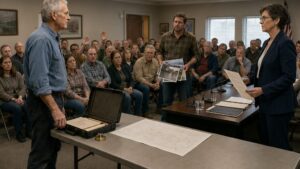
Sharon Taylor began the meeting by projecting a photograph of Gary’s half-dismantled ramp onto the wall and calling it an unauthorized exterior structure.
The room went still in the particular way rooms do when people know someone is being made an example of and are relieved it is not them. Folding chairs filled the community suite at the end of the new commercial row. Through the windows behind the board table, Gary could see storefront lights glowing against the early evening, each empty shop polished for opening day.
Carolyn had insisted on coming.
Gary had argued once, then stopped when she rolled herself to the truck door and waited for him to set the portable ramp. Now she sat beside him in the front row, her hands folded, her face turned toward the projection where their front door looked like evidence.
Sharon stood beside the screen in the same purple suit, a laser pointer in one hand and a stack of documents in the other.
“The issue before the board,” she said, “is not whether the association is sympathetic to personal circumstances. The issue is whether residents may install unapproved structures that interfere with established frontage standards, pedestrian circulation, and association liability.”
Gary felt Carolyn’s hand touch his wrist. Not holding him back. Measuring him.
Sharon clicked to the next slide. A site map appeared, all clean lines and shaded blocks. The fifteen new buildings formed a neat curve along the road. Gary’s house sat at the edge of the drawing like an inconvenience left behind.
A red line cut across his front access.
Gary leaned forward.
“That line is wrong,” he said.
Sharon did not look at him. “Resident comments will follow the compliance summary.”
“You put the line through my walk.”
“Mr. Walker.”
“That’s not a summary. That’s the mistake.”
A few chairs creaked. Someone whispered near the back.
Pamela Green sat at the board table with a binder open in front of her. She wore a cream blouse and small earrings, and she had the exhausted look of a person who had been adding columns all day. When Gary spoke, her eyes moved to the map, then quickly down to her binder.
Gary noticed.
Sharon continued. “The ramp extends beyond the approved residential threshold and into development common access. The material is unfinished. The slope does not match the final district standard. The rail height has not been certified. The board is therefore within its enforcement authority.”
Gary stood. “My wife uses a wheelchair.”
Sharon’s jaw tightened. “No one is disputing that.”
“You’re disputing her way out of the house.”
A board member shifted behind a nameplate. Sharon clicked off the laser pointer.
“You were instructed to submit complete plans before installation.”
“I submitted plans. I sent a doctor’s letter. I sent a contractor’s estimate for the permanent ramp and drainage repair.”
Pamela turned a page too quickly.
Gary saw it. So did Carolyn.
Sharon lifted a document. “The submission lacked final engineering approval and did not resolve the encroachment issue.”
“You never told me there was an encroachment issue until the saw was already cutting.”
“The association posted notice.”
“After the crew started.”
The room stirred. Gary heard a low murmur travel through the chairs.
Sharon looked toward the back where the officer from the morning stood near the door, not officially part of the meeting but present enough to remind everyone where the line was. Then she set the document down with care.
“Mr. Walker, the association is navigating a complex transition between legacy residential parcels and the Greenbrook Village commercial district. We cannot make exceptions that jeopardize insurance approval days before opening.”
Carolyn spoke for the first time.
“Can you say that last part again?”
Sharon blinked. “Excuse me?”
“The part where my front door jeopardizes your opening.”
A silence opened.
Sharon’s face held. “That is not what I said.”
“It’s what the slide says,” Carolyn replied.
Gary looked at his wife. Her voice was quiet, but not fragile. People turned to see her not as the woman in the chair, but as the person who had just cut through the room more cleanly than any saw.
Sharon clicked to the next slide. “Any replacement structure must be reviewed after the district opening inspection. Until then, the property must remain clear.”
Gary felt something in him sink.
“After?” he said. “You mean she waits inside until after you cut the ribbon?”
“That is not the board’s wording.”
“But it is the board’s decision.”
Pamela looked up then. For one second, her eyes met Gary’s. There was something there he did not expect. Not contempt. Not even embarrassment. Fear.
Gary reached into his folder and pulled out the medical letter. He walked to the board table and laid it in front of Sharon.
“Read the second paragraph,” he said.
Sharon did not touch it. “We have reviewed the medical documentation.”
“Then read it out loud.”
“This is not a courtroom.”
“No. In a courtroom, you’d have to answer the timeline.”
The board member beside Pamela whispered something. Pamela shook her head slightly, almost invisible.
Sharon gathered the pages into a stack. “The board will not be pressured into unsafe approval.”
“Unsafe for who?” Gary asked.
No one answered.
The vote took less than three minutes. Formal denial pending post-opening review. Temporary removal to continue. No new structure permitted until site compatibility could be determined.
Carolyn did not move when the decision was read. Gary wanted her to look at him, to give him an instruction, but she kept her eyes on the projected map.
After the meeting, residents avoided him in little currents, slipping around the chairs, pretending to check phones. Gary stayed near the front, staring at the red line across the screen while Sharon spoke with the officer near the door.
Pamela closed her binder.
Gary stepped toward her. “You knew something was wrong with that map.”
She pressed her lips together. “Mr. Walker, I can’t discuss board materials outside procedure.”
“You looked like you’d seen that line before.”
“I’ve seen many site plans.”
“My father poured that walk.”
Her hand tightened on the binder. “Old use and recorded control are not always the same thing.”
“That sounds rehearsed.”
“It sounds like a warning.”
Gary stared at her.
Pamela glanced toward Sharon, then lowered her voice. “Look at your closing documents. Not the tax map. The sale documents. The reservation language.”
“What reservation language?”
But Pamela had already stepped away.
Gary returned to the screen. The map was still projected on the wall, bright and clean and wrong. The red line did not just cross the ramp. It crossed the narrow strip between his porch and the road, the strip he had never thought to defend because he had never thought anyone could rename it out from under him.
Carolyn rolled up beside him.
“Gary,” she said.
He pointed at the screen, his finger stopping where the line swallowed the front walk.
“When I sold the acreage,” he said, barely above a whisper, “I kept access.”
Carolyn looked at him.
He had not said those words to her in years. Not because they were secret exactly, but because they led back to hospital bills, signatures, the closing table, the way he had smiled afterward and told her they would still have the house, as if the land had not been part of the life he thought he was supposed to protect.
On the wall, their home sat beside fifteen perfect buildings.
And the strip he had kept was missing.
Chapter 4: The Old Deed Said The Line Was Never Theirs
The county copy had a sentence Gary did not remember signing, and the clerk at the records counter had circled it in pencil before sliding the page back beneath the glass.
Reserved for Grantor: a perpetual access and drainage strip twelve feet in width along the eastern residential frontage.
Gary read it once standing up. Then he sat down in the plastic chair behind him and read it again.
The clerk watched him over the partition. “That language is old enough that I’d want a surveyor to interpret it.”
“It says reserved.”
“It does.”
“It says perpetual.”
“It does.”
Gary put one finger on the page, as if the sentence might move if he did not hold it there. The paper smelled faintly of toner and dust. At the bottom was his signature from years ago, heavier than the one he used now, the G in Gary looped hard, like a man trying to prove he meant what he was selling.
He had sold acreage. Not the house. Not the walk. Not the strip that carried rainwater away from the porch and gave them room to come and go. That was what he had told himself at the closing table while Carolyn was in rehab and the bills had stacked up in envelopes he could no longer open without feeling heat behind his eyes.
The clerk made another copy. “This doesn’t automatically settle anything.”
“I know.”
“The association will say the newer plat controls.”
“Can it?”
“That depends on whether this reservation was carried forward properly.”
Gary looked up. “And if it wasn’t?”
The clerk’s face softened in the careful way people softened when they knew the answer would not help enough. “Then you’ll need someone to make them look at it before they close out the development.”
Outside, he sat in the truck with the copy on the steering wheel. Across the county parking lot, a delivery truck idled. Gary could see the faint imprint of his wedding ring where his hand pressed the page flat.
He called Carolyn.
“Did you find it?” she asked.
“I found something.”
“That is not an answer.”
“It’s the strip. Access and drainage. Twelve feet.”
She was quiet for a moment. “You kept it.”
“I thought I did.”
“You did,” she said.
He closed his eyes, but only for a second. “The clerk says the newer plat may have swallowed it if nobody carried the language forward.”
“Did you know?”
“No.”
“Gary.”
“I didn’t know, Carolyn.”
“I’m not asking because I think you hid it from me. I’m asking because you hide shame like other people hide money.”
He looked through the windshield at the copy shop across the street, at the reflection of his own truck in the glass. “I sold most of it because we needed the bills paid.”
“I know why you sold it.”
“I told you we were fine.”
“We were not fine. We were alive.”
He rubbed his thumb over the old signature. “There’s a difference between giving up land and having someone pretend you gave up the way to your own front door.”
“Then come home and say that out loud.”
Before he did, he drove to the edge of the development.
The plaza was louder than it had been the day before. Workers carried folding chairs from a box truck. A crew unrolled red carpet at the entrance to the main walkway. Crates of balloons sat beside two posts where the ceremonial ribbon would hang. Red, white, and blue plastic curled out of the crates like bright rope.
Beyond the plaza, Gary’s house sat low and stubborn behind a line of temporary fencing. His front access ran at an angle the new drawings pretended was clean. On the ground near the curb, a fresh red survey ribbon had been tied to a stake. It fluttered only a few yards from the place his ramp had been cut.
Donald Moore stood near the fencing, talking to one of his workers.
Gary parked and walked over with the deed copy folded in his hand.
Donald saw him coming and looked away first. That told Gary enough.
“You scheduled that crew before the notice,” Gary said.
Donald glanced toward the plaza. “Mr. Walker—”
“Don’t call me that if you’re going to lie after it.”
Donald’s face flushed. He dismissed the worker with a nod, then lowered his voice. “We got the work order the day before.”
“The notice was posted after you started.”
“I didn’t post it.”
“You knew?”
“I knew we were supposed to be there at eight.”
“And you said nothing.”
Donald shifted his weight. “I run crews. I don’t review HOA process.”
“You review enough to know when a job smells wrong.”
Donald looked toward Gary’s house. “They told us it was a noncompliant decorative platform.”
Gary almost laughed. “Decorative.”
“I saw the chair when your wife came to the door.”
“And then you kept loading boards.”
Donald looked down at his clipboard. “Mrs. Taylor was standing there. The officer was standing there. My men were standing there. You think I could just tell everybody I had a feeling?”
“I think you could have stopped cutting.”
Donald took that without answering.
Gary unfolded the deed copy and held it out. Donald did not take it, but his eyes moved to the circled sentence.
“Twelve feet,” Gary said. “Access and drainage. That’s where the ramp sits.”
Donald swallowed. “That explains the drainage trench.”
“What drainage trench?”
Donald pointed toward the new sidewalk. “Behind the curb. They had us pour around an old low run, but the plans called it common frontage. There was a note on one version about legacy drainage. It disappeared on the final.”
Gary felt the ground shift under a memory: his father with a shovel after a hard rain, cutting a shallow run so water would not pool at the porch. Carolyn planting marigolds beside that same slope. Himself patching the concrete years later and never thinking a developer’s line could rename water.
“Who removed the note?”
Donald shook his head. “I don’t know.”
“Who had the version with the note?”
“Transition committee. Board. Engineer. I only saw it because my crew had to set forms.”
“Was Pamela Green on that committee?”
Donald’s silence answered before his mouth did.
“She signed payment approvals,” he said finally. “That’s all I know.”
Gary folded the copy and started back to the truck.
Donald called after him, “Mr. Walker.”
Gary stopped.
“The deed won’t stop tomorrow by itself.”
“I know.”
“They’ll say it’s ambiguous.”
“I know that too.”
Donald looked at the red ribbon crates, then at Gary’s house. “If you have a surveyor, bring one. If you don’t, bring everything old you’ve got.”
At home, the garage smelled of sawdust and old cardboard. Gary pulled boxes from the metal shelves he had meant to clean for six years. Carolyn waited in the kitchen, refusing to sit back from the work. He brought her papers in batches: closing statements, tax maps, old insurance drawings, his father’s receipts from concrete work, a faded photograph of the house before the development road had been widened.
Carolyn held the photograph longer than the others.
“There,” she said.
Gary leaned over her shoulder. In the photograph, the front walk curved toward the road, bordered by two wooden stakes with light-colored ribbon tied between them.
“Your father marked it?” she asked.
“For drainage. Access too.”
“You kept more than you remembered.”
He put both hands on the back of her chair and lowered his head. “I sold it because I thought the land mattered less than you.”
Carolyn turned enough to look at him. “I never asked you to weigh me against dirt.”
“I know.”
“Do you?”
The question stayed between them.
Before he could answer, his phone buzzed.
The message came from the HOA office. Sharon Taylor’s name appeared above a short notice requesting immediate signature. Attached was a temporary accommodation agreement. Gary opened it with Carolyn watching.
The first paragraph granted emergency permission for a temporary ramp replacement after the ribbon-cutting, subject to board-approved materials.
The second paragraph released any claim to the disputed access and drainage strip.
Carolyn read it before he could move the phone away.
Gary heard the small intake of her breath.
Sharon called ten seconds later.
He put it on speaker.
“Mr. Walker,” she said. “This is the fastest path to restoring access for your wife.”
Gary stared at the cut ramp board leaning against the kitchen wall.
“And the strip?”
“A legal clarification. The development cannot proceed under a cloud.”
“My wife can’t leave the house.”
“Then sign the agreement. We can authorize a temporary compliant ramp after opening review.”
Carolyn’s hand closed around the wheel of her chair.
Gary looked at the old photograph, the circled deed language, and the phone glowing on the table.
Sharon’s voice came through smooth and certain.
“You can have the ramp, Mr. Walker. But not the claim.”
Chapter 5: He Walked Through The Ribbon Ceremony Carrying One Broken Board
Gary stepped into the center aisle of the ribbon ceremony while the oversized scissors were already open.
For one long second, the whole plaza seemed to hold its breath around the shape of him: red-and-black plaid shirt, worn boots, brown folder under one arm, and a broken ramp board gripped in his right hand like something pulled from a wreck. The red-white-blue balloon arch swayed over the stage. Fifteen storefronts shone behind it, their windows polished so clean they reflected the seated crowd.
Sharon Taylor stood at the ribbon in her purple suit, smiling for three cameras.
Then she saw him.
Her smile did not fall. That was the impressive part. It hardened into something meant to survive photographs.
Gary kept walking.
A man near the aisle reached as if to stop him, then thought better of it. Heads turned in rows. Storefront tenants in new blazers stared over their programs. A child holding a small flag lowered it into their lap. The officer from Gary’s yard stepped away from the side of the stage, his eyes already fixed on Gary’s hands.
Gary lifted the board slightly.
“It’s wood,” he said before the officer reached him. “Not a weapon.”
“Mr. Walker,” the officer said quietly, “this is not the place.”
Gary looked at the ribbon stretched behind him. “That’s exactly why it is.”
Sharon came forward with a folded program in one hand and the blue folder in the other. Up close, he could see the makeup at the corner of her mouth had cracked from holding the smile too long.
“This is a private association event,” she said. “You need to leave.”
Gary looked past her at the stage table where ceremonial plaques waited beside bottled water. “Private? You invited the county, the tenants, the cameras, and half the neighborhood.”
“You are disrupting a permitted opening.”
“You sent a crew to my property before my appeal was over.”
Her eyes flashed toward the officer. “He is trespassing.”
The officer moved closer. “Sir, if you refuse to leave—”
Gary set the broken board down on the stage table before anyone could grab it.
The sound was not loud, but it carried. Wood on polished folding table. Several people in the front row flinched as if it had been a gavel.
Beside the board, Gary placed the deed copy, the notice with its timestamp, and a photograph of Carolyn in the doorway behind the half-cut ramp. He did not place the medical letter on top. He had promised Carolyn he would not make her diagnosis the spectacle if he could make the board answer the procedure first.
Sharon reached for the papers.
Gary put one finger on the board. “Leave them where people can see.”
“This is inappropriate.”
“You cut this from a wheelchair ramp three days before opening these buildings.”
A murmur moved through the crowd.
Sharon turned, chin high. “The association removed an unapproved structure that interfered with district frontage and access standards.”
Gary pointed to the deed copy. “That frontage includes a strip reserved to my property for access and drainage. Your map erased it.”
One of the storefront tenants stood halfway from his chair. “What does that mean for occupancy?”
Sharon’s head snapped toward him. “It means nothing. This is a private dispute being misrepresented.”
Gary heard the fear under that sentence. Not fear of him. Fear of the tenants hearing words like access, drainage, reserved, erased.
He opened his folder and pulled out the enlarged copy of the site map from the board meeting. He held it up so the front rows could see the red line cutting across his walk.
“My wife uses a wheelchair,” he said. “The ramp they cut down sits here. The strip they say belongs to them is the same strip this development needs to call its frontage clean.”
Sharon stepped closer. “You are using your wife’s condition to create public pressure over a property claim.”
Gary almost answered too fast. Carolyn’s warning from the kitchen came back to him: I don’t want you fighting like I’m the sad part of the story.
He lowered his voice.
“No,” he said. “I am using your public ceremony to ask the question you refused to answer in private.”
The officer looked from Sharon to Gary. His hand rested near his belt, but he did not touch it.
“What question?” he asked.
Gary turned the phone in his pocket so the recording app kept running. Then he faced Sharon.
“Who authorized removal before the appeal window closed?”
The plaza went quiet enough for Gary to hear balloons rubbing against their strings.
Sharon looked at the board on the table. “The enforcement action was properly noticed.”
“That wasn’t my question.”
“The structure posed a liability.”
“That wasn’t my question.”
“The board cannot allow individual homeowners to jeopardize a multi-year development project days before opening.”
There it was. Not cruelty. Not even hatred. A project. A schedule. A row of clean buildings that mattered more, in Sharon’s mouth, than a front door.
Gary picked up the notice. “This was posted at 8:42. My video shows Donald Moore’s crew cutting at 8:31. You know that. Donald knows that. Your office knows that.”
A woman in the crowd whispered, “Before the notice?”
Sharon’s face had gone pale beneath the careful makeup. “Mr. Walker is presenting selected information.”
Gary placed the old photograph beside the notice. The one where his father’s stakes marked the front strip.
“Then present the rest.”
A board member rose from a chair near the stage. “President Taylor, we should take this inside.”
Sharon did not move.
“Now,” the board member said, lower.
Gary saw Pamela Green seated at the end of the front row, half-hidden behind a tenant with a camera. She had not been on the stage. Her binder rested in her lap, both hands flat on top of it. Her eyes were fixed on the broken board.
“Pamela,” Gary said.
Her head lifted.
“You signed payment approvals on the frontage work.”
Sharon turned sharply. “Do not address individual board members.”
Gary did not raise his voice. “Did the board know my appeal window was still open when the crew came?”
Pamela’s mouth parted, then closed.
Sharon stepped between them. “This is not an evidentiary hearing.”
“No,” Gary said. “It’s a ribbon-cutting.”
He reached down and lifted the ceremonial ribbon from where it ran across the front of the stage, not pulling it loose, just raising the red fabric a few inches. Beneath it, the broken ramp board lay across the table beside the map.
“This ribbon opens fifteen buildings,” he said. “That board was my wife’s way out of one house.”
No one clapped. Gary was grateful for that. Applause would have turned it into something cleaner than it was.
The officer moved to the table and looked at the documents without touching them. “Mrs. Taylor, is there a scheduled appeal?”
Sharon said, “There was an incomplete accommodation request.”
“Was there an appeal period?”
“Officer, this is civil procedure.”
“Was there an appeal period?”
Sharon’s eyes went to Pamela.
Pamela stood.
The binder slipped slightly in her hands. For a moment she looked older than she had the night before, less like a board treasurer and more like a woman who had spent too many nights adding numbers that would not become morals no matter how neatly she arranged them.
“The appeal window was still open,” she said.
The words did not come loudly. They did not need to.
Sharon’s face turned toward her, stunned and furious.
Pamela swallowed. “The removal should not have been scheduled before the close of business tomorrow.”
A tenant cursed under his breath. Someone in the back lifted a phone higher. The ribbon moved in the breeze between its posts, bright and useless.
Gary looked at Pamela, then at Sharon.
He had wanted the moment to feel like victory. Instead it felt like a door opening onto a room he had not known was there.
“What else?” he asked.
Pamela’s fingers tightened around the binder.
Sharon spoke first, each word clipped. “We are moving this discussion inside immediately.”
Gary did not move from the stage table.
Pamela looked at the broken board, then at the site map, then at the fifteen buildings behind Sharon.
Her voice shook once before it steadied.
“The appeal was not the only thing still open.”
Chapter 6: Pamela Had Signed The Map She Could No Longer Defend
Sharon closed the boardroom door so hard the blinds rattled against the glass, then slid a waiver across the table toward Gary as if the paper itself could push him back into silence.
“Sign it,” she said. “You will have temporary ramp authorization by tomorrow afternoon.”
Gary did not touch the page.
The boardroom smelled of new carpet and overheated electronics. Through the interior window, the ribbon ceremony had broken into clusters of anxious conversation. A few guests still stood near the stage. The broken ramp board was now leaning against the wall beside Gary’s chair because he had refused to leave it outside.
Pamela sat at the far end of the table with her binder closed. She had not spoken since the sentence that stopped the ceremony.
Carolyn was not in the room. Gary had left her at home only after she made him promise to call before signing anything. That promise sat heavier than the folder on his lap.
Sharon tapped the waiver. “This resolves the immediate access concern.”
“It resolves your opening problem.”
“It allows your wife a ramp.”
“Temporary.”
“Subject to approved materials and inspection.”
“And in exchange, I release the access and drainage strip.”
Sharon’s face tightened. “You acknowledge the association’s current plat.”
“Your current plat is the problem.”
“The plat was approved through proper channels.”
Gary looked at Pamela. “Was it?”
Pamela did not lift her head.
Sharon leaned forward. “Mr. Walker, every hour this remains unresolved creates exposure. Tenants are asking questions. The county representative left before the photographs. Insurance review is pending. We are trying to offer you a practical solution.”
“A practical solution for who?”
“For everyone.”
“No,” Gary said. “Everyone is what people say when they don’t want to name who pays.”
For the first time that day, Sharon’s composure cracked into something almost honest. “Do you understand what happens if the development closeout is delayed? Storefront leases trigger penalties. Assessments hit residents. Contractors file claims. People who had nothing to do with your ramp get bills they cannot afford.”
Gary sat back.
There it was again. Not apology. Not admission. But a reason with weight. He could almost see how Sharon carried it: fifteen buildings, lenders, tenants, residents, board minutes, insurance deadlines, every promise tied to a date on a calendar. He could see it and still not let it excuse the saw in his handrail.
“You thought making my wife wait was cheaper,” he said.
Sharon looked away.
Pamela flinched.
Gary turned to her. “Tell me what was still open.”
Pamela opened the binder slowly. Inside were tabs, payment sheets, copied maps, committee notes. She pulled one page free and set it on the table between them.
It was an earlier site plan. Near Gary’s house, in small gray type, was a note: legacy access/drainage reservation to be verified before final frontage approval.
Gary stared at it.
“Who removed that note?”
“No one removed it from the file,” Pamela said.
“That’s not what I asked.”
Her lips pressed together. “The final presentation map didn’t include it.”
“Who signed the final presentation map?”
Pamela looked at the page as if it had accused her by name. “I did.”
Sharon turned. “Pamela.”
“No,” Pamela said, softly at first. Then stronger. “He asked.”
Gary waited.
Pamela folded her hands on the binder. “We were told the reservation language was ambiguous. The engineer said the strip had been functionally incorporated into the frontage plan and could be reconciled after opening if necessary.”
“If necessary,” Gary repeated.
“I asked whether it affected residential access.”
“And?”
“I was told the Walker property had alternate step access.”
Gary felt the words move through him slowly, like cold water under a door.
“Step access,” he said.
Pamela’s eyes finally met his. “I did not know about Carolyn then.”
“You knew before the crew came.”
She looked down.
Sharon said, “The accommodation request was incomplete.”
Pamela’s face hardened, not at Gary, but at the sentence. “It was incomplete because we marked it that way.”
The room changed.
Gary heard the ceremony noise outside fade under the pulse in his ears.
Pamela continued, each word costing her. “The request included the doctor’s letter, sketch, and contractor estimate. It did not include final engineering because the property line question was unresolved. We categorized it as incomplete rather than triggering the accommodation timeline.”
Gary looked at Sharon. “You used the missing answer to block the request.”
Sharon stood. “We categorized it according to process.”
“You created the process problem.”
“We were protecting the association.”
“You were protecting the ribbon.”
Sharon’s hand came down on the table, not hard, but enough to stop Pamela from speaking again. “Do not reduce this to ceremony optics. I have residents who will be assessed thousands if this project stalls. I have business owners who signed leases. I have contractors threatening delay claims. I have an insurer who will not bind coverage over unresolved access and drainage. Yes, I pushed for clean closeout. That is my responsibility.”
Gary looked at the broken board beside the wall. “And Carolyn’s front door?”
Sharon did not answer.
His phone buzzed. Carolyn.
He answered and put it to his ear.
“Did they offer it?” she asked.
“Yes.”
“What do they want?”
“The strip.”
A pause. Then: “Come home.”
“Carolyn—”
“Bring the paper. Do not sign it in that room.”
Gary looked at the waiver. Sharon watched him like someone watching a candle burn near dry curtains.
“I can get the temporary ramp by tomorrow,” he said into the phone.
“At what price?”
He did not answer.
Her voice softened, but it did not weaken. “I will not have a doorway bought with the same silence that let them cut it apart.”
Gary closed his eyes.
He saw the hospital bill envelopes. The closing table. His own hand signing away acres while telling Carolyn they were fine. Years of mowing up to a line he never marked again because he could not bear to look at what was gone. The ramp he built before approval because asking one more time felt like begging. The board he brought to the ceremony because wood was easier to carry than shame.
When he opened his eyes, he was still in the boardroom, and Sharon’s waiver still waited.
Gary ended the call and set the phone down.
“No,” he said.
Sharon’s expression went still. “Think carefully.”
“I have.”
“This offer may not remain available.”
“Then withdraw it.”
Pamela drew a breath.
Gary stood and picked up the broken board. “I’m requesting an emergency site hearing. At the property. With the city clerk, the board, Donald Moore, the officer if he wants to watch, and every version of that map.”
Sharon’s voice dropped. “You are making this harder than it needs to be.”
Gary looked at the waiver one last time.
“No,” he said. “I made it quiet too long. That’s how it got this hard.”
He walked out with the board under his arm, past the window where the ribbon still hung uncut between fifteen buildings, and did not look back when Sharon called his name.
Chapter 7: The New Ramp Was Built Where The Old Line Finally Spoke
The city clerk placed a metal stake into the ground where Gary’s ramp had been cut apart, and the whole board watched the red survey ribbon twitch against the handle of her measuring wheel.
No one sat. There were no microphones, no stage table, no balloon arch. The emergency site hearing stood in Gary’s front yard with the old porch at their backs and the fifteen new buildings shining across the road like they had been polished for a different story.
Donald Moore’s crew waited beside their truck, tools quiet. The officer stood near the curb, hands loose at his belt. Pamela Green held the earlier site plan in a clear folder. Sharon Taylor wore a gray suit this time, not purple, and her shoes sank slightly into the soft strip beside the walk.
Carolyn waited at the threshold.
Gary had wanted her inside until it was over. She had said nothing, only rolled herself to the open door and set the brakes. That was the end of the argument.
The clerk checked the old deed copy, then the newer plat, then the tape stretched from the porch corner to the stake.
“Twelve feet from residential frontage,” she said.
Sharon folded her arms. “With respect, that language predates the development district.”
“It does,” the clerk said. “It also predates the plat that treated this strip as common access.”
“Which was approved.”
“Conditionally,” Pamela said.
Sharon turned toward her.
Pamela did not look away this time. “The closeout checklist required verification of legacy access and drainage reservations.”
The clerk nodded once. “That is what my office found.”
Gary felt the words land, but he did not let himself move too soon. One sentence would not rebuild wood. One sentence would not carry Carolyn down the steps.
Sharon took a breath through her nose. “The association is prepared to approve a temporary accommodation while the legal language is reviewed.”
“No,” Gary said.
Every face turned to him.
He held the broken board from the ceremony under one arm. The cut end had darkened in the week since the saw first bit into it. He had brought it because he wanted them to see what procedure looked like when it passed through wood.
Sharon’s mouth tightened. “Mr. Walker, temporary approval gets your wife access today.”
“Temporary approval lets you remove it again next month.”
“That is not what I said.”
“It’s what the paper would let you do.”
The officer glanced at the clerk, then at Sharon. Donald looked down at his boots.
Gary walked to the edge of the strip and pointed to the shallow run where rainwater had always moved away from the house. “The permanent ramp goes here. The drainage repair goes here. The handrail stays inside the access strip. Materials match the house, not the storefronts, because this is still a home.”
Sharon looked across the road at the buildings. A few tenants stood near their windows, watching through glass.
“You are asking the board to acknowledge a permanent encumbrance across district frontage,” she said.
“I’m asking the board to stop pretending my front door is district frontage.”
The clerk bent and marked the ground with temporary paint. A thin white line appeared in the grass, plain and almost unimpressive. Gary stared at it. After all the slides and maps and threats, the truth looked like a stripe someone could step over.
Carolyn’s voice came from the doorway.
“May I say something?”
Gary turned so fast the board in his arm knocked against his hip.
Sharon opened her mouth, then closed it.
Carolyn released the brakes and rolled forward until her front wheels touched the place where the ramp used to begin. She could go no farther. The porch dropped just enough to stop her, just enough to make the argument visible without a word.
“I have listened to people discuss whether I need a temporary accommodation,” she said. “I do not need a favor. I need the entrance to my home to function.”
No one moved.
Carolyn looked at Sharon, not angrily, but directly. “I did not become part of a commercial district because someone drew a cleaner map. I did not become a liability because I cannot use stairs. And I am tired of being spoken about as if access is something generous people provide when schedules allow.”
Gary swallowed and looked down at the broken board.
For days, he had carried shame like another document. Shame over the sale. Shame over building before approval. Shame over letting Carolyn become the reason in every sentence because he had been too proud to say he was scared. Now she had said the thing he had circled around.
The clerk shut the deed folder. “My recommendation is immediate suspension of the violation, temporary field authorization for safe access today, and written board correction recognizing the unresolved access and drainage reservation before final development closeout.”
Sharon’s face changed at the last phrase. “Final closeout cannot be held hostage.”
“It is not being held hostage,” the clerk said. “It is being corrected.”
Pamela looked at Gary. “The treasurer’s office can authorize payment for replacement of the removed materials.”
“No,” Gary said.
Pamela blinked.
Gary touched the broken board. “You don’t buy the mistake and own the meaning. Donald’s crew can rebuild what they cut, and the association can pay the contractor for the permanent plan already submitted. But this board stays with me.”
Donald stepped forward. “I can have temporary rails in by this afternoon and coordinate with the contractor for the permanent build.”
Sharon looked at him. “You are not authorized to commit—”
“I’m authorized to state what my crew can do safely,” Donald said. His voice was quiet, but it held.
The officer looked almost relieved.
Sharon stood with the folder pressed against her side. For a moment Gary saw the woman behind the title: tired, cornered, calculating the cost of every admission against every resident who would blame her for it. Then she looked at Carolyn at the threshold, and whatever defense she had prepared did not come out.
“The violation is withdrawn pending corrected documentation,” Sharon said. “The board will approve the access repair under revised site terms.”
“Permanent,” Gary said.
Sharon’s jaw worked once. “Permanent, subject to code inspection.”
“And the strip?”
“The access and drainage reservation will be noted in the development closeout file.”
The clerk added, “And on the corrected association map.”
Gary looked at Pamela. She gave a small nod, not asking forgiveness with it.
Work began before noon. Donald’s crew did not use the saw until Gary handed him the new boards. The sound still made Carolyn flinch, but this time the blade cut clean lengths for the replacement frame. The red survey ribbon was moved from the broken handrail to the new stake, then tied where the permanent rail would turn.
Gary worked beside them until Donald said, “Let us do the lifting.”
Gary almost argued. Then he looked at Carolyn, who raised one eyebrow from the doorway.
He stepped back.
By late afternoon, the first new board lay where the old one had been cut away. Gary knelt and set his palm on it before Donald fastened it down. The wood was pale, raw, and ordinary. That was what made it feel right. Not ceremonial. Not dramatic. Just a board where a board was needed.
The permanent ramp took the rest of the week. The drainage run was reopened and lined properly. The corrected map arrived by email with the white strip marked along Gary’s frontage. The fifteen buildings stayed standing. The ribbon across the plaza was eventually cut in a smaller event, with fewer photographs and a revised closeout note filed before anyone smiled for the cameras.
On the morning the final rail passed inspection, Carolyn rolled to the threshold without asking Gary to stand behind her.
He did anyway, but not close enough to guide the chair.
She released the brakes. Her wheels moved onto the new ramp, over the first board, then the next. The rail caught the light. The red survey ribbon, still tied to the end post, fluttered once and went still.
At the bottom, Carolyn turned her chair toward the road, toward the buildings, toward the thin strip of ground that had finally been named correctly.
Gary stood on the porch with the broken board leaning against the brick behind him.
Carolyn looked back and said, “Are you coming?”
For the first time in a week, Gary did not reach to push her chair.
He stepped onto the ramp beside her.
The story has ended.