The HOA Sent a Crew to Tear Down the Ramp Before His Mother Could Leave
Chapter 1: The Crew Was Already Pulling Up the Ramp
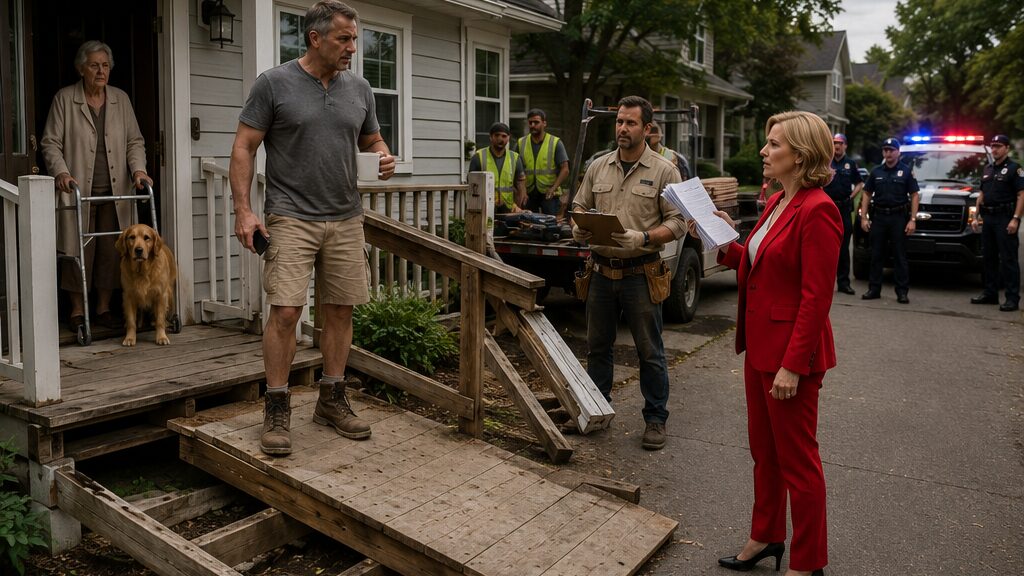
The power tool was already whining against the front ramp post when John Carter opened the door with his white mug still in his hand.
For one second he did not move. The sound cut through the morning harder than any knock could have. At the bottom of the porch, a worker in safety glasses leaned into a drill, shoulder tight, metal bit chewing around the bracket John had installed two weeks earlier. Another worker had already stacked two loosened boards against the side of a pickup truck.
The golden dog stood beside John’s knee and gave one uncertain bark.
“Stop,” John said.
The drill kept going.
John stepped onto the porch. The old wooden steps sat to his right, narrow and gray at the edges, still damp in the grooves from the last washing. The new ramp had been built over the left side, simple and plain, pressure-treated lumber, a handrail sturdy enough for a person who needed both hands. It was not pretty. It was safe.
The worker looked up only when John came down the ramp far enough to cast a shadow over the post.
“Sir, please stay clear of the work area.”
“This is my porch.”
A woman’s voice answered from the driveway before the worker could. “And this is an authorized enforcement action.”
Amanda Perez walked around the front of a parked police SUV as if the flashing lights belonged to her. Her red suit was bright enough to look staged against the beige houses and clipped lawns of the subdivision. She held a thick packet of papers against her chest with one hand and pointed with the other.
Behind her, two officers stood near the SUV. They were not reaching for anything. They were watching. That was almost worse. Their presence made the morning feel official without making anything clear.
John took a sip from his mug before he spoke. The coffee had gone lukewarm.
“Amanda,” he said, “tell your crew to stop.”
She glanced toward the workers. “Daniel, continue.”
The crew supervisor, a man with a clipboard tucked under his arm, looked from Amanda to John. He did not restart the tool, but he did not step away either.
John set his mug on the porch rail.
Amanda lifted the packet. “You were notified that this exterior structure is non-compliant. You ignored the violation. You ignored the board’s direction. You continued to maintain an unauthorized alteration on association-regulated property.”
“My property,” John said.
“Association-regulated exterior property,” Amanda corrected. She said it smoothly, as if she had practiced the phrase in a mirror.
John pulled his phone from his pocket and started recording. He did not raise it in her face. He held it low, angled toward the ramp, the truck, the officers, the red suit, the papers.
Amanda’s expression tightened. “You can record. That doesn’t change the governing documents.”
“No,” John said. “But it may help everyone remember what happened first.”
The worker nearest the post shifted his drill to his other hand. Daniel took a half step forward. “Sir, we were told this removal was cleared.”
“By who?”
“The association.”
John looked at Amanda. “Do you have a court order?”
Amanda opened the packet as if the answer was heavy enough to need both hands. “We have a final enforcement notice, contractor authorization, and documented violations dating back—”
“Court order,” John said. “Not a packet. Not a board vote. Not a letter you left on a door. A court order.”
One of the officers glanced toward Amanda then back to John. The movement was small, but John saw it.
Amanda did too. She drew herself taller. “Mr. Carter, the HOA has enforcement rights over exterior structures. You are past the cure period. At this point, accumulated fines and enforcement costs may be assessed against your account. If you continue obstructing removal, the association can move forward with additional remedies, including lien action.”
“There it is,” John said quietly.
“There what is?”
“The part where you try to make it sound like you own my house.”
Amanda’s finger came up. “Do not mischaracterize this. Your deed restrictions are clear. When you bought in this community, you agreed—”
“When I bought in this community,” John said, “I agreed not to paint my garage purple and park a boat on the lawn. I didn’t agree to let you tear out a medical access ramp while someone inside the house needs it.”
The word medical landed in the driveway without drama. It did not make Amanda soften. It made her blink once, fast.
“That was not included in your approved request.”
“My request has not been approved or denied properly.”
“It was incomplete.”
“It was pending.”
“You began construction.”
“Because waiting was unsafe.”
The dog gave another low bark from the doorway. John glanced back. The front door stood open behind him, dim hallway beyond it. He had meant to be in the kitchen for five minutes before helping his mother with her coat. He had meant to drive her to the appointment she had refused to call important because she did not want him worrying.
The drill whined again.
John turned before Amanda could speak. “Stop the tool.”
The worker froze, bit hovering over the bracket.
Amanda snapped, “Daniel.”
Daniel raised a hand to his crew. “Hold up.”
Amanda stared at him. “That is not your call.”
“It is if he’s standing in the work zone,” Daniel said.
“I’m standing on the ramp my mother uses to leave this house,” John said.
The officers heard that. The workers heard it. A neighbor across the street had stopped pretending to water a plant.
Amanda’s mouth pressed into a line. “You are escalating this unnecessarily.”
John almost laughed, but he did not. He looked at the loosened boards leaning against the truck, then at the empty notch where the first section of handrail had already been removed. The damage was not huge yet. That was the dangerous part. It was enough to make the ramp unsafe without being enough to look cruel in a photo.
He stepped down one careful board, placing himself between the workers and the remaining rail.
Amanda took two brisk steps toward him. “Mr. Carter, if you do not move, I will ask the officers to intervene.”
John raised his phone just enough to catch her face and the police lights behind her.
“Then say it clearly,” he said. “Say you want police to remove me so your crew can tear out the only safe way my mother gets through that door.”
For the first time, Amanda looked toward the open doorway.
No one appeared there. Only the dog, ears high, body tense.
Daniel lowered his drill to the ground.
Amanda flipped through her papers with sharp fingers. “This is a non-compliant structure. It changes the exterior appearance. It was installed without final approval. It creates potential liability for the association.”
John nodded once. “Good. Now put that in writing next to the part where you explain how she’s supposed to get down those steps.”
Amanda’s eyes hardened. “Your personal circumstances do not exempt you from the process.”
“No,” John said. “They are why the process exists.”
For a few seconds, all that moved was the flashing blue-and-red light against Amanda’s papers. John could hear the engine of the crew truck idling. He could hear the dog breathing behind him. He could hear, from inside the house, the faint metal click of a walker being shifted on the floor.
Then his mother’s voice came from the hallway, thin but clear.
“John?”
He turned his head but not his body.
“Is the ramp still safe enough to use?”
Chapter 2: The Notice on the Door Came Too Late
Carol Carter was waiting in the hallway with her coat buttoned wrong and one hand wrapped around the black handle of her walker.
John had seen his mother face surgery with less worry than she showed looking at the gap in the ramp rail. She stood just behind the threshold, chin lifted, gray hair brushed carefully back as if presentation could hold back humiliation. The dog had pressed himself against her shin.
“Don’t step out,” John said.
“I can see that.”
Her voice was dry, almost normal. That made it worse.
Behind John, Amanda was still speaking to one of the officers in a low, controlled tone. Daniel’s crew had backed away from the ramp but remained on the driveway, tools out, truck gate down, two boards already loaded halfway in.
Carol looked past John to the red suit and the police SUV. “Are they here because of us?”
“No,” John said. “They’re here because Amanda wanted this to look settled.”
Carol’s eyes flicked to the old steps on the right side of the porch. Three steps. They had been ordinary for twenty years. Since her hospital stay, they had become a wall with edges.
“I can try the steps,” she said.
“You’re not trying the steps.”
“I have an appointment.”
“You have a ramp that somebody half tore apart.”
She tightened her mouth. “I don’t like being talked about as if I’m furniture that needs moving.”
John lowered his voice. “I know.”
But he had done exactly that in the driveway, hadn’t he? My mother uses this. Someone inside needs it. He had said enough to stop the tool, not enough to make her visible.
He turned back toward Amanda. “We’re going inside. Nobody touches anything else.”
Amanda’s eyes sharpened. “The crew will remain until we clarify next steps.”
“Clarify them from the sidewalk.”
Daniel looked relieved when John said it. He waved his workers back another few feet.
Inside, John closed the door but left the front curtain slightly open. The police lights kept flickering through it, red and blue sliding across the hallway wall.
Carol moved slowly back into the kitchen. John followed close without touching her elbow. She hated that. She hated needing help more than she hated pain.
Her purse sat on the table beside a folded appointment card. She had put on lipstick. That detail broke something small in him.
“I’ll call and reschedule,” he said.
“You will not,” she replied.
“Mom.”
“I waited six weeks for that appointment.”
He reached for his phone. “Then I’ll explain.”
“And what will you say? That my son built me a ramp and the neighborhood government came with police to pull it apart?”
The words should have been ridiculous. They were not.
John opened his laptop at the kitchen table. His hands wanted to shake, so he made them do simple things: password, email, search bar, “ramp application.” Carol lowered herself into the chair across from him with the careful anger of someone whose body had made every movement public.
The original email appeared immediately. Sent twenty-seven days earlier.
Temporary safety ramp request for front entrance.
Attached were the contractor sketch, material list, and photos of the porch. John clicked through each file. Plain lumber. Non-slip strips. Removable post bases. He had written what he thought was enough: temporary safety access during recovery period. Built to code. Neutral wood finish. No change to drainage.
He had not written medical accommodation.
He had not attached Carol’s physical therapy recommendation.
He had not used the words mobility limitation or fall risk or post-hospital discharge because Carol had stood behind him that night and said, I don’t want my diagnosis passed around a board table.
So he had protected her. Or he had protected the idea of her he wanted to keep.
“There,” he said, turning the laptop slightly. “I submitted it.”
Carol read the email. She did not look relieved.
“Temporary safety ramp,” she said.
“Yes.”
“That sounds like something for moving furniture.”
He flinched before he could stop himself.
Carol saw it and closed her eyes. “I’m sorry.”
“No. You’re right.”
A knock hit the door, three hard taps.
John stood. “Stay here.”
Amanda’s voice came through the door before he opened it. “Mr. Carter, I am placing a copy of the enforcement notice where you cannot claim it was not received.”
He opened the door.
Amanda was taping a paper to the outside of the frame, above the doorbell, as if she were marking an abandoned property. The officer had stepped back toward the SUV. Daniel watched from the driveway with his clipboard hanging at his side.
John looked at the paper. FINAL NOTICE OF NON-COMPLIANT EXTERIOR STRUCTURE REMOVAL.
The date at the top was that morning.
He looked at Amanda. “You started before you served this.”
“We attempted notice previously.”
“When?”
“The association mailed correspondence.”
“Certified?”
Amanda’s eyes moved away for half a second. “Standard notice under the governing documents is sufficient.”
“You taped today’s notice after your crew removed part of the rail.”
“You refused prior compliance.”
“I never received a denial.”
She lifted the packet again. “Your application was incomplete and therefore automatically denied after the review period.”
“That’s not what the rules say.”
“It is how the architectural committee applies them.”
John felt Carol behind him before he saw her shadow. She had come to the hall despite what he asked, walker wheels quiet on the floor.
“John,” she said softly.
He did not turn. “Please stay back.”
Amanda leaned to see inside, and for once her expression wavered. Not sympathy exactly. Recognition. Then she covered it with procedure.
“This is why residents should wait for approval,” she said. “These situations become emotional.”
John stared at her.
“Emotional,” he repeated.
“I mean difficult.”
“No,” he said. “You meant inconvenient.”
Amanda’s cheeks colored. She pulled a second paper from her packet and held it out. “The board has scheduled this item for final enforcement review. You may attend and make a statement.”
John did not take the paper. “Email it.”
“I am handing it to you now.”
“After the crew.”
Her mouth tightened. “You are creating a record that you are refusing documents.”
John took the paper with two fingers.
The crew began loading the loosened board fully onto the truck. Daniel barked, “Leave that one down,” and the worker stopped.
John turned sharply. “That board stays here.”
Amanda said, “Removed material is held pending disposal.”
“It’s my material.”
“It is part of an unauthorized structure.”
He stepped off the threshold, still holding the paper. “Put it back on the ground.”
The worker looked at Daniel. Daniel nodded once. The board came down, leaning against the truck with a hollow knock.
Small victory. Useless victory. Carol still could not cross the threshold.
Back inside, John scanned the notice and compared dates. He pulled up the HOA portal. No denial message. No certified mail tracking. No board minutes. Only his application receipt and a status line that read: Under Review.
Then his phone buzzed.
The text was from Pamela Lewis, the HOA treasurer who lived two streets over. John knew her mostly by wave and mailbox conversations. She had attached a photo of a printed agenda.
Carter Exterior Violation — Final Enforcement.
Below it, in smaller text, was a meeting date.
Yesterday.
John stared at the screen long enough for Carol to notice.
“What is it?” she asked.
John turned the phone toward her.
Carol read it, then looked toward the front door where the taped notice still showed through the glass.
“They decided yesterday?”
John looked back at the ramp board outside, the crew truck, Amanda’s red sleeve flashing past the window.
“No,” he said. “They scheduled final enforcement before they told us there was anything final.”
Chapter 3: The Board Called It a Property Problem
John walked into the clubhouse meeting room while a photo of his ramp filled the projector screen.
For a moment he stopped in the doorway, not because he was surprised to see it, but because of the angle. The photo had been taken from low near the sidewalk, making the ramp look larger than it was, its plain rail cutting across the front of his house like a barricade. The old steps were cropped out. The doorway was cropped out. Carol’s walker was nowhere in frame.
Amanda stood beside the screen in the same red suit, though tonight she had exchanged the thick outdoor packet for a neat red folder. Six board chairs faced a row of folding seats. Half the room turned to look at John as if he had arrived late to his own accusation.
“Mr. Carter,” Amanda said. “We were just reviewing the visual record.”
“I can see that.”
He took a seat in the front row. He had brought a folder of his own, blue and thinner than hers. Inside were the application receipt, photos of the old steps, the contractor sketch, and a printed copy of the portal showing Under Review.
He had not brought Carol’s medical letter.
That stayed at home in the top drawer of the kitchen desk because Carol had folded her hands over it and said, Not yet. Let them follow their own rules first.
Amanda clicked to the next slide. The ramp from another angle. Then another. Each image had a red circle around a bracket, a post, a line where lumber met porch.
“This matter concerns an unapproved exterior modification installed before architectural approval,” Amanda said. “The board has an obligation to enforce community standards consistently. If we allow one resident to make exterior changes without approval, we weaken the governing documents for everyone.”
John watched the screen. He forced himself not to look back at the neighbors whispering behind him.
Pamela Lewis sat at the board table with a ledger binder open in front of her. She did not avoid his eyes, but she did not smile either.
Amanda continued. “There are also insurance considerations. A structure added to an entry point can create liability, especially if not inspected through association-approved channels.”
John raised a hand.
Amanda paused. “Public comment will come after the presentation.”
“It became public when you put my front door on a projector.”
A quiet rustle moved through the room.
Amanda’s expression held, but her finger tightened on the remote. “You will have your opportunity.”
John lowered his hand. He had promised himself he would not get angry in a way that made Amanda’s version easier to believe. Difficult resident. Emotional caregiver. Man who ignored rules and then dared people to stop him.
Amanda clicked again. A screenshot of his application appeared, enlarged. Temporary safety ramp request for front entrance.
“This application was incomplete,” she said. “It did not include final dimensions, finish color, proof of contractor insurance, or medical accommodation documentation.”
John stood. “The dimensions are attached on page two.”
Amanda turned toward him. “Please wait for comment.”
“They’re on page two,” he repeated, opening his folder. “You’re showing page one.”
Pamela leaned toward Amanda’s laptop. “Can we see the attachment?”
Amanda did not move at first. Then she clicked. The contractor sketch appeared. Dimensions along every side. Material list. Removable base detail. Neutral stain note.
The room shifted.
John sat back down.
Amanda recovered quickly. “Even with dimensions, the request was not complete for approval purposes. And work began before approval was granted.”
Pamela folded her hands. “John, did you understand that emergency safety language still required review?”
“Yes,” John said. “That’s why I submitted it before building.”
Amanda said, “Submission is not approval.”
“No,” John replied. “But under review is not denial.”
Pamela looked at him then, more sharply.
John took the portal printout from his folder and held it up. “As of this afternoon, the portal still says under review. I never received the denial letter Amanda says exists. I never received a cure deadline. I received a final notice after a crew had already removed part of the rail.”
Amanda opened her red folder. “A denial letter was prepared and mailed.”
“Prepared or mailed?”
The association attorney, seated along the wall with a laptop, looked up.
Amanda slid a paper from the folder. “Dated last week.”
John stepped forward to accept the copy she offered. The letter said his request had been denied due to incomplete submission and exterior nonconformity. It was dated five days earlier.
There was no postage mark. No certified tracking. No email header. No portal entry.
“This is the first time I’ve seen it,” John said.
Amanda’s voice cooled. “That does not mean it was not sent.”
“No,” John said. “It means you can’t prove I got it before you sent a crew.”
Pamela spoke carefully. “The board has to consider consistency. We cannot have residents installing first and explaining later. One exception becomes a lawsuit from the next homeowner who wants a deck, a shed, a patio cover.”
John turned to her. “My mother doesn’t use a deck to get to her doctor.”
The room went still.
There. Too much and not enough. He had opened the door but not let them see inside. He felt the old instinct rise: protect Carol, protect privacy, don’t let strangers make soft noises over her life.
Amanda used the hesitation. “Again, no medical accommodation documentation was provided with the application.”
John looked at the screen, at the cropped ramp, at the missing steps.
“I asked for temporary safety access,” he said. “I submitted dimensions. I submitted materials. I submitted before building. You can call it incomplete. But you cannot pretend I ignored you.”
The attorney typed something.
Amanda tapped her folder. “The board will take your comments under advisement. Until then, the structure remains unauthorized. Removal may resume if obstruction continues.”
John was about to answer when a man stepped near the side aisle. Daniel Moore, still in work pants, cap in both hands. He looked uncomfortable in the clubhouse light.
“Mr. Carter,” Daniel said quietly.
Amanda turned. “This is a closed board matter after comment.”
Daniel held up his clipboard. “I’m not here to argue. I just thought he should know what’s in the work order.”
John walked toward him.
Daniel lowered his voice, but not enough to keep it from Pamela. “The removal order we got from the association was dated two days before that denial letter.”
Chapter 4: The Old Porch Was Never the Real Issue
Fresh water was running under John’s porch even though the sky had been clear for two days.
He found it by accident the next morning, crouched beside the old steps with his phone flashlight pointed beneath the lowest board. A thin stream crawled through the dirt in a dark line, slipping from the side yard toward the porch footings. It was not enough to flood anything. It was enough to keep wood damp. Enough to soften the bottom edges of the old stair stringer. Enough to turn one ordinary step into something that shifted under weight.
John reached under the porch and pressed two fingers against the wood.
It gave.
He pulled his hand back and stared at the damp grit on his fingertips.
Behind him, the ramp looked worse in daylight. Without the handrail section, it had the embarrassed appearance of something interrupted mid-sentence. The removed board Daniel had left behind rested near the truck marks in the driveway, its screw holes torn wider than they had been when John installed it.
Carol stood just inside the doorway, not outside it.
“You’re going to get splinters,” she called.
“I’ve had worse.”
“That is not a medical argument.”
He almost smiled. Almost.
The dog lay across the threshold as if he had appointed himself a gate. Carol’s walker stood behind him, angled toward the porch but stopped by the missing rail and John’s warning.
John took photos. The wet dirt. The softened wood. The old step edge. The line where the ramp’s base had been secured away from the damaged side. Then he walked around to the side yard.
The common sidewalk behind the row of mailboxes sloped toward his property. He had noticed it before, but only the way a person noticed ordinary flaws in a place he had lived too long to inspect. A shallow landscaping trench ran beside the walkway, filled with decorative rock. Water sat beneath the top layer, hidden until he pressed his boot into it. The stones shifted and a small shine came up around the sole.
The sprinkler heads were not on.
John followed the damp line to the common green strip, then to the plastic utility cover half-buried near the curb. Something underground was leaking, or some drainage system was sending water where it did not belong.
A neighbor across the street slowed beside her mailbox. She looked toward the half-dismantled ramp, then at John crouched beside the sidewalk.
“They finally came after you?” she asked.
John straightened. “You knew they would?”
“I knew Amanda was making noise about it.”
He waited.
The neighbor lowered her voice even though no one was close. “They fixed drainage over on Harris Bend last year. Same kind of pooling. Water got under two front walks. Board didn’t want people making claims.”
John looked down at the wet rock.
“Did they inspect this side?”
“They measured,” she said. “That’s all I saw. A man with one of those wheels. Pamela was with him.”
“When?”
“Spring. Maybe early summer.”
Before Carol’s hospital stay. Before the ramp. Before Amanda called his porch a violation.
John thanked her and walked back to the house with the feeling of a second floor shifting beneath the first. The ramp had not only solved Carol’s access problem. It had kept her away from a step the HOA’s own common-area drainage may have helped ruin.
Inside, he found Carol in the kitchen pretending not to watch him through the window.
“You have that look,” she said.
“What look?”
“The one where you’re deciding whether to tell me something or fix it without telling me.”
He set the phone on the table and turned the screen toward her. “There’s water under the porch. From the side yard. Maybe from common drainage.”
She leaned in. Her face changed when she saw the softened wood. Not fear first. Recognition.
John noticed.
“What?” he asked.
Carol sat back.
“What?” he asked again, softer.
“I thought it was just me.”
He did not like how quiet the room became.
She folded one hand over the other. The skin over her knuckles looked thin in the morning light. “Before the hospital. The week before. I went down those steps to bring in the mail because you were at the store. The bottom step moved.”
John stared at her.
“I caught myself on the post,” she said quickly. “I didn’t fall all the way.”
“All the way?”
“I sat down hard.”
“Mom.”
“It was embarrassing.”
“You were hurt?”
“I was sore.”
“You didn’t tell me.”
“I didn’t want you ripping up the porch because I slipped.”
His jaw tightened. He looked toward the hallway, toward the front door, toward the half-ramp outside. He thought of all the times she had waved him off. I’m fine. I’m old, not glass. Don’t hover.
He had believed her because believing her let him keep treating her like the woman she wanted to be.
“When did you start avoiding the steps?” he asked.
She looked away. “After that.”
“And when the therapist recommended a rail and ramp?”
“She recommended options.”
“She recommended access.”
Carol’s eyes flashed. “Do not make this into me lying.”
“I’m not.”
“You are. In that quiet way you have.”
He stopped.
The dog lifted his head from the doorway.
John sat across from her. He wanted to say that if she had told him, he would have acted faster. But he had acted. He had built the ramp. He had just done it with half the truth written down because both of them were trying to preserve a version of life that had already changed.
“I didn’t want them talking about me,” Carol said.
“I know.”
“You don’t know. You can guess. You can be kind about it. But you don’t know what it feels like when your own front steps become a public discussion.”
John looked at his phone, at the photo of the wet wood. “They made it public anyway.”
His email chimed.
For a second, neither of them moved.
John opened it.
The subject line was clean and bureaucratic: Notice of Additional Assessment: Obstruction of Authorized Removal.
Amanda’s name appeared under the HOA letterhead. The fine was larger than the original violation. It claimed John had interfered with a lawful enforcement action and increased contractor costs by delaying removal. It warned that continued obstruction could result in further action, including recovery of association expenses.
Carol read over his shoulder.
“She fined you for standing on your own ramp,” she said.
“She fined me for making them stop before they finished tearing it out.”
Carol looked toward the front door.
John scrolled to the bottom. Attached were three photos: John standing between Daniel’s crew and the ramp; the police SUV behind Amanda; the removed rail section circled in red. There was no photo of Carol’s walker. No photo of the old steps. No photo of the wet wood under the porch.
John forwarded the email to himself, then printed it.
Carol watched the paper slide from the printer tray.
“You’re building a file,” she said.
“Yes.”
“This is what I didn’t want.”
He picked up the fine notice and held it beside the photo of the damp stair support.
“No,” he said. “This is what they were counting on.”
Carol touched the table to push herself upright. John started to move, then stopped before helping. She noticed. Her expression softened in a way that hurt more than anger.
At the hallway, she paused, one hand on the walker.
“I didn’t just sit down hard,” she said.
John looked up.
Carol’s eyes stayed on the door. “I fell on that bottom step once. Before the hospital. I hid it because I knew you’d look at the house like it betrayed me.”
Chapter 5: Amanda’s Clean Report Had a Deadline
The settlement offer arrived in a red folder hand-delivered by a courier who would not step past the driveway.
John stood on the porch holding the folder while the man retreated to his car as if the paper might become contagious. Amanda’s name was not on the envelope, but the color was hers. Red suit. Red folder. Red circles around his ramp. Red marks around anything she wanted the board to see and nothing she wanted them to understand.
Inside, the offer was written in the association attorney’s careful language.
The HOA would temporarily pause full removal if John agreed to pay contractor delay costs, remove the existing ramp within ten days, submit a new application, and acknowledge that the previous installation had violated architectural standards. Fines would be held in abeyance as long as he complied.
He read it twice at the kitchen table.
Carol did not ask him what it said. She watched his face.
“They want me to admit fault,” John said.
“For a pause?”
“For a pause.”
She reached for the paper. He gave it to her, then watched her read each paragraph slowly. Her lips tightened at the line about removal costs.
“They broke it,” she said.
“They started to.”
“And you are supposed to pay them for not finishing.”
“That’s the idea.”
Carol set the paper down and pushed it away with two fingers. “No.”
The word was small but clean.
John looked at her.
She lifted one shoulder. “I’m allowed one.”
He folded the offer and put it back in the folder. For years, his mother had taught him not to make decisions while angry. That morning he learned anger could also sharpen things if he did not let it drive.
At the HOA records office, the clerk behind the front desk looked relieved to have something ordinary to do until John gave her the written request.
“I need architectural committee records related to my application, any board communications scheduling enforcement, contractor authorization, and maintenance records for common-area drainage near my property.”
The clerk read the list and swallowed. “That may require board review.”
“I’m requesting access under the governing documents.”
“I understand. It’s just—”
“A lot?”
She looked at him then, tired rather than hostile. “Lately everything is a lot.”
Through the glass wall behind her, John saw Amanda crossing the small office with her phone to her ear. She stopped when she saw him. The red folder under her arm matched the one now sitting on John’s passenger seat.
She ended the call.
“Mr. Carter,” she said, coming into the lobby. “If you have questions about the settlement, the attorney can explain it.”
“I understood it.”
“Then you understand it is an opportunity to reduce further exposure.”
“To who?”
“To you,” Amanda said.
John nodded toward the records request in the clerk’s hand. “Then there shouldn’t be a problem giving me the records.”
Amanda’s gaze moved to the paper. Something small changed in her expression.
“The association is not required to produce privileged communications.”
“I didn’t ask for privileged communications.”
“You asked for contractor authorization and board communications.”
“Meeting notices, decisions, dates, maintenance records. Not legal advice.”
She stepped closer, lowering her voice. “You are turning a correctable violation into something much larger.”
“No,” John said. “You did that when your crew touched the ramp before the notice hit my door.”
The clerk looked down at her desk.
Amanda’s voice thinned. “That structure affects common exterior presentation and insurance review. You keep ignoring that.”
“Insurance review,” John repeated.
Amanda stopped.
He saw it then. Not guilt. Pressure. The look of someone who had been carrying a deadline and resented anyone who made it heavier.
“When is it?” he asked.
“When is what?”
“The review.”
Amanda’s shoulders squared. “Association insurance matters are not your concern.”
“They are if you’re tearing out a ramp to make a report look clean.”
Her face colored, but she did not raise her voice. “Every homeowner in this community pays when risk is mismanaged. Every one. If the carrier sees unapproved structures, unresolved exterior alterations, deteriorated entries, we all pay. You may think your ramp is one family’s issue. I have to think about one hundred and eighty-six homes.”
For the first time, John heard the argument under her argument. It was not compassion. It was not fairness. But it was fear with numbers attached.
“And if the carrier sees the common drainage problem?” he asked.
Amanda’s mouth closed.
The clerk’s eyes flicked up.
John let the silence stay where it was.
At home, Pamela Lewis was waiting near his mailbox.
She held her ledger binder against her chest as if she had not meant to stay long. Her car was parked half a house down, pointed toward the exit.
“I shouldn’t be here,” she said.
John got out of the truck. “Then why are you?”
Pamela looked at the ramp, the missing rail, the old steps. “Because I saw the photos you sent the office this morning.”
“I sent them with the records request.”
“I know.”
She opened the binder and pulled out a photocopy. “There was a closed session discussion about drainage liability in May. Not your ramp. Drainage. The board asked for estimates to correct runoff behind this row.”
John took the copy. It was not minutes, exactly. More like a treasurer’s note attached to budget projections. Drainage remediation — Phase 2 delayed pending insurance renewal.
“Phase 2?” he said.
“They did Harris Bend last year. This side was supposed to be next.”
“Supposed to be.”
Pamela nodded. “Then renewal quotes came in high. Amanda wanted no new claims, no new visible defects, no resident alterations before the inspection.”
John looked from the paper to her.
“You voted with her.”
“I voted to enforce the architectural process,” Pamela said. Her chin lifted, defensive before he accused her. “I did not vote to have a crew start before notice. And I did not know about your mother.”
John folded the copy carefully. “You didn’t ask.”
Pamela looked at the house.
“No,” she said. “I didn’t.”
That honesty did not absolve her. It made him listen.
She rubbed her thumb along the binder edge. “If the association admits common drainage contributed to your porch damage, there may be repair costs. Maybe more than your house. Maybe several. People here are on fixed incomes too. Assessments scare them.”
“My mother is on a fixed body,” John said.
Pamela flinched.
He regretted the cruelty of it and did not take it back.
That evening, the association attorney called. John put the phone on speaker at the kitchen table with Carol present.
“The association hopes to resolve this cooperatively,” the attorney said. “But you should understand that continued fines, enforcement costs, and attorney fees can be assessed to your account. If unpaid, the governing documents do provide lien remedies.”
Carol looked at John sharply.
John kept his eyes on the settlement offer. “Is the HOA claiming the right to remove a medical access ramp before the appeal period ends?”
“I cannot characterize it that way.”
“Then characterize it accurately.”
“The association maintains the structure was unauthorized.”
“And if the denial letter was not received?”
“There are factual issues to clarify.”
“Good,” John said. “Clarify them in writing.”
After the call, the kitchen felt too still.
Carol reached for the drawer beside her. It took effort. John started to help, then made himself wait.
She pulled out a folded envelope and placed it on the table.
“What’s that?”
“The letter from the physical therapist.”
John did not touch it.
Carol’s fingers remained on top of the envelope for a moment. “I didn’t want them to have it because I didn’t want strangers deciding how much of me was enough to matter.”
“I know.”
“No,” she said. “You knew the part I let you know.”
She slid the envelope toward him.
“Use it,” she said. “Not all of it. Not more than they need. But enough that they can’t pretend the ramp was lumber and nothing else.”
Chapter 6: The Papers Said Violation, Not Necessity
John placed the removed handrail bracket on the hearing table before anyone said his name.
It hit the polished surface with a dull metal sound that made the board members look up from their packets. The bracket was scratched where Daniel’s crew had loosened it. A sliver of wood still clung to one screw hole. John set the loose screw beside it, then placed his blue folder on his side of the table.
Amanda’s red folder was already open.
Pamela sat two seats away from her, ledger binder closed tonight. That was new. The association attorney sat near the wall with his laptop, fingers poised as if every sentence might need saving.
Amanda looked at the bracket. “Mr. Carter, this is a hearing, not a display.”
“It’s evidence of what happened before notice,” John said. “If it bothers the table, I can hold it.”
No one asked him to move it.
The room was smaller than the main clubhouse hall. Only board members, the attorney, John, and a few residents who had signed up to observe were present. It should have felt less public. It did not. The bracket made the missing rail more present than the whole ramp had been on Amanda’s slides.
Amanda began with procedure.
“The purpose of this special hearing is to review the exterior alteration violation at the Carter property, the homeowner’s obstruction of authorized removal, and the request for reconsideration submitted after enforcement began.”
“After removal began,” John said.
Amanda paused. “After enforcement began.”
“Those are different.”
The attorney glanced up but said nothing.
Amanda continued. “The association’s position remains that Mr. Carter installed an exterior structure without final approval. He failed to provide required documentation. He obstructed a contractor hired by the association and has since alleged procedural defects that do not alter the underlying violation.”
John opened his folder.
When his turn came, he did not start with Carol. He started with dates.
“Application submitted,” he said, sliding copies forward. “Twenty-seven days before removal. Status on the portal the morning of removal: under review. Denial letter Amanda produced at the board meeting: dated five days before removal, but never emailed, never uploaded, never sent certified, and not reflected in the portal. Final notice: taped to my door after the crew had already removed part of the handrail.”
Amanda’s fingers tapped once on the red folder.
John placed the contractor work order copy beside the bracket. Daniel had photographed it for him, blocking out his company’s pricing but leaving the date and scope visible.
“Removal work order,” John said. “Dated two days before the denial letter.”
Pamela leaned forward.
Amanda said, “Contractor scheduling often occurs in anticipation of enforcement. That does not mean work proceeds before authority exists.”
John looked at her. “It did proceed.”
“The crew was authorized to remove a non-compliant exterior element.”
“By an HOA packet.”
Amanda’s eyes hardened. “Mr. Carter, the association owns enforcement rights over every exterior element subject to the governing documents.”
John heard the phrase land. Owners. Rights. Exterior element. It was the driveway again, the police lights again, the bright red shape of her certainty standing between his house and his mother’s door.
He touched the bracket with two fingers.
“Enforcement rights are not ownership,” he said. “And they are not a court order.”
The room held still.
Amanda looked toward the attorney. He did not rescue her. He typed.
John took out the physical therapist letter. He had folded the page so only the necessary portion showed: Carol’s name, recommendation for no-step entry access, bilateral hand support, and fall-risk language. Nothing about the parts Carol had asked him to keep private. Nothing that turned her into a story for strangers.
His thumb rested on the fold before he pushed it forward.
“This is the medical necessity you said I didn’t provide,” he said. “I should have submitted it earlier. I didn’t because my mother asked me not to share details of her condition with the board. I wrote ‘temporary safety ramp’ because I thought that respected her privacy and told you enough.”
Amanda reached for the letter. John did not release it until Pamela had a hand on the other corner.
“You can read the visible section,” John said. “That is all you need.”
Amanda’s expression sharpened at the restriction. “The board must evaluate documentation.”
“You can evaluate necessity without owning her diagnosis.”
Pamela read first. Her face changed slowly, not with shock but with accounting of a different kind. Risk moved from one column to another.
Amanda read the exposed portion and set it down.
“This should have accompanied the initial application,” she said.
“Yes,” John said.
The admission made the room lean in.
He let it.
“I made that harder by trying to protect my mother’s privacy. That’s on me. But my mistake did not give the HOA the right to schedule removal before denial, start work before notice, or ignore the fact that my application said safety.”
Pamela looked at Amanda. “Was the appeal period open?”
Amanda closed the red folder, then opened it again. “The architectural committee deemed the request incomplete.”
“That is not my question,” Pamela said.
Amanda’s jaw shifted. “The formal appeal period would begin upon notice.”
“And when was notice completed?”
Amanda did not answer immediately.
John slid the fine notice forward next. “After I stopped the crew.”
The attorney finally spoke. “The board may want to focus on resolution rather than admissions.”
John turned to him. “Resolution that keeps the violation on my record is not resolution.”
Pamela looked down at the bracket. “There is also the drainage issue.”
Amanda’s eyes cut to her. “That is not on tonight’s agenda.”
“It affects the entry condition,” Pamela said.
“It is a separate maintenance matter.”
John opened the last section of his folder. Photos: water under the porch; damp landscaping rock; softened stair support; the old step edge; Carol’s walker stopped inside the threshold.
He placed them one by one around the bracket.
“The ramp was necessary because my mother cannot safely use the steps,” he said. “The steps may be unsafe partly because common-area drainage was delayed. If that’s separate, it’s separate only because the board kept it that way.”
A board member near the end of the table shifted in his chair. Pamela’s lips pressed together.
Amanda kept her eyes on John. “You are making serious claims based on your own photographs.”
“Yes,” John said. “That’s why I requested the records.”
“The association must protect all residents, not only one household.”
John looked at the folded medical letter, then at the bracket.
“My mother is one of the residents.”
The sentence did not rise. It did not need to.
For the first time all night, Amanda seemed less certain which version of the room she controlled.
Then the door opened.
Daniel Moore stood just inside, cap in his hand, face flushed from either haste or embarrassment.
Amanda turned sharply. “This is a closed hearing.”
Daniel looked at John, then at Pamela, then at the bracket on the table.
“I was told I could provide a factual statement,” he said.
The attorney’s hands stilled over the keyboard.
Pamela sat up. “About what?”
Daniel stepped farther into the room. “About the morning of removal.”
Amanda closed her folder. “That is unnecessary.”
Daniel swallowed. “We were instructed to begin as soon as we arrived. The notice was not on the door when my crew started. It was handed over after Mr. Carter came outside.”
John watched Pamela’s face as the statement landed.
Daniel took one more breath.
“And the work order we received was approved before the denial letter date in that packet.”
Chapter 7: The Vote Changed When the Timeline Broke
“Read the date aloud,” Pamela said.
Amanda did not look at her. She looked at Daniel, then at the attorney, then down at the work order lying beside the scratched handrail bracket. The room had changed shape around that piece of paper. A few minutes earlier, the board table had belonged to Amanda’s red folder and her controlled sequence of violations. Now every eye had moved to one line near the top of Daniel’s document.
Date authorized.
Pamela reached across the table and turned the paper slightly so the whole board could see it. “Amanda.”
“This is a contractor scheduling document,” Amanda said.
“Read the date.”
The attorney shifted in his chair. “The board should be careful not to characterize—”
Pamela cut him off without raising her voice. “I am asking our president to read a date from a document.”
Amanda’s lips pressed together. “The work order is dated the twelfth.”
Pamela looked at the denial letter. “And the denial letter?”
Amanda’s hand hovered over her red folder. “The denial letter is dated the fourteenth.”
John kept his eyes on the bracket. If he looked at Amanda too long, he might say more than he should. The screw still had a curl of wood around its threads. It looked almost delicate now, a little piece of the ramp pulled loose before anyone in authority had admitted they had the right to pull it.
Pamela sat back. “So removal was ordered two days before the denial letter existed.”
Amanda’s voice sharpened. “That is not what that proves.”
“It proves enough that we need to stop pretending this is clean.”
A board member at the end of the table murmured something to the attorney. The attorney bent toward him, whispering. Daniel remained near the door with his cap crushed between both hands, looking like a man who had walked into a room and found the floor missing.
Amanda turned to John. “Mr. Carter, the underlying issue remains. You installed without final approval.”
John nodded once. “I installed after submitting, because waiting made the front entrance unsafe.”
“You did not include the medical letter.”
“I said that already.”
“And that omission created the problem.”
“No,” John said. “It created a question. Your process turned the question into a demolition.”
Pamela’s eyes moved from John to Carol’s folded medical letter, then to the drainage photos spread around the bracket. She touched the edge of one photo: water shining under the porch in a narrow black line.
“When did we delay Phase 2 drainage?” she asked Amanda.
Amanda’s expression tightened. “This is not the proper hearing for maintenance budgeting.”
“When?”
“Pamela.”
“I’m treasurer. I know we delayed it. I’m asking you to say when.”
Amanda did not answer.
Pamela opened her binder at last. She flipped past tabbed pages until she reached a clipped set of notes. “May. We had estimates. We postponed until after renewal because the preliminary quotes were already high.”
The attorney said, “Maintenance planning is separate from architectural enforcement.”
John looked at him. “Not when the maintenance problem helps make the entry unsafe.”
The attorney closed his mouth.
Amanda’s control did not break all at once. It tightened first. Her posture became straighter, her speech more precise. “The association has obligations to all owners. Insurance renewal affects everyone. If a carrier sees unapproved structures, unresolved alterations, or non-standard access additions, premiums increase. That cost lands on families. Retirees. People who cannot absorb a special assessment because one homeowner decided urgency exempted him from process.”
For a moment, John could see the version of the story she told herself. One hundred and eighty-six homes. Numbers. Liability. A community she believed she was protecting by making every irregular thing disappear before inspection.
Then he saw Carol at the doorway, coat buttoned wrong, unable to leave.
“You protected the report,” John said. “Not the residents.”
Amanda’s face hardened. “That is unfair.”
“Maybe,” John said. “But it is not inaccurate.”
Pamela breathed out slowly. She looked older than she had at the start of the meeting. “I move that we suspend all enforcement related to the Carter ramp pending corrected review, withdraw the obstruction fine, and direct counsel to review whether notice was properly completed.”
Amanda turned toward her. “That is premature.”
Pamela continued. “And I move that the board inspect the drainage condition along the Carter property before finalizing any architectural decision.”
Another board member said, “Second.”
Amanda’s eyes flashed. “You understand what you are opening us up to?”
Pamela looked at John’s photos again. “I understand what we already opened ourselves up to.”
The vote did not happen like a movie. No one rose with a speech. No one applauded. One board member asked whether withdrawing the fine admitted fault. The attorney said the language could be drafted without admission. Another asked whether the ramp could remain if modified to match standards. Pamela said the question should be safety first, finish second.
Amanda voted no.
Pamela voted yes.
Three others followed Pamela.
The motion passed.
John did not feel victory. He felt the sudden absence of a weight he had been bracing against so hard that his shoulders did not know how to lower.
Amanda closed her folder with careful hands. “Then I propose a conditional resolution.”
John looked at her.
“The board can approve a temporary, smaller ramp,” Amanda said. “Narrower profile, lower visual impact, association-approved stain. Mr. Carter pays outstanding contractor delay costs, withdraws claims about improper notice, and signs a waiver acknowledging the original installation was non-compliant.”
Pamela stared at her. “Amanda.”
“It is a compromise.”
“It keeps the false violation alive,” John said.
“It resolves your practical problem.”
“No,” he said. “It resolves your paperwork problem.”
Amanda leaned forward. “Do you want access restored or do you want to be right?”
John thought of his mother’s envelope sliding across the kitchen table. Use it. Not all of it. Enough.
“I want access restored without signing a lie,” he said.
The room quieted again.
Daniel shifted by the door. “For what it’s worth, I can have the boards unloaded tomorrow morning if the work is canceled.”
John turned. “They still have them?”
Daniel nodded. “We held the material after the dispute. Nothing was disposed.”
Amanda’s jaw moved but she said nothing.
Pamela picked up her pen. “Then let’s be specific. Removal canceled. Materials returned. Violation withdrawn pending corrected accommodation review. No fines for obstruction. Drainage inspection scheduled.”
The attorney typed faster now. “Final approval may still require county review if the ramp remains as a permanent accommodation.”
“Then we get county review,” John said.
Amanda looked at him as if she still expected him to take the smaller offer, the cleaner offer, the one that got his boards back while leaving his name under violation.
He did not.
The meeting ended with papers still unsigned, but the direction had changed. Daniel followed John into the parking lot under the clubhouse lights.
“I should’ve stopped sooner,” Daniel said.
John unlocked his truck. “You stopped before it was gone.”
“That doesn’t feel like much.”
“It’s enough to matter.”
By the next morning, Daniel’s crew returned without drills running. No police SUV. No red suit in the driveway. Just a pickup truck, two workers, and the ramp boards that had been hauled away like evidence of wrongdoing.
John stood on the porch with his white mug while the first board came off the truck and landed back on his driveway.
Carol watched from behind the storm door.
Pamela arrived in a compact car just as Daniel set the handrail section near the porch. She carried a folder, not red, and looked like she had slept badly.
“The board voted to withdraw the violation language,” she said. “Temporarily, pending the corrected review.”
John took the paper. The words were cautious, but they were different. Not non-compliant structure. Not obstruction. Not final enforcement. Temporary accommodation review.
Then Pamela’s phone rang. She answered, listened, and her mouth tightened.
“What?” John asked.
She looked at the ramp boards, then at the damp side yard.
“The county accessibility clerk reviewed the preliminary photos,” she said. “They won’t sign off until the drainage condition is addressed. They said if water is undermining the entry, final approval has to include repair of the underlying hazard.”
Carol opened the door behind him. The dog slipped out and stood between the half-ramp and the steps.
John looked from the returned boards to the old porch, where water still darkened the dirt underneath.
The violation was withdrawn, but the way into the house was still not safe.
Chapter 8: The Ramp Stayed, But the Silence Did Not
Carol reached the porch threshold without stopping for the first time since the removal crew had come.
John stood below her on the new ramp, one hand near the rail but not touching her. The repaired boards were still clean enough to show every screw head. The handrail had been reset an inch higher, stained a muted brown that the county clerk had called acceptable and Amanda had called consistent. Beneath the porch, new drainage pipe carried water away from the footings toward the common swale where it should have gone in the first place.
Carol placed her right hand on the rail.
She did not move for several seconds.
“You don’t have to test it for my benefit,” John said.
“I am testing it for mine.”
The dog waited at the bottom of the ramp, tail sweeping once, then stopping as if he understood this was not the moment for excitement. John’s white mug sat on the porch rail behind Carol, steam thinning into the morning air.
Carol took one step forward. Then another.
The ramp did not shift.
John watched her shoulders, her grip, the small pause before each foot moved. He had learned too much in the past week about what she hid in those pauses. Pain. Calculation. Pride. Fear of being watched.
At the bottom, she looked back at the doorway.
“I hated that,” she said.
“The ramp?”
“Needing it.”
John said nothing.
“I hated the walker first,” she said. “Then the rail. Then the appointment cards. Then the way people lower their voices when they ask how I am.” Her fingers tightened on the handrail. “But I hated being trapped more.”
John looked toward the old steps. The damaged lower board had been replaced, but they were no longer the only way out. That mattered more than their repair.
A car slowed at the curb.
Amanda Perez stepped out in a pale jacket, not the red suit. She carried a folder under one arm. The color was ordinary manila. It made her look less like a warning sign and more like a tired woman with paperwork.
John felt Carol’s hand shift on the rail.
“She’s not coming up unless you want her to,” he said.
Carol straightened. “This is my ramp too.”
Amanda approached the driveway and stopped before the walkway. Her eyes moved over the finished ramp, the drainage trench, the new rail bracket, the dog, the mug. She seemed to see each thing as both object and accusation.
“Mr. Carter,” she said.
John nodded.
“Mrs. Carter.”
Carol did not correct the formality. “Ms. Carter is fine.”
Amanda blinked. “Ms. Carter.”
She opened the folder and removed two documents. “This is the corrected withdrawal of violation. The board has removed the exterior-structure violation and obstruction assessment from the account. This is the temporary accommodation approval pending final inspection, which the clerk indicated should be routine now that drainage correction is documented.”
John took the papers but did not sign immediately. He read them standing on the ramp Amanda had tried to remove. The language was careful. No admission. No apology. But the words that mattered were there: withdrawn, accommodation, no fines assessed, drainage remediation completed by association.
He signed where required.
Amanda took the document back. For a moment she looked as though she might say something personal and decided against it. John was almost grateful.
Then Carol spoke.
“You looked through my doorway that day,” she said.
Amanda’s eyes lifted.
“When you saw me inside,” Carol continued, “you still called it an exterior structure.”
Amanda held the folder against her body. “I did not have the documentation then.”
“No,” Carol said. “You had eyes.”
John looked at his mother, surprised by the steadiness in her voice.
Amanda absorbed it without flinching. That was something. Not enough, but something.
“I handled the timing poorly,” Amanda said.
Carol’s mouth tilted, not quite a smile. “That is a sentence made by a committee.”
A faint sound came from Pamela, who had arrived quietly at the sidewalk with another packet in hand. Amanda glanced back at her, then at the ramp.
“You’re right,” Amanda said.
The simple words felt uncomfortable in the air, as if no one knew where to set them.
Amanda looked at John. “The board is revising the emergency accommodation procedure. Temporary safety access requests will be reviewed separately from cosmetic exterior changes. Pamela is drafting the language.”
Pamela stepped closer. “And drainage Phase 2 is moving forward for the remaining homes on this row.”
John looked at her. “Because of insurance?”
Pamela did not pretend otherwise. “Partly. Because ignoring it costs more than fixing it. But also because we should have done it before anyone needed a ramp over a bad step.”
Carol looked down at the handrail under her palm. “That would have been nice.”
No one had an answer to that.
The inspection came just before noon. The county accessibility clerk measured slope, rail height, landing clearance, and the repaired drainage line. John followed with his blue folder, answering only what was asked. No speeches. No performance. Just dates, receipts, photos, approvals. The clerk signed the temporary approval on the hood of John’s truck.
When the clerk left, Daniel’s crew packed up the last tools. Daniel paused by the driveway.
“Looks better finished,” he said.
“It looked fine before you took it apart,” Carol replied.
Daniel lowered his eyes. “Yes, ma’am.”
She let him stand in that for one second, then nodded. “But you brought it back.”
“Yes, ma’am.”
The workers drove away. Pamela left after handing John a copy of the new drainage schedule. Amanda was last. She walked to her car with the manila folder held low, no papers raised, no finger pointed.
John and Carol stayed by the ramp.
“You didn’t overdo it,” Carol said.
“With what?”
“My letter.”
John looked at her. “I used what you gave me permission to use.”
“I know.” She watched the empty street. “I should have given it sooner.”
“I should have asked better.”
She turned toward him. “You did ask. I trained you not to push.”
He breathed out through his nose, almost a laugh and not one at all.
The dog came up the ramp and pressed his head under Carol’s hand. She stroked his ears, then took the last steps back to the porch. This time John did not hover below her. He walked beside her, matching her pace without making a show of it.
At the doorway, she stopped and looked back once more.
The ramp was only lumber, screws, stain, and rail. It did not fix age. It did not undo the missed appointment, the public meeting, the humiliation of having need debated under fluorescent lights. It did not make the neighborhood feel as safe as it had before.
But it held.
John picked up his white mug from the porch rail. The coffee had cooled again. He set it back down, this time on the wide flat top of the new handrail, where it sat steady without trembling.
The dog lay beside the ramp instead of across the doorway, leaving the entrance open.
The story has ended.