They Auctioned Her Life’s Work for Forty Million Dollars—Then She Reached the Red Emergency Port
Chapter 1: Her Blueprints Were Already Forty Million Dollars
Samantha Rivera’s employee badge flashed red at the exact moment the screen above the auction entrance named Christopher Hill the sole inventor of her life’s work.
The denial tone was soft, almost polite.
On the other side of the glass, an eight-story field of blue light opened across the main hall. Her architecture unfolded over the massive LED screen: interlocking encryption layers, transfer gates, fault-isolation channels, and the distinctive spiral logic she had sketched ten years earlier on graph paper at her kitchen table.
Beneath it appeared Christopher’s photograph.
FOUNDER. VISIONARY. PRINCIPAL INVENTOR.
The auction attendant held out his hand. “Try the badge again.”
Samantha pressed it to the scanner.
Red.
She wiped the plastic edge against her charcoal jacket and tried once more, though she already knew dust was not the problem.
Red.
Behind the glass, the current bid climbed from thirty-six million to thirty-eight and a half. Men and women seated beneath translation headsets raised numbered paddles while cameras glided above them on silent tracks.
“That credential has been revoked,” the attendant said.
“I work here.”
“Not according to the system.”
“I built the system they’re selling.”
His expression changed—not toward belief, but caution. He glanced at the security officer beside the gate.
Samantha pointed through the glass. “Section four. The nested recovery map. I drew that sequence.”
The officer looked at the screen, then at her plain jacket, worn shoulder bag, and shoes darkened by rain from the curb. His eyes returned to the screen, where Christopher stood under white stage lights in a tailored black suit.
“Ma’am,” he said, “step away from the scanner.”
A line had formed behind her. Auction guests shifted impatiently, their invitations glowing green on the gate. One man leaned far enough to read the rejected name on her badge, then studied her face as if expecting recognition to assemble itself.
It did not.
Samantha moved aside before security could move her. Her laptop sleeve was tucked under one arm. Inside its torn inner pocket, her fingers found the ridged metal casing of a red USB drive.
She did not take it out.
Christopher’s voice flowed through speakers hidden in the ceiling.
“What you are seeing is not merely secure computation,” he said. “It is trust made portable.”
The next presentation slide appeared.
THE SYSTEM DOES NOT GUARD DATA. IT TEACHES DATA WHEN TO REFUSE.
Samantha stopped breathing.
Those words had never appeared in a company report. She had written them in a black notebook after the first successful overnight test, when everyone else had gone home and the prototype had denied an unauthorized recovery command exactly as she had designed it to do.
Christopher had once asked why she kept paper notes.
“Because paper doesn’t silently change owners,” she had told him.
He had laughed.
Now her private sentence stretched thirty feet high over his head.
The bid struck thirty-nine million.
Applause rolled through the hall.
Samantha stepped toward the barrier again. “Get Patrick Garcia.”
The security officer blocked her with one arm. “You need to leave.”
“Tell Patrick Samantha is at the north entrance.”
“No.”
“He’s senior engineering. He can verify who I am.”
The officer’s hand moved toward the radio at his shoulder, but not to call Patrick. “Last warning.”
She saw Patrick before he saw her.
He stood near the technical booth with a tablet against his chest, wearing the dark formal jacket Christopher had ordered for the core engineers. His hair was flattened on one side from the headset he had removed. He looked smaller than he did in the laboratory, diminished by the hall’s polished surfaces and the giant image above him.
Samantha struck the glass with the flat of her hand.
Patrick turned.
For a second, relief crossed his face. Then fear erased it.
He glanced toward the stage.
Samantha raised her badge so he could see the red light.
Patrick said something to an engineer beside him, handed over the tablet, and walked toward the entrance. He did not hurry.
When he reached the glass, he stopped on the secure side.
“You shouldn’t be here,” he said through the narrow gap beside the gate.
“They removed my name.”
“I know.”
The answer cut more cleanly than denial would have.
“You knew they were auctioning the patent package tonight?”
“Not like this.”
“You’re standing inside the room.”
Patrick’s jaw tightened. “Lower your voice.”
“My drawings are covering the wall.”
“They’re company drawings now.”
The words sounded memorized, and he hated himself for saying them. Samantha saw that. It did not make them hurt less.
She pointed toward the screen. “The recovery sequence in the upper-right corner. Who designed it?”
Patrick looked at the diagram.
“You did,” he said quietly.
“And the phrase beneath it?”
His gaze dropped.
“Mine,” Samantha said. “Not company property. Not a slide. Mine.”
A new bidder entered at thirty-nine million six hundred thousand. The room applauded again.
Patrick shifted closer to the opening. “Christopher told security you might come.”
“Then he knows exactly what he did.”
“He says you took restricted material when you left.”
“I was locked out of my lab while my coat was still on the chair.”
“He says you resigned.”
“He revoked my credentials during a test cycle.”
Patrick rubbed a thumb against the edge of his event badge. Samantha knew that gesture. He did it before admitting a failed build.
“Bring me inside,” she said.
“I can’t.”
“You can.”
“If I do, he cancels the engineering retention package.”
Samantha stared at him.
Patrick continued, each word lower than the last. “No severance. No patent bonuses. He’ll classify everyone who helps you as participating in theft.”
“So this is why nobody answered my messages.”
“Some of them have mortgages. One of them has a child in treatment. You know that.”
“Yes,” Samantha said. “I know all of it.”
That was why she had accepted two years without a raise. Why she had allowed Christopher to call her chief architect in private and senior systems employee in public. Why she had told the team that recognition could wait until the platform survived.
She had believed she was buying them time.
Christopher had been buying their silence.
Patrick looked at the laptop sleeve beneath her arm. “What did you bring?”
“Ten years.”
His face sharpened. “Samantha.”
“Does the transfer package list the root dependency?”
“I haven’t seen the legal package.”
“Does the demonstration build still use my authentication chain?”
Patrick’s hesitation answered her.
Inside the hall, Christopher announced that the auction had entered its final phase. A clock appeared beneath the blueprints: 01:27:44.
Less than ninety minutes.
Patrick glanced over his shoulder as a woman in a navy suit approached from the compliance area.
Mary Carter carried no tablet, only a narrow paper folder. She had advised Samantha twice, months earlier, to document concerns formally. When Samantha had asked whether filing a complaint would freeze the team’s funding, Mary had not answered.
Now she stopped beside Patrick.
“Mr. Garcia, return to the technical booth.”
Patrick did not move.
Mary repeated it, and this time he obeyed. Before leaving, he met Samantha’s eyes through the glass.
“I’m sorry,” he said.
The gate sealed between them.
Mary passed through a staff door and joined Samantha on the public side. Security stayed close.
“You cannot enter the auction floor,” Mary said.
“I’m requesting an immediate provenance review.”
“That request was denied this afternoon.”
“I never made one this afternoon.”
“Your counsel did.”
“I don’t have counsel.”
Mary’s expression barely shifted, but something tightened around her eyes.
Samantha held up her revoked badge. “Open the technical authorship files before the transfer.”
“The transaction concerns company-owned rights.”
“The presentation contains material from my private notebooks.”
“Can you prove that?”
Samantha’s fingers pressed against the red drive inside the sleeve.
“Yes.”
Mary looked down at the sleeve. “Does your proof contain company data?”
Samantha did not answer.
Beyond the glass, the bid reached thirty-nine million nine hundred thousand.
Mary opened the paper folder.
“Before you decide what to hand me,” she said, “you should understand that Christopher has assignment documents bearing your signature.”
Samantha looked at the first page.
Her name was visible at the bottom.
Inside the auction hall, the clock continued to fall.
Chapter 2: The Signature That Made His Lie Plausible
Mary placed Samantha’s signature beneath Christopher’s patent assignment and asked, “Are you saying you did not sign this?”
They stood in a temporary compliance office built from movable gray walls behind the auction hall. The room contained one table, three chairs, and a printer that hummed every time the bidding system generated another revision to the sale documents.
Samantha did not sit.
The signature was hers.
So was the date, from three years earlier, when the company had been six weeks from missing payroll and Christopher had gathered the engineering team around a scarred conference table.
He had called the document a temporary consolidation of rights.
One owner on paper, he had said. One patent strategy. One clean story for investors. Once the platform was funded, the inventor schedule would be corrected and the team protected.
Samantha had signed first.
“I signed an employment assignment,” she said. “Not a declaration that Christopher designed the architecture.”
Mary turned the page.
The next document transferred all work created with company resources. The next authorized corporate counsel to file patents derived from internal research. The next bore initials beside a clause allowing presentation materials to be adapted from employee notes and working documents.
Each mark was Samantha’s.
“You told me to document my objections,” Samantha said.
“I did.”
“You also told me a formal dispute could suspend the funding round.”
“I told you it might.”
“And if funding stopped, twenty-two engineers lost their jobs.”
Mary closed the folder halfway. “You made a decision.”
“I made it because Christopher promised the inventor schedule would be corrected.”
“Is that promise written anywhere?”
Samantha said nothing.
The printer hummed.
From beyond the partition came Christopher’s amplified voice, warm and practiced.
“Our platform was born from a simple conviction: trust should never depend on one individual.”
Mary reopened the folder and pushed it toward Samantha. “That statement is also in the transfer packet.”
Samantha looked down.
The platform was described as fully portable, independently maintainable, and operational without reliance on any single employee, founder, engineer, credential holder, or creator.
She read the paragraph twice.
Then she sat.
Mary watched her closely. “What is wrong?”
“The root chain.”
“What about it?”
“It isn’t portable.”
Mary waited.
Samantha traced one finger beneath the sentence without touching the paper. “The proprietary core was initialized under a creator credential. It can authorize normal administration, but transfer of the root environment requires the original biometric chain.”
“Whose?”
Samantha looked at her.
Mary’s face remained controlled, but the silence became heavier.
“Mine,” Samantha said.
“Can the credential be replaced?”
“Only before the core is sealed.”
“And it was sealed?”
“Fourteen months ago.”
Mary glanced toward the wall separating them from the hall. “Christopher represented that the buyer would assume unrestricted control.”
“He can transfer licenses. He can transfer company assets. He cannot transfer the sealed root without me.”
“Does he know?”
“He was in the room when we finalized it.”
“That is not what I asked.”
Samantha remembered Christopher leaning over the test console during the sealing process, asking whether the light turning green meant the platform was finally investor-ready. She had told him the creator authority would become permanent once the sequence completed.
He had been replying to messages.
“He heard me,” she said.
Mary’s mouth flattened. “Hearing is not the same as understanding.”
“He signed the release.”
“Do you have it?”
“It’s in the provenance ledger.”
“Which is controlled by the company.”
Samantha opened her laptop sleeve. Her thumb found the red drive and drew it halfway into view.
Mary’s attention dropped to it.
The casing was old, its paint worn silver along the edges. No company label. No serial sticker. To anyone else it looked like a forgotten storage device from a decade earlier.
“What is on that?” Mary asked.
Samantha stopped.
There were early diagrams on the drive, written before Christopher leased the first office. There were test signatures, creator hashes, and the authenticated revocation sequence she had built after a contractor tried to duplicate the prototype without permission.
There was also company code.
Not the whole platform. Enough.
“If I give this to you,” Samantha said, “will you stop the auction?”
“If it establishes material misrepresentation, I can request a suspension.”
“Request?”
“I do not control the auction.”
“Who does?”
“The seller, the auction house, and the lead bidder under the current terms.”
“So Christopher can refuse.”
“Yes.”
Samantha slid the drive back inside the sleeve.
Mary’s eyes hardened. “Withholding relevant evidence weakens your position.”
“Handing it over could put me in handcuffs before anyone opens the files.”
“If it contains restricted code, that risk already exists.”
The bidding bell sounded through the wall.
Forty million dollars.
The number appeared on a small monitor above the printer. Mary looked at it before she could stop herself.
Samantha saw the calculation in her face: the size of the transaction, the number of lawyers attached to it, the careers tied to its completion.
“What would count as reproducible proof?” Samantha asked.
“A failed transfer under observed conditions. A verified technical dependency omitted from the disclosures. An authenticated record showing that the seller knew the representation was false.”
“All three are connected.”
“Then show me without accessing a system you are no longer authorized to access.”
“That’s impossible.”
Mary did not disagree.
Samantha rose and moved to the edge of the partition. Through a narrow gap, she could see the backstage presentation area. Engineers stood beneath monitors showing system health, transfer readiness, and bidder authentication. Patrick was among them.
Christopher crossed behind the stage carrying no notes.
He had never needed notes. Samantha had written his explanations so often that he could recite them with the confidence of memory, even when the meaning escaped him.
“Why did you finalize the package?” Samantha asked.
Mary remained at the table.
“Because signed documents supported the company’s ownership.”
“You knew there was an authorship dispute.”
“I knew you objected to attribution.”
“I told you he was removing technical provenance.”
“You did not provide evidence that the transfer itself was defective.”
“I was still trying to protect the team.”
Mary’s reply came without softness. “You keep saying that as though it changes what you failed to record.”
Samantha turned.
For months she had thought of Mary as another person Christopher had bent. It was easier than admitting Mary had warned her to put the truth somewhere official.
Samantha had chosen a private promise instead.
Christopher had taken that silence and filed it.
Mary gathered the documents. “If you enter the auction floor or connect any device to company equipment, security will treat it as unauthorized interference.”
“What if the platform fails on its own?”
“Then the technical team will respond.”
“They can’t.”
“You appear very certain.”
“I designed the failure states.”
Mary paused at the door.
From the stage, Christopher’s voice rose above another wave of applause.
“Forty million dollars,” he said. “A threshold worthy of the most transferable security architecture ever built.”
Samantha watched Patrick through the gap. He was studying a diagnostics panel, his shoulders drawn tight. A yellow indicator blinked beside the root-transfer environment.
Once.
Then again.
Patrick covered it with another window.
He knew.
Christopher continued. “And because our lead bidder has requested direct verification, I’m pleased to invite Barbara Anderson to inspect the live transfer system herself.”
A spotlight moved across the hall toward the front row.
A woman stood.
The countdown changed from eighty-three minutes to sixty.
Mary opened the door. “That demonstration may answer your question.”
“No,” Samantha said. “It may close the sale before anyone understands the answer.”
Chapter 3: The Emergency Port Nobody Was Supposed to Notice
The live demonstration froze for three seconds after Barbara Anderson asked Christopher to transfer a protected process into an empty buyer-controlled environment.
Three seconds was nothing to the audience.
To Samantha, it was an alarm.
She stood behind a half-open service door near the stage, watching the status ring around the central display change from white to amber and back again. The recovery process had caught the unauthorized root request, suppressed the visible warning, and rerouted the demonstration into a prepared simulation.
Christopher smiled as if nothing had happened.
“What you are seeing,” he told Barbara, “is a seamless migration between independent environments.”
Barbara did not return the smile. “I saw a delay.”
“Encrypted verification.”
“How long under production load?”
“A fraction of what you just observed.”
Samantha pushed through the service door.
No one stopped her immediately because she moved with purpose, carrying the old authority of someone who had crossed technical floors for ten years. She passed two equipment cases and stepped onto the edge of the main auction floor.
The blueprints glowed above her.
Christopher saw her when she was twenty feet from the console.
His smile held, but his fingers tightened around the microphone.
“The system did not migrate,” Samantha said.
Her unamplified voice traveled poorly through the hall, yet the nearest bidders turned.
Security moved from both aisles.
Samantha raised her voice. “It opened a simulation because the buyer environment has no valid root authority.”
Christopher gave the audience a weary look. “Ladies and gentlemen, I apologize. A former junior employee has been attempting to disrupt tonight’s proceedings.”
Barbara remained beside the demonstration terminal. “Did it migrate?”
“Yes.”
“No,” Samantha said. “Ask it to release a sealed process without the seller environment attached.”
Christopher’s eyes flicked toward Patrick at the technical booth.
Patrick looked down.
Barbara entered a command.
The system paused.
Samantha counted aloud. “Three seconds. Amber ring. Recovery mask. Then error nine, error fourteen, and a false completion notice.”
The ring flashed amber.
A line of text appeared and vanished too quickly for most of the room to read.
Error nine.
The backup display stuttered.
Error fourteen.
Then a green banner filled the terminal.
TRANSFER COMPLETE.
The silence that followed was different from confusion. It had an edge.
Barbara turned to Christopher. “Why did she know that?”
“She helped with testing.”
“I designed the isolation architecture,” Samantha said.
Christopher’s laugh came half a beat late. “She maintained one portion of an early prototype.”
“Open the provenance ledger.”
“There is no need to expose proprietary development records in a public auction.”
“You’re selling those records.”
“We are selling verified corporate rights.”
“Not the creator authority.”
The phrase moved through the translation headsets. Several bidders leaned toward their advisers.
Christopher stepped down from the stage. “Remove her.”
Security closed on Samantha, but Barbara lifted one hand.
“Wait.”
It was not kindness. It was control.
She looked at Samantha’s worn sleeve, her revoked badge, and the laptop case clutched beneath her arm. “Were you employed by this company?”
“Yes.”
“In what capacity?”
“Systems architect.”
Christopher answered over her. “Senior employee by courtesy. Junior contributor by actual scope.”
Samantha looked toward Patrick.
He did not raise his head.
Barbara said, “Did she work on the proprietary core?”
Christopher spread one hand. “Our platform was built by a broad team. Like many talented employees, she later confused contribution with ownership.”
That was the danger of a partial truth. It carried its own proof.
The company had paid salaries. It had rented servers. Patrick had built deployment tools. Other engineers had written modules Samantha could not have completed alone. Christopher had kept the project alive through two failed funding rounds.
He had not invented the core.
But he had built enough around it to make the theft look like management.
Samantha opened her sleeve and took out the red USB drive.
The closest security officer halted.
Christopher pointed at it. “There. Company property she removed after termination.”
“It predates the company.”
“An obsolete backup drive is not proof of invention.”
“No,” Samantha said. “It’s proof that you never understood the emergency architecture.”
His expression changed.
Only for an instant.
Samantha saw it and turned toward the control console.
Beneath the polished black housing, almost hidden behind a cable guide, was a narrow red-ringed port. She had required it in the first hardware specification after a remote update trapped the prototype inside a recursive authentication loop. The port bypassed the presentation interface and reached the creator-security layer directly.
Christopher had once asked why it was red.
“So nobody mistakes it for ordinary access,” she had said.
He had called it ugly.
Now it remained under the console because no one had understood it well enough to remove it.
Barbara followed Samantha’s gaze. “What is that port?”
“Emergency revocation.”
Christopher lifted the microphone. “Maintenance access.”
“It cannot perform maintenance.”
“Security.”
The officers seized Samantha’s arms.
The red drive remained trapped in her fist.
She twisted toward Barbara. “Ask him who holds the sealed creator credential.”
Christopher stepped close enough that his microphone no longer mattered. His voice was low.
“You signed the rights away.”
“I did not sign away a biometric root.”
“You built it on my payroll.”
“You’re selling something you cannot transfer.”
“I’m selling the company’s property.”
“Then reboot it under the buyer environment.”
His jaw tightened.
For the first time, Samantha saw fear beneath the polish—not fear of exposure alone, but of losing the structure that made him important. Christopher had financed the early years. He had persuaded investors to wait. He had risked money Samantha never possessed.
Somewhere along the way, he had decided that risking money meant he had created everything money touched.
He turned back toward the audience.
“This employee was dismissed after attempting to retain proprietary materials,” he announced. “Her presence here is part of an ongoing effort to extort compensation from a company that has already honored every contractual obligation.”
Security pulled Samantha backward.
Barbara did not stop them this time.
The red drive caught the stage light, bright as a warning.
Christopher saw it and smiled for the crowd. “Apparently our forty-million-dollar platform is threatened by a relic from a desk drawer.”
A few people laughed.
The sound struck harder than Samantha expected.
Not because they believed him.
Because belief was unnecessary. He had status, a microphone, contracts, and a room designed to turn confidence into value. She had a revoked badge and an old drive in a clenched hand.
The auctioneer stepped forward.
“Technical review will continue during the final transfer period,” he said. “Bidding remains open.”
Christopher nodded toward security.
“Take her out.”
The countdown expanded across the giant screen: 00:30:00.
Samantha’s arms were forced behind her.
As they dragged her toward the service corridor, she looked past Christopher to the console and the red-ringed port beneath it.
The drive in her fist could reach what arguments could not.
It could also destroy the platform’s transferable core, erase years of engineering labor from the production build, and make her look exactly like the saboteur Christopher had described.
The countdown began to fall.
Thirty minutes.
Twenty-nine fifty-nine.
Twenty-nine fifty-eight.
Chapter 4: The Team She Protected Chose Silence
“Can that thing destroy what we built?”
Patrick’s question stopped Samantha halfway down the holding corridor.
Security had released one of her arms only to reposition its grip. The officer nearest the exit was speaking into his radio, arranging for someone to escort her beyond the building. Through the wall, the auctioneer’s voice rolled over the crowd while the countdown continued unseen.
Samantha kept the red drive closed in her fist.
Patrick stood at the corridor entrance, breathing hard. He must have left the technical booth without permission. His formal jacket hung open, and the headset cord still trailed from one pocket.
“Answer me,” he said.
The officer tightened his hand around Samantha’s elbow. “Sir, return to the event.”
Patrick looked past him. “I’m senior engineering. I need sixty seconds to identify possible company property.”
The officer glanced at the red drive.
Samantha nearly laughed. Patrick had found the one phrase security could not ignore.
They moved her into a recessed service area beside stacked equipment cases. One officer remained at the opening while the other spoke with the event supervisor.
Patrick lowered his voice. “That’s the drive from the first boot.”
Samantha looked at him.
“I remember the red casing,” he said. “You plugged it in after the test environment locked us out. The entire system came back in six minutes.”
“That was before the core was sealed.”
“What is on it now?”
“The revocation sequence.”
Patrick stared at her.
Behind the wall, applause rose and broke apart.
“You built a kill switch.”
“I built a way to stop unauthorized deployment.”
“You never told us.”
“I told Christopher the root needed an emergency boundary.”
“That isn’t the same as telling the team you could erase the production core.”
“It doesn’t erase everything.”
Patrick took a step closer. “Then what does it do?”
Samantha looked toward the security officer. His attention remained on the radio, but not enough of it.
She spoke quietly. “It invalidates the transferable build. It locks the proprietary core against deployment outside the sealed authority. The provenance ledger survives.”
“And the operational environment?”
“Destroyed.”
“The modules?”
“Anything compiled into the protected core becomes unusable.”
Patrick’s face drained.
Years of work lived inside that sentence. His deployment layer. The diagnostic tools built by engineers who had slept beneath desks during failed releases. The compression module one of them had rewritten while recovering from surgery. Stock options. Retention bonuses. Promises made to families.
“You made that decision alone?” he asked.
“I made it before there was a team.”
“You kept it after there was one.”
“Because Christopher kept trying to turn creator authority into administrator authority.”
“You could have told me.”
“I was trying to keep you out of it.”
Patrick gave a short, bitter breath. “There it is again.”
“What?”
“You protecting us.”
The word landed like an accusation.
The countdown display briefly appeared on a service monitor as the event feed changed cameras.
00:18:42.
Patrick pointed toward the wall. “Do you know why nobody signed your complaint?”
“Christopher threatened them.”
“You told us not to.”
Samantha’s grip loosened around the drive.
Patrick continued. “When you were locked out, you sent one message to the engineering channel. ‘Nobody risk your position. Keep the platform stable.’ Then you called me separately and told me not to organize a response.”
“Because he would have fired all of you.”
“You didn’t know that.”
“I knew him.”
“You decided for us.”
The security officer looked over. Patrick lowered his voice again.
“You decided we couldn’t afford courage,” he said. “Maybe you were right about some of us. But you never let us answer.”
Samantha remembered the message. She had written it from the curb outside the company building while her access credentials failed one after another. Patrick had called within minutes. She had told him to stay at his console, protect the release, and make sure no one followed her outside.
At the time, it had felt like responsibility.
Now she saw the shape of the cage she had helped close.
Patrick rubbed both hands over his face. “Christopher ordered us to build an administrator bypass after he revoked you.”
Samantha’s attention sharpened. “When?”
“Six weeks ago.”
“You knew about the transfer that long?”
“We knew there was due diligence. Not an auction.”
“Did the bypass work?”
Patrick looked at the floor.
“How many attempts?” she asked.
“Seven.”
“And?”
“Every test reached the root boundary and died.”
“Did you document the failures?”
“Yes.”
“Are they in the transfer disclosure?”
“No.”
The answer was almost lost beneath the auction bell.
Samantha looked toward the wall as though she could see Christopher through it. He had known. Even if he had never understood her warning during the sealing process, seven failed bypass tests had explained it for him.
He was not selling in ignorance.
He was selling before the buyers discovered the limit.
“Who told you to hide the reports?” she asked.
Patrick’s expression closed. “Christopher said they were internal development noise.”
“Did Mary see them?”
“I don’t know.”
“Did Barbara?”
“No.”
The service monitor changed again.
00:12:05.
Patrick looked at the drive. “If you trigger it, everyone loses.”
“If I don’t, the buyer owns a system they can’t control.”
“They’ll force us to rebuild the root.”
“You can’t rebuild it without reproducing my architecture.”
“We can try.”
“That’s what Christopher is selling—your obligation to keep his lie alive.”
Patrick flinched.
Samantha regretted the cruelty of it, but not the truth.
He leaned against an equipment case. “My retention payment clears after the transfer.”
“I know.”
“My family already signed the hospital payment plan against it.”
“I know that too.”
“And you still want to destroy the asset.”
“I want to stop the transfer.”
“With a sequence that makes the asset worthless.”
“The audit ledger will survive. The failure reports can be preserved. The authorship record can be opened.”
“And then what? A judge gives us ten years back?”
“No.”
His eyes were wet now, though his voice remained steady. “You always make the sacrifice sound clean when you’re the one choosing it.”
Samantha looked at the red drive.
He was right in a way Christopher could never be right. She had hidden the revocation system because she did not trust the company. She had hidden it from Patrick because she did not trust him to survive knowing. She had treated her fear for the team as authority over the team.
Saving them and controlling them had grown from the same root.
The security officer ended his call. “Time to move.”
Patrick straightened. “Give us one more minute.”
“No.”
Samantha closed her fingers around the drive and looked directly at Patrick.
“The Wipe Script preserves the provenance ledger,” she said. “It destroys the transfer build, not the evidence. If Christopher closes this sale, the buyer inherits a fraud and you inherit the order to maintain it.”
Patrick swallowed.
“I won’t ask you to help me,” she continued. “I won’t ask you to testify. I won’t ask you to give up the payment or the job.”
“What are you asking?”
“Nothing.”
That seemed to hurt him more.
The officer took Samantha’s arm. The service monitor showed five minutes remaining.
Patrick moved aside, but his gaze stayed on the drive.
“I’m doing it alone,” Samantha said. “And afterward, you can tell them I never trusted you enough to give you a choice.”
The officer pulled her toward the corridor exit.
Behind her, Patrick said nothing.
Ahead, another security door opened toward the auction floor.
Chapter 5: He Bought the Stage but Not the System
Christopher’s face filled the giant screen before Samantha reached the end of the corridor.
“The individual being removed from tonight’s event,” he told the international audience, “has brought unauthorized software in an effort to extort the company she betrayed.”
A camera found Samantha between the security officers.
Her image appeared beneath the blueprints she had drawn.
The red USB drive was visible in her hand.
A murmur moved across the auction floor.
Christopher stood beneath the screen with one arm extended toward her, presenting her as evidence in his own argument.
“She has already attempted to interfere with protected company systems,” he continued. “Our security team is handling the matter.”
“That’s false,” Samantha called.
The microphone carried his reply cleanly. “You are no longer authorized to speak for this company.”
“I’m not speaking for it.”
Security steered her toward the outer barrier rather than the public exit. The auction floor had tightened for the final transfer, and guests crowded the main aisle. Every route placed her in view of the cameras.
Samantha stopped walking.
The officer pushed her forward.
She planted both feet. “Open the provenance files.”
Christopher smiled without warmth. “There will be no public release of proprietary records to satisfy a former employee’s grievance.”
“You concealed seven failed administrator bypasses.”
The technical booth went still.
Christopher’s eyes flicked toward Patrick, who stood behind the consoles with his hands at his sides.
Barbara Anderson rose from her seat. “Seven?”
Christopher turned smoothly. “Routine development tests.”
“Were they disclosed?”
“They were not material.”
“They tested transfer authority,” Samantha said.
Christopher lifted the microphone again. “They tested obsolete recovery methods. This disruption has no bearing on the asset being sold.”
Barbara looked toward the auctioneer. “Before I commit the final bid, I want a cold reboot under the buyer environment.”
Silence spread from the front row outward.
Christopher’s smile thinned. “That would interrupt the live session.”
“That is the point.”
“The transfer process already verifies independence.”
“I watched it simulate completion.”
Several bidder advisers began speaking at once.
The auctioneer stepped away from the hammer.
Christopher crossed toward the technical booth, keeping his voice low enough that the main microphone no longer carried it. Samantha could not hear the first words, but she saw Patrick’s face.
Christopher pointed at the authentication panel.
Patrick shook his head.
Christopher leaned closer.
Patrick shook his head again.
The nearest camera turned toward them.
Christopher straightened and forced a laugh for the room. “Our engineers are preparing the requested test.”
Patrick did not move.
“Mr. Garcia,” Christopher said.
Patrick looked at Samantha, then at the screen displaying the forty-million-dollar bid.
“I won’t generate a false authentication response,” he said.
His words were not amplified, but the technical booth microphone caught enough.
Barbara heard.
So did Christopher.
Something inside his expression broke loose.
“You will execute the test protocol I authorized.”
“There is no valid buyer-root response.”
“Then emulate one.”
“That would misrepresent the transfer.”
Christopher took one step toward him. “Your retention agreement requires full cooperation.”
Patrick’s face tightened, but he did not touch the console.
The auction clock showed 00:02:11.
Christopher turned back toward Samantha as though she had engineered Patrick’s refusal in advance.
Perhaps, in his mind, every independent choice was evidence of someone else’s control.
“You see what she does?” he said to the room. “She threatens colleagues, undermines agreements, and then claims moral ownership over work financed by everyone except herself.”
Samantha pulled against the officer’s grip. “Pause the sale.”
“You signed the rights.”
“Not the transferability claim.”
“You were paid.”
“Less than the engineers I trained.”
“I kept this company alive when your architecture was a set of diagrams no investor would touch.”
That was true.
For a moment, the room heard the argument Christopher had been saving beneath the insults.
“I mortgaged property,” he said. “I covered payroll. I found the clients. I built the legal structure that turned your unfinished system into something valuable.”
“You built a company around it.”
“I built the reason anyone cares.”
The words carried more desperation than triumph.
Samantha saw the faint tremor in his microphone hand. The sale was not only his victory. It was his escape. Without it, loans would mature, promises would fail, and the founder who had called himself indispensable would have to explain why the platform could not leave without the employee he had erased.
Barbara said, “Cold reboot. Now.”
Christopher ignored her.
The clock fell below one minute.
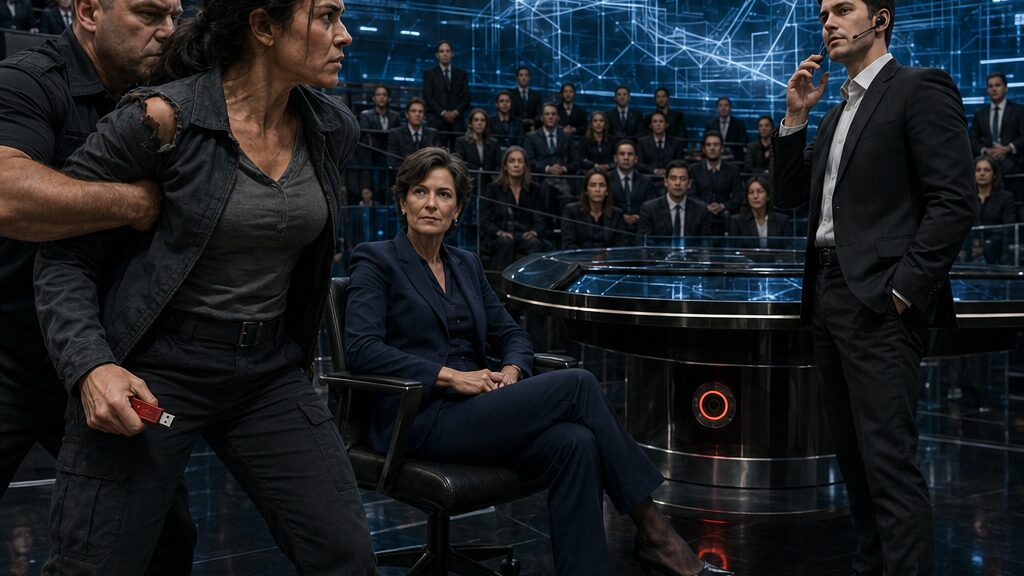
Security pulled Samantha against the glass barrier. Her wrist struck the metal rail. The red drive slipped from her hand, hit the floor, and skidded beneath a chair.
Christopher watched it stop.
Then he looked at Samantha.
“Your name doesn’t deserve to be on a multi-million-dollar patent,” he said into the microphone. “Get lost.”
The insult filled the hall.
No laughter followed this time.
The security officer twisted Samantha’s arm behind her. Pain flashed through her shoulder. Cameras held on her face, waiting for tears, rage, collapse—something that would make Christopher’s description easier to believe.
She looked instead at the giant screen.
Her blueprint rotated behind the final transfer confirmation.
AUTHORIZE SALE.
The auctioneer lifted the hammer.
Samantha stopped caring whether the room believed her.
Belief could come later, or never. The sale could not.
She drove one heel backward into the base of the officer’s shin. His grip loosened. She dropped her weight, turned, and tore one arm free.
The second officer caught her jacket.
Fabric split at the shoulder.
Samantha lunged toward the chair, swept the red drive from the floor, and rolled against the barrier as security closed again.
A fresh silver scar cut across the drive’s casing.
Patrick stood frozen at the technical booth.
Christopher shouted, “Remove her!”
The auction screen changed.
00:00:12.
Samantha was forced chest-first against the glass.
Directly across the aisle, beneath the polished central console, the red-ringed emergency port remained exposed behind its cable guide.
Ten seconds.
She twisted her freed wrist between the officer’s forearm and the rail.
Eight.
The hammer rose higher.
Six.
Samantha pulled until the torn sleeve slid off her shoulder.
Her arm came free.
Chapter 6: The Red Drive Entered Before the Hammer Fell
The auction hammer began to fall as Samantha vaulted the glass barrier.
Security missed the back of her jacket by inches.
She struck the floor on one knee, caught herself with her left hand, and drove forward through the narrow space between the front-row chairs and the central console.
Someone shouted.
The hammer stopped in midair.
Christopher lunged from the stage. “Do not let her touch that system!”
Samantha reached the console first.
The emergency port sat beneath the keyboard housing, protected by a spring-loaded metal cover. Her fingernail slipped on the latch. The first security officer hit the barrier behind her. The second came around the aisle.
She tore the cover open.
The red ring lit.
Christopher grabbed her shoulder.
Samantha drove the scarred USB into the port.
The console emitted a low tone she had not heard in years.
CREATOR DEVICE DETECTED.
The message flashed only on the maintenance strip beneath the main screen.
Christopher saw it.
His fingers dug into her jacket. “Pull it out.”
Samantha struck the mechanical keyboard with the heel of her palm.
Keys burst from their switches. Plastic caps scattered across the polished floor. The cancel command vanished beneath the broken frame, but the Enter key remained attached at the far edge.
Security seized her waist.
The drive began authentication.
BIOMETRIC CONFIRMATION REQUIRED.
Samantha pressed her thumb to the small sensor beside the port.
The console recognized the pattern stored when the core had been sealed.
Christopher reached across her and clawed for the drive.
Samantha twisted away, raised both hands, and smashed the center of the keyboard.
The housing collapsed.
A metal brace bent downward, blocking the port from easy removal. The Enter key stood alone beside the shattered frame.
On the giant screen, the transfer confirmation waited.
AUTHORIZE SALE.
The auctioneer still held the hammer.
Security pulled Samantha backward.
Her fingertips scraped across broken keys.
Christopher shouted over her shoulder, “Disconnect the console!”
Samantha caught the edge of the desk, hauled herself forward, and struck Enter with the side of her fist.
“Stop!”
The command accepted.
WIPE SCRIPT — EXECUTE.
Samantha’s voice tore out of her before she could restrain it.
“You bought the shell—not the mind!”
The screen went black.
For one impossible second, the hall contained no sound at all.
Then sirens began.
Red emergency lights pulsed along the ceiling. Cooling fans inside the console surged into a high mechanical whine. A thin coil of smoke pushed from the damaged keyboard housing where a crushed circuit had shorted beneath the impact.
Guests rose from their seats.
Security dragged Samantha clear of the console and forced her to the floor.
Christopher ran to the technical booth. “Administrator reboot. Immediately.”
Patrick did not move.
Another engineer reached for a terminal, then stopped when every display changed to the same warning.
TRANSFER ENVIRONMENT REVOKED.
PROPRIETARY CORE LOCKED.
AUDIT PRESERVATION ACTIVE.
Christopher shoved past the engineer and entered his own credentials.
The console rejected them.
He tried again.
“Network isolation,” he ordered. “Restore from the mirrored build.”
A technician opened the recovery panel.
AUTHORITY DENIED.
Christopher’s face reflected pale in the monitor. “Use the executive key.”
Patrick answered from behind him. “There is no executive key at the root level.”
“There is always an administrative override.”
“Not after sealing.”
Christopher turned. “You built the bypass.”
“We tested a bypass.”
“Use it.”
“It failed seven times.”
The microphone at the booth carried the exchange into the hall.
Barbara stood beside her empty chair, watching without expression.
Christopher entered another command. The screen requested biometric authorization.
CREATOR ROOT HOLDER: SAMANTHA RIVERA.
A murmur broke across the room.
The display expanded automatically, projecting the lock status onto the massive 8K screen.
Samantha’s name appeared beneath the architecture that had erased it only minutes earlier.
Security pinned her wrists behind her.
Christopher stared upward.
“This is sabotage,” he said. “She inserted that credential after termination.”
Samantha lifted her face from the floor. “The root was sealed fourteen months ago.”
“She fabricated the lock.”
“The system timestamp can verify it.”
“Arrest her.”
The officer holding Samantha looked toward the event supervisor, uncertain whether Christopher still possessed authority over the room.
Mary Carter entered from the compliance corridor at a run.
“What did she activate?” Mary asked.
“The audit preservation layer,” Patrick said.
Christopher stepped between them. “She destroyed company property. Shut down every output and remove the device.”
Mary looked at the red drive, now wedged behind the collapsed keyboard brace.
“Do not touch it,” she said.
“I am instructing you as company counsel.”
“I oversee transfer compliance. The logs are now material evidence.”
“You work for me.”
“I work for the company.”
The distinction landed harder than a raised voice.
On the giant screen, rows of provenance data began to appear.
Not conclusions. Not a clean declaration of ownership. The system displayed creation dates, credential migrations, sealing events, administrator requests, and modification histories. Some entries carried company identifiers. Others carried Samantha’s creator hash. Several timestamps showed later changes to labels and inventor fields.
Christopher pointed upward. “Those records prove company ownership.”
“They prove the records were altered,” Mary said.
“They were normalized for filing.”
“After the creator credential was sealed?”
He did not answer.
Barbara approached the technical booth. “Can the platform be restarted under buyer control?”
Christopher faced her. “Of course. This is a temporary malicious lock.”
“How?”
“My engineers will restore it.”
Barbara looked at Patrick. “Can you?”
Patrick’s eyes moved from Christopher to Samantha.
Samantha understood what the answer would cost him. His retention payment. His position. Perhaps his ability to find work quickly if Christopher controlled the story afterward.
She had promised not to ask.
She said nothing.
Patrick looked at the authentication request on the screen.
“No,” he said.
Christopher’s voice dropped. “Think carefully.”
“I have.”
“You signed a retention agreement.”
“I signed an agreement to maintain a transferable system.” Patrick pointed toward Samantha’s name. “This system was never transferable without her.”
Christopher moved close enough that their shoulders nearly touched. “You are angry because I refused to promote you.”
Patrick gave him a tired look. “You promoted me so you could put my name under test reports you didn’t want attached to yours.”
Another line appeared on the screen.
BYPASS TEST 01 — FAILED.
Then the second.
The third.
All seven attempts filled the display.
Each carried an internal restriction marker.
EXCLUDE FROM EXTERNAL TRANSFER PACKAGE.
Barbara turned to Christopher. “Who authorized that exclusion?”
He looked toward Mary.
Mary was already reading the signature block.
“It carries executive approval,” she said.
Christopher’s name appeared.
For the first time, the noise in the hall dropped beneath the steady alarm.
Security pulled Samantha upright. Her hands remained restrained, but no one moved her toward the exit.
Christopher pointed at her. “She destroyed a platform worth forty million dollars. Whatever internal testing occurred, she committed a criminal act in front of hundreds of witnesses.”
Every face turned toward Samantha.
The old instinct rose immediately: explain everything, justify everything, make them understand that she had done it for the team, the buyers, the integrity of the work.
She let the instinct pass.
“I triggered the revocation,” she said.
Christopher seized on it. “You hear that?”
“I knew it would destroy the transferable production core.”
Mary looked at her sharply.
Samantha continued. “I also knew it would preserve the provenance ledger. I chose to stop the sale because the asset was being represented as independently transferable when it was not.”
“You admit sabotage.”
“I admit what I did.”
The words steadied her.
She did not call herself blameless. She did not pretend the shattered keyboard, locked system, and smoke were an accident. Christopher’s lie had depended on concealment. Her defense would not.
Barbara looked back at the screen. “Does the lock establish that she owns every component?”
“No,” Mary said. “It establishes that the transfer disclosures omitted a creator dependency and that provenance records require investigation.”
“So we still don’t know who owns the platform.”
“Not tonight.”
Christopher spread both hands toward the bidders. “Then the auction can continue once the malicious interruption is contained.”
No one lifted a paddle.
He turned to the auctioneer. “Resume the transfer.”
The auctioneer lowered the hammer to the table without striking it.
Christopher’s composure finally vanished. “I said resume.”
Patrick stepped away from the engineering booth and approached the compliance terminal.
Christopher blocked him. “Where are you going?”
“To preserve the failed bypass reports.”
“You will do no such thing.”
“You ordered us to hide them.”
The sentence carried through the booth microphone.
Patrick looked toward the engineers behind him. None came forward, but none looked away.
“You told us to classify the failures as development noise,” he continued. “You told us the buyer would never inspect the root until after closing.”
Christopher reached for the terminal.
Mary placed her badge against the compliance reader.
The system sealed the audit directory.
ACCESS FROZEN — LEGAL PRESERVATION.
Company technicians rushed from the side aisle, but the terminal had already locked them out.
Mary removed her badge.
“The logs are preserved,” she said.
Christopher looked from the sealed terminal to Patrick, then to Samantha standing between security officers.
Above them, the blueprints disappeared behind a final message.
UNAUTHORIZED PATENT TRANSFER — SYSTEM PERMANENTLY LOCKED.
Chapter 7: The Deal Died Before the Truth Was Settled
Christopher tried to restart the auction while the giant screen still declared the transfer unauthorized and permanently locked.
“The disruption is contained,” he said, lifting a microphone that no longer made him look powerful. “The underlying intellectual property remains intact. Contractual ownership is unaffected.”
No one returned to a seat.
The emergency sirens had stopped, but red lights continued to pulse along the walls. Smoke hung in a thin layer above the ruined console. The auction hammer rested on its side, untouched.
Security had removed the restraints from Samantha’s wrists, though two officers remained near her. Her right shoulder burned where the jacket had torn. Across the floor, the red drive was still embedded beneath the bent keyboard brace.
She could see only one corner of it.
Christopher faced the bidders. “We will suspend for ten minutes, restore the presentation environment, and proceed under the agreed terms.”
Barbara Anderson stepped into the aisle. “Proceed with what?”
“The sale.”
“Of a system the buyer cannot control?”
“A system damaged by a former employee.”
“A system that requested her biometric credential before she damaged it.”
Christopher’s mouth tightened. “That mechanism was an internal safeguard. It does not determine legal ownership.”
“No,” Mary said. “But concealing it may determine whether the transfer disclosures were false.”
She stood at the compliance terminal with her badge still in hand. Auction counsel had gathered behind her, reading preserved records on a secondary monitor.
Christopher pointed toward Samantha. “You are allowing a saboteur to dictate the interpretation of company systems.”
Mary did not look at him. “I am allowing the logs to remain unchanged.”
“The company owns those logs.”
“The company also has a duty to preserve them.”
Samantha watched Christopher absorb the distinction. Everything he believed he owned was beginning to obey rules he had not written.
Barbara approached the technical booth.
“Mr. Hill,” she said, “explain the difference between the administrator layer and the creator root.”
Christopher glanced at Patrick. “That is an implementation distinction.”
“What does each control?”
“The administrator layer governs ordinary operations. The root is an internal security designation.”
“Can an administrator authorize transfer into an independent buyer environment?”
“With appropriate configuration.”
“Which configuration?”
Christopher’s gaze moved again toward the engineers.
None of them spoke.
Barbara waited.
He shifted tactics. “Technical architecture is why companies employ teams. A founder does not personally write every function.”
“No one asked whether you wrote every function.” Barbara’s voice remained level. “I asked how the asset you offered for sale becomes independent of your company.”
Christopher turned to Patrick. “Answer her.”
Patrick removed his event badge.
He set it on the console.
The small plastic click carried farther than it should have.
Another engineer did the same.
Then another.
They did not move toward Samantha. They did not applaud or speak her name. They simply withdrew from the role Christopher needed them to perform.
Patrick said, “There is no valid transfer path without Samantha’s creator authorization.”
Christopher stared at the badges on the desk. “You are all still under contract.”
“For tonight,” Patrick said.
Barbara asked Christopher a second question. “Why were seven failed bypass tests excluded from the buyer package?”
“They were irrelevant experiments.”
“A failed test of the only process required to deliver the product is not irrelevant.”
“They were unfinished.”
“Then why advertise the process as complete?”
Christopher’s voice hardened. “Because it was complete before she attacked it.”
Barbara looked toward the screen, where the sealed root event carried a date fourteen months old.
Her third question was quieter.
“When did you learn the creator credential could not be replaced?”
Christopher said nothing.
The silence answered enough.
Samantha felt no rush of vindication. The platform was still dead. Her shoulder still hurt. The officers were still close. Every preserved record could become evidence against her as easily as it became evidence against Christopher.
Mary came to her side.
“You should not leave,” she said.
“Am I under arrest?”
“Not at this moment.”
“That sounds temporary.”
“It may be.”
Samantha looked toward the broken console. “The audit ledger is intact?”
“Yes.”
“The source archives?”
“Sealed pending review.”
“The drive?”
“Evidence.”
“I want it returned.”
“Not tonight.”
Christopher heard them. “She admits the device is hers.”
“I admitted that before I used it,” Samantha said.
“You caused millions in damage.”
“I stopped a transfer you knew could not be completed.”
“You do not get to decide what the company sells.”
“No,” she said. “But I decided what I would not authenticate.”
For once, he had no immediate answer.
Mary lowered her voice. “Preserving the logs does not protect you from civil claims. It does not prevent a criminal complaint. The physical damage is visible, recorded, and intentional.”
“I know.”
“Do you?”
Samantha looked at the empty space where the blueprint had been.
“I knew when I pressed Enter.”
Mary studied her, perhaps waiting for remorse packaged as panic. Samantha had remorse. It simply did not erase the choice.
Across the room, auction counsel handed Barbara a printed summary.
Christopher moved quickly toward her. “This can be corrected. We can renegotiate the control provisions, discount the purchase, place the engineers under a transition agreement—”
“The asset was represented as transferable.”
“It is.”
“You cannot transfer it.”
“We can rebuild the root.”
“With whose architecture?”
Christopher turned toward Patrick.
Patrick stood beside the surrendered badges with his hands empty.
Barbara followed Christopher’s gaze and understood the answer.
She looked at the destroyed console, the locked screen, and Samantha’s name beneath the creator credential.
Then she faced Christopher.
“I invest in the brain that built this, not the shell of a thief. Deal’s off.”
She placed the printed summary on the auction table.
The hammer beside it did not move.
Christopher’s face went pale. “You cannot unilaterally collapse an international sale.”
“I can withdraw my bid.”
Other bidder representatives began closing tablets and collecting documents.
Christopher turned to the auctioneer. “Stop them.”
The auctioneer stepped away from the table.
At the technical booth, Patrick entered one final command.
His company access account changed from active to surrendered.
Nine more followed.
Christopher watched the list shrink until no core engineer remained logged in.
The deal had died, but the truth was still trapped among contracts, damaged hardware, and preserved records.
Samantha stood beneath the blank screen with no company, no certainty, and no idea whether she would be free to build again.
Chapter 8: A Blank Sign and Ten Resignation Letters
The office contained one desk, eleven folding chairs, and no servers.
Samantha unlocked it just after eight the next morning.
The landlord had taped a blank white board beside the door for a company name she had not chosen. Inside, uncovered windows admitted flat morning light onto bare concrete. A loose cable hung from the ceiling where a second light fixture was supposed to be.
Her laptop sat unopened on the desk.
Mary had called before sunrise to tell her not to access any disputed code, private repositories, company backups, or local files derived from the sealed platform. Formal notices would follow. So would demands for damages. The auction house had retained the camera recordings. The console and red drive remained under evidence control.
Samantha had rented the room three weeks earlier, when she still believed she might negotiate a quiet exit and begin consulting alone.
Now even consulting might be challenged.
She set a pad of paper on the desk and wrote one sentence.
Do not rebuild the old system.
The words felt like betrayal.
For ten years, the architecture had occupied every part of her life that was not sleep, and much of the part that was. It had survived failed funding, damaged prototypes, abandoned partnerships, and Christopher’s growing conviction that the person who presented an invention became its inventor.
She had saved the provenance ledger.
She had killed the living core.
Someone knocked.
Patrick stood outside holding a thick paper envelope.
Behind him, the hallway was empty.
“You found the place,” Samantha said.
“You sent me the address six weeks ago.”
“I forgot.”
“You told me it was only for mail.”
“It was.”
Patrick looked past her at the folding chairs. “That is a lot of chairs for mail.”
She stepped aside.
He entered but remained close to the door. He had changed out of the auction jacket. His shirt was wrinkled, and there was a dark bruise beneath one eye from lack of sleep rather than impact.
He placed the envelope on the desk.
“Ten resignations,” he said.
Samantha did not touch it.
“Including yours?”
“Mine is on top.”
“You should withdraw them.”
“No.”
“Christopher will challenge your bonuses.”
“They’re already gone.”
“Your hospital payment—”
“I know what it costs.”
Samantha looked at the envelope. “You don’t owe me this.”
“We aren’t doing it for you.”
The words made her look up.
Patrick took a second document from beneath the resignations and kept it in his hand.
“We’ll join a new company,” he said, “under conditions.”
Samantha glanced at the blank sign outside.
“What company?”
“That depends on whether you read this.”
He handed her the document.
It was not an employment proposal. It was a governance framework.
Named technical contributors would retain written attribution. Foundational architecture would require a documented creator schedule. No single founder could conceal a root dependency. Emergency controls would be disclosed to designated engineers. Material ownership changes required review beyond executive authority.
The final page created shared technical custody.
Samantha read it twice.
Patrick remained at the threshold of the office, as if crossing farther would mean accepting terms that had not yet been agreed.
“You wrote this overnight?” she asked.
“All of us did.”
“You should have counsel review it.”
“We will.”
“The ownership percentages aren’t defined.”
“Not yet.”
“There’s no salary structure.”
“We know.”
“You resigned before asking whether I could pay you.”
“We resigned because we were finished working for him.”
“That isn’t the same as choosing me.”
“No,” Patrick said. “This is.”
He tapped the governance document.
Samantha looked at the clause requiring disclosure of emergency authority.
“The red drive would have violated this.”
“Yes.”
“It existed before any of you joined.”
“You kept it after.”
“Yes.”
Patrick waited.
The old answer came easily to mind. She had protected the architecture. She had protected the engineers from knowledge Christopher could force out of them. She had protected the company during unstable years. Every secret had once sounded responsible.
“I was afraid someone would make you choose,” she said.
“You made the choice for us instead.”
“I know.”
The admission left no shield behind it.
Samantha turned to the final page.
A signature line waited beneath the shared-control terms.
She picked up a pen.
“Before titles?” Patrick asked.
“Yes.”
“Before equity?”
“Yes.”
“Before we decide what we build?”
“That is why it has to come first.”
She signed.
Patrick took the document, checked the name, and finally stepped away from the doorway.
A second knock came.
The rest of the engineering team filled the hall, carrying laptops, cables, notebooks, and cardboard cups. No one cheered. Several looked frightened. One had brought an office printer. Another carried the old whiteboard markers from the laboratory in a clear plastic bag.
They stopped when they saw Samantha.
She looked at the laptops.
“We cannot reuse the proprietary core,” she said. “Not one module under dispute. Not one copied function. We build from clean principles, or we do not build.”
Someone asked, “What about the transfer architecture?”
“We design a different one.”
“That could take years.”
“Yes.”
No one left.
The team entered one at a time.
By ten o’clock, every folding chair was occupied. The printer jammed on its first page. The hanging cable turned out not to be connected to anything. Patrick used the blank white board outside as a temporary planning surface, leaving the space for the company name untouched.
Near noon, Mary arrived.
Conversation stopped.
She carried a sealed evidence pouch.
“The device has been imaged, logged, and released under preservation agreement,” she said. “Do not alter or reconnect it. Your counsel will receive the conditions.”
Samantha accepted the pouch.
Inside lay the red USB drive, its casing scarred silver from the auction floor. One corner was blackened where the console had shorted.
Mary looked around the room at the engineers.
“I assume none of this is company equipment.”
“It isn’t,” Patrick said.
Mary nodded once. “Keep it that way.”
Before leaving, she looked at Samantha. “The investigation will not be quick.”
“I know.”
“The records do not settle ownership.”
“I know.”
“And last night will have consequences for you.”
Samantha held the pouch. “I know that too.”
Mary left without offering reassurance.
Samantha removed the drive only after the door closed. She placed it on the desk beneath the blank company sign visible through the glass.
For ten years, the device had represented the control she kept because she trusted no one else to carry it.
Now eleven laptops opened around her.
Patrick uncapped a marker and stood before the empty planning board.
“What do we call the first clean build?” he asked.
Samantha looked at the red drive.
She did not plug it in.
“Shared,” she said.
The marker touched the board, and the team began again.
The story has ended.