They Took His Keys Eighteen Days Before His Pension, So He Counted Every Date
Chapter 1: The Letter On The Black Hood
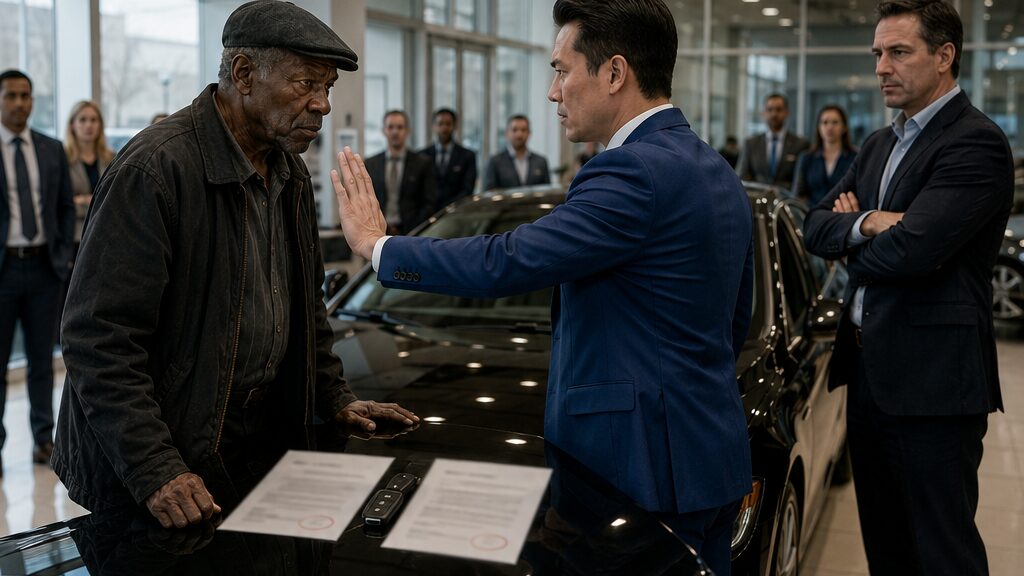
Richard Walker laid the termination letter on the hood of the black sedan, smoothed one corner with two fingers, and placed his benefits schedule beside it.
The showroom went still around him.
The sedan had been washed that morning until the ceiling lights looked doubled across its paint. Richard could see the reflection of his own cap in the hood, the brim low over his eyes, the deep lines beside his mouth drawn tighter than usual. Between the two documents, he set the key fob he had carried for three years, the one that opened the service gate, the storage cage, and the side door the salesmen used when they came in late.
Stephen Lee stepped in front of him with his palm up.
“Richard,” he said, voice low but sharp enough to carry, “you can’t do this out here.”
Richard did not look at Stephen’s hand. He looked at the dates.
The termination letter had been delivered at 8:06 that morning, folded inside a white envelope with his name typed on a label instead of written by someone who knew him. Effective immediately. May 1.
The benefits schedule was older, creased at the fold from the drawer where Richard had kept it under spare registration stickers and tire-pressure tags. On the second page, under Twenty-Year Service Profit-Sharing and Pension Conversion, the printed date was circled in blue pen.
May 19.
Eighteen days.
Richard tapped the first date once, then the second.
“Can you explain why this date?”
Stephen’s jaw shifted. He was younger by more than thirty years, dressed in a blue suit too bright for a Monday morning. Richard remembered when he had started in sales, nervous, always asking where to find extra key tags and which customers needed coffee. Richard had shown him which service writers had short tempers and which cars in the back lot needed a jump before test drives.
Now Stephen stood close enough that Richard could smell his cologne.
“This isn’t the place,” Stephen said.
“It’s where you handed me the letter.”
A receptionist behind the front desk lowered her eyes. Two salesmen near the glass doors stopped pretending to check their phones. A customer with a paper coffee cup watched from beside a display of floor mats. The service hallway behind Stephen remained open, but Richard knew he would not be allowed through it.
Stephen angled his body to block him from stepping past the sedan.
“You were notified of the decision,” Stephen said. “Your employment has ended. I need you to return all company property and leave the premises.”
Richard rested his fingers beside the key fob.
“I came to return the keys to Daniel. I also came to ask about the date.”
“The decision was based on business needs.”
Richard heard the phrase the way he heard bad brakes before anyone else noticed them: thin, repeated, meant to cover something that would get worse if ignored.
He tapped May 1 again.
“I’m asking about this date.”
Stephen’s eyes flicked down despite himself. For a moment he saw the two papers the way everyone else could see them if they chose to look. A letter ending Richard’s job. A benefits page promising that eighteen days later, the company would owe him more than polite thanks and a cardboard box.
“Mr. Walker,” Stephen said, and the formality landed harder than anger. “We are not discussing benefits on the showroom floor.”
From the far side of the black sedan, Daniel Hill spoke without moving from where he stood with his arms crossed.
“That’s right.”
Richard turned slowly.
Daniel wore a dark blazer over an open-collar shirt, the kind of clothing that said he had meetings with people above him and authority over everyone below. His face was calm, almost tired. He did not look embarrassed by the employees watching. He looked inconvenienced.
The key fob caught the light between the two documents.
Richard had handed that fob to porters, salesmen, managers, delivery drivers, and once to Daniel himself when the general manager locked his own set in a loaner. He had opened the building before sunrise, moved cars out of service bays during hail warnings, found lost customer plates, cleaned coffee off the driver’s seat of a trade-in, and stayed late when the new inventory system forgot half the stock numbers. He had not done those things loudly. He had assumed the work remembered him even when people did not.
Daniel nodded toward the key fob.
“Leave company property with Stephen.”
“I’ll leave it,” Richard said. “After someone answers me.”
Stephen’s palm rose higher, not touching him, but close enough that every person watching understood the message. Stop. Back up. You do not belong past this hand.
Richard looked at the hand. Then he looked at the young man’s face.
“You’re making this harder than it needs to be,” Stephen said.
“No,” Richard said quietly. “I’m making it exact.”
The words changed the air.
Daniel uncrossed his arms. “Richard, you had a long run here. Nobody is trying to disrespect that.”
The word disrespect moved through Richard slowly. It made him feel the showroom lights on his face, the customers pretending not to stare, the younger employees he had trained watching him stand outside the service hallway like a stranger waiting for permission.
He almost picked up the key fob and left.
That would have been easiest. He had built his life around not making scenes. His late wife used to say he could make silence feel like a locked door. He had thought that was discipline. Sometimes it was pride. Sometimes it was fear dressed up neat.
But the two dates sat on the black hood, eighteen days apart, and he could not make himself pretend he had not seen them.
“My last review said exceeds expectations,” Richard said.
Stephen’s mouth tightened. “Performance is part of a larger assessment.”
“My last three reviews.”
“Again, this is not the place.”
“It was the place when you took my badge.”
Stephen leaned closer. “You were asked to come in for a private meeting.”
“In a glass office with the blinds open.”
A salesman near the front window looked away too late.
Daniel stepped around the sedan now, slow and controlled. “This needs to stop.”
Richard took the benefits schedule in one hand and the termination letter in the other. He held them side by side at chest height, not high enough to perform for the room, only high enough that Daniel could not avoid seeing them.
“May first,” Richard said. “May nineteenth. That’s all I’m asking.”
Daniel’s eyes did not drop to the paper. That told Richard something.
Stephen reached for the key fob. “Company property, Richard.”
Richard let him take it. The small plastic body disappeared into Stephen’s hand as if twenty years could be reduced to an access device returned on demand.
Then Stephen said the thing that made several people stop breathing.
“If you refuse to leave now, we’ll have to treat this as trespassing.”
Richard felt heat rise behind his eyes, but his face stayed still. He folded the benefits schedule carefully along its old crease. He put the termination letter back into its envelope. His hands did not shake until he reached for the edge of the sedan to steady himself, and even then he made the gesture look deliberate.
Daniel’s expression shifted for less than a second. Not guilt. Calculation.
Richard turned toward the showroom doors. The automatic sensor caught him too early, and the glass doors slid open while he was still three steps away. Outside, the service lot was bright with rows of cars he had moved, tagged, jumped, washed, and found when everyone else had lost track.
Behind him, Stephen said, “I’m sorry it ended like this.”
Richard stopped but did not turn around.
“It didn’t end,” he said. “You just dated it.”
He walked out with the envelope under his arm and the benefits schedule folded inside his coat.
That evening, the phone rang while he was sitting at his kitchen table with both documents laid flat under a coffee mug to keep the corners from curling. The number was blocked. He almost let it go. Then he answered.
For three seconds, no one spoke.
“Mr. Walker?” a woman said.
Richard recognized the careful softness of Kimberly Allen from HR.
“Yes.”
Her breathing sounded thin, as if she had stepped into a hallway to make the call.
“I can’t discuss the decision,” she said.
“I didn’t ask you to.”
“I know.”
Another pause.
Richard looked at the two documents. May 1. May 19.
Kimberly lowered her voice.
“Request your full file in writing.”
Chapter 2: A Box Packed Under Showroom Lights
Richard’s locker was already empty when the service supervisor unlocked the narrow gray door and looked anywhere but at his face.
The shelf where Richard had kept his spare cap, winter gloves, tire gauge, and peanut butter crackers held nothing but a curl of dust and one broken plastic clip from an old badge reel. The dent in the back panel was still there from the winter a battery cart had rolled into it. Everything else was gone.
“They boxed it earlier,” the supervisor said.
Richard stood in the service corridor with his termination envelope under one arm and the benefits schedule folded into the inside pocket of his coat. Through the glass at the end of the hallway, he could see the showroom, the black sedan still parked under lights, its hood wiped clean. No papers. No key fob. No evidence that anything had happened except in the faces of the employees who looked away when he glanced their direction.
“Who boxed it?” Richard asked.
“I don’t know. Office told me it was ready.”
The supervisor lifted a cardboard box from under a parts counter. It had Richard’s name written in black marker on one side. Not Mr. Walker. Not Richard. Just WALKER, block letters, like a stock number.
He opened the flaps there in the hallway.
Inside were his gloves, his old lunch thermos, three pens, a safety vest, a pack of crackers, two photographs from the inside of the locker door, and a stack of performance reviews in a manila folder. For a moment he felt foolishly relieved. Then he counted them.
One was missing.
Richard moved the papers again, slower this time.
The review from two years ago was there. Exceeds expectations.
The review from last year was there. Exceeds expectations.
The quarterly recognition slip Stephen had signed after Richard caught a title error before delivery was there.
But the most recent annual review, the one Daniel had initialed after telling him, “You’re the reason this place still opens on time,” was gone.
Richard looked at the supervisor.
The man held up both hands a little. “That’s what they gave me.”
“Who is they?”
“Richard.”
The way he said the name carried warning and apology in the same breath.
Richard closed the folder. “I need a copy of everything in my personnel file.”
“You’ll have to ask HR.”
“I did.”
The supervisor’s eyes flicked to the camera mounted above the corridor.
Richard understood. The man still had a job. Richard had a box.
He carried it out through the side exit instead of crossing the showroom again. The side door, which he had unlocked thousands of mornings before anyone else arrived, now beeped twice after the supervisor opened it for him. That small sound followed him into the lot.
At home, he left the box on the kitchen table until the light changed on the floor.
Melissa arrived before sunset with a grocery bag in one hand and anger already in her face.
“Tell me you didn’t go back there alone.”
Richard took the milk from her bag and put it in the refrigerator.
“I went to return the keys.”
“They couldn’t send a prepaid envelope like normal people?”
“It was company property.”
She stared at him. “Dad.”
He closed the refrigerator too carefully. “Don’t start.”
“I’m starting because you won’t.”
The box sat between them on the table. Melissa was in her forties now, but when she leaned over paperwork, Richard still saw the little girl who used to do homework beside his repair invoices, asking why grown-up words were always made small on purpose.
She pulled the termination letter toward her first.
“Effective immediately,” she read. Her finger moved down the page. “May first.”
Then she opened the benefits schedule. “Where?”
Richard pointed.
Melissa found the circled line and went still.
“May nineteenth.”
He said nothing.
She took out her phone, opened the calendar, and counted under her breath. Her face changed before she spoke.
“Eighteen days.”
Richard looked toward the window over the sink.
“I know.”
“No, Dad. Eighteen days. Not six months. Not two years. Eighteen days.”
“I know.”
“And they told you this was performance?”
“Business needs.”
She made a sound that was almost a laugh, but there was no humor in it. “That’s what people say when they don’t want to say the thing.”
Richard turned back to the box. “There’s a review missing.”
Melissa’s anger sharpened into focus. “Which one?”
“The last annual. Daniel signed it.”
“What did it say?”
“What they all said.”
“Do you have a copy?”
Richard looked down.
Melissa waited, and the waiting was worse than scolding.
“I kept most things at work,” he said.
“Why?”
Because the dealership had been a place he understood. Because paper left in a drawer there felt safer than paper scattered in a house where grief still opened rooms he did not enter. Because after his wife died, work had been the place where he did not have to explain why he kept going in early.
Because he had trusted the house.
“I didn’t think I’d need to prove I was good at a job I did for twenty years.”
Melissa’s face softened then, which he did not want. He preferred her anger. Anger gave him something to stand against.
She sat down and pulled the box closer. “We’re going to make a list.”
“I’m not suing anybody tonight.”
“I didn’t say lawsuit. I said list.”
She took out a yellow legal pad from the grocery bag, as if she had come prepared to be his daughter and his witness both.
“What do you have?” she asked.
Richard removed each item from the box. Reviews. Recognition slips. Old schedules. A printout from the benefits meeting three years earlier, when HR had explained service credit and nobody in the room had asked enough questions. Melissa wrote dates beside each document.
When they reached the benefits schedule, she paused.
“Nineteen years, eleven months, and twelve days,” she said.
Richard looked at the number on the pad.
It seemed impossible that a life could be measured that way. Not by mornings opened, keys sorted, cars found, snow brushed off roofs before customers arrived. Not by staying late because a buyer had flown in from another state and someone had misplaced the second fob. Nineteen years, eleven months, twelve days. A number clean enough to cut with.
Melissa circled it.
“Dad, this is not close. This is targeted.”
“You don’t know that.”
“I know they know how to count.”
Richard leaned back. The chair creaked under him. “Stephen said if I didn’t leave, they’d call it trespassing.”
Melissa’s pen stopped.
“He said that in front of people?”
Richard nodded.
Her eyes filled, but she blinked it back. “That’s why you don’t do this quietly.”
“I made a scene.”
“No. They made one. You just refused to disappear during it.”
The words found the place he had been trying not to touch all day. He had felt shame standing beside that black car, shame so strong it had almost made him leave the papers there and walk away without asking. Shame that young men he trained had watched him be warned off the floor like someone trying to steal something.
He reached for the missing place in the folder again, as if the review might appear if he handled the papers enough.
“It should be there,” he said.
“Then we ask for it.”
Melissa turned his laptop toward her and drafted the records request while Richard dictated the facts. Full personnel file. All performance reviews. Termination decision records. Benefits-related service-credit documents. Communications concerning employment status. He stopped her when the language sounded too angry. She stopped him when it sounded too polite.
At 9:42 p.m., Richard read the message twice.
Then he sent it.
The automated reply arrived less than a minute later.
Thank you for your inquiry. Your request has been received and routed for review.
Richard almost closed the laptop. Melissa caught his wrist.
“Wait.”
The routing line at the bottom showed the recipient.
Not Kimberly Allen.
Not HR.
Daniel Hill.
Chapter 3: The Reviews That Changed Too Late
Richard entered the HR conference room holding the termination letter in his left hand and the benefits schedule in his right.
Kimberly Allen’s eyes went first to the papers, then to his face. Stephen Lee sat beside her with a folder closed in front of him and a bottle of water untouched near his elbow. The room had glass walls with frosted stripes across the middle, designed to suggest privacy while reminding everyone that privacy was only partial.
“Mr. Walker,” Kimberly said. “Thank you for coming in.”
Richard remained standing.
“I asked for my file.”
“And we are processing that request.”
“Daniel received it.”
Kimberly’s expression did not change, but Stephen shifted in his chair.
“All employment records requests are reviewed according to company procedure,” Kimberly said.
“Is Daniel company procedure?”
Stephen leaned back. “Richard, this meeting is an opportunity for us to clarify the separation terms, not debate internal routing.”
Richard placed the termination letter on the table. May 1 faced them.
Then he placed the benefits schedule beside it. May 19.
Kimberly folded her hands.
“I understand you have concerns about timing,” she said.
“I have one concern.”
“The decision was based on business needs.”
Richard looked at her until the sentence stopped echoing.
“Why this date?”
Stephen opened his folder. “We’ve been over this. The dealership has been evaluating operational efficiency for months. Your role was affected as part of a restructuring.”
“My role still exists.”
“The duties have been redistributed.”
“To who?”
Stephen looked at Kimberly.
Richard waited.
“To several team members,” Stephen said.
“Which team members?”
“This isn’t about replacing you one-for-one.”
Richard nodded once, as if Stephen had answered a different question honestly enough to be useful.
Kimberly slid a packet across the table. “This includes a summary of your separation, final pay information, and a copy of the performance concerns that were part of the review.”
Richard did not touch the packet at first.
“Performance concerns,” he said.
Stephen opened his folder now. “Yes.”
Richard removed three papers from his own folder, each one flattened the night before under Melissa’s largest cookbook. He laid them side by side below the termination letter.
Exceeds expectations.
Exceeds expectations.
Exceeds expectations.
The last one was not the missing annual review. It was the quarterly recognition slip Stephen had signed, but it carried enough of his own handwriting to make him look at it.
Richard turned it toward him.
“That’s your signature.”
Stephen glanced at the page and looked away. “That was a specific incident.”
“It says consistent reliability.”
“That was before more recent issues.”
“What issues?”
Stephen slid one page from his folder and placed it on the table with two fingers.
Richard read it without picking it up.
Performance Adjustment Notice. Entered March 22.
Sixty days before the termination. Less than two months after Daniel had told him the place still opened on time because of him. The notice used words Richard did not recognize as belonging to his work. Resistance to new process. Inconsistent responsiveness. Negative impact on modernization.
Richard felt something cold settle in his chest.
“No one gave me this.”
Kimberly looked at Stephen.
Stephen said, “It was entered after management review.”
“Entered,” Richard said.
“Yes.”
“Not discussed.”
Stephen’s face tightened. “Richard, your reluctance to adapt has been observed for some time.”
“My reluctance to adapt?”
“You challenged the new key tracking system repeatedly.”
“Because it was assigning used inventory keys to sold units.”
“That’s not the point.”
“A customer almost drove home with one key and the wrong temporary plate.”
Stephen’s eyes sharpened. “And again, you are demonstrating the same pattern.”
Richard knew then how the page had been made. Not from a lie exactly. From pieces of true things turned sideways until they pointed where someone needed them to point. He had objected to the new system. He had said in front of service staff that it would fail if nobody checked the physical tags. He had been right. But right, recorded by someone with power, could be written as difficult.
He sat down.
Not because he was tired. Because standing made Stephen look like the calm one.
“When was the restructuring list drafted?” Richard asked.
Kimberly’s hands tightened together.
Stephen said, “That’s internal.”
“When?”
Kimberly inhaled quietly. “Preliminary assessments began before March.”
Richard turned to her. “Before this performance notice?”
She did not answer quickly enough.
Stephen did. “These are separate processes.”
Richard placed his finger on the March 22 notice.
“This was entered after the list.”
“Richard,” Stephen said, “your conduct on Monday did not help your position.”
“My position had already ended.”
“You came onto the showroom floor after termination and created a disruption in front of employees and customers.”
“I asked about the date.”
“You refused to leave when instructed.”
“I returned the key.”
“You staged documents on a vehicle.”
Richard looked through the glass wall. Beyond the frosted stripe, he could see the showroom lights and the shape of the black sedan. Someone had moved it closer to the front windows. It looked ready for delivery, polished for somebody else’s first drive.
He turned back to Stephen.
“You’re making Monday the reason for something dated Monday morning.”
Stephen’s face flushed.
Kimberly’s voice came softer. “The effective date was determined before the meeting, yes.”
Stephen looked at her.
Richard did not move.
There it was. Not victory. Not proof. But a crack.
“Before Monday,” Richard said.
Kimberly lowered her eyes to the packet. “The termination meeting was scheduled after the decision was finalized.”
“And the performance notice was entered after the restructuring list.”
“I didn’t say—”
“You said preliminary assessments began before March.”
“Mr. Walker, I need to be careful.”
“So do I.”
For the first time since he entered, Kimberly looked tired. Not sympathetic exactly. Tired in the way of someone who had repeated other people’s language until it began to taste wrong.
She gathered the separation packet, but one page beneath it slid partly free. It was not on company letterhead like the others. It looked like a copied spreadsheet, the corner stamped confidential in pale gray.
Richard saw his last name before Kimberly’s hand came down.
Walker.
To the right of it was a number with a dollar sign.
Above the column, three words were visible.
Projected benefit liability.
Kimberly pulled the page back into the stack too fast.
Stephen stood. “This meeting is over.”
Richard kept his eyes on the place where the page had been.
“Was I on a list?”
Stephen moved to the door. “You’ll receive appropriate documents through the proper channel.”
Richard gathered his three positive reviews, the termination letter, and the benefits schedule. He put them in order slowly. He did not ask again. The question had already changed shape.
At the doorway, Kimberly held the packet against her chest and avoided looking at Stephen.
Richard paused beside her.
“Was I the only one?” he asked.
Kimberly’s mouth opened a little, then closed.
Stephen pulled the door wider.
Richard stepped into the hallway with the two dates under his arm and the missing page burning in his mind, no longer wondering whether they had counted the days.
Now he needed to know who else they had counted.
Chapter 4: The List Of Dates Nobody Wanted
Richard found Barbara Lewis’s departure date in a dealership newsletter archived between a Thanksgiving sales event and a service coupon for brake pads.
The public library computer froze twice before the old PDF loaded. When it finally opened, the newsletter showed a photograph of employees standing around a sheet cake in the break room. Someone had typed Happy Retirement, Barbara! above the picture, though Richard remembered no party, no speech, no gold watch. He remembered Barbara cleaning out the title desk with a sweater folded over one arm and an expression that warned people not to ask her anything kind.
He leaned closer to the screen.
The newsletter was dated October 7.
His legal pad lay beside the keyboard. On one page, he had written his own dates in careful columns.
Termination: May 1.
Benefit threshold: May 19.
Gap: 18 days.
Below that, he wrote Barbara Lewis.
He did not know her benefit date. Not yet. But he remembered her years. More than eighteen. Maybe nineteen. She had started before the showroom remodel, before the glass offices, before Daniel Hill began parking in the spot closest to the side door. Barbara had known every title clerk at the county office by voice. When salesmen lost paperwork, they blamed the system until Barbara found the missing signature in the folder they had dropped behind the copier.
Richard searched again.
The next document was an employee anniversary post. He clicked it. There she was, standing under a banner with a coffee cup in one hand, not smiling, while a manager presented a certificate for nineteen years of service.
Nineteen.
Richard wrote it down.
The pencil point broke.
For a moment he sat still with the library around him: a child whispering too loudly near the computers, the copier lid thumping at the circulation desk, the dry smell of old carpet and toner. His hands rested on either side of the legal pad. He had come looking for one missing review and one explanation. Now the page in front of him had begun to look like something that could grow teeth.
He printed the newsletter and the anniversary post. The printer spat them out with gray streaks through the photographs. He paid the clerk with quarters from his coat pocket and carried the pages back to the computer.
By noon, the list had four names on it, though only Barbara’s had enough dates to matter.
A former service technician had left “to spend more time with family” eleven months before his twenty-year mark. A finance assistant had resigned after “department restructuring” close to the year Richard guessed her profit-sharing would have increased. Another porter, older than Richard but part-time by the end, had vanished from the schedule after a medical leave and never came back.
Guessing was dangerous. Richard knew that. He wrote question marks beside every line he could not support.
At the bottom of the pad, he wrote the words Kimberly had not said.
Projected benefit liability.
Then he crossed them out, not because they were wrong, but because he had not earned them yet.
His phone buzzed.
Melissa: You eating?
He looked at the vending machine across the aisle.
He typed: Later.
Her reply came fast.
That means no.
Richard almost smiled. Then the library phone area opened, and a man in work boots stepped out. Richard recognized him before the man recognized Richard. Former service technician. Gray beard shorter now. Same cautious eyes.
Richard stood too quickly. “Hey.”
The man saw the legal pad first, then Richard’s face.
“I heard,” he said.
The words carried more knowledge than sympathy.
Richard folded the top of the pad down. “Can I ask you something?”
The man glanced toward the exit. “Depends.”
“When you left, were you close to anything? Pension, profit-sharing, any threshold?”
His expression closed. “Don’t do that.”
“I’m not putting your name anywhere.”
“Don’t put my name on anything,” the man said, sharper now. A woman at the reference desk looked up. He lowered his voice. “I signed papers. I got enough to keep my mortgage from falling behind. I’m not getting into it.”
“So there were papers.”
“Richard.”
“I’m trying to understand if it was just me.”
The man’s face softened, but fear stayed where it was. “That’s how they get you. They make everybody think they’re the only one.”
Then he stepped around Richard and walked out before Richard could ask anything else.
Richard sat back down slowly.
That sentence went on the pad, word for word, but without a name.
They make everybody think they’re the only one.
By the time Melissa came home that evening, Richard had spread the printed pages across her kitchen table because his own had run out of room. She paused in the doorway, holding her keys.
“Dad.”
He looked up from the spreadsheet he had drawn by hand. “I didn’t call anyone else.”
“That’s not the first thing a person says unless they almost did.”
He leaned back. “I saw someone at the library.”
“From the dealership?”
“He didn’t want his name involved.”
“Then don’t involve it.”
“I didn’t.”
Melissa set her keys down. Her anger from Monday had changed into something more nervous. She walked to the table and read the columns: name, department, last known date, years of service, possible threshold, reason given, source.
“You’re building a case,” she said.
“I’m building a list.”
“That is what a case looks like before someone official gets it.”
Richard picked up Barbara’s printed anniversary post. “She was at nineteen years.”
“Do you know where she is?”
“I found an old number in my phone.”
Melissa stared at him. “You haven’t called yet.”
“No.”
“Why?”
Because he remembered Barbara’s face that last week. Because he remembered not asking, and now asking felt like reaching backward to touch a bruise he had ignored while it was fresh. Because if she confirmed it, then his silence then would become part of the pattern too.
“I don’t want to scare her.”
Melissa pulled out a chair and sat. “Or you don’t want her to tell you that you should have noticed sooner.”
The words hit with such clean accuracy that Richard looked away.
Melissa’s face changed. “I shouldn’t have said that.”
“No,” he said. “You should have.”
She reached for the legal pad and touched the row where Barbara’s name sat. “Dad, I don’t want them doing this to you twice.”
“What does that mean?”
“They humiliated you once. Don’t let the rest of this take your health, your sleep, your whole life.”
Richard held the pencil between both hands. “You want me to stop.”
“I want you not to disappear inside it.”
He heard the difference. It still hurt.
After dinner, he called Barbara.
The first time, it went to voicemail after two rings. He did not leave a message.
The second time, it rang long enough that he imagined her standing over the phone, reading his name, deciding whether the past cost too much to answer.
On the fifth ring, she picked up.
“Richard?”
Her voice was lower than he remembered.
“Yes, ma’am.”
“Don’t ‘ma’am’ me. I’m not the DMV.”
Despite himself, he smiled.
Then neither of them spoke.
“I’m sorry to bother you,” he said.
“If you’re calling about the dealership, you’re not the first ghost to come out of that building.”
Richard looked across the table at Melissa. She had stopped pretending not to listen.
“I was let go Monday,” he said.
Barbara exhaled once. “How close?”
The question made the room shrink.
Richard placed his finger beside May 19 on the benefits schedule.
“Eighteen days.”
Barbara did not answer.
“Barbara?”
“They gave me the same reason,” she said at last. “Same chair. Same timeline.”
Chapter 5: Same Chair, Same Reason, Same Gap
“Tell me you haven’t signed anything,” Barbara said before Richard could ask his first question.
He had put the phone on speaker and laid it in the middle of the kitchen table. Melissa sat across from him, hands folded so tightly her knuckles had paled. The legal pad waited beside the phone, but Richard had not picked up the pencil. Barbara’s voice filled the kitchen with the old authority she used to bring to missing title work and late delivery packets.
“I haven’t signed,” Richard said.
“Good. Don’t. Not a severance, not a release, not a thank-you-for-your-years letter with a check stapled to it.”
“They haven’t offered.”
“They will.”
Richard took the pencil then. “Can I write down dates?”
“You can write what I say. You can’t use my name without asking me again.”
“I won’t.”
“And don’t say I told you to call.”
“I won’t.”
There was a pause. He heard a television low in the background on her end, then the sound dropped as if she had closed a door.
“They called mine a restructuring,” Barbara said. “Same phrase they always use when nobody wants to own the sentence. Business needs.”
Melissa looked at Richard.
He wrote it down.
Business needs.
“When was your last day?” he asked.
“October 7 on paper. They walked me out October 3.”
“Benefit date?”
“Profit-sharing distribution was October 21. My nineteen-year credit would have changed the formula. I know because I asked Kimberly for the estimate in August.”
Richard’s pencil stopped.
“You asked before?”
“I was trying to plan. My husband needed coverage through the end of the year. I had numbers taped to my refrigerator like a crazy person.” Her voice hardened. “Then suddenly Daniel wanted to talk about efficiency.”
Richard wrote October 7 and October 21. Fourteen days.
Two weeks.
The gap looked smaller than his. Somehow that made it worse.
“What did they say about performance?”
Barbara gave a dry laugh. “Nothing at first. Then after I asked about the payout, they found attitude concerns.”
“Attitude?”
“I told Stephen that salespeople couldn’t keep promising same-day delivery if they brought title work to me at four-thirty with signatures missing. That became ‘resistance to process improvement.’”
Richard looked at the performance notice from his HR meeting. Resistance to new process.
Same bones. Different skin.
“Daniel was in the room?” he asked.
“Daniel opened the meeting. Kimberly read most of it. Stephen stood by the wall like he had somewhere better to be.”
“Same chair,” Richard said softly.
“What?”
“You said same chair.”
“The conference room beside HR. The one where you can see the showroom if you look past the frosted glass.” Barbara’s voice dropped. “They make sure you can see everybody working while they tell you that you don’t.”
Melissa closed her eyes.
Richard kept writing.
He wanted to ask why Barbara had not fought. The question rose in him with unfair force, not because he judged her, but because he was frightened by how easy silence had been for everyone. He had worked beside her. He had watched her leave. He had accepted the cake story because accepting it cost him nothing then.
He swallowed the question.
Barbara answered it anyway.
“They offered me eight weeks,” she said. “Plus health bridge paperwork for my husband. If I signed the release.”
“You had to protect him.”
“I had to choose fast.”
“That’s not the same as choosing freely.”
For the first time, her voice broke a little. “Don’t make me noble, Richard. I was scared. I was embarrassed. I let them call it retirement because it was easier than telling people I got priced out.”
Richard set the pencil down. “I’m not calling because I think you should have done different.”
“Then why are you calling?”
He looked at the two documents that had started all of it. Termination letter. Benefits schedule. Then at the growing list, the dates lining up like cars parked too neatly on a lot after closing.
“Because Monday I thought they only did it to me.”
Barbara was quiet.
When she spoke again, the old hardness had thinned. “They count on that.”
Richard wrote her dates without her name in the public column, only B.L. in the margin where Melissa could see and he could remember. Barbara told him enough to confirm the shape but not enough to expose herself fully. The severance agreement had confidentiality language. She would not send a copy. She would not speak to anyone official yet. But she gave him one thing: the exact phrase Daniel used when she asked why the date was so close.
“We are aligning personnel obligations before fourth-quarter reporting.”
Richard repeated it.
Barbara said, “That’s not normal English. That’s money wearing a suit.”
After the call ended, Melissa took the pencil from him gently and circled Barbara’s gap.
Fourteen days.
Richard expected satisfaction. Instead he felt heavier.
“She’s scared,” Melissa said.
“She should be.”
“So should you.”
He looked at her.
She pushed an envelope across the table. He had not noticed it by her purse.
“This came while you were on the phone. Certified.”
The return address belonged to the dealership.
Richard opened it with a butter knife because his hands were stiff.
The letter was from Stephen Lee.
Richard Walker is hereby instructed to cease contacting current and former employees regarding internal employment matters. Reports have been received that you are making inquiries which may be considered disruptive, misleading, and harassing. Further contact may affect any separation terms offered by the company.
Melissa read over his shoulder. “They’re threatening you.”
“They’re warning me.”
“No, Dad. They’re trying to make you feel alone again.”
Richard read the letter twice more. The words were polished, but the timing was clumsy. He had called one person. Within hours, they had sent a warning broad enough to cover people they did not know he had considered.
“What are they afraid of?” Melissa asked.
Richard placed Stephen’s warning beside Barbara’s dates.
The table was beginning to resemble the black hood of the sedan. Papers side by side. Dates telling more than voices did.
“I don’t know yet,” he said.
He thought of Barbara asking if he had signed anything before she asked if he was all right. He thought of the former technician at the library stepping away from his own story. He thought of Kimberly’s whispered instruction, delivered through a blocked number like contraband.
His first instinct was to call Barbara back and warn her. His second was to call Stephen and demand an explanation. Both would give the dealership a fresh reason to call him unstable.
So he did neither.
He scanned the warning letter. He saved a copy. He added a row to the spreadsheet.
Company response after inquiry: warning letter dated same day.
Melissa watched him work, worry pressing her mouth thin. “You’re different when you do this.”
“Do what?”
“Count.”
He looked at the page.
“I spent twenty years counting keys because people lost them when they were careless,” he said. “Turns out dates are the same.”
Near ten, Melissa went home. Richard locked the door behind her and stood for a while in the small quiet of his apartment. The table lamp threw yellow light across the papers. Outside, a car passed with a loose belt squealing, and for one second his body expected to be needed.
Then came a soft scrape at the mail slot.
Richard turned.
A plain brown envelope slid across the floor and stopped against the baseboard.
No stamp. No return address. No knock.
He waited, listening. Footsteps moved quickly down the hall.
By the time he opened the door, whoever had brought it was gone.
Chapter 6: The Email That Named The Cost
Richard opened the brown envelope with scissors and saw his own name beside a dollar amount before he saw the words above it.
Walker, Richard — projected benefit liability: $74,860.
The paper inside was a printed email chain, folded into thirds, no note attached. The ink was slightly faded at the edges as if it had been printed in a hurry or from a machine running low. Richard carried it to the kitchen table and set it above the two documents that had begun the week: the termination letter and the benefits schedule.
For a few seconds, he did not sit down.
The number looked obscene not because it was large, but because it was exact. Somebody had calculated the cost of keeping him eighteen more days. Somebody had written it down, sent it, maybe discussed it while coffee cooled in a conference room.
The subject line read: Q2 Payroll Exposure / Near-Vesting Review.
Below it, a column of initials and last names. Not all were familiar. Some were current employees. Some, he realized with a slow tightening in his throat, were people who had already disappeared from birthday sheets and holiday potlucks.
His own row was highlighted.
B.L. appeared two lines below, marked prior cycle.
Richard sat down hard.
The email itself was short.
Need updated status on near-vesting payroll exposure before final restructuring selections. Please confirm which obligations can be avoided or reduced based on separation timing and role consolidation.
No one had written, Fire Richard before May 19.
No one had to.
He read the chain from bottom to top, then top to bottom. Daniel’s name appeared twice, not as the author of the first message but as someone copied after a finance review. Stephen’s name appeared near a follow-up about “operational fit.” Kimberly was copied only on the final scheduling note.
Richard put both hands flat on the table until the tremor passed.
He should have felt vindicated. Instead he felt used in a way that made the room seem too small.
By nine the next morning, he sat across from an employment attorney in a narrow office above a tax preparation storefront. The attorney had silver-framed glasses, a legal pad, and a manner that suggested sympathy was useful only after facts were sorted correctly.
She read the email chain without interrupting him.
Richard watched her eyes move from line to line. He wanted her to look up and say it was enough. He wanted someone with a license on the wall to make the room tilt back toward justice.
Instead, she placed the pages down carefully.
“This is useful,” she said.
Richard waited.
“But it is not everything.”
He felt his jaw tighten. “It names the cost.”
“It suggests cost was being tracked.”
“It says obligations can be avoided based on separation timing.”
“Yes. And that matters.” She tapped the page once. “But we still need to connect this to the final decision. Who approved the termination list after seeing this? When did they approve it? What reason did they put in your file? Whether that reason was supported before the cost analysis or built afterward.”
Richard looked at the words on her legal pad as she wrote.
Who approved after seeing?
The question was so simple that it angered him. He had asked why this date. The company had answered with fog. Now the question had a handle.
“Daniel was copied,” Richard said.
“Copied is not the same as approved.”
“He saw it.”
“Likely. We need more than likely.”
He looked toward the office window. Below, traffic moved through a strip mall parking lot. People carried coffee, grocery bags, dry cleaning. The world outside continued to run on receipts and dates and signatures most people trusted until one of them turned against them.
The attorney slid a state labor board intake form across the desk.
“You can file now,” she said. “Or we can send a demand letter first. But understand something. They may offer money quickly if they think this email is dangerous. Quick money usually comes with silence attached.”
Richard thought of Barbara.
“What if other people are on the list?”
“Then you decide whether you are pursuing only your claim or helping document a pattern.”
“That sounds expensive.”
“It can be.”
“I don’t have expensive.”
“I know.”
She said it plainly, not pitying him. That helped.
Richard folded his hands over the intake form. “If I file, can they say I’m harassing people?”
“They can say many things. Documentation is what matters. Don’t pressure anyone. Don’t exaggerate. Don’t guess. Keep dates, copies, and records of contact.”
“I already guessed on some.”
“Then mark guesses as guesses.”
He almost smiled despite the weight in his chest. Melissa had told him the same thing without the legal pad.
When he returned home, a FedEx envelope was wedged against his door.
For one wild second, he thought another anonymous packet had arrived. But the sender was the dealership’s administrative office.
Inside was a separation offer.
Four weeks of pay. A neutral reference. Continued healthcare contribution through the end of the month. Strict confidentiality. Release of all claims known or unknown. Agreement not to contact current or former employees regarding dealership employment matters.
The signature line waited at the bottom like an open mouth.
Richard read the dollar amount three times.
It was not enough to cover the benefit they had denied. Not close. But it was money now. Rent money. Prescription money. Repair-the-old-car money. Money that did not require hearings, forms, phone calls with frightened former coworkers, or sitting in glass rooms while men half his age called him disruptive.
He set the offer beside the email chain.
Four weeks of pay.
$74,860.
May 1.
May 19.
For the first time since Monday, he let himself imagine signing. Not forgiving. Not agreeing. Just ending the bleeding. He could tell Melissa he had done enough. He could tell himself the dealership had shown what it was and there was dignity in walking away from people who counted him as a liability.
Then he saw the initials again.
B.L.
Prior cycle.
Barbara had not sent him her agreement. She had not asked him to fight for her. She had asked him not to use her name. But her initials were on a list someone had folded into an envelope and pushed through his mail slot because someone inside that building knew one case alone might be buried.
Richard lifted the separation offer and read the confidentiality paragraph again.
Silence attached.
His phone rang while the papers were still spread in front of him.
The dealership number appeared on the screen.
He answered without speaking.
“Richard,” Daniel Hill said. His voice was smooth, almost warm. “I understand you received our offer.”
“I received it.”
“I’d like to resolve this respectfully.”
Richard looked at the email chain.
“Respectfully,” he repeated.
“There’s no benefit to dragging this out. For anyone. Come in tomorrow at ten. We can talk through final terms.”
“Kimberly there?”
A pause.
“This will be a management resolution meeting.”
“Stephen?”
“He may join for part of it.”
Richard touched Barbara’s initials with the edge of one finger.
“And HR?”
“Not necessary at this stage,” Daniel said. “Come alone, Richard. It’ll be easier that way.”
Chapter 7: Why This Date Became The Only Question
Daniel Hill slid the check across the conference table before Richard had taken off his coat.
It stopped halfway between them, faceup, trapped under the reflection of the showroom lights coming through the glass wall. Below the conference room window, the black sedan sat near the front doors again, polished so bright it looked untouched by anything that had happened beside it.
Richard looked at the check, then at Daniel.
Stephen Lee stood by the window with his arms folded. Kimberly Allen sat at the far end of the table with a closed folder in front of her, though Daniel had said HR was not necessary. Her eyes moved once to Richard’s briefcase and then away.
“Have a seat,” Daniel said.
Richard did not move. “You told me to come alone.”
“You are alone.”
“HR is here.”
Kimberly’s hands tightened around the folder.
Daniel’s smile was practiced and thin. “Kimberly is here to make sure the terms are documented properly. This is a resolution meeting.”
Richard placed his briefcase on the table. He opened it slowly.
The first thing he removed was the termination letter. He set it down, May 1 facing Daniel.
The second was the benefits schedule. May 19.
The third was the email chain with his name beside the dollar amount.
Stephen’s arms came uncrossed.
Daniel did not look at the email right away. He pushed the check a little closer. “That offer is more generous than what you received by mail.”
“How much more generous?”
“Enough to resolve this without involving outside agencies.”
Richard read the number.
It was higher than the four weeks. High enough to make the room quiet inside him for one dangerous second. High enough to pay bills, replace what he had borrowed from savings, and give Melissa one less reason to look frightened when she studied his kitchen table.
Still not what the date had taken.
Richard placed the check beneath the termination letter and benefits schedule, so the two dates sat over the money like weights.
“Is this for May first,” he asked, “or May nineteenth?”
Stephen let out a breath. “Richard, this is exactly the kind of behavior that makes it difficult to help you.”
Richard turned to him. “Help me how?”
“By giving you a clean exit.”
“I had a clean record.”
Stephen opened his folder. “You had documented performance concerns.”
Richard removed three positive reviews from his briefcase and placed them on top of the check. The paper edges aligned neatly because he had aligned them at home before leaving.
“Exceeds expectations,” Richard said. “Exceeds expectations. Exceeds expectations.”
Stephen glanced at them, then at Daniel. “Those predate the restructuring.”
“The performance notice you gave me came after the restructuring list.”
“You don’t know that.”
Richard looked at Kimberly.
The room changed before she said anything. Her face did not confess. It simply lost some of its professional distance, as if she had been holding a door closed and no longer had the strength to pretend there was nothing behind it.
Daniel spoke first. “Kimberly is not here to be cross-examined.”
“I’m asking about dates.”
“This is not a hearing.”
“No,” Richard said. “That comes after today.”
Daniel’s jaw tightened.
Kimberly opened her folder. The sound of the paper moving was small but sharp. She looked at Daniel, then down at the first page.
“The preliminary restructuring list was circulated before the March twenty-second performance entry,” she said.
Stephen turned on her. “That’s internal sequencing.”
“It’s a date,” Richard said.
Kimberly kept her eyes on the file. “The final notice was prepared after the performance entry.”
“Prepared,” Richard said. “Not decided.”
She did not answer.
Daniel leaned forward. “Let’s not pretend this is simple. The dealership has had a hard year. Margins are down. The expansion loan cost more than projected. Insurance, flooring, payroll, everything has gone up. We had to make difficult choices.”
Richard listened. It was the most honest Daniel had sounded, and that made it worse.
“I know difficult choices,” Richard said. “I made some when the parts cage flooded and three sold cars were due out by noon. I made some when your new key system assigned the wrong fob to a customer’s car and I stayed two hours late fixing it. Difficult isn’t the same as hidden.”
Daniel looked toward the showroom, where a salesman laughed with a customer near the sedan. “You were valued here.”
“Then why price me like a problem?”
Stephen stepped forward. “No one priced you.”
Richard tapped the email chain. “My name is next to a dollar amount.”
Daniel finally looked at the paper.
For the first time, he seemed less annoyed than careful.
“Where did you get that?”
Richard did not answer.
Daniel sat back. “That document is incomplete.”
“Then complete it.”
“You don’t understand the context.”
“Then explain it.”
“It was a financial planning discussion.”
“About which obligations could be avoided or reduced based on separation timing.”
The words sat between them exactly as written. Nobody in the room corrected him.
Daniel rubbed a thumb along the edge of the check. “Every company reviews payroll exposure. That is not illegal. That is business.”
Richard nodded once. “Who approved the termination list after seeing the exposure report?”
Stephen said, “This is ridiculous.”
Richard did not look at him. “Who approved it?”
Daniel’s eyes moved from Richard to Kimberly, then back. “I approved final departmental recommendations.”
“After seeing the report.”
“I saw many reports.”
“Did you see this one before approving my termination?”
Daniel’s silence lasted too long.
Kimberly closed her folder.
Stephen looked toward the door.
Richard felt no triumph. Only the old shame from the showroom returning in a different shape. They had stood in a room with glass walls and spoken around his life as if the number beside his name had no face attached.
Daniel picked up the check and held it out again.
“This offer is conditioned on confidentiality,” he said. “You sign, we pay, and everyone moves on.”
“What about Barbara Lewis?”
Daniel’s hand stopped.
Stephen’s face hardened. “You were warned about contacting former employees.”
“I didn’t say she told me anything.”
“You just named her.”
“She was on the email.”
Daniel laid the check down. “Former employee matters are not your concern.”
“They are if the same timing was used.”
“The offer disappears if you try to turn your personal separation into a fishing expedition.”
Richard looked at the check. He thought of Melissa’s worried face. He thought of the attorney saying quick money usually came with silence attached. He thought of Barbara saying she had been scared, not noble. He understood her better now than he had when he dialed her number. A person could sign away a fight and still know exactly what happened.
He picked up the check.
Daniel’s shoulders lowered a little, as if the room had obeyed him after all.
Richard turned the check over and placed it facedown beneath the benefits schedule.
“No.”
Stephen stared. “You’re making a mistake.”
“I already made one.”
Daniel’s expression cooled. “And what was that?”
Richard gathered the reviews, the email chain, the termination letter, and the benefits schedule. He placed them back in the briefcase in the same order they would appear in the complaint.
“I thought being loyal meant being quiet.”
Kimberly looked down at her hands.
Daniel stood. “Richard, think carefully. A formal complaint will take months. Maybe longer. It will cost you time, energy, money. And it may not give you more than what is on this table.”
Richard closed the briefcase.
“It already gave me more.”
“What?”
He looked through the glass wall at the black sedan, at the spot where Stephen had raised his palm and turned the whole room into witnesses.
“The right question.”
He left the conference room without taking the check. No one followed him down the stairs. No one stopped him at the showroom line.
At home, he added Barbara’s dates to the packet without her full name, as promised. He included the email chain, the positive reviews, the performance notice entered after the restructuring list, Stephen’s warning letter, and the separation offer with confidentiality language.
On the labor board intake form, under Brief Description, Richard wrote one sentence first.
I was terminated eighteen days before my twenty-year pension and profit-sharing threshold, after my projected benefit liability was circulated internally.
Then he added the question he had been asking since the black hood.
Who chose May 1?
He signed his name, attached the copies, and filed the complaint before he could teach himself to be silent again.
Chapter 8: What They Paid Could Not Restore
The corrected benefit number arrived in writing with no apology attached.
Richard sat in the state labor board office with the settlement packet open on his knees, reading the line three times while the intake officer waited across the desk. The number was close enough to what the May 19 threshold would have triggered that his first reaction was not relief, but anger at how easily it could be calculated when calculation served the other side.
Pension conversion value. Profit-sharing adjustment. Withheld benefit equivalent. Corrected final pay.
No admission of wrongdoing.
No acknowledgment that May 1 had been chosen because May 19 was waiting.
Just numbers arranged in a way the dealership was now willing to pay to keep from becoming testimony.
“Take your time,” the intake officer said.
Richard looked at the signature line. His name was already typed beneath it.
The employment attorney sat beside him, quiet. Across the room, Barbara Lewis stood near the water fountain with a folder held against her chest. She had not come in with him. She had called the night before and said only, “I’ll be there. Don’t make a thing of it.”
But she was there.
When the intake officer stepped out to copy the packet, Barbara crossed the room and sat two chairs away from Richard, leaving one empty seat between them like a little piece of privacy.
“You look terrible,” she said.
Richard almost laughed. “Good to see you too.”
She glanced at the packet. “They paid?”
“They corrected.”
“That’s not the same.”
“No.”
Barbara opened her folder. He saw the edge of her own termination letter, the severance agreement she had once refused to show him, and a handwritten page of dates.
“My husband told me I’ve been mad for seven months and calling it tired,” she said.
Richard looked at her.
She did not look back. “I’m signing onto the expanded complaint. Not because I’m brave. Because I’m tired of them using my fear as part of their math.”
Richard let the words settle. He wanted to thank her, but thanks would have made the moment smaller than it was.
Instead he said, “You sure?”
“No.” Barbara finally looked at him. “But I’m doing it anyway.”
The intake officer returned with copies and a new form. Barbara took the pen before she could talk herself out of it. Her hand shook once at the start of her signature, then steadied.
That was the moment Richard felt the case leave him.
Not abandon him. Leave him the way a car left the service bay after the repair was done—still carrying marks from the road, but no longer waiting on his hands alone.
The dealership settled Richard’s individual benefit claim before the hearing date. The broader complaint stayed open. The attorney told him not to expect miracles. The labor board would request records. The dealership would resist. Some former employees would speak; others would protect the papers they had signed. Daniel Hill would likely keep his job unless ownership needed a cleaner story. Stephen Lee might be reprimanded for documentation errors, not cruelty. Kimberly Allen’s record trail would matter more than anything she ever admitted out loud.
It was not enough.
It was real.
Three weeks later, Richard returned to the dealership after hours because the settlement packet required one final property acknowledgment. The building looked different without the morning rush. The showroom lights were dimmed to half brightness. The black sedan was gone, sold or moved or replaced by another vehicle polished into the same promise.
Daniel met him near the front desk.
No Stephen. No employees gathered. No customers pretending not to watch. Just the quiet hum of the display screens and the smell of carpet cleaner.
“You didn’t have to come personally,” Daniel said.
Richard held a small envelope in one hand. “Yes, I did.”
Daniel looked older than he had in the conference room. Not humbled. Worn. There was a difference, and Richard did not give him credit for the wrong one.
“Your payment should process by Friday,” Daniel said.
“I know.”
“And the pension conversion documentation will come from the administrator.”
“I know.”
Daniel nodded as if they had concluded something clean. Then he extended his hand.
Richard looked at it.
He remembered Stephen’s palm raised in front of his chest, the first hand telling him where he could not go. He remembered his own fingers tapping May 1 and May 19 on the hood of the black car. He remembered Daniel refusing to look down because looking down would have meant seeing the man attached to the cost.
Richard did not take the handshake.
Daniel let his hand fall slowly.
“I never wanted it handled that way,” he said.
Richard studied him. “But you handled it.”
Daniel’s face closed, but not with anger. With the practiced discipline of a man who had decided long ago that regret was only useful if it could be scheduled.
“We were under pressure,” Daniel said.
“So was I.”
Richard placed the envelope on the front desk.
Inside was the key fob.
Daniel frowned. “You already returned company property.”
“That one opened the side door until Monday. This one was my spare. I found it in an old coat.”
Daniel touched the envelope but did not pick it up.
Richard looked past him toward the service hallway. The door was closed now. Someone else would open it in the morning. Someone else would sort the keys, move the cars, catch the mistakes in a system designed by people who never walked the lot in the cold.
For years, Richard had believed access meant belonging. A fob. A badge. A locker. A name on the schedule. He had mistaken permission for respect because permission came every morning with a beep and a green light.
He no longer needed the door to open.
Daniel said, “Richard.”
He turned back.
For one second, Daniel looked as though he might say something human enough to wound them both. Then he only nodded.
Richard nodded once in return and left.
At home, he placed the final settlement copy in a folder with the termination letter, the benefits schedule, the email chain, and the spreadsheet he had made by hand. The papers were worn now, softened at the corners from being handled too often. May 1 and May 19 still faced each other across the first crease.
Melissa came by later with dinner and found him at the kitchen table.
“You keeping those?” she asked.
Richard closed the folder but did not put it away.
“Yes.”
She sat across from him. “To remember what they did?”
He thought about that.
Outside, a car passed with a clean engine sound, no belt squeal, no urgent need in it. For once, Richard did not rise in his body toward the problem.
“No,” he said. “To remember that I finally asked.”
The story has ended.