The Will Was On The Tablet, But Her Grandson Saw The Date First
Chapter 1: The Date On The Tablet Made The Room Go Quiet
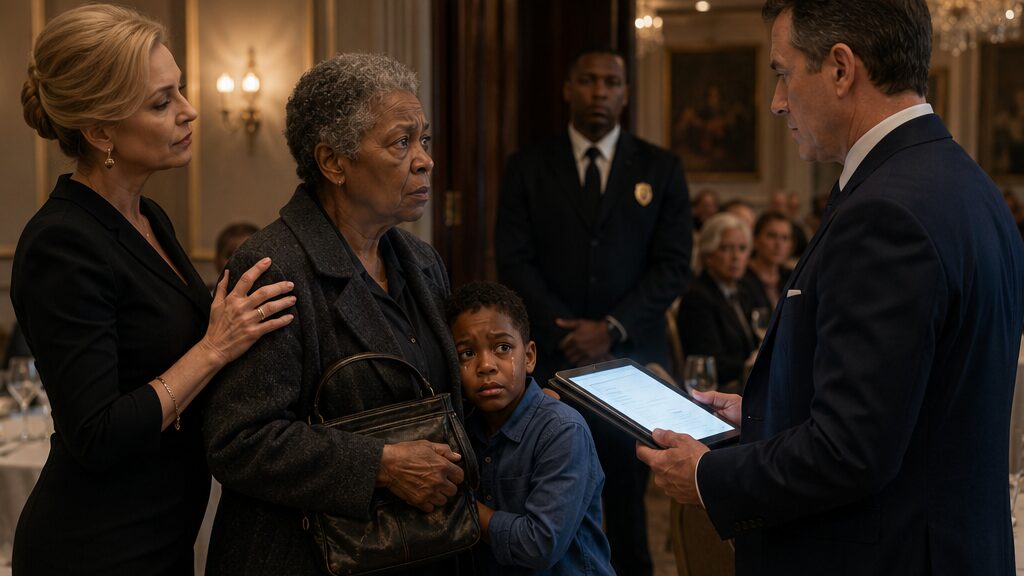
Jessica Clark’s hand was already on Ruth Mitchell’s shoulder when Ruth realized they were not being guided to a quieter table.
They were being moved toward the door.
“Let’s not do this here,” Jessica said, smiling with only the lower half of her face. Her fingers pressed through the dark wool of Ruth’s coat, firm enough to steer, polite enough for anyone watching to pretend it was kindness. “Paul wouldn’t have wanted a scene.”
Ruth looked past her, across the dining room Paul had chosen years ago for birthdays and anniversaries, back when his hands were steady enough to cut steak without pretending it was the knife’s fault. White tablecloths glowed under the chandeliers. Glasses of water caught the light. People who had hugged Ruth an hour earlier now studied their folded napkins.
Tyler stood close against her hip, his small hand clenched around the strap of her purse. He had worn the blue shirt Paul liked, the one Paul used to call his “serious young man” shirt. Now his collar was bent, and his eyes kept moving from Jessica’s face to the uniformed security officer near the entrance.
Ruth felt the boy’s fingers tremble.
“It’s all right,” she murmured.
Jessica heard her and lowered her voice. “It will be, if you sign the acknowledgment and let Mr. Scott finish the process properly.”
Raymond Scott stood beside the dessert table with a tablet in one hand and a thin folder in the other. He was tall, navy-suited, careful with his expression in the way lawyers were careful with locked cabinets. When Ruth had first seen him, she had thought he was there to read something Paul had left. Something with Paul’s voice still inside it.
Instead, Raymond had said, “Mrs. Mitchell, I know this is difficult, but the final estate documents are clear.”
Final.
That word had chilled her more than missing her own name.
Jessica angled her body between Ruth and the room, as if Ruth were the thing that needed concealing. Behind Jessica, an older couple Ruth had seen at Paul’s office parties years ago watched with their mouths closed tight. Neither came forward. Neither asked why Paul’s widow was being handled beside the coatroom like an unpaid bill.
“I don’t understand,” Ruth said.
Jessica’s fingers tightened. “Ruth.”
It was the way she said the name that did it. Not angry. Not grieving. Corrective. Like Ruth had wandered into a private room through the wrong door.
Raymond stepped closer. “The revised will names Jessica Clark as executor and primary beneficiary. It also revokes prior informal provisions, including any alleged verbal arrangements.”
“Alleged,” Ruth repeated.
He blinked. “That is the legal language.”
Tyler pressed harder against her. “Grandma?”
Ruth did not look down. If she looked down, she would lose the little strength she had left in her knees.
“Paul told me,” she said. “He said the house would be handled. He said Tyler’s school money was set aside.”
Jessica inhaled as if Ruth had spilled something. “He talked about many things when he was sick.”
“He talked about Tyler every day.”
“Paul changed his mind.” Jessica’s voice stayed smooth, but her eyes hardened. “That was his right.”
Raymond tapped the tablet. “There is also a release. It does not require you to agree emotionally. It simply acknowledges that you have received notice and will not interfere with the distribution.”
“Interfere,” Ruth said.
Someone at a nearby table shifted. A fork touched a plate, then went silent.
Jessica leaned closer, perfume and cold breath. “You don’t want people thinking this is about money.”
Ruth felt that sentence enter her like a pin. Jessica knew exactly where to place it. For three years Ruth had lifted Paul from chairs, counted pills into blue plastic compartments, learned which soup he could swallow on bad days, and told herself love did not need paper. She had not asked to see the will because asking had felt ugly. Because Paul had looked ashamed whenever paperwork came up. Because he had once squeezed her hand and said, “I’ll make sure you and the boy are all right,” and she had chosen to believe a promise spoken from a bed meant more than a notarized page.
Now the page had arrived without his voice.
“Let me see it,” Ruth said.
Jessica’s smile disappeared. “That isn’t necessary.”
Raymond hesitated, then turned the tablet slightly. “You may review the summary.”
Summary. Not the whole will. Not the pages Paul supposedly understood. Just the part they wanted her to absorb before they removed her.
The screen shone pale blue-white. Ruth saw columns, names, dates, words she could not hold onto because her eyes went first to the blank place where she expected to see herself. Paul Williams. Jessica Clark. Executor. Beneficiary. Tangible personal property. Residue of estate.
No Ruth Mitchell.
No Tyler.
The boy moved before she did.
He reached up with one finger and touched the screen near a line at the bottom. His nail made a soft tap against the glass.
“That’s the day Grandpa wouldn’t talk,” Tyler said.
Jessica’s head snapped toward him. “What?”
Tyler’s eyes had filled. He kept his finger on the tablet as if holding the date still would make the adults look properly at it. “That day. I remember. Grandma said not to make him answer questions because he was tired.”
Raymond lowered the tablet a fraction.
Ruth finally saw it.
Signed and executed: November 14.
A date. Cold, neat, harmless-looking. Six weeks before Paul died.
The dining room seemed to narrow around the tablet. The chandeliers blurred. The white tablecloths became snowfields with no footprints. Ruth saw Paul on that night: his mouth dry, his hand limp on the blanket, his gaze sliding past the television while Tyler sat beside the bed with a drawing of a rocket ship. Paul had smiled once when Tyler held it up. Not a full smile. A flicker. Ruth had told Tyler, “Grandpa sees it, baby. He just can’t talk much tonight.”
She remembered Jessica arriving late, carrying a leather tote and saying Ruth looked exhausted.
She remembered stepping into the kitchen to warm broth.
She remembered being gone for eighteen minutes.
“What date does it say he signed that?” Ruth asked, though she had already seen.
Raymond looked from the screen to her. “November fourteenth.”
Tyler’s face folded. “He couldn’t even say my name.”
Jessica moved quickly, her hand sliding from Ruth’s shoulder toward the tablet. “Children remember things strangely. He was emotional that week, but he had lucid periods. Mr. Scott would not have processed anything improper.”
Raymond did not answer.
Ruth looked at him. “Were you there?”
The question was not loud. It did not need to be. It traveled across the dining room because everyone had been waiting to find out whether Ruth would cry, shout, apologize, or leave.
Raymond adjusted his grip on the folder. “Mrs. Mitchell, this is not the appropriate place—”
“Were you there when he signed?”
Jessica stepped between them. “This is exactly what I was trying to avoid. Paul’s memorial is not the place for accusations.”
“No,” Ruth said. Her voice shook once and steadied. “It was the place you chose to hand me that.”
Jessica’s cheeks colored. “Because you would not return my calls.”
“You called once,” Ruth said. “From a number Tyler answered. You told him the house was family business.”
Tyler began to cry then, silently at first, his shoulders lifting and falling. Ruth put her arm around him and pulled him close. She wanted to cover his ears, cover his eyes, carry him out past the security officer and the watching faces. That was the old Ruth, the Ruth Paul had loved for her softness and blamed for her silences. The Ruth who could smooth a tablecloth after an insult and say it was fine.
But Paul’s date was on that screen.
And Tyler had seen it first.
Raymond cleared his throat. “No one is asking you to sign this second. You may take time—”
Jessica turned on him. “Raymond.”
He closed his mouth.
That was the first crack Ruth saw. Not in the document. In the room around it. Jessica had expected Raymond to be a wall. Instead, for one second, he looked like a man who had stepped where he had been told the floor was solid and felt it shift under his shoe.
Ruth reached into her purse, took out the pen Jessica had placed beside the release, and set it back on the nearest table without uncapping it.
“I’m not signing.”
Jessica’s eyes narrowed. “Then you are choosing to make this difficult.”
“No,” Ruth said. “I am choosing to read what my husband supposedly signed when my grandson remembers him unable to speak.”
The word husband landed between them. Jessica flinched, almost too quickly to see.
“Paul was my father,” she said.
“And he was my home,” Ruth replied.
The security officer took one step closer, perhaps because voices had sharpened, perhaps because Jessica’s hand had lifted. Ruth did not move. She kept Tyler against her, feeling his tears dampen the side of her coat.
Raymond drew the tablet back to his chest. “I think we should pause this discussion.”
Jessica faced him fully. “There is nothing to pause. The documents are complete.”
Raymond’s gaze shifted to Tyler, then to Ruth, then back to Jessica. When he spoke, his voice dropped low enough that only those closest could hear.
“Why didn’t you tell me the boy was there that week?”
Chapter 2: Jessica Said The Paperwork Was Cleaner Without Her
“Did Grandpa stop loving us before he died?”
Tyler asked it in the car before Ruth could get the key into the ignition.
For a moment, she sat with one hand on the steering wheel and the other still wrapped around the unsigned release Raymond had allowed her to keep. Not the will. Not the full document. Only the acknowledgment Jessica had wanted her to sign, and the printed summary Raymond had said he could provide “for review.” The tablet was gone, but the date had followed them out.
November 14.
Ruth stared through the windshield at the parking lot lights. In the reflection, her face looked older than it had that morning. The dining room door opened behind them, spilling gold light over the pavement. Guests came out in pairs, speaking softly until they saw Ruth’s car and went quiet.
Tyler sat beside her in his wrinkled blue shirt, cheeks wet, fists tucked under his arms. He looked ashamed of asking.
Ruth turned toward him. “No, baby.”
“But if he loved us, why wasn’t our names there?”
Because I trusted a promise instead of asking for a copy. Because I thought keeping peace meant staying quiet. Because I let Jessica decide which rooms I belonged in.
Ruth swallowed all of that.
“Sometimes paper gets made when people are tired,” she said. “And sometimes the paper doesn’t tell the whole thing.”
Tyler looked down. “Miss Jessica said it was his final wishes.”
Ruth heard Jessica’s voice again: cleaner without her. That was what Jessica had said near the side hallway while Raymond spoke to the security officer. She had thought Ruth did not hear. “The paperwork is cleaner without her. Dad wanted one family line, not confusion.”
One family line.
As if Ruth had been a smudge.
As if Tyler had not sat cross-legged on Paul’s bedroom floor counting out pills by color while Paul pretended he needed help remembering the order just to make the boy feel useful.
Ruth drove home without turning on the radio. At every red light, Tyler looked at the folded papers in her lap. By the time they reached her apartment, he was exhausted in that stubborn way children became when they refused to sleep because sleeping might let the adults change more things.
Inside, the rooms felt too small for what had happened. The apartment had always been a temporary place in Ruth’s mind. Paul’s house was where the good plates still sat, where her gardening gloves hung on the back porch hook, where Tyler had marked his height on the pantry doorframe because Paul said walls were better record keepers than phones.
Ruth set the papers on the kitchen table.
Tyler stood across from her, not taking off his shoes. “Are we still allowed to go to Grandpa’s house?”
Ruth looked at the printed summary. The word residue seemed to sit there like a locked gate.
“I don’t know yet.”
That frightened him more than no would have. She saw it and hated herself for not having a better answer.
“Go wash your face,” she said gently. “Then I’ll make tea.”
“I don’t want tea.”
“Then sit with me while I make it.”
He went to the bathroom, leaving the door open, water running too long. Ruth stayed at the table. The release had a blank line for her signature. Above it, legal sentences declared she had received proper notice, understood she had no claim, and agreed not to contest, delay, interfere with, or dispute the administration of the estate.
She touched the word interfere.
Paul had said, “You’ll be able to stay in the house. I don’t want you moved around after I’m gone.”
He had said it at the kitchen sink one spring morning, his robe tied crookedly, Tyler outside trying to teach a stray cat to answer to “Captain.” Ruth had laughed because the cat had more sense than both of them.
“You need to tell Jessica that,” she had said.
“I will.”
“You need to put it somewhere.”
“I am putting it somewhere.”
She had not pushed. He had looked tired. There had always been a reason not to push.
The bathroom water stopped. Ruth opened the drawer beneath the microwave and took out the little bundle of things she had carried from Paul’s house after the funeral: two photographs, a pharmacy receipt, and the folded lunch note he had once slipped into Tyler’s backpack after Ruth forgot to pack dessert.
For the serious young man: sandwich, apple, cookie hidden under napkin. Don’t tell Grandma I know how to be fun. —P.
Tyler had kept it in his pencil box for months before giving it to Ruth for safekeeping. Paul’s handwriting leaned to the right, impatient and familiar.
Ruth turned the note over. On the blank back, with the pen Jessica had expected her to use for surrender, she wrote:
November 14.
Her hand shook after the four.
Tyler came back and sat opposite her. His face was clean but swollen around the eyes. Ruth slid the note toward him, letting him see only Paul’s message on the front.
“He wrote that for you.”
Tyler touched the paper with two fingers. “He put the cookie under the napkin because you said I needed fruit first.”
“He believed in balance.”
“He said when I got bigger, there was papers for school.”
Ruth went still.
Tyler looked up. “Remember? When I showed him the science camp thing? He said, ‘Don’t you worry, young man. I got papers for that.’”
Ruth remembered the day, but not the sentence. Or maybe she had heard it and folded it into all the other soft promises because promises had felt safe then.
She stood and took her phone from the counter.
Paul’s voicemails were still saved under his name, though she had not been able to play them since the funeral. Her thumb hovered over the first one and moved past it. Too early. Too warm. His voice before illness. She scrolled to the later ones, the ones with pauses and breath.
The third played low through the speaker.
“Ruthie,” Paul said, voice rough as paper dragged over wood. “Jessica’s coming by Thursday with Mr. Scott’s office stuff. Don’t let me forget the papers for Tyler. And the house thing. I want it clean. I don’t want you asking anybody for what’s already yours.”
The message ended with a click.
Tyler stared.
Ruth pressed the phone to her chest, as if Paul might still be inside it and might hear how hard her heart had begun to hit.
The house thing.
The papers for Tyler.
Not everything. Not proof. But not nothing.
She replayed it once, and this time she heard what she had missed before: a thinness in Paul’s words, the effort it took to gather them. He had known he was losing the strength to finish things.
And she had thought giving him peace meant not asking.
The phone buzzed in her palm before the screen went dark.
Jessica Clark.
Ruth did not answer. A text appeared instead.
Raymond advised that we give you a short window to avoid unnecessary legal expense. I am willing to offer $5,000 as a courtesy if you sign the release within 48 hours. After that, access to all estate property and records will end. Please do not make this harder on Tyler.
Ruth read it twice.
Tyler leaned forward. “What does she want?”
Ruth turned the phone face down before he could see the amount.
“She wants quiet.”
“Are you gonna give it to her?”
Ruth looked at Paul’s lunch note on the table, the date on the back pressing through faintly beneath his old joke about the cookie. She thought of the dining room, Jessica’s hand on her shoulder, the security officer waiting for Ruth to become a problem big enough to remove.
For years, Ruth had believed peace was something you kept by swallowing the sharp parts.
Now peace looked like a blank signature line.
She picked up the phone and saved Paul’s voicemail to a separate folder. Then she took a photograph of the printed summary, the release, and the date she had written on the back of the note.
“No,” she said.
Tyler watched her.
Ruth’s voice did not rise. It did not need to.
“She gave me forty-eight hours,” she said. “So tomorrow, we start with the day he signed.”
Chapter 3: The Visitor Log Had One Name Too Many
“Your name was removed from the approved contact list three weeks before Mr. Williams passed.”
The records clerk said it kindly, which made it worse.
Ruth stood at the hospice office counter with Paul’s death certificate copy, her own identification, and a folder of papers she had organized twice before sunrise. The lobby smelled of hand sanitizer and coffee left too long on a burner. Behind the clerk, a printer hummed and stopped, hummed and stopped, as if even the machines were careful about what they released.
“Removed by who?” Ruth asked.
The clerk looked at her monitor. “I can’t disclose internal account changes without proper authorization.”
“I was his caregiver.”
“I understand.”
“I was there every day.”
“I understand that too.”
But the clerk’s hands stayed folded near the keyboard, and Ruth recognized the shape of refusal. It was softer than Jessica’s, but it led to the same locked door.
Ruth took a breath. She had promised herself in the car that she would not cry in front of anyone with a badge, desk, clipboard, or password.
“I’m not asking for his medical file,” she said. “I’m asking for the visitor log from November fourteenth. I was told a will was signed that day. My grandson remembers Paul unable to speak.”
The clerk’s eyes lifted.
There. Not sympathy exactly. Attention.
“I can print a limited visitor record,” the clerk said slowly, “showing arrivals and authorized contacts. It will not include clinical notes.”
“That’s all I’m asking.”
It was not all she needed, but Ruth had learned from the night before. Ask the smallest question that could not be called greed.
The clerk requested another form. Then another. Ruth signed where she was told, each signature making her think of Paul’s hand on November 14. Had he signed quickly? Slowly? Had someone held the page steady? Had Jessica stood over him with that same polished patience she had used in the dining room?
The printer started again.
While they waited, Ruth looked at the framed photograph on the wall: a hospice volunteer holding an old man’s hand beside a window. Under it, a phrase in pale script promised dignity in final days.
Ruth nearly laughed.
Not because dignity was false. Because it was fragile. Because it could be undone afterward by whoever controlled the paperwork.
The clerk handed over three pages.
“These are visitor entries and administrative contact updates for the period you requested.”
Ruth took them carefully. The paper was warm.
At first, the entries blurred into columns of dates, times, initials, and relationship fields. Ruth moved to a plastic chair near the corner and made herself read line by line.
Jessica Clark.
October 6. October 13. October 20. October 27. November 3. November 10. November 14.
Every week.
Ruth’s thumb stopped beside November 14.
Jessica Clark — 5:42 p.m.
Administrative contact update — 6:08 p.m.
Attorney video appointment — 6:30 p.m.
Ruth read it again.
She had left Paul’s room around six that evening to warm broth. Tyler had been drawing on the floor. Jessica had arrived with her leather tote and told Ruth, “You should eat something. You look like you’re about to fall over.”
Ruth remembered thanking her.
Thanking her.
A woman in scrubs came through the hallway carrying a stack of folders. She glanced at Ruth, slowed, and then looked away too quickly.
Ruth stood. “Excuse me.”
The woman paused.
“You were there,” Ruth said before she could stop herself. “On the east wing. November.”
The woman’s face tightened with the practiced caution of someone who had been warned that memory could become liability. “A lot of people were there in November.”
“My husband was Paul Williams.”
The nurse’s expression changed. Not dramatically. Just enough. Grief recognized grief before rules intervened.
“I remember Mr. Williams,” she said.
Ruth held the visitor log but did not push it toward her. “Do you remember November fourteenth?”
The nurse looked toward the counter. The clerk was helping someone else now.
“I can’t discuss patient details in a hallway.”
“I’m not asking you to break rules.”
The nurse gave her a sad look. “People always say that right before they ask.”
Ruth folded the pages once, then unfolded them. She forced her hands flat. “My grandson said Paul couldn’t talk that night. A will was signed that night.”
The nurse closed her eyes for half a second.
That was enough to make Ruth’s chest tighten.
“I can’t tell you whether he could legally sign anything,” the nurse said quietly. “That’s not my role.”
“But?”
The nurse looked at the visitor log in Ruth’s hand. “But records can show who was present. Medication times. General status notes. Requests for consults. If you have legal standing, you can request more.”
“Jessica says I don’t.”
“Jessica came often.”
The sentence was careful, but it carried weight.
Ruth looked down at the list. “Every week.”
“Yes.”
“She told people I wasn’t there?”
“I don’t know what she told people.”
Ruth waited.
The nurse’s mouth pressed into a thin line. “I know your name stopped appearing on the call board. Staff were told family communication should go through Ms. Clark because Mr. Williams was getting agitated with too many conversations.”
“Paul wasn’t agitated by me.”
“I didn’t say he was.”
The hallway seemed to tilt slightly.
Ruth thought of the days Jessica had called and said Paul was sleeping. The afternoon Ruth had arrived and been told he had just had a hard morning and visitors were limited. The night Paul had looked at her with wet eyes and whispered, “Too many people talking,” while Ruth stroked his forehead and blamed illness for the confusion.
“Who told staff that?” Ruth asked.
The nurse did not answer directly. “The administrative contact update should show who requested the change.”
Ruth looked again.
Requested by: Jessica Clark.
Approved contact: Jessica Clark.
Secondary contact: Raymond Scott Office.
Ruth’s throat tightened. “Raymond Scott was on the contact list?”
“For legal coordination, maybe. I don’t know.”
“He never told me he was speaking to hospice.”
The nurse’s caution returned. “Records alone may not prove what you want them to prove.”
“What do they prove?”
“That you should ask better questions.”
It was not comfort. It was not help, exactly. But it was the first honest thing anyone outside Ruth’s apartment had given her.
The nurse turned to leave, then stopped. “If there was a video appointment, ask whether the attorney saw him alone. Ask who answered questions. Ask whether Mr. Williams repeated the terms back himself.”
Ruth nodded.
“And Mrs. Mitchell?”
Ruth looked up.
The nurse’s voice lowered. “Don’t let anyone tell you confusion always looks dramatic. Sometimes it looks like a tired man agreeing because the person beside him keeps saying, ‘That’s what you meant, Dad.’”
Then she walked away.
Ruth sat back down with the visitor log on her lap.
The pages no longer felt like a small record. They felt like a map of doors closing while she had been standing on the other side, believing Paul was simply too weak for company.
At home, Tyler was at the kitchen table doing homework he was not really doing. He looked up when Ruth entered.
“Did they know?” he asked.
She hung her coat slowly. “They knew Jessica was there.”
“Did they know Grandpa couldn’t talk?”
Ruth set the visitor log on the table, away from his papers. She did not want the columns near his multiplication worksheet, as if adulthood might spread by contact.
“They knew enough that I need to ask Mr. Scott some questions.”
Tyler picked at the edge of his notebook. “Is he the man with the tablet?”
“Yes.”
“He looked scared when I said the date.”
Ruth had noticed that too. At the time she had thought it was discomfort. Now she wondered if it was recognition.
She took out Paul’s lunch note and placed it beside the visitor log. The date she had written on the back lined up with Jessica’s entry on the printed page. November 14 on one piece of paper, November 14 on another. One in Ruth’s shaking hand. One from a hospice printer. Both pointing at the same evening.
Her phone buzzed.
A second text from Jessica.
Forty-one hours, Ruth. Please don’t force us to involve counsel further.
Ruth did not answer.
Instead, she traced the visitor log down to the attorney video appointment line. Beside it, under external contact, was a number.
Raymond Scott’s office number.
Not Jessica’s. Not hospice’s. His.
Ruth sat down, pulled the phone toward her, and placed one finger over the number without dialing yet.
If Raymond’s office had been there on November 14, then the tablet had not started in the dining room.
It had started in Paul’s room, while Ruth was somewhere nearby, warming broth for a man everyone else had already begun turning into paperwork.
Chapter 4: The Lawyer Remembered The Call, But Not The Silence
“The signatures are valid,” Raymond Scott said before Ruth had sat down.
His office was too bright. The window behind him looked over a row of trimmed hedges and a parking lot where cars sat clean and still in their marked spaces. His desk held no family photographs, no clutter, nothing soft enough to suggest that grief had ever been invited in and allowed to stay.
Ruth stood with her purse against her ribs and the visitor log folded inside it.
“I didn’t ask whether the signatures were valid,” she said.
Raymond’s eyes moved once toward the chair opposite him. “Mrs. Mitchell, please.”
She sat, not because he asked, but because her knees had begun to remember the hospice hallway.
On his desk lay a printed copy of the estate summary he had shown on the tablet. The same date sat near the bottom. November 14. On paper it looked less alive than it had on the screen, but no less dangerous.
Raymond folded his hands. “I agreed to this meeting because I understand emotions are high after a loss. But I want to be clear. A properly executed document is not invalid simply because family members disagree with its terms.”
“Was Paul alone when you spoke to him?”
Raymond paused.
It was small, but Ruth saw it. A blink held half a second too long.
“The meeting was arranged through his authorized family contact.”
“Jessica.”
“Yes.”
“Was Paul alone?”
Raymond leaned back. “It was a video appointment.”
“That isn’t what I asked.”
His mouth tightened. “Jessica was present at the beginning.”
“At the beginning?”
“She assisted with the connection. Mr. Williams was physically weak.”
Ruth kept her hands clasped in her lap so he would not see them tighten. “Did he say my name?”
Raymond looked down at the paper. “Mrs. Mitchell—”
“Did Paul say my name, or did Jessica say it for him?”
The office seemed to hold its breath around them. A clock ticked somewhere near the bookcase. Ruth could hear it because Raymond did not answer quickly enough.
“He understood he was revising his estate plan,” Raymond said.
“How do you know?”
“Because I asked him.”
“And what did he say?”
Raymond reached for a file beside his tablet, then stopped. “I am limited in what I can disclose.”
“You handed me a release in a dining room with people watching me like I had stolen dessert off the table,” Ruth said. “You told me I had no claim. You let my grandson see a date that made him cry. Now you’re limited?”
His eyes flickered, not with anger. With discomfort.
“That was not how I would have preferred notice to occur.”
“But you let it happen.”
He did not deny it.
Ruth opened her purse and removed the visitor log. She unfolded it slowly, smoothing the creases with her palm, and placed it on his desk over the estate summary. The hospice paper looked plain beside his letterhead, but it changed the room more than any raised voice could have.
“November fourteenth,” she said. “Jessica came at 5:42. Contact update at 6:08. Attorney video appointment at 6:30. That was you.”
Raymond looked at the page.
Ruth watched his face. He did not look surprised by his own number, but something in his expression closed and reopened when he saw the contact update line.
“Where did you get this?”
“From hospice.”
“Limited records?”
“Enough.”
He picked up the log and read it with the kind of attention he had not given her grief. Ruth hated him for that, then hated herself for being grateful.
“Did you know my name had been removed?” she asked.
“No.”
“Did you ask why the woman who lived with him and cared for him wasn’t the contact?”
“I was told the household situation had become stressful.”
“By Jessica.”
He set the paper down. “Yes.”
“What else did she tell you?”
Raymond rubbed his thumb along the edge of the file. For the first time, Ruth saw the man beneath the suit: not cruel, not kind, but cornered by his own procedures.
“She said Paul wanted to simplify matters.”
“Cleaner paperwork.”
His eyes lifted.
“She used that phrase with you too,” Ruth said.
He did not answer, and that was answer enough.
Ruth took Paul’s lunch note from her purse. She had folded it into a plastic sandwich bag before leaving, afraid the paper might tear from being handled too much. She placed it beside the visitor log but kept one finger on it.
“This is not a will,” she said. “I know that. I am not pretending it is. But Paul wrote this for Tyler. He left voicemails about papers for Tyler and the house thing. I have one saved.”
Raymond’s gaze softened at the sight of the handwriting. Then the lawyer returned.
“Verbal statements and personal notes may not override executed estate documents.”
“I know.”
“Then what are you asking me for?”
“The truth about what you saw.”
Raymond looked away, toward the window. In the parking lot, a delivery truck backed into a space, its warning beep faint through the glass.
“I saw an ill man,” he said at last. “I saw a man who appeared to recognize the nature of the meeting. I asked standard capacity questions.”
“What questions?”
“His name. The date. The general nature of his assets. Who he wanted to benefit.”
“And he answered?”
“Some.”
“Some,” Ruth repeated.
Raymond’s jaw shifted. “He was weak. His speech was limited.”
“Did he say Jessica should get everything?”
Raymond did not speak.
Ruth felt the answer before he shaped it.
“He indicated Jessica was to manage the estate.”
“Manage,” Ruth said. “Not receive.”
“The draft presented to him named Jessica as executor and primary beneficiary.”
“Presented by who?”
“My office prepared the document after prior instructions.”
“From Paul?”
Raymond opened the file. “From the client, communicated through the authorized contact and confirmed during the call.”
“Jessica told you what he wanted, and then you asked him questions while she sat there.”
“That is not an accurate characterization.”
“Then correct it.”
He looked at the file again.
Ruth waited. She had spent three years waiting for Paul’s pain medicine to work, for hospice calls, for lab results, for Jessica to visit without bringing tension into the room. Waiting was not weakness. It was a skill. She could sit inside silence longer than Raymond could.
Finally, he said, “Jessica stated that you had been pressuring him regarding the house.”
Ruth almost laughed, but the sound stuck in her throat. “I was bathing him.”
“She said discussions about property were upsetting him.”
“I never asked him to give me anything.”
“She said you did. She said he felt obligated.”
Ruth pressed her fingertips into the arms of the chair. The office blurred for a second, not from tears, but from the sudden violence of being recast. All the soup, sheets, pills, nighttime alarms, and whispered prayers had been turned into pressure.
“That’s why I wasn’t on the call board,” she said. “That’s why hospice was told to go through her.”
Raymond was quiet.
“She made me look like the danger,” Ruth said.
“I should have asked more directly about your role.”
The sentence was small. Not enough. But it was the first thing he had said that cost him anything.
Ruth picked up the lunch note and returned it to her purse. “Open the file.”
“Mrs. Mitchell—”
“Open the file.”
He looked at her for a long moment, perhaps deciding whether she had any power in the room. Then he pulled a thin stack of papers from the folder. Draft notes. Intake forms. A printed email. A yellow sticky note half-hidden near the back.
He read silently, and his face changed.
“What is it?” Ruth asked.
Raymond did not answer.
She stood.
He looked as if he wanted to cover the file, but he did not. Ruth saw the note before he moved it.
Client confused by house provision — daughter clarified.
Ruth stared at the words.
The room did not spin. It sharpened.
“What did Paul think the house provision meant?” she asked.
Raymond looked down at the note as though it had appeared in someone else’s handwriting.
“I need to review this further,” he said.
Ruth kept standing.
“No,” she said. “You need to tell me what he thought he was signing.”
Chapter 5: She Offered Five Thousand Dollars For A Lifetime Of Silence
“You’re going to tear this family apart over money,” Jessica said before Ruth had fully entered the side room.
The same venue looked different without the memorial flowers. Tables had been cleared from the smaller dining room, leaving stacked chairs along one wall and a service cart with folded napkins waiting to be rolled away. It smelled faintly of lemon polish and coffee grounds. A place meant for celebrations, washed clean between one family’s grief and another’s reservation.
Jessica stood beside a round table with a cream envelope on it.
Ruth stopped just inside the doorway. She had not wanted to come back here. The dining room beyond was empty now, but she could still see Tyler’s finger touching the tablet, still hear the sharp hush that followed.
“I came because you said you wanted to talk,” Ruth said.
“I want to end this before it becomes embarrassing.”
“For who?”
Jessica’s mouth tightened. She wore another black dress, less formal than the memorial one, and her hair was pinned back so tightly it seemed to pull at her eyes. On the table beside the envelope lay a printed copy of the same release and a tablet with the screen dark.
Ruth looked at it but did not sit.
Jessica noticed. “There’s no trap in the chair.”
“There was one in the dining room.”
A small flash of hurt crossed Jessica’s face before anger covered it. “You think I enjoyed that?”
“I don’t know what you enjoyed.”
“You walked into my father’s memorial acting like you belonged at the center of it.”
Ruth held her purse strap. “I walked in with his grandson.”
“Your grandson.”
“Paul claimed him.”
Jessica gave a short laugh, not because anything was funny. “That’s exactly what I mean. You say things like that. You make it sound like you were the family and I was some visitor.”
Ruth saw then that Jessica had not called her there only to threaten her. She had called her there to unload something she had been carrying long before November 14.
“My father spent his last years in that house with you,” Jessica said. “Every holiday had to work around your schedule. Every decision had to include what Ruth thought would be easiest. And then Tyler started calling him Grandpa, and suddenly everyone expected me to smile while my own children’s pictures got moved off the mantel to make room for science fair ribbons.”
Ruth did not mention that Jessica had brought no children to Paul’s bedside. She did not mention that the pictures had been moved by Paul himself after Jessica stopped visiting for months at a time. Truth used carelessly could become cruelty too.
“Paul loved you,” Ruth said.
Jessica’s eyes shone. “Don’t.”
“He did.”
“You don’t get to explain my father to me.”
“No,” Ruth said. “But you don’t get to erase what he said to me.”
Jessica picked up the cream envelope and held it out. “Five thousand dollars. Sign the release. Walk away. Keep whatever memories you want. No one is taking those.”
Ruth did not touch it.
“That is what you think memories are worth?”
“It is what I am offering to avoid a fight you cannot afford.”
There it was. The clean legal voice. The same voice from the memorial, polished enough to hide the knife.
Ruth moved to the table and pulled out a chair, but instead of sitting, she placed her folder down. Visitor log. Printed summary. The back of Paul’s lunch note with the date written on it. She did not spread them dramatically. She simply set them where Jessica could see.
Jessica looked at the papers and then away. “None of that changes the will.”
“It changes what I know to ask.”
“You don’t have standing.”
“You keep saying that like it makes the date disappear.”
Jessica’s hand tightened around the envelope. “Dad changed his mind. That was his right.”
“He changed his mind six weeks before he died, when Tyler remembers him unable to say his name.”
Jessica stepped closer. “Do you know what he said when you weren’t there?”
Ruth went still.
“He said he was tired,” Jessica continued. “He said everyone wanted something. He said he did not want to keep being pulled apart.”
“That does not mean he wanted to leave us with nothing.”
“It means you don’t know everything.”
For a moment, Ruth heard something under Jessica’s anger that sounded dangerously like pain. Not innocence. Not excuse. But pain. The kind that made people rearrange facts until they could live with themselves.
“Maybe I don’t,” Ruth said. “That is why I’m asking.”
“No. You’re accusing.”
“I’m asking why Raymond’s file says Paul was confused by the house provision and you clarified it.”
Jessica’s face emptied.
The room changed.
Not enough for a confession. Enough for Ruth to know she had found a door Jessica had not meant to leave unlocked.
“Raymond showed you his file?” Jessica asked.
“He showed me enough.”
“He had no right.”
“Did Paul think he was giving you the house outright?”
Jessica looked toward the door as if calculating who might hear. “Paul wanted me to manage things.”
“Manage is not own.”
“You think I don’t know that?” Jessica snapped. “You think I don’t know every word you’re going to pick apart? Executor, beneficiary, life estate, residue. You think I haven’t had those words running through my head for weeks?”
“Then why did you let him sign something he didn’t understand?”
“Because he did understand the important part.”
“What was the important part?”
“That I was his daughter.”
The answer landed harder than Ruth expected.
Jessica’s chin trembled once, and she forced it still. “I was his daughter before you met him. Before Tyler. Before the pill boxes and the little notes and everyone telling me how lucky Dad was to have you. I was there when my mother left him sitting at the kitchen table with bills he didn’t know how to pay. I was there when he promised me that house would stay in the family. Then you came along, and suddenly he was talking about giving you rights to it like I was supposed to be grateful.”
Ruth let the words settle. There was truth inside them, but not enough truth.
“You could have talked to me.”
Jessica laughed again, softer now. “Would you have given it up?”
Ruth did not answer quickly, and Jessica saw it.
“You see?” Jessica said. “Everyone acts like I stole something, but no one asks what you were willing to take.”
Ruth felt the old shame rise. It whispered that Jessica was right. That a woman who had not married Paul until late, who had no blood claim, who had trusted promises because asking for documents felt indecent, should be careful how much space she occupied in the grief of a daughter.
Then Ruth looked at the tablet on the table.
“How long was he alone with you on November fourteenth?”
Jessica’s expression hardened again. “This meeting is over.”
“No. It is finally beginning.”
Jessica shoved the envelope toward her. “Sign, Ruth. Take the money. Keep your dignity. If you push this, the house will be listed before any review goes anywhere, and once legal fees start, there may be nothing left for anyone except lawyers.”
“You’re selling Paul’s house?”
“I am administering the estate.”
“Before Raymond reviews the signing?”
“Raymond works for the estate.”
“He also wrote down that Paul was confused.”
Jessica’s mouth tightened. “An unsigned note in a file is not a rescue rope.”
Ruth picked up the envelope, felt the weight of the check inside, and for one second imagined the relief of accepting it. Rent for a while. Groceries. Shoes for Tyler without checking the clearance rack. No more meetings in rooms where people used legal words to make her feel small.
Then she placed it back on the table.
“I’m not doing this over money,” she said. “I’m doing this because he didn’t sign that alone.”
Jessica looked at her for a long moment. When she spoke, the anger had cooled into something more dangerous.
“You have until tomorrow before I change the locks for good.”
Ruth’s fingers tightened around her folder. “You changed them already?”
“Estate property has to be secured.”
Ruth left without giving Jessica the satisfaction of watching her hurry.
Tyler was waiting in the hallway outside the side room, sitting on a bench with his knees pulled close. Ruth had told him to stay at home with a neighbor, but he had begged not to be left behind, and in the end she had brought him as far as the lobby. He stood when he saw her.
“She looked mad,” he said.
“She is.”
“Are you?”
Ruth almost said no. Then she stopped lying out of habit.
“Yes.”
Tyler nodded as if that made sense. In the parking lot, he reached into Ruth’s purse for a tissue, then frowned.
“Grandma?”
“What is it?”
“The old key,” he said, searching again. “Grandpa’s house key. The one with the green rubber thing. It’s not here.”
Ruth took the purse from him and looked herself.
The pocket where Paul’s old back-door key had been for years was empty.
Chapter 6: The House Still Held The Version He Meant To Sign
The front lock had been changed, but Paul had always trusted old hiding places more than new hardware.
Ruth stood on his porch the next morning with Tyler beside her, looking at the bright brass deadbolt that had not been there before. The new keyhole shone like an insult. A small sticker from the locksmith still clung to the edge of the plate.
Tyler touched the green paint on the porch rail. “Did Miss Jessica do it?”
“Yes,” Ruth said.
“Can we still go in?”
Ruth looked toward the driveway. Empty. No car. No moving truck. No real estate sign yet.
She should have called Raymond first. She should have waited. She should not have brought Tyler. Every careful voice in her head had a rule, and every rule sounded like another way to arrive too late.
“Stay close,” she said.
They walked around to the back. The yard was overgrown from weeks without Paul fussing at the weeds. His tomato cages leaned in the garden bed, empty now, one of them collapsed against the soil. Ruth had meant to come sooner. She had told herself Jessica needed space, the house needed time, grief needed quiet.
Quiet had been useful to everyone but her.
At the back porch, Ruth knelt beside the loose rail near the steps. Paul had taped a spare key there years ago after Ruth locked herself out while carrying groceries and refused to admit she had cried in the driveway. He had laughed for days, then taped the key underneath with silver duct tape and said, “Every kingdom needs a foolish little secret.”
The tape was old and dirty, curled at one edge.
Ruth held her breath and reached under.
Metal touched her fingers.
Tyler exhaled like he had been holding his own breath for the whole morning. “It’s still there.”
Ruth peeled it free. The key was not the green rubber one missing from her purse. It was smaller, older, scratched near the teeth. She wiped dirt from it with the hem of her coat and slid it into the back lock.
For one terrible second, it stuck.
Then it turned.
The kitchen smelled closed-up, stale coffee and dust and something faintly medicinal that Ruth had once stopped noticing because care had its own weather. Sunlight lay across the floor in pale rectangles. The little table by the window still had two chairs, though Jessica had removed the cushion Ruth used for Paul’s back. A mug sat upside down near the sink. Paul’s mug. The one with the faded fishing boat he had never used for fishing trips because he did not like boats.
Tyler hovered at the threshold.
“You can come in,” Ruth said.
He stepped inside and immediately looked toward the pantry doorframe. His height marks were still there, pencil lines beside dates Paul had written with exaggerated seriousness.
Ruth saw Tyler’s chin tremble.
“Grandpa didn’t erase those,” he whispered.
“No,” Ruth said. “He didn’t.”
They moved through the house carefully, not touching more than they had to. Ruth did not know what she was searching for exactly. A signed will would have been too easy. A letter explaining everything would have been too clean. Paul had never been a man who finished hard conversations neatly. He left batteries in drawers, coins in jars, receipts in jacket pockets, and feelings tucked inside jokes.
In the bedroom, the hospital bed was gone. Jessica had had it removed. The outline of it remained in the carpet, four square dents where the wheels had pressed. Ruth stood there longer than she meant to.
Tyler took her hand.
“You okay?”
“No,” she said. “But I’m here.”
The answer surprised them both.
She started with the nightstand. Empty except for a cough drop wrapper and a paperclip. The dresser held socks Jessica had not bothered to take, a watch with a dead battery, and a stack of old handkerchiefs. The closet had been partly cleared. Paul’s good jacket was gone. So were the boxes that had sat on the top shelf.
Ruth’s fear sharpened.
“She’s already been through here,” she said.
Tyler pointed to the bottom of the closet. “What about that?”
A plastic storage bin sat behind an old pair of slippers, half-hidden under a blanket Ruth recognized from the porch swing. She pulled it out. Inside were owners’ manuals, appliance warranties, tax envelopes, and a folder with Paul’s blocky handwriting across the tab.
Ruth / Tyler — ask Raymond to fix.
Ruth sat down on the closet floor.
The folder rested in her lap, heavier than paper should be.
Tyler crouched beside her. “Is that good?”
“I don’t know yet.”
Inside was an unsigned memo. Not legal paper. Not notarized. Not witnessed. Just three typed pages with handwritten corrections in the margins. The first page listed the house. The second listed an education fund for Tyler, with a bank name and a note in Paul’s hand: make separate, don’t let probate tangle it. The third page had Ruth’s name under a phrase she had never heard spoken out loud.
Life estate.
Paul had circled it and written: Ruth stays as long as she wants. Jessica gets house after. Fair?
Fair.
The word undid her.
Not because it was enough. Because it was Paul. His old habit of writing a question when he was afraid to make a demand. His attempt to stand in the middle of love and blood and make a bridge out of paperwork.
Ruth covered her mouth.
Tyler leaned closer. “He wrote us?”
“Yes.”
“So Miss Jessica lied?”
Ruth looked at the unsigned memo. “She didn’t tell the whole truth.”
“That’s lying.”
Sometimes children had no use for the soft words adults built around harm.
Ruth took out Paul’s lunch note from her purse. The date on the back stared up at her. November 14. She placed it beside the memo. One paper from before the dispute. One paper from after. One joking about a cookie under a napkin. One trying to divide a life without breaking a family.
“I should have asked him,” Ruth said.
Tyler looked confused. “Asked what?”
“To show me. To finish it. To not leave it to later.”
“He was sick.”
“I know.”
“So why is that your fault?”
Ruth had no answer. Or rather, she had too many answers that belonged to years Tyler was too young to carry. Because women like Ruth learned to be grateful for what was offered and careful with what they needed. Because she had mistaken not pressing Paul for loving him gently. Because somewhere deep down, she had feared Jessica’s accusation before Jessica ever made it: that Ruth wanted too much.
She folded the memo along its original crease.
“It isn’t enough by itself,” she said, more to herself than Tyler.
“But it says he remembered.”
Ruth looked at him.
That was the small mercy she had almost missed. She had come looking for proof and found something more painful: Paul had tried. Incomplete, late, imperfect, but real.
The front door opened.
Ruth froze.
Voices entered with the hard brightness of people expecting an empty house.
“It photographs better from the dining room first,” Jessica was saying. “The kitchen needs work, but the bones are good.”
A stranger’s shoes clicked on the hardwood.
Tyler’s eyes widened.
Ruth rose from the closet floor with the folder in one hand and Paul’s lunch note in the other. Her heart struck once, hard. She did not hide the papers. She did not tuck them away like something shameful.
Jessica appeared in the bedroom doorway with a real estate agent behind her holding a phone and a measuring device. For a second, all four of them stared at one another: Jessica in her polished coat, Ruth beside the stripped closet, Tyler near the empty space where Paul’s bed had been, and the agent caught between a listing and a family wound.
Jessica’s gaze dropped to the folder.
Her face went pale.
Ruth held it tighter.
“You were going to sell the house,” Ruth said, “before anyone could see what he meant to fix.”
Chapter 7: Ruth Did Not Win The Whole Estate, But She Kept The Truth
Ruth placed the tablet printout on Raymond Scott’s conference table and turned it so Jessica could read the date upside down if she wanted to pretend she had not seen it.
“Read it aloud,” Ruth said.
Jessica sat across from her in a gray coat, both hands folded over a leather folder. She looked smaller in Raymond’s office than she had in the dining room or Paul’s bedroom doorway. Not weaker. Just less protected by chandeliers, guests, and a security officer waiting near the door.
Raymond stood at the end of the table, his own file open in front of him. He had asked for “a measured discussion.” Ruth had brought the hospice log, Paul’s unsigned folder, the lunch note, the printed estate summary, and Tyler’s school notebook page where he had written, in a child’s careful hand, Grandpa couldn’t say my name that night.
She had not brought Tyler.
This room was already carrying enough.
Jessica looked at the printout. “We all know the date.”
“Then say it.”
“November fourteenth.”
Ruth heard the words settle.
The first time she had seen that date, it had been lit from underneath on a tablet in a crowded dining room, while Jessica’s hand pressed her toward the door. Now it sat flat on paper, surrounded by other papers, no longer alone.
Ruth slid the hospice log forward. “Jessica arrived at 5:42. My name had already been removed as an approved contact. At 6:08, the contact list was updated. At 6:30, Raymond’s office joined a video call. Paul was medicated that evening. Tyler remembers him unable to speak clearly. The nurse will not say what the law means, but she will confirm he was weak and minimally responsive.”
Jessica’s mouth tightened. “Minimally responsive is not the same as incompetent.”
“I know.”
The answer seemed to unsettle her. She had expected Ruth to overreach. Ruth saw it in the slight lift of Jessica’s chin, the prepared correction that no longer had somewhere to land.
Ruth slid the unsigned memo beside the log.
“This was in Paul’s closet. A folder labeled for me and Tyler. It is not signed. I know that too. It does not replace a will. It does not magically give me the house. It does not make the estate mine.”
Raymond’s eyes moved over the folder tab. Ruth had photographed it before handing anything over. She had learned.
“But it shows what he was trying to fix,” Ruth said. “It shows that the house provision confused him. It shows that he wanted me to stay, Jessica to have the house later, and Tyler’s school money kept separate.”
Jessica leaned forward. “That paper could have been written months before he changed his mind.”
“Yes,” Ruth said. “So tell us when he changed it.”
Jessica looked at Raymond.
Raymond did not rescue her.
Ruth kept her voice even. “Tell us the conversation. His words. Not yours. Not legal language. What did Paul say that night that changed ‘Ruth stays as long as she wants’ into Ruth leaves with nothing?”
Jessica’s lips parted, then closed.
The silence was not a confession. Ruth would not pretend it was. But it was the first time Jessica had no clean sentence ready.
Raymond removed a page from his file and placed it in the center of the table. “I reviewed the call notes and the draft history.”
Jessica turned toward him sharply. “Raymond.”
He did not look at her. “The revised document was prepared after communications from you as authorized contact. During the video call, Mr. Williams confirmed his identity and gave brief affirmative responses. He did not independently explain the full distribution. When the house provision came up, my note says, ‘Client confused by house provision — daughter clarified.’”
Ruth held still.
Raymond looked at the page as if each word had weight. “That should have prompted a separate call. It did not.”
Jessica’s face flushed. “You are making it sound like I tricked him.”
“I am describing the file.”
“You asked him if he wanted me to handle the estate. He said yes.”
“To handle,” Ruth said. “Not to take everything.”
Jessica looked at her then, and for a moment the anger dropped so completely that Ruth saw the daughter who had been standing behind it. Tired. Grieving. Humiliated in a different way.
“He was my father,” Jessica said.
“I know.”
“You keep saying you know, but you don’t. You got the gentle parts at the end. I got the years before that. I got him forgetting birthdays because he was working. I got him marrying again and acting like if he loved everybody hard enough, nobody would notice what was missing. Then you and Tyler were there every day, and I would walk into that house and feel like a guest in my own father’s life.”
Ruth let the words pass through the room before she answered.
“That may be true,” she said. “But it does not make November fourteenth clean.”
Jessica looked down.
Ruth reached into her purse and took out Paul’s lunch note. She unfolded it, worn now at the creases, and set it on top of the unsigned memo.
“For the serious young man,” she read softly. “Sandwich, apple, cookie hidden under napkin. Don’t tell Grandma I know how to be fun.”
Raymond looked away.
Jessica’s eyes shone, though she did not cry.
“He wrote silly things,” Ruth said. “He avoided hard things. That was his flaw. Maybe mine was letting him. I thought if I didn’t ask too much, I was loving him better. I thought keeping peace meant leaving the sharp questions alone.”
She looked at Jessica.
“But you used that silence. You filled it with your version of me.”
Jessica’s hands moved over the leather folder. “I thought you were taking advantage.”
“No,” Ruth said. “You needed to think that.”
The sentence landed between them with no raised voice, no triumph.
Raymond exhaled slowly. “Given what has been presented, I cannot say Mr. Williams fully understood the distribution as it was later written.”
Jessica closed her eyes.
Ruth felt no victory. Only a loosening, as if a hand had finally moved from her throat.
“What does that mean?” Jessica asked.
“It means,” Raymond said carefully, “the revised will should undergo formal review before distribution proceeds. It does not guarantee an outcome. It may be costly. It may delay the estate significantly. It also means any sale of the house should be paused.”
Jessica stared at him. “And if I refuse?”
Raymond’s voice stayed quiet. “Then Mrs. Mitchell has enough to challenge the process, and my file will not help your position.”
Ruth waited for the room to become dramatic. It did not. No one burst through the door. No one declared the will void. The law remained the law, slow and expensive and colder than grief.
Jessica opened her folder and pulled out a paper Ruth had not seen before.
“I already spoke to the bank representative,” Jessica said. “There was an account Dad meant for education. It was never formally moved the way he wanted. I can restore that for Tyler without admitting the rest.”
Ruth looked at the paper but did not touch it.
“And the house?”
Jessica swallowed. “I won’t list it while Raymond reviews the file.”
“That is not the same as what Paul wanted.”
“No,” Jessica said. “It is not.”
For the first time, she sounded as if the difference hurt her too.
Raymond looked from Jessica to Ruth. “A formal agreement can preserve the education funds immediately, pause the sale, and allow review of the house provision. Personal property can also be addressed.”
Ruth knew what that meant. Not justice wrapped whole and delivered. Not the past corrected. A pause. A record. A crack in the story Jessica had tried to make permanent.
“What personal property?” Ruth asked.
Jessica’s eyes lowered to the table. “His watch. The fishing mug. The porch swing blanket.” Her voice tightened. “And the pantry doorframe, if you want it removed before anything happens to the house.”
Ruth’s chest hurt.
The doorframe with Tyler’s pencil marks.
She looked at Jessica and saw that this was not generosity. It was surrendering a small piece of what she had tried to control. Maybe also apology, though neither woman was ready to call it that.
“I want Tyler’s marks preserved,” Ruth said. “Not cut out like damage.”
Jessica nodded once.
Later, outside Paul’s house, Ruth stood on the porch with the key Raymond had arranged for her to keep during the review. The new brass lock was still there, but it no longer felt like the final word. Inside, the house remained uncertain. The will remained contested. Jessica remained Jessica.
Tyler stood beside Ruth, holding Paul’s fishing mug in both hands even though it was empty.
“Did we win?” he asked.
Ruth looked through the front window at the dim shape of the kitchen table, the place where Paul had promised too softly and too late.
“No,” she said. “Not the way people mean when they say win.”
Tyler looked disappointed, then thoughtful. “But Grandpa didn’t forget us.”
Ruth touched the folded lunch note in her pocket, where the date on the back had begun as a wound and become a map.
“No,” she said. “He didn’t.”
Across the street, Jessica sat in her car for a long time before starting it. She did not wave. Ruth did not expect her to.
When the car finally pulled away, Ruth unlocked the door and let Tyler step inside first. The house smelled of dust, old wood, and something faintly like Paul’s coffee. Tyler went straight to the pantry doorframe and placed his hand under the last pencil line.
Ruth stood behind him with the folder under her arm.
The document had said one thing. The room said another. And this time, Ruth did not keep quiet to make the room easier for anyone else.
The story has ended.