My Neighbors Threatened to Take My Side Yard, Until the Survey Put Their Entire Garden on My Land
Chapter 1: The Fence Appeared Before Steven Spoke
Steven found the hostas beside the curb before he noticed the fence.
There were twelve of them, their pale roots exposed and tangled together on the damp grass like hands pulled from the soil. Clumps of black earth still held to the leaves. One plant had been split through the crown by a shovel.
Beyond them, along the side yard he had maintained for nineteen years, stood a new white picket fence.
The boards were clean enough to shine. Their pointed tops ran from the Whites’ driveway toward the rear yard in a straight, confident line, cutting across the narrow strip where Steven had planted the hostas after moving into the house.
A landscape contractor was tamping soil around the final post.
Steven set down the canvas lunch bag he had carried home from the high school.
“Excuse me,” he said. “Who authorized you to remove those plants?”
The contractor glanced toward the neighboring patio.
Carolyn White stood there wearing sunglasses and holding a tablet against her chest. She had moved into the house eighteen months earlier with her husband, Brian. In that time, they had replaced the roof, painted the brick, resurfaced the driveway, and turned the rear lawn into a garden that appeared regularly on the neighborhood Facebook page.
Carolyn walked across the grass without hurrying.
“They were in the construction area,” she said.
“They were on my property.”
She raised the sunglasses onto her hair. “The plans were approved.”
Steven looked from her to the fence. The nearest post sat where the outer row of hostas had been. He could picture the old line even without a string: the corner of his garage, the shallow drainage swale, the utility box near the back.
“Approved by whom?”
“The architectural committee.”
“That committee approves appearance. It doesn’t establish property lines.”
Carolyn’s expression tightened, not with doubt but with impatience. “Janet reviewed the site plan herself.”
The contractor had stopped working. His shovel rested against his boot.
Steven felt the familiar pressure behind his ribs that came whenever a disagreement turned public. Years earlier, at school, he had documented another instructor’s repeated safety violations. The report had been accurate. The man had also lost his position three months before qualifying for retirement benefits. Steven still remembered the empty workbench afterward and the way people lowered their voices when he entered the faculty room.
Since then, he had learned to wait. Most problems revealed their true size if a person did not rush toward them.
“I’d like the work stopped until we compare the plan to the deed,” he said.
Carolyn gave a small laugh. “The posts are already set.”
“That doesn’t answer me.”
“It answers the practical question.”
A truck door shut in the driveway. Brian White came around the front of the house carrying two bags of soil. He was broad through the shoulders, dressed in a quarter-zip shirt and new work gloves that had not yet darkened at the palms.
“What’s going on?”
Carolyn nodded toward Steven. “He says the fence is on his land.”
Brian put down the bags.
“It follows the original property line,” he said.
“Which original line?”
“The one that’s always been used.”
Steven looked at the new posts. “There wasn’t a fence there before.”
“There was a drainage edge. Same difference.”
“No. It isn’t.”
Brian smiled as though Steven had confirmed something for him. “This is exactly why we went through the HOA.”
The phrase landed harder than Steven expected. Not because he trusted the association, but because Brian said it loudly enough for the contractor and two neighbors across the street to hear.
Steven picked up his lunch bag.
“I have records inside,” he said. “Give me five minutes.”
In the kitchen, he knelt beside the lower cabinet where he kept property documents. He did not open the large plastic tote marked HOUSE RECORDS. Instead, he removed a thinner folder containing the drainage permit issued fifteen years earlier.
The permit included a sketch of the side swale and permission for utility access. It was not a survey, but it showed Steven as the property owner responsible for maintaining the channel.
When he returned, Janet Baker had arrived.
She was the chair of the HOA architectural-review committee and lived three streets over. She held a binder beneath one arm and wore the careful expression of someone who had already decided the disagreement should be smaller than the people involved believed.
“Carolyn called,” she said. “I thought we could clear this up.”
Steven handed her the permit.
“This shows the drainage strip attached to my parcel.”
Janet read the first page, then the second.
“It shows maintenance responsibility,” she said.
“It also shows the channel’s location.”
“But this isn’t a boundary survey.”
“No. It’s a county permit.”
“So it doesn’t resolve where the deed line sits.”
Brian folded his arms. “Which is what I told him.”
Steven looked at Janet. “Did the committee verify the property boundary before approving the fence?”
“We approve submitted plans based on homeowner representations.”
“Did anyone ask for a survey?”
“The application didn’t require one.”
Carolyn stepped beside Brian. “Then we followed the rules.”
Steven looked at the hostas by the curb. Their leaves had already begun to sag.
“You followed the association’s application process,” he said. “That isn’t the same thing as owning the ground.”
Janet closed the folder. “Steven, nobody is trying to take your yard. We have a two-foot placement disagreement at most. It would be better for everyone if we approached this proportionately.”
The contractor lifted his shovel again, waiting for an instruction.
Steven could have told him to stop. He could have stood in front of the next post. He could have called the police and created a scene large enough that nobody would mistake his politeness for permission.
Instead, he took the folder back.
“Don’t do any more work on the rear section,” he said.
Brian’s smile disappeared. “You don’t get to direct my contractor.”
“Not on my land.”
“You keep saying that.”
“Because it’s true.”
“Then prove it.”
The contractor looked down. Across the street, one of the neighbors pretended to examine a mailbox.
Brian stepped closer, lowering his voice only slightly.
“I spoke to an attorney before we started,” he said. “The strip has been used with this property since long before we bought it. Openly. Continuously. If you want to turn this into a legal fight, we can discuss adverse possession.”
Carolyn looked at Brian, and for the first time there was uncertainty in her face. It passed quickly.
Steven knew the phrase. He also knew enough not to answer from memory.
Brian picked up the bags of soil.
“My attorney says the use goes back at least fifteen years,” he said. “So think carefully before you start threatening people over a few plants.”
He carried the bags toward the new fence while the contractor drove his shovel into Steven’s side yard.
Chapter 2: Eighteen Months Presented as Fifteen Years
Brian placed a six-page claim summary in the center of the HOA table before Steven had taken off his coat.
The packet was clipped neatly, with a photograph of the side yard on the first page and the words CONTINUOUS PROPERTY USE typed beneath it. Copies waited at every board seat.
Janet sat at the head of the folding tables in the subdivision clubhouse. Two board members flanked her. Carolyn had arranged a laptop and a stack of printed photographs in front of her. Brian leaned back with one ankle resting on the opposite knee.
Steven sat alone on the other side.
“We’re not conducting a legal hearing,” Janet said. “This is an informal attempt to prevent escalation.”
“Then why does he have a legal claim summary?” Steven asked.
Brian touched the packet. “Because you accused us of trespassing.”
“I said your fence crossed my deed line.”
“You haven’t shown a deed line.”
Janet raised a hand. “Let’s keep the language neutral.”
Steven opened the folder he had brought. “My deed identifies the parcel. My tax records identify the parcel. The drainage permit identifies me as the responsible owner.”
Brian slid his packet toward the board.
“And our side has records of continuous use,” he said. “The prior owners maintained that strip. Their mower path followed the same edge. Their drainage access came from our yard. We continued the established use.”
Steven read the first page. Most of it described lawn maintenance, landscaping, and the absence of objections. The phrase adverse possession appeared four times.
“You’ve lived there eighteen months,” he said.
“The use attaches to the property, not just the current owner.”
“That assumes the previous use was hostile to my ownership.”
Brian shrugged. “It looked exclusive.”
“Looking exclusive isn’t the same as being exclusive.”
Carolyn turned the laptop toward the board.
“These are pictures of the area before and after,” she said. “You can see that it was neglected. We cleaned it up, corrected the drainage, and added value to both homes.”
The first photograph showed bare grass and the shallow swale. The next showed new beds framed in cedar, a stone path, and the white fence extending toward the back.
Janet studied the images.
“It is a substantial improvement,” she said.
Steven felt himself becoming the least attractive part of the room: the man objecting to a beautiful garden.
Carolyn clicked again. A photograph of the koi pond filled the screen. Smooth gray stones ringed dark water. Small maples leaned over one edge. The caption beneath the image read: FIRST SUMMER IN OUR NEW BACKYARD PROJECT.
Steven leaned forward.
“When was that posted?”
Carolyn’s hand paused on the mouse.
“Last June.”
“And you called it new.”
“It was new landscaping.”
“On land Brian says your property has possessed for fifteen years.”
Brian sat up. “Don’t twist a caption into a legal argument.”
“I’m not. I’m establishing your timeline.”
The next photograph was dated fourteen months earlier. Another, showing the first raised bed, was dated thirteen months earlier. Each caption described expansion, transformation, or a new garden.
For a moment, the room changed. The photographs no longer proved settled ownership. They documented how recently the Whites had taken control.
One board member tapped the packet. “Brian, do you have statements from the previous owners?”
“Not yet.”
“Recorded easements?”
“The county records show drainage use.”
Steven said, “Drainage access is permission to maintain water flow. It is not ownership.”
Janet looked at him. “We are not going to decide adverse possession tonight.”
“Then the association should not pressure me to accept the fence.”
“We’re asking whether you would consider leaving it in place while the parties clarify matters.”
“The posts are in my plants.”
“Allegedly.”
The word came from Brian.
Steven turned to him. “You removed twelve hostas.”
“They were inside the work area.”
“My work area or yours?”
Brian’s mouth hardened. “The area associated with our property.”
There it was again: language broad enough to sound official and vague enough to avoid proof.
Steven gathered the photographs into a stack.
“My house came with nineteen years of records,” he said. “Permits, tax receipts, utility notices, drainage maintenance.”
Brian laughed once. “A box of receipts doesn’t move a boundary.”
“No,” Steven said. “It doesn’t.”
The admission seemed to relax everyone except him.
When he returned home, he carried the large plastic tote from the cabinet to the kitchen table. HOUSE RECORDS was written across the lid in black marker. He had labeled it during his first winter in the house, when he still believed preserving documents was the same as protecting himself.
Inside were folders by year. Property-tax receipts. A utility easement. Drainage inspections. A county sketch showing the swale. Photographs of the hostas when they were young enough to fit beneath his hand.
He spread the records across the table and compared them with printed screenshots of Carolyn’s posts. The documentary timeline was strong. The physical line remained uncertain.
That distinction bothered him.
At school the next morning, a student held up two metal brackets that were supposed to match.
“They’re close,” the boy said.
Steven placed them together. One hole missed the other by less than an eighth of an inch.
“Close only works when nothing depends on alignment,” he said.
The student looked at the brackets. “So I start over?”
“You measure again.”
The words stayed with Steven after the bell.
During his planning period, he searched the state licensing directory and called Amy Lopez, a surveyor whose office was twenty minutes away. He explained the fence, the drainage documents, and the claim of long use.
“Do you want just the side line?” she asked.
Steven looked through the classroom window at students crossing the parking lot in straight painted lanes.
“The entire shared boundary,” he said.
There was a pause while she checked her schedule.
“I can be there next Thursday.”
“How much?”
“Depending on monument recovery, between four hundred and six hundred dollars.”
Steven thought of the split hosta crown.
“Book it.”
Before ending the call, Amy said, “Tell both owners not to disturb any pins or markers once I begin.”
Steven wrote the instruction down.
That evening he emailed Brian, Carolyn, and Janet with the survey date. Brian answered within seven minutes.
Good. Then everyone can finally see how small this complaint is.
Steven read the sentence twice.
He closed the record tote, but left it on the kitchen table.
Chapter 3: The Orange Line Crossed the Koi Pond
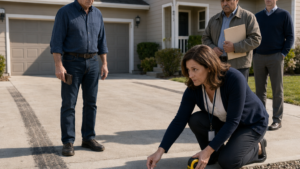
Amy Lopez drove the first steel pin into the ground several feet inside what Brian called his landscaped edge.
The hammer struck three times, sharp enough to carry across both yards.
Brian stared at the pin.
“That can’t be right.”
Amy did not look up. “It isn’t a conclusion. It’s a recovered point.”
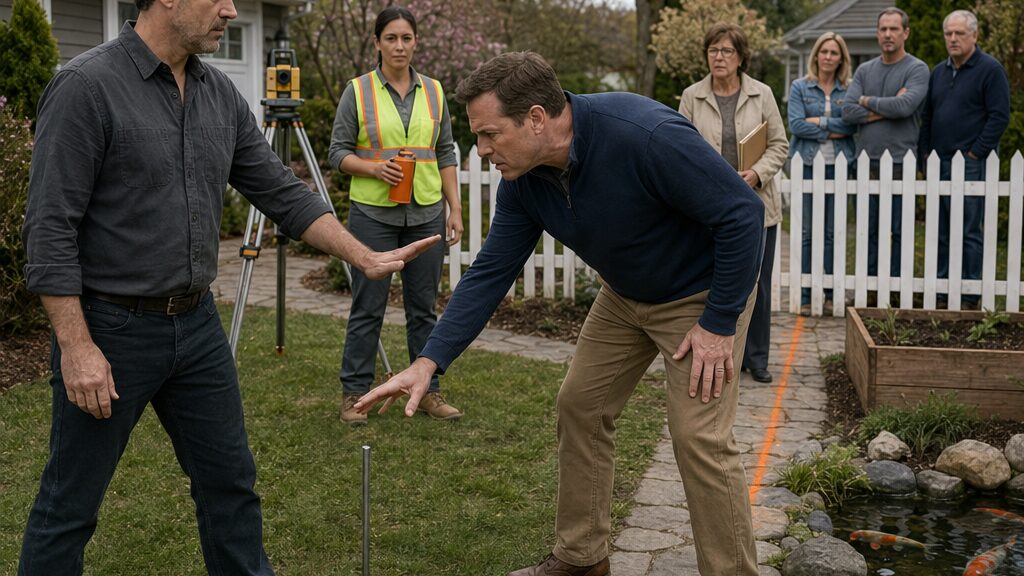
She crouched beside a capped iron monument near the street, checked her equipment, then sighted toward the rear. Her tripod stood on Steven’s lawn. A fluorescent vest covered her gray work shirt. Beside her lay a can of orange marking paint.
Brian had invited an audience.
Janet stood near the driveway with the two board members. Carolyn waited beside the white fence, arms folded tightly. Three nearby residents lingered at distances meant to suggest they had happened outside by coincidence.
Steven stayed near his garage.
A week earlier, he had imagined satisfaction. He had pictured one corrected post, perhaps two, and Brian’s expression when a professional confirmed the fence crossed the line.
The first pin was not near the fence.
It was nearly five feet beyond it.
Brian stepped toward Amy. “The original marker is closer to the utility box.”
“Show me the recorded monument.”
“I’m telling you where it’s always been understood to be.”
Amy adjusted the instrument. “Understanding is not a monument.”
Janet cleared her throat. “The association sketch places the boundary along the drainage swale.”
“Then the association sketch may be illustrative,” Amy said. “Subdivision plats control my retracement, along with recovered evidence.”
Brian looked at Steven. “Did you tell her what result you wanted?”
Steven felt every face turn toward him.
“I told her to survey the shared boundary.”
“You’re paying her.”
“I’m paying for a measurement.”
Brian laughed without humor. “That’s convenient.”
Amy lifted the paint can. “Mr. White, you may hire another licensed surveyor. Until then, stay clear of my equipment.”
The bluntness of it silenced him for several seconds.
Amy moved toward the back, setting another temporary point. She pulled a line between the markers and checked the reading twice. Then she shook the orange can.
The first burst of paint appeared in the grass like a flare.
It ran behind the new fence rather than along it.
Carolyn lowered her arms.
Amy walked slowly, spraying at intervals. The orange marks passed through the narrow planting strip where Steven’s hostas had stood, continued across a bed of tomato plants, and reached the first section of stone walkway.
Brian moved in front of her.
“This is wrong.”
Amy stopped spraying. “Move, please.”
“You’re drawing through our garden.”
“I’m marking the recovered deed line.”
“The HOA approved this layout.”
“The HOA does not establish title.”
Janet’s face changed slightly at that, though she said nothing.
Brian pointed toward the drainage swale. “The line has always followed that depression.”
Steven spoke before Amy could answer.
“The swale curves.”
“So?”
“Property lines usually don’t bend around landscaping.”
Brian turned on him. “You teach shop class. You’re not a surveyor.”
“No,” Steven said. “That’s why she’s here.”
Amy continued.
The orange line crossed the stone path at an angle. It clipped the corner of a raised cedar bed, passed under the low branch of a Japanese maple, and moved toward the koi pond.
Carolyn stepped forward.
“Wait.”
Amy stopped.
Carolyn looked at the paint, then at the pond. “Where does it go from here?”
Amy checked the rear point through the instrument.
“Straight.”
The word seemed to remove the air from the yard.
The pond sat ten feet beyond the fence. Its near edge was ringed with gray river stones Carolyn had once described online as imported Italian rock. A small pump sent water over a stacked-stone lip. Orange koi moved beneath the surface, unaware of the adults standing around them.
Amy sprayed the next mark beside the pond.
Then another beyond it.
The line did not divide the garden neatly. It cut through the design as though the design had never been consulted.
One of the nearby residents whispered, “Oh, my.”
Brian strode to the first steel pin.
“This point is bad.”
He bent and wrapped his hand around it.
Steven reached him before he pulled.
“Leave it.”
Brian straightened. Their shoulders nearly touched.
“Get your hand off me.”
Steven had not touched him. He held one palm open between Brian and the pin.
“If you remove a survey marker, you make this worse.”
“For whom?”
“For everyone.”
Brian looked past him at the watching neighbors. His face had begun to redden.
“You wanted this spectacle.”
“You invited them.”
“I invited witnesses because you’ve been making accusations.”
Steven glanced at the orange line crossing the stone path. “Now they’ve witnessed the measurement.”
Brian’s eyes sharpened. “You’re enjoying this.”
Steven wanted to deny it. Instead, he remembered the hostas by the curb and the contractor pressing soil around a post after Steven had asked him to stop.
For one brief moment, he had enjoyed it.
Then he looked at Carolyn.
She stood beside the pond with one hand resting on the stone edge. The garden behind her was not merely decorative. It was where she drank coffee in photographs, where she had planted herbs in labeled rows, where she had once posted a picture of Brian building the first raised bed with the caption Finally making this place ours.
Steven lowered his hand.
“Amy needs to finish,” he said.
Brian stepped away from the pin.
The survey continued toward the rear corner. Each measurement enlarged the problem. The white fence was not two feet over the line. At its widest point, it was more than six. The stone walkway crossed Steven’s parcel twice. Three raised beds stood partly or entirely on his side. The pond’s retaining edge and pump enclosure occupied the area needed to reach the drainage channel.
Amy recovered the rear monument beneath a mat of ornamental ground cover.
She cleaned the cap and read its identification.
“It matches the subdivision plat,” she said.
Steven took the copy from his folder. Amy compared the bearing and distance notes, then nodded.
“This record is consistent.”
Janet approached carefully. “Are you saying the association approved improvements eleven feet beyond their property?”
“I’m saying the recovered boundary places portions of those improvements approximately eleven feet onto Mr. Harris’s parcel.”
No one spoke.
Brian looked at Janet. “You approved the plan.”
“We approved the drawing you submitted.”
“Based on the subdivision map your office gave us.”
“It was a concept sketch.”
“You never called it that.”
Carolyn turned toward him. “You told me the line was verified.”
Brian did not answer her. He pointed at Steven’s folder.
“He has some old drainage paper. That changes this.”
Amy capped the paint can.
“It may affect access or maintenance rights,” she said. “It does not change the line I recovered.”
“What does that mean?”
“It means you need legal advice.”
Brian kicked lightly at the grass beside the pin, not enough to move it, but enough to send dirt across Amy’s boot.
She looked down.
“Do that again,” she said, “and I’ll document interference with the survey.”
His jaw tightened.
Steven should have felt triumphant. The evidence was cleaner than he had expected. The board had seen it. The neighbors had seen it. Brian’s small claim had opened into a garden-wide encroachment.
Instead, Steven saw costs everywhere.
The pond could not simply be picked up. The walkway stones were mortared at the edges. The raised beds were full of spring soil and new plants. Correcting the line might require excavation, drainage work, and removal of structures worth tens of thousands of dollars.
The orange paint looked less like a victory than a wound.
Amy walked back toward the front monument, reviewing her field notes. Near the drainage swale, she stopped.
“What is it?” Steven asked.
She crouched and brushed dirt from an old concrete marker half-hidden beneath grass.
“Not a boundary monument,” she said.
“Then what?”
“There’s a notation stamped into it.”
Brian came closer despite himself. Janet opened her binder.
Amy read the worn letters, then asked Steven for the county drainage permit. He gave it to her.
She compared the number on the permit with the marking in the concrete.
“This references a maintenance corridor,” she said.
Brian seized on the phrase. “There. That’s the original line.”
“No.” Amy turned the permit sideways. “It’s not drawn as a parcel boundary.”
“What is it drawn as?”
“That’s the problem. The notation is incomplete.”
Janet leaned over the page. “Could it give our property exclusive use?”
Amy straightened.
“I can tell you where the deed line is. I cannot tell you what an old maintenance permission legally allowed, especially when the recorded description is missing.”
She looked toward the orange marks crossing the garden.
“Before either of you tears out a fence or claims a pond, find the original document.”
Steven followed the line with his eyes from the hosta bed to the koi pond.
For the first time that morning, Brian looked less angry than afraid.
Chapter 4: The Approval That Proved Almost Nothing
The county clerk placed a single yellowed page beneath the glass and said, “This is probably what your surveyor found.”
Steven leaned closer.
The document was not a deed, easement, or recorded transfer. It was a handwritten maintenance permission from twenty-three years earlier, signed by the former owner of Steven’s house and witnessed by a county drainage employee. It allowed the adjoining homeowner to enter a narrow strip for clearing leaves and debris from the swale.
Nothing on the page granted ownership.
Nothing described exclusive use.
At the bottom, beside a faded stamp, was the same reference number Amy had found on the concrete marker.
“So this corridor belongs to my parcel?” Steven asked.
The clerk pointed to the attached parcel index. “The underlying land is shown with your lot. This permission only addressed maintenance access.”
“Could someone use it to claim the strip?”
The clerk withdrew her hand. “I can explain what’s recorded. I can’t give legal advice.”
Steven photographed the document and requested a certified copy. By the time he stepped outside, the certainty he had felt after the survey had become more complicated, but not weaker.
The Whites had never owned the maintenance strip. The old arrangement had simply made the edge look shared.
He drove directly to the HOA office.
Janet was waiting in the records room with the property manager. A paper copy of Amy’s survey lay on the table. Someone had highlighted the orange line in fluorescent marker, making it look even harsher on the black-and-white page.
Janet picked up the county permission.
“So the prior owners could maintain the drainage from their side.”
“They could enter for that purpose,” Steven said. “That’s all.”
“It explains why everyone treated the area as connected to that home.”
“It explains access. It doesn’t explain approving a pond on my land.”
The property manager opened a thick file. Inside was the Whites’ architectural application, several garden renderings, contractor estimates, and a site sketch copied from an old subdivision sales brochure.
The sketch showed lawns, driveways, and approximate lot shapes. Its lines were broad and decorative. It contained no bearings, distances, monuments, or survey certification.
Steven tapped it. “This is what the committee used?”
Janet folded her hands. “It was included in the subdivision archive.”
“That isn’t what I asked.”
She looked toward the property manager, who remained silent.
“Yes,” Janet said. “The committee used it as a reference.”
“You approved permanent structures from a sales illustration.”
“We approved the appearance and placement shown in the application.”
“Without confirming that the placement was on their property.”
“The homeowner signed a statement accepting responsibility for property boundaries.”
“Did you tell them the map was not accurate?”
Janet’s mouth tightened. “It was never presented as a survey.”
Steven slid the sketch beside Amy’s plat. The difference was almost embarrassing. Amy’s drawing contained measurements, recovered monuments, signatures, and certification. The HOA sketch contained stylized trees.
Brian had relied on something that proved almost nothing.
So had the board.
Janet sat down.
“We should have required a professional boundary confirmation for a project of this size,” she said.
The admission was quiet enough that Steven nearly missed it.
“Then put that in writing.”
Her eyes lifted. “I’m willing to acknowledge a procedural gap. I’m not prepared to accept liability for the entire project.”
“I didn’t ask you to.”
“You’re asking for language that will be used in litigation.”
“I’m asking the board to describe what happened.”
The property manager turned one of the application pages toward Steven. Carolyn’s signature appeared beneath the ownership statement. Brian’s initials were beside a note saying all dimensions had been field-verified by the homeowner.
Steven read it twice.
“Did anyone verify that claim?”
“No,” Janet said.
The answer should have satisfied him. Instead, it called up a memory he had avoided since the survey.
The first cedar raised bed had appeared the previous spring. Steven had been mowing when Brian placed stakes near the swale. One had seemed too close to the hostas. Steven had considered walking over.
He had not.
Later, when the landscape crew removed sod, he had watched from his kitchen. The work looked temporary. Then the path arrived. Then the stones. Each time, he told himself he would speak when he was certain.
By the time the koi pond was excavated, he had already waited so long that objecting felt like admitting he had allowed it.
Janet watched him.
“You knew they were building there,” she said.
“I saw construction.”
“And you didn’t raise a written objection.”
“I spoke to Brian before the pond was finished.”
“When?”
“After the path was laid.”
“That was months into the project.”
“Yes.”
The word sat between them.
Janet’s expression softened, but not kindly. “That matters.”
“It does not transfer title.”
“No. But it matters if you demand that everything be removed.”
Steven gathered the certified permission and the survey.
Outside, the orange paint was still visible on the grass when he returned home. It crossed the Whites’ stone path in broken sections, bright against the dark joints.
Brian stood beyond the fence watching him.
“Find your miracle document?” he called.
Steven held up the copy. “It was maintenance permission.”
Brian’s face shifted.
“So there was an agreement.”
“For drainage access. Not ownership.”
“You knew that strip was used by our property.”
“I knew the former owner could reach the swale.”
“And you watched us build.”
Steven did not answer quickly enough.
Brian nodded once, as if silence had finally produced something useful for him.
That evening, Steven sent the records to his attorney. They spoke the next afternoon.
“Your title position is strong,” the attorney said. “The survey is strong. The old permission does not create an ownership interest.”
“What about the HOA approval?”
“It may give the Whites a claim against the association. It does not give them your land.”
“And the fact that I waited?”
“It complicates the equities. It does not erase the deed.”
Steven looked through his kitchen window at the pond. Sunlight moved across the water pump. Carolyn knelt beside the stones, pulling debris from the edge.
“What would you recommend?”
“A formal demand covering every encroachment. Fence, beds, path, pond structures, retaining work. Thirty days to propose removal, or we file for declaratory and injunctive relief.”
“All of it?”
“If you ask for less before establishing the full right, you may surrender leverage you need later.”
The attorney emailed the draft that evening.
Steven printed it and placed it beside the survey.
The final paragraph demanded removal of every structure crossing the recorded boundary within thirty days.
Below it waited a blank line for Steven’s signature.
Chapter 5: The Letter Turned Proof Into a Weapon
Steven held the pen over the signature line until the ink began to gather at its tip.
The demand letter was eight pages long. The first seven felt factual: deed references, survey certification, maintenance permission, photographs, dates. The eighth converted all of it into consequence.
Thirty days.
Remove the fence.
Remove the raised beds.
Remove the stone path.
Remove or modify the koi pond, pump enclosure, and retaining structures.
Restore access to the drainage corridor.
He signed.
The attorney sent the certified packet the following morning. A reduced copy of Amy’s plat was enclosed, the boundary reproduced in orange so no one could miss what crossed it.
For three days, nothing happened.
Then Steven received a drainage assessment from a contractor his attorney had recommended. The pond’s retaining edge narrowed the maintenance corridor, and one section of stonework redirected runoff toward Steven’s foundation. The issue was not theoretical. During a heavy storm, water could back along the swale and collect beside his garage.
That finding hardened his resolve.
It also made the letter feel less like punishment.
At four twenty on the third afternoon, a truck stopped hard in Brian’s driveway.
The driver’s door slammed.
Steven was on his front porch replacing a loose board on the railing when Brian came across the grass with the certified packet crushed in one hand.
“What is this?”
Steven set down the drill.
“You received the letter.”
“You’re demanding that we tear out everything.”
“I’m demanding that the encroachments be corrected.”
Brian shook the packet at him. The orange survey map flashed between the pages.
“You waited until we finished.”
Carolyn appeared in their doorway but did not come outside.
Steven stayed on the porch. “I objected before the pond was completed.”
“You made one vague comment about a planting bed.”
“I told you the line was unresolved.”
“You said you thought the stakes might be over.”
“And you continued.”
“Because the HOA approved it.”
“The HOA did not own the land.”
Brian came closer to the steps.
“You stood in your kitchen and watched crews work for months. You watched concrete arrive. You watched the stones get set. You watched us spend money.”
Steven gripped the railing he had been repairing.
“That doesn’t make the property yours.”
“No, it makes this deliberate.”
“What does?”
“Waiting.”
The word struck with more force than Brian’s shouting.
Steven looked past him toward the garden. The orange paint had faded in places, but the line still crossed the path and ran beside the pond.
Brian opened the packet and stabbed a finger at the deadline.
“Thirty days? You think a pond gets removed in thirty days?”
“The letter asks for a removal plan or corrective agreement.”
“It says you’ll file suit.”
“If there’s no response.”
Brian laughed once, breathless and angry. “You want us scared.”
“I want the boundary resolved.”
“You want the garden.”
“No.”
“Then why demand all of it?”
Steven could have explained leverage. He could have repeated the contractor’s drainage findings or the attorney’s advice. Instead, he heard how thin those answers would sound to a man standing beneath the cost of his own mistake.
“The structures interfere with my property and drainage access,” Steven said.
Brian looked toward the porch window, where the HOUSE RECORDS tote was visible on the kitchen table.
“You had all those papers the whole time.”
“Yes.”
“And you never showed us.”
“I showed you the permit after you removed the plants.”
“After.”
Steven said nothing.
Brian’s face reddened further. For a moment he resembled the man Steven had imagined humiliating after the survey. The reality gave him no satisfaction.
“I lost a business two years ago,” Brian said. “Did you know that?”
Steven had not.
“I put everything left into that house. The garden was supposed to raise the appraisal. It was supposed to be one thing I did right.”
“That does not justify taking land.”
“I didn’t think I was taking it.”
“You threatened adverse possession.”
Brian looked away.
“That was after you started making trouble.”
“You invoked a claim you couldn’t support.”
“My attorney said long use could matter.”
“Did your attorney say you owned it?”
Brian folded the packet.
The question changed something. Not enough to produce honesty, but enough to make the anger less certain.
Carolyn called from the doorway. “Brian.”
He turned.
“Come inside.”
He remained on Steven’s lawn for several seconds, then pointed at the letter.
“You could stop this.”
“So could you.”
Brian walked back across the property line without looking down at it.
Steven picked up the drill but did not restart his work. The porch had gone quiet except for the pond pump cycling behind the fence.
Near dusk, Carolyn came over alone.
She stopped at the bottom of the porch steps.
“Did you know?” she asked.
Steven waited.
“Know what?”
“That the pond was going over your line before it was built.”
“I suspected the beds were too close.”
“That wasn’t my question.”
“No. I did not know the exact line until the survey.”
“But you thought there was a problem.”
“Yes.”
“When did you tell Brian?”
“Before the pond was finished. After the stone path went in.”
Carolyn looked back toward her house. Brian was no longer visible.
“What exactly did you tell him?”
“That the boundary had never been surveyed and the stakes appeared to cross my side.”
“And what did he say?”
“That Janet had approved the plan.”
Her jaw shifted.
“He told me you complained only after the pond was complete.”
“That isn’t true.”
“Do you have anything showing when you warned him?”
Steven thought of the email he had sent after their first conversation. He had written carefully, avoiding accusation: Before additional permanent work continues, I recommend confirming the property line because the current stakes appear inconsistent with my records.
Brian had replied that the HOA plan had been reviewed and that Steven should direct future concerns to the board.
“I have an email,” Steven said.
Carolyn’s face went still.
“What date?”
He told her.
“That was before we signed the landscaping loan.”
Neither of them moved.
The pond pump started again behind the fence.
Carolyn lowered her voice. “Brian told the bank there was no dispute affecting the project.”
Chapter 6: Carolyn Learned What Brian Had Hidden
Carolyn returned the next morning carrying a blue loan folder against her chest.
Rain had begun before sunrise. It darkened the white fence and softened the orange survey paint until the marks bled into the grass.
Steven opened his side door.
“I need to see the email,” she said.
He let her into the kitchen.
The HOUSE RECORDS tote remained on the table. He moved it aside and opened his laptop. The message appeared exactly where he remembered it, sent six weeks before the pond excavation and four days before the Whites signed their landscaping agreement.
Carolyn read Steven’s warning.
Then she read Brian’s reply.
The concern has been reviewed through the approved HOA plan. We consider the location settled and will proceed.
She sat back.
“He told me you agreed the swale was the line.”
“I never agreed to that.”
“He said you were upset about the hostas but not the boundary.”
“The hostas were part of the boundary problem.”
Carolyn opened the blue folder. Inside were loan disclosures, contractor invoices, and an appraisal estimate showing the projected value after the garden improvements.
“We borrowed against the house,” she said. “The pond, retaining work, stone, irrigation—almost all of it.”
Steven looked at the total and felt his stomach tighten.
“You signed this after my email.”
“I signed because Brian said the issue was resolved.”
“Did you ask Janet?”
“She said the plan was approved.”
“That’s not the same answer.”
Carolyn closed her eyes briefly. “I know that now.”
There was no apology in her voice. Only exhaustion.
Steven printed the email.
When the sheet emerged from the printer, Carolyn held out her hand for it.
“This doesn’t mean I’m agreeing to everything in your letter,” she said.
“I understand.”
“It doesn’t mean you were right to wait as long as you did.”
“I understand that too.”
She studied him, perhaps expecting resistance.
“I should have spoken sooner,” he said. “Before the path. Before the pond. I saw enough to ask for a survey, and I kept assuming the next step would make the problem obvious.”
“To whom?”
He looked at the tote. “To everyone.”
Carolyn folded the email into the loan folder.
Outside, a truck door opened.
Brian crossed the wet driveway without an umbrella. He stopped when he saw Carolyn through Steven’s kitchen window, then came to the side door.
She met him outside before Steven could speak.
“Did you get his email before we signed the loan?”
Rain ran from Brian’s hair onto his collar.
“What are you doing in his house?”
“Answer me.”
“This is exactly what he wants. He wants us divided.”
“Did you get it?”
Brian looked toward Steven.
Steven remained inside the doorway.
“Yes,” Brian said.
Carolyn’s shoulders dropped slightly, as though confirmation weighed more than suspicion.
“You told me there was no dispute.”
“I told you it wasn’t a real dispute.”
“You told the lender there was none.”
“Because I believed the plan was approved.”
“You believed, or you needed it to be true?”
Brian wiped rain from his face.
“The appraisal depended on completing the project.”
“So you hid the email.”
“I handled it.”
“You threatened him with adverse possession.”
“After he tried to destroy everything.”
Steven stepped onto the covered landing.
“You used that threat before the survey,” he said.
Brian turned. “Stay out of this.”
“It concerns my property.”
Carolyn held up the email. “Did your attorney tell you we had fifteen years?”
Brian said nothing.
“Did anyone tell you that?” she asked.
“The prior use could be added to ours.”
“Could it?”
“If the conditions were right.”
“Were they?”
Rain tapped against the metal gutter.
Brian’s voice lowered. “I was trying to protect us.”
Carolyn stared at him.
“No. You were trying to avoid telling me you hadn’t checked.”
The anger went out of his posture. What remained looked smaller and more dangerous to him: shame.
“I’d already lost the company,” he said. “I wasn’t going to come home and say I had messed this up too.”
Carolyn turned away, pressing the folder against her body.
Steven understood then that Brian’s legal certainty had never been certainty. It had been scaffolding around a financial mistake.
That did not excuse removing the hostas or ignoring the warning. It did not erase the threats.
But it changed the shape of the conflict.
Carolyn walked toward the fence and stopped where the rain had nearly erased the orange paint.
“If everything in that letter comes out,” she said, “we can’t absorb it.”
Brian looked at her. “Don’t discuss our finances with him.”
“They’re already part of this.”
She faced Steven.
“The loan payment is manageable because the appraisal came in high. If the garden is removed and the house is reassessed—or if we pay for demolition and legal fees—we may have to sell.”
Steven looked toward the pond. Rain stippled the dark surface. The koi moved beneath it in slow flashes.
“That cannot require me to surrender the land,” he said.
“I didn’t say it should.”
It was the first time Carolyn had spoken without claiming approval, appearance, or entitlement.
“What are you saying?” he asked.
“That the adverse-possession claim stops. I won’t support it.”
Brian stared at her. “You don’t get to decide that alone.”
“I’m on the deed and the loan.”
“This is our house.”
“Then stop gambling it to protect your pride.”
Brian walked back toward their garage without another word.
Carolyn remained beside the fading line.
“I’ll review a correction plan,” Steven said. “Not a promise. A plan.”
“What would stay?”
“I don’t know yet. Drainage access has to be restored. The fence has to move. Anything left on my side would need a recorded agreement.”
She nodded once.
By noon, the rain had washed most of the temporary paint from the grass. Only the sections on the stone path remained bright.
That afternoon, Janet called.
“The board has reviewed the survey and the approval file,” she said. “We’re scheduling an emergency hearing.”
“When?”
“Two weeks from tonight. Before your thirty-day deadline expires.”
“What is the purpose?”
“To seek a neighborhood resolution.”
Steven looked through the window at Brian standing alone beside the pond.
“Will the board acknowledge its approval failure?”
Janet paused.
“We’ll discuss all relevant circumstances.”
“That isn’t an answer.”
“It’s the answer I can give before the meeting.”
An hour later, the official notice arrived by email. Steven opened the attachment.
The agenda listed one item: Harris-White Boundary Accommodation.
Not correction.
Not encroachment.
Accommodation.
Chapter 7: The Board Wanted Peace Without Responsibility
Janet opened the emergency hearing by looking directly at Steven and saying, “We need you to be reasonable for the neighborhood.”
The projector behind her displayed Amy’s survey. The orange boundary line ran across the screen, cutting through the White garden in a color too bright for the beige meeting room.
Steven sat with his attorney on one side of the table. Brian and Carolyn sat together on the other, though several inches of empty space separated their chairs.
The two board members had copies of the drainage report. The property manager had arranged the architectural file into labeled stacks.
Janet continued.
“No one disputes the recorded line at this point. The question is how to resolve the improvements without creating unnecessary harm.”
Steven looked at the agenda sheet in front of her.
“Then why is this called an accommodation hearing?”
“Because we are seeking a practical accommodation.”
“Between an owner and structures placed on his land.”
Brian shifted in his chair. “There it is.”
Steven turned toward him.
“What?”
“The way you say it. Like we built the garden in the middle of your living room.”
“You built part of it on my parcel.”
“Based on an approved plan.”
Janet raised her hand. “We are not repeating the entire history.”
“We should,” Carolyn said.
Everyone looked at her.
She placed Steven’s printed email beside the loan papers.
“The history includes Brian receiving written notice that the boundary was unresolved before we signed the landscaping loan.”
Brian stared at the table.
Janet read the email without touching it.
“That communication was not included in the architectural file,” she said.
“No,” Carolyn replied. “It was not.”
One board member leaned back. “Would the committee have paused the project if it had been?”
Janet hesitated.
“Yes.”
The word entered the room quietly, but it changed the balance more than any accusation had.
Brian’s hand tightened around his pen.
“So now this is all on me?”
“No,” Janet said. “The committee should have required a survey for permanent work near an uncertain boundary. We did not.”
Steven waited.
Janet did not go further.
His attorney opened the drainage assessment.
“The pond edge and retaining wall reduce maintenance access and redirect runoff. Those structures must be removed or rebuilt. The fence must be relocated. The remaining beds and a portion of the path could theoretically stay under a recorded agreement, but only at Mr. Harris’s discretion.”
Janet looked at Steven.
“That sounds workable.”
“It might be.”
Brian laughed under his breath. “He gets everything.”
Steven faced him. “I get the land I already owned.”
“And control over our garden.”
“Control over what remains on my parcel.”
Janet folded her hands.
“What if the association prepared a permanent use agreement allowing the Whites to maintain the surviving improvements?”
“No,” Steven said.
The answer came faster than he expected.
Janet blinked. “You haven’t reviewed terms.”
“Permanent use creates the same confusion again.”
“It would be recorded.”
“It would still make my property function as theirs.”
Brian leaned forward. “Because that’s what you want. You want to be able to take it away whenever you feel like it.”
Steven looked at the projected line. It crossed the pond like a warning nobody had wanted to read.
“I want access to the drainage corridor. I want the fence moved. I want the ownership claim withdrawn in writing. I want the dangerous retaining section removed. And I want any remaining use to end if the property is sold or the agreement is violated.”
“That’s not an agreement,” Brian said. “That’s a leash.”
“It is a revocable easement.”
“It means he can hold the garden over us forever.”
Steven’s attorney said, “Only if you breach the terms.”
Brian pushed his chair back.
Carolyn did not move.
Steven felt the old instinct urging him toward silence. Let the attorney speak. Let the survey speak. Let the documents carry the burden.
He placed both hands on the table.
“I should have objected sooner.”
The room went still.
Brian looked at him sharply.
Steven continued.
“I saw the first stakes. I saw the path going in. I believed the line was wrong, but I did not insist on a survey. I told myself I was avoiding a fight. What I actually did was delay one.”
His attorney glanced toward him but did not interrupt.
“If I had acted then,” Steven said, “the loss would have been smaller. That part is mine.”
Brian’s expression shifted, almost hopeful.
Then Steven looked directly at him.
“But I warned you before the loan. You hid that warning. You removed my plants after I objected. You threatened to take the land through a claim you knew was uncertain. That part is yours.”
Carolyn lowered her eyes.
Janet said, “Then perhaps shared responsibility supports a shared compromise.”
“Shared responsibility does not mean shared ownership.”
Steven slid a one-page proposal across the table.
The fence would move to the surveyed line. The pond edge and retaining wall would be rebuilt to restore drainage access. Two raised beds and part of the stone path could remain under a recorded revocable easement. The Whites would pay for corrective work. The HOA would reimburse the survey cost and amend its review procedures. Brian and Carolyn would withdraw all adverse-possession claims.
Brian read the page.
“This goes on the property record.”
“Yes.”
“So anyone looking at the house sees that we built on someone else’s land.”
“They see that the boundary was resolved.”
“They see a mistake.”
Carolyn looked at him. “It was a mistake.”
His face hardened.
“I’m not signing something that follows us forever.”
Steven gathered the remaining copies.
“Then we file tomorrow.”
Janet leaned forward. “Steven, litigation will hurt both homes.”
“I know.”
“The association wants more time.”
“The deadline has already given everyone time.”
Brian stood.
“You won’t do it.”
Steven remained seated.
“I will.”
“You think a judge is going to order us to tear out a garden because you waited too long to complain?”
“I think a judge will decide from the deed, the survey, the drainage report, and the emails.”
Brian looked around the room as though someone might offer a different reality.
No one did.
Steven placed the proposal back in front of him.
“Tomorrow morning at nine,” he said. “Sign the agreement, or my attorney files.”
Brian stared at the page.
For the first time since the fence appeared, Steven did not soften the deadline after speaking it.
Chapter 8: The Boundary Stayed After the Paint Faded
The landscape crew lifted the first stone from the path six weeks later.
It came free with a wet scrape, leaving a dark rectangle in the soil where the orange line had once crossed.
The temporary paint was gone from the grass. Rain and mowing had erased it. The permanent steel pins remained, capped and level with the ground.
Brian had signed the agreement at eight forty-three the morning after the hearing.
Carolyn had signed first.
She had told him she would not risk the house on a claim they could not support. The association approved reimbursement for Amy’s survey and adopted a new rule requiring professional boundary verification for major construction near lot edges.
None of it felt like a victory celebration.
The corrective work began with the white fence.
Workers removed the posts that had cut through Steven’s hosta bed and reset them along the surveyed line. The pond remained, but its near edge was rebuilt several feet inward. The pump enclosure moved with it. The retaining wall came out entirely, restoring a clear route to the drainage swale.
Two raised beds stayed under the recorded easement.
So did a narrow section of path.
Steven had spent three days deciding whether to allow them.
His attorney had advised against leaving anything unnecessary. Clean boundaries created fewer future problems.
But the agreement terminated the use if the Whites sold the property, failed to maintain drainage access, or revived any ownership claim. It prohibited new structures. It required written permission for repairs crossing the line.
Steven signed it because the terms were clear, not because he had forgotten what happened.
On the second day of work, Brian came outside in old jeans and a faded sweatshirt. He stood beside the crew as they prepared to move one raised bed.
The landscape contractor pointed toward the new location.
“We’ll need another set of hands to keep the frame square.”
Brian looked at Steven, then gripped one end without speaking.
Together, they lifted.
The cedar frame was heavier than it appeared, packed with damp soil around the roots of spring lettuce. Steven took the opposite corner. For several steps they carried it across the yard, following the space between two steel pins.
“Set it there,” Steven said.
Brian adjusted his grip. “That’s inside the new line?”
“Yes.”
Brian looked down before lowering the bed.
It was a small act, checking first. Steven noticed it anyway.
They set the frame onto prepared soil. Neither man offered thanks.
Later that afternoon, Steven replanted the hostas.
Only seven of the original twelve had survived. He divided the healthiest crowns and spaced them along the restored side yard, just inside the permanent boundary.
Carolyn brought over a bucket of compost.
“These might help,” she said.
Steven accepted it.
“The pond looks smaller,” he said.
“It is.”
“Does it still circulate properly?”
“The contractor changed the pump angle.”
She looked toward Brian, who was fitting boards around the relocated bed.
“He hasn’t posted anything about the garden since the hearing.”
Steven pressed soil around a hosta.
“That may be temporary.”
“Maybe.”
Carolyn crouched near the next plant.
“I owe you an apology.”
He waited.
“I treated approval like proof because it was convenient. And I let Brian do the talking when I should have asked questions.”
Steven brushed dirt from his gloves.
“I let the work continue because confrontation was inconvenient.”
“That didn’t give us the land.”
“No.”
She nodded, accepting the limit of his admission.
Across the yard, Brian lifted the end of a board and tested it against the frame. The first cut was too long. He carried it to Steven’s garage.
“Can I use your miter saw?”
Steven looked at him.
Brian stopped outside the open door.
“I’ll bring it out,” Steven said.
He set the saw on a portable stand in the driveway. Brian measured the board twice before marking it.
“You always teach people to check twice?” he asked.
“I teach them not to trust the first assumption.”
Brian gave a brief, humorless smile.
“That aimed at me?”
“It applies to both of us.”
The saw blade lowered through the cedar with a clean, controlled sound.
When the corrective work was complete, Amy returned to verify the drainage access and surviving encroachments. She checked the fence, the pond edge, and the easement dimensions.
“Everything matches the agreement,” she said.
She pointed to the nearest steel pin.
“These stay.”
Brian nodded.
No one invited the neighbors to watch.
By early summer, the restored side yard no longer looked torn apart. Grass filled the disturbed soil. The hostas opened broad green leaves beneath the garage windows. From Steven’s kitchen, the surviving raised beds still appeared to belong visually to the White garden, but now the legal difference was recorded, measured, and understood.
The line itself was invisible again.
That no longer frightened him.
One evening, Steven was repairing a loose hinge on his backyard gate when his measuring tape slipped from the workbench and rolled into the grass near the boundary.
Brian picked it up.
He walked toward Steven, then stopped beside the nearest steel pin.
The distance between them was less than three feet.
“May I come across?” Brian asked.
Steven looked at the tape in his hand.
The question was ordinary. That was what made it matter.
“Yes.”
Brian stepped over the line and handed it back.
“Thanks.”
Steven clipped the tape to his belt.
Brian glanced toward the hostas, then toward the garden.
“The drainage held during last night’s storm.”
“I saw.”
“Water cleared before midnight.”
“That’s what the corridor was for.”
Brian nodded.
He stepped back onto his own side without being told.
The orange paint had vanished weeks earlier. The fence no longer cut through Steven’s plants, and the pond no longer blocked the swale. What remained was not friendship and not forgiveness.
It was something more reliable than either.
A boundary spoken aloud before anyone crossed it.
The story has ended.