My Neighbor Claimed My Driveway Until One Hidden Property Pin Destroyed His Case
Chapter 1: The Light That Entered His Living Room
Alexander Miller turned off the last lamp in his living room, and the room stayed bright.
Not dim. Not softly lit from the street. Bright.
The white glare came through the front windows in a hard square, flattening the color out of the sofa, the bookcase, the framed photographs on the wall. It touched the arm of his chair and turned the old wood floor pale. The glass in the picture frames shone as if someone had aimed a camera flash at them and forgotten to stop.
Alexander stood with his hand still on the lamp switch.
Across the narrow strip of grass and asphalt, Steven Hall’s floodlight buzzed on its pole beside the garage. It had been angled higher tonight. Not toward Steven’s own driveway. Not toward the dark patch behind his shed. Toward Alexander’s front windows.
Alexander looked at the clock on the mantel. 8:17.
He walked to the window but did not pull the curtain aside all the way. He had learned not to give Steven the pleasure of a clear reaction. He separated the edge of the fabric with two fingers and saw Steven’s white van nosed partly over the edge of his custom driveway, its right tires just beyond the clean concrete lip Alexander had paid for two years earlier.
The van sat at an angle, as if abandoned mid-turn. It blocked the lower curve of the driveway where Alexander backed out each morning. Steven was not unloading anything. He was leaning against the driver’s door with his arms folded, watching the light pour into Alexander’s house.
Alexander let the curtain fall back.
For a few seconds, he listened to the floodlight’s electrical hum and the faint ticking of his wall clock. The two sounds seemed to argue with each other. One belonged inside the house. One did not.
He crossed to the small writing desk near the hallway. On top of it sat a black binder, thick enough that the rings had begun to strain. He did not open it at first. He rested his hand on the cover as if checking the pulse of a thing he wished did not exist.
Then he opened it to the newest tab.
The page protector held a printed photo from the week before: the same van, same angle, same driveway. Below it, in Alexander’s careful handwriting, was the date, time, and a short line.
Van blocking driveway edge again. Floodlight active. No direct contact.
He took his phone from his pocket and photographed the room. First the sofa washed in glare. Then the window. Then the angle of the light through the curtains. He did not step outside. Not yet.
A laugh rose from the street.
Alexander moved back to the window. Linda Anderson from across the street had paused by her mailbox, one hand inside it, her head turned toward Steven. She was a cautious woman who waved at everyone and committed to no one. Steven had a way of talking to people like he was letting them in on a joke.
Alexander could not hear the first thing Steven said, only the shape of his grin. Then Steven’s voice came up louder.
“He built that driveway right where everyone used to turn around.”
Linda glanced toward Alexander’s windows. The floodlight glare probably hid him from view. She said something too soft to catch.
Steven pushed off from the van. “No, I mean it. Used to be simple. Pull in, back out, nobody cared. Then he poured that fancy concrete and decided the whole corner was his private kingdom.”
Alexander’s fingers tightened against the curtain.
The driveway was not fancy. It was practical, a curved strip of pale concrete designed so delivery trucks no longer chewed up the grass during winter. He had saved for it. Measured for it. Filed the permit himself. The curve stayed within his property line by more than a foot at its narrowest point, because Carol Young, the surveyor, had made him mark it twice before the contractor poured.
Steven knew that. He had watched the survey stakes go in. He had joked then, loudly enough for the workers to hear, that Alexander was “putting a border crossing in the suburbs.”
Linda said something again. Steven answered with a shrug so large it looked rehearsed.
“Shared space,” he said. “That’s all I’m saying. A street only works when people don’t get precious.”
Alexander closed his eyes.
Shared space.
The phrase landed harder than an insult because it sounded reasonable. It sounded like something a neighbor might say at a meeting, softening theft into compromise. It made Alexander’s locked front door, his clean driveway, his own living room seem like part of a negotiation he had never agreed to.
He moved away from the window and stood in the middle of the lit room. The floodlight made his shadow stretch behind him, long and thin across the floorboards.
His keys sat on a dish by the front door. He had no reason to leave. That was not the point. The point was that if he needed to leave, the van was there. The point was that Steven had made sure he knew it.
Alexander opened the binder again. He slid a new sheet into the page protector and wrote the time.
8:23 p.m. Steven tells Linda A. driveway is “shared space.” Van tires over concrete edge. Light aimed at living room.
His handwriting stayed neat until the final word. The M in room came out jagged.
Outside, the van door slammed.
Alexander looked up. The reverse lights flashed, red then white, as Steven climbed in and backed slightly farther into the driveway before pulling forward again. Not leaving. Adjusting. Making the angle worse.
The front tire rolled over the seam between the asphalt and Alexander’s concrete, slow enough to be deliberate. The tire stopped with its black rubber planted on the clean edge.
Alexander felt heat rise behind his ribs.
He walked to the door, opened it, and stepped onto the porch.
The glare hit him full in the face. He lifted one hand, not to shield his eyes completely, just enough to see Steven behind the windshield.
Steven lowered his window.
“Need something, Alex?”
Alexander hated the shortened name. Steven used it only when someone else could hear.
“Your van is blocking my driveway.”
Steven looked down at the tire as if surprised by where it had landed. “Barely touching it.”
“It needs to move.”
“I’m turning around.”
“You’ve been turning around for ten minutes.”
Steven smiled. “Didn’t know you were timing me.”
Linda was still by her mailbox. She had stopped pretending to sort envelopes.
Alexander kept his voice even. “Move the van, Steven.”
“See, this is the problem.” Steven leaned his elbow out the window. “You act like the whole street has to ask your permission to breathe.”
“The driveway is on my property.”
Steven tapped the steering wheel twice. “It’s a driveway. It connects to the street. People use driveways.”
“Not this one.”
That brought a flash into Steven’s eyes. Not anger yet. Satisfaction. He had pulled Alexander one step closer to sounding like the man he told everyone Alexander was.
Steven raised his voice, turning slightly toward Linda. “You hear that? Not this one. That’s neighborhood spirit right there.”
Alexander looked at Linda. She lowered her eyes to the mail in her hand.
Something inside him sank, but it did not break. Not tonight.
He stepped off the porch. The grass was cool and damp under the soles of his shoes as he crossed toward the driveway edge. Steven’s van idled. Exhaust drifted low and bitter.
Alexander stopped where the concrete curved closest to the narrow grass strip between their lots. He did not look at Steven. He looked down.
The grass had grown thick over the spot. He knew exactly where it was because he had touched it so many times in the dark, reminding himself that reality did not stop existing just because Steven talked louder.
Steven called from the van, “What are you doing now?”
Alexander crouched.
The floodlight threw his shadow across the ground, covering his hands as he parted the grass. His fingers searched through damp blades and packed soil until they found the small round head of metal beneath the surface.
The property marker pin was cold under his thumb.
He held it there, hidden in the grass, while Steven’s engine idled above him and Linda watched from across the street.
Chapter 2: The Pin Steven Pretended Not To See
Steven’s van was already angled into the driveway before Alexander had finished his morning coffee.
The cup sat untouched on the kitchen counter, steam fading into the air, while Alexander looked through the front window at the crooked white shape blocking the lower curve of the concrete. Morning made the scene worse. In daylight, there was no floodlight glare to blur the insult. There was only the van, the tire over the edge, and Steven standing beside it with a travel mug in one hand like he belonged there.
Alexander set his coffee down.
On the hallway table, the black binder waited where he had left it. Beside it lay a rolled survey map held tight with a rubber band. He picked up the map first, then the small garden trowel he kept near the back door, and walked outside.
Steven watched him approach with the lazy confidence of a man expecting an audience.
“Morning, Alex.”
Alexander stopped at the driveway edge. “Move the van.”
Steven sipped from his mug. “I’m not staying.”
“You’re parked on my driveway.”
“I’m beside your driveway.”
Alexander did not answer. He stepped into the grass, crouched near the curve of concrete, and used the trowel to cut through the mat of blades around the marker. The soil was soft from last night’s damp. In three careful motions, he cleared enough earth to expose the round metal head.
The pin caught a small piece of morning sun.
Steven’s face changed before he could cover it. The smugness thinned. Not surprise, exactly. Recognition.
Alexander wiped the metal clean with his thumb. “This is the lot line.”
Steven gave a short laugh. “That little thing?”
“The surveyor confirmed it.”
“Surveyors confirm whatever you pay them to confirm.”
Alexander stood and unrolled the map against the side of his thigh. “Carol Young filed this with the town. The driveway is inside my line.”
Steven looked toward the street as if searching for someone to appreciate how unreasonable this was. Linda Anderson had come out with a trash bag in one hand. She paused near her bin, not close enough to be part of the conversation, not far enough to miss it.
Alexander saw Steven notice her.
That was when Steven’s voice changed.
“You see this?” Steven called. “He’s digging up the yard over inches now.”
Linda froze with the black bag held against her leg.
Alexander kept the map open. “Linda, the marker pin is here. The driveway is on my property.”
Steven stepped closer, mug still in hand. “Nobody said the concrete wasn’t technically yours.”
Alexander looked at him.
Technically.
The word told him more than a denial would have.
Steven continued, “This used to be where people turned around. Delivery vans, neighbors, everyone. Before you built your little runway.”
“It was grass and mud.”
“It worked.”
“It was my grass and mud.”
Steven’s jaw tightened. For a second, the neighborhood mask slipped, and Alexander saw what was underneath: not confusion, not honest disagreement, but the fury of a man being corrected in public.
“You moved in and changed the whole feel of the corner,” Steven said. “You never asked anybody.”
“I didn’t need permission to improve my own driveway.”
“Common courtesy isn’t permission.”
The words were smooth enough that Linda looked uncertain. Alexander could feel the old trap forming. Steven did not have to prove ownership. He only had to make Alexander sound ungenerous.
Alexander lowered the survey map and pointed to the marker. “Your tire is over the line.”
Steven looked down at the van tire. Its outer edge sat on Alexander’s concrete. Not far. Enough.
He shrugged. “Then I’ll move it when I’m done.”
“You’re done now.”
“Or what?”
The question hung between them.
Alexander heard the faint rustle of Linda’s trash bag. He thought of the binder inside. The photos. The dates. The complaint numbers. He thought of how each page seemed strong when he made it, then small when described aloud.
Steven smiled again, sensing hesitation. “That’s what I thought.”
Alexander rolled the survey map slowly so his hands would not tighten around it. “I’m asking you one more time. Move the van off my driveway.”
Steven stepped forward and, with the toe of his shoe, kicked loose grass back over the marker pin.
The metal disappeared.
It was a small gesture. Almost childish. But it made Alexander’s chest go cold.
“There,” Steven said. “Problem solved.”
Linda looked away.
Alexander stared at the patch of grass. He did not move. He had the sudden, sharp memory of Carol Young standing in that same spot two years earlier with a tripod and measuring rod, telling him, “This line is clean. Don’t let anybody muddy it later.”
At the time, he had thought she meant contractors.
Steven climbed into the van. The engine coughed, then settled. He backed out with exaggerated slowness, using the lower curve of Alexander’s driveway exactly the way he had been told not to. The tire rolled over the edge, crossed the seam, and left a faint gray mark on the concrete.
Before pulling away, Steven lowered the window again.
“You know what?” he said. “Maybe I should report this setup. Dangerous access. Blocks the natural turn. Somebody’s going to get clipped because you had to own every inch.”
Alexander said nothing.
Steven drove off.
Linda still stood across the street, the trash bag now sagging from her hand. Alexander could tell she wanted to say something and wanted even more not to say it.
Finally, she crossed halfway to the curb. “I didn’t realize there was a marker there.”
Alexander brushed the grass aside again, uncovering the pin. “There is.”
“I just mean…” She looked down the street where Steven’s van had gone. “People did used to turn around near there.”
“Near there isn’t the same as on my driveway.”
“No. Of course.” She shifted the trash bag from one hand to the other. “It’s just getting tense.”
Alexander almost laughed, but there was no humor in him. Getting tense. As if tension had drifted in like weather. As if one man had not aimed a floodlight into another man’s living room and called it neighborhood spirit.
He folded the survey map under his arm. “I didn’t start this.”
Linda nodded too quickly. “I know. I’m not saying you did.”
But she retreated before saying anything more.
Alexander stayed by the marker until the street emptied. Then he went inside, placed the survey map into the binder, and made a new tab with a strip of blue tape.
Boundary / Survey.
He printed the morning photo from his phone: Steven’s tire touching the driveway edge, the marker exposed beside it. He slid the photo behind the survey copy and wrote the time beneath it.
At first, the act steadied him. The binder had always done that. It turned anger into sequence. It turned humiliation into paper that could be held.
But by afternoon, the calm had thinned.
Steven’s driveway stayed empty. His garage door remained shut. The floodlight pole stood harmless in daylight, angled toward Alexander’s house like a finger waiting for night.
At dusk, Alexander closed the living room curtains before the light came on. He told himself that was reasonable. Preventive. Not surrender.
At 7:42, the white glare appeared around the curtain edges.
At 7:49, it grew brighter.
Alexander stood in the hallway, listening.
Outside, metal scraped against metal. A ladder, maybe. A bracket being adjusted.
He approached the window and moved the curtain half an inch.
Steven stood beside the floodlight pole with a wrench in his hand. He tightened the mount, stepped back, judged the angle, then raised it higher. The beam shifted upward across Alexander’s front wall, climbed the glass, and punched directly through the narrow opening in the curtains.
It struck the sofa first.
Then the framed photographs above it.
Alexander watched the faces in the frames vanish behind reflected light.
Chapter 3: The Binder Nobody Wanted To Read
“Most of this is hard to enforce,” James Baker said, and flipped past six months of Alexander’s life in less than ten seconds.
The municipal office smelled of toner, old carpet, and burnt coffee. Alexander sat across from the code officer’s desk with the black binder open between them, watching James turn page protectors as if they contained grocery coupons instead of photographs of floodlight glare, tire marks, blocked driveway access, and dated notes written at hours when other people slept.
James was not rude. That made it worse. He had the tired patience of a man who had heard every kind of property complaint and survived by lowering the temperature of each one until it could be filed away.
“I’m not asking you to settle a personality conflict,” Alexander said.
“I understand.”
“This is repeated trespass.”
James stopped on a photo of Steven’s van angled across the driveway edge. “This one shows a tire near the edge.”
“On the edge. On my concrete.”
“It’s hard to determine from the image.”
“The survey map is behind it.”
James turned one page, glanced at the survey, then back at the photo. “The survey establishes the line. It doesn’t establish intent.”
Alexander folded his hands under the desk where James could not see them tighten. “He knows where the line is.”
“That may be true.”
“He kicked grass over the marker after I showed it to him.”
“Did you record that?”
Alexander looked down. “No.”
James gave a small nod that carried no judgment and no help. “Then we have competing statements.”
The office window behind James faced the parking lot. A municipal pickup sat outside with orange cones in its bed. Alexander stared at the cones while he steadied himself. They were bright, official, simple. Put them down and people understood not to cross.
His property pin had been in the ground for decades, and Steven had covered it with grass using the toe of his shoe.
James turned another page. He paused.
The photograph showed Alexander’s living room at night, curtains half drawn, the floodlight cutting across the sofa in a white bar. On the wall behind it, the framed photographs had become rectangles of glare.
“This is bright,” James said.
“It’s aimed at my windows.”
“Could be aimed for security.”
“It faces away from his garage.”
James looked longer this time. Then he set the page down. “I’m not saying you don’t have a complaint. I’m saying the angle alone doesn’t prove intent. We’d need to observe, or have a pattern tied to specific conduct.”
Alexander almost pushed the binder toward him. “That’s what this is.”
James’s expression softened, which somehow felt more dangerous than dismissal. “Mr. Miller, I’ve seen neighbor disputes where both parties document each other for years. Sometimes the file becomes part of the conflict.”
Alexander heard what he did not say.
Sometimes the binder was proof. Sometimes the binder was the symptom.
He closed it carefully. “So what do you suggest?”
“I can note the complaint. I can send an advisory letter about light nuisance and driveway obstruction. If there’s a specific incident during business hours, call it in. If he blocks your vehicle, you may need parking enforcement. If there’s damage, that becomes civil.”
“Civil,” Alexander repeated.
James spread his hands slightly. “Property line disagreements often are.”
“It isn’t a disagreement if the line is known.”
“I understand why you feel that way.”
Alexander stood before his voice could sharpen. That phrase had done what Steven rarely managed. It made him feel unreasonable for wanting words to mean what they meant.
At the counter, the clerk stamped his complaint copy. The sound was flat and final. Not victory. Not refusal. Just paper receiving ink.
Outside, Alexander sat in his truck for several minutes with the binder on the passenger seat. He did not start the engine. Through the windshield, he watched a man in a work vest carry a stack of forms into the municipal building. Everyone had paper. Everyone had proof of something. The town survived by deciding which paper mattered.
When he got home, Linda Anderson was pulling weeds along her front walk.
Alexander had almost reached his door when she called, “Mr. Miller?”
He turned.
Linda crossed the street with gardening gloves still on. She looked embarrassed before she spoke. “I don’t want to get involved.”
“No one’s asking you to.”
“I know. I just…” She rubbed soil from one glove with the other. “Steven told Carol from two houses down that you’ve been filming everybody. He said you have some kind of file on the whole street.”
Alexander looked toward Steven’s house. The van was gone. The floodlight pole stood still.
“I have photos of my driveway,” he said.
“I figured it was something like that.”
“Did you?”
Linda’s face colored. “I don’t mean it that way. I only mean people are talking.”
“People can talk to me.”
“They won’t if they think they’ll end up in a binder.”
The words struck cleanly because they were not cruel.
Alexander looked down at the black cover under his arm. It suddenly seemed larger than it had in James Baker’s office. Less like a shield. More like something he had been carrying so long he had stopped noticing its weight.
Linda softened her voice. “I saw the light last night. From my porch. It did look… pointed.”
“Then say that.”
Her eyes flicked toward Steven’s property. “I have to live here too.”
Alexander wanted to tell her that he lived here too. That his living room was not a stage for Steven’s glare. That his silence had not protected him from becoming a story people whispered about over trash bins and mailboxes.
Instead he said, “I understand.”
Linda seemed relieved and ashamed at the same time. She went back across the street.
Inside, Alexander placed the binder on the desk and opened to a fresh divider. For a moment, he held the pen above the tab without writing. The room was dim now, the curtains closed though the sun had not fully set.
He wrote: Driveway Encroachment.
Then he added the municipal complaint copy behind it, followed by photos of tire marks, the survey map, the image of Steven’s van, and a note about Linda’s warning.
He hesitated before writing her name. Then he wrote only: Neighbor reports S.H. claiming I film street. Social pressure increasing.
There. Factual. Controlled. Clean.
The floodlight clicked on at 7:41.
Alexander did not move toward the window. He sat in the wash of white around the curtain edges and added one more line.
Advisory letter requested from town. No enforcement yet.
He closed the binder.
For a while, he sat without turning on any lamps. The house had a strange half-light, neither his nor Steven’s, and he hated that most of all. It made his own rooms feel borrowed.
At 9:03, a hollow plastic thump came from outside.
Alexander lifted his head.
Another thump followed. Then the scrape of wheels over pavement.
He went to the front window and pulled the curtain aside just enough to see.
Two municipal garbage cans stood at Steven’s fence line, side by side, facing Alexander’s driveway like sentries. They were empty, lids open, their dark mouths tilted toward the concrete curve.
Steven was nowhere in sight.
Alexander stood very still with the curtain in his hand, watching the cans wait at the edge of the line.
Chapter 4: The Old Outburst Steven Kept Repeating
Steven was laughing at Alexander’s voice.
Not with him. Not near him. At him.
Alexander heard it before he saw the audience. He had stepped onto the porch to retrieve the morning paper, and there was Steven at the curb beside his van, one hand pressed dramatically to his chest, his face tightened into an ugly imitation of outrage.
“Move your light, Steven. Move your van, Steven. Move your whole life three inches to the left, Steven.”
The neighbor standing with him gave a reluctant chuckle. Linda Anderson stood farther back near her mailbox, her arms folded, not laughing but not leaving either.
Steven caught sight of Alexander and brightened, as if the performance had just gained its missing prop.
“There he is,” Steven said. “The man of the hour.”
Alexander held the folded paper at his side. The two empty municipal garbage cans still stood at Steven’s fence line, facing the driveway. Their lids had been closed now, neatly, as though they had always belonged there.
Steven turned toward the other neighbor. “I told you, right? He doesn’t talk. He records. Unless you catch him on a bad day, then he screams loud enough for half the block.”
Alexander did not move.
The words opened a door he had kept locked by force.
It had been four months earlier, a humid night when the floodlight first climbed into the living room and stayed there. Alexander had gone outside in slippers, still holding the book he had tried to read. Steven had stood by the pole with a screwdriver and that same satisfied half-smile.
“Angle’s wrong,” Alexander had said.
Steven had shrugged. “Looks fine from here.”
“It’s in my house.”
“Close your curtains.”
Something had torn loose in Alexander then. Not completely. Not violently. Just enough.
“You don’t get to put your spite inside my living room.”
Steven had gone still for half a second. Then he looked past Alexander’s shoulder. Two neighbors were on the sidewalk with a small dog between them.
“Spite?” Steven had said loudly. “Listen to yourself.”
Alexander remembered the heat in his face, the sound of his own breath, the book still in his hand. He remembered saying more. Too much more. He had not threatened Steven, but he had sounded wild enough to make the couple with the dog back away.
By morning, Steven had turned it into a story.
Alexander Miller, the man who kept files. Alexander Miller, the man who yelled about light. Alexander Miller, who thought a driveway made him king of the corner.
Now Steven repeated the old wound with a comic tremor in his voice, and Alexander understood with cold clarity why the garbage cans had been placed where he could see them. Steven was not only testing the boundary. He was testing the promise Alexander had made to himself after that night.
Never give him that version of you again.
Alexander walked down the steps, crossed to the driveway, and stopped beside the property marker. He brushed the grass aside with the toe of his shoe. The pin flashed dull silver.
Steven rolled his eyes. “There it is. The sacred dot.”
Linda came forward before Alexander answered. “Steven, maybe just move the cans.”
“They’re on my side.”
“They’re facing his driveway.”
“They’re garbage cans, Linda. They don’t have political views.”
The other neighbor laughed again, then seemed to regret it.
Alexander looked at the cans. They were technically on Steven’s grass. Their wheels pointed toward Alexander’s concrete. The position was too deliberate to be accidental and too harmless to prove anything. That was Steven’s talent: making a threat that looked silly when spoken aloud.
Steven stepped closer. “You want to take another picture? Add it to your street scrapbook?”
Alexander said, “I document what affects my property.”
“You document people. That’s different.”
“I document your conduct.”
“My conduct.” Steven smiled toward Linda. “Hear how he talks? Like he’s already in court.”
Linda’s eyes flicked to Alexander. There was worry there, and something worse: doubt.
Later that afternoon, she crossed the street while Alexander was measuring the distance from the marker pin to the tire mark Steven had left the day before. He had the tape measure hooked to a small screwdriver pressed into the soil. When Linda approached, he straightened.
“I’m not here to argue,” she said.
“I didn’t think you were.”
She looked at the tape, then at the binder lying open on the hood of Alexander’s truck. “Steven’s version of that night always sounded exaggerated.”
Alexander waited.
“But the binder…” She stopped, searching for a careful word. “It looks like a lot.”
“It is a lot.”
“I mean, to other people. If this goes somewhere official, they may look at it and think you’ve been waiting for him to slip.”
Alexander closed the binder slowly. “He has been slipping for years.”
“I know you believe that.”
“You saw the light.”
“Yes.”
“You saw the van.”
“Yes.”
“And still you’re not sure.”
Linda exhaled. “I’m sure Steven likes pushing people. I’m also sure I don’t want him deciding I’m next.”
The honesty of that quieted him more effectively than any apology could have. For the first time, Alexander saw that Linda’s hesitation was not only weakness. It was calculation. Survival, of a smaller kind.
She glanced toward Steven’s house. “He told people your driveway blocks safe turning. Says delivery drivers have to back into the street now.”
“They can use the street like everyone else.”
“He says he’s filing a complaint.”
Alexander felt the old heat again, not sharp this time but spreading. “For my driveway?”
“He says it changed access to the corner.”
“The town approved it.”
“I’m just telling you what he said.”
A garage door opened across the strip of grass. Steven stepped out with a folder in one hand.
He did not have to say anything. He lifted the folder, gave Alexander a small salute with it, and walked to his van.
By late afternoon, the complaint arrived.
It came folded in a municipal envelope, tucked cleanly inside Alexander’s mailbox, official enough that his fingers slowed before opening it. The letter stated that a review had been requested regarding driveway configuration, sightline obstruction, and unsafe turning access near the shared street edge.
Shared street edge.
Steven had found better words.
Alexander read the letter standing in his hallway while the floodlight waited outside for evening. The municipal review was scheduled for Friday morning. A code officer would inspect the driveway, boundary, and access area. Both property owners could provide documents.
Documents.
Alexander looked toward the desk where the binder sat, thick and black and patient.
For months, he had believed the binder would save him if Steven ever pushed too far. Now he saw the other edge of it. Steven had pushed first, talked first, laughed first. He had shaped the story until Alexander’s proof looked like obsession waiting for a target.
The floodlight clicked on before sunset.
Alexander did not close the curtains immediately. He stood in the white glare and let it hit his face. It washed the color from his hands, from the letter, from the room he had been trying to keep his own.
Across the street, the garbage cans remained at the fence line.
He stepped outside with the municipal notice in one hand and the survey map in the other. Steven was by his van, watching.
“Got your invitation?” Steven called.
Alexander did not answer.
Steven leaned against the van. “Maybe now someone neutral can explain how neighborhoods work.”
Alexander looked down at the grass. The marker pin was almost hidden again, only a thin rim of metal visible beneath the blades.
For a long moment, he wanted to pull it free from the earth and hold it up like proof that could finally silence everyone.
Instead he crouched and cleared it carefully with two fingers.
Behind him, the mailbox flag on Alexander’s box trembled slightly in the wind, the municipal notice still creased in his hand, setting a date for the first official fight Steven had managed to put on paper.
Chapter 5: Rotting Waste On Clean Concrete
The smell reached Alexander before he opened the door.
It was sour, wet, and heavy, the kind of smell that seemed to coat the back of the throat before the mind named it. He stopped in the hallway with his hand on the knob, already knowing the morning had changed before he saw anything.
The municipal review was scheduled for nine.
It was 7:18.
Alexander opened the front door.
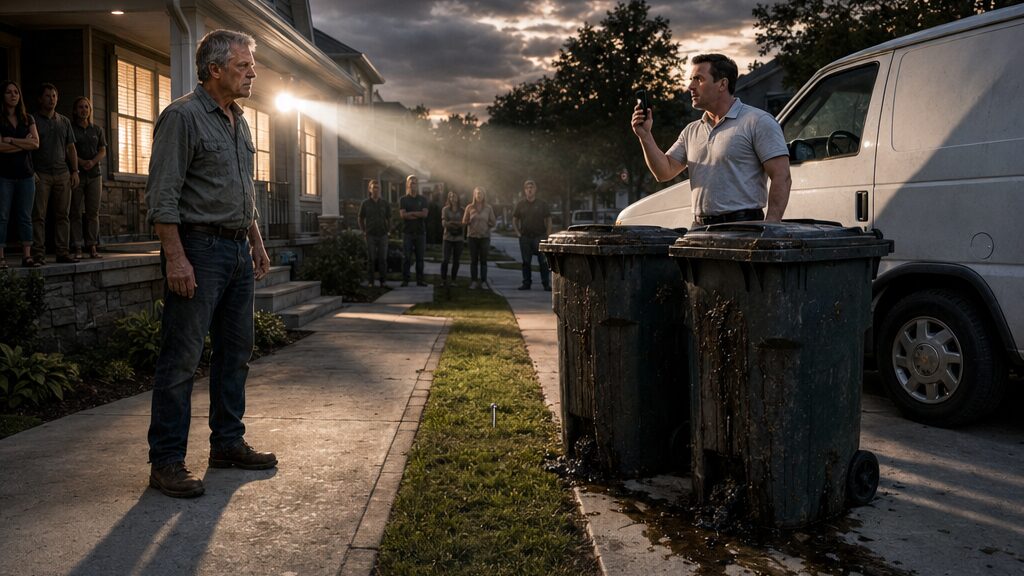
Two massive municipal garbage cans stood on his driveway, not at Steven’s fence line now, not facing the concrete like a warning, but fully across the pale curve Alexander had washed two days earlier. Their lids hung open. Black bags bulged inside them, split at the seams. A dark liquid leaked from the bottom of one can and crawled down the slope of the driveway in a crooked line.
Steven Hall stood beside them with his phone already raised.
His white van was parked across the lower edge of the driveway, one tire over the concrete, the front bumper angled as if he had stopped mid-turn and decided to claim the position as permanent.
“Morning,” Steven said.
Alexander remained on the porch.
A gull, lost far inland from the strip mall dumpsters, circled once overhead and veered away.
Steven shifted the phone slightly, framing him. “Careful, Alex. Big day.”
Alexander walked down the steps. He kept his eyes on the cans, not Steven’s phone. The stench strengthened as he approached. Rotting vegetable matter, old meat trays, sour milk, lawn clippings turned black in plastic heat. Flies lifted and settled again.
The clean concrete was streaked with brown liquid.
“What are these doing on my driveway?”
Steven made a show of looking around. “Driveway? Looks like shared access under review to me.”
“They’re on my property.”
“That’s what we’re here to find out, right?”
“No. We’re here because you filed a complaint about a driveway the town already approved.”
Steven smiled behind the phone. “Hear that tone? This is what I deal with.”
Alexander glanced once toward Linda’s house. Her curtains shifted. She was watching, but she did not come out.
He looked down at the grass beside the driveway. The property marker pin was visible where he had cleared it the day before. The garbage cans had crossed well beyond it. Their wheels sat on his concrete, six, maybe seven feet inside the line.
Alexander pointed to the pin. “Move them back.”
Steven laughed softly. “You and that dot.”
“Move the cans back, Steven.”
“Or what?” Steven’s voice lifted, almost pleased. “You’ll throw another fit before the officer gets here?”
Alexander inhaled through his mouth because the smell made his stomach turn. The binder was inside on the hallway table, packed with photos, copies, dates. The review notice lay beside it. He could go in, call James Baker, take pictures, wait.
He lifted his phone and photographed the cans. The leak. The van. The pin. Steven filming him.
Steven panned his own phone slowly. “For the record, I’m standing on my property, and Alexander Miller is photographing me again.”
“You’re standing beside garbage you dragged onto my driveway.”
“Allegedly.”
The word was smug enough to make Alexander’s hand flex.
He stepped closer to the nearest can. The smell rose in a warm wave. One of the bags inside had torn open, exposing gray-green scraps and something red-brown soaked into paper. The can was full enough that the lid could not close.
Alexander did not touch it.
“Last chance,” he said. “Move them.”
Steven lowered his phone just enough for his expression to sharpen. “No. You’re going to wait for the town like everybody else. Maybe they’ll tell you what I’ve been telling you. This corner isn’t your private loading dock.”
“My driveway is not your turnaround.”
“It was everybody’s turnaround before you poured concrete over common sense.”
“There was no common space.”
“There was neighborly space.”
The phrase hit the same old place, but this time Alexander saw the machinery beneath it. Steven was not confused. He had wrapped his entitlement in nostalgia because nostalgia sounded better than trespass.
A delivery truck slowed at the corner. The driver looked at the cans, the van, the two men facing each other, then kept moving.
Steven noticed. His voice grew louder. “You see what he did? He built this curve so nobody can use the corner. Now he wants to police trash cans.”
Alexander turned toward the marker pin. He crouched, cleared one stray blade of grass from the metal head, and stood again.
“That pin is the line.”
Steven walked to the nearest can and grabbed its handle. For one second Alexander thought he was going to pull it back. Instead Steven yanked it deeper onto the driveway. The wheels rattled across the concrete, leaving two wet tracks behind.
Alexander stepped forward. “Stop.”
Steven dragged the second can after it. The heavy plastic lurched, tipped, then slammed down. Rotting liquid splashed near Alexander’s shoe.
The van remained where it was, blocking the driveway’s mouth. Steven had made a corridor of Alexander’s own property: van at one end, garbage at the other, phone in between.
“Touch them,” Steven said, raising the phone again, “and I’ll sue you.”
The words were quiet. Not shouted for neighbors now. Said directly, with a little smile that told Alexander this was the real point.
He wanted Alexander on camera. Angry. Physical. Confirming the story Steven had been telling for months.
Alexander heard James Baker’s voice in memory: Sometimes the file becomes part of the conflict.
He heard Linda: They may think you’ve been waiting for him to slip.
He saw himself months earlier, book in hand, voice raised under the floodlight.
His first instinct was to step back.
Steven saw it. His smile widened. “That’s right.”
The retreat opened in front of Alexander like a familiar hallway: go inside, take more photos, write more notes, let the smell sit, let the concrete stain, let Steven stand there with his phone and his van and his garbage until the official arrived to find both men in a scene Steven had staged.
Alexander had walked that hallway too many times.
He looked at the windows of his living room. The curtains were still drawn from the night before, but he knew the room behind them: sofa, photographs, black binder, pale bars of light when evening came. A house turned into evidence storage. A man learning to move quietly so a bully would not have material.
The cans dripped.
The marker pin gleamed beside the driveway, small and almost absurd under the morning sun.
Alexander put his phone in his pocket.
Steven’s smile faltered just a little. “What are you doing?”
Alexander did not answer. He stepped to the first garbage can and wrapped both hands around its handle. The plastic was slick. The weight of it pulled hard at his shoulders, heavier than he expected.
Steven moved closer, phone up. “I’m warning you.”
Alexander looked at the marker pin once, then at the tire of Steven’s van resting over the concrete.
“No,” he said. “I warned you.”
He lifted.
The can rose an inch, then two, wheels scraping, waste shifting inside with a thick wet slump. Steven’s phone dipped. The smile disappeared from his face so quickly it was like someone had turned off a light.
Alexander set his feet on his own driveway and tightened his grip on both cans.
Chapter 6: Sue Me From Your Side Of The Line
The first garbage can hit Steven’s van with a sound that brought every quiet window on the street to life.
It was not a clean crash. It was a brutal, layered noise: plastic buckling, metal denting, rotting bags bursting against the van door, wheels skittering over gravel, Steven shouting as the can bounced sideways and emptied half its contents against the white panel.
For half a second, no one moved.
Then the second can struck.
It slammed lower, near the sliding door, and left a deep inward crease that caught the morning light like a wound in the paint. The lid snapped backward. Garbage spilled across the gravel strip between the driveways, wet and dark and steaming under the sun.
Alexander stood with both hands empty at his sides.
His breath came hard, but he did not speak. He had not thrown the cans into the street. He had not crossed into Steven’s yard. He had hurled them out of his driveway, toward the only obstruction Steven had left in their path: the van parked illegally over the line.
Steven stared at the dented door as if it had betrayed him.
Then he turned.
“You saw that!” he shouted.
Doors opened. Curtains moved. Linda Anderson stepped onto her porch with one hand at her throat. The neighbor from the day before came out barefoot. Somewhere down the block, a dog began barking.
Steven raised his phone again, but his hand was shaking now. “You all saw that! He attacked my van!”
Alexander walked to the grass beside the driveway. He crouched and cleared the property marker pin with two fingers. Then he stood over it.
“Your van was on my driveway,” he said.
“My van was parked!”
“Over the line.”
Steven jabbed a finger toward the garbage. “You destroyed my property.”
Alexander looked at the two municipal cans lying against the van, their wheels still spinning slightly. “You dragged them onto mine.”
Steven’s face darkened. “You’re finished.”
He stabbed at his phone screen and put it to his ear. The performance returned, louder now, frantic around the edges.
“Yes, I need someone out here. My neighbor just threw garbage cans into my vehicle. No, I’m not exaggerating. He’s been unstable for months. I have video.”
Alexander felt the street listening. He felt Linda’s uncertainty like a hand pressing between his shoulder blades. He had done the thing he had promised himself he would not do. He had acted in a way Steven could point to. The dent in the van was real. The crash had been real. Nobody could photograph restraint.
The smell of waste spread down the driveway.
He looked at the tire mark where the van crossed the concrete seam. Then at the marker. Then at Steven, who paced now in small angry half-circles while speaking into the phone.
Alexander went inside.
The hallway seemed too quiet after the crash. The binder sat on the table where he had left it, black cover closed, edges squared. For a moment, he rested his palm on it and felt the tremor in his own hand.
Not revenge, he told himself.
The words did not absolve him. They steadied him.
He picked up the binder and returned outside.
Steven saw it and laughed into the phone. “And now he’s bringing out the crazy book.”
A few neighbors murmured. Linda had come halfway down her walk but stopped at the curb.
Alexander set the binder on the hood of his truck and opened it to the first tab. Boundary / Survey. The page protectors clicked softly against the rings. It was a small sound, but it cut through Steven’s shouting because it did not match the scene. No panic. No scrambling. Just order.
Steven hung up and pointed at him. “You think paperwork fixes that door?”
“No.”
“Good. Because I’m suing you for the repair, the cans, cleanup, everything.”
Alexander turned one divider. Floodlight. Another. Driveway Encroachment. Another. Prior Warnings.
Steven stepped closer. “You hear me?”
“I heard you.”
“Say something for your little record.”
Alexander looked up. “From your side of the line.”
Steven blinked.
“Say what?”
“You can sue me from your side of the line.”
The neighbor across the street gave a low whistle before catching himself.
Steven lunged a step forward, then seemed to remember the phone still in his hand. He lifted it again, filming Alexander, the binder, the garbage, anything that might become useful if edited small enough.
A municipal pickup turned onto the street at 8:06, earlier than scheduled.
James Baker parked behind Alexander’s truck and got out slowly, taking in the cans, the van, the garbage trail, the neighbors, the open binder. His face changed only slightly, but Alexander saw it. The tired patience was still there. Under it now: inconvenience sharpened into attention.
“I thought the review was at nine,” Steven said immediately.
James looked at the mess. “So did I.”
Steven pointed to the van. “He did this. I have video.”
James did not answer him. He looked at Alexander. “Was anyone hurt?”
“No.”
“Did you throw those cans?”
“Yes.”
Steven let out a triumphant sound. “There. He admits it.”
Alexander kept his eyes on James. “After he dragged them across the property line and blocked my driveway with his van.”
James looked down at the marker pin, then at the van tire. He walked closer, careful not to step in the garbage. He crouched, examined the pin, the tire position, the wet tracks across the concrete. He took out his phone and photographed each one.
Steven’s voice rose. “You’re photographing the wrong thing.”
“I’m photographing the site,” James said.
Linda crossed the street then, unwillingly, like someone pulled by a thread. “I saw the cans after they were already on the driveway,” she said.
Steven swung toward her. “You saw him throw them.”
“I saw the crash.”
“Exactly.”
Linda looked at Alexander, then at the garbage streak, then at the marker pin. “I didn’t see who moved them there first.”
The sentence landed poorly. Alexander knew it as soon as she said it. It was honest, and it did not help enough.
Steven seized it. “Thank you. She didn’t see me do anything. She saw him damage my van.”
Alexander closed his fingers around the edge of the binder. The old hallway opened again: explain too much, sound desperate; explain too little, let Steven frame it.
James stood. “Mr. Hall, is this your van?”
“Obviously.”
“Please move it fully off Mr. Miller’s driveway.”
Steven’s mouth opened, then closed.
James added, “Now.”
For the first time that morning, Steven had to obey in front of everyone. He climbed into the van, jaw rigid, and started the engine. The dented door rattled as he pulled back. The tire dropped off Alexander’s concrete onto the street with a small, unmistakable thud.
The line was visible then. Not just as a pin in the grass, but as absence. The van had been occupying space that did not belong to it.
Alexander felt no triumph. Only the cost of being believed too late.
Steven got out again, face flushed. “This doesn’t change the damage. I’m filing suit today.”
James looked between them. “That’s your right.”
Steven pointed at Alexander. “And when I’m done, that binder won’t save you.”
Alexander opened the binder to the tab marked Pattern.
The first page showed the living room washed white by the floodlight. The next showed Steven’s van over the driveway edge three months earlier. Then another. Then another. Complaint copies. Advisory letter request. Survey. Notes. Photos of the garbage cans staged at the fence line the night before.
James’s expression tightened as he recognized his own office stamp on one of the pages.
Alexander turned the binder so James could see the tabbed sections.
“This is not one damaged door,” Alexander said, and his voice was quiet enough that the neighbors had to lean in to hear. “It is years of being told it wasn’t enough yet.”
Steven gave a harsh laugh. “That’s your defense? You kept a diary?”
Alexander looked at him across the open binder, across the property pin, across the clean legal line now stained with garbage.
“No,” he said. “That’s my counterclaim.”
Steven’s smile returned, but it arrived late and did not fit his face.
“I’ll see you in court,” he said.
Alexander turned one more page in the binder, to the section he had never wanted to need. At the top, written in blue tape and black ink, was a single word.
Pattern.
Chapter 7: Years Of Harassment, Filed In Order
Steven Hall placed the repair estimate on the hearing table like a winning card.
The paper slid across the laminate surface and stopped inches from the hearing officer’s folder. The total at the bottom had been circled in black ink. Steven had underlined the words door panel, paint match, and labor with a ruler-straight line, as if neatness could turn the morning on Alexander’s driveway into a simple bill.
“That is the damage,” Steven said. “That is what he did.”
Alexander sat with the black binder on his lap, both hands resting on its cover.
The municipal hearing room was smaller than he expected. One long table. Four chairs. A clock with a faint click in its second hand. Fluorescent lights that hummed overhead, softer than Steven’s floodlight but too similar for comfort. Through a narrow side window, he could see the parking lot and the back corner of James Baker’s municipal pickup.
James sat beside the hearing officer, a stack of field notes in front of him. Linda Anderson sat two chairs behind Alexander, not close enough to feel like an ally, not far enough to pretend she was not involved. Steven had chosen the seat nearest the door, as if he wanted the room to know he could leave whenever he pleased.
The hearing officer looked at the estimate but did not pick it up yet. “Mr. Hall, we’ll address property damage. We are also here on your driveway access complaint and Mr. Miller’s counterclaim of repeated trespass and nuisance conduct.”
Steven leaned back. “The access complaint explains everything. That driveway changed the way the corner works. He built it so nobody could turn around there anymore, then acted shocked when people still used the space the way we always did.”
Alexander felt the binder under his palms.
Always. Everyone. Shared. Common.
Steven’s favorite words never stood still long enough to be measured.
The hearing officer turned to Alexander. “Mr. Miller?”
Alexander opened the binder to the first section and removed Carol Young’s survey. He placed it flat on the table, smoothing the fold with the side of his hand.
“The driveway was permitted,” he said. “The survey shows the property marker pin and the driveway edge. The curve is inside my lot.”
Steven gave a short laugh. “Nobody’s arguing about your precious pin.”
James Baker looked up from his notes. “You argued about it on site.”
Steven’s head snapped toward him. “I said it didn’t change the reality of the corner.”
James did not answer. He reached into his file and pulled out a printed photograph. Alexander recognized it immediately: Steven’s van tire over the concrete edge, the marker pin visible in the grass beside it.
James laid it on the table.
“The van was not fully on the street,” James said.
Steven’s jaw shifted. “Barely. And then he threw garbage cans into it.”
The hearing officer raised one hand, not sharply, just enough. “We’ll proceed in order.”
Alexander heard the words in order and opened the binder wider.
He had built the binder that way because disorder had been Steven’s weapon. A light angled one night. A van tire over the edge another. A joke at the mailbox. A complaint framed as concern. Each incident small enough to dismiss alone, each one making the next easier.
Alexander turned to the floodlight section.
“These are dated photographs from inside my living room,” he said. “The first is from four months ago. This one is after I asked him to adjust the light. This one is after I showed him the property marker.”
He slid three photos across.
The hearing officer picked them up. James leaned slightly to see.
Steven sighed loudly. “Security light. Everyone has one.”
“It faces my living room.”
“It faces the side yard.”
James reached for one photo, frowning. “This one has a complaint number written on it.”
Alexander nodded. “That’s the advisory letter request I filed.”
James pulled another sheet from Alexander’s stack. His eyes narrowed at the stamped number in the corner. “I remember this.”
The room changed subtly. Not much. Just enough for Steven to notice.
James flipped through his own field notes. “This came in as a light nuisance inquiry. It was logged separately from the driveway obstruction.”
“It wasn’t separate,” Alexander said.
James did not argue. He kept reading.
Alexander turned another section. “Driveway obstruction. These are dates when his van crossed the concrete edge or blocked my exit. This is the advisory request. This is the morning of the review. These photos show the garbage cans on my driveway before I moved them.”
Steven leaned forward. “After you staged your little photo shoot.”
Alexander looked at him then. Not at the estimate. Not at the hearing officer. At Steven.
“I did not drag rotting garbage onto my own driveway before a municipal inspection.”
“You wanted a scene.”
“You brought the scene.”
Steven’s lips pressed together.
Linda shifted behind Alexander. The sound of her chair legs lightly tapping the floor seemed louder than it should have been.
The hearing officer turned. “Mrs. Anderson, you gave a preliminary statement. Is there anything you want to clarify?”
Linda’s face tightened. She looked first at Steven.
He smiled at her, but there was no warmth in it. Only warning wrapped as confidence.
“I saw the cans after they were already on Alexander’s driveway,” Linda said carefully. “I didn’t see who moved them there.”
Steven spread his hands.
Linda swallowed. “But I did see something else.”
Steven stopped moving.
Alexander did not turn around.
Linda continued, quieter now. “The night after Alexander showed Steven the marker pin, I saw Steven outside adjusting the floodlight. He raised it. After that, it shone directly into Alexander’s front windows. I could see the beam from my porch.”
The hearing room settled around her words.
Steven gave a strained laugh. “You saw me adjust a security light. That’s not harassment.”
Linda looked at the table. “You looked at his windows after you did it.”
Steven’s face hardened.
It was not a heroic statement. It came late. It came wrapped in fear. But it was a correction, and Alexander felt something inside him loosen by one notch.
James Baker pulled the floodlight photo closer. “Mr. Miller, do you have dates matching this adjustment?”
“Yes.”
He turned to the notes. There it was: the night Steven kicked grass over the pin, the night the beam climbed across the sofa and family photographs.
The hearing officer wrote something down.
Steven’s repair estimate no longer looked like the center of the room.
That was when Steven made the mistake.
He leaned forward, anger heating through his voice. “Look, before he started acting like he owned every inch, people used that turn. I used that turn. Delivery trucks used that turn. Nobody cared. Then he poured concrete and started hiding behind maps and pins and cameras.”
Alexander went still.
James looked up.
The hearing officer’s pen paused.
Steven seemed to hear himself only after the words had landed.
Alexander’s voice came quietly. “You used my driveway before I gave you permission?”
Steven scoffed. “It wasn’t like that.”
“You knew I objected.”
“You object to everything.”
“You knew where the line was.”
Steven pointed at him. “Because you made it impossible not to know. You shoved that pin in everybody’s face like it made you better than the rest of us.”
Carol Young’s survey sat open on the table between them. The marker pin was a small printed dot on the page. The driveway curve was a clean line beside it. There was no common space drawn there. No neighborhood habit. No memory wide enough to become ownership.
The hearing officer folded her hands. “Mr. Hall, did you place the garbage cans on Mr. Miller’s driveway?”
Steven looked away.
“Mr. Hall.”
“They were near the line.”
“That is not what I asked.”
He inhaled through his nose. “I moved them where I thought they made the point.”
“What point?”
“That the access area is disputed.”
Alexander closed his eyes for one second.
Not because he was relieved. Because the sentence hurt in a way he had not expected. All those months of proving, measuring, photographing, filing, and Steven had finally said it plainly: the cans had not been trash. They had been a message.
James Baker wrote something down.
The hearing officer looked at Alexander. “Mr. Miller, your counterclaim requests documentation of a pattern. Is that all you’re requesting today?”
Alexander’s hand moved over the binder tabs.
He had imagined wanting money. Repairs to the concrete. Cleanup costs. An order for Steven to stop blocking the driveway. Something measured. Something that made him seem reasonable.
But reasonableness had not stopped the light from entering his home. It had not stopped Steven from turning every restraint into weakness. It had not stopped the garbage from leaking over clean concrete while a phone camera waited for him to break.
Alexander looked at the floodlight photographs, then the survey, then the repair estimate Steven had circled so proudly.
“I’m not asking for revenge,” he said.
Steven muttered, “Could’ve fooled me.”
Alexander continued, not louder. “I want him off my driveway. I want the light out of my living room. I want a boundary that doesn’t depend on him deciding to respect a pin he’s already covered with grass.”
The hearing officer studied him. “Are you requesting a restraining order and a structural remedy?”
The words entered the room with the weight of something official enough to change the shape of both properties.
Steven sat forward. “A what?”
James Baker turned a page in his notes. Linda looked at Alexander as if she had only just understood what the binder had been building toward.
Alexander rested one hand on the open section marked Pattern.
For the first time in years, he did not feel like he was explaining a problem that only became real when someone else believed it. The room had seen the shape of it. Not all of it, maybe. But enough.
The hearing officer waited with her pen above the page.
Alexander looked once at Steven, then down at the survey line, clean and narrow and ignored for too long.
“Yes,” he said. “I am.”
Chapter 8: The Wall Built On Steven’s Side
The first pallet of bricks was unloaded on Steven Hall’s side of the line.
The forklift backed down the flatbed ramp with a low mechanical whine, carrying the stacked red blocks as if they were heavier than the morning itself. The driver lowered them beside Steven’s grass, well clear of the property marker pin that Carol Young had marked again with a small orange flag.
Steven stood near his garage with a folded copy of the order in one hand.
He had not spoken to Alexander in three weeks.
That had been part of the order too.
No direct contact. No entering the driveway. No obstruction of the driveway edge. No lighting aimed toward Alexander’s residence. No placement of objects, containers, vehicles, or debris beyond the surveyed property line. The language had been dry and exact, but Alexander had read it three times at his kitchen table, feeling each sentence remove a different hand from his throat.
The structural remedy had taken longer.
Steven had fought it until the last meeting, claiming cost, appearance, hardship, neighborhood character. He had argued that a ten-foot solid brick wall would make his own property feel boxed in. The hearing officer had asked whether he had considered that before shining a floodlight into a neighbor’s living room for months.
Steven had said nothing then.
Now the bricks were here.
A contractor stretched a string line between two stakes. Carol Young stood beside him with her clipboard, neutral as ever, watching the measurement. She did not look pleased. She did not look vindicated. She looked like a person doing the work correctly because correct work mattered whether anyone respected it or not.
Alexander stood on his porch with coffee cooling in his hand.
He had not come down to watch at first. He had told himself he did not need to see Steven pay for the wall. That was not the point. But when the flatbed’s backup alarm began pulsing through the morning, he found himself at the door, then on the porch, then at the top step.
The property marker pin glinted in the grass below the orange flag.
Small. Nearly absurd.
For years, that small metal point had been asked to hold back a man’s pride, a van, a floodlight, two garbage cans, and a neighborhood’s preference for calling cruelty tension because tension sounded less accusatory.
Now brick would do what the pin had always proven.
Steven walked toward the contractor, waving the order. “That line is too far onto my side.”
The contractor looked at Carol.
Carol checked the clipboard. “The wall footing begins six inches inside your property line, as required.”
Steven’s face reddened. “I know what the order says.”
“Then you know the line is correct.”
“It eats up my yard.”
Carol’s pencil paused. “It is your yard.”
The words were not sharp, but they struck with surgical precision.
Alexander looked down into his coffee to hide the flicker of satisfaction that crossed his face. It was not noble, that satisfaction. He knew that. Some part of him wanted Steven to feel every inch he had spent years dismissing. But the feeling passed quicker than he expected, leaving something quieter behind.
The contractor set the first bricks in mortar just after nine.
Brick by brick, the wall began as a line low enough to step over. That almost made it harder to watch. At first, it looked inadequate against everything that had happened. A knee-high row of red blocks where there had been glare, stink, shouting, and the white van’s tire nudging concrete like a dare.
Steven paced beside it until the contractor told him to move back.
“You people are turning my place into a prison,” Steven said.
The contractor kept working. Carol made a note.
James Baker arrived before noon in the municipal pickup. He parked on the street, not in either driveway, and walked over with a folder tucked under his arm. Steven went to him at once.
“You need to check this,” Steven said. “They’re overbuilding.”
James glanced at the string line, then at Carol. “Survey verified?”
Carol nodded. “Twice.”
“It’s excessive,” Steven said. “Ten feet? For a neighbor dispute?”
James looked at the rising wall, then at Alexander’s front windows. “It stopped being just a neighbor dispute when the record showed repeated nuisance conduct.”
Steven’s mouth tightened. “So his binder wins.”
James did not answer immediately. He looked tired, but not dismissive. That mattered to Alexander more than he wanted it to.
“The record wins,” James said. “You helped make it.”
Steven stared at him, order crumpling slightly in his hand.
Alexander went back inside before the wall reached waist height.
The living room was dim.
Not dark. Dim.
For a moment, he stood in the doorway and did not understand why the room looked unfamiliar. Then he realized what was missing. No hard white bar across the sofa. No glare trapped in the family photos. No bright wound at the curtain edge though the morning sun was high outside.
The floodlight pole still stood on Steven’s side, but the lamp had been removed under the order. Only the bracket remained, empty and angled at nothing.
Alexander crossed to the front window. The blackout curtain hung heavy against the glass. He had bought it after the third week of light and told himself it was temporary. Then it became habit. Like photographing tire marks. Like writing times beneath printed images. Like keeping the binder close enough to reach before answering the door.
He grasped the curtain and pulled one panel down from the rod.
Dust shook loose. Real daylight entered, soft and ordinary.
Alexander carried the folded curtain to the hallway. On the table lay the black binder.
He had meant to put it away after the hearing, but it remained there through the order, the contractor scheduling, the survey recheck, the first morning without the floodlight. Its presence had become a piece of furniture. A dark rectangle he passed on the way to the kitchen. A warning that peace could vanish if he stopped watching.
He opened it one final time.
The pages were still in order. Floodlight. Boundary / Survey. Driveway Encroachment. Prior Warnings. Pattern.
He paused at the photograph of his living room washed white. The sofa looked ghostly. The framed photographs reflected nothing but glare. He remembered standing there with his hand on the lamp switch, unable to make his own room dark.
Then he turned to the final section and slid in a copy of the restraining order.
Not on top.
At the back.
The binder did not need to be the first thing anymore.
Outside, the wall had reached chest height. The sound of trowels scraping mortar came through the open window. Steven’s voice rose once, then stopped, cut short by someone official or by the order itself.
Alexander took the binder to the hall closet. For a second, his hand hesitated before placing it on the upper shelf.
The hesitation embarrassed him.
He had wanted to believe that winning would feel like release all at once, clean and undeniable. Instead, release arrived awkwardly, in small permissions. Leaving the porch light off. Opening the curtains. Letting a truck slow at the corner without reaching for his phone. Putting the binder where he would need a step stool to reach it.
He closed the closet door.
By late afternoon, the wall stood high enough to block the view of Steven’s garage. It rose solid and red along the line, turning the narrow grass strip into two separate worlds. The contractor washed mortar from the lower bricks. Carol removed the temporary measuring stakes but left the small orange flag near the marker pin until the final inspection.
Alexander stepped outside after the workers packed up.
Steven was in his driveway, partly hidden by the wall he had paid for. Only his shoulders and head were visible above an unfinished section. He looked older from that angle. Smaller, though Alexander knew better than to confuse consequences with remorse.
Their eyes met once.
Steven looked away first.
Alexander walked to the edge of his driveway. The concrete still bore a faint stain where the garbage had leaked, no matter how many times he had scrubbed it. Near the grass, the property marker pin caught the last light of the day.
He crouched and brushed one blade of grass away from it.
Not because anyone had covered it.
Because he could.
Then he went back inside, leaving the curtain open.
As evening settled, his living room dimmed naturally. The sofa held its own color. The photographs on the wall became faces again instead of reflections. No glare entered. No engine idled at the edge of the driveway. No plastic wheels waited at the line.
Alexander sat in his chair without turning on a lamp.
Outside, the new brick wall held the boundary in silence.
For the first time in years, the quiet inside his house belonged only to him.
The story has