The Engineer Who Smashed Her Stolen Robot Before the World Could Applaud the Thief
Chapter 1: The Briefcase Opens Under the Lights
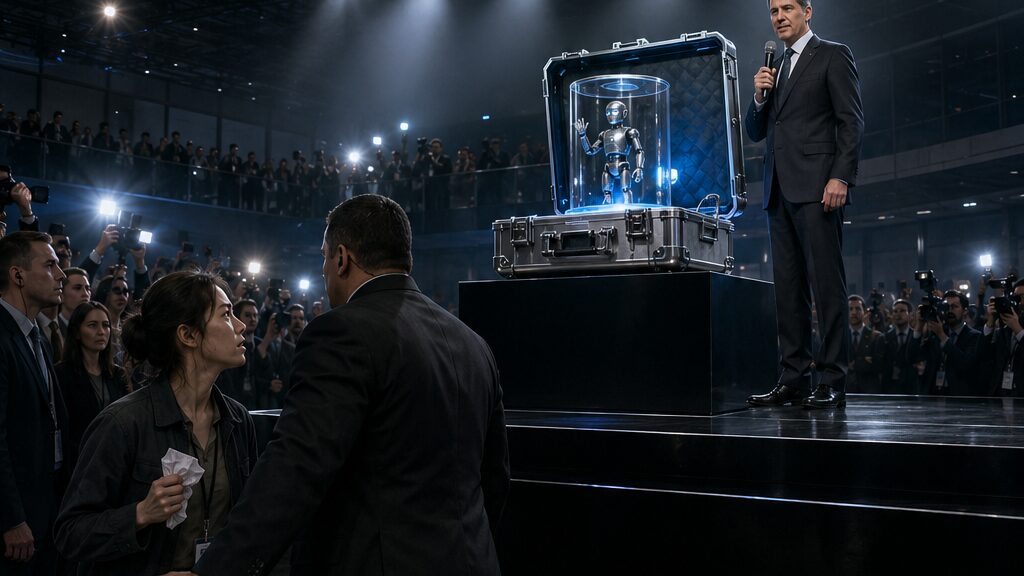
The bio-robot raised one delicate metal hand from inside the heavy silver briefcase, and the whole auditorium applauded as if it had just witnessed a miracle.
Amanda Lee could not clap.
Her right hand was crushed around a folded resignation paper until the sharp corner dug into her palm. Onstage, under a ceiling of white LED strips and moving camera cranes, the briefcase sat open on a black pedestal. Its interior glowed blue around the small machine she had built through three years of sleepless nights, missed birthdays, cold noodles, and whispered tests after midnight when the lab lights should have been off.
The robot blinked.
Not like a toy. Not like a demo unit. It blinked with the tiny hesitation Amanda had written into its response engine because real attention was never instant. Real attention took a breath.
The crowd loved it.
Executives leaned forward in their first-row seats. Journalists raised phones. A child sitting on his father’s lap near the center aisle gave a startled laugh when the robot turned its head toward him.
On the giant screen behind the stage, Brian Wright’s name appeared in letters taller than Amanda.
BRIAN WRIGHT
SENIOR GOVERNMENT TECH ADVISOR
PROJECT ORIGINATOR
Amanda felt the words land in her chest with a clean, surgical coldness.
Project originator.
Brian stood beside the briefcase with one hand resting lightly near the glass display cover, not touching it, careful not to look afraid of the machine he did not understand. His tailored dark suit caught the stage lights at the shoulders. His smile was practiced, warm, paternal. He had the face of a man who could make theft look like national service.
“Ladies and gentlemen,” he said, his voice filling the main auditorium through hidden speakers, “today, you are not seeing a product. You are seeing a new relationship between people and responsive intelligence.”
Amanda’s throat tightened.
He had changed the sentence. In her lab notes it had been: a new relationship between care and machine attention.
He had stripped even that down. Made it public-facing. Made it his.
The robot lifted its hand again, responding to the applause pattern. Three fingers curled, paused, then opened in a small wave.
Amanda’s breath snagged.
That pause was hers.
The first time she programmed it, the movement had been too perfect. Too clean. It looked like a machine imitating friendliness. So she added an almost invisible delay between curl and release, a fraction of uncertainty, the kind children had when waving back at strangers. She had tested it with coffee-stained hands at 2:17 in the morning while Emily Moore, before everything went wrong for her, sat cross-legged on the lab floor eating vending machine crackers.
“Too human,” Emily had said then.
Amanda had smiled. “Just human enough.”
Now the same gesture bloomed under a live broadcast banner while Brian stood in the applause as if his own hands had built it.
Amanda looked down at the paper in her fist.
RESIGNATION AND RELEASE AGREEMENT.
The line for her signature had been highlighted in yellow. Beneath it was a settlement number small enough to be insulting and large enough for Brian to pretend he had been generous.
She had not signed.
Not yet.
Her badge hung from her neck, turned backward against her blouse. She had flipped it over after seeing the updated digital program on the lobby wall. Her name had been gone there too. Not misspelled. Not reduced. Gone. The project team listed under Brian’s advisory office was a row of senior titles and polished photographs. Amanda’s access ID, the one that had opened the lab doors every night, did not exist in the public story.
Onstage, Brian paced slowly, comfortable in the spill of light.
“Our advisory lab has worked with the best minds across public systems and private innovation,” he said. “This breakthrough represents not one person’s dream, but a nation’s capacity to lead.”
Amanda almost laughed.
One person’s dream.
He would not even deny her directly. He had built the lie wide enough for her to disappear inside it.
The robot shifted in the briefcase. A thin arm unfolded from its compact torso. The glass case surrounding the core chamber reflected the lights in sharp white lines. Beneath that case, sealed behind a transparent protective column, sat the microprocessor stack—black, gold, and no bigger than a child’s lunchbox.
Amanda knew every path inside it.
She knew the first board that had overheated after thirty-six minutes. She knew which sensor had a hairline calibration flaw if the room temperature dropped below eighteen degrees. She knew the hidden bridge below the processor, soldered with hands that had trembled only once.
She looked away before the memory could open.
The child in the front section raised both hands now, delighted. His father whispered something and pointed. The robot tilted its head toward the boy, scanned his raised palms, and did the gesture Amanda had never entered in the official demonstration file.
It touched two fingers to the side of its own head, then tapped its tiny chest plate twice.
The child copied it, giggling.
Amanda stopped breathing.
That was not in Brian’s demo script. That was from a private testing routine. Her routine. She had taught it during a night when the auditorium model had still been a taped square on a lab floor and she was trying to teach the robot how to acknowledge a nervous user without overwhelming them. Think. Feel. Respond. Two fingers to the head. Two taps to the chest.
Emily had called it Amanda’s secret handshake with the future.
The audience made a soft, collective sound, the kind people made when a machine surprised them into tenderness.
Brian turned smoothly toward the child, recovering fast.
“And this,” he said, lifting a finger as if he had cued it himself, “is precisely the empathy framework we set out to create.”
Amanda’s folded paper cracked in her fist.
Her first urge was not rage. It was correction. Clean, immediate correction. The same instinct that made her fix bad code, misaligned housings, mislabeled data. She wanted to step forward and say: No. That is not what it is called. That is not what it means. That was never yours.
She took one step into the aisle.
A woman beside her glanced over, annoyed at the movement. A camera operator near the rail adjusted his angle, not toward Amanda but past her, toward the glowing briefcase.
Amanda took another step.
Her pulse hit her ears. The auditorium stretched between her and the stage in rows of dark heads and illuminated phones. She could still stop this cleanly, she told herself. She had files. Draft logs. Prototype videos. Encrypted commits. The original response architecture. If she could get close enough to a microphone, if she could force one question into the air, if the press heard even her name—
Brian’s voice rolled over the crowd.
“I want to thank the entire advisory lab team for believing in my vision.”
My vision.
The words erased three years in two syllables.
Amanda moved faster.
She passed the end of one row, then another. A few attendees turned. Someone muttered for her to sit down. She kept her eyes on the left stage stair, where a black-clad crew member stood with a tablet. Beyond him, the briefcase gleamed like something sacred and stolen.
At the edge of the aisle, a security guard stepped out.
Amanda slowed only because his body blocked the narrow space between the audience barrier and the press platform. He was broad, expressionless, one hand near his earpiece.
“Ma’am,” he said quietly, “you need to return to your seat.”
“I’m on the project team.”
“Not according to our access list.”
“My badge—”
“Has been flagged.”
Amanda felt the floor tilt slightly beneath her. “Flagged by whom?”
The guard’s eyes moved past her shoulder, then back. He did not answer.
Onstage, Brian’s smile widened as the audience clapped again. The robot’s hand rested against the lip of the briefcase, small and shining.
Amanda tried to step around the guard.
He shifted with her.
“I need to speak to Robert Clark,” she said. “Operations director. Now.”
“He’s aware of you.”
The sentence was too prepared. Too flat.
Amanda stared at him. “Aware of me?”
The guard’s mouth tightened, almost apologetic. “Mr. Wright’s office warned us you might attempt a disruption.”
For a second, the auditorium noise vanished. There was only the faint mechanical hum from the stage, the click of cameras, and the resignation paper slowly unfolding in Amanda’s damaged grip.
Brian had known she would come.
He had not just stolen the machine. He had arranged the room so the machine’s creator would look like a threat if she reached for it.
The guard extended one hand, palm low, directing her back into the shadows beneath the glowing stage.
Chapter 2: The Resignation Paper in Her Hand
The scanner at the backstage door flashed red before Amanda even pressed her badge flat against it.
ACCESS REVOKED.
The words appeared on the small black screen with the calm cruelty of a locked machine. Amanda tried again, harder, as if pressure could shame the system into remembering her. The badge chirped. The same red message returned.
ACCESS REVOKED.
Behind her, Brian’s amplified voice continued to pour into the auditorium. Every polished sentence leaked through the walls and curtain seams, softened but still unmistakable.
“Human-centered innovation requires trust,” he was saying.
Amanda let out one short breath that was almost a laugh.
A man in a dark Expo operations jacket approached from the service corridor, tablet tucked under one arm. He had a compact, efficient walk and the tired eyes of someone whose job was to prevent disasters nobody thanked him for preventing.
“Amanda Lee?” he asked.
She turned. “Robert Clark?”
“Yes.” His gaze dropped to her badge, then to the folded resignation paper in her hand. “You can’t be back here.”
“I built the interaction core being demonstrated on that stage.”
Robert’s expression did not change. “You are not listed as active technical personnel for this event.”
“Because Brian removed me.”
“I don’t handle employment disputes.”
“This isn’t an employment dispute.”
A cheer rose from the auditorium. It hit Amanda like heat through a door.
Robert lowered his voice. “Ms. Lee, I’m trying to keep this from getting worse for you.”
Worse for her.
She looked at him carefully then. He was not smirking. Not enjoying this. That made it more dangerous. Brian’s cruelty had edges. Robert’s obstruction had procedure.
“Did Brian tell you I was dangerous?” Amanda asked.
Robert glanced toward the stage door. “Mr. Wright’s office notified us there might be an attempt to interrupt the launch by a former contractor.”
“I’m not a former contractor.”
“That’s not what my file says.”
“Your file is wrong.”
“My file determines who passes through this door.”
Amanda stepped closer. “That machine can’t complete its live reboot without the original architecture key.”
Robert’s fingers tightened around the tablet.
There. A flicker.
“You know there’s a reboot sequence,” she said.
“I know there is a scheduled demonstration sequence,” Robert replied.
“You know if he mishandles it in front of a live crowd, this Expo becomes a failure on every feed in the hall.”
“I also know if you rush a stage during a government-backed launch, the situation becomes security-related.”
Amanda hated how reasonable he sounded. She hated more that some part of her understood him. He saw badges, schedules, barriers, liability. He did not see the nights in the lab. He did not see Brian standing too close behind her chair, saying, You’re young, Amanda. Don’t confuse contribution with ownership.
A door opened behind Robert.
Virginia Wilson stepped into the corridor with a slim folder in one hand. Her silver hair was pinned low and neat, her suit the exact gray of expensive restraint. Amanda had seen her in board meetings through glass walls, always seated beside people whose names appeared in press releases.
“Amanda,” Virginia said softly. “I hoped you would be sensible.”
Amanda’s stomach turned.
“So you know who I am.”
Virginia’s eyes flicked toward Robert, then back. “Of course we know who you are.”
Robert looked at his tablet as if it had become heavier.
“Then put my name back on the project,” Amanda said.
Virginia’s mouth tightened in faint irritation, not at the injustice, but at the simplicity of the request. “That is not possible at this stage.”
“At this stage,” Amanda repeated.
“The launch is live. Investors are present. Government partners are present. International press is present. Any confusion now damages everyone.”
“Everyone?”
Virginia held out the folder.
Amanda did not take it.
“It is the same agreement,” Virginia said. “With a revised payment schedule. Sign it, leave through the north service exit, and this can be described as a private separation matter.”
“A separation from my own invention?”
“Amanda.”
The warning in Virginia’s voice was quiet and practiced. She had probably used it on assistants, junior analysts, anxious founders. It was the voice of a woman smoothing wrinkles out of fabric before anyone important saw them.
“If you refuse,” Virginia continued, “Brian’s office is prepared to file a breach claim. They allege you retained proprietary files after termination. They allege attempted sabotage. They allege unstable conduct.”
Amanda looked at Robert. He did not meet her eyes.
“I haven’t been terminated,” she said.
Virginia’s silence answered before her words did.
“The paperwork is dated yesterday,” Virginia said.
“I was in the lab yesterday.”
“Unauthorized access, according to the current record.”
Amanda felt something cold and familiar press behind her ribs. The same pressure she had felt months ago when Emily stopped coming to work and no one would say why. The same pressure she had felt when Brian began asking for code reviews in private, then sending summaries to senior staff under his own name. Each time, Amanda had told herself to document more, save more, make the proof cleaner.
Clean proof had become a cage.
Virginia extended the folder another inch. “This is the cleanest exit for everyone.”
The phrase landed gently. That made it worse.
Amanda took the folder just to stop Virginia from holding it out like a gift. Inside was a thicker version of the resignation agreement. More pages. More clauses. She flipped once, twice. Non-disparagement. Forfeiture. Acknowledgment of advisory office ownership. A small payment broken into installments contingent on silence.
Pennies cut into monthly pieces.
Behind the wall, applause swelled again.
Brian’s voice rose with it. “In a few minutes, you will see what happens when leadership gives science the platform it deserves.”
Amanda closed the folder.
“Leadership didn’t build the machine,” she said.
Virginia’s expression shifted. Not guilt. Fear. Quick and buried.
“You are very talented,” Virginia said. “That is why this is painful. But talent without protection is vulnerable. Brian provides protection.”
“He provides theft.”
“He provides access.”
Robert looked up then. Something in that exchange had reached him, but not far enough.
Amanda turned toward the auditorium entrance. Through the narrow gap in the black curtains, she could see the edge of the stage and a slice of Brian’s body moving under white light. The microphone in his hand caught a flare each time he gestured.
The microphone. His hand. His voice.
Amanda took a step toward the gap.
Robert moved at once. “You can’t enter from here.”
“I’m not signing that.”
Virginia’s voice hardened. “Then do not make the mistake of turning a private mistake into a public self-destruction.”
Amanda looked back at her. “Whose mistake?”
Virginia did not answer.
The curtain gap widened as a crew member slipped through. For half a second, Amanda saw the stage clearly: the open metallic briefcase, the robot upright inside it, Brian facing the crowd with the ease of a man standing in stolen light.
Then Brian turned.
His eyes found Amanda through the gap.
Something passed across his face too quickly for the audience to see. Not surprise. Calculation. Then he smiled.
The auditorium speakers sharpened as he lifted the microphone closer.
“It appears,” Brian said warmly, “we have someone in the aisle who feels this morning should be about her.”
Amanda froze.
The nearby crew member stopped moving. Robert’s face went pale with operational dread. Virginia’s eyes closed for the briefest moment.
The cameras began to shift.
Amanda stepped through the curtain gap before anyone could stop her fully, not onto the stage, but into the visible side aisle where light spilled down from the rigging. Hundreds of faces turned. The sound of the crowd changed from admiration to appetite.
Brian walked toward the stage edge.
“Amanda,” he said, making her name sound like an indulgence. “This is not the place.”
Her mouth opened.
No sound came.
The microphone was in his hand, not hers. Every speaker belonged to him. Every camera had been invited by him. Even her own name, spoken aloud at last, came wrapped in his control.
She lifted the resignation paper. “You stole—”
The nearest security guard caught her arm.
The crowd murmured. Phones rose higher.
Brian’s smile thinned.
“Don’t make a scene,” he said into the microphone, each word clean enough for the back row. “Sign this resignation, take these pennies, and get out of my sight.”
For one stunned second, the auditorium was silent enough for Amanda to hear the paper crumple again in her fist.
Chapter 3: The Proof That Was Almost Enough
Amanda opened her laptop in a maintenance alcove beneath a wall-mounted screen and saw her own source notes labeled as property of Brian Wright’s advisory office.
For a moment, she simply stared.
The file tree was familiar enough to feel like a room she had once lived in: response_engine, microgesture_library, child_safety_protocol, empathy_delay_tests. Her folder names. Her architecture. Her shorthand comments scattered through the old commits like fingerprints.
But the author field had changed.
BRIAN WRIGHT ADVISORY LAB — ORIGINATING OFFICE.
Amanda clicked deeper, fingers moving too fast. The trackpad barely responded under the sweat on her skin. A janitorial cart stood abandoned beside the alcove, its plastic bottles rattling faintly each time the auditorium sound system thudded through the walls.
On the screen above her, the live feed showed Brian beside the open briefcase. The robot sat upright in its blue glow, patient and trapped. A caption beneath the feed read: Wright unveils human-responsive bio-robot at International Tech Expo.
Amanda opened the earliest design memo.
The date remained. The diagrams remained. The test failures remained. But the metadata had been overwritten three days ago, then backdated through administrative certification. Her name appeared only in the copied distribution list as A. Lee — technical support.
Technical support.
She pressed her fingers against her mouth until her teeth hurt.
This was why Brian had smiled when she raised the resignation paper. He had not only stolen the stage. He had cleaned the trail behind it.
Her email window flashed with delivery failures.
The packet she had tried sending to the reporter bounced back twice. Then her internal drive access collapsed. A red banner appeared across the secure portal.
TERMINATED CREDENTIALS DETECTED. ACTIVITY LOGGED.
“No,” Amanda whispered.
She switched to her private archive. The files were still there, locked in her own encrypted container. Prototype videos. Lab timestamps. Hardware calibration notes. Enough to raise questions, perhaps. Enough to look desperate, perhaps. Not enough to stop a live launch backed by a government office, a board, an Expo contract, and a stage full of cameras already pointed in the wrong direction.
Her phone vibrated.
For one terrible second, she thought it would be Brian.
It was Emily Moore.
The message had no greeting.
If he’s launching it today, he already buried your name.
Amanda’s thumb hovered over the screen.
A second message arrived.
I told you not to wait.
Amanda closed her eyes.
Emily had told her six months ago, outside the lab’s service elevator, one cardboard box in her arms and her badge already dead. Her face had been composed in a way Amanda did not understand then. Too careful. Too dry-eyed.
Don’t let him make you grateful, Emily had said.
Amanda had asked, Grateful for what?
For leaving you anything.
At the time, Amanda thought Emily had been bitter. Hurt. Maybe ashamed of a mistake she would not explain. Brian had said Emily mishandled proprietary code and resigned before formal review. He had sounded disappointed, almost protective.
“She’s talented,” he had told Amanda. “But not everyone is built for pressure.”
Amanda had believed him less than she admitted and more than she should have.
Now she typed with trembling thumbs.
What did he do to you?
The typing bubbles appeared, vanished, appeared again.
A burst of applause came through the wall. On the screen, Brian was leaning toward the front row, inviting a child to wave at the robot. Amanda looked up just as the machine touched two fingers to its head and two to its chest.
The alcove seemed to shrink around her.
That’s mine, she thought.
Not the patent. Not the contract. Not the board deck. Mine.
Emily’s reply arrived.
He said if I challenged the transfer, he’d send a misconduct notice to every lab that had offered me interviews. He had recordings of me complaining about safety delays. He said he could make me look unstable.
Amanda read it twice.
Then a third message.
I signed because my father’s treatment wasn’t covered that month. I needed the severance. I’m not proud.
Amanda’s anger moved in a strange direction then. It did not rise. It deepened. It became something heavy and quiet enough to carry.
She had thought Emily disappeared because she was afraid for herself. That had been true, but not complete. Brian had found the exact place to press until silence looked like duty.
Amanda typed: Do you still have proof?
The reply took longer.
Some.
Amanda waited, listening to the auditorium feed. Brian was talking about “ethical deployment,” each syllable so smooth it felt obscene.
Emily sent a small encrypted file.
Before Amanda could open it, the laptop chimed. Another banner cut across her screen.
SECURITY NOTIFICATION: UNAUTHORIZED DATA EXPORT ATTEMPT. PLEASE REMAIN WHERE YOU ARE.
Amanda looked toward the service hallway.
No one yet.
She unplugged the laptop from the wall and tucked it under her arm. Her phone buzzed again.
Not enough for court, Emily wrote. Enough for truth.
Amanda stepped out of the alcove into the long press corridor. Screens lined the wall at intervals, each carrying the same image: Brian, the briefcase, the robot, the glow. In every reflection, Amanda saw herself as a shadow beneath his stage.
She opened the encrypted file on her phone while walking.
Audio.
Only twenty-six seconds.
She pressed play and held the speaker close to her ear.
Brian’s voice emerged through faint static, lower than his stage voice, stripped of warmth.
“You can fight me, Emily, but you’ll do it alone. By the time I finish documenting your attitude problem, no serious lab will put you near a government contract again.”
A thin silence followed.
Then Emily, smaller than Amanda remembered: “You can’t just take my work.”
Brian laughed once.
“I can if you sign.”
The clip ended.
Amanda stopped in the corridor.
The phone felt hot in her hand.
There it was. Not all of it. Not the entire architecture. Not a perfect legal weapon. But his voice. His method. His shape.
Enough for truth, Emily had said.
Amanda forwarded the clip into her private archive, then attached it to the draft packet for the reporter. Her thumb hovered over send. If it went through, perhaps one journalist would look up from the live spectacle. Perhaps a question would be asked in an hour. Perhaps a correction would come after Brian closed the deal, after the broadcast spread, after Amanda became the unstable former contractor who tried to disrupt a national launch.
She sent it anyway.
The message spun.
Sending.
Sending.
Failed.
Her phone lost access to the Expo network. A moment later, two security staff appeared at the far end of the press corridor, moving quickly.
Amanda turned the other way.
Her laptop banged against her hip as she slipped through a side door into a dim service passage. The walls were concrete here, the floor scuffed, the sound of applause reduced to a distant animal roar. A red EXIT sign glowed above a stairwell, but Amanda did not go toward it.
Leaving would make Brian’s story complete.
Her phone vibrated again.
Emily.
This time the message carried an attachment and a warning.
Use this only if you’re willing to burn the machine too.
Amanda stopped beside a stack of coiled cables.
For the first time all morning, she did not look at the resignation paper, or the doors, or the security shadows lengthening behind her.
She looked up at the nearest monitor, where the metallic briefcase shone under holy blue light around the machine she had loved into being, and understood that Emily was not speaking in metaphor.
Chapter 4: The Girl Who Built the Silence
Amanda remembered the night she soldered the final bridge because Brian had stood behind her and called her useful.
Not brilliant. Not essential. Not even promising.
Useful.
The word had come softly, almost kindly, while the lab’s overhead lights buzzed above rows of benches and half-assembled sensor housings. Amanda had been bent over the open processor stack with a magnifying lens clipped over one eye, the smallest soldering iron in her kit trembling above a connection no one else knew existed.
Brian’s reflection had appeared in the dark lab window behind her.
“You have a rare kind of patience,” he had said. “That’s useful in people at your level.”
Amanda had kept her hand steady until the solder cooled.
Now, in the Expo service passage with security moving somewhere behind her, the memory came back with the smell of hot metal and flux so sharply that she almost tasted it. Her phone showed Emily’s latest attachment: a sealed file package, larger than the twenty-six-second audio clip, wrapped in the encryption pattern Amanda had written for emergencies and never wanted used.
Burn the machine too.
Amanda opened the attachment.
A text file appeared first.
The kill condition is still what you built, isn’t it?
Amanda leaned against the concrete wall, laptop trapped under one arm, and stared at the words.
Emily had known.
Not everything. Amanda had never told her everything. But Emily had been in the lab long enough to notice the extra routing under the processor stack, the diagnostic path that did not appear in the official architecture, the way Amanda’s backups were not only backups but traps with locked mouths.
A door clanged somewhere down the hall.
Amanda moved deeper into the service passage, passing stacked crates, cable cases, and a rolling sign that read LIVE DEMO SEQUENCE — DO NOT BLOCK ACCESS. The applause from the auditorium dimmed, then swelled again as she passed another screen.
Brian’s face filled it.
He was speaking with both hands now, no longer merely presenting but gathering the room around him. The metallic briefcase gleamed beside him. The glass case over the microprocessor reflected a ring of cameras.
Amanda touched the screen lightly, not his face, but the small shape of the robot behind him.
A message from Emily appeared.
I can talk for two minutes. No more.
Amanda answered before she could think herself out of it.
Call me.
The phone vibrated once.
Emily’s voice came through thin and breathless. “Where are you?”
“Service corridor behind Hall A.”
“You need to leave.”
Amanda almost laughed. “You sent me a file telling me to burn the machine.”
“I sent it because you asked for proof.”
“I didn’t ask for a weapon.”
“No,” Emily said. “You built one.”
Amanda closed her eyes.
The first version of the kill switch had been nothing more than fear turned into circuitry. After Emily left, after Brian began requesting all of Amanda’s drafts through his private office instead of the shared repository, after legal notices appeared in project folders like quiet threats, Amanda had started staying late again. She told herself she was improving the failsafe. Live bio-responsive systems needed emergency shutdown. That was true.
But the hidden bridge was not only a shutdown.
It was a confession mechanism.
Physical destruction of the microprocessor during live operation would trigger a sealed export from an isolated memory partition, one outside the main demo system. It would send the archive she had collected: source history, original videos, metadata snapshots, messages from Brian, dates, project transfers, and the audio files Emily had never been brave enough to use. It would not depend on Amanda’s credentials. It would not ask permission from Expo servers. It would use the live broadcast uplink as a carrier if the system detected tamper damage and identity conflict.
It was ugly. Desperate. Brilliant in the way cornered things could be brilliant.
And it would kill the machine.
“The processor has to break during live operation,” Amanda said.
Emily was silent.
“You knew that.”
“I guessed.”
“Emily.”
“I saw the redundancy map before I left,” Emily said. Her voice hardened, then frayed. “I saw the line you hid under the thermal safety layer. I didn’t say anything because I thought maybe you would never need it.”
Amanda looked at the screen again. The robot shifted in the briefcase, responding to Brian’s stage cues. It looked smaller from the hallway monitor. More vulnerable. A thing displayed in a jeweled box.
“I thought proof would be enough,” Amanda said.
“I did too.”
“No. You warned me.”
“I warned you after I had already signed.” Emily’s laugh was a dry, broken sound. “That makes me less wise than convenient.”
“You were trying to survive.”
“My father needed treatment. Brian knew the exact month my insurance gap started. He put the severance number right at the line where fear starts pretending to be math.”
Amanda pressed the heel of her hand to one eye.
Emily’s voice dropped. “I had more than that clip. Not court-perfect. Not enough to make a clean case. Enough to make people look. He told me if I fought, he’d make me a cautionary story. Difficult junior engineer. Emotional. Unstable. You know the words.”
Amanda did. They had been lined up for her in Virginia’s folder.
“Why didn’t you send it before?” Amanda asked.
“Because I hated you a little.”
The honesty cut so cleanly Amanda did not move.
Emily inhaled sharply. “Not because you deserved it. Because you stayed. Because after I left, you still went into that lab. You still let him call meetings. You still believed you could out-document him.”
Amanda looked at the laptop under her arm, the private archive inside it like a perfect locked room.
“I thought if I made the system undeniable—”
“He owns the room, Amanda.”
The words landed harder than the insult from the stage because Emily did not say them cruelly.
“He owns the room,” Emily repeated. “He owns the badges. The program. The microphone. The board. The story people receive first. Your files can be real and still arrive too late.”
Amanda heard footsteps now, distant but organized. Security checking doors.
On the auditorium feed, a countdown graphic appeared in the corner.
LIVE INVESTOR DEMONSTRATION IN 06:00.
Six minutes.
Emily saw it too through whatever stream she was watching, because her voice changed. “They’re going into live operation.”
Amanda’s hand tightened around the phone.
“If you leave,” Emily said, “he closes the deal. If you send the packet later, they’ll call it a contractual dispute. If you rush the stage without triggering anything, they’ll arrest you and bury the rest.”
Amanda stared down the corridor toward the stage access door. A crew member pushed through it carrying a coil of cable, and for one brief slice of time she saw the wings: black curtains, white glare, a row of display props along the side platform.
And beside the launch pedestal, mounted on two chrome hooks, was the ceremonial sledgehammer.
It had been part of Brian’s theatrics. Amanda remembered seeing the rehearsal note in the schedule weeks ago, when her credentials still worked. Brian planned to hold it during the “breaking barriers” segment, a symbolic gesture before the final reboot. A heavy metal hammer with a polished head and a black handle, never meant to strike anything important.
Amanda’s mouth went dry.
“Amanda?” Emily said.
The robot had not been built to be a martyr. It had been built to listen. To read hesitation. To offer attention without impatience. Amanda had made its face small on purpose, its movements gentle, its response delays humane. She had built it because the world was full of systems that rushed people, sorted them, dismissed them, filed them under the wrong name.
Now the one system she made to listen was being used to silence her.
“I don’t know if I can do it,” Amanda said.
Emily’s reply was quiet. “I know.”
That kindness nearly broke her.
The footsteps grew louder. A radio crackled somewhere beyond the crates.
Amanda saved Emily’s package into the archive, then watched the seal indicator turn green. The kill switch now carried more than her own proof. It carried Emily’s voice. Maybe others, buried in fragments. Maybe enough to make Brian visible as a pattern, not an accident.
The phone clicked as Emily muted herself, then came back.
“If you do this,” Emily said, “don’t do it for me.”
Amanda looked at the screen where the robot turned toward Brian’s hand, obedient to the demo cue.
“For who, then?”
“For the girl who thought being useful would save her.”
The stage countdown dropped to four minutes.
A security guard rounded the far end of the service passage.
“There!” he shouted.
Amanda shoved the phone into her pocket, clutched the laptop to her chest, and ran toward the stage access door.
At the edge of the curtain, the auditorium noise rose into a single enormous pulse. Brian’s voice cut through it, bright with triumph.
“In just a moment,” he said, “we will begin the final live demonstration.”
Amanda stopped in the wing, breathing hard.
The ceremonial sledgehammer hung beside the stage, exactly where the rehearsal diagram had placed it.
Chapter 5: The Demonstration That Turned Against Her
The robot repeated Amanda’s private phrase before Brian claimed it as his own.
“Slow is safe,” it said, its small voice carrying through the auditorium with a softness that made the crowd lean forward. “Safe is kind.”
Amanda went still behind the curtain.
She had never entered that line in the public demo. It came from an old calibration note, one she had murmured to herself when the robot’s early response cycle rushed frightened test users. Slow is safe. Safe is kind. She had said it so often the machine learned the rhythm before she formalized the protocol.
Brian turned toward the audience with a pleased, almost reverent smile.
“That,” he said, “is the foundation of our human empathy framework.”
Our.
Amanda’s hand found the edge of a black stage drape and gripped it until the fabric twisted in her fist.
The main auditorium was brighter now than before. The LED lights had shifted to a cool white constellation over the stage. The press cameras formed a dark line near the front. Investors sat behind reserved placards. Government guests watched from the center section with faces arranged into public seriousness.
The metallic briefcase sat open on its pedestal like an altar.
Inside it, the robot waited behind the glass-protected core housing. The processor stack pulsed faintly under diagnostic light. Live operation had begun; Amanda could see it in the rhythm of the status LEDs, in the slight delay before the robot’s head turned, in the way its body chose micro-movements without canned timing.
It was alive in the only way she had ever meant it to be.
Not conscious. Not magic. Responsive.
Brian was walking the audience through the final demonstration. He did it beautifully. That was the ugliest part. He understood cadence, suspense, where to pause so cameras could capture him in profile. He knew nothing of the hidden thermal loops beneath the processor, but he knew how to make donors feel they had arrived at history before anyone else.
Amanda looked down at the laptop in her arms.
It was useless now as a shield. Useful only as weight.
A hand closed around her elbow.
Robert Clark.
“You need to come with me,” he whispered.
Amanda jerked free. “The system is in live mode.”
“I know.”
“Then you know this is the only window.”
His face tightened. “I know there are two security officers behind me, and if they take you out through the press corridor, cameras may catch it. I’m trying to avoid that.”
“Still managing optics.”
“Still preventing a public incident,” he snapped under his breath.
The sharpness surprised them both. Robert glanced toward the stage as if the sound might have escaped.
Amanda stared at him. “He stole it.”
Robert’s eyes flicked to the briefcase. For the first time, he looked not annoyed, not procedural, but uncertain.
“I don’t know what he did,” he said. “I know what I can verify.”
“You can verify my badge was active yesterday.”
“The file says unauthorized.”
“The file is altered.”
“Then file a claim.”
Amanda almost stepped closer, anger flaring hot now. “With whose office? His? The board that handed me a resignation? The Expo that locked my badge before I arrived?”
Robert looked away.
Onstage, Brian gestured to the giant screen. A countdown appeared for the final reboot sequence.
03:00.
Virginia Wilson walked into view from the opposite wing, speaking quietly into a headset. She spotted Amanda and stopped.
The temperature seemed to change.
Virginia moved toward them fast, heels silent against the black floor. Her face was composed, but her eyes had lost their boardroom softness.
“Amanda,” she said. “No further movement.”
Amanda laughed once, not because it was funny but because the command was so small beside what had already been taken.
Virginia turned to Robert. “Escort her out before the reboot.”
Robert hesitated.
Virginia noticed. “Now.”
Amanda looked past them to the stage. Brian stood beside the briefcase with one hand lifted. The robot rotated toward him. On the giant screen, a live diagnostic tree bloomed in clean blue graphics.
Virginia stepped closer and lowered her voice. “The ownership dispute has been resolved.”
The phrase rippled through Amanda.
“What did you say?”
Virginia’s eyes moved toward the audience. “Investors have been informed there is no active challenge. That is the truth as of this moment.”
“Because you locked me out.”
“Because you have no standing unless you sign or sue, and if you choose the second path, you will be buried in filings for years.” Virginia’s controlled mask thinned. “You think I don’t know Brian is difficult? I know. But this deal funds five other projects, two public hospitals, and a robotics safety initiative that does not survive a scandal today. You are not the only person with something at stake.”
There it was. Not innocence. Arithmetic.
For one fraction of a second, Amanda saw the pressure around Virginia: the deal papers, the board calls, the public promises already made, the calculation that one young engineer could be sacrificed because many larger commitments had been built on top of her silence.
That understanding did not soften the harm. It made the harm more real.
The countdown dropped to two minutes.
Robert signaled the security officers.
Amanda stepped back.
Her heel struck the base of the ceremonial sledgehammer stand.
She felt the vibration through her shoe.
Brian’s voice rose, warm and grand. “What you are about to see is an autonomous empathy recovery cycle. The system will shut down, reidentify the user environment, and return with a fresh relational state.”
No, Amanda thought.
It was not his sentence. He had memorized it from the documents she wrote. He did not know the recovery cycle was also the door. During live reboot, the system opened its deepest diagnostic path for less than forty seconds. If the processor was destroyed during that window, the hidden bridge would read it as catastrophic identity breach and dump the sealed archive through the active uplink.
Forty seconds.
Robert reached for her arm.
Amanda let him touch her.
That was his mistake.
For half a breath, she went loose, the way she used to relax her hand before soldering under magnification. Robert expected resistance. He did not expect her to drop the laptop.
It hit the floor hard.
Everyone flinched toward the sound.
Amanda moved.
She twisted free, ducked under Robert’s arm, and shoved through the curtain gap into white light.
The auditorium saw her at once.
A murmur cracked through the crowd. Cameras pivoted. Brian’s face turned, and the polished certainty fell away so completely that Amanda saw the man beneath it: afraid, furious, cornered by a thing he could not fix with a title.
“Amanda,” he said into the microphone, voice still smooth by force. “Do not do this.”
The security officers burst from the wing behind her.
The stage stairs were five steps away.
Amanda ran.
Her shoes struck the black floor with flat, ugly sounds. The light blinded her. Someone shouted. Robert called her name, not as a command now, but as a warning.
Brian stepped between her and the briefcase.
“You’ll destroy yourself,” he said, no longer speaking only to the crowd.
Amanda saw the microphone in his hand. Saw the briefcase behind him. Saw the robot’s head turn toward her voice, though she had not spoken.
“I already let you do that once,” she said.
His eyes sharpened. “You don’t understand the scale of what you’re interfering with.”
“I built the scale.”
The countdown on the screen dropped below one minute.
Virginia’s voice cut from the wing. “Stop her!”
Amanda turned toward the ceremonial stand.
The sledgehammer was heavier than it looked. Its handle was cool and smooth, meant for photographs, not use. For one instant, its weight dragged her shoulder down.
Then her grip adjusted.
The audience noise changed into a collective intake of breath.
Brian’s smile was gone.
Chapter 6: The Hammer Falls on the Core
“Stop her!” Brian screamed, and the command blasted through the same speakers he had used to make the room laugh at her.
The word bounced from the auditorium walls, struck the LED ceiling, and came back swollen with feedback. Amanda heard it behind her, above her, inside her bones. Stop her. Not stop this. Not protect the machine. Her. The problem had a body now, and it was hers.
The sledgehammer dragged at her arms as she turned toward the briefcase.
For a split second, everything onstage seemed too sharp: Brian’s white-knuckled grip around the microphone, the open metallic briefcase glowing blue, the glass case over the processor, the robot’s small head angled toward Amanda as if listening through the noise. Beyond the stage, hundreds of faces blurred into a wall of eyes and screens.
The final reboot countdown flashed on the giant display.
00:34.
Amanda moved.
Brian lunged for the hammer handle.
He caught the lower end with one hand, not strongly enough to take it, but enough to pull her off balance. The microphone fell from his other hand and struck the stage with a hollow crack. The sound boomed once through the speakers, then rolled into a shriek of feedback.
For the first time all morning, Brian had no voice over the room.
His face was inches from hers.
“You think this proves anything?” he hissed. “You’ll be the unstable engineer who attacked a government launch. I’ll still be the person they call after the mess.”
Amanda tightened both hands around the handle.
“You don’t even know where the recovery path is,” she said.
His eyes flickered.
There. The smallest confession. Not words. Ignorance.
Behind her, security pounded up the stage stairs.
00:27.
Brian pulled again. “Let go.”
Amanda did not. She shoved forward instead, not toward him but past him, using the hammer’s weight to break his grip. The polished head swung low and clipped the edge of the pedestal with a sound that made the nearest investors gasp.
The robot turned fully toward her.
Its face-recognition lens adjusted. A soft white ring moved across its eyes, scanning. For one impossible breath, the auditorium disappeared. Amanda saw only the machine she had built from trial and failure and unreasonable tenderness.
It lifted one hand.
Not to wave at the crowd.
To Amanda.
Two fingers touched the side of its head. Two taps touched its chest plate.
Think. Feel. Respond.
Amanda’s arms weakened.
The sledgehammer dipped.
That gesture had been buried in the private library. A small thing. A foolish thing. Not patent-worthy. Not board-worthy. Not the kind of contribution Brian would know to steal because he would never understand its value.
The robot knew her.
Not legally. Not publicly. Not in metadata or contracts.
But it knew.
Security reached the top stair.
Robert shouted, “Amanda, wait!”
She did not look back.
If she waited, they would take the hammer. If she waited, Virginia would call it a security incident. If she waited, Brian would reclaim the microphone, reclaim the story, reclaim the machine, and the robot’s recognition would become one more private proof trapped inside her chest.
The countdown dropped to nineteen.
The live reboot sequence began.
The screen behind them shifted to a diagnostic tree. Blue branches opened one by one: environment scan, user-state reset, relational mapping, empathy cycle purge.
Beneath the glass, the processor stack brightened.
Amanda saw the hidden path in her mind. Not as code, not exactly. As a physical route. A thread under the thermal bridge. A sealed archive waiting in darkness. The evidence would not send if the machine merely powered down. It would not send if she struck the wrong housing. It would not send if security dragged her away while the system still believed the body was intact.
The core had to break.
Brian saw her understanding settle.
His face changed again. Fear burned through fury.
“Amanda,” he said, and now his voice was low, naked, meant only for her. “Don’t. You don’t know what happens after this.”
She almost said, Neither do you.
Instead, she stepped around him.
Virginia was onstage now, two security officers behind her. “Take the hammer,” she ordered.
Robert moved slower than the others. His gaze was on the robot’s lifted hand.
The machine still held the gesture.
Think. Feel. Respond.
Amanda raised the sledgehammer.
The auditorium erupted.
Some people shouted for security. Others rose from their seats. Cameras leaned in, hungry for disaster. The fallen microphone squealed again at Amanda’s feet.
Brian rushed her.
She pivoted, and his hand closed around her sleeve instead of the hammer. Fabric pulled tight at her shoulder. The pain was bright, immediate. Amanda drove one elbow back, not hard enough to hurt him badly, only enough to free herself. He stumbled against the pedestal.
The briefcase rocked.
The robot’s hand lowered.
00:08.
Amanda planted her feet.
For one final heartbeat, she saw the lab instead of the Expo: the little taped square on the floor where the first prototype learned to turn toward a voice; Emily eating crackers in the dark; Brian’s reflection in the glass; her own hand soldering the hidden bridge because she had been too afraid to speak and too careful not to leave herself helpless.
She had called it a failsafe.
It had always been a promise.
00:05.
Brian said something, but the feedback swallowed it.
Amanda swung.
The sledgehammer came down with a force that tore through her shoulders and back. The glass case exploded into glittering shards. The hammer head drove through the protective shell and struck the microprocessor stack dead center.
The sound was not clean.
It was a crack, a crunch, a metallic scream, and then a violent electrical snap that lit the inside of the briefcase white.
The robot froze mid-flinch.
Sparks spat upward. A thin ribbon of smoke uncurled from the crushed core. The blue glow inside the briefcase died, flickered, came back red, then vanished.
Emergency sirens woke all at once.
A metal shutter dropped halfway behind the stage before jamming. The auditorium lights pulsed. The giant screen went black.
For half a second, Amanda thought she had destroyed everything for nothing.
Then the screen flashed red.
KILL SWITCH ACTIVATED.
Chapter 7: Every Newsroom Heard His Voice
KILL SWITCH ACTIVATED.
The red words filled the giant auditorium screen while smoke curled out of the ruined metallic briefcase.
For three seconds, no one moved.
Amanda stood over the shattered glass with the sledgehammer still in both hands, arms shaking from the blow. The robot remained frozen inside the briefcase, one small hand half-raised, its blue-lit eyes dead. Beneath it, the crushed processor spat thin sparks into the display foam.
Then every phone in the front rows began to buzz.
Not one. Not a few.
A wave.
Journalists looked down first, then executives, then government guests. Screens lit in palms across the auditorium like a second audience waking in the dark.
The giant display changed again.
EVIDENCE PACKAGE SENT
RECIPIENTS: MAJOR NEWS OUTLETS
ARCHIVE STATUS: DELIVERED
Brian made a sound that did not belong on a stage.
“No,” he said.
The word was not amplified now. His microphone lay near Amanda’s foot, cracked from the fall. Without it, his voice was smaller than the sirens.
Virginia Wilson reached the briefcase first, not Amanda. Her eyes scanned the wreckage, the red screen, the rows of phones. She turned sharply to Robert.
“Cut the feed.”
Robert was already speaking into his headset. “Main display override isn’t responding.”
“Then cut power to the stage.”
“If we cut power during an emergency lock, the hall doors seal.”
“Do it.”
Robert looked at the audience, at the crowded aisles, at the people already standing. For the first time all morning, procedure gave him two bad choices and no clean one. “No.”
Virginia stared at him.
The screen flickered.
A file opened across it, projected too large to ignore.
TRANSFER AUTHORIZATION — ORIGINATING ARCHITECTURE
Original creator: Amanda Lee
Administrative reassignment: Brian Wright Advisory Lab
Timestamp conflict detected
Murmurs rippled through the hall.
Brian lunged toward the stage control console, but a technician backed away from him, hands raised. “Sir, it’s not taking local commands.”
Amanda lowered the sledgehammer.
Her palms burned. A thin cut crossed the back of her hand where a shard had struck her. She looked at the screen but felt no triumph. The proof was moving now without her. The system she had hidden under fear and copper and code had opened its mouth.
Virginia spun toward her. “You just destroyed proprietary property in front of international press.”
Amanda looked at the ruined robot.
“Yes,” she said.
The simplicity of the answer seemed to infuriate Virginia more than denial would have.
“Security,” Virginia snapped. “Detain her.”
The two guards moved, but not with the same certainty as before. Their eyes kept shifting to the screen, to their buzzing phones, to Brian.
Another file opened.
AUDIO RECORDING — WRIGHT / MOORE
Transcript generating…
Emily’s voice came first, faint and strained through auditorium speakers that had been built for celebration.
“You can’t just take my work.”
Then Brian’s voice, private and unmistakable, rolled across the same room where he had mocked Amanda.
“I can if you sign.”
The auditorium changed shape around the sentence.
It was not applause. Not outrage yet. Something colder passed through the crowd: recognition. The adjustment people made when a man they had treated as important suddenly sounded exactly like what he was.
Amanda’s chest tightened.
Emily.
All those months of silence, and now her fear filled the room bigger than Brian’s keynote.
Brian turned toward the crowd, palms out. “That recording is taken out of context.”
No microphone carried him. He had to shout like anyone else.
The screen did not care.
Another clip loaded.
“You can fight me, Emily, but you’ll do it alone. By the time I finish documenting your attitude problem, no serious lab will put you near a government contract again.”
A journalist in the front row lifted her camera fully to her eye. Another began speaking rapidly into a phone. In the reserved investor section, a man stood and walked out without looking at Brian.
Virginia moved closer to Brian. Her face had gone pale beneath its careful makeup.
“What else is in that archive?” she whispered.
Brian did not answer.
That was answer enough.
The screen split into four panels. Metadata logs. Reassigned commits. Contract drafts. Audio file names. Amanda saw her own archive unfolded in public, not as a neat case, not as a courtroom exhibit, but as a flood. Too much for Brian to smooth. Too connected for Virginia to call confusion.
A line appeared:
PATTERN MATCH: MULTIPLE JUNIOR ENGINEER RELEASE AGREEMENTS
Amanda heard someone in the audience say, “There are others?”
Brian tried again to reach the cracked microphone. Amanda stepped on its cable without thinking. He saw her foot there and stopped.
For the first time, he looked directly at her without performance.
“You think they’ll thank you?” he said. “You think they’ll hire someone who builds traps into national systems?”
Amanda felt the old reflex rise: explain the safety logic, defend the architecture, prove she had acted carefully, prove she was not reckless, prove, prove, prove.
She said nothing.
The screen answered instead.
KILL CONDITION NOTES — AUTHOR: AMANDA LEE
Trigger limited to catastrophic physical breach during live identity-conflict event.
Purpose: prevent unauthorized ownership transfer and preserve evidence chain.
Robert read it where he stood. His face changed slowly, not into admiration, but into the grim discomfort of a man watching his own neutrality become part of the machinery.
He spoke into his headset. “Do not detain Amanda Lee unless law enforcement requests it directly. Keep the stage secure.”
Virginia rounded on him. “You don’t have authority to make that call.”
“I have authority over Expo safety.”
“This is board property.”
“This is an emergency scene.”
Brian backed away from both of them. His eyes searched the crowd for someone still on his side.
The crowd gave him cameras.
The first live question came from the front-row journalist who had been filming since the hammer strike. She stepped over a fallen stanchion, press badge swinging against her jacket.
“Mr. Wright,” she called, her voice cutting through the sirens, “did you extort Emily Moore into surrendering her work?”
Brian turned away from her.
Another reporter shouted, “Did Amanda Lee create the bio-robot?”
“Who authorized the metadata changes?”
“Were other engineers paid to stay silent?”
The questions piled up, sharp and public. Brian had built his life around rooms where people waited their turn to speak to him. This room no longer did.
Virginia stepped back from him.
It was small, only one pace, but Amanda saw it. Brian saw it too.
“Virginia,” he said.
She did not look at him. Her eyes were on her phone now. Whatever message she read there made her jaw tighten.
“The partnership office is suspending the signing session,” she said, almost to herself.
Brian’s face hardened. “You don’t get to distance yourself now.”
“I get to protect the institution from fraud.”
“You knew enough.”
Virginia’s head snapped toward him.
The words hung between them, not amplified, but close enough that the nearest cameras tilted forward. Amanda watched Virginia understand that Brian, cornered, would drag any handhold down with him.
On the giant screen, another email confirmation appeared.
DELIVERED: GLOBAL TECH REVIEW
DELIVERED: PUBLIC SYSTEMS JOURNAL
DELIVERED: NATIONAL BROADCAST DESK
DELIVERED: INTERNATIONAL BUSINESS WIRE
Brian stared at the list as if the names were doors slamming shut.
The journalist took another step toward the stage.
“Mr. Wright,” she said, camera fixed on his face, “did you extort Amanda Lee too?”
Brian looked from the camera to Amanda, and the stage lights that had made him glow now showed every line of panic in his face.
Chapter 8: The Creator Walked Past the Cameras
Amanda looked back once at the sparking briefcase and understood the robot would never wave again.
The realization came without drama. It arrived as a small physical emptiness beneath her ribs while the emergency sirens softened into intermittent pulses. The machine’s hand had fallen against the broken lip of the case. One finger was bent at the wrong angle. Smoke stained the blue foam black. The glass that had protected the core now glittered across the stage like ice.
She had made it to listen.
Now it would never hear another voice.
Reporters crowded Brian from three sides. Security had formed a loose barrier, but it faced him now, not her. The giant screen still cycled through evidence headers and delivery confirmations, though the actual files had stopped opening publicly. Somewhere beyond the stage, phones kept ringing.
Amanda realized she still held the resignation paper.
It had survived the running, the struggle, the hammer swing. Crumpled, creased, damp from her palm, but intact.
Virginia Wilson approached her near the edge of the stage with two careful steps, as though Amanda might swing again if startled. Her face had changed. The softness was gone. The authority was still there, but stripped of comfort.
“Amanda,” she said. “We need a statement.”
Amanda stared at her.
Virginia swallowed. “A controlled statement. From you. From the board. We can acknowledge a dispute over attribution, condemn any improper pressure, and clarify that an independent review—”
“No.”
The word came out quietly.
Virginia blinked. “You should think carefully.”
“I did.”
“This can still become worse for you.”
Amanda almost smiled, but there was no joy in it. “That sentence is getting tired.”
Virginia’s composure cracked at the edges. “You destroyed a prototype attached to government contracts and investor commitments. People will use that against you. Brian’s exposure does not make your choice simple.”
Amanda looked past her to the broken machine. “It wasn’t simple when I made it.”
For the first time, Virginia had no immediate reply.
Robert Clark came up the stage stairs carrying Amanda’s laptop. One corner of its casing was cracked from where she had dropped it. He held it with both hands, not like evidence, not like contraband, but like something borrowed.
“You left this in the wing,” he said.
Amanda took it.
Their fingers did not touch.
“I should have listened earlier,” Robert said.
“Yes,” Amanda said.
He accepted it with a small nod.
No forgiveness offered. No forgiveness demanded. That felt cleaner than apology.
Behind him, a security barrier remained half-locked across the side exit, its red light still blinking under emergency protocol. Robert glanced at it, then took a keycard from his jacket and pressed it to the panel. The light turned green. The barrier clicked open.
Amanda looked at the open passage.
All morning, every door had known Brian’s version of her. Former contractor. Disruption risk. Unauthorized. Now one door opened because someone had finally decided the file was not the truth.
It was a small thing.
It was not nothing.
As Amanda stepped through, a reporter called her name.
“Ms. Lee! Did you build the kill switch?”
Another voice: “Did you intend to destroy the robot?”
Another: “How long has Brian Wright been taking credit for your work?”
The questions chased her into the side corridor. Cameras pressed near the barrier, but Robert held the line with two security staff. Amanda kept walking. Her legs shook now that no one was blocking her. Each step sent a dull ache through her shoulders from the hammer swing.
In the service corridor, the noise fell behind her in layers.
First the questions.
Then the sirens.
Then Brian’s raised voice, saying something she could no longer make out.
She stopped near the same wall-mounted screen where she had watched the launch from exile. It now showed a live news banner forming beneath shaky footage of the red kill-switch screen.
GOVERNMENT TECH ADVISOR FACES FRAUD QUESTIONS AFTER EXPO DEMO COLLAPSE
A smaller line appeared beneath it.
Engineer Amanda Lee named in evidence archive as original creator.
Named.
The word did not feel the way she had imagined.
She had thought recognition would be warm, maybe vindicating, maybe bright. Instead it felt heavy and exact. A correction carved into the public record after too much damage.
Her phone vibrated.
Emily.
Amanda answered but did not speak.
For a moment, neither did Emily.
Then Emily exhaled shakily. “I heard it.”
Amanda leaned her shoulder against the concrete wall.
“I’m sorry,” she said.
“For what?”
“For waiting. For thinking files were enough. For letting you be the warning I didn’t want to understand.”
Emily was quiet.
On the screen, footage replayed Amanda lifting the sledgehammer. The angle made her look harsher than she had felt. Not triumphant. Not heroic. Just a woman at the end of all permitted options.
Emily said, “He used my voice.”
Amanda closed her eyes.
“He used it to scare me,” Emily continued. “You used it to stop him.”
Amanda’s throat tightened. She could hear people moving at the far end of the corridor, officials, staff, maybe investigators. The story was no longer inside her control. Maybe it never had been. The difference was that Brian no longer controlled it either.
“Are you safe?” Amanda asked.
“I don’t know yet.” Emily gave a small, unsteady laugh. “But my phone hasn’t stopped ringing. One of the calls was from a lab that ghosted me last year.”
Amanda opened her eyes.
On the screen, Brian was being followed by three cameras while Virginia stood several feet away, speaking urgently into her phone. A caption updated: Advisory contracts under review pending investigation.
Then another: Multiple companies suspend ties to Brian Wright.
The words moved fast. Too fast to trust as justice, but fast enough to mark collapse.
A pair of officials in dark suits entered the corridor. One stopped at a respectful distance.
“Amanda Lee?”
She lowered the phone slightly. “Yes.”
“We need to speak with you about the original architecture.”
Her fingers tightened around the laptop handle.
Years of habit rose in her: hand over the work, explain clearly, make herself useful, become necessary before anyone could discard her. Then she looked at the unsigned resignation paper still crumpled in her other hand.
The highlighted signature line was smeared where sweat had dampened the ink.
Virginia appeared behind the officials, walking quickly.
“Amanda,” she said, breath controlled but thin. “Before you speak with anyone, the board can arrange counsel. We can coordinate messaging. It is in everyone’s interest that the next statement be careful.”
Amanda looked at the officials, then at Virginia.
“How many times,” Amanda asked, “did you tell yourself careful was the same as right?”
Virginia flinched.
Not much. Enough.
Amanda did not wait for an answer.
She turned to the officials. “I’ll speak about the architecture. Not through the board. Not through Brian’s office. And not under anything that calls my work a dispute.”
The taller official nodded. “Understood.”
Virginia’s face closed, but she did not try to stop her.
Amanda walked toward the corridor exit. The hallway opened into the rear of the Expo center, where gray daylight filtered through high glass doors. Staff moved in clusters, whispering around phones. No one applauded. No one cheered. A few recognized her and stepped aside.
At the trash bin beside the exit, Amanda stopped.
She smoothed the resignation paper once against her thigh. The creases did not come out. Brian’s insulting settlement number stared up at her. So did the signature line, still empty.
For a long second, she saw the robot’s hand again: two fingers to the head, two taps to the chest.
Think. Feel. Respond.
Amanda tore the paper in half.
Then again.
She dropped the pieces into the bin and pushed through the glass doors as cameras swarmed Brian on the screens behind her.
The story has ended.