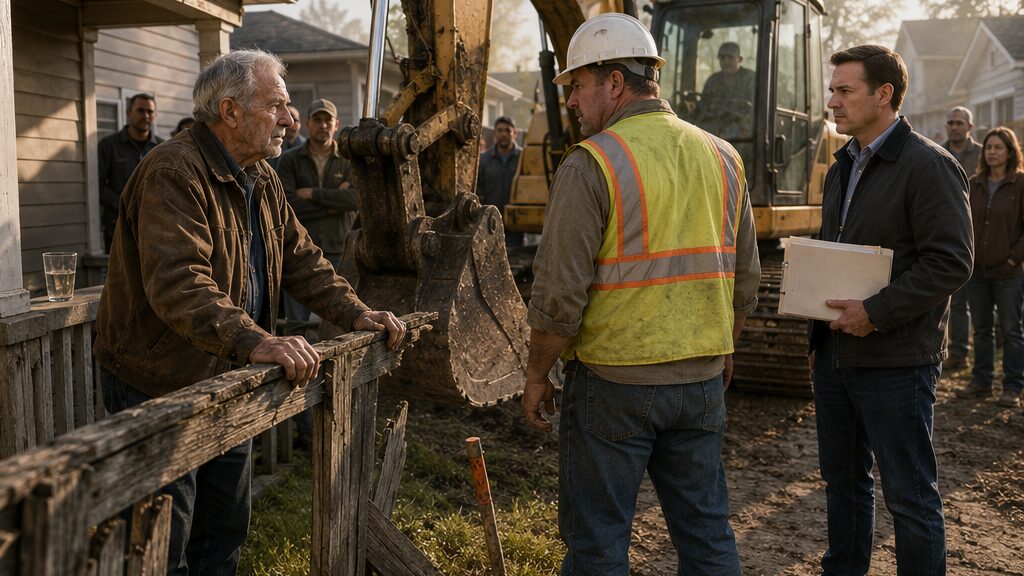
The Crew Laughed When Ronald Hall Said Their Backhoe Had Crossed His Wife’s Line
Chapter 1: The Backhoe Bucket Crossed Before Anyone Spoke
The backhoe bucket came over Ronald Hall’s fence before anyone knocked on his door.
It swung slow and yellow through the morning light, teeth hanging above the narrow strip of grass beside his driveway, close enough that the shadow crossed the porch rail where his water glass sat. The glass trembled once, just a small ring of motion, and a gray film of dust loosened from the rail beneath it.
Ronald stood inside the kitchen doorway with one hand on the frame.
For a moment he did not move. He watched the bucket dip, rise, and drift again over the old fence line as if the air above his yard had already been given away. The operator could not see him. The machine idled on John Rivera’s side, its engine coughing against the quiet of the cul-de-sac, but its reach ignored the fence entirely.
A truck blocked Ronald’s driveway.
Not partly. Not carelessly. Fully.
A white crew cab sat across the cracked apron where Ronald usually backed out for groceries, doctor appointments, and the Tuesday senior discount at the hardware store. Behind it lay stacks of lumber, orange cones, a pallet of concrete mix, and a coil of black drainage pipe dropped onto the grass where Patricia used to plant marigolds.
Ronald opened the kitchen door.
The noise met him first. Diesel rattle. Metal chain. Men calling over one another. A radio playing somewhere under the hammering. He stepped onto the porch slowly, not because he wanted to seem frail, but because the left knee had never forgiven him for forty years of climbing in and out of road-maintenance trucks. The porch boards gave their familiar dry complaint beneath his shoes.
His water glass shook again.
He looked at it before he looked at the men. The glass had been clean when he set it there. Now dust speckled the rim. A thin brown ring floated on the surface.
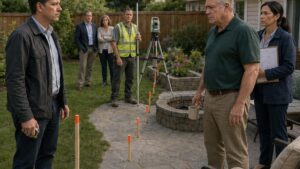
Across the driveway, Steven King, the foreman, stood with a clipboard tucked under one arm and a pencil behind his ear. He was broad through the shoulders, sun-browned, in a neon vest already smudged with dirt. He was speaking to a crewman near the truck, one hand cutting through the air in short impatient motions.
Ronald descended the porch steps and stopped at the edge of his driveway.
“Morning,” he said.
No one answered at first. The machine coughed. The backhoe bucket shifted again, its teeth passing above the fence like a jaw deciding where to bite.
Ronald raised his voice only enough to carry. “Your truck is blocking my drive.”
Steven turned. His expression was not hostile yet. It was the look of a man interrupted during something he considered more important than the interruption.
“Morning, Mr. Hall,” he said. “We’ll be in and out.”
“I need it moved.”
“We’re unloading.”
“I can see that.”
Steven glanced toward the crewman, then back at Ronald. “Give us twenty minutes.”
Ronald did not answer. He looked past him to John Rivera’s lot.
For months, the old one-car garage next door had been a skeleton. Then it became a cleared rectangle. Then stakes appeared. Then forms. Then men in work boots. John had told Ronald it would be “just a garage with a workspace, nothing that affects you.” He had smiled when he said it, the same neighborly smile he used when his lawn service blew clippings under Ronald’s fence.
But the building footprint now sat closer than Ronald remembered. Too close. The space between John’s new foundation trench and Ronald’s fence had narrowed like a room closing in.
Ronald walked toward the side yard.
Steven came after him. “Sir, I need you to stay clear of the active site.”
“I’m on my property.”
“You’re near equipment.”
“The equipment is near me.”
A crewman laughed, not loudly, but enough. Another looked down at his boots.
Ronald continued along the fence until he reached the old side gate. It hung crooked now. One fence board had been split halfway down and pushed inward. Fresh pale wood showed beneath the gray weathering, a wound bright enough to be new.
Ronald lowered one hand to the rail.
The rail had been there since the summer after he and Patricia bought the house. He remembered holding boards steady while she stood barefoot in the grass telling him the line was crooked. He remembered telling her fences were never as straight as marriages. She had said, “Then we’ll forgive it a little.”
He ran his thumb over the torn grain.
Beyond the broken board, an orange survey stake leaned in the grass. It was planted on Ronald’s side of the fence, not by much to a man in a hurry, but by enough to a man who had repaired culverts and road shoulders by inches. It leaned toward the house, its top bent as if struck.
A strip of orange tape fluttered from it.
Ronald stared.
The backhoe bucket lowered again. This time it carried dirt from the trench and dumped it beside the stake, spilling clods across the edge of his grass.
“Stop that machine,” Ronald said.
Steven’s patience thinned. “It’s on Rivera’s side.”
“No.”
“Sir—”
“No,” Ronald said again, softer.
Steven stepped closer, close enough that Ronald could smell coffee on his breath under the dust. “The survey is marked. We’re working off the approved line.”
Ronald kept his hand on the fence rail. He did not step back.
“That stake is inside my yard.”
Steven looked at the stake the way men look at things they do not intend to discuss. “That’s where the line is.”
“It wasn’t there Friday.”
“We didn’t set it Friday.”
“Then who did?”
Steven exhaled and glanced toward the driveway, where two crewmen had stopped pretending not to listen. Across the street, a curtain shifted in a front window. The neighborhood was awake now. Ronald could feel it in the stillness between engine sounds.
John Rivera came out from behind a stack of forms, phone in hand, wearing spotless boots for a muddy job. “Ronald,” he called, too brightly. “There a problem?”
Ronald turned his head but did not remove his hand from the rail. “Your crew is over the line.”
John gave a small smile, the kind that asked everyone nearby to notice how reasonable he was being. “We went through this with the permit office. Everything’s approved.”
“The bucket crossed my fence.”
“It’s just clearance for digging.”
“My driveway is blocked.”
“For a little while.”
“My fence is broken.”
John’s smile faded a degree. “That board was old.”
Ronald looked at the split wood. “It was old yesterday too. It wasn’t broken then.”
One of the crewmen coughed into his glove. Another gave a short laugh and looked away. Steven lifted his clipboard and tapped it once against his palm.
“Mr. Hall,” Steven said, “we don’t have time to stop every ten minutes because something looks different to you.”
Ronald felt the sentence settle around him. Not angry yet. Not surprised. Just there. Something looks different to you.
He turned back to the stake. The orange tape snapped in the morning breeze.
The water glass on the porch rail trembled again. When Ronald glanced back, he could see the dust on it from where he stood. A small, ordinary thing made dirty without being touched.
“I want the truck moved,” he said.
Steven looked toward the blocked driveway. “After unloading.”
“I want the machine kept out of my yard.”
“It is.”
Ronald’s fingers tightened once around the fence rail.
John stepped nearer, opening both hands as if calming a child. “Ronald, nobody is taking anything from you. This was all posted.”
Ronald turned to him. “Posted where?”
“At the site. On the board. Weeks ago.”
The backhoe engine lowered into a rough idle. Men watched from the half-built frame. Across the street, another neighbor had come to the porch with a coffee mug.
Steven pointed the clipboard toward the orange stake. “You had your chance to object, Mr. Hall. The paperwork was posted weeks ago.”
Chapter 2: The Line They Painted Through Patricia’s Garden
Ronald did not ask to see the paperwork right away.
That seemed to bother Steven King more than if he had shouted.
Instead, Ronald bent slowly at the waist, picked up a piece of broken fence board from the grass, and set it across the remaining rail. The movement was small, almost useless, but it returned the wood to the place where it had belonged. For a few seconds, the split board rested there like a corrected sentence.
Steven watched him do it. “That needs to stay clear.”
Ronald straightened. “The fence?”
“The work area.”
“This is not your work area.”
John Rivera gave a tired little laugh behind him. “Ronald, come on.”
The laugh carried. One crewman grinned. Another leaned on a shovel and looked toward the operator as if the morning had turned into a show. Ronald heard the air shift around him, that familiar little gathering of people who were relieved not to be the one being corrected.
He kept both hands on the rail.
The side yard was narrow there. Fence on one side, Ronald’s house on the other, with the old strip of packed earth running between the grass and the foundation. It was not much to look at. A path, really. Patricia had called it the kitchen walk because it led from the driveway gate around to the back steps, past the place where she used to keep a row of clay pots.
After her hip surgery, when the front steps became too steep and the back steps too narrow, Ronald had laid flat stones along that path one at a time. He had leveled them with sand, checked each with a short bubble level, and watched Patricia test them with her walker while pretending she did not need him hovering.
Most of the stones were still there. Some had sunk. Some were moss-dark at the edges. Two were now marked by a chalky white line that cut across them from John’s yard into Ronald’s.
Ronald looked at the line, then at the orange stake.
“Who painted that?”
Steven glanced down. “Survey assistant.”
“When?”
“This morning.”
“Before I came out?”
“Before we started layout.”
Ronald let the answer sit in the noise. “You painted through my wife’s garden.”
John’s face tightened. “Ronald, with respect, that hasn’t been a garden for years.”
Ronald looked at him.
The crewman with the shovel looked down again. Steven shifted his weight, annoyed by the turn the conversation had taken.
“It’s a path now,” Ronald said.
“It’s a few stones,” John replied. “And we’re not touching your house.”
The backhoe bucket creaked overhead as the operator adjusted. Ronald did not flinch, though the shadow passed over his shoulder and slid across the old path. Steven noticed. So did the crew.
“Sir,” Steven said, “you need to move away from the equipment.”
Ronald looked up at the bucket. “Tell him to move the equipment.”
Steven’s jaw worked once. “It’s on our side.”
Ronald lifted one hand from the fence rail and pointed to the bucket’s teeth hanging beyond the broken fence. “That is not.”
The operator cut the engine a notch lower. The sudden reduction in noise made the watching seem louder.
Steven stepped in front of Ronald’s pointing hand, not touching him, but close enough that Ronald had to look around him to see the bucket. It was the kind of move a man made when he expected his size to finish the argument.
“Mr. Hall, I’m asking you politely,” Steven said. “Step back.”
Ronald’s chest felt tight, not from fear exactly, but from the effort of keeping the morning in order. There was a way to act when younger men wanted you to become ridiculous. Patricia used to say it when someone at a service desk spoke to him as if gray hair meant confusion: Don’t give them the shape they expect.
So Ronald did not raise his voice.
He reached into the back pocket of his work pants and drew out a worn steel measuring tape, scratched silver along the edges. Steven’s eyes dropped to it.
Ronald hooked the tape on the old iron pin half-hidden at the base of the fence post. Most people missed it. It sat low in the dirt, dark and round as a buried bottle cap. Ronald had uncovered it twice in the last ten years, once after a hard rain and once when Patricia wanted the side path widened. The pin had been there long before John bought the next house.
He pulled the tape slowly toward the porch corner.
“What are you doing?” John asked.
“Measuring.”
“For what purpose?”
Ronald set the tape against the porch foundation and looked down at the numbers. “Because your stake is wrong.”
Steven gave a short sound, half laugh, half breath. “You’re checking a survey with a hand tape?”
Ronald looked at him. “I’m checking your stake against my house.”
“That’s not how surveys work.”
“It’s how memory works when men move things.”
The words quieted the crew for less than a second, then one of them laughed under his breath. Another said something Ronald did not catch. Steven’s mouth flattened.
John stepped around the trench with a permit folder tucked under his arm now, blue paper sticking from one side. “This is exactly why we went through the county first. To avoid this kind of thing.”
Ronald did not release the tape.
The chalk line ran across Patricia’s stones as if somebody had drawn a boundary through a room she had just left. He saw her hand on the walker. Her careful first step. The way she had smiled without showing her teeth because she hated being watched while trying.
“Move the stake back,” Ronald said.
Steven shook his head. “No.”
“Then stop work until it’s checked.”
“We’re not stopping because you don’t like where the line falls.”
“It doesn’t fall. Someone put it there.”
John opened the folder. “Ronald, listen to me. I know this is emotional for you.”
Ronald turned his head sharply enough that John stopped.
“This is not emotional because I am old,” Ronald said. “It is emotional because it is mine.”
A neighbor across the street lowered her coffee mug. One of the crewmen stopped smiling.
Steven rubbed at the side of his face with two fingers, leaving a streak of dust near his temple. “Sir, nobody’s trying to take your yard. We’re forming a side wall. We need room to work. When we’re done, everything gets cleaned up.”
“Concrete doesn’t clean up.”
“We are not pouring on your property.”
Ronald looked at the orange stake. “You are preparing to.”
Steven stepped closer again, this time so the toe of his boot touched the grass just inside the old fence line. Not far. Maybe an inch. Maybe two. Enough.
Ronald looked down at the boot, then up at Steven.
Behind Steven, the crew watched. John watched. The neighbors watched from porches and windows. The whole small street seemed to hold itself in place, waiting for the old man either to shout or retreat.
Ronald did neither.
He placed the measuring tape on top of the torn rail, keeping one finger pressed against the number he had read. Then he set both hands beside it, palms flat on the wood. His shoulders were stooped, his shirt sleeves dusted, his face lined and tired in the morning glare.
“Your boot is over it too,” he said.
Steven looked down.
The crewman with the shovel gave a louder laugh this time, but it died strangely when Ronald did not look away.
Steven moved his boot back. “You’re making this harder than it needs to be.”
“No,” Ronald said. “You did that when you put your line through her path.”
John’s patience cracked. “Ronald, I’m trying to improve my property. That’s all. I’m not responsible for every memory attached to every inch of yours.”
Ronald felt the words land harder than the truck, harder than the engine. He looked at John, then past him to the half-built frame that would soon rise high enough to block the morning sun from the kitchen window.
For the first time that day, Ronald wondered whether this had ever been about room for a garage. The stake, the chalk, the blocked driveway, the quick work before he came outside—it all had the feel of men trying to finish a fact before anyone could question it.
John held out the folder.
“Here,” he said. “Approved site plan. County stamp. Setback marked. Property line marked. Everything.”
Ronald looked at the blue sheet clipped inside.
The drawing showed his house as a neat rectangle, John’s as another, and between them a line Ronald had never seen in that place before. Clean black ink. Straight and official. Too far toward Ronald’s porch.
He did not touch the folder.
John gave a small impatient shake. “You see? That’s the line.”
Ronald looked from the paper to the bent orange stake in the ground.
“No,” he said. “That is a line someone drew.”
Chapter 3: The Water Glass Filled With Dust
By afternoon, the inside of Ronald’s house tasted like grit.
He noticed it when he drank from the kitchen tap. The water itself was clean, but dust had settled on the rim of the glass he brought in from the porch, and it left a dry mineral scrape on his lip. He washed the glass twice, set it upside down in the rack, then stood at the sink listening to the machinery thump through the walls.
The crew had moved the truck after an hour.
Steven had made a show of it, waving one arm and saying, “Clear Mr. Hall’s driveway,” loud enough for the neighbors to hear. The white truck backed out, but the pallet of concrete mix stayed near the apron, and a stack of forms remained leaned against the fence like the work had only stepped back to breathe.
Ronald did not go to the grocery store.
He took photographs instead.
Not with a hidden camera, not with drama. Just his old phone held steady in both hands: the broken board, the chalk line through Patricia’s stones, the backhoe tracks in the grass, the orange stake leaning inside the fence, the distance from the porch corner to the iron pin. He wrote each measurement in a spiral notebook he kept for furnace filters, doctor instructions, and repair receipts.
At two-thirty, a hard metallic drop shook the kitchen window.
Ronald went outside and saw a crewman dragging the black drainage pipe across John’s yard. One end bumped over Ronald’s side path and left a dark smear of mud on the second flat stone. The crewman looked up, saw Ronald watching, and pulled it back without a word.
Ronald photographed the smear.
Then he sat at the kitchen table and placed the phone beside the notebook.
The table had two chairs, though only one had been used for months. Patricia’s chair still faced the window. He had tried moving it once after the funeral, only as far as the wall, and the room had felt wrong by supper. So he had put it back. Sometimes mail collected there. Sometimes folded towels. Today, the old property folder rested on its seat.
It was a brown accordion envelope with a string closure, soft at the corners from years of being pulled from drawers. Patricia had written HOUSE PAPERS in black marker across the front. Her letters had always leaned slightly right, as if moving ahead of her hand.
Ronald untied the string.
Inside were tax bills, insurance notices, old contractor receipts, appliance warranties, a deed copy, a plat map, and a folded note from Patricia reminding him where she had put the spare garage key. He touched that note longer than he meant to.
His phone rang.
Kathleen’s name filled the screen.
He let it ring twice before answering. “Hi, Kathy.”
“Dad, John Rivera called me.”
Ronald closed his eyes briefly. “Did he.”
“He said there was an issue with the construction.”
“There is.”
“He said you were standing near equipment.”
“I was standing by my fence.”
There was a pause. Kathleen lowered her voice the way she did when trying not to sound like she was managing him. “Dad.”
He looked through the kitchen window. The orange stake was visible between the fence slats, too bright against the tired grass.
“What did he tell you?” Ronald asked.
“That the crew has permits, that there’s a misunderstanding about the property line, and that you got upset.”
Ronald turned one page of the plat map carefully. “That’s a lot of words for what happened.”
“Did you get upset?”
“No.”
“Dad.”
“I got accurate.”
She sighed. In the background he heard traffic, then the muted chime of a car turn signal. Kathleen always called from the car when she wanted a conversation to stay short.
“I’m not saying they’re right,” she said. “I’m saying you can’t put yourself in front of machines.”
“I didn’t.”
“John said Steven had to ask you to move.”
“Steven asked me to leave my yard.”
“Maybe just until the work is finished.”
Ronald looked at Patricia’s chair. “And if they finish wrong?”
“Then you file something. Or we call someone. Or you let me handle it.”
“You have work.”
“I can take time.”
“You shouldn’t have to.”
“You shouldn’t either,” Kathleen said, sharper than she intended. Then softer: “Dad, I’m worried. You’ve been alone in that house with all of Mom’s things, and now this happens right on the side where her path was. I know what that does to you.”
Ronald folded the plat map along its old crease. “Do you?”
The silence between them was longer this time.
Kathleen said, “I didn’t mean it that way.”
“I know.”
“I just don’t want you fighting over a strip of dirt because it feels like losing her again.”
Ronald looked at the mud smear on the stone outside. He remembered Patricia stopping there once, one hand on the walker, face pale with effort. She had said, “Don’t widen it anymore, Ron. Leave some garden or I’ll feel like a road project.”
He had laughed then. He had widened it another two inches anyway.
“It’s not dirt,” he said.
Kathleen breathed in. “Then tell me what it is.”
He opened his mouth, but the words did not come cleanly. Not because he did not know. Because explaining a thing sometimes made it smaller. A path became accessibility. A fence became property. A promise became paperwork.
“It kept water from the foundation,” he said instead. “It kept your mother steady. It kept the house usable.”
“Okay,” Kathleen said gently. “Then let me come over tomorrow.”
“Not tonight?”
“I can’t tonight. I have the late shift.”
“I’m all right.”
“I know you say that.”
He nearly smiled. “Because I am.”
After they hung up, Ronald sat awhile with the phone still in his hand.
The machinery stopped at five. The sudden quiet felt less like peace than like a room after an argument. Ronald went outside with the notebook and took one more walk along the fence.
The chalk line had dulled under boot prints. The orange stake leaned farther than before, its tape twisted with dried mud. The water glass on the porch rail, the second one he had filled after washing the first, was filmed brown across the surface.
Ronald lifted it and looked through the cloudy water toward John’s half-built frame.
Then he poured it into the grass.
Back inside, he spread the house papers across the kitchen table. He found the deed copy. He found the tax parcel sketch. He found the old receipt for the fence materials from the summer Patricia argued about crooked lines. He found the drainage note from a contractor who had warned them never to block the side slope toward the street.
But the survey page he wanted—the one with the original boundary pin measurements—was not in the envelope.
Ronald checked twice. Then a third time.
He untied every folded paper, shook out every receipt, opened every brittle sleeve.
The page was gone.
Chapter 4: The Permit Folder Did Not Match the Ground
Ronald was at the county permit office when the doors opened.
He arrived ten minutes early and sat in the truck with the brown accordion envelope on the passenger seat, one hand resting on the string closure as if it might leave if he did not hold it down. The building was a low brick rectangle between a tax office and a nail salon, with a flag snapping above the entrance and a row of planters that had not been watered recently.
At eight, the clerk unlocked the glass door.
Ronald waited until she turned the sign before he got out.
Inside, the air smelled of paper, floor wax, and old coffee. A line had already formed at the counter: a man with electrical permits, a woman asking about a business license, a contractor holding rolled drawings under one arm. Ronald stood behind them with his envelope tucked flat against his chest.
When his turn came, the permit clerk looked at the envelope, then at him.
“I need to see the approved site plan for the Rivera project on Oak Bend,” Ronald said.
“Are you the applicant?”
“I live next door.”
Her expression changed only a little, but Ronald saw it. The practiced softening. The look reserved for people who might require patience.
“If you have a complaint,” she said, “you can fill out a form online.”
“I need to see the plan.”
“Property disputes are civil matters.”
“I’m asking for a public permit record.”
The clerk paused, then turned to her computer. “Address?”
Ronald gave it.
She typed, clicked, waited. The printer behind her coughed to life. “There’s an approved accessory structure, drainage review included, footing inspection pending.”
“Pending?”
“Not completed yet.”
“Concrete is scheduled.”
She glanced up. “Who told you that?”
“The crew.”
Another small pause. She looked back at the screen, then printed two more pages. “They can prep. They can’t pour footings until inspection.”
Ronald did not say anything.
The clerk slid a copy across the counter. It was the same clean plan John had shown him: black rectangles, setback notes, an official stamp, a property line that looked certain because ink always did. Ronald took his reading glasses from his shirt pocket and put them on.
The paper did not tremble in his hands. That mattered to him.
He studied the side yard, the distance between houses, the drawn line. The plan showed a narrow work zone along John’s lot, but the measurement from Ronald’s porch corner did not match what he had read with his tape. It was not a wild difference. Not dramatic. Just enough to swallow Patricia’s path and make it seem like it had always belonged somewhere else.
“Do you have the survey reference?” Ronald asked.
“That’s on page three.”
“I only got two pages.”
The clerk checked the stack. “Sorry.”
She printed another sheet.
Ronald looked down at the third page. The newer survey named the property corner, the setback, the drainage angle, and the side easement. But the old iron pin by Ronald’s fence was not marked. Instead, a newer stake point had been used near the front edge of John’s drive.
Ronald read the numbers twice.
“Do you have the prior plat?” he asked.
“That would be with property records, not permits.”
“This plan doesn’t show the old pin.”
“If it isn’t on the submitted survey, we wouldn’t add it.”
“But if the submitted survey starts from the wrong mark?”
The clerk folded her hands. “Sir, I can’t interpret survey disputes at the counter.”
He looked at her badge, then back at the plan. “Who can?”
“You can request an inspection if active work appears inconsistent with the approved plan.”
“I’m requesting one.”
She reached for a form. “You’ll need to describe the issue.”
Ronald took the pen she offered. There was a chain attached to it. He bent over the counter and wrote slowly, carefully, refusing to let anger make his handwriting childish.
Work zone appears to cross existing fence line and side drainage path. New stake placed inside my property. Original boundary pin not shown on submitted drawing. Concrete pour pending.
The clerk read it after he handed it back. Her voice softened. “Do you have photographs?”
Ronald opened his phone and showed her the broken fence board, the chalk line through the stones, the orange stake, the backhoe bucket hanging above the rail.
At the last photo, she stopped tapping.
“Is that your fence?”
“Yes.”
“And the stake is on your side?”
“Yes.”
She did not admit anything. Officials rarely did at counters. But she turned to the computer with more attention than before.
“I can put this in as a priority site check,” she said. “The inspector has a route today, but I can’t promise he’ll make it before closing.”
“The crew is still working.”
“Prep work?”
“Yes.”
“Then take this copy.” She stamped Ronald’s request form and handed him the carbon sheet. “If they attempt to pour before inspection, call the number at the top.”
Ronald folded the copy and slid it into Patricia’s envelope.
He should have felt relieved. Instead, he felt the shape of a door that had opened only to show another hallway.
By the time he returned home, the street was louder than when he left. A delivery truck idled near John’s driveway. Two crewmen were carrying boards along the trench. Steven King stood beside the orange stake talking into his phone, one boot on Ronald’s side of the chalk line.
Ronald parked at the curb because his driveway apron was partly blocked again.
Steven ended the call when he saw him. “You go downtown?”
Ronald closed his truck door. “Yes.”
Steven’s face tightened, but his tone stayed flat. “You didn’t need to do that.”
“I did.”
John came out from behind the frame. “Ronald, if there’s a concern, we can talk neighbor to neighbor.”
“We did.”
“You accused my crew of moving a survey stake.”
“I asked who moved it.”
“That kind of accusation creates problems.”
Ronald opened the envelope and took out the county copy. He did not offer it to John. He held it so he could look from the paper to the ground.
Steven watched. “The inspector already cleared layout.”
“No,” Ronald said. “Footing inspection is pending.”
Steven looked away.
That was the first honest thing Ronald had seen from him.
John frowned. “Pending doesn’t mean stopped.”
“It means not poured.”
“We’re not pouring today.”
“When?”
Neither man answered quickly enough.
Ronald knelt beside the old iron pin. It took effort. His knee objected, and one hand had to brace against the fence post. He used the tip of his pocketknife to scrape dirt from around the pin’s edge. The metal emerged dark and stubborn.
The orange stake stood a little beyond it, bright and temporary, leaning in the mud as though embarrassed by its own color.
Ronald stretched his tape from the pin to the porch corner again. He wrote the number in his notebook. Then he compared it to the site plan. The difference was the width of a man’s boot and a little more.
“Your drawing relies on this newer mark,” Ronald said.
Steven crossed his arms. “The surveyor set that.”
“The drawing doesn’t account for this pin.”
John gave an impatient shake of his head. “Old pins get abandoned. Lines get updated.”
“Land doesn’t move because paper is newer.”
John’s eyes narrowed. “You’re not a surveyor, Ronald.”
“No,” Ronald said. “I used to fix roads after surveyors left.”
Steven looked at him then, really looked, but only for a second.
Ronald rose slowly. The effort cost him, and he hated that both men saw it. He put the county copy back in the envelope and tied the string around the button.
“The inspector is coming,” he said.
Steven rubbed the back of his neck. “When?”
“Soon as they can send him.”
John turned toward the crew, then back. “We can’t keep pausing every time you feel uncertain.”
Ronald looked at the orange stake. “I’m not uncertain.”
That evening, just before six, his phone rang. The county number appeared on the screen.
The inspector’s voice was brisk and tired. He had reviewed the complaint. He had added the site to his Wednesday morning route. He would check the work before any footing pour.
Ronald thanked him.
“One more thing,” Ronald said. “They told me they were pouring soon.”
“Permit shows footing inspection required first.”
“What if the truck comes before you?”
“Call the office. And don’t stand in front of equipment.”
Ronald looked through the window at the orange stake, pale in the settling dusk.
“What time will you be here?” he asked.
“Morning,” the inspector said. “As early as I can.”
Ronald hung up and stood in the kitchen with the phone in his hand.
Outside, Steven was locking the tool trailer. John was talking to him near the forms. Ronald could not hear every word through the glass, but he heard one phrase clearly when Steven raised his voice.
“Concrete’s already scheduled for dawn.”
Chapter 5: The Neighbors Watched Him Stand in Mud
By Tuesday evening, the mud had crossed the sidewalk.
It had been tracked from John Rivera’s lot in clumps and tire crescents, pressed into the curb, smeared across the apron of Ronald’s driveway, and dried in rough brown scales near the mailbox. Ronald stood at the edge of it with a broom in his hand, not sweeping yet, only noticing the direction of every mark.
The orange stake leaned harder than before.
Sometime after Ronald returned from the county office, machinery or boots had struck it again. Its tape was twisted around the top, mud splashed halfway up the wood, and the stake now angled toward Patricia’s path as though pointing at what it meant to take.
Ronald photographed it.
Then he swept his driveway.
The broom was old, the bristles flared. Patricia had once written HALL on the handle with black marker because neighborhood tools had a way of not returning. The letters had faded but not vanished. Ronald swept until the mud collected in a dull ridge at the edge of the apron.
Across the street, a neighbor stood at the end of her walk with folded arms. Another paused beside his garbage bin. No one asked if he needed help. No one said he was wrong. They simply watched the way people watched a storm that might or might not reach them.
John came over at six-fifteen.
He carried a white envelope and wore a jacket too clean for the worksite. Steven followed several steps behind, phone in one hand, hard hat pushed back. He looked tired now. Not sorry. Tired.
“Ronald,” John said, “can we talk?”
Ronald leaned the broom against the fence. “We are.”
John glanced toward the watching porches and lowered his voice. “Some of the neighbors are concerned.”
“About the truck blocking my driveway?”
“About delays.”
Ronald looked at him.
John adjusted the envelope in his hand. “This project has been approved. It improves property value. It cleans up an old structure. Nobody benefits from turning a minor boundary confusion into a neighborhood fight.”
“Then why bring the neighbors into it?”
“I didn’t.”
A car rolled slowly past, slower than it needed to. The driver looked toward Ronald’s yard, then forward again.
John noticed and smiled tightly. “People notice.”
“They noticed your backhoe.”
Steven shifted behind him. “We’re trying to get in and get out. That’s all.”
Ronald looked down at Steven’s boots. Mud clung to the soles. A dry flake broke off and landed on Ronald’s cleaned driveway.
John held out the envelope. “I want to make this simple. Temporary access agreement. Small compensation for inconvenience. We repair the fence board after work is complete. You sign, we finish, everyone moves on.”
Ronald did not take it.
“How small?”
John exhaled. “Five hundred dollars.”
Steven looked away.
The number sat there between them, absurdly clean.
Ronald looked past John to the side yard. Five hundred dollars for a path Patricia had crossed one careful foot at a time. Five hundred for mud on the stones, dust in the glass, a stake planted wrong, a fence pushed inward. Five hundred for the right to say later that he had agreed.
“No.”
“You haven’t read it.”
“I heard enough.”
John’s voice sharpened. “It’s more than fair for a strip you don’t use.”
Ronald reached for the broom handle. “I use it every time I know it is still there.”
One of the neighbors across the street turned away as if embarrassed by the sentence.
John lowered the envelope. “Ronald, I’m trying to be respectful.”
“No. You’re trying to be finished.”
The words landed harder than Ronald expected. Steven looked at him again, and for a second Ronald saw something in the foreman’s face that was not contempt. Pressure, maybe. The look of a man measuring cost.
Ronald turned toward him. “When is the concrete truck coming?”
Steven said nothing.
John answered too quickly. “After inspection.”
“What time?”
“After inspection,” John repeated.
Ronald looked at Steven. “What time?”
Steven pushed his phone into his pocket. “Early.”
“How early?”
“Depends on dispatch.”
“Before the inspector?”
Steven’s jaw moved. John cut in. “Ronald, you are not the project manager here.”
“No. I’m the man whose yard you need.”
John stepped closer. “For temporary access.”
“For a false line.”
“It is not false because you dislike it.”
Ronald bent, picked up the envelope John had lowered toward him, and opened it. He scanned the first page. Legal language. Temporary use. Access for forms, equipment, drainage adjustment, repair at contractor discretion. A blank line for his signature. No mention of Patricia’s path. No mention of the iron pin. No mention of the broken board except “existing fence condition.”
He folded it once and handed it back.
“You wrote my fence was already broken.”
John’s face tightened.
Ronald looked at Steven. “Was it?”
Steven did not answer.
“You saw it Monday morning,” Ronald said. “Was that board broken before the bucket crossed?”
Steven rubbed his thumb along the seam of his work pants. “It was weathered.”
“That isn’t what I asked.”
John snapped, “Steven is not here to testify.”
Ronald turned back to John. “No. He’s here to pour before the inspector can say stop.”
The quiet that followed was not complete. The street still hummed. A dog barked once from a backyard. Somewhere a screen door closed. But the conversation itself had narrowed.
Steven spoke finally. “A delayed truck costs money.”
Ronald nodded once. “There it is.”
“I didn’t say we were pouring without inspection.”
“You didn’t say you weren’t.”
Steven looked toward the forms beside the trench. His face had the dry, drawn look of a man who had spent the day between orders and consequences. “I’ve got a schedule, Mr. Hall. Crew, truck, rental equipment. Everybody wants everything done cheaper and faster, then acts shocked when a morning gets tight.”
“Then start from the right place.”
Steven’s eyes flicked to the orange stake.
Ronald saw it.
“You know it moved,” Ronald said.
“I know stakes get hit.”
“After they’re placed wrong?”
Steven’s silence was small but useful.
John stepped between them with the envelope in one hand. “This is done. I’m not being held hostage over a garden path that hasn’t mattered in years.”
Ronald felt heat rise in his face then. Not enough to shout. Enough to make him careful.
“It mattered when Patricia couldn’t climb the front steps,” he said.
John’s expression faltered, but only briefly.
“That path,” Ronald continued, “kept her from being trapped in her own house. That slope kept water out of the crawlspace when the storms came from the west. You call it empty because you didn’t watch anyone need it.”
Across the street, the neighbor with the garbage bin stopped pretending to adjust the lid.
Kathleen’s car turned into the cul-de-sac then, moving slowly past the mud and the stacked forms. She parked along the curb and stepped out in scrubs, her face already tight from the scene she had arrived into.
“Dad?”
Ronald did not look away from John.
Kathleen approached carefully. “What’s going on?”
John held up the envelope. “I offered a temporary access agreement. Your father won’t even consider it.”
Kathleen looked from the envelope to Ronald. “Dad?”
“He wants me to sign that the fence was already damaged and the path doesn’t matter.”
“I didn’t say that,” John said.
“It says contractor discretion,” Ronald replied. “That means you decide what damage counts after the concrete is in.”
Kathleen took the envelope from John and read quickly. The work noise had stopped by then; even the crew had gone still near the trailer.
“Dad,” she said quietly, “this isn’t good.”
John’s shoulders loosened, mistaking her tone for agreement.
Then she looked at him. “For you.”
John blinked.
Kathleen held up the page. “You want him to sign this before the inspection?”
“It’s standard.”
“It’s convenient.”
Ronald glanced at her, surprised by the steadiness in her voice. She did not smile at him. She was still worried. Still angry with him, maybe, for standing in mud with men watching. But she stood beside him now.
A county office number buzzed Ronald’s phone. He answered on the second ring.
The permit clerk spoke quickly. The inspector had received the photographs. He would be there first thing in the morning. Work was not to proceed to pour before inspection.
Ronald thanked her and hung up.
“The inspector is coming in the morning,” he said.
Steven looked at John. John looked toward the forms.
Kathleen handed the agreement back without signing.
John folded it into the envelope with stiff fingers. “Fine. We’ll wait for the inspector.”
But his words came too smoothly, and Steven’s eyes were already on the street beyond the cul-de-sac, where trucks would arrive from the main road before most neighbors opened their blinds.
Ronald swept the last ridge of mud from his driveway after they left.
At four-thirty the next morning, before the sky changed color, headlights washed across his bedroom wall.
Chapter 6: Before Sunrise, Ronald Moved Only One Board
Ronald was awake before the headlights came.
He had not slept much. The house made too many small noises in the dark: the refrigerator clicking on, a branch brushing the gutter, distant trucks down on the county road. Each sound seemed to ask whether he would stay inside this time.
When the first wash of light crossed the bedroom wall, he was already dressed.
He sat on the edge of the bed and tied his shoes with care. Not the soft house shoes Kathleen preferred. Work shoes. Brown leather, cracked at the bend, soles worn but steady. He put his notebook in one jacket pocket, the county copy in the other, and carried the old measuring tape in his hand.
In the kitchen, Patricia’s chair faced the window.
Ronald paused beside it.
There was no framed speech waiting in him, no grand sentence for the dead. Only a practical thought, one she would have respected: If they pour wrong, no one will unpour it for free.
He filled a glass of water and set it on the porch rail as he stepped outside.
The air was blue-black and cold. The streetlights still burned. At the end of the cul-de-sac, a crew truck rolled slowly toward John Rivera’s lot with its headlights low and yellow on the pavement. Behind it came another truck pulling a small trailer.
No concrete truck yet.
Ronald went to the side yard.
The mud had stiffened overnight. It cracked beneath his shoes. The orange stake leaned in the dim light, its tape limp, its color nearly gray until the truck beams hit it. The torn fence board still rested where Ronald had placed it, not fastened, only waiting.
He carried it to the true line.
The board was not heavy, but it was awkward. His shoulder complained. His knee clicked once when he lowered himself beside the old iron pin. He worked without hurry, because hurry was how younger men made mistakes and called them necessary.
From a coffee can under the porch, he took two old galvanized brackets and four screws. He had set them there the night before. He fitted the split board between the remaining fence posts, not to rebuild the whole fence, not to trap anyone, but to mark where the opening had been before the machinery widened it.
The first screw fought him.
His fingers were cold. The screwdriver slipped. Pain flashed up his wrist and he breathed through it, looking once toward the road. The crew truck doors opened. Voices carried low in the dark.
Steven King’s shape moved near the trailer.
Ronald set the screwdriver again and turned the screw until it caught.
By the time Steven reached him, the board was fastened at one end and Ronald was starting the second.
“Mr. Hall,” Steven said.
Ronald kept turning.
“What are you doing?”
“Repairing my fence.”
“You can’t put that there.”
Ronald looked up. “It was there Monday.”
“We need access.”
“You need permission.”
Steven’s hard hat was tucked under his arm. His hair was flattened on one side, his face unshaved. He looked less like the man who had laughed with his crew and more like the man who had been answering phone calls all night.
“We’re not pouring on your side,” Steven said.
“Then the board won’t bother you.”
“It blocks the form.”
“The form is wrong.”
Steven looked over his shoulder. Crewmen had stopped near the truck. One held a thermos. Another stood with gloves tucked under one arm, eyes moving between the men and the fence.
“Don’t make this into something,” Steven said.
Ronald tightened the second screw until the board drew firm against the post. Then he stood, slower than he wanted. “It already is something.”
John Rivera came across the yard in a jacket zipped over his shirt, phone glowing in one hand. “What is this?”
“A fence board,” Ronald said.
John stared at it. “Take it down.”
“No.”
“We had an agreement to wait for the inspector.”
“You had headlights before sunrise.”
“We are staging.”
“For a pour.”
John looked toward Steven. Steven said nothing.
Ronald reached down and picked up the bent orange stake. He had loosened it before fastening the board. It came out of the mud with a wet sound. A clump of earth held to the end. He carried it three steps and laid it beside the old iron pin.
Then he hooked his measuring tape on the pin.
Steven made a frustrated sound. “Again with the tape.”
“Yes,” Ronald said.
He pulled the tape along the ground, past the repaired board, to the porch corner. The numbers gleamed faintly in the truck lights.
“From this pin to my foundation,” Ronald said. “Same as yesterday. Same as the old fence. Same as the drainage note. Your stake was planted inside that.”
John said, “That is not an official survey.”
Ronald pointed to the board. “Neither was moving my fence.”
The words stopped John for half a breath.
A rumble came from the main road.
Steven turned first.
The concrete truck appeared at the entrance to the cul-de-sac, white drum rotating slowly, headlights rolling across mailboxes and parked cars. It came like a decision already made.
Ronald felt his heart lift hard against his ribs. Not fear. Not exactly. The body did not always know the difference between danger and importance.
Kathleen’s car was not there. The inspector was not there.
The concrete truck slowed behind the crew trailer. Its brakes sighed.
John looked relieved before he could hide it. Steven looked trapped.
Ronald stepped to the narrow opening beside the repaired board, not in front of the truck, not in the street, but at the only place where the chute and crew would need to pass materials along the side yard. He held the county copy in one hand and the old measuring tape in the other.
“Mr. Hall,” Steven said carefully, “move away from there.”
“No.”
“You’re creating a safety issue.”
“The safety issue is pouring before inspection.”
“We’re not pouring until we’re set.”
“You are set on my land.”
John’s face hardened. “This is obstruction.”
Ronald looked at him. “This is my fence.”
The concrete driver climbed down and looked from Steven to John. “You ready or not?”
Steven did not answer.
Ronald saw the moment of pressure pass through him. Crew time. Truck time. Rental time. John’s money. The inspector’s delay. An old man standing where a pushed line could become permanent. Steven’s eyes moved to the repaired board, then to the bent stake lying beside the true pin.
“How far off?” Steven asked.
John turned. “Don’t entertain this.”
Steven ignored him. “How far?”
Ronald gave the number.
Steven looked at the plan in John’s hand. “That’s not nothing.”
“It’s not yours,” Ronald said.
John snapped, “It is a few inches.”
Ronald’s voice stayed low. “A few inches is enough for water.”
The sky had begun to pale behind the houses. Porch lights flickered on across the cul-de-sac. A neighbor stepped outside in a robe. Another opened blinds. The watching had begun again, but this time Ronald did not feel surrounded by it. He felt the old iron pin at his feet, the board under his hand, the tape between truth and denial.
Kathleen’s car turned in fast and stopped behind the concrete truck.
She got out without closing the door. “Dad!”
“I’m not in the street,” he said before she could accuse him.
She came closer, breathing hard, taking in the truck, the board, the men. “Are they pouring?”
“Trying to.”
Steven said, “We’re waiting.”
John glared at him.
Kathleen looked at the repaired fence board. Her face changed, not all at once, but like a curtain being drawn back carefully. “Mom’s path.”
Ronald nodded.
He had not told her the whole thing the night before. He had not known how. But now she was looking at the stones, the slope, the narrow clearance between the house and the line of construction forms. She could see where Patricia’s walker had passed because she had walked behind it many times, one hand hovering uselessly near her mother’s elbow.
Kathleen stepped beside Ronald.
John lifted both hands. “This is becoming emotional again.”
Kathleen turned on him. “It was always emotional. You just thought that made it weaker.”
Before John could answer, another set of headlights entered the cul-de-sac.
A county vehicle rolled in behind Kathleen’s car. The inspector stepped out with a clipboard, a reflective vest hanging open over his shirt. He looked at the concrete truck, then at the crew, then at Ronald standing beside the repaired board with a bent orange stake at his feet.
“Nobody pours,” the inspector said.
No one moved.
He walked to the side yard and crouched near the iron pin. Ronald handed him the county copy, the photographs, and the notebook without a speech. The inspector compared the plan to the ground, then asked Steven for the submitted survey. Steven brought it. John hovered too close until the inspector told him to give him room.
Minutes passed with the sky turning gray.
The inspector measured from the pin. Then from the newer stake point. Then to the porch corner. He checked the drainage slope along the foundation and the line of Patricia’s stones. He did not rush. Ronald watched his pencil move.
Finally the inspector stood.
“The work is too far over,” he said.
John’s mouth opened. “By how much?”
“Enough.”
Steven looked at the ground.
The concrete truck drum kept turning, patient and expensive.
The inspector pointed to the forms. “Those come back. No pour until a corrected layout is approved and the drainage clearance is shown. The fence damage gets documented.”
John’s face flushed. “This is a misunderstanding.”
Ronald looked at the bent orange stake lying beside the true pin. For the first time since Monday morning, no one was calling it official.
The concrete driver leaned against his truck and folded his arms.
Steven removed his hard hat, rubbed a hand over his hair, and looked at Ronald. His voice, when it came, had lost its public edge.
“We crossed too far.”
Ronald did not answer right away.
The repaired board was rough under his palm. Beyond it, Patricia’s path showed through the mud, damaged but still there. Kathleen stood beside him, close enough that her sleeve brushed his.
The inspector turned toward the concrete truck as the sun broke over the roofs.
Then the driver looked down the street, and Ronald heard another low engine approaching.
Chapter 7: Small Boundaries Still Held the House Together
The second engine belonged to the pump truck.
It turned into the cul-de-sac slowly, too large for the narrow street and too late to pretend the morning had been only about staging. The driver eased it toward the curb behind the concrete truck, then stopped when he saw the county vehicle, the inspector’s raised hand, and the line of men standing still beside Ronald Hall’s fence.
No one spoke for several seconds.
The pump truck’s engine idled with a deep, useless patience. The concrete drum kept turning. Dawn brightened the mud, the forms, the chalk line, and the bent orange stake lying on the ground beside the iron pin.
The inspector looked at Steven King. “Send them away.”
Steven did not look at John Rivera this time. He walked to the concrete driver first, then to the pump truck. His shoulders were tight, but he gave the order clearly. The drivers were not pleased. Money was already being lost. Schedules were already broken. But neither truck poured, pumped, or backed over Ronald’s line.
They left one by one, engines fading down the street.
Only after the trucks disappeared did John speak.
“This is an overreaction.”
The inspector glanced at him. “No. Pouring before confirming the disputed line would have been the problem.”
John held the permit folder like it had grown heavier. “The surveyor set the layout.”
“The layout on the ground doesn’t match the conditions shown clearly enough for me to approve it,” the inspector said. “And the fence damage needs to be documented.”
“It was old.”
The inspector looked at the split board Ronald had fastened back into place. “Old things can still be damaged.”
Ronald kept one hand on the rail. Kathleen stood beside him, arms folded against the morning cold. She had not tried to lead him inside. Not once since the inspector arrived. That mattered more than Ronald could say.
The inspector marked the site with small flags of his own, yellow instead of orange. He photographed the iron pin, the repaired board, the chalk line through the stones, and the drainage slope along the foundation. He made Steven pull the forms back from Ronald’s side path. The crew worked quietly now, without the morning laughter, lifting boards and scraping mud while the neighbors watched from porches with coffee going cold in their hands.
John objected twice more. Each time the inspector listened, answered briefly, and returned to the ground.
By eight-thirty, the false shape of the work had begun to undo itself.
Not fully. The grass was torn. The path was muddy. One of Patricia’s flat stones had been chipped at the corner. The fence looked patched and tired, held by Ronald’s old brackets. But the concrete forms no longer crossed the disputed strip, and the orange stake no longer stood upright pretending to be truth.
Steven picked it up near the end.
He turned it in his hand, mud flaking from the lower point. Then he walked to Ronald and held it out.
Ronald did not take it.
Steven looked down at the stake. “This should’ve been checked against the pin.”
“Yes.”
“We were running off the newer mark by the drive. John wanted the side wall squared up before the truck came. Survey assistant set it off that mark, and after the first pass with the machine, it got hit. We kept working from it anyway.”
John’s head snapped toward him. “Steven.”
Steven did not look back. “That’s what happened.”
Ronald studied the foreman’s face. He saw no grand apology there, no collapse into shame. Only a tired man saying what he should have said before the trucks arrived.
“You knew yesterday,” Ronald said.
Steven’s jaw tightened. “I suspected yesterday.”
“That is not the same thing as stopping.”
“No,” Steven said. “It isn’t.”
Kathleen looked at Ronald then, as if waiting for him to demand more. Maybe part of him wanted to. There was a younger version of himself somewhere inside, one with stronger knees and quicker anger, who might have known exactly how to make the man in front of him feel small.
But Ronald was not trying to win Steven’s smallness.
He looked at the path.
“The stone has to be reset,” he said. “The slope has to stay open. The fence line gets repaired from the pin back, not from that stake. And nothing goes on my side without a written access agreement that says exactly what gets touched and who fixes it.”
Steven nodded once. “Fair.”
John gave a short laugh. “This is my project.”
Ronald turned to him. “Then build it on your land.”
The neighbors heard it. Ronald knew they did. A few looked down. One stepped back inside. No one laughed.
The inspector wrote the correction notice before leaving. No footing approval until revised layout. Drainage clearance to be shown. Fence damage and access conditions to be documented. Ronald watched each line appear in block letters, not because the paper saved him by itself, but because he had forced the ground to be seen before it disappeared under concrete.
Kathleen drove him to the hardware store that afternoon.
He did not ask her to. She simply took the keys from the hook and said, “You’re not driving on that knee after standing all morning.”
He almost argued. Then he saw the look on her face and did not.
They bought new screws, a replacement fence board, two bags of leveling sand, and a small metal cap for marking the iron pin clearly. At checkout, Kathleen picked up a pair of work gloves and added them to the pile.
“I have gloves,” Ronald said.
“These are for me.”
At home, they worked until the sun dropped behind John’s half-built frame. Kathleen reset the chipped stone with more care than skill. Ronald corrected it with the edge of his boot, and she gave him a look that was half annoyance, half grief. They did not talk much about Patricia. They did not need to. Her path ran between them, visible again.
The next week moved slower.
John’s revised plan came back narrower. The garage would still be built, but not where the false stake had tried to put it. The drainage pipe was shifted away from Ronald’s foundation. A written access agreement arrived with specific repair language, and Ronald crossed out two vague phrases before signing. Kathleen read every line over his shoulder and said nothing when he took his time.
Steven’s crew returned on Thursday.
They were quieter. Not friendly, exactly, but careful. Steven came to the porch before the work began and waited until Ronald opened the door.
“We’ll be on Rivera’s side today,” he said. “If anything needs access, I’ll ask first.”
Ronald nodded.
Steven looked toward the side yard. “Board looks better.”
“Kathleen helped.”
“Good.”
It was not an apology. Not completely. Ronald accepted it for what it was: a man stepping back to the right side of a line.
By Friday, the old iron pin had a small metal cap over it, bright enough to catch the morning light. The fence board had been replaced. Patricia’s stones were level again, though one still bore a faint scar where the pipe had struck it. Ronald did not replace that stone. He told Kathleen it still held weight. She understood.
On the following Monday, Ronald set a glass of water on the porch rail before breakfast.
The crew was working next door, but the ground no longer shook. Dust still came now and then; construction was construction. But it did not settle over everything like ownership. The water stayed clear.
Ronald carried his coffee to the side yard and stood beside the repaired fence. The new board was pale against the old gray rails. In time, rain and sun would dull it. The grass would grow back in uneven patches. John’s garage would rise, too large in Ronald’s opinion, but behind the corrected line.
He placed both hands on the fence rail.
Beyond it, Steven measured a form twice before giving the crewman permission to set it. John stood farther back, phone in hand, saying less than usual.
Ronald looked down at the path. Patricia’s stones held their narrow route from driveway to back steps, plain and stubborn and useful. Not a monument. Not a victory flag. Just a way through.
Kathleen came out onto the porch behind him. “Water’s clean today.”
Ronald glanced at the glass on the rail.
“Yes,” he said. “It is.”
She came to stand beside him, close but not hovering. For a while they watched the work continue where it belonged.
The yard was not untouched. The fence had a new board because an old one had been broken. The grass bore tracks. The mud had dried in places Ronald would have to rake loose. The relationship with John Rivera would not return to easy nods over trash cans. Maybe it had never been as neighborly as Ronald once believed.
But the line was no longer invisible.
Ronald ran his thumb over the top of the repaired rail. It was smooth where Kathleen had sanded it and rough where the old wood began.
Small boundaries, he thought, were rarely small to the people who had to live behind them.
He lifted the water glass from the porch rail and drank. Then he set it back in the clean ring it had made in the dustless morning, rested both hands on the fence, and watched the men next door build without crossing.
The story has ended.