They Parked Their Machines Across Her Driveway, But Barbara Knew Exactly Where The Line Was
Chapter 1: The Machines Were Already Across Her Driveway
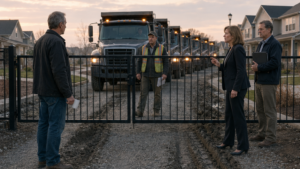
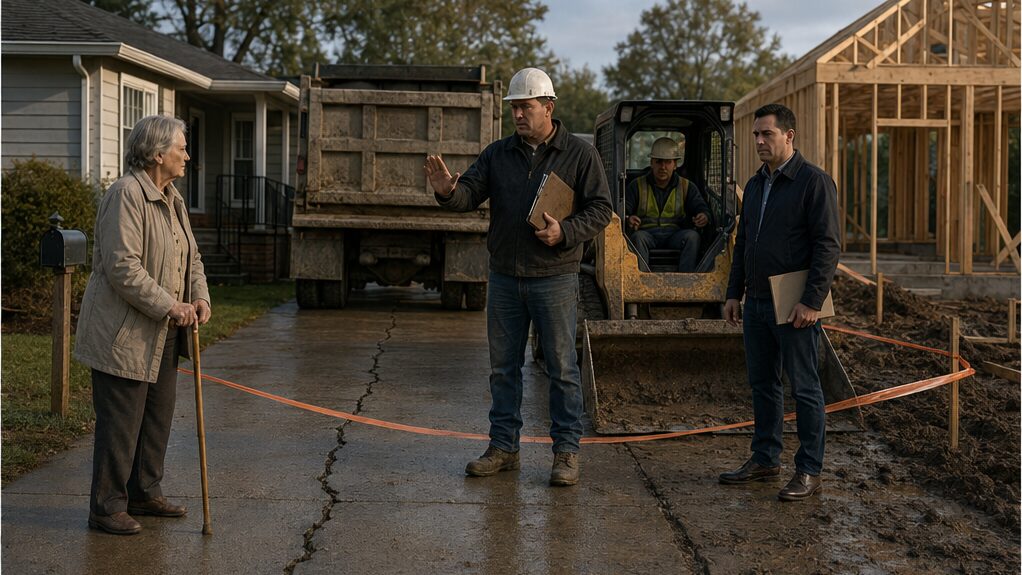
The dump truck was across Barbara Allen’s driveway before the sun had cleared the maple trees.
She saw it from the kitchen window while the kettle was just beginning to click and tremble on the stove. At first, her mind made the shape into something ordinary: a delivery truck, maybe, or the town crew trimming limbs after last week’s wind. Then the yellow skid-steer behind it lurched backward with a sharp metal beep, and the bucket swung over the mouth of her driveway like a lowered arm.
Barbara stood still with one hand on the counter.
Her driveway was narrow, patched twice, and pale from years of sun. A long crack ran from the street edge toward the right side of the porch steps, thin as a drawn pencil line in some places, wide enough to catch maple seeds in others. William had once joked that the crack knew more about their property than the tax office did. It followed the old boundary, close enough to it that he had never let anyone park over it without a reason.
Now orange construction tape crossed that crack.
Not beside it. Not along Edward Ramirez’s side, where the new garage frame had begun to rise behind temporary fencing.
Across it.
Barbara turned off the stove before the kettle could whistle. She reached for the cane by the back of the chair, not because she always needed it in the house, but because outside the pavement sloped toward the street. At seventy-eight, she had learned the difference between pride and foolishness. Pride was pretending she was twenty. Foolishness was going out to face a construction crew without something solid in her hand.
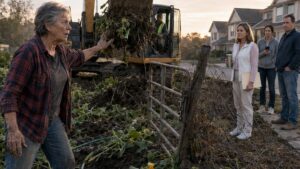
The morning air smelled of cut dirt and diesel. A stack of lumber sat in Edward’s yard, wrapped in plastic, and a bright new sign on a post announced a permitted residential improvement. Behind it, two workers in reflective vests moved near a trench. The old hedge between the properties had already been torn out, leaving a raw brown gap where birds used to vanish.
Barbara stopped at the porch steps.
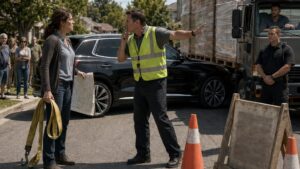
A man in a hard hat looked up from a clipboard near the dump truck. He was broad through the shoulders, younger than William would have been now but older than the men carrying lumber. He had a phone clipped to his belt and a pencil tucked behind one ear. He saw Barbara and gave her the quick, practiced smile of someone who expected to be obeyed.
“Morning,” he called. “We’ll be out of your way soon.”
Barbara came down one step at a time. “You’re in my driveway.”
“Just for a few minutes.”
“You’re across it.”
He glanced back as if the truck might have moved there on its own. “We had to get the skid-steer in. Tight access on this side.”
“This side is mine.”
The man walked toward her, not fast, but with the steady confidence of someone used to taking up space. His boots left half-moons of mud on the edge of her pavement. The orange tape fluttered behind him in the soft wind.
“I’m Dennis King,” he said. “Foreman on the Ramirez job.”
“I know whose job it is.”
“Then you know we’re permitted.”
Barbara looked past him at the tape. One end was tied to a temporary stake in Edward’s dirt. The other was tied to the thin metal post of her mailbox. No one had asked her permission for that, either.
“Permits don’t move driveways,” she said.
Dennis gave a small laugh, not cruel exactly, but too quick. “No one’s moving your driveway, ma’am. We just need a little edge while we work. Edward said he talked to you.”
“Edward told me framing would start next week.”
Dennis checked his clipboard, then the phone at his belt, then Barbara’s face. “Schedule changed. Weather coming in tonight. We’re trying to get ahead of it.”
The skid-steer beeped again, and Barbara turned her head. Its bucket dipped, not touching the ground, but hovering too close to the crack. A worker waved to the operator. The machine rolled forward inches, then stopped. Its front tire rested where William used to set the trash cans on Sunday nights.
A neighbor across the street paused with a dog on a leash. The dog sniffed at the curb, uninterested. The neighbor looked at Barbara, then at the truck, then away.
Barbara felt the old familiar heat rise under her collar. Not anger yet. Something tighter. The feeling of being made to ask for what had already belonged to her.
“Move the truck,” she said.
Dennis’s expression shifted. Not much. The smile stayed, but his eyes measured her differently now. “We can’t do that right this second.”
“Then when?”
“When we finish staging.”
“You are staging on my driveway.”
“We’re staging beside it.” He pointed with the pencil toward the tape. “That’s the work line.”
Barbara looked where he pointed.
The orange tape angled from Edward’s dirt, crossed the driveway crack, then leaned toward her mailbox. It did not run straight. It bent around the cracked pavement as if avoiding the truth of it. William would have noticed that before he noticed the truck. He had been that kind of man. Quiet about birthdays, useless at remembering where he set his glasses, but exact about posts, bolts, shingles, pipe angles, and property corners.
Barbara stepped closer.
Dennis put out one hand, palm low, the way a person might calm a child near traffic. “Careful there. We’ve got equipment moving.”
“I can see that.”
“That’s why I need you to stay back.”
She looked at his hand, then at his boots, then at the muddy prints on her side of the crack. The print nearest her porch had a deep, squared heel.
“Your men have already been on this side,” she said.
“It’s a construction site.”
“No. That is a construction site.” She pointed to Edward’s yard. “This is my driveway.”
Dennis sighed through his nose. The sound was small but meant to be heard. “Ma’am, I understand this feels disruptive.”
Barbara did not answer immediately. The word feels hung between them. Not is. Not we are blocking you. Not we tied tape to your mailbox. Feels, as if the problem were somewhere inside her age, her nerves, her empty house.
Behind Dennis, Edward Ramirez came out from behind the framed skeleton of his new garage. He wore clean jeans and a dark jacket that had not touched dirt. He lifted a hand as if greeting someone at a neighborhood cookout.
“Barbara,” he called. “I was going to come over.”
“You already came over with a truck.”
Edward’s smile thinned. He stopped beside Dennis, creating a pair of them between her and the street. One with paperwork, one with money. The dump truck idled behind them, wide and unmoved.
“We’re not trying to make trouble,” Edward said. “It’s just a little tight getting equipment in.”
“That does not make my driveway yours.”
“No one said it was.”
“The tape says it.”
Dennis glanced at Edward. That glance told Barbara more than either of them meant to say. It was quick, irritated, and almost private. They had discussed the tape. They had expected the tape to settle something.
Edward folded his arms. “The survey crew marked what they needed.”
“The survey crew tied it to my mailbox?”
“That was temporary,” Dennis said.
Barbara took another step toward the line. Her cane clicked once on the pavement. The skid-steer operator leaned out slightly, watching.
The driveway crack opened in front of her, dark with last night’s damp. Orange tape trembled a few inches beyond it, on her side. It looked bright and official and wrong.
She remembered William kneeling there with a small hammer, tapping at the pavement edge after the drainage work. “This is where they’ll forget,” he had said. “Not today. Not tomorrow. But someday, someone will forget where this corner is.”
At the time she had laughed from the porch because he had dirt on his cheek.
Now she was not laughing.
Dennis shifted his clipboard under one arm. “The line’s already been measured.”
Barbara kept her eyes on the orange tape as it bent around the crack.
“Then somebody measured it crooked,” she said.
Chapter 2: Barbara Put Her Cane On The Line
The skid-steer bucket moved before Barbara did.
It rose with a hydraulic whine, low and yellow and scraped along the morning air, carrying nothing but threat. The operator eased the machine forward, front tires rolling over grit, the bucket’s edge floating toward the driveway crack as if the crack were not there, as if no one had ever knelt to mark it, patched it, swept leaves from it, or warned a child not to trip on it.
Barbara stepped onto the pavement.
Dennis lifted his voice. “Hold up.”
For one second, she thought he had stopped the operator because he understood. Then he turned toward her instead.
“Ma’am, you can’t stand there.”
Barbara placed the rubber tip of her cane directly on the crack.
The machine stopped with a jerk. Its backup alarm died mid-beep. Dust drifted around the front tire. A worker near the lumber stack lowered a board onto two sawhorses and watched without pretending not to.
Dennis walked toward Barbara faster now. Edward followed at an angle, careful to avoid the mud.
“Barbara,” Edward said, “this is not necessary.”
She looked at the bucket. It hung close enough that she could see dried clay clinging to its teeth.
“It is over my line,” she said.
“It is not over anything,” Dennis said. “It’s in the work area.”
“My cane is on the line.”
Dennis looked down at the cane, then at the crack beneath it. “That’s a driveway crack.”
“It follows the marker.”
“What marker?”
Barbara did not answer. She had not expected to say that much. The word had come out before she could stop it, pulled from somewhere older than the morning.
Dennis drew himself up. “Listen, we’re not going to have a debate in front of moving equipment. I need you to step back onto the porch.”
“No.”
The single word seemed to surprise even the workers. A hammer stopped. The skid-steer engine idled louder in the silence.
Edward gave a short, impatient breath. “Barbara, this is exactly why I wanted to speak with you before things got busy. This is an approved project. There’s a site plan. There are measurements.”
“Then measure from the right place.”
“We did.”
“No,” she said. “You taped from the convenient place.”
Dennis’s jaw moved as if he were biting down on a reply. He turned his shoulder toward the crew and made a flat motion with his hand. The operator cut the engine. The sudden quiet rang in Barbara’s ears.
A delivery van slowed on the street, unable to pass the dump truck cleanly. The driver leaned forward over the wheel, looked at the scene, then backed up and turned into a neighbor’s driveway. Across the street, the neighbor with the dog had stopped again. This time, the neighbor did not look away as quickly.
Dennis lowered his voice. “I’m trying to keep this safe.”
“So am I.”
“You’re standing in front of machinery.”
“The machinery is standing in front of my house.”
His face reddened around the cheeks. He took one more step, crossing the orange tape as if it had no meaning at all. His boot landed on Barbara’s side of the crack.
She looked at it.
Dennis noticed. “This is what I mean,” he said. “You’re focused on inches.”
“I am focused on the line.”
“It’s not your line just because you say it is.”
Barbara lifted her eyes to him. She was aware of her breath, of the cane under her palm, of the porch behind her and the open street she could not reach. She was also aware that he stood too close. Not touching her, but crowding the space where William would once have stepped between.
She moved the cane slightly, not backward, but sideways, tracing the crack until the tip caught in a shallow hollow near the edge.
Dennis frowned. “Please don’t do that.”
“Don’t do what?”
“Dig at the pavement. We’re not responsible for damage if you start prying at old asphalt.”
Barbara looked at the hollow. Rain and years had packed dirt inside it. A maple seed lay split across the edge. She remembered William pressing a thumb there, saying the head was under the grit, not gone, just covered.
She crouched slowly.
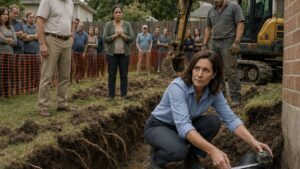
Her knee protested before she was halfway down. She ignored it. One hand stayed on the cane while the other reached toward the crack. The pavement felt cold. Tiny stones bit her fingertips. She scraped once, lightly, loosening damp dirt from the hollow.
Dennis bent forward. “Ma’am, stand up.”
Edward said, “Barbara, you’re going to hurt yourself.”
“I have done that before.”
“This is not safe,” Dennis said.
Barbara scraped again. A dark clot of grit came free and rolled onto the pavement. Beneath it, something dull and round showed for half a second before mud smeared over it.
She stopped breathing.
It was there.
Not clean. Not proof enough. Not yet. But there.
Her hand trembled, and she pressed her fingers flat against the pavement to hide it.
Dennis saw the movement but not what she had uncovered. “That’s enough,” he said. “We have a pour scheduled this afternoon, and we’re already losing time.”
Barbara looked up. “A pour?”
“For the side form,” Edward said, too quickly.
“What side form?”
Dennis turned a page on the clipboard. “The edge of the access pad.”
“Edward’s access pad.”
“Along the approved work area.”
Barbara remained crouched. From here, the orange tape looked even more wrong. It sliced through the morning between the truck and her mailbox, bright as a warning sign pretending to be law.
“You plan to pour concrete on this line today?” she asked.
“Not on your driveway,” Dennis said.
“On this side of the crack.”
“The crack is not the boundary.”
Barbara stood slowly. Her right knee burned. She kept her cane planted until she was fully upright.
“Then wait while the town checks it.”
Dennis gave a tight laugh. “The town already checked it when they issued the permit.”
“Then they can check it again.”
Edward’s voice hardened. “Barbara, a delay costs money.”
“So does taking land.”
“No one is taking land.”
She looked at the skid-steer bucket, the tape on her mailbox, the boot print on her pavement, the dull metal barely visible beneath loosened dirt.
“No,” she said quietly. “You are trying to make it too small to call taking.”
Dennis’s face changed. The foreman’s patience, thin from the start, tore at one corner.
“I need you off the work area,” he said.
Barbara moved her cane off the crack for one beat. Dennis’s shoulders loosened, almost in relief.
Then she set the cane down again, closer to the hollow where the old metal waited.
“This is not your work area,” she said.
Edward looked toward the workers, then toward the street, aware now that people could see. “Barbara, let’s talk inside. We don’t need a scene.”
She almost smiled at that. A scene was what people called it when the quiet person finally made the wrong thing visible.
Dennis stepped toward the skid-steer and called to the operator, “Keep it parked. We’ll shift the sequence.”
Barbara did not miss the word shift. Not stop. Not remeasure. Shift.
The workers began moving around her, slower now, carrying stakes and forms toward Edward’s side. One of them dragged a board that scraped against the pavement and left a pale line of dust across the crack. Dennis spoke into his phone, turned away, then glanced back at her with the look of a man calculating how long an old woman could stand outside.
Barbara waited until no one was looking directly at her.
Then she bent again, just enough to touch the hollow with two fingers. She brushed the dirt aside carefully, no bigger motion than wiping crumbs from a table.
The dull metal head showed through.
Small. Round. Stubborn.
Barbara stared at it until the noise of the crew seemed far away.
William had not been wrong.
Chapter 3: The Permit Folder Did Not Match The Pavement
By noon, the truck had moved just enough for Barbara to squeeze past if she walked sideways along the grass, but the driveway still did not feel open.
The skid-steer sat near Edward’s garage frame with its bucket lowered, resting like a jaw. Two wooden forms lay stacked where Barbara could see them from the porch. The orange tape still ran to her mailbox. No one had untied it. It snapped softly in the breeze each time a truck passed, tugging the mailbox post as if the construction site had hooked a finger around her house and meant to keep it.
Barbara made tea and forgot to drink it.
She sat at the kitchen table with the old deed envelope in front of her. The envelope was yellowed, soft at the corners, and marked in William’s square handwriting: House / Survey / Drainage. He had written the words as if he expected someone practical to need them someday. Barbara had not opened it since the year after he died.
Her fingers rested on the flap.
Through the kitchen window, she could see the crack where it crossed the driveway. From this distance, it did look like nothing. Just old pavement. Just wear. Just the kind of thing a contractor could point to and dismiss with a half smile.
She opened the envelope.
Inside were folded papers, a copy of the deed, a property sketch, receipts from drainage work, and one Polaroid photograph so faded that the grass looked gray. William stood in the picture wearing work gloves and a cap, one boot on the driveway edge, one hand pointing toward the ground. Barbara could barely see what he was pointing at, but she knew. The boundary pin had been uncovered that summer because runoff from the neighbor’s yard had flooded the porch steps during a storm. William had insisted the drain be corrected and the line marked before anyone forgot.
Barbara turned the survey sketch sideways, then back again.
Numbers marched along the page. Setbacks. Lot width. Easement notation. She had never loved numbers the way William had. To her they had always seemed less real than the porch railing he painted every other spring, less real than the lemon cookies she used to cool on the kitchen counter for children who walked home from school. But today the numbers had weight. Today they stood between her and the bucket outside.
A knock sounded at the back door.
Barbara folded the deed paper once, not hiding it exactly, but protecting it. When she opened the door, Edward stood on the step with a blue permit folder tucked under his arm.
He had changed from his clean jacket into a polo shirt, as if making himself look more neighborly. Behind him, Dennis stood near the driveway, talking to a worker and pretending not to watch.
“I brought the paperwork,” Edward said.
Barbara looked at the folder. “Come in.”
He hesitated. She did not move aside far enough to make it easy, and for a moment he had to turn his shoulders to pass through. The small awkwardness satisfied her more than it should have.
In the kitchen, Edward placed the folder on the table with the confidence of a man laying down the final answer.
“Site plan,” he said. “Permit approval. Contractor notes. Everything’s in order.”
Barbara did not touch it. “Sit down if you want.”
“I can’t stay long.”
“Then stand.”
Edward’s mouth tightened. He opened the folder and pulled out a clean copy of the plan. The paper smelled faintly of toner. Fresh, black lines showed Edward’s lot, the proposed garage, the access pad, and a narrow marked construction zone along the side.
He tapped the page. “See? This is the approved work area.”
Barbara leaned over the plan. Her glasses were on the table beside the deed envelope. She put them on slowly. Edward’s finger remained planted near the line as if holding her attention there by force.
“Move your hand,” she said.
He lifted it.
She studied the drawing. The page showed a setback from the property line. She followed the measurement with one finger, then looked through the window at the driveway. From paper to pavement. From pavement to paper. The drawing showed a straight boundary. The tape outside did not.
“Where is this measured from?” she asked.
“The survey markers.”
“Which marker?”
Edward blinked. “The survey markers.”
“The old one at the driveway?”
“I’m not the surveyor, Barbara.”
“But you’re the one building.”
His voice softened into something almost patient. “That’s why I hired professionals.”
She turned the plan slightly. “The setback is here.”
“Yes.”
“And your access pad is here.”
“Yes.”
“Then why is your tape over my crack?”
Edward looked toward the window. “Because the crew needs working clearance. That doesn’t mean the final structure goes there.”
“The concrete form does.”
“Not permanently on your land.”
Barbara looked at him.
He rubbed one hand over his jaw. “Look, the form may sit slightly outside the final edge during the pour. That’s normal. It comes out after.”
“And the truck?”
“Temporary.”
“The tape on my mailbox?”
“Temporary.”
“The mud on my driveway?”
He closed the folder halfway. “Construction is messy.”
“That is not an answer.”
“It is the truth.”
“No,” Barbara said. “It is a way to make many small wrong things sound like weather.”
Edward stood straighter. “I have followed the process. I filed plans. I paid fees. I hired a licensed contractor. I’m not sneaking around in the night.”
“You began a week early.”
“We adjusted.”
“You did not tell me.”
“I don’t need permission to work on my property.”
Barbara placed her palm flat on the table. “That is right.”
The words seemed to surprise him.
Then she added, “But you need permission to use mine.”
Edward looked down at the old deed envelope. “Is that what this is about? Old paperwork?”
“It is about the line outside.”
“You’re treating this like someone is stealing your house.”
Barbara glanced toward the photograph of William but did not pick it up.
Edward’s voice grew quieter. “Barbara, I understand this place means a lot to you. But neighborhoods change. Houses get improved. People need garages, access, storage. Not every change is an attack.”
She watched his face as he said it. He believed some of it. That was what made him harder to hate. He wanted his garage. He wanted his trucks off the street. He wanted the town inspector satisfied, his contractor paid, his schedule kept. He did not want to think of himself as the kind of man who would take from an old widow.
So he called it access.
He called it temporary.
He called it improvement.
Barbara folded her hands. “When William was alive, men knocked before they tied things to my mailbox.”
Edward’s eyes flickered. “Dennis should have asked.”
“Dennis should have stayed on your side.”
“I’ll tell him to be careful.”
“Careful is not a boundary.”
Outside, the skid-steer engine started again. Barbara turned sharply toward the sound. The bucket lifted, then lowered. A worker carried one of the wooden forms toward the driveway edge.
Edward gathered the permit papers. “They’re just staging for tomorrow now.”
“Tomorrow?”
“The pour got moved. Weather tonight, then concrete in the morning if the ground holds.”
Barbara’s mouth went dry.
“You said this afternoon.”
“Schedule changed again. That gives everyone time to cool off.”
She heard the phrase as he meant it: time for her to stop making trouble.
Barbara stood and went to the window. From there, she could see the orange tape still bending around the crack, still bright, still wrong. The dull metal head she had uncovered was hidden now under dust kicked up by the workers, but she knew where it was. Her body knew. Her hand knew. Some knowledge did not need clean paper to remain true.
Behind her, Edward slipped the permit plan back into the folder.
“I don’t want this to become a bigger issue,” he said.
“It already is.”
He paused at the door. “They’ll pour in the morning unless someone official stops us.”
Barbara did not turn around.
On the glass, her reflection looked small beside the moving shapes of machinery outside. But the crack was still there, running through the driveway exactly where William had left it, and the orange tape still bent to avoid it.
Barbara pressed one finger against the window, lining it up with the mark in the pavement.
“Then I will find someone official,” she said.
Chapter 4: Anna Asked Her Mother To Let It Go
Anna Lopez arrived just after six with a grocery bag in one hand and her work shoes still on.
Barbara knew the sound of her daughter’s car before it reached the house. The little engine always hesitated at the stop sign, then turned in with two careful bumps over the old curb. Tonight, there was only the hesitation. The car did not turn into the driveway.
Barbara looked through the kitchen window and saw why.
The orange tape still hung from the mailbox. A pair of wooden stakes leaned against the driveway edge, and one of the forms lay flat beside the crack like a ruler waiting to become permanent. The dump truck was gone, but the marks it left behind were not. Muddy tire tracks darkened the lower driveway. A boot print had dried near the porch walk.
Anna parked on the street and carried the grocery bag across the grass.
The moment she stepped into the kitchen, she looked at Barbara’s hands.
“Are you hurt?”
“No.”
“Your pants are dirty.”
“I knelt down.”
Anna set the groceries on the counter too hard. A can rolled out and tapped against the toaster. “Mom.”
Barbara turned back to the table. The old deed envelope lay open beside the permit copy Edward had left her. She had spent the afternoon comparing one page to another, then comparing both to the view out the window until the lines blurred behind her glasses.
Anna took off her coat but did not sit. “The neighbor across the street called me.”
Barbara looked up. “Which one?”
“The one with the little dog.”
“She should have called the town.”
“She was worried about you standing in front of equipment.”
“I was not in front of it. It was in front of me.”
Anna closed her eyes briefly. “That is not as comforting as you think.”
Barbara pushed one paper toward her. “Look at this.”
“I will. But first, tell me what happened.”
“I told them they were over the line.”
“And they moved?”
“Not enough.”
“Mom.”
The word came out tired, not angry. Anna rubbed the back of her neck and finally sat across from her. She had William’s hands, broad in the knuckles, though her nails were short and polished clear for work. When she reached for the permit copy, Barbara saw a small tremor in her fingers.
Anna studied the drawing without really seeing it. “I don’t understand these.”
“Neither did I at first.”
“Then maybe we should wait for someone who does.”
“They are pouring in the morning.”
Anna looked toward the window. The kitchen had grown dim around them. Outside, Edward’s garage frame stood like a rib cage against the cloudy sky.
“Can they do that?”
“They say they can.”
“Then call the town first thing.”
“I tried. The office closed at four.”
“Then we call in the morning.”
Barbara did not answer.
Anna noticed. “What?”
“They will start before the office opens. Dennis said weather changed the schedule.”
Anna folded the permit copy carefully, too carefully, buying time. “Maybe the form is temporary like Edward said.”
“Maybe.”
“You don’t believe that.”
“No.”
Anna leaned back. “How much land are we talking about?”
Barbara looked at her.
“I’m not saying it doesn’t matter,” Anna said quickly. “I’m asking because I need to understand. Is it six inches? A foot?”
“It starts as inches.”
“Mom.”
“It does.”
Anna’s face softened, and that was worse than if she had argued. “You are seventy-eight years old. You cannot be standing in front of machines because of inches.”
Barbara gathered the papers, squared their edges, then let them go. “If I let them pour over those inches, the next paper will show those inches as theirs. Then the drain sits closer. Then their access pad pushes water toward my porch. Then when I complain, someone says the concrete is already there.”
“You don’t know that.”
“I know enough.”
“You know this house. You know that driveway. But you don’t know construction law.”
“No,” Barbara said. “I know what men call temporary when they want you tired.”
Anna’s eyes moved to the old envelope. “Is this about Dad?”
The question entered the room softly, but Barbara felt it like a hand on her chest.
She stood and went to the stove though nothing was cooking. The kettle sat cold on the back burner. She touched its handle, then let it go.
“Your father set that marker after the porch flooded,” she said.
Anna looked toward the window again. “I remember water on the steps.”
“You were in college.”
“I remember you putting towels by the door.”
“It came from that side.” Barbara nodded toward Edward’s lot. “Different owner then. They had filled a low place near the fence, and the rain came straight toward us. William argued with them for a month. Not loud. You know how he was.”
Anna smiled faintly despite herself. “Quiet mad.”
“Very quiet. Very mad.”
Barbara returned to the table and drew the Polaroid from beneath the deed. She slid it across. Anna picked it up with both hands.
In the faded picture, William stood at the edge of the driveway, pointing down.
“He marked it?” Anna asked.
“He found the original pin. Then he made sure the drain followed the right slope. He said someday someone would forget.”
Anna stared at the photograph. “I didn’t know he kept all this.”
“He kept things he thought would matter after people stopped listening.”
For a while, only the refrigerator hummed.
Anna lowered the photograph. “I’m not against you.”
“I know.”
“I just don’t want to get a call that you fell. Or that some machine clipped your cane. Or that you’re out there alone with men who don’t care if you can get back up.”
Barbara looked down at her hands. There was still dirt under one nail from the crack. She had washed twice.
“I don’t want to be alone out there either,” she said.
Anna reached across the table, but Barbara did not take her hand right away. Not because she did not want comfort. Because comfort sometimes made surrender feel reasonable.
“It’s a strip of pavement,” Anna said, softer now.
Barbara shook her head. “No. It is whether they still have to ask.”
Rain tapped once against the window, then again. The sound spread across the glass in scattered dots. Anna turned toward it.
Outside, water began to shine along the raw trench beside Edward’s framed garage. It gathered in the uneven dirt, found the lowest path, and slipped under the orange tape toward Barbara’s driveway.
Barbara stood.
Anna followed her gaze.
The first thin stream of muddy water crossed the crack.
Chapter 5: Mud Reached The Porch Before Morning
By dawn, mud had reached the bottom porch step.
It was not deep. That was the first thing Barbara told herself when she opened the door and saw the brown smear shining in the pale morning light. Not deep. Not a flood. Not yet the kind of water that pushed through weatherstripping and soaked rugs and made the house smell old for weeks.
But it had traveled exactly where she feared it would.
From the raw trench in Edward’s yard, water had run under the sagging orange tape, crossed the driveway crack, and spread in a fan toward the porch walk. Fine grit settled in the low places of the pavement. Maple seeds clung to the mud. The old crack had disappeared beneath a brown film, as if the night had tried to erase it for them.
Barbara stood on the porch in her robe and coat, cane in one hand, phone in the other.
She took a picture before she stepped down.
Anna had stayed the night on the living room sofa, and when she came to the doorway, her hair was loose around her face and her eyes were still swollen from sleep.
“Oh, Mom,” she said.
Barbara took another picture. “Do not step in it yet.”
“I wasn’t planning to.”
“I need the tracks clear.”
Anna went quiet.
Across the street, the houses were just beginning to wake. A porch light clicked off. Somewhere a garage door opened. The neighborhood had the washed, gray look of a place after rain, except for Edward’s yard, which looked torn open. Plastic sheeting had pulled loose from one stack of material. Water dripped from the garage frame. A temporary black drainage pipe lay half-buried near the trench, its open mouth pointed toward Barbara’s driveway.
Barbara photographed that too.
Anna came down beside her wearing sneakers without socks. “That pipe wasn’t like that yesterday.”
“No.”
“You’re sure?”
Barbara gave her a look.
Anna held up both hands. “I’m asking because someone else will.”
That, Barbara admitted silently, was fair.
She moved slowly along the porch walk, taking pictures from different angles. The mud sucked lightly at the rubber tip of her cane. When she reached the driveway crack, she crouched only halfway, bracing herself against her thigh. The old pin was hidden again. She did not scrape at it yet. The mud itself was evidence now.
Anna hovered close but did not touch her. Barbara appreciated that. Help offered too quickly could feel like doubt.
A pickup rolled up in front of Edward’s lot at seven fifteen. Dennis got out with a paper cup of coffee and stopped when he saw the two women standing by the driveway. Behind him, two workers climbed from another truck. One looked at the mud and then at Dennis.
Dennis put on his hard hat.
“Morning,” he called.
Barbara did not answer.
He came closer, scanning the ground. “Rain made a mess.”
“Your drainage pipe made a mess.”
Dennis looked toward the pipe. “That’s temporary.”
“Everything is temporary until it damages my house.”
Anna stepped forward. “The water came across her driveway and reached the porch.”
Dennis glanced at Anna, then back at Barbara. “And you are?”
“My daughter.”
“Okay. Well, we had heavy rain.”
Barbara held up her phone. “I have pictures from last night. The trench filled, and that pipe pointed toward my property.”
Dennis took a sip of coffee. “The site drains downhill. We can’t control gravity.”
“You can control where you point a pipe.”
His expression tightened. “We’ll adjust it.”
“Before or after the concrete?”
Dennis did not answer immediately.
Barbara looked past him. A larger truck was turning slowly at the end of the street. Behind it, a white cement mixer waited at the intersection, its drum already rotating.
Anna saw it too. “They’re pouring today?”
Dennis turned and signaled to one of the workers. “We lost time yesterday. We’re trying to keep things moving.”
“The town office is not open yet,” Barbara said.
“They issued the permit.”
“The line is disputed.”
Dennis’s voice lowered. “Mrs. Allen, we went through this.”
“No,” Barbara said. “You talked around it.”
The cement mixer’s low churn carried down the street. It was an ordinary sound, one Barbara had heard on other blocks, other summers. Today it made the muscles in her shoulders pull tight.
Dennis stepped around a muddy patch and walked to the driveway edge. “We’re setting the side form. Not pouring your driveway. Not touching your porch. The access pad is on Edward’s property.”
Barbara followed him, careful, and pointed with her cane to the place where the mud hid the crack. “The form was stacked here last night.”
“For staging.”
“And today?”
He looked toward the workers again. “Today it goes where the plan says.”
“Show me on the ground.”
Dennis exhaled. “I don’t have time for this.”
“Make time before the concrete hardens.”
Anna murmured, “Mom.”
Barbara knew what that tone meant. Caution. Fear. Love wrapped in warning. She did not resent it. But she could not obey it.
She moved to the crack and scraped the mud lightly with the side of her shoe. A thin dark line appeared. She took out the small tape measure she had found in William’s kitchen drawer the night before. The metal casing was scratched and stiff; it had resisted her thumb at first, then snapped open with a sound so familiar it made her throat close.
William had used that sound all over the house. Cabinet hinges. Porch boards. The distance between tomato plants. The width of Anna’s first apartment window when she wanted curtains.
Barbara hooked the tape at the porch walk edge and extended it toward the boundary crack. Her hands were slower than they used to be. The tape bowed once. She pulled it straight.
Anna came closer. “Let me hold the end.”
Barbara almost refused, then handed it to her.
Together they measured from the porch walk to the crack. Barbara checked the number against a note William had written on the old drainage receipt. It matched closely enough to steady her breath.
Dennis watched, impatience visible now. “Personal measurements aren’t survey work.”
“No,” Barbara said. “They are memory checking itself.”
“That won’t stop a pour.”
She looked up. “The town will.”
“The town opens in forty minutes.”
“Then you can wait forty minutes.”
Dennis stared at her. For the first time, she saw something beyond annoyance in his face. Pressure. Not from her alone. From Edward, from the truck waiting down the street, from workers on hourly time, from forms not yet set and weather not guaranteed. He was not a monster. He was a man trying to keep a job moving by making her smaller than the schedule.
Edward arrived at seven thirty in a dark rain jacket, walking fast from his house. He looked first at the cement mixer, then at Dennis, then at Barbara.
“What’s going on now?”
Barbara pointed to the mud. “Your water reached my porch.”
Edward looked at it. “It rained.”
Anna’s face sharpened. “The pipe is aimed at her driveway.”
Edward turned toward the pipe. “Dennis?”
“We’ll adjust it,” Dennis said.
“Before the pour?” Barbara asked.
Edward put both hands on his hips. “Barbara, with respect, every construction site has runoff. You can’t use mud to shut down a permitted project.”
“I can use mud to show where your project is going.”
The cement mixer turned onto the street.
Its engine filled the block. The rotating drum was white with old gray streaks, and its tires hissed on wet pavement. It slowed behind the worker’s pickup because there was nowhere else to go.
Barbara felt Anna’s hand hover near her elbow, then withdraw.
Dennis raised his voice to the crew. “Set the form. We’re already late.”
Two workers lifted the long wooden form from beside Edward’s garage frame and carried it toward the driveway edge.
Barbara stepped into their path.
Not quickly. Not dramatically. She simply moved until the crack lay beneath her shoes and the mud touched the hem of her coat.
The workers stopped.
Dennis’s face darkened. “Mrs. Allen.”
Barbara looked at the cement mixer, then at the form, then at the orange tape sagging on the wrong side of the crack.
“No concrete,” she said, “until someone checks the line.”
Chapter 6: The Concrete Form Was Set Before Inspection
Dennis set the concrete form down anyway.
He did not shove past Barbara. He did not order the workers to touch her. He simply nodded toward the far end of the driveway, and they carried the form around her, boots slipping in mud, faces turned away from the old woman standing on the crack. They placed the board along the edge of Edward’s proposed access pad, close enough to Barbara’s side that one end rested over the brown water where her driveway line disappeared.
The board made a hollow slap against the wet ground.
Barbara felt the sound in her teeth.
“That is over,” she said.
Dennis adjusted his hard hat. “It’s a form. It comes out.”
“It sets the pour.”
“It shapes the pour.”
“It is on my side.”
He glanced toward Edward, who stood near the cement mixer with his phone to his ear, speaking in clipped phrases. The mixer waited at the curb, drum turning, its chute folded like a metal arm. The driver leaned against the cab, watching the block with the blank patience of someone paid by the hour but tired of being stared at.
Anna stood beside Barbara now. Not in front. Beside. Barbara noticed and did not thank her because thanking her would break something tender.
“I’m calling the town,” Barbara said.
Dennis gave a short nod. “You do that.”
He said it as if the town were a closed door.
Barbara took out her phone. Her fingers were damp, and the screen did not respond at first. She wiped her thumb on her coat and tried again. The town office number was written on a scrap of paper Anna had found online before sunrise. Barbara dialed.
A recorded voice answered.
She pressed the number for permits. The recorded voice told her the office opened at eight.
It was seven fifty-two.
Dennis began speaking to the workers again. “Stake it. We’ll be ready when we get the go.”
Barbara held the phone against her chest. “They are not open.”
Dennis did not look at her. “That’s unfortunate.”
“Eight minutes,” Anna said.
Edward ended his call and walked toward them. “The truck can’t sit forever.”
Barbara looked at him. “Then send it away.”
“That costs money.”
“So does damage.”
Edward looked down at the mud, then at her porch. His mouth moved as if he had an answer, but he chose not to say it.
The workers drove stakes along the form. Each strike of the hammer sounded too final. Wood into wet ground. Wood into mud. Wood into the morning before anyone with authority had looked at the line.
Barbara dialed again at seven fifty-seven. Recorded voice.
At eight exactly, she called a third time.
This time a clerk answered with the bright, hurried voice of someone already behind. “Town Building and Permits.”
Barbara closed her eyes for half a second. “This is Barbara Allen. I need to report an active property-line dispute before a concrete pour.”
The clerk paused. Papers shuffled somewhere on the other end. “Is this an emergency?”
“It is happening now.”
“What is the address?”
Barbara gave it.
Edward stepped closer. “Barbara, put it on speaker.”
She looked at him. “No.”
Dennis muttered something to a worker, then walked toward the mixer.
The clerk asked for the permit number. Barbara did not know it. Anna reached for the blue folder copy on the porch chair and flipped through the pages with quick hands.
“Read the top right,” Barbara said.
Anna did.
Barbara repeated the number into the phone.
The clerk’s tone changed slightly, from polite to cautious. “That is the Ramirez residential garage addition.”
“Yes.”
“And you are the adjacent property owner?”
“I am the property owner whose driveway they are using.”
Another pause. Typing. “The permit shows work on the applicant’s parcel.”
“The tape is on my side. The form is on my side. The drainage pipe sent mud to my porch. There is an old boundary pin in the driveway crack.”
“Has a surveyor confirmed that?”
“The pin exists.”
“Ma’am, I understand, but we can’t determine a boundary over the phone.”
“I am asking you to stop the pour until it is checked.”
The clerk lowered her voice. “If there is an active boundary dispute affecting the pour area, the inspector needs to be notified before concrete is placed. But I cannot issue a stop order myself.”
“What can you do?”
“I can message the inspector.”
“When?”
“I can send it now.”
Barbara looked at the cement mixer. Dennis was speaking to the driver. The driver climbed back into the cab.
“Please send it now,” Barbara said.
“I need your callback number.”
Barbara gave it. Her voice remained even until the final digit. Then it cracked, just enough that Anna looked at her.
The clerk softened. “Mrs. Allen, make sure you stay clear of equipment.”
Barbara watched Dennis unfold the mixer chute.
“I am clear,” she said. “The equipment is not.”
She ended the call.
Anna whispered, “What did they say?”
“The inspector has to be notified.”
“Is he coming?”
“She said she would message him.”
Edward laughed once, sharply. “A message is not an order.”
Barbara slipped the phone into her coat pocket. “It is notice.”
Dennis came back from the mixer. “We’re not pouring on your driveway.”
Barbara pointed to the form. “Move it back.”
“No.”
“Then you are choosing this.”
His eyes narrowed. “Choosing what?”
“To pour before the line is checked.”
He took off his hard hat, wiped his forehead with his sleeve, and put it back on. The gesture made him look tired for the first time. “Mrs. Allen, I have a crew, a truck, a schedule, and a permit. I cannot run a construction site by every neighbor’s feelings.”
Barbara felt the word pass through her without landing.
Feelings.
Yesterday it had been disruptive. Today it was feelings. Always the problem placed inside her, never under his boot.
She bent and scraped mud from the crack with the tip of her cane. The dark line emerged in a broken path beneath the form’s shadow.
“My husband found that marker after water came into this house,” she said. “He set the drain by it. He kept the papers because he knew someday someone would call the line a feeling.”
Dennis looked away first.
Edward did not. “Barbara, I am willing to repair any damage if damage happens.”
“Damage has happened.”
“Mud is not damage.”
She pointed to the lower porch step, where a brown stain had already dried along the white paint. “That house has stayed dry for nineteen years.”
Edward’s face shifted, not enough for apology, but enough to show he had heard the number.
The mixer chute swung down with a metallic clank.
Barbara’s phone rang.
Everyone seemed to hear it.
She answered so quickly she nearly dropped it.
“This is Barbara Allen.”
A man’s voice came through, low and brisk. “Mrs. Allen, this is the town inspector. I received a notice about a disputed line and a concrete pour.”
Barbara turned slightly away from Edward but kept her eyes on the form. “Yes.”
“I’m on another site. I can be there in twenty minutes. Has concrete been placed?”
“Not yet.”
“Do not stand in front of equipment.”
“I am standing on my driveway.”
“Ma’am.”
“They are unfolding the chute.”
The inspector was quiet for one beat. “Tell the contractor not to place concrete in the disputed area until I arrive.”
Barbara looked at Dennis.
“Will you tell him?” she asked.
“Put him on.”
Barbara held out the phone. Dennis stared at it as if it were something dirty. Then he took it.
“This is Dennis King.”
He listened. His jaw flexed. “We’re within approved limits.”
He listened again.
“The truck is already here.”
Another pause.
Dennis turned his back, but Barbara could still see the color rising along his neck.
“Fine,” he said at last. “We’ll hold.”
He handed the phone back without looking at her.
The inspector spoke once more. “I’ll be there as soon as I can.”
Barbara thanked him and ended the call.
For several seconds, nothing moved except the cement drum.
Then Edward said, “Twenty minutes.”
Dennis snapped, “I heard him.”
The workers stepped back from the form. One wiped mud from his glove onto his pants. The driver in the mixer cab leaned his head against the seat and stared through the windshield.
Barbara should have felt relief. Instead, she felt the thinness of what stood between her and the pour: a phone call, a delayed inspector, an old pin hidden under mud, and her own body on tired legs.
Dennis turned toward the crew. “Nobody pours until he gets here.”
The words had barely left his mouth when the cement truck lurched forward a few feet to straighten its angle.
The chute swung over the street-facing edge of the driveway.
Barbara looked past it toward the corner.
A town vehicle had not yet appeared.
Chapter 7: Everyone Watched The Old Pin Come Up Clean
The town vehicle came around the corner while the cement mixer was still breathing at the curb.
It was a white pickup with the town seal on the door and a yellow light on top that was not flashing. It moved slowly, almost politely, as if the street were an ordinary street and not a place where a concrete truck, two work pickups, a skid-steer, a half-built garage, and an old woman in a mud-spattered coat had all been waiting for one man to decide whether a line mattered.
Barbara watched it pull in behind the mixer.
For the first time that morning, Dennis stopped giving orders.
The town inspector stepped out with a clipboard under one arm and rubber boots already on his feet. He was middle-aged, careful-faced, and not in a hurry to belong to either side. He took in the chute, the form, the orange tape, the muddy driveway, the porch step, then Barbara.
“Mrs. Allen?”
“Yes.”
He nodded. “I’m the inspector.”
Dennis walked over before Barbara could say anything else. “We’re within the approved work area. We’ve got the permit set, forms ready, and a truck sitting.”
The inspector looked at him. “You’re Dennis King?”
“That’s right.”
“Concrete has not been placed?”
“No. Because we were told to hold.”
“Good.”
Dennis’s mouth tightened, but he said nothing.
Edward came forward with the blue permit folder already open. “I’m Edward Ramirez, property owner. I appreciate you coming out, but this is a misunderstanding. We’re not building on her property. We’re just using temporary clearance for the form.”
Barbara heard the smoothness in his voice. The same smoothness from her kitchen. Not false exactly, but polished until the rough edges were hard to grab.
The inspector accepted the folder, glanced at the permit page, and then looked at the ground. “Show me the disputed area.”
Dennis pointed. “Right along here.”
Barbara stepped forward. “No. Here.”
Her cane touched the mud where the driveway crack disappeared under brown water.
The inspector’s eyes followed the cane. “That crack?”
“It follows the old marker.”
Dennis exhaled. “It’s a crack in an old driveway.”
The inspector glanced at him, then back at Barbara. “You mentioned a boundary pin.”
“Yes.”
“Visible?”
“Partly, yesterday. Mud covered it overnight.”
Edward spoke quickly. “With respect, an old metal cap in pavement may not be a legal marker. It could be anything.”
Barbara looked at him. “Then you should not be afraid to look at it.”
The neighbor with the dog had stopped across the street again. The delivery driver from earlier had parked farther down and stood beside his van, arms folded. One of the cement crew leaned against the mixer and watched. No one spoke loudly now. The waiting made every small sound larger: the wet suck of boots, the faint churn of the mixer drum, the tape snapping lightly against Barbara’s mailbox.
The inspector crouched near the crack. “Mrs. Allen, can you show me exactly where you saw it?”
Barbara lowered herself slowly. Anna moved beside her, but Barbara shook her head once, and Anna stopped. Not leaving. Not taking over. Just staying near enough.
Barbara set the cane on the pavement and used her fingers.
The mud was cold. It slid under her nails as she scraped along the crack, following the memory of yesterday’s hollow. At first there was only grit and black water. Dennis shifted behind her.
“This is what I’m talking about,” he said. “We’re stopping an entire pour for—”
The inspector lifted one hand without looking back. Dennis stopped.
Barbara scraped again, smaller now. She felt the edge before she saw it. A hard round lip under the mud. Her breath caught.
“There,” she said.
The inspector leaned closer.
Anna crouched beside Barbara and held out a paper towel from her coat pocket. Barbara took it and wiped gently. Brown water smeared away. The dull metal head appeared, no bigger than a coin, set low in the pavement beside the crack.
The neighbor across the street whispered something to the dog, though the dog had not moved.
The inspector took a small brush from his pocket and cleaned around the metal. The letters on it were worn almost smooth, but the shape was unmistakable: a capped marker set into the old pavement, aligned with the crack and not with the orange tape.
Dennis stared at it.
Edward said, “That still doesn’t mean the form—”
The inspector looked up. “Don’t finish that sentence yet.”
The words were not sharp, but they closed Edward’s mouth.
Barbara sat back on her heels, pain moving through her knees in a hot wave. Anna touched her elbow this time, and Barbara allowed it. Together they stood.
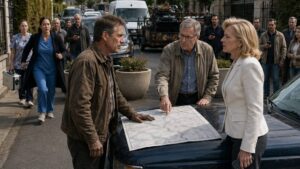
The inspector took the old deed copy from Barbara’s hand and laid it against the permit plan on the hood of his truck. The papers fluttered, and Anna held one corner down. The inspector checked measurements, looked toward the porch walk, then toward Edward’s framed garage. He asked for a tape. Dennis handed him one without speaking.
“From the porch walk?” the inspector asked.
Barbara nodded. “William measured from there after the drainage work.”
“William?”
“My husband.”
The inspector did not comment. He hooked the tape at the porch walk edge and stretched it across the muddy pavement. Anna held the end steady. The metal tape line passed over the driveway crack and landed near the exposed pin.
The inspector checked the number against the old drainage note, then against the survey page.
He did not make a dramatic announcement. He simply straightened and looked at the orange tape tied to the mailbox.
“That tape is not on the boundary,” he said.
Dennis rubbed one hand down his face.
Edward stepped closer. “Temporary working clearance. That’s all it was.”
“Temporary clearance still requires permission if it uses adjacent property,” the inspector said.
Edward’s eyes flicked toward Barbara, then away.
The inspector walked to the wooden form. He planted one boot beside it and sighted down the line toward the pin. “This form is too close to a disputed boundary to pour today.”
Dennis said, “We can pull it back a few inches.”
“You can pull it back after the line is properly marked.”
“We have a truck here.”
“You have a truck here because you called it here before the dispute was checked.”
The words hung in the air.
Barbara looked at Dennis. He was not humiliated the way a cruel man might deserve to be in a simpler story. He looked cornered by time, by cost, by decisions he had treated as harmless because they had landed on someone else’s edge. That did not make Barbara pity him. It made the whole thing more exhausting.
Edward opened the permit folder again. “What exactly are you requiring?”
“For today? No pour in this section. Move the form off the disputed strip. Remove the tape from Mrs. Allen’s mailbox. Redirect that drainage pipe away from her driveway. Then get the boundary confirmed before you set forms again.”
“The permit allows the project,” Edward said.
“The permit does not allow you to use her driveway.”
The neighbor across the street lifted their chin as if hearing what they had been waiting for. The delivery driver glanced at Barbara, not smiling, just noticing.
Barbara did not feel taller. She felt tired. Mud was drying on her fingers. Her knee throbbed. The exposed pin sat at her feet, small and plain, not shining, not triumphant. Just there.
The inspector turned to Barbara. “Mrs. Allen, do you have a copy of the old drainage work records?”
“Yes.”
“Keep them. Take photos of the marker before anyone covers it. I’ll note the dispute and require corrected placement before inspection.”
Barbara nodded.
Edward’s voice dropped. “This delay is going to be expensive.”
Barbara looked at him then. “So was the first flood.”
For a moment, he did not know what she meant. Then his eyes moved to the porch, to the muddy stain along the lower step, to the drainage pipe pointing wrong.
Dennis turned to the crew. “Fold the chute. Send the truck.”
The mixer driver shook his head once, climbed down, and began securing the equipment. The drum kept turning, but the sound had changed. It no longer sounded like a decision rushing toward her house.
One worker untied the orange tape from Barbara’s mailbox. The tape fell loose, bright and limp in his hand. Without it, the mailbox stood by itself again, a little crooked but no longer claimed.
Dennis walked to the wooden form and lifted one end with another worker. Mud sucked at the board as it came free. Under it, the driveway crack reappeared in broken pieces.
Barbara watched the line return.
The inspector closed the permit folder. “No concrete on a disputed line.”
He said it once, plainly, and the whole street seemed to understand.
Chapter 8: The Driveway Opened Without Anyone Applauding
Several days later, the driveway was open enough for Anna to pull in without touching the grass.
Barbara stood on the porch and watched her daughter guide the car slowly over the repaired edge. There was still a patched look to the pavement where the mud had been cleaned away and the chipped section filled. Fresh gravel lined Edward’s side now, set back from the crack. The drainage pipe had been turned into a shallow swale that carried water toward the street instead of Barbara’s steps. It was not beautiful. It was not how the yard had looked before the hedge came out. But the water had somewhere else to go.
Anna parked, cut the engine, and looked through the windshield at her mother.
Barbara lifted one hand.
No one across the street came out to clap. No one recorded it. No one made a speech about justice. The neighborhood had already returned to its small habits: trash cans at the curb, a dog barking behind a fence, a lawn mower starting two houses down. The construction crew still worked next door, but their machinery no longer crossed her driveway.
That was enough.
Edward arrived a few minutes later with Dennis and the inspector. Dennis carried a rolled set of corrected plans. Edward had no folder this time, only a single sheet and an expression that had lost some of its polish.
Barbara met them at the driveway edge. Anna stayed on the porch steps, close but silent.
The orange tape was gone. In its place, a thin white paint line followed the driveway crack, clean and direct. It ran past the exposed boundary pin, which had been brushed, photographed, and temporarily protected under a small metal cover until a surveyor could reset the official marking. The line looked almost modest. Anyone passing too quickly would miss it.
Barbara did not.
Dennis unrolled the corrected plan on the hood of his pickup. “The access form shifts back here,” he said, pointing. “We narrowed the working clearance. No equipment staging on your driveway. Drainage stays pitched toward the street.”
His voice was businesslike. Not warm. Not friendly. But he did not call anything temporary, and he did not call anything a feeling.
Barbara looked at the plan, then at the ground. “And the damaged edge?”
Edward handed her the single sheet. “Repair agreement. Pavement edge, porch step cleaning, and any settling from the runoff for ninety days.”
Barbara took the paper but did not immediately read it. “Ninety days from completion.”
Edward glanced at Dennis.
Dennis looked at the ground, then said, “That’s reasonable.”
Edward’s mouth tightened. “Fine. From completion.”
Barbara read the first lines slowly. She had learned not to rush when other people were waiting for her to feel embarrassed about being slow. The paper named her driveway, her porch step, the drainage adjustment, the boundary protection during construction, and the restriction on staging. It did not sound like kindness. It sounded like something that could be held in a drawer and found later.
Good.
She looked up. “And no tape on my mailbox.”
Edward gave a short breath that might once have become a laugh, but did not. “No tape on your mailbox.”
The inspector made a note.
Dennis shifted his weight. “Mrs. Allen.”
Barbara turned to him.
He seemed to struggle with the shape of whatever he had decided to say. He was easier to look at without the cement truck behind him.
“The tape was placed for working clearance,” he said. “Not the true boundary.”
“I know.”
“I should have said that.”
“Yes.”
He nodded once. “I also should have asked before tying off to your mailbox.”
“Yes.”
There was no apology in the grand sense. No bowed head, no sudden understanding of her whole life, no easy transformation into a better man. But his voice had changed. It had lost the part that expected her to step back because he had a schedule.
Barbara accepted that as far as it went.
Edward looked toward his framed garage. “I didn’t think it would become all this.”
Barbara followed his gaze. The structure had bones now: posts, beams, roofline. It would become exactly what he wanted, only slightly narrower in its approach, slightly more careful at the edge.
“That was the problem,” she said.
He turned back.
“You did not think it would become anything for me.”
Edward opened his mouth, then closed it. The inspector capped his pen. Dennis rolled the plans back up.
Work resumed that afternoon.
This time, the skid-steer entered from Edward’s gravel path. Its bucket stayed low and away from the white line. When workers carried boards, they turned sideways before reaching the driveway. One of them paused to look at the metal cover over the boundary pin, then stepped around it without being told.
Barbara watched from the porch with a cup of tea cooling in her hands.
Anna sat beside her. “You should rest.”
“I am resting.”
“You’re supervising.”
“That can be restful.”
Anna smiled a little, then looked out at the line. “I’m sorry I called it a strip of pavement.”
Barbara kept her eyes on the driveway. “It looked like one.”
“Not to you.”
“No.”
Anna leaned back against the porch chair. “Dad really said someone would forget?”
“He said someday someone would forget where the corner was.”
“And you remembered.”
Barbara did not answer right away. Across the yard, Dennis corrected a worker with a quick point, redirecting a stack of forms away from the painted line. Edward stood near the garage frame, speaking into his phone, but when he walked toward the driveway, he stopped short of the crack.
The smallness of it struck her then.
All this noise, all that mud, the truck waiting, the phone calls, Anna’s worried face, Dennis’s impatience, Edward’s paperwork, the inspector’s measured voice—and at the center of it, a round piece of metal barely wider than two fingers.
It would be easy for someone else to laugh at that.
Barbara did not.
After the crew left, she waited until the street settled into evening. The new paint line had dried pale against the old pavement. Dust from the day’s work had collected along the crack, softening its edges. Barbara took the porch broom from beside the door and stepped down carefully.
Anna rose. “Mom?”
“I’m only sweeping.”
This time Anna did not argue.
Barbara swept from the porch walk toward the driveway edge in short, steady strokes. Dust lifted, then drifted aside. The white line sharpened. The crack showed beneath it, still old, still uneven, still running where it had always run. Near the metal cover, she slowed.
She thought of William kneeling there with dirt on his cheek, saying someone would forget. She thought of herself laughing because the future had seemed too far away to be practical. She thought of the morning when the truck blocked the driveway and the tape bent around the truth as if truth were an inconvenience.
The broom whispered over the pavement.
Across the street, the neighbor with the dog lifted a hand. Barbara lifted hers back, then returned to sweeping.
No one had given her anything. Not really. They had only stopped taking what was not theirs.
When she finished, she stood at the edge of the driveway and looked at the open space from porch to street. A car could pass. A person could walk. Rain could run where it was supposed to run. The mailbox stood free. The line remained.
Anna came down and stopped beside her.
“You okay?” she asked.
Barbara rested both hands on the broom handle.
For the first time in days, the house behind her did not feel as if it were being quietly measured by other people. It felt like a house again. Worn, patched, stubborn, and hers.
“Yes,” Barbara said. “I am.”
She swept once more across the crack, leaving the corrected line clean in the evening light.
The story has ended.