The Weekend the HOA Took His Garage and Exposed What the Neighborhood Had Chosen Not to See
Chapter 1: The Trucks Were Already Inside His Garage
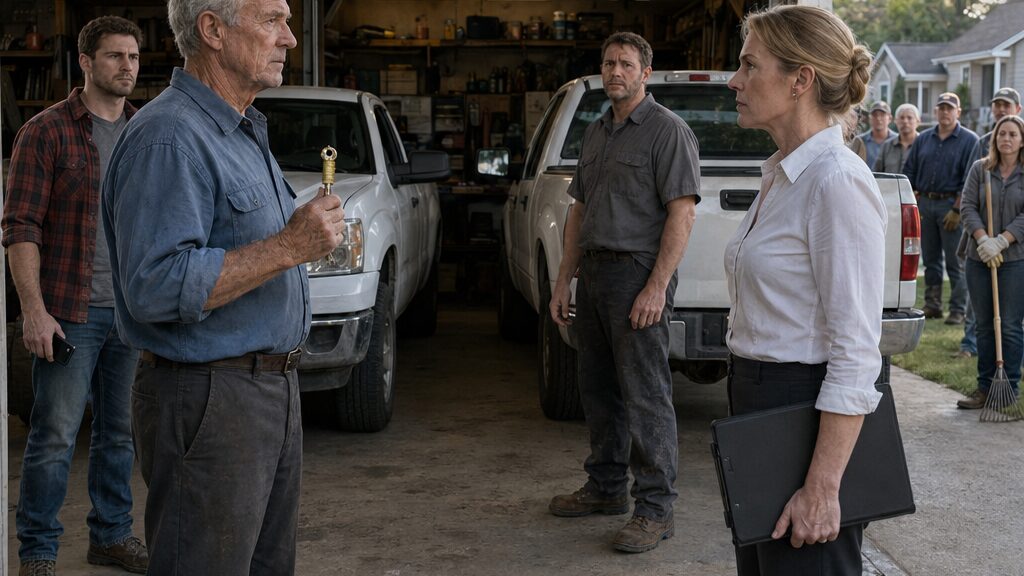
When Samuel Wilson raised the garage door, two white pickup trucks were waiting inside as if they had been there longer than he had.
For one suspended second, he thought he had opened the wrong building.
Then the familiar details returned one by one: the dent in the left door track, the coffee can full of stripped bolts, the green municipal toolbox he had bought at auction after retirement. Beyond the trucks, almost hidden by their tailgates, stood his workbench.
Both vehicles carried the blue-and-gray emblem of Cedar Ridge Homeowners Association.
A folding table had been opened beside the first truck. Plastic bins sat on it, along with traffic cones, hedge-trimmer cases, and boxes of irrigation fittings. One maintenance worker was backing toward Samuel with a carton in his arms. Another stood inside the second truck’s bed, sliding equipment toward him.
The worker with the carton turned.
“Morning, Mr. Wilson.”
Samuel kept one hand on the garage-door control. “Set that down.”
The man stopped.
“Not on my floor,” Samuel added.
The worker lowered the carton onto the truck’s tailgate instead. “Brian said we could stage here.”
“Where’s Brian?”
“Out front.”
Samuel looked between the trucks. Their mirrors had been folded inward to clear the doorframe. That meant whoever parked them had taken time. They had not mistaken the garage for an HOA storage shed. They had maneuvered carefully into Samuel’s private bays and arranged themselves for the weekend.
He walked to the wall beside the interior door.
A wooden board hung there with four brass hooks. The house key remained on the first. The padlock key for the rear gate hung on the second. The third held a red plastic tag marked WATER SHUTOFF.
The fourth hook was empty.
Samuel touched it anyway.
Behind him, shoes scraped on concrete. His grandson stepped through the open garage door carrying a cardboard tray with two coffees.
Jacob slowed when he saw the trucks.
“I thought you said we were changing the mower belt.”
“We were.”
Jacob lowered the tray onto a narrow shelf. He was thirty-two now, broad through the shoulders, dressed in jeans and a red plaid overshirt Samuel had seen in photographs but never in person. He visited often enough to know where the coffee went, but not often enough to know that the fourth hook had once held another key.
“Whose trucks are these?”
Samuel looked at the empty hook. “That’s what I’m finding out.”
Brian Anderson came around the first truck. He wore a faded work shirt with the association emblem stitched over one pocket. His face had the pinched look of a man who had begun the morning already behind schedule.
“Samuel,” he said. “I was going to come knock.”
“You were already inside.”
Brian glanced at the workers. “Katherine said she’d cleared it with you.”
“She didn’t.”
The answer was quiet enough that both workers stopped moving.
Brian rubbed his thumb along the edge of his phone. “She told me this was approved storage through Monday. We had two vehicles vandalized at the open lot last week. Broken windows, tools taken. Insurance is giving us trouble.”
“That doesn’t make this your garage.”
“No. I know that.” Brian lowered his voice. “But she had a key.”
Jacob looked sharply toward the interior door. “A key to what?”
Samuel did not answer. He walked past the trucks toward the rear of the garage.
Years earlier, he had installed a security bar across the side service door. It could be lifted only from inside unless someone used the exterior release cylinder. The metal arm now rested upright in its bracket.
Jacob crouched near the lock. “This was opened from outside.”
Samuel saw the faint crescent of fresh wear around the cylinder.
His first feeling was not anger. It was something colder and more humiliating—the realization that whoever had entered had known exactly how.
“Grandpa?”
Samuel straightened. “There used to be an emergency key.”
“Used to be where?”
“With the association.”
Brian shifted his weight. “Katherine said it was current.”
Samuel turned toward him. “Did she show you written permission from me?”
“She showed me the storage order.”
“That isn’t what I asked.”
Brian’s jaw tightened. “No.”
A truck door slammed outside. Voices drifted up the street. It was the first morning of the neighborhood cleanup, when homeowners dragged branches to the curb and association volunteers distributed bags, gloves, and bottled water. Samuel could hear children calling to each other near the entrance monument.
The timing was deliberate. With half the neighborhood outside, the trucks could be presented as part of the cleanup before anyone asked why they were inside his garage.
One worker reached again for the carton.
Samuel held up a hand. “Nothing else comes off either vehicle.”
The worker looked to Brian.
“You heard him,” Brian said.
It was a small thing, but the garage changed when the men obeyed. It became Samuel’s again for the length of a breath.
Jacob pulled out his phone. “I’m taking pictures.”
“Put it away.”
“This is trespassing.”
“I know what it is.”
“Then we should document it.”
Samuel looked at him. “You can take pictures after I know who said what.”
Jacob’s mouth set in the same stubborn line his mother had worn at that age. “Pictures are how you know who said what.”
Before Samuel could respond, a woman’s voice came from the driveway.
“Good. Everyone’s here.”
Katherine Miller approached holding a black clipboard against her white blouse. Her blond hair was pinned back, and she wore the composed expression she used at board meetings when announcing decisions that had already been made elsewhere.
She smiled at Samuel as though arriving for an appointment.
“I’m sorry we had to use the side entrance,” she said. “You weren’t answering.”
“I was asleep.”
“We tried not to disturb you.”
Jacob gave a short, disbelieving laugh.
Katherine’s eyes moved to him. “You must be Jacob.”
“You used a key to enter his garage.”
“It was an emergency-access key.”
“What was the emergency?”
“The association’s equipment had to be secured.”
Samuel stepped between them. “Who authorized storage here?”
Katherine opened the clipboard. “The association did.”
“That isn’t authorization from me.”
Her smile thinned. “Samuel, we’ve stored equipment here before.”
“One truck. One night.”
“And you never withdrew access.”
“I didn’t grant permanent access.”
Katherine drew out a printed page and held it where he could see the heading.
CEDAR RIDGE HOA — WEEKEND MAINTENANCE STORAGE ORDER.
Below it, his address had been typed into a box labeled APPROVED SECURE LOCATION.
Samuel read the line twice.
At the bottom was Brian’s name. Above it, in smaller type, appeared: Prior owner consent on file.
Katherine tapped that sentence with the end of her pen.
“This is what Brian was given,” she said. “As far as the association is concerned, your garage was approved.”
Chapter 2: You Had Access, Not Ownership
“The arrangements are already settled,” Katherine said, as if Samuel had objected to the time of a luncheon rather than two trucks inside his garage.
Behind her, neighbors in work gloves moved slowly along the street, pretending to gather litter while watching the driveway. A boy dragged a black trash bag past the mailbox. Two women in matching cleanup shirts stopped talking when Samuel looked their way.
Katherine placed the clipboard on the hood of the nearest truck.
“The vehicles will be gone Monday morning,” she said. “No one will use your tools. No one will enter the house. You won’t be inconvenienced.”
Samuel glanced toward his workbench, sealed behind two tons of association property.
“I’m inconvenienced now.”
“We need secure storage for the weekend.”
“Then rent some.”
“We had storage.”
“What happened to it?”
A pause. Small, but real.
“Our current arrangement is unavailable.”
Jacob stood near the side door with his phone lowered but ready. “So you decided his garage was free.”
Katherine kept her attention on Samuel. “I decided the association had previously established access.”
Samuel looked at the work order again. “Where is the consent on file?”
“It may be attached to the emergency-access record.”
“May be?”
“I don’t carry the entire association archive on a Saturday.”
“You carried my key.”
Katherine’s fingers tightened around her pen.
Brian stood several feet away, saying nothing. The two workers remained beside the trucks, trapped between an employer’s order and the homeowner whose floor they occupied.
Samuel walked to the wooden hook board. He touched the empty fourth hook once more, then turned.
“Give it back.”
Katherine frowned. “Give what back?”
“My key.”
A pickup passed slowly at the end of the driveway. The driver lifted a hand but did not stop.
Katherine reached into a zippered pocket of her document case and removed a small brass key with a square black cap. A faded strip of yellow tape circled the head.
Samuel recognized the tape. His wife had wrapped it there three summers before she died because, in her words, every spare key in the house looked exactly alike once he set his glasses down.
Katherine laid it beside the clipboard.
The sight of it struck harder than the trucks.
Samuel picked it up. The tape had darkened where other hands had held it.
“This key was issued during the tornado warning three years ago,” he said.
Brian looked over.
Katherine said, “It was placed in the emergency-access file.”
“For one night. A maintenance truck had a broken window, hail was coming, and your storage gate had jammed.”
“No expiration date was recorded.”
Samuel closed his hand around the key. “A favor is not a lease.”
“Samuel, nobody is claiming a lease.”
“You entered a locked building before sunrise.”
“We believed we had permission.”
“You believed I would give it after you were already inside.”
A murmur moved through the onlookers at the curb. Katherine heard it. Her posture stiffened.
“This doesn’t need to become a public confrontation.”
“You brought the public with you.”
The cleanup table stood across the street under an association canopy. Bottled water, clipboards, and volunteer sign-in sheets covered it. Every few seconds someone looked toward Samuel’s driveway and then quickly away.
Katherine lowered her voice. “We have an inspection Tuesday. The irrigation repairs near the east entrance must be finished before then. If these trucks are damaged or unloaded elsewhere, that work may be delayed.”
“Then tell the neighborhood why.”
“That would not be productive.”
“It might be accurate.”
Her cheeks colored. “The association is trying to keep services running with limited resources.”
Samuel studied her. He had known Katherine six years. She was not careless in the ordinary sense. She arrived early, remembered deadlines, and could quote landscaping provisions from memory. She had once spent an entire Sunday coordinating pumps when a drainage basin overflowed.
That competence had made the present violation easier, not harder. Katherine had not stumbled into his garage. She had calculated that he would absorb the inconvenience because he had always absorbed it before.
Samuel turned to Brian. “Move the trucks.”
Brian exhaled through his nose. “Both?”
“Both.”
Katherine stepped closer. “Samuel, please consider what that means for everyone else.”
He looked at the key enclosed in his fist.
For years, people had brought him things that rattled, leaked, stalled, or refused to start. Snowblower carburetors. Bent mower decks. A generator that coughed black smoke. Once, Katherine had appeared with an HOA utility cart and said the repair shop could not take it for two weeks.
Samuel had fixed it before supper.
No invoice. No meeting. No question about zoning then.
Katherine tapped the clipboard. “You have always supported the association’s maintenance needs.”
“I helped.”
“Exactly.”
“No.” Samuel set the key on top of the storage order. The small piece of brass clicked against the metal clip. “Not exactly.”
The street had gone nearly silent.
He placed one finger beside the key.
“You had access,” he said. “Not ownership.”
Katherine looked at the watching neighbors, then at Brian. “The board can review this Monday.”
“The trucks leave now.”
“And if scheduled repairs are not completed?”
“That belongs in your report.”
Brian made the decision before Katherine could answer. He nodded to one worker and pointed toward the first truck.
“Clear the table. I’ll back it out.”
The worker began stacking the bins. Another folded the legs of the staging table. Katherine stared at Brian.
“You were instructed to secure both vehicles here.”
“I was instructed to use an approved location,” he said. “The owner says it isn’t approved.”
“The work order says otherwise.”
“I’m standing in his garage.”
The engine started. Exhaust rolled through the enclosed space until Samuel hit the wall switch and raised the door fully. Brian climbed into the cab, adjusted the folded mirrors, and eased backward inch by inch.
Neighbors abandoned the pretense of not watching.
The truck emerged into the driveway, white hood flashing in the late-morning sun. Its rear cleared the threshold. For the first time since Samuel opened the door, a strip of his workbench became visible.
Relief came first.
Then shame followed it.
Not shame because he had objected. Shame because everyone had seen how much effort it took for him to be obeyed on his own property.
Jacob came beside him. “You did the right thing.”
Samuel kept his eyes on the moving truck. “That isn’t always the same as doing it well.”
Katherine gathered the storage order from the hood. The key remained under Samuel’s hand.
“You’re forcing the association into an avoidable expense,” she said.
“You forced your way into my garage.”
“That is an inflammatory description.”
“It’s a door with a lock. You used a key I did not know you still had.”
“The board will determine whether your prior consent remained effective.”
Samuel almost smiled. “The board doesn’t determine what I consent to.”
The first truck reached the curb. Brian got out to guide the second.
Katherine slid the paper into her clipboard. “Then the board may need to review the use of this structure more broadly.”
Jacob turned. “What does that mean?”
Katherine’s gaze moved past Samuel to the workbench now appearing behind the second truck. Tools hung in orderly rows. A disassembled mower transmission sat beneath a canvas cover.
“It means,” she said, “that the governing documents prohibit commercial or industrial activity in residential accessory buildings.”
Samuel felt the key press into his palm.
“I don’t run a business.”
“That will be part of the review.”
The second engine started.
Katherine stepped away from the garage as though the matter had become administrative and therefore no longer personal.
“We’ll contact you regarding your unauthorized shop activity,” she said.
Then the first truck pulled down the street, leaving Samuel’s driveway open and his garage nearly empty, while the threat she had placed inside it remained.
Chapter 3: The Favors Recorded in Grease and Pencil
Jacob found Katherine Miller’s name on seventeen separate pages before Samuel noticed what he was reading.
The ledger lay open beneath the workbench light, its blue cloth cover darkened by years of fingerprints. Entries filled the pages in Samuel’s square block printing: dates, equipment, symptoms, parts, and brief notes about what had been done.
MILLER — CART WON’T CHARGE.
HOA PUMP — REPLACE SEAL.
MILLER — SNOWBLOWER AUGER PIN.
HOA TRAILER LIGHTS.
No prices appeared beside any of them.
Jacob turned another page.
“Did you bill the association for this work?”
Samuel was sweeping tire grit from the place where the second truck had stood. “No.”
“Why not?”
“It was small work.”
“There are six years of small work here.”
Samuel pushed the broom into the corner. The garage looked larger now, but not untouched. Mud from the truck tires marked the floor. A scuff ran along one cabinet. Someone had shifted his rolling stool and left it crooked beneath the drill press.
Jacob read another line aloud. “HOA mower deck, welded bracket. Three hours.”
“Closer to two.”
“That isn’t the point.”
“It matters if you’re going to read it.”
Jacob shut the ledger, then opened it again as though unable to decide which action expressed his anger better.
His phone rested beside the recovered garage key. During the truck removal he had taken photographs despite Samuel’s instruction. He had captured Katherine at the hood, the key beside her clipboard, Brian backing the first vehicle out.
One post, Jacob believed, would make the board retreat before lunch.
Samuel knew it too. That was part of why he refused.
“You should put all of this online,” Jacob said. “The trucks, the work order, the ledger. Let people see what they’ve been doing.”
“No.”
“They’re threatening you with a violation for repairs they brought here.”
“They haven’t issued anything.”
“Katherine said they would.”
“Katherine says many things before a board votes.”
Jacob stared at him. “You’re defending her?”
“I’m describing how it works.”
“That’s what you always do. You explain why the person causing the problem isn’t technically the whole problem.”
Samuel set the broom against the wall. “And you turn every problem into an audience.”
“Because audiences make organizations behave.”
“Sometimes they make noise.”
“Noise might help.”
“Not if it speaks before I do.”
Jacob’s face tightened. The hurt arrived before he could hide it.
“I drove two hours because you said the mower needed work.”
“I did not ask you to fight the HOA.”
“No. You don’t ask anybody for anything.”
The garage went still except for the ticking of cooling metal from the mower engine.
Jacob looked down at the ledger. “Mom told me you’d been having trouble with the board.”
“Your mother worries professionally.”
“She said you stopped going to meetings.”
“I got tired of meetings.”
“She said you stopped answering half your calls.”
“I answer important ones.”
Jacob gave a thin laugh. “How would you know?”
Samuel picked up the recovered key. The yellow tape felt brittle beneath his thumb.
Three years earlier, the sky had turned green just after five in the afternoon. Sirens sounded from town, and wind pushed rain sideways across Cedar Ridge. Brian had arrived in an HOA truck with a temporary plastic sheet taped over the passenger window.
The association’s storage gate had jammed. Hail had already begun.
Samuel’s wife had opened the side garage door before Brian finished explaining.
“Put it inside,” she had said. “We have room.”
Later, when the tornado warning extended into the night, Katherine had asked for an emergency key in case the power failed or they needed to retrieve pumps.
Samuel had handed it over.
One night. One storm. One practical decision made while his wife brewed coffee for frightened neighbors in the kitchen.
Jacob watched him turn the key over.
“That was the first truck, wasn’t it?”
Samuel looked up.
“The one Katherine mentioned. You let them store it here.”
“During a tornado warning.”
“And you never got the key back.”
“I forgot.”
Jacob glanced at the empty hook. “You don’t forget keys.”
Samuel placed it beside the ledger. “There were other things happening.”
His wife had begun treatment that same month. At first, appointments. Then tests. Then rooms where doctors spoke gently while looking at charts instead of faces.
By the time Samuel remembered the spare key, the garage had already become a place people entered with problems because the house had become a place where he could not fix the one that mattered.
Jacob’s anger softened, but it did not disappear.
“So it started as help.”
“Yes.”
“And then?”
Samuel nodded toward the ledger. “Then people kept asking.”
“And you kept saying yes.”
“Most of it took an hour.”
“That’s not an answer.”
“It’s the only one I have today.”
Jacob pulled out his phone.
Samuel’s voice sharpened. “Do not post those photographs.”
“They’re evidence.”
“They’re mine.”
“The pictures are on my phone.”
“The garage is mine. The dispute is mine. And the decision is mine.”
Jacob stood very still.
Samuel heard the harshness after it was too late. He saw his grandson’s expression close, not in anger now but in recognition of an old boundary—one Samuel had built so high that even family could not tell whether it protected him or excluded them.
“I’m trying to help,” Jacob said.
“I know.”
“You don’t act like it.”
Samuel had no useful reply.
Jacob locked the phone and slipped it into his pocket. “Fine. I won’t post anything.”
“Thank you.”
“That doesn’t mean I agree.”
“I didn’t ask you to.”
The words landed badly again.
Jacob walked into the kitchen. A cabinet opened, then shut harder than necessary.
Samuel remained at the bench. He turned the ledger’s pages more slowly.
Names appeared among the machinery. Angela Scott’s hedge trimmer. A neighbor’s generator. The association’s salt spreader. Katherine’s snowblower, repaired the winter Samuel’s wife died.
He remembered Katherine standing in this same garage, hands wrapped around a paper cup, saying the board did not know what it would do without him.
At the time, it had sounded like gratitude.
Now it read differently.
Near the back of the ledger, Samuel found several blank pages. He had always assumed there would be more entries.
A knock sounded against the raised garage door.
No one stood outside.
Jacob came from the kitchen holding a red-bordered sheet of paper. “This was taped to the front.”
Samuel took it.
NOTICE OF ALLEGED COVENANT VIOLATION.
The document cited commercial repair activity, unauthorized equipment servicing, and potential nuisance conditions. A hearing had been scheduled for Monday evening. Photographs were referenced but not attached.
At the bottom, beneath the property manager’s printed name, was a handwritten notation:
Expedited review requested by Operations Chair.
Jacob looked from the notice to the open ledger.
“They didn’t even wait until Monday.”
Samuel read the first paragraph again. Then he looked at the rows of unpaid repairs written in grease and pencil—the favors the association had accepted quietly until the moment his garage door closed against them.
Outside, a strip of red tape still clung to the front frame where the notice had been fastened.
This time, Samuel let Jacob photograph it.
Chapter 4: The Board Called Generosity a Business
Samuel recognized his own handwriting before he recognized the page.
It filled the clubhouse wall in blue-white light, enlarged until every grease-darkened letter looked accusatory.
HOA PUMP — REPLACE SEAL.
TRAILER LIGHTS — CLEAN GROUND.
MOWER DECK — WELD BRACKET.
Someone had photocopied three pages from his ledger and placed them into a presentation titled POSSIBLE UNAUTHORIZED COMMERCIAL ACTIVITY.
Samuel stopped just inside the meeting room.
Jacob, beside him, said under his breath, “They took pictures of the book.”
“Looks that way.”
“Who had access to it?”
Samuel already knew.
During the truck removal, the ledger had been open on the bench. Katherine had stood within ten feet of it. So had Brian, the workers, and half a dozen neighbors drifting close enough to watch.
The board president sat at the center of a folding table beneath the association seal. Katherine occupied the chair to his right. The property manager had arranged several document packets in front of her. Two other board members sat farther down, avoiding Samuel’s eyes.
A row of plastic chairs faced them. More were occupied than at any regular meeting Samuel had attended in years.
He and Jacob took seats near the front.
The board president tapped the microphone, though the room was small enough not to need one.
“This special hearing concerns the alleged operation of a repair business from the accessory structure at Mr. Wilson’s property.”
Samuel looked at the projected page again.
The ledger had never been a business record. It was simply how he remembered what had been done, which parts had been used, and whether something was likely to fail again. He had begun keeping such notes at the municipal garage forty years earlier. Machines repeated themselves. People did too.
The property manager read from the governing documents.
“No trade, commercial enterprise, industrial operation, or nuisance-producing activity may be conducted from a residential lot where such use generates traffic, noise, storage, hazardous materials, or regular servicing of third-party equipment.”
Jacob leaned toward Samuel. “They parked their trucks there and now they’re accusing you of traffic and storage.”
Samuel kept his eyes forward. “Let them finish.”
Katherine folded her hands over the clipboard.
“The issue,” she said, “is not whether Mr. Wilson has occasionally helped a neighbor. The issue is the volume and regularity of the activity reflected in these records.”
She clicked to the next image.
Another ledger page appeared. Several entries had been boxed in red. Katherine’s name was absent from the crop, but the equipment descriptions remained.
UTILITY CART.
SALT SPREADER.
PUMP MOTOR.
“They removed the names,” Jacob whispered.
Samuel saw what she had done. Without the names, the entries looked like a repair schedule. With them, they showed whose equipment had been brought to him and why.
The board president asked, “Mr. Wilson, did you perform these repairs?”
“Yes.”
“Were you compensated?”
“Not with money.”
Katherine looked up quickly. “What does that mean?”
“It means people brought food sometimes. Or parts. Brian replaced a section of fence after a limb came down. Angela brought over soup when my wife was sick.”
The property manager made a note.
“So there was compensation,” Katherine said.
“There was neighborliness.”
“That distinction may not be clear under the covenant language.”
Samuel turned toward her. “It was clear when the association needed its pump running.”
A few people shifted in their chairs.
Katherine’s voice remained even. “That is precisely why the board needs to understand the scale of the arrangement.”
“What arrangement?”
“The ongoing use of your garage for equipment servicing.”
Samuel felt something inside him move—not quite anger, but the sharp edge before it.
“There was no arrangement.”
Katherine gestured toward the wall. “Your own records suggest otherwise.”
“My records say what I repaired. They don’t say I invited you to enter my garage.”
The board president raised one hand. “Let’s keep the parking incident separate from the zoning review.”
“You made them the same thing,” Jacob said.
The president looked at him. “You are not the property owner.”
“No,” Jacob said, “I’m just the person who saw two HOA trucks inside his locked garage.”
Samuel touched Jacob’s forearm once. The pressure was enough.
The property manager advanced to photographs of Samuel’s workbench, welding unit, floor jack, compressed-air tank, and shelves of parts.
The images had been taken from the open doorway after the trucks were removed.
Samuel studied the angle. Katherine had probably taken them while he was speaking with Brian at the curb.
“These are ordinary tools,” he said.
Katherine replied, “Ordinary tools can support a commercial use.”
“Or a retired mechanic.”
One of the board members asked, “How often do people bring you equipment?”
Samuel hesitated.
That hesitation changed the room.
It was not guilt. It was calculation. A truthful answer would require years he had never intended to explain publicly. It would require saying how often neighbors came after his wife died, how grateful he had been for reasons to stay in the garage until dark, how useful work kept the kitchen from feeling too quiet.
Katherine saw only the pause.
“Weekly?” she asked.
“No.”
“Monthly?”
“Sometimes.”
“For how many years?”
Samuel looked at the ledger page on the wall. “A long time.”
The board president leaned back.
Katherine said, “That level of recurring activity is what prompted review.”
Jacob’s chair scraped. “Recurring because the association kept sending him things.”
Katherine turned. “Do you have evidence of that?”
Before Jacob could answer, a voice came from the back row.
“Yes.”
Brian Anderson stood beside the door, still wearing his work clothes. He carried a folder tucked under one arm.
Katherine’s posture changed by less than an inch, but Samuel noticed.
Brian walked forward and placed the folder on the table.
“These are maintenance logs from the past four years,” he said. “They show equipment assigned to Mr. Wilson for inspection or repair.”
The board president opened the folder.
Katherine said, “Assigned may not be the correct term.”
“It’s the term in the logs.”
“Who wrote them?”
“Mostly me.”
“Under whose authority?”
“Operations.”
The room quieted.
Brian pointed to one page. “Here. Irrigation pump sent to Samuel after the service company quoted six weeks. Utility cart after the controller failed. Salt spreader before the ice storm.”
The property manager looked at Katherine. “Were these approved expenses?”
“There were no expenses.”
“Because he wasn’t paid,” Brian said.
The president flipped through more pages. “How many items?”
“Twenty-three that I could find.”
Samuel knew there had been more.
Katherine did too.
Her face had lost its flush. What remained was concentration, the look of someone rebuilding a plan under pressure.
“Those records demonstrate informal volunteer support,” she said. “They do not negate the possibility of noncompliant use.”
Brian looked at her. “You can’t call it volunteer support when we need it and a business when he says no.”
The sentence moved through the room like a current.
For the first time that evening, Samuel felt the balance shift.
The board president conferred quietly with the property manager. Then he faced the room.
“The proposed fine will be suspended pending further review.”
Jacob exhaled. Several neighbors murmured.
It was a small victory. No fine. No immediate order to remove tools. No finding against Samuel.
But Katherine did not look defeated.
She removed a stapled packet from beneath her clipboard.
“There is still the matter of prior consent,” she said.
The property manager frowned. “We are discussing the shop citation.”
“They are connected insofar as Mr. Wilson’s history of cooperation establishes context.”
She distributed copies along the table, then gave one to Samuel.
The document was a set of meeting notes dated eighteen months earlier. Under MAINTENANCE CONTINGENCIES, one line had been highlighted:
Mr. Wilson has indicated continued willingness to assist with equipment needs and secure temporary storage when necessary.
Samuel read it twice.
He remembered the meeting. Barely.
He had attended after the drainage basin failure. Someone had asked whether he could continue advising Brian on old pump equipment. Samuel had said, “If I’m able.”
He had not said anything about storage.
He looked at the initials beside the notes.
K.M.
Katherine said, “These minutes were approved without objection.”
“I wasn’t at the next meeting.”
“They were circulated to all homeowners.”
“Inside a forty-page packet.”
“You had the opportunity to correct them.”
Samuel felt the first true break in his confidence.
Not because the statement was fair. Because it was partly true.
He had received the packet. He had set it aside. He had stopped attending meetings, stopped reading every notice, stopped correcting people when their assumptions spared him a conversation.
Katherine had stretched his silence into consent.
But he had supplied the silence.
The board president said the storage question would be reviewed at an emergency session later in the week. The hearing ended without a fine and without a decision.
Outside the clubhouse, Jacob paced beside the parked cars.
“She altered what you said.”
“She wrote what suited her.”
“That’s the same thing.”
“No. It’s worse in one way and better in another.”
Jacob stared at him. “How can it be better?”
“Because I should have read it.”
“That doesn’t give her permission.”
Samuel folded the copied meeting notes and placed them in his jacket pocket.
“No,” he said. “But it gave her room.”
A porch light flicked on across the clubhouse lawn. Angela Scott stood near Jacob’s truck, clutching her cardigan closed at the throat.
She looked first at Samuel, then away.
“Jacob,” she said, “could I speak with you?”
Samuel started toward them, but Angela lifted one hand.
“Just him. For a minute.”
Jacob glanced at Samuel. Samuel nodded once.
They moved several yards away. Angela spoke too softly for Samuel to hear. Jacob’s expression changed almost immediately—from impatience to disbelief.
He turned toward Samuel.
“Grandpa.”
Angela closed her eyes.
Jacob crossed the space between them. “She heard you tell Katherine no.”
Samuel looked at Angela.
“When?”
“Friday afternoon,” Angela said.
Her voice shook. “Before the trucks were ever brought over.”
Chapter 5: The Promise That Turned Help Into Obligation
“Katherine knew the trucks weren’t welcome,” Angela said. “She knew before Brian parked them.”
Tuesday morning light fell across her porch in clean, hard bands. Samuel stood at the bottom step with the copied meeting notes folded in his jacket. Jacob had wanted to come, but Samuel told him this conversation belonged to the people who had been present before he arrived.
Angela gripped a coffee mug with both hands.
“She came by Friday,” Angela continued. “She asked whether you were home. I told her I’d seen you leave for the hardware store.”
“What did she say?”
“That the association needed somewhere secure for the trucks. She said your garage had been used before.”
Samuel waited.
Angela looked toward his property. From her porch, the detached garage was visible beyond a row of lilacs.
“I told her she should ask you.”
“And?”
“She said she had.”
Samuel felt the answer before Angela gave it.
“She said you were being difficult about it,” Angela said. “That you’d probably come around once the trucks were there.”
The porch boards creaked beneath Samuel’s shoe.
“You heard that.”
“Yes.”
“And you didn’t call me.”
Angela lowered the mug.
“No.”
Across the street, a landscaping crew moved slowly along the drainage strip. One of the workers lifted a bag of clippings into a trailer. Ordinary sound continued around them with an almost insulting steadiness.
“Why?” Samuel asked.
Angela’s eyes filled, but she did not look away.
“Because the east entrance irrigation has been failing for weeks. Because the grass around the monument was turning brown. Because people have been complaining, and Katherine said if the trucks weren’t secured, repairs might stop.”
“You thought my garage was a fair price.”
“No.”
“You decided it was an acceptable one.”
Angela flinched.
Samuel regretted the sharpness and did not take it back.
She set the mug on the porch rail. “You’ve helped everyone here for years. I thought you would be angry, then let it go.”
“That was convenient.”
“Yes.”
The word came out small and unprotected.
Angela sat in the wicker chair near the door. “You fixed my generator the winter your wife died.”
Samuel looked toward the yard.
“It was eight degrees,” she said. “The power was out. I called because I didn’t know who else to call. You came over before I finished leaving the message.”
“The fuel line was cracked.”
“I know what was wrong with it. You told me three times.”
Despite himself, Samuel almost smiled.
Angela continued, “I brought soup the next day. You left it on the porch until it froze.”
“I wasn’t hungry.”
“You weren’t answering the door.”
“That too.”
She folded her hands. “After that, people kept bringing you things. I told myself it was good for you. That being needed kept you connected.”
Samuel looked at her then.
“And maybe it did,” Angela said. “But it also meant the rest of us didn’t have to ask whether you were all right.”
The sentence landed where accusation could not.
For years, Samuel had accepted machines in place of questions.
Machines had symptoms. They had causes. They could be opened, measured, cleaned, tightened, and tested. If a pump failed again, it was not because Samuel had chosen the wrong words beside a hospital bed.
His wife had understood that long before he did.
During her final week at home, when the hospice nurse had stepped out and evening settled over the kitchen, she had reached for his hand.
“Don’t disappear into that garage after I’m gone,” she had said.
He had told her he would not.
“Keep helping people,” she said. “But let them help you too.”
Samuel had remembered only the first half.
Or perhaps he had chosen the half he knew how to perform.
He left Angela’s porch without promising forgiveness.
In the garage, the recovered key lay on the workbench beside the ledger. Samuel opened the top drawer and removed a small recipe box that had belonged to his wife. It held appointment cards, grocery lists, and scraps of paper she had saved because she believed useful words should not be trusted to memory.
Near the back, he found a yellow note in her handwriting.
Ask Angela about the tomatoes.
Call Jacob back.
Let someone else carry something.
Samuel sat on the stool.
The third line had no date. He had seen it before, though not for years. He remembered finding the note tucked beneath his coffee cup during her treatment. At the time he had assumed she meant grocery bags, oxygen tanks, laundry.
Now the words seemed less practical.
He placed the garage key beside the note.
Jacob entered through the open door carrying two paper cups.
“You talked to her?”
Samuel nodded.
“Is she going to testify?”
“I didn’t ask.”
Jacob set down the coffee. “Why not?”
“I wanted the truth before I wanted the use of it.”
“That sounds noble.”
“It wasn’t. I was angry.”
“That would be allowed.”
Samuel looked at the note.
Jacob followed his gaze. “Was that Grandma’s?”
“Yes.”
He picked it up carefully. His expression softened as he read.
“She always wrote like every word cost money.”
“She hated wasting paper.”
Jacob placed the note back exactly where it had been.
Samuel said, “I told her I’d keep helping the neighborhood.”
“Grandma?”
“Yes.”
“That’s why you did all this?”
Samuel looked at the ledger. “That’s what I told myself.”
Jacob waited.
“The garage was easier,” Samuel said. “People brought me things that needed work. I could fix them, and they’d leave. No one had to sit in the kitchen and ask whether I was sleeping. No one had to watch me lie.”
Jacob leaned against the bench.
“You could’ve called me.”
“I know.”
“You always say that after the part where you didn’t.”
Samuel rubbed the edge of the key with his thumb. “I thought needing you would become your responsibility.”
“I’m your family. Some of it is my responsibility.”
“That’s what I was afraid of.”
Jacob looked hurt again, but this time he did not retreat.
“You decided for me.”
“Yes.”
It was the hardest word Samuel had spoken all week.
A shadow crossed the garage opening.
Angela stood outside holding an envelope.
“I should have called first,” she said.
Samuel almost told her she should have. Then he saw the papers inside.
“What is that?”
“My statement.”
She stepped forward but did not cross the threshold.
“I wrote down what Katherine said Friday. The time, where we were standing, what I answered. I signed it, but I haven’t given it to anyone.”
Samuel took the envelope.
“You don’t have to use it,” Angela said. “But I’m done calling silence neutrality.”
Samuel studied her face. She looked frightened—not of him, but of what speaking would cost among neighbors she saw every day.
“Why now?” he asked.
“Because I told myself I was protecting services. I was protecting comfort.”
He opened the envelope. Her account was short, dated, and precise.
Katherine had said Samuel refused temporary storage.
Katherine had said he would likely accept it after the trucks arrived.
Angela had advised her to ask again.
Katherine had answered that there was no time.
The statement did not solve everything. It did not erase the meeting notes or Samuel’s history of implied cooperation. But it cut through the claim that the board had entered in good faith.
“Thank you,” Samuel said.
Angela nodded, eyes wet.
Jacob asked, “Will you give it to the board?”
Samuel folded the note from his wife and placed it inside his wallet. Then he put Angela’s statement beside the meeting minutes.
“Yes.”
“What are you going to ask them for?”
Samuel looked around the garage—the tools, the clean floor, the empty bays, the hook where the key had once hung.
For two days he had imagined different answers. Katherine removed. The board embarrassed. Every dollar calculated. Every favor announced.
None of them reached the part that mattered.
“I’m not asking them to rescue me from something I helped teach them to expect,” he said.
Jacob frowned. “That sounds like you’re taking the blame.”
“I’m taking my share.”
“And Katherine’s?”
“She can take hers.”
Samuel closed the ledger.
“I’ll speak at the emergency hearing myself.”
Chapter 6: What Katherine Was Trying to Hide
“Who authorized the garage entry?”
The property manager asked the question without raising her voice.
Katherine sat across from her in the management office, the copied emergency key attached to a faded form between them. The yellow tape around its head had left a pale adhesive mark on the paper.
The board president stood near the window, arms crossed.
Brian occupied the chair beside Katherine. He had not removed his work jacket. Rainwater darkened both shoulders.
Katherine looked at the emergency-access form.
It bore Samuel Wilson’s address, the date of the tornado warning, and a handwritten note: Temporary access for storm equipment.
No expiration date appeared.
No language granted recurring storage.
No one in the room needed that explained.
“I authorized the work order,” Katherine said.
The property manager did not look down. “On what basis?”
“Prior use and the access record.”
“The access record says temporary.”
“It did not specify a termination procedure.”
Brian shifted in his chair.
The property manager turned to him. “What were you told?”
“That Mr. Wilson had approved the garage.”
“By whom?”
Brian looked at Katherine.
She answered before he could. “By me.”
The board president moved away from the window. “We need to be careful about terminology. Katherine believed consent remained effective.”
The property manager slid another paper forward.
“This is an email from Friday at four twelve. Katherine, you wrote: Samuel is resistant, but the previous emergency agreement gives us sufficient operational cover.”
Katherine felt heat rise beneath her collar.
The president read the line silently.
Brian stared at the floor.
The property manager asked, “What did resistant mean?”
“He objected to the timing.”
“To the timing or to the storage?”
Katherine considered lying.
Not a large lie. Only a narrowing. She could say Samuel had been unclear. She could say he objected to two trucks but might have accepted one. She could point to years of cooperation, to meeting notes, to the key he never reclaimed.
All of it would contain enough truth to survive casual review.
“Storage,” she said.
The room changed.
The president exhaled slowly. “Then why did you proceed?”
Katherine looked at the file stack beside her.
The answer was not in one document. It was spread across months of postponed decisions.
The association’s leased storage yard had expired in May. Renewal costs had risen by forty percent. The board delayed signing while seeking alternatives.
Then vandals entered the temporary open lot. They broke two windows, stole power tools, and cut fuel lines. The insurance deductible consumed nearly all the maintenance contingency.
Katherine had moved money from landscaping to replace equipment, expecting to restore it after quarterly dues arrived.
Then the county notified Cedar Ridge that the east entrance irrigation leak was damaging the shoulder. Repairs had to be completed before Tuesday’s inspection or the association could face additional costs.
Every solution required money the board had not approved.
Every delay would appear beneath Katherine’s name.
“I thought Samuel would agree once he understood the situation,” she said.
Brian looked up. “You didn’t tell him the situation.”
“I intended to.”
“After the trucks were inside.”
“Yes.”
The word sounded worse aloud.
The property manager opened another folder. “Why was the storage lease allowed to expire?”
“The board wanted lower bids.”
The president said, “That was a collective decision.”
“Why were homeowners not informed after the vandalism?” the manager asked.
Katherine answered, “Because we were still assessing losses.”
“You had final numbers ten days ago.”
“We were trying to avoid panic.”
Brian gave a humorless breath.
Katherine turned toward him. “People were already angry about the special assessment discussion. If we announced another loss before knowing whether insurance would cover it, every maintenance decision would have become a referendum.”
“So you used Samuel’s garage instead,” Brian said.
“I used an available option.”
“He said no.”
“I believed his refusal was temporary.”
“You believed he would give in.”
Katherine’s hands tightened beneath the table.
She had spent six years keeping Cedar Ridge from noticing how much work it took to remain ordinary. Irrigation lines failed beneath decorative grass. Contractors missed deadlines. Residents demanded lower dues and faster service in the same email. The board president wanted problems solved before meetings so he could announce results instead of explain choices.
Samuel had always been one of the people who made that possible.
He fixed what others postponed. He did not submit invoices. He did not ask to be thanked publicly. When she brought him the utility cart two winters ago, he had said only, “Leave it by the bench.”
She had mistaken the absence of complaint for an endless supply.
The property manager tapped the emergency form. “The hearing tomorrow will address unauthorized entry, the retaliatory appearance of the citation, and the accuracy of the meeting minutes.”
“The citation was not retaliation,” Katherine said.
The manager opened a time-stamped email.
“You requested expedited enforcement forty-seven minutes after the trucks were removed.”
“The garage activity came into view during the incident.”
“The activity had been known to the association for years.”
Katherine had no answer that did not collapse under its own wording.
The board president pulled out the remaining chair and sat.
“We need a path that limits exposure,” he said. “The association can rescind the citation, clarify that the access record was misunderstood, and resolve the matter privately.”
Brian looked at him. “Misunderstood by who?”
The president ignored him.
“We should also separate the contractor from the authorization decision,” he continued. “Brian entered based on a work order. However, his failure to verify homeowner consent before entering could be treated as a procedural breach.”
Brian’s face hardened. “You want to put this on me.”
“No one said that.”
“You just described it.”
The president folded his hands. “You were physically present.”
“Katherine told me it was approved.”
“And you had professional responsibility to confirm site access.”
Brian stood. “I’m a maintenance contractor. I’m not supposed to call every homeowner after the operations chair hands me a signed order.”
Katherine looked at the president.
He avoided her eyes.
The shape of the solution became clear. Brian’s contract was due for renewal next month. He had less protection than any board member. A written warning, perhaps a short suspension, and the association could claim the entry resulted from a field-level verification failure.
The larger decisions would remain unnamed.
The president slid a drafted statement across the table.
Katherine read it.
Maintenance personnel entered the property under an outdated access assumption without sufficient independent confirmation. Operations leadership had no knowledge that current consent was disputed.
She read the last sentence again.
“That isn’t true.”
“It is a settlement position,” the president said.
“It says I didn’t know.”
“It says operations leadership did not know current consent was disputed.”
“I did know.”
The president leaned closer. “Then perhaps you should consider how much responsibility you intend to assume publicly.”
There it was.
Not a threat exactly. A calculation.
Katherine thought of the unpaid budget transfer. The expired contract. The email describing “operational cover.” If she accepted the statement, Brian would carry the visible fault and she might retain her role long enough to repair the finances.
If she refused, she would likely lose authority and perhaps her board position.
She looked at Brian. He stood rigid beside the chair, anger held behind his teeth because he still needed the contract.
Then she thought of Samuel closing his hand around the key.
You had access, not ownership.
She had heard the line repeated twice already—once in the grocery store parking lot, once from a neighbor who did not realize she was behind him. She hated what it made her sound like.
She hated more that it was accurate.
Katherine pushed the statement back.
The board president did not touch it.
“You should read it carefully,” he said.
“I did.”
“This protects the association.”
“It protects us.”
“That is part of protecting the association.”
“No.” Katherine looked at Brian, then at the emergency key attached to the temporary form. “It protects the people who made the decisions and blames the person who followed them.”
The president’s expression cooled. “Are you refusing to cooperate?”
“I’m refusing to sign something false.”
Rain struck the window in a sudden hard burst.
The property manager closed the folder.
“Then tomorrow’s hearing will require full testimony.”
Katherine nodded.
For the first time since the trucks had entered Samuel’s garage, she understood that keeping her position and telling the truth had become different choices.
She left the unsigned statement on the table.
Chapter 7: The Key Returned Under Written Terms
Samuel placed the recovered garage key on the board table before anyone called the hearing to order.
The yellow tape around its head had begun to peel. Under the fluorescent lights, the small brass shape looked too ordinary to have carried so much presumption.
Jacob sat in the first row. Angela occupied the chair beside him, an envelope balanced across her knees. Brian stood near the wall with his arms folded. Katherine sat at the far end of the board table rather than in her usual place beside the president.
Her clipboard was gone.
The board president tapped the microphone.
“Before we begin, Mr. Wilson, the association is prepared to resolve the violation notice immediately.”
Samuel remained standing.
“What does resolve mean?”
“The citation will be withdrawn. No fine will issue. The association will confirm that your personal repair activities do not constitute a commercial enterprise.”
“And the garage entry?”
“We can acknowledge that procedures were not followed.”
“Which procedures?”
The president glanced toward the property manager. “Access verification.”
Samuel looked at the key.
“That sounds like a mistake at the door,” he said. “The decision happened before anyone reached the door.”
A low murmur passed through the room.
The president pressed his lips together. “We are attempting to avoid unnecessary conflict.”
“No,” Samuel said. “You’re attempting to end visible conflict.”
Jacob shifted in his chair but said nothing.
Samuel had asked him not to speak unless invited. This time Jacob had agreed without argument.
The property manager opened a folder. “Mr. Wilson, you may present your statement.”
Samuel carried no speech. He had brought the ledger, Angela’s signed account, the altered meeting notes, and the yellow paper from his wife folded inside his wallet. But when he faced the room, he left all of them on the chair behind him.
“I gave the association that key during a tornado warning,” he said. “A truck had a broken window. Hail was coming. My wife and I had room.”
He looked around the tables.
“That was permission for one night. It became an emergency-access record. Then it became prior consent. Then prior consent became approved storage. By the time I opened my garage Saturday morning, two trucks were already inside and I was being told the arrangements were settled.”
The president leaned toward the microphone. “No one disputes that the communication was inadequate.”
Samuel turned to him. “Communication is what happens before a decision. This was an explanation afterward.”
The president sat back.
Samuel opened the ledger.
“For years, the association brought me equipment it could not get repaired quickly or affordably. Pumps. Carts. Spreaders. Mowers. I wrote the work down because that is how I keep track of machines.”
He set the ledger beside the key.
“I did not charge. Sometimes people brought parts. Sometimes food. Sometimes they helped me with something later. The board knew. The maintenance staff knew. Many of you knew.”
Several homeowners lowered their eyes.
“When I refused the trucks, those same repairs were presented as evidence that I was running an unauthorized business.”
The property manager said, “That citation has been withdrawn.”
“That is one correction.”
Samuel looked toward Katherine.
She met his eyes, then stood.
The board president said, “Katherine, you will have an opportunity—”
“I need to answer this now.”
He stopped.
Katherine’s hands rested flat on the table.
“Samuel told me Friday that he did not agree to the storage,” she said. “I believed the earlier emergency access and his history of helping the association gave me enough basis to proceed.”
The room became completely still.
“I told Brian the location was approved,” she continued. “It was not. I expected Samuel to object and then accept the situation once the trucks were there.”
Brian’s jaw loosened slightly.
Katherine looked at Angela. “Angela advised me to ask again. I did not.”
The board president reached for the microphone, but the property manager placed one hand over the control.
Katherine continued.
“The storage lease had expired. Equipment had been vandalized at the temporary lot. The association’s maintenance budget had been reduced by the loss, and the county inspection was approaching. I was trying to prevent service failures and another expense.”
She paused.
“That explains why I felt pressure. It does not give me the right to convert his past generosity into permission.”
Samuel watched the struggle in her face. It was not performance. She hated every word because each one removed a piece of the competence she had built her identity around.
She looked at Brian.
“I also authorized the citation review after the trucks were removed. I told myself the garage activity raised a legitimate covenant question. The timing made it retaliatory, whether I used that word or not.”
The board president cleared his throat. “The association accepts Katherine’s statement as an individual account, though some legal interpretations remain—”
Samuel lifted one hand.
“I’m not here for legal interpretation.”
“Then what are you asking for?”
The question hung in the room.
Jacob leaned forward. Angela held the envelope tighter. Katherine sat but did not look away.
Samuel had spent the previous night at his workbench drafting a list. The first version demanded resignations. The second demanded payment for every entry in the ledger. The third was longer than both and said less.
He had torn them up.
Now he removed one folded sheet from his jacket.
“Written access rules,” he said. “No homeowner’s key retained without a dated agreement stating the purpose, location, holders, and expiration. No entry based on meeting notes, prior favors, or assumed consent. Emergency access must be confirmed afterward in writing, and the key returned.”
The property manager began taking notes.
“Second, the citation against my garage is rescinded in writing, not simply paused or removed from tonight’s agenda.”
She nodded.
“Third, the association reviews every maintenance entry in this ledger that was requested by an officer or contractor. I’m not asking for market labor rates. I am asking for the parts I paid for and a reasonable amount for documented emergency work.”
A board member asked, “How far back?”
“Four years. That is as far as Brian’s logs go.”
The answer surprised Jacob. Samuel saw it.
He could have demanded more. Some entries reached back nearly a decade. But payment for all of them would turn every neighborly act into an invoice. That was not what he wanted.
“Fourth,” Samuel said, “Brian is not disciplined for following an order Katherine gave him. He should have asked me before entering. He has admitted that. But the authorization did not begin with him.”
Brian looked down.
The president folded his hands. “And regarding Katherine’s position?”
Samuel looked at her.
For several days, he had imagined the satisfaction of saying the word removed.
It felt smaller now than it had in the garage.
“She should no longer control property access or contractor authorization,” he said. “Whether she remains on the board is for the homeowners to decide under the bylaws.”
Katherine released a breath.
The president said, “That is a significant restriction.”
“So was entering my garage.”
A few people nodded. No one applauded.
Samuel was grateful for that.
The board recessed for twenty minutes.
During the break, Jacob joined Samuel near the hallway water fountain.
“You could have asked them to remove her.”
“I asked for what protects the next person.”
“She knew what she was doing.”
“Yes.”
“You’re not angry?”
Samuel looked through the clubhouse window at the dark parking lot.
“I am.”
“You don’t sound like it.”
“I don’t need to sound like everything I feel.”
Jacob accepted that, though not easily.
Then he said, “You left something out.”
“What?”
“Your part.”
Samuel turned.
“You said you were going to take your share.”
The words stung because they were accurate.
When the hearing resumed, the board president read the proposed resolution.
The citation would be rescinded. Katherine would be removed from operations authority pending a membership review. Brian’s contract would remain in force. The association would reimburse documented parts and emergency labor after an independent review. A written key-control policy would be drafted within thirty days.
The president looked at Samuel.
“Does this resolve your complaint?”
Samuel could have said yes.
Instead, he stood again.
“There is one thing I need included in the record.”
The president’s expression tightened, but he nodded.
Samuel rested his hand on the ledger.
“I made this easier to do.”
Jacob watched him carefully.
“For years, I said yes without setting terms. I stopped attending meetings. I did not read minutes that used my name. I left an emergency key in the association’s control and never asked for it back.”
Katherine began to speak, but Samuel shook his head.
“That does not excuse what you did. My silence was not consent.”
He looked toward the homeowners.
“But silence creates empty space. People fill it with what benefits them.”
He opened his wallet and removed the yellow note.
“My wife told me to keep helping people after she was gone. I used that promise as a reason never to tell anyone when help had become too much. I thought boundaries would make me selfish. What they might have done was keep generosity from turning into obligation.”
Angela lowered her eyes.
Samuel folded the note again.
“I am not closing my garage to everyone. I am closing it to assumption.”
The property manager added the statement to the record.
The resolution passed without objection.
No one cheered. Katherine gathered her documents slowly. The board president avoided the waiting homeowners. Brian crossed the room and stopped in front of Samuel.
“I should have knocked.”
“Yes.”
“I knew something felt wrong.”
“Next time, trust that sooner.”
Brian nodded.
Katherine approached after the room had nearly emptied.
“I’m sorry,” she said.
Samuel looked at her.
The apology was not enough. They both knew it.
“You believed the work mattered more than the way you got it done,” he said.
“I did.”
“That belief doesn’t leave because you said this out loud.”
“No.”
She glanced toward the key on the table. “I don’t expect you to forgive me.”
“That isn’t tonight’s work.”
Katherine accepted the answer.
Several weeks later, the association adopted the new access policy. The original emergency key was sealed inside the policy file as an example of an expired credential that should have been returned. Every active key received a label, a holder’s name, a purpose, and a date.
Samuel received a reimbursement check that covered the parts in Brian’s records and more labor than he expected, though less than Jacob thought fair.
He deposited it without argument.
On a Saturday morning in early fall, Samuel stood at the garage workbench fitting a new belt onto the mower deck. The garage door was open. The bays were empty except for his truck and a folding chair Angela had brought over after deciding the old stool was bad for his back.
A knock sounded against the raised door.
Jacob stood in the driveway holding coffee.
“You know it’s open,” Samuel said.
“I was told to knock.”
“Good policy.”
Jacob stepped inside and set the coffee on the shelf.
Samuel reached into his pocket and removed a newly cut key. Its head was covered with clean yellow tape.
Jacob stared at it.
“This is for the side door,” Samuel said. “Not the house.”
“Understood.”
“You call before you use it.”
“Even if you don’t answer?”
“Especially then.”
Jacob took the key. “Is there an expiration date?”
Samuel considered him.
“Ask me next year.”
Jacob smiled and attached it to his key ring.
Samuel turned back to the mower, then stopped.
“Come by next Saturday.”
“For the belt?”
“The belt will be done today.”
“Then what are we doing?”
Samuel picked up his coffee.
“Nothing that needs fixing.”
Jacob looked at him for a moment before nodding.
The new key rested in his palm, not taken, not assumed, but given.
The story has ended.