The Farmer Who Blocked One Bridge and Exposed Six Months of Political Theft
Chapter 1: The Survey Stakes Beside the River
The orange survey stake came out of the earth with a wet sucking sound, exposing the granite corner stone Patrick Harris’s father had set by hand forty-six years earlier.
Patrick held the stake beside the stone and read the plastic tag twice.
PARCEL 18-C. COMMERCIAL ACCESS.
His farm was Parcel 18-A.
He wiped mud from the tag with his thumb. The number stayed wrong.
Across the river, a crow lifted from the sycamores. Beneath the small reinforced bridge, brown water moved hard between the concrete piers, carrying broken branches from rain farther north. Patrick had crossed that bridge every day since childhood. He knew which boards complained in winter, which bolts loosened after flood season, and where the eastern rail had been reinforced after a cattle truck struck it.
He also knew nobody had permission to drive a survey stake beside his father’s boundary stone.
Patrick placed the stake across the hood of his utility cart and followed the fence toward the bridge. Twenty yards from the road, the bottom wire sagged into the grass. It had not rusted through. Both ends had been cut cleanly.
Boot prints pressed the damp soil on the other side.
He crouched and touched one print. Sharp edges. Recent.
A second orange stake stood near the bridge abutment. Then a third. Each carried the same false parcel number.
Patrick did not pull those yet.
Instead, he walked to the western beam and found a square of fresh blue paint on the old iron. Beside it, someone had written in construction marker:
CLEAR FOR DEMO—PHASE 1.
The words were small enough to miss from the road.
Patrick rested his palm against the beam. The bridge vibrated faintly under the river’s pressure. Whoever had marked it for demolition had never crawled beneath it during flood season, never replaced the cross-bracing, never watched ice pile against the upstream pier.
They saw an access point.
Patrick saw the only road home.
Behind him, the barn door banged once in the breeze. Inside sat the tractor his father had bought used before Patrick was born: faded red paint, broad iron wheels, patched exhaust, and an engine Patrick could still rebuild without opening a manual.
He had spent most of dawn replacing a worn fuel line. Now he returned to it, set the survey stake on the workbench, and tightened the last brass fitting. His hands moved from habit, but his attention stayed on the bridge.
The tractor coughed twice when he turned the starter, then settled into a low mechanical thrum. He listened for a knock and heard none.
Patrick drove it out of the barn and stopped beside the bridge. He climbed down with a wrench, knelt near the eastern truss, and checked the anchor bolts one by one. Three held firm. The fourth turned an eighth of an inch before tightening.
The tractor could sit on the bridge safely. Its weight would travel straight through the reinforced frame into both piers.
A sideways pull would be different.
His phone vibrated in his shirt pocket.
He walked away from the engine before answering.
“Sarah.”
“Tell me you haven’t touched anything.”
Patrick looked toward the orange stakes. “Depends what you mean.”
“I mean survey markers, paperwork, vehicles, people. Anything placed there to get a reaction.”
“One stake’s on my workbench.”
A controlled breath came through the phone. Sarah Torres had a way of making silence sound procedural.
“You were told to document, not interfere.”
“It was driven against my father’s stone.”
“That is exactly why they put it there.”
Patrick looked at the blue demolition mark. “They marked the bridge.”
The pause changed.
“What kind of mark?”
“Phase one clearance.”
“Send me a photograph.”
He did. Sarah remained on the line while the image transmitted.
“Patrick, listen carefully. Do not confront anyone. The operation is still active. We need them speaking freely, and we need you safe enough to testify afterward.”
“Safe men don’t usually get useful answers.”
“That is not your decision alone.”
He looked at the farmhouse above the riverbank, its porch shaded by two walnut trees. Beyond it lay eighty-three acres of hayfield, pasture, and black soil his family had paid taxes on through droughts, floods, and years when selling would have been easier than planting.
“They’re not marking paper anymore,” he said. “They’re marking iron.”
“We’re moving resources closer.”
“How close?”
“Close enough if you follow instructions.”
That meant not close enough.
Patrick rubbed the edge of the phone with his thumb. Six months of meetings, hidden microphones, whispered names, and copies of county records had taught him how carefully Sarah chose words. It had also taught him how quickly official caution could become another kind of delay.
“Do not engage Ryan,” she said. “Do not let him pull you into an argument.”
“I don’t argue much.”
“That is not reassurance.”
A faint sound reached Patrick from beyond the trees.
At first it was only tires on the county road. Then came the heavier grind of a diesel engine.
Patrick stepped onto the bridge approach.
Black vehicles appeared around the bend in a slow line. The first was Ryan Miller’s polished county SUV. Behind it came two sheriff’s cruisers, three contractor pickups, and a white legal van.
At the rear rolled a tow truck.
Its boom was raised just high enough for a heavy rusted chain to sway beneath it. A massive steel hook knocked against the truck bed with every dip in the road.
Patrick lowered the phone.
“Sarah,” he said, watching the convoy approach, “they didn’t bring that chain for paperwork.”
Chapter 2: The Papers Thrown Into His Face
The first sheet struck Patrick across the mouth before he could finish asking for the filing number.
Its edge caught his cheek. The remaining pages burst from Ryan Miller’s hand and scattered over the gravel between them.
“Read it,” Ryan said. “Then get off my land.”
Behind him, engines idled in a crooked line along the county road. Contractors leaned against their pickups. Two deputies stood near the cruisers, hands resting above their belts. The tow truck waited farthest back, its iron chain hanging dark with old rust.
Patrick bent and picked up the page that had cut him.
“Your land?” he asked.
Ryan adjusted the cuffs of his pale shirt. He was dressed for cameras that had not arrived: pressed trousers, polished boots, county pin on his collar. His expression carried irritation rather than anger, as though Patrick had delayed a scheduled meeting.
“The district approved commercial redevelopment,” Ryan said. “This parcel is now part of the Riverbend Retail Corridor. You were notified.”
“No.”
“You ignored notice.”
“I didn’t receive one.”
“That is not the county’s problem.”
Justin Adams stepped forward with a metal clipboard tucked beneath one arm. He was younger than Ryan, narrow-faced, with the restless confidence of a man billing by the hour.
“The order authorizes immediate possession,” Justin said. “Failure to comply exposes you to arrest, removal costs, and civil damages.”
Patrick studied the page.
At the bottom was a judge’s signature. He had seen the same judge’s name on drainage disputes and tax appeals. The shape looked right until the final stroke, which ended too cleanly.
Above it, there was no clerk’s filing seal.
No case number.
No appeal period.
The property description began with Parcel 18-C.
Patrick folded the sheet once, not to preserve it but to stop the wind taking it.
“What court entered this?”
Justin tapped the clipboard. “County civil division.”
“What date?”
“It’s printed there.”
“That’s the preparation date.”
Justin’s jaw tightened. “You’re not a lawyer.”
“No.”
“Then stop pretending you understand procedure.”
Patrick glanced at the deputies. The senior one, Samuel Baker, had known him long enough to remember when Patrick’s hair was still dark. Samuel avoided his eyes.
Ryan pointed past the bridge toward the farmhouse.
“You have until noon to remove personal effects. Anything left after that becomes subject to demolition and disposal.”
Patrick looked at the dashboard clock in Ryan’s SUV. Ten forty-three.
“You brought demolition crews before serving an order.”
“We brought contractors to prevent further delay.”
“You also brought a tow truck.”
Ryan smiled without warmth. “We anticipated stubbornness.”
A contractor kicked one of the scattered pages away from his boot. It slid toward the bridge, caught on a clump of grass, and trembled in the wind.
Patrick crouched to retrieve another sheet. Justin mistook the movement for submission.
“That’s better,” he said. “Collect your papers and make this easier on everyone.”
Patrick rose.
“These parcel numbers are wrong.”
Justin extended his hand. “Give me that.”
Patrick did not.
Ryan’s patience thinned. “The rezoning consolidated the tracts.”
“Rezoning doesn’t change a deed.”
“It changes permitted use.”
“It doesn’t give you possession.”
“The order does.”
“The order has no filing seal.”
For the first time, one of the younger deputies looked directly at Justin’s clipboard.
Justin stepped closer. “You can challenge it after compliance.”
“After my house is gone?”
“After lawful possession transfers.”
Patrick looked toward Samuel. “Did you see the original?”
Samuel shifted his weight. “Patrick, let’s keep this calm.”
“That wasn’t my question.”
Ryan turned his head slightly. It was not quite a warning, but Samuel heard it.
The deputy lowered his voice. “County administration confirmed the paperwork.”
“Did you see the original?”
“No.”
The word landed quietly.
Samuel rubbed his thumb along the edge of his duty belt. “We were advised verification had already been completed.”
“By whom?”
Ryan cut in. “This is not a roadside hearing.”
Patrick noticed the strain beneath his irritation now. Ryan kept checking his watch. The contractors had come ready to work, not wait. Somewhere beyond the visible convoy, a deadline was pressing harder than Patrick’s questions.
Justin pulled another copy from the clipboard.
“You are being formally directed to vacate,” he said, louder now, making sure every deputy and contractor could hear. “Any attempt to obstruct authorized entry will be documented as deliberate noncompliance.”
He held the page close to Patrick’s chest.
Patrick let him.
The small receiver hidden behind Patrick’s right ear was almost invisible beneath his gray hair. The microphone under his shirt collar pressed against his skin.
Sarah had told him not to engage Ryan.
She had not seen the chain.
Patrick said, “Who approved immediate clearing?”
Ryan answered before Justin could stop him.
“The county did.”
“Which office?”
“All relevant offices.”
“That sounds like no office.”
A few contractors exchanged glances.
Ryan stepped forward until only the scattered papers separated their boots.
“You think this farm is the center of the world because your father died here and his father worked here. It isn’t. The town needs tax revenue. It needs stores. It needs jobs that don’t disappear when one old man stops cutting hay.”
There it was—not the admission Sarah needed, but the belief beneath it.
Ryan gestured toward the fields.
“This project keeps the district alive. You were offered compensation. More than this acreage earns in twenty years.”
“I didn’t offer it for sale.”
“Progress does not require unanimous consent.”
Patrick felt the old answer rise in him: a hard refusal, simple and final.
He swallowed it.
Instead, he turned to Samuel. “Are you going to let them cross?”
Samuel looked at Ryan, then at the bridge.
“If the order is valid, we are here to keep the peace while possession is enforced.”
“You don’t know it’s valid.”
“I know what I was assigned.”
“That isn’t the same thing.”
Samuel’s face tightened, not from insult but recognition.
Ryan clapped his hands once.
“We are finished discussing this. The clearing crew crosses now. The residence will be emptied under supervision. Adams, document any resistance.”
Justin raised the clipboard and began dictating the time.
Patrick looked down at the papers around his boots. One sheet lifted and skittered toward the river. He trapped it with his heel.
Then he stepped away.
Ryan’s expression eased.
“Good choice.”
Patrick walked across the bridge alone. He did not hurry. Halfway over, he placed a hand on the rail and felt the current’s vibration through the iron.
At the barn, he opened both doors.
The antique tractor waited in the dimness, its fuel line clean, its broad rear wheels scarred by decades of stone and mud.
He climbed into the seat.
The engine fired on the second turn.
Across the river, Ryan waved the first contractor truck forward, believing Patrick had finally understood the difference between a farmer and a convoy.
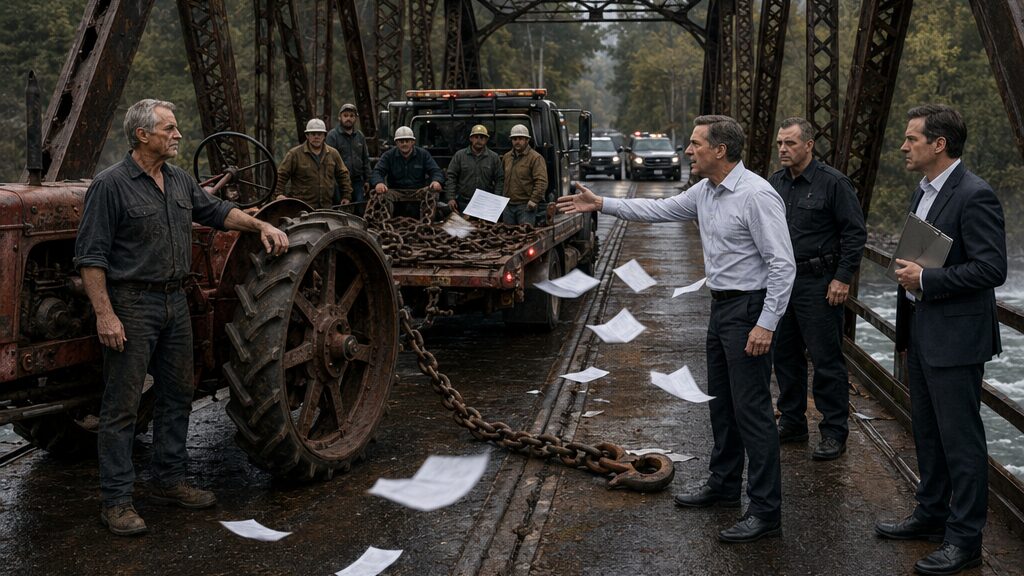
Patrick shifted into gear and pointed the tractor toward the only bridge.
Chapter 3: One Tractor Across the Only Bridge
The tractor engine died in the exact center of the bridge.
Silence dropped so suddenly that Patrick could hear the river striking the upstream pier.
He removed the key, climbed down, and slipped it into his pocket.
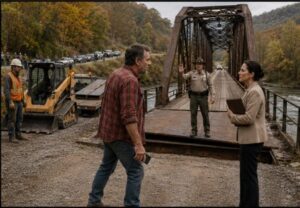
The tractor sat crosswise where the bridge narrowed between the reinforced rails. Its broad rear wheel stopped inches from the western beam. The front axle angled toward the eastern side. No truck could pass. A person might squeeze beside it, but one wrong step would send them over the rail into fast water.
Ryan’s convoy remained trapped on the county-road side.
Patrick stood beside the rear wheel.
Ryan marched onto the bridge with Justin and Samuel behind him.
“What are you doing?” Ryan demanded.
“Parking.”
“You are obstructing a lawful entry.”
“Yes.”
Justin lifted the clipboard. “State that again.”
Patrick looked at him. “The bridge is closed.”
Ryan pointed toward the tractor seat. “Move it.”
“No.”
“You just turned a civil matter into criminal obstruction.”
Patrick rested one hand on the iron wheel. The metal was warm from the engine.
“No,” he said. “You did that when you brought a demolition crew under false parcel numbers.”
Ryan laughed once, sharp and disbelieving. “You think an antique tractor outweighs a court order?”
“It weighs six thousand three hundred pounds with fuel.”
“That was not the question.”
“It matters more to this bridge.”
The tow truck driver had climbed down and was studying the approach. Behind him, two contractors began pulling the rusted chain from the bed. Each link landed on the road with a heavy clank.
Patrick’s receiver clicked.
Sarah’s voice came low against his ear.
“What did you do?”
He kept his face still.
“Patrick, answer without touching the transmitter.”
He shifted his stance and looked toward the road as if measuring distance.
“State units are twenty minutes away,” Sarah said. “You were told not to create a physical standoff.”
Twenty minutes.
Ryan stepped close enough to smell Patrick’s engine grease.
“You have thirty seconds to produce the key.”
Patrick said, “Your tow truck can’t pull from that angle.”
Ryan stared at him.
“The western truss takes straight weight,” Patrick continued. “Side load transfers into the old abutment. You hook that tractor and pull from the road, you’ll twist the frame before you move the rear axle.”
Justin smirked. “Convenient.”
Patrick pointed beneath the bridge. “There are new braces under the center span and original bolts at the west seat. I replaced two after the spring flood. You want to check, crawl down there.”
“No one is crawling anywhere,” Ryan said.
Samuel approached the western rail and looked over it. The drop was more than twenty feet. The water below folded brown and white around exposed stone.
“Could the bridge fail?” he asked.
Patrick answered him, not Ryan. “A hard lateral pull could crack the seat or shear an anchor. Maybe it holds. Maybe one side drops.”
Samuel looked back at the tow truck.
Ryan caught the hesitation.
“This bridge has carried loaded grain trucks.”
“Straight across,” Patrick said. “Not sideways.”
“The county engineer cleared access.”
“Show me the report.”
Justin slapped the clipboard with his palm. “You do not get to demand every supporting record before obeying an order.”
Patrick’s collar felt damp beneath the hidden microphone. Ryan had said county engineer, but not enough. Sarah needed direct connections—names, instructions, intent.
He had put the tractor on the bridge before her teams were ready. That mistake was his. Now he needed time without appearing to need it.
Patrick turned toward the demolition markings.
“You already marked the bridge before serving me.”
Ryan’s eyes flicked toward the blue paint.
Justin answered too quickly. “Preliminary assessment.”
“Assessment for demolition?”
“For authorized site preparation.”
“Under Parcel 18-C.”
Ryan stepped between them. “Enough.”
Patrick looked past him at the contractors dragging the chain closer.
“You promised somebody this bridge would be open today.”
Ryan’s face changed by a fraction.
Patrick saw it.
The financing deadline. The investors. Whatever held the project together, it was close enough to make Ryan arrive in person.
“You’re stalling,” Ryan said.
“So are you.”
“For what?”
Patrick gave him nothing.
The receiver clicked again.
“Do not let them attach that chain,” Sarah said. “But do not expose the operation. We are moving.”
A contractor walked onto the bridge carrying the massive steel hook in both hands. Rust flaked from the chain behind him.
Samuel raised one palm.
“Hold up.”
Ryan turned. “Deputy?”
“I want the load plan clarified before anybody tensions that line.”
Ryan stared at him as if Samuel had spoken out of rank.
“The load plan,” Samuel repeated. “If Harris is right about structural risk, we need a county engineer.”
“You have an authorized contractor.”
“I have a tow operator.”
The driver lifted both hands, unwilling to inherit the argument. “I can pull it,” he said. “Question is what I’m pulling against.”
Patrick nodded toward the tractor. “Rear housing is cast iron. Hook the wrong point, you break the tractor before it rolls.”
Ryan looked from the chain to Patrick.
Then he smiled.
It was not confidence. It was the relief of a man finding a way to make someone else responsible.
“If the equipment is damaged during lawful removal,” he said, “the owner bears the loss.”
Patrick’s receiver went silent.
Sarah was listening.
Patrick said, “And if the bridge fails?”
“It won’t.”
“You were just told it might.”
Ryan glanced at the contractors, deputies, and idling vehicles behind him. Retreat would be public now. He had built the moment too large to step away from it.
“This project has been reviewed for months,” he said. “One farmer does not get to manufacture a safety concern on enforcement day.”
“Months,” Patrick repeated. “Before the order was signed?”
Justin’s gaze snapped toward Ryan.
A small opening.
Ryan closed it.
“Attach the chain.”
Samuel moved into his path. “I haven’t authorized that.”
“You are here to preserve the peace, not manage equipment.”
“I am also not standing on a bridge while someone knowingly risks dropping it.”
For the first time that morning, Patrick felt the balance shift—not toward him, but away from Ryan.
It was small. Not enough.
Ryan stepped off the bridge and raised his voice.
“Proceed.”
The contractor hesitated, then obeyed.
He dragged the chain along the steel deck. The links scraped over old paint and left orange dust behind. At the tractor, he bent near the rear housing.
“Not there,” Patrick said.
The man paused.
“You hook that lift arm, it can snap upward.”
Ryan shouted, “Ignore him.”
The contractor moved the hook lower, searching for purchase beneath the axle.
Patrick remained beside the wheel. Every instinct told him to step forward, take the hook, stop the work before iron met iron.
But twenty minutes had become perhaps fifteen.
Ryan stood close enough for the microphone.
Patrick let the contractor work.
The hook caught around the tractor’s rear frame.
The chain ran back across the bridge to the tow truck, a rusted line stretched between Ryan’s deadline and Patrick’s land.
The driver climbed into his cab.
Samuel swore under his breath.
“Do not tension it,” he called.
Ryan raised one hand toward the driver.
Patrick felt the bridge beneath his boots, steady for now. He pictured the western bolts, the old concrete seat, the reinforcement plate his father had installed after the flood of 1987.
The tow truck engine deepened.
Slack slid from the chain link by link.
Then the massive steel hook slammed against the tractor’s iron frame.
The sound rang across the river like a struck bell.
The chain lifted from the bridge deck and took the first inch of tension.
Chapter 4: The Admission Hidden Inside the Threat
The chain stopped tightening, but Sarah’s voice came through Patrick’s receiver with no relief in it.
“We still do not have enough.”
Patrick kept his eyes on Ryan.
The tow truck idled at the road end of the bridge. Rusted links hovered above the steel deck, stretched straight to the hook beneath the tractor. One pull would turn the entire span into a test nobody had approved.
“What do you need?” Patrick asked, making the words sound directed at Ryan.
Ryan mistook them for surrender.
“I need the key.”
Sarah answered in Patrick’s ear.
“We need him to connect the seizure order to the rezoning. His own words. Not Adams speaking for him. Not another county employee.”
Patrick rubbed his jaw as if considering Ryan’s demand.
Six months earlier, the first microphone Sarah had clipped beneath his shirt had felt heavier than any tool he owned. Since then, Patrick had carried conversations out of hardware stores, county offices, diners, and public meetings. He had recorded Ryan’s aides discussing assessments that changed overnight. He had heard contractors joke about parcels becoming cheap after tax notices arrived.
Every recording pointed in the same direction.
None had Ryan standing at the center of it.
Patrick looked at the forged papers trapped against the bridge rail by the wind.
“You brought all this before the appeal period expired,” he said.
Justin stepped in. “There is no appeal period applicable to emergency possession.”
“I wasn’t asking you.”
Ryan gave Justin a brief glance.
Patrick saw the opening and widened it.
“You promised the investors this parcel before any hearing,” he said. “That is why the demolition mark was already on my bridge.”
Ryan’s face tightened. “The project was approved.”
“The public hearing was next month.”
“The development agreement was approved.”
“Not possession.”
Ryan took another step onto the bridge. “You have confused procedure with reality for years. Reality is the town is dying. Stores close. Young people leave. Roads crumble because there is no revenue to fix them.”
“You said the county engineer cleared this bridge.”
“He did.”
“What engineer?”
Justin cut in again. “This is irrelevant.”
Patrick did not look at him.
Ryan’s voice rose. “The office handled it.”
“What office changed Parcel 18-A to 18-C?”
The contractors had gone quiet. Even the tow truck driver leaned toward his open window.
Ryan glanced back at them, aware of the audience now.
“You think records fall from the sky?” he said. “County staff correct classifications every day.”
“Correct them before or after you tell them what the project needs?”
A warning clicked softly in Patrick’s receiver.
“Careful,” Sarah said.
Patrick ignored it.
Ryan laughed, but there was no humor left.
“You were offered more than fair value. Margaret Lopez was offered fair value. Everyone along this corridor was given a chance to participate.”
The name struck harder than the papers had.
Patrick’s left hand moved toward his collar before he stopped it.
Margaret’s old kitchen table flashed through his mind. Her letter unfolded between them. The boundary map she had asked him to confirm. His own promise to come to the hearing.
Then the morning of the hearing, when he had stayed home and repaired a fence that did not need repairing.
Patrick forced his attention back to Ryan.
“You call what happened to Margaret participation?”
“She signed.”
“After the tax lien.”
“That was a separate matter.”
“The lien appeared three weeks after she challenged the boundary change.”
Ryan’s jaw worked.
Justin stepped closer to him. “We should discontinue this conversation.”
Patrick heard Sarah breathe in his ear.
Ryan did not like being advised to retreat. Not in front of deputies. Not in front of men he had hired.
He pointed toward Patrick’s fields.
“You farmers act as if land records are sacred scripture. They are administrative tools. The county planning office corrected obsolete agricultural designations so the district could qualify for redevelopment funding.”
Patrick said nothing.
Ryan continued, pulled forward by his own need to justify himself.
“Without consolidated commercial access, the financing disappears. Without financing, there are no jobs, no tax base, no road improvements. We made the classifications match the approved use.”
Samuel’s head turned.
“Made them match?” he asked.
Ryan looked at him. “Corrected them.”
“Before the rezoning vote?”
Justin answered. “Deputy, this is outside your assignment.”
Patrick saw Samuel’s expression change. He had spent the morning trying to stand between duty and doubt. Ryan had just moved the ground beneath him.
Patrick said, “So county staff altered my parcel because your investors needed access.”
Ryan looked at him with open contempt.
“They did what was necessary to implement a lawful development plan.”
It was close.
Not enough.
Sarah confirmed it.
“Good,” she said. “Keep him on the order.”
Patrick let his shoulders drop slightly, giving Ryan the appearance of progress.
“Then show me the filed order,” he said.
Justin held up the papers. “It is in your hand.”
“No seal. No case number. No appeal notice.”
“The judge signed it.”
“Did the judge know the parcel number came from your corrected records?”
Justin’s mouth closed.
Ryan answered for him.
“The judge reviewed what was submitted.”
“By Justin?”
“The county’s legal representatives handled the submission.”
“Under your instruction?”
Ryan stepped nearer.
“You are trying to turn a technical process into a scandal because you cannot accept that this land has greater value than what you use it for.”
Patrick’s receiver warmed against his skin.
“Did you tell Justin to prepare that order before the hearing?”
Justin moved sharply.
“That question has been answered.”
“No,” Patrick said. “It hasn’t.”
Ryan stared at him.
The river hammered below. The tow truck’s engine pulsed through the chain, a faint vibration traveling into the tractor frame.
Patrick felt another warning from Sarah.
“Do not force it too quickly.”
He had already forced too much.
Ryan looked at his watch again. The gesture was small, almost involuntary.
Patrick followed it.
“What happens at noon?” he asked.
Ryan’s eyes lifted.
“Your deadline.”
“No. Yours.”
Justin stepped between them.
“That is enough. Deputy Baker, remove him from the bridge.”
Samuel did not move.
Justin turned. “He is obstructing entry under a signed order.”
“I am still reviewing the situation.”
“You are not counsel.”
“No,” Samuel said. “I am the man being asked to arrest someone under paperwork I have not verified.”
Ryan’s face hardened.
Patrick saw Justin glance toward his collar.
Not at his face.
At the collar.
Patrick’s pulse changed.
He had touched it when Ryan said Margaret’s name. Once. Maybe twice.
Justin’s eyes narrowed.
“What are you wearing?” he asked.
Patrick did not answer.
Justin took one step forward.
Sarah’s voice sharpened.
“Patrick, disengage. Now.”
Justin raised the metal clipboard between them.
“Deputy, search him.”
Samuel frowned. “On what grounds?”
“He is recording a privileged legal enforcement.”
Patrick said, “There is nothing privileged about threatening a man on his own bridge.”
Justin moved closer, the clipboard held higher now, no longer as paperwork but as a hard-edged shield.
Ryan pointed toward Patrick’s shirt.
“Search him.”
Samuel still did not move.
Justin’s fear turned into decision.
He reached for Patrick’s collar.
Patrick caught his wrist.
For one suspended second, both men stood beside the tractor wheel, Justin’s arm trapped between them and the metal clipboard raised above Patrick’s face.
Then Justin twisted free and swung it.
Chapter 5: The Metal Clipboard Against the Wheel
Patrick caught Justin’s wrist inches before the clipboard struck his temple.
The force drove both men against the tractor’s rear wheel. Iron pressed into Patrick’s shoulder. Justin’s face went white with effort and surprise.
“Let go,” Justin hissed.
Patrick twisted the wrist outward.
The clipboard fell halfway, still hooked in Justin’s fingers.
Patrick tore it free.
He could have thrown it into the river.
Instead, he turned and slammed it flat against the tractor wheel.
Metal cracked against iron.
The clipboard folded perfectly across its center, the upper half bending until it touched the lower. Papers burst loose and spiraled around their boots.
Nobody spoke.
Patrick held the ruined clipboard in one hand.
“That,” he said, “was your warning.”
Justin backed away, clutching his wrist.
Samuel stepped between them with one hand near his holster.
“Both of you stop.”
Patrick dropped the bent clipboard onto the bridge deck.
Justin pointed at him. “You saw that. Arrest him.”
“I saw you swing first,” Samuel said.
“He assaulted counsel during lawful enforcement.”
“I said stop.”
The younger deputy moved closer, uncertain where to stand.
Ryan looked less concerned about Justin than about the men watching. His lawyer had just been disarmed by the farmer he had called obsolete. The contractors no longer looked amused.
Patrick’s receiver hissed with Sarah’s voice.
“Reveal now. Tell Baker you are cooperating with the state.”
Patrick stared at the chain.
Not yet.
If he revealed the wire now, Sarah would move in before Ryan gave the final connection. The recordings would show fraud around him, pressure beneath him, altered records serving his project.
But Ryan would still claim aides acted without his knowledge.
Patrick had spent six months listening to men step carefully around his name.
He would not stop one sentence short.
“Patrick,” Sarah said, reading his silence. “Do not make this worse.”
He had not carried the emergency signal she had issued.
Sarah had told him to keep it in his left pocket: a small transmitter he could press without speaking if he was searched or threatened. Patrick had left it on the kitchen table that morning.
He had told himself it might activate by accident during farm work.
The truth was simpler.
He had feared Sarah would pull him out before Ryan crossed the line.
Now Justin’s papers lay scattered under the tractor, and the chain remained tight enough to hum.
Patrick raised both hands where Samuel could see them.
“I am done touching him.”
Justin laughed bitterly. “How generous.”
Patrick looked directly at the younger deputy’s body camera.
“That bridge cannot take a sideways tow safely. The western seat is old concrete. The anchor assembly was repaired after flood damage, and the pull angle transfers weight toward the river rail.”
Ryan threw up one hand. “We have heard this performance.”
Patrick kept speaking to the camera.
“If that driver pulls, everyone standing on this span is at risk.”
Samuel followed Patrick’s gaze to the camera and understood why he had phrased it so carefully.
“Tow stays stopped,” Samuel said.
Ryan turned on him. “You do not have authority to suspend execution.”
“I have authority to prevent an unsafe act.”
“The county sent you here to keep order.”
“I am keeping it.”
Ryan’s expression sharpened into something colder than anger.
“Your department requested three new vehicles in next year’s county budget.”
Samuel went still.
The younger deputy looked at him.
Ryan stepped closer.
“That request is on my committee.”
There was no mistaking the pressure now.
Samuel’s face reddened, but his hand dropped away from his belt.
“You should not have said that,” he replied.
Ryan smiled thinly. “I am reminding you that government works through cooperation.”
Patrick heard Sarah clearly this time.
“We have that. Stay back. Do not provoke him further.”
But Ryan had not yet admitted the forged order.
Justin bent to gather the papers. His fingers shook, whether from pain or fear Patrick could not tell.
Patrick looked at the bent clipboard between them.
“Government also works through filed documents,” he said. “Where is the original?”
Ryan spun toward him.
“You have been given an order.”
“A copy with no seal.”
“You are not entitled to delay an approved project over clerical formatting.”
“So it is formatting now?”
Justin rose with a handful of papers pressed against his chest.
“Do not answer him.”
Ryan ignored him.
“The legal work was completed.”
“By Justin?”
“You know it was.”
“Under whose authority?”
Ryan’s mouth tightened.
Patrick saw the answer behind his eyes and knew Ryan saw the trap as well.
For a moment, neither spoke.
Then the tow truck driver climbed down from his cab.
“I’m not pulling while people are standing there,” he said.
Ryan turned. “Get back in the truck.”
“I said I can pull it. I didn’t say I’d pull a bridge apart.”
“You are contracted to remove an obstruction.”
“Contract doesn’t cover killing anybody.”
Ryan walked off the bridge toward him.
Patrick watched the change in Ryan’s stride. The careful public official was gone. What remained was a man watching a deadline collapse in front of employees, officers, and witnesses.
Ryan stopped at the edge of the road.
“You will perform the job you were paid to perform.”
The driver folded his arms. “Not until the bridge is cleared.”
“Then clear it.”
“With what?”
Ryan pointed at Patrick.
“Deputy Baker, arrest him for obstruction. Remove him and secure the key.”
Samuel did not move.
Ryan’s voice rose. “That is a direct request from the county official overseeing this enforcement.”
“I need the original order verified.”
“You were told it was verified.”
“By your office.”
“By the county.”
“You keep using those as if they mean the same thing.”
The contractors shifted farther from the bridge entrance.
Patrick felt the standoff narrowing. Every person present was being forced to choose where authority ended and responsibility began.
Ryan made his choice first.
He climbed onto the tow truck’s side step and leaned into the cab.
“Pull the tractor.”
The driver shook his head.
Ryan pointed toward one of the contractor supervisors. “You know how to operate this?”
The supervisor hesitated.
“It is a hydraulic winch,” Ryan said. “Not an aircraft.”
Justin called from the bridge, “Ryan, stop.”
That was the first time he had used Ryan’s name without title or deference.
Ryan looked at him.
Justin held the bent clipboard against his chest, suddenly less aggressive than frightened.
“The record is becoming difficult,” he said.
Patrick almost laughed at the phrase.
Ryan did not.
“The record,” he said, “will show a landowner attacking counsel and refusing a lawful order.”
He turned to the contractor supervisor.
“Get in.”
The man looked at the chain, then at the river.
Ryan lowered his voice, but the bridge carried it.
“If this site is not under possession today, the financing dies. Every one of you loses the next eighteen months of work.”
That landed differently.
The contractors stopped shifting away. One looked toward the fields. Another toward the tow truck.
Ryan had reached the part of his justification that was true. Men had been promised paychecks. The town had empty storefronts. The project had become a machine with many people attached to it, most of them knowing only the piece in front of them.
The supervisor climbed into the cab.
Samuel stepped forward.
“I am ordering you not to tension that line.”
Ryan pointed at Patrick.
“And I am ordering you to arrest him.”
Samuel looked at the younger deputy, then at Patrick.
Patrick could end it.
He could open his collar, show the microphone, say Sarah’s name.
Instead, he looked at the western bridge seat.
The chain lifted another fraction.
He understood then what his stubbornness had done. He had treated the bridge like an extension of himself—something that could bear whatever pressure he chose to endure. But Samuel stood on it. Justin stood on it. The younger deputy stood on it. Even Ryan’s contractors, however willing, stood within reach of its failure.
Patrick had not kept the danger to himself.
The tow engine revved.
“Everybody off the span,” Samuel shouted.
Ryan raised his hand toward the cab.
The chain straightened with a violent snap.
A metallic pop came from beneath the western rail.
Patrick knew the sound before anyone else did.
One of the anchor bolts had sheared.
Chapter 6: Six Months Recorded Beneath His Collar
Patrick climbed onto the tractor wheel as the chain tightened and put his body between the rear housing and the bridge rail.
“Stop the winch!”
The contractor in the cab either did not hear or had decided not to.
The tractor shifted less than an inch.
The bridge answered with a deep groan.
Samuel shoved Justin toward the road.
“Off the span. Now.”
The younger deputy grabbed the loose papers before abandoning them, then let them go when another bolt rattled across the deck. Pages lifted around him and sailed toward the river.
Patrick leaned over the wheel and reached beneath the tractor seat.
The hydraulic line attached to the rear lift assembly ran inches above the chain hook. If the winch kept pulling, the hook might tear through the housing before the tractor rolled.
His receiver crackled.
“Patrick, signal us.”
He had no transmitter.
Sarah did not know that.
“Ryan,” Patrick shouted, keeping his voice aimed toward the microphone. “Tell him to stop.”
Ryan stood at the road end of the bridge, face flushed.
“Give them the key.”
“The key does not release the chain.”
“It moves the tractor.”
“Not under tension.”
“Then release it.”
Patrick looked toward the cab.
The winch slowed but did not stop.
Samuel planted himself between Ryan and the bridge.
“Nobody touches that control again until I see an original court order.”
Ryan stared at him.
“You are refusing a lawful directive.”
“I am refusing to let you drop four people into the river.”
“The bridge is safe.”
“You heard Harris say it was not.”
“Harris is manufacturing a crisis.”
A second groan moved through the western truss.
Patrick felt it through the wheel.
Samuel held out his hand.
“The original order. Now.”
Justin stood several yards away, breathing hard, his folded clipboard hanging at his side.
He looked at Ryan.
Ryan looked back.
The silence between them was the first honest thing either had offered all morning.
Samuel saw it.
“There is no original, is there?”
Ryan’s expression closed.
“The county attorney’s office prepared the necessary documentation.”
Justin spoke quickly. “The papers reflect a valid administrative action.”
“Filed where?” Samuel asked.
Justin did not answer.
Patrick climbed higher onto the wheel, giving himself a clear path to the hydraulic release lever.
“Who told him to make them?” he called.
Ryan pointed toward him.
“You are done speaking.”
“No,” Patrick said. “You came to my bridge with a copied signature, a false parcel number, and men paid to cross before noon. Who told Justin to make the order?”
Ryan turned to Samuel.
“Arrest him.”
Samuel did not move.
Ryan’s voice sharpened.
“I secured your department’s equipment allocation. I protected your staffing request. You will not stand there and sabotage a project that keeps this county solvent.”
Samuel’s face changed—not fear now, but disgust.
“You expect me to arrest him because you helped our budget?”
“I expect you to enforce what the county put in front of you.”
“What you put in front of us.”
Ryan stepped close enough that the microphone under Patrick’s collar caught every word.
“Yes. What I put in front of you. Because waiting another month would have killed the financing.”
Justin said, “Ryan.”
But Ryan had crossed into the place Patrick had spent six months trying to reach.
He could no longer retreat without admitting weakness.
“The judge never authorized emergency possession,” Patrick said.
Ryan looked at him.
“You do not know what the judge authorized.”
“I know there is no filed order.”
“The signature is sufficient.”
“A copied signature Justin placed on it?”
Justin’s face emptied.
Sarah’s voice cut through Patrick’s receiver.
“Keep him talking.”
Ryan laughed once, harshly.
“You think judges type their own orders? Adams prepared it. The signature was already on the county template.”
Samuel stared at him.
“You used a template?”
Ryan realized too late how much he had said.
Justin stepped backward.
Patrick pressed.
“And the false parcel number?”
Ryan pointed at the fields.
“The planning staff changed the classification because the development agreement required consolidated access.”
“Before the vote.”
“Before your obstruction cost this county millions.”
“You ordered them to change it.”
“I ordered them to make the records reflect the project the county had already committed to.”
There it was.
Patrick felt no triumph.
Only the cold release of something held too long.
Sarah’s voice came softly.
“We have it.”
But the chain tightened again.
The contractor in the tow cab had leaned on the control, perhaps from panic, perhaps because Ryan had signaled him.
The tractor lurched.
Patrick’s boot slipped on the iron wheel.
The western rail dipped toward the river.
Samuel shouted and ran for the cab.
Patrick dropped to one knee and reached behind the wheel. His fingers found the hydraulic release housing. The lever was pinned by pressure.
He pulled once.
Nothing.
The chain shrieked against the tractor frame.
Below them, brown water opened between the rail and the shifting deck.
Patrick braced one boot against the axle and struck the release with the heel of his hand.
Still nothing.
For years he had taught himself that endurance was a form of control. If he carried enough alone, nothing could be taken from anyone else.
Margaret had once asked him for one sentence at a hearing.
He had kept it.
Now Samuel was running toward a machine under load. A contractor was trapped behind a control he did not understand. Sarah was somewhere beyond the bend, waiting for a signal Patrick had chosen not to carry.
The cost of his silence had never belonged only to him.
Patrick stopped pulling.
He took the tractor key from his pocket and drove its metal edge into the release catch.
The lever dropped.
Hydraulic pressure dumped with a hard hiss.
The rear lift arm collapsed downward, throwing the steel hook loose from its angle. The chain snapped toward the deck and struck sparks from the iron.
The tow truck rocked backward.
The tractor settled.
Samuel reached the cab and tore open the door.
“Hands off the controls!”
Patrick slid from the wheel, landing badly on one knee.
His collar had torn open.
The small black microphone showed against his shirt.
Justin saw it first.
His lips parted.
“You recorded us.”
Patrick stood slowly.
“For six months.”
Ryan’s face lost all expression.
Patrick touched the exposed microphone.
“Sarah,” he said aloud. “Come in.”
The answer arrived as engines.
From the county road behind Ryan’s convoy, black state vehicles rounded the bend in a tight line. At the same moment, more appeared beyond Patrick’s fields on the far approach, sealing both ends of the property.
Doors opened before the vehicles fully stopped.
Investigators in plain clothes moved toward the bridge.
Sarah Torres emerged from the lead car, one hand raised.
“Ryan Miller,” she called, “step away from the protected witness.”
Ryan looked behind him, then across the river.
There was no open road left.
Justin dropped the bent clipboard.
Samuel pulled the rusted chain away from the tractor and kicked the hook flat against the deck.
Ryan found his voice.
“This is entrapment.”
Sarah stopped at the bridge entrance.
“No one instructed you to forge an order, alter parcel records, pressure a deputy, or authorize a dangerous tow.”
Ryan looked at Patrick.
“You planned this.”
Patrick wiped blood from his knee with the back of his hand.
“I parked a tractor.”
Sarah’s investigators moved around Ryan and Justin. One secured the tow truck cab. Another began separating the contractors for statements.
The younger deputy retrieved a sheet caught against the bridge rail and handed it to Sarah.
Ryan’s copied order fluttered in her hand.
Samuel said, “My body camera recorded the tow command.”
Sarah nodded once.
Ryan turned toward him.
“Samuel, think carefully.”
Samuel looked at the snapped bolt near his boot.
“I am.”
An investigator took Ryan’s arm.
The handcuffs closed with a clean metallic click.
A gust came off the river and lifted the remaining fraudulent pages from the bridge. They scattered over the rail, white against the brown water, and vanished beneath the span.
Patrick watched them go.
Behind him, the tractor remained in the center of the bridge, scarred where the steel hook had struck but unmoved.
Sarah approached and looked at his torn collar.
“You left the emergency transmitter in the house.”
It was not a question.
Patrick met her eyes.
“Yes.”
Anger crossed her face, followed by something more tired.
“You nearly brought the bridge down.”
“I know.”
“You nearly brought all of us down with it.”
Patrick looked at Samuel, then at the contractors being led away from the chain.
“I know that too.”
Sarah held his gaze a moment longer.
Then she turned toward the investigators.
“Secure every recording. No local routing. Notify the judge’s office and state records division.”
Patrick said, “And the other parcels.”
Sarah looked back.
“The case begins here.”
“No. It began before mine.”
He thought of Margaret’s letter, still folded in the kitchen drawer where he had hidden it from everyone except himself.
Sarah followed his expression, but did not press.
“Then you will have to decide how far you are willing to take it.”
Patrick looked across the bridge at Ryan standing in handcuffs on the road he had intended to seize.
For six months, Patrick had believed the final truth would be whatever the microphone captured.
Now he understood there was one statement left that no wire could make for him.
Edit
Chapter 7: What Remained After the Convoy Left
Margaret Lopez arrived carrying the letter Patrick had never answered.
She stood at the edge of his porch with the envelope held between two fingers, its folds worn pale and its stamp canceled nearly four years earlier. Patrick recognized his own name before she turned it toward him.
He had written nothing on the envelope. Not even a date.
His silence had preserved it better than any reply would have.
“The state called me,” Margaret said. “They said you had evidence.”
Patrick set down the drill he had been using on the porch fence.
Behind her, the bridge was open again. Temporary steel plates reinforced the damaged western seat, and orange barriers narrowed traffic to one lane. The tractor stood near the barn, its rear housing scraped where the hook had struck. It had started that morning without complaint.
Patrick looked at the letter.
“I still have my copy of your map.”
“I didn’t ask about the map.”
“No.”
Margaret climbed the porch steps but did not sit. Her hair had gone mostly silver since Patrick last saw her at the county building. The years had sharpened her face rather than softened it.
“You promised to testify,” she said.
“I know.”
“You said you remembered where the old boundary ditch ran.”
“I did.”
“You said the survey line was wrong.”
“It was.”
“And then you stayed home.”
Patrick nodded.
Margaret held out the letter.
He took it.
The paper was soft at the creases. He did not need to open it. He remembered every line: the tax lien, the altered parcel number, the hearing date, her request that he tell the board what he knew.
He had convinced himself his testimony would not change the result. He had told himself Ryan’s people might come for his land next if he interfered.
Both things had been true enough to hide behind.
“They told me your recordings could reopen the cases along the corridor,” Margaret said. “Not just yours.”
“They can.”
“Can, or will?”
“That depends on what I give them.”
Her eyes narrowed.
“What are you considering keeping?”
“Nothing.”
“Then why did they say you had to decide?”
Patrick folded the letter along its oldest crease.
“Because the charges tied to my farm are clean. Forged order. altered records. coercion. The rest takes more.”
“More evidence?”
“More from me.”
Margaret waited.
Patrick looked past her toward the bridge. A fragment of fraudulent paper remained caught high in the riverbank roots, too far above the current to wash away. He had considered climbing down to remove it.
He had left it there.
“I knew the boundary change on your property was false,” he said. “I knew before your hearing.”
Margaret’s mouth hardened.
“You knew when I asked you.”
“Yes.”
“And if you say that now?”
“The state can show the county had notice the original boundary still existed. They can compare my records with the later classifications.”
“And they can ask why you said nothing then.”
“Yes.”
“What will you tell them?”
“The truth.”
Margaret gave a small, tired laugh.
“You make that sound new.”
Patrick accepted it.
From the county road came the low sound of a cruiser. Samuel Baker parked near the temporary barriers and walked across the bridge carrying a sealed evidence bag.
His uniform looked the same, but he moved differently on the span. He stopped once to examine the repaired rail before continuing.
Margaret glanced at him.
“Am I supposed to trust the sheriff’s office now?”
“No,” Samuel said as he reached the porch. “You are supposed to examine what we recorded.”
He held up the bag. Inside was the broken anchor bolt recovered from the bridge deck.
“My body camera captured Miller ordering the tow after Harris warned him about structural failure,” Samuel said. “The younger deputy’s camera captured Adams admitting the papers came from a county template.”
Margaret looked at Patrick.
“That saves your farm.”
“It helps save it,” Patrick said.
Samuel set the evidence bag on the porch rail.
“The Attorney General’s office is preparing broader warrants. They asked Harris to sign a statement about the earlier boundary disputes.”
Margaret’s gaze returned to the letter in Patrick’s hand.
“And has he?”
“Not yet.”
Patrick went inside.
On the kitchen table waited the statement Sarah had delivered that morning. Twelve pages. Each paragraph turned memory into language formal enough to survive challenge.
He carried it onto the porch with a pen.
Margaret watched him place it beside the old letter.
“You want me to forgive you because you sign something now?” she asked.
“No.”
“You want me to say you made it right?”
“No.”
“Then what do you want?”
Patrick opened the statement to the signature page.
“I want what I know to stop belonging only to me.”
He signed.
The pen dragged slightly where his hand tightened, but the name remained legible.
Samuel witnessed it, then signed beneath him.
Patrick closed the pages and handed them over.
“This includes the recordings?” Samuel asked.
“All of them.”
“Sarah said you could limit consent to the seizure investigation.”
“I know.”
Margaret looked toward the fields.
Her family’s property lay beyond the ridge, though it no longer carried their name. A storage yard occupied the pasture where her father had raised cattle. Patrick had driven past it only twice since the sale.
“Reopening a case doesn’t give land back,” she said.
“No.”
“It doesn’t erase the lien.”
“No.”
“It doesn’t return the years.”
Patrick folded her letter once more, carefully.
“No.”
She studied him as if waiting for a defense.
He offered none.
At last, she took the signed statement from Samuel and read the first page. Her eyes moved slowly over the lines. When she reached the section describing the old ditch and the original survey markers, she stopped.
“You remembered all of it.”
“Yes.”
“That makes it worse.”
“I know.”
Margaret closed the document.
“I’ll give them my records,” she said. “But I’m not ready to tell you this fixes anything.”
Patrick met her eyes.
“I didn’t sign it for that.”
She placed the old letter on the table between them.
“Keep it,” she said. “You may need to remember what waiting costs.”
Then she walked back across the bridge.
Samuel remained on the porch.
After a while, he said, “The department suspended everyone assigned through Miller’s office pending review.”
Patrick looked at him.
“You?”
“I requested it.”
“You did not forge the order.”
“I carried it.”
Samuel picked up the evidence bag.
“I spent too long believing verification was somebody else’s job.”
Patrick understood the shape of that sentence.
Neither man tried to lessen it.
When Samuel left, Patrick returned to the fence.
He had recovered the broken survey instrument from the grass near the bridge: one splintered leveling rod, the cracked sight from a contractor’s tool, and two bent marker brackets. He bolted the pieces to the porch fence facing the road.
Below them, he mounted Justin’s folded metal clipboard.
The crease made both halves touch like closed jaws.
He considered adding a sign.
He did not.
Anyone who had seen the convoy would understand. Anyone who had not could ask.
Patrick tightened the final bolt, then carried his tools back to the barn.
The tractor waited where he had left it.
He ran one hand over the scrape in its iron housing. The damage would remain. Repairing it would require grinding away good metal merely to make the scar disappear.
Patrick climbed into the seat and started the engine.
The old machine rolled toward the lower field, crossed the bridge slowly, and returned to work.
Behind him, the broken survey pieces stirred in the river wind. The bent clipboard struck the fence once, producing a hard, hollow note that traveled down the road.
The story has ended.