She Fined Their Folding Chairs, So Shirley Built a Reading Porch Beyond Her Reach
Chapter 1: The Fine Beneath the Association Binder
Margaret Wilson slid the violation notice across the table before she said what Shirley Mitchell had supposedly done.
The paper stopped against Shirley’s folded hands.
“Three hundred dollars,” Margaret said. “Due within thirty days.”
The association meeting room was too small for the number of chairs it held. Six gray plastic seats stood against one wall, all empty. A fluorescent panel buzzed overhead. Behind Margaret, a framed aerial photograph of Briar Glen showed identical roofs arranged around a pond that looked bluer than it ever had in real life.
Shirley did not touch the notice.
“For what?”
Margaret rested one palm on the thick black association binder. She wore a lavender cardigan buttoned to the throat, though the room was warm. Her expression had the practiced patience of someone who expected resistance and considered it proof of guilt.
“An unpermitted recurring assembly with commercial characteristics.”
Shirley looked down at the paper.
The notice included a photograph taken from the sidewalk outside her house. Through the front window, one folding chair was visible near the bookshelf. A white rectangle had been drawn around it. Beneath the image, someone had typed: TEMPORARY SEATING ASSOCIATED WITH RECURRING ACTIVITY.
She read the sentence twice.
“Commercial characteristics,” she said.
“Yes.”
“We drank tea.”
Margaret’s mouth tightened. “That is not the only issue.”
Ninety days earlier, eight people had sat in Shirley’s living room with paperbacks balanced on their knees. Heather Clark had brought lemon cookies in a dented tin. Someone had filled the kettle too high, and when it began rattling on its base, they had laughed because nobody wanted to interrupt the argument over whether the ending of the novel was hopeful or cruel.
The book had cost Shirley two dollars at a yard sale. The cover was creased, three pages had penciled notes in the margins, and the former owner had written a grocery list inside the back flap.
There had been no cash box. No merchandise. No fee.
Only folding chairs because Shirley owned four dining chairs and eight people had come.
She raised her eyes to Margaret. “Which rule?”
“Section Forty-One.”
“The whole section?”
Margaret tapped the binder with one finger. “No recurring assemblies. No retail activity. No exception for informal arrangements.”
“I’m asking what I violated.”
“I just told you.”
“No. You listed two categories.”
A faint movement came from the end of the table. Steven Campbell, the HOA treasurer, sat with a yellow legal pad in front of him. He did not look up. Two other board members studied their copies of the agenda.
Margaret opened the binder and turned to a tab marked 41. She read aloud.
“Residents shall not conduct recurring assemblies, retail activity, or organized public events that create parking, traffic, insurance, or nuisance exposure for the association.”
Shirley waited.
Margaret closed the binder.
“That isn’t the whole paragraph,” Shirley said.
For the first time, Steven looked at her.
Margaret’s fingers remained on the cover. “It is the applicable portion.”
“What comes after exposure?”
“This is not a deposition.”
“What comes after it?”
Margaret leaned back. “The board is not required to debate every word with a resident who has already been notified.”
The room went quiet enough for the light fixture to sound louder.
Shirley felt heat climb from the collar of her blouse into her face. She knew the sensation. Years earlier, in conference rooms with developers and lenders, she had learned to keep her hands still while someone twice as loud mistook silence for surrender.
She slid the notice closer.
“You called eight neighbors reading a used book a commercial event.”
“There was repeated attendance.”
“Three meetings.”
“There were chairs visible from the street.”
“There are chairs visible in half the garages on this block.”
Margaret’s expression changed—not much, but enough. The patience disappeared.
“You people sit on the porch for hours,” she said. “Cars come and go. Strangers walk up. It creates the appearance of an operation.”
Shirley looked at Steven again. His pen had stopped moving.
“You people,” Shirley repeated.
Margaret’s cheeks colored. “Book-club people. Don’t distort what I said.”
One of the board members shifted in her seat.
Shirley could have argued. She could have asked why the football watch party two streets over had never received a notice, or why the annual garage sale used temporary signs, tables, and cash without being called retail activity.
Instead, she folded the notice along its existing crease.
“What is the appeal deadline?”
“Ten business days.”
“And I want a complete copy of Section Forty-One.”
“You already received the relevant language.”
“I want the complete section.”
Margaret glanced toward Steven.
He cleared his throat. “Residents are entitled to the governing text cited in an enforcement action.”
Margaret looked at him long enough to make the room uncomfortable.
“Fine,” she said. “It will be emailed.”
Shirley stood. The legs of her chair scraped the tile, a small ugly sound that seemed to please Margaret.
At the door, Shirley turned.
“Who took the photograph?”
Margaret did not answer immediately.
“Compliance documentation is collected by authorized volunteers.”
“Which volunteer?”
“That information is not part of your appeal.”
Shirley nodded once and left.
The evening had cooled by the time she reached home. A white envelope was tucked beneath the brass clip beside her front door.
She knew the association logo before she pulled it free.
The second notice was for two hundred dollars.
VISIBLE TEMPORARY SEATING FROM PUBLIC ROADWAY.
Attached was another photograph. This one showed three folded chairs stacked beside her porch wall, where she had left them after wiping pollen from the seats.
The image had been taken that morning.
Shirley stood on the porch with both notices in her hand. Across the street, a garage door lowered. Farther down, a sprinkler ticked over a lawn in slow, shining arcs.
Heather’s porch light came on next door.
Shirley almost walked over. She could picture Heather reading the notices, growing angry on her behalf, offering tea, saying they would fight it together.
Instead, Shirley went inside and locked the door.
She placed the notices on the dining table, then opened a narrow cabinet beneath the built-in shelves. At the back, behind old tax folders and closing statements, lay a cardboard tube with a cracked plastic cap.
She carried it to the table.
The county map inside was eleven years old. The paper resisted as she unrolled it, trying to curl back into itself. She held one corner down with the kettle and another with the two-dollar novel.
Briar Glen appeared as a clean block of residential parcels bounded by a heavy black line.
Beside the western fence sat an irregular half-acre lot, overgrown now with thistle and scrub oak. It touched the neighborhood. It looked like part of the neighborhood.
But the heavy line bent around it.
Shirley stared at the legal boundary, then at the two notices.
She found a red pen in the drawer and circled the neglected parcel.
Chapter 2: The Half Acre Outside Their Rules
The legal description did not follow the fence.
By seven the next morning, Shirley had checked it three times.
The neighborhood’s western fence ran in a straight cedar line behind six houses, including hers. The recorded plat did not. It jogged east by thirty-six inches before reaching the corner marker, leaving a narrow strip and the entire half-acre parcel outside the association boundary.
She sat at her dining table with her reading glasses low on her nose, the old map spread beneath a current satellite printout. One folding chair stood beside her, opened and facing the table as though someone else might arrive.
No one did.
Heather texted shortly after eight.
Are you all right? I saw Margaret’s car at the clubhouse last night.
Shirley turned the phone facedown.
She told herself she would explain after she knew whether the map still mattered. Before she retired, she had watched experienced people ruin negotiations by speaking too early. A fact was not a fact until it survived the records office, the zoning counter, the title index, and somebody else’s lawyer.
By ten, she was inside the county administration building beneath a sign directing visitors to Planning, Permits, and Land Records.
The clerk at the records counter took the parcel number Shirley had copied from the old plat.
“You looking for ownership or zoning?”
“Both. And any recorded changes to the boundary since 1987.”
The clerk typed, waited, then turned her monitor slightly away before remembering Shirley could not see it anyway.
“Boundary is unchanged.”
“Current owner?”
“Paul King.”
“Mailing address?”
“I can print the public property summary.”
“And zoning?”
“That’s planning.”
Shirley paid for the copies and carried them down the hall.
The zoning clerk was younger than Shirley had expected and wore a county badge clipped to a green lanyard. She entered the parcel number, frowned, and opened a second database.
“This is unusual.”
“Why?”
“It’s C-2.”
“Still active?”
“Looks active.”
“No overlay district?”
“Not on this screen.”
“No residential conversion?”
The clerk shook her head. “The surrounding subdivision was approved around it. Parcel stayed general commercial.”
Shirley kept her face neutral.
“Permitted uses?”
“Retail, office, personal service, food service with conditions. Anything involving customer traffic would require site review.”
“Coffee?”
“Possible.”
“Books?”
The clerk smiled slightly. “The county does not prohibit books.”
Shirley looked down at the printed parcel summary so the clerk would not see the satisfaction rise in her face.
“What about access?”
“That could be the problem. The frontage is narrow. You’d need traffic review, fire access, parking compliance, stormwater, probably a landscape buffer.”
“So not impossible.”
“I didn’t say impossible.”
The answer was better than permission. Permission could be withdrawn. Difficulty could be measured.
Shirley requested a zoning verification letter and left with a list of departments, fees, forms, and review times.
At home, she took the folding chair into the backyard and carried it through the gate beside her fence. The neglected lot smelled of dry weeds and damp soil beneath them. Seed heads clung to her trousers. A rusted length of wire lay half-buried near the rear corner.
She opened the chair in the middle of the parcel and placed the maps across its seat.
From there, she could see the back of Margaret’s house two streets over. She could also see the neighborhood gate through a gap in the trees.
A reading porch facing that direction would be visible from every car entering Briar Glen.
The thought came too quickly and felt too good.
Shirley folded the map.
She had once told a junior broker never to design a deal around proving someone wrong. Deals built from wounded pride had poor foundations. At the time, the advice had sounded wise because it had cost her nothing.
She called the number listed for Paul King.
He answered on the fourth ring.
“Who is this?”
“My name is Shirley Mitchell. I’m calling about the half-acre parcel beside Briar Glen.”
A pause.
“You with the association?”
“No.”
“Good.”
They met the next afternoon at a diner off the state road. Paul arrived in work boots and a clean button-down shirt, carrying no folder. He looked at Shirley’s documents, then at Shirley.
“You want to buy it?”
“Lease it.”
“For what?”
“A small bookstore and coffee bar.”
He laughed once, not unkindly. “On that patch?”
“It has commercial zoning.”
“I know what it has. My father kept it because he thought the road would widen.”
“It didn’t.”
“No.”
She slid a one-page term sheet toward him.
Paul read the first lines, then stopped.
“Ten years?”
“I need enough control to justify improvements.”
“Thirty thousand a year.”
“That is above its current income.”
“Its current income is weeds.”
“Then it is substantially above.”
He looked at her over the paper. “You planning to fight those homeowners?”
“I am one of those homeowners.”
“That wasn’t my question.”
Shirley placed both hands on the table. “I’m planning to operate a legal business on legally zoned property.”
Paul leaned back.
“Insurance?”
“Tenant responsibility.”
“Taxes?”
“Base taxes yours. Increases tied to use, mine.”
“Environmental?”
“Due diligence period.”
“And if the county says no?”
“I absorb application costs. Lease terminates if core approvals fail.”
Paul read further. His expression changed at the rent escalation clause.
“You did this for a living.”
“Twelve years.”
“Why’d you stop?”
The question was ordinary. Shirley heard another one inside it.
Because in her last office, a senior partner had altered a disclosure timeline. Because a younger broker had been blamed when the buyer discovered it. Because Shirley had known enough to intervene and had waited until speaking would cost less.
By then, it had cost someone else everything.
“I retired,” she said.
Paul tapped the term sheet.
“I won’t carry your fight. If neighbors sue, if permits stall, if your financing falls apart, I still get paid.”
“I understand.”
“And I’m not cutting the rent because your cause is noble.”
“I did not say it was.”
That answer seemed to satisfy him.
They met again the following morning with the formal lease Paul’s attorney had prepared. Shirley reviewed every page. She corrected the parcel description, narrowed the indemnity clause, and added a contingency for access approval.
Then she signed.
The pen made a faint scratching sound across the final page.
Paul gathered his copy. “When do you tell the association?”
“When there is something to tell.”
Outside, Shirley sat in her car with the executed lease on the passenger seat. Her phone showed three missed calls from Heather and a new message.
We moved book club to my place Thursday. Margaret says future meetings could affect all of us.
Shirley read it twice.
She could call. She could tell Heather about the zoning letter, the parcel, the lease, and the plan taking shape.
Instead, she placed the phone in the center console.
The first annual payment was due in fifteen days.
She had signed for ten years before telling a single person she claimed to be doing it for.
Chapter 3: Three Feet Beyond Margaret’s Authority
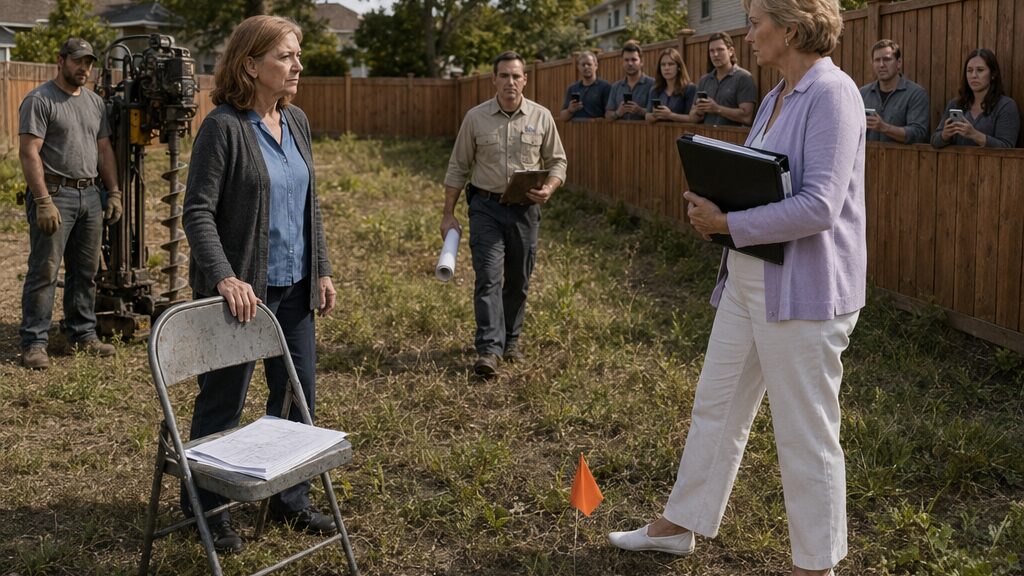
Margaret stepped over the survey flag while telling the contractors they were trespassing.
She came through the opening beside the HOA fence with the black association binder tucked under one arm. Behind her, five residents gathered along the sidewalk. Two held phones at chest level. Steven stood farther back, his hands in his pockets.
“This work stops now,” Margaret said.
One contractor lowered the post-hole auger. The other looked toward Shirley.
It was nine days after the lease signing. The half-acre parcel had been mowed, staked, and marked with orange paint. A temporary project board stood near the road, displaying a site-plan number and county review contact. No building permit had been issued. That detail was printed clearly.
Margaret pointed at the equipment.
“This is residential property adjacent to an association-controlled common area. You cannot begin commercial construction.”
“We’re not beginning construction,” Shirley said.
“Then what do you call this?”
“Survey verification and soil testing.”
Margaret opened the binder. “The distinction does not matter.”
“It matters to the county.”
One of the contractors had placed Shirley’s old folding chair near the fence and spread the preliminary plans across its seat. In the morning rush, the chair’s front leg had landed over a capped metal survey marker.
Margaret planted one white sneaker on the narrow strip between the chair and fence.
“You were notified that commercial activity violates community standards.”
“Inside Briar Glen.”
“This parcel is part of the residential perimeter.”
“It touches the perimeter.”
Margaret turned toward the watching residents.
“You see the problem. She is exploiting a technical irregularity to put a coffee business against our homes.”
Murmurs moved along the sidewalk.
Shirley felt the old heat rising beneath her collar. For days she had imagined this confrontation. In every imagined version, she had been calm and Margaret had been forced into silence by the map.
The real scene was messier. The neighbors did not look impressed. They looked worried.
A woman near the gate called, “How many cars?”
“The traffic review isn’t complete,” Shirley said.
“How late will it stay open?”
“Operating hours are not final.”
Margaret closed the binder with a sharp clap. “Because none of this is final. She has no approval.”
“I have zoning verification, a recorded lease, and authorization for site investigation.”
“You have paper.”
“So do you.”
The words came out harder than Shirley intended.
Margaret’s eyes narrowed. “This is exactly the attitude the board has been trying to prevent.”
Shirley looked toward Steven. He avoided her gaze.
Then a county vehicle turned off the road and stopped beside the parcel.
The planning inspector emerged carrying a rolled map, a measuring wheel, and a clipboard. Margaret’s posture changed at once.
“Good,” she said. “You can explain to Ms. Mitchell that this parcel falls within a residential association.”
The inspector glanced from Margaret to Shirley, then toward the stakes.
“I’m here to verify the property limits and preliminary access conditions.”
Margaret moved closer. “The association plat includes this boundary.”
“It includes your boundary,” Shirley said.
Margaret ignored her. “I have personally reviewed the subdivision plan.”
The inspector unrolled the county map on the folding chair.
One corner slipped.
Shirley reached for it and saw the metal cap beneath the chair leg.
She folded the chair and lifted it away.
The cap was set flush with the soil, stamped with the surveyor’s license number. Orange paint marked the grass around it, but the chair had hidden the center.
Shirley crouched and brushed dirt from the metal.
“This is the western HOA corner,” she said.
The inspector checked the map, then the cap.
“Yes.”
Margaret pointed to the fence. “Exactly. The fence marks the association line.”
“No,” Shirley said. “The marker does.”
She took a measuring tape from the contractor’s toolbox, hooked it against the cap, and extended it toward the cedar fence.
Thirty-six inches.
Three feet of grass lay between the recorded corner and Margaret’s shoe.
Margaret looked down.
Shirley kept her voice level.
“You crossed the association boundary when you stepped over the marker.”
The sidewalk went silent.
Margaret shifted her foot but did not step back.
“That cannot be correct.”
The inspector studied the plat. “The recorded line turns east at this monument. The fence was installed west of the legal boundary.”
“So the association owns the strip?”
“No. Based on this plat, the strip is part of the commercial parcel.”
Margaret’s face lost color.
She opened the binder again, though there was nothing inside it that could move the cap in the ground.
“I checked the county map.”
“Which map?” the inspector asked.
“The subdivision plat.”
“That shows subdivision property. The zoning map is separate.”
Margaret looked at Shirley. “You knew this.”
“Yes.”
“And said nothing.”
“You never asked where your authority ended.”
A few residents exchanged glances. Shirley heard the sentence after it was spoken and wished she could pull back its edge. It sounded less like clarification than triumph.
Margaret heard it too.
“You are spending money to punish this community.”
“I’m developing commercial land.”
“With a porch pointed at our gate.”
Shirley did not answer.
That silence answered for her.
The inspector rolled the plat halfway closed. “For the record, the HOA has no permitting authority over this parcel.”
One of the contractors exhaled through his nose.
Margaret’s grip tightened on the binder.
“But,” the inspector continued, “zoning compatibility is not final site approval.”
Shirley looked up.
“The use is permitted conditionally,” he said. “Access review remains open. The proposed entrance is close to the neighborhood approach. Traffic engineering may require redesign.”
Margaret recovered quickly.
“And parking?”
“Under review.”
“Noise?”
“Operating conditions may be imposed.”
“Public testimony?”
“There will be a hearing.”
The residents began speaking at once.
“How many spaces?”
“Will delivery trucks use our entrance?”
“Can people cut through the neighborhood?”
Margaret stepped back across the marker at last.
“You heard him,” she said. “This is not approved.”
“The parcel is outside your jurisdiction,” Shirley said.
“But the consequences won’t be.”
That landed more cleanly than anything else Margaret had said.
The inspector asked the contractors to continue only with the authorized soil borings. Margaret returned to the sidewalk, where the residents closed around her. Steven remained apart.
Shirley refolded the chair and set it upright beside the exposed marker.
For one brief moment, she had expected the boundary confirmation to settle everything. The law had answered the question she cared about most.
It had not answered theirs.
That evening, every household in Briar Glen received an email from the HOA.
EMERGENCY COMMUNITY MEETING: PROPOSED COMMERCIAL TRAFFIC AND NEIGHBORHOOD SAFETY.
The message listed projected concerns: customer parking, delivery access, lighting, noise, pedestrian movement, property values, and insurance exposure.
At the bottom, in bold type, was a request for residents to submit written objections before the county hearing.
Shirley was still reading when Heather called.
“This is the first I’ve heard about a coffee shop,” Heather said.
“It’s more than that.”
“Then tell me what it is.”
Shirley looked through the back window toward the dark parcel beyond the fence.
On the grass, barely visible in the porch light, the folded chair stood beside the survey marker.
“It’s a place for us,” Shirley said.
Heather was quiet.
“You signed something, didn’t you?”
Shirley did not answer soon enough.
“Oh, Shirley.”
The disappointment in Heather’s voice was worse than Margaret’s accusation.
“How much?” Heather asked.
“That isn’t the point.”
“It is if you did this in our name.”
Before Shirley could respond, another email arrived. This one included Margaret’s agenda for the emergency meeting and a proposed neighborhood resolution opposing the project.
Heather let out a slow breath.
“I wanted my book club back,” she said. “I didn’t ask you to start a war at the gate.”
Then she ended the call.
Chapter 4: The Book Club Refuses Her Revenge
Heather returned the folding chair at eight the next morning.
She carried it across Shirley’s lawn with both hands, though it weighed almost nothing. The chair was still dusty from the last book-club meeting. A pale ring from someone’s teacup marked the vinyl seat.
Shirley opened the door before Heather knocked.
“I thought you might need this for the hearing,” Shirley said.
Heather set the chair against the porch rail.
“No.”
The word was quiet, but it closed something between them.
Shirley glanced toward the street. Curtains shifted in a house across the way.
“You could have called.”
“I did call.”
“I mean before bringing it over like evidence.”
Heather folded her arms. “You want to talk about evidence?”
Shirley stepped onto the porch and pulled the door nearly shut behind her. “The county hearing is at two. I need people there who can explain what the book club actually was.”
“That’s why I came.”
Relief moved too quickly through Shirley.
Then Heather said, “I’m not speaking for your plan.”
Shirley looked at the chair.
“It is a bookstore.”
“It is a coffee shop with parking, deliveries, employees, and a porch aimed at Margaret’s front gate.”
“The porch faces the entrance road.”
“You drew it that way.”
“I drew it for visibility.”
Heather gave a short, tired laugh. “Exactly.”
Shirley felt herself reach for the familiar protection of details.
“The proposed use is compliant with C-2 zoning. The building footprint is under four thousand square feet. Customer access will come from the county road, not Briar Glen.”
“How much is the lease?”
“That is private.”
“How long?”
Shirley said nothing.
Heather’s expression changed.
“Ten years?”
“It takes a long term to justify construction.”
“How much, Shirley?”
“Thirty thousand annually.”
Heather stared at her.
“Before construction?”
“Yes.”
“Before you know whether traffic approval will pass?”
“There are contingencies.”
“That isn’t an answer.”
“It is the correct answer.”
Heather stepped back from the porch.
There had been a time when Shirley’s precision made people trust her. Now it seemed to make Heather tired.
“We wanted somewhere to meet without being photographed through your window,” Heather said. “We didn’t ask you to build a business and call it ours.”
“I never said it belonged to the group.”
“You told me it was a place for us.”
“It can be.”
“If it survives.”
Shirley looked toward the folded chair again. “Margaret cannot be allowed to decide whether eight adults may sit together.”
“I agree.”
“Then what are we arguing about?”
“We’re arguing about whether you’re fighting for eight adults or using eight adults to fight Margaret.”
The porch went still.
Heather’s voice softened, which made the question harder to dismiss.
“You didn’t tell us because you knew we might say no.”
Shirley reached for the door handle.
“I have to prepare.”
Heather nodded. “So do I.”
The county hearing room was full before two.
Margaret sat in the front row with the association binder on her lap. Steven occupied the seat beside her, turning a pen between his fingers. Behind them, residents held printed copies of the emergency resolution. Paul King stood near the wall, watching the room with the expression of a man calculating how much delay cost by the hour.
Shirley placed her site plan on the applicant’s table.
The planning-board chair summarized the request: conditional approval for a neighborhood-scale bookstore and coffee bar on a commercially zoned parcel, subject to access, parking, lighting, drainage, and operating restrictions.
Margaret spoke first during public comment.
“We are not disputing what an old zoning map says,” she began. “We are asking whether a technical designation from 1987 should override the safety of seventy-two homes.”
She described delivery trucks, customer headlights, litter, noise, and pedestrians using the HOA gate. Her tone was measured. She did not mention folding chairs.
A resident spoke about property values. Another worried that teenagers would gather after dark. Steven explained that the association’s insurance carrier had raised questions about unmanaged public access, though he offered no document.
Then Heather approached the microphone.
Shirley sat straighter.
Heather placed both hands on the lectern.
“I was part of the book club that started this,” she said. “The association’s fines were unfair. We were eight neighbors reading in a private home. We paid no fee and sold nothing.”
Margaret’s jaw tightened.
For one clean second, Shirley believed Heather had chosen her side.
Then Heather continued.
“But I also need to say that none of us approved this project. We were not shown the lease, the business plan, the traffic estimate, or the cost. We wanted a safe room to read in. We did not ask for a commercial fight at the neighborhood gate.”
The words did not sound angry.
That made them impossible to dismiss as betrayal.
The planning-board chair asked, “Do you oppose the proposed use?”
Heather looked toward Shirley.
“I oppose this version of it.”
A murmur passed through the room.
Shirley stared at the site plan. The rear porch was drawn in deliberate lines, facing the HOA entrance exactly as Heather had said. Twenty-eight parking spaces filled most of the remaining parcel.
When Shirley’s turn came, she presented the zoning verification, the recorded boundary, and the access concept. She answered questions about drainage and fire lanes. Her voice did not shake until a board member asked who would operate the café.
“That arrangement is being finalized.”
“How many employees?”
“Approximately six at peak operation.”
“And projected daily customers?”
“Between eighty and one hundred twenty.”
The number sounded larger in the hearing room than it had in the feasibility sheet.
Margaret lowered her eyes as though hiding satisfaction.
The board deliberated for twenty-three minutes.
It rejected the association’s claim that the parcel fell under HOA authority. The commercial use remained legally available.
Shirley allowed herself one breath.
Then the board voted to delay approval pending a revised traffic study, reduced parking impact, clearer operating hours, and evidence that the proposed scale was compatible with the adjoining homes.
Not denial.
Not victory.
Outside, Paul waited beside Shirley’s car.
“You told me the neighborhood would complain,” he said.
“I told you the HOA would.”
“That woman in there was your friend.”
“She still is.”
Paul looked back at the building. Heather had emerged alone and was walking toward the far end of the lot.
“Didn’t sound like it.”
Shirley opened her car door.
“The board confirmed the zoning.”
“The board delayed the project.”
“I can revise the access plan.”
“And pay rent while you do it.”
“The contingency period—”
“Expires in thirty days.”
Shirley looked at him.
Paul’s voice remained businesslike. “I gave you time to secure core approvals. I did not agree to carry a public dispute through six months of redesign.”
“You will still receive the deposit.”
“I want a tenant, not a lawsuit.”
“There is no lawsuit.”
“Yet.”
He handed her a white envelope.
Inside was formal notice that she had thirty days to demonstrate a viable approval path or surrender the lease contingency and the money already committed to preliminary work.
Paul walked away before she finished reading.
Across the parking lot, Heather paused beside her car. For a moment, Shirley thought she might come back.
Instead, Heather opened the trunk and placed another folding chair inside.
Chapter 5: What Margaret Was Trying to Hide
Steven Campbell arrived at Shirley’s unfinished site office carrying a budget sheet that residents had never seen.
The office was a rented construction trailer set near the parcel’s road frontage. It smelled of plywood, dust, and the burnt coffee Shirley had forgotten on a hot plate. Rolled plans leaned against one wall. Through the window, the survey marker remained visible beside the HOA fence.
Steven closed the door behind him.
“You cannot say I gave you this.”
Shirley looked at the paper but did not take it.
“Then why are you here?”
“Because Margaret scheduled a vote to authorize legal action.”
“Against the county?”
“Against the lease, the access request, anything the attorney thinks might delay you.”
“That will cost the association.”
“Yes.”
“And you are the treasurer.”
“That is why I’m here.”
He placed the sheet on the folding table.
The operating budget showed a projected insurance increase large enough to require either draining reserves or imposing a special assessment. Beside the premium line, someone had written a note in blue ink: PRIOR INCIDENT / FAILURE TO CONTROL COMMON-AREA GATHERINGS.
Shirley read it again.
“What incident?”
Steven sat in the lone folding chair.
“Last summer. A resident hosted a birthday gathering on the clubhouse porch. One of the guests leaned back in a chair, went over the edge, and broke her wrist.”
“I never heard about it.”
“The claim settled.”
“For how much?”
“Enough for the carrier to inspect our rules.”
Shirley looked at the numbers. “And the board did not tell residents.”
“We told them premiums had increased.”
“You did not tell them why.”
Steven rubbed his thumb against the side of his pen.
“Margaret thought disclosure would create panic before renewal.”
“Or questions.”
“Both.”
The insurer’s letter was referenced but not attached. Shirley pointed to the note.
“This says common-area gatherings. My living room is not common area.”
“I know.”
“Then why use Section Forty-One against a private book club?”
Steven stared at the trailer floor.
“The carrier asked what controls we had for recurring events.”
“That is not an answer.”
“Margaret wanted examples of enforcement before the renewal meeting.”
Shirley sat across from him.
“She needed to show the insurer the board was controlling something.”
“She believed consistent enforcement would help.”
“Consistent?”
Steven flinched.
Shirley opened her laptop and brought up photographs from Briar Glen’s community page: a football watch party with cars lining both sides of a cul-de-sac; a holiday craft sale in a garage; a weekly card game advertised to residents; a graduation dinner beneath rented lights.
“No notices,” she said.
“I don’t know.”
“You approve the fine ledger.”
“I don’t review every violation.”
“You sign the monthly report.”
Steven’s face reddened. “I believed the compliance committee was applying the rule evenly.”
“Margaret is the compliance committee.”
“There are volunteers.”
“Who report to Margaret.”
He looked toward the window.
Beyond the fence, three stacked chairs sat beneath the clubhouse porch awning. They had been chained together since the prior incident. Shirley could see the silver loop even from the trailer.
Fear had made the association stack away every chair it did not know how to manage.
She understood the impulse more than she wanted to.
Years earlier, after the disclosure dispute at her firm, Shirley had watched management remove every junior broker from client meetings. The company had called it risk control. The person who had actually changed the timeline kept his office.
“Margaret’s concern is not imaginary,” Shirley said.
Steven looked relieved too soon.
“But she selected the safest gathering in the neighborhood because she thought I would pay quietly.”
His relief disappeared.
“I voted for the first fine,” he said.
“Why?”
“Because I saw the insurer’s questions. I saw the reserve balance. A special assessment would hurt people here.”
“So you used me as proof of control.”
“I did not understand what the event was.”
“The notice said book club.”
“It said recurring assembly.”
Shirley folded the budget sheet.
“That is how people hide choices. They rename them.”
Steven stood.
“What are you going to do?”
“I’m going to request the enforcement ledger, insurer correspondence, and board minutes.”
“Margaret will deny it.”
“Then I will make a formal records demand.”
“That could force the legal vote.”
“It is already scheduled.”
Steven moved toward the door, then stopped.
“There is another file in the records room,” he said. “A draft amendment to Section Forty-One.”
“Approved?”
“No.”
“Who wrote it?”
“Margaret.”
Shirley found the draft two days later during a supervised records inspection at the clubhouse.
Margaret had assigned a board volunteer to watch her. Shirley sat at the long meeting table beneath the same buzzing fluorescent panel where the first fine had been delivered. Boxes of minutes and correspondence surrounded her.
The enforcement ledger confirmed the pattern.
No action for the holiday sale.
No action for the weekly card group.
A warning, but no fine, for the football gathering.
Three fines against Shirley within twelve days.
The insurer’s letter was more measured than Steven had implied. It requested documented procedures for events affecting common areas and association-managed facilities. It did not demand enforcement inside private homes. It did not mention folding chairs visible through windows.
Margaret had stretched a real concern until it reached the resident least likely to make noise.
Near the bottom of a file marked GOVERNANCE REVIEW, Shirley found the unsigned amendment.
The draft narrowed recurring assemblies to events exceeding specified attendance, traffic, or commercial thresholds. It created written notice requirements, an appeal panel independent of the president, and an exemption for private social gatherings without payment or public advertising.
At the end, in Margaret’s handwriting, was a note:
Current language is too broad to defend consistently. Revision advisable before resident challenge.
Shirley held the page by its edges.
The document could dismantle Margaret’s public position. It showed that Margaret knew the rule was too broad before issuing at least the later fines. It could also expose the insurance issue, the hidden budget weakness, and the board’s selective enforcement.
The supervising volunteer looked up from her phone.
“Everything all right?”
“Yes.”
Shirley placed the draft beside the ledger and took the copies she was entitled to request.
That evening, she spread the documents across the folding table in the site office.
The insurer’s warning.
The budget sheet.
The selective fine ledger.
Margaret’s unsigned admission.
Shirley imagined reading every line at the next meeting. She imagined Margaret seated beneath the fluorescent light while residents learned that the certainty in her voice had been covering fear.
Then she pictured Heather at the county microphone.
We wanted a safe room, not a war at the gate.
Shirley slid Margaret’s draft away from the other documents.
For the first time since circling the parcel, she did not know whether the strongest evidence in her hands was a weapon or an invitation.
Chapter 6: A Smaller Porch With Wider Doors
Shirley tore the original floor plan into eight pieces and left the violation notices untouched.
The sound of paper ripping brought the contractor out of the trailer.
“You sure about that?”
She placed the pieces on the folding table. The largest fragment showed the rear porch and the row of windows facing Briar Glen’s gate.
“No,” she said. “But redraw it.”
“Smaller?”
“Much smaller.”
He waited.
Shirley pointed to the parking field. “Cut the building footprint by half. Twelve spaces, not twenty-eight. No drive-through service, no evening deliveries, no amplified events.”
“That changes the revenue model.”
“I know.”
“And the lender package.”
“I know.”
“What stays?”
She looked through the window toward the neighborhood fence.
“The reading room.”
By afternoon, the coffee-bar operator had withdrawn from the project. The projected customer volume no longer supported a full commercial lease. Paul responded to the revised concept with a three-word message: Rent stays due.
Shirley spent the next morning at the planning office with tracing paper laid over the site plan. A staff reviewer marked the reduced access needs, a smaller drainage basin, limited hours, and a possible shared-use designation.
“A nonprofit reading house with incidental beverage service is easier,” the reviewer said. “Not easy. Easier.”
“What would the county need?”
“An operating entity. Defined occupancy. Parking controls. Community support would help.”
Community support.
Shirley carried those words home like something fragile.
That evening, she placed six folding chairs around her dining table. None matched. Two were hers. One had a torn rubber foot. Another bore a faded strip of masking tape from the last book-club meeting.
At seven, Heather knocked.
She stood in the doorway without entering.
“You said it was important.”
“It is.”
“Is this about the hearing?”
“Everything is about the hearing now.”
Heather’s expression suggested she might leave.
Shirley stepped aside.
Heather came in and sat in the chair she had returned. The pale teacup ring remained on the seat.
For several seconds, Shirley arranged papers that were already straight.
“I reduced the project,” she said.
“How much?”
“Half the building. Less than half the parking. Limited hours. No full café.”
Heather looked at the revised plan.
“What is it now?”
“A reading house. Membership-supported, nonprofit if we can organize it. Coffee and tea, but not as the primary business.”
“We?”
Shirley sat across from her.
“If you are willing.”
Heather did not touch the plan. “Why now?”
“Because the original version will not pass.”
“That is one reason.”
Shirley looked down at her hands.
The truthful sentence waited behind several easier ones.
“I wanted Margaret to see the porch every time she entered the neighborhood.”
Heather remained still.
“I drew the windows toward the gate,” Shirley continued. “I counted how visible the sign would be. I told myself it was about access. Some of it was.”
“And the rest?”
“I wanted her to know she had failed.”
The admission left the room quieter than an argument would have.
Heather glanced at the stacked documents near the kettle.
“You have something on her.”
“I have records showing selective enforcement. I also have an unsigned draft in which she admits the rule is too broad.”
“You could embarrass her.”
“Yes.”
“Do you want to?”
Shirley considered lying.
“Yes.”
Heather nodded slowly, as if honesty did not repair anything but at least gave them a floor to stand on.
“And do you still want the book club?”
“Yes.”
“Those are not the same thing.”
“I know.”
Heather finally pulled the revised plan closer.
“What does shared mean?”
Shirley had prepared an answer. She set it aside.
“You tell me.”
Heather studied her face, perhaps checking for another negotiation.
Then she picked up a pencil.
By eight, three more book-club members had arrived. One brought a folding chair because Shirley had said seating might be short. Another carried the lemon-cookie tin. They worked around the dining table, crossing out rules that sounded like the HOA’s and adding ones Shirley would not have chosen herself.
No paid membership required for neighborhood reading hours.
A reservation system for groups larger than twelve.
No one person controlling appeals.
Quiet closing time.
A community board with rotating seats.
Transparent budgets.
One member tapped the site plan. “The porch should face both directions.”
“There is no both directions,” Shirley said.
“There can be doors on each side.”
The contractor returned the next morning and looked at the marked-up plan.
“You want two entrances?”
“One public entrance from the county road. One pedestrian gate only if the HOA signs an access agreement.”
“That is not wider. That is more complicated.”
“Sometimes they are the same thing.”
Heather arrived carrying another chair. Behind her came two neighbors who had signed Margaret’s opposition resolution. One of them set down a metal chair painted blue.
“I still don’t want traffic,” the neighbor said.
“Neither do we,” Heather replied. “That’s why we need to design it.”
The circle grew slowly.
By the third day, Shirley had letters supporting the smaller reading house, a draft nonprofit structure, revised operating limits, and a proposal for a pedestrian-access agreement that would prevent customer cars from entering Briar Glen.
Paul came to the parcel and reviewed the new numbers.
“This rent does not work for a nonprofit,” he said.
“Extend the term to fifteen years and reduce the first three years.”
“You told me ten years was necessary.”
“I was wrong.”
He looked at her sharply, perhaps because he had not expected to hear the words.
“What do I get?”
“Stable improvements, maintenance, a longer term, and community support instead of litigation risk.”
He walked the property line, then returned.
“Show me county support and signed neighborhood backing. Then we talk.”
It was not agreement, but it kept the lease alive.
Margaret came to Shirley’s house that evening.
She did not bring the binder.
“I hear you are circulating a revised plan,” she said.
“Yes.”
“With pedestrian access through association property.”
“Only by agreement.”
“There will be no agreement.”
“That is for the board.”
“I am the board president.”
“You are not the board.”
Margaret’s face tightened, but her voice stayed controlled.
“Withdraw the project, and I will discuss reducing the fines.”
“Cancel them.”
“I said discuss.”
“And revise Section Forty-One.”
Margaret’s eyes flicked toward the dining room, where mismatched chairs remained around the table.
“You obtained internal drafts.”
“I inspected association records.”
“You do not understand the pressure this board is under.”
“I understand more than you told the residents.”
For a moment, Margaret looked less angry than tired.
Then she rebuilt the expression Shirley knew.
“Cancel the development first.”
“No.”
“Then there is nothing to discuss.”
Margaret turned toward the steps.
“Margaret.”
She stopped.
Shirley could have mentioned the handwritten admission. She could have named the insurance letter, the budget weakness, the selective ledger.
Instead, she said, “The county hearing and the HOA meeting should be held together. Same room. Same record. The project and the enforcement policy affect the same people.”
Margaret faced her.
“You want a spectacle.”
“No. I want nobody deciding one part in private and pretending it has nothing to do with the other.”
Margaret studied her, then walked away without answering.
The next morning, Shirley submitted two formal requests.
The first asked the county to hear the reduced reading-house proposal with the neighborhood-access agreement.
The second required the HOA board to consider cancellation of the fines, revision of Section Forty-One, and an independent appeal process at the same public session.
She attached the selective enforcement ledger.
She did not attach Margaret’s handwritten draft.
Not yet.
Chapter 7: The Chairs On Both Sides
Steven handed Shirley the unsigned draft ten minutes before the joint hearing began.
Not a copy.
The original.
Margaret’s blue handwriting crossed the bottom margin beneath the proposed amendment: Current language is too broad to defend consistently. Revision advisable before resident challenge.
Shirley held the page by its corners.
“Where did you get this?”
“Margaret put it in the board packet this morning,” Steven said. “She planned to withdraw it before the meeting.”
“Why give it to me?”
His eyes moved toward the hearing-room doors. Residents were filing inside, carrying folders, traffic diagrams, petitions, and the old anxieties that had grown around the parcel.
“Because she should not be allowed to pretend she never knew,” he said. “And because I should have spoken sooner.”
Inside, two rows of folding chairs had been set behind the applicant’s table. The county planning board occupied the raised desk at the front. The HOA board sat at a second table below it, an arrangement intended to make one public record from two disputes.
Margaret sat in the center with the black binder closed before her.
She saw the draft in Shirley’s hand.
For a moment, neither woman moved.
Heather touched Shirley’s elbow. “You do not have to decide now.”
“Yes,” Shirley said. “I do.”
The planning-board chair called the meeting to order.
The county staff presented the revised proposal first. The building had been reduced to a reading room, a small service counter, storage, and two porches. Hours would end at eight. Deliveries would occur from the county road. Twelve parking spaces replaced twenty-eight. The neighborhood gate would remain closed to vehicles, and any pedestrian entrance would require a separate agreement with the HOA.
The traffic reviewer recommended approval with conditions.
Paul King sat near the aisle, his arms folded. He had agreed to lower the first three years of rent only if the project received county approval and documented neighborhood support that night.
Without both, the lease ended at midnight.
Margaret spoke for the association.
“The revised scale is less disruptive,” she said. “But the board remains concerned about access, insurance exposure, and enforcement responsibility.”
Her voice was steady, though Shirley saw the strain around her mouth.
“The association cannot permit an uncontrolled opening through its boundary fence.”
Heather whispered, “We did not ask for uncontrolled access.”
Shirley placed a hand over the draft amendment.
When public comment began, residents who had opposed the original café acknowledged the changes. One still worried about headlights. Another wanted the porch closed earlier. A homeowner who had signed Margaret’s resolution said she would support a one-year trial if parking was monitored.
No one applauded.
People asked practical questions and expected practical answers.
That, Shirley realized, was what community looked like when nobody was performing victory.
Then the HOA portion began.
Steven presented the enforcement ledger. He did not soften his own role.
“I voted for the initial violation,” he said. “I believed the rule was being applied consistently. It was not.”
Margaret turned toward him. “The ledger does not capture informal warnings.”
“It captures fines,” Steven replied. “Only one household received repeated monetary penalties for a private social gathering.”
The association attorney advised the board that Section Forty-One, as written, was vulnerable because it lacked clear thresholds and an independent appeal process.
Margaret’s fingers rested on the binder.
“The board acted under genuine insurance pressure,” she said.
Shirley believed her.
That no longer made the fines acceptable.
The planning-board chair invited Shirley to speak.
She carried the original violation notice, the selective enforcement ledger, and Margaret’s unsigned draft to the lectern. The three documents lay before her like three possible versions of the same story.
She began with the folding chair.
“The first photograph used against me showed temporary seating through my front window,” she said. “The association called that evidence of commercial activity.”
She described the book club without ornament: eight neighbors, a kettle, a used novel, no fee, no sales, no public invitation.
Then she described the other gatherings that had not been fined.
Margaret stared straight ahead.
Shirley lifted the insurer’s letter.
“The board did face a real concern after an injury at the clubhouse. Residents should have been told that. Clear rules could have been written. Instead, a broad rule was used selectively against the easiest gathering to document.”
She could feel the unsigned draft beneath her hand.
One paragraph would prove Margaret knew.
One sentence in Margaret’s handwriting would change the room.
Shirley remembered the junior broker sitting alone outside the conference room years earlier while senior people discussed how much truth they could safely disclose. Shirley had waited for the perfect moment to speak. The moment had passed, and someone with less power had carried the consequence.
Silence could protect cruelty.
But exposure could become cruelty too.
She looked at Margaret.
“The records also show that members of this board had already considered revising Section Forty-One because its language was too broad.”
Margaret’s head lifted.
Shirley did not identify the author of the draft. She did not read the handwritten note. She did not describe Margaret’s attempt to remove it from the packet.
“The association had the beginning of a better rule,” Shirley continued. “It should finish that work in public.”
Heather released a breath behind her.
Shirley presented the proposed compromise: cancellation of all book-club and chair fines; defined attendance and traffic thresholds; exemptions for unpaid private gatherings; written notice before monetary penalties; an independent three-person appeals panel; and a one-year pedestrian-access agreement for the reading house, reviewable after six months.
The HOA attorney whispered to Margaret.
Margaret closed her eyes briefly.
Then she asked to speak.
“The fines will be withdrawn,” she said. “Provided the board adopts the revised enforcement procedure and the access agreement includes the insurance conditions recommended by counsel.”
It was not an apology.
It was enough to move the work forward.
The HOA board approved the reforms four votes to one. The county approved the reduced reading house with traffic, lighting, and operating conditions. Paul signed the amended fifteen-year lease in the hallway before midnight.
Margaret resigned as president at the end of the meeting.
She handed the binder to Steven.
Outside, Shirley found her standing beside the parcel fence.
“You could have read the note,” Margaret said.
“Yes.”
“Why didn’t you?”
“Because the policy needed to change more than the room needed another humiliation.”
Margaret looked toward the dark half-acre.
“That does not make us friends.”
“No.”
“I still think the location is a mistake.”
“It may be.”
Margaret studied her, perhaps waiting for triumph.
Shirley had none to offer.
Two months later, the reading house opened without a ribbon ceremony.
The building was smaller than Shirley’s first design. One porch faced the county road. The other faced Briar Glen, but its chairs were arranged in an open circle rather than rows aimed at the gate.
Heather managed the reservation calendar. Steven posted the first quarterly budget on a corkboard near the service counter. Paul repaired the old drainage ditch himself after deciding the county estimate was unreasonable.
At the edge of the porch, the original survey marker remained exposed beneath a clear protective cap.
The pedestrian gate stood three feet beyond the old HOA corner, exactly where the recorded line allowed it. A small agreement box beside it held the access rules in plain language.
No one crossed unknowingly anymore.
Shirley carried out the folding chair from the first violation photograph. She had cleaned the vinyl but left the pale teacup ring on the seat.
Heather watched her place it near the entrance.
“You could buy a better one,” she said.
“I could.”
“Then why this one?”
Shirley opened it.
“Because someone should remember what it was accused of.”
The first visitor was a woman Shirley did not recognize. She paused at the doorway with a library book tucked beneath one arm.
“Do I need to be a member?”
“No,” Shirley said.
“Is this seat taken?”
Shirley looked at the old chair, then toward the circle stretching across the porch.
“No,” she said. “That one is for whoever arrives next.”
The story has ended.