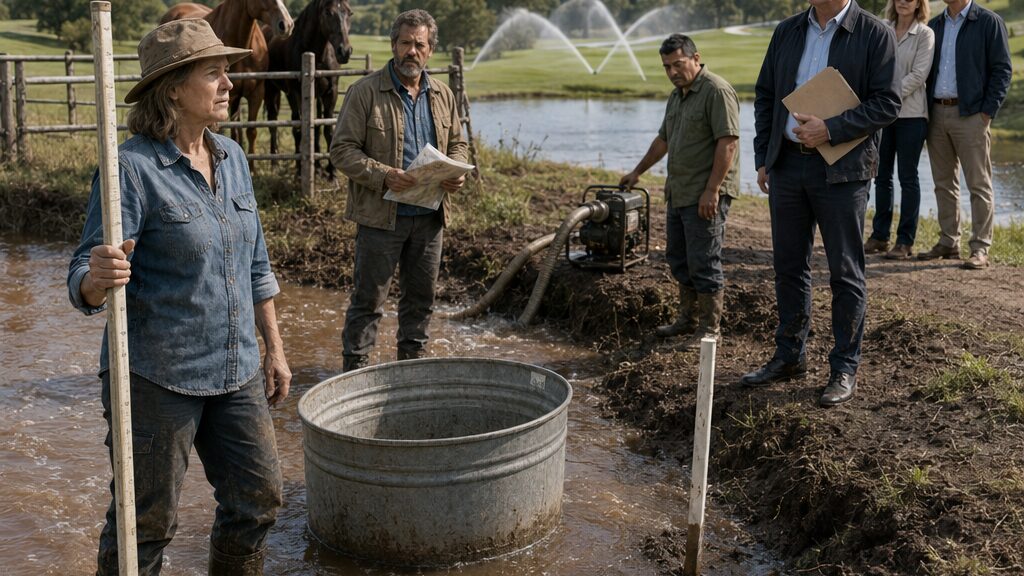
They Flooded Katherine’s Horse Pasture to Save the HOA Golf Course—Then Every Sprinkler Went Silent
Chapter 1: The Water Reached Everywhere Except the Trough
Katherine Carter’s right boot sank past the ankle before she understood that the pasture was underwater.
She stopped moving.
Yesterday, the ground below the barn had been hard enough to ring beneath a horseshoe. Now brown water slid through the grass in a sheet, carrying straw, cottonwood leaves, and a floating length of baling twine toward the south fence.
Her mare stood at the upper gate with her neck stretched forward, nostrils wide. The gelding remained behind her, refusing the slope.
“Stay there,” Katherine said.
The mare flicked an ear but did not step.
Katherine pulled her boot free with a wet sucking sound and backed toward the barn. The water was only four inches deep near the fence, but the soil beneath it had softened into paste. One wrong step could strain a tendon. One frightened rush could bring both horses down.
She closed the lower gate, opened the dry paddock, and led the horses around by the service lane. The mare pressed her muzzle into Katherine’s shoulder as they passed, looking for the morning bucket.
The galvanized trough stood beneath the cottonwood, empty.
Katherine stared at it longer than she needed to.
Floodwater shone across half an acre, yet the trough’s bottom held only dust, mineral scale, and two dead moths.
She checked the inlet pipe. No vibration. No trickle.
The old system was simple. A narrow branch from the seasonal creek fed a buried line, which filled the trough by gravity before spilling into the upper paddock swale. It had worked through dry summers, spring runoff, and three county road projects. When the creek ran high, the trough filled faster. When it ran low, it filled slowly.
It did not stop while the pasture flooded.
Katherine took a wrench from the barn and opened the cleanout valve. Air hissed once. Nothing followed.
She crouched beside the pipe, listening.
No water. No sediment. No pressure.
The horses watched her from the paddock rail.
“I see it,” she told them.
She carried two buckets from the barn faucet, then two more. The gelding drank first, pushing his muzzle so deep that water ran from his chin. Katherine filled the trough only high enough to settle them. The barn well could support the house and emergency livestock use for a day or two, but not indefinitely.
She went back to the flooded slope with a fiberglass measuring rod, a shovel, and the small field notebook she had not opened in months.
At the north edge of the pasture, three cedar stakes marked elevations she had surveyed years earlier. She had installed them after a cloudburst sent runoff down the HOA service road. The board had called them unsightly. Katherine had cut them low and painted the tops brown.
The first stake stood under two inches of water.
The second stood under five.
At the third, nearest the boundary, the flow had climbed eleven inches since the previous evening.
Katherine wrote down the numbers, then checked the sky.
No storm clouds. No fresh snowmelt. The county gauge upstream had been low for a week.
She stepped over the fence where the ground rose and followed the water backward.
The grass flattened in one direction, toward her property, but the current came from the opposite side of the usual creek channel. It crossed the HOA maintenance strip through a cut in the bank that had not existed the day before.
Beyond the fence, the soil was raw.
Wide steel tracks pressed deep into the service road. Mud clung to their squared edges, still damp beneath the surface. An excavator had passed there recently, heavy enough to crush the gravel into the clay below.
Katherine laid her hand against one track.
Cool, not cold.
The work had been done overnight or before dawn.
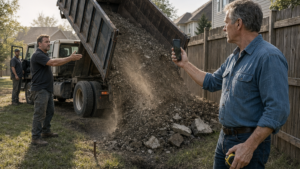
She followed the tracks along the boundary. Forty yards down, the old drainage swale had been opened into a trench nearly four feet wide. Fresh dirt stood in ridges on both sides. Whoever had cut it had sliced through the natural bank and aimed the new channel across the corner of her lower pasture.
A white stake had been driven beside the cut.
Laminated paper flapped from it.
PRIVATE DRAINAGE EASEMENT
WHITESTONE COMMUNITY ASSOCIATION
AUTHORIZED ACCESS
There was a board seal at the bottom and a project number in smaller type.
Katherine read the notice twice.
Her parcel had no private drainage easement.
There was a utility strip along the eastern road, a shared fence agreement to the west, and an old stock-water crossing at the creek. She knew every recorded burden on the land because she had reviewed them when the subdivision expanded around her.
The paper was not a recorded right. It was a declaration that one existed.
She photographed the sign, the stake, the trench, the tire tracks, and the point where the cut crossed the old boundary stones. Then she walked back to the barn and brought out the deed box.
The documents smelled faintly of cedar and machine oil. She spread the survey plat across the workbench, pinning the corners with horseshoe nails.
No drainage easement.
She found the HOA map from the previous year’s annual packet. A proposed stormwater corridor ran downhill from the newer homes, but it turned east toward the county culvert. It did not touch her pasture.
Katherine looked through the stack again.
An unopened envelope lay near the bottom.
WHITESTONE COMMUNITY ASSOCIATION
DRAINAGE RESILIENCE PROJECT — PRELIMINARY NOTICE
The postmark was four months old.
She remembered carrying it in from the mailbox, seeing the association logo, and placing it with the other board mail. At the time, Benjamin Lewis had been sending notices about fence colors, gravel storage, and her refusal to join the landscaping committee.
She had assumed this one was more of the same.
Katherine set the envelope aside without opening it.
Not yet.
The current in the lower field had strengthened. Water pressed through the grass in smooth, dark bands. She returned to the trench and walked its outer bank, keeping above the mud.
At first, it followed the property line south.
Then, where the approved neighborhood drain should have continued toward the county culvert, the new channel turned west.
Away from the homes.
Away from the road.
Katherine climbed the rise until she could see beyond the cottonwoods.
Below her, on the other side of the boundary fence, the golf course irrigation pond lay bright and full beneath the morning sun. A pump station hummed beside it. Sprinklers swept silver arcs across the nearest fairway.
The fresh trench descended directly toward the pond.
Chapter 2: The Easement Sign Covered the Wrong Boundary
The maintenance truck arrived before Katherine finished closing the valve.
Kevin Perez braked on the service road, left the engine running, and came down the slope in work boots that were already stained with the mud from her pasture.
“You can’t shut that,” he called.
Katherine tightened the wheel another quarter turn.
The portable pump beside the trench coughed, slowed, and fell silent.
“I just did.”
Kevin stopped several feet away. He was carrying a ring of keys and a folded work order inside a clear plastic sleeve. His eyes moved from the valve to the horses behind the upper fence.
“That pump is association equipment.”
“The valve is on my parcel.”
“It’s connected to an emergency project.”
“Then show me the permit.”
Kevin looked toward the service road as if someone else might answer.
Katherine placed the wrench on the valve housing and opened her notebook. “When was the trench cut?”
“I don’t know the exact time.”
“You supervised it.”
His mouth tightened. “I was told the access had been cleared.”
“By whom?”
He held out the plastic sleeve. “The board.”
The work order authorized excavation along the “temporary emergency drainage corridor.” It listed the project number from the laminated sign but contained no parcel description and no attached survey.
Katherine handed it back.
“That does not grant access.”
Kevin exhaled through his nose. “We’ve got water backing up above the newer homes. If this pump stays off, it has nowhere to go.”
“It had somewhere to go before you cut across my field.”
“The old path is blocked.”
“Then unblock it.”
“That isn’t what I was directed to do.”
There it was—not defiance, exactly. Something closer to surrender spoken in advance.
Kevin moved toward the valve.
Katherine stepped between them.
He stopped at once.
“I’m not fighting you,” he said.
“Good.”
“I have a job.”
“So did the person who wrote the order.”
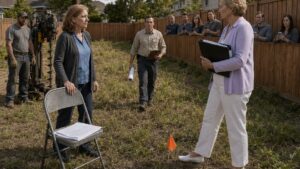
A sedan appeared at the top of the service road, followed by a golf cart carrying two board members. Benjamin Lewis stepped out before the sedan had fully settled on its suspension.
He wore a pale golf shirt beneath a lightweight jacket, as if the mud had been scheduled around him. He glanced at the dead pump, then at Katherine.
“You’ve created a serious problem.”
Katherine looked past him. “You brought an audience.”
“I brought board witnesses because you interfered with emergency infrastructure.”
“And the county inspector?”
“He’s on his way.”
“Then we can wait.”
Benjamin’s jaw shifted. “The downhill homes cannot wait for you to make a point.”
Katherine felt the words land where he intended them to. Lisa Rivera’s house sat below the eastern ridge, along with two newer homes built close to the old wash. If the runoff had truly backed up there, stopping the pump could transfer the damage.
Benjamin saw the pause.
“This isn’t about the golf course,” he said. “It is about protecting occupied homes.”
Behind him, sprinklers moved across the fairway in steady intervals.
Katherine picked up the measuring rod.
“Come with me.”
Benjamin did not move.
“You said this is emergency drainage,” she said. “Come look at the drainage.”
The board members followed first. Kevin came behind them. Benjamin joined only when the group had already started down the slope.
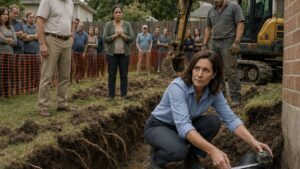
At the empty trough, Katherine lowered the rod to the bottom.
“Zero usable inflow,” she said.
One board member folded her arms. “We can see it’s empty.”
Katherine crossed to the flooded channel and pushed the rod into the moving water.
“Eight and three-quarter inches here. Eleven at the boundary stake. A little over twelve at the trench mouth.”
Benjamin glanced at Kevin. “What is this supposed to establish?”
“That the new cut intercepts the creek branch above my inlet and sends the flow west. My lower pasture gets overflow. My trough gets nothing.”
“The system was failing before the project.”
“No.”
“You cannot know that from one morning.”
Katherine turned the rod sideways. A dark band of wet mud marked the depth.
“I have seven years of measurements from this field.”
One board member gave a small, disbelieving laugh.
Katherine ignored it. She walked to the white stake, removed the laminated easement notice, and carried it back.
Benjamin’s voice hardened. “Put that back.”
“It is on my property.”
“It identifies authorized access.”
“It claims authorized access.”
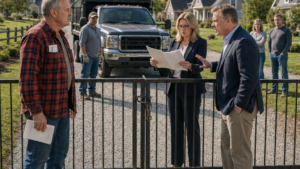
She laid the notice across the hood of Kevin’s truck. When Scott Davis arrived in a county vehicle several minutes later, Katherine placed her deed map beside it.
Scott greeted her with a brief nod, then surveyed the group.
“What was changed?”
Benjamin answered before Katherine could. “A temporary emergency corridor was activated under the association’s drainage authority. Ms. Carter shut down the pump.”
Scott looked at Katherine. “Did you?”
“Yes.”
“Why?”
“No recorded easement, no parcel-specific permit, active livestock impact, and the trench does not follow the preliminary route.”
Scott held out his hand. “Maps.”
Katherine gave him hers. Benjamin supplied a rolled plan from the sedan.
Scott spread both on the truck hood. Wind lifted one corner until Kevin pinned it with his key ring.
The laminated notice covered part of Katherine’s parcel on the association map. Scott shifted it aside, checked the project number, then compared the boundary bearings.
“This sign isn’t an easement,” he said.
Benjamin’s expression did not change. “It’s notice of one.”
“Notice does not create one.”
“The association has emergency authority.”
“Emergency authority still requires a legal corridor or county authorization.”
“We submitted the drainage plan.”
“Submission isn’t authorization.”
The two board members stopped looking at Katherine.
Scott walked the trench, took photographs, and inspected the pump connection. When he returned, he asked Kevin who had marked the excavation line.
Kevin looked at Benjamin.
“The field adjustment came from the board liaison,” he said.
Benjamin’s tone sharpened. “Because field conditions made the original line impractical.”
Scott tapped the plan. “Where is the approved adjustment?”
“We were responding to an immediate hazard.”
“To which properties?”
“The lower residences.”
Katherine watched Scott’s face. He was careful by habit, almost irritatingly so. He would not accuse anyone until the measurements forced him.
Benjamin stepped closer to him. “If that pump stays off and those homes take water, the county will have been standing here while Ms. Carter obstructed mitigation.”
Scott turned toward the ridge.
“How many homes?”
“Three at direct risk. More if the culvert overtops.”
That was specific enough to be either true or prepared.
Katherine looked at the silent pump. Her horses stood above them, both facing the trough.
“Can the pump operate without sending the flow through my field?” she asked.
Kevin shook his head. “Not in the current configuration.”
“What happens if it stays off for six hours?”
Benjamin answered. “Water accumulates behind the service road.”
Scott did not contradict him.
Katherine felt her certainty narrow. The trespass was plain. The consequences of stopping it were not.
“You can inspect the upper basin,” she told Scott. “The valve remains closed until you do.”
Benjamin gave a humorless smile. “You don’t get to set emergency policy.”
“On my valve, I do.”
Scott raised one hand before Benjamin could reply. “No one restarts anything until I verify the route and upstream storage. That is a county hold, not Ms. Carter’s.”
Kevin stepped away from the valve.
For the first time since arriving, Benjamin looked uncertain.
Scott returned to his vehicle and opened the county plan database on a mounted tablet. He searched the project number, then frowned.
“What?” Katherine asked.
He enlarged a drawing and turned the screen toward them.
The approved corridor ran from the upper collection basin east along the service road, through a reinforced swale, and into the county culvert.
It never crossed Katherine’s boundary.
It never approached the golf pond.
Scott zoomed in on the approval stamp. “This is the only plan attached to the permit.”
Benjamin leaned toward the screen. “That was the preliminary alignment.”
“No,” Scott said. “This is the approved alignment.”
The sprinklers continued sweeping behind them, bright arcs rising and falling over the fairway.
Katherine looked from the county map to the trench at her feet.
The lawful drain was almost two hundred yards away.
Chapter 3: The Lawful Drain Cost More Than Silence
The county file contained two maps with the same project number.
Katherine placed them side by side beneath the records-room light.
On the first, the drainage corridor ran east along the service road toward the county culvert. On the second, a heavy blue line crossed the corner of her pasture and curved west toward the golf pond.
The title blocks were nearly identical.
The approval stamps were not.
The eastern route bore a county engineer’s signature, a permit date, and three revision notes. The western route carried only an HOA document footer and the words FIELD IMPLEMENTATION COPY.
“Is that one part of the permit record?” Katherine asked.
The county clerk leaned over the counter. “It was uploaded as supplemental correspondence yesterday morning.”
“By whom?”
“The association’s management office.”
“After the trench was cut.”
The clerk checked the timestamp. “Looks that way.”
Katherine photographed both pages, then requested the complete drainage file: cost estimates, engineer comments, contractor bids, correspondence logs, and any notices identifying affected parcels.
The clerk studied her over the top of her glasses. “That could take a while.”
“I have time.”
She did not, but she had learned long ago that impatience in a records office could turn ten minutes into an afternoon.
Scott joined her near noon with photographs from the upper basin. The risk to the downhill homes was real. Sediment and root growth had reduced the old swale’s capacity, and the service-road culvert was undersized for the current development.
“The pump was keeping the basin below the road shoulder,” he said.
“By sending the water through my field.”
“Yes.”
“And into the pond.”
“Yes.”
Katherine waited.
Scott closed the folder in his hand. “I’m not defending the route.”
“But you’re not ordering a permanent shutdown.”
“Not until there’s a safe alternative. If the basin overtops, Lisa Rivera’s property takes the first hit.”
Katherine looked back at the two maps.
Benjamin had not invented the danger. He had used it.
The distinction mattered more than she wanted it to.
By early afternoon, the clerk produced a box of project records and gave Katherine a table near the back wall. The first engineering estimate explained why the approved route had stalled.
Retaining wall along service road.
Replacement culvert.
Utility relocation.
Slope stabilization.
The projected cost exceeded the HOA reserve by hundreds of thousands of dollars. A handwritten note on the estimate divided the shortfall among homeowners. Even without exact figures, Katherine understood the result: a special assessment large enough to frighten any board.
She found meeting minutes discussing delinquency risk, insurance renewal, and reduced property values if the drainage deficiency remained unresolved. Benjamin’s comments were measured and consistent.
The community could not ignore the hazard.
The association could not absorb the full cost.
A large assessment might force some owners to sell.
Nothing in those minutes mentioned Katherine’s pasture.
Her phone vibrated against the table.
Lisa Rivera had called twice.
Katherine let the second call end, then listened to the voicemail.
“Katherine, Scott told me you’re reviewing the file. I think there are things you should understand before tonight’s board call. Not excuses. Just—context. Call me.”
Katherine set the phone facedown.
For years, Lisa had waved from the downhill road, brought over extra tomatoes, and once asked Katherine to look at a damp retaining wall. Katherine had answered the technical question and declined coffee.
After the board dismissed Katherine’s runoff warning at a public meeting, she had stopped attending neighborhood gatherings altogether. Lisa had continued inviting her for several months. Then she stopped.
Facts had seemed cleaner than relationships.
Facts did not ask why she had gone quiet.
Katherine called back.
Lisa met her outside the records building in a compact car with a cracked rear taillight. She remained behind the wheel, hands resting at ten and two although the engine was off.
“You found the cost estimate,” Lisa said.
“Yes.”
“That number isn’t current. The final one was higher.”
“How much higher?”
Lisa looked toward the building entrance. “Enough that some owners would not make it.”
“An assessment does not authorize trespass.”
“I know.”
“Did you vote for the western route?”
“No.”
“Did you vote for the project?”
“For preliminary drainage work. Clearing the basin, surveying the eastern line, getting bids.”
“But the trench was cut.”
Lisa’s fingers tightened around the wheel. “Benjamin said the eastern route could not be completed before the insurance inspection. He called the field route temporary.”
“Across my parcel.”
“He said there was an old drainage right.”
“There isn’t.”
“I know that now.”
Katherine studied her face. “When did you know there might not be?”
Lisa did not answer immediately.
“That’s what I thought.”
“My house is below that basin,” Lisa said. “So are two others. When the engineer showed us the overtopping map, the water line went through my garage and halfway up the first floor.”
“And that frightened you.”
“Yes.”
“Enough not to ask where the water would go instead.”
Lisa flinched, but she did not look away. “Yes.”
The honesty took some force out of Katherine’s anger without reducing it.
“Give me the board emails,” Katherine said.
“I can’t.”
“You can.”
“Not without a records request or board authorization.”
“You are the treasurer.”
“That doesn’t make every private communication mine to release.”
“It makes you responsible for what the board funds.”
Lisa turned toward her. “And if I hand you internal emails outside the process, Benjamin will say everything you found is tainted by a personal leak. He’ll make the argument about me instead of the trench.”
Katherine hated that Lisa might be right.
“Submit a formal request,” Lisa said. “I won’t block it.”
“That could take weeks.”
“I know.”
The words sounded different from her than they had from the clerk.
Katherine stepped back from the car. “You waited too long.”
Lisa nodded once. “So did you.”
Katherine’s hand tightened around the file folder.
Lisa looked down. “You got the preliminary notice, didn’t you?”
Katherine said nothing.
“It went to every affected property,” Lisa continued. “Benjamin said you never responded.”
“I was not listed as affected.”
“You were listed as adjacent.”
“My land was not part of the approved corridor.”
“No. But you knew the board was discussing drainage.”
Katherine heard the accusation beneath Lisa’s careful tone, and worse, she heard the piece of truth inside it.
“I did not authorize this,” she said.
“I didn’t say you did.”
“Then be precise.”
Lisa’s voice lowered. “I’m trying to be.”
Back at home, Katherine opened the four-month-old envelope.
Inside were three pages. The first described basin failure and insurance concerns. The second showed the approved eastern corridor. The third invited owners with technical or property information to attend a planning session.
Katherine had not attended.
She carried the papers to the barn and measured the brown stain along the trough. The floodwater had risen outside nearly to the rim while the interior remained dry. She photographed the contrast and wrote the elevation in her notebook.
By evening, the pasture smelled of wet clay and trampled grass. The pump remained off under the county hold, but Scott had warned that the basin could not stay unmanaged if rain arrived.
Katherine returned to the project box she had copied onto a flash drive. She went through invoices one by one: excavation, pump rental, temporary pipe, sediment fencing, emergency labor.
The final invoice was from the golf-course operations contractor.
Most of the line items were routine.
One was not.
EMERGENCY ROUTE MODIFICATION — POND PRESERVATION PRIORITY
Katherine read it twice.
The amount beside it was larger than the cost of protecting the three downhill homes during temporary pumping.
She turned to the authorization field.
Benjamin Lewis had approved it.
Chapter 4: Katherine’s Silence Became Benjamin’s Permission
Benjamin Lewis opened the emergency board meeting by placing Katherine’s photograph of the empty trough on the clubhouse projector.
He did not begin with the trench.
He did not begin with the unrecorded easement notice or the altered map.
He began with Katherine.
“Mrs. Carter has chosen to interrupt temporary flood protection while three occupied homes remain at risk,” he said.
The room held nearly forty residents, more than Katherine had seen at any association meeting in years. Folding chairs filled the carpeted dining room. Muddy boots and work shoes stood beside polished loafers. Through the tall windows behind Benjamin, sprinklers moved across the ninth fairway in measured silver fans.
Katherine sat in the second row with her file box between her boots.
On the screen, the trough looked smaller than it did in person. Its galvanized sides caught the flash from her camera. The dry interior was visible, along with the brown flood line outside the rim.
Benjamin clicked to the next image: the closed valve.
“This is association infrastructure currently disabled by a private owner.”
“It is my valve,” Katherine said.
Several people turned.
Benjamin looked at her with patient disappointment. “You will have time to speak.”
“You started by misidentifying property.”
His mouth tightened, but he returned to the screen. “The board acted because the upper collection basin is nearing failure. The county has confirmed that stopping the pump indefinitely could cause water to cross the service road and enter homes.”
That part was true.
Katherine felt the room settle around it.
A man near the aisle raised his hand. “How close are we talking?”
Benjamin displayed the overtopping map. Three properties glowed red, including Lisa Rivera’s house. A wider orange zone reached the garages of several others.
“My insurance just renewed with a flood exclusion,” a woman said. “If that basin goes, I’m not covered.”
Another resident leaned forward. “And the proposed assessment was what? Twelve thousand per unit?”
“Preliminary estimates varied,” Benjamin said.
“Mine was over fourteen,” someone called from the back.
The murmur moved through the room like a draft.
Katherine had come prepared to show a false corridor, an unauthorized excavation, and a contractor invoice. Instead, she watched fear gather around numbers no one could easily pay.
Benjamin did not need to call her selfish. He only had to let the map do it.
He clicked to a slide showing the approved eastern drainage route.
“The board originally pursued this alignment,” he said. “Engineering conditions and cost escalation made immediate completion impossible.”
“You mean it required retaining walls,” Katherine said.
“And utility relocation, culvert replacement, slope stabilization, and time we did not have.”
“You had months.”
“We had changing insurance deadlines.”
“You also had my property line.”
Benjamin rested both hands on the lectern. “Mrs. Carter received the same preliminary notice as other adjacent owners. She did not attend the planning session. She did not submit comments. She did not respond when technical participation was requested.”
The words drew no gasp. They were too ordinary for that.
They were worse because Katherine had no clean answer.
Benjamin looked directly at her. “You were invited to help.”
The old humiliation rose before she could stop it: another room, another projector, another board president smiling while residents laughed at her runoff calculations. She had warned them that widening the uphill roads without rebuilding the drainage swales would push water toward the lower lots. A board member had called her concerns “retirement-project engineering.” Benjamin had not made the remark, but he had allowed the meeting to move on.
Afterward, Katherine had stopped offering.
Months later, when the drainage envelope arrived, she had placed it unopened in a box.
She stood.
“I received the notice,” she said.
The room quieted.
“I did not read the full proposal.”
Benjamin’s eyebrows lifted slightly.
Katherine continued before he could use the admission. “That was my mistake. It does not create an easement. It does not authorize a trench. It does not excuse altering an approved plan after work begins.”
A resident near the windows said, “But if you had responded, maybe this could have been avoided.”
“Maybe.”
The answer unsettled them more than denial would have.
Katherine walked to the display table and placed the two project maps beneath the document camera. The approved route appeared first, then the western field copy.
“These carry the same project number,” she said. “Only one carries county approval.”
She set the laminated notice beside them.
“This was posted on my land. It states that authorized access exists. No recorded easement exists. No parcel-specific authorization exists. The association created a sign that looked official enough to discourage questions.”
Benjamin stepped from behind the lectern. “Emergency mitigation often requires field adjustments.”
“Then where is the signed adjustment?”
“We were operating under counsel’s interpretation of association authority.”
“Where is that interpretation?”
A board member shifted in her seat.
Benjamin glanced toward her. The movement was brief, but Katherine saw it.
Scott Davis stood along the side wall, arms crossed. He had come as an observer and had warned both sides that the county would not decide internal association governance.
Benjamin turned to him. “Can the pump remain off overnight?”
Scott answered carefully. “Not without another controlled outlet. The basin is below emergency elevation now, but rain is possible late tomorrow.”
“Then the board has a duty to continue temporary operations,” Benjamin said.
“Through an unapproved route?” Katherine asked.
“Until a safer alternative is available.”
The phrase landed well. Several residents nodded.
Lisa sat in the front row, hands folded tightly over a yellow legal pad. She had not looked at Katherine since the meeting began.
A homeowner stood near the back. “I don’t care about the golf pond. I care whether my basement fills.”
Another said, “And I care whether the association bankrupts us fixing this.”
The room split, not into sides, but into fears.
Katherine had expected anger she could answer with measurements. Fear was harder. Fear accepted bad choices if they arrived wearing the language of necessity.
Benjamin called for a motion authorizing overnight pumping under county observation while the board reviewed the corridor.
Lisa lifted her head. “I want the motion limited to twelve hours.”
Benjamin looked toward her. “The system needs flexibility.”
“Twelve hours,” she repeated. “And no additional excavation.”
One board member seconded it.
Katherine turned to Lisa. For a moment, neither spoke.
The vote passed four to one.
The pump would resume.
A low conversation began around the room. Some residents looked relieved. Others avoided Katherine’s eyes. Kevin waited near the side door for instructions.
Katherine gathered her maps.
Benjamin approached while people were still standing.
“You see the problem now,” he said quietly.
“I see several.”
“You could have been part of the process.”
“You could have knocked on my door before digging.”
“I believed we had authority.”
“No. You believed I would be easier than the eastern route.”
His expression changed, not into guilt, but fatigue. “You think leadership is choosing between right and wrong. Most days it is choosing which damage the community can survive.”
“You chose damage you would not have to look at.”
“I’m looking at it now.”
Katherine closed the file box. “Because the pump stopped.”
Outside, the evening air smelled of cut grass and pond water. The sprinklers along the fairway clicked as their heads rotated.
Her phone vibrated before she reached her truck.
A message from Lisa contained no greeting, only a single line copied from an unreleased email:
Use Carter’s low field; she will fight, but she stands alone.
Katherine read it under the parking-lot light.
Then she looked back through the clubhouse windows at Benjamin, who was speaking with the board members beside the projected image of her empty trough.
Chapter 5: The Board Protected the Pond Before the Homes
Lisa arrived at Katherine’s kitchen door before seven Friday morning carrying a banker’s box and a resignation letter.
She had not called first.
Her hair was still damp, and her blouse was buttoned wrong at the cuff. She held the box against her ribs as though someone might take it from her.
“I sent that email line,” she said. “I shouldn’t have done it without context.”
Katherine opened the door wider. “Come in.”
Lisa set the box on the kitchen table. On top lay a signed letter addressed to the board.
“I’m resigning as treasurer after today’s emergency work is resolved.”
“Because you sent me a sentence?”
“Because I stayed after I understood what the sentence meant.”
Katherine lifted the lid.
Inside were printed emails, meeting notes, contractor revisions, pump logs, and board budget sheets. Some bore confidentiality headers. Lisa had highlighted dates in yellow.
“Did you obtain authorization to release these?”
“No.”
“Then Benjamin will challenge them.”
“I know.”
“You told me not to build the case around a private leak.”
“I was trying to keep my job on the board when I said that.”
Lisa sat across from her. “That wasn’t caution. It was fear wearing a rule.”
Katherine looked at the resignation letter again.
“Why now?”
“Because last night he made your silence sound like permission. And I realized mine actually was.”
The answer did not absolve her. It did make the room less simple.
Katherine began with the earliest correspondence. The engineers had rejected the western route twice. The soil in her lower pasture was unsuitable for sustained channel flow. The trench would spread water across the surface, erode the creek bank, and bypass the livestock inlet.
A later email from Benjamin asked whether a temporary pump could discharge into the golf pond.
The engineer replied that it could, but only through a lined corridor or pipe that avoided private land.
The lawful temporary system cost more than the board had approved.
Another email followed.
Pond levels must remain adequate for irrigation commitments and course operations through renewal inspection.
Katherine turned the page.
A board member had objected.
Benjamin’s response was brief:
Preserving the pond also preserves emergency storage and community asset value. Use Carter’s low field; she will fight, but she stands alone.
Lisa watched Katherine read it.
“You voted for this?”
“I voted to clear the upper basin and rent a pump. The final route was presented afterward as an emergency field adjustment.”
“You saw the route.”
“Not until the equipment was already moving.”
“And you said nothing.”
“I asked Benjamin whether the easement was valid. He said counsel had reviewed it.”
“Did you ask to see the review?”
“No.”
“Why?”
Lisa looked toward the window above the sink. From there, Katherine’s upper paddock was visible through the cottonwoods.
“My mortgage reset last year. My husband’s hours were cut. The first assessment estimate would have taken everything we had set aside for property taxes and the furnace.” She rubbed one thumb over the edge of the table. “If I challenged the project and the eastern route came back for a vote, I knew what it would cost us.”
Katherine heard herself from the day before: You waited too long.
So did you.
Lisa met her gaze. “I kept thinking someone with more room to take the hit would speak.”
“You mean me.”
“Yes.”
“You did not ask.”
“You stopped answering invitations years ago.”
Katherine shut the folder.
The silence held no comfort, but it held recognition.
They carried the box to the pasture after Scott arrived. The pump had run overnight under the twelve-hour authorization. Water again crossed the lower field, though Kevin had reduced the rate. The trough remained dry.
Scott examined the correspondence without taking possession of it.
“I can use the permit records and what I directly observe,” he said. “Internal board intent is a civil issue unless it establishes a false filing.”
“It establishes why they abandoned the approved route,” Katherine said.
“It may. But first we need to get through the next twenty-four hours.”
He unfolded the latest weather bulletin on the truck hood. Heavy rain was forecast after sunset.
“If the upper basin fills and we close this route completely, water reaches the service road in roughly three hours,” he said. “After that, the first three houses are exposed.”
Lisa’s face went pale.
Katherine looked toward the golf-course pond. “How much storage is available?”
“Less than the logs suggest.”
Lisa reached into the box and pulled out a binder. “The pump logs.”
The handwritten entries showed inflow, pond level, irrigation draw, and discharge times. Katherine traced the columns.
On two evenings when the upper basin had approached alert level, irrigation continued across the golf course for hours before emergency pumping began.
“They preserved pond operating depth,” she said.
Scott leaned closer.
Lisa pointed to a notation beside one entry. “The superintendent requested no interruption before a tournament.”
The logs did not prove the homes had been ignored entirely. They proved they had not been first.
Katherine carried the binder to the trough.
Its capacity was stamped faintly on one end, but she did not trust the old marking. She measured the length, width, and curved depth, then calculated usable volume in her notebook. Next she compared the trough’s elevation with the inlet, trench, basin, and pond.
Scott watched her work. “What are you thinking?”
“A controlled split.”
“The eastern corridor isn’t built.”
“It doesn’t need to be finished for a temporary bypass.”
She drew a rough cross-section.
The pump could discharge part of the basin flow through a temporary surface pipe along the service road, over the stable shoulder, and into the county swale below the weak culvert. The remaining flow could pass through the original creek branch at a rate low enough to fill the trough without spreading across the pasture.
“The pipe run is long,” Kevin said when she showed him.
“You have enough section on the equipment lot.”
“Not enough couplings.”
“The golf course has irrigation couplings.”
Kevin glanced toward the pond.
Katherine continued. “Close the fairway system. Use its portable sections. The pond becomes reserve storage only.”
Scott studied the elevations. “It could work through one storm if the joints are secured.”
“And if the basin is watched continuously,” Katherine said.
Benjamin arrived at the pump station just before noon. Lisa gave him her resignation letter before Katherine showed him the plan.
He read the first line and folded it once.
“You are putting the association in a vulnerable position.”
Lisa’s voice shook, but she did not lower it. “It already is.”
Katherine placed the flow diagram on the control cabinet.
“The western trench closes at sunset. Temporary pipe takes the primary discharge east. The creek branch receives only enough controlled flow to restore the trough and prevent bank erosion.”
Benjamin scanned the page. “Who designed this?”
“I did.”
“This is not stamped.”
“It is an emergency operating protocol, not a permanent design. Scott can place it under county field supervision.”
Scott said, “The county can authorize temporary stabilization if the association consents and provides labor.”
Benjamin looked toward the golf course. “You are proposing to shut down irrigation.”
“I am proposing to use the equipment protecting grass to protect homes.”
“The pond is part of the drainage system.”
“Then let it function as storage instead of a supply tank.”
Benjamin’s attention moved to the box of records beside Lisa.
“What did you give her?”
“The truth I should have given the board,” Lisa said.
His expression hardened, then flattened again. “If these records are distributed improperly, the association may face additional liability.”
Katherine tapped the weather bulletin. “You already have liability. The question is whether you want a safe storm plan.”
“And if I refuse?”
“Scott issues what orders the county can issue. I seek an injunction on the trench. Your homeowners stand here while the basin rises and lawyers argue about whose delay mattered.”
Benjamin looked at the clouds forming beyond the foothills.
Katherine closed her notebook.
“You have until sunset.”
Chapter 6: Two Hundred Sprinklers Stopped Before the Rain
The first drops struck the pump-station roof while the golf-course sprinklers were still running.
Katherine heard them before she felt the rain: soft taps on corrugated metal beneath the mechanical hum of pumps and the repeated hiss of irrigation heads across the fairways.
Her temporary bypass lay in sections along the service road, not yet connected.
Benjamin had not signed the operating authorization.
Kevin stood beside the equipment trailer with three maintenance workers, waiting for an order that had not come. Scott checked the upper-basin gauge, then looked at his watch.
“Two inches below alert level,” he said.
“How fast is it rising?” Katherine asked.
“Faster than this morning.”
The rain darkened the gravel in scattered circles.
Benjamin stood under the pump-station awning speaking into his phone. When he ended the call, he walked toward them.
“Counsel advises against adopting an unstamped homeowner plan.”
Katherine looked at the unassembled pipe. “Did counsel offer another plan?”
“No.”
“Then counsel is not standing below the basin.”
Benjamin lowered his voice. “The association will authorize temporary pipe along the service road, but the golf irrigation system remains operational until we confirm pond stability.”
“That defeats the capacity calculation.”
“The course has contractual obligations.”
“So do you.”
“To every owner in the community.”
“You keep saying every when you mean the ones you have chosen.”
Rain began to bead on his jacket.
Scott stepped between them. “The basin is approaching county emergency threshold. I can order reduction of inflow to the unapproved western trench. I cannot assemble this bypass without association access and labor.”
Kevin raised one hand.
“I can.”
Benjamin turned.
Kevin held a folded copy of the excavation order. His face looked older than it had on Tuesday.
“I have the crew,” he said. “We can connect the east run in ninety minutes if the golf shop releases the couplings.”
“You take direction from management,” Benjamin said.
“I take direction from the board liaison. That has been you.”
“And it remains me.”
Kevin looked at Katherine, then at Scott.
“The engineers marked the field route rejected,” he said.
Benjamin went still.
Kevin unfolded the order. Beneath the typed instructions was a handwritten change with Benjamin’s initials.
“You told me to use Carter’s field after the engineer said the slope would spread the water. I asked about the easement. You said the board would handle it.”
One of the maintenance workers looked down.
Benjamin’s voice dropped. “You were instructed to respond to an emergency.”
“Yes.”
“And you agreed the basin was unsafe.”
“Yes.”
“Then do not pretend you lacked judgment.”
Kevin absorbed that without protest. “I knew the route was wrong. I did it anyway.”
The admission changed nothing mechanically. The pumps still ran. The basin still rose.
But it ended the last pretense that the trench had appeared through confusion.
Scott checked the gauge again. “One inch.”
Katherine opened the control cabinet and placed her written protocol inside the door.
“Scott, will the county supervise?”
“If the association authorizes access, yes.”
She looked at Benjamin. “You can sign now, or the county can restrict the western discharge and leave you to explain why no replacement was ready.”
Benjamin stared across the course.
Hundreds of sprinklers rotated under the rain, watering ground that no longer needed water.
He took the pen.
“Temporary emergency use only,” he said.
“That is what the page says.”
“And this is not an admission of wrongdoing.”
“That is not what the page asks.”
He signed.
Kevin moved before the ink dried.
The crew loaded pipe sections onto utility carts. The golf-course superintendent protested when Kevin began removing portable couplings from the irrigation inventory, but Benjamin told him to release them.
Katherine walked the route with Scott, marking joint positions and high points. Rain gathered on the brim of her hat and ran down the back of her collar. At the lower crossing, the service-road shoulder softened under their boots.
“Anchor here,” she said. “If this joint lifts, it swings toward Lisa’s property.”
Scott drove a flag into the gravel.
At the pasture, Katherine adjusted the gate on the original creek branch. She set the opening according to her measurements, then placed the fiberglass rod inside the galvanized trough.
The first water arrived as a thin rusty thread.
It struck the metal bottom with a sound so small she almost missed it.
The mare heard it. She came to the fence and watched.
Katherine checked the time.
“Rate?” Scott called from the road.
She watched the line climb past the first mark.
“On target.”
At the upper basin, Kevin’s crew connected the final pipe. The temporary run shuddered when the pump redirected. Water pushed east along the service road, bypassed the damaged culvert, and entered the county swale below the homes.
Scott radioed the gauge reading.
“Basin falling.”
Lisa stood near the service-road crossing in a raincoat, watching the water pass without turning toward her house.
The western trench slowed.
Mud stopped spreading across Katherine’s pasture.
Only the golf irrigation system remained.
Its draw kept the pond below the reserve level specified in Katherine’s protocol.
She went to the main control panel with Scott and Benjamin.
The panel displayed active zones across all eighteen holes.
Benjamin studied the lights. “We could shut down half.”
“No,” Katherine said. “The model assumes full reserve.”
“The rain itself reduces demand.”
“Then the grass will not suffer from the cutoff.”
He looked at her. “You have wanted this moment since Tuesday.”
Katherine glanced toward the trough, where water had risen to the second mark.
“No. I wanted you to avoid it.”
Scott rested his hand above the master switch. “County emergency stabilization requires reserve capacity now.”
Katherine nodded.
Scott threw the switch.
Across the golf course, the nearest sprinkler faltered first. Its arc shortened, broke into heavy drops, and collapsed. Farther down the fairway, one head after another lost pressure.
The silver fans disappeared in rows.
Within seconds, the entire course was still.
Rain fell where irrigation had been.
No one applauded.
Kevin’s crew kept working. Lisa checked the lower road. Scott watched the basin gauge. Katherine returned to the pasture and measured the trough.
The water reached the third mark at the exact time her calculation predicted.
By midnight, the basin was stable. The three downhill homes remained dry. The temporary pipe held through the heaviest hour of rain.
Benjamin found Katherine inside the pump station after the storm weakened.
He had removed his wet jacket. Without it, he looked less like the association president and more like a tired man who had spent too long defending a decision after it had stopped being defensible.
“We can settle your damage claim privately,” he said.
Katherine kept writing the final gauge reading.
“Pasture restoration, veterinary monitoring, fencing, creek-bank repair. The association can cover all of it.”
“It should.”
“We can also compensate you for inconvenience.”
She closed the notebook.
“In exchange for what?”
“No public release of internal correspondence. No demand for individual board accountability. The project records remain within counsel’s review.”
Katherine looked through the pump-station window. In the distance, the dark golf course lay under rain. Beyond the service road, porch lights glowed in the three homes the bypass had protected.
“You still think the problem is who sees what you did.”
“The problem is keeping this community solvent.”
“The records will cost less than repeating the decision.”
Benjamin rubbed one hand over his face. “You want humiliation.”
“No.”
“You want me removed.”
“I want the route restored, the damage paid, the project history disclosed, and residents able to see the system that affects their homes.”
“You know what disclosure will do.”
“Yes.”
“It may trigger claims. Insurance review. Another assessment.”
“Yes.”
“And you are willing to impose that on people who had no part in this?”
Katherine thought of the meeting room, the anxious voices, Lisa’s mortgage, her own unopened notice.
“No,” she said. “That is why the agreement includes a hardship reserve and staged repairs.”
Benjamin stared at her.
“You drafted an agreement already.”
“I drafted one when you spent the afternoon deciding whether to sign a storm plan.”
She removed a folder from her field bag and laid it on the control desk.
The first page required restoration of her pasture and creek branch. The second required construction of the approved eastern corridor. The third established public flow logs, resident review, and independent county certification. The fourth required disclosure of the route change and its authorization.
Benjamin turned to the final page.
“You included my resignation as project liaison.”
“Yes.”
“Not as president.”
“That is for the homeowners to decide.”
He looked up, wary now.
Katherine met his eyes. “Accountability is not the same as spectacle.”
Outside, water moved safely through the temporary pipe. Inside the pasture, the trough continued filling one measured inch at a time.
Benjamin looked down at the signature line.
Chapter 7: Clean Water Did Not Restore Easy Trust
The laminated easement notice was waiting inside Katherine’s restoration file.
Six weeks after the storm, she found it pressed between the county certification and the contractor’s final soil report, its corners curled from rain and mud still trapped beneath the plastic.
PRIVATE DRAINAGE EASEMENT.
The words looked smaller now.
Someone had crossed out AUTHORIZED ACCESS in black ink and marked the sheet EVIDENCE—RETAIN WITH PROJECT RECORD.
Katherine carried it outside.
The lower pasture no longer held standing water. Fresh seed had taken along the repaired creek bank, though the new grass was thinner and brighter than the older growth around it. Orange construction fencing still protected two soft sections where machinery had removed contaminated fill. The horses had been kept out until the veterinarian and restoration contractor agreed the footing was stable.
Near the cottonwood, the galvanized trough stood full.
Clear water entered through the restored branch line, made a small circular current around the float valve, and settled below the rim. Beside it, Scott Davis had installed a stainless measuring post marked in half-inch increments. A weatherproof box held a flow notebook that any resident could inspect.
Katherine placed the laminated notice on the trough’s edge.
For several days after the storm, neighbors had driven slowly past her property. Some raised a hand. Some stared at the trench repairs. One left a bag of horse treats at the gate without a note.
No one had apologized on behalf of the community. Katherine was relieved they had not tried.
The final board meeting began at six that evening in the same clubhouse room where Benjamin Lewis had projected the photograph of her empty trough.
The sprinklers outside remained off. Not because the golf course had lost water permanently, but because the restoration agreement limited irrigation until the new eastern corridor passed its final capacity test. Brown patches showed along the rough. The greens had survived under reduced watering, which made several earlier claims of immediate catastrophe look less convincing.
Katherine sat beside Lisa Rivera at a table facing the board.
Lisa no longer occupied the treasurer’s seat. Her resignation had taken effect after the emergency work, but she had spent the previous month helping an independent accountant reconstruct project spending.
Benjamin sat at the center of the board table.
He had signed Katherine’s agreement the morning after the storm.
He had also resigned as drainage-project liaison, submitted the internal correspondence for resident review, and remained HOA president pending the recall vote scheduled for the following month.
The arrangement satisfied almost no one completely.
That was one reason Katherine trusted it more than a dramatic victory.
Scott presented the county findings first. The approved eastern corridor had been completed with a reinforced swale, a replacement culvert, and a controlled overflow route. Katherine’s pasture had been removed from every drainage plan. The temporary pipe remained stored for future emergencies, but activation now required county notice and written identification of affected parcels.
“The corrected system passed modeled peak flow and field testing,” Scott said. “The Carter branch is operating within historic range.”
He looked toward Katherine.
She nodded once.
The insurance adjuster followed with the financial terms. Katherine’s pasture restoration, veterinary monitoring, fence repair, and lost boarding use would be paid from the HOA’s liability coverage and reserve funds. The golf-course operator would reimburse the association for the portion of emergency expenses tied to pond preservation.
That left the permanent corridor.
Residents had feared the final assessment for weeks.
Lisa stood when the board reached that item.
“The original proposal divided the entire shortfall evenly,” she said. “The revised proposal uses reserve funds, golf-course reimbursement, staged contractor payments, and a hardship fund for owner-occupied homes.”
A homeowner near the aisle raised his hand. “Who decides hardship?”
“An outside administrator,” Lisa said. “Not the board. Income documents remain confidential.”
“And where does the fund come from?”
“Voluntary reserve transfers, delayed nonessential landscaping, and a temporary increase to golf-club facility fees.”
A man in a club jacket leaned back sharply. “So golf members pay for a drainage project serving the whole community?”
Lisa did not flinch. “Golf operations received priority from the unauthorized route. The revised cost allocation reflects that.”
There was no applause.
There were objections, questions, and several strained conversations about fairness. One resident said the board should have chosen the expensive route from the beginning. Another said she could not have afforded it then and could barely afford the revised amount now.
Katherine listened.
The meeting did not divide into innocent homeowners and guilty leaders. It divided into people learning what the hidden choice had cost and discovering that correcting it still required money.
Benjamin waited until the financial discussion ended before speaking.
He stood without notes.
“The upper basin was unsafe,” he said. “The insurance deadline was real. The projected assessment would have placed some owners in serious difficulty.”
No one interrupted.
“I believed the western route could be treated as temporary emergency use. I also believed preserving the pond protected both storage capacity and a major community asset.”
He looked toward Katherine, but he did not address her directly.
“When the engineers rejected the field route, I authorized it anyway. I relied on authority the association did not possess, and I allowed a notice to be posted that implied a recorded easement existed.”
His voice remained level.
“I made that choice because I thought delay would expose more homes and because I believed I could manage the consequences afterward.”
Katherine watched his hands. He kept them flat on the table.
“I was wrong about the route. I was wrong about the notice. And I was wrong to decide that one owner’s land could absorb the risk without her consent.”
He sat down.
He did not ask for forgiveness.
Katherine appreciated that more than she wanted to.
During public comment, a resident proposed creating a permanent drainage oversight committee. Another suggested that Scott attend every meeting, which Scott immediately explained the county could not do.
Then Lisa stood again.
“The committee needs someone who understands the system,” she said. “And someone residents will believe when the numbers are inconvenient.”
Katherine knew what was coming before Lisa turned toward her.
“I nominate Katherine Carter to chair it.”
The room shifted.
Katherine looked at the board, then at the homeowners seated behind her. Some appeared hopeful. Others looked uncomfortable. The man in the golf jacket folded his arms.
Benjamin said nothing.
Years earlier, Katherine had left a similar room convinced that public service was mostly an invitation to be ignored. She had told herself she was protecting her time. Later, she told herself she was protecting her dignity.
Both things had been partly true.
Neither explained the unopened envelope in her barn.
“I won’t chair a committee that exists to make the board look transparent,” she said.
Lisa remained standing. “Then write the terms.”
“Meetings open to residents. Raw flow records available without formal requests. Any route change affecting private land requires direct notice, not a line in a general mailing.”
A board member began writing.
“Technical objections go into the minutes whether the board agrees with them or not. And no committee recommendation becomes an excuse to hide who makes the final decision.”
The man in the golf jacket asked, “Does that mean yes?”
Katherine looked at Lisa.
Lisa’s expression carried no demand for reconciliation, only the risk of having asked.
“For one year,” Katherine said. “Then the residents choose again.”
The motion passed with two abstentions.
After the meeting, Benjamin approached while Katherine was collecting her papers.
“I don’t expect this changes your view of me,” he said.
“It changes what you admitted.”
“That is not the same thing.”
“No.”
He nodded, accepting the boundary.
At home, Katherine carried the final project file to the pasture. The sun had dropped behind the foothills, leaving the trough water dark and still.
She removed the false easement notice from the folder and placed it in the weatherproof box beneath the flow notebook. Not as a warning nailed to a stake, but as part of the record.
Then she opened the notebook to the first page.
Morning level: 31.5 inches.
Inlet flow: normal.
Pasture condition: stable.
Below the entry, she wrote instructions for the next reader in plain language.
She considered taking the notebook back to the barn. Rain, dust, careless hands—there were many reasons to keep records under her own control.
Instead, she returned it to the box.
She closed the lid without locking it.
The story has ended.