She Shut Down a Boy’s Lemonade Stand, Then Her Own HOA Records Exposed the Real Reason
Chapter 1: The Rule Karen Chose to Read Out Loud
“You need to shut this down immediately.”
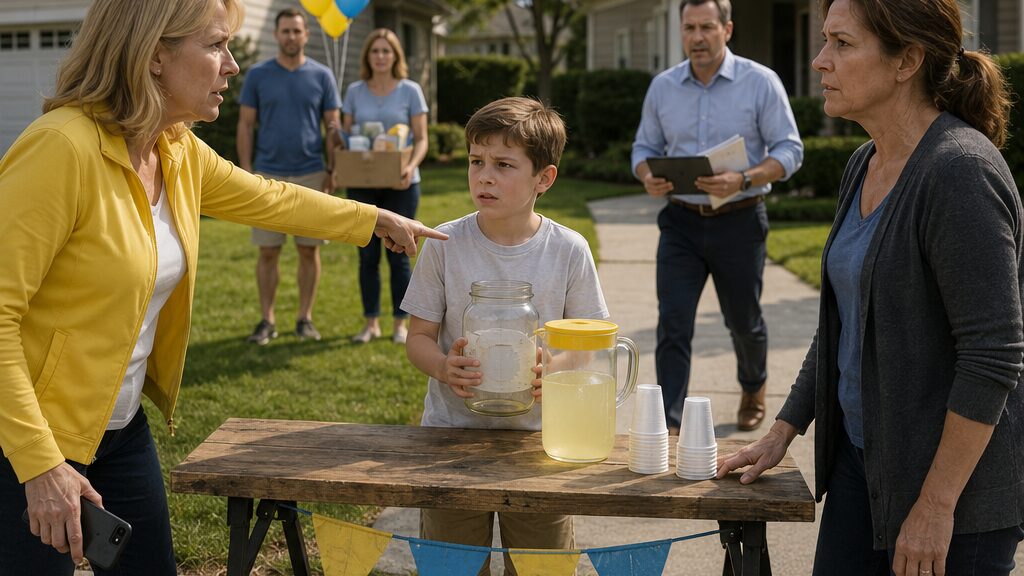
Cynthia Walker was still halfway across her front lawn when Karen Clark pointed at the folding table beside the sidewalk.
Ryan froze behind it with both hands around a clear plastic pitcher. The yellow lid sat crooked from where he had just refilled it. Three paper cups waited in a neat row. A hand-lettered sign leaned against the table leg.
LEMONADE — $1
Beside the pitcher stood a glass jar with a strip of masking tape across it.
BIKE FUND.
Karen pointed again.
“I mean it, Cynthia. This is not permitted.”
Two houses down, someone stopped dragging a cooler toward the clubhouse. Across the street, a neighbor who had been tying balloons to a mailbox straightened slowly.
Cynthia reached the driveway and made herself stop before stepping between Karen and Ryan. At sixty-one, she had spent enough years around angry people to know that moving too quickly could be mistaken for aggression by someone already looking for it.
“What isn’t permitted?” she asked.
Karen wore white walking shoes and a bright yellow athletic jacket despite the morning heat. Her phone was in one hand. Her HOA president badge was not visible, but she carried herself as if it were.
“Running a business from a residential lot.”
Ryan looked at Cynthia. “It’s lemonade.”
“I can see that,” Karen said.
The boy’s shoulders tightened.
Cynthia kept her voice level. “He’s eleven.”
“That doesn’t change the covenants.”
“What covenant?”
Karen gave a short breath through her nose. “Commercial activity is prohibited.”
“Which section?”
For the first time, Karen’s expression shifted.
Not much. Just enough.
“I don’t have the declaration memorized.”
“Then maybe we shouldn’t call a child a business violation until we read it.”
One of the neighbors across the street looked down abruptly, pretending to study a box of plastic tablecloths.
Karen’s mouth thinned.
Ryan lifted the pitcher a fraction. “I only sold four cups.”
“Ryan,” Cynthia said quietly.
He lowered it.
Karen glanced toward the jar. “And you’re collecting money.”
“Yes,” Ryan said.
“For what?”
He looked embarrassed now, which irritated Cynthia more than Karen’s finger had.
“A bike.”
Karen stared at him.
Ryan swallowed. “I’m saving for one.”
For half a second, Cynthia thought the answer might soften something.
Instead Karen said, “That’s not relevant.”
Ryan looked down at the jar.
Cynthia felt the old instinct arrive right on time: lower the temperature, move the problem indoors, keep everyone from saying something that could not be taken back.
It was an instinct she had long considered maturity.
“Karen,” she said, “the neighborhood fundraiser is today. There are tables going up all over the route.”
“Approved tables.”
“This is a lemonade stand.”
“It is a revenue-generating activity on private residential property.”
Cynthia almost laughed, but Ryan was watching her.
“So show me the rule.”
“I will.”
“No. You’re ordering us to shut it down now. Show me now.”
Karen’s cheeks colored.
“I am telling you how the governing documents are enforced.”
“That isn’t the same thing.”
A car slowed near the curb. The driver looked at the table, at Karen, then continued.
Karen turned toward the jar.
Before Cynthia understood what she was doing, Karen raised her phone and took a photograph.
The camera sound was small.
Ryan flinched anyway.
“What are you doing?” Cynthia asked.
“Documenting the violation.”
“You’re photographing my grandson’s savings jar?”
“I’m documenting evidence of commercial activity.”
Ryan picked up the jar.
Karen took another photograph.
Cynthia stepped forward then.
Not toward Karen. Toward Ryan.
“That’s enough.”
Karen lowered the phone. “Cynthia, do not make this harder than it needs to be.”
The sentence landed with the polished familiarity of something Karen had said in meetings before.
Cynthia heard herself answer, “I’m not the one making it hard.”
A volunteer pushing a wagon of bottled water came around the corner. The wagon wheel clipped the edge of the folding table.
Everything moved at once.
Ryan grabbed for the cups. The pitcher slid toward the pavement.
Cynthia caught it against her hip, lemonade sloshing beneath the yellow lid. One cup fell. The jar knocked against the tabletop in Ryan’s hand.
“I’m sorry,” Ryan said immediately.
Cynthia set the pitcher upright.
“No.”
He stared at her.
“You don’t apologize for something nobody has proved you did wrong.”
Silence spread farther than she intended.
Karen’s face hardened. “Rules are rules.”
There it was.
The phrase Cynthia had heard in violation hearings, pool arguments, parking disputes, fence applications. Usually followed by someone explaining why the rule applied differently this time.
Cynthia looked at her.
“Then read me the rule.”
Karen said nothing.
A man approached from the direction of the clubhouse carrying a tablet and a stack of papers under one arm. Matthew Green, the HOA treasurer, wore the distracted expression of someone trying to manage three problems before breakfast.
“What happened?” he asked.
Karen answered first. “Unauthorized commercial activity.”
Matthew looked at the lemonade stand.
Then at Ryan.
Then at the balloons tied along the fundraiser route.
“Isn’t this connected to today’s event?”
Karen’s reply came too quickly.
“No.”
Matthew frowned. “I thought children were—”
“The association approved designated activities,” Karen said. “Not independent businesses on residential lots.”
Ryan looked from one adult to another.
Cynthia saw the hope leave his face in increments.
“Matthew,” she asked, “was something approved?”
He shifted the papers against his ribs. “I’d have to check the event packet.”
Karen folded her arms. “There is nothing to check. This setup was not authorized.”
Cynthia could have kept arguing.
She knew that.
She could have asked Matthew to walk back to the clubhouse and bring the packet. She could have made Karen stand there in front of the neighbors while someone found the exact covenant.
Instead she looked at Ryan.
His fingers were pressed so tightly around the jar that his knuckles had gone pale.
The old instinct won.
“Bring the cups inside,” Cynthia said.
Ryan did not move.
“Grandma—”
“We’ll sort it out.”
Karen relaxed almost imperceptibly.
Cynthia saw it.
That was the worst part.
Ryan carried the jar first. Then the cups. Cynthia folded the table while the neighbors suddenly became busy with their own preparations.
No one applauded Karen.
No one defended Ryan either.
By ten thirty, the driveway was empty except for a pale sticky ring where lemonade had splashed onto the concrete.
Cynthia scrubbed it with the garden hose.
Inside, Ryan sat at the kitchen table without speaking.
“You didn’t do anything wrong,” she told him.
He rolled the jar between his palms.
“Then why did we have to stop?”
Cynthia opened her mouth.
Nothing useful came.
At five forty-three that afternoon, her phone chimed while she was slicing tomatoes for dinner.
The email subject read:
FORMAL COMPLIANCE NOTICE — WALKER PROPERTY
She wiped her hand and opened it.
The first sentence made her read it twice.
An unapproved vendor had been observed conducting commercial activity from her lot.
Cynthia looked through the kitchen doorway.
Ryan’s BIKE FUND jar sat on the counter.
Karen had filed the complaint before the lemonade on the driveway had dried.
Chapter 2: The Complaint Arrived Before the Lemonade Dried
The notice called Ryan an “unapproved vendor.”
Cynthia sat at the kitchen table Saturday evening with the laptop open and read the phrase a fourth time.
Unapproved vendor.
Across from her, Ryan was separating quarters from dollar bills.
He had made seven dollars.
Four dollars from lemonade. Three from a neighbor who had handed him cash before Karen arrived and told him to keep the change.
Cynthia scrolled.
The notice cited “prohibited commercial enterprise and unauthorized vending activity” and required corrective action. It warned that continued activity could result in a hearing and fines.
There was no quoted covenant language.
No section number.
Only a portal link.
Ryan glanced up. “Am I in trouble?”
“No.”
“You got an email.”
“I get emails all the time.”
He knew that was not an answer.
“Is Mom going to know?”
“Your mother is going to know there was a disagreement.”
He pushed two quarters together until their ridged edges clicked.
“She’ll say I should’ve asked first.”
“Did you?”
Ryan’s eyes flicked toward her.
Cynthia noticed.
“Ryan.”
“I asked about the fundraiser.”
“Who?”
He shrugged.
“Who did you ask?”
“One of the people setting stuff up last week.”
“That is not a name.”
“I don’t know her name.”
Cynthia leaned back.
Ryan gathered the money quickly and put it in the jar.
“I’m done anyway.”
He carried the jar to the counter.
Cynthia watched him open the cabinet above the refrigerator, the one where she kept holiday platters and things nobody needed daily.
He put the jar inside.
The door closed.
Something in Cynthia tightened.
But instead of calling Karen, she clicked the HOA portal.
Private handling, she told herself.
Facts first.
No scenes.
The governing documents filled three browser tabs: declaration, bylaws, rules and regulations. She searched “commercial.” Six results.
The relevant sentence appeared in the declaration:
No Lot shall be used for ongoing commercial enterprise or activity creating regular customer traffic inconsistent with residential use.
Cynthia read it slowly.
Ongoing.
Regular traffic.
She searched “vendor.”
Nothing.
She searched “fundraiser.”
Nothing.
By nine o’clock she had drafted a reply twice and deleted it twice.
The first sounded angry.
The second sounded frightened.
She finally wrote:
Please identify the specific governing provision that prohibits a temporary child-operated lemonade stand and explain how the cited conduct meets the document’s standard for ongoing commercial enterprise or regular customer traffic.
She sent it only to the property management address listed on the notice.
Not Karen.
That felt sensible.
Sunday morning, Cynthia took a longer route on her walk.
She told herself it was for exercise.
In truth, she did not want to pass Karen’s house.
The fundraiser had continued after Ryan’s table disappeared. Balloons drooped from mailbox posts. A few folding booths remained near the clubhouse, waiting to be collected. Hand-painted signs advertised baked goods, used books, dog treats, and raffle tickets.
Cynthia stopped.
Dog treats.
A folding table beside the common green still held a small sign:
$3 A BAG — COMMUNITY FUND
She stared at it.
A neighbor loading boxes into an SUV noticed.
“Good turnout,” the woman said.
“So I heard.”
“Shame about Ryan.”
Cynthia looked at her.
The woman’s hands stopped on a cardboard box.
“I mean—I didn’t see everything.”
“No?”
“Just that Karen was upset.”
Cynthia waited.
The woman added, “You know how she gets when something isn’t on the list.”
“What list?”
But the woman had already lifted the box.
“I’ve got ice cream melting.”
She closed the trunk.
Cynthia walked home with suspicion taking the place embarrassment had occupied the day before.
At eleven fifteen, her phone rang.
Matthew Green.
“I saw your portal response,” he said.
Cynthia stood at the kitchen window. “Was I supposed to call you?”
“No. Karen copied the board on the incident report.”
“Incident report.”
“I know how it sounds.”
“Do you?”
He was silent.
Cynthia opened the laptop.
“I found the actual language, Matthew.”
“I figured you would.”
“It says ongoing commercial enterprise. Regular customer traffic.”
“Yes.”
“Does an eleven-year-old selling four cups of lemonade meet that?”
Another pause.
“I’m not comfortable answering for the board.”
“I’m asking you.”
“As a board member, I am the board.”
“That’s convenient.”
He exhaled.
“The language is less clear than Karen made it sound yesterday.”
There it was.
A small answer.
Not enough.
“Then why is there a formal notice?”
“The management company issues notices based on reports.”
“Whose report?”
“You know whose.”
Cynthia looked toward the cabinet above the refrigerator.
“Was Ryan part of the fundraiser?”
“I’m checking.”
“Yesterday you said he might be.”
“I said the stand might be connected.”
“What does that mean?”
“It means the event plan changed several times.”
“Who changed it?”
“Cynthia.”
The warning in his voice was mild, almost apologetic.
She recognized it because she had used the same tone herself. The tone of a person asking someone else not to force a difficult truth into the open.
Matthew continued. “Let me find the packet before we turn this into something bigger.”
Cynthia nearly agreed.
Then she remembered Karen photographing the jar.
“It already became bigger.”
After the call, Cynthia searched her email for every message containing the fundraiser name.
Most were reminders.
Volunteer signup.
Street map.
Donation goals.
Then she found an announcement from three weeks earlier.
She opened it.
ANNUAL COMMUNITY FUNDRAISER — NEIGHBORS OF ALL AGES WELCOME
The message encouraged residents to participate along the marked route with “small tables, family activities, refreshments, crafts, and other community-friendly fundraising ideas.”
Cynthia read that line twice.
No designated booths.
No mention of separate board authorization.
She printed it.
At three twenty, a reply appeared in the HOA portal.
The message came from Karen’s board account.
Mrs. Walker,
The annual fundraiser did not provide blanket permission for independent revenue-generating activity on private Lots. Participation remained subject to board authorization and all governing restrictions.
Cynthia read the words independent revenue-generating activity.
She looked out the window at a child’s chalk drawing still faintly visible near the curb.
Then she clicked Reply.
Her fingers hovered.
She could ask for the authorization list. She could demand the section number again. She could copy every neighbor who had sold cookies or raffle tickets.
Instead she closed the laptop.
Facts first, she told herself.
Privately.
Reasonably.
Monday morning, Ryan came into the kitchen carrying an empty cereal bowl.
Cynthia had placed the fundraiser announcement beside the laptop.
He read the heading.
“Is that from the HOA?”
“Yes.”
He stood still.
“Did Karen write it?”
“I don’t know. It came from the association.”
Ryan stared at the line about small tables and refreshments.
Cynthia asked, “You said someone told you that you could do the stand.”
He nodded.
“Who?”
“I told you, I don’t know her name.”
“Where were you?”
“By the clubhouse.”
“When?”
“Last week. When they were putting signs in the yards.”
“What exactly did she say?”
Ryan shifted the bowl from one hand to the other.
“She said kids could make their own tables. I said I had a lemonade stand from school field day. She said that was perfect.”
Cynthia felt a faint pulse of hope.
“Was anyone else there?”
Ryan looked at her.
Then he said, “Karen.”
Cynthia stopped breathing for a beat.
Ryan’s voice dropped.
“She was standing right there when they told me I could do it.”
Chapter 3: The Stand Everyone Remembered Differently
The words BIKE FUND were gone.
Cynthia found the jar Monday morning on Ryan’s bedroom desk with the strip of masking tape still wrapped around the glass, but the blue marker had been rubbed away until only pale smears remained.
Ryan was in the doorway behind her.
“I can write something else.”
Cynthia turned.
“Why?”
He shrugged.
The jar contained seven dollars and a quarter. He had added a quarter of his own.
“Ryan.”
“It looked stupid.”
“No, it didn’t.”
“It made it look like I was begging.”
The answer was too practiced to have begun in that moment.
Cynthia set the jar down carefully.
“Who said that?”
“Nobody.”
Which meant somebody had.
Or he had said it to himself after watching a grown woman photograph it as evidence.
Cynthia left the room before her anger could become another thing Ryan had to manage.
By noon, she was at the clubhouse.
The building smelled faintly of floor cleaner and burned coffee. Fundraiser decorations had been stacked against one wall. A volunteer rolled extension cords into loops while Cynthia asked about the planning meeting from the week before.
“Children’s tables?” the volunteer repeated.
“Yes.”
“Oh, sure. That was discussed.”
“Who approved them?”
The volunteer’s expression changed.
“Approved?”
“Who told children they could set up small tables along the route?”
“I don’t know that anybody formally—”
“Ryan says a volunteer told him his lemonade stand was perfect.”
The woman glanced toward the office door.
“I remember people talking about kids doing things. Bracelets. Cookies.”
“Lemonade?”
“Maybe.”
“Was Karen there?”
The volunteer picked up another cord.
“She came and went.”
It was not a denial.
Cynthia tried another person near the storage closet.
That answer was different.
Children had been invited, but only in common areas.
A third person remembered families being encouraged to use driveways because it extended the fundraiser route.
By one o’clock, Cynthia had three versions of the same event and no one willing to attach their name to any of them.
She understood why.
It was a small neighborhood.
People borrowed ladders from one another. They collected mail during vacations. They nodded at board members while taking out trash.
No one wanted to become evidence.
Outside the clubhouse, Ryan waited on a bench with the altered jar between his shoes. Cynthia had asked him to come because she wanted him to identify the volunteer who had spoken to him.
He had identified no one.
“Can we go?” he asked.
“Soon.”
“You said that twenty minutes ago.”
“I know.”
“This is dumb.”
Cynthia sat beside him.
“I’m trying to figure out what happened.”
“I know what happened.”
She looked at him.
“Karen made me stop.”
The simplicity of it struck her harder than the paperwork had.
Matthew’s truck pulled into the lot.
He got out holding a thick folder.
“I found something,” he said.
Karen arrived four minutes later.
Cynthia had not asked for her.
Matthew had.
That irritated her immediately.
They stood near Ryan’s bench while the last volunteer carried boxes inside.
Matthew opened the folder.
“The event packet has several versions.”
Karen folded her arms. “Which is exactly the problem.”
Matthew ignored that.
“The early plan was centralized around the clubhouse. Then the route expanded.”
“Yes,” Karen said. “For association activities.”
Matthew pulled out a page.
“This says neighborhood participation stations.”
“That is not a defined term.”
Cynthia almost admired the speed of the response.
Matthew continued. “The volunteer instructions say families may host small activities and refreshments along the marked route.”
Karen’s face remained composed.
“Subject to governing restrictions.”
“Where does it say that?”
“It doesn’t need to. Governing restrictions always apply.”
Ryan bent forward and picked at the edge of the tape on his jar.
Cynthia saw it.
“Stop.”
Everyone looked at her.
She was looking at Karen.
“Stop talking as if his table appeared from nowhere.”
Karen’s brows lifted.
Cynthia continued, “He was told children could participate. The association announcement encouraged small tables and refreshments. People sold dog treats and baked goods.”
“On behalf of the community fund.”
“Some did.”
“All approved participation did.”
“Then show me the approval list.”
Karen looked at Matthew.
Matthew looked down at the folder.
That was answer enough.
“There isn’t a single list,” he said.
Karen’s head snapped toward him. “There were signups.”
“For primary booths.”
“Exactly.”
“Not for every participation station.”
Silence.
A car passed on the street beyond the clubhouse. Cynthia could hear the rhythmic click of a bicycle freewheel.
Matthew turned another page.
Then stopped.
His expression changed so distinctly that even Ryan looked up.
“What?” Cynthia asked.
Matthew pulled one sheet free.
At the top was the fundraiser name. Beneath it, a paragraph approving the expanded route, resident participation stations, refreshments, and family-led activities consistent with event guidelines.
At the bottom was a signature.
Karen Clark.
Board President.
For one bright, foolish second, relief went through Cynthia like electricity.
She almost laughed.
Matthew held the page toward Karen.
“You signed the expanded plan.”
Karen looked at it.
No one spoke.
Ryan stood.
Cynthia could see the moment in his face—the same quick hope she felt.
Karen read the page once.
Then again.
Matthew said, “This appears to include resident-hosted participation.”
Karen lifted her eyes.
“No.”
The hope vanished so quickly Cynthia felt ashamed for having let Ryan see it.
Matthew frowned. “Karen.”
“This approved the event framework.”
“Yes.”
“It did not approve an independent private business.”
Cynthia stared at her.
“The page says resident participation stations.”
“It does.”
“Refreshments.”
“Yes.”
“Family-led activities.”
“Yes.”
Karen’s voice remained calm. That made it worse.
“Within the fundraiser.”
Ryan spoke before Cynthia could.
“I was in the fundraiser.”
Karen turned to him.
“You were selling lemonade for your bicycle.”
The jar seemed suddenly enormous in his hand.
Ryan looked down at it.
Cynthia stepped between them.
“His reason for participating does not erase the invitation.”
“It changes the nature of the activity.”
“According to what rule?”
“According to the distinction between community fundraising and private profit.”
“Profit?” Cynthia said. “He made seven dollars.”
“That is not the point.”
“No. I’m beginning to think it is exactly the point.”
Matthew shifted uneasily.
Karen’s expression sharpened.
“You asked for documentation. You now have it. The event was approved. This stand was not separately authorized.”
Cynthia took the page from Matthew.
At the bottom, Karen’s signature curved in dark ink above her printed title.
The evidence should have settled something.
Instead it had opened a new problem.
Cynthia looked at the date.
Three weeks before Karen stood on her sidewalk and said the stand was obviously forbidden.
“You knew about resident tables,” Cynthia said.
“I knew about fundraiser participation.”
“You signed this.”
“Yes.”
“And then you photographed an eleven-year-old’s jar as evidence.”
Karen’s face changed.
Not guilt.
Something closer to fear, quickly covered.
“You are trying to turn a compliance issue into a personal accusation.”
“Why are you fighting this hard?”
Matthew said quietly, “Cynthia.”
There was that tone again.
Do not force it open.
Cynthia ignored him.
Karen picked up her phone.
“I think this discussion has reached its limit.”
She walked toward the parking lot.
Ryan watched her go.
Matthew rubbed a hand over his jaw.
“I’m going to copy this page for you.”
“I want the whole packet.”
“That may include internal drafts.”
“I want whatever I’m entitled to as the homeowner you accused.”
“I didn’t accuse you.”
“No,” Cynthia said. “You just let someone else do it.”
He looked away.
Tuesday afternoon, the association portal sent another notification.
Cynthia opened it standing at the library circulation desk during a quiet minute between patrons.
NOTICE OF VIOLATION HEARING
She read the first paragraph.
The hearing had been scheduled for Thursday evening of the following week.
The alleged violation was no longer described under Ryan’s name.
The responsible party was listed as:
CYNTHIA WALKER, LOT OWNER.
Requested enforcement review: continuing violation determination and potential monetary sanction.
Cynthia read the line twice.
Karen had seen her own signature.
And instead of backing away, she had made the case official.
Chapter 4: What the Signature Did Not Prove
“The signature may be irrelevant.”
The property manager said it without malice, which somehow made the words worse.
Cynthia sat across from him in the small HOA office Wednesday morning with Karen’s signed approval page inside a clear plastic sleeve on the desk between them. She had brought two copies, as if duplication could make the ink more powerful.
The manager tapped the paragraph above Karen’s name.
“This authorizes the event framework.”
“It authorizes resident participation stations.”
“Yes.”
“And refreshments.”
“Yes.”
“And family-led activities.”
“Yes.”
Cynthia waited.
He folded his hands. “That still doesn’t necessarily authorize every activity conducted by every resident on every lot.”
“Then what did it authorize?”
“That would depend on the adopted event plan, volunteer instructions, board intent, and how the governing documents apply.”
“Board intent.”
“Yes.”
“So the president can sign language that says one thing, then later tell me she intended something narrower.”
“I’m explaining the issue.”
“You’re explaining why her signature proves less now that it’s inconvenient.”
The manager leaned back.
“I understand why you’re frustrated.”
Cynthia hated that sentence nearly as much as rules are rules.
She gathered her papers.
“Do you?”
“I deal with these disputes every week.”
“No. You deal with files every week.”
His expression cooled.
Cynthia heard herself and stopped.
There it was again—the sudden heat she had spent years avoiding in other people. She took a breath.
“I’m sorry,” she said. “That was unfair.”
The manager gave a small nod.
Then he said, “But the hearing is still scheduled.”
The apology had changed nothing.
Outside, Cynthia sat in her car with the air conditioner running and Karen’s signature on the passenger seat.
For two days she had imagined the paper as a key.
Now it looked like paper.
At home, Ryan’s jar sat empty on the kitchen counter.
He had removed the seven dollars and a quarter the night before and put the money into an envelope in his backpack. Cynthia had not asked why.
The tape remained on the glass.
Blank now.
She picked it up and turned it in her hands.
A knock came at the door.
Deborah Perez stood on the porch holding a covered casserole dish.
Cynthia knew her mostly from neighborhood gatherings and from the fact that she was Karen’s older sister. Deborah lived three streets over and had spent much of the past year helping care for a relative outside the development.
“I brought this because I didn’t know what else to bring,” Deborah said.
Cynthia looked at the dish.
“Is someone sick?”
“No.”
“Then I’m confused.”
“So am I.”
Deborah glanced toward the street.
Cynthia understood the request and stepped aside.
In the kitchen, Deborah put the casserole on the counter beside the empty jar.
Her eyes stopped there.
“That his?”
“Yes.”
Deborah touched neither object.
“I heard about the hearing.”
“I assumed everyone had.”
“Not everyone knows the details.”
“Do you?”
Deborah took a chair but did not sit until Cynthia did.
“My sister thinks this is getting out of control.”
Cynthia almost laughed.
“Your sister filed it.”
“I know.”
“After seeing her own signature.”
“I know.”
The second answer changed the room.
Cynthia studied her.
“What do you know, Deborah?”
Deborah pressed both palms together.
“Karen knew children’s tables were expected.”
Cynthia said nothing.
“She knew?”
“The fundraiser planning got messy. At first it was supposed to be booths around the clubhouse. Then people complained the back streets were always ignored, so they expanded the route.”
Cynthia pulled out the chair across from her.
“Go on.”
“Some volunteers wanted family stations. Kids selling bracelets. Drinks. Games. Whatever fit.”
“And Karen approved it.”
“She approved the broader plan.”
Cynthia looked at the empty jar.
“Then why stand on my driveway and act like Ryan invented a crime?”
Deborah’s mouth tightened.
“Because by the week of the event, things had changed.”
“What things?”
“The budget.”
Cynthia waited.
Deborah looked toward the back door, as if even an empty yard might overhear.
“The association spent more than expected on drainage repairs last winter. Then a vendor contract went over estimate. People started asking why the fundraiser goal had changed.”
“I saw the goal changed.”
“It doubled.”
“For community improvements.”
“That was the explanation.”
“Was it false?”
“No. Not exactly.”
The phrase raised Cynthia’s attention.
Deborah continued. “Karen had been pushing to rebuild the reserve cushion without another special assessment. She thought the fundraiser could help. But some residents were angry because not every booth sent money through the association. They said private tables were benefiting from HOA advertising.”
Cynthia understood before Deborah finished.
“Ryan’s jar.”
Deborah nodded.
“A private goal at an association event.”
“He was saving for a bicycle.”
“I know.”
“Seven dollars.”
“I know.”
Cynthia stood.
Deborah flinched slightly.
That stopped her.
Cynthia gripped the back of the chair instead.
“So Karen decided to make an example of an eleven-year-old because adults were arguing about fundraiser accounting?”
“No.”
Deborah’s answer was sharp.
Then softer: “Not that simply.”
“What version is simpler for her?”
Deborah looked tired.
“Karen spent months being told she couldn’t manage the board. Every time she allowed an exception, someone accused her of favoritism. Every time she enforced something, someone accused her of being cruel.”
“That does not answer my question.”
“No. It explains why she sees exceptions as threats.”
Cynthia sat again.
Deborah rubbed one thumb over the other.
“There’s family stuff too.”
Cynthia did not ask.
Deborah told her anyway.
“I’ve had a rough year. Housing. Money. I may need to move in with Karen for a while.”
The admission came quietly.
Cynthia felt her anger change shape.
Not disappear.
Change.
Deborah went on. “She thinks if she loses credibility on the board, everything she has held together starts slipping. I know that sounds ridiculous.”
“It sounds human.”
Deborah looked relieved.
Cynthia added, “It doesn’t make it right.”
The relief vanished.
“No,” Deborah said. “It doesn’t.”
For a moment neither spoke.
Then Cynthia asked, “Will you say what you just told me at the hearing?”
Deborah looked down.
The answer arrived before the words.
“I can’t.”
Cynthia stared at her.
“My relationship with Karen is already—”
“You came here.”
“I came because somebody should tell you this is not just about hating a lemonade stand.”
“But you won’t tell the board she knew children’s tables were expected.”
Deborah’s eyes filled, though no tears fell.
“I can’t be the person who does that to my sister in public.”
Cynthia looked at the casserole dish.
Covered. Carried over. A kindness that cost less than testimony.
She recognized the bargain because she had made versions of it herself.
Deborah stood.
“I’m sorry.”
Cynthia did not say it was all right.
After she left, Cynthia opened every old HOA email she had saved.
She searched terms from the current dispute: discretion, enforcement, exception, commercial activity.
Most results were useless.
Then one message appeared from six years earlier.
A homeowner had been cited for keeping a work van in his driveway. Other commercial vehicles remained overnight elsewhere in the development, but the board had called his case different because of visible equipment racks.
Cynthia remembered the argument.
She remembered thinking the man had a point.
She remembered not wanting another ugly meeting.
Then she found her own email.
It was short.
I understand the concern, but the board needs reasonable discretion. We elected them to make judgment calls, and constant challenges make the neighborhood harder to manage.
Cynthia read it once.
Then again.
Below her name was the date.
Six years earlier.
She had defended the same kind of discretion now being used against Ryan.
Chapter 5: The Silence Cynthia Had Called Being Reasonable
Cynthia printed the old email before she could talk herself out of it.
The sheet came warm from the printer Thursday morning.
She stood beside the desk and read her own words in black ink.
The board needs reasonable discretion.
Constant challenges make the neighborhood harder to manage.
She remembered writing them at this same desk, though the room had been painted since then. She remembered the earlier homeowner knocking on doors, asking whether anyone else had noticed the uneven enforcement.
Cynthia had noticed.
She had simply disliked his anger.
That had been enough for her to dismiss the substance of what he said.
At the time she called it staying out of drama.
Now, with Ryan’s hearing folder open beside her, the phrase looked smaller.
She folded the email and put it inside.
At the library that afternoon, Cynthia spent her break in the staff room with a legal pad and three columns.
Rule text.
Event documents.
Enforcement pattern.
She wrote what she could prove and crossed out what she could not.
Karen’s motive? Not provable.
Deborah’s account? Private unless Deborah changed her mind.
Signed approval? Real, but disputed in scope.
Volunteer invitation? Several people remembered it differently.
Commercial rule? Ambiguous.
Cynthia stared at the page.
The case no longer felt like a clean exposure.
It felt like work.
A colleague entered, opened the refrigerator, and glanced at the papers.
“Big project?”
“Neighborhood nonsense.”
The colleague smiled. “The worst kind.”
Cynthia almost agreed.
Instead she said, “Sometimes.”
Her phone vibrated.
Ryan.
Can I walk home from the pool?
She typed yes, then added:
Wait for me. I’ll walk with you.
He replied with a thumbs-up.
That evening they took the long path through the development.
Ryan kicked a pinecone ahead of him.
Cynthia had brought no folder. She had promised herself one hour without the hearing.
They made it twelve minutes.
“Did you take the bike money out of the jar?” she asked.
Ryan kicked the pinecone again.
“Yes.”
“Why?”
“I told you. I’m done.”
“With the stand?”
“With all of it.”
“You still want the bicycle.”
He shrugged.
Cynthia stopped walking.
Ryan took three more steps before noticing.
“What?”
“I am trying very hard not to turn this into an interrogation.”
“Okay.”
“Help me.”
He looked toward the houses.
A sprinkler clicked across a front lawn.
Finally he said, “It’s not just for riding around.”
Cynthia waited.
Ryan’s voice went flatter, which she knew meant the opposite of careless.
“My friend moved.”
“I know.”
“Not that far.”
“Across the development.”
“Yeah.”
Cynthia knew the family had relocated after a difficult separation. She had not known how much Ryan understood.
“He used to be two streets over,” Ryan said. “Now Mom says I can’t walk that far by myself because of the big road.”
“The collector road.”
“Whatever.”
“And with a bicycle?”
“I could use the path behind the tennis courts.”
Cynthia pictured it.
The path connected the older section to the newer streets without requiring the busier crossing.
Ryan rubbed the toe of his sneaker against the pavement.
“He doesn’t come to the pool anymore.”
“Why didn’t you tell me?”
His face tightened.
“Because then everybody would do that thing.”
“What thing?”
“The sad voice.”
Cynthia almost smiled.
She did not.
“So you told everyone you wanted a new bicycle.”
“I do.”
“But you didn’t tell them why.”
“I don’t want people giving me one because they feel bad.”
There it was.
The jar had never been only about a bicycle.
Karen had photographed it as proof of commerce.
Cynthia had defended it as innocent childhood.
Ryan had been trying to buy himself a route back to someone he missed without asking adults to rescue him.
They resumed walking.
After a block Cynthia said, “I owe you an apology.”
“For what?”
“For shutting the stand down.”
Ryan looked at her.
“You told me I didn’t do anything wrong.”
“I know.”
“But you still made me stop.”
“I know.”
He was quiet.
Cynthia felt the old explanations rise.
I was protecting you.
I didn’t want a scene.
I thought we could solve it later.
All true.
All incomplete.
“I was afraid,” she said.
Ryan frowned. “Of Karen?”
“Of conflict.”
“That’s worse.”
A laugh escaped her before she could stop it.
Ryan looked surprised.
Then he smiled a little.
“Probably,” Cynthia said.
At home, she took the empty jar from the counter.
Ryan watched.
“Can I put the label back?”
He stiffened.
“Why?”
“Not for the hearing. Not unless you agree.”
He picked at a loose thread on his shirt.
“People will think I’m begging.”
“They may think many things.”
“That’s not helpful.”
“No.”
Cynthia found a blue marker in the junk drawer.
“I think taking the words off let somebody else decide what the jar meant.”
Ryan considered that.
Then he pushed it toward her.
“Same words.”
Cynthia wrote slowly across fresh masking tape.
BIKE FUND.
Her handwriting was neater than Ryan’s had been.
She peeled it off.
“That looks like a bank sign,” he said.
“Fair criticism.”
He took the marker.
On another strip, he wrote the words himself.
Uneven capitals.
The K slightly larger than the other letters.
He wrapped it around the jar.
Cynthia placed her old email beside it.
“What’s that?”
“Something I wrote a long time ago.”
“About bikes?”
“No.”
She told him about the work van.
Not every detail. Enough.
She told him she had believed the man was treated inconsistently and had still defended the board because she wanted the argument to stop.
Ryan listened.
“So you were on Karen’s side?”
The question hurt because it was accurate in a way Cynthia had not expected.
“Not exactly.”
He raised his eyebrows.
Cynthia corrected herself.
“Yes. In the way that mattered, I was.”
The next morning she emailed the property manager.
I request that the hearing remain open to the extent permitted and that the board address the interpretation and consistency of enforcement on the record.
She attached no dramatic accusation.
No demand that Karen resign.
Only documents.
At four thirty, Matthew called.
His voice was low.
“You’re really doing this publicly?”
“I am.”
“You understand Karen will say the signed event plan doesn’t authorize Ryan’s stand.”
“Yes.”
“She’ll say the jar proves private commercial purpose.”
“I know.”
“And Cynthia—”
“What?”
A pause.
“She intends to request a fine.”
Cynthia looked at Ryan’s jar on the kitchen table.
“How much?”
“I don’t know yet.”
“For a stand that has already been removed?”
“She may argue the unresolved violation is your refusal to acknowledge the restriction.”
Cynthia went still.
“So compliance now means agreeing with her.”
“I didn’t say that.”
“You didn’t have to.”
Matthew sighed.
“I thought you should know before the hearing.”
Cynthia touched the folded old email in her folder.
For years she had believed reasonable people kept communities peaceful by refusing to make every dispute public.
Now Karen was preparing to fine her not for continuing the stand, but for refusing to accept Karen’s interpretation of it.
“Matthew.”
“Yes?”
“Put my response in the official packet.”
“All of it?”
Cynthia looked at the six-year-old email.
“Yes,” she said. “Especially the part that makes me look bad.”
Chapter 6: When the Board Finally Had to Vote
Karen asked that Ryan’s jar be entered into the record as evidence of commercial activity.
She said it before Cynthia had finished sitting down.
The clubhouse meeting room held twenty-two folding chairs. More than half were occupied. No crowd had been invited, exactly, but word traveled quickly in a neighborhood where the board agenda was posted online.
Ryan was not there.
That had been his choice.
The BIKE FUND jar sat on the table in front of Cynthia because Karen had included photographs of it in the violation packet and Cynthia had decided the actual object should be present too.
Beside it lay Karen’s signed approval.
The board secretary adjusted a small recorder.
Karen sat at the center of the front table.
“The association’s position,” she said, “is that the labeled collection container demonstrates a private revenue purpose separate from the annual community fundraiser.”
Cynthia looked at the jar.
Seven dollars had once rattled inside it.
Now it was empty.
Matthew sat two seats from Karen with the event packet open before him.
The property manager read the alleged violation. Ongoing commercial activity. Unauthorized vending. Potential monetary sanction.
When he finished, Karen turned to Cynthia.
“You may respond.”
Cynthia had prepared four pages.
She used none of them at first.
“I’d like the rule read aloud.”
Karen’s jaw tightened.
The manager read it.
No Lot shall be used for ongoing commercial enterprise or activity creating regular customer traffic inconsistent with residential use.
When he stopped, Cynthia asked, “How many times did Ryan operate the stand?”
Karen answered. “The incident was documented on one date.”
“How many customers?”
“The exact number is not determinative.”
“Do you know?”
“No.”
“Four.”
A board member shifted in his chair.
Karen said, “The amount of business does not determine whether business occurred.”
Cynthia nodded.
“That is your interpretation.”
“It is a reasonable interpretation.”
“Maybe.”
The word unsettled the room more than an accusation would have.
Cynthia continued. “But the rule does not say all exchange of money is prohibited. It says ongoing enterprise and regular customer traffic.”
Karen leaned forward.
“The board must be able to enforce restrictions before an activity becomes ongoing.”
“Then that standard should be written.”
“We cannot draft a rule for every conceivable situation.”
“No. But you can’t pretend unwritten standards are obvious only after someone violates them.”
A murmur moved through the back chairs.
Karen looked toward the audience.
“This is a hearing, not a public debate.”
The room quieted.
Cynthia opened the event packet.
“The association invited small tables, refreshments, and family activities along the route.”
“Within approved participation.”
“Where is the complete approval list?”
“There were signups.”
“For primary booths.”
Karen’s eyes moved toward Matthew.
He did not look away this time.
Cynthia placed the signed page beside the jar.
“You approved resident participation stations.”
“I approved the event framework.”
“You knew children’s tables were expected.”
Karen’s face became very still.
“Do you have evidence for that statement?”
Cynthia thought of Deborah.
No.
Not evidence she could use.
“I have the volunteer instructions and the sequence of drafts.”
“Then please rely on the documents.”
The challenge was precise.
Cynthia felt anger rise.
For a second she wanted to say Deborah’s name.
She did not.
Instead she reached into her folder and removed the old email.
“I have another document.”
Karen glanced at it.
“This concerns a prior enforcement matter.”
“Yes.”
“I’m not sure how it is relevant.”
“It’s relevant because I wrote it.”
Cynthia heard a chair creak behind her.
She unfolded the page.
“Six years ago, a homeowner argued that a work-vehicle rule was being enforced inconsistently. I believed he had a point.”
Karen said nothing.
“I also thought he was angry and difficult. I wanted the meetings to stop being unpleasant.”
Cynthia looked at the board.
“So I wrote that you needed reasonable discretion and that constant challenges made the neighborhood harder to manage.”
She slid the email forward.
“I was wrong.”
The room went quiet enough for the recorder’s faint light to seem loud.
Karen’s expression shifted, almost imperceptibly.
Cynthia continued.
“I’m not here claiming selective enforcement started with Ryan. I’m saying I helped make it easier. I defended discretion when someone else paid the cost.”
Matthew looked down.
Cynthia turned back to Karen.
“But discretion cannot mean the president decides, after the fact, what a signed approval was intended to include and then fines the homeowner who disagrees.”
Karen’s voice was controlled.
“You are collapsing separate issues.”
“No. I am connecting them.”
“You are asking the board to create an exception because the person involved is a child.”
“No.”
Cynthia touched the jar.
“I’m asking the board to explain why this object proves a prohibited business when other residents collected money during the same event.”
“For community purposes.”
“Some did. Some sold goods tied to private costs and later donated portions. Some accepted cash without a centralized process.”
The board secretary looked up.
Karen said, “And that lack of consistency is exactly the problem.”
For the first time all evening, her voice cracked.
Not loudly.
Enough.
She gripped her pen.
“You think I enjoy this?”
Cynthia did not answer.
Karen looked past her toward the occupied chairs.
“Last winter we had emergency drainage repairs. We had a vendor overrun. We had residents threatening action over assessments and others threatening action if we did not maintain reserves. Every exception becomes a precedent. Every informal permission becomes evidence that somebody else was treated unfairly.”
Matthew said, “Karen—”
“No. She wants it on the record.”
Karen looked directly at Cynthia.
“So put this on the record too. Boards get accused of favoritism when they use judgment and cruelty when they enforce. If we allow private fundraising under an association event, what do we say to the next resident selling something from a driveway? What do we say when traffic becomes regular? When someone claims we approved their business because we tolerated a child’s stand?”
The room had changed.
Cynthia felt it.
Karen was no longer a finger pointed over a pitcher.
She was frightened.
And still wrong.
Cynthia said, “You write the standard.”
Karen stared at her.
“You adopt a temporary-fundraiser policy. You define duration. Traffic. Event participation. You record exceptions.”
“That takes time.”
“So did filing this complaint.”
A few people looked down.
Cynthia continued, quieter now.
“You were not required to choose Ryan as the place to prove you were consistent.”
Karen’s mouth tightened.
Cynthia tapped the approval page.
“And you knew the event plan was broader than you later said.”
“That is your interpretation.”
“Yes.”
Cynthia sat back.
“And that is the problem. Your interpretation can fine me. Mine cannot even get reviewed unless I force a hearing.”
Matthew closed his folder.
“I want a recorded vote.”
Karen turned.
“We are already conducting a hearing.”
“I mean on the disposition.”
“We usually deliberate first.”
“Not this time.”
His hands were shaking slightly, but he kept them on the table.
“I’ve spent a week trying to stay neutral. I wasn’t neutral. I was avoiding responsibility.”
Karen stared at him.
Matthew looked at the secretary.
“Please record my motion to void the violation for insufficient basis under the cited provision and inconsistent event guidance.”
The secretary’s fingers moved over the keyboard.
Karen said, “Matthew, think carefully.”
“I am.”
Another board member seconded.
The vote did not produce applause.
Cynthia was grateful.
One by one, the members stated their positions.
The violation was voided by a narrow majority.
For several seconds nobody moved.
Cynthia had imagined relief.
What she felt was fatigue.
Karen sat motionless.
Then Matthew spoke again.
“I also move for a review of fundraiser approvals, temporary sales and fundraising activity, and discretionary enforcement practices.”
Karen’s eyes closed briefly.
The motion was seconded.
This vote passed unanimously.
Even Karen voted yes.
Afterward, chairs scraped back. Neighbors spoke in low voices. Nobody rushed Cynthia.
She gathered the papers.
The jar remained on the table.
Karen stood on the opposite side of it.
For one moment they were alone between the departing rows of chairs.
“You made this larger than it needed to be,” Karen said.
Cynthia looked at her.
“Maybe.”
Karen seemed surprised.
Cynthia picked up the jar.
“But small was not the same as harmless.”
Karen had no answer.
Cynthia walked outside carrying the empty BIKE FUND jar under one arm and the voided violation notice in her hand.
Behind her, through the clubhouse windows, the board remained seated.
The complaint against her was over.
The review of how they had all allowed it to happen had just begun.
Chapter 7: The Bicycle Money After Everyone Went Home
“I don’t want them buying lemonade because they feel sorry for me.”
Ryan said it Saturday morning while Cynthia was unfolding the same table she had carried back into the garage a week earlier.
She stopped with one metal leg half locked.
Across the street, volunteers were tying new balloons to the route markers. The fundraiser had been rescheduled in a smaller form after the hearing, partly because several activities had never happened the first time and partly because the board needed to prove, to itself as much as anyone, that the neighborhood could still gather without turning every table into evidence.
Ryan stood in the garage doorway holding the BIKE FUND jar.
The label was back in his handwriting.
Cynthia lowered the table.
“Then don’t do it.”
He frowned. “You said I could.”
“I said you could choose.”
“That sounds like something adults say when they want you to choose the thing they want.”
Cynthia looked at him.
“That is uncomfortably accurate.”
He almost smiled.
On the kitchen table behind them lay a sheet of paper they had written together:
LEMONADE — $1
RYAN’S BIKE FUND
AFTER THE BIKE GOAL IS REACHED, EXTRA MONEY GOES TO THE COMMUNITY PROJECT FUND
Ryan had insisted on the last line.
Cynthia had suggested waiting to see whether there was any extra money.
He had said that was not the point.
Now he rolled the jar between his palms.
“What if they come because of the meeting?”
“Some will.”
“What if they say stuff?”
“Some might.”
“What if they hate Karen and buy ten cups?”
Cynthia glanced toward the street.
“Then you can sell them one.”
Ryan considered that.
“And give them nine dollars back?”
“Yes.”
“That would be funny.”
“It would.”
He set the jar on the table.
“All right.”
The first hour was slow.
Cynthia was relieved.
A few children stopped. Two neighbors bought cups and spoke to Ryan about ordinary things: soccer practice, summer reading, whether he had enough ice.
One woman placed a twenty-dollar bill on the table.
Ryan looked at it.
“One dollar.”
“Keep it.”
“No, thank you.”
The woman hesitated.
“It’s for your bicycle.”
Ryan held out nineteen dollars.
“One dollar.”
Her eyes moved toward Cynthia.
Cynthia did nothing.
After a moment, the woman took the change.
Ryan watched her walk away.
“Was that rude?”
“No.”
“Good.”
At eleven thirty, the jar held twenty-eight dollars.
Added to what Ryan had saved before the stand, plus birthday money and small jobs, he was getting close.
The ordinary pace seemed to settle him.
Then Cynthia saw Karen.
She was walking alone from the direction of the clubhouse.
No yellow jacket.
No phone raised.
No folder under her arm.
Ryan noticed a second later.
His hand stopped over the stack of cups.
Karen approached the driveway but did not step onto it.
“I’d like a private minute with Cynthia.”
Ryan looked at his grandmother.
Cynthia said, “You can stay.”
Karen’s expression tightened.
Then she nodded.
“All right.”
A car passed slowly. Karen waited until it was gone.
“The policy review is underway.”
Cynthia said nothing.
“I assume you’ve seen the notice.”
“I have.”
“I’m remaining on the board during the review.”
“I saw that too.”
Ryan looked between them.
Karen glanced at the jar, then away.
“I’m not here in an official capacity.”
Cynthia resisted the easy answer.
What capacity are you ever in?
Instead she waited.
Karen folded her hands.
“At the hearing, you said I knew the event plan was broader than I later represented.”
“Yes.”
“I did.”
Ryan’s head lifted.
Cynthia felt no triumph.
Only a stillness.
Karen continued. “I knew family tables were contemplated. I believed they were supposed to operate within the fundraiser’s community purpose.”
“Believed?”
“That was my understanding.”
“But you knew the approval was broader.”
Karen looked at Cynthia.
“Yes.”
The word was small.
Ryan stared at the lemonade pitcher.
Cynthia asked, “Then why deny it?”
Karen’s face hardened on instinct.
Cynthia saw the habit arrive.
Then Karen let it go.
“Because by the time of the event, I had people accusing the board of mismanaging money. People wanted to know which activities counted toward the fundraiser total. We had no clean answer.”
“So you created one.”
“I tried to enforce one.”
“After the fact.”
“Yes.”
The admission landed harder than the signature had.
Karen looked toward the clubhouse.
“I thought if I allowed private fundraising under the association event, every complaint about unequal treatment would get worse. And I thought if I backed down in front of everyone after I had already confronted Ryan, I would lose whatever authority I had left.”
Ryan said, “So you kept going?”
Karen looked at him.
“Yes.”
Cynthia saw the cost of the answer in Karen’s face.
Not enough to erase anything.
Enough to make it real.
Karen said, “I should not have done that.”
Ryan’s expression remained guarded.
Cynthia asked, “Are you apologizing?”
Karen looked at her.
“I’m acknowledging what happened.”
“That isn’t the same thing.”
“No.”
For a moment Cynthia thought Karen might leave.
Instead she said, “I am sorry for how I handled your stand.”
Ryan did not answer.
Karen waited.
Cynthia did not rescue either of them.
Finally Ryan said, “Okay.”
Karen looked almost relieved.
Then he added, “I’m still mad.”
The relief disappeared.
“I understand.”
“No, you don’t.”
Cynthia touched Ryan’s shoulder lightly.
Not to stop him.
Only to remind him she was there.
Karen nodded.
“You may be right.”
She turned to Cynthia.
“I don’t expect this to fix anything.”
“Good.”
The word came out harder than Cynthia intended.
Karen absorbed it.
Cynthia could have softened.
She did not.
“I understand why you were afraid,” Cynthia said. “I understand the budget pressure. I understand what Deborah is dealing with.”
Karen’s eyes changed.
“Deborah spoke to you?”
“Yes.”
A flush moved across Karen’s face.
Cynthia continued before she could respond.
“She did not come to destroy you.”
Karen looked away.
“She was trying to protect you.”
“She had no right to discuss family matters.”
“Probably not.”
Karen stared at her.
Cynthia said, “But knowing why you did something is not the same as deciding it was acceptable.”
The balloons at the nearest mailbox pulled against their strings.
Karen looked back at Ryan’s jar.
“No,” she said. “It isn’t.”
She left without buying lemonade.
Cynthia watched her go.
Ryan poured a cup for himself.
“Was that an apology?”
“Partly.”
“Do we forgive her?”
Cynthia looked at him.
“You decide what you forgive.”
“That sounds like another adult answer.”
“It is.”
“Is it a bad one?”
“Not this time.”
By three o’clock, the ice had melted into shallow water at the bottom of the cooler.
Ryan counted the jar money twice.
Then he brought out the envelope from his backpack.
Cynthia sat beside him while he added everything.
He stared at the total.
“I have enough.”
“For the bicycle?”
He nodded.
“How much over?”
He counted again.
Forty-three dollars.
Cynthia smiled.
“You did it.”
Ryan looked at the money.
Then at the sign about the community project fund.
A neighbor approached with two children.
Ryan capped the jar.
“Sorry,” he said. “We’re done.”
The neighbor laughed. “Out of lemonade?”
“No.”
Ryan looked at Cynthia.
Then back at the money.
“I reached the goal.”
The neighbor held up a five.
“You can keep selling.”
Ryan shook his head.
“No. I said what the extra was for.”
That evening, after everyone had gone home, Cynthia found him at the kitchen table with forty-three dollars separated from the bicycle money.
He pushed it toward her.
“I don’t want it.”
Cynthia sat down.
“It’s yours under the sign.”
“No. It says community project fund.”
“That was your choice.”
“Yeah.”
“What project?”
Ryan looked at the empty jar.
“I don’t know yet.”
He slid the forty-three dollars farther across the table.
“But I know it shouldn’t turn into somebody else deciding after the fact.”
Chapter 8: The Jar No Longer Meant What It Had Before
Cynthia almost deleted the email.
The subject line read:
INVITATION — TEMPORARY FUNDRAISING POLICY COMMITTEE
She saw it on her phone three weeks after the hearing while standing in the driveway beside a new bicycle.
Ryan was adjusting the helmet strap beneath his chin.
The bicycle was blue, lightly used, and better than the brand-new model he had first saved toward. A bicycle shop employee had helped him compare frames until he found one that fit.
Cynthia opened the committee invitation.
Then closed it.
“Ready?” Ryan asked.
“You know the route?”
“Yes.”
“Which crossing?”
“I’m not crossing the big road.”
“Where are you turning?”
“Behind the tennis courts.”
“And your phone?”
“In my pocket.”
“Charged?”
“Grandma.”
She looked up.
Ryan had one foot on a pedal.
For a second she saw the child behind the lemonade pitcher, shoulders tight while adults debated what his jar meant.
Then he pushed off.
Cynthia watched him ride down the street.
At the corner he raised one hand without turning around.
The bicycle carried him toward the path behind the tennis courts and, beyond it, the newer section where his friend now lived.
Cynthia looked back at the committee email.
Her thumb hovered over Delete.
She had spent years believing involvement came in two forms: control or conflict.
Karen had represented one.
The angry meetings Cynthia avoided represented the other.
Cynthia did not want to become either.
She opened the invitation again.
The proposed committee would review temporary fundraising, garage sales, event participation, and discretionary exceptions.
She typed:
I will serve for the duration of this policy review only, provided meeting minutes are published and any recommended exception process is documented in writing.
She read it twice.
Then sent it.
The policy took four meetings.
Not one.
Not magically.
Residents disagreed about duration limits. One board member wanted permits for every table. Another wanted no restrictions at all. The property manager warned that vague language would reproduce the same problem.
Cynthia spoke less than people expected.
When she did, she asked questions.
What triggers review?
Who records an exception?
Can a denial be appealed?
Does the same standard apply when the board sponsors the event?
Karen attended every meeting.
Sometimes she and Cynthia agreed.
Neither appeared pleased by it.
At the final session, the committee recommended a written temporary-fundraiser policy: limited duration, no recurring customer traffic, basic safety requirements, a simple event registration process, and recorded decisions available to homeowners.
The board adopted it with minor changes.
The notice went up on the clubhouse board on a Tuesday afternoon.
Cynthia stood in front of it with a grocery bag against her hip.
Matthew joined her.
“We should have done this years ago,” he said.
“Yes.”
“I keep thinking about that.”
“Good.”
He gave her a sideways look.
“You don’t make people comfortable.”
“I used to.”
He smiled faintly.
“Karen hates the published exception log.”
“I know.”
“She voted for it.”
“I know.”
Matthew put his hands in his pockets.
“I’m sorry I waited.”
Cynthia looked at him.
“For the packet?”
“For all of it.”
She nodded.
It was not forgiveness.
It was enough for the moment.
At home, the BIKE FUND jar remained empty.
Ryan had given the forty-three dollars to the new community project fund after the board created a transparent process for it. He had insisted on receiving a receipt.
Then, one Saturday morning, Cynthia found him carrying the jar toward the garage.
“What are you doing?”
“Using it.”
“For what?”
He shrugged.
They had been discussing a small community project to replace damaged books in the clubhouse children’s shelf and add a repair station near the bicycle path.
Ryan set the jar on the old lemonade table.
He peeled off the BIKE FUND label.
Cynthia felt an unexpected ache.
“Wait.”
He stopped.
She touched the masking tape.
“Keep it.”
“Why?”
“I don’t know.”
Ryan studied her.
Then, instead of removing it, he turned the jar around.
On the other side he taped a new note:
COMMUNITY PROJECT CONTRIBUTIONS
VOLUNTARY
PURPOSE POSTED BEFORE COLLECTION
Cynthia read the last line.
“You wrote that because of me.”
“Maybe.”
“It sounds like a policy manual.”
“Definitely because of you.”
She laughed.
The jar sat on the driveway table that afternoon.
No balloons.
No official event.
Just an approved neighborhood collection with its purpose listed on a sheet beside it.
A few people stopped.
Some contributed.
Some did not.
Nobody photographed it as evidence.
Late in the afternoon, Cynthia was carrying empty cups into the garage when she saw Karen at the sidewalk.
Karen had been walking past.
At least that was how it appeared.
She slowed near the table.
Cynthia stayed where she was.
Karen read the new label.
Then her eyes moved to the old BIKE FUND tape still visible through the glass on the opposite side.
For a moment neither woman spoke.
Karen reached into her pocket.
She placed one dollar in the jar.
No announcement.
No apology repeated.
No request that Cynthia recognize the gesture.
She simply left the bill there and continued down the sidewalk.
Cynthia watched her go.
The dollar rested against the glass where the old label showed through from the other side.
Ryan came out of the garage carrying his helmet.
“Who put that in?”
Cynthia looked toward the corner where Karen had disappeared.
“A neighbor.”
Ryan picked up the jar.
The dollar slid across the bottom with a small, ordinary sound.
He set it back down, climbed onto his bicycle, and pushed toward the path.
Cynthia stood beside the table.
Once, she had believed keeping peace meant stepping away before discomfort became conflict.
Now she knew better.
Sometimes peace required a rule written clearly.
Sometimes it required a vote.
Sometimes it required admitting the moment you had stayed silent when someone else needed a voice.
And sometimes it was only this: an old jar holding a new purpose, with enough of the past left visible that nobody could pretend it had never happened.
The story has ended.