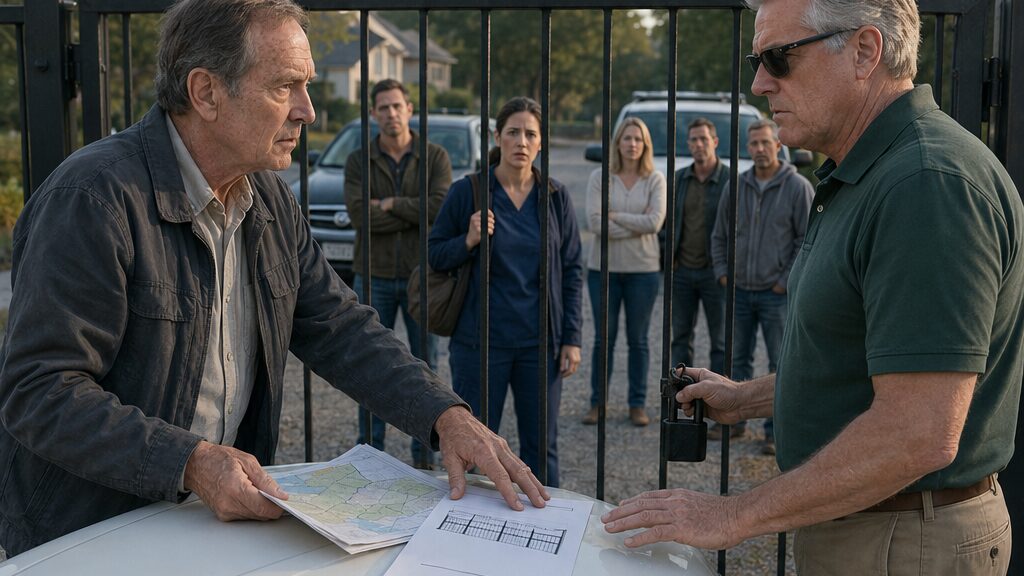
The HOA Locked His Private Road, but Removing the Gate Cost More Than Anyone Expected
Chapter 1: The Gate Across the Road He Owned
Donald Harris’s key entered the black padlock cleanly, but it would not turn.
He tried once more, slower this time, feeling for the worn catch he knew from thirty years of locks, toolboxes, fuel caps, and municipal equipment sheds. The key stopped against something solid. It was the wrong lock.
Donald looked through the bars of the new steel gate at the gravel road beyond it.
His road.
The gate stood twelve feet across, taller than his pickup, its square posts sunk into fresh concrete on either side. Dew still clung to the black paint. Whoever had installed it had finished recently enough that the gravel around the footings remained darker than the rest of the lane.
He stepped back and read the laminated notice fastened at eye level.
SECURITY ACCESS REGISTRATION REQUIRED.
Below that were instructions to contact the Meadow Ridge Homeowners Association office for entry credentials.
Donald read the notice twice. Then he looked at the brass key in his hand as though it might explain why a seventy-year-old man needed permission from an HOA to use land recorded in his name.
An engine idled behind the gate.
Sarah Clark’s teenage son sat in a compact car twenty yards up the road, one hand resting on the steering wheel. Sarah stood beside the driver’s window in navy hospital scrubs, her arms folded tightly against the morning chill.
“Mr. Harris,” she called through the bars. “Do you have the code?”
Donald kept his eyes on the lock. “No.”
“The email said property owners would get one.”
“I didn’t get an email.”
Sarah came closer. She looked tired in the specific way of someone who had not yet gone to bed. “He has to be at school in twenty minutes.”
Donald tested the gate itself. It did not move. A chain ran through the center bars and into the new padlock. The chain was heavy enough for a commercial yard.
“Who put this here?” he asked.
“The board’s contractor. They worked yesterday afternoon.”
Donald had spent Sunday at his sister’s house two counties away. He had returned after dark, entering from the older service path behind his home. He had not driven this end of the road until now.
“Did they say where the boundary was?”
Sarah glanced toward the identical roofs behind her. “They said it was common access.”
“That isn’t what I asked.”
Her mouth tightened. “I don’t know.”
Donald walked to the left gatepost. Fresh concrete filled a rough square cut into the gravel shoulder. A narrow root from the old maple near the ditch had been sliced cleanly where the footing went down.
He crouched and brushed loose stone aside with his fingers.
A faded orange survey cap showed beneath the gravel, less than eight inches from the concrete.
He knew that marker. He had watched it go into the ground before Meadow Ridge had a sign, a clubhouse, or a single vinyl fence. The boundary line ran from that pin along the western edge of the road, crossed beneath the gate, and continued to the back corner of his acreage.
Donald took out his phone and photographed the cap, the concrete, the severed root, and the gatepost.
Sarah watched him. “Can you open it or not?”
“No.”
Her son leaned across the passenger seat and called, “Mom, I’m already late.”
Sarah exhaled sharply. “The board said this would make things safer.”
Donald moved to the opposite post. Another capped survey pin sat partly buried beside the footing. Both posts were inside his line.
There were four houses beyond the gate. Sarah’s stood first, then three others built along the narrow lane before it met the subdivision’s newer paved street. Their owners had used the gravel road under an access agreement Donald and his wife had signed years earlier, when the developer had discovered that the planned rear street would not be completed on schedule.
Temporary access, the developer had called it then.
The houses had remained. The road had remained. Temporary had stretched into habit.
A delivery van approached from the subdivision side and stopped behind Sarah’s son. The driver got out, saw the gate, and checked his handheld device.
“Need a code?” he asked.
Sarah gave a short, humorless laugh. “Apparently everyone does.”
Donald photographed the laminated notice. At the bottom, beneath the registration instructions, a smaller line stated that unauthorized entry or tampering could result in fines.
He read that part again.
A fine for tampering with a lock placed on his land.
The anger arrived without heat. It tightened his jaw and steadied his hands.
He returned to his pickup, removed a folded property map from the glove compartment, and spread it across the hood. The paper had softened along the creases from years of use. He found the road line, then the parcel number printed beside it.
Sarah came through the pedestrian gap between the ditch and the gatepost, careful not to step into the wet concrete.
“You’re saying the road belongs to you?”
“I’m saying the county record says it does.”
“But we have access.”
“Yes.”
“Then what’s the difference?”
Donald folded the map once. “Access lets you pass over land. It doesn’t let someone pour concrete into it.”
Sarah looked back at her son, the delivery driver, and the two cars now waiting behind them. “That distinction doesn’t get him to school.”
Donald heard the accusation beneath the exhaustion, though the gate was not his work.
He could have said so. Instead, he walked toward the ditch where the shoulder widened. If the ground was dry enough, a car might edge around the post.
It was not. The drainage cut dropped steeply, and yesterday’s excavation had pushed loose soil into the channel. A tire would slide.
He called the nonemergency number for the county public works office, then the HOA office. Public works sent him to property records. The HOA voicemail said the office opened at nine.
Sarah checked her phone.
“I’ll back him up to the paved street,” she said. “He can leave through the north entrance if the cars move.”
Her son lowered the window. “That’s fifteen minutes the other direction.”
“I know.”
As the cars reversed one by one, Donald remained beside the gate. The road looked different through black bars. Smaller. Claimed.
He photographed the chain from three angles. On the padlock’s smooth face, a white inventory sticker carried the HOA’s initials.
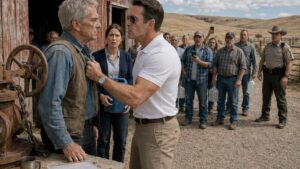
A white SUV turned onto the gravel from the subdivision side. It stopped beyond the gate, and Thomas Mitchell climbed out wearing sunglasses and a dark green polo with the Meadow Ridge emblem.
Two board members got out behind him.
Thomas walked toward the gate with the brisk confidence of a man arriving to correct someone else’s mistake.
“Donald,” he said, loud enough for everyone nearby to hear. “You need to complete the access registration before we can issue your credential.”
Donald held the folded map at his side. “Take the gate down.”
Thomas placed one hand on the new padlock.
“That road,” he said, “is under board control now.”
Chapter 2: The Signature Thomas Could Not Produce
“Register for access,” Thomas repeated, as if saying it twice might turn the road into HOA property.
Donald stood on the outside of the gate. Thomas stood on the inside with his fingers curled around the black padlock. Between them, the chain pulled tight through the steel bars.
“To my own land?” Donald asked.
“To the controlled access corridor.”
“That isn’t what the deed calls it.”
One board member shifted uncomfortably. The other, the HOA treasurer, held a thin folder against her chest.
Thomas glanced toward the waiting cars. “We’re not doing a title seminar in the road. The neighborhood had three trespassing incidents in six weeks. Packages were stolen. A vehicle came through here after midnight and damaged a mailbox. Residents asked for action.”
“Which residents asked you to put posts in my property?”
“Residents asked for security.”
“That’s not the same answer.”
Thomas removed his hand from the lock. “The association maintains access rights over this road.”
Donald nodded once. “Rights to do what?”
“To manage passage for the benefit of Meadow Ridge.”
“Show me where it says that.”
Thomas’s expression hardened. “The association’s attorney reviewed the agreement.”
“Then you should have brought it.”
“I don’t need to carry legal files every time you disagree with a board decision.”
Donald unfolded the map across the hood of Thomas’s white SUV.
Thomas stared at it as though Donald had placed mud there.
The county parcel map showed the narrow road running along Donald’s eastern boundary. Donald placed a second sheet over it—the survey prepared when the subdivision lots had been approved. The road lines matched. Both gateposts fell inside the same parcel.
Sarah had returned on foot after getting her son out through the north entrance. Two other homeowners stood behind her. No one spoke.
Donald pointed to the road. “This parcel is mine.”
Thomas tapped a shaded strip on the survey. “And this is the access easement.”
“Correct.”
“So the association has authority.”
Donald looked at him. “An easement isn’t ownership.”
“It is a recorded right.”
“To pass.”
“To regulate safe use.”
“Show me the language.”
Thomas turned toward the treasurer. “Give me the agreement.”
She hesitated before opening the folder. That pause was small, but Donald noticed it.
Thomas took several stapled pages from her and slid them onto the SUV hood. He flipped to a section labeled Maintenance and Access Standards.
“There,” he said. “Reasonable safety improvements.”
Donald read the paragraph. It permitted grading, gravel replacement, drainage maintenance, and temporary traffic controls during repair work.
“A permanent steel gate isn’t listed.”
“It doesn’t have to list every possible improvement.”
Donald turned the page.
Near the bottom was a separate clause.
No permanent obstruction, structural installation, or controlled-entry device shall be placed within the access area without the written approval of the fee owner.
Donald read it aloud.
No one interrupted him.
Thomas’s jaw moved once. “The board interpreted the gate as a security device, not an obstruction.”
“It’s locked.”
“Registered users can enter.”
“After asking you.”
“For credentials.”
“To cross my property.”
Thomas leaned closer. “You keep saying that as though the four households behind this gate don’t exist.”
Donald felt Sarah’s attention settle on him.
He turned to the final page. The agreement contained signature blocks for the original developer, Donald and his late wife, and a separate approval line for later permanent installations.
The approval line was blank.
Donald laid the page flat over the drawn gate line on the map.
“Point to my signature.”
Thomas did not look down.
“Donald, this can be handled through counsel.”
“You told me the road was under board control. Point to the signature that gave you that control.”
The treasurer lowered her folder.
One of the homeowners behind Sarah stepped closer to the bars. “Is there supposed to be a signature?”
Thomas turned toward him. “The board acted under its general safety authority.”
“That wasn’t the question,” Donald said.
Thomas removed his sunglasses. His eyes were tired and bloodshot, but the look in them was sharp.
“You’ve opposed every improvement near that road for years.”
“I opposed widening it onto my yard.”
“You opposed lighting.”
“The lights were aimed at my bedroom.”
“You opposed cameras.”
“I asked where the footage would be stored.”
“You make ordinary decisions impossible.”
Donald folded his arms. “And you make permission sound like surrender.”
The words landed harder than he intended. Thomas’s face reddened.
Sarah stepped nearer. “I voted for better security.”
Thomas gestured toward her as if she had settled the matter. “Exactly.”
“I didn’t vote for this gate,” she said.
The silence changed shape.
Thomas looked at her. “The survey showed broad support.”
“The survey asked about cameras, patrols, and controlled access. It didn’t say the road would be locked.”
“The final plan was presented at the board meeting.”
“I was at work.”
“The minutes were distributed.”
Sarah’s voice remained level, but fatigue sharpened it. “The minutes said security improvements were approved. It didn’t say Donald had refused permission.”
Thomas gathered the agreement pages too quickly. The blank approval sheet slipped and nearly fell from the hood.
Donald caught it before it touched the gravel.
For a moment they both held the same page.
Thomas released it.
“You are interfering with a board-approved safety project,” he said. “If you damage association property, the HOA will pursue costs.”
Donald looked through the gate at the concrete footings. “Association property?”
“The gate.”
“The gate may be yours. The holes are mine.”
A board member murmured something to the treasurer. Thomas snapped the folder shut.
Donald took photographs of each page before returning them. When he reached the unsigned approval sheet, Thomas put his palm over it.
“You don’t have permission to copy internal board documents.”
“This isn’t an internal document. It’s my agreement.”
Thomas moved his hand.
Donald photographed the blank line.
A small satisfaction passed through him—not triumph, exactly, but the relief of a machine part clicking into the position it had always been designed to occupy. The facts were where they belonged now.
Then he saw the faces behind the gate.
The homeowner who had asked about the signature was no longer looking at Thomas. He was looking at Donald. So were the others.
Not with gratitude.
With calculation.
One of them asked, “If the board had no authority, does that mean our access agreement isn’t valid either?”
“It means the gate isn’t authorized,” Donald said.
“That isn’t what I asked.”
Donald folded the map along its familiar crease. “The access agreement is a separate issue.”
“What separate issue?”
Thomas seized the opening. “This is what I warned the board about. Mr. Harris has never accepted that these homes require reliable access.”
Donald looked at him. “Don’t speak for me.”
“Then speak.”
Donald could have explained that the agreement still existed. He could have said it had terms, dates, and limits. He could have reassured them that he had never blocked a neighbor from reaching a home.
But the old resentment rose before the explanation.
For years, delivery trucks had widened the gravel shoulders. Residents had complained when he parked a tractor near the lane. The HOA had sent him courtesy notices about weeds on land outside its jurisdiction. Cooperation had gradually become expectation, and expectation had turned into Thomas gripping a lock across Donald’s road.
So Donald said only, “I’ll discuss access after this gate is removed.”
The homeowners exchanged glances.
Thomas put his sunglasses back on. “There it is.”
Sarah came through the narrow pedestrian gap and stopped a few feet from Donald.
Her scrubs were wrinkled. A hospital badge hung from her pocket. She looked less angry than frightened, which unsettled him more.
“My shift starts at seven tonight,” she said. “I have to know whether I can get home.”
“You have access under the agreement.”
“For how long?”
Donald did not answer quickly enough.
Sarah’s eyes narrowed.
“You knew this was coming, didn’t you?”
“What?”
“Some kind of fight over the road.”
Thomas remained behind the gate, silent now.
Sarah looked from the folded map in Donald’s hand to the unsigned approval page.
“Are you protecting your property,” she asked, “or are you planning to lock all four families out?”
Chapter 3: What Donald Never Told the Four Houses
Kathleen Roberts did not ask whether the gate was legal.
She placed the access agreement on her desk, opened it to the termination section, and asked, “Why haven’t the four households been told this expires in six weeks?”
Donald sat across from her in a wooden chair that creaked when he shifted his weight.
“I haven’t terminated anything.”
“That wasn’t my question.”
Her office overlooked the county courthouse parking lot. On the wall behind her hung framed plats, a law-school diploma, and an old photograph of Kathleen standing beside Donald’s wife at a charity auction nearly twenty years earlier.
Donald looked down at the agreement.
The expiration date had been there all along. He knew it as well as he knew the serial number stamped into the mower he had repaired every spring for twelve years.
“It can be renewed,” he said.
“It can also lapse.”
“I hadn’t decided.”
“And while you were not deciding, the HOA decided for you.”
Donald’s mouth tightened. “They poured concrete into my land.”
“Yes. Without written approval. The gate is unauthorized, and you can demand removal.”
Kathleen leaned back.
“But legal strength does not erase the fact that four households have built their daily lives around that road.”
“They knew the agreement had a term.”
“Did they?”
“It was recorded.”
“That means a title company could find it. It does not mean Sarah Clark reads county records before driving to work.”
Donald glanced toward the window.
Kathleen turned the agreement around and tapped the permanent-structure clause. “You are right about this. Completely.”
Then she moved her finger to the expiration date.
“You are not completely right about everything else.”
They spent the next hour separating ownership from access, gate removal from easement renewal, and Donald’s anger from his available remedies. Kathleen could send a formal demand immediately. She advised photographs, a repair estimate, and written confirmation that no permanent installation had ever been approved.
Donald had already taken most of the photographs.
“What about the lock?” he asked.
“Do not cut it.”
“It’s on my land.”
“And it belongs to the HOA. Let them be wrong without giving them a cleaner argument.”
At the county records office, a clerk pulled the subdivision plats and original access instruments. Donald watched pages appear on a monitor: his parcel, the narrow road, the four rear lots, and the easement shaded over the gravel lane.
No transfer deed existed. No later amendment granted ownership to the HOA. No recorded document gave the association control over a gate.
The road was still his.
The confirmation should have settled him.
Instead, Sarah’s question followed him out of the records office.
For how long?
He found Paul Nelson that afternoon in a detached garage behind a brick ranch house, sharpening the blade of a garden hoe. Paul had retired from county surveying more than a decade earlier, but he still kept field books stacked in labeled boxes.
Donald laid copies of the plats on his workbench.
Paul did not need long.
“That line hasn’t moved,” he said.
“The HOA says the road is under its control.”
“The HOA says a great many things once enough people repeat them.”
Paul traced the easement strip with a thick finger. “The developer wanted this for two years. Maybe three. Then the rear street was supposed to connect.”
“It never did.”
“Money ran out. New developer bought the lots. Everyone decided the gravel road was easier.”
Donald opened the agreement to the approval clause.
“They installed a gate.”
“I saw it.”
“You could’ve called me.”
Paul gave him a steady look. “You could’ve called the households six months ago.”
Donald said nothing.
Paul set down the hoe.
“You knew the agreement was running out.”
“I knew the date.”
“You also knew Thomas had started calling the road a community entrance.”
“He can call it the interstate if he wants. That doesn’t change the deed.”
“No. But silence lets people build stories where facts ought to be.”
Donald rolled the maps tighter than necessary. “You sound like Kathleen.”
“Then Kathleen is having a sensible day.”
Paul opened one of the old field books and found a sketch of the original road. Beside it, in faded pencil, was a note about the future connection street.
“The mistake,” Paul said, “was thinking temporary meant somebody would fix it later.”
“You signed off on the survey.”
“I did.”
“And you never corrected the board.”
Paul’s face changed slightly.
“No,” he said. “I didn’t.”
That admission took some of the force out of Donald’s anger.
Paul closed the book. “Thomas asked me last year whether the HOA maintained the access corridor. I said the association had contributed gravel and drainage work. I should’ve told him contribution wasn’t ownership.”
“Why didn’t you?”
“Because I assumed he knew.”
Donald almost laughed. The sound never came.
By evening, the new black lock and chain were still across the road. Donald returned home through the rear service path and went into his workshop.
On a hook beside the workbench hung an old black padlock, its paint worn silver at the corners. His wife had used it on the shed where she kept garden tools and bags of birdseed. Donald took it down and set it beside a photograph of the HOA lock on his phone.
The new lock was larger, cleaner, and harder to ignore.
He opened the bottom drawer of a metal filing cabinet and removed a box marked ROAD AGREEMENT. Inside were old letters, renewal drafts, gravel receipts, and a cream envelope in his wife’s handwriting.
Donald had not opened it in years.
The note inside was brief. She had written it after the developer first asked for access, when the four lots were still foundations and framed walls.
Don’t let their poor planning trap the families who end up there. Protect the land, but keep the road human.
Donald sat on the shop stool.
For thirty-one years, he had remembered the first half more easily than the second.
The phone rang. Kathleen’s name appeared on the screen.
“I found the gate contractor’s invoice in the board packet you photographed,” she said. “Look at the date.”
Donald opened the image and enlarged the top corner.
The invoice for excavation, concrete footings, and steel installation had been issued nine days before the HOA meeting where the project was supposedly approved.
Kathleen continued, “Thomas didn’t act after the vote.”
Donald stared at the date.
“He committed the money first,” she said. “Then he held the vote.”
Chapter 4: The Vote That Happened After the Concrete
The invoice had been approved nine days before the board voted to install anything.
Donald stood at the back of the HOA clubhouse Tuesday evening with the copy folded in his shirt pocket. Through the open doorway, Thomas Mitchell was arranging photographs on an easel: a smashed mailbox, an empty porch where packages had been taken, and the blurred shape of a vehicle captured by a doorbell camera after midnight.
The room filled quickly.
Residents who had never used Donald’s road took seats beside the four households that depended on it. Some carried printed emails. Others whispered while glancing toward Donald as though the dispute had already become a choice between safety and one stubborn man.
Thomas waited until every chair was occupied before placing the black padlock on the table in front of him.
It was a simple gesture, but deliberate. The lock sat under the fluorescent lights like evidence of order restored.
“We need to begin with why the board acted,” Thomas said. “This neighborhood has experienced three unauthorized-entry incidents in six weeks.”
He pointed to the photographs.
A woman near the front described finding her mailbox bent backward. Another resident said two medication deliveries had disappeared from his porch. The owner of a corner house reported seeing a dark pickup use the gravel road after midnight.
Donald listened.
The fear in the room was not invented. That complicated things.
Thomas moved from the photographs to a slide showing the rear access corridor. The image had been taken from above, and the gravel road was highlighted in yellow as though it belonged naturally to the subdivision.
“The board considered cameras, increased patrols, and controlled entry,” Thomas said. “Controlled entry provided the strongest protection at a manageable cost.”
Sarah, seated near the aisle, raised her hand.
Thomas saw her and continued speaking.
“The installation was authorized through the board’s general duty to protect common access routes.”
Sarah kept her hand raised.
Finally, the HOA treasurer leaned toward him and whispered. Thomas stopped.
“Yes, Sarah?”
“When did we vote for a locked gate?”
Thomas’s expression remained smooth. “The security package was approved at last month’s meeting.”
“I voted for cameras.”
“The ballot asked residents to support improved access control.”
“It asked about three options.”
“The board selected the most effective one.”
Sarah looked around the room. “Did anyone here vote specifically for a gate with a lock?”
No hands rose.
Thomas’s voice sharpened. “Boards are elected to make implementation decisions. We cannot hold a community-wide vote on every hinge and bolt.”
Donald felt the invoice against his chest.
He could have interrupted. Instead, he waited until Thomas finished describing the late-night vehicle and the stolen packages.
Then he walked to the front.
Thomas looked at him. “Public comment comes after the presentation.”
“I have a question about the presentation.”
“You’ll have your turn.”
Donald removed the invoice from his pocket and unfolded it.
“When did the board approve the concrete?”
A faint murmur passed through the room.
Thomas did not look at the paper. “The project was approved at the meeting noted in the minutes.”
Donald held the invoice where the front row could see it. “This contractor billed excavation and footings nine days before that meeting.”
The treasurer’s eyes dropped.
Thomas folded his arms. “Preliminary work was necessary to reserve the contractor.”
“Preliminary work usually comes before concrete?”
“We were responding to an urgent security concern.”
“So the vote came after the posts were ordered.”
“The board ratified the project.”
Donald turned toward the treasurer. “Was the contract shown to the full board before the vote?”
She adjusted the folder in her lap. “I saw the total.”
“That isn’t what I asked.”
Thomas stepped between them. “You are attempting to turn a scheduling issue into misconduct.”
Donald took out the copied approval page.
“This page requires my signature before permanent construction.”
The blank line faced the room.
Thomas’s voice lowered. “We’ve already discussed your interpretation.”
“Was this page included in the packet the board reviewed?”
No one answered.
Donald looked at the two board members seated beside the treasurer. One frowned and reached for the packet in front of him.
“I don’t remember seeing that,” he said.
Thomas turned quickly. “The complete agreement was available upon request.”
“Was it in the packet?” Donald asked.
The board member flipped through his pages. “Not this page.”
The room grew still.
Thomas picked up the padlock from the table and held it in one hand.
“This is not a land grab,” he said. “It is a lock. A security measure. Four homes retain access. Emergency services retain access. Registered owners retain access.”
Donald watched his grip tighten around the lock.
“You keep describing what the gate does,” Donald said. “You haven’t explained who gave you permission to put it there.”
A resident near the wall spoke up. “What happens if he makes you remove it?”
Another answered before Thomas could. “Then anyone can come through again.”
“That road was open for thirty-one years,” Donald said. “The recent theft reports involve front porches on the paved streets. Not one report identifies my road as the entry point.”
Thomas lifted a printed police summary.
“The dark pickup was seen near the rear corridor.”
“Near it isn’t through it.”
“You want us to wait until someone gets hurt?”
The question drew several uneasy nods.
Donald understood what Thomas was doing because part of it was reasonable. A board president who had received complaints, photographs, and angry calls could not simply shrug. People wanted visible action. Cameras required policies. Patrols cost money every month. A steel gate was immediate, physical, and easy to photograph in a newsletter.
The problem was not that Thomas had recognized fear.
The problem was that he had used it to step over a line he knew existed.
Sarah stood.
“My son was trapped behind that gate Monday morning,” she said. “The board had not given us credentials. Donald didn’t have one either. That is not controlled access. That is poor planning.”
Thomas’s face tightened. “The credential delay was corrected.”
“It should not have happened.”
“We moved quickly because residents demanded it.”
“I demanded cameras,” Sarah said. “You used my vote to approve something else.”
The first crack in Thomas’s support did not produce applause. It produced quieter things: residents checking old emails, board members comparing packets, the treasurer staring at the table.
Donald felt no satisfaction.
These people had legitimate concerns. Thomas had simply arranged the facts so every concern pointed toward the solution he had already purchased.
After the meeting, Donald walked back to the gate with Sarah and two homeowners. Thomas followed in the white SUV and stopped beside them.
The black bars reflected the headlights.
Donald showed the others where the footings crossed his boundary. He pointed out the cut maple root and the loose soil pushed into the drainage channel.
One homeowner crouched near the concrete. “They said this was within the easement.”
“It is,” Donald said. “An easement lets you use the land for a stated purpose. It doesn’t erase the owner.”
Thomas got out of the SUV carrying the padlock.
“You’re creating panic over language that can be resolved,” he said.
“Then unlock it and suspend use while it is resolved,” Sarah replied.
Thomas looked at her as though she had changed sides.
“The gate stays operational,” he said. “The board cannot abandon a security measure because one owner disputes the paperwork.”
Donald took the formal notice Kathleen had drafted from an envelope.
“You have forty-eight hours to remove the gate and restore the land.”
Thomas accepted the notice but did not open it.
“You are threatening access for four families.”
“No. I am demanding removal of an unauthorized structure.”
“You remove this gate, and whatever happens next is on you.”
Donald looked through the bars toward Sarah’s house. Her porch light glowed beyond the bend.
Thomas tucked the unopened notice beneath his arm.
“The gate will remain locked,” he said, “no matter what deadline you put on paper.”
Chapter 5: Forty-Eight Hours Before the Road Closed
The certified-mail receipt showed that someone at the clubhouse signed for Donald’s notice at 9:14 Wednesday morning.
By ten, three neighbors had called him.
The first asked whether he intended to bulldoze the road. The second wanted to know why each household owed him eight hundred dollars. The third did not ask anything. He said Donald should be ashamed of using four families as leverage and hung up.
Donald stood in his workshop with the phone still against his ear.
On the bench lay a copy of Kathleen’s demand letter, the contractor’s restoration estimate, and the photograph of the black padlock. Nothing in the letter mentioned charging the households.
He called Sarah.
She answered on the fourth ring, her voice low. “I’m trying to sleep.”
“Where did the eight-hundred-dollar number come from?”
Silence.
“Thomas said you demanded eight hundred from every house before renewing access.”
Donald looked at the restoration estimate. The bottom line was $3,240 for removing damaged concrete, rebuilding the shoulder, correcting drainage, and protecting the maple roots.
Four households. Roughly eight hundred each.
“He divided the repair estimate,” Donald said.
“So there is an eight-hundred-dollar charge.”
“To the HOA. For damage its contractor caused.”
“That is not how he explained it.”
“I never sent you a bill.”
“No. You didn’t send us anything.”
The words landed cleanly.
Donald leaned against the bench. “The notice gives the HOA forty-eight hours to remove the gate.”
“And after that?”
“If they refuse, I’ll hire a licensed crew.”
“What happens to the road during removal?”
“It will be closed temporarily.”
“My shift starts Thursday night at seven. I get home Friday morning.”
Donald looked at the site plan spread beneath the estimate. The crew Kathleen recommended had proposed placing equipment directly in the twelve-foot lane. With the crane truck, cutting tools, and debris, no vehicle could pass.
“How long is temporarily?” Sarah asked.
“Four hours, maybe six.”
“You don’t know.”
“No.”
“I work in the emergency department, Donald. I cannot call the hospital at sunrise and say I’m sitting behind a property dispute.”
He rubbed a thumb along the worn edge of his wife’s old padlock.
“I’ll work something out.”
“That is what the board said.”
Sarah ended the call.
Donald drove to the other three houses before noon.
At the first, a homeowner opened the door only wide enough to speak through the gap. At the second, Donald was shown a printed HOA email stating that he had “initiated financial demands related to continued access.” The third homeowner invited him inside but asked whether renewing the agreement would mean surrendering to new fees every year.
Donald answered each question directly. No household owed him eight hundred dollars. The existing agreement remained active. The removal notice concerned the gate, not their right to pass.
Every explanation came later than it should have.
By the fourth conversation, he could hear how defensive his own words sounded.
At the post office, Donald mailed separate copies of the notice and restoration estimate to all four households. He included a single handwritten sentence:
Your access remains valid during this dispute.
He disliked how much reassurance one sentence carried when delivered at the right time.
Kathleen called that afternoon.
“The gate contractor returned my message,” she said. “Before the final bid, he proposed a removable barrier with coded access.”
“Why didn’t they use it?”
“Thomas rejected it.”
“Cost?”
“The removable design was cheaper.”
Donald stopped beside his pickup.
“Then why?”
“According to the contractor, Thomas said a removable system would leave operational control with the landowner.”
Donald looked down the road toward the black gate.
There it was.
Security had been the reason. Control had become the objective.
“He wanted the HOA to own the decision every time that gate opened,” Donald said.
“That is what it sounds like.”
“Can the contractor put that in writing?”
“He is considering it. He does not want to be pulled into litigation.”
Donald understood. The man had installed what he had been hired to install. He had probably assumed the HOA had the necessary rights.
“Donald,” Kathleen said, “what is your removal plan?”
He told her.
“No,” she said immediately.
“It’s the safest setup.”
“It blocks all four homes.”
“For a few hours.”
“And confirms every accusation Thomas has made about you.”
Donald bristled. “I am not responsible for the size of the lane.”
“You are responsible for the plan you choose now.”
He almost ended the call.
Instead, he unfolded the site map across the pickup hood.
The ditch on the west side was too steep, but the east shoulder widened near the old maple before narrowing again. If the crew staged the crane farther back and cut the gate into sections, one side of the road might remain passable. It would take longer and cost more. The estimate increased by nearly nine hundred dollars.
Donald approved it.
Thursday evening, he met the removal crew supervisor at the gate. They marked a temporary lane with orange cones and steel plates over the soft shoulder. A compact car could pass. An ambulance could pass slowly. A large delivery truck could not.
Sarah arrived in scrubs before leaving for work.
She studied the cones. “You changed it.”
“Yes.”
“Because I called?”
“Because the first plan was wrong.”
She looked at him for a moment. “Thank you.”
The words did not repair anything, but they eased one tight place in his chest.
Thomas’s white SUV appeared before sunset. He stepped out carrying a copy of Donald’s notice.
“You have no authority to touch association property,” he said.
Donald pointed toward the concrete. “Your property is attached to mine without permission.”
“Our counsel will seek an injunction.”
“Then serve it before the deadline.”
Thomas looked at the cones and steel plates. “What is this?”
“A lane for the households.”
“So you admit removal threatens access.”
“I admit the neighbors should not pay for your decision.”
Thomas’s expression flickered.
“You think this makes you reasonable?”
“No.”
Donald photographed the certified envelope beside the padlock, then photographed the clock on his phone.
The deadline passed at 5:00 Friday morning.
At 5:01, Thomas was still standing beside the locked gate.
Chapter 6: When the Steel Gate Left the Ground
The crane chain tightened around the top rail before sunrise.
Steel groaned against steel, low and heavy enough that Donald felt it through the gravel beneath his boots. The removal crew had positioned the truck at an angle near the maple, leaving the temporary lane open along the opposite shoulder.
The black gate did not move at first.
Its posts held inside the concrete as though they had grown there.
The crew supervisor raised one hand. A worker brought a cutting tool to the chain around the center bars. Sparks scattered briefly over the gravel. When the black padlock dropped free, it struck the ground with a dull, final weight.
Donald picked it up with gloved hands and placed it in an evidence bag Kathleen had given him.
He did not feel what he had expected.
No release. No victory.
Only attention.
A compact car crept through the temporary lane. The driver lowered his window, thanked the crew, and kept going.
Then Thomas arrived.
His SUV stopped hard enough to spray gravel against the cones. He got out with his phone raised, recording.
“Stop work,” he shouted. “You are destroying HOA property.”
The crew supervisor switched off the cutting tool.
Donald stepped forward. “The notice expired.”
“We are seeking emergency relief.”
“Do you have an order?”
“Our attorney is filing.”
“Do you have one now?”
Thomas kept the phone aimed at him. “You were warned.”
The supervisor looked between them. “I need to know whether there’s a court order.”
“There isn’t,” Donald said.
Thomas pointed toward the gate. “This structure belongs to Meadow Ridge.”
The supervisor nodded. “And the land?”
Thomas hesitated.
Donald handed the supervisor copies of the deed, survey, notice, and Kathleen’s written authorization to proceed.
The man read the first page, then looked at Thomas. “My crew is removing an installation from the owner’s parcel. Unless you produce an order, we continue.”
Thomas’s face reddened.
“You installed it,” he said. “Your company installed this gate.”
The supervisor shook his head. “Different contractor.”
Thomas called the original gate contractor on speaker.
Donald heard the man answer after several rings.
Thomas spoke quickly. “I’m at the rear gate. Harris has a crew cutting it apart. Tell them the installation was authorized.”
There was a pause.
The contractor’s voice came through thin but clear. “The HOA represented that it had site authority.”
“You reviewed the agreement.”
“We received a site plan and board authorization.”
“Did you or did you not install this legally?”
“I’m not making a legal determination.”
Thomas paced away from the crew. “You poured the footings.”
“Based on the documents your office provided.”
“Then tell them to stop.”
“I can’t do that.”
Thomas ended the call.
The supervisor gave the signal.
A worker cut through the first hinge assembly. The crane took the weight, lifting one side of the gate several inches. Gravel fell from the lower rail.
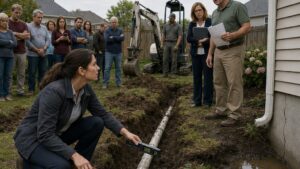
As the post pulled against the concrete, a section of the shoulder cracked open. Beneath it, muddy water had collected where the footing blocked the drainage channel. The maple’s severed roots lay exposed inside the broken soil.
The supervisor crouched to inspect it.
“This footing changed the runoff,” he said. “Water’s been backing under the road.”
Donald knelt beside him. The gravel base was soft where it should have been compacted. Another heavy rain might have washed the edge out.
Thomas looked at the damage, then away.
“You were told to protect the drainage,” Donald said.
“The contractor was responsible for site conditions.”
“You selected the contractor.”
“The board approved the project.”
“After the concrete was ordered.”
Thomas lowered his phone.
For the first time since Monday, he looked less angry than cornered.
The gate rose another foot.
Sarah’s car appeared beyond it just after six. She had returned from the hospital in her navy scrubs, her hair pulled back and her face pale with fatigue. The crew stopped while she guided the car through the temporary lane.
When she reached Donald, she lowered the window.
“It’s open enough,” she said.
“For now.”
Her eyes moved to the suspended gate. “And after today?”
“The road stays open under the current agreement.”
“That expires soon.”
Donald did not hide behind silence this time.
“Yes.”
Sarah gripped the steering wheel. “Removal doesn’t solve that.”
“No.”
“What happens to us in six weeks?”
Thomas had moved close enough to hear.
“This is what I’ve been saying,” he told her. “He wants control.”
Donald looked at the black lock inside the clear evidence bag.
Thomas was wrong about the road.
He was not entirely wrong about Donald.
For months, Donald had imagined the agreement expiring without renewal. He had pictured the board discovering that cooperation could be withdrawn. He had told himself that he was protecting his rights, but beneath that was something harder: the wish to make Meadow Ridge feel uncertainty after years of treating his permission as automatic.
Sarah waited.
Donald said, “We will discuss a replacement before it expires.”
“We?”
“The four households and me.”
Thomas stepped forward. “The HOA is the proper party.”
“No,” Donald said. “The HOA is why a crane is standing here.”
The crew cut the second hinge.
The full gate lifted clear of the posts.
For several seconds it hung above the road, black bars suspended against the pale morning sky. Thomas stared upward. Sarah watched from her car. The crew rotated the gate slowly toward the grass.
Donald had expected that image to feel like justice.
Instead, he saw how easily one man’s boundary could become everyone else’s obstruction.
The crew lowered the gate onto timber blocks. Workers removed the posts, broke apart the unauthorized concrete, and cleared the central lane. They left the deeper excavation marked for restoration.
By nine, cars could pass normally.
The padlock remained in Donald’s evidence bag.
The HOA treasurer arrived without Thomas and photographed the damaged roots. She asked for copies of the restoration estimate. Donald gave them to her.
Thomas stood beside his SUV making calls. He no longer addressed the crew.
When the last section of steel was stacked on the grass, one homeowner offered Donald his hand.
Donald shook it but did not smile.
Sarah had returned on foot after sleeping for less than two hours. The other three affected homeowners came with her. They stood near the open road, separated from Donald by the places where the gateposts had been.
“What happens now?” one asked.
Donald looked at each of them.
He could have said their access continued until the agreement expired. He could have told them Kathleen would prepare papers. He could have postponed the difficult part again.
Instead, he folded the boundary map once and placed it under his arm.
“Monday evening,” he said. “My workshop. All four households.”
Sarah glanced toward Thomas.
“With the board?”
Donald looked at the removed gate lying on the grass.
“No,” he said. “This time, without the HOA.”
Chapter 7: The Agreement That Left the HOA Outside
Donald began the meeting by admitting he had helped Thomas.
The four households sat in mismatched chairs inside his workshop, surrounded by pegboards, tool cabinets, and the dry smell of sawdust. Sarah occupied the chair nearest the open door. Paul Nelson stood beside the workbench with the worn boundary map spread flat beneath two steel weights.
On the corner of the bench lay the cut black padlock.
Donald had considered putting it away. Leaving it visible felt more honest.
“I knew the agreement was getting close to its end,” he said. “I did not tell you directly.”
One homeowner crossed his arms. “Why not?”
Donald looked at the road line on the map.
“Because I was tired of the HOA treating my cooperation like something it owned. I told myself the recorded date was enough. It wasn’t.”
The room remained quiet.
Sarah leaned forward. “Were you going to renew it?”
“I had not decided.”
“That means no.”
“It means I was angry and preferred not to say so.”
The answer cost him more than the legal arguments had. There was no clause to stand behind and no blank signature to expose.
Sarah looked at the padlock. “Thomas told us you had been planning to cut off the road for months.”
“He did not know what I planned.”
“Neither did we.”
Donald accepted that without defending himself.
Kathleen Roberts had prepared three possible structures. Donald distributed copies, but he did not ask anyone to read them yet.
“The old agreement was between me and the developer, with the association handling maintenance,” he said. “That is part of how the board began speaking as though it controlled the road.”
“What replaces it?” another homeowner asked.
“A recorded easement for each of the four properties. Not for the HOA.”
Sarah opened the first document. “Permanent?”
“Running with the property. Your access would not depend on who owns my land later.”
The guarded expression on her face shifted, though only slightly.
“And the board?” she asked.
“Would have no ownership interest, no right to install structures, and no authority to restrict entry.”
One homeowner scanned the maintenance section. “Who pays for gravel and drainage?”
“The four properties and mine, by a fixed share. Major work requires written approval from the affected owners.”
“Unanimous approval?”
“For permanent structures, yes.”
Sarah tapped the page. “That gives you veto power.”
“It gives every landowner affected by a permanent structure veto power.”
“You own the ground. We rely on it. That isn’t equal power.”
Donald felt the old instinct to answer with the deed.
Instead, he said, “No. It isn’t.”
Paul glanced at him.
Donald continued. “That is why the access right should be recorded. It limits what I can do, too.”
Sarah read further. “You could not block the road?”
“Not without an emergency or agreed repairs.”
“And if you sell?”
“The easements remain.”
“And if one household refuses to pay?”
“No one loses access. Unpaid maintenance becomes a civil debt, not a lock.”
The severed padlock seemed heavier on the bench.
One of the homeowners picked it up, then set it down quickly. “What about security?”
Paul pointed to a small square drawn beside the road entrance. “Donald’s proposing an access box mounted inside his boundary. Emergency key, camera power, and space for a future household-controlled system.”
“Unlocked?” Sarah asked.
“For now,” Donald said. “Cameras can be considered later. A gate only if all five property owners approve its design, location, and operation.”
“Not the HOA?”
“Not the HOA.”
The first hour exposed every weakness in Donald’s draft.
The lane was too narrow for parked vehicles. Delivery access needed protection. Snow removal responsibility was vague. The first version allowed Donald to close the road for twelve hours during repairs; Sarah insisted on an emergency passage requirement. Another homeowner wanted notice before heavy equipment entered. Donald resisted language that allowed household owners to bring contractors onto his land without approval.
Their voices rose twice.
Neither time did anyone leave.
At one point Sarah pushed the papers away.
“You keep describing what you will permit,” she said. “We need rights, not favors.”
Donald looked toward Paul.
Paul did not rescue him.
Kathleen, seated beside the filing cabinet, said, “She is correct.”
Donald picked up his wife’s old letter from the workbench drawer. He had not planned to show it. The fold lines had nearly worn through.
“My wife wrote this when the original agreement was signed.”
He passed it to Sarah.
She read the sentence silently, then aloud.
“Protect the land, but keep the road human.”
No one spoke for several seconds.
Donald took the letter back carefully.
“She understood the developer might disappear before the problem did,” he said. “I remembered her promise as an obligation I had to carry alone. That made it easy to resent all of you for depending on it.”
Sarah’s expression softened, but not into forgiveness.
“Dependence without certainty creates resentment on our side, too.”
“I know that now.”
They returned to the draft.
By nine o’clock, the new agreement had changed substantially. Each property received a defined, recorded access right. Donald retained title. The households shared ordinary maintenance. No HOA dues, fines, rules, or elections could alter passage. Permanent controls required direct written consent from every affected owner.
Kathleen gathered the marked pages.
“I can have clean drafts by Thursday.”
A knock sounded at the workshop door.
Thomas stood outside holding a large envelope.
“You cannot negotiate away association interests without board involvement,” he said.
Donald remained seated. “The association has no ownership interest to negotiate.”
Thomas entered without being invited. His eyes moved over the documents and stopped at the cut padlock.
“Our attorney will challenge removal costs and any agreement that interferes with the HOA’s duty to secure common access.”
Sarah rose. “It is not common property.”
“It serves Meadow Ridge homes.”
“So does the power line,” she said. “You do not own that either.”
Thomas turned to Donald. “You think excluding the board solves this? The next theft will be blamed on you.”
Donald felt the familiar anger gather, but it no longer controlled the room.
“If residents want cameras, the property owners can discuss cameras.”
“You are dismantling community governance because you dislike me.”
“No,” Donald said. “I am removing the HOA from a road it never owned.”
Thomas placed the envelope on the bench. Inside was a letter refusing the restoration invoice and warning of litigation if Donald recorded new easements without association approval.
Kathleen read it once.
“This has no supporting authority,” she said.
“It is notice of our position.”
Thomas looked around at the four households. “You should consider who will protect you when he changes his mind.”
Sarah held up the marked agreement.
“This protects us.”
Thomas’s face changed—not anger this time, but the realization that his strongest argument had depended on the neighbors fearing Donald more than they distrusted him.
He left without taking the padlock.
Thursday afternoon, the five property owners signed the revised documents at the county recorder’s office. The clerk stamped each copy, entered the parcel references, and slid the originals beneath the counter glass.
Donald watched the machine press the date into the paper.
It was not permission. It was obligation, made visible.
Outside, Sarah handed him a small metal access box for the roadside post.
“No lock?” he asked.
“Not until everyone agrees what belongs inside.”
Donald turned it over in his hands. “Fair enough.”
They were crossing the parking lot when the HOA treasurer hurried toward them carrying a thick binder.
She looked behind her before opening it.
“I should have done this before the vote,” she said.
Inside was the original board packet. The permanent-structure clause was marked in yellow. The unsigned approval page was clipped behind it, along with an email from Thomas instructing her to remove both pages from the copies distributed to the other board members.
Chapter 8: The Road Stayed Open, but the Lock Did Not
The missing approval page lay on every board member’s desk.
One month after the gate came down, the clubhouse was full again. This time there were no security photographs on the easel and no black padlock displayed beneath the lights. The board packet in front of each member contained Thomas’s email, the contractor invoice, Donald’s removal notice, the restoration estimate, and the page Thomas had ordered withheld.
Thomas sat at the end of the table rather than at its center.
The treasurer read his email aloud.
“Remove the owner-approval language from the voting packet. It will create unnecessary confusion over authority already exercised by the association.”
No one moved when she finished.
Thomas rested both hands on the table. “That message has been stripped of context.”
A board member turned toward him. “What context makes the missing signature unnecessary?”
“We had counsel’s informal view that the board possessed broad authority.”
“Do you have that in writing?”
“No. It was a phone conversation.”
Kathleen sat beside Donald in the second row. She did not speak.
Thomas continued. “Residents were demanding action. We had theft complaints, trespassing reports, and a narrow entry point that no one was monitoring. I made a decision.”
“You signed a contract before the vote,” the board member said.
“I reserved a contractor before prices increased.”
“You ordered concrete.”
“The project could have been modified.”
“The contractor says you rejected a removable design.”
Thomas looked toward Donald.
“You have turned an administrative error into a campaign against me.”
Donald felt every face in the room shift toward him.
A month earlier, he might have answered immediately. He might have listed each cut root, each unauthorized bolt, each lie about the eight-hundred-dollar charge.
Instead, he said, “I did not bring the email.”
The treasurer straightened in her chair. “I did.”
Thomas’s mouth tightened.
She continued. “I knew the page had been removed. I told myself the full agreement was available in the office, so the board could have asked. That was cowardly.”
No one applauded her confession. Donald was grateful for that.
The meeting moved through the practical consequences.
The removal crew had cleared the steel structure. A separate landscaper had stabilized the shoulder and rebuilt drainage around the maple. Paul had verified the boundary pins and inspected the restored grade. The four households had recorded direct easements. The road remained open, and a shared camera proposal was being reviewed by the five property owners.
The HOA had received no ownership interest.
The remaining questions were money and accountability.
The treasurer presented a motion for the association to reimburse Donald’s documented removal and restoration costs. A second motion required title verification and written landowner consent before future HOA projects on property not recorded to the association.
One resident objected.
“Why should all of us pay for a dispute between two men?”
Sarah stood near the aisle.
“Because the contractor was hired with association funds,” she said. “The board acted in our name. We cannot accept the authority when we like it and call it personal when the bill arrives.”
The resident sat down without answering.
Thomas looked at Sarah as if he still could not understand when she had stopped standing behind him.
The board member nearest Donald asked whether he wanted Thomas’s resignation as a condition of settlement.
The room became very quiet.
Donald saw Thomas’s shoulders stiffen.
A public apology was also available. Kathleen had told him he could request one. The concealed page, the false claim about household fees, and the refusal to remove the gate gave him more than enough grounds.
He thought of the first morning, when Thomas had held the padlock and ordered him to register.
He thought of his own silence while four households wondered whether they would lose access.
“No,” Donald said. “I want the land restored, the costs paid, and the rule changed.”
The board member waited. “You are not asking for an apology?”
“No.”
Thomas looked up.
Donald met his eyes. “An apology given as a condition is another kind of credential. I don’t need one to know which road is mine.”
The reimbursement motion passed.
The property-verification rule passed unanimously.
Thomas voted against neither. He also did not apologize.
Before the meeting ended, he resigned as president and from the security committee, effective immediately. His statement was brief. He said the neighborhood still needed stronger protections and that he believed delay had exposed residents to avoidable risk. He accepted responsibility for procedural mistakes but did not admit that the gate itself had been an abuse of authority.
Then he folded his papers and left through the side door.
Donald watched him go.
The result was incomplete, and therefore believable.
Two weeks later, grass seed had begun to take along the restored shoulder. The maple’s damaged roots were covered with fresh soil and protective mulch. Paul had set a small survey marker beside the access box, not as a warning but as a reference everyone could see.
The box stood on a plain metal post several feet from the road.
It had no padlock.
Inside were emergency contact instructions, the recorded maintenance schedule, and space reserved for future camera controls if the five owners approved them. The households had agreed that no single person would hold exclusive authority over whatever system came next.
Donald kept the severed HOA padlock in his workshop.
He hung it from the old hook where his wife’s worn lock had once been, but he left its cut shackle open. Beneath it, he placed the rejected restoration estimate marked with Thomas’s invented household division. Not as a trophy. As a reminder of how quickly facts could become weapons when people did not speak to one another.
One afternoon, Sarah stopped beside the workshop door.
“My son says you wave every morning now,” she said.
“I always waved.”
“He says you used to lift two fingers from the steering wheel. Now you use your whole hand.”
Donald considered denying that there was a difference.
Instead, he said, “He may be right.”
Sarah looked toward the road. “The camera proposal is ready.”
“I saw it.”
“No facial recognition. No HOA access. Footage deletes after seven days unless there is an incident.”
“And every owner can inspect the settings.”
“Yes.”
Donald nodded. “I can agree to that.”
She smiled faintly. “You know, agreeing out loud is faster.”
“So I’m learning.”
The next morning, Donald carried the worn boundary map to the roadside. Paul had asked whether he wanted a fresh laminated copy for the access box.
Donald unfolded the old one across the top of the post.
The paper had been opened so many times that the road line had become the deepest crease. For years, he had treated that line as a defense against other people. Now five recorded easements crossed it without erasing it.
Sarah’s car approached from the houses beyond the bend.
She slowed beside him and lowered the window.
“Everything all right?”
Donald looked at the open road, the restored shoulder, and the empty space where the gate had stood.
“Yes.”
She drove through without entering a code, requesting permission, or waiting for him to move.
Donald folded the map once along the road line.
He placed the new camera agreement inside the access box and left the box unlocked. Then he turned toward home while Sarah’s car disappeared onto the paved street behind him.
The road remained his.
It no longer had to belong only to his anger.
The story has ended.