The HOA President Locked the Gate While an Ambulance Waited, but the Easement Told a Different Story
Chapter 1: The Ambulance Stopped at the Locked Gate
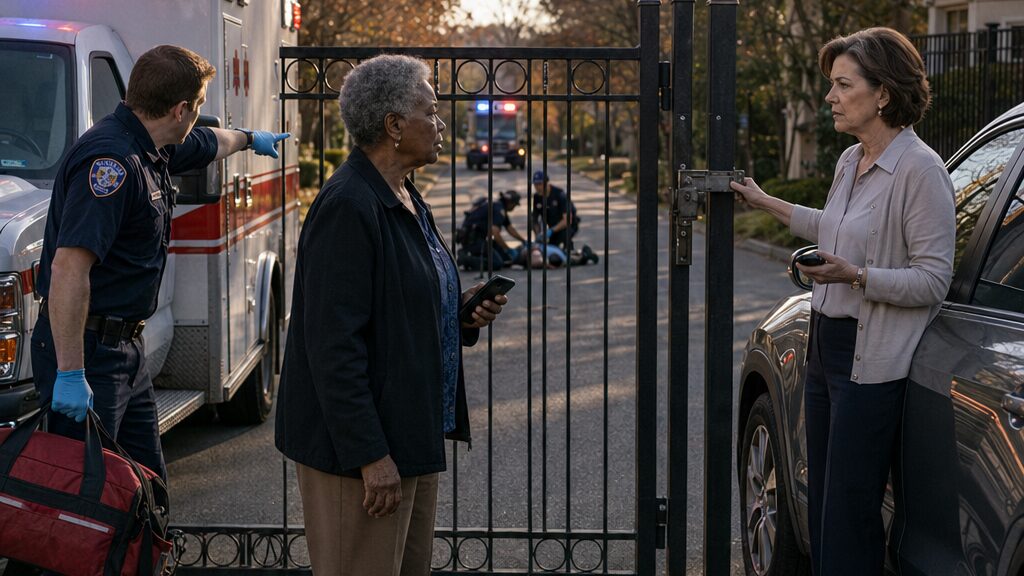
Catherine Brown’s SUV sat sideways across the entrance, its rear bumper inches from the steel gatepost, while red ambulance lights pulsed over her windshield.
“Move the vehicle,” Virginia Lewis said.
She had run nearly the full length of the private lane without a coat. Gravel had worked into one slipper, and each breath scraped the back of her throat. Behind her, four houses stretched along the narrow road. Her own sat at the far end, where a delivery driver lay on his back beside a scatter of cardboard boxes.
Catherine stood between the ambulance and the gate with her HOA lanyard hanging over a cream sweater.
“They can’t enter without authorization.”
Virginia stared at her. “There is a man dying in my driveway.”
The ambulance driver lowered the window. “Ma’am, move the SUV.”
Catherine did not turn around. “This is a private access road.”
The words landed with the neatness of something rehearsed.
Nine minutes earlier, Virginia had been carrying groceries from her garage when the delivery van rolled to a stop outside her house. The driver had stepped down with two boxes stacked against his chest. He was a broad-shouldered man in his fifties, though in the instant before he fell, his face had seemed to age ten years.
One box slipped first.
Then he pressed a fist beneath his collarbone.
“Sir?”
His knees folded. The second box struck the gravel and burst open along one edge. A bundle of padded envelopes slid into the driveway.
Virginia reached him before his head hit the ground. His eyes were open but unfocused. His lips had already begun losing color.
She called 911, placed the phone on speaker, and followed the dispatcher’s instructions. She checked for breathing. She pressed both hands over his chest. Each compression drove pain through her wrists, but she did not stop.
When the dispatcher said the ambulance was approaching the development, Virginia ran toward the gate to wave it through.
Instead, she found Catherine’s SUV across the lane.
Now the paramedic in the passenger seat pushed open his door and stepped down.
“Where’s the patient?”
“Last house,” Virginia said. “About two hundred yards in.”
Catherine lifted one hand. “You need to wait while I verify temporary entry.”
The paramedic looked at her as though he had misheard. “We have a cardiac patient.”
“The policy applies to all unauthorized vehicles.”
Virginia moved closer to Catherine. “The easement allows emergency access.”
Catherine’s mouth tightened. “You don’t get to interpret board policy at the gate.”
“I’m not interpreting board policy. I’m telling you what the recorded access says.”
“You are not on the board.”
The second paramedic climbed out and opened the rear ambulance doors. Metal equipment shifted inside.
“Cardiac arrest?” he called.
Virginia nodded. “He stopped responding before I ran down here.”
The first paramedic turned to Catherine. “Open the road now.”
For one second, Catherine’s face changed. Not much. Just a brief tightening around the eyes, the look of a person who had heard the seriousness and understood it.
Then she walked to the gate.
Virginia thought she was finally going to release it.
Instead, Catherine reached through the bars, pulled the metal latch toward her, and drove it into the locked position.
The click was small.
The sound of it carried farther than the siren.
“What are you doing?” Virginia said.
Catherine kept her hand on the latch. “The temporary-entry policy was adopted after the accident. We cannot make exceptions whenever someone claims urgency.”
The paramedic stepped toward her. “The patient is in cardiac arrest.”
“I heard you.”
“Then open it.”
Catherine looked past him at the residents beginning to emerge from their homes. Jessica Torres stood halfway down the lane in a dark cardigan, one hand covering her mouth. Another neighbor had come onto his porch.
Catherine’s posture straightened.
“If I ignore the policy in front of everyone,” she said, “then there is no policy.”
Virginia felt something inside her go still.
Catherine had always spoken this way when challenged. Not loudly. Not crudely. She wrapped control in careful sentences and made resistance sound disorderly.
“Move the car,” Virginia said once more.
Catherine looked directly at her.
“Make me.”
For a moment, Virginia wanted to strike the latch from her hand. She wanted to shout until Catherine’s calm expression cracked.
Instead, she reached into the pocket of her housedress and took out her phone.
Her fingers shook as she opened the camera.
Catherine gave a short, disbelieving breath. “Oh, please.”
Virginia pressed record.
“The time is 3:47 p.m.,” she said. Her voice sounded flatter than she felt. “I am recording the locked gate, the ambulance, and your hand on the latch.”
Catherine pulled her hand away.
Virginia moved the phone slowly, framing the ambulance, the SUV across the lane, the license plate, then Catherine.
“The paramedic has stated that the patient is in cardiac arrest.”
“You are escalating this,” Catherine said.
“No. I am preserving it.”
The paramedics exchanged a look.
The first one turned toward the rear of the ambulance. “We go on foot.”
They dragged out a folded stretcher, a cardiac monitor, and two bags. The gate was high enough that the stretcher could not simply be lifted over while folded. One paramedic climbed the bars, dropped to the other side, and reached back for equipment.
Virginia lowered her phone only long enough to help guide a bag through the gap beneath the gate.
Jessica had reached them now.
“Catherine,” she whispered. “Open it.”
Catherine’s face flushed. “You know what the insurer said.”
“This is an ambulance.”
“That is not the point.”
Virginia looked at Jessica. “Call the other end of the lane. Tell them to clear every vehicle.”
Jessica pulled out her phone.
The second paramedic vaulted the gate. Together, they hauled the folded stretcher over, metal scraping against metal.
Virginia started running back toward her house with them. Her lungs burned. Halfway up the lane, she heard Catherine call after her.
“You cannot make board decisions by creating a scene.”
Virginia did not turn around.
At the driveway, the delivery driver lay where she had left him. One of the padded envelopes had blown against his arm. His skin had taken on a gray cast that made the blue of his work shirt look unnaturally bright.
The paramedics dropped beside him.
“No pulse,” one said.
They cut open the front of his shirt. Adhesive pads came out. The monitor gave a thin electronic tone.
Virginia stepped back, still holding her phone, though she was no longer recording.
“Clear.”
The man’s body lifted from the gravel.
Nothing.
The paramedic resumed compressions.
Virginia looked down the lane. The ambulance remained outside the gate, its lights flashing against Catherine’s parked SUV.
“Charge again.”
The monitor tone sharpened.
“Clear.”
The driver’s body jerked a second time.
One paramedic leaned over him, watching the screen.
For half a breath, nobody spoke.
Then the line changed.
“We have something.”
Virginia pressed one hand to her mouth.
The relief lasted less than ten seconds.
The monitor alarm changed again.
The paramedic’s expression tightened.
“He’s losing it.”
Chapter 2: Forty Seconds Became the Whole Case
The stretcher rolled over the gravel without an ambulance behind it.
Its small wheels snagged twice in the ruts, forcing the paramedics to lift one end while continuing to ventilate the unconscious man. Virginia walked beside them with the cardiac monitor bag pressed against her hip. Jessica ran ahead to open a side pedestrian panel that Catherine had finally unlocked after the sheriff’s dispatcher called the gate directly.
By then, the ambulance had been waiting outside for nearly six minutes.
They loaded the driver into the vehicle. One paramedic climbed in after him. The other turned to Virginia before closing the rear doors.
“Do you know his name?”
Virginia shook her head.
“Any medical history?”
“No. He was delivering packages.”
The paramedic nodded once. “You did the compressions?”
“Until I ran for you.”
“That mattered.”
The doors slammed shut.
The ambulance backed away from the gate, then disappeared down the county road with the siren rising.
Catherine’s SUV was no longer blocking the lane. She had moved it beside her house and gone inside.
No one had seen her leave.
Virginia stood at the entrance until the flashing lights vanished. Her hands were streaked with gravel dust and something darker from the driver’s torn shirt. She rubbed them together once, then stopped when she realized what she was doing.
Jessica came beside her.
“You should sit down.”
“I need the dispatch time.”
“What?”
“The time the ambulance arrived. The time they reached him. The time they left.”
Jessica’s face tightened. “Virginia, maybe wait until we know whether he—”
“We already know what happened at the gate.”
“I know.”
“Do you?”
Jessica looked toward Catherine’s house.
The other two homeowners had returned indoors, but their blinds remained angled toward the lane.
Jessica lowered her voice. “Before you call anyone outside the association, let the board meet.”
Virginia stared at her.
“I’m not defending Catherine.”
“You just asked me to delay reporting an ambulance obstruction.”
“I’m asking you not to make the situation worse before we understand the insurance implications.”
A dry laugh escaped Virginia before she could stop it.
Jessica flinched.
“That sounded like her,” Virginia said.
“I know how it sounded.”
“No. You know how it sounded after you said it.”
Jessica folded her arms. “If the carrier drops us, some people on this lane cannot absorb the increase. Catherine has been trying to keep the policy in place because of what happened last year.”
“A man almost died.”
“And I am not saying otherwise.”
“Then don’t ask me to protect the board before we know whether he lived.”
Jessica looked down.
Virginia walked back toward her house.
The packages remained scattered across the driveway. One box had split open, revealing a set of kitchen canisters wrapped in clear plastic. Virginia gathered the envelopes and placed them inside the delivery van through the unlocked side door. The driver’s handheld scanner lay beneath the front tire, its screen cracked.
Inside her kitchen, she washed her hands for too long.
Then she set her phone on the table and played the recording.
Forty-three seconds.
Her own voice stated the time. The camera moved across the ambulance, the gate, the SUV. Catherine’s hand entered the frame.
The image blurred for an instant as Virginia stepped closer, then sharpened.
The latch was fully visible.
So were Catherine’s fingers closing it.
Virginia paused the video.
The frame held Catherine in profile, ambulance light across one cheek, her hand wrapped around the metal as though she were protecting the gate from the emergency instead of opening it for one.
Virginia saved the original file to her computer. She created two copies. One went to an external drive. The other she uploaded to a secure folder she had used during her compliance years.
She opened a legal pad.
3:47 p.m. — recording begins.
3:48 p.m. — responders begin climbing gate.
She stopped.
The rest would need verification.
Virginia called the county dispatch records line and left a formal request. Then she called the sheriff’s nonemergency number and asked to make a statement. When she identified the issue as interference with emergency access, the clerk transferred her twice before an investigator took the basic facts.
Finally, she went to the filing cabinet in her home office and pulled the property folder from the bottom drawer.
The easement had been recorded twelve years earlier, when the four homes were divided from a larger parcel. Virginia had reviewed it before buying the house. She found the paragraph she remembered.
The language was plain enough: the access lane was to remain available for residents, guests, service providers, utilities, and emergency personnel.
Nothing in it gave the HOA power to suspend emergency entry.
Her phone chimed.
An email from Catherine had gone to all four households.
Subject: Clarification Regarding Today’s Unauthorized Entry Incident.
Virginia read it standing beside the filing cabinet.
Catherine wrote that emergency responders had declined to follow the community’s established temporary-entry process. She stated that the gate had remained accessible through an approved pedestrian route and that no board officer had prevented medical personnel from reaching the patient.
She described the delay as “an operational decision made by the responding unit.”
Virginia read the sentence twice.
Then she forwarded the email to her secure folder.
A second message appeared, this one from Jessica.
Please don’t reply tonight. Let us meet first.
Virginia returned to the kitchen. The sun had gone down, leaving the gate invisible beyond the dark line of trees, but she could still see Catherine’s fingers on the latch in the frozen phone image.
She opened a new email addressed to the sheriff’s investigator, the fire marshal’s office, and the HOA’s management company.
She attached the video, the easement, and Catherine’s message.
Her hand rested over the trackpad.
For eleven years, Virginia had written compliance findings for people who believed facts protected themselves. Facts did not. They had to be entered, dated, delivered, and defended. She knew that better than anyone.
Still, she did not click send.
A memory had surfaced—not of the ambulance, but of the board’s spring meeting.
Catherine standing beside a printed gate policy.
Jessica asking whether anyone saw a conflict.
Virginia saying she would review it.
She returned to her office and searched her drafts.
Six months earlier, at 11:18 p.m., she had written an email to the board.
The proposed temporary-entry policy appears inconsistent with the recorded easement, particularly as applied to utility and emergency access.
The message continued for four paragraphs.
It cited the relevant section.
It recommended legal review.
It had never been sent.
Virginia sat down slowly.
On the screen, beneath the warning she had written months before the ambulance arrived, one word remained visible.
Draft.
Chapter 3: The Warning Virginia Never Entered
The date on Virginia’s unsent email was six months older than the bloodstain still darkening her driveway.
She printed the message before she could talk herself out of it.
The printer fed out two pages, each marked with the draft timestamp. Virginia placed them beside the recorded easement, Catherine’s email, and her handwritten emergency timeline. The papers formed a clean row across her desk.
One document proved Catherine had no authority.
Another proved Catherine had exercised it anyway.
The third proved Virginia had seen the danger coming.
She had not slept. At seven-thirty, she drove to the county records office with the documents in a manila folder.
The clerk behind the counter recognized the subdivision name and directed her to a public terminal. Virginia searched the parcel record, the original easement, subsequent amendments, and board filings attached to the development.
There was no amendment granting the association exclusive control over emergency access.
No recorded restriction requiring temporary permits for ambulances.
No superseding agreement.
The gate policy existed only in HOA minutes and a resident handbook revised that spring.
Virginia printed the certified index.
The clerk stamped the request sheet and slid it back.
“Looking for anything else?”
“A gate agreement filed after the easement.”
The clerk shook her head. “Nothing under these parcels.”
Virginia looked through the glass partition at the stamped pages.
The answer should have felt like vindication.
Instead, it made the unsent email heavier in her folder.
When she returned home, Jessica was waiting near the mailbox.
“I called twice,” Jessica said.
“I was at county records.”
“I figured.”
Virginia unlocked her front door but did not invite her in.
Jessica held a travel mug with both hands. “Catherine scheduled an emergency board session for tonight.”
“To discuss the man she delayed?”
“To discuss legal exposure.”
“Of course.”
Jessica closed her eyes briefly. “Virginia, I came because I need to tell you something before that meeting.”
Virginia waited.
“At the spring session, when we adopted the gate procedure, Catherine said you had reviewed it.”
“I had not.”
“She said you had concerns, but nothing that required delaying the vote.”
Virginia’s grip tightened around the folder.
“I told her privately that I was reviewing the easement.”
“I know.”
“How?”
“Because she mentioned it during executive discussion.”
Virginia stared at her.
Jessica shifted the mug from one hand to the other. “She said you were being cautious because of your old job. She said if you believed there was a real legal defect, you would put it in writing.”
The words struck with humiliating precision.
Virginia had put it in writing.
She had simply kept the writing to herself.
“Did you ask me?” Virginia said.
“No.”
“Did anyone?”
“No.”
“And you voted for it.”
Jessica looked toward the gate. “The insurance notice had come three weeks earlier. Catherine said if we delayed, the carrier might exclude gate-related claims.”
“So you accepted her version.”
“I accepted the version that kept the premium from jumping.”
Virginia opened the folder and removed the draft email.
Jessica read the first paragraph. Her face changed.
“You wrote this before the vote?”
“The night before.”
“Why didn’t you send it?”
Virginia took the pages back.
Years earlier, at the city, she had documented a supervisor’s habit of pressuring inspectors to soften findings for favored landlords. Her report had been accurate, measured, and supported. It had also made every morning afterward feel like entering a room where the conversation had stopped just before she arrived.
Her assignments changed. Her performance reviews cooled. No one ever admitted retaliation. They simply made her correctness expensive.
When she retired, she promised herself she would never again volunteer for a war other people could avoid by reading their own records.
“It was not my board,” Virginia said.
Jessica’s expression held no accusation, which made the answer sound worse.
“No,” Jessica said. “It was only your road.”
Virginia looked past her toward the entrance. From this distance, the gate appeared harmless: black bars, neat hinges, clean keypad, metal latch.
Jessica lowered her voice. “Catherine is going to say no one objected.”
“Someone should have.”
“You did.”
“Not where it counted.”
Jessica took a breath. “The driver is alive.”
Virginia looked at her sharply.
“The hospital confirmed it to the management office this morning. Critical, but alive.”
Relief loosened something in Virginia’s chest. She gripped the edge of the folder until it passed.
“Did they identify him?”
“Not to us.”
Virginia nodded.
A dark sedan turned into the lane and stopped outside her house. A man in a county jacket stepped out, carrying a small recorder and a notebook.
“The sheriff’s investigator,” Virginia said.
Jessica looked at the draft in Virginia’s hand. “Are you giving him that?”
Virginia did not answer.
Inside, she seated the investigator at the kitchen table. He asked her to describe the collapse, the 911 call, the ambulance arrival, Catherine’s vehicle position, and the closing of the latch.
Virginia answered each question in order.
She gave him a copy of the video.
He watched it once without interrupting. At the moment Catherine closed the gate, he leaned closer to the screen.
“Was this before or after the responder identified cardiac arrest?”
“After.”
“You’re certain?”
“My recording captures the statement.”
He played it again with the volume raised.
The paramedic’s voice came through thin but unmistakable.
Cardiac arrest. Open the road now.
Then the metallic click.
The investigator stopped the video.
“Did Ms. Brown ever state that she believed the ambulance was fraudulent or that the emergency was staged?”
“No.”
“Did she have a way to open the gate?”
“She controlled the latch and had the remote for the vehicle gate.”
“Was there any mechanical failure?”
“Not that I observed.”
He wrote for several seconds.
Then his eyes moved to the stack of papers beside Virginia’s elbow.
“What’s that?”
“The recorded easement. The county index. The HOA policy.”
“And the other pages?”
Virginia looked down.
The first line of her unsent draft was visible beneath the easement.
She could slide it back into the folder. The investigator had not asked whether she had warned the board. Catherine’s conduct remained Catherine’s conduct. Virginia had not locked the gate. She had not blocked the ambulance.
But she had spent a career telling reluctant property owners that omission did not become harmless merely because someone else committed the final act.
She placed the draft on top.
“I wrote this before the policy was adopted.”
The investigator read the timestamp.
“You sent it to the board?”
“No.”
“Did you communicate the concern another way?”
“I told Catherine I believed the easement needed review.”
“Was that conversation documented?”
“No.”
He studied her for a moment, not unkindly.
“Why didn’t you send the email?”
Virginia glanced through the kitchen window toward the gate.
Because she had been tired.
Because she had believed another public fight would cost more than silence.
Because she had trusted that no one would apply a foolish rule when a human life made the rule indefensible.
None of those answers altered the timestamp.
The investigator set the pages flat on the table.
“Mrs. Lewis,” he said, “before yesterday, did you already know the gate policy might be legally defective?”
Chapter 4: The Rule Was Written Out of Fear
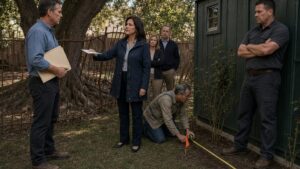
Nicholas Clark placed the inspection photograph on the table and tapped the empty space beside the gatepost.
“There should have been an emergency override here.”
Virginia leaned closer. The photograph showed the black bars, the keypad, and the steel latch Catherine had closed. Nothing in the frame allowed a responder outside the community to release it.
Nicholas folded his hands.
“Most private gates use a fire department access box, a dispatch-controlled code, or an approved breakaway system. Yours had none of those.”
They sat in a small conference room at the county fire marshal’s office. The walls held diagrams of commercial exits and hydrant clearances. On the table lay Virginia’s video, the recorded easement, the HOA handbook, and a preliminary response timeline.
“So the gate was illegal?” Virginia asked.
“I didn’t say that.”
“It prevented emergency entry.”
“That is a fact I can evaluate. Legal responsibility is not mine to decide.”
Nicholas spoke carefully, as if every sentence had edges.
“The installation predates some current standards. That may affect what corrective authority we have. But the absence of an emergency release created a serious access failure.”
Virginia looked at the timeline.
The ambulance reached the gate at 3:46:31.
The paramedics reached Patrick at 3:52:08.
Five minutes and thirty-seven seconds.
On paper, the interval occupied one line.
In her memory, it was Catherine’s hand tightening around the latch.
“Could the pedestrian panel count as access?” Virginia asked.
“Not for a stretcher, a cardiac monitor, oxygen, and a full response crew.”
“Catherine said the responders chose not to use the approved procedure.”
Nicholas’s expression did not change. “There was no approved emergency procedure in the documents the association provided.”
A small part of Virginia had wanted him to say more. She wanted a declaration clear enough to place between herself and every question about what she should have done six months earlier.
Nicholas gathered the photographs.
“We will issue a correction notice. That will address the physical gate. It will not resolve what happened between the residents.”
“No,” Virginia said. “It won’t.”
At the hospital, a nurse told her Patrick remained sedated but stable enough that the doctors were reducing medication.
Virginia stood outside his room without going in. Through the glass, she saw only one side of his face and the tubing taped beneath his nose. His chest rose with mechanical steadiness.
A cardboard box sat on the visitor chair. Someone from his employer had brought his personal belongings: a phone, a wallet, keys, and the cracked handheld scanner from the delivery van.
Virginia recognized the scanner.
She had left it under the tire.
The nurse stepped beside her. “Family has been contacted.”
“Good.”
“You’re the homeowner who started compressions?”
Virginia nodded.
“They said those first minutes mattered.”
Virginia looked at Patrick’s still hand.
“So did the other minutes.”
The nurse did not answer.
When Virginia returned to the lane, Catherine was standing at the gate with a can of lubricant and a white cloth.
She pressed the latch down, released it, then pressed it again.
Metal clicked against metal.
Virginia stopped several feet away.
“The fire marshal says there was no compliant emergency override.”
Catherine wiped the latch. “I received his notice.”
“You knew that before he sent it?”
“I knew the gate had passed the installation inspection.”
“That is not what I asked.”
Catherine folded the cloth into a smaller square. “What do you want, Virginia?”
“The truth without board language.”
Catherine gave her a tired look. In daylight, without the lanyard and the ambulance behind her, she seemed older. Fine lines showed around her mouth. Her cream sweater had been replaced by a navy jacket zipped to the throat.
“You believe I woke up that morning intending to endanger someone.”
“I believe you heard a paramedic say cardiac arrest and closed the gate.”
Catherine’s hand returned to the latch.
Click.
Release.
Click.
“You were not here last year when the contractor’s truck rolled backward.”
“I was at the emergency meeting.”
“You were not the one the residents blamed.”
The accident had damaged a parked car and part of the stone entrance wall. No one had been injured. The contractor’s insurer disputed part of the claim, and the HOA’s carrier had issued a warning that another unmanaged access incident could affect renewal.
Catherine continued.
“Jessica cried in my kitchen because she thought her assessment would double. One of the owners told me he would have to sell. The management company sent six pages of risk controls and told us enforcement had to be consistent.”
“Consistent does not mean blind.”
“That is easy to say after the exception proves necessary.”
“It was an ambulance.”
“It was a vehicle I had not authorized entering a lane where an accident had already occurred.”
Virginia stared at her. “You saw the lights.”
“Yes.”
“You saw the uniforms.”
“Yes.”
“You heard the paramedic.”
Catherine’s fingers stopped moving.
Virginia waited.
The lane was quiet except for a lawn sprinkler ticking somewhere behind Jessica’s house.
Finally, Catherine said, “I heard him.”
“Say what you heard.”
Catherine looked toward the four houses.
“He said cardiac arrest.”
The admission was soft enough that Virginia nearly missed it.
“And then you locked the gate.”
“I secured the gate.”
“After he told you a man’s heart had stopped.”
Catherine’s jaw tightened. “If I opened it because you shouted louder than the policy, then every resident standing there would know the policy meant nothing.”
Virginia felt the anger rise again, but Catherine did not look triumphant. She looked frightened.
Not of the ambulance.
Of being seen yielding.
Catherine rubbed the white cloth over the metal until it squeaked.
“You think rules fail when someone breaks them,” Virginia said. “Sometimes rules fail when people obey them past the reason they exist.”
“You had concerns about the policy.”
Virginia went still.
“You told me you wanted to review the easement,” Catherine said. “Then you never objected.”
“That did not give you authority.”
“No. It gave me confirmation.”
“Confirmation of what?”
“That the one person here who understood these documents did not believe the problem was serious enough to stop the vote.”
Virginia looked at the latch.
Catherine had made a choice at the gate. Nothing erased that.
But the accusation found the place Virginia had been protecting.
“You used my silence,” she said.
“I relied on it.”
“You relied on what suited you.”
“So did you.”
Catherine placed the cloth and lubricant inside a small plastic basket.
“You wanted peace. Jessica wanted low premiums. The others wanted deliveries controlled. I was the one expected to turn all of that into a rule and take the blame when someone ignored it.”
“You are responsible for what you did.”
“Yes,” Catherine said. “And you are very interested in where my responsibility begins.”
She carried the basket toward her SUV.
Virginia remained beside the gate.
Her phone rang.
The hospital number appeared on the screen.
She answered at once.
The nurse spoke quickly.
Patrick had opened his eyes. He was confused and weak, but he had asked about the driveway, the ambulance, and the woman at the gate.
Then the nurse lowered her voice.
“He wants to know who blocked the road.”
Chapter 5: The Driver Had Signed Their Contract
Patrick recognized Catherine’s HOA badge before Virginia told him her name.
The hospital had removed most of the tubes, but his voice remained rough. He watched the silent video on Virginia’s phone from a raised bed, one hand resting over the blanket.
When Catherine appeared beside the gate, the lanyard visible against her sweater, Patrick narrowed his eyes.
“That association uses our management services.”
Virginia paused the recording.
“You know the community?”
“I know the badge.”
He asked her to continue.
The screen showed the ambulance lights, Catherine’s hand, the latch sliding into place. Patrick watched without expression until the clip ended.
Then he handed the phone back.
“How long?”
“From the ambulance arriving to the paramedics reaching you, five minutes and thirty-seven seconds.”
He closed his eyes.
Virginia waited.
“I don’t remember falling,” he said. “I remember carrying two boxes. Then somebody pressing on my chest.”
“That was me.”
His eyes opened again. “They told me.”
“You were without a stable pulse twice.”
He looked toward the window.
Virginia had rehearsed what she would say on the drive to the hospital. She had planned to begin with Catherine’s conduct, the easement, the false board email, and the fire marshal’s notice.
Instead, she placed her folder on the visitor chair and removed the unsent draft.
“There is something else.”
Patrick read the first page slowly.
“You wrote this before the gate policy passed?”
“Yes.”
“And the board received it?”
“No.”
He looked up.
“I told Catherine privately that the easement needed review. I drafted the formal warning. I did not send it.”
“Why?”
Virginia had answered the sheriff’s investigator that morning. Saying it once had not made the answer easier.
“I spent years in compliance. I reported something at work that should have been corrected. It was corrected eventually, but not before the people involved made it expensive for me to have spoken.”
Patrick waited.
“When this policy came up, I told myself the board had its own attorney and management company. I told myself I was no longer responsible for other people’s rules.”
“But you knew.”
“I suspected strongly.”
“That is not the same as closing the gate.”
“No.”
“But it is not nothing.”
“No.”
Patrick returned the pages.
Virginia had expected anger, perhaps because anger would have restored the clean line between victim and witness. His restraint made the room less comfortable.
“What were you doing on a delivery route?” she asked.
A faint smile passed over his face and vanished.
“Covering it.”
“You’re not a regular driver.”
“I started as one. Now I’m regional operations director.”
Virginia said nothing.
“Our contractor lost three people that week. One called out, one quit, one had a family emergency. Packages were stacking up. I told the supervisors nobody in the office was too important to take a route.”
He touched the adhesive mark on his chest.
“Turns out I was right.”
Virginia thought of Catherine defending rules in front of residents who had watched her build authority from them.
“Your company manages our HOA.”
“One division does.”
“Did you sign the contract?”
Patrick studied her, then held out his hand for the folder.
Virginia passed him the management agreement she had printed from the association portal. He turned to the signature page.
His name was there.
Patrick Smith, Regional Operations Director.
He stared at it for several seconds.
“I approved this renewal last year.”
The reversal should have felt satisfying. Instead, Virginia watched him absorb the fact that a contract bearing his signature had helped place Catherine at the gate.
“Can you remove her?” Virginia asked.
His expression sharpened. “From the board?”
“From management authority. Gate authority. Anything.”
“I can suspend services if the contract allows it. I can recommend action. I cannot remove an elected HOA president.”
“You can refuse to support her.”
“I can.”
“Will you?”
“I’m not doing anything until I know what my own company told the board.”
Virginia leaned back.
“A woman blocked the ambulance carrying the man who signed her management contract, and you want more review.”
“I want the complete record.”
“That sounds familiar.”
“It should. You spent eleven years asking for complete records.”
The answer irritated her because it was true.
Patrick shifted against the pillows and winced.
“If this is one person abusing authority, we address that. If our guidance helped create the authority she abused, then firing one person protects the company more than the residents.”
“She knew you were in cardiac arrest.”
“I saw the video.”
“She closed the gate anyway.”
“And I am not excusing her.”
His breath shortened. He waited until it steadied.
“I’m saying I won’t use my position to create the kind of convenient answer that almost killed me.”
Two days later, Virginia met Patrick by video conference with a property-management attorney and an operations manager at the regional office.
The attorney spoke in cautious phrases: active investigation, preservation obligation, potential contractual exposure.
Virginia listened until the operations manager shared the access-policy file.
The management company had sent Catherine a packet after the prior contractor accident. It recommended documented entry procedures, vendor verification, and consistent enforcement.
One paragraph stated that emergency vehicles should receive immediate access under applicable law and recorded property rights.
Another encouraged boards to use discretion when unusual circumstances made standard verification impractical.
“Then Catherine ignored your guidance,” Virginia said.
The attorney adjusted his glasses. “The document could have been clearer.”
“It says immediate access.”
“It also delegates local implementation.”
Patrick appeared on the screen from home, pale but upright.
“Show us the email chain.”
The operations manager hesitated.
Patrick repeated the request.
Several messages appeared.
Catherine had written five months earlier asking whether the association could create a permanent exemption code for fire, ambulance, utility, and law-enforcement vehicles.
The management office replied that a universal code might create security risk.
Catherine asked what she should do when an unlisted emergency vehicle arrived.
The answer was brief.
Use board discretion based on the circumstances. Document any exception afterward.
Virginia read it twice.
Catherine had not been trapped by an absolute rule.
She had requested guidance.
She had received permission to make exceptions.
At the gate, she had told everyone she had none.
Patrick’s voice came through the speaker.
“She knew.”
Virginia looked again at the email timestamp.
Five months before Catherine closed the latch, the management company had placed the choice directly in her hands.
The question was no longer whether she misunderstood the rule.
It was why, after hearing the truth at the gate, she had chosen the rule anyway.
Chapter 6: Catherine Chose the Rule After Hearing the Truth
Catherine entered the executive session carrying a gate remote that no longer worked.
The board had deactivated her access code that morning. She had learned only when she tried to drive out and the gate remained closed until Jessica opened it from her phone.
Now Catherine placed the useless remote on the meeting table.
“You could have informed me.”
Jessica sat at the far end with the association records stacked in front of her.
“We informed you by email.”
“At six twelve this morning.”
“The fire marshal’s correction notice required immediate control changes.”
Virginia sat opposite Catherine. Between them lay a clear evidence bag containing the removed metal latch. Nicholas had taken it during the gate inspection after determining that repeated use had worn the catch deeper into the locked position.
Beside the bag sat Virginia’s unsent email.
The two objects looked unrelated until one noticed the dates.
One had closed the gate.
The other had failed to open a warning.
Two board members attended in person. A property-management attorney joined by speakerphone. Residents waited in the larger community room for the public session.
Catherine looked at the latch.
“Am I being removed?”
“One proposal is a temporary suspension,” Jessica said.
“Pending what?”
“The sheriff’s investigation, the fire marshal’s findings, and the insurer’s review.”
Catherine’s gaze moved to Virginia.
“You wanted consequences. Here they are.”
Virginia did not answer.
The property-management attorney asked Catherine to describe her understanding of the emergency-vehicle policy.
Catherine spoke in the same even tone she had used at the gate.
“The association adopted controlled access after a prior loss. The management guidance emphasized consistent enforcement. The vehicle was not listed in our system.”
“Did you believe it was a legitimate ambulance?” the attorney asked.
“Yes.”
“Did you hear a responder state that the patient was in cardiac arrest?”
Catherine’s fingers tightened around the dead remote.
“Yes.”
“Did you understand that you had discretion to admit emergency vehicles?”
Silence gathered around the table.
Jessica looked down at the records.
The attorney repeated the question.
Catherine said, “I understood that exceptions required judgment.”
“And you chose not to make one.”
“I chose to maintain control until the situation could be verified.”
Virginia felt the old anger return.
“The paramedic verified it.”
Catherine turned toward her. “The paramedic shouted at me in front of the entire lane.”
“He told you a man’s heart had stopped.”
“And everyone was watching to see whether I would abandon the policy the first time it became difficult.”
There it was.
Not confusion.
Not legal uncertainty.
Fear of losing authority in public.
Catherine looked at the others.
“For months, every complaint came to me. Deliveries at the wrong house. Contractors scraping the wall. Residents giving out codes. The insurer warning us. Management telling us to enforce consistently. Every person in this room wanted control until control became unpleasant to watch.”
Jessica raised her head.
“I signed the minutes,” she said.
Catherine stopped.
Jessica pushed a copy of the spring meeting record toward the center.
“I voted for the policy without reading the easement. I relied on your summary and the management packet.”
“You all did.”
“Yes,” Jessica said. “That does not make what you did at the gate our decision.”
Catherine looked at Virginia.
“No. Her decision came earlier.”
The room turned toward her.
Virginia placed both hands on the table.
She had intended to disclose the email during the public session, where residents and official minutes would prevent anyone from minimizing it. But Catherine had already opened the door.
Virginia picked up the draft.
“I wrote this the night before the board adopted the policy.”
She read the first paragraph aloud.
The proposed temporary-entry policy appears inconsistent with the recorded easement, particularly as applied to utility and emergency access.
Her voice remained steady.
She read the section recommending legal review and an emergency override before enforcement.
Then she placed the pages beside the latch.
“I did not send it.”
One board member shifted in his chair.
Jessica said nothing.
Virginia continued.
“I told Catherine privately that I had concerns. I believed the board should review the easement. Then I decided I had already spent enough of my life correcting rules other people were paid to understand.”
Catherine watched her without triumph.
“That was my failure,” Virginia said. “It did not close the gate. But it allowed everyone here to pretend no qualified objection existed.”
The attorney’s voice came through the speaker.
“For the record, are you stating that the board had informal notice of a possible conflict?”
“Yes.”
Catherine leaned back.
“And now we are finished,” she said. “Suspend me. Note everyone’s share of responsibility. Send the correction to the insurer.”
The board member nearest Jessica nodded too quickly.
“A ninety-day suspension may be appropriate while we revise procedures.”
The second member agreed.
The shape of the proposed resolution became clear: remove Catherine temporarily, revise a paragraph, and call the crisis contained.
Jessica looked at Virginia.
“This does not fix the gate,” Virginia said.
“The fire marshal required an override,” one member replied.
“It does not fix who controls it.”
“We can assign access to another officer.”
“That is the same system with a different hand on the remote.”
Catherine’s face hardened. “What do you propose? Leaving the gate open permanently?”
“No.”
“Then someone must control it.”
“Not one person. Not a private board officer deciding whether emergency services look authorized enough.”
Virginia turned the latch inside its evidence bag with one finger. It gave a dull metal knock against the table.
“I propose a dispatch-accessible emergency release, written emergency exemptions tied to the easement, annual testing, and records available to every resident.”
The first board member frowned. “That could be expensive.”
“So was the ambulance waiting outside.”
“We do not have a quote.”
“Then get one before you declare the problem solved.”
Catherine picked up the dead remote.
“You think admitting your silence makes this noble?”
“No.”
“Then what does it make?”
“Complete.”
For the first time, Catherine looked away.
The executive session ended without a vote.
In the public room, folding chairs had been arranged in rows. Residents from the four homes sat with spouses and adult children. Nicholas stood near the wall. Patrick attended through a video screen placed on the front table.
Jessica read the proposed suspension motion.
The room remained quiet.
Virginia listened until the language reached its final clause: suspension pending review, temporary transfer of gate authority, no admission of association-wide failure.
Then she raised her hand.
Jessica recognized her.
Virginia stood.
“I oppose the motion.”
A murmur moved through the room.
Catherine stared at her.
Virginia held up the unsent email.
“I am not opposing consequences for Catherine. I am opposing the idea that changing the person with the remote changes the danger.”
She told the residents what she had known, what she had written, and what she had failed to send. No one interrupted.
When she finished, the room felt smaller.
One resident asked what the proposed system would cost.
Another asked whether insurance would cover any part of it.
A third said older homeowners could not absorb another assessment.
Virginia looked at the latch sealed on the table.
“I do not know the final cost,” she said. “I know the cost of leaving the choice in one person’s hands.”
Jessica closed the suspension packet.
“What motion are you making?”
Virginia looked toward Patrick’s image on the screen, then at Nicholas, then at Catherine.
“That the association permanently surrender exclusive personal control of emergency access and obtain a compliant system before this gate is locked again.”
Chapter 7: No One Person Held the Gate Again
The cost estimate appeared on the projector screen in numbers large enough that no one in the room could pretend not to see it.
The new emergency access system.
The electrical work.
The county inspection.
The annual testing requirement.
The training sessions.
The residents of the four-home lane stared at the projected total with the same expression they had worn months earlier when insurance premiums were discussed.
Fear.
Virginia Lewis stood near the front of the community room with the old gate latch resting inside its clear evidence bag on the table beside her.
Six weeks had passed since Patrick Smith’s ambulance waited outside the entrance.
Six weeks since Catherine Brown’s hand closed around that piece of metal.
The latch looked smaller now.
That bothered Virginia more than she expected.
Something that had held so much power in her memory was only a few inches of worn steel sitting beneath fluorescent lights.
Jessica Torres stood beside the projector.
“We have two options,” she said. “We can keep the current system with a manual emergency procedure and a revised board policy, or we can install the dispatch-accessible release recommended by the fire marshal.”
A resident in the second row raised his hand.
“Which one costs less?”
Jessica looked at the estimate.
“The first one.”
A few people nodded.
Virginia expected that.
No one liked paying for problems they wished had never happened.
Another resident spoke.
“Then why are we considering the expensive option?”
Before Jessica could answer, Virginia stepped forward.
“Because the cheaper option still depends on someone making the right decision in the moment.”
The room became quiet.
Virginia looked around at the neighbors she had known for years.
Some had brought folding chairs from home. Some still held printed copies of the proposal. Some looked tired of hearing about the gate.
She understood that.
A neighborhood could survive conflict more easily than uncertainty. People wanted the meeting to end with a vote, a repair schedule, and a feeling that the dangerous part had passed.
But dangerous parts did not always disappear because people wanted closure.
“When the ambulance arrived,” Virginia said, “there was a person standing at the gate with authority to open it.”
Her eyes moved briefly toward Catherine.
Catherine sat near the back wall.
She had resigned as HOA president three weeks earlier but had remained a resident. She no longer wore her board badge. She no longer carried the gate remote.
She looked smaller without either.
“Changing the person holding the authority does not change the problem,” Virginia continued. “The problem was that one person had the ability to decide whether an emergency deserved access.”
A resident crossed his arms.
“And you are saying you had no part in that?”
The question was not hostile.
That made it harder.
Virginia nodded.
“I had a part.”
The room shifted.
She had already admitted it once, in the board meeting. She had entered it into the record. But saying it again in front of everyone carried a different weight.
“I recognized a problem with the policy before it was adopted. I wrote a warning. I did not send it.”
A woman near the doorway whispered something to her husband.
Virginia continued.
“I spent years believing that careful people could avoid conflict by documenting concerns privately. Sometimes that is true. Sometimes it is just another way of waiting for someone else to act.”
Jessica looked down.
The admission changed the room.
Not because it erased Catherine’s decision.
Because it removed the easy version where only one person had failed.
The property-management attorney joined the meeting by video.
“The recommendation from the insurer is clear,” she said. “If the association adopts the new system and documents emergency-access procedures, coverage remains available.”
A resident frowned.
“So we are paying more because of what happened?”
Patrick appeared on the screen beside her.
He had recovered enough to attend remotely. He looked healthier than he had in the hospital, though his movements remained careful.
“That is one way to look at it,” he said.
Everyone turned.
Patrick rarely spoke at the meetings. He had avoided becoming the face of the conflict.
But tonight he had asked to attend.
“My company reviewed the records,” he said. “The gate failure was not caused by one person alone.”
Virginia watched several residents react.
Some expected him to condemn Catherine.
Instead, he continued.
“Local boards were given discretion without enough guidance. The association adopted a process without an emergency override. Some people knew the process needed review and waited.”
His eyes moved briefly to Virginia.
She accepted the look.
“He is right,” she said.
Patrick nodded.
“The person at the gate made the final choice. But the system made that choice possible.”
No one spoke for several seconds.
Then Catherine stood.
Virginia had not expected it.
Catherine walked slowly toward the front table.
“I want to say something.”
Jessica looked uncertain.
But she nodded.
Catherine stopped beside the evidence bag.
For the first time since the ambulance incident, she touched the table instead of the gate.
“I keep hearing people say I cared more about the rule than the person.”
No one interrupted.
“Maybe that is true.”
Her voice was quiet.
“I thought if I gave up control once, everyone would see me as someone who could not protect this community.”
Virginia watched her carefully.
There was no performance in Catherine’s voice now.
No board language.
No policy references.
“I heard the paramedic,” Catherine said. “I knew what he said. I knew what the ambulance was. I knew what was happening.”
She looked at the residents.
“I still thought opening the gate would prove I had failed.”
The room remained silent.
“I was wrong.”
Virginia saw several people lower their eyes.
Not because Catherine had been forgiven.
Because the admission removed the final excuse.
The vote happened fifteen minutes later.
It was not unanimous.
Nothing important had been unanimous in this neighborhood for a long time.
The measure passed by one vote.
No applause followed.
No one stood.
The room simply exhaled.
The work would begin the next week.
The old system would be removed.
The new one would require county testing.
Emergency access would no longer depend on whether one person believed a situation was serious enough.
After the meeting, Virginia walked outside alone.
The gate stood open for the evening because the maintenance crew had already disabled the old locking system.
Patrick came through a few minutes later.
Not in an ambulance.
Not carrying boxes.
Just walking.
He stopped beside her.
“Feels strange.”
Virginia looked at the opening.
“What does?”
“Not needing permission.”
She smiled slightly.
“Sometimes permission is useful.”
“Sometimes?”
“Sometimes people confuse having permission with having control.”
Patrick looked at the empty gate space.
“Are you going to stay on the board?”
Virginia laughed softly.
“No.”
“Why not?”
“Because I spent too many years believing expertise meant I should stand outside the conflict and explain it.”
She looked at the metal posts where the old latch had been.
“I think sometimes expertise means stepping into the middle before someone gets hurt.”
Patrick nodded.
A maintenance worker approached carrying a new emergency-release panel.
He placed it beside the gate.
The future solution looked ordinary.
A box.
A button.
A system.
That was the strange thing about repairs.
The thing that prevented disaster often looked much smaller than the thing that caused it.
Virginia watched as the worker measured the placement.
For months, the gate had represented authority.
Now it represented access.
No one person held it anymore.
The story has ended.