The HOA Sent Fake Officers to His Cabin, but the Road Beneath Them Held the Truth
Chapter 1: The Men at the Cabin Door
The first blow against the door shook dust from the top hinge.
Richard Carter stood in the narrow space between the kitchen and the front room, one hand still wrapped around a coffee mug, listening as a second blow landed harder than the first.
“Mr. Carter,” a man called from the porch. “Open the door.”
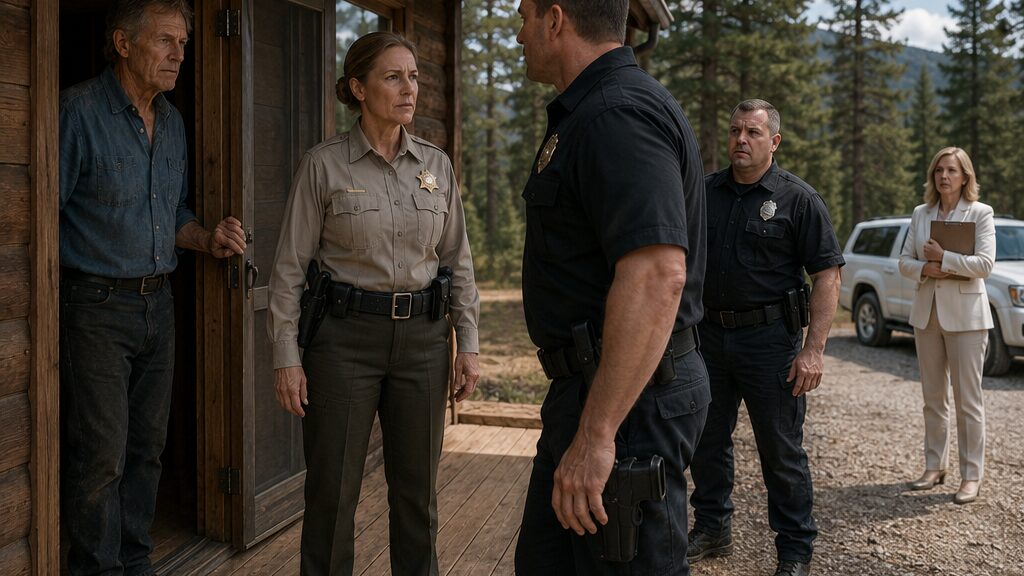
Through the front window, Richard could see two dark uniforms and the pale shape of Amanda White’s suit behind them. Her white SUV sat crooked on the gravel road, its tires pressed deep into the soft edge Richard had spent Saturday repairing.
Amanda stepped into view and pointed toward the cabin.
“You need to leave this property,” she said. “If you refuse, my officers will remove you.”
My officers.
Richard set the mug down.
The men wore metal badges above their shirt pockets. One had a black belt carrying a radio, handcuffs, and something shaped like a holster. From ten feet away, the arrangement looked official. Up close, Richard suspected, it would look like a costume assembled by someone who understood silhouettes better than law.
The taller man struck the door again.
Mary came out of the hallway fastening the cuff of her uniform shirt. Her duty belt rested on the table beside her keys. She had planned to leave for the county office in twenty minutes.
“What is that?” she asked.
“Association business.”
Her eyes shifted to him.
“What kind of association business pounds on a door?”
Richard did not answer. He crossed the room and lifted the curtain by half an inch.
Amanda was speaking to the men now, low enough that he could not hear. She held a clipboard against her ribs. The taller contractor nodded, then planted one boot on the lowest cedar step.
Mud came off his sole and darkened the board Richard had cut, sanded, and fitted himself twenty-six years earlier.
Mary reached for her belt.
“You called the sheriff?”
“No.”
“Did they?”
“I doubt it.”
She watched him for one second longer than he wanted.
Then the man outside called, “Final warning.”
Richard opened the inner door but left the storm door latched.
The taller man leaned forward. His badge was an oval shield with no department name, no county seal, and no number visible from the threshold.
“Richard Carter?”
“You know who lives here.”
“We’re authorized to escort you off disputed property.”
“Authorized by whom?”
The man glanced toward Amanda.
She stepped closer. “The board has assumed administrative control of this parcel pending annexation review.”
Richard looked at her.
“This parcel has never belonged to your board.”
“That issue has been decided.”
“By your board.”
“By the proper process.”
Behind Richard, Mary lifted her belt from the table.
The shorter contractor shifted his stance. “Sir, step outside.”
Richard felt the old reflex rise in him—the one that had kept road crews moving through broken culverts, snow slides, and arguments over county boundaries. Give one clear instruction. Make the next move unavoidable. Do not raise your voice.
He could have told them Mary was a deputy. He could have watched their confidence drain before the door opened.
Instead, he unlatched the storm door and stepped back.
“Mary,” he said, “someone’s here.”
She appeared beside him in full uniform, her genuine county badge fixed over her shirt pocket and her duty belt secured at her waist.
The taller man went still.
Mary looked first at his badge, then at the black nylon holster, then at Amanda.
“What agency?” she asked.
The man’s mouth opened.
Mary waited.
“What agency issued your credentials?”
“We’re private enforcement,” he said.
“That isn’t an agency.”
Amanda tightened her grip on the clipboard. “They’re licensed security contractors.”
Mary’s gaze stayed on the taller man. “Then why did you identify yourselves as officers authorized to remove a resident from his home?”
“We didn’t say police.”
“You said officer,” Richard said.
The shorter contractor looked toward the SUV.
Mary stepped onto the porch. Her boots landed exactly where the mud marked Richard’s cedar.
“Take your hand away from that holster,” she said.
The contractor obeyed.
“Is there a weapon in it?”
“No, ma’am.”
“What is in it?”
He hesitated. “Pepper spray.”
Mary held out her hand. “Identification.”
Neither man moved.
She gave them her name, rank, and agency, each word level and unhurried. Then she asked again.
The taller contractor produced a plastic card from his wallet. Mary examined it without touching his imitation badge.
“This license does not grant arrest authority,” she said. “It does not grant eviction authority. It does not permit you to represent yourself as law enforcement.”
Amanda took one step backward.
“They were only here to keep the peace.”
“You brought them to a private residence and called them your officers.”
“That was a figure of speech.”
Mary looked at Richard. “Did they threaten removal before I came to the door?”
“Yes.”
The taller contractor started down the steps.
Mary said, “You may leave. Do not remove anything from your vehicle or discard anything on the road. Your names and plate numbers will be included in my report.”
That was enough.
Both men moved quickly, not running at first but abandoning dignity with every step. Gravel scattered beneath their boots. One opened the passenger door before the other had reached the rear bumper.
Amanda stayed behind.
Her face had lost its polished certainty, but not its anger.
“You’ve made this much worse,” she told Richard.
“No,” Mary said. “You did.”
Amanda looked as though she might answer. Instead, she turned, her heels sinking into the wet shoulder of the road. The white SUV reversed too fast, fishtailed once, and climbed away through the pines.
Silence returned in pieces: the fading engine, the tick of the porch rail beneath cooling sun, the small rush of wind over the lake.
Richard bent to inspect the mud on the cedar.
“Leave it,” Mary said.
He straightened.
She stood inside the doorway now, not looking at the road. She was looking at the narrow desk beside his chair.
A corner of white paper showed beneath an old equipment catalog.
Mary pulled the catalog aside.
Under it lay three certified envelopes, two violation notices, and a folded demand printed on bright white paper.
She read the top line.
“Ten days to remove the deck?”
Richard said nothing.
She lifted another page. “Truck violation. Woodpile violation. Unauthorized road use.”
“They’re nonsense.”
“That isn’t what I asked.”
He looked past her at the road.
Mary placed the papers on the kitchen table one at a time, arranging them by date.
The oldest was nearly three weeks old.
When she spoke again, her voice was quieter than it had been on the porch.
“How long have you been lying to me by omission?”
Chapter 2: Fresh Toner on Old Boundaries
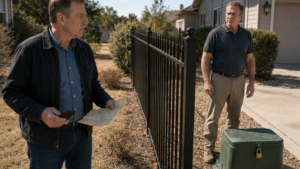
Three Sundays earlier, Richard had found the first orange flag twelve feet beyond the old iron boundary marker.
It stood among the pines on his side of the slope, bright enough to look unnatural against granite and brown needles. A second flag waited farther downhill. A third had been pushed into the soil near the drainage cut above the lake.
He pulled none of them out.
Instead, he measured.
The iron marker had been set before Richard was born. His father had shown it to him when he was fourteen, after making him carry a survey chain uphill through rain.
Never move a marker, his father had said. A moved marker becomes an argument. An untouched marker becomes evidence.
Richard stretched a tape from the iron pin to the nearest flag and wrote the distance on the back of a feed receipt.
At eleven thirty, tires came up the gravel road.
Amanda White’s white SUV appeared between the trees, spotless except for dust gathering along the doors. She stopped beside Richard’s gate without asking permission and stepped out wearing a cream jacket, narrow slacks, and shoes built for flooring rather than mud.
She saw the tape in his hand.
“You noticed the preliminary markings.”
“They’re on my land.”
“They indicate the proposed development boundary.”
“No. They indicate where somebody pushed plastic into dirt.”
Amanda smiled as though patience were a favor she was lending him.
“The board approved the annexation plan Thursday.”
“My property isn’t in your association.”
“The slope is being incorporated into the revised community map.”
“By whom?”
“Our planning consultant.”
“That wasn’t my question.”
She opened the clipboard. A color rendering showed rows of large homes facing the lake. The road on the drawing curved through Richard’s property as if his gate, cabin, and deck had never existed.
His house appeared only as a pale rectangle labeled existing rustic structure.
Amanda tapped the page.
“The expansion depends on a consistent architectural standard. Your cabin creates a visual conflict.”
“From whose window?”
“The future lots.”
“They don’t exist.”
“They will.”
Richard looked again at the rendering. The road line passed over the exact place where he had spread and compacted gravel with his father forty years earlier.
“You’ve drawn houses on land you don’t own.”
“We have board authorization.”
“A board cannot vote itself my acreage.”
“The county has been consulted.”
“Then the county can speak for itself.”
Amanda’s smile vanished.
“You’re treating this as personal.”
“You drove through my gate and planted flags beside my lake.”
“The gate was open.”
“That doesn’t make the road public.”
She closed the clipboard. “You should think carefully about cooperation. Owners who resist planned improvements often discover that existing conditions are not as compliant as they assumed.”
The next day, a violation notice arrived by certified mail.
It cited Richard’s woodpile as an unapproved exterior storage feature. The parcel number belonged to a lot on the other side of the ridge.
He noticed the error, folded the paper, and placed it beneath the equipment catalog.
Two days later came the truck notice. His faded pickup, parked behind the cabin, was described as a commercial vehicle visible from a common area. The nearest common area was half a mile away and screened by pine forest.
Richard placed that notice with the first.
He told himself there was no reason to involve Mary. She worked long shifts, carried other people’s trouble home in the set of her shoulders, and was careful to keep her county position separate from private disagreements. He could handle letters.
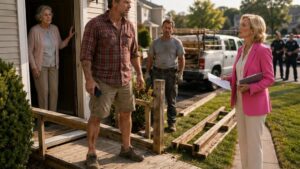
On the following Sunday, Amanda returned.
This time she drove all the way to the cabin.
Richard met her near the woodpile.
“You used my road after I told you it was private.”
“You haven’t provided the board with proof of exclusive access.”
“I don’t provide proof to trespassers.”
“That attitude is precisely why the board has moved to formal enforcement.”
She handed him a new envelope.
The paper was warm from her vehicle. Fresh toner gave off a sharp chemical smell.
Richard opened it.
The board demanded removal of his cedar deck within ten calendar days. It called the structure unauthorized, visually incompatible, and partly situated within a utility and access corridor controlled by the association.
He read the last phrase twice.
“The deck was built before your development.”
“Then you should have no difficulty producing the approvals.”
“There was no association here to approve it.”
“There is now.”
Richard looked past her toward the railing. He had built it after Mary slipped on the old steps while carrying groceries. His father had helped set the final posts before his hands became too weak to hold a drill steady.
Amanda followed his gaze.
“It is rustic,” she said.
She made the word sound like decay.
Richard folded the notice.
“Who gave you this parcel description?”
“Our legal and planning team.”
“It’s wrong.”
“The map has been updated.”
“Maps don’t update ownership by ambition.”
Her cheeks colored. “You may believe you’re protecting a family retreat. What you’re actually doing is threatening a project that benefits more than sixty households.”
“That project is not my obligation.”
“It may become one.”
She left before he could ask what she meant.
That evening, Richard spread every notice across the kitchen table after Mary went to bed. The parcel references did not match one another. One cited the HOA’s master tract. Another used the number from the vacant lot east of his slope. The deck notice included a legal description he recognized only partly.
At the bottom of the construction attachment, in small type, was a reference to an access instrument.
Easement 78-4416.
Richard knew the number.
He went to the metal file cabinet in the back room and opened the drawer marked LAND—TAX—ROAD. His father’s handwriting appeared on old folders, blocky and impatient.
The original deed was there. So was the survey from 1968.
The easement folder was missing.
Richard sat on the floor with the construction packet across his knee.
His father had mentioned an easement only once, years ago, after the first houses appeared beyond the ridge. Utility business, he had called it. Nothing that changes the road.
Richard had accepted the answer because he had been angry about something else and because his father had already turned away.
Now an HOA expansion map carried that old number as if it were a key.
In the bedroom, Mary shifted beneath the blankets.
Richard folded the packet, returned the notices to the desk, and closed the drawer.
In the morning, he would go to the county recorder’s office.
He did not wake her to say why.
Chapter 3: The File His Father Never Explained
Heather Miller recognized the filing number before Richard finished writing his last name.
“Seventy-eight, forty-four sixteen,” she said, leaning over the request slip. “That was one of your father’s.”
Richard looked up. “You remember it?”
“I remember the handwriting.”
The county recorder’s office occupied the lower floor of a concrete building that had once housed the road department. Richard had worked upstairs for nineteen years before the county moved maintenance operations to a metal facility near the highway.
The public counter was newer now, but the room still smelled of paper, dust, and overheated machinery.
Heather carried the request slip toward the archive door.
“Give me a few minutes.”
She returned with a gray box, a rolled plat, and a thin ledger wrapped in a faded blue band.
Richard had expected one easement. The box contained eleven filings connected to the original property.
Heather set the deed on the counter first.
“There’s your parcel.”
The legal description followed the ridge line, crossed the drainage cut, and returned along the lake boundary. No amendment showed annexation into the neighboring association.
Richard traced the edge with one finger.
“Their map puts my south slope inside the development.”
“Then their map doesn’t match this record.”
“Can you certify that?”
“I can certify what is recorded. I can’t tell you what legal conclusion to draw from it.”
“You always talked like that?”
“Only when people ask me questions that should cost them attorney fees.”
The corner of her mouth moved.
Richard almost smiled.
She unrolled the older plat and weighted it with two brass blocks. A road had been drawn by hand from the county route to the cabin site, a narrow double line curving through the property.
Richard recognized the shape immediately.
His father had followed an old logging cut before grading the surface. Richard had hauled stone in a dump truck with failing brakes and spread it shovel by shovel where the slope narrowed.
“The road predates their first subdivision filing,” Heather said.
“By how much?”
She checked the ledger. “Thirty-nine years.”
That should have been enough to settle something inside him.
Instead, Richard looked at the gray box.
“And the easement?”
Heather drew out three pages.
The first granted a utility corridor across a defined strip of the Carter property. It allowed installation, inspection, maintenance, and repair of a sewer line serving the original development. The association named in the document no longer existed under that title, but its successor was listed in a later notation.
Richard read the signature.
His father’s name sat at the bottom, pressed hard enough to dent the paper.
“What did he get for it?”
“Consideration says ten dollars and mutual benefit. That language was common.”
“He never told me about a sewer.”
Heather turned the plat sideways and pointed to a dashed line beneath the road.
“It enters here, follows the shoulder, then crosses toward the ridge.”
Richard stared at it.
The line ran under land he had repaired every spring without knowing what rested below.
Heather brought out a newer utility map.
The dashed line continued into the existing subdivision. A proposed extension branched from it toward the planned lake-view lots.
Richard saw the problem before she explained it.
“There’s no other route.”
“Not on the submitted plan.”
“They want the expansion to drain through my property.”
“That appears to be the design.”
“And they never asked.”
Heather folded her hands.
“I can tell you there is no newly recorded grant from you.”
The vindication came clean and cold.
Amanda’s board had issued fines against land outside its authority. It had ordered removal of a deck it did not regulate. It had drawn an expansion around a utility route that depended on an agreement signed by a dead man.
Richard read the easement again.
A phrase near the middle slowed him.
For present service and reasonable future necessity, subject to the conditions herein.
“What conditions?”
Heather turned the page.
The following paragraph required restoration of the road after any work, written notice before entry except in emergencies, and consent from the landowner for any material increase in burden.
Richard tapped the final phrase.
“That means they need me.”
“It means the language is there.”
“I can revoke it.”
“I did not say that.”
“The burden is changing. New houses. More flow. More trucks.”
“That may affect expansion rights. Maintenance rights could be different.”
He felt impatience rise.
“My father signed this, not me.”
“The easement may run with the land.”
“May?”
“Richard.”
Heather’s voice softened, which irritated him more than caution would have.
“I remember your father coming in with these papers,” she said. “He asked more questions than most people did. Don’t assume he signed carelessly.”
“He signed plenty without explaining any of it.”
“That’s between you and him.”
“He’s dead.”
“Yes.”
The word landed without decoration.
Heather searched the gray box again. She checked the ledger, then the back of the original instrument.
“There should be a reference here to a supplemental amendment.”
“Where is it?”
“I don’t know yet. It may have been indexed under the utility district instead of the property owner.”
“What amendment?”
“The notation only says supplemental conditions.”
Richard looked at the clock.
Amanda’s ten-day deadline had four days left. Survey crews had already marked the slope. If the construction packet was accurate, equipment could arrive within the week.
“I need certified copies of the deed, the plat, and this easement.”
Heather began marking the request form.
“And the amendment?”
“When I find it.”
“That could be too late.”
“It could also change what you think you know.”
Richard gathered the copies when they came from the machine. The toner was warm against his palm.
Outside, he sat in his pickup and read the easement twice more.
The phrase material increase in burden seemed plain enough. Whatever his father had intended in 1978, he could not have intended a gated expansion pressed against the cabin. He could not have intended Amanda’s flags, fines, or threats.
Richard drove to the post office instead of home.
At the standing counter, he wrote a notice revoking permission for any construction access, expansion work, survey activity, or increased utility use across his property. He cited the deed, the recorded plat, and the easement conditions. He demanded written confirmation that all crews would stay beyond the gate.
The postal clerk slid the green certified-mail form toward him.
Richard signed it.
His hand paused only once.
Heather had warned him that another amendment existed.
He folded the notice, sealed the envelope, and pushed it across the counter anyway.
By the time he returned to the cabin, the certified receipt was in his shirt pocket and the decision was already traveling toward the HOA office.
Mary’s patrol vehicle was not in the drive.
Richard placed the receipt beneath the equipment catalog with the other papers.
Then he walked down to the gravel road and closed the gate.
Chapter 4: The Victory Behind the Locked Gate
At six forty the next morning, the first dump truck stopped at Richard’s chain.
By seven, three more vehicles filled the lower curve of the gravel road: a utility van, a tracked excavator on a trailer, and a white pickup carrying orange cones in its bed. Their engines idled beneath the pines, sending a steady vibration through the ground.
Richard stood inside the gate with the padlock key in his pocket.
The construction foreman leaned out of the lead truck.
“We have scheduled access.”
“You don’t.”
“We have an easement.”
“You have a certified notice suspending construction access.”
The foreman climbed down, paperwork rolled beneath one arm. He was younger than Richard expected and already looked tired.
“I’m not here to argue land law.”
“Then don’t cross the chain.”
Behind him, a worker lowered the excavator ramp halfway before the foreman shouted for him to stop.
Mary stood uphill beside her patrol vehicle, out of uniform except for her county jacket. She had not spoken to Richard since breakfast. She was there because her supervisor had asked her to preserve the scene until a neutral deputy arrived, not because Richard had requested help.
That distinction showed in the distance she kept between them.
The foreman held out a work order. “We’re supposed to clear the shoulder and expose the line.”
“For the expansion?”
“For phase one.”
“What does phase one serve?”
The foreman glanced at the utility van. “You need to ask the engineer.”
Richard did not take the paper.
Amanda’s SUV arrived fifteen minutes later. It stopped behind the equipment, unable to pass.
She walked uphill carrying a phone and a leather folder.
“You cannot block essential infrastructure,” she said before reaching the gate.
“You cannot build an expansion through my property without consent.”
“We have recorded rights.”
“For the old line. Not for new lots.”
“That is not your interpretation to make.”
“And it isn’t yours.”
Amanda turned toward Mary. “Deputy Carter, are you going to allow this?”
Mary’s face remained still.
“I am not acting as his deputy.”
“Then why are you here?”
“Because two security contractors represented themselves as officers at this residence yesterday. That matter has been referred for review. Today I am a witness until the assigned deputy arrives.”
Amanda’s mouth tightened.
“This is retaliation.”
Richard almost laughed. Instead, he drew the certified-mail receipt from his shirt pocket.
“This was delivered to your office yesterday afternoon.”
Amanda did not look at it.
“You’ve stopped a permitted project.”
“I’ve stopped your equipment at my gate.”
By nine, the county planning director had arrived, followed by a utility inspector in a mud-streaked truck. The inspector examined the chain, the road shoulder, the work order, and the maps Amanda produced.
Then he walked downhill with Richard toward the flagged slope.
Orange paint marked a trench line parallel to the road.
“Who authorized these markings?” the inspector asked.
Amanda said, “Our engineering contractor.”
“Did the landowner consent?”
“The easement grants access.”
“For maintenance,” Richard said. “Not expansion.”
The inspector crouched beside a fresh soil cut and rubbed the dirt between his fingers.
“No excavation today,” he said.
Amanda stepped closer. “On what basis?”
“Unresolved access rights, inconsistent parcel references, and active allegations of unauthorized entry. I’m issuing a temporary stop-work order until planning and utilities review the recorded documents.”
The satisfaction Richard felt was immediate and sharper than he expected.
The inspector returned to his truck and printed the order from a portable unit. He clipped one copy to the gate inside a clear sleeve.
The red heading stood out against the dull chain:
STOP-WORK ORDER.
Workers began shutting down engines. One by one, the trucks reversed along the narrow road, guided by hand signals. The excavator trailer took two attempts to clear the bend. Gravel shifted beneath its rear wheels, leaving deep scars where Richard had repaired the shoulder.
Amanda remained until the last truck disappeared.
“This won’t stand,” she said.
Richard touched the clear sleeve.
“It’s standing now.”
She looked at him with something beyond anger—something strained and almost frightened—but it vanished before he could name it.
By noon, the county had also suspended the HOA’s violation notices pending jurisdictional review. The email came to Mary’s account because Richard had never set up online access.
She printed it and placed it beside his coffee.
“Your deck is safe for the moment,” she said.
“So are they done?”
“No.”
“They can’t fine me.”
“That isn’t the same thing.”
Richard looked through the window toward the locked gate. The stop-work order moved slightly in the wind.
“It is a start.”
Mary folded her arms.
“You enjoyed that.”
“They came onto my land.”
“That wasn’t my question.”
“They tried to erase the cabin from their map.”
“And now you want to erase their project.”
“I want them stopped.”
“You want Amanda stopped.”
“There’s a difference?”
“There should be.”
Before Richard could answer, a dark sedan came up the road and parked below the cabin. A man in a charcoal suit stepped out carrying a flat document case.
Mary checked the time.
“That will be their attorney.”
Brian Perez removed his shoes at the kitchen door without being asked. Mud had collected along the edges, and he set them neatly beside the mat before taking the chair opposite Richard.
He did not begin with a threat.
“That line beneath your road,” he said, “does not serve only the proposed expansion.”
Richard leaned back.
“It serves the development.”
“It serves twenty-eight existing homes in the lower section. The extension is proposed. The trunk segment is not.”
“The stop-work order is on new construction.”
“For now. But the inspection request uncovered a maintenance concern near the culvert. If access remains blocked during a failure, emergency work becomes more expensive. Much more.”
Mary placed a glass of water near him.
“How much more?” she asked.
Brian opened his case.
“The association’s reserve account cannot absorb a major line failure and the current drainage repairs. Without expansion revenue, the board is considering a special assessment.”
Richard’s shoulders tightened.
“That sounds like their problem.”
“It becomes the homeowners’ problem. Some of them are retired. Some bought before the current board. They didn’t send anyone to your door.”
Amanda had used nearly the same argument, but from her it had sounded like leverage. From Brian, seated without his shoes at Richard’s table, it sounded like arithmetic.
“How large an assessment?” Mary asked.
“Preliminary range is between eleven and eighteen thousand dollars per home, depending on the repair.”
Richard looked again toward the road.
He had wanted the trucks gone. He had wanted the board to feel the gate shut against them.
He had not pictured twenty-eight kitchen tables receiving envelopes.
Brian slid a photocopy across the table.
“This is why I’m here.”
At the bottom was his father’s signature.
Richard recognized the hard downward stroke of the C before he read a single line.
The heading said:
SUPPLEMENTAL EASEMENT CONDITIONS AND CONTINUING SERVICE AGREEMENT.
“This wasn’t in the file yesterday,” Richard said.
“It was indexed under the former utility district,” Brian replied. “The county clerk located it this morning.”
Mary sat beside Richard but did not touch the page.
Brian pointed to the second paragraph.
“The original easement may not authorize your expansion. I’m not arguing that today. But this amendment appears to preserve continuing service and emergency maintenance for existing users.”
Richard read the sentence once.
Then again.
The gate had stopped Amanda’s trucks.
It had not separated her ambition from the people already living beyond his road.
Chapter 5: What the Easement Was Built to Protect
The amendment gave neither side what it wanted.
Richard read it at the kitchen table before sunrise, turning each page with hands that had once handled cracked asphalt, frozen chains, and steering wheels bucking in mountain runoff. The paper weighed almost nothing. It resisted him more than any of those things.
Mary sat across from him with a legal pad.
“Read the purpose clause aloud,” she said.
“I can read it.”
“I know.”
He looked at her.
She waited.
Richard lowered his eyes to the page.
“Continued sanitary service to existing residences shall not be interrupted by the grantor or successors, provided access is limited to inspection, repair, replacement in kind, and emergency maintenance.”
Mary tapped her pen once.
“And the next paragraph?”
“No material extension, increase in burden, or service to additional parcels without separate written consent from the landowner.”
“So Amanda cannot use it for the expansion.”
“Not without me.”
“And you cannot block necessary service to the existing homes.”
“Not if the work stays within the original burden.”
Mary wrote two short lines.
Richard disliked the calmness of it. The amendment should have revealed betrayal or vindication. Instead, it divided the ground exactly where neither side had bothered to look.
“My father never told me.”
“Maybe he thought the document was enough.”
“He knew I maintained that road.”
“He also knew people lived beyond it.”
Richard folded the top page back too sharply.
“He made choices about my land before it was mine.”
“It was his land when he made them.”
“That doesn’t mean he had to hide them.”
Mary’s eyes lifted.
“You hid three weeks of notices from me.”
The room seemed to contract around the sentence.
“That was different.”
“It usually is when you’re the one doing it.”
Richard stood and carried the amendment outside.
The morning was cool enough that his breath showed above the gravel. He walked downhill past the gate and followed the road toward the culvert, where the utility inspector had placed two red stakes near the shoulder.
The inspector arrived at eight with a probe, a compact camera unit, and the construction foreman. Amanda did not come.
They opened a small access cover beside the drainage cut. A sour mineral smell rose from below.
The camera cable disappeared into the pipe.
Richard watched the monitor over the inspector’s shoulder. The inside of the line appeared gray and wet, its joints marked by pale deposits. At one section, roots entered through a hairline gap.
“Not a failure yet,” the inspector said. “But the soil around that joint is moving.”
He pointed uphill.
The road shoulder had settled by less than an inch. Richard had noticed it during spring grading and blamed runoff.
“Could the expansion work cause that?” he asked.
“Not if they haven’t excavated here. Age, drainage, maybe compaction from old repairs.”
“How soon?”
The inspector shook his head. “Could hold another year. Could shift during the next hard rain.”
The foreman crouched near the access cover.
“We can sleeve the section from the lower manhole,” he said. “Minimal trenching.”
Richard looked at him.
“Is that expansion work?”
“No. Existing line.”
“How many trucks?”
“Two service vehicles. Maybe a small compressor.”
“Where do you stage?”
“Along the wide section below your gate.”
Richard imagined opening the chain for them. The thought felt like losing ground.
Then the inspector rotated the camera. Roots trembled in the moving water.
“If this blocks,” he said, “the lower homes lose service first.”
They walked farther along the road, following the invisible line beneath it.
Richard remembered being seventeen and standing on the back of his father’s dump truck while gravel slid around his boots. His father had driven too fast and spoken too little. When Richard complained about spreading stone for houses that would someday crowd the ridge, his father had stopped the truck.
People need roads, he had said. Doesn’t mean they get to take yours.
At the time, Richard had heard only the first sentence and resented it.
Now the amendment carried both.
At the cabin, Heather Miller had left a message. Richard returned the call from the wall phone.
“I found the original filing notes,” she said. “Your father requested the added conditions.”
“Requested them?”
“The utility district’s draft allowed future extensions. He refused. The final amendment preserved existing service and required fresh consent for new parcels.”
Richard looked through the window at the road.
“Did he say why?”
“There’s a handwritten note in the file. Not legal language.”
“What does it say?”
Heather paused.
“Keep neighbors working. Keep developers asking.”
Richard closed his eyes.
His father’s voice did not return. Only the blocky handwriting on old folders and the pressure of a hand guiding a steering wheel through loose gravel.
Mary stood near the sink, watching him without pretending not to.
“What did she find?” she asked after he hung up.
Richard told her.
She pulled out a chair.
He remained standing.
“I thought he gave them something that would outlive us,” he said. “Like he decided the road mattered more than the cabin.”
“Maybe he was trying to protect both.”
“He could have told me.”
“Yes.”
There was no defense in her answer, and that made it easier to hear.
Richard sat.
“I should have told you about the notices.”
“Yes.”
“I didn’t want your job dragged into it.”
“You let me open a door to two men dressed like officers without telling me what had led them there.”
“I didn’t know they were coming.”
“You knew Amanda was escalating.”
He rubbed his thumb over the amendment’s edge.
“I thought handling it myself was keeping it contained.”
Mary looked toward the deck.
“You didn’t contain it. You contained me.”
The words stayed between them.
Richard folded the amendment carefully this time.
“I’m sorry.”
Mary nodded once. She did not rescue him from the silence that followed.
At noon, Richard called the inspector and allowed limited emergency assessment access under written terms: existing line only, no expansion work, no survey beyond the original corridor, vehicle list supplied in advance.
He sent the conditions by certified mail.
The envelope felt different from the violation notices stacked on his table. Those had arrived as commands. This one carried a boundary he had chosen.
The repair crew was scheduled for the following morning.
Near dusk, Amanda’s SUV stopped outside the gate.
She came alone.
Her white suit was gone. She wore dark pants, a plain blue blouse, and flat shoes dusted at the toes. Richard met her at the chain but did not unlock it.
“I heard you authorized inspection,” she said.
“For the existing line.”
“Thank you.”
He waited.
She gripped the top of the gate.
“The financing commitment expires in seventy-two hours.”
“That is not my emergency.”
“No. But it explains the pressure.”
“It does not explain the men at my door.”
Her face tightened.
“I was told they could deliver a removal warning and maintain order.”
“You called them officers.”
“I needed you to take the board seriously.”
“You needed me frightened.”
Amanda looked down the road toward the ridge.
“If the expansion fails, the association loses the developer contribution. Without it, we have drainage repairs, sewer work, and reserves below the required level. The assessment will break some of those households.”
“Then you should have brought them the real numbers before you brought me fake authority.”
“I thought I could solve it before they had to know.”
Richard almost smiled at the familiarity of the mistake.
“You hid the threat from the people beside you,” he said.
Amanda’s hand left the gate.
For the first time, she looked less like an enemy than a person who had walked too far into her own decision and could no longer pretend the road had carried her there.
“Will you meet before the deadline?” she asked.
Richard looked at the chain, the red inspection stakes, and the gravel his father had taught him to spread evenly.
“I’ll attend the county hearing.”
“That may be too late for the financing.”
“Then bring the truth faster.”
Amanda returned to her SUV.
Before she opened the door, she turned.
“Monday evening,” she said. “Seventy-two hours ends at midnight.”
Richard watched her drive back toward the neighborhood.
The deadline no longer felt like a weapon she held over him.
It felt like a test of what he intended to do with the gate.
Chapter 6: The Hearing Where Silence Became a Choice
The first person Richard heard blame him was an older woman carrying an oxygen concentrator.
She stood near the hearing-room doors with two other homeowners, her voice low but sharp enough to cross the hall.
“That’s him,” she said. “He shut down the sewer work.”
Richard stopped beside Mary.
The woman looked directly at him, then turned away as though the sight confirmed something.
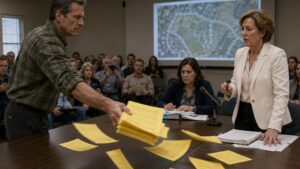
Inside, nearly every chair was occupied. Residents from the development filled the left side. County staff sat behind a raised counter. A projector displayed the disputed map on the wall: the HOA boundary in blue, Richard’s parcel in yellow, and the sewer line in red beneath the gravel road.
For the first time, Richard saw every connected house at once.
Twenty-eight small rectangles branched from the red line before it reached the proposed expansion.
Amanda sat at the front table with Brian Perez and the HOA treasurer. She had returned to her white jacket, but the effect was different under fluorescent lights. The sleeves looked creased. A stack of financial sheets waited beside her clipboard.
Mary chose a chair in the second row instead of sitting with Richard at the presentation table.
He understood why.
The county hearing clerk called the meeting to order. The planning director summarized the stop-work order, the disputed easement, the unauthorized parcel references, and the utility concern near the culvert.
Then Amanda spoke.
“The association acted on legal and engineering advice available at the time,” she said. “Our intent was to preserve infrastructure stability and complete a project already approved by the membership.”
A man behind Richard muttered, “Until he chained the road.”
Amanda continued.
“The security contractors involved in Sunday’s incident were retained to prevent confrontation during delivery of a formal notice. They were not instructed to represent themselves as police.”
Mary’s chair moved.
Not loudly. Just enough for Richard to hear.
The planning director looked toward her.
“Deputy Carter, you submitted the incident report?”
“Yes.”
“Did the contractors identify themselves as law enforcement?”
“They used the term officer, wore metal shields without company identification, carried duty-style equipment, and stated they were authorized to remove a resident from his home.”
Amanda leaned toward her microphone.
“I said my officers. I meant security officers.”
Mary’s expression did not change.
“You also told one contractor by phone to make sure Mr. Carter understood they could physically escort him off the parcel.”
Brian turned toward Amanda.
The room shifted—not with noise, but with attention.
The planning director asked, “How do you know that?”
“One contractor provided a statement and call log during the sheriff’s review.”
Amanda’s hand closed around her pen.
“He misunderstood.”
Mary replied, “The review will determine that.”
The hearing clerk asked Mary to step back from further comment because of the pending matter. She did so without protest.
Richard looked at Amanda.
He had expected satisfaction. Instead, he saw the same instinct he recognized in himself: hold the line, reveal nothing, call secrecy protection until the consequences belonged to everyone else.
The HOA treasurer presented the numbers next.
The current reserve fund could cover routine repairs but not the drainage project and a major sewer failure. The planned expansion would have contributed several hundred thousand dollars in developer fees. Without those funds, an assessment would likely be required.
Murmurs moved across the room.
The older woman with the oxygen concentrator raised her hand during public comment.
The clerk brought her a microphone.
“My husband and I bought twenty-one years ago,” she said. “We did not vote for lake-view houses. We did vote for the repair plan because we were told the expansion would pay for most of it.”
She glanced at Richard.
“I cannot pay fifteen thousand dollars. I cannot borrow it. If the sewer fails and the county condemns units, I don’t know where I go.”
No one answered.
Richard looked at the projected map again.
The red line beneath his road had become more than ink. It ran through kitchens, bathrooms, mortgage balances, and people who had never driven survey stakes into his slope.
That did not make Amanda’s annexation legal.
It did make simple destruction feel dishonest.
Brian presented the easement language. He conceded that new parcels required Richard’s written consent. He also argued that existing maintenance had to continue.
Richard stood when the clerk called his name.
He carried no speech. Only copies of the deed, the original easement, the amendment, and the certified notices.
“My property was never annexed,” he said. “The violation letters used parcel descriptions that did not match my deed. The board marked land it did not own and planned new sewer service through a corridor that requires my consent.”
Someone in the back said, “But you shut everything down.”
Richard turned toward the voice.
“I stopped expansion access. I authorized inspection and repair for the existing line this morning.”
The room quieted.
The planning director asked, “Under what conditions?”
“Existing service only. No new connections. No expansion survey. Written vehicle list. Restoration of any road damage.”
The utility inspector confirmed the agreement and reported that the weak section could be sleeved without full excavation if work began promptly.
The older woman lowered her oxygen tube from her cheek and looked at Richard more carefully.
Amanda spoke again.
“The expansion cannot proceed at half scale. The developer’s design and financing depend on the full lot count.”
Richard faced her.
“Then the design depends on land and rights you do not have.”
“We can negotiate compensation.”
“This is not only compensation.”
“What is it, then?”
He looked toward Mary.
She did not nod. She did not need to.
“It is whether your board can turn a private road into a promise without asking the person who owns it.”
The planning director reviewed the county’s options. The existing repair could proceed. The expansion permit would remain suspended. If no lawful access agreement was submitted before the financing deadline, the county would reject the current utility route and require redesign.
Amanda whispered with Brian. The HOA treasurer covered her face with both hands.
The hearing should have felt like victory.
Instead, Richard saw the older woman folding the same financial sheet into smaller and smaller rectangles.
He opened his father’s amendment.
“There may be a route,” he said.
Brian looked up.
Richard walked to the projected map and pointed to the upper section of the proposed development.
“The lots along this ridge require the longest extension and the widest construction corridor. Remove them.”
Amanda stood. “That cuts nearly half the project.”
“It cuts the part that presses against my slope.”
“The remaining lots may not carry the financing.”
“That is for your developer to decide.”
He moved his finger to the existing sewer line.
“I will permit replacement in kind for the current neighborhood. I will consider a limited new extension only if it stays within the lower corridor, uses no part of my deck or lake slope, and includes permanent restoration protection.”
Amanda stared at the map.
Richard continued.
“All invalid fines withdrawn in writing. The association records a statement that my parcel is outside its jurisdiction. Independent legal review before any future boundary or easement action. A restoration bond before equipment crosses the gate. No security personnel on my property without my written agreement, except actual law enforcement acting under lawful authority.”
A few residents began whispering.
Brian asked, “Compensation?”
“Yes. Fair value for added burden. Not payment for silence.”
Amanda’s face hardened.
“You’re asking us to surrender the entire prestige section.”
“I’m telling you what I will not surrender.”
The planning director leaned toward the microphone.
“If the parties can produce a signed term sheet by midnight, the county can hold the rejection in abeyance for forty-eight hours. Otherwise the current expansion route will be denied.”
Amanda looked at the clock.
Less than five hours remained.
The hearing clerk asked whether the HOA wished to enter immediate mediation.
Brian answered before Amanda could.
“Yes.”
Amanda turned on him.
He spoke quietly, but the microphone caught the words.
“We do not have another route.”
Richard returned to his seat.
Mary remained one chair away.
After a moment, she reached across the gap and placed the certified receipt beside his hand.
Not forgiveness. Not yet.
But partnership, offered without taking the choice from him.
Across the room, Amanda stared at the reduced map while the treasurer calculated figures on the back of an assessment sheet.
The road beneath the red line could still carry service.
It would no longer carry every ambition placed upon it.
Now the association had until midnight to decide whether less was enough.
Chapter 7: The Terms Written Across the Road
Brian Perez returned to the cabin two mornings later with a revised agreement and one phrase Richard rejected before reaching the second page.
Association-adjacent property.
Richard placed his finger beneath the words.
“Change it.”
Brian had not removed his coat. “It’s descriptive.”
“It is suggestive.”
“It means your parcel borders the association.”
“It makes the association the fixed point and my land something hanging off its edge.”
Brian studied him, then drew a line through the phrase.
“Privately owned Carter parcel?”
“Recorded parcel number first. Owner second. No adjectives.”
Across the table, the HOA treasurer opened a calculator. Amanda was not present. The board had removed her from direct negotiations after the county hearing, though she remained president until the recall vote scheduled for the following month.
Mary sat beside Richard with a yellow pad, off duty and out of uniform.
The new draft reduced the expansion from twenty-three lots to twelve. It moved every proposed structure away from Richard’s lake slope and limited utility work to a narrow corridor beside the existing line. The invalid fines were withdrawn in an attached letter. Another page acknowledged that Richard’s property had never been subject to the HOA declaration.
Those were gains.
The agreement still treated access as the central purpose and Richard’s protection as a list of exceptions.
Brian turned to the compensation section.
“The association has authorized a one-time easement payment, restoration costs, and reimbursement of your survey and legal review.”
Richard closed the document.
“What is the easement for?”
Brian paused. “The limited extension shown on Exhibit C.”
“That’s where it goes. What is it for?”
“To serve the approved lower lots.”
“And before that?”
“I’m not following.”
Richard opened his father’s amendment and placed it beside the new draft.
“This says existing service is protected and expansion requires consent. It tells anyone reading it what each side is allowed to do. Your draft starts with payment, then spends nine pages finding ways onto my road.”
The treasurer shifted in her chair.
“The payment is substantial.”
“I did not ask whether it was substantial.”
Brian leaned back. “What language do you want?”
Richard slid a blank sheet across the table.
“Purpose first.”
He dictated slowly enough for Brian to write.
The agreement existed to preserve safe service for current residents, permit a specifically defined and reduced extension, protect the Carter parcel from unauthorized expansion, and assign every cost of access, damage, repair, inspection, and restoration to the association.
Brian stopped writing.
“That is unusually restrictive.”
“So was sending men dressed like officers to my door.”
Mary did not look at Richard, but her hand settled flat on the table.
Brian crossed out a paragraph and began again.
They worked for four hours.
Every broad phrase became a measured one. Reasonable access became access between listed hours after forty-eight hours’ written notice. Necessary vehicles became vehicles identified by type and license plate. Restoration became restoration to equal or better condition, verified by an independent inspector chosen jointly and paid by the association.
Richard required a bond before the first truck crossed the gate.
The treasurer objected. “We cannot tie up that much cash.”
“You tied up my road without permission.”
“We are trying to correct that.”
“Then the correction has to survive the next board.”
Brian proposed insurance instead of the full bond. Richard accepted a combination: a smaller cash bond, contractor coverage, and direct liability for damage.
The final disagreement concerned enforcement.
The HOA wanted mediation before any suspension of access. Richard wanted immediate suspension for work beyond the recorded corridor.
Mary read both versions.
“Emergency service should continue no matter what,” she said. “Expansion work should stop the moment they exceed the agreement.”
Richard looked at her.
“That is what my father wrote.”
“Then keep the part he got right.”
Brian revised the clause.
By late afternoon, the agreement had become narrower than Amanda’s original project and stronger than Richard’s first revocation. It protected the existing homes. It permitted only the lower extension. It prohibited any claim of jurisdiction over the cabin, deck, slope, road, truck, woodpile, or future structures lawful under county rules.
It also required the association to adopt outside legal review for boundary changes and easement actions.
The treasurer signed first.
Brian signed as counsel.
Richard held the pen over his line.
Through the window, the gravel road curved downhill toward the locked gate. For weeks, every vehicle on it had felt like an intrusion. His own decision had turned the chain into a weapon almost as quickly as Amanda had turned a clipboard into one.
Mary touched the certified receipt lying beside the agreement.
“You do not have to sign because they ran out of time,” she said.
“I know.”
“You also do not have to refuse because they frightened you.”
Richard looked at her.
That was the choice beneath every clause.
He signed.
The repair crews arrived the next morning.
Richard opened the gate himself.
Two service trucks entered, each matching the list sent in advance. The foreman stopped beside him and handed over a laminated site plan before proceeding. No one wore a badge. No one called the road common property.
Still, Richard remained beside the gate until both trucks were in position.
Trust had not been created by ink. Ink had only given distrust a lawful shape.
The failed section of pipe was sleeved from the lower access point without cutting the main road. A small section of shoulder had to be opened near the culvert. Richard watched the excavation, photographed each stage, and corrected the crew when spoil was placed too close to the drainage channel.
The foreman accepted the instruction without argument.
By sunset, the pipe was sealed and the trench compacted. The shoulder would need another layer of gravel before winter.
The association paid for it.
During the following week, survey crews removed every orange flag from Richard’s upper slope. New markers defined the reduced corridor below the ridge. The proposed lake-view lots disappeared from the county map.
At the recorder’s office, Heather Miller compared the final agreement against the original deed and easements.
“You made them use the parcel number six times,” she said.
“Seven.”
She counted again.
“Seven.”
“The next person should not have to guess which land they mean.”
Heather stamped the filing cover and slid it toward him.
“There was also an indexing correction on the old amendment. It is now cross-referenced under your parcel.”
Richard looked at his father’s signature on the copy.
“Keep neighbors working. Keep developers asking.”
Heather nodded.
“He knew how counties forget.”
“He knew how I forget, too.”
She did not ask what he meant.
By early autumn, the white stop-work sleeve had been removed from the gate. In its place hung a small metal notice listing the easement corridor and the number to call before entry.
The road reopened for authorized repair traffic, county inspection, and the limited extension. Most days it remained quiet.
Amanda’s recall vote passed by a narrow margin.
Richard did not attend.
He heard that she had apologized to the board for the security incident but continued to insist that the expansion had been necessary. Both things could be true: she had seen a real financial danger, and she had chosen to meet it by making Richard smaller.
The sheriff’s review resulted in citations and license action against the contractors. The prosecutor declined more serious charges after determining that their conduct, though deceptive and reckless, had stopped short of an explicit claim to public office. Mary accepted the result without celebration.
“It is not nothing,” she said.
“No.”
“It is also not everything.”
Richard understood.
On a clear morning after the first frost, he carried a replacement boundary marker down the road. Mary followed with a sledgehammer resting across one shoulder.
The old iron marker had been bent when the survey crews crossed the slope. Richard could have demanded that the association install the replacement. The agreement allowed it.
He preferred to do this part himself.
They reached the granite outcrop where the private parcel met the utility corridor. The new marker was steel, plain and bright against the brown ground.
Richard set it in the original hole.
Mary raised the hammer.
“You holding that straight?”
“It is straight.”
“It is leaning toward the association.”
“It is not.”
She adjusted it half an inch.
Richard gave her a look.
Mary smiled for the first time that morning and drove the marker into the soil with three measured blows.
The sound carried down the gravel road.
Richard checked the post with a small level. The bubble settled between the lines.
Mary looked toward the cabin. From there, the cedar deck showed through the trees, weathered but intact. Beyond it, the lake held the pale reflection of the ridge.
“You still think asking for help means losing control?” she asked.
Richard brushed dirt from his gloves.
“Sometimes.”
“That was not the question.”
“No.”
He looked down the road.
Fresh gravel covered the repaired shoulder near the culvert. Farther away, beyond the gate, homes stood among the pines. Their service continued beneath his land, not because a board had claimed it and not because he had surrendered it, but because he had chosen the conditions under which the road could carry more than memory.
“I think,” he said, “control is knowing what you can share without giving away what is yours.”
Mary rested the hammer against the marker.
“That sounds expensive.”
“It was.”
They stood there a moment longer.
Then Richard picked up the level, and Mary lifted the hammer.
Together they walked back toward the cabin, leaving the new marker behind them—firm in the ground, visible from both sides of the road.
The story has ended.