My Neighbor Locked the Water Line Behind Our HOA Fence—Then Page Four Changed Everything
Chapter 1: The Padlock Inside Richard’s Fence
The first thing Gary Mitchell noticed was not that the sprinklers had stopped.
It was the padlock.
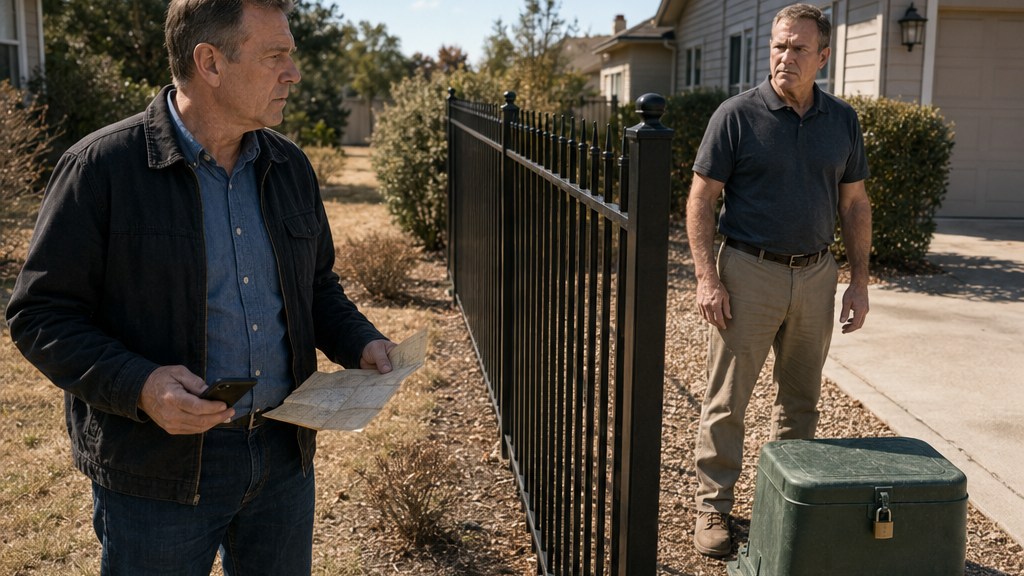
A small brass lock hung from the metal irrigation box just inside Richard Baker’s fence, bright enough to look new against the faded green lid. Gary stood on his side of the property line with one hand still wrapped around a coffee mug, staring through the black aluminum pickets.
For twenty-six years, that box had never been locked.
He set the mug on the retaining wall.
Beyond his patio, the rear irrigation zones should have been running. At six-thirty every Monday, water normally ticked against the magnolia leaves, darkened the mulch around the azaleas, and reached the narrow strip of lawn along the back fence. Instead, everything was silent.
Gary walked to the small meter beside his garage.
No movement.
He checked the controller.
Zone four: active.
Flow: zero.
He went back to the fence.
Richard was coming down his driveway in work gloves, carrying a cordless drill. For the past month, lumber and wrapped building materials had been stacked beside Richard’s garage. An orange survey mark had appeared on the concrete. Then another. Gary knew Richard had plans for the property, but Richard had never explained much beyond calling it “an expansion.”
Gary pointed through the fence.
“You lock that?”
Richard glanced at the valve box.
“Yeah.”
“Why?”
Richard removed one glove finger by finger.
“We need to settle the strip.”
Gary looked at him.
“What does that have to do with my irrigation?”
Richard rested one forearm on the fence.
“You know exactly what it has to do with it.”
Gary felt the first sharp lift of anger but kept his voice level.
The six-foot strip ran along the side of Gary’s lot, between Richard’s driveway and Gary’s hedge. Richard had asked about buying it twice. Gary had declined twice. The second conversation had ended with Richard saying Gary was being unreasonable about land he “didn’t even use.”
Gary used it every week. He had planted the hedge there with his wife years earlier.
“The line’s been there longer than either of us,” Gary said.
“It’s inside my fence.”
“The valve is.”
“Same difference.”
“No.”
Richard gave him a tired smile.
It was the kind of smile that bothered Gary more than anger would have.
“I’m not doing this all summer,” Richard said. “I’ve got contractors scheduled. I made you a fair offer. You keep acting like six feet of mulch is some family farm.”
Gary looked past him at the valve.
“Are you refusing me access?”
Richard’s smile disappeared.
“I’m telling you we need to settle the strip.”
“That wasn’t my question.”
Richard picked up his drill.
“The water can stay off until we do.”
There it was.
Not a misunderstanding. Not a maintenance problem.
Gary took his phone from his pocket.
Richard frowned. “What are you doing?”
“Documenting it.”
Gary photographed the padlock. Then the closed valve position visible through the narrow gap at the edge of the lid. Then the meter on his own side showing no flow.
He took another photograph wide enough to include the fence and both property lines.
Richard shook his head.
“You really want to turn this into some big thing?”
Gary almost laughed.
Instead, he said, “I’m trying to figure out what thing it already is.”
For years, Gary had been the person neighbors called reasonable.
When Richard’s landscaper had put two irrigation heads a foot over the line, Gary had said not to worry about it. When construction debris had sat against his hedge for three weeks, he had moved it himself. When the HOA sent him a notice about branches from Richard’s maple extending into a common drainage strip, Gary had trimmed them rather than argue about responsibility.
His wife used to say there was no prize for winning every small fight.
After she died, Gary kept repeating that sentence long after it stopped applying.
Richard returned ten minutes later carrying a white envelope.
He held it through the fence.
“Before you start calling attorneys, read this.”
Gary took it.
Inside was a one-page purchase offer.
Thirty-four thousand dollars.
Six feet by the length of the side yard.
Gary read it twice.
“You increased it.”
“I’m trying to be practical.”
“You’re trying to buy something I already said I don’t want to sell.”
Richard exhaled.
“Gary, look around. You barely use that side. I need driveway clearance. You get thirty-four grand for dirt and shrubs. Everybody wins.”
Gary folded the paper.
“Except you turned off my water.”
“I turned off a line on my property.”
Gary looked at the locked box.
“That’s what you think.”
Richard stepped back.
“If the HOA says otherwise, I’ll listen.”
Gary nodded once.
That afternoon, Amanda Lee from the community-management office returned his call.
She sounded careful rather than concerned.
“The irrigation box is physically located on Mr. Baker’s lot?”
“Yes.”
“And you don’t have a separate shutoff?”
“No.”
There was a pause while she typed.
“I’m looking at the association utility map. I don’t see a shared irrigation easement there.”
“The houses were built before that map existed.”
“I understand. But I can only tell you what our current documents show.”
Gary looked through the kitchen window toward the back lawn.
By then, the late-summer heat had flattened the hydrangea leaves.
“What happens if the current documents are incomplete?”
“Then we’d need the recorded documents.”
“Recorded where?”
“County.”
Amanda lowered her voice slightly.
“Gary, I’d suggest you don’t enter Richard’s property or cut the lock yourself. If there’s an access right, establish it first.”
Gary had already decided the same thing, though hearing it from the HOA made him feel less restrained and more trapped.
After the call, he went into the hall closet.
His closing papers had been moved twice since his wife died and once during a kitchen renovation. He found them inside a blue plastic file bin behind old tax folders.
There were title pages, insurance forms, surveys, inspection reports and decades of documents he had once read carefully enough to sign.
He sat on the floor and worked through them.
Most meant nothing.
Then, clipped behind the original settlement statement, he found a typed index prepared by the first title company.
Near the bottom, beside a faded check mark, someone had written three words in blue ink:
1989 utility corridor.
Gary stared at them.
Then he looked through the window toward Richard’s fence and the small locked box behind it.
He had spent the morning asking whether Richard could lock the valve.
Now he had a different question.
What, exactly, had somebody recorded in 1989?
Chapter 2: The Map the HOA Never Scanned
At 7:12 Tuesday morning, Amanda’s email arrived with a PDF attachment and one sentence Gary read three times.
The association has no recorded shared irrigation line affecting either lot.
He opened the attachment.
It was the same clean digital map Amanda had described on the phone: property lines, storm drains, common landscaping, utility boxes, easements near the street.
Nothing along the side boundary between his house and Richard’s.
Gary printed it anyway.
Then he printed the photographs from the previous morning—the padlock, the closed valve, the dead meter—and spread everything across his kitchen table.
Outside, the controller clicked on for another scheduled cycle.
The pipes gave a faint dry knock in the wall.
Nothing followed.
Gary shut the system off manually.
By nine, he was at the county records office.
The clerk behind the counter listened while Gary explained that he was looking for a subdivision instrument from 1989.
“Do you have a number?”
“No. Just a note.”
“That helps less than people think.”
Gary slid over a copy of his old title index.
The clerk adjusted his glasses and studied the handwritten phrase.
“What’s the subdivision?”
Gary told him.
The clerk turned toward an older computer.
“Original phase or second phase?”
“Original.”
“That helps more.”
Twenty minutes later, Gary was following him past the public terminals toward a row of oversized bound plat books stored in a temperature-controlled room.
The clerk set one on a viewing table.
“Most of this predates the digitization project,” he said. “Some of it got indexed. Some didn’t.”
“That happens?”
“All the time.”
Gary thought of Amanda’s confident PDF.
The clerk opened the book.
The pages were heavy enough to resist turning.
Lot lines spread across them in thin black ink, accompanied by measurements, drainage notes and developer stamps. The neighborhood looked strange stripped of houses and trees. Just numbered rectangles cut out of former open land.
Gary found his lot first.
Then Richard’s.
Between them ran a narrow hatched band.
He leaned closer.
UTILITY CORRIDOR.
The line began near the community well connection, crossed Richard’s parcel, then continued directly along the side of Gary’s property before turning behind his house.
Gary took out his phone.
“Can I photograph this?”
“Yes.”
He photographed the full page, then close-ups of the corridor and recording stamp.
The date was November 1989.
For the first time since seeing the lock, something inside him loosened.
Not victory.
Proof that he had not imagined the history.
The clerk pointed to a small notation near the edge.
“You’ll want this.”
Gary followed his finger.
The corridor referred to a separate declaration by instrument number.
“What does that mean?”
“The plat shows where something is. The declaration usually tells you what it does.”
“Can we pull it?”
The clerk typed the number into the county system.
Nothing appeared.
He tried another database.
Still nothing.
“Old indexing,” he said. “Give me a minute.”
Gary sent Amanda a photograph of the plat while he waited.
Her response came faster than he expected.
I have never seen this version.
Then another message:
Please send the entire page.
Gary did.
A third message arrived.
I’m checking our archive.
Gary almost smiled.
Yesterday, the HOA’s map had been presented like an answer. Now the same office was searching for documents it did not know existed.
The clerk returned carrying a cardboard archival folder.
“This is probably your problem.”
Inside was a photocopy of the original declaration, but several pages were missing. The first page identified the subdivision developer. The second discussed utility installation. The last page contained signatures and a recording stamp.
Gary counted.
“Where’s the rest?”
“Attachment didn’t scan with the main document.”
“So this doesn’t tell me what the corridor is for?”
“Not completely.”
Gary pointed at a sentence mentioning service access.
It was broad enough to encourage him and vague enough to be dangerous.
He had spent most of his working life installing landscapes around other people’s buildings. He knew what happened when someone saw one favorable measurement and stopped checking.
A half-inch mistake could become a retaining wall in the wrong place.
He forced himself not to treat one phrase as a conclusion.
“Can you find the attachment?”
“We can request the microfilm.”
“How long?”
The clerk shrugged.
“Could be this afternoon. Could be tomorrow.”
Gary left with certified copies of the plat and the incomplete declaration.
At home, he took the old plat outside.
He stood at the side yard, aligning the drawing with the real property.
The corridor began almost exactly where the locked box sat.
From there, Gary could trace its route without seeing the buried pipe. It passed beneath a narrow patch of Richard’s lawn, crossed under the fence, and continued beside Gary’s hedge toward the rear zones.
The map was not approximately right.
It was precisely right.
Richard appeared at his driveway.
“You digging for treasure?”
Gary folded the copy.
“Found the original plat.”
Richard stopped walking.
“The HOA already told you there’s nothing.”
“The HOA hadn’t seen this one.”
Richard’s expression tightened for less than a second.
Then he shrugged.
“A map isn’t an easement.”
Gary noticed that.
Not What map?
Not Let me see.
A map isn’t an easement.
Gary said, “You might be right.”
Richard looked almost disappointed by the answer.
“I’m not trying to screw you, Gary.”
“You shut off my irrigation.”
“I’m trying to get a project finished.”
“Then finish it without my property.”
Richard looked toward the hedge.
“You’re proving my point. You won’t even discuss it.”
“We discussed it twice.”
“You said no twice.”
“That is discussing it.”
Richard walked back toward his garage.
Gary remained beside the fence.
The old version of himself would have softened that last sentence. Added something about understanding Richard’s position. Maybe apologized for the inconvenience of his own refusal.
He felt the impulse.
He let it pass.
By late afternoon, brown edges had appeared on two sections of boxwood near the patio. Gary ran temporary hoses from the front spigot as far as they would reach, but the pressure was weak.
At 4:38, the county clerk called.
“We found the missing attachment.”
Gary sat down.
“How many pages?”
“Four.”
“And the corridor?”
“You’ll need to read it yourself. I can’t interpret legal language.”
“Can I get copies tomorrow?”
“They’ll be ready when we open.”
Gary thanked him.
Before hanging up, the clerk added, “Page Four is the one with the property schedule.”
Gary wrote the words on the back of Amanda’s digital map.
Page Four.
The HOA had not scanned it.
The county had not indexed it correctly.
And whatever it said had been sitting in the public record since 1989.
Chapter 3: The Signature Gary Wishes He Had Read
Richard placed Gary’s own signature in the middle of the HOA conference table Wednesday evening.
The paper slid across the laminate and stopped beside Gary’s hand.
“There,” Richard said. “That’s his signature.”
Amanda Lee looked from the document to Gary.
Gary recognized it before he read the first paragraph.
Six years earlier, after Richard replaced the old wooden fence between their properties, the HOA had asked both owners to sign an acknowledgment covering the landscaping strip along the boundary.
Gary had signed without thinking much about it.
At the time, Richard’s contractor had damaged three shrubs and shifted irrigation heads. Gary had been tired of emails and measurements. He remembered his wife sitting at the kitchen counter while he complained.
Just sign the maintenance part and be done with it, she had said.
She had died the following spring.
Now the same signature looked much larger than he remembered.
Amanda read aloud from the paragraph above it.
“‘Owner of Lot 42 accepts ongoing maintenance responsibility for landscaping and irrigation improvements adjacent to the shared boundary.’”
Richard leaned back.
“That’s Gary’s lot.”
Gary said nothing.
One of the board members shifted in his chair.
Amanda folded her hands.
“This complicates things.”
Gary looked at her. “How?”
“If you accepted responsibility for the irrigation improvements, Richard may have a reasonable argument that the association never considered that line a shared utility.”
“I didn’t install the buried supply line.”
“But you signed responsibility for irrigation.”
“For maintaining landscaping.”
Richard tapped the paper.
“It says irrigation improvements.”
Gary felt heat move up his neck.
He had arrived with the 1989 plat in a folder, expecting it to change the room.
Instead, Richard had produced something newer, simpler and carrying Gary’s own name.
The irony was hard to miss.
For years Gary had signed small things because reading every sentence felt like turning ordinary neighborhood issues into disputes.
Now one of those signatures was being used to define a right he had never intended to surrender.
Amanda turned to him.
“Do you have anything establishing access to the valve itself?”
“I have the original plat.”
“That establishes a corridor.”
“Exactly.”
Richard shook his head.
“No. It establishes that somebody drew one thirty-five years ago. Gary signed this six years ago.”
Gary looked at Richard.
“You knew about the old plat?”
“I knew there were old utility drawings. Every neighborhood has them.”
“That wasn’t my question.”
Richard’s jaw tightened.
Amanda interrupted before either man continued.
“We’re not deciding ownership tonight. Until we have the recorded declaration, we don’t have enough.”
Gary wanted to object.
His backyard had already gone three days without proper water. Two azaleas were curling. The lawn along the southern exposure had begun bleaching pale green.
But Amanda was right about one thing: he did not yet have enough.
After the meeting, Gary drove directly to Deborah Carter’s office.
He had used Deborah years earlier for a boundary question involving one of his landscaping clients. She listened without interrupting while he put three documents on her desk: the digital HOA map, the original 1989 plat, and the signed maintenance acknowledgment.
She read the acknowledgment first.
Gary watched her face.
Finally he said, “How bad?”
She looked up.
“That depends on what you think it says.”
“I think it says I was careless.”
“That may be true. It doesn’t mean Richard owns your water.”
Gary sat back.
Deborah tapped the first sentence.
“This document allocates maintenance responsibility for landscaping and irrigation improvements adjacent to the boundary.”
“That’s what Amanda said.”
“Yes. But maintenance responsibility and real-property rights are different questions.”
Gary pointed to his signature.
“So I didn’t give up access?”
“I didn’t say that.”
The relief disappeared as quickly as it had come.
Deborah slid the paper aside.
“I said this document alone doesn’t establish that you did.”
She picked up the plat.
“This is more important, but not enough either.”
Gary frowned.
“It shows the corridor.”
“It shows where the corridor was intended to be. We need the instrument that created the right.”
“The county found it.”
“All of it?”
“Four-page attachment. I can pick it up tomorrow.”
Deborah nodded.
“Good.”
Gary looked through the office window at the parking lot.
“I should’ve dealt with this Monday.”
“Yes.”
The answer surprised him.
He turned back.
Deborah did not soften it.
“You photographed the lock, which was smart. But then you waited because you didn’t want to make the conflict bigger.”
Gary rubbed his thumb along the edge of the plat.
“I wanted to be sure.”
“You wanted to be sure Richard couldn’t accuse you of overreacting.”
Gary said nothing.
Deborah had known him long enough not to need the answer.
“My wife hated neighbor fights,” he said finally.
“That doesn’t make Richard right.”
“No.”
“It also doesn’t make every boundary a fight.”
That landed harder.
Gary thought of the small accommodations he had treated as kindness because refusing them required an uncomfortable conversation. Fence placement. Landscaping debris. Delivery trucks crossing his side strip. Irrigation heads.
None had mattered much individually.
Together, they had taught Richard something Gary had never intended to teach him.
That Gary eventually yielded.
Deborah tapped the photograph of the padlock.
“You don’t need to become aggressive. You need to become clear.”
The following morning, Gary picked up the county copies before eight.
The four attachment pages smelled faintly of old paper and toner. The first two contained definitions and developer obligations. The third described maintenance of shared infrastructure.
Gary began reading faster.
Deborah stopped him.
“Slow down.”
They were back in her office.
He forced himself to start again.
The language was dense enough that familiar words became slippery. Grant. Successors. Assigns. Benefited parcel. Burdened parcel. Utility installation.
Near the bottom of Page Three, a paragraph referred to access for inspection, repair and replacement.
Gary looked up.
“That’s it.”
“Maybe.”
“You keep saying maybe.”
“Because you keep trying to win before we finish reading.”
Gary closed his mouth.
Deborah turned the page.
Page Four began with a legal description.
Lot 41.
Richard’s property.
Then Lot 42.
Gary’s.
The same instrument number from the 1989 plat appeared beside both.
Gary felt his pulse quicken.
Deborah traced the paragraph with one finger but did not read it aloud yet.
“Before you get excited,” she said, “we need the exact language. Whether this right survived later transfers depends on how they created it.”
Gary leaned forward.
“What am I looking for?”
“A right that attaches to the property, not just to whoever owned it in 1989.”
“And if it doesn’t?”
“Then Richard’s argument gets stronger.”
Gary looked down at Page Four.
The answer had been sitting there for more than three decades.
He had spent years believing peace meant not making other people uncomfortable. Richard had spent three days betting that belief would hold.
Deborah pushed the document back toward him.
“Read it all the way through Page Four, Gary.”
He lowered his eyes to the paragraph beneath the legal descriptions.
For the first time since Monday morning, the padlock no longer felt like the most important object in the dispute.
The words beneath his hands did.
Chapter 4: Page Four Runs With the Land
The first line on Page Four named Richard’s lot.
Gary read it twice before letting himself breathe.
Lot 41 appeared beside a legal description matching the dimensions on the original subdivision plat. Beneath it came Lot 42—Gary’s property—followed by the same instrument number the county clerk had found beside the old utility corridor.
Deborah Carter sat across from him with a yellow legal pad untouched beside her elbow.
“Keep going,” she said.
Gary lowered his eyes.
The paragraph began with language he understood only in pieces: grantor, successors, assigns, burdened parcel, benefited parcel.
Then he reached the phrase Deborah had told him to look for.
Irrevocable utility easement appurtenant to the benefited parcel.
Gary stopped.
“That’s it.”
Deborah didn’t answer immediately.
He looked up. “Isn’t it?”
“It’s important.”
“You said appurtenant was what mattered.”
“It is. Now we make sure nothing later limits it.”
Gary almost laughed from frustration.
For four days, every promising fact had arrived with another condition attached. The old plat showed the corridor but not the rights. His signature looked damaging until Deborah separated maintenance from ownership. Now Page Four seemed to say exactly what he needed, and she was still refusing to celebrate.
She turned the document toward herself.
“This says the easement runs with the land. That means it wasn’t granted just to the homeowners who happened to live there in 1989.”
“So Richard bought subject to it.”
“If the chain remains intact, yes.”
“And I inherited the benefit when I bought my house.”
“Yes.”
Gary leaned back.
For the first time since Monday morning, the room seemed larger.
He pictured the brass padlock inside Richard’s fence.
All week it had felt like proof that Richard controlled something Gary depended on.
Now it looked different.
Not harmless.
But temporary.
Deborah continued reading.
“The language includes installation, inspection, repair, replacement and continued operation of water-distribution improvements within the described corridor.”
Gary pointed. “Access?”
She moved her finger down.
“Here.”
The easement allowed reasonable entry onto the burdened parcel for maintenance and operation, with responsibility to minimize damage and restore disturbed surfaces.
Gary let out a long breath.
“So he can’t just lock me out.”
“He can impose reasonable conditions on access. Notice, scheduling, protection of his property. But shutting down the line to pressure you into selling land is a very different thing.”
Gary looked toward the copy of Richard’s purchase offer lying at the corner of Deborah’s desk.
Thirty-four thousand dollars.
On Monday it had seemed less like an offer than a price attached to the return of his water.
Now he could separate the two.
The strip was one issue.
The irrigation line was another.
Richard had been treating them as if he could combine them by force.
Gary folded his copy of Page Four and placed it carefully in his folder.
“What do we do?”
“Not what you want to do.”
Gary raised an eyebrow.
“You don’t know what I want to do.”
“You want to walk next door, hold this up and ask him if he still thinks the valve belongs to him.”
Gary said nothing.
Deborah smiled faintly.
“That would feel good for about five minutes. Instead, we establish the record.”
By noon, Gary had certified copies of the original plat, the declaration and Page Four.
He emailed them to Amanda.
Her response took nearly an hour.
When it arrived, it was only two sentences.
This instrument does not appear in the association’s current digital utility file. I am forwarding it to counsel and the board.
That was different from Tuesday.
No assertion that there was no easement.
No suggestion that Gary simply had maintenance responsibility.
Just acknowledgment that something important had been missing.
Gary printed the email.
Then he went outside.
The rear lawn had begun showing visible stress. One section beside the patio looked dull and gray-green. The boxwood nearest the south wall had curled inward at the tips.
He walked to the fence.
The padlock was still there.
He photographed it again, holding the copy of Page Four low enough in the frame to show both the date and the locked box beyond the fence.
Richard stepped out of his garage.
He looked at Gary’s papers.
“You planning a scrapbook?”
Gary lowered the phone.
“I found the declaration.”
Something shifted in Richard’s expression.
Not fear.
Recognition, perhaps.
Then it was gone.
“And?”
“The corridor is an appurtenant utility easement.”
Richard stared at him.
“You talked to a lawyer.”
“Yes.”
“Of course you did.”
Gary ignored the tone.
“It includes operation and access.”
Richard walked toward the fence.
“Nobody disclosed an irrigation easement to me when I bought this house.”
Gary studied him.
“That’s your position?”
“That’s the truth.”
“The original plat references it.”
“I didn’t buy an original plat.”
“The declaration was recorded.”
Richard gave a short, impatient shake of his head.
“Gary, do you know how much paper is buried in a thirty-year-old subdivision? You’re acting like everybody reads every instrument number in a title package.”
For once, Gary understood the argument.
He had signed his own landscaping acknowledgment without appreciating what someone might later claim it meant.
People missed things.
People trusted summaries.
People bought houses and assumed professionals had reduced decades of records to what mattered.
It was possible Richard genuinely had not known.
But that did not explain the padlock.
“You knew Monday there was at least a question,” Gary said.
Richard’s mouth tightened.
“You told me there was a line.”
“I told you it predated both houses.”
“That’s not the same as an easement.”
“No. But it was enough to check before shutting it off.”
Richard turned away.
“My attorney can look at whatever you found.”
“That’s fine.”
“You’re still not getting free access to my yard whenever you feel like it.”
“I didn’t ask for that.”
Richard looked back.
For a moment, neither man spoke.
Gary had expected the document to make him feel taller somehow. Instead, it made him more precise.
He did not need Richard embarrassed.
He needed the water restored.
Late that afternoon Deborah called.
“Before we send notice, I want one more thing.”
“What?”
“Richard’s deed.”
Gary frowned. “Why?”
“He says nobody disclosed the easement. Let’s see what his recorded chain says.”
The county offered online certified deed copies for newer transfers.
Gary found Richard’s purchase record after dinner.
He almost missed the relevant language because it was not in the main property description. It appeared several pages later under exceptions and encumbrances.
There were drainage rights, utility reservations, HOA covenants and an old access provision.
Then Gary saw the number.
He checked Page Four.
Same instrument.
He checked again.
No mistake.
Richard’s own deed expressly referenced the 1989 declaration.
Gary sat alone at the kitchen table with both documents side by side.
Richard might not have understood what he had bought.
He might never have read the exception schedule.
But he could no longer claim the easement had been invisible.
And Gary could no longer pretend this dispute would disappear simply because he disliked confrontation.
Chapter 5: The Easement Printed on Richard’s Deed
Richard’s deed contained the same recording number he had insisted nobody had ever shown him.
Gary placed the certified copy beside the original declaration Saturday morning and drew a line between the two numbers with his finger.
Exact match.
He called Deborah.
She answered on the fourth ring.
“You found it?”
“Yes.”
“Read me the language.”
Gary did.
The deed listed the property as subject to easements, restrictions and covenants of record, including the 1989 instrument.
Deborah was quiet for a moment.
“That matters.”
“He lied.”
“Maybe.”
Gary stood up from the kitchen table.
“How is that a maybe?”
“Because there’s a difference between a document being in his chain of title and proving he personally understood it.”
“He said nobody disclosed it.”
“That could still be how he experienced the purchase.”
Gary looked through the window toward Richard’s house.
The garage door was open. Wrapped lumber sat beside the driveway. A stack of concrete forms leaned against the wall.
“You sound like you’re defending him.”
“I’m keeping you from turning a strong property case into an argument about whether your neighbor is a liar.”
Gary said nothing.
Deborah continued.
“You don’t need to prove what was in his head. You need to establish that the easement burdens his property and that he interfered with it after receiving notice.”
Gary glanced at the photograph of the padlock.
“Then send it.”
“We send it Monday.”
“I want forty-eight hours.”
“That’s reasonable given the landscape damage, assuming we offer a practical way to restore service.”
Gary paused.
“What does that mean?”
“It means you don’t demand unrestricted entry. Give him options. He can unlock the box himself, authorize the HOA manager to supervise access, or allow a technician to reopen the valve.”
The distinction mattered.
Gary wanted the water back.
If his demand was broader than necessary, Richard could make the dispute about access to his yard.
“Do that,” Gary said.
Monday morning, the notice went out by certified mail, email and hand delivery through the management office.
Deborah kept it short.
It identified the recorded instrument, quoted the access provision, included the deed reference and demanded restoration of irrigation service within forty-eight hours.
Gary read the final paragraph twice.
Nothing in it mentioned the six-foot strip.
That pleased him more than he expected.
At eleven, Amanda called.
“I’ve spoken with association counsel.”
Gary waited.
“We’re no longer treating this as an ordinary landscaping dispute.”
“That’s good.”
“I wish our system had contained the older instrument.”
“So do I.”
Amanda sighed.
“I’m not saying the association accepts liability. But the digital map clearly isn’t complete.”
Gary could hear papers moving on her desk.
“I’ve told Richard we won’t approve any work that obstructs a recorded utility corridor until this is resolved.”
Gary sat straighter.
“What work?”
“His driveway modification.”
That was the first time Amanda had given the project a specific name.
“I thought he was doing a garage expansion.”
“He is. The driveway work is connected.”
Gary looked toward the side yard.
Six feet.
Richard had repeatedly said he needed six feet of Gary’s property for clearance.
“What exactly is he building?”
“I can’t discuss his application details without permission.”
“Fair enough.”
Amanda hesitated.
“Gary, I will say this. His schedule is tighter than I realized.”
That explained urgency.
Not the lock.
But something underneath the urgency was beginning to take shape.
At noon, Gary walked the certified notice next door himself.
Richard opened the door before Gary reached the porch.
“I already got the email.”
“This is the paper copy.”
Richard did not take it.
“You’re really doing certified notice against your next-door neighbor?”
Gary held the envelope steady.
“You locked my water.”
“You could have sold the strip two months ago and none of this would be happening.”
There it was again.
Gary felt the old instinct—to reduce the temperature, to say he understood, to retreat into some harmless middle ground.
Instead he said, “Those are separate issues.”
“Not to me.”
“They are now.”
Richard looked at the envelope.
Finally, he took it.
“You know what this project is costing me every week it sits?”
“No.”
“Exactly.”
Gary met his eyes.
“You never told me.”
“I shouldn’t have to give you my personal life before you’ll negotiate.”
“No. But you also don’t get to shut off my water because I said no.”
Richard’s jaw worked once.
Then he closed the door.
The first twenty-four hours passed without a response.
Gary checked the valve Tuesday morning.
Still locked.
The rear lawn looked worse.
An irrigation repair technician inspected the system from Gary’s side and confirmed there was no equipment failure downstream.
“Supply’s closed,” the technician said. “Everything here is calling for water.”
Gary asked for the finding in writing.
By Tuesday evening, Amanda had become noticeably less neutral.
She emailed Richard, copying Gary and both attorneys, stating that the association could not support continued interference with a recorded utility corridor pending review.
Richard did not answer.
Wednesday morning marked forty-eight hours.
Gary stood beside the fence at the exact minute the deadline expired.
The brass padlock hung where it had all week.
For several seconds, he simply looked at it.
Then he photographed it again.
This time there was no hesitation.
He sent the image to Deborah.
Deadline expired. No restoration.
She replied almost immediately.
Proceeding.
Gary expected the next step to be another letter.
Instead, shortly after lunch, his phone rang from a county number.
The caller identified himself as a code inspector following up on documentation associated with the property dispute.
Gary stepped outside.
“What documentation?”
“The irrigation corridor crosses the neighboring parcel?”
“Yes.”
“And that parcel has an active driveway permit?”
“I think so.”
The inspector was silent for a moment.
“Mr. Mitchell, did anyone tell you that permit is currently under review for a clearance problem?”
“No.”
Gary looked toward Richard’s driveway.
The survey marks suddenly seemed brighter.
“What kind of clearance problem?”
“I’d rather discuss it on site. I’ll be in the neighborhood tomorrow morning.”
Gary lowered the phone slowly after the call ended.
The water line had started this fight.
But whatever Richard needed from Gary’s six-foot strip was now tied to something larger than irrigation.
Chapter 6: The Reason Richard Needed Six Feet
The county inspector arrived Thursday carrying plans that showed Richard’s project stopping six feet short of approval.
Gary saw the problem before anyone explained it.
A proposed driveway widening ran along the side of Richard’s garage. On the submitted plan, the new pavement pushed toward Gary’s property line, narrowing beside the utility corridor before reaching the rear garage door.
The inspector placed a finger on the drawing.
“This is where they lose clearance.”
Richard stood on the opposite side of the driveway with his arms folded.
Amanda had come from the HOA office because the architectural approval depended on the same measurements.
Gary looked from the plan to his own hedge.
Six feet.
The amount Richard wanted was not arbitrary.
Without Gary’s strip, the widened drive could not reach the required dimensions shown on the permit plan.
The inspector pointed toward the garage.
“And the easement complicates excavation here. You can’t build a permanent obstruction over a protected utility access route without addressing it.”
Richard said, “We were redesigning that.”
“With whose land?” Gary asked.
Richard looked at him.
Nobody answered.
A contractor’s temporary fencing surrounded the garage addition. Through the open framing, Gary could see that the rear portion had already been divided into rooms.
This was more than a driveway widening.
“What’s going in there?” he asked.
Richard’s expression changed.
Amanda looked toward him, leaving the answer to him.
Richard stared at the concrete for several seconds.
“My sister.”
Gary waited.
Richard rubbed the back of his neck.
“Her husband died last year. She’s selling their place. She doesn’t want to live alone anymore.”
The anger Gary had carried all week shifted—not disappeared, but changed shape.
Richard looked toward the half-finished conversion.
“She needs a bedroom, bath, small sitting room. We got the interior work approved. Then the county changed what they wanted on vehicle access after final review.”
The inspector corrected him quietly.
“The requirement didn’t change. The first drawing didn’t demonstrate compliant clearance.”
Richard ignored that.
“I already have contractors booked. Materials paid for. She has a closing date.”
Gary looked at him.
“You could have told me.”
“I asked to buy the strip.”
“You offered money. That isn’t the same thing.”
“What did you want me to do? Come over and beg?”
“No.”
Richard gave a humorless laugh.
“Because that’s what it felt like.”
For the first time, Gary saw something beneath Richard’s confidence that was not calculation.
Embarrassment.
Richard had built his identity in the neighborhood around knowing procedures. He chaired architectural meetings. He corrected people on setback rules. He spoke in the clipped certainty of someone accustomed to being the person with the answer.
His own project had failed on something basic.
Then Gary had refused to sell.
Richard had turned urgency into entitlement.
The explanation made sense.
It did not make the lock disappear.
The inspector walked to the side fence.
“We need access to inspect the valve corridor.”
Richard looked at Gary, then at the inspector.
“The box is inside my property.”
“Yes,” the inspector said. “And we now have the recorded easement documents. This inspection is being coordinated with the association and both property owners.”
Richard’s shoulders dropped slightly.
He took a key from his pocket.
Gary had imagined this moment several times during the week.
In those versions, Richard struggled with the lock while Gary watched him surrender.
The reality felt smaller.
The key turned.
The brass lock came off.
The inspector lifted the lid while the irrigation technician confirmed the line route. With everyone present and the documentation on file, the valve was reopened long enough to test supply.
Gary’s phone buzzed.
His irrigation controller had detected flow.
The vibration in his palm felt more satisfying than any speech could have.
Richard looked away.
The valve was closed again temporarily while the inspector finished documenting the corridor, but the padlock did not return.
Later, inside the HOA office, Gary and Richard sat across from each other.
Amanda had assembled the current map, the old plat and the permit drawings.
They no longer matched neatly.
That was the point.
The neighborhood had spent years relying on a simplified version of its own history.
Richard broke the silence.
“I’ll give you forty-five.”
Gary frowned.
“Forty-five what?”
“Thousand. For the strip.”
Amanda looked down at her papers.
Richard continued.
“You withdraw the complaint. We revise the easement access around the driveway and everybody moves on.”
Gary almost answered immediately.
Forty-five thousand dollars was not meaningless money.
And now he understood what Richard was trying to save.
His sister’s move.
His sunk construction costs.
His pride.
But the old pattern was sitting right there in the offer.
Solve discomfort by yielding something permanent.
Gary rested both hands on the table.
“No.”
Richard’s face hardened.
“You know why I need it now.”
“Yes.”
“And you still won’t help?”
Gary took a moment before answering.
“I will help you find a solution. I won’t sell you my property because you shut off my water.”
“That’s not what I’m asking now.”
“It’s connected because you made it connected.”
Richard pushed back from the table.
“So what do you want? Fines? Legal fees? You want the county to stop the whole project?”
“No.”
Richard stopped.
Gary surprised himself with how certain the answer felt.
He could make Richard’s week much worse.
The inspector had identified permit deficiencies. Deborah had outlined possible claims for landscape damage and interference. The HOA was already worried about liability.
For several days Gary had fantasized about letting every process run as hard as possible.
Now that he actually could, it felt too much like another version of Richard’s mistake—using whatever leverage existed because it existed.
“I want my irrigation restored,” Gary said. “I want the repair damage covered. I want the association map corrected. And I want a written access procedure so neither one of us gets to improvise this again.”
Richard stared at him.
“And my driveway?”
“Redesign it.”
“That could cost me months.”
“I know.”
“My sister has nowhere lined up after closing.”
Gary felt the pull of sympathy, but he did not confuse it with obligation.
“Then I’ll cooperate quickly with any redesign that stays on your property and protects the easement.”
Richard shook his head.
“You make that sound generous.”
“It isn’t generosity. It’s the boundary.”
Amanda looked between them.
Gary continued.
“You can have notice requirements for maintenance access. Supervision if needed. Restoration standards if anybody damages your yard. Put it all in writing.”
Richard said nothing.
“But the valve stays accessible,” Gary said. “The line stays operating. And the six feet stays mine.”
The room went quiet.
Gary thought of his wife then, not because he believed she would have told him what to do, but because he finally understood the sentence he had borrowed from her for years.
There was no prize for winning every small fight.
This was true.
But there was also no peace in teaching people that your answer did not count.
Richard looked down at the old plat.
When he spoke again, his voice had lost its edge.
“I thought if the water became inconvenient, you’d finally negotiate.”
Gary met his eyes.
“I know.”
It was the first direct admission Richard had made.
Not an apology.
Not yet.
But the truth was enough to change the room.
Gary pulled a blank sheet of paper from Amanda’s legal pad and placed it between them.
“Then let’s negotiate the thing we should’ve been negotiating.”
Richard looked at the paper.
“The easement?”
“The rules around it.”
Gary slid the page toward the center of the table.
For the first time since Monday, he was no longer asking someone else to tell him where his boundary was.
Chapter 7: The Valve Became Ordinary Again
The first sprinkler rose from the lawn at 6:41 Friday morning.
Gary heard it before he saw it.
A sharp hiss came from behind the patio, followed by the familiar ticking sweep of water striking leaves. Then a second head lifted. A third.
Gary stepped outside barefoot.
For eleven days, the rear yard had been defined by what was missing—the silence inside the pipes, the curled boxwood leaves, the pale lawn, the locked metal box beyond Richard’s fence.
Now water moved across the grass in overlapping arcs.
Gary stood near the patio and watched one stream catch the early light before breaking against the hedge.
He did not cheer.
He did not call Richard.
He simply opened the controller on his phone and watched the flow reading settle where it should have been all along.
The irrigation technician arrived an hour later to inspect the system under the temporary access authorization.
This time, the gate between the properties was open.
Richard stood beside the valve box with Amanda and the technician. The brass padlock was gone.
Gary noticed the empty hole in the latch before anything else.
The technician lifted the lid.
“Valve’s holding. Pressure looks normal.”
He checked the fittings, then followed the line toward Gary’s fence.
“There may have been some stress when it was shut against demand, but I don’t see a break.”
Gary nodded.
“What about the zones that weren’t getting water?”
“Run them longer for a few days. Don’t drown them trying to catch up.”
Gary knew that already. He had given the same advice to customers for years.
Still, it felt good to hear something ordinary about the system.
Richard remained quiet.
Amanda held a folder against her chest.
“We need signatures at four,” she said. “Association counsel finished the access language.”
Gary looked at Richard.
Richard gave a small nod.
No argument.
No offer.
Just acknowledgment.
At four, they sat around the same HOA conference table where Richard had once placed Gary’s old signature in front of everyone as if it ended the dispute.
The table looked different now only because the documents had changed.
Amanda had spread three maps across it.
The first was the clean digital HOA map that had started the week by showing no shared irrigation line.
The second was the original 1989 plat.
The third was a revised association utility map.
A narrow marked corridor now crossed Lot 41 and continued into Lot 42.
Gary traced it with one finger.
“You added the recording reference.”
Amanda nodded.
“And linked the declaration to both lots in the permanent association file.”
One board member cleared his throat.
“We’re also changing the records procedure. Older subdivision instruments will be checked before the association gives a homeowner a definitive answer about utility or access rights.”
Gary looked at Amanda.
She did not defend the original mistake.
“We relied too heavily on what had been digitized,” she said. “That was our error.”
It was not an apology meant for an audience. There was no audience.
Only four people, folders, and a map that was now more accurate than it had been eleven days earlier.
That was enough.
Deborah had reviewed the final agreement before Gary arrived.
The terms were practical.
Gary—or a licensed technician acting for him—would give reasonable notice before entering Richard’s yard except in emergencies.
Access would be limited to inspection, repair, maintenance and operation of the recorded irrigation line.
Any disturbed landscaping would be restored.
Richard could request that he or an HOA representative be present when practical.
The valve could not be locked, blocked, buried, paved over or otherwise made inaccessible.
The association would keep the easement documents attached to both property records.
Gary read every line.
This time, he did not skim because the room felt friendly.
He did not sign because somebody told him the form was routine.
When he reached the bottom, he turned back to the first page and read it again.
Richard noticed.
“You planning to memorize it?”
Gary looked up.
A week earlier, the comment might have been sharp.
Now it sounded tired.
“Trying a new habit.”
For the first time in days, Richard almost smiled.
Amanda slid another document toward Gary.
“This is the reimbursement agreement.”
The HOA’s insurer would cover part of the technician’s inspection cost because of the association’s incomplete record response. Richard would reimburse the documented emergency watering expenses and replacement value of two shrubs that had failed during the shutoff.
Gary had originally listed five plants.
Three were already showing signs of recovery.
He had removed them from the claim.
Richard saw the revised amount.
“You took some off.”
“They’re coming back.”
Richard studied the number, then signed.
The driveway was the final issue.
Amanda unfolded Richard’s revised architectural plan.
The widening no longer crossed toward Gary’s strip. Instead, the design narrowed near the side yard and shifted part of the turning area toward the front.
It was less convenient.
It also left the easement corridor clear.
“The county says this version can work,” Amanda said, “subject to final measurements.”
Richard stared at the drawing.
“It’ll add weeks.”
Gary said nothing.
Richard looked at him.
“My sister’s closing got moved.”
“Good.”
“She’s staying with me until this is finished.”
Gary nodded.
Richard rubbed one hand over his face.
“This whole thing would have been easier if you’d sold me the strip.”
There was no accusation in it this time.
Only fact, from Richard’s point of view.
Gary considered his answer.
“It would’ve been easier for you.”
Richard looked at the revised drawing again.
“Yeah.”
Gary waited.
After a moment, Richard said, “I shouldn’t have shut the valve.”
The room remained quiet.
Gary had imagined an apology at various points during the week. In some versions, Richard admitted everything. In others, Amanda or the board made him say it.
The real sentence was smaller.
That made it easier to believe.
“No,” Gary said. “You shouldn’t have.”
Richard nodded.
He did not ask Gary to tell him it was all right.
Gary appreciated that.
They signed the access agreement.
Amanda gathered the documents and separated copies into folders.
When the meeting ended, Richard left first.
Gary remained while Deborah called to confirm the final language had been executed correctly.
“You read it before you signed?” she asked.
“Twice.”
“Good.”
“You sound disappointed I didn’t need you in the room.”
“I’m devastated.”
Gary smiled.
Then Deborah’s voice softened.
“You handled the last part well.”
Gary looked through the conference-room window toward the parking lot.
“I almost didn’t.”
“What changed?”
He thought of Richard’s permit problem. The money already spent. His sister. The complaint process Gary could have pushed harder once he had leverage.
“I didn’t want to become right the way he became wrong.”
Deborah was quiet.
Then she said, “That’s probably worth remembering.”
At home, Gary walked to the side boundary one final time before dinner.
The irrigation cycle had finished hours earlier.
The grass was damp under his shoes.
Richard’s gate was closed, but not locked.
Gary opened it under the new access terms and stepped just far enough inside to inspect the valve.
No brass padlock.
No wire.
No temporary obstruction.
The same faded green metal lid sat in the same patch of grass where it had sat before the dispute.
Gary lifted it.
The valve handle was open.
He thought about how much meaning the little box had accumulated in eleven days.
On Monday it had been proof that somebody else could decide what Gary received.
Then it became evidence.
Then a legal question.
Then the center of a fight that reached backward to a developer’s paperwork from 1989 and forward into two neighbors’ plans for their own properties.
Now it was just a valve again.
Richard came around the side of his house carrying a cardboard box.
Gary straightened.
Richard stopped when he saw him.
“Everything okay?”
“Just checking it.”
Richard nodded toward the open box.
“My sister’s bringing some things over tomorrow. Until the construction’s done.”
Gary glanced at the cardboard in Richard’s hands.
Kitchen written in marker across one side.
“I hope the redesign moves quickly.”
Richard looked surprised.
Then he nodded.
“Thanks.”
Gary closed the valve lid.
Richard started toward the garage, then stopped.
“For what it’s worth, I really did think you were holding out because you knew I needed the land.”
Gary considered that.
“I wasn’t.”
“I know that now.”
Richard shifted the box against his hip.
“And I thought you’d eventually give in.”
Gary looked at the fence between them.
“So did I, probably.”
Richard frowned.
Gary gave him a small shrug.
“That was part of the problem.”
Richard seemed to understand.
He continued toward the garage.
Gary stepped back through the gate and closed it behind him.
There was no handshake.
No promise that they would become friends.
The hedge between their houses would still need trimming. Richard’s contractors would still make noise. Gary would probably find something about the redesigned driveway irritating before the month was over.
That felt normal.
At the patio, Gary stopped beside the two damaged shrubs.
New green showed beneath several curled leaves.
He rubbed one leaf gently between his fingers and let it go.
For years he had treated accommodation as proof that he was keeping peace.
His wife had never actually asked him to disappear inside that idea. That part had been his.
There was a difference between refusing every compromise and believing every refusal required an apology.
He understood it now.
The next Monday morning, the irrigation system started at six-thirty.
Gary was pouring coffee when the pipes gave their familiar soft knock.
Water began ticking against the magnolias.
He carried his mug outside.
He did not check the meter.
He did not walk to the fence.
He did not look through the pickets to see whether Richard was near the valve.
The system ran.
The hedge darkened.
Water collected briefly on the boxwood leaves before dropping into the mulch.
Gary stood there long enough to finish half his coffee.
Then he went back inside.
Behind Richard’s fence, the valve box remained closed and unlocked.
For the first time in eleven days, Gary did not need to see it.
The story has ended.