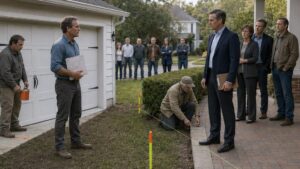
The Pool Trailer Blocked His Driveway, but the Old Easement Hid a Costlier Truth
Chapter 1: The Trailer Waiting in His Headlights
Richard Harris saw the white trailer before he saw his own house.
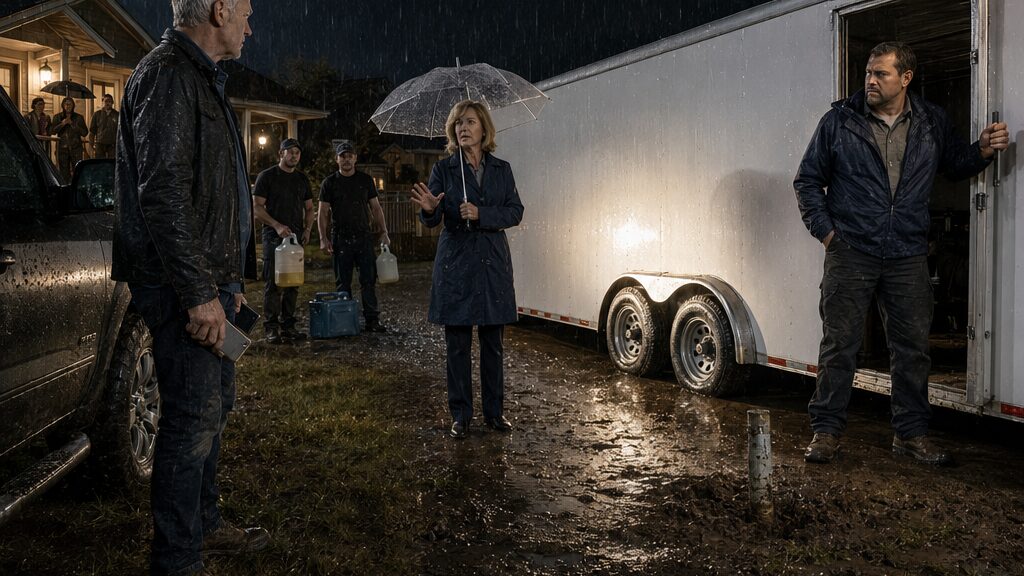
His headlights struck its polished side and threw the blue lettering back at him: CAMPBELL POOL SERVICE. The trailer sat sideways across the narrow gravel lane, its rear axle nearly touching the drainage ditch and its hitch pointed toward Jason Campbell’s property. There was no room to pass.
Richard stopped his pickup twenty yards away and left the engine running.
Rain clicked against the windshield. Beyond the trailer, the driveway continued another hundred yards toward Richard’s porch light. It was the only practical access to his home. On the left, a split-rail fence followed the lane. On the right, the ground dropped into a wet strip of grass that had already begun to shine with standing water.
Two men in dark work shirts were unloading plastic chemical drums beneath the trailer’s open side door. Jason stood beside them, one hand on his hip, speaking loudly enough to be heard over the rain.
Richard lowered his window.
“Jason.”
Jason glanced over, then lifted one finger as if Richard had interrupted a phone call.
“Give me five minutes.”
“You’re across the drive.”
“We’re moving inventory.”
“This is my access.”
Jason looked at the space between the trailer and the ditch. “You can get around.”
Richard followed his gaze. The route Jason meant was not the driveway at all. It was Richard’s lawn, softened by two days of rain.
“No,” Richard said. “I can’t.”
One of the employees paused with a drum balanced against his thigh. Jason waved him on.
“We had a delivery come late,” Jason said. “The garage is full. I’ll have it cleared tomorrow.”
Richard put the truck in park. His hands remained on the wheel.
He had lived at the end of that lane for eleven years. He had patched its potholes, cleared its snow, and paid half the gravel costs under the shared-access agreement. In all that time, Jason had occasionally stopped a truck there for ten minutes, perhaps fifteen. He had never placed a commercial trailer across it.
“Move the truck that’s attached to it,” Richard said. “Pull it onto your side.”
“Can’t. Transmission’s slipping.”
“Then use one of the work trucks.”
“They’re loaded.”
Richard watched another chemical drum disappear into Jason’s garage.
A porch light came on at the house across the lane. Then another. The trailer’s white side made a bright wall in the darkness, and Richard felt suddenly exposed, sitting behind his windshield like a man asking permission to reach his own front door.
A black SUV turned into the shared entrance behind him. Its horn sounded once.
Katherine Moore stepped out carrying a clear umbrella. She wore a navy raincoat over office clothes and moved with the brisk irritation of someone summoned to correct other people’s behavior.
“What happened?” she asked.
“Nothing happened,” Jason said. “Richard’s making this into something.”
Richard opened his door and stepped into the rain.
“The trailer is blocking the easement.”
Katherine looked from the trailer to Richard’s truck. “Jason told the board he might need temporary overflow while he reorganized his business storage.”
“The board doesn’t control this easement.”
“It runs through the subdivision.”
“It runs across two private parcels.”
Katherine’s expression tightened. “We’re trying to support a local business that serves half the neighborhood.”
Richard heard movement behind him. Samuel Rivera had come out beneath the eave of his garage. Two other residents stood near the road, watching without umbrellas.
Jason folded his arms. “Exactly.”
Richard looked at Katherine. “Did the board vote to authorize commercial storage here?”
“We discussed it.”
“That wasn’t my question.”
Her umbrella shifted as the wind pushed rain against it. “The board handled it.”
Richard said nothing for several seconds.
He had learned years ago that people often filled silence with details they had not intended to provide. Katherine did not. She simply stared back, waiting for him to become the unreasonable one.
Richard reached into his truck and took out his phone.
Jason laughed. “What, you calling the sheriff over a trailer?”
Richard walked toward the right edge of the lane. Water soaked the cuffs of his jeans. Near the trailer’s rear wheel, partly buried beneath mud, was a flat metal cap no larger than a silver dollar.
He crouched and wiped it clean with his thumb.
The stamped numbers were faint but readable.
The trailer tire sat less than six inches from it.
Richard photographed the wheel, the marker, and the full width of the blocked lane. Then he opened the notes application on his phone.
“Katherine,” he said, “repeat what you just told me.”
Her face changed slightly. “Excuse me?”
“You said the HOA handled the storage arrangement. I want the exact wording.”
“You don’t need to document every conversation.”
“I do when someone claims authority over a recorded property right.”
Jason stepped toward him. “You’re acting like this is a courtroom.”
Richard rose slowly.
“No HOA vote can expand a county-recorded easement,” he said. “Not by discussion. Not by convenience. Not because your garage is full.”
For the first time, one of Jason’s employees looked uncertain.
Katherine lowered her voice. “Richard, this can be resolved like neighbors.”
“I tried that when I asked him to move it.”
“You ordered me,” Jason said.
“I told you I needed access to my house.”
The black SUV behind Richard sounded its horn again. Katherine turned sharply and motioned for the driver to back out. There was no room for three vehicles and the trailer.
Richard returned to his pickup.
He could have stayed there until Jason moved. He could have called a deputy and forced the matter into an official report. Instead, unwilling to create a larger scene in front of the watching houses, he turned the wheel toward the wet grass.
The front tires left the gravel.
For six feet, the truck moved. Then the right rear tire spun.
Mud rose against the door in a dark fan.
Richard eased off the accelerator, but the truck settled deeper. The engine strained. Beneath the rain, he heard Jason say something to one of the employees, followed by a short laugh.
Richard tried once more. The tire carved a rut nearly to the axle.
Jason approached the driver’s window.
“Want me to pull you out?”
Richard looked at him.
The offer might have been genuine. That made it worse.
“No.”
“Suit yourself.”
Richard shut off the engine and climbed down into ankle-deep mud. He walked the remaining distance to his house without looking back.
Inside, he left his wet boots on the mat and stood in the dark kitchen. Through the window, the trailer remained visible between the trees, bright beneath its work lights. Men moved around it. Doors opened and slammed. The lane had become part of Jason’s business yard.
Richard made coffee he did not drink.
Near midnight, his phone vibrated.
A message from Jason appeared.
Trailer will be gone when I’m done. Stop making everything a legal issue.
Richard read it twice.
Then another message arrived.
If you don’t like it, lawyer up. Trailer stays.
Richard placed the phone face down on the table.
After a moment, he turned toward the hallway leading to his office.
Chapter 2: The Words Buried Inside the Old Deed
The safe door opened with a dry metal click that sounded louder than the rain.
Richard switched on the green banker’s lamp and removed a thick accordion file from the lower shelf. The label on its spine had been written in his father’s block lettering: HARRIS–CAMPBELL ACCESS, 1996.
He carried it to the desk but did not open it immediately.
For years, the file had remained beneath insurance policies, tax receipts, and the deed to the house. Richard had used certified copies when he bought the property, but he had avoided the original folder. His father’s handwriting turned every measurement into something personal.
Outside, a diesel engine started. A moment later, it stopped.
The trailer had not moved.
Richard opened the folder.
The first document was a recorded easement agreement, six pages long, signed by the former owners of both parcels. He found the operative language on page two.
A nonexclusive easement for ingress and egress, twenty feet in width, for the benefit of the dominant parcel.
He read the sentence again, though he knew what it meant.
Ingress and egress. Entry and exit.
Not parking. Not storage. Not loading. Not an outdoor warehouse.
A yellowing survey map followed. A clean black line marked the two-hundred-twenty-foot route from the county road to Richard’s parcel. Beside the line, his father had drawn a small circle and written: set iron cap, station 3+84, autumn 1996.
The same marker Richard had uncovered beside the trailer wheel.
Richard leaned back.
The document settled the narrow question. Jason had no recorded right to leave the trailer there. But certainty did not produce the relief Richard expected. Instead, it sharpened his awareness of what Katherine had said.
The board handled it.
He logged into the HOA portal. Meeting minutes were available by year, though several recent files had vague titles and no searchable text. Richard worked backward through them.
September: landscaping renewal.
August: reserve study.
July: pool-pump replacement.
June: homeowner parking complaints.
He opened June first.
Three recreational vehicles had been discussed. One resident had been ordered to remove a boat from a side yard. Another had received a warning for leaving a contractor’s van in the street overnight.
There was no mention of Jason’s trailer.
Richard searched every set of minutes from the past eighteen months. No motion. No vote. No temporary-use approval. No written exception.
At one-thirty in the morning, he found a board agenda containing a single line under “Old Business.”
Local vendor accommodation.
The minutes for that meeting recorded no discussion at all.
Richard printed the page and placed it beside the easement.
By dawn, the rain had weakened to a mist. He had drafted a letter that filled less than one page.
It identified the recorded document, quoted the ingress-and-egress clause, described the obstruction, and requested removal of the trailer within forty-eight hours. He kept the tone neutral. No threats. No reference to zoning. No demand for damages to the lawn.
He read it once more before signing.
A narrow remedy for a narrow violation.
At eight, he drove his second vehicle, an older sedan kept beneath a carport, down the lawn’s firmer edge. The trailer remained across the gravel. Jason was not outside.
At the post office, Richard sent the letter by certified mail and requested electronic confirmation.
On his way home, he stopped at the HOA office, a converted room beside the community clubhouse. The secretary sat behind a folding desk beneath a bulletin board covered with pool schedules and autumn cleanup notices.
“I need the board resolution approving Jason Campbell’s trailer storage,” Richard said.
She looked at him over her glasses. “You’ll have to submit a records request.”
“I did last night.”
“That quickly?”
“I knew what I was looking for.”
Her smile disappeared. “Katherine handles those requests.”
“Then please make sure she receives it.”
By noon, every homeowner in the subdivision received an email from the HOA.
The subject line read: Clarification Regarding Private Driveway Disagreement.
Richard opened it while standing at his kitchen counter.
The message stated that a temporary accommodation had been granted to a neighborhood service provider during equipment reorganization. It called the matter “a limited private disagreement between adjacent owners” and said the board considered it resolved.
No vote was cited. No date of approval appeared. Richard’s name was not used, but the references were unmistakable.
The final paragraph asked residents to avoid escalating minor disputes through “unnecessary legal or governmental channels.”
Richard printed that email too.
He placed it beside the agenda line marked Local vendor accommodation.
At three-fifteen, his phone showed confirmation that the certified letter had been delivered. Jason had signed for it himself.
Richard waited.
At four, the trailer remained.
At five, its side lights switched on.
At six, one of Jason’s work trucks arrived and parked behind it.
Richard stood at the edge of the muddy rut, holding the deed copy inside a clear plastic sleeve. Jason crossed the lane carrying a toolbox.
“You got the letter,” Richard said.
Jason did not stop. “I got it.”
“The deadline is Thursday.”
“You wasted postage.”
“The document is clear.”
Jason set the toolbox in the back of his truck and slammed the door. “Katherine already told you the HOA approved temporary use.”
“The HOA cannot approve storage on the easement.”
“Then sue me.”
Richard watched him walk away.
For the first time, he wondered whether Jason truly believed Katherine’s approval had legal force or whether he was simply betting that Richard would not spend the money to challenge him.
At seven-thirty, another HOA email arrived, this one sent only to Richard.
Katherine wrote that his records request was unnecessarily broad and might require administrative fees. She repeated that the accommodation had been discussed in good faith and warned that continued disruption of vendor operations could expose him to claims from affected residents.
Richard read the sentence twice.
Vendor operations.
The board was no longer pretending the trailer was incidental. It was acknowledging a business use while refusing to produce the vote that supposedly allowed it.
His confidence in the deed remained intact. His confidence in the simplicity of the dispute did not.
At eight-sixteen, Jason sent a photograph.
The image had been taken from the end of Richard’s driveway. The certified letter lay open on the trailer’s hitch. Behind it, the white trailer still blocked the lane.
Beneath the photograph, Jason had typed four words.
Still here. Your move.
Chapter 3: The Complaint That Reached Beyond One Trailer
The county planning clerk turned her monitor toward Richard and asked, “Why is a commercial fleet operating from a rural-residential parcel?”
Richard had expected a form. He had not expected the word fleet.
On the screen was an aerial photograph of the subdivision. Jason’s house occupied a two-acre lot between Richard’s property and the county road. Behind the garage, partly hidden by trees, stood the white trailer, two service trucks, a utility trailer, and what appeared to be stacked chemical containers beneath a temporary shelter.
Richard leaned closer.
“That image is from spring,” he said.
“The latest county layer,” the clerk replied. “You’re reporting obstruction of an access easement?”
“Yes.”
“That part is civil. We don’t enforce private easement terms.”
“I understand.”
“But the commercial storage is different.”
She opened the parcel record. The zoning designation appeared in a box near the top: RR-2, Rural Residential.
“Does he have a home-occupation permit?” Richard asked.
The clerk searched by parcel number, then by Jason’s business name.
“No active permit.”
“A variance?”
“No.”
“Conditional use?”
She shook her head.
Richard felt the argument widen beneath his feet.
He had come to confirm one point: whether county rules prohibited storage of a large commercial trailer on residential property. He had expected a simple answer that might persuade Jason to move it. Instead, each search produced another blank field.
The clerk printed a complaint packet.
“You can identify only the storage concern,” she said. “Or you can request review of all apparent business activity.”
“What happens if I request the full review?”
“That depends on what compliance finds.”
“Could they require him to stop operating?”
“Yes.”
The word landed more heavily than Richard expected.
“Immediately?”
“Not usually. There are notices, correction periods, appeals. But if chemicals are stored improperly or vehicles exceed what the code allows, different provisions may apply.”
Richard looked at the complaint packet.
The first section concerned outdoor commercial storage. The second asked about employee traffic. The third covered deliveries, dispatch activity, signage, hazardous materials, and customer visits.
He could check only the first box.
That would address the trailer.
Instead, he began checking every condition he had personally observed.
Commercial vehicle storage.
Employee arrivals.
Equipment loading.
Chemical deliveries.
Business signage.
The clerk watched him without comment.
When he finished, she took the packet and scanned the first page.
“You worked for the county?” she asked.
Richard looked up.
“Years ago.”
“I thought I recognized the way you wrote the parcel description.”
“I was in surveying, not planning.”
“Still. Compliance will want to know that.”
Richard said nothing.
The clerk placed the packet in an intake tray. “An officer should contact you within two business days.”
Outside, the parking lot was bright and cold after the storm. Richard sat in his sedan with both hands resting on the steering wheel.
He had told himself the complaint was procedural. Jason had ignored the deed, the request, and the certified notice. Katherine had claimed authority she did not possess. Every checked box was factually defensible.
Yet the clerk’s question remained with him.
Why is a commercial fleet operating from a rural-residential parcel?
That was no longer the same as asking why one trailer blocked his driveway.
The next afternoon, Emily Davis called.
Her voice was clipped but not unfriendly. “Mr. Harris, I’m reviewing your complaint regarding the Campbell parcel.”
“Yes.”
“You included photographs showing the easement marker. Are you asking the county to determine the property boundary?”
“No. The boundary is already recorded. I included the marker to show where the trailer was positioned.”
“And the private obstruction?”
“I understand that part may require civil action.”
“Good. I need to keep the issues separate.”
Richard heard papers moving.
“You reported commercial storage, employee traffic, chemical deliveries, signage, and dispatch activity,” Emily continued. “Are all of those ongoing?”
“Yes.”
“How often?”
“Work trucks leave most weekdays. Deliveries vary. The trailer has been there continuously since Monday night.”
“Any customer traffic?”
“Not that I’ve noticed.”
“Noise?”
“Occasionally before seven.”
“Chemical odors or spills?”
“No spills that I can confirm.”
Emily paused. “You wrote that you were formerly employed by the county.”
“I added it after the clerk mentioned it.”
“I appreciate that. I’ll inspect Thursday morning.”
“That’s the certified-letter deadline.”
“I’m not enforcing your letter.”
“I know.”
Another pause.
“Mr. Harris, a full compliance review can have consequences beyond moving a trailer. I want to be certain that is what you intended to request.”
Richard looked through his kitchen window. The muddy ruts had filled with brown water. Beyond them, the trailer’s roof showed above the hedge.
“I intended to report what is there.”
“That wasn’t my question.”
His grip tightened on the phone.
“What would you prefer I say?”
“I’m not asking for a preferred answer. I’m asking whether your goal is corrected access or review of the entire business use.”
“Can’t it be both?”
“It can. But those are not the same remedy.”
Richard thought of Jason’s photograph. Still here. Your move.
“The entire use should be reviewed,” he said.
Emily gave him the inspection time and ended the call.
By Wednesday evening, the HOA had sent another message. This one did not mention Richard directly, but it announced that Campbell Pool Service might experience delays because of “an external complaint affecting local operations.” Residents were invited to contact the board if they depended on Jason for winterization.
Richard received six emails within an hour.
One resident wrote that Jason had maintained her pool at half the rate charged by Boise companies.
Another accused Richard of trying to bankrupt a family over tire marks.
Samuel Rivera sent only one sentence.
You should have talked to me before going to the county.
Richard almost replied that he had spoken to Jason, Katherine, and the HOA office. Instead, he deleted the draft.
Thursday morning, Emily arrived in a white county vehicle. She photographed the trailer, the business sign, the work trucks, and the chemical storage visible through Jason’s open garage. Jason followed her from place to place, jaw tight, answering questions in short bursts.
Richard watched from his porch.
At one point, Emily crossed the lane and examined the metal marker. She looked toward Richard but did not approach.
An hour later, she drove away.
The trailer remained.
By late afternoon, however, Jason’s two employees began carrying equipment out of the garage. They loaded hoses, pumps, and tool cases into one of the trucks. No one spoke above a murmur.
Jason’s teenage daughter stood beneath the garage awning in a gray sweatshirt, arms folded against the cold. She watched the men secure the load, then looked across the lane toward Richard’s house.
Richard stepped back from the window, though he was not sure whether she had seen him.
A few minutes later, one employee removed the magnetic company sign from the truck door.
The other placed it face down in the bed.
Richard had wanted the trailer moved.
Watching the men dismantle their workday, he understood that he might have set something much larger in motion.
Chapter 4: The Board’s Favor Had a Price
Richard’s complaint was already on the wall when he entered the clubhouse.
A projector threw one of his photographs across the white screen: his pickup angled off the gravel, its rear tire sunk into the lawn. The image had been cropped tightly enough to remove Jason’s trailer. Without it, the deep tracks looked less like the consequence of an obstruction and more like careless damage.
Katherine Moore stood beside the screen with a remote in her hand.
“There he is,” someone near the back said.
Richard closed the door behind him.
Nearly every folding chair was occupied. Residents who rarely attended annual elections had come to discuss a private easement they could not see from their own properties. Samuel Rivera sat at the treasurer’s table with a closed binder in front of him. He did not meet Richard’s eyes.
Katherine clicked to the next slide.
The heading read COMMUNITY IMPACT OF EXTERNAL COMPLAINT.
Below it were photographs of covered swimming pools, a service truck, and Jason’s two employees loading equipment.
“This is not a trial,” Katherine said. “It is a special board meeting to address disruption affecting residents.”
Richard remained standing near the door.
“Then why is my property on the screen?”
“Because your actions began the disruption.”
A murmur moved through the room.
Katherine indicated an empty chair in the front row. Richard chose one near the aisle instead.
An elderly resident raised her hand before the meeting was formally called to order.
“Jason winterizes my pool every year,” she said. “He doesn’t charge me for the second visit if the lines freeze. The company from Boise wanted six hundred dollars.”
Another resident turned toward Richard. “Was the trailer really hurting anything?”
“It blocked the only vehicle access to my house.”
“For one night?”
“Four.”
Jason sat against the side wall in a work jacket, his hands clasped between his knees. His daughter was not with him. Neither were the employees.
Katherine advanced the slide again. The cropped photograph reappeared beside an estimate for lawn repair.
“The board also has a duty to enforce standards consistently,” she said. “Mr. Harris drove across a maintained lawn area and caused visible damage.”
Richard looked at her. “You are proposing to fine me for avoiding the trailer you authorized.”
“We did not authorize an obstruction.”
“You authorized storage.”
“A temporary accommodation.”
“Show me the vote.”
The room quieted.
Katherine lowered the remote. “Board discussions are reflected in the minutes as appropriate.”
“I requested the resolution. There isn’t one.”
“This meeting is not about technical games.”
“No,” Richard said. “It’s about whether the board can create authority after the fact.”
Jason rose from his chair.
“You could’ve called me again.”
“I spoke to you in the driveway.”
“You gave me an order in front of my employees.”
“I asked you to clear the access.”
“You talked to me like I was one of your county files.”
The remark struck closer than Richard expected. A few residents shifted in their chairs.
Jason continued. “I told you the truck pulling the trailer had a bad transmission. I needed time.”
“You also told me the trailer was staying.”
“Because you came at me with paperwork before the mud on your tires was dry.”
Richard opened his mouth, then stopped.
That was not accurate. The certified letter had gone out the following morning. Yet the distinction sounded smaller in the room than it had at his desk.
Katherine stepped between them verbally before either could continue.
“The practical issue is that Jason’s operation may now be suspended. Several residents have prepaid service contracts. Two local workers may lose hours. All because a neighbor declined to resolve a temporary inconvenience informally.”
Richard looked toward Samuel.
“You knew the trailer was there?”
Samuel rubbed one thumb along the edge of his binder. “I knew he needed storage.”
“Did the board vote?”
Samuel did not answer.
Katherine’s voice sharpened. “Samuel.”
He opened the binder.
Inside were invoices, some stamped paid, others marked with handwritten credits. He removed three sheets and placed them on the table.
“The HOA owes Jason money,” he said.
Katherine stood very still.
A resident near the window asked, “How much?”
Samuel looked down. “Just under eleven thousand.”
The room erupted in overlapping questions.
Katherine moved toward the table. “Those invoices were disputed.”
“They weren’t disputed,” Samuel said. “They were delayed.”
“For incomplete work.”
“For work we asked him to do before the reserve transfer cleared.”
Jason stared at the floor.
Richard watched him rather than Katherine. The confidence Jason had shown beside the trailer was gone. His shoulders seemed narrower beneath the work jacket.
Samuel explained in fragments. The community pool’s filtration system had failed in July. Jason had repaired it before the board secured funding. He had also serviced several private pools at discounted rates after Katherine promoted him as the neighborhood’s preferred vendor.
When cash ran short, the board offered accommodations instead of payment: use of a maintenance shed that never became available, permission for limited equipment staging, flexibility regarding commercial vehicles.
“Permission from whom?” Richard asked.
Samuel looked at Katherine.
“We were trying to keep costs down,” she said. “Residents benefited.”
“So you paid him with rights the HOA didn’t own.”
“That is not what happened.”
Jason finally looked up. “It’s close enough.”
Katherine turned on him. “We supported your business.”
“You kept telling me the check was coming.”
“We prevented complaints.”
“You were the complaints.”
The room fell silent again.
Richard saw the arrangement differently now. Jason had not simply persuaded the board to ignore the rules. The board had needed him cheap, available, and quiet. Katherine had offered protection because it cost the HOA nothing.
That did not give Jason the right to block the driveway. It did not excuse the photograph, the taunts, or the refusal to move. But the story was no longer one man using influence to claim another man’s land.
It was a debt disguised as permission.
Katherine recovered first.
“None of this changes Mr. Harris’s decision to involve the county without allowing the board process to work.”
“What process?” Richard asked. “The one that never reached the minutes?”
“The process of neighbors showing restraint.”
Richard felt every face turn toward him.
He could have produced the deed. He had brought a copy in his folder. He could have quoted the clause, identified the parcel, and explained that an easement was not a community favor to be reassigned.
Instead, he heard Emily’s question again.
Is your goal corrected access or review of the entire business use?
He had answered both.
Katherine clicked back to the lawn photograph.
“I move that the board issue a notice of violation for damage to common-view landscaping and assess the standard restoration charge.”
“The lawn is mine,” Richard said.
“It is visible from the shared drive.”
“It was damaged because your vendor blocked the drive.”
“Your choice of route caused the damage.”
Samuel closed his binder with a hard snap.
“No,” he said. “The trailer caused it.”
Katherine stared at him.
Samuel kept his hand on the binder. “And we never voted to let Jason put it there.”
A board member near the front asked for the motion to be withdrawn. Another requested legal review before any fine was issued.
Katherine’s face reddened, but she set the remote down.
The meeting dissolved into smaller arguments. Residents surrounded Samuel with questions about the invoices. Jason slipped through a side door without speaking to Richard.
Richard remained seated until the screen went blank.
As people left, the elderly resident approached him.
“I still think you went too far,” she said.
Richard nodded.
“But they should’ve paid him.”
“Yes.”
She studied him for a moment, perhaps waiting for more. Richard had nothing useful to add.
Outside, headlights swept across the clubhouse parking lot. A white county vehicle stopped beside Jason’s truck.
Emily Davis stepped out carrying a document envelope.
Jason had just reached his driver’s door. She called his name, showed him her identification, and handed him several pages clipped together.
Richard watched from beneath the clubhouse awning.
Jason read the first sheet. His jaw tightened.
Emily pointed toward the trailer visible beyond the trees and then to a line on the notice. Even from a distance, Richard could see the bold heading at the top.
NOTICE OF VIOLATION AND ORDER TO CEASE UNAUTHORIZED OUTDOOR STORAGE.
Jason lowered the pages and looked directly at Richard.
This time there was no smile, no challenge, and no satisfaction in being proved right.
Chapter 5: When the Clear Driveway Became an Emergency
The ambulance stopped where Richard’s headlights had stopped two nights earlier.
Its red lights flashed against the rain, illuminating Jason’s trailer jackknifed across the easement. The trailer’s rear wheel had climbed the gravel edge and struck the old metal marker, tilting it toward the ditch.
A paramedic leaned from the passenger window.
“Can this be moved?”
Jason stood beside the trailer hitch, soaked through, pulling at the latch with both hands.
“The jack slipped,” he shouted. “The tow truck’s coming.”
“Who called the ambulance?” Richard asked.
“My daughter.”
Jason pointed toward his house. Through the open front door, Richard saw a figure lying or sitting low in the entryway and another paramedic running toward her with a bag.
The ambulance driver tried to angle past the trailer. The right front tire reached the grass, spun once, and stopped.
Richard was already moving toward his pickup.
“What happened?”
“She fell,” Jason said. “Couldn’t breathe right after. I don’t know.”
The county notice had required the commercial equipment removed from outdoor storage within forty-eight hours. Jason had waited until the second evening, then attempted to move the trailer in heavy rain with a borrowed truck. The trailer now blocked more of the lane than before.
Richard opened the utility box in his pickup bed and pulled out a length of survey chain.
Jason saw it. “The frame’s hung on the jack. If you pull wrong, it’ll twist.”
“If we wait for the tow truck, the ambulance stays here.”
“I know that.”
Richard hooked one end of the chain through the trailer’s rear frame.
The ambulance driver stepped out. “We need eight feet. Not the whole lane.”
Richard crouched near the tilted marker. The trailer wheel had pressed the metal cap sideways, exposing several inches of rust-darkened shaft.
He measured the available angle by sight.
“Back your truck to the ditch,” he told Jason.
“The transmission barely moves.”
“Then leave it in neutral and steer.”
Jason hesitated.
Richard looked at the open house. “Now.”
They worked without discussing the complaint or the notice. Jason climbed into the borrowed truck attached to the trailer. Richard backed his pickup onto firmer ground and connected the chain to the rear hitch.
“On my signal, release the brake,” Richard called.
Rain ran into his eyes. The ambulance lights pulsed over the old marker, making the stamped date appear and disappear.
Jason lowered the window. “If the tongue drops—”
“I see it.”
Richard eased forward.
The chain tightened.
For an instant, nothing moved. Then the trailer groaned and shifted two inches away from the ditch. The damaged jack scraped over gravel.
“Hold,” Richard called.
He climbed down, moved the chain to a lower point, and returned to the cab.
The ambulance driver stood near the front wheel, signaling the clearance needed.
Richard pulled again.
A hard metallic knock came from beneath his pickup. The steering wheel shuddered in his hands. The trailer swung another foot, but the pickup’s engine rose without matching movement.
Transmission, Richard thought.
He did not stop.
“More,” the driver called.
Jason’s truck rolled backward in neutral. The trailer pivoted on the trapped wheel, opening a narrow wedge between its front corner and the fence.
Richard gave the pickup enough throttle to drag it another three feet.
Something beneath him slipped with a grinding snap.
The ambulance driver raised both arms.
“That’s enough.”
Richard braked.
The ambulance squeezed through with inches to spare. Its side mirror passed the trailer, then the fence post. The vehicle continued toward Jason’s house and stopped near the porch.
The red lights moved away from the marker.
Richard shifted his pickup into reverse.
The engine revved, but the truck did not move.
Jason climbed down from the borrowed truck and approached.
“You broke it?”
Richard tried drive, then reverse. Nothing engaged.
“It was already worn,” he said.
Jason stood in the rain, looking at the pickup Richard had damaged to clear the access Jason had blocked.
Neither man spoke for several seconds.
The tow truck arrived twenty minutes later. By then, paramedics had brought Jason’s daughter outside on a stretcher. She was conscious, an oxygen mask over her face, one hand holding a paramedic’s wrist.
Jason walked beside her until they reached the ambulance. Before the doors closed, she pulled the mask aside.
“Dad, come with me.”
He looked toward the trailer, the borrowed truck, and the county notice taped inside his garage window.
“I’ll follow.”
Richard heard the fear beneath the answer.
“You should go,” he said.
Jason looked at him.
“I’ll wait for the tow driver.”
“That trailer—”
“Will still be here when you get back.”
Jason’s shoulders dropped slightly. He climbed into the ambulance.
The tow-truck driver examined the trailer setup and whistled under his breath.
“Who tried to pull this?”
“Both of us,” Richard said.
The driver pointed to the tilted marker. “Lucky you didn’t shear that off.”
Richard crouched and touched the exposed shaft. It moved under light pressure.
“I’ll reset it later.”
“Survey pin?”
“Easement reference.”
The driver glanced up the lane toward the departing ambulance. “Seems important tonight.”
By midnight, the trailer had been moved onto a flat area beside Jason’s garage. It was still not a lawful storage location, but the drive was clear. Richard’s pickup sat near his house, waiting for its own tow in the morning.
Jason returned shortly after one.
His daughter had suffered a severe allergic reaction, he said. She would remain at the hospital for observation but was stable.
Richard stood beneath his porch roof. Jason remained on the gravel, water dripping from his jacket.
“Thank you,” Jason said.
Richard nodded.
“I’ll pay for the transmission.”
“No.”
“I caused it.”
“You didn’t make me use the truck.”
“I blocked the drive.”
“Yes.”
Jason flinched as though the simple agreement carried more weight than an accusation.
He looked toward the trailer.
“The business loan’s in default,” he said. “Three months.”
Richard said nothing.
Jason continued because the silence left him nowhere to hide.
“The bank owns the trailer and both service trucks. I lost the storage unit in August. Rates went up, and I was already carrying the pool repairs for the HOA.”
“You could have told me.”
“And said what? That I needed to use the drive because Katherine kept promising checks that never came?”
“You could have asked.”
Jason gave a tired laugh. “You would’ve said no.”
“You didn’t give me the chance.”
“No. I didn’t.”
The admission settled between them.
Jason rubbed both hands over his face. “Katherine told me the easement was under HOA authority. She said you’d complain, but the board would make you back down.”
Richard felt the cold more sharply.
“What exactly did she promise?”
“That if I kept doing the community pool at cost and finished the winterizations, she’d protect the home operation until spring. She said the board had leverage over you because of your lawn, your shed setback, whatever they needed.”
“My shed is permitted.”
“I know that now.”
“Did Samuel know?”
“About the money. Not all of it.”
Richard looked down the lane. The trailer no longer blocked it, but the old marker leaned in the mud, struck sideways by the wheel.
Jason followed his gaze.
“I thought it was just an old cap.”
“It marks the recorded line.”
“I know that now too.”
A week earlier, Richard might have heard the words as surrender. Standing there after the ambulance had barely passed, they sounded different.
The boundary had not protected only Richard’s right to reach his house. It had protected the route paramedics needed to reach Jason’s daughter.
Jason stepped back toward his property.
“I’ll tell Emily everything,” he said. “About Katherine. About the agreement.”
“Tell her the truth about the trailer too.”
Jason nodded.
He had taken three steps when Richard stopped him.
“Jason.”
He turned.
“When did Katherine first tell you the board would make me back down?”
Jason’s expression tightened.
“Before I parked the trailer.”
Chapter 6: The Truth Behind the Nineteen-Ninety-Six Line
Emily placed the survey record beneath the archive lamp and tapped Richard’s surname with one finger.
“Harris,” she said. “Was this your father?”
Richard did not answer quickly enough.
The county archive room had no windows. Flat files lined two walls, and the air carried the dry-paper smell of records opened rarely and trusted too much. Emily had asked him to meet there after Jason provided copies of his messages with Katherine.
She turned the document toward him.
The signature at the bottom was unmistakable.
Jonathan Harris, Survey Technician.
“Yes,” Richard said.
“You didn’t mention that.”
“I didn’t think it affected the present violation.”
Emily leaned back. “You didn’t think your father’s role in creating the easement was relevant while you were citing its language from memory?”
“I cited the recorded document.”
“That isn’t an answer.”
Richard looked at the field sheet.
His father’s handwriting ran along the margin in pencil, faded but legible. Richard had seen a copy in the safe, but not this original page.
Access route constrained by drainage and fence. Keep full width unobstructed. No standing vehicles at station 3+84.
The note had never appeared in the final easement agreement.
Emily read it silently.
“Why wasn’t that restriction included?” she asked.
“It was considered unnecessary.”
“By whom?”
“The property owners’ attorney drafted the final language. My father believed ingress and egress was sufficient.”
“And later?”
Richard traced the edge of the paper without touching the writing.
“Later, the owners argued over farm equipment left in the lane. One claimed the easement didn’t expressly prohibit temporary parking. My father blamed himself.”
“How long did that dispute last?”
“Six years.”
Emily closed the folder partway.
“And you bought the dominant parcel afterward.”
“Eleven years ago.”
“To keep the access clear?”
“To live there.”
She waited.
Richard looked at the note again.
His father had been a careful man who checked measurements twice and apologies never. During the old dispute, he had carried the failed wording like a private defect. He drove past the lane whenever county work took him nearby. He complained about the machinery, the lawyers, the owners—everyone except himself.
Near the end of his life, he gave Richard the accordion file.
Should’ve written what I meant, he had said.
Richard had answered that ingress and egress already meant what it meant.
His father had looked at him for a long moment.
Meaning isn’t much protection when nobody accepts it.
Richard had placed the file in the safe and treated the sentence as regret rather than warning.
“I did not file the complaint because of my father,” Richard said.
Emily’s expression remained neutral.
“Not entirely,” he added.
“That sounds closer.”
She removed another set of pages from her case folder.
“These are messages Jason provided.”
The first was from Katherine.
We can treat the lane as association-controlled access for temporary operational needs.
Another followed.
Richard will object. Do not engage with his technical arguments. The board has enforcement options on his property.
A third message referred to the unpaid pool invoices.
Keep the neighborhood accounts current and I will make sure storage is not a problem through winter.
Richard read all three without speaking.
Emily said, “The board did not have authority to make that promise.”
“I know.”
“Jason says he believed it did.”
“He also knew the trailer blocked my access.”
“Yes.”
Emily did not soften the conclusion for either man.
“Katherine created an incentive for him to disregard you. Jason chose to do it. Those facts can coexist.”
Richard handed back the pages.
“What happens to her?”
“That depends on the HOA, its counsel, and whether members pursue a records complaint. My office deals with land use.”
“You found the business violations.”
“We confirmed outdoor commercial storage, dispatch activity, employee reporting, and chemical quantities inconsistent with an unpermitted minor home occupation.”
“Can Jason correct them?”
“He can remove storage and dispatch from the property, submit a limited administrative permit for office use, and demonstrate compliant chemical handling elsewhere.”
“And if he can’t?”
“We issue an order to cease all business activity at the parcel.”
Richard looked toward the archive door.
Emily studied him.
“You understand that the county can proceed without you withdrawing anything.”
“Yes.”
“Your evidence is sound. The complaint was valid.”
“But?”
“But being correct does not answer what correction should look like.”
Before Richard could respond, the archive clerk entered with a copied HOA records packet. Samuel had provided financial ledgers after the emergency. The packet contained invoices, board emails, and internal notes.
They moved to a table in the adjacent records room.
The evidence did not reveal a grand scheme. It showed something more ordinary and, to Richard, more troubling: decisions made one compromise at a time.
Katherine had delayed Jason’s invoices to protect the reserve balance before an election. Samuel had carried them as pending rather than overdue. Jason had continued working because losing the HOA’s referrals would have hurt his business. In return, complaints about work trucks and equipment disappeared from agendas.
One email from Katherine read:
Formal approval creates questions. Informal flexibility keeps everyone satisfied.
Richard read it twice.
Samuel sat across from him, his face drawn.
“I should have stopped it,” he said.
“You should have recorded it.”
“I should have done both.”
“Why didn’t you?”
Samuel looked toward the closed door. “Because the pool stayed open. People liked the rates. Katherine kept saying the next assessment would cover everything.”
“And when it didn’t?”
“We carried it forward.”
“You hid debt.”
Samuel’s eyes hardened. “Yes. And you hid behind a deed until the county was involved.”
Richard almost answered with the clause. The words were ready: ingress and egress, twenty feet in width, recorded in 1996.
Instead, he looked at his father’s field note.
Should’ve written what I meant.
“My father laid out the easement,” Richard said.
Samuel’s anger faded into confusion.
“He knew storage would become a problem. He wrote a warning in the field notes, but it never reached the final agreement.”
“Why didn’t you tell anyone?”
“Because the recorded language was enough.”
Samuel looked at the complaint packet. “Was it?”
The question had no clean answer.
The language had been enough for the county records, for a certified letter, and for a future judge. It had not been enough to keep a trailer out of the lane when one man needed space, another needed cheap labor, and a board president needed everyone to believe she had matters under control.
Richard spent the afternoon helping Emily separate what was proven from what was assumed.
Jason’s storage violations were documented.
The employee traffic was documented.
The HOA’s promise was unauthorized but real.
The unpaid invoices were real.
Richard’s access had been blocked repeatedly.
The emergency had shown the practical danger.
None of those facts erased another.
At the end of the meeting, Emily stacked the files neatly.
“Full enforcement is legally supportable,” she said. “Immediate removal of all commercial activity from the parcel, followed by penalties if the deadline is missed.”
Samuel looked at Richard.
Emily continued. “There may also be a corrective path. Off-site storage and dispatch. Limited office use only. A compliance schedule, proof of a lease, and regular inspection.”
“Who decides?” Richard asked.
“The county decides what it will accept. But the affected complainant’s position matters, especially if access is restored and the primary nuisance is corrected.”
Richard understood what she was offering him and what she was not.
She was not asking him to forgive Jason.
She was not asking him to pretend Katherine’s conduct had been harmless.
She was asking whether he wanted the rules used as a boundary or as a blade.
Emily slid two draft recommendations across the table.
One called for immediate cessation.
The other allowed thirty days for corrective compliance.
“Which outcome are you asking us to pursue?” she said.
Richard looked down at his father’s note beside the two documents.
For the first time since the trailer appeared in his headlights, proving what the line meant was no longer the hardest decision before him.
Chapter 7: A Boundary That Protected Both Houses
Richard’s name was called before he had decided which document to carry to the witness table.
The hearing officer waited beneath the county seal. Emily sat at a side table with two folders open before her: immediate cessation in the red folder, corrective compliance in the blue one.
Richard left both draft recommendations in his seat.
He walked forward carrying only the recorded easement and his father’s field note.
Jason sat behind him with his daughter and his two employees. He wore a clean work shirt without the company logo. Katherine occupied the opposite row beside the HOA secretary. Samuel sat alone between the two groups, a binder balanced on his knees.
The hearing officer asked Richard to state his relationship to the affected properties.
“I own the parcel at the end of the shared access,” Richard said. “The easement crosses Mr. Campbell’s property and serves mine.”
“Was your access obstructed?”
“Yes.”
“How many times?”
“The commercial trailer remained across the lane for four days. It blocked the lane again while it was being moved under the county notice.”
“And that second obstruction delayed an ambulance?”
“It prevented the ambulance from reaching the house until we shifted the trailer.”
A pen stopped moving somewhere behind him.
The officer examined the photographs: the white trailer in Richard’s headlights, the tire beside the faded marker, the pickup sunk in mud, and the ambulance lights reflected across the tilted metal cap.
“Do you dispute any of the county’s findings?” she asked.
“No.”
“Do you believe the violations should be enforced?”
“Yes.”
Jason’s chair creaked.
Richard looked toward Emily. She gave no signal.
The officer folded her hands. “Mr. Harris, the county has two proposed enforcement paths. One requires all business activity to cease at the Campbell parcel immediately. The other permits a thirty-day correction period under strict conditions. Which do you support?”
Richard placed the easement on the table.
“For eleven years, I never had to explain why I needed access to my own house,” he said. “When the trailer appeared, I asked for the lane to be cleared. Mr. Campbell refused. The HOA claimed authority it did not have. I sent written notice. It was ignored.”
Katherine shifted in her seat.
Richard continued.
“The complaint was valid. The storage was unauthorized. The employee reporting, chemical storage, and dispatch activity exceeded what the parcel permits. I am not withdrawing any of that.”
Jason looked down.
Richard laid his father’s field note beside the recorded document.
“But the violation that affected me can be corrected without closing a lawful business everywhere. I support the thirty-day plan, provided the trailer, chemicals, employee reporting, loading, and dispatch all move to an approved commercial location. The house may be used only for office work allowed under a limited permit. The access must remain fully open at all times.”
The hearing officer studied him. “Why should the county allow additional time after the earlier notice was ignored?”
“Because the second notice was not ignored. The trailer was being moved when it jackknifed.”
“It was moved late.”
“Yes.”
“And only after enforcement began.”
“Yes.”
Richard did not soften the facts.
“Then why recommend leniency?”
“I’m not.”
He heard a faint movement in the room.
“I’m recommending correction,” Richard said. “The county’s purpose is compliance. My purpose was access. Both can be achieved without pretending the violations did not happen and without punishing people who did not place the trailer there.”
One of Jason’s employees lifted his head.
The officer turned to Jason. “Do you accept the proposed conditions?”
Jason came forward carrying a thin folder. He placed a preliminary lease agreement on the table.
It was for a fenced commercial yard six miles away, large enough for the trailer, service trucks, and chemical storage. The monthly rate had been reduced for the first three months. Samuel had arranged for the HOA to pay two overdue invoices immediately, though the remaining debt would require a formal schedule.
“I accept them,” Jason said.
“Have you reviewed the restrictions?”
“Yes.”
“No employee reporting at your residence?”
“Yes.”
“No loading, dispatch, or outdoor commercial storage?”
“Yes.”
“Do you understand that another obstruction of the access may result in immediate enforcement?”
Jason glanced at Richard.
“I understand.”
The hearing officer asked whether he wished to respond to the complaint.
Jason rested both hands on the table.
“I told Mr. Harris the HOA had approved the trailer. That was what I’d been told, but I also knew the trailer was blocking him. I used the board’s promise as an excuse not to deal with him.”
Katherine stared straight ahead.
Jason continued. “I was behind on payments. I thought if the trailer left my property, the lender would find out I’d lost storage. I thought I could buy time.”
“Did Mr. Harris cause your business difficulty?”
“No.”
The answer came without hesitation.
“My business was already in trouble. His complaint exposed it. That isn’t the same thing.”
Richard had not expected the distinction to be spoken aloud.
Jason returned to his seat without asking Richard to acknowledge him.
The county approved the corrective plan with inspections at ten and thirty days. Failure to produce the final commercial lease, remove all prohibited activity, or maintain clear access would activate the cessation order without another hearing.
No fine was announced beyond administrative inspection costs.
No one applauded.
Outside the hearing room, Katherine stood beside the elevators while residents passed without speaking to her. She handed the HOA secretary a single sheet.
Samuel read it after she walked away.
“Resignation,” he said.
“Effective when?” Richard asked.
“Immediately.”
“Any explanation?”
Samuel looked at the page. “She says the board has lost confidence in her ability to serve.”
“That’s all?”
“That’s all.”
Katherine reached the elevator, then turned toward Richard.
For a moment, he thought she might apologize.
Instead, she said, “This community will pay more for every service now.”
Richard folded his father’s field note and returned it to the folder.
“Then the community should vote on what it is willing to pay.”
The elevator doors closed between them.
Katherine’s resignation did not repair the HOA’s records. It did not pay Jason in full or explain why Samuel had carried the unpaid invoices. Over the next weeks, the board hired an outside bookkeeper and adopted a written policy requiring recorded votes for vendor agreements and commercial-vehicle exceptions.
Richard attended one meeting. When the board began discussing penalties for unauthorized parking, he suggested they first distinguish brief loading from storage and emergency obstruction from ordinary inconvenience.
Samuel looked at him across the table.
“That sounds less simple than the old rule.”
“It is.”
The ten-day county inspection occurred at Jason’s property on a clear morning.
The white trailer was gone. The chemical drums were gone. One personal pickup sat beside the garage, and no employees arrived during the inspection window.
Emily walked the driveway with Richard and Jason.
When they reached the old marker, she stopped.
The trailer wheel had bent it too far to straighten safely. Richard had obtained a replacement cap and the original county coordinates, but he had refused to reset it alone.
Emily checked the survey equipment while Richard held the rod. Jason stood with a shovel, waiting where he was told.
“Two inches east,” Emily said.
Jason moved the shovel.
“Too far. Back one.”
He corrected it.
Richard watched the measurements settle on the display. The process was familiar enough to tighten his chest: numbers becoming a line, a line becoming a shared fact, a shared fact becoming something people might still choose to ignore.
Emily marked the point.
Jason dug carefully until the disturbed soil reached the correct depth. Richard placed the new iron shaft into the hole.
The cap carried the present year rather than 1996.
Jason held it steady while Richard checked the vertical alignment.
“That right?” Jason asked.
Richard adjusted it by less than half an inch.
“Now it is.”
They packed gravel and soil around the shaft. When they finished, the cap sat level with the ground at the exact edge of the easement.
Jason wiped dirt from his hands.
“I thought the old one was just a piece of metal.”
“My father probably thought the wording around it would be enough.”
Jason looked toward Richard. “Was it?”
Richard considered the open lane behind them.
“Not by itself.”
Emily photographed the reset marker and entered the coordinates into her inspection report. Before leaving, she looked toward Richard’s pickup, which had returned from the transmission shop two days earlier.
“Runs?”
“More expensively than before.”
Jason spoke before Richard could stop him. “I’m paying half.”
Richard turned to him.
Jason shrugged. “You said no when my daughter was in the ambulance. I didn’t agree.”
“You don’t have the money.”
“I have some.”
“Pay your employees.”
“I am.”
The answer carried enough firmness that Richard let the matter rest.
At the thirty-day inspection, Emily visited the new commercial yard. Jason’s trailer stood inside a fenced lot between a landscaping company and an electrical contractor. The service trucks were parked in marked spaces. Chemical containers sat within a covered containment area.
A small office trailer served as the morning dispatch point.
Jason’s two employees were working again.
The HOA had paid part of its debt, and Samuel had arranged a written repayment schedule for the balance. Jason’s limited home-office permit remained under review, but the county allowed him to handle billing and calls from his residence as long as no operational activity returned there.
The business survived smaller than before.
Richard’s driveway remained open.
One evening, he drove home as the sun dropped behind the fields. His headlights reached the full length of the gravel lane without striking a white wall.
Near the marker, he slowed.
Jason was repairing the fence where the ambulance had squeezed past. His daughter sat on the porch steps doing schoolwork, a blanket around her shoulders.
Jason raised one hand.
Richard stopped the pickup but did not get out.
“The yard lease is final,” Jason said. “One year.”
Richard nodded. “Emily told me.”
“I also sent the correction to the HOA list.”
Richard had seen it. Jason had written that the board never possessed authority to approve storage on the easement and that his earlier claim had been wrong.
It was not an apology. It was better suited to the harm.
“The fence looks straight,” Richard said.
Jason glanced along it. “Close.”
“Top rail drops an inch near the marker.”
Jason stared at him, then laughed once.
“I’ll fix it tomorrow.”
Richard put the truck in gear.
“Richard.”
He waited.
“Your father’s note,” Jason said. “The one about keeping the lane open. You going to record that somehow?”
“The new access agreement is being drafted.”
“With the storage restriction written out?”
“Yes.”
Jason nodded. “Good.”
Richard continued toward his house.
In the rearview mirror, the new marker caught the fading light for an instant. It no longer looked like evidence waiting to be used against someone. It marked the place where one property right ended and a shared obligation began.
At his porch, Richard looked back down the two-hundred-twenty-foot lane.
No trailer blocked it. No crowd waited beside it. No victory sign announced what had changed.
There was only an open road between two houses, kept clear because both men now understood what it was for.
The story has ended.