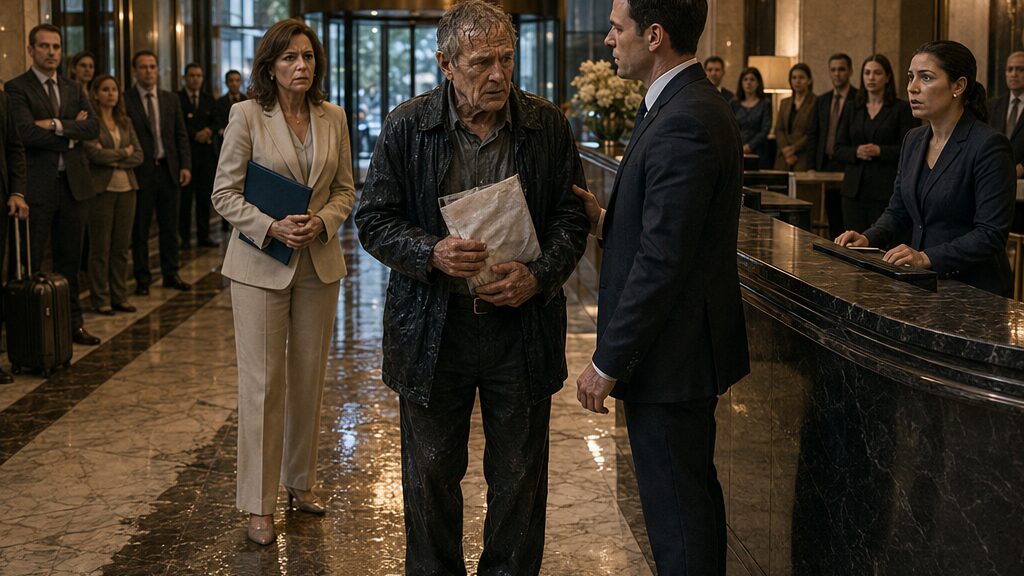
He Kept The Hotel Running Through The Storm. They Fired Him One Day Before His Pension.
Chapter 1: The Letter Was Dated One Day Early
Ryan Wright’s hand closed around James Lewis’s arm before the lobby doors had finished swinging shut.
James still had water dripping from the hem of his coat. It ran down the marble in thin dark marks, leaving a trail from the service corridor to the front desk, past the brass luggage carts and the arrangement of white lilies that always looked too perfect to be real. His right shoe made a faint squelching sound with every step. In his left hand, he held the termination letter so tightly the paper had creased across the date.
“James,” Ryan said, quiet enough to sound professional and firm enough for everyone to hear, “you need to come with me.”
“I’m not refusing to leave,” James said.
“You refused to sign.”
James looked at the front desk. Amy Green stood behind it with her hands on the keyboard, though she was not typing. Two guests in tailored coats had stopped near the elevators. A bell cart waited beside them with silver handles polished bright enough to catch the chandelier light.
“I asked a question,” James said.
Ryan’s fingers tightened through the wet sleeve. “You were given the explanation.”
The explanation sat in James’s hand.
Position eliminated due to operational restructuring.
Effective date: June 13.
James had read it three times in the small HR room upstairs while Anna Taylor sat across from him in her cream suit and folded her hands over a blue folder. Ryan had stood by the door as if James might run. The storm had only just passed. The lower mechanical room had flooded before dawn. James had been down there since three-thirty with a pump that coughed twice before taking hold and a drain valve that had to be loosened by hand.
At six-forty, the hot water came back.
At seven-ten, Ryan told him to report to HR.
At seven-twenty-two, James saw June 13 printed beneath the hotel letterhead.
At seven-twenty-five, he remembered June 14.
He had not shouted then. He had only reached into the inside pocket of his coat, the pocket where the rain had not reached, and pulled out the folded benefits summary he had been carrying for three weeks because he did not trust himself to understand it unless he kept reading it.
Retirement Bridge Eligibility: June 14.
Anna had seen it before Ryan did. Her eyes had moved to the date, away, and back again.
Now she followed them into the lobby, the blue folder pressed against her ribs.
“James,” she said, softer than Ryan but not kinder, “this is not the appropriate setting.”
James stopped walking.
Ryan moved half a step ahead of him, then had to stop too. The lobby seemed to go still in pieces: first Amy’s hands, then the bell cart, then the two guests, then the security guard near the glass doors.
James looked down at Ryan’s hand on his arm.
“I worked here twenty-five years,” he said.
“That’s not in dispute,” Ryan replied.
James nodded once. Water dripped from his gray hair onto his cheek. He did not wipe it away. “Then let go of my arm.”
For a moment, Ryan’s face changed. Not guilt. Not anger. Calculation. James had seen that look on boiler gauges when pressure wanted somewhere to go and had not yet found the weakest seam.
Ryan released him.
James moved to the marble counter at the front desk. Amy took one step back, as if she had been trained to make room for a guest and had forgotten James was no longer supposed to count as one. James set the termination letter flat on the counter. His hand shook once, not from fear, but from the cold that had sunk into his joints downstairs.
Then he unfolded the benefits summary and laid it beside the letter.
Two pieces of paper. Two dates.
June 13.
June 14.
He smoothed the wet corner of the termination letter with two fingers. The ink had not run. The company had printed it too cleanly for that.
“My pension bridge starts on the fourteenth,” he said.
Ryan’s jaw tightened. “This decision was based on business needs.”
James tapped the letter. “This is the thirteenth.”
“James,” Anna warned.
He tapped the benefits page. “This is the fourteenth.”
A guest near the elevators leaned forward, just slightly. One of the night maintenance workers, still in a damp uniform shirt, appeared at the edge of the service hall and stopped dead. Behind the desk, Amy stared at the papers as though the dates had turned into something alive.
“I’m asking why today,” James said.
Ryan’s voice stayed smooth. “Your position was eliminated.”
“Why today?”
“We don’t make these decisions casually.”
“I didn’t ask if it was casual.”
Anna moved closer, but she did not touch the documents. “Benefit eligibility questions can be directed to corporate benefits.”
James looked at her. “You were in the room when I asked.”
“And I answered.”
“No,” James said. “You told me where to ask. That is not answering.”
Ryan gave a short breath through his nose. “This is exactly the behavior we discussed. Refusal to follow direction. Creating disruption in a guest-facing area.”
The word disruption passed through the lobby like a small cold draft.
James heard it. He also heard what it was meant to become later. A note. A phrase in a file. A reason that could sit where the truth ought to be.
He looked at Amy then, not to ask her for help, only because she had seen him every morning for thirteen years at that desk. She knew which pipe knocked in winter. She knew he kept peppermint candies in the third drawer of the maintenance office for children who cried during delayed check-ins. She knew he had been below the lobby before dawn so the guests upstairs could take hot showers and never know anything had almost failed.
Amy looked down.
Something in James’s chest moved, but it did not break.
Ryan stepped beside him, close enough to block part of the counter from the guests. “You need to collect your personal belongings and leave the property. Any benefits questions can be handled after separation.”
“After separation,” James repeated.
“Yes.”
“After the thirteenth.”
Ryan did not answer.
The security guard shifted near the door. James saw it without turning his head. The lobby had changed shape around him. He was no longer the engineer who knew the building by sound. He was a scene to be managed.
James picked up the termination letter, then the benefits summary. He held them together, edges aligned, like he was checking whether one had been cut to hide the other.
“When was the decision made?” he asked.
Ryan’s expression hardened. “We’re done here.”
“When was it made?”
“James, you are becoming insubordinate.”
A flush rose up James’s neck, hot against the cold rainwater in his collar. He wanted to say that insubordinate was what people called you when the answer was worse than the question. He wanted to say he had opened the hotel roof access during an ice storm while Ryan was still learning the difference between a service elevator and a freight elevator. He wanted, for one ugly second, to drop the wet coat on the polished floor and let them smell the water he had pulled out of their building.
Instead, he folded the benefits page carefully.
“Then put that in writing too,” he said.
Anna’s eyes sharpened.
Ryan turned toward the security guard. “Escort Mr. Lewis to the service entrance.”
The sound of his last name moved through the lobby strangely. Mr. Lewis. Not James from engineering. Not the man they called when the boiler clicked or the revolving door stalled. Not the person who had a key to rooms most managers had never seen.
The security guard approached slowly, uncomfortable in a way Ryan was not. James did not make him touch him. He stepped back from the counter and put the two documents inside his coat.
As he turned, he caught sight of himself in the dark glass by the doors: gray hair plastered to his forehead, coat hanging heavy, old shoes leaving water on a floor someone else would mop. Behind him, under the chandelier, Ryan stood clean and dry.
Anna bent to gather the blue folder from where she had set it down. Then she reached for the damp corner of the benefits summary James had not noticed he had left on the counter, a copied page, half folded beneath the termination letter’s envelope.
James put his hand over it first.
For the first time that morning, Anna looked frightened.
He let her take it, but only after he saw her eyes flick once more to June 14.
She slid the page into her folder and lowered her voice until only James could hear.
“You were already told not to discuss benefit dates in the lobby.”
Chapter 2: The Reviews That Changed After Twenty-Five Years
The papers James needed most had stuck together.
He stood at his kitchen table in his undershirt, the wet coat hanging over a chair with a towel beneath it, and tried to separate five years of work from a brown folder that had absorbed rainwater through one torn corner. The folder had been in his coat when Ryan walked him through the lobby. James had thought the inside pocket was dry. He had thought many things that morning because thinking them had been easier than checking.
The first page came loose with a sound like skin peeling.
“Damn,” he whispered.
The ink on an old benefits notice had blurred around the edges, but not enough to hide the words. The numbers were still there. The dates were still there. June 14 sat in the middle of the page like a nail head.
He set it beside the termination letter and pressed two coffee mugs on the corners to keep both pages flat.
His apartment was small and too quiet for daytime. The refrigerator hummed. A ceiling stain above the window had grown since winter. On the shelf near the phone sat a framed photograph turned slightly away from the room: James and his wife at a hotel holiday party eleven years ago, both of them dressed better than they felt. She had held his elbow in that picture, smiling as if she knew he would rather be fixing the banquet room thermostat than standing under a fake garland.
Keep your papers in order, she used to say.
James had laughed at that. He could rebuild a pump blindfolded, trace a short through six floors of conduit, hear a failing bearing before a warning light ever came on. Paperwork was for people upstairs. Paperwork was what they printed after men like him made sure the lights stayed on.
Now the paper was what had teeth.
He opened the metal file box from the closet. Pay stubs. Old insurance forms. A warranty for a water heater he no longer owned. Retirement brochures he had brought home, skimmed, and put away because the language made him feel foolish. He found performance reviews under a manual for a window unit.
The first one was from three years ago.
Overall Rating: Exceeds Expectations.
James stared at it longer than he needed to. Ryan had not signed that one. The old general manager had. There was a note in the comments box: James remains essential to overnight operations and guest safety.
He placed it on the table.
The next review, two years ago, said the same.
Exceeds Expectations.
Reliable under pressure. Strong institutional knowledge.
The next, from last year, had Ryan’s signature at the bottom. James remembered Ryan wearing a new suit that day, sitting behind a desk still too empty to look used.
Meets and often exceeds expectations.
James had not liked the downgrade from “exceeds” to “meets and often exceeds,” but Ryan had smiled and said everyone’s language was being standardized across departments. James had signed because the raise was small either way and because he did not want to seem difficult when retirement was close enough to count in months.
He put that review beside the others.
Then he found the coaching memo.
It had been folded once, then twice, then shoved behind an envelope from the benefits office. He remembered the moment before he remembered the words. Ryan catching him outside the service elevator. Anna standing nearby with a tablet. James tired from a double shift. The phrase “just acknowledgment of conversation.” The pen in his hand.
He opened it.
Employee displayed resistance to updated communication protocols and failed to demonstrate alignment with operational leadership expectations.
There was no mention of boilers. No mention of flood valves. No mention of rooms without heat or guests trapped in elevators or the night James spent on the roof resetting damp sensors while sleet hit his face sideways.
At the bottom was the date.
April 15.
Sixty days before June 14.
James sat down.
The chair made a sharp sound on the floor. He looked at the three good reviews, then at the memo. It was not a bad review. Not exactly. It was a small thing shaped like a larger thing. A hook left in the wall so someone could hang a reason there later.
He tried to remember why he had signed.
Because Ryan had said it was nothing.
Because Anna had said it would not affect his standing.
Because James had wanted to get back downstairs to a leaking condensate line.
Because he trusted the building more than he trusted language, and he had spent too long believing the building was the job.
The phone rang.
He let it ring twice before picking up.
“Mr. Lewis?” a voice asked. Not Ryan. Not Anna. A corporate benefits representative, brisk and distant. “I’m calling regarding your inquiry from this morning.”
“I didn’t make an inquiry.”
“There was a note that you had questions about separation impact on retirement bridge eligibility.”
James looked at the termination letter. “Who put in the note?”
“I don’t have that information.”
“When was it put in?”
A pause. Keyboard clicks. “Today at eight-oh-six.”
That was before Ryan took him through the lobby.
“What does it say?” James asked.
“I’m not able to read internal notes verbatim.”
“Does it say I asked about June fourteenth?”
Another pause, shorter. “It says eligibility concerns were raised.”
James closed his eyes.
Eligibility concerns were raised. Not James asked why he was fired one day before the pension bridge. Not HR knew the date. Not Ryan refused to answer.
“Can you email me my retirement bridge documents?” he asked.
“After separation, requests go through the employee records portal.”
“My separation was today.”
“Yes.”
“I don’t have access to the employee portal anymore.”
“That may take twenty-four to forty-eight hours to update.”
“So I can’t get my documents until after the system removes me?”
The representative said nothing for a moment. “You may submit a written request.”
James wrote that down on the back of an envelope, pressing hard enough to tear the paper.
By midafternoon, he put on a dry shirt, folded the termination letter and benefits summary into a plastic grocery bag, and took the bus back toward the hotel. He told himself he only needed his maintenance locker. Inside were his old notebooks: dates of repairs, shift swaps, call-ins, the kind of details that never made it into official reports unless something went wrong.
The service entrance smelled of wet concrete and kitchen exhaust. A security guard stood behind the small metal desk. He had known James for years, had once asked him to fix a space heater for his mother’s apartment.
The guard looked at the screen, then away. “I can’t let you in.”
“My tools are inside.”
“I was told property access ended this morning.”
“My personal things are in my locker.”
“They said someone will box them.”
“Who said?”
The guard did not answer.
James held the plastic bag tighter. “I’m not going upstairs. I’m not going near guests. I need my notebooks.”
“I’m sorry.”
The apology was real, which made it worse.
James stepped back into the alley. A delivery truck hissed at the curb. Above him, the hotel rose clean and bright, every window reflecting a sky already clearing after the storm. He had spent half his life keeping that brightness from flickering.
His phone buzzed before he reached the corner.
The screen showed Amy Green.
For a moment he almost did not answer. She had looked down in the lobby. He had seen it. He had felt it.
Then he remembered the way Anna’s eyes had moved to June 14.
He answered.
Amy’s voice was low, rushed. “James, I can’t talk long.”
He stood beside a stack of empty linen carts. “Then talk short.”
“I’m sorry about this morning.”
He did not help her by saying it was all right.
She swallowed audibly. “Ryan ordered your maintenance logs boxed before you left the building.”
James looked back at the service door.
“When?” he asked.
Amy lowered her voice further.
“Before HR called you upstairs.”
Chapter 3: The Manager Called It Performance
James entered Ryan Wright’s office carrying the termination letter, the benefits summary, three performance reviews, and the coaching memo in a folder that would not close.
The receptionist outside administration had told him Ryan was unavailable. James had said he would wait. After twenty minutes, Anna Taylor came out of the conference room, saw the folder under his arm, and stopped as if she had stepped onto a wet floor.
“James,” she said, “you should have scheduled this.”
“I did,” he said.
Ryan’s office door opened behind her. “It’s fine, Anna.”
Ryan wore a navy suit today instead of black. His tie was straight. His desk was clear except for a laptop, a phone, and one thin stack of papers turned facedown. The office looked like a room designed for decisions that left no fingerprints.
James sat only after Ryan gestured to the chair.
Anna remained standing near the wall.
“I’m going to say this once,” Ryan began. “Yesterday was unfortunate. We understand transitions can be emotional, but your behavior in the lobby created a serious concern.”
James opened his folder.
Ryan stopped.
James placed the termination letter on the desk first. Then the benefits summary beside it.
June 13.
June 14.
“I’m asking about the date,” James said.
Ryan leaned back. “And I’m telling you the decision was based on business needs.”
James placed the first performance review beneath the termination letter.
Exceeds Expectations.
Then the second.
Exceeds Expectations.
Then the third.
Meets and often exceeds expectations.
Ryan looked at them without touching them.
“You said performance was part of the decision,” James said.
“It was one factor among several.”
“My last three reviews were good.”
“Performance includes adaptability, communication, alignment with current leadership—”
James placed the coaching memo beside the reviews.
Ryan’s mouth closed.
“This appeared sixty days before my pension bridge,” James said. “After twenty-five years.”
Anna shifted near the wall. Her bracelet clicked once against her folder.
Ryan looked at her, then back at James. “That memo reflected a documented conversation.”
“You told me it was nothing.”
“I told you it was a coaching note.”
“Anna told me it wouldn’t affect my standing.”
Anna’s lips parted, then closed.
James kept his voice even. He had practiced on the bus. Not too loud. No anger for them to write down. No shaking finger. Only dates.
“You said the decision was made before the storm,” he said.
“It was.”
“When?”
Ryan folded his hands. “Personnel decisions are confidential.”
“It was my personnel.”
“The process began prior to yesterday.”
“Before April fifteenth?”
Ryan’s face changed almost imperceptibly.
There it was again, that little pressure movement behind the eyes.
James pointed to the coaching memo. “Before this?”
Anna said, “James, these processes often involve multiple stages.”
“I’m asking when.”
Ryan exhaled. “You’re trying to connect unrelated items.”
“No. I’m putting them in order.”
The room went quiet.
Outside the glass panel beside Ryan’s door, someone from accounting passed and glanced in. James saw the glance, saw Ryan see it too. The office had no chandeliers, but it had the same polished feeling as the lobby. Every surface clean. Every word meant to leave no stain.
Ryan lowered his voice. “The hotel has changed. You know that. Occupancy is not what it was. Labor costs are being reviewed across departments. Long-term employees are not exempt from performance expectations.”
James took that in. Long-term employees. Labor costs.
“Retirement costs?” he asked.
Ryan’s eyes flicked to Anna.
Anna looked down.
It was small. Too small for a court, maybe. Too small for anything official. But James had spent his life listening for small changes before pipes burst.
He turned to her. “Did corporate ask for retirement-cost projections?”
Anna straightened. “Corporate reviews many categories of workforce planning.”
“That’s not no.”
Ryan’s palm came down flat on the desk, not hard enough to slam, just hard enough to end a conversation in the way managers learned to end them. “James. You are not employed here anymore. We are not going to debate confidential business operations.”
“I want my personnel file.”
“You can request it through the proper channel.”
“I want my maintenance logs.”
“Hotel property.”
“My notebooks were in that locker.”
“If they contain hotel operations information, they remain subject to review.”
James stared at him. “I wrote those notes so the night crew wouldn’t get hurt.”
“And we appreciate your years of service.”
The phrase landed worse than an insult.
James gathered the reviews into a neat stack, then stopped before putting them away. “You appreciate them enough to count them, not enough to pay what they earned.”
Ryan’s eyes hardened. “Be careful.”
James nodded slowly. “That sounds like advice.”
“It is.”
“Then here’s mine. Don’t call it performance if you can’t show performance.”
Anna looked at him then. Really looked. Not as an HR representative reading risk in a room. As a person who had just heard a sentence she could not soften.
Ryan opened the drawer on his right and removed an envelope. He placed it on the desk between them, just above the two dates.
“We were prepared to offer a separation payment,” he said. “It is not required. It is being offered in recognition of your tenure and to allow both parties to move forward.”
James did not touch it.
“How much?”
Ryan named a number.
It was enough to pay two months’ rent and some bills. It was not enough to replace the pension bridge. It was not enough to cover the retiree health gap. It was not enough to buy back the way Amy had looked down in the lobby.
“What do I sign?” James asked.
Ryan slid the envelope closer. “Standard release. Confidentiality. Non-disparagement. Waiver of claims.”
“There it is,” James said.
Anna said his name softly. “You don’t have to decide this second.”
Ryan looked annoyed. “The offer expires at five p.m.”
James looked at the clock on the wall. 9:18 a.m. They had given him less than a workday to trade the date for silence.
He picked up the envelope, opened it, and read the first page. The language was dense, but not dense enough to hide its purpose. He saw release. He saw waive. He saw known or unknown claims. He saw no admission of wrongdoing.
He placed the release on top of the termination letter.
June 13 disappeared beneath it.
That was the trick, he thought. Put enough paper on top of the date and maybe even he would stop seeing it.
“I’m requesting my full employment records,” James said. “Performance file, benefits communications, termination decision timeline, and any documents related to my benefit class.”
Ryan stared. “Your what?”
Anna made a small sound.
James turned toward her.
She had gone still. Not cold. Not composed. Still, the way someone becomes still after stepping too close to saying the wrong thing.
“My benefit class?” James repeated.
Anna’s face tightened.
Ryan said, “That is not a formal term you need to concern yourself with.”
James looked from Ryan to Anna. “But it is a term.”
Ryan stood. “This meeting is over.”
James did not stand with him. “Who else was in it?”
“Enough.”
“Who else was in my benefit class?”
Anna pressed the blue folder to her chest with both hands. Her voice came out quieter than before, and for the first time it did not sound prepared.
“Your benefit class was reviewed with the others.”
Chapter 4: Ruth Had The Same Dates
Ruth Brown would not sit down until James promised he had not come to ask her to save him.
She stood beside the diner booth with her purse hooked over one forearm, her coat still buttoned, her eyes on the front window instead of his face. The lunch crowd clattered around them—forks on plates, a bus tray rattling near the kitchen, someone laughing too loudly at the counter—but Ruth looked as if she were listening for a door to close behind her.
“I’m not going back there,” she said.
“I didn’t ask you to.”
“You called about the Wilson Grand.”
“I called about dates.”
That made her look at him.
James slid the benefits summary halfway out of his folder, just enough for her to see the highlighted line. He had highlighted it himself that morning with a marker so old it left the paper pale yellow instead of bright. June 14 looked sickly under it.
Ruth’s mouth tightened.
“Sit down,” he said. “Or don’t. But tell me if I’m wrong.”
She sat.
She had been the housekeeping supervisor on the eighth through twelfth floors for seventeen years. James remembered her with a radio clipped to her waistband and a pencil tucked into the twist of hair at the back of her head, able to find a missing linen cart faster than most managers could find their own offices. Now her hands stayed folded around her purse, the knuckles raised and pale.
James laid the termination letter beside the benefits page.
Ruth did not touch either one.
“They did it on the thirteenth,” James said. “Bridge started on the fourteenth.”
Her eyes moved between the pages. “One day.”
“One day.”
“And what reason did they give you?”
“Business needs. Position eliminated. Then performance.”
At that, Ruth looked toward the kitchen window and gave a short laugh without humor. “They like that one.”
James waited. He had come prepared to ask questions. Instead, seeing her face, he understood that asking too fast would be another kind of taking.
The waitress came with coffee. Ruth waved it away. James accepted his and did not drink. He took out a blank sheet from the folder, then hesitated. The page looked too clean for what he was about to put on it.
“I need to know what happened to you,” he said. “Only what you want to tell me.”
Ruth’s gaze fell to the blank sheet. “You’re writing it down?”
“I have to.”
“For who?”
“I don’t know yet.”
She looked at him then, not angry, exactly, but tired of people who brought her uncertainty and called it hope. “Then I’ll tell you what I wish somebody had told me. If they put a paper in front of you and money behind it, they already know you’re scared.”
James looked down at the termination letter.
“They offered me money,” he said. “If I signed by five.”
“You didn’t sign?”
“No.”
Ruth’s fingers tightened around the clasp of her purse. “Good.”
It was the first word from her that sounded like she had chosen his side.
She unbuttoned her coat but did not take it off. “They called me in on a Tuesday. Said the hotel was moving to a new housekeeping model. Outsourcing overflow, cross-training supervisors, all those nice clean words. I had two weeks before my long-service payout.”
James wrote carefully.
Two weeks before payout.
“Was Ryan there?”
“No. This was before he had the title he has now. He sat in, though. Quiet. Taking notes like he was learning how it was done.”
The pen stopped in James’s hand.
“He was there?”
Ruth nodded. “Anna was too. Same cream suit, if you can believe that. Maybe she owns five of them.”
James did not smile.
“What reason did they give?”
“Business needs.”
The phrase sat between them like a third document.
Ruth continued, “They said it wasn’t performance. They said nobody was questioning my contribution. They said they wanted to honor my years with a separation payment.”
“How much?”
She named a number. It was more than James’s offer, but not enough. Not if the payout she had been waiting for was what he thought it was.
“And you signed.”
Ruth’s face closed.
James immediately wished he had not said it that way.
“I’m sorry,” he said.
“No. That’s what I did.” She opened her purse and took out a napkin folded into a square, then unfolded it though there was nothing inside. Her hands needed the task. “My brother had just moved in with me after his surgery. I had rent. Medicine. I thought maybe if I fought, they’d take the offer away. They gave me until the end of the day.”
“Five p.m.?”
Her eyes flicked up.
James felt the back of his neck go cold.
“They tell you that too?” she asked.
He nodded.
Ruth leaned back, and for the first time she looked less afraid than angry. Quietly angry, the kind that had been folded and stored until the creases became permanent.
“I told myself it was business,” she said. “That’s what they kept saying. Business needs. I told myself I was too old to start a fight. I told myself I should be grateful they gave me anything.”
James wrote the phrase beneath hers.
Business needs.
Then he drew a line and wrote his own date.
June 13 / June 14.
He hesitated before adding Ruth’s.
She watched him. “I don’t remember the exact date.”
“Close is enough for now.”
“No,” she said. “Not if you’re doing this. Close is how they beat you.”
She reached into her purse again, this time pulling out an old phone with a cracked corner. It took her three tries to unlock it. James looked away while she searched. She muttered once when the screen dimmed. Then she turned it toward him.
A photo of a letter, taken on a kitchen table.
Effective separation date: November 3.
Ruth swallowed. “My payout was November 17.”
James wrote both dates.
November 3 / November 17.
The pattern was only two lines long, but the page had changed. It no longer looked like a man’s complaint. It looked like the beginning of something with edges.
Ruth touched the paper with one finger. “There were others.”
James looked up.
“I don’t have proof.”
“Names?”
She shook her head. “Some. Not all. People leave embarrassed. They stop answering calls. The hotel makes you feel like you did something wrong by being expensive.”
That word landed hard.
Expensive.
Not old. Not slow. Not difficult. Expensive.
James thought of Ryan saying labor costs. Long-term employees. Not exempt.
“Why didn’t you call me?” he asked before he could stop himself.
Ruth’s eyes narrowed.
He lowered his gaze. “I don’t mean—”
“Yes, you do.”
James folded his hands over the pen.
Ruth’s voice softened, but that made it worse. “You were still inside, James. You still believed if you kept your head down, they’d leave you alone.”
He could not answer.
Because she was right. He had heard whispers. People leaving. Departments changing. Quiet envelopes. Security at the service entrance. He had noticed and looked back toward whatever pipe was leaking that day. He had mistaken survival for wisdom.
Ruth took a breath. “I’m not saying that to hurt you.”
“I know.”
“I’m saying it because you have to stop thinking like a hotel man. They’re not your building anymore.”
The waitress passed again. James finally took a sip of coffee. It had gone lukewarm.
At his apartment later, Ruth sat at the kitchen table while James drew columns across three sheets of paper: Name. Department. Years. Termination Date. Benefit Date. Reason Given. Signed Release.
He printed slowly because his hand cramped if he rushed. Ruth remembered two more people by role, not full names. A banquet captain. A laundry lead. Someone from night audit. No proof yet, only shadows.
“Don’t put down what we can’t support,” James said.
Ruth watched him. “Now you sound like Anna.”
He stopped.
She regretted it immediately. “I didn’t mean—”
“No,” James said. “You’re right.”
He crossed out one line instead of leaving it half-true.
The page looked smaller afterward, but cleaner.
When Ruth stood to leave, she paused by the door and looked at the wet coat still hanging over the chair. It had dried stiff at the hem.
“You really were downstairs in that storm?”
“Mechanical room three.”
“Fixing what?”
“Flood pump failed. Hot water loop nearly went with it.”
“And they fired you after?”
“They fired me after.”
Ruth shook her head once. “They always make sure the building looks clean before they remove the person who cleaned it.”
She opened the door, then stopped and reached into her purse one last time. From a side pocket, she took out a folded scrap with a last name and an extension number written on it.
“I shouldn’t have this,” she said.
James did not take it yet. “What is it?”
“Payroll clerk. She called me after I left because my vacation payout was wrong. She was kind, then scared. Told me my name had been on a list before HR called me.”
James looked at the paper.
Ruth held it out.
“Ask who made the list,” she said.
Chapter 5: The List They Were Not Supposed To See
“A bad date is suspicious,” Joseph Martin said. “A pattern is a case.”
James sat across from him in an office so small the filing cabinet blocked part of the window. The wall air conditioner clicked every few minutes without cooling much. On Joseph’s desk lay James’s two documents, Ruth’s photographed letter, the handwritten chart, three performance reviews, the April coaching memo, and the folded scrap Ruth had given him with the payroll extension.
Joseph had not touched the documents right away. He had read them in order, then out of order, then placed them back exactly as James had set them down, as if respecting the way James had carried them.
Now he leaned back and took off his glasses.
“What I don’t have,” Joseph said, “is proof that anyone connected your termination date to the pension bridge before the decision was made.”
James pointed to the benefits page. “They had the date.”
“Having access to the date is not the same as using it.”
“They reviewed my benefit class.”
Joseph’s expression sharpened. “Who said that?”
“Anna Taylor. HR.”
“Exact words?”
James repeated them.
Joseph wrote them down. “Good. Not enough by itself. But good.”
James looked at the stack of papers. It had taken him a week to make them look this orderly. Seven days of phone calls that went to voicemail, forms that required access he no longer had, a records request he mailed certified because Joseph told him to stop trusting portals that could lock him out. Seven days of waking before dawn because his body still expected the hotel to need him.
Joseph slid the handwritten chart closer. “You need more names.”
“I have Ruth.”
“You need dates attached to names.”
James felt his jaw tighten. “People are scared.”
“They should be. Releases are meant to make them scared.”
“Then what do I do?”
Joseph tapped the chart. “You ask for records. You ask former employees what they remember. You ask payroll questions without leading them. You do not accuse anyone on the phone. You do not guess. You do not fill in blanks because you know in your bones what happened.”
James looked away.
Joseph waited.
“I did that with one line,” James said.
“I saw the cross-out.”
“Ruth said I sounded like HR.”
“That probably hurt.”
“It should have.”
Joseph looked at him a long moment. “Mr. Lewis, if this becomes anything, the company will try to make you the problem. Angry. Confused. Disgruntled. Careless with facts. Do not help them.”
James nodded once.
The word careless followed him from Joseph’s office to the labor board intake room that afternoon, where a clerk behind a thick glass partition slid forms through a metal tray and told him to print clearly. He printed like each letter could be challenged. Dates. Names. Requested records. Benefit schedule. Termination letter. Performance contradiction.
When the form asked for a brief description, he wrote:
Terminated effective June 13 after 25 years. Retirement bridge eligibility June 14. Employer stated business needs/performance. Requesting review of timing and records.
He read it three times before sliding it back.
The clerk stamped a received date on the corner.
The sound was small, but James felt it in his ribs.
Not victory. Not even progress exactly. Recognition that the paper existed outside his kitchen now.
Two days later, the payroll clerk called from a blocked number.
James knew it was her by the silence at the start.
“This is James Lewis,” he said.
“I can’t talk long,” she replied.
Everyone who still worked for the Wilson Grand seemed to begin that way now.
He sat down at the kitchen table and reached for his pen. “I’m listening.”
“You didn’t get this from me.”
“I don’t even know who you are.”
A breath. Not quite a laugh.
“I remember Ruth Brown. I remember because her vacation payout was wrong and I had to reopen her separation worksheet. There was a spreadsheet attached to the ticket. I wasn’t supposed to see the whole thing.”
James wrote spreadsheet.
“What kind of spreadsheet?”
“Workforce exposure review.”
His pen paused.
“Exposure to what?”
“Costs. Benefits. Tenure. I don’t know all of it. There were columns. Age bands maybe, but I can’t swear to that. Service years. Projected benefit triggers. Department.”
James wrote only the words she gave him.
“Was my name on it?”
“I don’t know. I didn’t see yours then.”
“Then when?”
The line went quiet long enough for James to think she had hung up.
“Three weeks ago,” she said. “There was another ticket. Engineering. I saw your employee ID.”
The room narrowed around the phone.
“What did the ticket say?”
“I can’t quote it.”
“Tell me what you remember.”
“It referenced near-threshold benefit exposure.”
James wrote the phrase slowly.
Near-threshold benefit exposure.
For a moment, the words did not feel like language. They felt like a machine part with the cover removed. Cold, functional, built to do one thing.
“Who requested it?” James asked.
“I don’t know.”
“You said there was a ticket.”
“The request came through regional operations.”
“Ryan?”
“I don’t know.”
“Anna?”
“I don’t know.”
The fear in her voice pulled him back. He stopped pressing.
“Why are you telling me?”
Another pause.
“Because my father got cut from a plant two months before his retiree medical. Different company. Same kind of words. He never asked for the records. He just believed them.”
James closed his eyes.
There it was—the first surprise that had nothing to do with a document. Someone helping not because she was brave, but because an old wound had recognized the shape of his.
“Thank you,” he said.
“I didn’t help you,” she replied quickly.
“No,” James said. “You didn’t.”
After she hung up, he copied the phrase onto a clean sheet and placed it beside his own two dates.
Near-threshold benefit exposure.
June 13.
June 14.
The gap between the dates no longer looked like a mistake. It looked like a target.
By the end of the week, Joseph had helped James turn the kitchen-table chart into a printed spreadsheet. Seven lines had enough detail to include. James. Ruth. The banquet captain whose full name Ruth found in an old holiday party program. The laundry lead who answered once and said, “Don’t call again,” but confirmed her separation month. Three others with partial information marked clearly as incomplete.
Joseph circled only the confirmed rows.
“Do not overstate,” he said.
“I know.”
“You’re learning.”
James almost smiled. “Late.”
“Late is not never.”
Then the hotel responded.
The email came from Anna’s office, copied to a corporate benefits representative and a general HR inbox. Joseph printed it because James said he wanted to see it on paper.
The company maintained that James’s separation resulted from documented performance and conduct concerns, including failure to follow chain-of-command protocols, resistance to updated operational procedures, and abandonment of assigned post during a severe weather event.
James stared at the last line.
Abandonment of assigned post.
Joseph was still reading when James stood.
“Sit down,” Joseph said.
“I was in mechanical room three.”
“I know.”
“No. You know because I told you. They know too.”
“Sit down.”
James sat, but only because his knees had gone strange.
The wet coat hung in his apartment closet now, stiff at the cuffs from dirty water. He had been ashamed of how he looked in the lobby. Ashamed of the trail he left. Ashamed of guests watching him like he had wandered in from the street.
Now the hotel was turning the same storm into a charge against him.
Joseph underlined the sentence. “Can anyone place you there?”
“The work order.”
“Do you have it?”
“In the system.”
“Which you can’t access.”
James rubbed one hand across his face. “My notebook had the pump readings.”
“In your locker?”
“Yes.”
“The logs they boxed.”
James looked at the email again. “They took the proof, then wrote the accusation.”
Joseph did not soften it. “That may be exactly what they did. Or they may have enough internal confusion to pretend it’s true. Either way, we need someone or something independent.”
James thought of the service corridor. The flood alarm. The pump switch. Amy behind the front desk, watching him come out near dawn while he carried the wrench and stripped off gloves dark with water.
Amy, who had looked down.
“I don’t know if she’ll talk,” he said.
Joseph folded the email and placed it beside the spreadsheet. “Then ask her for the truth, not loyalty.”
That night, James called Amy twice and did not leave a message. On the third call, he stopped himself before pressing the button. He remembered Ruth saying he had to stop thinking like a hotel man. He remembered Joseph saying not to help them make him look careless.
So he sent a text instead.
I need to know if you saw me after the mechanical room repair on June 13. I am not asking you to risk anything you are not willing to risk. I am asking what you remember.
He set the phone on the table beside the two dates.
It rang forty minutes later.
He grabbed it so fast his hand knocked the pen to the floor, but the call had already gone to voicemail.
Amy’s voice filled the kitchen, low and shaken.
“James, I saw you come out of the mechanical room at 4:12.”
Chapter 6: The Storm Log Changed Everything
James sat across from Ryan Wright with the same two documents from the lobby, now dry, copied, and placed in clear sleeves.
The termination letter lay on the conference table to his left. The benefits schedule lay to his right. Between them sat a printed spreadsheet, three performance reviews, the April coaching memo, the labor board intake stamp, and a single-page statement Amy Green had signed after two meetings, three phone calls, and one long silence in which she nearly changed her mind.
Ryan did not look at the documents first.
He looked at James’s coat.
James had worn it deliberately. Clean now, brushed as well as it could be brushed, but still marked faintly at the cuffs where the storm water had dried into the seams. He had considered leaving it home. Then he remembered Ryan’s email: abandonment of assigned post during a severe weather event.
The coat had been in the room. The coat would stay in the room.
Anna Taylor sat beside Ryan with a legal pad open but empty. A regional director joined by speakerphone. Joseph Martin sat to James’s right, hands folded, quiet.
“This meeting is an attempt to resolve disputed issues before escalation,” the regional director said through the speaker. “Nothing discussed should be interpreted as an admission by the company.”
Joseph glanced at James.
James gave one small nod. He understood. They would build a room from language and ask him to live inside it.
Ryan leaned forward. “James, before this goes further, I want to say we regret how the lobby situation unfolded.”
James looked at him. “Which part?”
Ryan’s expression held. “The public nature of it.”
“Not the date.”
Anna’s pen moved, though she wrote nothing.
Joseph said, “Let’s begin with the timeline.”
James opened the folder himself. Not Joseph. Not anyone speaking for him. He took out the first page and placed it in the center of the table.
“June thirteenth,” he said. “Termination effective date.”
He placed the second page beside it.
“June fourteenth. Retirement bridge eligibility.”
The regional director said, “As previously stated, business conditions drove staffing decisions.”
James placed the three reviews beneath the termination letter.
“Three reviews. No performance failure.”
Ryan said, “The reviews do not capture all conduct concerns.”
James placed the April memo down.
“Sixty days before eligibility. First negative document in my file.”
Anna finally wrote something.
James looked at her hand, then at her face. “You told me it wouldn’t affect my standing.”
Anna kept her eyes on the page. “At the time, that was my understanding.”
Ryan shifted. “The memo reflected real concerns about adaptability.”
James did not argue the word. He placed the printed email from HR on the table and tapped the line about abandonment.
“You also said I abandoned my post during the storm.”
Ryan’s jaw flexed. “You were not reachable through proper channels.”
“I was in mechanical room three.”
“You did not notify leadership.”
“The flood alarm notified everyone with access to the system. The hot water loop came back before seven.”
Ryan looked toward the speakerphone. “Again, the issue is chain of command.”
James opened the next sleeve. Amy’s statement.
Joseph had told him not to dramatize it, so he did not. He simply read the first sentence.
“I observed James Lewis exiting the lower mechanical room corridor at approximately 4:12 a.m. on June 13 carrying maintenance tools and wearing wet outer clothing.”
Ryan looked at Anna before he could stop himself.
James saw it.
So did Joseph.
James continued. “She also confirms I came to the front desk at 6:43 and told her hot water service had been restored to the north tower.”
Anna’s face had gone pale under the conference room lights.
The regional director’s voice sharpened. “Who is the employee who provided that?”
Joseph answered. “A current front desk supervisor. Her full statement is included in the packet.”
Ryan said, “Front desk staff are not qualified to evaluate mechanical repairs.”
“No,” James said. “But they can tell time.”
The room went still.
It was not a loud sentence. It did not need to be. James felt, for the first time since the lobby, that the marble floor was no longer under his feet. This was a different surface. Plainer. Harder. One he could stand on.
Joseph slid the spreadsheet forward. “The issue extends beyond Mr. Lewis. We have confirmed at least four long-tenure employees separated within weeks of benefit-related milestones. We have partial information on three more. We are requesting preservation of all records related to workforce exposure reviews, benefit-trigger analysis, and separation selection criteria.”
Anna’s pen stopped.
Ryan said, “That phrase is being taken out of context.”
James turned to him. “Then put it in context.”
Ryan’s eyes moved to the speakerphone.
No one spoke.
Joseph looked at Anna. “Ms. Taylor, did you or did you not warn Mr. Wright that a June thirteenth effective date could create a benefit avoidance issue?”
Anna’s face changed so quickly James almost looked away. Not because she was exposed. Because she looked suddenly human, and tired, and afraid of a decision she had already made once.
Ryan said, “Anna, you don’t need to answer characterizations.”
Joseph said, “She can answer facts.”
The regional director cut in. “We are not conducting testimony here.”
James looked at Anna, not Joseph, not Ryan, not the black speaker in the middle of the table.
“You saw the date,” he said.
Anna’s throat moved. “I saw the date.”
Ryan turned toward her. “Anna.”
She did not look at him.
“I sent an email,” she said carefully, each word placed like glass. “I noted that the proposed effective date was close to retirement bridge eligibility and recommended review before delivery.”
James’s hand closed under the table.
Joseph asked, “To whom?”
Anna looked at Ryan then.
Ryan’s face had gone flat.
“To Ryan,” she said. “And regional HR.”
The speakerphone made a small burst of static.
Ryan said, “And the review determined that the business justification was sufficient.”
James heard the shape of it. Not denial. Not confession. A bridge built quickly over something dangerous.
“Then you knew what June fourteenth meant,” James said.
Ryan straightened. “I knew many dates, James. I manage operations for a hotel with hundreds of employees. I knew costs were under review. I knew we had to make difficult decisions to protect the property and the people who would remain employed.”
There it was, finally—not cruelty, not exactly. Just the clean arithmetic of keeping his own place in the structure.
“You thought cutting me protected them,” James said.
“I thought refusing to make hard decisions would cost more jobs.”
“And putting a false reason in my file?”
Ryan’s eyes hardened. “Your conduct during transition confirmed concerns.”
“After you chose the date.”
Ryan did not answer.
Anna looked down.
Joseph let the silence sit until it became part of the record no one was officially making.
The regional director cleared his throat through the speaker. “We believe a resolution may be possible. The company is prepared to revise its offer.”
A new envelope came from Anna’s folder this time, thicker than the first. She placed it near Joseph, not James.
Joseph read. James watched his eyes move. The offer was higher. He knew it before Joseph told him. He saw it in the way Ryan sat back, as if money could restore the room to procedure.
Joseph leaned close and murmured the amount.
For one moment, James saw rent paid. Medical premiums covered. The months between now and whatever came next made less frightening. He saw himself putting the folder away, not waking at four, not asking Ruth to remember what she had tried to bury. He saw peace, or something shaped like it.
Then Joseph turned the page.
His expression changed.
“What?” James asked.
Joseph kept his voice low. “Confidentiality. Release of all claims. No cooperation with third-party claims related to other separations.”
James looked at Ruth’s line on the spreadsheet.
November 3.
November 17.
He looked at Amy’s statement. Her careful signature. The risk in every letter of her name.
Ryan said, “This is a fair offer. More than fair, considering the circumstances.”
James touched the sleeve holding the benefits summary. Clear plastic, dry paper, June 14 waiting where it had always been.
He thought of his wife’s voice. Keep your papers in order.
He had once thought that meant file boxes and folders. Maybe it meant this too: do not let someone else arrange the truth until it no longer resembles your life.
James pushed the envelope back across the table.
Ryan blinked. “You should review that before making a decision.”
“I did.”
“You barely looked at it.”
“I looked at the part where you pay me to leave Ruth out.”
The regional director said, “No one is asking you to characterize—”
James turned toward the speakerphone. “Then write it differently.”
Anna’s pen rested motionless in her hand.
Joseph said nothing. He did not need to.
James gathered the termination letter, the benefits schedule, the storm statement, and the spreadsheet into one stack, but he did not put them away.
“I’m not asking for my job back,” he said. “I’m asking for the record to say why the date was chosen. And the other names stay in the file.”
He slid the release back to Anna unsigned.
Chapter 7: What The Dates Could Not Give Back
The settlement letter arrived in a white envelope so plain James almost threw it away with the grocery coupons.
It lay between a power bill and an advertisement for replacement windows, his name printed through the little plastic address window in a font that looked too small for what it carried. He stood by the mailboxes in his apartment building with one hand on the envelope and the other still holding the key. A neighbor passed behind him with a laundry basket and said good morning. James answered, but the words came out late.
He knew before opening it that something had changed. Joseph had called the night before and told him to expect paper, not celebration.
At the kitchen table, James slit the envelope with the same pocketknife he had once used to strip insulation from wire. Inside were six pages. The first said the company denied wrongdoing. The second said the company was prepared to resolve all claims related to his separation. The third named the amount.
James read that number twice.
It was enough.
That was the first disappointment.
Not joy. Not relief sharp enough to cut through the past month. Just enough to cover the pension bridge value, enough to compensate for the retiree health gap, enough to make the arithmetic no longer insult him. The money was real. The correction was real.
But the table remained the same table. The apartment remained quiet. His coat still hung over the chair because he had never put it back in the closet after the formal review. On the wall shelf, the framed photograph of his wife faced the room now. He had turned it back after Chapter Six’s meeting without admitting to himself that he had done it for approval.
He read the line Joseph had told them to insist on.
The company agrees to correct internal separation records to reflect elimination of position and disputed benefit-timing resolution. The company further agrees to preserve and review records related to similarly situated employees identified in the pending administrative inquiry.
Similarly situated employees.
That was what Ruth had become in company language. Not Ruth with a pencil in her hair and a radio at her waist. Not Ruth who had signed because her brother needed medicine. A similarly situated employee.
James put the letter beside the old two documents, the ones that had started it.
June 13.
June 14.
For weeks, those dates had looked like a wound. Now, under the settlement letter, they looked like evidence after the room had emptied.
The phone rang before he reached for his coffee.
Joseph did not ask whether James had read it. “Do not sign anything until we go through every page.”
“I know.”
“You’ll be tempted because the number is livable.”
James looked at the amount again. “You always talk like you’re reading my kitchen.”
“I read people who have been made tired.”
James sat down. “What about the other names?”
“The preservation language stayed. The labor board will keep the inquiry open. That does not mean everyone gets paid. It means the company cannot pretend the pattern was never raised.”
“Ruth signed a release.”
“I know.”
“Does that close her out?”
“Maybe. Maybe not. Depends on what was disclosed, what wasn’t, and whether the review finds a broader practice. I won’t promise her anything.”
“Don’t,” James said. “She’s had enough of people making paper sound kinder than it is.”
Joseph was quiet for a moment. “That’s a good sentence to remember.”
After they hung up, James called Ruth.
She answered on the fourth ring, guarded. “What happened?”
He told her only what he knew. Not more. Not hope dressed as fact.
“They’re preserving records,” he said. “The labor board review stays open. Your name is still in the file.”
Ruth did not speak.
James listened to the faint sound on her end: a television low in another room, a cabinet closing, the small domestic noises of a life that had continued around an old injury.
“Ruth?”
“I’m here.”
“It may not change anything for you.”
“I heard you.”
“I don’t want to make it sound—”
“James,” she interrupted, and there was something like steadiness in her voice now. “For months I thought I was the only fool who signed before asking the right question.”
He closed his eyes.
“You weren’t a fool,” he said.
“Maybe not. But I was alone.” She drew a breath. “I’m not alone in the file.”
That was all she wanted to say. It was enough.
Later that afternoon, an envelope appeared under James’s door.
There was no stamp. No return address. For one sharp second he thought it was from the hotel, and his body tightened before his mind caught up. He opened it standing in the hallway.
Inside was his old maintenance badge.
The plastic had been scratched cloudy from years of clipping against keys and tool belts. His photograph was ten years old, maybe more. The man in it had darker hair, a firmer mouth, and eyes that still believed the Wilson Grand was a place he belonged because he knew how to keep it breathing.
A folded note came with it.
I found this in the box before they sealed it. I should have spoken sooner. I’m sorry. I gave my statement because you were there when the hotel needed you. I hope that counts for something.
No signature.
It did not need one.
James stood in the hallway until the automatic light clicked off and left him holding the badge in the dim.
Amy had kept her job. Joseph had told him the statement was careful enough not to accuse beyond what she saw. Still, James knew what care cost in a place built on watching what people said.
He carried the badge inside and set it beside the two dates.
For the first time, the papers looked crowded by something human.
A week later, the consulting offer came from a building management firm two neighborhoods over. No full-time promise. No pension. No false family language. They needed someone to train younger maintenance staff on old mechanical systems in older buildings that had been renovated too quickly by people who liked glass walls more than shutoff valves.
James almost said no before the man on the phone finished explaining.
Then the man said, “We heard you know how to document repairs clearly.”
James looked at the kitchen table, at the ruler-straight stacks of copied records, at the spreadsheet with Ruth’s line still visible. He almost laughed.
“I’m learning,” he said.
He accepted two days a week.
Not because he needed another institution to call home. Not because a new badge could replace an old one. Because there were young workers who might one day sit across from someone in a clean suit and need more than memory to protect them.
On the morning he went to sign the final settlement, James put the termination letter and benefits summary into a plain folder. Not the plastic sleeves. Not the grocery bag. Not the damp brown folder with the torn corner. A plain folder from the drugstore, labeled in black pen.
June 13 / June 14.
He paused, then added another line beneath it.
Answered.
At Joseph’s office, they read every page. Joseph changed two words. The company changed one back. Joseph objected. The word stayed changed. James signed only after Joseph nodded.
His hand did not shake.
When it was done, Joseph offered him the pen. “Keep it.”
James looked at it. “Why?”
“Some people frame checks. You seem more like a pen man.”
James put it in his pocket.
Outside, the afternoon light had the polished look of the day after rain. James could have taken the bus straight home. Instead, he walked six blocks out of his way until the Wilson Grand came into view.
The hotel stood bright and composed on the corner, glass doors shining, brass handles wiped clean, the lobby beyond them glowing under chandeliers. Guests moved through the entrance with luggage. A bell cart rolled over the marble. At the front desk, someone leaned forward with a professional smile. From the sidewalk, the hotel looked exactly as it had always tried to look: effortless, welcoming, untouched by what it cost to stay that way.
James stopped across the street.
For twenty-five years, he had entered through the service door before sunrise, through loading bays and corridors painted beige, through mechanical rooms that smelled of oil, dust, and hot metal. The lobby had been the face of the building. He had been one of the hands behind it.
The light changed. People crossed around him.
He took the old badge from his coat pocket. Amy had returned it in an envelope, but he had carried it loose today. The plastic was warm from his hand.
He thought he might feel pulled toward the doors. He did not.
He thought he might feel hate. He did not feel that either.
What he felt was stranger and quieter: the end of waiting for the building to remember him.
James turned the badge over once, then placed it in the plain folder with the settlement copy and the two dates. He closed the folder and tucked it under his arm.
Across the street, the lobby doors opened for someone else.
James did not go in.
The story has ended.