They Put Her Sapphire Behind Glass After The Will Removed His Name
Chapter 1: The Sapphire Behind Glass Had His Name Missing
“The will says it isn’t yours.”
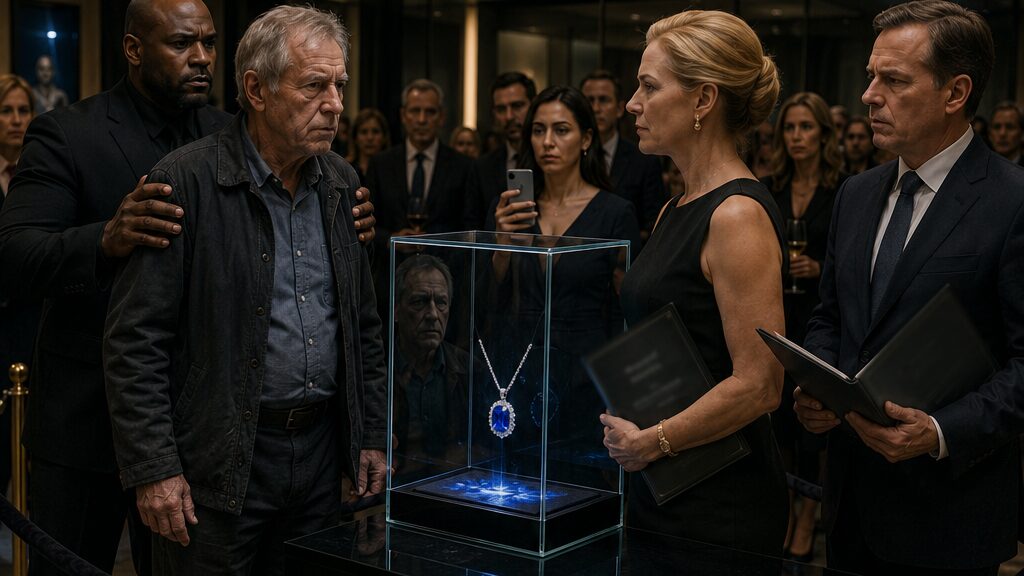
Kathleen Harris said it quietly enough that the nearest guests leaned in, but loudly enough that Paul White felt the words touch the back of the room. A security guard’s hands settled on his shoulders, not hard at first, just present, the way a locked door was present. Paul stood between a row of velvet ropes and a glass display case where Ruth’s sapphire threw blue light across the polished black table.
For a second, he did not look at Kathleen. He looked at the stone.
It had always seemed too bright for Ruth’s small hands. When she wore it, she would turn the pendant inward under her blouse before going into a grocery store or a diner, embarrassed by anything that drew attention. But at home, at the kitchen table, when the late sun came through the west window, she would set it in her palm and let the color catch.
“My blue light,” she had called it.
Now it sat under museum glass on a satin riser, labeled with a printed estate number. A small card described the sapphire as a family heirloom from the White estate, available for private inquiry before auction. The words looked clean. They made the taking look clean.
Kathleen stood in front of him in a black dress too formal for grief and too careful for accident. Her blond hair was swept back. A thin gold bracelet rested at her wrist. Behind her, the auction coordinator spoke in low tones to two guests holding champagne flutes. A man in a navy jacket had already lifted his phone halfway, pretending to check a message.
Paul’s worn dark coat suddenly felt heavier than it had when he left the house. He had worn it because Ruth used to tug the collar straight before church. He had not imagined it would make him look like someone who had wandered into the wrong room.
“I’m not here to make trouble,” he said.
“You already did.” Kathleen’s mouth tightened. “Dennis read the summary. You heard him.”
Dennis Campbell stood near the wall with a folder in one hand and a face trained for difficult rooms. He had read the revised estate provisions fifteen minutes earlier in a soft professional voice. Furniture to Kathleen. Liquid accounts to Kathleen after expenses. Personal jewelry, including sapphire pendant and matching setting, to Kathleen Harris, sole beneficiary under Article Four.
Paul had waited for his name.
It had not come.
At first he thought he had missed it. Ruth had never owned much that mattered to anyone else, but she had been clear about the sapphire. Paul keeps the blue light. Then Emily, if she still wants it. It had never sounded like money when Ruth said it. It had sounded like a way to keep both sides of her life from resenting each other.
Kathleen turned slightly, showing the room she was still in control. “This is a private preview, Paul. Buyers are here. Appraisers are here. This is not the place for a scene.”
A scene. The word settled into him.
The security guard’s thumbs pressed closer to his shoulder blades.
“I asked to see it,” Paul said.
“You asked to remove it from the case.”
“I asked to hold my wife’s necklace.”
Several people looked away at that, not from shame, exactly, but from the discomfort of having grief spoken plainly in a room arranged for valuation.
Kathleen stepped closer. “My mother’s necklace.”
There it was. The line she had never said while Ruth was alive, though Paul had heard it in the silence between them for years. My mother’s chair. My mother’s house. My mother’s Christmas plates. My mother’s nurse. My mother’s money. My mother.
Paul took a breath. The sapphire trembled in its own reflected light, though nothing had touched it.
Dennis cleared his throat. “Mr. White, I understand this is emotional. But the current signed estate document is controlling unless challenged through the proper legal process.”
“Current,” Paul said.
Kathleen’s eyes moved sharply toward Dennis, then back.
The security guard shifted, guiding Paul a step away from the case. Paul’s foot caught the edge of the carpet runner. He steadied himself, but the guard tightened both hands as if Paul had lunged. A brief sound went through the room—one woman’s breath, one man’s small amused laugh, the quick hush that follows public embarrassment.
The man with the phone raised it fully now.
Paul saw himself in the glass: gray hair flattened from the drive, lines around his mouth, one hand open at his side as if he had forgotten what it was for. Beyond his reflection was the sapphire, blue and still and unreachable.
Kathleen lowered her voice. “Don’t make me have you removed.”
For a moment, he almost let it happen. He could leave. He could go home to the chair Ruth no longer sat in and the blanket she no longer asked him to fold over her knees. He could tell himself there was dignity in walking away. He had done that before. He had walked away from arguments because Ruth hated raised voices. He had let Kathleen correct him on dates, medicine schedules, family stories. He had let paperwork sit unopened because Ruth looked tired whenever he mentioned it.
Silence had seemed kind then.
Now it had hands on his shoulders.
Paul looked from Kathleen to Dennis. “What date did she sign the page that removed me?”
The room did not go quiet all at once. It narrowed. A glass touched a table. The auction coordinator stopped mid-sentence. Dennis blinked once, then lowered his folder as if the answer were heavier than the question.
“The will was executed properly,” Dennis said.
“That isn’t what I asked.”
Kathleen gave a short laugh. “You are not going to cross-examine everyone in the middle of an estate preview.”
Paul kept his eyes on Dennis. “What date?”
Dennis opened the folder. Pages whispered against each other. The sound was dry and official, nothing like Ruth’s old recipe cards or the letters she kept tied with a ribbon in the hall cabinet. He ran one finger down a page.
“March seventeenth,” he said.
Paul felt something inside him stop.
Not break. Stop.
The date did not fall into place; it opened a floor under him. March seventeenth was not just six weeks before Ruth died. It was the week she had stood in their kitchen at two in the afternoon, wearing one slipper, asking why the clock said six when the sun was still up. He had turned the clock around to show her the hands. She had smiled politely, then asked him if her father would be coming for supper.
Her father had been dead for thirty-two years.
Kathleen’s face changed just enough for Paul to see she knew the date meant something. Not guilt, not yet. A tightening around the eyes. A calculation.
“Mom had good days,” she said.
Paul turned to her. “That week?”
“She knew what she wanted.”
“Did she?”
Kathleen’s cheeks flushed. “You don’t get to decide she was confused just because you don’t like what she chose.”
The phone was still raised. Paul could feel it recording the worn coat, the old man, the daughter with the law behind her. He could imagine what it would look like without the date. Bitter widower disrupts estate sale. Second husband wants family jewel. Security called.
He stepped forward, not toward Kathleen, but toward the glass. The guard pulled him back half a step, and the movement brought him close enough that his breath briefly clouded the case.
Blue light blurred.
Paul lowered his voice. “Ruth couldn’t read the kitchen clock that week.”
No one answered.
Dennis looked down at the folder, and for the first time his professional face showed something less polished than caution.
Kathleen lifted her chin. “This preview is over for you.”
The guard’s hands became firmer. Paul did not fight them. He let himself be moved back from the case, but he kept his eyes on the sapphire until Kathleen’s shoulder blocked it from view.
At the doorway, he turned once more.
“March seventeenth,” he said.
The words did not sound like an accusation yet. They sounded like a date he was memorizing for someone who could no longer speak.
Outside, in the corridor, the noise of the room returned behind him. Laughter, lowered voices, the soft clink of glass. Paul reached into his coat pocket for his keys and found Ruth’s old house key still on the ring, the one she had refused to replace because she liked the worn brass edge.
He closed his fingers around it.
March seventeenth was the week Ruth had stopped recognizing the kitchen clock.
Chapter 2: The Date On The Signature Was Wrong
Paul laid the will summary beside Ruth’s untouched teacup and circled March seventeenth three times.
The pen tore the paper on the last circle.
He sat at the kitchen table until the house made its evening sounds around him: refrigerator hum, pipe knock, the faint tick of the clock Ruth had misunderstood. He had not moved it since the day she asked about supper for her father. It still hung over the stove, its brass rim dulled by years of kitchen steam, its hands plain and black.
March seventeenth.
He wrote the date again on the back of an envelope, then wrote six weeks before, then stopped because the words made the room tilt.
Ruth’s teacup sat across from him, clean but unwashed from the last morning she had been home before the final care facility stay. She had taken two sips and told him the tea tasted blue. He had thought she was joking. Later, he wondered if she had been trying to say something else. By then, there had always been later. Later for doctors. Later for paperwork. Later for asking Kathleen why she kept taking Ruth to appointments without telling him until after.
Paul pressed the heel of his hand against his eye.
He had not wanted to be the husband who kept score. Kathleen was Ruth’s daughter. Emily was Ruth’s granddaughter. They had history Paul had entered late. He had told himself that stepping back was respect.
Now he saw another possibility: stepping back had left empty space for someone else to fill.
He turned the will summary over. Dennis Campbell’s office had provided only the summary at the reading, not the full document. Paul had signed nothing. He had been given a copy because he was surviving spouse, Dennis had said, though not a named beneficiary under Article Four.
Not named. As if Ruth had forgotten how to spell him.
Paul reached for the phone, then stopped. He did not call Kathleen. He could already hear the tone she would use: careful, injured, prepared. He did not call Dennis either. Lawyers knew how to answer only what they wanted answered.
Instead, he searched the county probate office hours and wrote the address beneath the date.
The next morning, he arrived before the doors opened. He had shaved badly, missing a silver patch under his jaw. In the truck mirror, he noticed and did not fix it. The courthouse annex was a low beige building with tinted glass and a flag that snapped in the wind. People entered carrying folders, envelopes, boxes of small disasters.
At the probate counter, the clerk glanced at his copy of the summary. “Estate of Ruth White?”
“Yes.”
“You’re listed as surviving spouse, but the executor is Kathleen Harris.”
“Executor means she gets to decide who sees what?”
“It means she has authority to administer the estate once letters are issued.”
“Have they been issued?”
The clerk typed. Her nails clicked softly against the keys. Paul watched the screen’s reflection in her glasses, too blurred to read.
“Request is pending expedited review.”
“Expedited by who?”
The clerk looked at him over the frame. Not unkindly. Not on his side. “The petitioner.”
“Kathleen.”
“The executor named in the will.”
He nodded as if the distinction mattered to him. Maybe it mattered to everyone but Ruth.
“I need the full will,” he said.
“You can request a copy once it’s filed in the probate record. Some documents are available now. Some may not be scanned yet.”
“She signed it March seventeenth.”
The clerk’s expression changed by half a shade. She had heard many dates said that way.
Paul continued, quieter. “She was in a care facility then.”
The clerk typed again. “The self-proving affidavit lists witnesses at a care facility.”
Paul’s fingers tightened on the edge of the counter. “Not at Dennis Campbell’s office?”
“No. It appears the signing took place at the facility.”
A small answer. A larger question.
Paul looked down at his envelope where he had written March seventeenth. He added care facility beneath it.
“Who witnessed it?”
“I can’t interpret the document for you.”
“I’m not asking you to interpret. I’m asking who was in the room.”
“If it’s on the filed copy, you can request it. If you intend to challenge the will, you may want counsel.”
He almost laughed. Counsel. A word that meant money before it meant help.
“How much does that cost?” he asked.
“The copy?”
“The challenge.”
The clerk’s face softened just enough to hurt. “That depends.”
Paul knew what that meant. It meant more than Ruth’s checking account. More than the truck was worth. More than pride should cost.
He took the forms she slid through the opening. His hand moved slowly as he filled them out. Name. Address. Relationship to deceased. Surviving spouse looked strange in his own handwriting. He had been husband until six weeks ago. The county had given him a new title.
When he returned the form, the clerk said, “There may be a delay. The executor requested certified copies yesterday.”
“Of what?”
“The filed petition, death certificate, and supporting documents.”
“Supporting documents,” he repeated.
“And letters of administration as soon as approved.”
“Why the rush?”
The clerk did not answer. Her silence was procedural, but it still felt like a door.
Paul looked around the room at people waiting on benches. A young woman with a stroller. A man in work boots holding a shoebox. An older couple whispering over a deed. Everyone there had a private grief converted into forms.
He lowered his voice. “If a person signed at a care facility, would there be a record of who visited that day?”
“Possibly. Facilities keep logs.”
“Can I ask for them?”
“You can ask.” The clerk folded his receipt and pushed it toward him. “Whether they release them is another matter.”
He took the paper. “And if the executor already asked?”
She paused.
Paul looked up.
The clerk’s fingers rested on the counter. “I can’t discuss another party’s requests in detail.”
“But she did.”
“I didn’t say that.”
No, Paul thought. But she had.
Back in the truck, he sat with the forms on the passenger seat. A copy fee receipt. A request number. A pamphlet about probate rights printed in soothing blue ink. None of it looked strong enough to carry Ruth’s voice.
His phone buzzed once.
For one second he thought it might be Kathleen. It was not. A reminder from the pharmacy that Ruth’s prescription refill was ready for pickup.
Paul stared at it until the screen dimmed.
Then he started the truck and drove to the care facility.
The building sat behind a line of trimmed hedges, clean and pale, with automatic doors that opened too slowly. He had spent more hours there than he liked to count, though not enough, his mind now said. Never enough. Inside, the lobby smelled of lemon cleaner and warm plastic trays. A television played silently in one corner.
At the reception desk, the care-home receptionist looked up, smiled with recognition, then lost the smile when she saw his face.
“Mr. White.”
“I need to ask about Ruth’s visitor log.”
Her hands moved to the keyboard, then stopped. “For what dates?”
“March seventeenth. And every Tuesday before it if that’s easier.”
The receptionist looked toward the hallway as if someone might rescue her from the question. “I’m sorry. We can’t release resident records without proper authorization.”
“I’m her husband.”
“I know.”
The words were gentle. The refusal was not.
“Who can authorize it?”
“The estate representative.”
“Kathleen Harris.”
The receptionist did not say yes.
Paul took out the probate receipt and placed it on the counter. “I’m asking because Ruth signed a will here that day.”
Her eyes moved to the paper, then back to him.
“I’m very sorry,” she said. “Kathleen requested copies of certain logs already. We were told all estate-related requests should go through her.”
Paul felt the counter under his palm, cool and hard.
Behind the desk, down the hallway toward Ruth’s old room, someone laughed at a game show. A cart squeaked. Life continued in the place where Ruth’s mind had begun leaving her in pieces.
The receptionist lowered her voice. “You can put your request in writing.”
“Will I get it?”
“I don’t know.”
Paul folded the receipt and put it back in his pocket. At the door, he turned. “Was Ruth here all day on March seventeenth?”
The receptionist looked at the hallway again.
“That would be in the log,” she said.
It was not an answer. It was not nothing.
Paul stepped outside into the sharp afternoon light with one fact heavier than the rest: the visitor log existed, and Kathleen had already asked for it.
Chapter 3: The Visit Log Started Answering Too Much
“You’re not listed as family contact anymore,” the receptionist said, and then looked as if she wished she could pull the sentence back.
Paul stood with both hands flat on the care facility counter. Behind him, the automatic doors breathed open and shut for visitors carrying flowers, mail, soft blankets still folded in store bags. The lobby had not changed since Ruth died. That seemed indecent to him. Same lemon-cleaner smell. Same television with captions running under cheerful faces. Same whiteboard announcing afternoon bingo.
“I’m her husband,” he said.
“I know, Mr. White.”
“Then who took me off?”
The receptionist pressed her lips together. Her badge swung when she shifted in her chair. “Kathleen asked that estate matters and records go through her. She said it would reduce confusion.”
“Whose confusion?”
The receptionist did not answer.
Paul had written his request for the visitor log on lined paper because he did not know what kind of form grief required. March seventeenth. Tuesdays prior. Sign-out records. Visitors present. He had placed it on the counter in an envelope with Ruth White printed carefully across the front.
The receptionist accepted it but did not put it in the tray beside her. She held it in both hands.
“I can pass this along,” she said.
“To Kathleen?”
“To administration.”
“Which will call Kathleen.”
Her face tightened. “I’m sorry.”
Paul looked past her toward the hallway. Ruth’s room had been the third door after the nurses’ station, left side, window facing the courtyard. He had brought her a blue cardigan there once because she kept saying the room was cold. She had accused him of stealing her bus ticket. Then she had cried because she could not remember his middle name.
He had left early that day.
He still remembered the relief of stepping outside. The shame of that relief came back now with such force that he had to grip the counter.
“Could I see her room?”
“It’s been reassigned.”
“Just the hallway then.”
The receptionist hesitated. “Five minutes.”
A buzzer sounded when she unlocked the inner door. Paul walked slowly, as if speed might make him look guilty. Residents sat in wheelchairs near the common room, some watching him, some watching nothing at all. A nurse came out of a supply room with a stack of towels and stopped.
“Mr. White?”
He remembered her voice before her face. She had been kind to Ruth on the days Ruth was suspicious of everyone else.
“I’m sorry,” the nurse said. “I didn’t know you were coming.”
“I didn’t either.”
Her eyes moved toward the reception desk behind him. “Are you here about paperwork?”
Paul almost said no. The old habit rose automatically: don’t involve people, don’t make trouble, don’t turn sorrow into a scene. Then he thought of the sapphire behind glass.
“I’m here about March seventeenth.”
The nurse’s hand tightened around the towels.
Paul noticed.
“She signed a will here that day,” he said. “Did you know that?”
“I knew there was an appointment.”
“With Dennis Campbell?”
“I don’t remember the name.”
“But you remember the appointment.”
She glanced toward the nurses’ station. “Not here.”
They walked toward Ruth’s old hallway. Her room door was open, but the bedspread was different now, bright yellow flowers instead of Ruth’s pale green quilt. A framed print of sailboats hung where Paul had taped Emily’s school photo years ago. The room had swallowed another life.
The nurse stopped near the window at the end of the hall. Courtyard light fell across the floor.
“I can’t give you records,” she said.
“I’m not asking you to risk your job.”
“You are, a little.”
Paul accepted that. He deserved it.
“I should have asked more questions while she was here,” he said.
The nurse looked at him then. Not with pity. With recognition.
“She had hard days,” she said. “And better hours inside hard days.”
“Kathleen says Ruth knew what she wanted.”
“That can be true and not true, depending on the hour.”
Paul swallowed. “Was March seventeenth a better hour?”
The nurse folded the towels against her chest. “I remember that week because she kept asking about clocks.”
The hallway seemed to lengthen.
“What did she ask?”
“She asked why lunch was happening at midnight. She asked whether her mother had called. She asked me if the blue light was locked up.”
Paul’s chest tightened. “The blue light?”
“That’s what she called it. I thought she meant a lamp at first.”
“No,” Paul said. “The sapphire.”
The nurse nodded slowly. “Kathleen came that day. Emily too, I think. Your wife was anxious before they arrived. She kept touching her neck like something was missing.”
Paul could see the motion. Ruth’s fingers finding the hollow of her throat, searching for the pendant he had put away after she began misplacing jewelry in tissue boxes and shoes.
“Did Ruth leave the facility that day?”
“I can’t confirm that officially.”
“But did she?”
The nurse looked toward the nurses’ station again. “There was a sign-out. I remember because she didn’t want her coat. Kathleen said it was just a short appointment.”
“With Dennis.”
“With someone.”
“Was Ruth clear?”
The nurse’s face changed. “She knew Kathleen. She knew Emily. She asked for you.”
Paul closed his eyes.
The nurse’s voice lowered. “I told Kathleen maybe you should be called if documents were involved.”
“What did Kathleen say?”
“She said you got Ruth upset. She said legal things were family matters.”
“I was her husband.”
“I know.”
The words hit differently this time. The receptionist had said them as an apology. The nurse said them as regret.
A cart rattled at the far end of the hall. The nurse stepped back, putting distance between them and the confession that was not quite a confession.
“Can you write any of that down?” Paul asked.
Her eyes filled, but she shook her head. “Not without authorization. I have children. I need this job.”
“I understand.”
He did, and he hated that he did.
She shifted the towels to one arm and reached into her scrub pocket. For a moment he thought she might hand him something. Instead, she only touched the pocket and stopped.
“What?” he asked.
“I shouldn’t.”
“What is it?”
The nurse looked at Ruth’s old door. “After appointments, staff entered notes. Not medical opinions. Just behavior notes. Sometimes families forget those exist.”
“Who can release them?”
“Administration. Or a subpoena.”
The word sounded too large for the hallway.
Paul nodded. “Thank you.”
As he turned to leave, she said, “Mr. White.”
He looked back.
“She asked if you were mad at her.”
His hand closed around the hallway rail.
“That day?” he asked.
The nurse nodded. “Before they took her out. She said, ‘Paul will think I gave away the blue light.’ Then she cried.”
Paul could not speak.
“She was tired after,” the nurse said. “Very tired.”
At the reception desk, the receptionist had placed his envelope in a locked drawer. He saw it disappear as he approached. A clean little burial.
“Could I have a copy of her activity calendar?” he asked.
“That’s not restricted.” She seemed relieved to give him something. She printed the last two months from the facility schedule: bingo, music hour, family lunch, chair exercise, salon day. Paul folded it once, then opened it again in the parking lot.
March seventeenth was a Tuesday.
There was no legal appointment listed. No family outing. No notation beside Ruth’s name, only the ordinary printed schedule: morning crafts, courtyard walk, afternoon music.
He took out his phone and opened the shared family calendar Ruth had once insisted they keep so Kathleen would not accuse him of forgetting appointments. March seventeenth showed nothing. March tenth showed Kathleen visit. March third showed Kathleen visit. Every Tuesday for months had some small entry. Groceries. Doctor. Mom lunch. Forms.
But March seventeenth was blank.
Paul sat in the truck with the activity calendar on his lap and the family calendar glowing in his hand.
Ruth had an appointment with Dennis Campbell on a Tuesday no one had written down.
Chapter 4: The Lawyer Remembered One Sentence Differently
“The signatures are verified,” Dennis Campbell said.
Paul sat across from him with the copied activity calendar folded in his coat pocket and his hands resting on his knees so Dennis would not see them tighten. The attorney’s office was quiet in the expensive way: thick carpet, dark shelves, framed certificates, a glass bowl of peppermints no one had touched. On Dennis’s desk, Ruth’s revised will lay in a clean stack, clipped at the corner, its pages too white under the lamp.
“I asked when she understood them,” Paul said.
Dennis took off his glasses and set them beside the folder. “Mr. White, capacity is not measured by whether someone has occasional confusion.”
“Then how is it measured?”
“By whether the person understands the nature of the document, the property involved, and the people who would ordinarily be expected to benefit.”
Paul leaned forward. “Did Ruth name those people?”
Dennis’s mouth tightened. “I’m not at liberty to disclose every conversation.”
“You read me out of my wife’s will in front of buyers. You can tell me if she knew who I was.”
“That is not what happened.”
Paul let the silence answer for him.
Dennis looked toward the closed office door, then back at the file. “Mrs. White knew she was signing estate documents.”
“Did she know she was giving Kathleen the sapphire?”
“She understood that personal jewelry would go to Kathleen.”
“Those were her words?”
Dennis hesitated.
Paul saw it. A small thing, hardly more than a pause. But after weeks of people telling him paper was stronger than memory, the pause felt like a loose thread.
“What were her words?” Paul asked.
Dennis slid one page aside and uncovered a yellow legal pad. The top sheet had a date written in blue ink: March 17. Beneath it were neat notes, abbreviated. Paul could read only fragments upside down. Jewelry. Daughter. Keep in family.
Dennis noticed him looking and turned the pad slightly away.
“She said Kathleen knew where it belonged,” Dennis said.
Paul sat still.
That sentence did not open a door. It opened two.
“Where it belonged,” he repeated.
“Yes.”
“With Kathleen?”
“That was my interpretation in context.”
“What context?”
“The requested revision transferred personal jewelry to Kathleen.”
“Requested by Ruth?”
Dennis put his glasses back on, though he did not look at the page through them. “The appointment was made on her behalf.”
“By Kathleen.”
“By Mrs. Harris, yes.”
“And Ruth told you she wanted that?”
Dennis folded his hands. “Kathleen explained that her mother had always intended the sapphire to remain with the blood family. Mrs. White did not object.”
Paul felt heat move up his neck. Not anger only. Shame. He had trusted empty space. He had trusted that Ruth’s kitchen-table promises needed no witnesses because love was a kind of witness.
He said, “Not objecting isn’t the same as choosing.”
Dennis’s eyes flickered. “Sometimes, with elderly clients, family assists in communicating long-standing intentions.”
“My wife communicated fine when people gave her time.”
“I don’t doubt that.”
“You just didn’t give her any.”
Dennis sat back. The first open sign of irritation crossed his face. “Mr. White, I understand your grief, but be careful. Accusing an attorney of misconduct because you dislike an outcome is serious.”
Paul took the folded activity calendar from his pocket and placed it on the desk. He did not push it forward. He simply laid it there, Ruth’s blank March seventeenth visible between them.
“This is the facility calendar for that day,” he said. “There was no legal appointment listed.”
“I don’t control facility calendars.”
“And the family calendar was blank.”
“I don’t control that either.”
“No. But someone controlled who knew she was leaving.”
Dennis looked at the page without touching it.
Paul continued, “Ruth asked a nurse if I was mad because she gave away the blue light.”
At that, Dennis’s face changed. Not enough to concede anything. Enough to show the phrase had landed.
“The blue light,” Dennis said.
“You heard that before?”
Dennis did not answer right away.
Paul’s pulse pressed in his ears. Outside the office, a phone rang once and stopped.
Dennis opened another folder, thinner than the will packet, and scanned a page. “I made a note that Mrs. White referred to the sapphire as blue light. I assumed it was an affectionate description.”
“What exactly did she say?”
Dennis looked tired now. Older than he had seemed at the estate preview. “She said, ‘Kathleen knows where the blue light belongs.’”
Paul closed his eyes briefly.
Kathleen could use that sentence. So could he. Ruth had made a bridge, and everyone else had turned it into a weapon.
“She said Paul?” he asked. “Did she say my name?”
“Not in that sentence.”
“Did you ask her?”
“Ask her what?”
“Where it belonged. Did you ask whether she meant with Kathleen now, or with me first, or with Emily later, or locked in the old box until everyone stopped behaving like fools?”
Dennis looked down.
“You didn’t,” Paul said.
“The document reflected the instructions I was given.”
“By Kathleen.”
“By the family member coordinating the appointment.”
“My wife had a husband.”
Dennis exhaled through his nose. “You were not present.”
“No one told me.”
“I was told you preferred not to be involved in estate discussions because they upset Mrs. White.”
Paul’s hand moved on his knee. He pressed it flat again. That was close enough to truth to cut. He had said, more than once, “Don’t bother Ruth with papers today.” He had said it because she cried when bills came. He had said it because Kathleen stood in the doorway waiting for him to be the difficult one. He had said it because he was tired.
Dennis watched him absorb that.
“Contesting this,” Dennis said more softly, “will be expensive. It may cost more than the estate share you could reasonably recover.”
“I’m not asking about share.”
“You may feel that way now.”
“No,” Paul said. “I felt that way when my wife was alive. That’s why I let too much go.”
Dennis tapped one finger against the folder. “The will is valid on its face. There are witnesses. A notarized affidavit. If you pursue capacity or undue influence, you’ll need more than memory.”
“I’m finding more.”
“Be careful how you find it. Contacting facility employees, pressuring family members, making accusations at private events—these things can damage your position.”
Paul looked at the attorney’s neat desk, the controlled stack of documents, the clean language that could turn absence into consent.
“Private events,” he said. “Is that what you called it when they put her sapphire in a case before the estate was settled?”
Dennis’s gaze sharpened. “The executor has authority to inventory and appraise estate property.”
“Appraise,” Paul said. “Not shame people with it.”
Dennis said nothing.
Paul stood. He had not won anything. The pages remained where they were. Ruth’s name sat at the top of a document that did not sound like her. But he had one phrase now, and one admission: the appointment had been made on Ruth’s behalf.
At the door, Dennis spoke.
“Mr. White.”
Paul turned.
“There is one detail you should understand before you form conclusions.”
Paul waited.
Dennis looked down at the legal pad again, and this time the professional caution seemed to fail him for a second. “Kathleen did not drive Mrs. White here that day.”
Paul’s fingers tightened around the doorknob.
“Then who did?”
Dennis lifted his eyes. “Emily Sanchez brought her in.”
Chapter 5: The Daughter Who Benefited Was Not Only Greedy
“You’re going to tear this family apart over a necklace,” Kathleen said before Paul had both feet out of his truck.
She stood in her driveway with a white envelope in one hand and her phone in the other. Her house looked freshly painted, the shrubs clipped low, the front windows bright with reflected afternoon. Nothing about it suggested a woman cornered by grief, except the way she held herself too straight, as if bending even slightly would break something.
Paul closed the truck door.
“I came to ask why Emily drove Ruth to Dennis Campbell’s office.”
Kathleen’s face hardened. “You went back to Dennis.”
“He told me.”
“He shouldn’t have.”
“That’s what you’re worried about?”
“I’m worried about you harassing everyone my mother ever spoke to.”
“Your mother was my wife.”
Kathleen stepped closer, lowering her voice though there were no neighbors outside. “And you keep saying that like it cancels out the rest of us.”
Paul looked at the envelope. “What is that?”
“A way to stop this before it gets uglier.”
She pushed it toward him. He did not take it, so she held it there between them until the air itself seemed embarrassed.
“It’s not an admission,” she said. “It’s a courtesy. Five thousand dollars from the estate once funds clear. You sign a release. You stop contacting the facility, Dennis, Emily, and any buyers connected to the preview.”
The number was so far from the sapphire’s value that Paul almost missed the insult inside it.
“You think I’m asking for cash?”
“I think you’re angry and grieving and letting people put ideas in your head.”
“What people?”
“Clerks. Nurses. Anyone who wants to feel important.”
Paul looked past her into the house. Through the open door, he could see a kitchen table covered in papers. Not casual papers. Stacked, sorted, clipped. One page had red print across the top. Another had the logo of Ruth’s care facility.
Kathleen noticed his gaze and moved slightly, blocking the view.
“Those bills?” he asked.
“That is none of your business.”
“Ruth’s care bills are estate business.”
“Now you care about the bills?”
The words came fast enough to show they had been waiting.
Paul’s face stilled. “What does that mean?”
“It means when Mom was declining, you got to be the sweet husband who brought tea and held her hand. I got to argue with insurance, sit on hold with billing, meet with administrators, explain why she needed another month of care when the accounts were thinning. You went home when she got confused. I stayed.”
Paul did not answer at once.
The accusation had truth in it. Not all of it. Enough.
“I left some days because she was afraid of me,” he said.
“She was afraid of everyone some days.”
“I know.”
“Do you? Because I remember you calling me saying she accused you of hiding her purse. I remember you saying, ‘Maybe you should go tomorrow instead.’ I remember you being relieved when I did.”
The envelope lowered in Kathleen’s hand.
Paul looked at the driveway between them. A hairline crack ran from the concrete seam to the garage. Ruth had always noticed cracks. She said houses confessed through them.
“I was relieved,” he said.
Kathleen blinked, not expecting that.
He forced himself to continue. “Some days. Yes. Then I hated myself for it before I got home.”
For the first time since the preview, Kathleen’s anger faltered into something messier. Tiredness, maybe. Or recognition she did not want.
Then she recovered. “Then don’t stand here pretending you were the only one who loved her.”
“I never said I was.”
“You act like I stole from a stranger.”
“No,” Paul said. “I think you took advantage of your mother while telling yourself you were protecting her.”
Kathleen’s mouth parted slightly. The words hit harder because he had not raised his voice.
She looked toward the open door. “You have no idea what I was protecting.”
“Tell me.”
Her laugh was short and brittle. “You want truth? Fine. Mom was going to leave the sapphire to you. You know what happens then? It leaves the family. You could sell it. Remarry. Give it to some niece I never met. Put it in a drawer until you die and then who knows? That stone came from my grandmother. I grew up hearing about it. Then you show up in her life after my father is gone, and suddenly you’re the one who knows all her little names for everything.”
Paul stood still.
There it was beneath the legal language. Not just greed. Displacement.
“I didn’t show up,” he said. “Ruth chose me.”
“And she chose me first.”
“She didn’t have to choose.”
Kathleen’s eyes shone, but no tears fell. “Easy for you to say. You got the gentle years.”
Paul nearly said there were no gentle years at the end, but he stopped. He remembered Ruth laughing in the garden before the diagnosis. Ruth teaching him how to make her mother’s rolls. Ruth falling asleep against his shoulder during a movie she had insisted she wanted to finish. Yes. He had gotten gentle years too.
On the kitchen table behind Kathleen, a red bill slipped from a stack and drifted to the floor.
She turned sharply, as if the paper had betrayed her. Paul saw enough before she picked it up: overdue balance, care services, final notice.
“You should have told me,” he said.
“So you could offer to help with money that was already half yours by marriage? So you could look noble while I looked desperate?”
“I would have helped Ruth.”
“You would have helped Ruth,” she repeated. “Not me.”
He had no answer ready. That made it worse, because Kathleen saw it.
She folded the red bill and gripped it in her fist. “The sapphire was the one thing I knew would stay. The one thing that proved Mom’s first family hadn’t been replaced.”
“It wasn’t proof,” Paul said. “It was Ruth’s.”
“And she gave it to me.”
“Did she? Or did you explain it until she stopped objecting?”
Kathleen’s face closed again. “Take the offer or don’t. But if you contact Emily about this, I’ll file harassment. She doesn’t need you dragging her into your little investigation.”
“She drove Ruth.”
“She was doing me a favor.”
“Did she know what Ruth was signing?”
“That’s between Emily and her conscience.”
Paul heard the door in that sentence and the lock turning behind it.
Kathleen pushed the envelope against his chest. He let it fall. It landed between them on the driveway, white against gray concrete.
“I’m not signing away Ruth’s voice for five thousand dollars,” he said.
Kathleen looked down at the envelope. “Then don’t complain when this costs you more than you have.”
Paul walked back to the truck without picking it up. His hand shook when he opened the door, but he did not let her see. Inside, he sat behind the wheel and looked once at the house. Kathleen was still in the driveway, the envelope at her feet, the red bill in her fist.
His phone buzzed as he started the engine.
The message came from a number he did not recognize, but the words made him stop breathing for a second.
Grandma said something in the car that day.
A second message followed before he could type.
It’s Emily.
Chapter 6: The Old Box Held A Smaller Truth
“I wondered when someone would come asking about that stone,” Frank Moore said, and opened a drawer Paul had not noticed was there.
The jewelry shop was narrow, older than the polished estate room, with wood cases worn smooth at the edges and a bell over the door that still trembled from Paul’s entrance. Frank stood behind the counter with a jeweler’s loupe hanging from a cord around his neck. His hair had gone white at the temples, and his hands moved carefully, as if they remembered every fragile thing they had ever held.
Paul had not told him much on the phone. Only Ruth’s name. The sapphire. A question about old repairs.
Frank had gone quiet for several seconds before saying, “Come before closing.”
Now he lifted a flat archival box from the drawer and placed it on the counter between them. Not the sapphire itself. Nothing so easy. Just a gray box labeled White, Ruth in black ink.
Paul touched the edge but did not open it.
“She brought it in after one of the prongs loosened,” Frank said. “Maybe eight years ago. You were with her.”
“I waited outside,” Paul said. “She said jewelry shops made me stand like a man guarding a museum.”
Frank smiled briefly. “That sounds like her.”
The smile faded as he untied the cotton string around the box.
Inside were repair envelopes, a copy of an appraisal, a small photograph of the pendant, and a velvet pouch flattened by time. Frank lifted the appraisal first and turned it toward Paul.
The page had the usual language: stone weight, setting, estimated value. Near the bottom, in Frank’s handwriting, was a note that did not belong to appraisal language.
Client states pendant to remain with husband, Paul White, for lifetime safekeeping; then to granddaughter Emily if family agrees.
Paul read it twice. The words shifted in and out of focus.
“She said that to you?”
“She did.”
“Why did you write it down?”
Frank rubbed the side of his thumb along the counter. “Because she asked whether an appraisal could include instructions. I told her no, not legal ones. She said, ‘Then write what I mean somewhere honest.’ So I put it in my working notes.”
Paul gave a small sound that was almost a laugh and almost not. Ruth would do that. Distrust the proper form and trust the margin.
“Is this enough?” he asked.
Frank’s eyes softened. “For court?”
“For anything.”
“For showing intent at that time, maybe. For proving she didn’t change her mind later, no.”
Paul nodded. The disappointment did not surprise him. What surprised him was that he felt steadier anyway. Ruth had said it somewhere outside the kitchen. Somewhere with another person present. Somewhere ink had kept it.
Frank lifted the photograph. The sapphire lay on dark cloth, its blue deeper than it looked behind the estate glass. On the back of the photo, Ruth had written in her slanted hand: blue light cleaned, clasp repaired.
Paul ran his thumb over the words without touching the ink.
“She called it that here too,” Frank said. “Blue light.”
“She called it that everywhere.”
Frank looked toward the front window, where the closed sign hung ready but not turned. “Your stepdaughter came in a few months ago.”
Paul looked up.
“Kathleen.”
“I assumed she was handling things for Ruth. She had questions about market value. How quickly a piece like that could sell. Whether provenance mattered. Whether family history increased value.”
“When was this?”
Frank reached into the box again and found a small intake slip. “January.”
Two months before the signing. Three months before Ruth died.
Paul felt the room tighten around the date.
“Did she have the sapphire with her?”
“No. A photograph. Not this one. A phone picture through a display case or maybe from a box. Hard to tell.”
“What did you tell her?”
“That a private sale could move quickly if documentation was clean, but a better price would come through a curated estate preview.”
“The preview,” Paul said.
Frank did not meet his eyes. “I gave general advice. I didn’t know there was a dispute.”
“There wasn’t yet.”
But that was not true. There had been a dispute before Paul knew to call it one.
Frank closed the appraisal folder halfway, then opened it again. “There’s one more thing.”
He removed the flattened velvet pouch. Inside was a folded piece of stationery, cream-colored, torn along one bottom corner. The paper had been creased so long the fold lines looked permanent.
“She left this in the old box,” Frank said. “I found it when we cleaned the clasp. I told her it was there. She laughed and said old women were allowed to hide notes from themselves.”
Paul took the page carefully.
Ruth’s handwriting crossed it in uneven lines, written years before the shaking began.
If I go first, Paul keeps the blue light where I can find it in my mind. Emily should have it after him, if she still loves the old stories. Kathleen will say this is unfair. It is not against her. It is because—
The sentence ended at the torn corner.
Paul stared at the missing piece.
“Where is the rest?”
“That’s how it was when I found it.”
“Did Ruth tear it?”
“I don’t know.”
Paul read the last visible words again. It is because—
Because what? Because Paul loved her? Because Kathleen would sell it? Because Emily needed a bridge? Because Ruth already knew the two halves of her family would not trust each other once she was gone?
Frank stood quietly while the question widened.
“This isn’t a will,” Paul said.
“No.”
“It doesn’t prove March seventeenth was wrong.”
“No.”
“It proves she thought about all of us before Kathleen ever made that appointment.”
Frank nodded. “That, I’d say.”
Paul folded the note along its old lines. His hands were steadier now, but not because he had enough. Because he had something that did not sound like Dennis, did not sound like Kathleen, did not sound like law translating love into categories.
It sounded like Ruth stopping mid-thought and expecting someone who loved her to understand the rest.
Frank made a copy of the appraisal note, the repair tag, and the handwritten page. He placed them in a plain envelope and wrote Paul White across the front.
At the door, Paul paused. “Why didn’t you call me when Kathleen came in?”
Frank looked ashamed, though not guilty enough to make the past change. “Families ask about jewelry all the time. Most of the time, it’s none of my business.”
“And now?”
“Now I think maybe it was.”
Paul stepped outside with the envelope tucked inside his coat. In the truck, he took out the torn note again before starting the engine.
It is because—
His phone lay dark in the cup holder. Emily’s message waited unanswered.
Paul picked it up and typed with one finger.
Tell me what Ruth said in the car.
Chapter 7: He Asked For The Promise, Not The Money
“Take the check or leave the estate alone,” Kathleen said, and Paul slid it back across Dennis Campbell’s conference table without opening the envelope.
No one touched it after that.
The conference room had the same controlled chill as Dennis’s office, but the table was larger, built for families to sit far enough apart to pretend distance was civility. Kathleen sat with her purse on her lap, one hand gripping the strap. Dennis sat at the head of the table with a legal pad, two folders, and the look of a man who had begun to understand that procedure had not protected him from consequence. Emily Sanchez sat near the window, shoulders folded inward, phone face down in front of her.
Paul placed Frank Moore’s envelope on the table.
Kathleen’s eyes went to it immediately. “What is that?”
“Not money.”
“Paul.”
He looked at her then. “You keep saying my name like it’s a warning.”
Dennis touched the edge of his legal pad. “Let’s keep this focused.”
“It is focused,” Paul said. He took out the photocopy of Frank’s appraisal note and laid it flat. “Ruth told Frank Moore the sapphire was to stay with me for my lifetime, then go to Emily if the family agreed.”
Kathleen gave a small, exhausted laugh. “A jeweler’s note is not a will.”
“No,” Paul said. “It isn’t.”
The answer seemed to take some strength out of her. She had expected him to overreach. Maybe she needed him to.
He placed the torn note beside it. Ruth’s handwriting faced upward.
Emily leaned forward before she seemed to realize she had moved. Her lips parted.
Kathleen saw the movement and stiffened. “Emily.”
“I’ve never seen that,” Emily said.
“It was in the old box,” Paul told her. “Frank copied it.”
Dennis picked up the note carefully, as if it might accuse him of something if he held it too hard. He read the lines without expression until he reached the tear.
“If I go first,” Emily whispered, reading upside down from across the table. “Paul keeps the blue light where I can find it in my mind.”
Her voice broke on the last word.
Kathleen turned on her. “Do not start.”
Emily sat back, but her eyes stayed on the paper.
Dennis set the note down. “This is meaningful, Mr. White. But Kathleen is correct that it is not testamentary in form.”
“I know that.”
“Then what are you asking for today?”
Paul had rehearsed answers in the truck. He had planned to say he wanted the sale stopped, the signing investigated, the facility notes preserved, the truth acknowledged. All of that was true. But with Ruth’s torn sentence on the table, what came out was simpler.
“I want you to stop calling it her clear choice.”
The room changed.
Kathleen’s fingers tightened around her purse strap. “It was her choice.”
“Then tell me why the appointment was hidden.”
“It wasn’t hidden.”
“It wasn’t on the family calendar. It wasn’t on the facility activity calendar. I wasn’t told. Dennis says the appointment was made on Ruth’s behalf. The nurse says Ruth was asking if I’d be mad that she gave away the blue light. Frank says you came asking how quickly the sapphire could sell before Ruth ever signed the new will.”
Kathleen’s face lost color in stages.
Emily looked at her mother. “You went to Frank before March?”
Kathleen closed her eyes. “I asked a question. That is not a crime.”
“No one said crime,” Paul said.
“You keep building toward it.”
“I’m building toward the date.”
Dennis wrote something down, then stopped halfway through the word.
Paul turned to Emily. He did not want to. She looked young in that moment, though she was a grown woman. Young the way people looked when they realized childhood had placed them inside adult damage.
“You drove Ruth to Dennis’s office on March seventeenth.”
Emily’s hand moved to her phone and then away. “Mom asked me to.”
Kathleen said sharply, “You don’t have to answer him.”
“Yes,” Emily said, surprising everyone. “I think I do.”
Kathleen stared at her.
Emily’s eyes filled, but she kept speaking. “Grandma was having a hard morning. She thought we were going to church at first. Then she thought we were going to see a doctor. Mom kept saying, ‘It’s just paperwork, Mom. It keeps things in the family.’”
“Emily,” Kathleen said.
“No. I’ve been hearing that sentence in my head for weeks.”
Paul did not move.
Emily looked at him. “In the car, Grandma asked if you knew where we were going. I said I didn’t know. She got upset. She kept touching her neck. She said, ‘Paul keeps the blue light first. Then you.’”
Kathleen stood so fast her chair legs scraped the floor. “That is not what she meant.”
Emily flinched but did not stop. “She said it twice.”
“She was confused.”
“She was confused about where we were going,” Emily said. “She was not confused about that.”
The words hung above the table, clear and terrible.
Dennis leaned back slowly. His eyes moved from Emily to the will folder and then to Kathleen. “Mrs. Harris, did you inform me that Mrs. White had expressed a life-use arrangement involving Paul?”
Kathleen’s jaw tightened. “My mother said a lot of things over the years.”
“That is not what I asked.”
Paul heard the echo of his own words from the estate room and felt no satisfaction in it.
Kathleen gripped the back of the chair. “She was my mother. Do you understand that? Every time I visited, something else had become his. His chair. His routine. His stories about what she liked. His way of speaking for her. And then I was supposed to sit there and let the one thing my grandmother left her go to him too?”
Paul said quietly, “Ruth didn’t say it should end with me.”
Kathleen looked at him.
“She said first,” he continued. “Emily says she said first. The note says after me, Emily. Frank’s note says lifetime safekeeping. You and I both know what that sounds like.”
Kathleen shook her head, but less firmly now. “You could have sold it.”
“I could have,” Paul said. “And you could have asked Ruth to write it the way she meant before she was too tired to fight all of us.”
Kathleen’s eyes flashed. “Don’t put that on me alone. You were there too. You were her husband. You didn’t ask either.”
The accusation landed because it was true.
Paul looked down at Ruth’s torn note. It is because—
“I know,” he said.
Kathleen seemed startled by the admission.
“I should have asked her to write it down,” he said. “I should have sat with her through the hard talk instead of telling myself kindness meant leaving it for later. That’s on me.”
His voice roughened, but he held it steady.
“Use that against me if you want. But don’t use my silence to make your version of Ruth.”
Emily covered her mouth with one hand.
Dennis removed his glasses and rubbed the bridge of his nose. “I need to be clear about something. What has been discussed today may not overturn the will. But it creates serious questions about the disposition of the sapphire, the circumstances of the signing, and any sale conducted with notice of a dispute.”
Kathleen sat down slowly.
Paul reached into his coat and took out his phone. “There’s one more thing.”
Kathleen looked wary. “What?”
“Emily sent me the video from the preview.”
Emily closed her eyes.
Paul did not play the whole thing. Only ten seconds. The glass case. The sapphire throwing blue light. Kathleen’s voice saying the will says it isn’t yours. The security guard’s hands on Paul’s shoulders. A stranger’s laugh. Paul’s own face reflected in the glass before he asked for the date.
When the clip ended, the room stayed silent.
Paul turned the phone face down. “That is what the document did in your hands.”
Kathleen stared at the table.
He pushed the check envelope back toward her again, this time with two fingers. “I don’t want this.”
“What do you want?” she asked, but the fight had gone out of the question.
“The sapphire removed from sale. A written agreement that I keep it while I’m alive and Emily receives it after me. And the record corrected enough that no one says Ruth clearly chose to humiliate me.”
Dennis’s pen hovered over his pad.
Kathleen looked at Emily, but Emily did not rescue her.
The clock on the conference room wall clicked once, too loud.
Kathleen stood again, slower this time. “Everyone leave.”
Dennis frowned. “Kathleen—”
“I said leave.” Her eyes stayed on Paul. “Everyone except him.”
Chapter 8: The Document Stayed, But The Story Changed
The glass case was empty when Paul walked into the jewelry room.
For one unsteady second, he thought Kathleen had sold the sapphire anyway.
The room was closed to buyers now. No champagne glasses. No estate-preview cards. No strangers leaning in to examine Ruth’s life under lights. The velvet ropes had been pushed against one wall, and the black display table stood bare except for the case, its lid raised, its satin riser holding only a square shadow where the pendant had rested.
Kathleen stood near the far counter with a small locked box in front of her.
Dennis was there too, not at the center of the room this time, but off to the side with a folder tucked under one arm. Emily waited near the door, her face pale, her hands clasped around her phone. Frank Moore stood behind the counter, looking as if he would rather be polishing silver in the back room than witnessing a family rearrange itself around an old wrong.
Paul stopped beside the empty case.
No one put hands on his shoulders.
Kathleen noticed him looking at the space. “It’s not gone.”
He turned.
She unlocked the small box and lifted out Ruth’s sapphire.
Without the display lights, it looked less like wealth and more like weather held in stone. Blue deepened at the center, then softened near the edges. The pendant chain slipped over Kathleen’s fingers in a thin gold line.
Paul did not reach for it.
Kathleen held it for a moment longer than necessary. “Dennis drafted the agreement.”
Dennis opened the folder. “The sapphire pendant will be withdrawn from sale and placed into a separate family trust arrangement. Paul will retain possession during his lifetime. Upon his death, it transfers to Emily. The agreement does not resolve all estate issues, nor does it constitute a full admission of undue influence.”
Kathleen’s mouth tightened at that last part, but she did not object.
Paul looked at her. “Do you still say Ruth clearly meant to cut me out?”
Kathleen’s eyes moved to the sapphire. “I say the document says what it says.”
“That isn’t what I asked.”
Her fingers closed around the pendant.
Emily shifted near the door. Frank looked down at the counter.
Kathleen’s voice, when it came, was quieter than Paul had ever heard it. “I told myself she would have understood.”
The sentence did not excuse anything. Maybe that was why it mattered.
“I told myself,” Kathleen continued, “that if she was clear on her good days, then it was my job to protect what she really meant. And I needed what she meant to be me.”
Paul looked through the open case at her. The glass edge caught the light between them.
“She loved you,” he said.
Kathleen’s jaw worked. “I know.”
“I don’t think you do. Not all the way. Because if you did, you wouldn’t have needed the sapphire to prove it.”
For a moment, anger returned to her face. Then it passed, leaving only exhaustion.
“You think I don’t know that?” she said.
Paul had no answer that would make the room kinder.
Dennis placed the agreement on the counter. Paul read slowly. Legal words still had their coldness. Life estate. Personal property. Transfer upon death. No waiver of broader claims. No admission. No contest barred as to remaining estate matters.
The document did not sound like Ruth. It could not. But this time, it did not erase the sentence she had tried to leave behind.
Paul signed where Dennis indicated. Kathleen signed after him. Emily signed as future recipient. Her hand shook enough that the pen made a small mark outside the line.
Frank opened a drawer and removed the old velvet box. The torn note lay inside, protected now in a clear sleeve. The repair tag had been tucked beneath it. Paul saw Ruth’s handwriting through the plastic.
If I go first, Paul keeps the blue light where I can find it in my mind.
Kathleen placed the sapphire into the box, but she did not close the lid. She pushed it toward Paul.
He still did not pick it up.
“Did Ruth cry that day?” he asked.
Kathleen’s face changed.
Emily looked at her mother.
Kathleen pressed her palm against the counter. “Yes.”
Paul closed his eyes once.
“She asked for you after,” Kathleen said. “In the car. I told her we were almost back.”
“Why didn’t you call me?”
“Because if you came, she might have changed her mind.”
The honesty was so bare that no one moved.
Kathleen looked at him then, really looked, without the estate room between them. “Or she might have said what she meant clearly enough that I couldn’t pretend.”
Paul felt the old anger rise. It came with a shape now, less wild than before. It had somewhere to stand. He thought of Ruth in the car touching her throat, asking if he knew. He thought of himself leaving early on hard days. He thought of Kathleen sitting with bills, turning fear into entitlement.
“I can’t fix that for you,” he said.
“I know.”
“And I can’t forgive it today.”
Kathleen nodded. “I know that too.”
Emily wiped her cheek quickly, as if embarrassed by the movement.
Dennis cleared his throat, but did not speak. There was nothing legal to add that would not make the moment smaller.
Paul reached into the box at last. The pendant chain pooled against his palm, light and cool. The sapphire settled in the center of his hand with a weight he remembered and did not remember. Ruth had worn it the night they signed their marriage license at the courthouse because she said old love deserved a little shine. Later, at home, she had taken it off and put it in his palm.
“If I lose track,” she had said, smiling then, still herself, “you keep the blue light where I can find it.”
He had thought she meant the jewelry box.
Now he understood she had meant him.
At home, Paul did not put the sapphire in the safe right away.
He sat at the kitchen table with Ruth’s old velvet box open in front of him. The clock over the stove ticked steadily. He had left it there, hands plain and black, not because Ruth had misunderstood it once, but because he no longer wanted to hide from the things they had not finished.
He placed the torn note inside the box. Beside it, he placed Frank’s repair tag and a copy of the agreement. Then he set the sapphire on top, not as a prize, not as proof that he had won, but as something returned from behind glass to the life it had been meant to remember.
The rest of the estate remained unsettled. Dennis had warned him there would be more letters, more costs, more decisions about what was worth fighting. Kathleen had left without saying goodbye. Emily had hugged him in the parking lot and cried into his coat like someone much younger than she was.
The family had not healed.
But the story had changed.
Paul took a plain envelope from Ruth’s desk drawer. On the front, he wrote Emily’s name. His handwriting looked older than he expected, but clear enough. Beneath her name, he wrote: when it is time.
He placed the envelope inside the velvet box and closed the lid.
For a while, he kept his hand resting on top of it.
“The blue light is home,” he said to the quiet kitchen.
This time, no document answered back.
The story has ended.