The HOA Moved His Fence Two Feet, but the Ground Still Remembered the Original Line
Chapter 1: The Cedar Posts Appeared Between the Soybean Rows
The auger bit into Jacob Harris’s soybean field before he understood what he was hearing.
At first the engine sounded like a tractor laboring beyond the tree line. Then came the hard mechanical chatter of steel cutting packed earth, followed by the wet tearing sound of roots being dragged upward. Jacob left the grain cart where it stood and crossed three rows at a run.
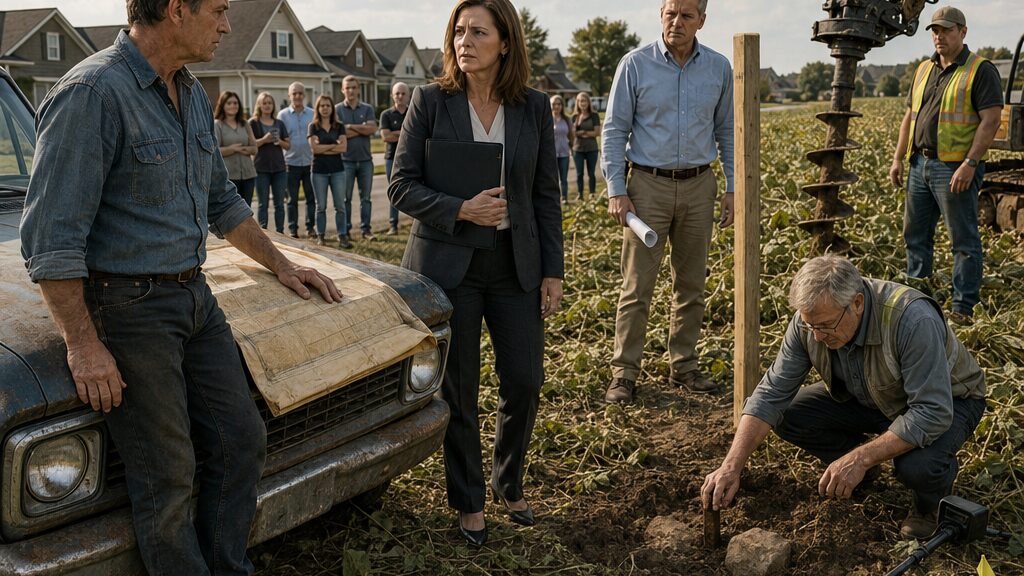
A fence contractor had already drilled one hole through the crop. A fresh cedar post stood upright among flattened leaves, its pale wood clean against the dark soil. Ten yards farther north, a second man was positioning the auger over another painted mark.
Jacob stepped in front of it.
“Shut it down.”
The operator lifted both hands from the controls. The engine settled into a rough idle.
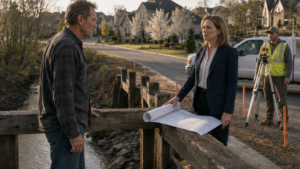
A man in pressed khakis walked down from the subdivision side, carrying a rolled sheet of paper. Jacob recognized Ryan Carter from the mailbox gathering two months earlier. Ryan had introduced himself then as the new architectural committee chair for Cedar Ridge, saying the association needed more consistency.
Behind him came Sandra Roberts, the community manager, with a tablet held against her chest.
Ryan stopped on the unplanted edge of the row. “Jacob, I was going to come find you.”
“You found me.”
Ryan looked at the damaged plants, then at the post. “The contractor was told to stay on the surveyed line.”
“This isn’t the line.”
Sandra opened a file on her tablet. “The association approved replacement fencing based on a licensed boundary survey.”
Jacob crouched beside the post. The hole had taken out six plants and torn the feeder roots of several more. He pressed two fingers into the loosened soil, not because he needed to examine it, but because it gave his hands something to do.
His father had taught him the western line by walking it, not by pointing at a map. From the old white oak near the road to the shallow drainage cut, then south toward the iron corner buried beside the stone shelf. The fence that had stood there when Jacob was a boy had rotted away before Cedar Ridge was built, but the distance between the field edge and the old drainage path had not changed.
The new post was inside it.
“Two feet,” Jacob said.
Ryan unrolled the sheet on the hood of the contractor’s truck. “Closer to twenty-six inches at this end.”
He said it as if accuracy made the taking smaller.
The survey bore a blue stamp, a date from the previous month, and lines drawn with a confidence Jacob disliked on sight. Ryan tapped the western lot boundary.
“My surveyor located the corner here. The subdivision fence was supposed to follow this line when the development went in. It never did.”
Jacob studied the numbers. Ryan watched him with the patience of someone waiting for an older man to accept a fact.
“You measured from that road monument?” Jacob asked.
“The surveyor did.”
“Which one?”
Ryan’s expression tightened slightly. “The one of record.”
Jacob traced the printed distance from the northern section reference to Ryan’s southern corner. Then he looked across the field.
The figure was wrong.
Not wildly wrong. Just enough.
He had planted this strip for thirty-eight seasons. The outer row lay where the planter turned after passing the drainage cut. The width from the white oak to that turn had been checked when he replaced the irrigation line twelve years earlier. The number on Ryan’s paper shortened the field by a little more than two feet.
“That measurement doesn’t close,” Jacob said.
Ryan gave a restrained smile. “It closed for the surveyor.”
“It doesn’t close on the ground.”
Sandra stepped nearer. “Mr. Harris, I understand this is upsetting, but the association cannot disregard a sealed survey based on recollection.”
Jacob looked at her. “You think I remember two feet wrong?”
“I think property disputes require documentation.”
The contractor killed the engine completely. In the sudden quiet, Jacob heard the dry whisper of soybean leaves rubbing together.
Ryan lowered his voice. “We’re not trying to make this personal. Brenda and I need the boundary settled before we can move ahead with our addition. I paid for the survey. The HOA reviewed it. We’re doing this properly.”
Jacob’s gaze moved toward the Carter house. It was the newest one on the subdivision edge, brick front, wide windows, a temporary ramp leading to the porch. He had seen Brenda once using a cane near the driveway.
“That doesn’t move my field,” he said.
“No,” Ryan replied. “The survey establishes where your field should end.”
The words landed harder than the cedar post.
Jacob reached for the paper. Ryan hesitated, then handed it over. Jacob folded it once, carefully, and tucked it beneath his arm.
“I’ll keep this.”
“That’s a copy,” Ryan said.
“Good.”
Jacob walked toward the first post and pulled the orange survey stake beside it from the ground. The thin wood came free with almost no resistance.
Sandra’s voice sharpened. “Do not remove markers.”
“It isn’t a monument.”
“It is part of an authorized project.”
“It’s a painted stick in my beans.”
She turned the tablet so he could see the document on the screen. The heading read NOTICE OF COMPLIANCE AND ACCESS. His name appeared below it, though Jacob had never belonged to Cedar Ridge.
“This notice advises you not to obstruct the association’s contractor,” she said. “The recorded subdivision documents show a maintenance strip along this boundary. If you interfere, the board may seek costs and legal fees.”
Jacob read only enough to see that the notice treated the disputed land as already decided.
“You sent me something like this?”
“By certified mail and email.”
“I don’t use email.”
“That doesn’t invalidate service.”
Ryan glanced at the two subdivision residents watching from the road. “We should pause for today.”
Sandra looked at him. “The contractor is scheduled.”
“And Jacob is standing in front of the equipment.”
Jacob folded the orange stake over his knee until it cracked. The sound was small, but everyone heard it.
He immediately regretted it.
Sandra took a photograph.
“There,” she said. “That is precisely the kind of conduct the board will document.”
Jacob let the broken pieces fall. He had given her what she needed: not proof of a boundary, but proof of a difficult man.
Ryan rolled up the remaining survey sheets. “We’ll give you until Thursday to produce something formal.”
“You don’t give me time on my own land.”
Ryan’s politeness thinned. “Then use the time anyway.”
The contractor loaded the auger. Sandra placed a printed copy of the notice under the windshield wiper of Jacob’s truck, though he was standing ten feet away. As they left, the fresh cedar post remained behind, upright in the damaged row.
Jacob waited until the road was empty.
Then he paced from the white oak to the drainage cut, counting under his breath. He measured again with the steel tape from his toolbox. The number matched his memory and contradicted Ryan’s survey by twenty-five and three-quarter inches.
Close enough to dismiss.
Large enough to take.
At the truck, Jacob opened the passenger door. Dust lay thick across the floor mat. Behind the seat sat a dented thermos, two grease rags, a length of chain, and a bundle wrapped in dark oilcloth.
He had not opened it in years.
His father had made him promise not to leave those papers in the courthouse, a lawyer’s office, or anyone else’s hands longer than necessary. Paper disappeared, his father used to say. Memory got corrected by men with cleaner shoes.
Jacob lifted the bundle and placed it on the seat.
The oilcloth had stiffened at the folds. He loosened the cord and drew back one corner.
Beneath it lay the yellowed edge of a plat dated 1953.
Chapter 2: The Map His Father Never Trusted Anyone to Hold
Maria found the documents before Jacob had finished making coffee.
She came through the mudroom carrying the broken survey stake he had left in the truck bed. Her work shoes clicked across the kitchen linoleum. She set the two pieces on the table, then placed the oilcloth bundle beside them.
“You kept these behind the seat?”
Jacob poured coffee into a chipped mug. “They were wrapped.”
“That truck doesn’t lock.”
“It locks.”
“The passenger door opens with a screwdriver.”
He sat opposite her. The bundle lay between them like something she had caught him hiding, which was close enough to the truth.
Maria untied the cord and unfolded the oilcloth. She handled the papers carefully, but her jaw stayed tight. The first was the 1953 plat, creased into quarters, its ink faded to brown. Beneath it lay a patent deed and a sworn affidavit signed in 1971 by the surveyor who had reestablished the western corner for Jacob’s father.
Maria read the legal descriptions twice.
“These all call the same distance.”
“I know.”
“To the inch.”
“I know that too.”
She looked up. “Then why weren’t copies recorded with the farm file?”
“The plat was recorded.”
“The plat was. This affidavit isn’t indexed with the current parcel records. The deed references an older book. And this”—she touched the oilcloth—“is not a filing system.”
“It kept them dry.”
“For seventy years, apparently by accident.”
Jacob drank his coffee.
Maria worked as an agricultural loan officer at a bank in Hillsboro. She understood collateral reports, title exceptions, recorded easements, and every other form of paper Jacob believed had been invented to make ownership uncertain.
“You should have called me yesterday,” she said.
“I called Christopher.”
“You called a surveyor before you told your daughter an HOA was fencing off part of the farm.”
“I needed someone who knew what he was looking at.”
Maria leaned back. “That was not the right answer.”
He knew it, but the old reflex rose anyway. “You left farm work for the bank.”
“I left field work. I did not leave the family.”
Jacob looked toward the window above the sink. From there he could see the roof of his truck and, beyond it, the upper branches of the white oak.
Maria gathered the documents into a flat stack. “We’re taking these to the county.”
“We’re taking copies.”
“They need to examine the originals.”
“They can examine them while I’m standing there.”
Her mouth pressed into a thin line. “Fine.”
At the Jefferson County records office, the clerk spread the plat beneath a clear protective sheet. Jacob stayed close enough to see every movement of her hands.
She checked the recording reference in a ledger, then brought up a scanned image on her monitor. The digital copy was faint but legible.
“This plat is recorded,” she said. “Book twenty-eight, page one hundred fourteen. Filed June of 1953.”
Maria released a breath.
Jacob felt a small, private satisfaction. The paper had not needed defending after all.
Then the clerk searched the adjacent subdivision.
Cedar Ridge had been recorded decades later. Its western exhibit showed a line that did not sit directly over the old farm call. A utility easement ran along part of the edge, and the subdivision corner appeared shifted east.
Maria placed Ryan’s survey beside the old plat.
The two corners could not both be right.
The clerk enlarged the subdivision image. “This exhibit references a set rebar at the southwest corner.”
“What year?” Maria asked.
“During the subdivision filing.”
Jacob pointed at the older map. “That corner was already monumented.”
The clerk gave him the patient look of someone refusing to become part of an argument. “I can certify what was recorded. I can’t interpret which monument controls.”
She produced certified copies of the old plat, the later subdivision exhibit, and the section-monument record. The last document contained field notes from several survey visits, some handwritten, some typed. One entry referenced an original iron pin near a stone shelf. A later entry noted that the pin was “not recovered.” The subdivision filing relied instead on a capped rebar.
Maria read the phrase aloud.
“Not recovered,” Jacob said. “That does not mean gone.”
“No,” she replied. “It means someone didn’t find it.”
The distinction offered hope, but not certainty.
By noon they were in Christopher King’s survey office. Rolled maps filled vertical bins along one wall. Survey equipment cases occupied the other. Christopher, gray-haired and narrow-shouldered, studied the certified records without offering Jacob the easy agreement he expected.
“You remember the old corner?” Christopher asked.
“I know where it is.”
“That wasn’t my question.”
Jacob felt Maria watching him.
“I remember where my father showed me.”
Christopher nodded. “And your father was shown by whom?”
“His surveyor.”
“The man who signed this affidavit?”
“Yes.”
“That helps. It does not finish the work.”
Jacob tapped the 1953 plat. “Three documents call the same point.”
“And a later recorded subdivision uses another point. If I walk into court and say your point wins because it is older, I’ll be asked whether the original monument can be identified, whether it was disturbed, whether the calls close, and whether the replacement marker was set by mistake or by a valid retracement.”
“You sound like Sandra.”
“I sound licensed.”
Maria looked down to hide what might have been a smile.
Christopher overlaid transparent drafting film across the two maps. He marked the white oak, the drainage cut, the road reference, and the subdivision’s capped rebar. Then he drew the old call toward the western corner.
The lines separated by slightly more than two feet.
“There,” Jacob said.
Christopher kept drawing.
The old distance closed neatly against the northern section reference. The newer exhibit closed against the replacement rebar but introduced a small rotation along the subdivision edge.
Maria leaned closer. “Would that affect more than Ryan’s lot?”
“Possibly.”
“How many?”
“I’m not answering that until I run the entire edge.”
Jacob pointed at the older section notes. “Search where this says.”
“I will.”
“When?”
“Thursday.”
“The contractor comes Thursday.”
Christopher looked at him. “Then tell them not to disturb the area.”
“I already told them.”
“Tell them in writing.”
Jacob turned toward the window.
Maria said, “We’ll send it.”
Christopher circled one entry on the section-monument record. The note described an iron pin beside natural stone, set from the original government line and later verified in 1971. Below it, he circled the later phrase: not recovered.
Then he drew a line to the capped rebar used for Cedar Ridge.
“If your pin is still there and undisturbed,” he said, “Ryan’s survey may begin from the wrong iron.”
The room went quiet.
Jacob had come expecting the old map to settle the matter. Instead, the truth had narrowed to something that might be buried under forty years of soil, roots, grading, and neglect.
Maria gathered the certified copies. “And if the pin isn’t there?”
Christopher capped his pen.
“Then this gets much harder.”
Chapter 3: The Ground Answered Before the HOA Would
The contractor’s auger hung three feet above the place Christopher intended to search.
Jacob saw it from the cab of his truck as he came over the rise Thursday morning. Sandra’s SUV stood on the subdivision road. Ryan’s pickup was parked beside it. Two board members waited near the fence materials, and several residents had gathered where the pavement ended.
Christopher had not arrived.
Jacob drove into the field and stopped between the auger and the predicted corner. He left the truck crosswise, blocking the contractor’s path.
Sandra walked toward him holding a folder. “You were notified that work would resume at eight.”
“You were notified that a licensed surveyor was examining the line.”
“Our attorney reviewed your letter. The association is proceeding under the recorded subdivision exhibit unless a court orders otherwise.”
Ryan stood behind her, avoiding Jacob’s eyes.
Jacob looked at the contractor. “You drill there, you may destroy a monument.”
The contractor shifted his weight. “I go where they mark.”
Sandra removed a document from the folder. “The board has authorized completion. Any crop extending into the association maintenance strip will be removed and charged back as an enforcement cost.”
One of the residents raised a phone.
Jacob noticed the lens and felt heat climb his neck. He could already imagine how the scene would look: old farmer blocks equipment, breaks stakes, argues with professionals.
He opened his truck door but did not get out of the way.
“Then wait for Christopher.”
Sandra checked her watch. “Five minutes.”
Ryan finally spoke. “Jacob, the addition contractor is holding our schedule. We can’t keep stopping every time you find another old paper.”
Jacob looked at the temporary ramp outside the Carter house. “This isn’t about your addition.”
“It is to me.”
“That still doesn’t make the line move.”
A white survey truck turned from the county road.
Christopher parked near the field entrance and climbed out with a metal detector, a shovel, and a case of instruments. Maria followed in her car. She carried the oilcloth bundle against her chest.
Sandra’s expression changed when she saw it. “Those documents should not be exposed out here.”
Maria answered before Jacob could. “Neither should the monument you’re preparing to drill through.”
Christopher walked straight to the auger. “Lift the bit and shut down the machine.”
The contractor looked at Sandra.
“I am not directing his work,” she said.
Christopher faced the operator. “If you disturb a possible controlling monument after receiving notice, put my name in your report as the person who warned you.”
The operator killed the engine.
The residents drew closer.
Christopher set a tripod over the northern reference point and took readings. He checked the old call against the certified plat, then measured south and west. Jacob watched the numbers accumulate on the instrument display, but Christopher offered no running explanation.
At the predicted area, packed soil showed where subdivision grading equipment had once passed. A thin layer of gravel lay beneath the grass.
Maria spread the 1953 plat across the hood of Jacob’s truck. The oilcloth kept it from touching the dust. Beside it she placed the certified copy and Ryan’s polished survey.
Old paper. New paper. One field.
Christopher drove a fluorescent flag into the soil.
“This is the calculated vicinity,” he said.
Ryan folded his arms. “How wide a vicinity?”
“Until I find evidence, wider than you’ll like.”
Christopher switched on the detector. Its low electronic hum drifted across the quiet field. He moved it slowly over the soil, overlapping each pass.
Nothing.
He shifted west.
The machine gave a faint chirp, then went silent.
Jacob’s confidence tightened into something less stable. He looked toward the stone shelf, most of it hidden now by weeds and years of soil pushed from the subdivision side. His father had once rested a boot there and told him never to trust a fence without knowing what held the corner.
Christopher swept again.
A sharper tone sounded.
Everyone heard it.
He stopped and marked the spot with his boot.
Sandra stepped forward. “That could be scrap.”
“It could,” Christopher said.
He knelt and cut a square of sod with the shovel. Beneath it lay compacted clay mixed with small stones. He removed the soil by hand as he went deeper.
The detector sounded again over the hole.
Jacob moved closer, but Christopher held up one palm. “Let me expose it.”
At eight inches, the top of a rusted iron pin appeared.
For a moment nobody spoke.
Christopher brushed away the dirt. The pin was old, square-sided, and seated beside the buried edge of natural stone. He measured its position, photographed it, and checked the call again.
Jacob looked from the pin to the cedar post. The post stood a little more than two feet inside the line indicated by the iron.
Ryan’s face lost color.
Maria placed one hand on the oilcloth, as if steadying the old plat.
“That’s it,” Jacob said.
Christopher did not look up. “It is consistent with the original call.”
“You know what it is.”
“I know what it may be. I still verify before I certify.”
Sandra opened the recorded subdivision exhibit. “The association relied on this document in good faith. A buried object does not automatically invalidate a recorded plat.”
Christopher stood. Soil marked both knees of his work pants.
“This is not merely a buried object.”
“Then are you declaring the subdivision exhibit wrong?”
“I am saying no further work should occur until the monument chain is reconstructed.”
“That is your opinion.”
“It is my professional recommendation.”
The board members murmured to each other. The resident holding the phone lowered it, then raised it again toward the exposed pin.
Jacob expected satisfaction. Instead he felt the argument changing shape beneath him. The ground had answered, but the people who had demanded proof were already deciding how much proof they required.
Ryan walked toward the hole.
Christopher stepped between him and the pin. “Don’t touch it.”
“I wasn’t going to.”
His voice lacked its former certainty.
Jacob pointed to the cedar post. “You’ll pull those today.”
Sandra closed the exhibit. “No. Work is paused pending review. Nothing will be removed until the association’s attorney assesses liability.”
“It is in my crop.”
“And removal could compromise evidence.”
“You weren’t worried about evidence when the auger was running.”
Her eyes hardened, but she did not answer.
Christopher moved toward the subdivision’s recorded corner, where a newer rebar marker rose just below ground level. He cleared the grass around it and examined the cap.
“This is the point Ryan’s survey used,” he said.
The cap bore a stamped number.
Christopher wiped it with his thumb, then checked the subdivision exhibit.
“What?” Maria asked.
He took a photograph.
“This is a developer’s construction rebar, not the original section monument.”
Ryan stared at it. “My surveyor said it was the corner.”
“It was treated as the corner.”
“Is there a difference?”
Christopher looked back toward the old iron pin beside the stone shelf.
“There may be twenty-six inches of difference.”
Sandra ordered the contractor to remove the auger from the field but leave the posts in place. The board members departed without speaking to Jacob. Residents drifted back toward the road, carrying the image of the rusted pin with them.
Ryan remained beside the newer marker.
“Could the old one have been abandoned?” he asked.
Christopher packed his detector into its case. “Possible.”
“Could the newer one be valid?”
“Possible.”
Ryan seized on the word. “Then we don’t know.”
“We know enough to stop pretending there was no conflict.”
Jacob heard the sentence strike Ryan more cleanly than any accusation he could have made.
Maria folded the certified copies. She left the original plat on the oilcloth until Jacob placed it back inside.
Christopher took one final measurement between the two irons.
Then he pointed to the stamped cap on the replacement rebar.
“That number belongs to the company that laid out Cedar Ridge,” he said. “If we want to know how this line moved, we start with their field notes.”
The old iron pin remained exposed in the morning light. Two feet away, the cedar post stood straight and new.
Between them lay the distance someone had mistaken, inherited, or chosen.
Chapter 7: The Fence Came Down, but the Line Stayed Recorded
The contractors returned six weeks later with pry bars instead of an auger.
Jacob watched from the edge of the soybean field as the first cedar post rocked loose from the soil. Its base emerged dark with moisture, dragging a small collar of roots and clay behind it. The contractor laid it flat beside the row, then moved to the next one.
No one spoke much.
The HOA’s insurer had approved payment for the damaged crop, Christopher’s survey work, the county filings, and part of Jacob’s legal costs. Ryan had agreed to contribute the remainder personally. The settlement did not call his conduct fraud, and it did not erase the fact that he had relied on a recorded exhibit at the beginning. It stated only that he had continued enforcement after receiving notice of a credible monument conflict.
That sentence had taken three weeks to negotiate.
Sandra stood beside the subdivision road with a clipboard. She checked off each removed post and photographed the empty holes. Her company had mailed correction notices to the three affected homeowners and suspended all fence approvals along the western edge until the revised plat was recorded.
She no longer called Jacob’s soybeans an encroachment.
The old iron pin remained beneath a protective survey cap near the stone shelf. Christopher had marked it with two temporary flags, but no fence stood on it. The line needed no decoration now. It existed in measurements, certified records, and the ground itself.
Ryan arrived after the third post came out.
He wore work clothes instead of the pressed shirts Jacob associated with him. Brenda sat in the passenger seat of their pickup while he walked across the grass carrying a document folder.
“The recorder accepted it,” Ryan said.
Jacob took the folder.
Inside was the corrective survey bearing Christopher’s seal, the county recorder’s stamp, and references linking the original 1953 monument to the current parcel descriptions. A second filing established the temporary construction-access easement along the farm lane.
The true boundary had not merely been found.
It had been made difficult to lose again.
“Maria has a copy,” Ryan said.
“She has more than one.”
Ryan nodded. He looked toward the contractors. One of them lifted another post from the field and placed it on the growing stack.
“I resigned from the committee.”
Jacob closed the folder. “I heard.”
“The board president asked me to stay until the correction notices were finished.”
“Did you?”
“No.”
The answer carried no request for praise.
Ryan looked back toward Brenda. “The architect moved the addition eight inches east and narrowed a storage wall. The access easement gives them enough room for equipment.”
“Good.”
“The loan had to be rewritten.”
Jacob waited.
Ryan rubbed his thumb along the edge of his belt. “I kept thinking that if the old marker had mattered, someone would have put it in a place where people could see it.”
“It was in the place it belonged.”
“I know that now.”
Jacob heard an apology trying to form and failing.
Ryan’s eyes shifted to the field. “I should have stopped the work when the surveyor warned me.”
“Yes.”
“I thought delay was the same as losing.”
Jacob glanced at Brenda’s temporary ramp, visible beyond the truck. “Sometimes it is.”
Ryan looked at him, surprised by the concession.
“Doesn’t make every shortcut yours to take,” Jacob added.
“No.”
That was as close as they came.
Ryan signed the final acknowledgment on the hood of Jacob’s truck. The document confirmed the corrected boundary, waived further claim to the disputed strip, and accepted responsibility for his settlement contribution. His signature was smaller than Jacob expected.
When he finished, he handed over the pen.
Jacob signed beneath him.
There was no handshake.
Brenda opened the passenger door and stepped down carefully with her cane. Ryan moved toward her, but she waved him back. She crossed the grass at her own pace until she reached the farm lane.
“Mr. Harris,” she said.
“Jacob is fine.”
She looked at the strip marked for construction access. “The contractor says they will need it for twelve working days.”
“They get fourteen under the filing.”
“I know. I read it.”
“I figured you would.”
A faint smile passed across her face.
“They’ll restore the gravel and compacted soil afterward,” she said.
“And reseed anything they tear up.”
“That is in there too.”
Jacob nodded.
Brenda looked toward the exposed stone shelf near the old pin. “Ryan told me you could have refused the access.”
“I could have.”
“Why didn’t you?”
Jacob considered giving her the simple answer, that her bedroom had nothing to do with his property line. But that was not the whole of it.
“Because the line needed correcting,” he said. “It did not need punishing.”
Brenda’s grip tightened slightly on the cane. “Thank you.”
He accepted the words without dismissing them.
By midday, every cedar post had been removed. The contractor filled the holes and leveled the soil, though the damaged soybean plants could not be restored. Their flattened stems formed a pale scar through the green rows.
Maria arrived carrying a fireproof document case.
She found Jacob beside the old iron pin, looking at the empty line.
“The recorder gave me the certified copies,” she said.
“So Ryan told me.”
She opened the case on the truck hood. Inside were the corrective survey, the old deed, the 1971 affidavit, and high-resolution archival copies of the 1953 plat. The original oilcloth bundle rested beneath them.
“You said the original stays with me,” she said.
“I remember.”
“I want it at the bank for now. Later we can put it in a safe-deposit box under both names.”
Jacob looked at the case. “Both?”
“If you still intend to make this shared.”
He reached into the cab and pulled a clean envelope from the glove compartment. Inside was a certified field copy of the plat, laminated against dirt and rain.
“This one goes behind the seat,” he said.
Maria laughed once. “At least lock the truck.”
“I repaired the lock.”
“When?”
“Last week.”
“That may be the most surprising part of this entire dispute.”
They placed the field copy behind the seat where the oilcloth bundle had been. It looked too new there, too clean, but useful things did not have to look inherited.
Maria closed the fireproof case.
“The lender approved the operating line,” she said. “They accepted the corrected title report and the insurance payment.”
Jacob let out a breath he had been holding for weeks.
“The south parcel stays?”
“It stays.”
Across the field, Ryan helped Brenda back into the pickup. Their house would still stand close to Jacob’s land. They would still meet at the road, hear each other’s equipment, and see the corrected line every time they looked west.
Nothing about that had become easy.
The last contractor loaded the cedar posts and drove away. In the disturbed soil, only shallow dark circles showed where they had stood.
Jacob walked to the old pin and pressed the protective cap firmly with his boot. It did not move.
Maria joined him.
“My grandfather showed this corner to my father,” Jacob said. “My father showed it to me.”
Maria looked down at the marker. “And now?”
Jacob handed her the key to the document case.
“Now you know where the line is.”
She closed her fingers around it.
Behind them, the truck held a copy meant for weather, work, and ordinary use. The original map left the field in Maria’s care, still wrapped in the same dark oilcloth, no longer hidden and no longer guarded by one person alone.
The ground had remembered the line.
At last, so would the record.
The story has ended.