She Wanted the Old Maple Cut Down Until Its Shadow Became the Only Safe Place Left
Chapter 1: The Sunset Complaint Became an Official Threat
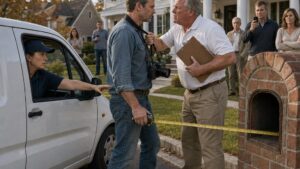
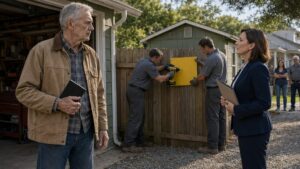
The tree-removal estimate had been taped across Frank Williams’s front door at eye level, as though whoever placed it there wanted to make certain he could not enter his own house without touching it.
He stood on the porch with one grocery bag hanging from each hand and read the bold line twice.
REMOVAL OF MATURE MAPLE, INCLUDING STUMP GRINDING.
Below it, someone had circled the total in blue ink.
The paper bore the name of a contractor from two towns over. Frank had never called them. He had never asked anyone to price the tree.
He set the bags down and peeled the estimate from the glass. A strip of orange survey ribbon had been stapled to one corner. When he looked past the porch rail, he saw another length of the same ribbon tied around the maple’s trunk.
The tree stood between his yard and Shirley Baker’s, though most of its trunk rose on Frank’s side of the low hedge. Its canopy spread over both properties, crossed the sidewalk, and reached toward the curb. Evening light broke through the leaves in scattered pieces.
Shirley was standing on her patio with her arms folded.
“You could have spoken to me,” Frank said.
“I did,” she replied. “More than once.”
“You complained about leaves in your gutter.”
“And roots near my patio. And branches over my roof. And the fact that I can’t see the sunset from the room we bought for that view.”
Frank held up the estimate. “This isn’t a conversation.”
“No. It’s a price.”
Her new patio still looked too bright against the older brick of the house. Dark pavers formed a clean rectangle where a narrow flower bed had once been. A metal table sat near the edge, positioned toward the western sky.
Frank had watched the crew work there three weeks earlier. He remembered the cutter grinding through something beneath the soil, followed by a short argument about drainage. He had not gone over. Shirley had spent years telling him where his mower crossed the line, where his leaves collected, where his ladder leaned too close to her fence. He had decided her patio was her concern.
Now she pointed beyond him, toward the maple’s crown.
“That tree blocks half the sky.”
“It was here before your house.”
“So was the drainage ditch. We improved that.”
“You don’t improve a thirty-year-old maple by grinding it into mulch.”
Shirley’s mouth tightened. “My granddaughter was standing beside that table during the storm last month. A limb came down six feet from her.”
Frank looked up. The broken place was visible high on the eastern side, a pale scar among the leaves. He had removed the fallen branch himself after the storm. It had been thick enough to require his bow saw, but not thick enough, in his judgment, to condemn the tree.
“You said nobody was hurt,” he replied.
“That’s what nearly means.”
For a moment her voice lost its usual sharpness. Frank saw not the architectural committee chair who corrected mailbox colors, but a woman remembering a child’s startled cry.
Then Shirley nodded toward the estimate.
“I’m not waiting for the next one.”
“You called a removal company before an arborist.”
“I called people who return messages.”
Frank looked again at the orange ribbon around the trunk. It shifted in the breeze like a warning flag.
“You’re not authorized to mark anything on my property.”
“That’s exactly what the board will determine.”
“The board?”
“I’m chairing the review.”
Frank gave a short, humorless breath. “You filed a complaint and you’re chairing the review.”
“I disclosed that we share a property boundary.”
“You disclosed your sunset too?”
Her expression hardened.
“I don’t need to defend wanting to use my own home. The tree drops branches. It pushes roots under my patio. It creates a liability. The blocked view is one part of the complaint, not the whole complaint.”
Frank folded the estimate once, then again, pressing the creases with his thumbnail.
“You’re not cutting it down.”
“You may not be the only person who gets to decide.”
The shadow of the maple had crossed her lawn while they spoke. It reached the legs of her patio table, then the sliding glass doors behind her. The sun remained visible between two branches for another few seconds before the leaves swallowed it.
Shirley looked toward the fading light as though the tree had done it deliberately.
A white sedan turned into the cul-de-sac and stopped at the curb. Elizabeth Jones stepped out carrying a document envelope and a tablet. Frank recognized her from annual meetings, where she sat at the end of the board table and translated every disagreement into deadlines, sections, and liability language.
“Mr. Williams,” she said as she approached. “Mrs. Baker.”
“Good timing,” Shirley said.
Frank did not answer.
Elizabeth glanced at the ribbon, then at the folded estimate in his hand. Her face showed mild irritation, but not surprise.
“I would have preferred to deliver this before contractor materials appeared,” she said.
“You knew about the estimate?” Frank asked.
“I knew the association requested preliminary pricing.”
“Before an inspection?”
“It is standard to establish possible exposure.”
She handed him the envelope.
Inside was a ten-day hazard-review notice. The maple was described as a “potentially compromised tree affecting adjacent property and common pedestrian access.” Frank was required to provide evidence of inspection, insurance information, and any prior maintenance records.
At the bottom, a paragraph stated that if immediate danger were confirmed, the association could authorize emergency work and seek reimbursement from the responsible owner.
“Responsible owner,” Frank read aloud. “That hasn’t even been established.”
Elizabeth’s gaze moved from the trunk to the sidewalk. “The tax map suggests the trunk is primarily on your lot.”
“The neighborhood planted it.”
“That may affect maintenance history. It may not affect present liability.”
Shirley said, “This is what I’ve been trying to explain.”
Frank turned toward her. “You’ve been trying to explain the sunset.”
“And a child nearly being struck.”
The distinction landed harder this time.
Elizabeth spoke before he could respond. “No decision has been made. But refusing access for inspection will be treated as noncooperation.”
“I never refused an inspection.”
“You told the landscaping supervisor not to touch the tree last fall.”
“He was topping ornamental pears with a pole saw. He had no business near this maple.”
“That distinction is not reflected in the report.”
“Then the report was written by someone who wasn’t listening.”
Elizabeth held his gaze. “Ten days, Mr. Williams.”
She returned to her car. Shirley followed her toward the curb, already asking whether the review could be moved forward.
Frank stayed beside the tree.
He placed his palm against the bark. The trunk was warm on the western side and cool where the shadow had settled. Ruth used to say the tree kept two kinds of time: sunlight on one side, shade on the other.
He untied the orange ribbon and carried it around the trunk, intending to throw it away.
That was when he saw the disturbed soil near Shirley’s patio.
The grass ended in an uneven strip where the pavers began. Beneath the hedge, several roots had been exposed and covered again badly. One, as thick as Frank’s wrist, showed a pale, flat cut no more than a month old.
He crouched and brushed loose dirt aside.
A second root had been severed farther in.
The cuts led directly under Shirley’s new patio.
Chapter 2: The Tree Belonged to More Than One Yard
The county plat put the maple on a line so faint that Frank had to hold the paper against the morning sun to see whether the trunk belonged to him, the association, or no one in particular.
He stood at the counter of the HOA office while Elizabeth Jones watched him trace the boundary with one finger.
“This line is the landscape easement,” he said.
“That is one interpretation.”
“It’s labeled.”
“The label refers to the original development plan. Easement responsibilities were modified when the association took over from the builder.”
“Where’s the modification?”
Elizabeth turned her tablet around. “That is what our counsel is reviewing.”
Frank looked at the enlarged map. The trunk’s center sat almost exactly where his lot line met a narrow strip marked for common landscaping. Its roots ignored both.
“So you can’t say it’s mine.”
“I can say the tree affects your parcel.”
“It affects six parcels.”
“Effect is not ownership.”
Frank folded the plat. “Convenient.”
Elizabeth’s expression remained controlled. “Ambiguity does not eliminate danger. If the tree fails while everyone argues about who owns it, the damage will still occur.”
She slid a form toward him. It listed removal, stump grinding, sidewalk repair, and possible special assessment charges.
Frank pushed it back.
“I’m not signing responsibility for a tree the association planted.”
“You have records proving that?”
“I was there.”
“That proves memory.”
He disliked her for saying it, mostly because she was right.
Outside, the air had already become heavy. The forecast called for temperatures above ninety-five by afternoon, unusual for early June. Frank walked home with the plat under his arm and found Angela waiting beside his mailbox.
She wore work pants, a municipal forestry polo, and the expression she used when she knew he had ignored three messages.
“You could have called me,” she said.
“I could have.”
“But you didn’t.”
“You work for the city, not the HOA.”
“I also know trees.”
“I know this tree.”
“That isn’t the same thing.”
Frank continued toward the maple. Angela matched his pace.
He unfolded the plat against the trunk, using the bark to hold it flat. The shadow covered most of the sidewalk now. Two elderly residents had placed folding chairs near the curb. A parent stood with a stroller beneath the outer branches while a delivery driver paused to drink water.
Angela examined the map.
“The easement matters,” she said. “It may spread financial responsibility.”
“It spreads more than that.”
“I know.”
“No, you know what’s printed. You don’t know how this block used to look before the tree grew.”
She looked up into the canopy. “You mean before Mom’s planting project.”
Frank refolded the paper too quickly.
“This isn’t about her.”
Angela let the silence challenge him.
Across the street, Brandon Lopez was helping his daughter onto a scooter. The child pushed toward the small playground at the end of the cul-de-sac, where the slide and climbing platform stood in full sun.
Five minutes later, Brandon carried her back.
Her face was flushed, and she had stopped protesting. That alarmed Frank more than crying would have.
“What happened?” Angela asked.
“She got dizzy,” Brandon said. “The equipment’s too hot to touch.”
He lowered his daughter into one of the chairs beneath the maple. Angela crouched, checked her responsiveness, and asked for water. Frank brought a cold bottle from his garage refrigerator and wet a clean shop towel.
The child pressed it to the back of her neck.
Within minutes, her color began to settle.
Brandon looked toward the bright playground. “They took out the two smaller trees last winter because the roots lifted the rubber surface.”
Frank remembered. The board had approved removal in one meeting and replacement in another. No replacements had appeared.
“She shouldn’t have been out there that long,” Brandon said, more to himself than anyone else.
“You brought her back,” Angela replied. “Keep her cool and indoors for the rest of the day.”
The child leaned against her father and watched light move through the leaves.
Frank followed her gaze. The maple’s shadow crossed the sidewalk, reached Brandon’s lawn, and covered the curb where older residents sat every afternoon. It had become so ordinary that no one had thought to list it as an amenity.
Brandon said, “They can’t cut this down.”
Angela stood. “They may need to do something to it.”
“Like what?”
“That depends on an inspection.”
Frank folded his arms. “The tree is sound.”
Angela turned to him. “You saw root cuts.”
“That doesn’t mean the whole tree is failing.”
“It means you don’t know yet.”
Brandon looked between them. “Whose side are you on?”
“The side where no child gets hurt by heat or a falling limb.”
The answer quieted him.
Later that afternoon, Frank searched his garage for old association records. He found photographs of neighborhood planting days, receipts for mulch, volunteer schedules, and a faded site plan showing the maple as one of twelve trees installed along the common walk.
Most of the other eleven were gone.
One had split in an ice storm. Three had been removed during sidewalk repairs. Two died in drought years. Others disappeared when houses changed owners and patios, fences, or widened driveways replaced them.
The maple had outlasted every committee that had voted on it.
Frank carried the site plan to Elizabeth’s office before closing.
She studied it without visible satisfaction.
“This supports common-area origins,” she said.
“So the HOA maintained it.”
“It supports that possibility.”
“There are mulch receipts.”
“Volunteer mulch receipts. Your name appears on most of them.”
“Because I did the work.”
“That may be used to argue you assumed care.”
Frank stared at her. “You can’t ignore the tree for twenty years, then claim my care made it mine when it becomes expensive.”
“I’m not making that claim. I’m telling you what counsel may say.”
She copied the documents and returned the originals.
“The hazard question still comes first,” she added. “Ownership will not prevent emergency action.”
Frank left with a small victory that somehow felt heavier than defeat. If the tree belonged partly to everyone, then everyone had depended on him to notice what was wrong with it.
Angela’s car was in his driveway when he returned.
He found her in the workshop, standing beside his drafting table. A yellowed inspection report lay open beneath the removal notice.
At the bottom of the final page was Frank’s signature.
Angela rested one hand beside it.
“You told me there had never been a recommendation,” she said.
Frank looked at the date.
Two years earlier.
He remembered the arborist’s visit, the chalk mark on the eastern limb, and the sentence he had chosen not to repeat to anyone.
Angela tapped the report.
“What did you agree to, Dad?”
Chapter 3: The Report Frank Never Intended to Show
Angela laid the old report beside the ten-day removal notice, aligning the pages as carefully as evidence.
Frank remained near the workshop door.
The report’s final recommendation was underlined in faded blue ink: selective reduction of one overextended eastern scaffold limb within twelve months, followed by annual inspection.
His signature appeared beneath it.
“You signed this,” Angela said.
“I acknowledged receiving it.”
“You also wrote ‘schedule after nesting season’ in the margin.”
Frank moved closer. “That was not permission to remove the limb.”
“It was permission to reduce it.”
“The arborist wanted to take too much.”
“Did you get another opinion?”
He did not answer.
The workshop smelled of cedar dust and machine oil. Along one wall hung chisels Frank had sharpened for forty years. Above the bench, a worn wooden folding rule rested on two brass hooks.
Angela followed his eyes.
“Mom’s?”
“She used it for the planting layout.”
“I know whose it was.”
Frank took the rule down and opened it one section at a time. Ruth’s initials were still visible near the hinge, darkened by years of handling.
“The branch was healthy then,” he said.
“The report says it was overextended and poorly attached.”
“It says reduction, not hazard.”
“It says delay would increase loading at the union.”
“That language is how they protect themselves.”
Angela’s face changed, not into anger but disappointment.
“You sound exactly like Shirley when she talks about liability.”
Frank closed the rule with a snap.
“That tree has survived windstorms, ice, drought, and every management company this neighborhood has hired.”
“And one of its limbs nearly hit a child.”
“It fell in a storm.”
“That is when compromised limbs usually fall.”
He turned away from her.
Through the open workshop doors, the eastern branch stretched above Shirley’s side yard. Leaves shifted along its length. The pale scar from the fallen limb sat lower, near a fork Frank had inspected from the ground and decided was clean enough.
Angela came to stand beside him.
“Show me which limb the report meant.”
Frank took the folding rule and walked beneath the canopy. He used the closed rule to sight along the branch, then opened it to measure clearance from the roofline as though distance could answer what he had refused to ask.
The eastern scaffold began twelve feet above the ground and divided over Shirley’s patio. One side carried most of its weight toward her house.
“That one,” he said.
Angela examined the union through binoculars from her car.
“There’s included bark,” she said. “And the canopy is heavier at the end than it was in the old photos.”
“It put on growth.”
“That is the problem.”
A gust came through the cul-de-sac.
Most of the maple answered with the soft rush of thousands of leaves. The eastern limb gave a lower sound—a slow wooden complaint from deep at the union.
Frank felt it through the soles of his shoes.
Angela lowered the binoculars.
“You heard that.”
“It moved.”
“It creaked.”
“Wood creaks.”
“So do structures before they fail.”
He looked toward Shirley’s patio. Her sliding door was closed. No one sat at the table.
“I was going to handle it,” he said.
“When?”
He did not know.
Angela waited until the silence became an answer.
Frank opened the folding rule again, though there was nothing left to measure.
“Your mother fought to plant those trees,” he said. “The builder wanted ornamental pears because they were cheap and looked finished fast. Ruth wanted shade trees. She went door to door until enough families signed.”
Angela’s expression softened, but only slightly.
“She didn’t ask you to preserve every branch forever.”
“No.”
“What did she ask?”
Frank looked at the moving shadow beneath them.
“She said people would complain about the leaves before they understood the shade.”
Angela glanced toward Shirley’s yard. “She was right about that.”
“She was right about most things.”
“That doesn’t make you right now.”
The words struck cleanly because Angela did not raise her voice.
Frank folded the rule and slipped it into his back pocket.
He had kept the report in the workshop drawer beneath Ruth’s planting photographs. At first he intended to schedule the pruning. Then the association changed managers. The arborist retired. A board member mentioned removing mature trees to reduce insurance exposure. Frank decided that if the report entered the HOA files, “reduction” would become “removal” by the time it crossed a committee table.
One season passed. Then another.
He told himself he watched the limb closely. He measured roof clearance after storms. He removed deadwood from the ground. He checked for fungal growth and loose bark.
He had performed care in every form except the one recommended.
“I should have had it reduced,” he said.
Angela nodded once.
That small acceptance made the admission worse.
A car door closed next door.
Shirley crossed her lawn carrying a copy of the old report.
Frank immediately understood where she had gotten it. HOA maintenance records had included the original inspection request, even if his copy had stayed hidden.
She stopped outside the hedge.
“You knew,” she said.
“It wasn’t a removal recommendation.”
“You knew there was a structural concern.”
“I knew one limb needed reduction.”
“And you did nothing.”
“I monitored it.”
“You measured it from the ground.”
Frank’s hand moved toward the folding rule in his pocket, then stopped.
Shirley held up the report.
“My granddaughter stood under that limb.”
“Your patio contractor cut roots.”
Her eyes flickered.
It lasted less than a second, but Angela saw it too.
Shirley recovered. “Do you have proof?”
“I saw the cuts.”
“You saw roots near a property line.”
“Freshly severed roots under new paving.”
“My contractor followed the approved plan.”
“Approved by whom?”
“The committee.”
“You chair the committee.”
“I recused myself from the vote.”
“But not from choosing the contractor.”
Angela stepped between them before Frank could continue.
“Both issues matter,” she said. “The limb was overdue for reduction, and root damage may affect stability. Arguing about which one cancels the other is how the whole tree gets condemned.”
Shirley turned toward her. “You work for the city. Are you saying it’s dangerous?”
“I’m saying it needs a full assessment.”
“The report already says—”
“The report is two years old.”
“And he ignored it for two years.”
Frank felt shame tighten into anger because anger was easier to carry.
“You wanted the tree gone before you knew about that report.”
“I wanted the risk addressed.”
“You wanted your sunset.”
“Yes,” Shirley said. “I wanted the sunset. I still do. I also want to sit in my own yard without wondering whether the next storm will drop half a tree on my family. Both things can be true.”
No one spoke.
Her honesty removed the simplest version of the argument. Frank could no longer dismiss every concern as vanity, just as Shirley could no longer pretend the view meant nothing.
A notification sounded on Angela’s phone.
Then Frank’s.
Then Shirley’s.
The HOA email had been sent to the full board and affected residents.
EMERGENCY HEARING: POTENTIAL TREE HAZARD.
The meeting was scheduled for Monday afternoon, three days away. The notice stated that because of the prior recommendation, recent branch failure, and unresolved ownership, the board would consider immediate removal under its emergency-maintenance authority.
A preliminary summary was attached.
Frank opened it.
The summary quoted the old report’s structural concern but omitted the recommendation for selective reduction. It mentioned “reported root interference” without identifying the new patio excavation. At the bottom, the management company recommended authorizing removal if no current certified assessment established retention as safe.
Shirley read over his shoulder.
“They moved it up,” she said.
“You asked them to.”
“I asked for a review.”
“This is a removal vote.”
Her silence suggested she had expected urgency, but perhaps not this form of it.
Angela scrolled to the final page.
“There’s no time to schedule a normal inspection before Monday.”
Frank looked up at the eastern limb. It moved gently above them, giving no sign that its future had just been reduced to three days.
The old report was no longer private. His delay was now evidence. Shirley’s complaint had become institutional momentum, and momentum did not care whether either of them had told only part of the truth.
At the bottom of the notice was one final line:
A tree-removal contractor would attend the hearing and remain available for immediate work upon authorization.
Chapter 4: The Hearing Moved Into the Maple’s Shadow
The contractor unloaded the chainsaw before the board had placed its folding table.
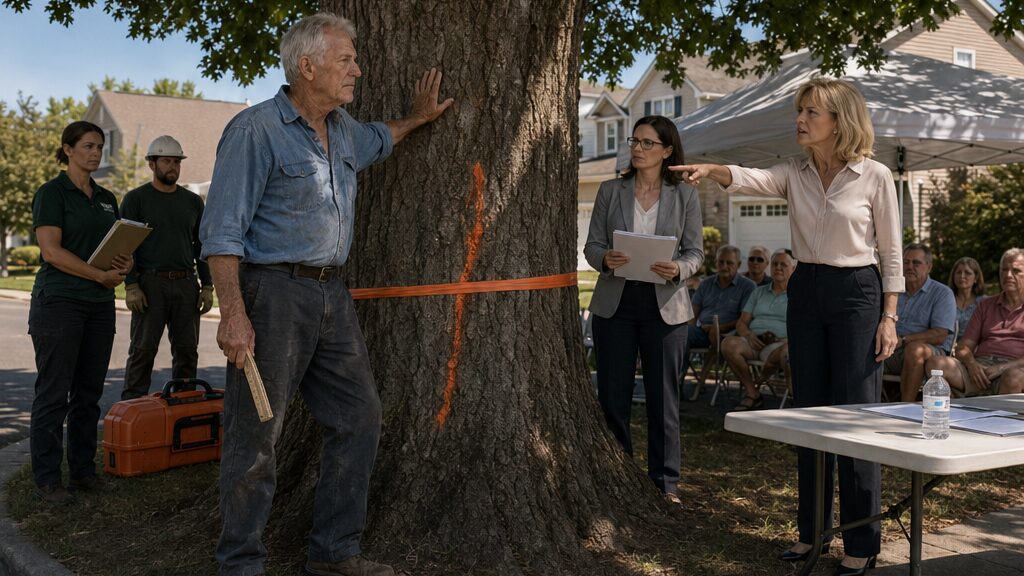
Frank watched him set the orange case on the grass beside the maple, followed by wedges, ropes, and a fuel can. A second worker wrapped fresh ribbon around the trunk at chest height and sprayed a small painted line near the base.
The hearing had not begun. No vote had been taken.
Still, the tree had already been marked like a decision.
“Take that off,” Frank said.
The worker looked toward Elizabeth Jones rather than answering.
Elizabeth stood beneath a temporary white canopy with a stack of packets pressed against her hip. The clubhouse air-conditioning had failed that morning, and the heat advisory had forced the emergency meeting outdoors. The board table had been set in direct sunlight because the canopy would not fit beneath the maple’s lowest branches.
“Contractor preparation is not authorization,” she said.
“He’s painted my tree.”
“He marked a proposed cut zone.”
“There shouldn’t be a proposed cut zone before the vote.”
Shirley Baker was arranging chairs in two straight rows. “The crew is charging for the day whether we use them or not.”
Frank looked at her. “You know that how?”
“Because I asked.”
The temperature display on Elizabeth’s tablet read ninety-seven degrees. Residents arrived carrying water bottles, paper fans, and copies of the hearing notice. Brandon Lopez came with his daughter but sent her to sit with an elderly neighbor beneath the maple.
The board members remained at the table until the sun heated the metal chair backs. One by one, they shifted their seats toward the edge of the tree’s shadow.
Frank noticed. So did Shirley.
Neither mentioned it.
Angela stood beside him with the old report and the county plat in a folder. Before leaving his house, she had asked what he intended to say.
“The truth,” he had answered.
“All of it?”
He had not replied.
Now the eastern limb stretched above the hearing, its leaves trembling in air that felt too heavy to move. Frank could see the point where the branch joined the trunk. Once seen through Angela’s eyes, the union no longer looked solid. A narrow seam ran down one side, partly hidden by bark.
Elizabeth called the meeting to order.
She summarized the recent branch failure, the two-year-old recommendation, the disputed ownership, and the association’s authority to correct immediate hazards. The language was calm enough to make removal sound like routine maintenance.
“The management recommendation,” she concluded, “is to authorize removal today unless reliable current evidence supports retention.”
A board member asked whether pruning remained an option.
Shirley answered before Elizabeth could.
“The prior recommendation was ignored. We are beyond minor pruning.”
Angela shifted beside Frank.
Elizabeth said, “The consulting summary states that structural concerns have progressed in the absence of corrective work.”
“Which consulting summary?” Frank asked.
“The one provided in your packet.”
“I asked for the complete report.”
“The relevant findings are included.”
“That is not what I asked.”
Several people turned toward him. Frank felt the old instinct to explain, defend, and fill every silence. Instead he walked to the trunk.
The contractor’s painted line ran eight inches above a flare root. Frank removed Ruth’s folding rule from his pocket, opened two sections, and laid it vertically against the bark beside the mark.
“What are you doing?” Shirley asked.
“Measuring the decision you made before the hearing.”
Elizabeth’s voice sharpened. “Mr. Williams, please return to the designated area.”
Frank left the rule against the trunk and remained beside it.
“Read the full recommendation.”
“We have summarized—”
“Read the part after structural concern.”
Elizabeth looked down at her packet.
Angela held up a separate copy. “Page four.”
Shirley’s face changed.
Frank saw it and knew there was more than omission by convenience.
Elizabeth turned several pages. “The original arborist recommended selective reduction of the eastern scaffold limb.”
“And?”
“Annual reassessment.”
“And the current assessment?”
“There is no completed current assessment.”
“Then who decided removal was the only safe option?”
No one answered immediately.
The contractor stepped away from the saw case.
Frank continued. “Your packet quotes a preliminary review. Where is the rest of it?”
Elizabeth’s fingers rested on the page. “The arborist who reviewed the photographs also noted that delayed pruning may have increased risk.”
“That isn’t the rest.”
Angela opened her folder.
“The full email says the tree requires an on-site root-zone investigation before a final retention decision because recent soil disturbance may have affected stability.”
A murmur moved through the chairs.
Shirley stood. “Photographs cannot show whether roots are stable.”
“Exactly,” Angela said. “Which is why the arborist did not recommend cutting the tree down from photographs.”
Frank watched Elizabeth. Her composure had not broken, but she no longer looked at the board members.
“Was the soil-disturbance note removed from the packet?” he asked.
“It was considered unverified.”
“The old pruning recommendation was also unverified by a current inspection, but you included that.”
“That report bears your signature.”
Frank accepted the blow.
“Yes,” he said. “It does.”
The murmuring stopped.
“I should have scheduled the reduction two years ago. I did not. That was wrong.”
Angela looked at him, but he kept his eyes on the board.
“The branch needs attention. Maybe more than it needed then. But my delay does not turn a recommendation for investigation into an order for removal.”
Shirley folded her arms. “And if it falls while you demand more paperwork?”
“If the full assessment says the tree cannot be retained, I will hear it.”
“You haven’t heard anyone yet.”
Frank glanced at the folding rule against the trunk.
“No. I heard only what I wanted. That does not mean the board should do the same.”
The first edge of the maple’s shadow reached the hearing table. A board member dragged his chair backward into it. Another followed. Parents moved children from the temporary canopy, where heat had collected beneath the vinyl roof, into the darker air under the branches.
Within minutes, nearly everyone sat inside the shade of the tree they were considering removing.
Shirley remained in the sun.
Elizabeth asked the contractor to hold his equipment until the board reviewed the full correspondence. The board recessed while she made two calls.
Frank stayed near the trunk. Sweat ran beneath his collar. Brandon handed him a bottle of water.
“You got them,” Brandon said quietly.
“No.”
“They can’t cut it now.”
“They can if the roots are gone.”
Brandon looked toward Shirley’s patio.
When the hearing resumed, Elizabeth announced that same-day removal would be suspended pending a root-zone inspection the following morning.
Relief moved through the gathering, but Frank felt none. The tree had gained one night, not safety.
Then Shirley approached the table carrying a sheet of paper.
“The soil work was authorized,” she said. “Mr. Williams knew about the trench.”
Frank stared at her.
She handed the page to Elizabeth.
It was a work request for patio drainage and utility clearance. Near the bottom, beside the line marked ADJACENT OWNER ACKNOWLEDGMENT, were the initials F.W.
The letters looked like his.
Not exactly, but close enough to force doubt.
Elizabeth turned the form toward him.
“Is this your acknowledgment?”
Frank studied the heavy downward stroke on the F. He had made that stroke thousands of times on invoices and shop drawings. The W leaned left, as his did when he wrote quickly.
“I didn’t sign this.”
Shirley’s voice was steady. “The contractor would not have proceeded without it.”
“I never saw this form.”
“You spoke to the crew.”
“I told them not to leave gravel against my hedge.”
Elizabeth examined the paper. “We will verify the original.”
Frank looked past her toward the eastern branch. He had hidden one truth and been exposed. Now a document suggested he had hidden another.
The board members watched him differently.
Not as the caretaker of the tree.
As a man whose denials might only mean that more had not yet been found.
Chapter 5: The Damage Beneath Shirley’s New Patio
The arborist lifted one patio paver and exposed a root cut so clean and pale that it looked like unfinished lumber.
Frank crouched at the edge of the opening.
The root was nearly five inches across. It ended beneath the dark paver in a flat face marked by machine teeth. A second severed root lay farther down, half buried in loose base gravel.
The arborist removed his gloves and pressed two fingers into the soil.
“This was not hand excavation,” he said. “A trencher came through here.”
Shirley stood near her sliding door with her husband. She had not offered anyone coffee or water. Her arms remained close to her body, as though the inspection itself were an intrusion.
Elizabeth photographed the opening.
Angela asked, “How far does the trench run?”
The arborist followed the paver line with a probe. “At least twelve feet. Possibly farther beneath the patio.”
Frank looked at Shirley. “Your contractor said he was cutting a drainage channel.”
“He said the roots were small.”
“These aren’t small.”
“I did not stand over him while he worked.”
“You signed the plan.”
“I signed a plan showing a shallow trench.”
The arborist inserted the probe again. “This is deeper than shallow.”
Elizabeth held the disputed work request in a clear sleeve.
“The contractor sent the original last night,” she said. “The adjacent-owner initials were added after the committee approval.”
Frank rose.
“By whom?”
“The contractor says one of his workers obtained them from you.”
“He’s lying.”
Angela reached for the form. Her eyes moved over the page, then stopped at the maintenance-history attachment.
“Dad.”
Frank recognized the sheet beneath the work request. It was a copy of an old volunteer tree-care form he had submitted years earlier. His initials appeared beside three maintenance entries.
The F and W on the patio form had the same angle, spacing, and uneven ink break as the copied initials below.
Not similar.
Identical.
“They lifted it from this,” Angela said.
Elizabeth compared the two sets. “It appears copied.”
Shirley looked at the paper, then toward the open patio.
“I never asked anyone to copy his initials.”
“But you gave the contractor this maintenance form,” Elizabeth said.
“It was in the committee file.”
“Why did the contractor have it?”
“He asked who maintained the roots on the other side.”
Frank’s anger rose fast and clean. He imagined the emergency hearing, the board members studying him as though his memory were another defect. He imagined reading the copied initials aloud to every resident and watching Shirley’s authority collapse.
Brandon stood beyond the hedge with two neighbors. News of the inspection had traveled before breakfast. Frank could have called them closer. He could have made sure they heard.
Instead he asked the arborist, “Can the tree survive?”
The question redirected every face toward the exposed roots.
The arborist sat back on his heels.
“Possibly.”
Shirley gave a short breath. “That is not reassuring.”
“It is also not a removal recommendation.”
He explained that the severed roots reduced stability on the eastern side, the same side carrying the overextended scaffold limb. Soil beneath part of the patio had also been compacted, limiting oxygen and water. The tree showed no major trunk decay, but the combination of root loss and canopy weight created a risk that could not be ignored.
“What would retention require?” Angela asked.
“Immediate reduction of the eastern limb and selective reduction elsewhere to balance the crown. Root-zone excavation with an air tool. Compacted soil replaced or amended. A support system may be appropriate, depending on what we find. Watering through the summer. Monitoring for several years.”
“How much of the branch?” Frank asked.
The arborist looked up.
“Enough that the tree will not look the same.”
Frank felt the words more sharply than he expected.
Shirley stepped toward the opening. “And after all that, can you guarantee it won’t fall?”
“No.”
“Then removal is safer.”
“Removal transfers one risk into other costs. Heat, loss of canopy, soil disturbance, replacement, and the possibility of damaging adjoining roots and utilities. My job is not to guarantee nature. It is to recommend a reasonable risk level.”
“My granddaughter was standing right there.”
Her voice broke on the last word.
No one moved.
Shirley looked down at the pavers, not at Frank.
“She was visiting during the storm,” she said. “I had told her we could watch the rain from under the covered part of the patio. The branch hit the table after my husband pulled her inside. The glass shattered.”
Frank had seen the replacement table but had not known why it was new.
“She had cuts?” he asked.
“From the glass. Small ones.”
“But enough,” Angela said.
Shirley nodded. “She screamed every time the wind moved the leaves after that. I told her I would make sure it could not happen again.”
Frank looked toward the eastern limb. In his mind, the dispute had begun with a sunset. That was the version he had preferred because it allowed him to dismiss everything else.
“You should have told me,” he said.
“I did.”
“You told me it blocked your view.”
“I told you about the branch too.”
He remembered her exact words. A limb came down six feet from her.
He had answered that no one was hurt.
Frank looked at the cut roots. “And then you hired a contractor who made it worse.”
Shirley’s jaw tightened. “I hired someone approved by the committee.”
“You chaired the committee.”
“I recused myself.”
“You handed him my records.”
“I did not tell him to copy anything.”
“No. You only made it easy.”
Elizabeth lowered her phone.
“The association will investigate the contractor and the approval process. That does not resolve today’s hazard.”
Frank could feel Brandon waiting for him to attack. Shirley seemed to expect it too.
He pointed to the copied initials.
“Put it in the record that I did not authorize the trench.”
Elizabeth nodded.
“And put in the record that Shirley disclosed what happened to her granddaughter.”
Shirley looked at him.
“It does not excuse this,” Frank added. “But it explains why she was afraid.”
The anger did not leave her face. Something else entered it, quieter and less certain.
The arborist replaced neither paver. He marked the opening and continued testing the soil. By noon, he had traced the damaged zone and examined the eastern union from a rope. His written recommendation arrived before he packed his equipment.
Retention remained possible, but only if corrective pruning began within twenty-four hours.
The estimated cost for pruning, root remediation, soil work, and monitoring was more than the removal quote.
Elizabeth reviewed the figures beside Shirley’s patio table.
“Responsibility will be allocated after the contractor review and insurance response,” she said. “The association can advance emergency costs, subject to reimbursement.”
Shirley’s husband asked whether their homeowner’s insurance would pay.
The insurance adjuster, reached by speakerphone, said damage caused by unapproved or improperly performed landscaping might be excluded. Coverage would depend on documentation and contractor insurance.
Shirley sat down.
For the first time since the dispute began, she looked less like the person controlling the process than someone watching it move beyond her.
Frank read the pruning specification. The eastern scaffold would lose nearly a third of its length. Several secondary branches would be reduced to rebalance the canopy.
The drawing resembled the tree he knew only in outline.
“You can still refuse,” Elizabeth said. “If you do, the board will authorize removal under the emergency provision tomorrow morning.”
Frank folded the plan once but did not crease it.
“What time?”
“Six-thirty. Before the heat rises.”
The arborist closed his case.
“I need your decision before the crew arrives. Pruning or removal. There is no responsible option that leaves the tree as it is.”
Frank looked toward the moving shadow. It reached the edge of Shirley’s patio but stopped where the trench had severed the roots beneath it.
By sunrise, he would have to decide whether saving the maple meant allowing the saws into its crown.
Chapter 6: Saving the Tree Required Cutting Part of It Away
Frank signed the pruning authorization at six twenty-eight in the morning while the saw crew waited beneath the eastern limb.
The contractor from the hearing was not among them. Elizabeth had hired a different company at the arborist’s request. Their truck carried ropes, climbing saddles, rigging blocks, and a chipper. No one had marked the trunk for removal.
Even so, when Frank handed back the clipboard, his fingers did not release it immediately.
The crew supervisor waited.
“You’re authorizing the work described on pages two and three,” Elizabeth said. “Not removal.”
“I read it.”
Angela stood beside the workshop with two cups of coffee. Shirley watched from her patio, dressed but not prepared for company. The pavers over the damaged roots remained stacked against her wall.
Frank released the clipboard.
The first climber ascended using a rope set high in the canopy. He moved carefully through branches Frank had watched grow from finger-thick shoots. At the eastern union, he attached a rigging line and called measurements to the ground crew.
Frank took Ruth’s folding rule from his pocket.
Angela offered him coffee. “You don’t have to measure from down here.”
“I know.”
He opened the rule anyway.
The first cut removed deadwood and small outer growth. Leaves descended slowly on ropes rather than crashing. The second cut shortened a secondary branch over Shirley’s roof.
Then the supervisor pointed to a cut farther back on the main scaffold.
“That is past the specified lateral,” Frank said.
The supervisor checked the plan. “We need clearance to reduce weight.”
“The arborist marked the next union out.”
“The climber thinks this point gives a cleaner balance.”
Frank stepped beneath the rope line.
“Stop.”
The chipper went silent.
Shirley muttered something to her husband. Elizabeth approached Frank with visible restraint.
“You authorized corrective work.”
“I authorized the written plan.”
“The field conditions may require adjustment.”
“Then the arborist adjusts it, not the man holding the saw.”
The supervisor studied him. “We can call.”
“Call.”
For ten minutes, nothing moved except the leaves.
Angela stood beside Frank. “Are you stopping an excessive cut or trying to stop the work?”
He kept his eyes on the climber.
“The cut is wrong.”
“Be certain.”
The arborist answered by video call. The supervisor showed him the branch union and proposed location. After a brief discussion, the arborist directed the crew to use the marked lateral, with a smaller reduction on the opposite side.
Frank stepped out of the work zone.
The saw started again.
This time he did not interfere.
The main cut took several minutes. The climber worked in sections, lowering each piece under control. With every branch removed, more morning light reached the ground. The familiar shadow broke apart.
Frank remembered Ruth kneeling in the same soil with a sapling no taller than she was. She had carried the neighborhood plan in one hand and the folding rule in the other, arguing that the builder’s spacing would leave gaps over the sidewalk.
He had treated the plan as hers ever since.
During the night, unable to sleep, he had found the original copy in the workshop drawer. Ruth had written a note across the bottom:
These are not yard decorations. Plant them where the block will share the shelter.
Not where Frank would remember her.
Not where no one could alter them.
Where the block would share the shelter.
By noon, the eastern limb ended well short of Shirley’s roof. The canopy was visibly uneven until smaller balancing cuts opened space on the western side. The maple looked lighter, older, and strangely exposed.
Frank could see sky through places that had been green for years.
The loss hurt.
It did not feel like destruction.
The arborist arrived to examine the finished crown and the exposed root zone. Using compressed air, the crew uncovered more of the damaged roots without cutting them further. Some were beyond repair. Others remained intact beneath the compacted soil.
“The trunk response is good,” the arborist said. “No significant decay at the main union. With soil remediation and monitoring, I am comfortable retaining it.”
Frank heard Angela exhale.
Brandon, who had gathered volunteers to keep children away from the work area, smiled toward him.
Shirley did not.
“What does monitoring mean?” she asked.
“Inspections after major storms, annual assessment for at least three years, deep watering during heat, and no excavation inside the protected zone.”
“And if it declines?”
“We reassess.”
“So this is not over.”
“No,” the arborist said. “Living things rarely are.”
By late afternoon, amended soil filled the air-excavated area. A temporary permeable surface replaced the removed section of Shirley’s patio. The cost sheet grew as new work was added.
Elizabeth received the insurance response by email.
“The contractor’s policy may cover the copied acknowledgment and improper trenching,” she said. “But Shirley’s carrier is denying immediate payment for the remediation until responsibility is determined.”
Shirley stared at the revised estimate.
“We cannot pay all of that.”
Frank expected satisfaction and found none.
The association had failed to maintain the tree. Shirley had pushed a project through a committee she chaired. Frank had ignored the pruning report. The contractor had copied his initials and cut the roots. Responsibility had spread almost as widely as the canopy once had.
Elizabeth said, “The HOA can use reserve funds temporarily, but the board may seek reimbursement from multiple parties.”
“Meaning a special assessment,” Brandon said.
“Possibly.”
The word changed the mood. Residents who had supported the tree began asking what it would cost them. One board member questioned whether removal would have been cheaper after all.
Frank looked at the altered shadow. It no longer covered the same ground. A bright strip crossed the sidewalk where children had sat during the hearing.
“If everyone benefits only when it is free,” he said, “then no one actually believes it belongs to everyone.”
The board member frowned. “What are you proposing?”
Frank turned toward Elizabeth.
“Place the tree under common-care protection. The association pays for scheduled inspection and maintenance. No resident or committee approves work inside the root zone without an arborist’s review. Costs from this damage are pursued from the contractor first.”
“And your share?” Shirley asked.
Frank looked at the folding rule in his hand.
“I will contribute the amount I should have spent on the pruning two years ago.”
Angela did not smile, but her posture eased.
Brandon said, “I can organize watering. People already use the shade. They can take a week.”
A few neighbors nodded. Others remained cautious.
Shirley looked at the reduced branch over her patio. For the first time in years, the western horizon was visible through the opened canopy. The sunset she wanted would return that evening.
But the tree’s future would no longer be hers to control through the committee.
Elizabeth closed the cost sheet.
“A common-care amendment requires a full board vote and resident comment.”
“Schedule it,” Frank said.
Shirley looked from him to the tree.
She had gained part of her view and lost the clean victory she had demanded. Frank had saved the maple and surrendered its old shape.
Neither of them had received what they first wanted.
The board meeting was set for six weeks later, after the contractor’s insurance review and the first post-pruning assessment.
Until then, the maple would stand under temporary protection while the neighborhood decided whether its shadow was truly shared—or merely appreciated when someone else carried the cost.
Chapter 7: The First Hot Afternoon After the Vote
Shirley Baker arrived carrying a red folding chair toward the maple’s reduced shadow.
Frank saw her from across the street and stopped beside the new maintenance box the HOA had installed near the curb. For six weeks, Shirley had avoided sitting outside during the afternoon. She crossed from her front walk now with the chair tucked beneath one arm and a folder held against her side.
The maple no longer shaded half the block.
Its eastern crown had been shortened enough that sunlight reached Shirley’s patio and cut a bright opening across Frank’s lawn. Yet the remaining canopy had filled out around the pruning cuts, and its shadow still covered the sidewalk, two sections of curb, and part of Brandon Lopez’s yard.
Shirley opened her chair at the very edge of it.
She did not look at Frank.
Brandon’s daughter sat nearby drawing with chalk. Two elderly neighbors occupied their usual places, their chairs angled toward the faint breeze. A watering hose ran from Brandon’s spigot to the slow-release ring around the maple’s roots.
The tree had survived the first post-pruning inspection.
That was not the same as being safe forever, as the arborist had reminded them. The reduced limb showed no new cracking, and the exposed roots had begun producing fine growth in the amended soil. But the monitoring schedule ran for three years, with an additional inspection after any major storm.
Frank had read the report twice that morning.
He had once believed certainty was something a careful man earned. The maple had taught him otherwise.
Shirley set the folder on her lap.
“The board packet?” Frank asked.
“Yes.”
“You read the amendment?”
“Three times.”
“And?”
“The meeting starts in twenty minutes.”
It was not an answer, but it was more conversation than she had offered him since the pruning.
Frank nodded toward the chair. “You found some shade.”
“It’s ninety-six degrees.”
“The sunset should be clear later.”
Shirley glanced through the opening in the crown. “It is.”
Neither of them said whether that made the loss worthwhile.
The HOA meeting room was already crowded when they entered. Elizabeth Jones had arranged copies of the common-care amendment at every seat. The proposal would designate the maple and five remaining original street trees as protected shared assets. Any excavation inside their root zones would require certified review. Full technical reports—not summaries—would be distributed before removal votes.
The cost section remained the difficult part.
The contractor’s insurer had accepted partial responsibility for the copied initials and improper trenching but disputed the full remediation amount. The HOA reserve fund would absorb some expenses. Frank had deposited the cost of the delayed pruning into the association account.
Shirley’s share was still unresolved.
Elizabeth opened the meeting without ceremony.
“The first question is whether the maple will enter common-care status,” she said. “The second is how current costs will be allocated. These votes are related, but they are not identical.”
A board member objected that the amendment created an expensive precedent.
Brandon answered too quickly. “The expensive precedent was ignoring the trees until something went wrong.”
The board member turned toward him. “Some residents cannot afford open-ended maintenance.”
“Then set a schedule,” Brandon said. “Don’t pretend removal is free.”
The room tightened.
Frank raised one hand. “Let her finish.”
Brandon sat back, frustrated.
Elizabeth reviewed the proposed inspection fund, annual budget cap, contractor recovery, and volunteer watering plan. The amendment would not guarantee that every protected tree remained forever. It would guarantee that decisions were made from complete assessments and that no single homeowner carried all responsibility for a shared benefit.
When public comment opened, several residents spoke in support.
Others asked why they should pay for a tree that did not shade their homes.
Frank listened without answering each one. Six weeks earlier, he would have tried to correct them all. He would have described planting day, summer temperatures, property values, storm-water absorption, and every afternoon Ruth had spent gathering signatures.
Instead, when his turn came, he stood with one page in his hand.
“I treated the maple as though caring for it gave me the right to decide for it,” he said. “The association treated it as though avoiding liability was the same as managing risk. Shirley treated it as though the danger and the view belonged only to her. None of those positions was enough.”
Shirley looked down at her folder.
Frank continued. “The amendment does not promise the tree will never come down. It says no one gets to remove it—or damage it—without the whole truth in the room.”
He sat before the words could become a speech.
Elizabeth called for the vote.
One board member voted against the amendment. Another abstained because of the cost allocation. The remaining members voted in favor.
Then it was Shirley’s turn.
As architectural committee chair, she had one recorded vote on the root-zone rules that would limit her committee’s authority over future patio, fence, and drainage applications.
Frank watched her open the folder.
Inside was a receipt from a salvage reseller. Shirley had sold the unused pavers and stone edging intended for the unfinished portion of her patio. The proceeds had been assigned to the root-remediation balance.
She placed the receipt beside Elizabeth’s tablet.
“This does not cover everything,” Shirley said. “But it covers what the materials were worth.”
Her husband stared at the table, though he did not object.
Elizabeth asked, “And your vote on the amendment?”
Shirley’s answer was quiet.
“In favor.”
No one applauded.
Frank was grateful for that.
The motion passed, followed by a cost agreement dividing the remaining unrecovered amount among the contractor claim, HOA reserves, Frank’s pruning contribution, and Shirley’s material proceeds. The settlement did not leave everyone satisfied. The reserve fund would need rebuilding. Shirley’s patio would remain smaller. Frank would pay for a mistake he could no longer call harmless.
The tree would remain under annual review.
When the meeting ended, residents returned to the curb in uneven groups. The afternoon heat had softened but not broken. Shirley carried her folding chair back to the same place beneath the maple.
This time she opened it closer to the trunk.
Brandon’s daughter showed her a chalk drawing of a broad green tree with a red chair underneath. Shirley studied it, then said, “The branches are bigger than that now.”
The child looked up at the pruned canopy.
“Not on your side.”
Shirley gave a brief laugh before she could stop herself.
Frank went to the new maintenance box. Inside were the watering schedule, inspection log, hose key, emergency contact sheet, and a weatherproof folder containing the full arborist reports.
He removed Ruth’s folding rule from his pocket.
The wood was smooth at the hinges and dark where her fingers had held it years before. Frank opened it once, watching the sections form a straight line. For decades he had used it to measure branch clearances, trunk growth, planting distances, and changes he could not prevent.
He closed it and placed it inside the box.
Angela, standing behind him, saw what he had done.
“You’re leaving that here?”
“It belongs with the plan.”
“Are you sure?”
Frank looked toward the maple.
Its smaller shadow crossed his yard, passed over the sidewalk, reached Shirley’s red chair, and continued far enough to touch Brandon’s daughter’s chalk drawing.
“No,” he said. “But I’m leaving it.”
He shut the maintenance box without locking it.
The story has ended.