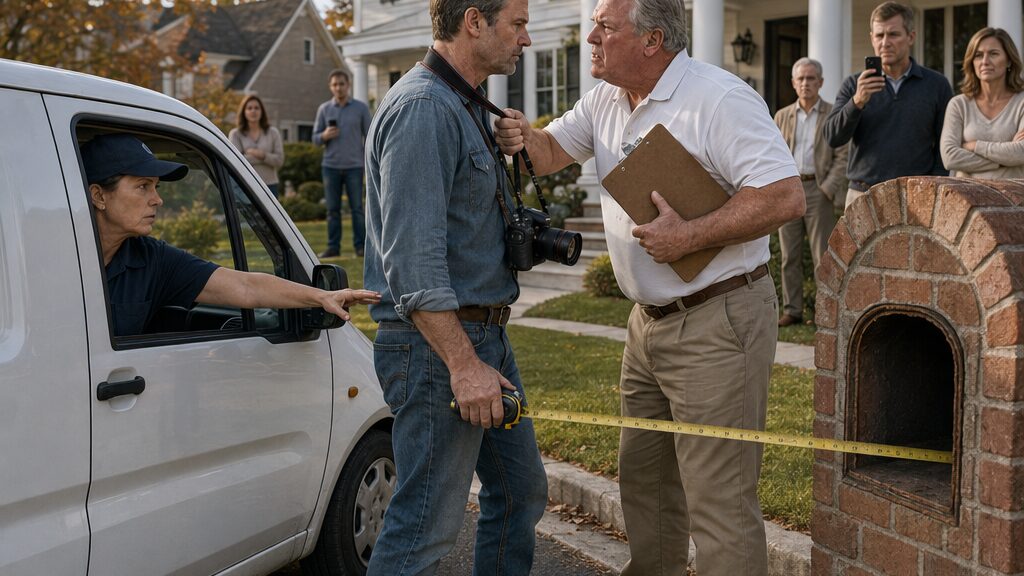
The Mailbox Fine That Forced an Entire Neighborhood to Measure What It Had Ignored
Chapter 1: The Fifty-Dollar Notice on the Brick Pillar
William Roberts tore the small flag from Christopher Hall’s mailbox and let it fall into the gutter.
“Fifty dollars a day,” he said. “Starting tomorrow. Every day that thing is still standing.”
The word thing landed harder than the plastic flag striking the pavement.
Christopher stood on the front walk in a faded blue work shirt, one hand still resting on the camera hanging against his chest. His work truck idled in the driveway behind him, ladder rack rattling softly with the engine. A tape measure hung from his belt, its yellow case scarred from years of drops onto concrete.
William planted himself between Christopher and the brick mailbox pillar as though he had already taken possession of it. His white polo was tucked tightly into khaki trousers, and a brown clipboard was pressed beneath one arm.
“You don’t touch anything on my property again,” Christopher said.
William glanced toward the gutter but made no move to retrieve the flag.
“It was attached to a nonapproved structure.”
“It was attached to a bracket.”
“It was attached to an eyesore.”
The mailbox had stood beside the curb for eleven years. It was modest compared with the structures farther down the street—brick columns with copper roofs, carved wooden posts, imitation stone towers wide enough to hold flower boxes. Christopher’s was a plain rectangular pillar built from red brick that matched the front foundation of his small house. The black metal door faced the road. Nothing leaned. Nothing cracked. Nothing blocked the sidewalk.
William slapped a white notice against the brick. The adhesive strip failed at one corner, and the paper fluttered in the morning breeze.
Christopher did not touch it.
“Which rule?” he asked.
William’s expression brightened with the satisfaction of a man who had been waiting for the question.
“Mailbox uniformity standards.”
“We don’t have uniform mailboxes.”
“We do now.”
Christopher looked down the street. Three houses away, a mailbox shaped like a miniature barn stood beneath a brass rooster. Across from it, two gray stone columns supported a box recessed behind a decorative arch. In front of William’s own property, a brick structure nearly four feet wide sat beneath a white cap that matched the columns on his porch.
Christopher looked back at him. “When did that happen?”
“The board voted.”
“What board meeting?”
“The meeting where the matter was decided.”
“I didn’t receive notice.”
William leaned closer. “You lost, Christopher.”
Christopher felt the camera strap tighten across the back of his neck as his shoulders drew up. He made himself lower them. William had always spoken as if volume could turn an assertion into a record. At annual meetings, he answered questions before people finished asking them. At block cleanups, he carried the clipboard even when there was nothing to write.
Christopher bent, picked up the flag, and brushed a wet leaf from its edge.
“I asked when the meeting occurred.”
“You had the same opportunity as every other resident.”
“That isn’t a date.”
William tapped the notice with one blunt finger. “You have ten calendar days to remove the structure and replace it with an approved post. Fines begin tomorrow because you were warned informally last month.”
“You told me you didn’t like the paint.”
“I told you it didn’t fit the character of the neighborhood.”
Christopher’s thumb pressed along the flag’s thin wooden stick. His father had mounted the bracket after they finished the pillar, stepping back into the street to judge whether it sat level. He had moved it twice by less than an inch before finally tightening the screws.
Christopher had not told anyone that part. He did not intend to tell William now.
“What’s approved?” he asked.
William opened the clipboard and withdrew a single sheet. It contained a photograph of a black post-mounted mailbox with a curved top and a small decorative brace.
“That model or an equivalent from the approved list.”
“Where’s the list?”
“The board has it.”
“The dimensions?”
“In the standards.”
“Color codes?”
“In the standards.”
“Placement requirements?”
William’s mouth tightened. “You’re trying to make this complicated.”
“No. I’m asking what you’re ordering me to build.”
William glanced at the truck, the worn boots, the tape measure. The look was brief, but Christopher knew it. Customers sometimes gave him the same one before discovering that he understood permits better than they did.
“You people always think knowing how to use tools makes you an expert on everything,” William said.
Christopher heard a screen door open across the street. He did not turn. He could feel the attention behind windows and porch rails.
“Put it in writing,” he said.
“It is in writing.”
“This says ‘unapproved mailbox.’ It doesn’t identify the rule, the vote date, the approved dimensions, or the appeal process.”
“You don’t dictate how the association conducts business.”
“I’m not. I’m asking you to show me how it conducted this business.”
William’s face flushed above the white collar.
Christopher continued before his temper could decide for him. “Give me the complete specifications. All of them. Height, setback, post type, colors, materials, every approved variation. Give me the meeting notice, the vote result, and the effective date.”
For a moment, the only sound was the truck’s engine and the dry ticking of leaves across the sidewalk.
Then William smiled.
It was not a warm smile. It was the expression of someone being handed the chance to bury an opponent under paperwork.
“You want the full package?”
“Yes.”
“You’ll have it within forty-eight hours.”
“Good.”
“And when you do, I expect compliance. Not another performance.”
William pulled the loose notice free, pressed it flat again, and slapped his palm against it until the adhesive held. He walked toward his house with the clipboard tucked under his arm, never looking at the flag in Christopher’s hand.
Christopher waited until William reached the opposite curb before turning off the truck. He photographed the notice where it sat on the brick. Then he photographed the torn bracket, the gutter, and the line of decorative mailboxes extending down the street.
He crouched beside the pillar and pulled the tape measure from his belt.
The metal blade clicked out six inches before he stopped.
Not yet.
He rewound it, carried the flag into the garage, and laid it on his workbench beside the camera.
By nine-thirty, he had emailed the association’s general account requesting the records in the notice. At ten, he called the management number and reached voicemail. At noon, he checked the association portal. No meeting appeared on the calendar for the previous three months except a landscaping committee session and a closed discussion about insurance renewals.
He printed the page.
That afternoon, the notice on the mailbox drew more attention than any sign Christopher had ever posted. A neighbor slowed while walking a dog. Another drove past twice. Nobody knocked.
Near sunset, Christopher was tightening a cabinet hinge in the garage when Sandra Clark appeared at the open door.
She stood just outside the threshold, arms folded against the cooling air. Sandra lived next door and served as HOA treasurer, though she rarely spoke during meetings unless numbers were involved.
“I saw what happened,” she said.
Christopher set down the screwdriver. “Then you saw him pull the flag off.”
“I did.”
“Did you vote on my mailbox?”
Sandra looked toward the street.
“Was there a board meeting?” he asked.
Her silence lasted long enough to become an answer.
Christopher wiped his hands on a rag. “Sandra.”
“There was a conversation,” she said.
“A meeting?”
“Not a full one.”
“Was notice sent?”
She shook her head once.
“Were minutes taken?”
Her eyes moved to the printed association calendar on his workbench.
“You need to ask William for the records,” she said.
“I did.”
“Then wait for what he gives you.”
“You’re the treasurer.”
“I handle accounts.”
“You sit on the board.”
Sandra stepped backward. “I can’t get in the middle of this.”
“You already are.”
Something tightened in her face—not anger, exactly. Fear, perhaps, or embarrassment.
“No full board meeting happened,” she said quietly. “But you didn’t hear that from me.”
Before Christopher could ask why, she crossed the lawn and disappeared through her side door.
On the workbench, the small flag lay beside the silent tape measure.
Chapter 2: The Packet That Made the Street Look Different
William dropped the glossy packet onto Christopher’s workbench as though delivering a court judgment.
“There,” he said. “Everything you demanded.”
The packet struck the wood hard enough to stir dust around the flag bracket Christopher had removed for repair. Its cover bore the association seal and the title Residential Mail Receptacle Standards in blue block letters.
Christopher looked at the wall clock. Forty-six hours had passed.
William remained at the garage entrance. “Now there can be no confusion.”
Christopher picked up the packet. The pages were newly printed and still carried the waxy warmth of a commercial copier.
“I’ll read it.”
“You can read it after you schedule removal.”
“I’ll read it first.”
William’s gaze moved across the garage—the organized drawers, camera lenses, levels, masonry bits, county plats rolled into cardboard tubes. He seemed disappointed not to find chaos.
“You have eight days left,” he said.
“I thought the fine started yesterday.”
“It did.”
“So I’m already being fined while I’m still waiting for the standards?”
“You were warned.”
Christopher opened the cover.
The first page listed height limits. The next specified color codes. Another showed approved wooden and metal posts. A diagram placed a curved-top box near a roadway edge, though the drawing contained no scale.
“When was this adopted?” Christopher asked.
“The date is printed inside.”
He found it at the bottom of page two.
Tuesday.
One day after William had claimed Christopher lost the vote.
Christopher looked up. William had already turned toward the driveway.
“The effective date is after the violation notice.”
William stopped.
“The standards were issued Tuesday,” Christopher said. “You cited me Monday.”
“They formalize existing expectations.”
“Where are the old standards?”
“This replaces them.”
“Then what exact rule did I violate before this existed?”
William turned back, one hand resting on the clipboard. “You wanted specifications. I brought specifications. Don’t pretend you’re confused because you dislike the answer.”
“I’m not confused.”
“Good.”
William left before Christopher could ask about the missing minutes.
For the next two hours, Christopher read every page.
He made three columns on a yellow legal pad: requirement, effective date, existing examples. Under height, he noted that half the decorative structures on the street appeared taller than the packet allowed. Under approved posts, he wrote that William’s own masonry column was not listed. Under colors, he circled the requirement for black, white, or association gray, then looked through the garage door at a copper-green mailbox across the street.
The packet did not create uniformity. It created a record of selective exceptions.
That should have pleased him.
Instead, one diagram held his attention.
It showed the mailbox opening positioned near the curb with a clear approach for delivery. The language beneath it referred to postal requirements and safe access. The association packet treated the subject as though appearance and delivery were the same system.
Christopher opened his laptop.
He searched official postal guidance, then narrowed the results to curbside mail receptacles. The language was less dramatic than William’s packet and more practical. Boxes had to be placed at usable heights and distances, with safe approach and unobstructed access. Local delivery conditions mattered. The carrier had to reach the opening without leaving the vehicle where curbside service applied.
Christopher pulled up photographs he had taken for unrelated jobs around the neighborhood. In the background of one roof inspection, William’s mailbox appeared beside the curb. Its front opening sat several inches inside the face of the surrounding brick.
He enlarged the image.
Then he looked down the street.
By late afternoon, the neighborhood no longer appeared to him as a collection of decorative choices. It looked like a row of measurements waiting to be taken.
He began with his own pillar.
The tape blade extended from the road edge to the mailbox door. He photographed the number, then measured the height from pavement to the bottom of the opening. He checked the clearance around the door and the distance from the curb.
Most of it looked reasonable.
The setback gave him pause.
Depending on where the local route measured from, the box might sit slightly too far back. Not by much. An inch or two, perhaps. Enough to matter if someone applied the standard strictly.
Christopher wrote the number down anyway.
He could have rounded it. He did not.
At the next property, a wooden post leaned toward the street but remained reachable. At another, a stone tower placed the receptacle deep inside a rectangular cavity. Christopher slid the tape measure into the opening and photographed the depth.
Seven and a half inches.
A carrier reaching from a vehicle would have to angle an arm into the masonry while pulling close to the curb.
He moved to the next mailbox.
A garage door opened across the street. Sandra stepped out carrying a recycling bin. She watched him take two photographs but did not approach.
Christopher raised a hand.
She looked away and rolled the bin to the curb.
That bothered him more than he expected. He reminded himself that evidence did not require permission when collected from the public right-of-way. The boxes stood beside the street. The dimensions were visible. He was not entering lawns.
Still, when a curtain shifted in the nearest house, he felt the camera become heavier around his neck.
He considered knocking on doors.
Then he imagined explaining William’s fine, the packet, the alleged vote, and Sandra’s whispered warning to every resident. By evening, the story would return to William in fragments, changed by each retelling. The measuring would stop before it began.
Facts first, Christopher told himself.
Conversation later.
At the fourth mailbox, he found a bronze approval plaque set into the masonry base. The association seal was stamped above a date from six years earlier. The structure exceeded the new height limit by nearly ten inches.
He photographed the plaque beside the tape measure.
There it was: a small, clean proof that the board had approved what the new packet prohibited.
His satisfaction lasted less than a minute.
When he checked the opening depth, it measured nine inches. The metal door scraped the upper brick when raised. A mail carrier would have to twist a wrist inside the cavity to place anything larger than a letter.
The inconsistency was real.
So was the access problem.
Christopher lowered the camera.
He had expected to uncover hypocrisy. He had not expected to uncover a legitimate hazard beneath it.
The next morning, he returned to the street just after sunrise. He carried a clipboard of his own now, though his was stained with pencil marks and adhesive from job sites. He measured from the pavement, photographed openings, and noted obstructions.
At Nicholas King’s house, the mailbox stood on a decorative metal post surrounded by a low stone planter. Its height was correct, but the planter projected toward the curb. Christopher recorded it without seeing anyone at the window.
By eight-thirty, he had documented eleven boxes.
The twelfth belonged to a neighbor with a broad brick column and a black receptacle set deep beneath an arch.
Christopher crouched at the curb. He extended the tape into the opening, held his camera low, and pressed the shutter.
“What do you think you’re doing?”
William’s voice came from behind him.
Christopher straightened slowly.
William stood in the road wearing the same white polo, his clipboard tucked against his side. His eyes moved from the camera to the tape measure and then to the neighbor’s house.
“Documenting the standards you gave me,” Christopher said.
William’s face changed.
Not surprise. Recognition.
He understood exactly what Christopher had found.
Chapter 3: The Morning Everyone Watched the Tape Measure
The mail carrier’s fingers stopped three inches short of the back of William’s mailbox.
She leaned farther from the open window of the postal vehicle, shoulder pressed against the door frame, and tried again. The brick opening swallowed her forearm nearly to the elbow.
“I can reach letters,” she said, withdrawing her hand. “A small package would be difficult.”
William stood on the curb with his clipboard clamped against his ribs.
“This is unnecessary,” he said.
Christopher held the tape measure across the depth of the recessed opening. “Nine and a quarter inches from the face of the brick to the back of the box.”
“You have no authority to inspect my property.”
Christopher looked down at his boots. Both remained on the asphalt.
“I’m in the street.”
“You’re interfering with mail delivery.”
The carrier had already placed William’s letters inside. She glanced from one man to the other, then toward the houses where people had begun appearing on porches.
Christopher had not planned the demonstration.
William had followed him that morning from the twelfth mailbox, accusing him loudly enough to draw attention. When the postal vehicle turned onto the street, William stepped in front of Christopher and announced that no carrier had ever complained.
Christopher asked the carrier one question: Could she reach the box safely from her normal position?
Now half the block was watching the answer.
William pointed at the camera hanging from Christopher’s neck. “Turn that off.”
“It isn’t recording.”
“You’ve been photographing private property.”
“I’ve been photographing mailboxes from the public road.”
“This is harassment.”
Christopher reeled in the tape. “This is the standard you gave me.”
“The standard applies to your violation.”
“That isn’t what the packet says.”
A neighbor near the corner folded her arms. Another remained beside a running pickup, listening through the open door. Sandra stood at the end of her driveway with a coffee mug held in both hands.
William lowered his voice. “You’re angry because the board told you no. So now you’re trying to punish everyone.”
The accusation moved through the watching residents faster than any explanation Christopher could have offered. He saw it in their faces. The camera, the clipboard, the list of addresses—tools that felt neutral in his garage now looked different in the street.
Christopher had measured their homes without speaking to them.
“I’m checking whether the rules are being applied consistently,” he said.
“You’re collecting material for a complaint.”
“I’m collecting facts.”
William laughed once. “You hear that? He’s collecting facts about all of you.”
No one answered.
The carrier shifted in her seat. “I need to continue the route.”
Christopher stepped back immediately. “Of course.”
William remained beside the vehicle.
The carrier looked at his mailbox, then at the next one down the street. “Some of these installations do make access difficult,” she said. “That’s something the local office would review if there were a formal concern.”
William’s jaw tightened. “There has been no concern.”
Christopher lifted his clipboard. “There is now.”
The words came out sharper than he intended.
A murmur rose from one porch.
William saw the reaction and seized it. “There. That’s what this is. Retaliation.”
Christopher felt heat climb his neck. He had wanted a clean comparison: his modest pillar against the larger approved structures. He had wanted the street to see William’s rules fold under their own contradictions.
Instead, he had just threatened everyone’s mail service in a single sentence.
The carrier drove forward.
Christopher walked toward the next mailbox before William could turn the moment into a speech. He chose a stone column already marked on his list and extended the tape measure toward the opening.
William followed.
“Stop this now.”
Christopher read the number. “Eight inches.”
“I’m instructing you as association president.”
“You can’t instruct me not to stand in the road.”
“You are targeting residents.”
“I’m checking the structures your board approved.”
William moved between him and the mailbox. “You are a little nobody with a camera who thinks he found a loophole.”
The street went still.
Christopher’s grip tightened around the tape measure. He could feel the metal blade flex where it entered the opening. One quick pull would snap it back with enough force to cut his knuckles.
He pressed the lock instead.
The blade stayed extended.
“Move,” he said.
William leaned closer. “Or what?”
Christopher looked past him at the plaque set into the stone base.
“Or I photograph the approval date from right here.”
William turned his head.
That was all the opening Christopher needed. He stepped sideways and raised the camera.
William grabbed the strap.
The pull jerked Christopher forward. The camera struck his chest, and the tape measure clattered onto the asphalt with its blade still extended. A woman on the nearest porch gasped.
For one second, Christopher saw only William’s fist closed around the black strap.
His body remembered every job-site shove, every customer who stepped too close, every younger version of himself who would have answered pressure with pressure. His right hand came up.
He stopped it against William’s wrist.
Not a strike. A brace.
“Take your hand off me,” Christopher said.
William’s face was inches away.
“You’re creating a disturbance.”
“Remove your hand.”
William looked toward the neighbors. Perhaps he expected support. He found phones instead—two raised openly, another visible behind a porch rail.
His fingers opened.
Christopher stepped back and caught the camera before it swung into the brick. He checked the lens, then the strap. The webbing had twisted but not torn.
A local police officer rolled slowly around the corner in a marked car, likely summoned by someone watching. William immediately lifted his clipboard.
“This man is trespassing and harassing residents.”
Christopher pointed at his boots. “Public road. I haven’t entered a yard.”
The officer parked and approached without urgency. He listened while William described stalking, intimidation, and interference with delivery. Christopher said little. He showed the officer the HOA packet, the public curb, and the photographs displayed on the camera screen.
“Any resident asked you to leave their property?” the officer asked.
“I haven’t been on their property.”
The officer looked at William. “Did you grab him?”
William’s mouth opened, then closed.
Several neighbors remained within hearing distance.
“I attempted to stop him from damaging the mailbox,” William said.
Christopher looked at the tape measure lying across the asphalt.
The officer followed his gaze. “That measuring tape?”
William flushed again. “The situation was escalating.”
The officer separated them and advised Christopher not to block traffic or interfere with delivery. He told William that association disputes belonged in civil or board channels unless a crime occurred.
Neither man received what he wanted.
But as the officer returned to the car, the current mail carrier reappeared at the far end of the loop. She slowed near Christopher’s house, then stopped.
Christopher walked toward the vehicle.
“I shouldn’t have involved you without warning,” he said.
She studied him through the window. “You asked about reach. I answered.”
“Are the boxes actually a problem?”
“Some are.” She nodded toward the street. “Deep openings. Planters too close to the route. Doors that stick. Usually we work around things until we can’t.”
“My box?”
The question felt different now.
The carrier looked toward his red brick pillar. “Your opening is easier than most. But the setback may be outside what the station prefers for this route.”
“How far?”
“I can’t give you an official determination from the truck.”
“But it might need changing.”
“Yes.”
Christopher looked back at the neighbors. William stood beside the officer’s car, speaking with one hand raised. Sandra remained in her driveway, but her coffee mug was gone.
The tape measure no longer seemed like a simple answer.
That afternoon, Christopher returned to his garage and placed every photograph on the worktable. He sorted them by height, depth, setback, obstruction, and approval plaque. William’s mailbox was among the worst. His own was not among the best.
He opened the Postal Service inquiry page.
The form asked for the location of the concern.
He entered the street name.
It asked whether the issue affected one receptacle or multiple addresses.
Christopher paused over the options.
One receptacle would protect the neighbors and narrow the complaint to his dispute. It might also let William dismiss the rest as irrelevant.
Multiple addresses would establish inconsistent enforcement and force an honest review. It could also bring consequences to Nicholas, Sandra, and people who had never touched Christopher’s flag or called him a nobody.
He saved the form without submitting it.
At six that evening, an email arrived from the association.
The subject line read FORMAL COMPLAINT: HARASSMENT AND UNSAFE CONDUCT.
Attached was a signed statement from William accusing Christopher of photographing residents, obstructing mail delivery, threatening neighborhood services, and creating a hostile environment. The board would review sanctions at an emergency session.
Christopher scrolled to the final paragraph.
Until the review was complete, he was ordered to cease all “unauthorized inspections” and surrender copies of any photographs containing association property.
Below William’s signature was a blank line for board approval.
Christopher looked at the unsent postal form on one side of his screen and the harassment complaint on the other.
William had turned the street into evidence first.
Chapter 4: When the Mail Truck Passed Without Stopping
Emma Lopez called at 7:12 the next morning.
Christopher was standing in the garage with the harassment complaint open on his laptop and the unsent postal form beside it.
“Mr. Hall,” she said, “I need to confirm something before this goes any farther. Are you reporting one mailbox or every address in the photographs you attached?”
Christopher looked at the folder on the workbench. Twenty-three images. Eleven measurements. Four approval plaques. One photograph of William’s hand closed around his camera strap, taken by a neighbor and emailed without comment.
“I haven’t submitted the form yet.”
“You sent a general inquiry last night with supporting images.”
He had forgotten the preliminary upload. The website had accepted attachments before the final address selection.
Emma continued. “Some of those boxes appear to have genuine access problems. If you make a route-wide complaint, we can’t pretend we didn’t see them.”
Christopher sat down.
“What happens?”
“Inspection. Possibly temporary delivery changes.”
“For the whole street?”
“For affected addresses.”
He stared through the open garage door at the red brick pillar.
“I’m challenging selective enforcement,” he said.
“I understand that’s your dispute with the association. My concern is whether the carrier can serve the boxes safely.”
“William Roberts is using postal language to fine me under standards written after the fact.”
“That may matter to your HOA. It does not make the reach problems disappear.”
Christopher pressed two fingers against the bridge of his nose. He had wanted an official answer. Now the answer had edges.
“Can you review only my box?”
“Yes. But the other images are already in the file. If they show a clear hazard, the station may still follow up.”
“So the choice is already made.”
“No,” Emma said. “The choice is whether you submit accurate locations and measurements or leave us to determine them.”
There was no satisfaction in her voice. No alliance. Only procedure.
Christopher looked again at William’s complaint.
“I’ll send the full chart.”
By ten, he had converted his handwritten notes into a spreadsheet. Address, opening height, curb setback, recess depth, obstruction, visible approval marker. He added a final column for uncertainty and marked his own mailbox in yellow.
Potential setback issue. Requires local confirmation.
He could have omitted it.
He did not.
At noon, an email from the HOA attorney arrived. It warned that Christopher could be responsible for legal expenses arising from “disruptive conduct, unauthorized documentation, and interference with association operations.” Attached was a demand that he preserve all photographs and cease distribution.
He printed it and placed it beside the postal chart.
Two systems, each asking for the same evidence for different reasons.
At one, he walked to Sandra’s house.
She opened the door only halfway.
“I need the minutes,” he said.
“You received William’s complaint.”
“Yes.”
Her eyes dropped to the folder under his arm. “You reported the street.”
“I reported the conditions.”
“That isn’t how people are going to see it.”
“Did the board approve the standards before Monday?”
Sandra glanced behind her, though no one else appeared to be home.
“I can’t release records without board authorization.”
“You told me there was no full meeting.”
“I told you something I should not have told you.”
“You’re the treasurer. Your name is on the board.”
“My name is on bank documents,” she said sharply. “That does not mean I control William.”
“You can say whether a vote happened.”
“And then what? Everyone learns the board has been approving these structures without complete reviews. They demand replacements. They demand refunds. They demand to know why reserve funds are low.”
Christopher paused.
“Reserve funds?”
Sandra’s expression closed.
“That isn’t what this is about.”
“It sounded like it was.”
“You don’t know what you’re pulling apart.”
“Then show me.”
She gripped the edge of the door. “Not without authorization.”
The door shut between them.
Christopher stood on the porch long enough to hear the deadbolt turn.
The postal inspection began the following morning.
Emma arrived in a white service vehicle with the current carrier. She wore a navy jacket and carried a plain folder, no dramatic notice, no raised voice. William came out of his house before she reached the second mailbox.
“I’m the association president,” he announced.
Emma nodded. “Then you may observe from the sidewalk.”
“I need to know the basis of this review.”
“A customer inquiry and carrier-access concerns.”
William looked directly at Christopher.
Christopher stood beside his truck with his arms folded, feeling the weight of every closed curtain on the street.
The inspection took less than an hour.
Emma measured openings, watched the carrier’s approach, and photographed obstructions. She did not use Christopher’s tape measure. She used her own.
At his mailbox, she checked the height twice and measured the setback from the curb.
“How bad?” Christopher asked.
She wrote something on her form. “It is outside the preferred route placement.”
“By how much?”
“About two inches, depending on the pavement edge used.”
William heard.
“So his is noncompliant,” he said.
Emma looked at him. “Several are.”
“But his complaint—”
“Does not exempt his address.”
The answer should have embarrassed William. Instead, Christopher felt it settle over him.
At four that afternoon, notices appeared on twelve doors.
Temporary delivery adjustment.
Mail for affected addresses would be held at the local station beginning Monday until safe access was restored or an interim arrangement approved.
The notice on Christopher’s own door was identical to the others.
By sunset, three neighbors had knocked.
The first demanded to know why he had reported her mailbox when she had never complained about his. The second asked whether he planned to pay for repairs. The third simply handed him a copy of the postal notice and said, “You made your point.”
Christopher tried to explain the sham vote, the selective fine, William’s packet.
Each explanation sounded smaller beside the inconvenience in their hands.
Monday morning, the mail truck entered the street, slowed, and passed twelve houses without stopping.
Christopher watched from the curb.
At Nicholas King’s house, the older man stood beside his decorative planter with one hand braced on a cane Christopher had never seen him use. The truck continued past him.
Nicholas did not look toward Christopher.
That evening, an envelope lay on Christopher’s doorstep.
It was not sealed. A pharmacy label showed through the window, along with a red stamp from the postal station: HELD FOR CUSTOMER PICKUP.
A handwritten note was clipped to the front.
This was delivered late because I could not get to the station yesterday.
Christopher carried it inside without removing the clip.
For the first time, the evidence on his workbench did not look complete.
Chapter 5: The Records Hidden Behind the Insurance Deadline
Sandra arrived before breakfast carrying a binder with three empty signature lines.
She stepped into Christopher’s garage without waiting to be invited and placed it on the workbench beside Nicholas’s pharmacy envelope.
“These are the minutes William says support the vote,” she said.
Christopher opened the binder.
The meeting date was listed as Sunday evening, two weeks before the violation notice. The location was “electronic conference.” Beneath the motion approving mailbox standards were spaces for the president, treasurer, and secretary.
Only William’s name appeared.
Not a signature. Typed text.
“You never signed this,” Christopher said.
“No.”
“Did you attend?”
“There was no conference.”
The words came out flat, as if she had practiced saying them without emotion.
Christopher turned the page. A vote tally showed four in favor, one absent.
“Who voted?”
“No one.”
He looked at her.
Sandra kept her eyes on the binder. “William called two board members individually. He described it as an informal consensus. Then he drafted these minutes.”
“And you knew.”
“I knew after the packet went out.”
“You still refused to release them.”
“Yes.”
The answer struck harder because she did not defend it.
Christopher closed the binder. “Why?”
Sandra looked toward the open garage door. Across the street, a neighbor was loading mail bins into a car for the trip to the postal station.
“Because this did not begin with your mailbox.”
She pulled a folded letter from the back pocket of the binder.
The letterhead belonged to the HOA’s insurance carrier. The date was four months earlier.
Christopher read the first paragraph, then the second.
Roadside masonry structures. Vehicle-impact exposure. Inconsistent installation records. Possible premium adjustment. Required risk-management response before renewal.
A handwritten note in the margin read: Immediate corrective action needed.
“William received this in March,” Sandra said. “The insurer asked for a full inventory and proof that installations were approved. We don’t have either.”
“How many were approved informally?”
“Most of them.”
“By William?”
“By different boards. Contractors would submit a picture. Someone would email back that it looked fine. Sometimes there was a fee. Sometimes there wasn’t.”
Christopher thought of the bronze plaques. Authority stamped into stone without a record behind it.
“The reserve fund?” he asked.
Sandra rubbed her thumb against the binder edge.
“We had drainage repairs last year. Then the clubhouse roof. If premiums rise sharply, we may need a special assessment.”
“How much?”
“We don’t know. Enough that people will panic.”
“So William picked one box.”
“He picked the one he thought would be easiest to remove.”
Christopher glanced at his work truck.
“The smallest house.”
Sandra said nothing.
“The working contractor who would replace it himself.”
“He said your structure lacked a formal approval file.”
“Did his?”
“No.”
The garage seemed suddenly too narrow for the amount of paper between them.
Christopher wanted to feel vindicated. William had fabricated the vote. The standard had been issued after the notice. The enforcement was selective.
But the insurer’s letter was real.
“So there is an actual problem,” he said.
“Yes.”
“And you let him turn it into my problem.”
Sandra’s face tightened. “I let him tell me he could contain it.”
“By lying.”
“By correcting one visible structure before renewal and then addressing the rest gradually.”
“He chose mine because he thought no one would care.”
“Yes.”
The admission hung between them.
Christopher tapped the blank signature line beneath Sandra’s printed name.
“You could have stopped him.”
“I could have forced a meeting.” Her voice dropped. “Then everyone would have learned about the insurance warning before we had numbers. People would have demanded immediate answers. Some would have accused me of hiding the reserve shortage. Some would have put their houses on the market.”
“That’s what you were protecting?”
“I was protecting families who cannot absorb a five-thousand-dollar assessment.”
“You were also protecting yourself.”
“Yes.”
Again, no defense.
Christopher looked at Nicholas’s envelope.
“People are already paying for it.”
Sandra followed his gaze. “I know.”
He expected her to say she had not understood the postal consequences. Instead, she lowered herself onto the old stool beside the workbench.
“My husband handled conflict,” she said. “For twenty-six years, he was the one who stood up at meetings, called contractors, told people no. After he died, I thought handling the accounts would be different. Numbers do not shout.”
Christopher had known she was widowed. He had not known how she had divided the world since.
“William shouts,” he said.
“Yes.”
“And you let him do it for you.”
“Yes.”
Christopher sat opposite her.
For once, he did not open the binder again. He did not ask for another date or document.
“What happens if every mailbox has to be replaced immediately?” he asked.
Sandra exhaled. “The association cannot pay. Individual owners would be responsible unless the board negotiated a phased plan. The masonry structures could cost thousands each.”
“And the insurer?”
“They want evidence of a correction program, not necessarily demolition tomorrow.”
Christopher read the letter again. The language supported her. Inventory. Mitigation schedule. Documented action.
William had manufactured urgency that did not exist.
“Why didn’t he propose a schedule?”
“Because a schedule requires admitting the approvals were inconsistent. He wants the record to show residents violated standards, not that the board failed to maintain records.”
That was the deeper shape of it.
William was not merely protecting his mailbox or his pride. He was moving responsibility downward, house by house.
Christopher drove to the county records office that afternoon with copies of the site plan references from the association files. A clerk helped him retrieve the recorded subdivision map. The right-of-way lines, curb locations, and utility strips were clearer than anything in William’s packet.
He spread the map across a public table and compared it with his route chart.
Some structures could be corrected by moving the receptacle opening forward without demolishing the pillar. Some planters could be trimmed. Several posts could be reset. A few masonry towers would require major work.
His own pillar fell into the first group.
He took photographs of the map and paid for certified copies.
When he returned home, William’s white SUV was parked at the clubhouse.
An emergency meeting notice had been taped to every mailbox that still received direct delivery and placed on the doors of those that did not.
Saturday, 6:00 p.m.
Purpose: authorization of immediate corrective action regarding the Hall property, recovery of legal expenses, and preservation of neighborhood standards.
At the bottom, in smaller type, the notice stated that a licensed masonry contractor would be present to carry out removal upon approval.
Christopher found Sandra standing in her driveway with the same notice in her hand.
“You gave me the records,” he said.
“I gave you copies.”
“Will you say what happened?”
She looked toward William’s house.
Then at the neighbors driving away to collect their held mail.
“I will say what I signed,” she said.
“You signed nothing.”
Sandra folded the meeting notice once.
“Exactly.”
Chapter 6: The Vote William Needed Before Anyone Read the Minutes
The masonry contractor was waiting outside the clubhouse with a sledgehammer in the back of his truck.
Christopher saw it through the glass doors before the meeting began.
The tool lay beside a stack of orange safety cones and a demolition saw. William had not come to ask permission. He had come to make the vote feel inevitable.
Inside, residents filled the folding chairs in tight rows. Postal notices protruded from purses and coat pockets. A few people held repair estimates. Others carried nothing and watched Christopher as he entered.
He had brought a cardboard box.
At each table, he placed a tape measure.
The yellow cases were mismatched—some new, some borrowed from his truck, some donated by contractors he knew. The room quieted as residents picked them up.
William stood behind the front table in a navy blazer instead of his white polo. The clipboard had been replaced by a leather folder.
“This is not a workshop,” he said.
“No,” Christopher replied. “It’s a meeting about measurements.”
William ignored him and called the session to order.
The board secretary sat at one end of the table. Sandra sat at the other, the unsigned binder closed in front of her.
William began with the harassment complaint.
He described Christopher’s photography as deliberate intimidation. He described the postal review as an act of retaliation. He described the delivery interruption as a preventable community hardship caused by one resident’s refusal to accept a lawful decision.
Several people nodded.
Nicholas King sat in the second row with his cane hooked over one knee. He did not look at Christopher.
William held up the glossy standards packet.
“This association cannot function if every rule becomes an invitation to investigate your neighbors.”
Christopher felt the room turning against him. Not because William’s record was honest, but because the inconvenience was honest.
The trips to the postal station were real. The repair costs were real. Nicholas’s delayed medication was real.
When William finished, he motioned toward the contractor outside.
“I am proposing immediate removal of the Hall structure, suspension of further fines upon compliance, and recovery of legal expenses resulting from Mr. Hall’s conduct.”
A resident near the aisle raised her hand. “Will that restore delivery?”
William hesitated.
“It will demonstrate corrective action.”
“That wasn’t the question.”
Another resident spoke. “What about the other eleven notices?”
“We will address those individually.”
Christopher saw the opening William had left, but he did not take it yet.
He stood and placed the certified subdivision map on an easel.
William’s expression hardened. “You are not recognized.”
“I’m the subject of the motion.”
“You will have three minutes after the board presentation.”
Sandra opened the binder.
“No,” she said.
The room shifted toward her.
William turned. “Excuse me?”
“You said the board presentation includes the vote history.”
“It does.”
“Then the records need to be read first.”
William lowered his voice. “Sandra, this is not the time.”
“It is exactly the time.”
She removed the minutes and held them up.
“These show a board vote that did not happen.”
The sentence landed without drama. That made it stronger.
William stepped away from the lectern. “There was consensus.”
“There was no noticed meeting. There was no electronic conference. I did not vote. I did not sign these minutes.”
The board secretary leaned forward. “Neither did I.”
A murmur moved through the room.
William’s face lost color, then regained it quickly.
“The board had an obligation to respond to an insurance risk.”
Christopher looked at Sandra.
She placed the insurer’s letter on the table.
“This is the actual reason the standards were created,” she said. “The carrier requested an inventory and correction plan months ago. The board did not complete one.”
Now the anger in the room changed direction, but Christopher knew better than to mistake that for resolution.
He stepped to the easel.
“William is wrong about the vote,” he said. “He is wrong about selective enforcement. He is not wrong that some boxes need correction.”
Several residents stared at him.
Christopher pulled his own measurement sheet from the stack.
“My mailbox is one of them.”
William blinked.
Christopher pointed to the setback entry. “It sits about two inches farther from the preferred route position than the local station wants.”
A neighbor in the front row said, “Then why did you report everyone?”
“Because I thought proving inconsistency would protect me.” He looked around the room. “I measured first and explained later. That was a mistake.”
No one applauded. Nicholas’s expression did not soften.
Christopher continued.
“The postal concerns are not all the same. Some openings can be moved forward without demolishing the pillars. Some planters can be cut back. Some posts can be reset. A few structures need larger repairs.”
He unfolded a phased plan and placed copies on the tables.
“Priority one is any box the carrier cannot safely reach. Priority two is obstruction and setback. The insurer’s letter asks for a documented mitigation schedule. It does not require every structure to be destroyed this month.”
William picked up one copy. “You are not an insurance professional.”
“No. I’m a contractor who reads the words on the page.”
“That plan has no authority.”
“Not yet.”
Christopher turned to Emma’s written response, received that afternoon after he had sent preliminary options. It did not approve the proposal, but it agreed the station would review interim corrections if the association submitted a documented schedule.
He read only the relevant paragraph.
Nicholas raised his hand.
“Would this restore delivery before every box is rebuilt?”
“For addresses corrected to the station’s satisfaction,” Christopher said. “Yes.”
“And who decides which ones go first?”
“Carrier access. Medical hardship. Mobility. Not who has the largest house.”
Nicholas looked down at the plan.
William closed the folder in front of him. “This is chaos dressed as fairness.”
“It is slower than ordering one man’s mailbox destroyed,” Christopher said.
“Slower means premiums rise.”
Sandra shook her head. “The insurer gave us a renewal deadline, not a demolition deadline.”
William looked from her to the board secretary. The control he had carried into the room was slipping, but he had one final card.
“All right,” he said. “I will resign as president tonight if the residents approve immediate adoption of the full replacement program. Clean standards. One design. No exceptions. My resignation becomes effective when the work begins.”
For a moment, the offer tempted the room.
William understood that. He had paired his removal with certainty. End the conflict, replace everything, move on.
A resident asked the cost.
Sandra answered. “The association cannot cover it. Owners would pay individually, or we would need a special assessment.”
“How much?”
“For some masonry boxes, several thousand dollars.”
The room erupted.
William raised both hands. “Property values require investment.”
Nicholas stood slowly, using the cane.
“My box has a planter around it,” he said. “My wife built it before she died. I can move the box. I’m not tearing out the whole thing because you want a photograph of matching posts.”
William’s mouth tightened.
Nicholas picked up the tape measure from his table.
He walked to Christopher’s demonstration frame, a scrap of lumber holding a sample mailbox opening. He extended the blade to the proposed safe height.
“This is what the carrier needs?”
Christopher nodded. “That and the correct reach.”
Nicholas locked the blade.
“Then measure that.”
One by one, other residents began opening the plans.
The vote came in three parts.
First, the membership voided Christopher’s fines and rejected the demolition motion.
Second, the board accepted Sandra’s motion to invalidate the mailbox standards until proper notice, review, and recorded approval could occur.
Third, residents voted to remove William as president and create a temporary correction committee subject to open records and public measurement criteria.
William did not speak during the final count.
The leather folder remained closed beneath his hand.
When the chair asked who would coordinate the technical inventory, three people looked toward Christopher. Then more.
He stood beside the easel, suddenly aware of the small flag bracket in his shirt pocket. He had carried it without planning to show anyone.
“My father and I built my pillar,” he said. “It’s the last project of his that I still use every day.”
The room quieted.
“That doesn’t make it exempt,” he continued. “If the opening has to move, I’ll move it. If I expect everyone else to meet the same standard, mine goes first.”
He placed the bracket on the table beside the tape measure.
The motion appointing him passed, though not unanimously.
Nicholas voted yes.
William gathered his folder and walked toward the doors. Outside, the contractor saw him coming and reached for the truck keys.
William stopped beside him.
“No work tonight,” he said.
The contractor glanced through the glass at Christopher.
Then he removed the sledgehammer from the tailgate and laid it flat inside the truck.
By the time the clubhouse emptied, Sandra had given Christopher the full insurance file, the approval records, and the association’s official stamp.
Nicholas remained near the doorway.
“You caused damage,” he said.
“I know.”
“You also brought a plan.”
“I should have done that first.”
Nicholas turned the tape measure over in his hand.
“Then do it right this time.”
Christopher looked at the rows of tables, each with a yellow case left behind.
The residents had removed William’s authority.
Now they had handed Christopher responsibility.
Chapter 7: The First Delivery After the New Line Was Drawn
Emma Lopez arrived six weeks later with a metal gauge in one hand and a folder thick enough to contain every argument the street had made.
The mail truck waited at the corner with its engine running.
Christopher stood beside his brick pillar while Nicholas King held the end of the tape measure against the curb. The yellow blade crossed the asphalt in a straight line, bright beneath the pale morning sun.
“Don’t move it,” Christopher said.
Nicholas glanced down. “I delivered mail for thirty-one years. I know how to hold a tape.”
“You also told me two days ago that six inches looked like eight.”
“That was before coffee.”
Emma stopped beside them and examined the temporary correction Christopher had made to the opening. He had removed the original metal box, cut back the inner brick lining, and mounted a new receptacle closer to the face of the pillar. The exterior remained almost unchanged.
Almost.
Emma placed her gauge against the opening, checked the height, then measured the distance from the curb.
She did it again.
Christopher watched her pencil move across the form.
“How far?” he asked.
Emma did not answer immediately.
Nicholas leaned closer. “That is never good.”
Emma looked at Christopher. “You are three-quarters of an inch outside the approved interim position.”
Christopher stared at the tape.
“That can’t be right.”
“You want to check?”
He took the metal gauge from her and repeated the measurement. The result did not change.
Three-quarters of an inch.
Behind them, several neighbors had gathered near their corrected boxes. Some had replaced posts. Others had moved doors forward inside existing masonry. Two planters had been cut back and rebuilt with narrower borders. The work had taken weekends, borrowed tools, payment plans, and more patience than anyone had expected.
Christopher’s own box was the last one awaiting approval.
“I used the site map,” he said.
Emma nodded. “You measured from the original curb line. The route uses the current pavement edge.”
“The asphalt patch changed it.”
“By about three-quarters of an inch.”
Nicholas let the tape blade retract a few inches.
Christopher caught it before it snapped back.
For six weeks, he had told every resident that the same measurement would apply to every property. No old approval would create an exemption. No decorative value would outweigh access. No personal attachment would change the line.
Now the line cut through his own work.
Emma closed the folder. “You can request a local variance. The carrier can reach it.”
“How long would that take?”
“I can’t promise.”
“And delivery?”
“The other corrected addresses can resume. Yours would remain on hold until the review.”
Nicholas looked at the brick pillar. “Three-quarters of an inch is not much.”
Christopher ran his thumb along the edge of the opening.
“No,” he said. “But it is the number.”
He carried his tools from the garage.
The neighbors did not leave. They watched as he removed the black metal door, loosened the inner frame, and marked a new cut line across the mortar. The work should have taken twenty minutes. It took longer because he did not want to damage the original brick.
His father had laid that course on a cold Saturday morning, tapping each piece into place with the wooden handle of a trowel. Christopher had mixed mortar too wet, and his father had made him throw out the batch and begin again.
A straight line is not cruel, his father had told him. It just refuses to lie for you.
Christopher had not thought of the sentence in years.
Nicholas steadied the pillar while Christopher cut the inner edge. Fine red dust settled across their sleeves. When the frame finally shifted forward, Christopher checked the distance twice before tightening it.
Emma measured again.
“Approved,” she said.
A few neighbors smiled. No one applauded.
Christopher preferred it that way.
He reached for the small flag bracket attached to the side of the pillar. He had repaired it after William tore the flag down, straightening the bent metal and replacing the screws. To move the mailbox frame, he needed to shift the bracket half an inch.
The first screw came free.
The second resisted.
Christopher turned the screwdriver harder.
The old metal mount cracked across its center.
The sound was small, almost lost beneath the idling mail truck.
Christopher held the broken pieces in his palm.
Nicholas looked at him. “Can you weld it?”
“Maybe.”
“You have another one?”
“I could buy one.”
But it would not be the one his father had positioned twice before deciding it was level.
Christopher set the pieces on the truck’s tailgate.
Across the street, William Roberts stood beside his own mailbox.
His large brick structure had been altered without removing the white cap. The opening now sat flush with the front face, and the decorative arch had been trimmed. Christopher had not done the work. William had hired the masonry contractor who once waited outside the clubhouse with a sledgehammer.
William had attended no committee meetings. He had answered required emails with one-line replies. He had not apologized.
Yet three days earlier, Sandra had found an anonymous cashier’s check in the association drop box, made out for the exact cost of repairing a low-income homeowner’s damaged post. The bank receipt showed it had been purchased near William’s office.
Sandra had recognized his handwriting on the envelope.
She had asked Christopher whether the committee should record the contribution publicly.
Christopher had said no.
Now William met his eyes from across the street.
His gaze moved to the broken flag bracket on the tailgate.
For a moment, Christopher thought he might cross the road.
William only rested one hand on his corrected mailbox and looked away.
Emma proceeded down the route.
At each approved address, she placed a green mark on her list. The current carrier followed in the truck, testing the approach and opening each box from the driver’s seat.
Nicholas walked beside Christopher toward his own property.
His wife’s stone planter remained intact. They had moved the post six inches forward and narrowed one corner to clear the vehicle path. New mortar showed pale against the older stone.
The carrier reached the box easily.
Nicholas watched her place a stack of envelopes inside.
“That would have made her happy,” he said.
“The planter?”
“That I did not tear it out just because somebody told me it was easier.”
Christopher looked at him. “You told me to measure what the carrier needed.”
“I did.”
“You were right.”
“I know.”
Nicholas opened the box and removed the envelopes. A pharmacy package sat beneath them, delivered directly this time.
He held it up without comment.
The committee’s phased plan had required more work than William’s replacement program would have. Every structure had to be examined separately. Owners had to receive written findings and time to respond. Costs had to be documented. Records had to remain available.
It was slower.
It was also fair.
Sandra had taken over as acting board chair until a new election could be held. At her first meeting, she placed the insurance letter on the public table and read the reserve balance aloud. No one thanked her. Several residents asked hard questions.
She answered each one.
The insurer accepted the correction schedule after Emma provided the first inspection report. Premiums still increased, though less than feared. The association approved a modest assessment spread across twelve months.
No one was happy about it.
That, Christopher had learned, did not mean the decision was wrong.
Emma returned to his curb near noon.
“All priority addresses are cleared,” she said. “The remaining cosmetic standards are the association’s concern, not ours.”
Christopher nodded toward the truck. “Will delivery start today?”
“It already has.”
The carrier pulled forward and stopped beside his pillar.
Christopher stood back.
The window slid open. The carrier leaned toward the box without twisting her shoulder or stretching across the door. She opened the black metal front and placed one white envelope inside.
The movement was ordinary.
That was what made it matter.
After the truck continued down the street, Christopher opened the mailbox. The envelope contained the final written confirmation of restored service.
He folded it once and placed it in his shirt pocket.
Nicholas picked up the broken flag bracket from the tailgate.
“You could mount the flag on the house,” he said.
“I could.”
“Your father object?”
Christopher looked at the brick pillar, at the altered opening, at the fresh mortar line that would darken with time.
“He would object if it was crooked.”
Nicholas smiled and handed him the pieces.
That afternoon, Christopher fabricated a new bracket from a strip of steel in his garage. He used the broken original as a pattern but did not try to disguise the changes. The new mount was stronger, simpler, and shifted just enough to clear the corrected mailbox door.
Before tightening it, he stepped into the street.
Nicholas stood near the curb holding the tape measure.
“Level?” Christopher called.
Nicholas narrowed one eye.
“Left side needs to come up.”
Christopher adjusted it.
“Now?”
“Half an inch.”
“That is not half an inch.”
Nicholas lifted the tape measure. “Do you want accuracy or friendship?”
Christopher moved the bracket again.
When the flag finally hung straight, he tightened the screws and stepped back.
The red brick pillar no longer looked exactly as it had when his father built it.
It still held.
Near sunset, William drove past slowly. He did not stop or lower the window.
Christopher did not need him to.
The mailbox door opened smoothly beneath Christopher’s hand. Inside rested the first envelope delivered after the new line had been drawn—not by William’s clipboard, nor by Christopher’s anger, but by a measurement everyone had agreed to face.
The story has ended.