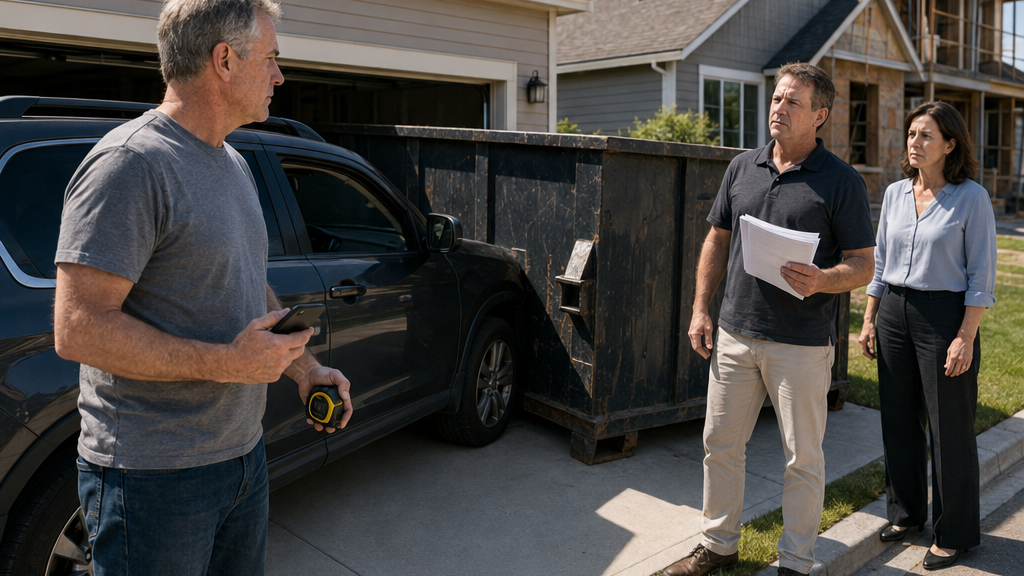
My Neighbor Blocked My Driveway With a Dumpster—Then the HOA Learned His Permit Never Covered My Property
Chapter 1: The Dumpster Was Waiting Outside His Garage
Joseph Allen pressed the garage-door button and heard the familiar rattle of rollers overhead.
Then the morning light opened onto a wall of dark green steel.
He stopped with one hand still on the button.
A construction dumpster sat across the mouth of his driveway, close enough that its rear corner seemed almost aligned with the left edge of the garage. Beyond it, a narrow strip of concrete remained visible toward the curb, but from where Joseph stood behind his SUV, it looked more like an escape route for a bicycle than a path for a vehicle.
For several seconds he simply stared.
The house next door had been under renovation for months. Steven Walker had replaced windows, opened walls, torn out a deck, and generated enough construction noise that Joseph had learned to distinguish a circular saw from a reciprocating saw without trying.
The dumpster was new.
Joseph walked down the driveway.
Its steel side rose above his shoulder. Broken drywall and splintered lumber showed over the rim. One wheel sat near the curb; the other end angled toward Joseph’s property just enough to narrow the driveway entrance.
He stood at the curb and looked back toward his garage.
Technically, there was space.
That was the kind of technicality Joseph distrusted.
He had spent most of his working life supervising building maintenance. A doorway could technically meet a drawing and still be useless when a cart had to turn through it. A service corridor could technically remain open while becoming impossible to use safely.
His phone buzzed in his pocket. He had planned to drive across town before nine.
Instead, he crossed the lawn toward Steven’s front door.
Steven answered wearing a gray robe and holding a coffee mug.
“Morning,” Steven said.
“Morning. Is that your dumpster?”
Steven leaned slightly to look past Joseph, although there was no chance he had missed it.
“Contractor dropped it early.”
“It’s blocking most of my driveway.”
Steven took a sip. “They had trouble getting it in front of mine. Truck needed room to swing.”
Joseph waited for the rest.
None came.
“I need to get my car out.”
“You can get around it.”
“I’m not sure I can.”
Steven’s expression tightened by a degree. “They’ve got permits for all this. HOA signed off too.”
Joseph had not asked whether the renovation was approved.
“How long is it supposed to sit there?”
“Couple weeks, probably. Demolition phase.”
Joseph looked back at the dumpster.
“Two weeks?”
“Maybe less.”
There was no hostility in Steven’s voice. Somehow that made the answer worse. He spoke as though he were explaining that trash collection would be late.
Joseph kept his tone level.
“I can’t have my driveway narrowed like that for two weeks.”
Steven exhaled through his nose.
“What do you want me to do? The truck couldn’t put it where the contractor originally wanted it.”
“I want enough room to use my driveway.”
Steven looked toward the street again.
“There’s room.”
Joseph almost answered too quickly.
He remembered the fence dispute from years earlier—the one that had started over six inches of edging and somehow became a story repeated at two summer cookouts as Joseph being “very particular about lines.”
He had hated that phrase.
Very particular.
As if wanting someone to ask before shifting a boundary made a person unreasonable.
So he swallowed what he wanted to say.
“Could they move it over?”
Steven considered the dumpster.
“Maybe two feet.”
“That might work.”
The sentence left Joseph’s mouth before he had really decided whether he believed it.
Steven nodded as though the matter were settled.
“I’ll call the contractor.”
Joseph returned to his garage and stood behind the SUV. He could have attempted the angle. He might even have made it with enough back-and-forth steering.
But the curb dropped sharply at one side, and the dumpster left no margin if another vehicle came around the bend.
He canceled his morning trip.
By noon, construction workers were tossing debris into the container. Each impact sent a hollow metallic boom across the two properties.
Joseph went outside twice.
The dumpster did not move.
At three, Steven came over.
“They’ll shift it tomorrow morning,” he said. “Truck was tied up today.”
“All right.”
“They said two feet is probably the most they can do without getting into the other lane.”
Joseph nodded.
Steven stayed on the walkway.
“I appreciate you being flexible.”
Joseph looked past him at the enormous steel box sitting in front of his driveway.
“Sure.”
That evening, his wife stood at the front window and asked, “You really think two feet fixes that?”
Joseph folded his arms.
“They say it will.”
“That isn’t what I asked.”
He looked at her.
She had a way of asking questions without offering him somewhere comfortable to hide.
“I’ll see tomorrow.”
Tuesday’s shift was prepared before it happened.
Joseph noticed the contractor crouched beside the dumpster shortly after seven, a can of marking paint in one hand. He sprayed a short line near the pavement, then another near the front corner.
Joseph stepped outside.
“That where it’s going?”
The contractor straightened.
“About there.”
Joseph walked down the driveway.
The fresh mark was barely beyond the dumpster’s current edge.
He paced the distance once, then again.
Two feet sounded larger when someone said it across a porch.
On concrete, beside a twenty-yard steel container, it looked almost meaningless.
The contractor pointed toward Steven’s house.
“Can’t push much farther. Need the lane.”
Joseph stared at the painted mark.
The narrow strip of driveway beside the dumpster would become slightly wider.
Slightly.
Behind him, his garage door remained open, his SUV visible in the shadow.
For the first time, Joseph wondered whether everyone involved was trying to solve his problem—or merely move the dumpster far enough to say they had.
Chapter 2: Two Feet Still Wasn’t Enough
The SUV’s rear bumper was halfway out of the garage when Joseph realized he would have to choose between stopping and gambling.
He stopped.
In the side mirror, the dumpster filled almost the entire view.
The truck had arrived before eight and dragged the container toward the painted marks. Steel rollers had scraped across the pavement. The whole operation took less than ten minutes.
Steven had walked over afterward, hands on his hips.
“Better.”
Joseph had looked at the wider strip of concrete.
“Looks better.”
Now, from behind the wheel, looking through mirrors instead of standing on the lawn, it did not feel better.
He turned the wheel, eased backward another foot, and watched the front corner of the SUV swing toward the garage jamb. Correcting away from the house brought the rear closer to the dumpster.
He stopped again.
Steven was watching from his driveway.
Joseph rolled down the window.
“This is what I meant.”
Steven walked over.
“You’ve got room.”
“I don’t.”
“You’re not even close to it.”
Joseph put the SUV in park.
“That’s because I stopped.”
He got out.
The gap between the vehicle and dumpster looked different from the sidewalk than from the driver’s seat, which Joseph suspected was part of the problem. People saw concrete and assumed concrete meant access.
Steven pointed toward the curb.
“Come out wider.”
“If I come out wider, the front clips the garage edge before I clear the dumpster.”
“You could back straight farther first.”
“I can’t. Look at the angle.”
Steven stared at the vehicle, then at the steel container.
A woman walking a dog slowed at the opposite sidewalk.
Joseph felt heat crawl into his face.
This was exactly the kind of scene he hated: two grown men standing beside property lines while a neighbor pretended not to listen.
Steven raised his hands.
“I had them move it for you.”
“I know.”
“Two feet.”
“I know how far they moved it.”
“So what else am I supposed to do?”
Joseph walked into the garage and came back with a tape measure.
Steven gave a short laugh.
“You’re measuring it?”
“Yes.”
“Joseph.”
“What?”
“It’s temporary.”
Joseph hooked the tape at the dumpster’s closest corner and extended it toward the usable edge of the driveway.
The woman with the dog had stopped completely now, apparently occupied with something on her phone.
Joseph read the measurement, photographed it, then measured from the curb approach.
Steven crossed his arms.
A car pulled up behind them. Nicole Green stepped out.
Joseph knew Nicole mostly from HOA meetings and the occasional conversation at the mailbox cluster. She served as board treasurer and had the practiced expression of someone who had spent too many evenings listening to residents argue about roofing colors.
“What’s going on?” she asked.
“Apparently the dumpster is still unacceptable,” Steven said.
Joseph looked at him.
“Unusable is the word I used.”
Nicole glanced at the space.
“It does look tight.”
“It was moved two feet,” Steven said.
Joseph gestured toward the SUV.
“I just tried it.”
Nicole looked at him. “Could you make it if someone guided you?”
Joseph almost laughed.
“I shouldn’t need a spotter to leave my own garage.”
Nicole’s mouth pressed into a line.
“I’m not saying you should. I’m asking.”
“And I’m saying that isn’t normal access.”
Steven turned toward his front porch.
“Give me a second.”
He returned carrying a thick folded packet with a plastic cover.
“Here.”
Joseph did not take it.
“What is it?”
“My approval.”
Steven flipped the cover open.
“Architectural committee approval. Contractor plan. Temporary construction staging. All of it.”
Nicole stepped closer.
“I remember this application.”
Steven tapped a stamped page.
“This wasn’t some random thing I decided to do Monday morning.”
Joseph looked down.
There it was: the association’s name, Steven’s property address, renovation scope, dates, contractor information, several pages of diagrams.
Approved.
The word appeared more than once.
For a moment, Joseph felt the certainty drain out of him.
He had spent the morning acting as though the problem was obvious. Now he was standing in the street with a tape measure while Steven held official-looking paperwork and an HOA board member confirmed she remembered the approval.
Maybe this really was one of those situations where inconvenience was permitted.
Maybe he had turned a tight driveway into exactly the kind of dispute he had promised himself he would avoid.
Nicole seemed to sense his hesitation.
“Construction does create temporary disruptions,” she said. “The board has been trying to get this project finished too.”
Steven gave a humorless smile.
“Thank you.”
Joseph looked at Nicole. “You’ve had complaints?”
“Noise. Dust. Contractor parking. The project has dragged.”
Steven’s face hardened.
“Because the HOA stopped me twice.”
“One stop-work was for materials stored outside the approved area,” Nicole said.
“And the other one cost me twelve days over a window specification.”
“I’m not arguing about that now.”
Joseph watched them.
For the first time, Steven’s impatience made a little more sense. Not enough to turn Joseph’s driveway into staging space, but enough to make the situation less simple.
Steven was not casually renovating for amusement. He was trying to keep a delayed project moving while each adjustment cost more money.
Then Joseph looked at the narrow strip again.
Understanding Steven’s pressure did not make his SUV narrower.
He crouched and took another photograph from wheel height.
“What are you doing now?” Steven asked.
“Showing what it looks like from the car.”
“Come on.”
Joseph stood.
“The issue isn’t whether that dumpster moved two feet. The issue is whether I can use my driveway normally.”
Nicole studied the vehicle position.
“What would you consider normal?”
“Backing out without risking the house, the dumpster, or the curb.”
“That sounds reasonable.”
Steven stared at her.
“Nicole.”
“I said it sounds reasonable. I didn’t say the approval is invalid.”
Joseph looked at the packet again.
“Can I see that?”
Steven handed it over.
The packet was thicker than Joseph expected. Architectural drawings. Exterior finishes. Contractor hours. Waste-removal language. Rules about street cleaning. Dates for demolition.
He read more slowly.
Steven shifted his weight.
“You planning to inspect every page?”
“I want to see what was approved.”
“It’s right there.”
Joseph turned another page.
Then another.
Temporary materials had to remain within designated staging zones. Construction vehicles could not obstruct common streets overnight. Debris containers were subject to municipal requirements.
He saw nothing saying Joseph’s driveway could be narrowed.
Nothing identifying Joseph’s frontage.
Nothing authorizing use of neighboring property.
He looked back toward the dumpster.
“Where’s the placement plan for this?”
Steven pointed vaguely at the packet.
“It’s part of staging.”
“Which page?”
Steven took the packet and flipped through it.
Nicole stepped closer.
Steven went backward, then forward.
Finally he stopped at a diagram of his lot.
A rectangle marked for staging sat near the side of Steven’s driveway.
Not Joseph’s.
Steven tapped the page.
“This is conceptual.”
Joseph noticed the word immediately.
“Conceptual doesn’t mean my property.”
“I didn’t say it did.”
“You said this approved the dumpster.”
“It approves the project.”
Joseph held out his hand for the packet again.
Steven did not give it back.
Nicole said, “There may also be a city permit for the container itself.”
Steven nodded quickly.
“There is.”
Joseph turned to him.
“A city permit?”
“Yes.”
“For this location?”
Steven hesitated just long enough for Joseph to notice.
“For the dumpster.”
That was not the same answer.
Joseph knew it.
Steven knew it too.
Nicole looked from one man to the other.
“If there’s a municipal permit, that may control placement.”
Joseph folded the tape measure into his palm.
The morning had started with him wondering whether he was being unreasonable.
Now the question had changed.
The HOA packet approved Steven’s renovation. It regulated hours, debris, contractors, materials and staging. But Joseph could not find one sentence granting anyone the right to narrow his driveway.
He looked at the giant container again.
If the HOA paperwork did not place it there, perhaps the city permit did.
And if the city permit did not, then somebody had been using the word approved far more broadly than the paperwork allowed.
Chapter 3: The Permit Was Real After All
The city permit database found Steven Walker’s address on the first search.
Joseph stared at the screen.
Status: Active.
He leaned back in his office chair.
For half the afternoon he had expected to discover there was no permit at all. It would have been clean. Simple. Steven had put a dumpster in the wrong place and forgotten—or chosen not—to get permission.
Instead, there was a permit number, an issuance date, a contractor name and a valid expiration date.
Joseph rubbed a hand across his face.
“Of course there is,” he muttered.
He had already uploaded the morning photographs into a folder. One showed the SUV stopped halfway through its turn. Another showed the tape measure extended across the narrow strip. A third showed the dumpster’s steel corner against the driveway entrance.
They had looked persuasive twenty minutes ago.
Now they looked like evidence gathered by a man who might not understand the rules.
Joseph clicked the permit.
A document opened.
Temporary roll-off container. Residential construction. Placement subject to approved diagram and right-of-way conditions.
He read the restrictions.
No obstruction of hydrants.
No blocking pedestrian passage.
Clear sight lines near intersections.
No obstruction of adjacent driveway access.
Joseph sat forward.
He read that line again.
Adjacent driveway access.
That was better.
But not complete.
Rules often sounded decisive until exceptions and definitions followed.
He scrolled.
The document referenced an attached placement sketch.
Joseph clicked it.
A simple site diagram appeared.
Steven’s property was outlined beside the street. His driveway was marked. A rectangular box sat along Steven’s own curb frontage, offset to the right of his driveway.
Joseph stared.
Then he opened one of his photographs.
On his monitor, he placed the permit sketch beside the image taken that morning.
The difference was not subtle.
In the approved drawing, the rectangle belonged in front of Steven’s house.
In the photograph, the dumpster’s rear edge intruded across the mouth of Joseph’s driveway.
Joseph enlarged the diagram until the property lines were clear.
He felt something inside him settle.
Not triumph.
Precision.
The dumpster was permitted.
The location was not.
He checked the permit number again, then the address, then the contractor.
Everything matched.
He called the municipal permit office anyway.
A clerk answered after several minutes.
Joseph gave the permit number.
“I’m trying to understand whether the placement sketch is binding or just informational.”
The clerk paused to pull up the record.
“For a roll-off in the right-of-way, placement is site-specific.”
“So moving it somewhere else would require an amendment?”
“Depends how far and whether it changes the approved conditions.”
“What if it blocks part of the neighboring driveway?”
“That would normally be a problem.”
“Even with the active permit?”
“The permit authorizes the approved placement. It doesn’t authorize any placement.”
Joseph wrote the sentence on a notepad.
Not because he planned to quote the clerk dramatically to Steven.
Because it described the thing that had bothered him since Monday.
Approval had edges.
Steven kept speaking about approval as if it spread outward from his property and covered whatever his project needed.
The HOA packet approved the renovation.
The city permit approved a dumpster.
Neither answer automatically settled where the dumpster could sit.
Joseph opened the city complaint portal.
He entered the permit number, Steven’s address, and his own.
He described the obstruction in plain language.
No accusations.
No claims that the project was illegal.
He attached the permit sketch and his photographs.
At the last field—Requested Action—he paused.
His fingers hovered over the keyboard.
He could ask for immediate removal.
He could mention fines.
He could write that Steven had refused to cooperate.
Instead he typed:
Please confirm whether current placement matches the approved site plan and whether full driveway access must be restored.
He reread it twice.
Then he stopped before submitting.
The fence dispute returned to him, unwanted.
Years earlier, another neighbor had moved a short landscaping border several inches beyond where Joseph believed it belonged. Joseph had raised the issue at an HOA meeting after two private conversations failed.
He had been right about the survey.
That had not prevented the story from becoming Joseph Allen Gets Out a Ruler.
For months afterward, people smiled when property lines came up.
Joseph had told himself he did not care.
He had cared.
His wife appeared in the office doorway.
“You found something?”
“There is a permit.”
Her eyebrows rose.
“So Steven was right?”
“Partly.”
Joseph turned the monitor toward her.
“This is where they approved it.”
She looked at the sketch.
Then at the photograph beside it.
“That’s not where it is.”
“No.”
“What are you going to do?”
Joseph looked at the complaint form.
“I’m deciding.”
She came farther into the room.
“You already tried asking him.”
“He moved it.”
“Not enough.”
“He thinks it is.”
“Do you?”
Joseph said nothing.
She looked at him for another second.
“Then stop answering the question for him.”
After she left, Joseph clicked Submit.
The confirmation number appeared.
He expected relief.
Instead, he felt exposed.
At six-thirty, Steven texted.
Joseph read the message once, then again.
You really filed with the city?
A second message arrived before Joseph answered.
Kimberly told my contractor where to stage it. HOA management knew exactly where it was going.
Joseph stared at the name.
Kimberly White.
The community manager.
If Steven was telling the truth, the problem had just changed again.
The city sketch showed one approved location.
The HOA packet showed another general staging area.
And now Steven claimed the HOA manager had personally directed the contractor to the spot in front of Joseph’s driveway.
Joseph looked through the office window at the dark green dumpster outside.
For two days, everyone had been saying the same word.
Approved.
Tomorrow, he would have to find out whether any of them meant the same thing.
Chapter 4: The Approval Everyone Had Misread
“Steven isn’t wrong,” Kimberly White said. “The project was approved.”
Joseph had been in the HOA management office less than two minutes.
He stood across from Kimberly’s desk with Steven’s text open on his phone and a printed copy of the city placement sketch tucked under his arm. Through the narrow office window, he could see the entrance road curling past the clubhouse and disappearing between rows of nearly identical mailboxes.
Kimberly folded her hands.
“I want to be clear about that before we go any further.”
“So do I,” Joseph said. “Approved for what?”
She gave him the patient look she used at annual meetings when someone asked a question already covered in the packet.
“Exterior renovation. Interior demolition. Temporary staging. Contractor access.”
“And my driveway?”
“That’s not what I said.”
Joseph set the city diagram on her desk.
“This is where the city approved the dumpster.”
Kimberly glanced down.
“I’m familiar with the permit.”
“Then you know that isn’t where it is.”
“The contractor had a delivery issue.”
“So Steven says you told them where to put it.”
Kimberly leaned back.
For the first time, her expression changed.
Not guilt exactly.
Calculation.
“What Steven told you,” she said, “may not be the same thing as what I told the contractor.”
Joseph waited.
Kimberly opened a drawer and pulled out a thick folder. Joseph recognized Steven’s architectural packet immediately by the clear plastic cover.
Again, the documents arrived like armor.
She opened to the approval letter.
“The board approved the renovation in May. Then the project got delayed because material storage extended into the common area. We corrected that. Then there was the window issue. We corrected that too.”
“I know.”
“No, I don’t think you do.”
Her tone sharpened.
“We had seven separate complaints about that property in six weeks. Contractor vehicles. Dust. Debris. Noise before approved hours. Residents wanted the project controlled, and Steven wanted us to stop changing requirements every time somebody objected.”
Joseph said nothing.
Kimberly flipped another page.
“So when the dumpster delivery became a problem Monday morning, the contractor called me. He said the original placement interfered with access for the demolition truck.”
“What did you tell him?”
“I told him to keep the travel lane clear and stage it however practical.”
Joseph looked at her.
“However practical.”
“Yes.”
“Did you tell him he could block my driveway?”
“No.”
“Did you tell him he could use my frontage?”
“No.”
“Did you ask where he planned to put it?”
Kimberly paused.
“No.”
The answer landed more heavily than Joseph expected.
For two days he had imagined a deliberate chain of decisions: Steven requesting permission, Kimberly approving it, someone deciding Joseph could tolerate the inconvenience.
Instead there seemed to have been no decision at all.
Only people making assumptions in sequence.
The contractor needed space.
Kimberly wanted the street kept open.
Steven wanted the renovation moving.
The dumpster ended up at Joseph’s driveway because no one had stopped long enough to ask who would absorb the consequence.
Kimberly slid the packet toward him.
“Nothing in here grants use of your property.”
Joseph turned a page.
“Then why did Steven think it did?”
“Because his project is approved.”
“That’s not the same thing.”
“I know that now.”
The words were quiet.
Joseph looked up.
Kimberly rubbed the edge of the folder with one thumb.
“I could have been more specific.”
That admission changed the room.
He had expected resistance. Maybe a clause. Maybe a formal letter explaining why he was wrong.
Instead, Kimberly looked tired.
“We’ve been trying to get this renovation finished,” she said. “Every additional week creates more complaints. Steven has been paying storage fees. His contractor has rescheduled crews twice. Residents are frustrated. I gave the contractor a practical instruction because I was trying to solve a practical problem.”
“And it became my problem.”
“Yes.”
The simplicity of the answer took some of Joseph’s anger with it.
Not all.
But enough to separate the mistake from the result.
Kimberly stood and walked around the desk.
“Show me your photos.”
Joseph opened them on his phone.
The stopped SUV.
The tape measure.
The dumpster corner.
Kimberly studied each without comment.
When she reached the photograph taken from wheel height, she enlarged it.
“That is tighter than it looked from the street.”
Joseph nearly said, That’s what I’ve been telling everyone.
He stopped himself.
“That’s the point,” he said instead.
Kimberly nodded.
“What do you want?”
“The dumpster moved to the permitted location.”
“That may not be possible until Friday.”
“Why?”
“Because the roll-off company can’t return sooner without charging an emergency repositioning fee.”
“That’s between Steven and them.”
“It may be several hundred dollars.”
Joseph looked toward the window.
A maintenance cart rolled past outside.
Kimberly continued.
“The demolition crew finishes Thursday. If you can tolerate the current placement for three more days, they can relocate the container as part of the normal pickup sequence.”
Joseph felt an old reflex rise.
Three days.
Not weeks.
Three days was the kind of number reasonable people were supposed to accept.
He imagined saying yes and walking out with everyone relieved.
Kimberly would not have to call the board.
Steven would avoid a fee.
The contractor would stay on schedule.
Joseph would once again become the easiest person in the problem.
“I need to think about it,” he said.
Kimberly nodded.
“That’s fair.”
As Joseph gathered his papers, she said, “For what it’s worth, I don’t think Steven was trying to take advantage of you.”
Joseph looked back.
“He knew yesterday that I still couldn’t use the driveway normally.”
Kimberly did not answer.
Outside, the dumpster looked even larger after the conversation.
Not because Joseph now believed someone had intentionally placed it against him.
Because he understood the opposite.
No one had thought enough about him to ask.
At home, he found his wife at the kitchen table with her phone on speaker.
A woman’s voice came through.
“We just need to confirm vehicle access for Thursday morning.”
Joseph stopped.
His wife pointed at the chair across from her.
“It’s the transport coordinator.”
Joseph sat.
The coordinator continued.
“The driver needs to enter the driveway or have a safe curbside loading area. If there’s active construction equipment obstructing the approach, I need to note that.”
Joseph looked through the kitchen window.
From that angle he could see the dark green side of the dumpster and the narrow ribbon of concrete beyond it.
His wife answered carefully.
“Our neighbor has a construction dumpster partially blocking the driveway.”
There was a pause.
“Can our vehicle enter, turn, and exit without assistance?” the coordinator asked.
Joseph knew what Kimberly had asked him to tolerate.
Three more days.
He also knew the answer to the question.
His wife looked directly at him.
Joseph opened his mouth, but for a moment no sound came.
Because saying no meant the dispute was no longer about whether he seemed difficult.
It meant someone else now had to plan around his silence.
“No,” he said.
Chapter 5: The Complaint Became More Than Paperwork
“Then I can’t guarantee curbside pickup at that address.”
The transport coordinator’s sentence came through the speakerphone with the flat professionalism of a rule that did not care who had created the problem.
Joseph’s wife looked at him.
The coordinator continued.
“We can try to assign a smaller vehicle, but those are limited. If access is still restricted Thursday morning, the driver may need to cancel.”
Joseph felt something inside him harden—not against Steven exactly, but against the word temporary.
Temporary had become a way of making every consequence sound small until somebody else had to carry it.
“Understood,” his wife said.
After the call ended, the kitchen was quiet.
Joseph reached for his phone.
“I’m calling Kimberly.”
His wife stopped him.
“What are you going to say?”
“That this has to be moved.”
“You knew that yesterday.”
Joseph looked at her.
She did not sound angry.
That was worse.
“I was trying not to turn it into something bigger than it needed to be.”
“And did that work?”
He looked away.
She pushed the phone toward him.
“Joseph, I don’t care about Steven’s renovation. I don’t care about the HOA. I care that you keep waiting for somebody else to tell you you’re allowed to object.”
The words followed him into the office.
His city complaint was still open on the screen.
A new message showed that it had been assigned for review.
Joseph clicked through his attachments again.
Photograph.
Measurement.
Permit diagram.
He had written everything carefully, avoiding loaded words. No accusation that Steven had acted illegally. No claim that the HOA had knowingly authorized trespass.
He had spent so much effort sounding reasonable that the complaint almost read as though nothing urgent was happening.
His phone rang.
Kimberly.
“I just got a notice from the city,” she said. “Did you leave the complaint active?”
“Yes.”
“I thought you were considering the three-day compromise.”
“I did.”
“And?”
“My wife has scheduled medical transportation Thursday. They won’t guarantee service with the driveway restricted.”
Kimberly went silent.
“I didn’t know that.”
“I know.”
“I can call Steven.”
“You can. But I’m not withdrawing the complaint.”
Another pause.
“Joseph, if the city sends an inspector, this becomes an enforcement matter.”
“It already became something when the driveway stopped being usable.”
“That’s not what I mean.”
“I know what you mean.”
Kimberly lowered her voice.
“If we can resolve it privately before the inspector comes, it may save everyone unnecessary fees.”
Everyone.
Joseph looked at the old survey envelope on the shelf beside his desk.
Years earlier, during the fence dispute, he had brought measurements, photographs, and survey notes to an HOA meeting. He had been correct, but afterward he had replayed every sentence he said, wondering whether he had sounded petty.
He remembered two neighbors joking about keeping rulers away from him.
The joke had faded.
His reaction to it had not.
“I’m not trying to get anyone fined,” Joseph said.
“Then give me until this afternoon.”
Joseph almost agreed.
He could hear the familiar path opening in front of him.
Kimberly would promise movement.
Steven would promise cooperation.
Joseph would wait.
If it failed, he would be the only person surprised because everyone else had already learned he usually accepted one more delay.
“No,” he said.
Kimberly said nothing.
Joseph continued.
“I’ll cooperate with whatever solution you arrange. But the complaint stays active until the driveway is clear.”
“All right.”
Her voice had changed.
Not hostile.
Formal.
“I understand.”
After the call, Joseph returned to the complaint portal.
For nearly a minute, his cursor hovered over the withdrawal option.
Then he closed the page.
At noon, he added one final photograph: the entire driveway from inside the garage.
The image showed the SUV, the concrete apron, the container cutting across the exit, and the open street beyond.
For the first time, the narrow strip did not look like a disagreement over inches.
It looked like what it was.
A blocked choice.
He uploaded the picture and added one sentence.
Restricted access now affects scheduled transportation to the residence.
Then he submitted the update.
Steven arrived forty minutes later.
He did not knock softly.
Joseph opened the door before the second knock.
“You’ve got an inspector coming?” Steven asked.
“I have a complaint assigned.”
“Same thing.”
“Not necessarily.”
Steven stepped back onto the porch.
“You could’ve told me before escalating this again.”
“I did tell you the driveway wasn’t usable.”
“And I moved the dumpster.”
“Two feet.”
“Because that was what they could do.”
Joseph looked at him.
“No. That was what they could do cheaply.”
Steven’s jaw tightened.
“That’s not fair.”
“Isn’t it?”
“The roll-off company wanted four hundred and seventy-five dollars to reposition it again.”
There it was.
The number.
Specific enough to change the argument.
Joseph folded his arms.
“So you knew it could be moved.”
“I knew it could be moved if I paid almost five hundred dollars for a special call.”
“And you chose not to.”
Steven’s face reddened.
“I’ve already burned thousands on this project because every week somebody finds something else. The HOA stopped work over a window that was half an inch outside the approved trim profile. My contractor charged me for a crew that sat around for a day. I’ve paid storage on cabinets because the interior wasn’t ready.”
Joseph listened.
Steven was not pretending now.
The irritation had cracked enough to reveal the fear underneath it: costs accumulating beyond control, every correction becoming another invoice.
“I’m not asking you to understand all of that,” Steven said. “But yes, when they told me moving the dumpster again would cost another five hundred dollars and delay demolition, I told them to leave it.”
Joseph’s anger sharpened, but not in the way he expected.
The problem was no longer a misunderstanding.
Monday might have been.
Tuesday morning might have been.
But once Steven knew Joseph still could not use the driveway, he had made a choice.
“You could’ve told me that.”
Steven gave a short, bitter laugh.
“And what? Asked if you wanted to split it?”
“No. Told me the truth.”
“I did tell you. The project is temporary.”
“That isn’t the truth I mean.”
Steven stared at him.
Joseph continued.
“You kept saying it was approved. You kept saying there was room. What you meant was moving it cost money, and you decided I could live with the inconvenience instead.”
For a moment neither man spoke.
Construction noise came from Steven’s house: three hammer blows, then a saw starting somewhere inside.
Steven looked toward it.
“I’m trying to finish my house.”
“I know.”
“You think I wanted that thing in front of your driveway?”
“No.”
“Then stop acting like I did this to you.”
Joseph considered the sentence.
“I don’t think you did it to me.”
Steven looked back.
“I think you let it stay there because it was cheaper for you.”
That landed.
Steven’s shoulders dropped slightly.
He looked older suddenly.
Not defeated.
Cornered by something he could not rephrase.
Finally he said, “Maybe I did.”
Joseph waited.
Steven rubbed a hand over his mouth.
“But if the HOA told the contractor that location was acceptable, I’m not paying the whole move.”
“That’s between you and the HOA.”
“Easy for you to say.”
“Yes,” Joseph said. “Because it isn’t my dumpster.”
Steven stared at him another second, then walked back toward his property.
Joseph closed the door.
His phone buzzed almost immediately.
A city message.
Inspection scheduled: Friday, 9:00 a.m.
Joseph read it twice.
The argument had shifted again.
The original placement might have begun with confusion.
But Steven had just admitted that after the problem became clear, he had chosen the cheaper option.
Tomorrow, an inspector would decide whether the rules permitted that choice.
Joseph was beginning to understand that the harder question would come afterward.
Chapter 6: The Inspector Asked One Exact Question
“Who authorized this side of the property line?”
The city inspector stood in the street with Steven’s permit sketch on a clipboard.
No greeting had carried more weight all week.
Joseph stood near the end of his driveway. Steven was several yards away beside the dumpster. Kimberly had arrived five minutes earlier, and Nicole Green had come down from her house after seeing the city vehicle.
The inspector pointed at the rectangle on the diagram.
“This approved placement is here.”
His finger moved to the curb in front of Steven’s property.
Then he pointed at the actual dumpster.
“This is not here.”
Steven folded his arms.
“The HOA directed the contractor.”
The inspector looked at Kimberly.
“Did the association amend the municipal placement permit?”
“No.”
“Did you submit a revised site plan?”
“No.”
“Then the HOA cannot amend a city right-of-way permit verbally.”
Kimberly nodded once.
“I understand.”
The inspector walked to the narrow strip beside the dumpster.
He stood almost exactly where Joseph had stretched the tape measure Tuesday morning.
Joseph noticed the alignment and felt a strange urge to photograph it.
He did not.
The inspector crouched, checked the driveway mouth, then looked toward Joseph’s garage.
“You’ve been getting a vehicle through here?”
“Not normally.”
“Have you tried?”
“Yes.”
“Any damage?”
“No. I stopped.”
The inspector nodded.
“That was the right choice.”
Steven shifted.
“So what happens now?”
“The container has to be relocated to the permitted placement or removed.”
“When?”
The inspector checked his notes.
“Today, if the hauler can do it. Otherwise they need to confirm relocation arrangements before close of business.”
“And if they can’t?”
“Then enforcement escalates.”
Steven looked toward Kimberly.
“This is exactly why I said the HOA needs to cover the move.”
The inspector closed the clipboard.
“That’s not a city issue.”
It was almost disappointing how ordinary the ruling sounded.
No raised voices.
No declaration.
No dramatic citation slapped against the dumpster.
The inspector had simply compared a diagram with a location and found they did not match.
After he left, Steven turned immediately to Kimberly.
“You heard him.”
“I heard him.”
“You told my contractor to stage it there.”
“I told your contractor to keep the travel lane clear and stage the project practically.”
“Same thing.”
“No,” Joseph said.
Both of them looked at him.
He had not intended to interrupt.
But the word had come too easily.
Same thing.
Approved.
Temporary.
Enough room.
All week, problems had been created by treating different things as interchangeable.
Steven’s face tightened.
“I wasn’t talking to you.”
Joseph almost stepped back.
Instead he remained where he was.
“It isn’t the same thing,” he said. “That’s how we got here.”
Kimberly looked down at the pavement.
Then she surprised him.
“He’s right.”
Steven turned toward her.
Kimberly exhaled.
“I gave the contractor vague direction. I was trying to keep trucks from blocking the street because we had complaints about that too. I should have asked for an exact revised staging location.”
Nicole had been quiet until then.
“So the board never approved this spot?”
“No,” Kimberly said.
“You told us the project was compliant.”
“The project was approved. The placement wasn’t separately reviewed.”
Nicole’s expression changed.
Joseph had seen her defend the situation Tuesday as a temporary construction inconvenience. Now she looked at the dumpster as if it had become evidence of something larger than inconvenience.
“So when we told Joseph to be patient,” Nicole said, “we were relying on an approval that didn’t actually cover this.”
Kimberly nodded.
“Yes.”
Steven let out a frustrated breath.
“Fine. Then the HOA should pay the relocation fee.”
Nicole looked at him.
“All of it?”
“Why not?”
“Because you knew Tuesday that he still couldn’t get out normally.”
Steven glanced at Joseph.
“That doesn’t change where the contractor got the instruction.”
“No,” Nicole said. “But it changes what happened after you knew.”
For once, Steven had no immediate answer.
The roll-off company called before noon.
They could move the dumpster Saturday morning.
Emergency surcharge applied.
Steven forwarded the estimate to Kimberly and copied the board.
By evening, the dispute had moved into the clubhouse meeting room.
Joseph sat at one end of a rectangular table with his photographs and the permit sketch in a folder. Steven sat across from him. Kimberly and Nicole occupied the center seats with two other board members.
The room smelled faintly of coffee and dry-erase marker.
Kimberly summarized the city finding.
Then she did something Joseph had not expected.
“My verbal direction contributed to the incorrect placement,” she said. “I should have required the contractor to submit a revised staging plan.”
No one interrupted.
Steven leaned forward.
“Then reimbursement should be straightforward.”
Nicole looked at the estimate.
“The question is how much.”
“All of it.”
“You made the decision to leave it after Joseph demonstrated the access problem.”
“Because I believed the HOA had approved the location.”
Kimberly shook her head.
“You believed the project approval covered it.”
“Because that’s how you presented it.”
Joseph watched the argument move back and forth.
A week earlier, he would have felt satisfied seeing responsibility spread away from him.
Instead, he felt the opposite.
Everyone was still trying to locate one person who could own the entire mistake.
There wasn’t one.
Kimberly had been careless.
Steven had been pressured and then selfish.
Nicole had assumed temporary meant harmless.
Joseph had accepted a two-foot adjustment he never believed would solve the problem because he wanted to avoid looking unreasonable.
None of that made the harm equal.
But it made the truth less convenient.
One of the board members suggested the association reimburse half the emergency relocation fee.
Steven objected.
Another suggested waiting for legal review.
Joseph saw the discussion drifting toward the same familiar territory: cost, procedure, whose budget absorbed what.
He looked at the photograph lying in front of him.
His SUV.
The dumpster.
The narrow strip.
He had spent the week measuring that strip as though the right number might persuade everyone.
Now the number mattered less.
The assumption mattered more.
Nicole turned to him.
“Joseph, what outcome are you asking the board for?”
Every face shifted toward him.
There it was again: the moment when he could soften the answer enough to make the room comfortable.
He folded the photograph into the permit packet.
“I’m not asking the board to punish Steven.”
Steven looked up.
“And I’m not asking you to refuse any reimbursement.”
Kimberly waited.
Joseph continued.
“But before you decide who pays what, I want the minutes to state one thing clearly.”
“What?” Nicole asked.
“That neither Steven’s architectural approval nor the HOA’s contractor direction gave anyone permission to bargain away access to my driveway.”
The room stayed quiet.
Joseph felt the old fence-meeting memory rise again.
The ruler jokes.
The looks.
The sense that being correct and being liked had somehow become opposing choices.
This time he did not fill the silence.
Nicole looked down at the photograph.
Then at Kimberly.
Kimberly nodded slowly.
“That’s accurate.”
Steven shifted in his chair.
Joseph looked at him.
“I’m willing to support a reasonable split if the HOA’s direction contributed to the extra cost. But I’m not going to pretend the problem was just a misunderstanding about money.”
Steven’s jaw moved.
Then he looked away.
Nicole closed the estimate folder.
“All right,” she said. “Then that acknowledgment goes first.”
Joseph sat back.
For the first time all week, nobody asked him to tolerate one more day, one more foot, or one more informal interpretation.
Tomorrow morning, the dumpster would move.
But whether the neighborhood could move past what had happened depended on what everyone did once there was no steel box left to blame.
Chapter 7: The Driveway Looked Ordinary Again
The roll-off truck arrived before breakfast.
Joseph heard the diesel engine before he saw it. By the time he stepped onto the front porch, the driver was already backing into position, amber lights pulsing against the houses.
For six days, the dumpster had dominated the front of Joseph’s property.
Now steel chains dropped from the truck with a hard metallic clatter.
Steven came outside a minute later wearing jeans and a sweatshirt. He stopped at the edge of his lawn and watched without saying anything.
The driver climbed down, checked the container, and looked toward Joseph’s driveway.
“This yours?”
Joseph shook his head.
Steven raised one hand.
“Mine.”
The driver glanced between them, then at the paperwork.
“Moving it to the approved spot?”
“Yes,” Steven said.
There was no argument left in his voice.
The truck’s hydraulic system began to whine.
Joseph stood near the garage as the front of the dumpster lifted. The rollers broke contact with the pavement one at a time. For a moment the container hung at an angle, exposing the pale rectangle of concrete that had been hidden beneath it.
Joseph had expected to feel something larger.
Victory, maybe.
Instead he noticed ordinary things.
A few flattened leaves.
Two dark wheel marks.
A small patch of grit.
The familiar slope from his driveway toward the street.
The space looked almost disappointingly normal.
That was what he had wanted all along.
The driver eased the container onto the truck bed and repositioned the vehicle in front of Steven’s house. The whole operation took longer than the first delivery because he stopped twice to compare the placement with the diagram clipped inside the cab.
Steven walked over while the driver worked.
“They’re charging me the emergency fee.”
Joseph nodded.
“I figured.”
“The board agreed to cover part.”
Joseph looked at him.
“How much?”
“Two hundred.”
“And the rest?”
“Mine.”
Joseph waited for resentment.
Steven gave a small shrug.
“I told them to leave it after Tuesday. Hard to argue I had nothing to do with it.”
It was not an apology.
Joseph realized he preferred that to a false one.
Steven looked toward the truck.
“I still think Kimberly’s instructions put us in a bad spot.”
“They did.”
“And I still think the city diagram wasn’t practical once the larger demolition truck showed up.”
“Maybe.”
Steven glanced at Joseph.
“But?”
“But then you change the plan before using somebody else’s access.”
Steven nodded slowly.
“Yeah.”
They stood in silence while the dumpster settled onto the pavement in front of Steven’s property.
The driver climbed down again, checked the distance from the driveway apron, and made one small adjustment.
This time, no part of the container crossed Joseph’s entrance.
Steven put his hands in his sweatshirt pockets.
“For what it’s worth, I didn’t realize how bad that angle was until I watched you try to back out.”
Joseph looked at him.
“You still left it there.”
“I know.”
The sentence was enough.
Not forgiveness.
Not friendship.
Recognition.
Joseph’s wife came outside and looked down the driveway.
“Well,” she said, “that looks suspiciously like a driveway.”
Steven almost smiled.
Joseph did.
Later that morning, Joseph backed the SUV out without thinking about angles.
No spotter.
No tape measure.
No calculation.
He reached the street, put the vehicle in drive, and realized halfway down the block that he had not once looked toward the dumpster.
Three weeks later, the HOA held its follow-up meeting.
The same architectural packet sat on the table, but this time Kimberly had added a new document on top.
“Construction staging and access procedure,” she said.
Joseph read the first page.
Any temporary dumpster, storage container, contractor equipment, or material staging that extended beyond the applicant’s lot frontage required written consent from the affected property owner.
Changes to a city-approved placement required confirmation from the city before relocation.
Verbal management instructions could not substitute for required approvals.
Nicole tapped the final paragraph.
“We also added a requirement that contractors submit updated staging diagrams if the original plan becomes impractical.”
Steven sat across from Joseph.
His renovation was still underway, though the worst of the demolition had ended.
Kimberly looked around the table.
“The board approved this unanimously.”
One of the other board members asked about reimbursement.
Kimberly reviewed the final arrangement.
The HOA would cover the portion of the relocation charge attributable to management’s ambiguous direction. Steven would pay the remainder because he had chosen not to request immediate relocation after learning Joseph’s access remained restricted.
Steven did not object.
Nicole closed the folder.
“There’s one more item.”
She looked at Steven.
“Your contractor submitted a revised schedule for the remaining exterior work.”
Joseph felt Steven glance toward him.
The new plan required a delivery truck to stop briefly near the two properties the following week. Under the new rule, Steven needed written confirmation from Joseph because part of the unloading path would temporarily overlap the curb area near Joseph’s frontage.
Kimberly slid the request across the table.
Joseph read it.
The truck would arrive between nine and ten in the morning.
Estimated unloading time: twenty minutes.
Joseph’s driveway would remain open.
No equipment would be stored there.
Steven spoke before Joseph finished.
“If you’d rather I find another way, I will.”
The sentence surprised Joseph more than he expected.
Three weeks earlier, Steven had stood beside a dumpster insisting that two feet was enough.
Now he was asking.
Joseph read the request again.
There was nothing unreasonable in it.
For a second, the old instinct appeared in reverse.
He could refuse because he had earned the right to.
He could make Steven absorb the inconvenience this time.
He could call it principle.
Instead he picked up the pen.
“This doesn’t block the driveway?”
“No,” Steven said.
“And if the delivery runs long?”
“The truck leaves and reschedules.”
Joseph signed.
Steven looked at the paper.
“Thanks.”
Joseph handed it back.
“I’m not against your renovation.”
“I know.”
It was the first time Joseph believed he did.
After the meeting, Nicole caught up with Joseph near the clubhouse door.
“You handled this better than I would have.”
Joseph shook his head.
“No. I waited too long.”
Nicole frowned slightly.
“You filed the complaint.”
“Eventually.”
He looked through the glass toward the parking lot.
“I kept trying to make the problem small enough that nobody would think I was difficult.”
Nicole gave him a knowing look.
“That sounds exhausting.”
“It was.”
She smiled and left.
Joseph stayed for another moment.
He thought about the tape measure in his garage.
For years, it had represented the part of himself he tried to hide whenever property disagreements appeared—the man who checked dimensions, saved documents, noticed where edges actually were.
The problem had never been measuring.
The problem had been believing that every boundary he defended needed an apology attached to it.
When Joseph got home, Steven’s dumpster was still in front of Steven’s house.
The renovation crew had painted one room and stacked empty boxes beside the garage.
Nothing dramatic had happened to him.
No project had collapsed.
No neighbor had been ruined.
A line had simply been corrected.
Joseph opened his garage and got into the SUV.
He backed down the driveway in one smooth motion.
At the curb, he stopped.
Steven was outside speaking with his contractor and holding the newly approved staging request.
He noticed Joseph and lifted the paper slightly.
“Tuesday at nine.”
Joseph nodded.
“I’ll be out by then.”
“You don’t have to be. Driveway stays open.”
Joseph looked at the clear strip of concrete between his garage and the street.
Not a narrow strip anymore.
The whole entrance.
“I know,” he said.
Then he drove away.
The story has ended.