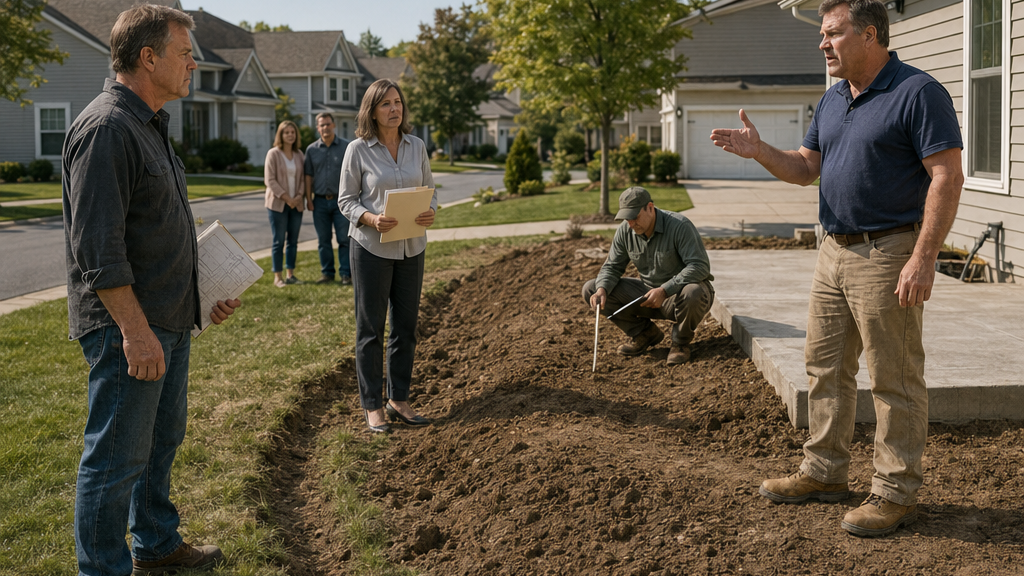
My Neighbor Flooded My Finished Basement for a Bigger Patio—Then the HOA Found What He Never Filed
Chapter 1: Three Inches of Water Below the Stairs
Thomas Carter knew something was wrong before his foot touched the basement floor.
The air smelled like wet soil.
He stopped on the last stair, one hand on the railing, and looked down at three inches of brown water covering the flooring he had installed himself six weeks earlier.
For a second he simply stood there.
Then the sump alarm began chirping from the utility closet.
“Come on.”
He stepped down.
Cold muddy water poured over the tops of his shoes.
The basement had taken him eight months. Not eight months of contractors arriving while he wrote checks. Eight months of evenings after work, Saturday mornings, and Sundays when his knees hurt enough that getting back up from the floor required both hands.
He had cut the trim himself.
Installed the cabinets.
Built the workbench against the far wall.
His father’s old steel vise was bolted to one corner.
Now a plastic storage bin drifted past it.
Thomas moved.
He unplugged the power strip above the workbench, lifted two tool cases onto a shelf, then grabbed the cardboard file box he kept beneath the stairs. The bottom had already gone soft.
When he picked it up, one corner tore.
Receipts and manuals spilled into the water.
Thomas swore under his breath and dropped to one knee.
By the time he saved what he could, the water had darkened his jeans to the thigh.
A low mechanical rumble came through the basement wall.
He froze.
The sound lasted only a few seconds.
Heavy equipment.
Thomas climbed the stairs two at a time.
Rain struck the kitchen windows hard enough to blur the neighboring houses. He went through the garage, crossed his driveway, and followed the side of the house toward the narrow strip of lawn separating his property from Charles Hill’s.
Water was moving through it like a shallow stream.
Not standing water.
Moving water.
It came from the higher ground behind Charles’s house, crossed the freshly disturbed section beside the unfinished patio, then curled directly toward Thomas’s foundation.
Thomas stared at it.
The strip between the homes had always dipped slightly. Barely enough to notice unless you were mowing. The shallow depression carried stormwater toward the rear drainage basin.
Now half of it was packed with fresh reddish-brown soil.
Charles had raised his side of the yard.
Thomas stepped closer.
Mud washed across the place where the low strip used to be.
Three days earlier, he had stood beside the fence while Charles’s contractor pushed soil with a compact loader.
“That looks higher than it was,” Thomas had said.
Charles had leaned on the fence post.
“We’re leveling it for the patio.”
“You sure the water still has somewhere to go?”
Charles had smiled.
Not cruelly. More like Thomas had asked whether he knew how to mow his own grass.
“The contractor knows what he’s doing.”
Thomas had looked at the loader, then at the shallow swale.
He had considered calling the HOA.
The thought irritated him enough that he dismissed it.
For seventeen years, he had complained that the association involved itself in things that did not matter. Mailbox colors. Fence stains. Trash cans visible from the street for an extra afternoon.
He was not going to become the man reporting a neighbor because a yard looked different.
So he had said, “All right. Just asking.”
Now water was pressing against his basement wall.
Thomas crossed the wet grass and knocked on Charles’s side door.
Charles opened it wearing work boots and a rain jacket.
“What?”
“My basement is flooded.”
Charles glanced toward the rain.
“Mine’s dry.”
“I’m getting runoff from your yard.”
Charles frowned. “Thomas, it’s been raining for hours.”
“I know what rain looks like.”
“So do I.”
Thomas pointed toward the side yard.
“You filled the drainage strip.”
“I leveled my property.”
“The water is coming straight off that fill.”
Charles stepped onto the covered landing but did not come farther.
“My contractor graded it.”
“Then your contractor graded it toward my house.”
Charles gave a short laugh.
It was not loud.
That made it worse.
“Maybe you need a better sump pump.”
Thomas looked at him.
Charles’s expression changed slightly.
Not apology.
Recognition that the joke had landed badly.
Thomas said, “I didn’t have water in that basement before you changed the grade.”
“And I didn’t make it rain.”
There were several things Thomas wanted to say.
He said none of them.
He turned and walked back through the water.
By late afternoon, the remediation crew had arrived. Two men carried hoses downstairs and began extracting water while another measured moisture in the baseboards.
Thomas stood near the stairs, answering questions.
How long had the water been present?
Was the basement finished?
Had there been prior flooding?
Any foundation work?
Any photographs before the loss?
That last question caught him.
“Photographs of what?”
“The exterior before the storm. Drainage. Grading. Anything like that.”
Thomas thought about Charles’s loader.
He had watched it for several days.
He had taken no pictures.
“No.”
The crew member nodded and kept typing.
Thomas looked toward the workbench.
The steel vise sat above the waterline, untouched.
His father had given it to him thirty years earlier.
When Thomas first bought the house, his father had helped him build shelving in the unfinished basement and said, half joking, “One day you’re going to stop treating this place like you’re leaving next year.”
Thomas had spent years replacing things only when they broke.
The basement had been his answer.
He had finally built a room meant to stay.
Now the lower cabinets were swelling at the seams.
After the crew left, Thomas went upstairs and opened the drawer where he kept house paperwork.
He found closing documents, insurance renewals, appliance warranties, and old HOA letters he had never bothered throwing away.
At the bottom was a folded subdivision plan from the year he bought the house.
He spread it across the kitchen table.
Property lines ran in thin black strokes.
Utility easements.
Lot numbers.
Then another line.
It curved between his property and Charles’s, following the exact shallow strip Thomas had mowed for seventeen years.
Beside it, in small printed notation, were the words identifying a drainage feature.
Thomas leaned closer.
The line passed directly beneath the fresh soil Charles had added.
He put one finger on it and traced it toward the rear basin.
For the first time all day, the anger inside him became quiet.
Chapter 2: The Line Hidden Under Fresh Dirt
The line on the subdivision plan ran exactly beneath Charles Hill’s new fill.
Thomas checked it three times before breakfast.
He turned the paper around, compared the lot numbers, then carried it to the kitchen window and looked toward the narrow space between the houses.
From there, nothing dramatic was visible.
That was almost the problem.
The drainage swale had never looked important.
It was just grass.
A shallow dip.
Something the mower tilted into for four seconds before leveling again.
Thomas put on his boots and went outside.
The storm had moved east overnight, leaving the neighborhood unnaturally clean except for the mud.
At the rear corner of Charles’s unfinished patio, the new soil stood several inches above the old lawn. Thomas followed the edge toward his own house.
He crouched.
Small bits of washed mulch and red clay had collected against his foundation.
The path was unmistakable now.
He took out his phone.
First photograph.
Then another.
Then twenty more.
He photographed the filled strip, the unfinished patio, the slope, the mud line against his siding, and the old depression farther downhill where the swale remained untouched.
Only afterward did he notice Charles watching from his deck.
Thomas stood.
Charles called, “Building a case?”
“I’m documenting the damage.”
“You could’ve done that without pointing the camera at my yard.”
“I’m pointing it at the water path.”
Charles shook his head.
“I have approval for the patio, Thomas.”
That stopped him.
“From who?”
“The HOA.”
Thomas looked at the fill again.
“For the grading too?”
“For the project.”
“That isn’t what I asked.”
Charles came down two steps.
“I submitted drawings. They approved it. I hired a contractor. I’m not doing something in the middle of the night.”
Thomas folded his phone into his palm.
“Then I’ll ask them what they approved.”
Charles gave him a tight smile.
“Good.”
By ten o’clock, Thomas was sitting across from Kathleen White in the HOA management office.
The room occupied a converted front section of the clubhouse and smelled faintly of printer paper and coffee.
Kathleen had managed the subdivision for five years. Thomas knew her mostly through emails reminding residents about annual dues and landscaping inspections.
He placed the old subdivision plan on her desk.
“This is the original drainage route.”
Kathleen studied it.
“And this is between your lot and the Hill property?”
“Yes.”
“He filled part of it.”
“Charles says he had approval.”
Kathleen leaned back.
“He did submit a patio application.”
Thomas waited.
She added, “That doesn’t automatically make the drainage issue an association matter.”
“He changed the drainage feature shown on the subdivision plan.”
“I understand what you’re saying.”
“My basement has three inches of water in it.”
“And I’m not minimizing that.”
“It sounds like you are.”
Kathleen’s expression tightened.
“What I’m saying is that the HOA is not a county engineering office. If one homeowner causes drainage damage to another, that can be a private liability issue.”
Thomas sat back.
The phrase irritated him because it sounded polished enough to close a door.
“A private liability issue that started with an HOA-approved project.”
“We approved a patio request.”
“Did you approve filling this?”
He tapped the plan.
Kathleen looked down again.
“I’d need to review the application.”
“Please do.”
She hesitated.
“I can tell you the patio itself was approved.”
Thomas felt the first clean certainty he had experienced since discovering the flood begin to slip.
Charles had not invented the approval.
That mattered.
Kathleen turned toward her computer.
“I’ll pull the file.”
While she searched, Thomas looked through old photographs on his phone.
He did not expect much.
He rarely photographed the side yard.
But three summers earlier, he had taken pictures while replacing a section of fence near the rear property line.
He enlarged one.
There it was.
The grass between the houses dipped clearly before rising toward Charles’s old lawn.
Another photograph from a family cookout caught the same area in the background.
Thomas placed the phone beside the subdivision plan when Kathleen returned.
“That’s before he moved in.”
Kathleen studied both.
“That does show a depression.”
“It shows the swale.”
“It appears consistent with the plan.”
That was enough to steady him.
Not victory.
But something solid.
Kathleen placed a one-page form on the desk.
At the top was Charles’s address.
Below it was a simple drawing of a rectangular patio behind the house.
Thomas leaned forward.
“That’s it?”
“This is the application summary.”
“Where’s the grading plan?”
Kathleen flipped the page.
“There isn’t one attached here.”
“Drainage calculation?”
“No.”
“Elevation?”
“No.”
Thomas looked up.
Kathleen’s voice became more careful.
“The architectural committee reviews residential improvements. It does not necessarily conduct engineering review for a standard patio.”
“Was this standard?”
“That depends on what was actually built.”
Thomas pointed toward the application.
“The patio in this sketch looks smaller.”
Kathleen examined it.
The rectangle on the page ended several feet before the side property line.
Charles’s unfinished concrete base extended much closer.
“I need to compare this to the site,” she said.
“And I need the complete file.”
“This is what’s currently scanned.”
“Currently scanned?”
Kathleen glanced toward a metal cabinet.
“Older committee records are sometimes maintained in paper form.”
Thomas nearly laughed.
For years he had regarded HOA paperwork as evidence of bureaucratic obsession.
Now he wanted more of it.
“When can I see it?”
“I’ll locate it.”
“Today?”
Kathleen gave him a look.
“I said I’ll locate it.”
He left before saying something that would make cooperation less likely.
That evening, an email arrived from his insurance adjuster asking whether any prior complaint had been made about Charles’s grading before the storm.
Thomas read the sentence twice.
He typed, I spoke with the neighboring homeowner.
Then deleted it.
He typed, No written complaint was made.
That stayed.
He hated how weak it looked.
The next afternoon Kathleen called.
“I found the paper file.”
Thomas returned to the clubhouse.
She had spread three sheets across the conference table.
The first was the same application summary.
The second showed material samples.
The third was Charles’s sketch.
Nothing else.
No grading notes.
No drainage review.
No contractor plan.
Thomas picked up the sketch.
A handwritten notation near the bottom said approved as submitted.
“That phrase,” he said. “What does it mean?”
“It means the committee approved what’s shown.”
“And what isn’t shown?”
Kathleen did not answer immediately.
Thomas looked at the plain rectangle drawn behind Charles’s house.
No soil quantities.
No changed elevations.
No filled swale.
No broad platform reaching toward Thomas’s property.
Charles had approval.
But Thomas was beginning to understand the more important question.
Approval for what?
Chapter 3: The Approval Charles Thought Covered Everything
The loader came back before Kathleen gave Thomas a written answer.
He heard the engine at 7:42 on Friday morning.
Thomas was standing in his kitchen with coffee when the backup alarm began pulsing through the glass.
He set the mug down.
Outside, Charles’s contractor was moving another bucket of soil toward the side yard.
Thomas walked straight across the grass.
The contractor lowered the bucket when he approached.
Charles emerged from the back door.
“What now?”
“You’re continuing?”
“We’re finishing the base.”
“Kathleen is reviewing the approval.”
Charles pointed toward his house.
“I already have an approval.”
“You have a sketch for a patio.”
“I have an approval.”
“The grading isn’t on it.”
Charles folded his arms.
“You don’t get to reinterpret my paperwork because your basement leaked.”
Thomas felt the old anger rise.
He pictured the swollen cabinets downstairs.
The ruined flooring stacked in the garage.
The cardboard box of receipts drying on newspapers.
He also pictured himself shouting across the yard while the contractor watched.
So he stopped.
“Fine,” Thomas said.
Charles looked almost disappointed.
Thomas went home and made two calls.
The first was to Kathleen.
The second was to the county drainage office.
By early afternoon, Kathleen’s compact SUV was parked at the curb beside a municipal vehicle.
Two neighbors had drifted outside, pretending to check mailboxes and weeds.
Thomas hated that.
He wanted the matter resolved, not performed.
Charles appeared to feel differently.
He walked toward the group holding a copy of his HOA approval.
“This is getting ridiculous.”
Kathleen said, “We’re clarifying the scope of the project.”
“I’ve already clarified it.”
The municipal inspector stood near the side yard studying the original subdivision plan Thomas had provided.
Charles pointed toward Thomas.
“He’s treating my backyard like it belongs to the neighborhood.”
Thomas said nothing.
Charles continued.
“I bought the property. I submitted the patio. You approved it. Now he gets water during one of the biggest storms we’ve had this year and suddenly everybody’s acting like I built a dam.”
Thomas looked toward the filled swale.
The soil had dried enough that the original shape was almost impossible to see.
That was exactly why he did not argue.
He turned to the inspector.
“Can you compare the existing grade to the drainage line on the recorded plan?”
The inspector looked from the paper to the ground.
“Do you have any grading documents for this project?”
Charles lifted his approval.
“I have this.”
“I mean elevations. A grading plan. Drainage details.”
“My contractor handled the site.”
The contractor, standing several yards away, suddenly became interested in something inside the loader cab.
The inspector asked, “Was fill imported?”
Charles paused.
“Yes.”
“How much?”
“I don’t know.”
“Was the swale shown here relocated?”
“It wasn’t a swale. It was just a low spot.”
Thomas almost spoke.
The inspector crouched near the edge of the unfinished patio.
He took several measurements, then walked toward the rear basin.
When he returned, he asked Kathleen for the architectural drawing.
She handed him Charles’s sketch.
He studied it for less than a minute.
“This drawing shows a patio footprint,” he said. “It doesn’t show authorization to modify the subdivision drainage path.”
Charles stared at him.
“But it was approved.”
“By the association.”
“Yes.”
“That does not replace county requirements.”
The sentence landed harder than Thomas expected.
Not because Charles looked defeated.
He did not.
He looked confused.
For the first time, Thomas saw the possibility that Charles had genuinely believed one approval covered everything.
Kathleen said quietly, “The association approved the patio placement as submitted. We did not approve filling the drainage feature.”
Charles turned on her.
“You approved the project.”
Kathleen’s face changed.
“I approved the architectural application after committee review.”
“You’re the manager.”
“I administer what the committee approves.”
“And nobody thought drainage mattered until he complained?”
The question was meant as an accusation.
Instead, it created a silence.
Kathleen looked toward the ground.
Thomas noticed.
So did Charles.
The inspector walked back to his vehicle and returned with a bright notice in a clear protective sleeve.
Charles’s voice dropped.
“What is that?”
“A stop-work notice pending review of the grading and drainage modification.”
One of the neighbors across the street stopped pretending to examine a shrub.
Charles looked at Thomas.
“This what you wanted?”
Thomas could have said yes.
Forty-eight hours earlier, he might have.
Instead he said, “I wanted the water to stop coming into my house.”
The inspector attached the notice near Charles’s front entry where it could be seen from the walk.
The loader shut down.
For several seconds, the neighborhood seemed unusually quiet without its engine.
Charles stared at the notice.
Then he looked at Kathleen.
“You told me the patio was approved.”
“It was.”
“Then why am I being shut down?”
Kathleen opened her mouth, then closed it.
The contractor came over.
“If we’re stopping, I need to know whether I’m pulling equipment today.”
Charles rubbed one hand across his forehead.
“How much to leave it here?”
“That depends how long.”
Thomas watched the shift happen.
The argument was no longer about whether his basement had flooded.
It was about money Charles had already spent, work already done, and permission that had turned out to mean less than Charles believed.
Thomas should have felt satisfied.
Instead he felt something more cautious.
Leverage.
Not vindication.
Kathleen asked Thomas to meet at the clubhouse that evening.
The architectural committee gathered around a long folding table with printed copies of Charles’s application and the subdivision plan.
Dennis Thompson sat at the far end.
Thomas had known Dennis for more than a decade. They waved when passing on the street and occasionally talked about property taxes or lawn equipment.
Dennis tapped Charles’s sketch.
“The committee approved this.”
Thomas said, “Then somebody should explain why the actual project includes several truckloads of fill.”
One board member said, “We don’t inspect construction.”
“Then what does approval mean?”
“That the design complies with the covenants.”
“Does filling a drainage swale comply?”
The room went quiet.
Kathleen answered.
“We did not conduct drainage review.”
Thomas looked at her.
“So nobody checked.”
“For a typical patio, no.”
“This wasn’t typical.”
“We know that now.”
Charles, seated on the opposite side of the table, gave a humorless laugh.
“You all knew enough to approve it when I was paying the contractor.”
Dennis leaned forward.
“Charles, the application you submitted did not show this grading.”
“My contractor said the grade had to come up to make the patio level.”
“Then the application should have been amended.”
“Nobody told me that.”
Thomas looked from Charles to Kathleen to Dennis.
The simple version of the story—the version in which Charles ignored every rule and Thomas uncovered the truth—was beginning to break apart.
Charles had exceeded the drawing.
That much was clear.
But the HOA had approved a project without asking how a large level patio would fit onto a sloped yard.
Thomas said, “How many projects get approved like this?”
Dennis did not answer.
Kathleen looked toward him.
That was enough.
After the meeting, Dennis caught Thomas in the parking lot.
“Thomas.”
Thomas kept walking.
“Not tonight.”
“Then tomorrow.”
“I have a basement torn apart.”
“I know.”
Thomas stopped.
Dennis lowered his voice.
“Before you decide Kathleen caused this, or the committee caused this, you need to understand how these approvals have been handled.”
Thomas looked at him.
“For how long?”
Dennis glanced back toward the clubhouse doors.
“A long time.”
“What does that mean?”
“It means Charles isn’t the first homeowner who got more flexibility than the written procedure really allows.”
Thomas said nothing.
Dennis added, “And before you decide exactly how angry you want to be about that, there’s something in those old files you should see.”
Thomas felt the first edge of a new suspicion.
“What?”
Dennis met his eyes.
“Your name.”
Chapter 4: The Shortcut Everyone Had Learned to Accept
Dennis Thompson laid a manila folder on his porch table and said, “This is the part nobody likes admitting.”
Thomas remained standing.
The folder was thick enough that its metal fastener bowed.
“What am I looking at?”
“About seven years of architectural approvals.”
“You took HOA records home?”
“Copies. Mostly.”
“That’s comforting.”
Dennis ignored the remark and opened the folder.
Patio requests. Fence replacements. Shed applications. Retaining walls. Walkways. Windows.
Some files contained diagrams and contractor specifications.
Others contained little more than a form, a rough sketch, and an approval signature.
Dennis pushed several toward Thomas.
“After the management company changed, people were waiting six or eight weeks for simple projects. Homeowners complained. Board members complained. So we started handling routine applications faster.”
“By ignoring the rules?”
“By deciding not every flower bed needed an engineer.”
“This wasn’t a flower bed.”
“No. But it entered the system looking like a patio.”
Thomas sat down.
Dennis tapped Charles’s application.
“A rectangle. Materials. Distance from the rear line. Nothing that said imported fill.”
“Anybody who walked into his backyard would’ve seen the slope.”
“We don’t walk every application.”
“Then what are you approving?”
Dennis leaned back.
“That’s a fair question.”
Thomas had expected defensiveness.
The quiet answer unsettled him more.
Dennis turned through the papers.
“We got used to treating the application as the project. If somebody showed a fence, we reviewed the fence. If somebody showed a patio, we reviewed the patio.”
“And if the contractor needed to move half the yard?”
“The homeowner was supposed to update the application.”
Thomas looked toward Dennis’s lawn.
“You really think Charles knew that?”
“I think Charles knew he was adding more fill than he told us.”
“That’s not what I asked.”
Dennis rubbed his thumb along the folder edge.
“No. I don’t think he understood where HOA approval ended and county requirements started.”
Thomas felt his jaw tighten.
“That doesn’t put my floor back.”
“I know.”
“Doesn’t dry my cabinets.”
“I know.”
“Doesn’t change what he said when I warned him.”
“No.”
That answer stayed between them.
Charles had been careless.
Then defensive.
Then, after Thomas warned him, stubborn enough to continue.
None of that disappeared because the system had been sloppy.
Dennis turned another page.
“There’s one more thing.”
He slid a file across the table.
Thomas recognized his address before he saw his name.
His egress window.
Eight years earlier.
He remembered the project clearly because the first contractor had backed out, leaving Thomas with a hole cut into the basement wall and three weeks of rain in the forecast.
He opened the file.
Application.
Sketch.
Approval.
No engineering note.
No foundation review.
No drainage review around the window well.
A handwritten approval date showed that the committee had turned it around in four days.
Thomas stared at it.
Dennis said, “You called me twice because the management company told you standard review was thirty days.”
“I had an opening in my basement wall.”
“I remember.”
“I wasn’t changing the grade.”
“No.”
“So this isn’t the same.”
“I didn’t say it was.”
“It sounds like you’re trying to.”
“I’m saying the process you’re angry about is the same process that helped you when you needed flexibility.”
Thomas closed the file harder than necessary.
“My window didn’t flood anybody.”
“No. It didn’t.”
Dennis leaned forward.
“That’s why this matters. The shortcut didn’t hurt anyone until it did.”
Thomas looked at his own approval again.
For two days, he had been building a clean argument in his head.
Charles had ignored procedure.
The HOA had failed to enforce procedure.
Thomas had done everything right.
Now there was his signature on the same kind of thin file.
Not equal responsibility.
But not clean innocence either.
He left Dennis’s porch carrying photocopies.
At the HOA records room the next afternoon, Kathleen had assembled other applications Dennis had flagged.
A retaining wall approved without soil details.
A shed placed near a drainage easement.
Two patios.
A landscape berm.
Nothing proved another flood had happened.
That was almost worse.
They had been lucky.
Kathleen stood beside a filing cabinet.
“I should have caught the grading issue.”
Thomas looked up.
It was the first time she had said it plainly.
“You weren’t given a grading plan.”
“I should have looked at the lot before the committee approved the revision.”
“What revision?”
She paused.
Then pulled out an email.
Charles had asked whether his patio could extend several feet wider than the original sketch.
The reply had been brief.
No objection provided setbacks remained compliant.
Thomas read it twice.
“That wasn’t in the file you gave me.”
“It was in the management email archive.”
“So the patio changed.”
“The width changed.”
“And nobody asked why?”
“No.”
Thomas handed it back.
Kathleen said, “I was trying to avoid turning every homeowner improvement into a three-month process.”
Thomas nearly answered that this was exactly why HOAs existed.
The irony stopped him.
For years he had complained whenever they did more than the minimum.
He went home to the basement.
The lower drywall had been cut away. Bare studs circled the room. Fans hummed where his cabinets had stood.
His father’s vise remained bolted to the workbench.
Thomas put his hand on the steel handle.
He had wanted a person to blame because a person was easier to understand than a chain of small choices.
Charles still had choices to answer for.
So did the HOA.
So, in a smaller way, did Thomas.
His phone rang.
The insurance adjuster.
Thomas answered.
“I reviewed what you sent,” the adjuster said. “The photographs, HOA file, and county notice.”
“And?”
“We’re not denying that a drainage alteration may have occurred.”
Thomas waited.
“But we still need causation.”
“The water path is visible.”
“We need to know whether the neighboring work caused the interior loss or whether an existing foundation condition contributed.”
Thomas looked at the exposed basement wall.
“There was no flood before.”
“That helps. It doesn’t settle allocation.”
“So what are you telling me?”
“That we’re not authorizing full recovery from the neighbor’s carrier based on the current documentation.”
Thomas closed his eyes.
The stop-work order had felt like the end of the argument.
It had not even settled the beginning.
“What do you need?”
“An engineering assessment.”
After the call, Thomas stood beside the workbench while the fans blew cold air across the stripped room.
He had proven that Charles exceeded the patio approval.
He had proven the swale existed.
He had proven the HOA had never reviewed the grading.
And still, on the question that mattered most financially, the answer remained open.
Was Charles’s fill what put the water in the basement?
Or had the storm simply found a weakness that was already Thomas’s?
Chapter 5: What the Water Actually Followed
Jennifer Jones drove a metal stake into Charles Hill’s yard and looked through her level toward Thomas’s foundation.
Then she checked the reading again.
Charles stood near the unfinished patio with his hands in his pockets.
Thomas waited.
Jennifer moved the measuring rod several feet.
Another reading.
Then another.
Finally she pointed toward the new soil.
“This section pitches toward the Carter property.”
Thomas felt something loosen in his chest.
Charles said, “It always sloped.”
“Not at this elevation.”
Jennifer stepped toward the side property line.
The county stop-work notice was still posted near Charles’s front walk, faded slightly from sun.
She had spent the morning reviewing the recorded subdivision plan, photographs Thomas had found, and the current site conditions.
Now bright survey stakes traced a shallow curve through both yards.
The old swale.
For the first time since the grading, Thomas could see its original route as a deliberate thing rather than a vague memory in the grass.
Jennifer pointed to the filled section.
“The historic drainage path carried runoff toward the rear basin. This fill raises the upstream edge and reduces the cross-section.”
Charles said, “In normal language?”
“Water has less room to move through the intended path.”
“And that means it went into his basement?”
“It means the alteration materially increased runoff pressure toward his side.”
Thomas looked at Charles.
Charles looked away.
There it was.
Not a confession.
Something better.
A measurement.
Jennifer continued along Thomas’s foundation.
She knelt near the discharge line for the foundation drainage system.
“How old is this?”
“The house? Twenty-three years.”
“The drain.”
“Original as far as I know.”
She asked Thomas to run water through an access point while she checked the outlet.
A few minutes later, her expression changed.
“What?”
Jennifer stood.
“Flow is lower than I’d expect.”
Thomas felt the relief disappear.
“How low?”
“I need to test it properly.”
Charles looked over.
Thomas heard the shift before anyone said another word.
By afternoon, Jennifer had opened a cleanout near the foundation.
Water backed up slowly.
“Partial restriction,” she said.
Thomas folded his arms.
“Enough to flood the basement?”
“Not by itself under ordinary conditions, based on what I’ve seen.”
Charles spoke from behind them.
“But it mattered.”
Jennifer did not soften it.
“Yes.”
Thomas turned toward her.
“I’ve never had water in there.”
“I believe you.”
“Then his grading caused it.”
“I’m not going to say that in absolute terms.”
Thomas stared.
She pointed toward the stakes.
“I can support that the fill altered the drainage path and materially increased water directed toward your foundation during the storm.”
“That sounds like cause.”
“It is a contributing cause.”
“And the drain?”
“Also a contributing condition.”
Charles exhaled.
For the first time in days, he seemed to have been handed something solid to stand on.
Thomas disliked that reaction enough that he nearly argued with Jennifer.
Then he stopped.
He had hired her because he wanted an answer strong enough to survive disagreement.
Not an answer designed to make him feel right.
Jennifer showed them the proposed restoration line.
Remove fill from the former swale.
Lower part of the patio base.
Reestablish positive flow toward the rear basin.
Thomas watched the stakes form a visible curve between the homes.
The line Charles had buried was back.
Not yet in grass.
But undeniable.
Later, in Thomas’s basement, Jennifer examined the exposed wall and the old drain route.
She pointed to staining near the lower edge.
“This portion may have been underperforming before the flood.”
Thomas looked at the mark.
“Would I have known?”
“Probably not unless you had a similar storm load.”
“So I could’ve gone another ten years without knowing.”
“Possibly.”
“And if Charles hadn’t filled the swale?”
Jennifer considered it.
“I can’t reconstruct the exact storm without more data. But the original drainage route reduced the amount of water reaching this wall. Removing that capacity made the system less forgiving.”
Thomas sat on the edge of the workbench.
That phrase stayed with him.
Less forgiving.
It described more than drainage.
Charles had assumed his approval forgave whatever adjustments were necessary.
The HOA had assumed ordinary projects did not require difficult questions.
Thomas had assumed seventeen dry years meant his foundation was beyond concern.
The storm had exposed all three assumptions at once.
Jennifer packed her equipment.
“I’ll send the report to both carriers and the county.”
Thomas said, “Be specific.”
“I will.”
“About the grading.”
“I’ll be specific about everything.”
After she left, Thomas looked at the workbench.
His father’s vise had acquired a faint orange film near the base from the damp air.
Thomas wiped it with an oily rag.
He had spent the first week imagining Charles writing a check for every ruined plank, every swollen cabinet, every hour Thomas had spent tearing out what he built.
Now he knew the truth would not support that clean equation.
The grading had mattered.
A lot.
So had his own aging drainage system.
That evening Charles came to the property line.
He stayed on his side.
“The engineer told you the drain was bad?”
“Partially restricted.”
Charles nodded.
“So this wasn’t all me.”
Thomas looked toward the survey stakes.
“No.”
Charles seemed surprised.
Thomas continued, “And it wasn’t all my drain.”
“I know.”
“You kept grading after I warned you.”
Charles looked toward the patio.
“My contractor told me the water would run around it.”
“You believed him because stopping would’ve cost you money.”
Charles’s mouth tightened.
“You don’t know what I believed.”
“No. I know what you chose.”
Charles left without answering.
Two days later, Jennifer’s report arrived.
The language was careful.
The fill materially altered established surface drainage.
The change increased runoff toward Thomas’s foundation.
The partially restricted foundation drainage system reduced the home’s ability to manage the increased load.
Corrective work was recommended on both properties.
Thomas forwarded it to his insurer.
By Friday, the neighboring carrier responded.
They were prepared to contribute substantially toward the basement remediation.
Thomas read the proposed figure.
It would not cover everything.
It would cover enough that he could rebuild without emptying the savings account.
Then he reached the release.
In exchange for payment, Thomas would release Charles, his insurer, and related parties from further claims connected to the event and drainage conditions.
He read that part again.
The money would help repair the basement.
The wording could leave the yard exactly where it was once the county stop-work issue ended.
Thomas looked through the kitchen window.
Bright stakes still traced the old swale across the grass.
He could take the money.
Or he could insist that the line in the ground mattered as much as the damage below it.
Chapter 6: The Offer That Would Fix Only His Basement
The settlement number sat at the top of Thomas Carter’s kitchen table, large enough to make saying yes feel sensible.
His contractor’s repair estimate sat beside it.
The gap between the two was manageable.
Thomas could cover it.
He could replace the flooring, rebuild the lower cabinets, repair the foundation drain, and have the basement usable again before winter.
All he had to do was sign.
He turned to the final page.
Release of all claims arising from the incident, including present or future drainage-related damages.
Thomas picked up a pen.
Then put it down.
For the first week after the flood, he would have signed almost anything that forced Charles to pay.
Now the money felt strangely incomplete.
His phone rang.
Kathleen.
“The board meeting is tonight,” she said. “Dennis told me you may have a proposal.”
“I have one.”
“Are you planning to pursue the association?”
Thomas looked at the release.
“I haven’t decided.”
Kathleen was quiet.
Then she said, “If this becomes litigation, the board will turn it over to counsel. Once that happens, nobody gets to be practical anymore.”
“You’re asking me not to sue.”
“I’m telling you what happens if you do.”
“What does the HOA plan to change?”
“We’re drafting a requirement for drainage review when projects alter grade or add significant impervious surface.”
“Drafting because of this?”
“Yes.”
Thomas leaned back.
A month earlier he would have enjoyed hearing her admit that.
Now it sounded like work that should have happened years ago.
“Bring the draft tonight.”
At the meeting, Charles sat three chairs away.
The stop-work order had halted his patio long enough that weeds were beginning to appear around the unfinished edges.
Dennis had Jennifer’s corrective sketch in front of him.
Kathleen distributed a proposed architectural-review amendment.
Thomas read the first page.
Too broad.
It required professional review for almost any project that changed elevation.
He looked up.
“This will make somebody hire an engineer to build a garden border.”
Kathleen said, “We’re trying not to repeat this.”
“You’ll repeat a different problem.”
Dennis gave the smallest smile.
Thomas noticed.
Years of complaining about HOA overreach had apparently trained him for something useful.
He tapped the draft.
“Set thresholds. Imported fill over a certain amount. Retaining walls above a defined height. Projects within recorded drainage features. Large new hard surfaces on sloped lots.”
A board member asked, “Why are you helping us write this if you think the association is partly responsible?”
“Because being partly responsible doesn’t mean you should become twice as intrusive.”
Charles looked at him for the first time that evening.
Kathleen said, “That’s workable.”
Thomas slid the insurance release onto the table.
“This isn’t.”
Charles recognized it.
“That’s between the carriers.”
“It becomes between us if I sign away future drainage claims while your yard stays unfinished.”
“The county already stopped the work.”
“A stop order isn’t a repair.”
Dennis looked toward Jennifer’s plan.
“What are you asking for?”
Thomas had rehearsed the answer and then deliberately shortened it.
“Restore the swale according to Jennifer’s plan. Remove the part of the patio base that blocks it. I repair my foundation drain. Your carrier pays the agreed share of the basement damage. I release the flood claim after the drainage work passes inspection.”
Charles leaned back.
“You want me to tear out concrete.”
“Part of it.”
“I paid for that.”
Thomas looked at him.
“So did I.”
The room tightened.
Thomas could have continued.
He could have listed the flooring, cabinetry, remediation, wasted weekends.
Instead he said, “Jennifer’s report says my drain contributed. I’m paying to fix my side.”
Charles’s expression shifted.
Thomas pushed the release toward the center.
“I’m not asking you to pay for my whole basement. I’m asking you to fix what your project changed.”
Kathleen said, “That would also give the association a clear basis to close the violation once the county signs off.”
Charles looked at her.
“And what about my contractor?”
“That’s between you and the contractor.”
“Of course it is.”
His voice carried more exhaustion than anger.
Dennis said, “Charles, the alternative is that this stays unresolved.”
“I understand the alternative.”
He stood.
For a moment Thomas thought he was leaving.
Instead Charles walked to Jennifer’s plan.
“How much of the patio goes?”
Dennis pointed to the shaded area.
“This section.”
Charles stared at it.
“That’s where the steps were supposed to go.”
No one answered.
He sat again.
Thomas saw, perhaps for the first time clearly, that Charles was not defending dirt anymore.
He was defending money already spent.
A promise already made.
A project that had become harder to abandon each time another dollar went into it.
Charles said, “I put almost everything we had set aside for the house into this.”
Thomas said nothing.
“My wife wanted one finished thing,” Charles continued. “We moved in and every room needed something. Roof work. Appliances. Landscaping. I told her I’d get the backyard done.”
Nobody moved.
Charles looked down at the plan.
“When Thomas came over the first time, the contractor had already ordered concrete.”
Thomas remembered the laugh.
The sump-pump remark.
“You could’ve stopped.”
“I know.”
It was the first time Charles had said it.
Not an apology.
But not an excuse either.
Charles rubbed both hands over his face.
“I need to see what the contractor will charge to undo it.”
Thomas nodded.
“That’s fair.”
Charles looked surprised again.
The meeting ended without signatures.
Kathleen kept the proposed rule for revisions.
Dennis gathered the approval files.
Thomas folded the old subdivision plan along its worn creases and carried it under his arm.
In the parking lot, Charles caught up with him.
“I’m not agreeing tonight.”
“I know.”
“I need numbers.”
“I know.”
Charles glanced at the plan.
“You really had that thing for seventeen years?”
“Bottom of a drawer.”
“And never cared about the drainage line until your basement flooded.”
Thomas looked at him.
“No.”
Charles gave a tired half-laugh.
“At least we agree on something.”
Three days passed.
Thomas did not call.
On the fourth afternoon, his doorbell rang.
Charles stood outside holding Jennifer’s corrective plan.
“The contractor says I can remove the section without tearing out everything.”
Thomas waited.
Charles pointed toward the side yard.
“I want to walk the line before I say yes.”
Thomas stepped outside.
They crossed the grass without speaking.
The bright survey stakes curved between their properties, following the shape that had once been too ordinary for either man to think about.
Charles stopped beside the first stake.
“All right,” he said. “Show me exactly where you want the water to go.”
Chapter 7: The Drainage Line They Could Both See
The excavator returned six weeks after the flood, but this time its bucket was pointed at Charles Hill’s patio.
Thomas stood near the side of his house while the operator eased the machine across plywood sheets laid over the lawn.
Charles watched from his deck.
Neither man said anything when the first section of concrete cracked.
The sound carried between the houses.
Thomas had imagined this moment more than once during the first days after the flood. In those versions, he had expected satisfaction. Maybe even pleasure.
Instead he found himself watching the operator separate broken pieces carefully so the portion of patio outside Jennifer Jones’s corrective plan could remain.
The settlement had been signed four days earlier.
Charles’s insurer would cover the agreed share of Thomas’s basement damage. Thomas would pay for cleaning and repairing his restricted foundation drain. Charles would remove the fill and patio section interfering with the recorded drainage route.
The HOA would close its violation only after the county accepted the restoration.
Nobody had won everything.
That was probably why the agreement had held together.
The operator lifted another chunk of concrete.
Underneath it was compacted stone, then soil.
Jennifer arrived just after nine carrying a measuring rod and level.
Kathleen White came fifteen minutes later with the revised HOA drainage-review policy in a folder.
Dennis Thompson followed her.
Thomas looked at the three of them standing near the lawn.
“Quite an audience.”
Kathleen said, “I’m calling it documentation.”
Dennis smiled. “She’s learned that word.”
Kathleen ignored him.
Jennifer marked several points with temporary stakes.
“Take the fill down to this elevation. Then blend toward the rear basin.”
The operator nodded.
Charles came down from his deck.
“How much lower here?”
Jennifer showed him.
Charles studied the stake.
“That’s basically where it was before.”
“That is the idea.”
He looked toward Thomas.
Thomas said nothing.
The work continued through the morning.
Each bucket of soil removed made the old shape of the yard reappear.
The swale had never been deep. Even restored, nobody driving down the street would notice it.
But Thomas could.
He remembered mowing through that gentle dip for years without once asking why it existed.
By noon, water from a garden hose placed near Charles’s upper yard ran through the reconstructed channel and curved toward the rear basin.
It did not approach Thomas’s foundation.
Jennifer followed the flow.
“Still needs final grading and sod,” she said, “but that’s the path.”
Thomas watched the narrow ribbon of water move through the dirt.
Charles stood beside him.
After a while he said, “I thought you were exaggerating.”
Thomas turned.
Charles kept looking at the ground.
“When you warned me before the storm.”
“I figured.”
“My contractor had already told me stopping would mean rescheduling the concrete crew.”
Thomas waited.
Charles rubbed the back of his neck.
“I’d put down deposits. Materials were ordered. My wife had been asking for that backyard since we moved in.”
He gave a short breath that was almost a laugh.
“Every time I looked at the house, there was another thing that needed money. The patio was supposed to be the one project we finished and didn’t have to think about anymore.”
Thomas remembered Charles standing under the covered landing while water filled his basement.
“Then I came over.”
“Then you came over.”
“And you told me to get a better sump pump.”
Charles winced.
“I know.”
“Why?”
Charles kicked lightly at a clod of dirt.
“Because if you were right, I had to stop.”
Thomas said nothing.
Charles continued.
“And if I stopped, I had to admit I’d committed more money than I should’ve before I knew what the contractor was actually doing.”
That was not the explanation Thomas had expected.
It did not make the remark better.
But it made it recognizable.
Fear dressed as certainty.
Thomas had done his own version of that.
He had watched grading change beside his property and refused to contact the HOA because doing so would have meant admitting that sometimes rules served a purpose.
“You still should’ve stopped,” Thomas said.
“I know.”
The answer was quiet.
That was enough.
They were never going to become friends because of a drainage dispute.
Thomas did not need them to.
By the following week, sod covered the reconstructed swale.
The county inspector walked the route, checked Jennifer’s measurements, and cleared Charles to finish a smaller version of the patio outside the drainage area.
Kathleen sent residents a notice explaining the new architectural standards.
Projects involving significant imported fill, retaining structures above the new threshold, work inside recorded drainage features, or substantial hard surfaces on sloped lots would require additional review.
Thomas read it twice.
It was specific.
That mattered.
Dennis stopped by while Thomas was reinstalling basement cabinets.
“We have an opening on the architectural committee.”
Thomas looked at him over the cabinet frame.
“No.”
Dennis laughed.
“You didn’t even think about it.”
“I’ve spent enough time thinking about everybody’s yards.”
“You’d be good at it.”
“That’s exactly why I’m saying no.”
Dennis leaned against the stair rail.
“You know you helped write half the new policy.”
“I helped make sure you didn’t require engineering drawings for flower beds.”
“Public service.”
“Temporary lapse in judgment.”
Dennis shook his head.
Before leaving, he looked at the repaired wall.
“Basement looks good.”
“It’s getting there.”
Thomas waited until Dennis had gone before mounting the final cabinet door.
The insurance money had covered most of the remediation and replacement materials. Not every dollar. Thomas’s contribution toward the foundation drain was substantial enough that he felt it each time he looked at his savings account.
But the repaired drain now ran clear.
He had watched the test himself.
A week later, Thomas carried the old workbench away from the center of the basement and pushed it back against the wall.
The top still bore faint water marks.
He could have sanded them out.
He chose not to.
He tightened the bolts on his father’s steel vise and wiped a thin layer of oil across the handle.
Upstairs, something tapped against the kitchen window.
Rain.
Thomas stopped.
For a moment his body reacted before his mind did.
He listened.
The rain strengthened.
He went outside.
Across the narrow strip between the houses, water gathered in the grass.
Then it moved.
Not toward him.
Through the shallow swale.
Past the edge of Charles’s smaller patio.
Toward the rear basin.
Charles stood under his deck roof watching it too.
Their eyes met across the wet grass.
Neither waved.
Neither needed to.
Thomas went back inside and descended the basement stairs.
At the bottom, he stopped.
The floor was dry.
The cabinets were dry.
The rebuilt wall was dry.
He crossed the room and set his coffee mug on the workbench beside the old vise.
For seventeen years, the shallow line outside had been something he barely saw.
Then it had become the line he wanted to use against his neighbor.
Now it was simply doing what it had always been meant to do.
Carrying away what did not belong on either man’s property.
Thomas listened to the rain for another minute.
Then he picked up his tools and went back to work.
The story has ended.