The Day a Master Potter Burned a Fortune Rather Than Betray a Dead Artist’s Name
Chapter 1: The Vase That Should Not Exist
“They’ll sell it.”
The whisper floated across the workshop before dawn, low enough to avoid accusation, loud enough to be heard.
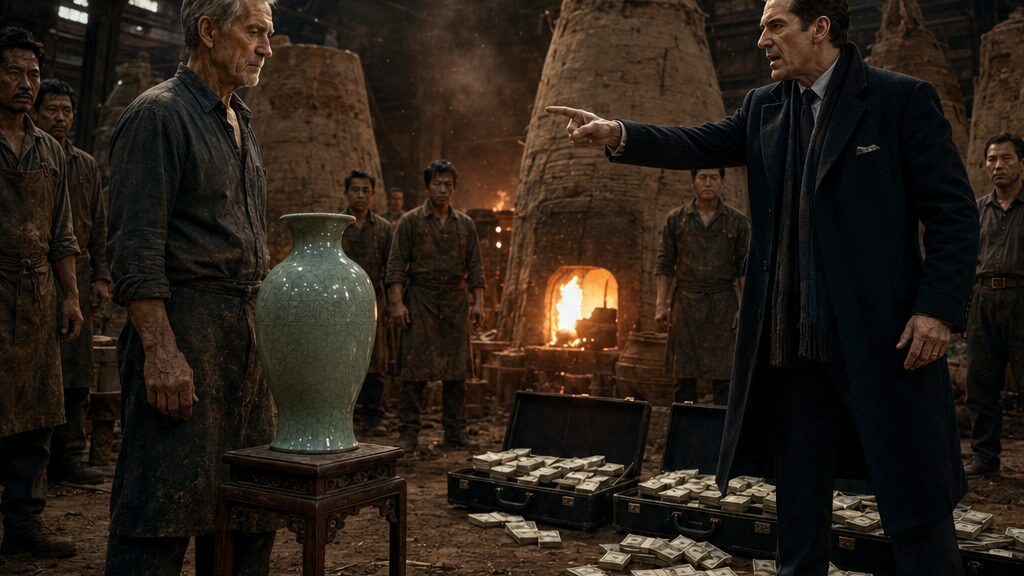
Joseph Hall continued sanding the base of the Celadon vase as though he hadn’t heard anything. Dust gathered on his fingers. Behind him, furnaces breathed heat into the ancient bronze bell foundry, their orange glow flickering across rows of towering clay molds that looked like sleeping giants.
“They have to sell it,” another worker murmured. “Look at the roof. Look at the accounts.”
Patrick Young stood near the loading doors pretending to organize crates. He wasn’t pretending very well.
Joseph set down the polishing cloth.
The vase sat in front of him on a wooden stand.
Even unfinished, it seemed impossible.
The pale green glaze held a depth that changed with every shift of light. It wasn’t merely smooth. It seemed alive beneath the surface, as if a layer of jade had somehow become liquid and then frozen forever.
Workers slowed whenever they passed it.
Visitors stopped speaking.
Collectors made impossible offers.
Joseph hated all of them for it.
Not because they admired it.
Because they only saw a price.
A sharp metallic crack echoed through the foundry.
Someone was testing a bronze casting mold.
Work resumed.
The whispers didn’t.
Patrick finally approached.
“You should go home for a few hours.”
Joseph didn’t look up.
“You’ve said that every day this month.”
“And you’ve ignored me every day this month.”
Joseph smiled faintly.
Patrick glanced toward the office.
“The electricity bill arrived.”
The smile disappeared.
Neither man said anything for a moment.
Numbers had become more frightening than fire.
The foundry had survived floods, recessions, changing fashions, factory competition, and the death of nearly every master craftsman who had once worked there.
What threatened it now was something far simpler.
Time.
Customers wanted speed.
Investors wanted volume.
Collectors wanted stories more than skill.
The old workshop offered none of those things.
Only work.
Painfully slow work.
Joseph finally stood.
His knees protested.
Patrick noticed.
Joseph noticed Patrick noticing.
Neither acknowledged it.
“How much?” Joseph asked.
Patrick named the figure.
It was worse than expected.
Joseph nodded once.
No anger.
No surprise.
Only acceptance.
That worried Patrick more than anything.
“You could sell the vase.”
The words came quietly.
Joseph walked toward the furnace.
Patrick followed.
“Just listen.”
“I’m listening.”
“You’ve spent three years on it.”
“I know.”
“You could save everything.”
Joseph stopped beside a massive clay mold taller than either of them.
“The workshop survives because of standards.”
“The workshop survives because it stays open.”
The answer came too quickly.
Patrick regretted it immediately.
Joseph turned.
For a second neither man looked away.
Then Joseph returned to work.
Conversation over.
Patrick hated when that happened.
Not because Joseph was rude.
Because silence usually meant Joseph had heard something he didn’t want to admit was true.
Hours passed.
By noon the foundry gates opened.
A black vehicle rolled into the courtyard.
Nobody recognized it.
Nobody missed it either.
The driver stepped out first.
Then another man emerged.
Expensive coat.
Expensive watch.
Expensive confidence.
The sort of confidence that assumed every door eventually opened.
Raymond Martin.
He entered the workshop like he already owned it.
His eyes found the vase almost instantly.
For a moment his expression changed.
Not greed.
Not calculation.
Something closer to awe.
Then it vanished.
Business returned.
Patrick intercepted him.
“Can I help you?”
“I doubt it.”
Raymond continued walking.
Workers exchanged looks.
Joseph remained seated beside the vase.
The dealer approached slowly.
Neither man offered a handshake.
For several seconds they simply examined each other.
Raymond smiled first.
“I’ve traveled a long way.”
Joseph nodded.
“You found it.”
The dealer laughed.
“Everyone is looking for it.”
His gaze settled on the vase.
“You know what you’ve made?”
“Yes.”
“Do you?”
The question carried unusual weight.
Joseph ignored it.
Raymond crouched slightly.
The Celadon glaze reflected faint green light across his face.
“I’ve seen collections worth hundreds of millions.”
Joseph said nothing.
“I’ve seen royal archives.”
Nothing.
“I’ve seen pieces museums would kill to acquire.”
Still nothing.
Raymond finally stood.
“And this is better.”
The workers nearby froze.
Patrick stared.
Joseph merely brushed a speck of dust from the rim.
Praise never impressed him.
Only intentions.
“What do you want?” Joseph asked.
The dealer smiled.
“A conversation.”
By evening they sat inside the cramped office overlooking the workshop floor.
Old ledgers lined shelves.
Invoices sat stacked on a desk.
The room smelled of paper and clay.
Raymond placed a folder between them.
Then another.
Then another.
Purchase offers.
Valuations.
Auction estimates.
Private collector inquiries.
Numbers filled every page.
Huge numbers.
Patrick nearly choked when he glimpsed them.
Joseph remained expressionless.
“You could retire tomorrow.”
“No.”
“You could rebuild this place.”
“No.”
“You could fund apprenticeships for twenty years.”
Joseph studied the documents.
For the first time uncertainty flickered behind his eyes.
Raymond noticed immediately.
Good.
There was a weakness after all.
The dealer leaned forward.
“I want the vase.”
Joseph closed the folder.
“It isn’t finished.”
“I’ll wait.”
“No.”
Raymond smiled again.
Not offended.
Amused.
The way a hunter smiles after spotting movement in the brush.
“You misunderstand.”
Joseph looked at him.
Raymond tapped the top folder.
“I don’t want to buy the vase.”
The room became very still.
Even Patrick stopped breathing.
Raymond folded his hands.
“I want to discuss what happens after you finish it.”
Chapter 2: The Price of a Signature
The contract covered nearly half the desk.
Patrick stared at it as if the paper itself might explode.
Raymond Martin sat comfortably across from Joseph, one arm resting on the chair, completely at ease.
The dealer had not removed his coat.
That irritated Joseph for reasons he couldn’t fully explain.
Maybe because it suggested he never intended to stay long.
Maybe because it suggested the workshop wasn’t worth respecting.
Or maybe because Raymond seemed too comfortable discussing the fate of something that had consumed three years of Joseph’s life.
“The offer stands for sixty days,” Raymond said.
Joseph didn’t touch the document.
“What offer?”
Raymond raised an eyebrow.
“The one in front of you.”
“I haven’t accepted anything.”
“No. But you’ll read it.”
Patrick already had.
At least the first page.
The number printed near the bottom seemed unreal.
The amount could repair the foundry.
Replace equipment.
Pay debts.
Train apprentices.
Restore damaged sections of the roof.
Keep everyone employed.
It was enough money to change every conversation they’d had during the past five years.
Joseph closed the folder.
“Why?”
Raymond smiled.
“That’s the interesting question.”
He stood and walked toward the office window.
Below them workers moved between furnaces and molds.
The vase remained visible even from here.
Like a small piece of moonlight inside a building made of fire.
“I have buyers.”
Joseph remained silent.
“Important buyers.”
“Then sell them something else.”
Raymond laughed.
“If only it were that simple.”
He returned to the desk.
“The vase is extraordinary.”
Joseph said nothing.
“But that’s not why they’re interested.”
There it was.
The first crack in the story.
Patrick noticed it too.
Raymond opened another folder.
Photographs slid across the desk.
Ancient ceramics.
Museum displays.
Auction catalogs.
A portrait of a long-dead master potter whose work had become legendary among collectors.
Joseph recognized the face immediately.
His expression hardened.
Raymond noticed that too.
“Now we’re getting somewhere.”
“What does he have to do with this?”
“Everything.”
Joseph looked down at the photographs.
The deceased artist’s surviving pieces were almost impossible to acquire.
Many had vanished into private collections decades earlier.
Others sat behind museum glass.
Their value increased every year.
Raymond tapped the portrait.
“My buyers believe a final undiscovered work exists.”
Joseph’s eyes narrowed.
“No.”
“Yes.”
“No, they don’t.”
Raymond chuckled.
“You’re right. They don’t believe it.”
The dealer leaned forward.
“They expect it.”
The distinction felt dangerous.
Patrick frowned.
“What does that mean?”
“It means wealthy people sometimes spend money before reality catches up.”
Joseph already knew where the conversation was heading.
He hated that he knew.
Raymond opened the final folder.
Inside sat a certificate template.
A provenance statement.
Authentication papers.
And a blank signature space.
Joseph’s stomach tightened.
The dealer watched him carefully.
“You want a forgery.”
“Not exactly.”
“It is exactly.”
Raymond sighed.
“As a craftsman, perhaps that’s how you see it.”
“As a criminal matter, that’s how courts see it.”
For the first time Raymond’s smile weakened.
Only slightly.
But enough.
The dealer looked toward the workshop floor.
“When this vase enters the market, nobody will question it.”
Joseph said nothing.
“The quality is too high.”
Silence.
“The age can be documented.”
Silence.
“The materials are perfect.”
Silence.
Raymond finally met his eyes.
“I only need one thing.”
Neither man spoke.
“The signature.”
The office felt smaller.
Patrick looked from one man to the other.
He expected Joseph to throw the dealer out immediately.
Instead Joseph remained seated.
That frightened him.
Because it meant Joseph was actually considering the consequences.
Not the forgery.
The money.
Hours later Raymond left.
The contract remained behind.
So did the photographs.
The workshop grew quieter as evening approached.
Workers returned home.
Furnaces dimmed.
Patrick remained.
Joseph remained.
The vase remained.
And the number written on the contract remained.
Patrick broke the silence first.
“Nobody would know.”
Joseph looked up slowly.
Patrick regretted speaking immediately.
But continued anyway.
“The signature would be wrong.”
Joseph waited.
“But the craftsmanship wouldn’t.”
“That matters?”
“It should.”
Joseph stared at the vase.
Patrick stepped closer.
“The roof leaks.”
No response.
“The accounts are terrible.”
Silence.
“We lost three clients last month.”
Still silence.
Frustration finally pushed Patrick forward.
“You keep carrying all of this yourself.”
Joseph’s jaw tightened.
Patrick saw it.
Good.
At least something had landed.
“You never tell anyone what’s happening.”
“I tell them enough.”
“No.”
Patrick pointed toward the workshop.
“You tell them nothing.”
The words hung between them.
For a moment Joseph looked older than Patrick had ever seen him.
Not weak.
Tired.
Dangerously tired.
Patrick lowered his voice.
“If the choice is between one signature and losing everything…”
Joseph interrupted quietly.
“The choice is never that simple.”
Patrick wanted to argue.
Instead he looked at the contract.
Then at the vase.
Then back at Joseph.
“You should at least think about it.”
Joseph turned away.
But he didn’t say no.
That was the problem.
Chapter 3: What Art Means to Men Like You
The cash arrived before Raymond did.
Two men carried black cases into the workshop and placed them directly beside the vase.
Nobody touched them.
Nobody spoke.
Workers watched from a distance.
Patrick felt a knot form in his stomach.
The cases remained closed for nearly twenty minutes.
Then Raymond entered.
This time he smiled like a man expecting a celebration.
“Good morning.”
Joseph continued trimming a ceramic piece without looking up.
Raymond didn’t seem bothered.
He walked directly to the cases.
Click.
Click.
The lids opened.
Stacks of cash filled both containers.
The room went silent.
Even the furnaces seemed quieter.
Raymond spread his hands.
“There.”
Nobody moved.
Patrick had never seen that much money in one place.
The dealer looked around the workshop.
At the cracked beams.
The aging equipment.
The patched roof.
The worn clothing.
Then he nodded toward the cash.
“Problems solved.”
Joseph finally stood.
Slowly.
Deliberately.
He looked at the money.
Then at Raymond.
Then at the vase.
Nothing changed in his expression.
That unsettled the dealer more than anger would have.
“I haven’t agreed.”
“You haven’t refused.”
The answer came too quickly.
As if Raymond had rehearsed it.
Workers gathered closer.
Not enough to interfere.
Enough to witness.
The dealer noticed.
Good.
An audience helped.
People became practical when enough eyes were watching.
Raymond stepped beside the vase.
He never touched it.
Not yet.
“I have buyers waiting.”
Joseph remained silent.
“I have shipping arranged.”
Silence.
“I have investors involved.”
Still silence.
The dealer’s patience began to fray.
Patrick could see it.
Raymond wasn’t here merely because he wanted the vase.
He needed it.
That realization changed something.
The confidence now looked strained.
The smile looked forced.
“Tell them no,” Joseph said.
The dealer laughed.
“That’s easy for a man with no obligations.”
Patrick flinched.
Joseph didn’t.
Raymond gestured toward the workshop.
“Look around.”
No response.
“This place is dying.”
Silence.
“You know it.”
Silence.
“You just refuse to admit it.”
For the first time Patrick saw uncertainty flicker across Joseph’s face.
Only for a second.
But it was there.
Raymond saw it too.
And pressed harder.
“You think you’re protecting something.”
The dealer pointed toward the furnaces.
“The world moved on.”
No response.
“Factories replaced workshops.”
Silence.
“Collectors replaced patrons.”
Silence.
“Money replaced ideals.”
Then Raymond smiled.
“And money won.”
The words echoed through the foundry.
Workers exchanged uncomfortable looks.
Patrick felt anger rising.
But Joseph remained calm.
Too calm.
Raymond mistook that calm for weakness.
That would become his mistake.
The dealer walked toward a wooden stool beside Joseph’s workstation.
Old.
Scarred.
Used for decades.
Without warning he kicked it aside.
The stool struck the floor and spun across the workshop.
The sound cracked through the room.
Several workers stepped forward.
Patrick among them.
Joseph raised one hand.
Everyone stopped.
The silence afterward felt heavier than any shouting.
Raymond looked around.
“What art?” he said.
His voice carried easily through the foundry.
“You’re just poor craftsmen clinging to the past and begging rich people for money.”
Nobody moved.
Nobody spoke.
Joseph stared at the overturned stool.
Not the dealer.
The stool.
A strange choice.
Yet Patrick suddenly understood.
The insult wasn’t personal.
It was aimed at every hand that had ever worked inside these walls.
Every apprentice.
Every master.
Every forgotten craftsman.
Joseph slowly walked over and picked the stool up.
Set it upright.
Brushed dust from the seat.
Then returned to his workbench.
The restraint stunned everyone.
Even Raymond looked surprised.
For a brief moment Patrick felt something unexpected.
Pride.
Not because Joseph had fought.
Because he hadn’t.
Raymond misread the silence.
Again.
The dealer pulled a document from his coat.
Dropped it on the workbench.
“You have forty-eight hours.”
Joseph didn’t look at it.
“After that, the deal disappears.”
The dealer turned toward the exit.
Then paused.
Without looking back he spoke one final sentence.
“When the roof collapses, remember that pride doesn’t pay invoices.”
The workshop remained silent long after he left.
Only after the vehicle disappeared beyond the gates did Patrick walk to the workbench.
The document sat beside the vase.
A deadline.
A contract.
And a future measured in hours.
Joseph looked at neither.
Instead he stared at the Celadon surface reflecting the glow of the furnaces.
For the first time since Patrick had known him, he looked like a man standing between two losses.
And neither path seemed survivable.
Chapter 4: The Exhibition No One Mentioned
The envelope was buried beneath three weeks of correspondence.
Margaret White almost threw it away.
She stood in a museum archive room surrounded by shelves of acquisition records when the unfamiliar seal caught her eye. The letter had been routed incorrectly, forwarded twice, and finally dropped into a stack waiting for review.
She opened it.
Halfway through the first page, she stopped reading.
Then she started again from the beginning.
“No.”
The word escaped before she realized she had spoken aloud.
A nearby archivist looked up.
Margaret ignored him.
She turned to the attached documents.
Photographs.
Committee approvals.
Cultural preservation endorsements.
International signatures.
And one name.
Joseph Hall.
She grabbed her phone.
No answer.
She tried again.
Still nothing.
By the time she reached the workshop’s listed number, frustration had replaced confusion.
The call connected after six rings.
Patrick answered.
“Hall Foundry.”
“Patrick Young?”
A pause.
“Yes.”
“This is Margaret White from the National Museum.”
Patrick straightened immediately.
“What happened?”
“We may have a problem.”
Across town, Joseph was standing alone beside the Celadon vase.
The workshop had emptied for lunch.
Only the furnaces remained active.
The vase sat where it always had.
Unchanged.
Yet somehow different.
Since Raymond’s visit, it no longer felt like a work of art.
It felt like a decision.
Joseph hated that.
For years it had been a labor of patience.
Now everyone looked at it as though it were an answer.
The contract remained folded inside a drawer.
He had not signed it.
He had not destroyed it.
That bothered him more than either option would have.
A vehicle approached outside.
Patrick entered moments later.
His expression immediately told Joseph something was wrong.
“Who died?”
Patrick blinked.
“What?”
“You only walk that fast when someone dies.”
Patrick almost smiled.
Almost.
Instead he held up a folded note.
“A museum director called.”
Joseph frowned.
“What museum director?”
“Margaret White.”
The name meant little at first.
Then recognition surfaced.
Years ago she had visited an exhibition featuring regional ceramics.
They had spoken briefly.
Nothing memorable.
“What did she want?”
Patrick hesitated.
“That’s the problem.”
Joseph waited.
“She wouldn’t explain.”
The answer irritated him.
“Then why are you worried?”
Patrick handed him the note.
Written on it was a single sentence.
Please call immediately regarding the exhibition file.
Joseph stared at the words.
“Exhibition?”
Patrick nodded.
“She sounded nervous.”
Neither man spoke.
The vase seemed to draw their attention again.
Always the vase.
Always back to the vase.
Joseph folded the paper.
“I’ll call later.”
Patrick stared.
“Later?”
“Yes.”
“Joseph—”
“I said later.”
The answer came sharper than intended.
Patrick fell silent.
Not because he agreed.
Because he recognized the wall.
Joseph had spent decades building it.
Every problem became private.
Every burden became personal.
Every concern became something he would carry alone until it nearly crushed him.
Patrick turned away before saying something he would regret.
That evening he made a different mistake.
He called the museum himself.
Margaret answered immediately.
Within minutes he was listening to information that made his stomach tighten.
Not because he fully understood it.
Because he understood enough.
“The exhibition isn’t public yet,” Margaret said.
“Then why tell me?”
“Because I think Joseph never received the notice.”
Patrick’s grip tightened around the phone.
“What notice?”
Papers shuffled.
“The Celadon vase was selected six months ago for an international cultural preservation exhibition.”
Patrick blinked.
“What?”
“The committee considered it one of the most important contemporary ceramic works in the country.”
Silence.
Margaret continued.
“The final designation hasn’t been publicly announced.”
Patrick stared across the workshop toward the distant glow of the furnaces.
“What designation?”
Another pause.
Then:
“The vase may qualify for protected heritage status.”
Patrick sat down heavily.
The room seemed smaller.
Suddenly Raymond’s desperation made more sense.
Not entirely.
But enough.
The vase wasn’t merely valuable.
It was becoming something else.
Something larger than ownership.
Something larger than money.
Yet Joseph knew none of it.
Or perhaps he did.
Patrick wasn’t sure anymore.
That uncertainty frightened him.
The following morning, Raymond accelerated everything.
His vehicle appeared before sunrise.
Workers hadn’t even finished opening the workshop.
He entered carrying a leather portfolio and an expression stripped of patience.
Joseph watched him approach.
“You’re early.”
“I’m behind schedule.”
The answer came instantly.
Raymond set the portfolio on the workbench.
“No more delays.”
Joseph remained silent.
The dealer opened the case.
Inside sat shipping forms.
Insurance documents.
Transport agreements.
Every step already prepared.
Patrick watched from nearby.
His pulse quickened.
This wasn’t negotiation anymore.
It was execution.
Raymond looked directly at Joseph.
“My buyers are flying in.”
Joseph said nothing.
“I’ve invested too much to stop.”
Silence.
The dealer leaned closer.
“Whatever doubts you’re having, finish having them.”
Patrick stepped forward.
“You should leave.”
Raymond ignored him.
His attention never left Joseph.
For the first time uncertainty appeared behind the dealer’s confidence.
Fear.
Not of Joseph.
Of failure.
Of losing something already promised.
That made him dangerous.
“Tomorrow,” Raymond said quietly.
“One final visit.”
Joseph didn’t answer.
The dealer nodded toward the vase.
“When I return, we’re done discussing it.”
He closed the portfolio.
Turned.
Walked away.
Nobody moved until his vehicle disappeared.
Only then did Patrick approach.
He opened his mouth.
Stopped.
Started again.
“There are things you need to know.”
Joseph looked at him.
For a moment Patrick nearly revealed everything.
The museum.
The exhibition.
The possibility of heritage protection.
But uncertainty held him back.
What if Margaret was wrong?
What if the designation wasn’t finalized?
What if he created false hope?
The hesitation lasted only seconds.
Long enough.
A horn sounded outside.
Everyone turned.
Raymond’s vehicle had returned.
The dealer stepped out once more.
This time he wasn’t carrying documents.
He was carrying the black cash cases.
Chapter 5: Fire Accepts No Bribes
The cases hit the dirt floor with enough force to send dust into the air.
Every worker in the foundry stopped what they were doing.
Nobody needed an explanation.
Raymond Martin opened both cases.
Money filled them from edge to edge.
The sight should have felt triumphant.
Instead it felt ugly.
The stacks of cash looked out of place among clay, ash, furnaces, and decades of labor.
As if someone had dumped a casino into a cathedral.
Raymond seemed unaware of the contrast.
Or perhaps he simply didn’t care.
“There.”
He spread his arms.
“Enough to save every problem in this building.”
Nobody approached.
Nobody spoke.
The only sound came from the furnaces.
Joseph stood beside the Celadon vase.
His hand rested lightly against the wooden stand.
The gesture wasn’t protective.
It was thoughtful.
Like someone saying goodbye without admitting it.
Raymond noticed.
His confidence returned.
“Good.”
He smiled.
“You’re finally thinking clearly.”
Patrick stepped closer.
Joseph raised a hand slightly.
Not yet.
The signal was enough.
Patrick stopped.
Raymond reached into his coat and removed a marker.
Then a sheet of paper.
Then the authentication certificate.
He laid everything on the workbench.
“One signature.”
Joseph looked at the document.
Nothing more.
Nothing less.
One signature.
A dead man’s name.
An easy lie.
A profitable lie.
A lie that would save the workshop.
The temptation wasn’t imaginary anymore.
That was the worst part.
Patrick could see it.
For the first time, Joseph wasn’t rejecting the idea instantly.
He was measuring its cost.
Raymond mistook that silence for surrender.
“You’ve spent years making this.”
Still silence.
“You want it preserved.”
Silence.
“You want people to see it.”
Silence.
“I can make that happen.”
Joseph finally looked up.
“And if I don’t?”
The dealer sighed.
“As I’ve said before, the world keeps moving.”
His gaze swept across the foundry.
“The roof leaks.”
The workers listened.
“The equipment is outdated.”
Nobody argued.
“Your customers are disappearing.”
Still true.
Raymond stepped closer.
“What exactly are you protecting?”
The question lingered.
Joseph looked around the workshop.
The furnaces.
The molds.
The tools.
The workers.
The years.
He thought about every apprentice who had quit for factory jobs.
Every collector who cared more about resale value than craftsmanship.
Every exhibition that preferred trends over skill.
Every compromise he had refused.
Patrick suddenly understood something.
Joseph wasn’t deciding whether to sell the vase.
He was deciding whether everything he believed still mattered.
Raymond spoke again.
“What art?”
The words were softer than before.
Almost pitying.
“You’re just a group of poor craftsmen begging rich people for money.”
Then he kicked the old stool.
The same stool.
It slid across the floor and struck a clay mold.
The sound echoed through the foundry.
Something changed.
Not loudly.
Not dramatically.
But everyone felt it.
A line had been crossed.
Joseph walked slowly toward the stool.
Picked it up.
Set it upright.
His movements were calm.
Careful.
Measured.
The kind of calm that appears right before a storm.
When he returned to the workbench, he looked at Raymond.
Really looked at him.
Perhaps for the first time.
Not as a customer.
Not as an obstacle.
As a man.
A frightened man trying to buy certainty.
A desperate man who had confused value with price for so long that he no longer knew the difference.
The realization brought neither anger nor hatred.
Only clarity.
Raymond held out the marker.
“Sign.”
Joseph didn’t take it.
Instead he lifted the vase.
A collective breath swept through the room.
Patrick froze.
The workers froze.
Even Raymond stopped speaking.
The Celadon vase glowed pale green beneath the furnace light.
Three years of labor.
Three years of mistakes.
Three years of patience.
Three years of hope.
Joseph held it in both hands.
Then he turned toward the nearest clay mold.
For the first time uncertainty touched Raymond’s face.
“What are you doing?”
Joseph didn’t answer.
“Joseph.”
No response.
The dealer took a step forward.
Another.
Then stopped.
Because something in Joseph’s expression warned him not to continue.
Joseph raised the vase.
Higher.
Workers stared.
Patrick realized what was about to happen one second before everyone else.
“No—”
The word died unfinished.
The vase struck the clay mold.
The sound was enormous.
Ceramic exploded into hundreds of fragments.
Green shards scattered across the floor.
Silence followed.
Absolute silence.
Nobody moved.
Nobody breathed.
Raymond simply stared.
As if his mind refused to process what his eyes had seen.
The masterpiece was gone.
Three years.
Gone.
Then Joseph picked up the authentication papers.
Dropped them into the furnace.
The flames consumed them instantly.
Next came the contract.
Then the shipping forms.
Then the certificates.
Raymond lunged forward.
“Stop!”
Too late.
The papers curled black and disappeared.
Finally Joseph grabbed a stack of cash.
Threw it into the fire.
The flames erupted.
Workers gasped.
Raymond shouted.
Joseph threw another stack.
Then another.
The dealer stumbled forward in horror.
Years of profit vanished in seconds.
“Have you lost your mind?”
Joseph looked at him calmly.
“No.”
Another stack disappeared into the furnace.
“I finally remembered it.”
Raymond stood frozen.
Joseph pointed toward the workshop doors.
One gesture.
Nothing more.
“Get out.”
The dealer did not move.
At least not until vehicles arrived outside.
Several vehicles.
Fast.
Official.
And very, very late.
Chapter 6: The Cost of Refusing Everything
The first museum vehicle had barely stopped when the doors opened.
Officials stepped out immediately.
Behind them came cultural agents carrying document cases.
Margaret White exited last.
One look inside the foundry told her she was too late.
The shattered remains of the vase glittered across the floor.
Ash drifted from the furnace.
Burned paper curled in the heat.
And Raymond Martin stood motionless among the ruins of his plan.
Margaret closed her eyes briefly.
Then entered.
“Joseph.”
Her voice carried through the silence.
Joseph turned.
He looked tired.
Not regretful.
Just tired.
Margaret’s gaze moved to the fragments.
The loss hit her visibly.
Yet when she looked back at Joseph, something like understanding replaced disappointment.
“You destroyed it.”
“I did.”
The answer contained no apology.
None was offered.
None was expected.
Raymond suddenly found his voice.
“Tell him what he’s done.”
Nobody responded.
The dealer pointed toward the shattered pieces.
“Tell him.”
Margaret looked at him.
For the first time.
Her expression hardened.
One of the agents handed her a folder.
She opened it.
Removed a document.
Then held it up.
“Joseph Hall.”
The foundry fell silent again.
“This morning, an international cultural preservation committee finalized your designation.”
Joseph frowned slightly.
Margaret continued.
“You were formally recognized as a Living Human Treasure.”
Workers exchanged stunned looks.
Patrick felt his stomach drop.
So it had been true.
All of it.
Margaret lowered the document.
“The vase had been selected as the centerpiece of a UNESCO-supported cultural heritage exhibition.”
Raymond’s face drained of color.
“No.”
Nobody looked at him.
“The paperwork was delayed,” Margaret said quietly. “We believed notification had already reached you.”
Joseph glanced toward the shattered fragments.
Then back to Margaret.
“I never received it.”
She nodded.
“I know.”
For a moment neither spoke.
Then Raymond laughed.
A strange, desperate sound.
“Then he destroyed it.”
Nobody answered.
The dealer looked around wildly.
“He destroyed it himself.”
One of the agents stepped forward.
“Mr. Martin.”
Raymond ignored him.
“He destroyed the evidence.”
The agent’s expression remained unchanged.
“Evidence of what?”
Silence.
The question landed harder than any accusation.
Another agent opened a separate file.
Documents.
Statements.
Financial records.
Communications.
Enough to reveal a pattern.
Not enough to arrest a man for ambition.
Enough to investigate him for fraud.
Raymond finally understood.
The fear appeared instantly.
Not because the vase was gone.
Because the story was no longer under his control.
Outside, a worker raised a phone.
Then another.
Then another.
Video recordings had already begun spreading.
The confrontation.
The cash.
The insult.
The destruction.
Everything.
Patrick looked at one screen.
Then another.
The clips were multiplying faster than anyone could follow.
Raymond noticed too.
And for the first time all day, he looked truly defeated.
Not by Joseph.
By consequences.
Margaret walked toward the shattered fragments.
Carefully.
She crouched beside one piece.
The glaze still reflected green light.
Beautiful even in ruin.
After a moment she stood.
“I wish it had survived.”
Joseph nodded.
“So do I.”
Then she surprised him.
“But not at that price.”
The foundry remained quiet.
Workers listened.
No applause came.
No celebration.
Only understanding.
The furnace crackled softly behind them.
Patrick looked at Joseph.
The old craftsman seemed smaller somehow.
Yet stronger too.
As if losing the vase had stripped away something unnecessary.
Outside, notification sounds echoed from dozens of phones.
The videos were already moving beyond the town.
Beyond the region.
Beyond the country.
Raymond heard them.
So did everyone else.
And nobody could stop what came next.
Chapter 7: The Legacy Left in Ashes
The video had been viewed more than twelve million times before Joseph Hall finally watched it.
Patrick placed a tablet on the workbench and stepped back.
“You should see it.”
Joseph stared at the screen as if it were another tool he had never learned to use.
For weeks he had avoided interviews, requests, invitations, and reporters. Whenever a camera appeared near the foundry gates, he disappeared into the workshop.
The attention felt wrong.
The vase was gone.
That was the only fact he cared about.
Yet the world seemed unable to move on.
Patrick tapped the screen.
The recording began.
Joseph watched Raymond dump cash onto the floor.
He watched the argument.
The insult.
The kicked stool.
The silence afterward.
Then the moment everyone talked about.
The vase rising into the air.
The impact.
The explosion of green fragments.
Millions of strangers had watched that instant.
Millions more had argued about it.
Some called him a hero.
Others called him foolish.
Many simply replayed the moment over and over.
Joseph watched once.
Then turned the screen off.
Patrick waited.
“That’s all?”
“What else is there to see?”
Patrick laughed despite himself.
“Twelve million people disagree.”
Joseph picked up a ceramic fragment from a nearby shelf.
One of the surviving pieces of the vase.
Margaret had insisted they preserve whatever remained.
Several fragments now rested in a museum-controlled display case inside a small side room.
Not as an artwork.
As evidence of a choice.
Joseph still wasn’t sure how he felt about that.
Outside, voices drifted through the open workshop doors.
Visitors.
There were always visitors now.
Students.
Collectors.
Journalists.
Craftsmen.
Curious strangers.
Some traveled for hours just to see the place where the vase had been destroyed.
The attention brought money.
Enough money to repair the roof.
Enough to replace equipment.
Enough to erase debts.
The irony never stopped bothering him.
The workshop became financially secure only after he destroyed the one object everyone wanted.
Patrick sat on a nearby stool.
Not the old stool.
That one had been retired.
Nobody had discussed it.
Nobody needed to.
The damaged stool now rested on a shelf overlooking the workshop.
A reminder.
Or perhaps a warning.
“The applications arrived.”
Joseph sighed.
“What applications?”
“Apprentices.”
Joseph closed his eyes.
Patrick smiled.
“There are forty-three.”
“That’s ridiculous.”
“It is.”
“Reject them.”
“No.”
Joseph looked up.
Patrick folded his arms.
“You spent years complaining that nobody wanted to learn.”
“That wasn’t complaining.”
“It sounded like complaining.”
Joseph almost smiled.
Almost.
Patrick continued.
“They saw the video.”
“That isn’t a reason.”
“It is for them.”
Joseph looked around the workshop.
For years he had feared the craft would disappear.
Students came briefly.
Then left.
Factories offered easier lives.
Collectors preferred stories over skill.
The future had seemed increasingly narrow.
Now letters arrived daily.
Requests.
Questions.
Applications.
People wanted to learn.
Not because of the vase.
Because of what the vase represented.
That realization unsettled him.
The sound of a vehicle outside interrupted his thoughts.
Margaret White stepped through the doorway carrying a folder.
“You’re becoming difficult to find.”
Joseph raised an eyebrow.
“You found me.”
“Unfortunately.”
Patrick laughed.
Margaret placed the folder on the workbench.
“I brought numbers.”
Joseph immediately looked suspicious.
“Then I don’t want them.”
“Too bad.”
She opened the folder anyway.
Articles.
Exhibition proposals.
Educational grants.
Cultural preservation funds.
The workshop had become a symbol.
Joseph disliked symbols.
Margaret knew that.
Which was why she ignored his expression entirely.
“The heritage committee approved the restoration grant.”
Patrick straightened.
“Approved?”
Margaret nodded.
“Fully approved.”
Patrick stared.
For years every application had been rejected.
Delayed.
Reduced.
Ignored.
Now everything had changed.
Joseph remained silent.
Margaret watched him carefully.
“You’re angry.”
“No.”
“You’re absolutely angry.”
He looked away.
The museum director smiled slightly.
For the first time since arriving, she noticed the display case containing the surviving vase fragments.
Sunlight reflected through the green glaze.
Even broken, the pieces seemed beautiful.
Margaret studied them quietly.
“I still wish it had survived.”
“So do I.”
The answer came automatically.
A familiar ache followed.
Neither pretended otherwise.
The loss was real.
The sacrifice mattered precisely because it had cost something.
Patrick glanced toward the fragments.
Then toward Joseph.
“Can I ask something?”
Joseph sighed.
“You’re going to ask anyway.”
Patrick ignored that.
“If you had known about the designation… if Margaret had arrived earlier… would you have done anything differently?”
The question settled over the room.
Margaret looked curious.
Joseph looked at the fragments.
For a long time he said nothing.
Patrick began to think he wouldn’t answer.
Then:
“No.”
The word surprised them both.
Joseph continued turning the ceramic shard in his hand.
“If I had signed the paper, the vase would still exist.”
Neither interrupted.
“But the work would be dead.”
The room fell silent.
No speeches followed.
No grand declaration.
Just the truth.
Simple and final.
Margaret looked away first.
Patrick stared at the workshop floor.
Because suddenly he understood something he had missed for years.
Joseph had never been trying to preserve objects.
Objects broke.
Burned.
Disappeared.
People inherited them.
Sold them.
Forgot them.
What mattered was the line nobody crossed.
The standard nobody lowered.
The principle that survived after everything else vanished.
A week later the first new apprentices arrived.
Nervous.
Awkward.
Excited.
Joseph almost sent them home.
Patrick prevented that.
The days grew busy.
Then busier.
Work resumed.
Real work.
Clay.
Heat.
Mistakes.
Corrections.
Lessons.
The foundry slowly sounded alive again.
One evening, after everyone had gone home, Joseph remained alone beside the furnace.
The repaired roof no longer leaked.
Fresh tools hung on the walls.
Young voices now filled spaces that had once felt empty.
Across the workshop, inside the display case, fragments of the destroyed vase reflected the glow of the fire.
Joseph looked at them.
Not with regret.
Not anymore.
The vase had never become what the world expected.
It had become something else.
A lesson.
A warning.
A promise.
He stood quietly for a moment.
Then turned away from the display.
Behind him the fragments remained exactly where they belonged.
Ahead of him waited unfinished clay, impatient apprentices, and work still worth doing.
For the first time in many years, that felt like enough.
The story has ended.