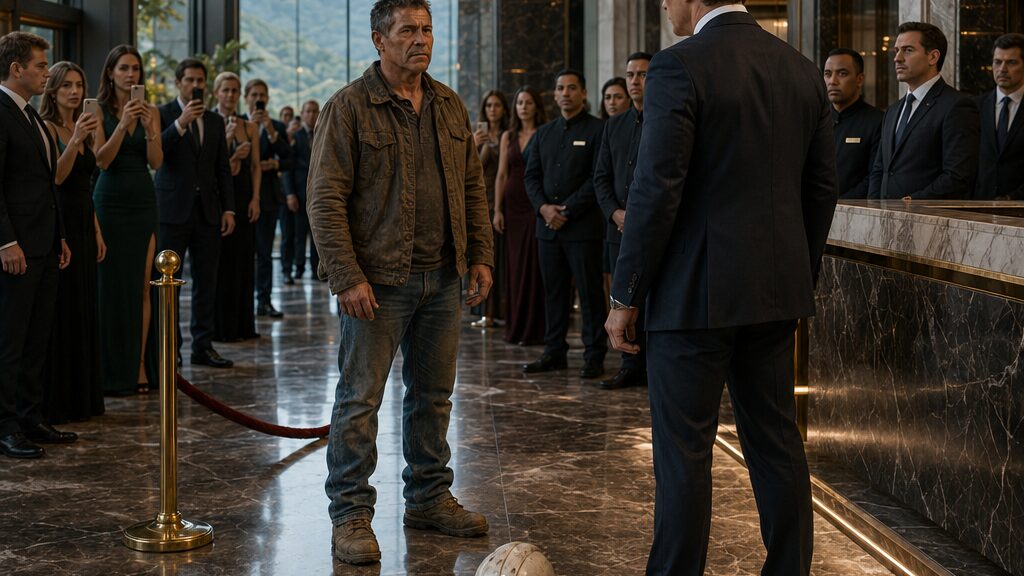
The Day a Luxury Resort Broker Slapped a Dirty Worker and Destroyed His Own Empire
Chapter 1: The Worker Who Did Not Belong There
The security guard stepped directly into James Rodriguez’s path before he reached the lobby doors.
“Service entrance is around back.”
James stopped.
The hilltop resort gleamed behind walls of glass and pale stone. A waterfall spilled into a decorative pond beside the entrance. Luxury vehicles lined the circular drive. Guests in expensive clothing drifted through the lobby carrying designer luggage.
James stood among them wearing dusty work boots, faded jeans, a worn jacket, and a scratched white hard hat tucked beneath his arm.
The guard looked him up and down.
“You lost?”
James smiled mildly.
“I’m looking around.”
The guard’s expression hardened.
“This isn’t a public attraction.”
For a moment, James simply watched.
Not the guard.
The reactions behind him.
A valet helping a wealthy guest immediately.
A porter rushing to open doors.
A concierge greeting a family by name.
Then the moment those same employees looked toward him, their expressions changed.
Caution.
Dismissal.
Discomfort.
Almost fear.
The anonymous complaints had described exactly that.
Not poor service.
Selective service.
James nodded politely.
“I won’t be long.”
He stepped around the guard and entered anyway.
The lobby spread beneath a towering glass ceiling.
Marble floors reflected sunlight from enormous windows overlooking the mountains.
The place was beautiful.
And immediately wrong.
A maintenance worker pushing a cart near the elevators accidentally brushed a guest’s suitcase.
The worker apologized instantly.
The guest ignored him.
A supervisor appeared seconds later.
Not to help.
To reprimand the worker.
James watched the employee lower his eyes and absorb the criticism.
No discussion.
No fairness.
Only obedience.
The supervisor noticed James watching and frowned.
That happened three more times in less than ten minutes.
A bartender laughed with wealthy visitors while snapping impatiently at a dishwasher.
A concierge spent fifteen minutes helping one guest find a hiking guide while refusing directions to a delivery driver.
Employees weren’t being trained to provide excellence.
They were being trained to rank human beings.
James felt a familiar weight settle inside his chest.
Twenty-eight years earlier he had worn clothes far worse than these.
He had poured concrete.
Loaded trucks.
Cleaned construction sites.
Built the first small roadside motel that eventually grew into an international hospitality company.
Back then he had promised himself something.
No worker would ever be treated as invisible.
Yet here he was.
Standing inside one of his flagship properties.
Watching exactly that happen.
A server hurried past carrying a tray.
As she passed, she lowered her voice.
“You should leave.”
James glanced at her.
She kept walking.
Never looking back.
Interesting.
Not anger.
Fear.
Someone was afraid he would stay.
James moved deeper into the lobby.
Near the reception area he noticed something else.
A polished brass stanchion connected by thick red velvet ropes separated VIP guests from everyone else.
The ropes created a narrow path leading toward a private lounge.
A symbolic barrier.
Simple.
Elegant.
And strangely revealing.
Everyone treated the ropes as if they were sacred.
James studied them for a moment.
Then continued walking.
A group of wealthy visitors stood near a display model of luxury villas planned for the mountainside.
A sharply dressed man was presenting investment opportunities.
His voice carried across the lobby.
“Exclusivity is everything.”
Several people laughed.
The presenter smiled confidently.
He looked expensive.
Perfect suit.
Perfect watch.
Perfect haircut.
Every movement carefully practiced.
James recognized him from photographs.
Eric Miller.
One of the company’s largest outside real-estate partners.
The son of a wealthy developer.
Ambitious.
Successful.
And according to several complaints, increasingly difficult.
Eric noticed him almost immediately.
His smile disappeared.
James saw the exact moment the judgment happened.
Not curiosity.
Not concern.
Classification.
Eric had already decided what kind of person he was looking at.
The broker excused himself from his audience and walked over.
The surrounding guests followed with their eyes.
The atmosphere shifted.
People sensed conflict before a single word was spoken.
Eric stopped several feet away.
“Can I help you?”
His tone suggested the opposite.
James met his gaze.
“Just looking around.”
Eric’s eyes narrowed.
“Looking around for what?”
“The resort.”
“You staying here?”
“No.”
“Then why are you here?”
James noticed several employees watching nervously.
No one intervened.
No one welcomed him.
No one asked if assistance was needed.
They simply waited to see what Eric would do.
That interested James more than Eric himself.
Because cultures always revealed themselves through spectators.
Not perpetrators.
Eric folded his arms.
“You work construction?”
“Sometimes.”
“Not here.”
“No.”
Eric nodded slowly.
As though confirming a suspicion.
A few guests had begun gathering nearby.
Phones appeared.
People loved public conflict.
Especially when they weren’t involved.
James looked around the lobby again.
Every detail had been designed to communicate prestige.
But prestige without dignity became something uglier.
And he was beginning to suspect that was exactly what had happened here.
Eric stepped closer.
“Then I think we’re done.”
James remained calm.
“Are we?”
The broker’s jaw tightened.
The surrounding employees suddenly looked very uncomfortable.
For the first time James wondered whether the complaints had understated the problem.
Because nobody seemed surprised.
Only worried.
As if they had seen this before.
Eric glanced toward security.
Then back toward James.
And smiled.
Not kindly.
Not professionally.
Like someone preparing to make an example of another human being.
Chapter 2: The Cost of Looking Poor
By the time Eric spoke again, nearly twenty people had gathered nearby.
Some pretended not to stare.
Most made no effort.
The resort lobby had become entertainment.
Eric gestured toward James’s clothes.
“You know, we spend a lot of money creating a certain experience for our guests.”
James said nothing.
“We also spend a lot of money keeping unwanted people off the property.”
Several guests laughed softly.
James watched their faces.
None appeared cruel.
Merely comfortable.
Comfortable enough to assume someone else deserved humiliation.
That was often how these things worked.
Not through monsters.
Through audiences.
Eric took another step closer.
“You understand what I’m saying?”
“I understand you’re concerned about appearances.”
The broker smiled.
“There you go.”
One of the guests chuckled.
“At least he’s self-aware.”
More laughter.
James looked toward the reception desk.
A young employee immediately looked away.
Another pretended to check a computer screen.
Nobody wanted involvement.
That bothered him more than the insults.
Cultures failed long before incidents happened.
Incidents merely exposed the failure.
A quiet voice spoke behind him.
“You should leave.”
James turned.
The same server stood there holding an empty tray.
Her expression was tense.
“Please.”
“Why?”
She hesitated.
Because she had already said too much.
Then she whispered.
“He always wins.”
Before James could answer, she hurried away.
Eric noticed the exchange.
His smile faded.
“What did she tell you?”
“Nothing important.”
“Good.”
The single word carried enough meaning.
Not a threat.
A habit.
Someone accustomed to controlling a room.
James studied him more carefully.
The complaints had portrayed Eric as arrogant.
But arrogance alone didn’t create fear.
Fear came from consequences.
Whoever challenged him paid for it.
Interesting.
Very interesting.
Security guards approached.
Not aggressively.
Yet.
Eric pointed toward the doors.
“Escort him out.”
One guard shifted uncomfortably.
“Sir, maybe—”
“Now.”
The guard immediately fell silent.
That reaction told James more than any report ever could.
Power flowed through the building in one direction.
Everyone knew it.
Nobody challenged it.
The first guard approached.
“Sir, let’s go.”
James remained still.
“I haven’t broken any rules.”
“You don’t belong here.”
The words hung in the air.
Several people nodded.
James looked around the lobby.
Marble.
Glass.
Waterfalls.
Designer furniture.
Everything beautiful.
Everything expensive.
And somehow all of it less impressive than the hard hat tucked beneath his arm.
Because he remembered earning that.
He remembered building things.
He remembered sleeping inside unfinished structures during winter because he couldn’t afford rent.
Those memories weren’t shameful.
They were the foundation beneath every stone in this resort.
Eric seemed unable to understand that.
“Are you deaf?” Eric asked.
James finally looked directly at him.
“No.”
“Then leave.”
“What if I don’t?”
A ripple passed through the crowd.
Conflict sharpened.
Eric laughed.
“Then security removes you.”
James nodded slowly.
“You seem very confident.”
“I know exactly who belongs in places like this.”
There it was.
The truth.
Not policy.
Not security.
Not rules.
Belonging.
Status.
Hierarchy.
The real currency.
James felt disappointment more than anger.
Because this wasn’t one arrogant man.
This was an entire culture.
And cultures began at the top.
Which meant some responsibility belonged to him.
The realization settled heavily.
He should have come sooner.
Eric mistook the silence for surrender.
“Last chance.”
James looked around once more.
Employees avoiding eye contact.
Guests recording.
Security waiting for orders.
The entire system arranged around appearances.
“No,” James said quietly.
Eric’s face hardened instantly.
The restraint disappeared.
He stepped forward.
“So you’re one of those people.”
“What people?”
“The kind who thinks rules don’t apply.”
James almost laughed.
The irony was remarkable.
Eric continued.
“You come here dressed like that. Wander wherever you want. Refuse instructions.”
His voice grew louder.
Performative.
Designed for the audience.
“People work hard to afford places like this.”
James answered softly.
“So did I.”
Eric snorted.
“Not enough.”
The words produced another wave of laughter.
But less confident now.
Some people were beginning to feel uncomfortable.
A few lowered their phones.
Others kept recording.
The server who had warned James stood frozen beside a pillar.
Fear filled her eyes.
Not for herself.
For him.
That surprised James.
Kindness survived even here.
The realization almost made him smile.
Then Eric moved.
Fast.
Sudden.
Unnecessary.
His hand crossed the distance between them.
The crack echoed across the marble lobby.
James staggered sideways.
His hard hat flew from beneath his arm.
Spinning.
Sliding.
Skidding across polished stone.
The entire room fell silent.
Eric stared down at him.
Breathing hard.
His voice cut through the stillness.
“Garbage like you doesn’t deserve to breathe the same air as us.”
Nobody laughed.
Nobody moved.
The hard hat continued sliding until it finally stopped near the reception desk.
For one endless moment, every eye in the lobby focused on it.
Chapter 3: What the Cameras Captured
Silence lasted exactly three seconds.
Then dozens of phones lifted higher.
Recording.
Streaming.
Capturing everything.
James tasted blood.
Not much.
Just enough to remind him how hard the slap had landed.
He remained where he was.
One knee touching the marble floor.
Across the lobby, his hard hat rested beside the reception desk.
Scuffed.
Motionless.
The sight struck him harder than the slap.
Not because of the object itself.
Because of what it represented.
Years of labor.
Thousands of workers.
The people who built places like this and were rarely welcomed inside them.
Nobody moved toward him.
Not security.
Not management.
Not guests.
The room simply watched.
Eric straightened his jacket.
Trying to regain control of the scene.
Trying to act as though what had happened was normal.
Reasonable.
Necessary.
But something had shifted.
The crowd’s energy felt different now.
Uneasy.
One guest lowered his phone.
Another whispered, “Did he really just do that?”
The spell was cracking.
Eric sensed it too.
Which made him more dangerous.
“Get him out.”
No one moved.
His voice sharpened.
“I said get him out.”
The guards exchanged glances.
The hesitation was small.
But it existed.
James noticed.
Eric noticed too.
And hated it.
Karen Thompson emerged from a side corridor near the administration offices.
She had heard the commotion.
Her pace slowed as she took in the scene.
The crowd.
The phones.
The hard hat on the floor.
James kneeling.
Eric standing over him.
Something flashed across her face.
Not recognition.
Not yet.
But concern.
Professional concern.
The kind that appeared when someone realized a situation was far worse than expected.
She walked quickly toward the reception area.
“What happened?”
Eric answered before anyone else could.
“Trespasser.”
Karen looked unconvinced.
“He’s bleeding.”
“He resisted.”
James almost smiled.
A lie delivered too quickly.
Karen’s eyes moved from Eric to James.
Then to the hard hat.
Then back.
For a brief moment she seemed to study him.
Really study him.
Something about that bothered James.
As if she recognized a detail she couldn’t place.
The silence stretched.
Finally she said carefully, “Maybe we should move this somewhere private.”
“No.”
Eric’s answer came instantly.
The operations director stiffened.
“No?”
“He leaves.”
Karen lowered her voice.
“There are cameras everywhere.”
Eric glanced around.
Only then did he seem to notice how many people were recording.
The realization arrived late.
Very late.
One guest was openly livestreaming.
Comments scrolled rapidly across the screen.
Others had begun doing the same.
James saw Eric calculating.
Not morality.
Risk.
That distinction mattered.
Karen saw it too.
The disappointment in her eyes was subtle but unmistakable.
James slowly rose to his feet.
A guard stepped forward nervously.
“Sir…”
James ignored him.
Instead he looked around the lobby.
At the employees.
At the guests.
At the architecture.
Months of anonymous complaints echoed in his memory.
Workers treated differently.
Promotions tied to wealth.
Guest status prioritized above dignity.
Report after report.
All dismissed.
All explained away.
All softened by managers.
He had come because something felt wrong.
Now he knew.
The problem wasn’t hidden.
It was visible.
Everyone simply accepted it.
Karen moved closer.
“Sir, are you alright?”
James met her eyes.
For a moment neither spoke.
Then she glanced toward the hard hat.
A strange expression crossed her face.
Recognition.
Not of him.
Of something else.
A memory.
An image.
James filed it away.
Before he could respond, Eric pointed toward the doors.
“Enough. Call the police.”
Several people gasped.
Karen stared at him.
“For what?”
“Trespassing. Destruction if necessary. Whatever applies.”
“He hasn’t destroyed anything.”
“Yet.”
The word landed heavily.
James noticed the subtle fear in the room.
Not fear of him.
Fear of Eric.
The realization carried surprising weight.
How many people had remained silent because speaking cost too much?
Karen looked ready to argue.
Then stopped.
Career preservation.
Self-protection.
The calculations happened visibly behind her eyes.
James understood.
He didn’t approve.
But he understood.
The same compromise had probably repeated itself dozens of times.
Maybe hundreds.
That was how cultures rotted.
One silence at a time.
A security guard reached for a radio.
James watched.
Then looked again at the hard hat lying beside the reception desk.
Something inside him settled.
Not rage.
Certainty.
The inspection was over.
Observation had reached its limit.
His entire life he had believed patience revealed truth.
Today patience had revealed enough.
Around him, guests continued recording.
Employees watched nervously.
Karen stood frozen between loyalty and responsibility.
Eric stood waiting for victory.
James walked slowly across the lobby.
Toward the polished brass stanchion connected by thick red velvet ropes.
The crowd parted instinctively.
Nobody understood what they were witnessing.
Not yet.
His hand closed around the cold metal.
Behind him, someone inhaled sharply.
The brass groaned under his grip.
And the entire lobby seemed to hold its breath.
Chapter 4: The Sound That Stopped the Lobby
The brass stanchion tore free with a violent metallic crack.
Several guests jumped.
One woman dropped her phone.
The sound echoed through the vast lobby like something breaking far beyond metal and stone.
James held the heavy brass post in both hands.
The red velvet rope sagged to the floor.
For a brief moment nobody moved.
Not Eric.
Not security.
Not Karen.
Not even the guests recording from every angle.
The symbol that had separated important people from everyone else now lay useless on the marble.
James looked at it.
Then at Eric.
The broker finally found his voice.
“What are you doing?”
James walked forward.
Slowly.
Deliberately.
The brass stanchion hung at his side.
Security stepped back instead of forward.
The shift was subtle but unmistakable.
Fear had begun changing direction.
Eric saw it happen.
His confidence flickered.
“Put that down.”
James stopped in front of the reception desk.
The polished marble counter stretched across the center of the lobby like a monument to wealth.
He remembered approving the design years earlier.
Imported stone.
Custom craftsmanship.
Excessive even then.
The irony wasn’t lost on him.
Everyone watched.
Waiting.
Karen’s eyes widened.
Something in her expression suggested she understood that whatever happened next could never be undone.
James looked across the lobby at the hard hat still resting on the floor.
Then he looked back at the reception desk.
His voice was calm.
“You know what disappoints me most?”
Eric laughed nervously.
“Disappoints you?”
James nodded.
“Not the slap.”
Nobody spoke.
“The fact that nobody here seemed surprised.”
The words settled heavily over the room.
Several employees lowered their eyes.
Karen looked away.
Eric scoffed.
“You’re insane.”
James’s grip tightened.
“No.”
Then he swung.
The brass post crashed into the marble.
The impact exploded through the lobby.
Stone fractured.
Chunks shattered across the floor.
The sound resembled a gunshot.
Screams erupted.
People stumbled backward.
Phones shook.
Security froze.
A jagged crack split through the center of the desk.
Dust drifted through the air.
Silence followed.
Pure silence.
James lowered the stanchion.
Nobody moved.
Nobody breathed.
Even Eric seemed incapable of speech.
The desk stood ruined.
The symbol of control and luxury had become broken stone.
James looked directly at Eric.
“You just made a very expensive mistake.”
For the first time since entering the resort, uncertainty appeared in Eric’s eyes.
Not fear.
Not yet.
Confusion.
Because James didn’t sound like a man defending himself.
He sounded like someone issuing judgment.
A phone rang somewhere.
Nobody answered it.
Then another phone buzzed.
And another.
The world outside the lobby was beginning to react.
Karen stepped forward carefully.
“Who are you?”
James met her gaze.
For a moment he considered answering.
Instead he asked a question.
“How long have you worked here?”
Karen hesitated.
“Six years.”
“And how many complaints have you ignored?”
The question struck harder than the shattered desk.
Karen’s face drained of color.
Not because she was guilty of creating the culture.
Because she knew exactly what he meant.
Eric pointed furiously.
“Call the police!”
No one moved.
“Now!”
A security supervisor swallowed.
Still no movement.
The crowd noticed.
Power was shifting again.
The broker’s authority suddenly looked smaller.
Less certain.
A black SUV rolled into the circular drive outside.
Then another.
And another.
People near the windows turned.
Conversations spread through the crowd.
Karen followed their gaze.
Her expression changed instantly.
Recognition.
Alarm.
She whispered something under her breath.
James saw it.
The vehicles weren’t supposed to be here.
Not today.
Not unless someone had activated an emergency executive response.
The lobby doors opened.
Men and women in business attire entered quickly.
Not tourists.
Not investors.
Corporate leadership.
The atmosphere changed immediately.
Several resort managers paled.
Karen stared openly now.
The lead executive pushed through the crowd.
His eyes searched the room.
Passed over Eric.
Passed over security.
Found James.
And stopped.
The executive’s face went completely white.
“Chairman…”
The word slipped out before he could stop it.
The entire lobby froze.
Eric blinked.
“What?”
The executive hurried forward.
John Clark.
Regional executive director.
One of the few people in the company who knew exactly who James Rodriguez was beneath the disguise.
John stopped several feet away.
His breathing looked unsteady.
His eyes moved to the blood near James’s mouth.
Then to the shattered reception desk.
Then to the hard hat on the floor.
The pieces connected instantly.
A look of horror crossed his face.
“Chairman,” he repeated quietly.
The title spread through the crowd like electricity.
Nobody spoke.
Nobody recorded.
Nobody moved.
The reality was still catching up.
James finally looked at John.
“You’re late.”
John lowered his head.
“Yes, sir.”
Eric stared at both men.
The color vanished from his face.
“What did he call you?”
James didn’t answer.
He simply looked around the lobby.
At the employees.
At the guests.
At the broken marble.
At the discarded red velvet rope.
The inspection was over.
The real work was about to begin.
Chapter 5: The Reports That Never Reached the Chairman
The conference room felt smaller than the lobby despite being twice the size.
Executives crowded around the long table.
Managers sat rigidly in their chairs.
Nobody touched the coffee prepared for the emergency meeting.
At the center of the table sat James’s damaged hard hat.
The scratch from the marble floor cut across the front like a scar.
Every eye in the room kept drifting toward it.
James allowed the silence to linger.
People revealed themselves during silence.
John stood near the wall.
Karen sat halfway down the table.
Eric sat at the far end.
Separated from everyone else.
No longer commanding attention.
No longer protected by confidence.
Only by stubbornness.
James opened a thin folder.
Inside were copies of complaints.
Letters.
Emails.
Anonymous reports.
Months of them.
He slid the first document across the table.
“Who handled this?”
Nobody answered.
The document described a housekeeping employee publicly humiliated by a guest.
Management sided with the guest immediately.
Case closed.
James placed down another.
Then another.
Then another.
The pile grew.
Karen stared.
Some reports looked familiar.
Others clearly did not.
Her expression slowly changed from concern to shock.
John looked equally unsettled.
Finally Karen spoke.
“These weren’t in our monthly reviews.”
“I know,” James said.
The room became very quiet.
He opened another folder.
This one thicker.
More detailed.
Internal audit notes.
Missing complaint records.
Altered summaries.
Employees who resigned shortly after filing concerns.
The deeper James had looked, the more inconsistencies he found.
Which was why he had come personally.
Months earlier he had sensed something wrong.
But he had chosen observation instead of intervention.
Again.
The same mistake.
The same belief that truth would eventually reveal itself.
It had.
At a cost.
Karen slowly reached for one report.
Her eyes widened.
“This was never submitted.”
“It was submitted.”
James tapped the page.
“It was removed.”
Nobody looked comfortable anymore.
John stepped forward.
“Sir, we need to determine who altered these records.”
“We will.”
James’s voice remained calm.
“But first we determine who benefited.”
The answer hovered over the room.
Everyone knew.
Nobody wanted to say it.
Eric finally leaned forward.
“This is ridiculous.”
Several executives turned toward him.
The broker continued.
“You’re treating me like some criminal because of one incident.”
James met his gaze.
“One incident?”
“You broke property.”
“You hit a man.”
“You trespassed.”
“You assaulted someone.”
Eric’s jaw tightened.
For a moment neither spoke.
Then Eric gestured around the room.
“You built a luxury brand.”
Nobody responded.
He continued.
“People expect standards.”
“Standards?”
“Exclusivity.”
There it was again.
The word.
The belief.
The justification.
Karen closed her eyes briefly.
As if hearing it now sounded different than it had before.
Eric looked toward her.
Then toward the executives.
“You all know this.”
No one answered.
Because some of them did know it.
Not openly.
Not consciously.
But the culture had taught it.
Reward wealth.
Ignore everyone else.
James understood something important in that moment.
Eric wasn’t lying.
That was the problem.
He genuinely believed he had protected the resort.
The realization made the situation worse.
Not better.
A knock interrupted the meeting.
A corporate investigator entered carrying a tablet.
He handed it to John.
John reviewed the information.
His face darkened.
“Sir.”
James looked up.
John turned the screen.
The data showed complaint logs.
Deleted entries.
Access histories.
Administrative overrides.
Some alterations traced directly to resort management.
Others traced higher.
Far higher.
Several executives visibly stiffened.
The corruption wasn’t isolated.
The room understood that now.
The problem had roots.
Deep roots.
Karen looked devastated.
Not because she had caused it.
Because she had ignored signs.
Her silence had helped it survive.
James recognized the feeling.
He shared it.
The investigator quietly left.
Nobody spoke for several seconds.
Then Eric laughed.
A short desperate laugh.
“You’re all panicking over paperwork.”
The room stared at him.
He still didn’t understand.
Or refused to.
James looked at the hard hat.
Then back at Eric.
“The paperwork isn’t the problem.”
“What is?”
“The fact that people stopped seeing each other as human beings.”
Eric rolled his eyes.
For the first time all day, James felt genuine anger.
Not at Eric.
At himself.
Because this culture had grown inside his company.
Under his watch.
While he reviewed reports instead of realities.
The meeting continued for another hour.
Evidence accumulated.
Stories emerged.
Patterns connected.
Excuses collapsed.
And with every revelation, Eric became more isolated.
Finally his phone vibrated.
He glanced down.
His confidence returned instantly.
A small smile appeared.
His father.
At last, someone on his side.
Eric answered.
“Dad—”
The voice exploding through the speaker wasn’t calm.
It was terrified.
Every person in the room heard it.
And every person turned toward him.
Chapter 6: The Contracts That Disappeared Overnight
“Son, who did you offend?”
The voice exploded from Eric’s phone speaker.
Gone was the confidence of a powerful developer.
Gone was the measured tone of a man accustomed to negotiations.
This voice sounded frightened.
Truly frightened.
Every person in the conference room heard it.
Eric forced a smile.
“Dad, calm down.”
“Don’t tell me to calm down!”
The room remained silent.
James watched.
Not with satisfaction.
With interest.
Because consequences revealed character more honestly than success.
Eric stood from his chair.
“We’ll figure this out.”
“No, you won’t.”
His father’s breathing sounded uneven.
“They terminated everything.”
Eric’s expression faltered.
“What?”
“The contracts. All of them.”
Nobody moved.
The words hung in the room.
The family company had built luxury properties across three states.
James knew exactly how much business flowed between their organizations.
Enough to create wealth.
Enough to create dependence.
Not enough to survive without.
Eric laughed nervously.
“That’s impossible.”
His father did not laugh.
“The notices are already coming.”
A pause.
Then a quieter question.
“Who did you offend?”
For the first time, Eric looked toward James.
Not at him.
Toward him.
As though finally seeing the man he had slapped.
The room felt smaller.
His father’s voice cracked.
“Every bank is calling.”
“Dad—”
“They know before I do.”
Eric sat down slowly.
The blood had drained from his face.
“We’ll appeal.”
“There is no appeal.”
Another pause.
Then the sentence that finished the conversation.
“Son, what did you do?”
The call disconnected.
Nobody spoke.
The silence felt different now.
Not tense.
Final.
Eric stared at the dark screen.
His confidence had carried him through humiliation, investigation, and exposure.
But it could not survive reality.
Karen looked down at the table.
John watched quietly.
Several executives avoided eye contact.
James finally spoke.
“The contracts weren’t canceled because of one slap.”
Eric looked up.
Anger returned briefly.
A desperate substitute for control.
“Then why?”
“Because your behavior revealed a risk.”
“A risk?”
“You treat people according to what they own.”
Eric opened his mouth.
Then closed it.
Because there was no defense left.
The evidence sat in stacks around the room.
The deleted complaints.
The altered reports.
The employee departures.
The silence.
None of it existed because of one bad day.
It existed because the culture rewarded it.
James stood.
The meeting followed.
Instinct.
Habit.
Respect.
Or perhaps fear.
“The investigation continues,” James said.
“You’re destroying my family.”
The accusation came suddenly.
Eric’s voice was rough.
Raw.
For the first time all day he sounded human.
Not powerful.
Not polished.
Just frightened.
James studied him.
There was truth inside the statement.
The consequences would be enormous.
Employees would lose positions.
Projects would stop.
Families would suffer.
The reality bothered him.
Justice rarely arrived cleanly.
“The damage began long before today,” James said quietly.
Eric looked away.
Because deep down he knew it.
The meeting adjourned.
People filed out slowly.
Nobody seemed eager to leave.
As though the room had become a place where illusions ended.
Karen remained behind.
So did John.
James walked toward the window overlooking the resort grounds.
Far below, workers moved between service buildings.
Groundskeepers trimmed hedges.
Maintenance crews repaired pathways.
Housekeeping staff crossed service roads carrying supplies.
The people who kept the resort alive.
Karen approached carefully.
“I’m sorry.”
James remained silent.
She continued.
“I saw pieces of it.”
“What pieces?”
“The complaints. The turnover. The fear.”
James turned.
“And?”
Her eyes lowered.
“I convinced myself it wasn’t my responsibility.”
The honesty surprised him.
Most people protected themselves.
Karen seemed exhausted by self-protection.
“You weren’t the only one.”
The answer surprised her.
James looked back outside.
“My mistake was bigger.”
Karen frowned.
“You came here because you suspected something.”
“I came months too late.”
The words lingered.
Because they were true.
His company had grown beyond anything he imagined.
With growth came distance.
Reports replaced conversations.
Metrics replaced observations.
He had allowed it.
Not intentionally.
But leadership failures rarely announced themselves.
They accumulated quietly.
John joined them.
“We have another issue.”
James turned.
John handed over a tablet.
The video.
The lobby footage.
Not security footage.
Guest recordings.
Livestream clips.
Thousands of uploads.
Millions of views.
The slap.
The hard hat.
The shattered desk.
The reveal.
Every angle imaginable.
Comments streamed endlessly.
The story had escaped the resort.
It belonged to the world now.
Karen stared at the numbers.
“How many?”
John exhaled.
“More than twenty million views.”
James rubbed his forehead.
By evening it would be far more.
The internet loved reversals.
Especially public ones.
Yet what troubled him wasn’t the attention.
It was what viewers would miss.
Most would see a rich man humiliating another rich man.
Few would see the real issue.
The employees.
The culture.
The silence.
John seemed to read his thoughts.
“We can issue a statement.”
“We will.”
Karen looked toward the screen.
“What happens now?”
Nobody answered immediately.
Outside the window, resort employees continued working.
Inside the room, careers and reputations were collapsing.
Neither reality canceled the other.
Finally James spoke.
“We decide whether this company deserves a future.”
That evening crowds gathered outside the resort entrance.
News crews arrived.
Phones flashed.
Guests whispered.
Employees watched from service corridors.
The story had become larger than any individual.
As James stood near the entrance, he noticed something.
The red velvet ropes were gone.
Maintenance crews had removed them.
Only empty floor anchors remained.
Small circles in the marble.
The barriers had disappeared.
But the mindset that created them remained.
And that was the harder problem.
Beyond the gates, more people continued arriving.
Waiting.
Watching.
Judging.
James knew the next decision would matter more than any contract.
Because punishment was easy.
Leadership was harder.
Chapter 7: The Hard Hat Left on the Marble Floor
By sunrise, rumors had spread through every department.
Employees gathered in clusters.
Whispers followed managers through hallways.
Housekeepers exchanged nervous glances.
Kitchen workers spoke quietly in storage rooms.
Everyone expected firings.
Mass firings.
The resort felt less like a luxury destination and more like a building waiting for a verdict.
James arrived before most executives.
His damaged hard hat sat beside him on the conference table.
Someone had cleaned it.
The scratch remained.
He was glad.
Some marks deserved to stay visible.
When employees entered the ballroom for the emergency meeting, the atmosphere was heavy.
Karen stood near the stage.
John organized documents.
Managers filled the front rows.
Workers lingered in the back.
Old habits.
Old hierarchies.
James noticed everything.
He stepped to the microphone.
The room fell silent.
No applause.
No ceremony.
Just uncertainty.
Good.
That felt honest.
For several seconds he said nothing.
Then he lifted the hard hat.
A murmur moved through the audience.
Many recognized it immediately.
Most had already seen the videos.
“I wore this when I built my first motel.”
The room remained quiet.
“I kept it because I never wanted to forget where the company came from.”
His gaze moved across the crowd.
Housekeepers.
Gardeners.
Servers.
Managers.
Executives.
Everyone.
“When I walked through this resort yesterday, I learned something.”
Nobody shifted.
Nobody looked away.
“We remember luxury better than we remember dignity.”
The words landed softly.
Which made them harder to dismiss.
James placed the hard hat on the podium.
“When that happens, the company loses its purpose.”
Near the back, several employees exchanged glances.
Not everyone looked convinced.
He understood why.
Trust was not rebuilt with speeches.
Only actions.
A hand rose.
Unexpected.
One of the maintenance workers.
“What happens to us?”
The question cut through the room.
Not executives.
Not shareholders.
Workers.
James appreciated the honesty.
“The people who did their jobs honestly have nothing to fear.”
The tension eased slightly.
Not completely.
Just enough.
Karen stepped forward and distributed packets.
New reporting procedures.
Anonymous complaint protections.
Independent reviews.
Direct access channels.
Changes that bypassed local management when necessary.
Some executives looked uncomfortable.
Good.
A company should not be comfortable while fixing itself.
Halfway through the meeting another challenge emerged.
One senior manager stood.
“This will slow operations.”
The objection was immediate.
Practical.
Predictable.
James nodded.
“It will.”
The manager blinked.
Apparently expecting resistance.
“It will also make abuse harder to hide.”
The room became quiet again.
No easy answer existed.
Accountability required effort.
That was the point.
The discussion continued for hours.
Questions.
Concerns.
Frustrations.
Suggestions.
Not everyone agreed.
Not everyone trusted the process.
But for the first time, disagreement happened openly.
Without fear.
Without punishment.
Without someone deciding whose voice mattered according to income.
By afternoon, the atmosphere had changed.
Not solved.
Changed.
As people filed out, Karen remained behind.
“So that’s it?” she asked.
James smiled faintly.
“You think one meeting fixes this?”
She laughed despite herself.
“No.”
Neither did he.
Through the ballroom windows they watched employees crossing the grounds.
Working.
Talking.
Living.
The resort looked the same.
Yet somehow different.
Karen folded her arms.
“Why did the slap bother you so much?”
The question lingered between them.
James looked at the hard hat.
For a long moment he said nothing.
Then he answered.
“Because nobody reacted.”
Karen’s expression softened.
“It wasn’t the hit.”
“No.”
He shook his head.
“I’ve been hit before.”
The words surprised her.
James continued.
“I grew up around people who worked hard. Nobody cared about titles. Nobody cared about money. If someone was treated unfairly, people spoke.”
He looked toward the empty ballroom.
“Yesterday everyone waited to see who was important before deciding what was right.”
Karen had no answer.
Neither did he.
That was the deeper problem.
The one no investigation could fully solve.
Late that afternoon, a maintenance worker mounted a display case in the main corridor.
Inside rested the repaired hard hat.
Beneath it sat a simple plaque.
FOUNDATION BEFORE STATUS.
Employees stopped to look.
Guests did too.
Some understood.
Some did not.
That was fine.
Symbols only mattered when supported by action.
As evening settled over the resort, James walked through the lobby one final time.
The shattered reception desk was gone.
The damaged marble had been removed.
Repairs would take weeks.
The empty floor anchors where the velvet ropes once stood remained visible.
He hoped they would stay that way for a while.
A reminder.
Not of Eric.
Not of humiliation.
Of consequences.
Near the entrance, several employees greeted him.
Not formally.
Not nervously.
Simply as another person walking through the building.
James returned the greetings.
For the first time since arriving, the resort felt closer to what it was supposed to be.
Not perfect.
But honest enough to improve.
He paused beside the display case.
The hard hat reflected softly in the evening light.
Years ago it had symbolized labor.
Yesterday it symbolized humiliation.
Today it symbolized responsibility.
Not only for the workers.
For him.
Leadership could not remain hidden behind reports and distance.
That lesson had cost a shattered lobby, damaged reputations, and painful truths.
But perhaps it had arrived before something worse.
James stood there a moment longer.
Then turned and walked toward the exit.
Behind him, the resort continued operating.
Ahead of him, the work of rebuilding had only begun.
The story has ended.