The Booth They Said Was Taken
The Booth They Said Was Taken
Part I — The Candle No One Was Supposed to See
When the construction worker stopped beside the old man’s booth and said, “That seat’s taken,” every conversation in the diner seemed to dim by half a breath.
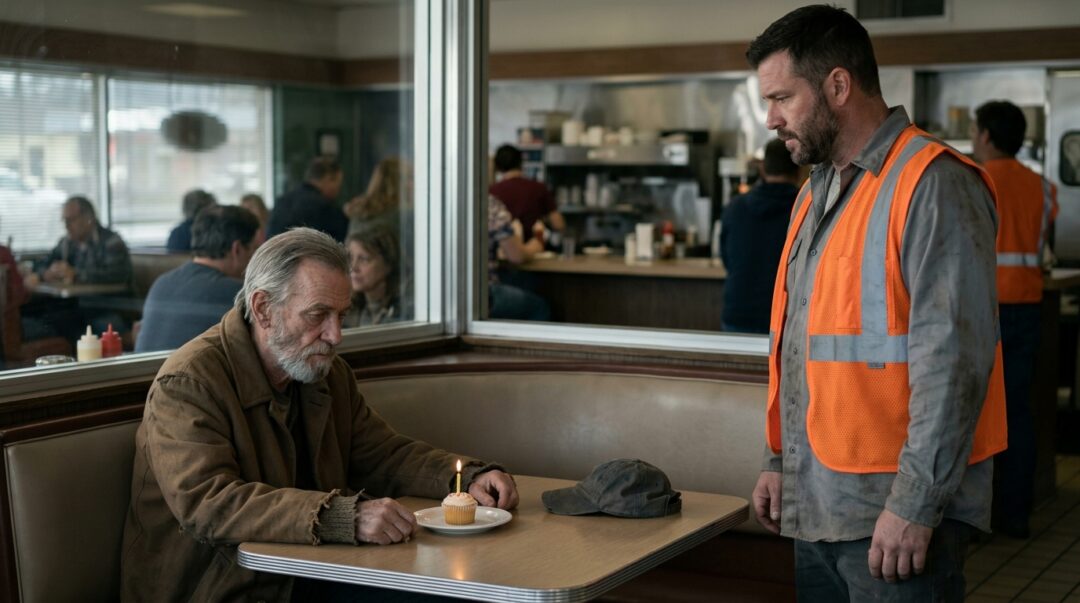
The old man had been sitting alone in the corner booth near the window, shoulders bent forward as if he had spent years learning how to take up less space than he needed. In front of him sat a cupcake on a small white plate, the candle on top burning with a single, trembling flame. It was the kind of candle diners kept behind the counter for rushed birthdays and shy celebrations. Cheap. Thin. Meant to be blown out before anyone looked too closely.
But everyone had looked.
At least, that was how it suddenly felt.
The lunch rush was in full swing at Mae’s Diner, the kind of place where hard hats were left on empty seats and coffee was never allowed to cool. The booths were packed with electricians, roofers, truck drivers, and regulars who came in so often they no longer needed menus. Orders were shouted toward the kitchen. Plates clattered. A fryer hissed from somewhere in the back.
And yet that one sentence—That seat’s taken—seemed to land louder than all of it.
The old man, whose name was Leon Mercer, lifted his eyes to the worker standing over him. Leon had a narrow, lined face and a beard gone mostly silver, though the mustache still held a trace of darker gray near the corners. His coat was weathered and too large in the shoulders, the cuffs frayed enough to show how often they had been rubbed between cold fingers. He looked at the worker with the immediate, practiced caution of someone who had learned long ago that public spaces always belonged to somebody else first.
Leon glanced at the empty half of the booth.
“Oh,” he said quietly. “I can go.”
He reached for the plate before he reached for himself, one hand curving protectively around the little cupcake as if to shield the candle from a draft that did not exist.
A few booths away, forks paused in midair.
The construction worker was broad-shouldered, maybe forty, with a trimmed beard and a fluorescent orange safety vest over a dusty gray shirt. He had come in with six other men from the road crew working two blocks down, and they had been eating eggs and hash browns in the center of the room for the last twenty minutes. To anyone watching, he looked exactly like the sort of man Leon had every reason to fear in that moment: bigger, younger, louder, more certain that the world would make room for him.
Leon slid one hand against the vinyl seat and started to rise.
Before he could, a waitress came quickly around the end of the aisle with a loaded tray balanced on her shoulder. She was in her early thirties, dark hair tied back, navy uniform pressed at the collar and already wrinkled through the waist from the speed of the shift. Her name tag read Marlena, though almost everyone just called her Mar.
She saw Leon standing and her expression changed at once.
“Wait,” she said.
Leon froze.
His embarrassment deepened, not eased. To him, the tray in her hand only confirmed what he had already assumed: he was in the way. Somebody else needed the booth. The cupcake and candle had been a gesture of politeness, nothing more, and now the real customers had arrived to claim the rest of the space.
“It’s alright,” he said, too fast. “I’m not staying.”
He tried to smile when he said it, but the smile was the kind people used when dignity had to be assembled in public from whatever scraps were still available.
Marlena set the tray down hard enough to make the silverware jump.
The construction worker put one hand on the edge of the booth, not pushing Leon, but stopping him from fully stepping out.
“Not for someone else,” he said.
Leon looked from the worker to Marlena, confused.
Marlena started unloading plates onto the table. Meatloaf. Mashed potatoes. Green beans slick with butter. A bowl of soup. Two dinner rolls wrapped in a napkin to keep them warm. More food than any one person expected to appear in front of them on an ordinary Tuesday.
Leon stared.
“For me?” he asked.
Marlena’s face softened. “Nobody eats birthday dessert by itself.”
For a second, Leon did not move. He simply looked at the meal, then at the little candle still burning beside it. The room had not gone quiet, exactly, but something had changed in its attention. It was no longer drifting around him. It was resting on him.
And Leon, who knew how dangerous that could be, did not yet know whether to trust it.
Part II — The Man Who Had Learned to Leave Early
Leon had not planned to be in the diner long enough for anybody to notice him.
That had been true of most of his life lately.
He had arrived just after eleven, before the lunch crowd thickened, because the mornings were easier. Fewer eyes. Less chance of someone at the register looking him over too long before deciding whether he counted as trouble. He had spent the night in a church shelter across town, and before that in his truck until the truck stopped being his. Before that, in a one-bedroom apartment with his wife, Darlene, who had folded towels with clean edges and believed every bad season eventually had the decency to end.
Darlene had been gone four years.
The jobs had thinned before she died, then disappeared altogether after. Leon had never learned how to speak about grief in the language people found useful. He did not say depression. He did not say collapse. He said things like I got behind. He said one thing turned into another. He said I’m managing.
Managing had led him, step by invisible step, to places where a man learned not to unpack hope in public.
Earlier that morning, Marlena had noticed him standing outside the diner window longer than weather alone could explain. Not begging. Not peering at plates. Just standing there with that particular stillness that came from trying to decide whether entering a place was worth the possibility of being unwelcome.
She had opened the door herself.
“You coming in?” she asked.
Leon had almost said no.
Instead he stepped inside, took off his cap, and asked for the cheapest coffee on the menu.
He did not mention the date. He did not mention that birthdays had become something he tried not to examine too closely. But when Marlena brought him a refill, she saw the worn paper card sticking out of his coat pocket. A church volunteer had written Happy Birthday, Leon across the front in blue marker. The handwriting was careful, but there had been no envelope.
Marlena had not said anything then. She only nodded once, as if she had been handed a fact that needed to be carried properly.
At the center booth, the road crew had seen it too. They were local men, most of them. They knew the shelter. Knew the church lot. Knew the quiet choreography of people who had once belonged to ordinary lives and were now surviving in plain view of them. The broad-shouldered one, whose name was Wade, had asked Marlena a question when Leon went to the restroom.
“That his birthday?”
Marlena had nodded again.
Wade looked toward the empty corner booth. “He here alone?”
“Looks like it.”
That was all it took.
A few folded bills were placed on the table between ketchup bottles and coffee mugs. Somebody said to get him a real meal. Somebody else said a cake if the kitchen could do it. One of the younger workers, awkwardly pretending not to care too much, muttered that no man should spend his birthday with just a coffee and a cupcake.
The cupcake had been Marlena’s first move because it was fast. The kitchen could spare one, and she had put the candle in it herself with a box of matches from the register. She had wanted to give Leon something before he left. Something small enough not to embarrass him.
But then Wade had watched Leon bow his head over that little flame as if even one candle might be more mercy than he knew how to hold.
That was when the meal had stopped being enough.
Back in the present, Leon lowered himself into the booth again.
He sat slowly, like a man unsure whether the floor beneath him had truly settled. His hands, rough and dry at the knuckles, hovered over the table for a moment before folding together in front of him. It was not a formal prayer. It was something older and more involuntary than that. A reflex of gratitude too large to be spoken cleanly.
Marlena noticed and looked away just enough to let him keep the moment.
Wade stepped back from the booth, the hard line of his body softening now that the misunderstanding had broken. The rest of the road crew remained gathered near their table, watching but keeping their distance. They had the uneasy expressions of men who were more comfortable lifting concrete than handling tenderness in public.
Leon looked up at Wade. “You all did this?”
Wade scratched once at the side of his beard. “Wasn’t just me.”
Leon’s eyes moved to the men behind him, then back to the plate in front of him. The little candle still burned on the cupcake, stubborn and bright.
He gave a small nod, as if the room had offered him a truth too large to take in all at once.
Part III — The Seat They Were Saving
The first bite seemed to undo him more than the surprise had.
Leon cut into the meatloaf with the side of his fork, the way people did when they were trying to eat carefully in front of strangers, and held it in his mouth for a second before swallowing. It was hot enough to fog his glasses. He took them off, wiped them with a napkin, and laughed once under his breath at nothing obvious.
Marlena, still standing beside the booth, smiled. “Good?”
Leon nodded. “Tastes expensive.”
That pulled a few low laughs from the road crew, enough to ease the room without breaking its gentleness.
But Marlena knew the story was not finished. Neither did Wade.
The whole time Leon ate, the empty space beside him remained open. The half of the booth Wade had claimed with those first harsh words stayed untouched, as if they were all still waiting for whatever belonged there.
Leon noticed it too. Every now and then his eyes flicked toward the seat, puzzled but too polite to ask.
At the counter, the cook emerged from the kitchen carrying a bakery box bigger than a toolbox. White cardboard, tied with red string. He passed it to Wade, who took it with both hands in a way that made several people around the diner suddenly grin before they could stop themselves.
Leon saw the change in their faces first.
Then he turned.
Wade approached the booth again, slower this time, and the entire room seemed to lean with him. The fluorescent vest that had looked threatening ten minutes earlier now looked almost ceremonial, bright as a flare in the middle of all that brown paneling and chrome.
“I told you,” Wade said, nodding toward the empty seat. “That seat’s taken.”
He untied the box, lifted the lid, and for a second Leon just stared.
Inside was a full cake, iced in white, the kind grocery stores made for sheet-order celebrations and retirement parties. Someone in the kitchen had written Happy Birthday, Leon in blue frosting that slanted slightly upward at the end, as if hope itself had held the piping bag. Candles—more than one this time, enough to make the cake glow—were set across the top and already burning.
Leon’s mouth opened, but nothing came out.
Wade slid the cake carefully into the empty half of the booth. Into the space Leon had believed he was being forced to surrender. Into the space they had been protecting for him all along.
A sound rose around the diner then—not one thing, but many things becoming the same thing. Forks set down. Hands coming together. Boots scraping against tile as men stood up from tables they had no intention of leaving. Even the cook from the kitchen leaned in the doorway to see.
Marlena put one hand lightly on the back of the booth.
“Nobody leaves before cake,” she said.
Leon looked down at the blue frosting, then up at the faces around him. Most of them were strangers. Or near strangers. Men he had passed on sidewalks, women who might have poured him coffee without knowing anything beyond what he ordered and whether he paid in coins.
And yet here they were, looking at him not with pity, not with impatience, not with that wary distance he had grown used to—but with something simpler and rarer.
Recognition.
Not of his history. Not of every wrong turn or loss. Just of his humanity, plain and immediate.
Leon drew in a shaky breath.
He remembered, suddenly and with painful clarity, the last birthday Darlene had celebrated with him. A grilled pork chop. Store-brand pie because she said cake was too much fuss for two people. Her laughing when he pretended to complain. The small domestic holiness of being expected somewhere at dinnertime.
He had not understood, back then, how much of love was repetition. A plate set down. A chair waiting. Someone knowing you were due to arrive.
The applause in the diner was gentle, not rowdy. It did not crowd him. It carried him.
Wade looked down at the candles. “Go ahead.”
Leon swallowed once.
His eyes were wet now, but he did not seem embarrassed by that anymore. The room had made a place where embarrassment could not survive. He leaned forward, beard silver in the candlelight, and blew. The flames went out in a single wave, smoke curling upward in thin gray lines.
The diner broke into fuller applause.
Leon laughed then—a short, startled laugh, like a man hearing his own voice return after a long silence.
Part IV — A Place at the Table
He stayed far longer than he had meant to.
That, more than anything, was how Marlena would remember the day later.
Not the cake. Not the candles. Not even the way Wade, who looked as if he had been built to argue with asphalt, had blinked hard and looked at the ceiling after Leon blew them out. It was the staying that mattered.
Leon did not bolt after the first thank you. He did not hurry through the meal as if kindness accrued interest. He sat there, finishing his coffee and accepting a second slice of cake cut by Marlena with the seriousness of a ceremony. He answered questions when people asked them softly enough. Told the men from the road crew he used to fix industrial boilers. Told Marlena his wife had loved diners because she thought every one of them smelled like people trying their best.
By two o’clock, the rush was over. Half the booths had emptied. Sunlight shifted across the floor in broad, dusty stripes.
Wade lingered by the register, pretending to study a scratch-off ticket he had no intention of buying. Eventually he walked back to Leon’s booth and reached into the pocket of his work jacket.
He placed a folded envelope on the table.
“What’s this?” Leon asked.
“Address,” Wade said. “Church pantry on Willow gets first call on odd jobs. My cousin runs a warehouse two mornings a week. Nothing grand. But if you want, I can take you by.”
Leon looked at the envelope but did not touch it immediately.
It would have been easy to make that moment sentimental, to turn it into rescue, to pretend one meal and one cake could unwind years of damage. But that was not what passed between them. Wade did not offer a miracle. Leon did not suddenly become a different man.
What changed was smaller, and because it was smaller, it was real.
An opening.
A seat held for him.
Leon finally took the envelope and slipped it into the same coat pocket where the church birthday card still rested.
“Alright,” he said.
Marlena came over with a takeout container wrapped in a plastic bag. Two slices of cake. Dinner roll. Extra napkins.
“You’re not leaving empty-handed,” she said.
Leon looked at her for a moment as if searching for the right way to carry gratitude without breaking under it.
“I almost walked out,” he said.
Marlena leaned one shoulder against the booth. “Yeah,” she said gently. “I know.”
He glanced toward Wade and the men at the counter.
“I thought—”
“We know that too.”
There was no shame in it now. No need to finish the sentence. Everyone there understood what he had thought. That the seat was taken by someone more welcome. That the room was closing around him instead of opening.
Leon looked at the empty side of the booth one last time.
Funny, he thought, how a place could change meaning in under a minute.
Before he left, he stood slowly and set his palm against the tabletop, grounding himself. The room was nearly back to normal. Silverware rolled. Chairs scraped. Someone laughed near the coffee station. The spell of the moment had thinned into ordinary afternoon.
But ordinary was not what it had been.
As Leon moved toward the door, Wade lifted a hand. One of the younger workers did the same. Then the cook. Then two women at the counter who had watched the whole thing without ever stepping in. None of them made a fuss of it. They just acknowledged him as he passed.
For once, Leon did not lower his eyes.
Outside, the day had turned bright and cold. He stood on the sidewalk with the takeout bag in one hand and the envelope in the other, looking at his reflection in the diner glass. He was still wearing the same worn coat. Still carrying the same years. Still facing the same uncertain night.
And yet something in his posture had shifted.
Inside, through the window, he could see the corner booth. The one by the glass. The one with the empty side they had said was taken.
He understood now that they had not meant the seat belonged to someone else.
They had meant it belonged to a moment he had not expected to have.
To hot food set down with care.
To a cake with his name written across it.
To strangers deciding that loneliness should not be allowed to finish the day unchallenged.
Leon touched the breast pocket of his coat, feeling both pieces of paper there—the church card and Wade’s folded note—thin as they were, enough to be felt through cloth. Proof that the day had not imagined itself.
Then he put on his cap, tucked the takeout bag close against his side, and started down the street.
For the first time in longer than he could remember, he was not walking like a man trying to leave early.