The Blue Dress She Was Asked Not To Wear Again
Part I — The Moment Everyone Saw
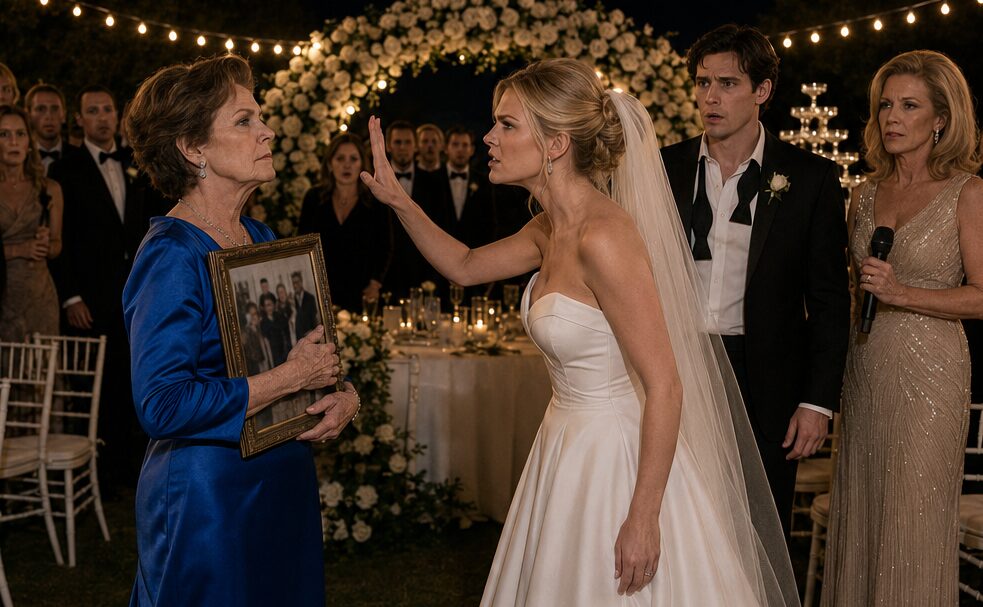
Donna crossed the backyard in a royal-blue satin dress while two hundred people watched her become the woman they would talk about for years.
The candles were already lit. The champagne tower glittered under rented string lights. White roses climbed the arch like the whole house had been trained to behave.
Heather, still in her wedding gown, lifted one hand and pointed at her.
“Don’t you dare make this about you.”
She said it loudly enough for the first two rows to hear. Loudly enough for the groom’s coworkers to turn. Loudly enough for the neighbors from both sides of the cul-de-sac to stop pretending they were not already listening.
Donna did not answer.
She walked past the floral arch.
Past the table where guests had dropped cream envelopes into a gold birdcage.
Past the champagne-colored mother of the bride, Kathleen, whose polished smile had finally cracked.
Past Andrew, her son, frozen in his tuxedo with his collar already loose and his face gone pale.
Heather stepped forward like she could still control the room if she arranged her expression correctly. Her makeup was flawless. Her dress was structured and expensive and so white it seemed to accuse everything around it of being ordinary.
“Put that away,” Heather said.
Donna held the framed photograph against her chest.
Heather reached for it.
The frame slipped.
The glass cracked against the edge of a white garden chair.
That was the sound that changed the wedding.
Not the music stopping. Not the gasps. Not Kathleen saying, “Oh, for God’s sake,” into the microphone she had refused to release.
The crack.
A thin, bright little sound. Easy to miss. Impossible to undo.
Donna looked down at the broken frame. Behind the fractured glass, Ronald’s face was still smiling in the old photograph Andrew had chosen when he was sixteen because he said his father looked “less serious in this one.”
Heather’s fingers hovered in the air.
Donna looked back up.
Then she slapped the bride once.
The sound moved through the backyard faster than any announcement could have. Heather’s face turned with it. Her hand flew to her cheek. She bent forward, not because the pain was great, but because the room had seen her lose control.
No one moved.
For one suspended second, the whole wedding looked like a painting of people pretending not to breathe.
Kathleen gasped first.
Andrew moved second.
But he did not reach for Heather. He did not reach for Donna.
He bent down and picked up his father’s photograph from the grass.
Donna’s hand trembled only after it was over.
She looked at Heather and said, quietly enough that only the front tables heard it, “You don’t get to build a family by erasing one.”
No one clapped. No one defended her. No one knew where to put their eyes.
And maybe that was the first honest thing that had happened all day.
Part II — The List on the Kitchen Counter
Eight hours earlier, Donna had arrived at Andrew’s house carrying two garment bags, three boxes of wedding favors, and a checkbook she had been pretending did not feel heavy.
The house did not belong to Andrew yet, though everybody had started calling it “their house” in the careful way people did when they wanted the future to sound settled. It was a white-brick colonial in a wealthy Atlanta suburb, with trimmed hedges, black shutters, and a mailbox that looked more expensive than Donna’s first car.
The backyard had been transformed overnight.
Rental crews had laid pale flooring over the grass. Florists were wiring roses into the arch. A man in a black shirt was testing microphones near the patio. White chairs stood in clean rows, all facing the place where Andrew would promise his life to Heather before God, neighbors, coworkers, cousins, and people whose names Donna had only seen on envelopes.
Donna parked on the street because the driveway had been reserved for vendors and “immediate family.”
She stared at that phrase on the little printed parking sign for a moment.
Immediate family.
Then she lifted the boxes from her trunk.
Inside, Kathleen was standing in the kitchen with a clipboard, a phone tucked between shoulder and ear, and a champagne-colored robe tied at her waist as if she had been born in soft lighting.
“There you are,” Kathleen said, like Donna had arrived late, though it was barely nine.
Donna set the boxes on the island. “The favors are all here. I checked the tags last night.”
“Wonderful.” Kathleen slid a printed sheet across the counter. “I made a little schedule so everyone knows where they’re most useful.”
Most useful.
Donna wiped her hands on the sides of her dress pants and looked down.
Her name appeared six times.
Donna — pick up extra ice if caterer requests.
Donna — verify table cards.
Donna — assemble bathroom baskets.
Donna — hand vendor gratuity envelopes to Kathleen.
Donna — remind groom’s side no unplanned speeches.
Donna — make sure your side behaves.
She read the last line twice.
Kathleen was already looking past her. “Also, the family photo list is on the second page. We’re keeping things tight because the light is best between five-fifteen and five-forty.”
Donna turned the page.
Bride with parents.
Bride with mother.
Bride with bridesmaids.
Bride and groom with bride’s family.
Bride and groom with full bridal party.
Bride and groom with both families.
Groom’s relatives.
That was where she was.
Not groom with mother.
Not groom with parents, because Ronald had been gone seven years, and death made forms awkward.
Just groom’s relatives.
Donna folded the paper once, slowly.
Kathleen smiled. “I hope that all makes sense.”
“It does,” Donna said.
That was the first lie she told that day.
A soft thud came from upstairs, followed by a sharp voice: “No, not those earrings. The smaller ones.”
Kathleen closed her eyes for half a second.
“Big day,” she said.
Donna nodded and reached for the boxes. “Where would you like the favors?”
Kathleen’s smile returned. “You’re a lifesaver.”
By ten, Donna had tied loose ribbons on seventy-two boxes of sugared almonds. By eleven, she had moved the groom’s family table six feet farther from the dance floor because Kathleen said the caterers needed “better flow.” By noon, she had fixed a typo on the seating chart with a gold paint pen she found in a junk drawer.
The typo had been on her own sister’s name.
“People won’t notice,” Kathleen said.
Donna noticed.
She noticed everything.
She noticed that Heather’s family had their own getting-ready room upstairs while Andrew and his groomsmen had been sent to the basement den beside the old treadmill.
She noticed that the welcome sign said, Welcome to the Beginning of Heather and Andrew’s Forever, though Donna had mailed the deposit check for the sign herself.
She noticed that the florist asked Kathleen where to put “the little memory chair thing,” and Kathleen waved toward the front row without looking.
Donna had set that chair herself.
A single white chair on Andrew’s side, front row, closest to the aisle. She had placed Ronald’s framed photograph on it before anyone else arrived. In the picture, he wore a navy jacket and a crooked grin, one arm thrown around a twelve-year-old Andrew, both of them sunburned from a fishing trip where they had caught nothing and returned happy anyway.
Donna had polished the glass before leaving her apartment.
“He should have a seat,” Andrew had said months ago, quiet over coffee.
So Donna had given him one.
At one-thirty, Heather came down the stairs in silk pajamas and a white robe with BRIDE stitched on the back. Her hair was pinned up halfway. Her face had already been painted into something bridal and distant.
“Donna,” she said, kissing the air near her cheek. “Thank you for everything. Seriously. We could not have done this without you.”
It was loud enough for the room.
Then Heather leaned closer and lowered her voice.
“Did you bring the blue dress?”
Donna glanced down at the garment bag hanging over a chair. “Yes.”
Heather’s smile tightened. “It’s beautiful. It’s just… a little bright.”
Donna waited.
Heather touched the counter, then lifted her hand as if the counter might leave dust on her fingers. “The palette is mostly cream, champagne, sage. Soft tones. Mom is worried the photos might look a little uneven.”
“Uneven,” Donna repeated.
“Not bad,” Heather said quickly. “Just noticeable.”
Donna thought of the royal-blue dress hanging in its bag. She had bought it three months ago from a department store where the saleswoman said, “That color loves you.” Donna had not been loved by a color in years.
Andrew had seen a picture and said, “Mom, that’s perfect.”
So she had kept it.
“I’ll wear it,” Donna said.
Heather blinked.
Before she could answer, Andrew entered through the back door, carrying two cases of bottled water, tuxedo pants still unhemmed at the bottom.
“Mom,” he said, relieved. “Can you help me find the cuff links?”
Donna looked at him. Her boy. Thirty-three years old and still looking, in panic, like the child who used to lose one shoe before church.
“I can,” she said.
Heather’s smile came back, but smaller.
As Donna followed Andrew down the hall, she heard Kathleen in the kitchen say, “We’ll manage it in the angles.”
Manage it.
That was what they called making someone smaller without asking them to leave.
Part III — The Chair That Moved
Andrew’s cuff links were in the pocket of the jacket he had already checked twice.
Donna found them in thirty seconds.
He laughed, embarrassed, and sat on the edge of the basement couch while she fastened one at his wrist. His hands were damp.
“You okay?” she asked.
“Yeah.” He looked toward the ceiling, where footsteps moved above them. “Just a lot.”
“It’s allowed to be a lot.”
“I know.” He swallowed. “Mom, please don’t let anything get weird today.”
Donna kept working on the cuff link.
There were many things she could have asked.
Why am I on the errand list?
Why am I not in the photos?
Why did Heather look at my dress like I had spilled something on the wedding?
Instead she said, “What do you mean?”
Andrew gave a tired little smile. “You know how Kathleen gets. And Heather’s stressed. Just let today be easy.”
Donna’s fingers paused.
Easy.
That word had followed her through motherhood like a commandment.
Make it easy for your father when he comes home tired.
Make it easy for Ronald when the bills get tight.
Make it easy for Andrew after the funeral.
Make it easy for everyone, and maybe no one will notice what it costs.
She finished the cuff link.
“Of course,” she said.
Andrew leaned forward and kissed her cheek. “Thank you.”
He did not see that her eyes had gone wet.
By three, the house was full of people trying to look calm in expensive clothes.
Donna changed in the downstairs powder room because the bedrooms were occupied. The royal-blue dress slid over her shoulders with a clean, cool weight. It was satin, simple, elegant, with sleeves that softened her arms and a waist that reminded her she still had one.
When she stepped into the hallway, one of Heather’s cousins looked up and said, “Oh.”
Donna smiled politely.
The cousin recovered. “That’s a bold color.”
“Yes,” Donna said. “It is.”
Outside, the photographer had begun arranging family groups.
Donna stood near the patio, hands folded around her clutch, waiting to be called.
“Bride with parents!”
Kathleen swept in beside Heather, smile bright, chin lifted. Heather’s father, a quiet man named Jerry who seemed to have learned years ago where not to stand, moved into place.
“Beautiful,” the photographer said. “Now bride with mom.”
Donna watched Kathleen press her cheek against Heather’s. They looked like a magazine ad for inheritance.
“Bride and groom with bride’s family!”
Andrew joined them.
Donna smiled when he glanced over.
He smiled back, apologetic before anything had happened.
“Full bridal party!”
The bridesmaids gathered in sage green. Groomsmen adjusted jackets. Laughter rose and fell.
Donna kept standing.
A woman beside her, one of Kathleen’s neighbors, leaned toward another and whispered, not quietly enough, “That’s his mother, right?”
“Yes,” the other said. “Kathleen said she’s been very emotional.”
“Widowed?”
“I think so. Very attached to him.”
Donna looked straight ahead.
Attached.
As if she had clung to Andrew like ivy. As if she had not encouraged him to move out, date, travel, take the job downtown, buy the ring. As if love only counted as healthy when it stood far enough away to look tasteful.
The photographer finally called, “Groom’s relatives?”
Donna stepped forward with Andrew’s aunt, two cousins, and a nephew who was already picking at his boutonniere.
Andrew moved beside her.
For three seconds, his arm went around her back.
Donna nearly leaned into him.
Then the photographer said, “Great, got it,” and the moment was over.
The ceremony began at five.
Donna sat in the front row on Andrew’s side.
Ronald’s chair was not there.
At first, she thought she had miscounted. The rows had been shifted. Chairs had been angled. A large floral arrangement now occupied the place where she had set the frame.
She looked down the row.
No photo.
No white chair.
No Ronald.
Her hands went cold.
The music began before she could stand. Guests turned. Bridesmaids came down the aisle in soft green. Heather appeared at the back of the yard glowing under a veil so fine it looked like mist.
Andrew cried when he saw her.
Donna watched her son’s face and forced herself not to look for his father again.
The ceremony was beautiful.
That was the hardest part.
The vows were gentle. The breeze moved through the roses. Heather’s voice shook when she promised to build a life with Andrew, and for one painful second, Donna believed her completely.
Then the guests stood. The couple kissed. Everyone clapped.
Donna clapped too.
Love and insult could occupy the same hand.
During cocktail hour, she searched the front rooms first.
No photo.
She checked the hallway table, the gift table, the piano, the mantel.
Nothing.
Finally, in the laundry room off the kitchen, beside spare napkins and a plastic tub of bathroom baskets she had assembled herself, Donna found Ronald face-down on a shelf.
The frame had been turned over.
She picked it up slowly.
A voice behind her said, “Oh, good, you found it.”
Kathleen stood in the doorway, holding a glass of champagne.
Donna turned. “Why was it in here?”
Kathleen’s expression softened in the rehearsed way people soften when they are about to refuse you kindly.
“The planner thought the front row looked a little uneven with the extra chair.”
“The planner.”
“It was a visual decision.”
“It was my husband.”
A flicker crossed Kathleen’s face. Annoyance, quickly dressed as sympathy.
“Of course,” she said. “And we all feel that. Truly. But Heather was already anxious, and we didn’t want anything too heavy right before she walked down.”
Too heavy.
Ronald had become weight.
Donna held the frame so tightly the edge pressed into her palm.
Kathleen stepped closer. “Donna, this is not about excluding anyone. It’s about keeping the mood joyful.”
Donna looked at the woman in champagne silk standing in front of shelves stacked with emergency paper towels and hidden grief.
“Where would you like me to put him?” Donna asked.
Kathleen smiled, relieved by her cooperation. “Maybe the welcome table after dinner? Somewhere tasteful.”
Tasteful.
Donna almost laughed.
Instead she set the frame upright on the shelf, facing outward.
“Then he can watch the napkins,” she said.
Kathleen’s smile thinned.
For the first time all day, Donna let her see she had meant it.
Part IV — The Money That Changed Shape
Dinner was served under a tent of lights.
The tables were named after places Heather and Andrew had traveled together. Charleston. Savannah. Asheville. Napa. Donna sat at Chattanooga, though she could not remember either of them mentioning Chattanooga even once.
Her table had Andrew’s aunt, two of Ronald’s old friends, Heather’s former boss, and a couple from down the street who kept asking how Donna liked “all this.”
All this meant the oyster station. The custom cocktail napkins. The linen menus. The monogram projected in gold against the side of the house.
All this also meant the money.
Donna had given Andrew twenty thousand dollars the previous winter. Not for the wedding, exactly. She had said, “Use it for the house. Closing costs, repairs, whatever helps you start.”
He had cried then too.
“I’ll pay you back,” he said.
“You won’t,” she told him. “That’s not what mothers mean when they give.”
Now she watched a server refill champagne in glasses etched with Heather and Andrew’s initials and wondered how much a person could spend making a day look effortless.
Andrew found her between courses, tugging at his collar.
“Can I talk to you?” he asked.
The look on his face made her stand immediately.
He led her around the side of the house, near the garage, where the caterers had stacked crates and the music arrived muffled through the tent.
“What is it?” Donna asked. “Are you all right?”
He rubbed both hands over his face.
“I need to tell you something before someone else does.”
Nothing good ever began that way.
Donna waited.
“The money you gave me,” he said. “For the house.”
Her chest tightened. “What about it?”
He looked toward the driveway, then back at her. “Some of it went to the wedding.”
Donna did not speak.
“Not all,” he said quickly. “Just—there were upgrades. The tent, mostly. And the extra catering. Kathleen said with Heather’s clients coming, and the neighborhood, it needed to feel—”
“Like what?”
Andrew shut his mouth.
“Like your mother didn’t plan it?” Donna asked.
“No.”
“Like my money looked better as flowers?”
He flinched.
That hurt her more than she wanted it to.
“How much?” she asked.
He said it softly.
Donna looked past him at the tent. At the lights. At the white roses. At the rented perfection glowing against a house he did not yet own.
“You told me it was for your future,” she said.
“It was.” His voice cracked. “This is part of my future.”
“No, Andrew. This is one day.”
He covered his eyes with one hand. “I know.”
“Did Heather know?”
He did not answer fast enough.
Donna nodded once.
“Mom—”
“Did you think I would say no?”
“No.” He looked ashamed. “That was the problem.”
The words landed cleanly.
That was the problem.
Not that he feared her anger. Not that he thought she would refuse. He had counted on her love being easier to spend than anyone else’s approval.
“I knew you’d say yes,” he said. “And then pretend it didn’t hurt.”
Donna felt something in her go very still.
It was a strange thing, to be known that accurately and loved that carelessly.
From the tent came laughter. Glasses chimed. Someone called Andrew’s name.
“Go,” Donna said.
“I’m sorry.”
“I know.”
He looked smaller than thirty-three. “Mom, please don’t leave.”
She almost touched his face.
Instead she said, “I’m going to find your father’s picture.”
He swallowed. “What?”
“It’s in the laundry room.”
His eyes changed.
“What do you mean it’s in the laundry room?”
Before Donna could answer, Heather appeared at the corner of the house, lifting her skirt slightly to keep it off the grass.
“There you are,” she said to Andrew. “They need us for sunset photos.”
Then she saw Donna’s face.
A bride learns quickly when a room is about to stop belonging to her.
“What happened?” Heather asked.
Andrew said, “Not now.”
But Donna was tired of not now.
“Did you know your mother moved Ronald’s chair?” Donna asked.
Heather’s jaw tightened. “Donna—”
“Did you know?”
Heather glanced toward Andrew, then back. “It wasn’t meant to be personal.”
Donna almost smiled. “It never is.”
Heather stepped closer, lowering her voice. “My mom was trying to keep the ceremony from feeling sad.”
“His son was getting married.”
“I understand that.”
“No,” Donna said. “You understand photographs.”
Heather’s eyes filled fast, unexpectedly.
For a second, Donna saw the woman under the bride: young, exhausted, strapped into a perfect dress like armor.
“You have no idea what she’s like when people aren’t watching,” Heather whispered.
Donna looked toward the tent, where Kathleen’s laugh rose clean and bright.
Heather’s mouth trembled. “She said my vows were too plain. She said my hair made my face look round. She said if we moved your table closer, people would wonder why my aunt was in the back. She has corrected every breath I’ve taken today.”
Donna’s anger did not vanish.
It changed shape.
“I’m sorry,” she said, and meant it.
Heather blinked, as if kindness had startled her.
Then she wiped under one eye with the careful finger of a woman afraid of ruining expensive makeup.
“Please don’t make Andrew feel guilty about the money,” she said. “He wanted to give me one beautiful day.”
There it was.
The door opened. The same room again.
Donna stared at her.
“He did not give it,” she said. “I did.”
Heather looked away.
The music swelled behind them. The photographer called for the bride and groom.
Andrew stood between them, miserable and silent.
Donna understood then that silence was not peace. It was just a place everyone put the truth until it began to rot.
Part V — The Speech With Missing Names
Kathleen gave her welcome speech after the salads were cleared.
She stood beneath the lights in her champagne dress, one hand on the microphone, the other pressed delicately to her heart. Behind her, the white roses looked almost silver in the evening.
“Friends, family, neighbors,” she began, smiling out at the tent. “What a joy to welcome you into this home for such a beautiful beginning.”
Donna sat at Chattanooga with Ronald’s photograph in her lap.
She had gone back to the laundry room and retrieved it after the conversation by the garage. No one stopped her. No one noticed. That, somehow, was worse.
Andrew saw it when he and Heather returned to the head table. His face tightened with pain, but he did not ask her to put it away.
That was something.
Small, but something.
Kathleen continued, thanking the planner by name, the florist by name, the caterers, Heather’s father, Heather’s aunt who had arranged the hotel block, the neighbor who had lent extra silver trays, and “our dear friends from the club who made tonight feel so full of love.”
Donna waited.
She should not have. She knew better.
But hope is humiliating in the way it keeps standing up after being told to sit down.
Kathleen said, “And of course, we thank both families for surrounding Heather and Andrew with support.”
Both families.
No names.
Donna felt Andrew look at her.
Kathleen turned slightly toward the head table. “Marriage reminds us that love is not only about those present with us, but those who are here in spirit.”
Donna’s fingers tightened around the frame.
“Those we miss tonight,” Kathleen said, voice sweetening, “would surely be so proud.”
The tent softened. People tilted their heads. A few guests put hands to their hearts.
Donna stared at the woman who had put Ronald face-down beside napkins and now used his absence to decorate a speech.
That was when she stood.
Her chair scraped the floor.
Not loudly. Enough.
Kathleen paused, still smiling.
Donna stepped away from the table with Ronald’s photograph held against the blue satin of her dress.
The guests nearest her watched. Then the next table. Then the next.
Andrew rose halfway from his chair.
Heather’s eyes widened.
Donna did not walk fast. She was not performing. She was not storming. She was simply done asking grief to wait in the laundry room until it could be useful.
Kathleen lowered the microphone. “Donna?”
Donna kept walking.
She reached the aisle between the tables, where the white runner still led from the ceremony arch to the patio. Ronald’s face looked up through the glass. His smile was divided by the reflection of string lights.
Heather came toward her first.
Not Andrew.
Not Kathleen.
Heather.
She gathered her skirt in one hand, moving quickly but trying not to look like she was hurrying. Brides do not hurry in front of guests. They glide, even when panicking.
“Donna,” she said under her breath. “Please.”
Donna looked past her.
“I’m putting him on the welcome table.”
“Not right now.”
“Yes. Right now.”
Heather’s smile appeared for the guests. Her voice sharpened for Donna. “Put that away. You’re embarrassing us.”
The word moved through Donna like a key turning.
Embarrassing.
Not grieving. Not hurt. Not excluded.
Embarrassing.
Behind Heather, Kathleen had started toward them with the microphone still in hand, as if even disaster required amplification if she controlled it.
Andrew stood frozen beside the head table.
Donna saw his face, and for one last second she almost saved him.
She almost swallowed it again.
She almost became easy.
Heather leaned closer. “Don’t do this.”
Donna said, “I have spent all day doing what you asked.”
Heather’s eyes flashed. “This is my wedding.”
“It is also my son’s.”
“And you are making it about you.”
That line rose louder than Heather intended.
Guests turned fully now.
The first two rows heard it clearly.
“Don’t you dare make this about you,” Heather said.
The backyard went thin with silence.
Donna felt every eye.
The neighbors who thought she was emotional.
The coworkers who thought this was an elegant wedding.
The cousins who had watched her tie favors and move chairs.
Kathleen, who had thanked both families without naming hers.
Andrew, who had spent her money because he knew she would forgive him.
Donna held the photograph tighter.
“No,” she said.
Heather blinked. “What?”
“No.”
It was the smallest word Donna had said all day.
It was also the first one that belonged entirely to her.
She stepped around Heather.
Heather reached for the frame.
Not cruelly. Not hard. Desperate, more than anything. Afraid of the photograph, the guests, the story changing in front of her.
Her fingers caught the edge.
Donna pulled back.
The frame slipped between them.
It struck the corner of a white garden chair.
The glass cracked.
Everyone heard it.
Andrew moved at last.
But Donna moved first.
Her hand rose before she had decided to raise it. The slap was quick, clean, and terrible.
Heather’s face turned.
A gasp traveled through the tent.
Kathleen made a sound that had no polish in it.
Donna’s palm stung.
For a moment, she hated herself.
For another, shorter moment, she felt air reach a room inside her that had been closed for years.
Heather bent forward, hand to her cheek, veil slipping over one shoulder.
Andrew knelt and picked up Ronald’s photograph from the grass.
Not Heather’s bouquet. Not the microphone. Not his mother’s fallen clutch.
His father’s photograph.
Donna saw it.
So did Kathleen.
So did the tables nearest them.
The whole reception seemed to rearrange around that one act.
Donna looked at Heather.
Her voice came out quiet.
“You don’t get to build a family by erasing one.”
No one answered.
There were no perfect words left.
Part VI — Before the Cake
Afterward, the wedding did not end.
That was the cruel practicality of expensive events. They continued because deposits had been paid, meals had been served, and people did not know what else to do with themselves.
The band played something soft and wrong.
Servers cleared plates with their eyes lowered.
Guests whispered over untouched cake plates.
Heather disappeared upstairs with two bridesmaids and Kathleen, who had finally surrendered the microphone to a groomsman who set it on a table like it might bite.
Andrew stood near the welcome table holding the cracked frame.
Donna went to the front porch.
No one followed her for ten minutes.
She sat on the top step in the royal-blue dress Heather had thought too bright and looked out at the quiet street. The neighbor’s sprinklers clicked on across the road. Somewhere behind the house, the wedding resumed in pieces, like a vase glued together badly.
Her palm still stung.
She did not admire what she had done.
That was important.
She would not make a virtue out of losing control. She would not dress it up as justice because it had made a clean sound in a silent crowd. She had crossed a line.
But for once, she was not the only one who had crossed one.
The front door opened behind her.
Andrew stepped out.
His tuxedo jacket was gone. His shirt sleeves were rolled. He looked older than he had that morning, and younger too.
He sat beside her, leaving a careful space.
For a while, neither of them spoke.
Then he said, “I’m sorry.”
Donna kept her eyes on the street.
He tried again. “For the money. For Dad’s picture. For asking you to make everything easy.”
She looked down at her hands.
“I should have said something before today,” she said.
“Maybe.” His voice broke. “But I should have noticed before today.”
That almost undid her.
Almost.
Mothers are trained to comfort the child who admits pain, even when he caused it. Donna felt the old instinct rise in her. To pat his hand. To say, It’s okay. To make her own hurt smaller so his guilt could breathe.
She folded her hands together instead.
“It isn’t okay,” she said.
Andrew nodded.
The night carried music around the side of the house. A slow song now. The kind people danced to when they wanted photographs that looked like memory.
“What happens now?” he asked.
Donna gave a tired laugh. “You’re asking the wrong woman.”
He looked at her.
“You have a marriage to decide how to live in,” she said. “And I have a life to stop apologizing for.”
He looked away, wiping under one eye with the heel of his hand.
“I don’t want to lose you.”
“Then don’t ask me to disappear.”
The words sat between them.
Inside, someone called for the cake cutting.
Neither of them moved.
After a moment, Andrew reached beside him and lifted the frame. Ronald’s face was split by a thin crack running from the top corner down across the glass, missing his smile by less than an inch.
“I can fix it,” Andrew said.
Donna touched the frame.
“No,” she said. “Leave it for tonight.”
He understood enough not to argue.
They walked back inside together, not arm in arm, but close.
At the welcome table, beside the gold birdcage full of envelopes and the little sign asking guests to leave advice for the newlyweds, Donna set Ronald’s photograph upright.
The crack caught the light.
People noticed.
Some looked away.
Some did not.
Kathleen stood across the room, rigid beside the cake table. Her champagne dress no longer looked soft. Heather was at the upstairs window, visible between the curtains, one hand at her cheek, her face unreadable.
Donna looked up at her.
For a second, neither woman moved.
Then Donna picked up her clutch.
Andrew stepped toward her. “Mom?”
“I’m going home before the cake,” she said.
He looked as if he wanted to ask her to stay. He looked as if he wanted to ask her to forgive him right there, in front of the table, before the guests could decide what kind of son he was.
But he didn’t.
That was another small thing.
Small things had built the wound. Maybe small things would have to build whatever came after.
Donna kissed his cheek.
This time, he leaned into it.
She walked out through the front door in the blue dress no one could manage into the background.
Behind her, the wedding lights glowed over the backyard. The music continued. The cake waited. The guests had a story now, though not the simple one they wanted.
On the welcome table, Ronald’s cracked photograph stood facing the room.
Donna did not look back again.