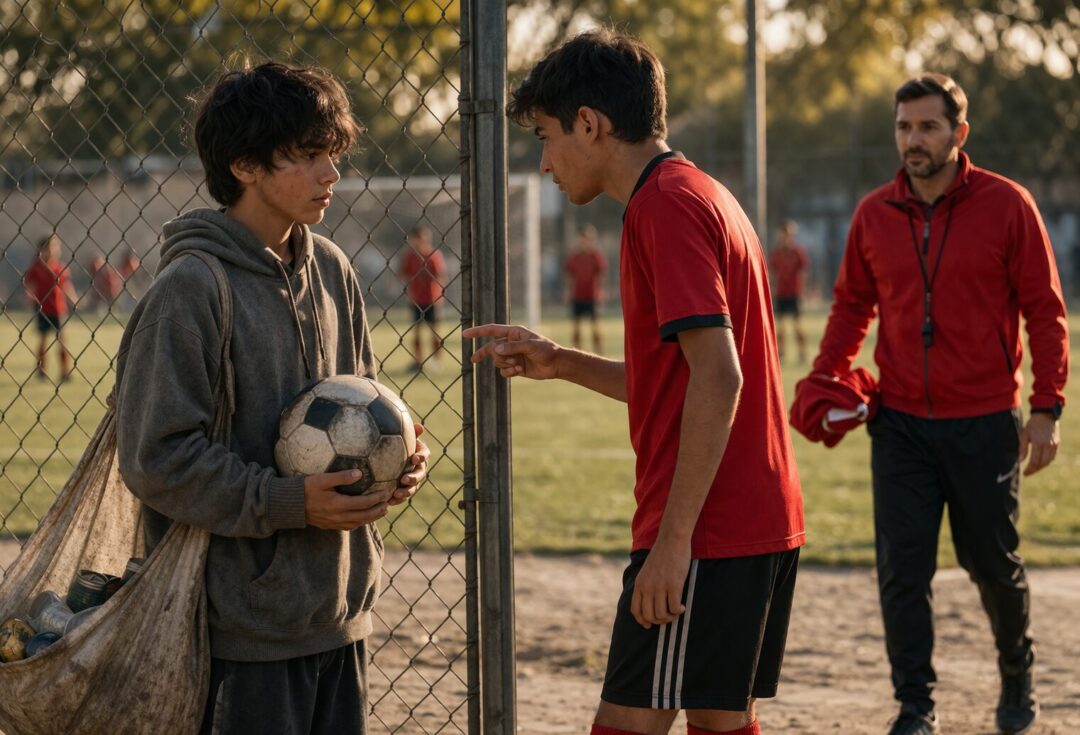
The Boy Outside the Fence
The Boy Outside the Fence
Part I — The Side Nobody Chose
By the time the shouting started, Rowan had already learned the first rule of wanting something beautiful: stand far enough away that no one could accuse you of touching it.
He stood just beyond the chain-link fence of the neighborhood soccer field, one hand wrapped around the neck of a stained canvas sack, the other resting lightly on the cold, worn panels of a soccer ball that had rolled to his feet by accident. The field on the other side glowed under the last warm light of afternoon. Grass caught the sun in thin gold lines. Boys in red jerseys moved in sharp bursts of speed, laughing, calling, turning their bodies with the kind of carelessness that belonged to people who expected to be there.
Rowan did not expect to be anywhere.
His hoodie hung off his shoulders in soft, tired folds, too big at the wrists and too faded to have any real color left in it. His shoes had once been black, though that had been hard to prove for months. The canvas sack against his hip clinked faintly with aluminum cans and plastic bottles every time he shifted his weight. He had spent the afternoon moving through alleys, behind corner stores, near the bus stop where people dropped half-finished drinks beside the bench. Enough bottles meant enough coins. Enough coins meant bread, sometimes eggs, and if the week had been good, something warm from the street cart near the overpass.
But then the ball had come through the narrow opening near the fence.
A hard kick from somewhere inside the field. A bounce off the dirt. One clean roll into the world outside the game.
He had picked it up before he thought better of it.
It was heavier than the cheap plastic balls boys kicked in the empty lot behind the abandoned apartments. It smelled faintly of grass and rubber and something else too—care, maybe. Use. Belonging. Rowan had turned it in his hands with a strange ache in his chest, as if the ball itself knew it lived in a better world.
That was when he heard footsteps coming fast.
He looked up.
A boy a little older than him was walking toward the fence with the blunt certainty of someone who had never had to ask permission to move through a space. Red jersey. Black shorts. Long red socks pulled clean and high. He had a lean, athletic frame and a serious face that sharpened as he came closer.
Rowan knew that look. It usually came right before someone said, What do you think you’re doing?
The older boy stopped a few feet away, close enough that Rowan could see the heat in his cheeks from practice.
“Give the ball back.”
The words were not shouted, but they landed hard anyway.
Rowan’s fingers tightened reflexively around the ball. Not to keep it. Just from the instinct to protect himself when embarrassment hit too fast.
“Sorry,” he said at once.
The apology came out so quickly that it almost sounded rehearsed, and in a way, it was. Sorry for standing here. Sorry for looking too long. Sorry for wanting what wasn’t his.
The boy in red did not say anything immediately. He just stared at Rowan for one suspended second, as if something in the speed of that apology had reached him before he wanted it to.
Then another figure stepped into the space beside him.
The coach.
Rowan had seen him before from across the street—broad-shouldered, calm, always moving with the unhurried steadiness of someone who knew the whole field belonged to him. He wore a red training jacket zipped to the chest and a whistle that hung from a black cord. In one hand, folded over his forearm, was a jersey the same bright red as the others.
Rowan’s first foolish thought was that the coach had brought it for someone else.
His second was that maybe he was about to be told to leave.
Instead, the coach looked at the older boy and said quietly, “No. Bring him in.”
The field seemed to hold its breath.
The boy in red turned. “Coach?”
But the coach was already looking at Rowan.
Not past him. Not through him. At him.
Then he stepped closer and held out the folded jersey.
“This is yours.”
For a second, Rowan forgot how to move.
He could hear sounds around him—the chain fence vibrating faintly in the breeze, a distant car passing the corner, someone on the field bouncing on their heels—but all of it seemed to drift away from the center of the moment.
Because no one had ever handed him anything like that before.
Things were usually thrown. Left behind. Snatched back. Offered with conditions. Given out of pity and regretted before his fingers closed around them.
But this jersey was held out carefully, almost solemnly, as if it mattered that he understood what it meant.
Rowan stared at it. Then at the coach.
“Mine?” he asked, and hated how small his voice sounded.
The coach did not laugh. He did not soften into that too-bright smile adults used when they wanted to seem kind without committing to it.
He only nodded once, steady and certain.
The tears came before Rowan could stop them.
Not loud, dramatic sobs. Just a sudden burning in his eyes, then the humiliating blur of the field, the fence, the red of the jersey doubling and smearing. He pulled the fabric to his chest with both hands as if someone might still decide this had all been a misunderstanding.
The boy in red shifted where he stood.
When Rowan looked at him again, the hard edge in his face was gone. In its place was something more awkward, more honest. Surprise, maybe. Guilt. Or maybe simply the shock of realizing that one sentence could hurt someone that much because the world had already done so much of the work before you arrived.
He reached for the gate latch.
“Come on,” he said. His voice was different now, rougher in a less defensive way. “Let’s play.”
And just like that, the fence was no longer a boundary. It was a door.
Part II — Before the Gate Opened
If someone had asked Rowan what hurt most, he would not have said hunger.
Hunger had shape. It came and went. It twisted, eased, returned. Hunger was practical. You could plan around it if you knew how. Drink water. Sleep early. Walk past the food stalls without slowing down.
What hurt most was being near a life that felt made for other people.
The field had tormented him for months.
He passed it almost every day on his way to the sorting yard behind the grocery district, where vendors sometimes let him dig through bags before the trucks came. At first he only heard the games: whistles, cleats, cheers. Later he began to stop. Then he began to linger.
From behind the fence, he learned things.
How a player planted one foot before sending the ball long.
How shoulders could tell the truth before a face did.
How the boys in red joked when they were winning and went silent when the coach wanted them focused.
He learned the names of drills without ever hearing them explained. He copied movements at night in empty spaces under overpasses, using a dented plastic bottle as a ball and his shadow as an opponent. When the streetlights worked, he practiced cuts and turns until his calves shook. When they didn’t, he did it anyway in the dark, guided by memory.
He never told anyone.
There was no one to tell except his mother, and even then he would have kept it to himself. Her days were already full of things that asked too much of her: bad knees, long lines, temporary work that disappeared without warning, the humiliation of asking for one more day and then one more after that. She noticed enough without Rowan adding another impossible thing to the list.
Sometimes, when he returned with a half-full sack and too little money, she would touch his hair and say, “You’re still a boy. Don’t become old before you have to.”
He never knew how to answer that.
Because old was exactly how the world treated children like him.
The week before the jersey, rain had soaked everything they owned except one blanket and the shoes they slept in. Two nights later, a man from the shelter line had told Rowan to stop loitering near the field because kids from the team had parents who complained when “street boys” watched practice. Rowan had nodded and stayed away for exactly one day.
Then he went back.
Not because he was brave.
Because wanting can become stronger than shame if you feed it long enough.
That afternoon, he had not meant to stop for more than a minute. He was tired, his shoulders aching from the sack. The practice was already underway. The boys in red were moving through passing drills, their bodies clean and precise against the green. Rowan stood farther back than usual, where the dirt from the road met the fence line.
Then the ball came.
A mistake from inside the drill. A ricochet. One brief rebellion of chance.
He could have nudged it back with his shoe.
He knew that. He should have.
But the thing rolled against his ankle and stopped there, as if it had chosen him.
So he bent and picked it up.
Later, much later, when he tried to think about why the moment hurt so much, Rowan would understand that the coach had not only given him a jersey.
He had interrupted a story.
The old one. The one Rowan had been forced to memorize: You can look, but not belong. You can carry, but not keep. You can survive, but not step through.
People imagine kindness as something soft. It isn’t always.
Sometimes kindness is blunt enough to break a whole history open in one sentence.
No. Bring him in.
That was what undid him.
Not the jersey itself. Not even the gate.
It was the shock of hearing someone with authority refuse the version of him the world had already accepted.
Part III — The Weight of Red
The jersey smelled of detergent and sun.
Such a small thing, and yet Rowan nearly cried again when he noticed it.
Clean. Warm. Real.
He stood near the open gate with the fabric bunched in his fists, unable to stop staring at it. The white trim along the sleeve flashed in the light when he moved. One of the boys on the field had stopped bouncing in place to watch. Another nudged him and said something Rowan couldn’t hear. No one laughed.
The coach waited without pressing.
“You can put it on,” he said after a moment.
Rowan nodded, but his hands were clumsy from emotion. The older boy in red—who introduced himself later as Silas—stepped forward as if to help, then seemed to think better of it. He only held the gate wider and looked away long enough to give Rowan some privacy that wasn’t really privacy at all.
The hoodie was hard to pull off quickly. Its cuffs snagged. His hair stuck up worse when it finally came free. The afternoon air touched the thin T-shirt underneath, and for half a second Rowan felt exposed in a way that had nothing to do with clothing.
Then he slid the jersey on.
It was a little big.
Not so big that it looked ridiculous. Just enough that it might have been borrowed from possibility itself.
Silas looked back and let out a breath that almost became a smile.
“There,” he said. “Better.”
Rowan did not trust himself to answer.
He stepped through the gate.
The feeling was not dramatic at first. No music from the sky. No sudden certainty. Just the strange firmness of the packed ground under his shoes and the awareness that for the first time, he was on the inside of something he had only ever seen from the edge.
But then the coach tossed him the ball.
Not gently. Not ceremonially.
Like he expected Rowan to be able to handle it.
The ball hit Rowan’s hands with a familiar force. He caught it cleanly out of instinct, and before he could think, he dropped it to his foot and popped it back up with a controlled lift.
The field went quieter.
Silas blinked. “You can play.”
Rowan flushed hot at once. “A little.”
The coach’s eyes sharpened, not with suspicion but with interest. “Show me.”
That was all.
No speech. No patronizing. No miracle language.
Just an invitation.
Rowan set the ball down, inhaled, and let his body do what it had taught itself in secret. Touch. Turn. Push. Catch. Shift weight. Cut left. Stop short. Flick the ball across his body and recover it with the opposite foot.
Not fancy enough to belong on a highlight reel. Not polished enough to fool anyone into thinking he had trained on grass.
But real.
Everything around him—the fence, the road, the sack he had left leaning at the post—fell away for those few seconds. His body knew something his life had never allowed him to say out loud.
When he looked up, Silas was grinning openly now.
The coach did not smile right away. He only crossed his arms, nodded once, and said, “I thought so.”
The words struck Rowan harder than praise would have.
Not surprise. Recognition.
As if the coach had seen the evidence from the start. The way Rowan held the ball. The way longing changes posture when it has somewhere to go.
Practice that day changed shape around him.
It wasn’t that the boys immediately made space with effortless grace. Real life did not work that way. A few stared too long. One looked confused. Another seemed annoyed for reasons that had nothing to do with Rowan and everything to do with the shifting order of things. But the coach ran drills the same way he always had, and because he treated Rowan like a player instead of a charity project, the others began to do the same.
Silas paired with him first.
At first Rowan thought it was because the coach had silently ordered it. Later he realized it was because guilt can turn into responsibility in decent people, and responsibility, if it stays long enough, becomes loyalty.
“Stay lighter on your heels,” Silas muttered during one drill.
Rowan adjusted.
“Not bad.”
A minute later: “You see the pass too late. Earlier.”
Then, when Rowan made the correction and sent the ball exactly where it needed to go, Silas barked a laugh and slapped his shoulder once.
There it is.
That small approval nearly lifted Rowan off the ground.
By the end of practice, the sun had lowered and the red of the jerseys had deepened into something richer in the fading light. Rowan’s old hoodie lay folded on the bench. His sack waited by the gate. The two parts of his life sat within sight of each other, and for the first time neither one had erased the other.
When practice ended, the boys drifted toward the sideline in loose clusters. Parents waved from outside the fence. Water bottles clicked against benches. The ordinary machinery of after-practice life moved on.
Rowan hesitated.
The jersey on his back felt too valuable to take home.
As if wearing it into the street might expose the whole thing as temporary.
The coach noticed.
“You keep it,” he said.
Rowan looked up quickly.
“For next practice.”
Next practice.
The phrase was so simple it almost slipped past him.
But there it was. Not a one-day act of mercy. Not a sweet story ending before nightfall. An assumption. A continuation. A place waiting ahead.
Silas, standing nearby, kicked at the dirt with one cleat.
“You coming Thursday?” he asked, with an awkwardness that was somehow more generous than smooth kindness would have been.
Rowan swallowed.
“Yes,” he said. Then, because the truth wanted out all at once: “If I can.”
Silas gave him a look that made it clear the answer was already settled in his mind. “Come anyway.”
Part IV — What Followed Him Home
His mother cried when she saw the jersey.
Not immediately. At first she only stared as Rowan stepped into the narrow room they rented by the week, red bright against the dim walls, face still carrying the stunned softness of someone walking home from a dream and not yet sure the pavement would hold.
Then she sat down on the edge of the bed as if her knees had given up all at once.
“Where did that come from?”
Rowan told her.
Not perfectly. He left out the worst of the humiliation because it had already done enough damage. He told her about the ball, the boy, the coach, the gate. He told her how the coach had said next practice as if Rowan’s return were expected. He told her about passing drills and correction and the moment the ball left his foot exactly right.
By the end, her hand was over her mouth.
“Oh,” she whispered. “Oh, Rowan.”
She reached for the jersey sleeve the way some people reach for proof.
After that, things were not magically easy.
They still worried about food. Rowan still collected bottles in the mornings. His mother’s work was still uncertain, the rent still fragile, the weather still capable of undoing a week’s effort in one bad night.
But the week acquired shape.
Thursday became real. Then the next one. Then another.
The coach found him old cleats in a donation pile and made no speech about them, which Rowan appreciated more than he could explain. Silas began saving him a place during drills. The other boys learned his name. One of them brought an extra banana after practice and pretended he had packed too much.
The world did not soften all at once.
But it cracked open in one place, and sometimes that is enough to let a whole life start breathing differently.
Months later, Rowan would still pass the fence and remember the person he had been on the wrong side of it. He did not stop remembering hunger or shame or how quickly both could return. He did not become naive. He did not mistake acceptance in one place for safety everywhere.
What changed was more dangerous and more useful than innocence.
He began to believe that exclusion was not always the truest version of a thing.
That a gate could open.
That one person saying no to cruelty could interrupt an entire history.
On the first cool evening of autumn, after practice, Rowan ran the length of the field while the last light burned copper against the nets. His chest was open, his stride longer than it had once been, his red jersey lifting slightly at the shoulders in the wind.
For one flashing second, he remembered himself outside the fence, clutching a ball like it was a secret he had no right to hold.
Then the memory fell behind him.
Not erased.
Just answered.
And when he smiled as he ran, it was not because life had suddenly become easy.
It was because, at least here, in this rectangle of grass and breath and dusk, someone had looked at the boy outside the fence and chosen to see a player.