My Neighbor Dumped a Truckload on My Property—Then the HOA Learned Why I Never Moved the Survey Pin
Chapter 1: The Truck Was Already Raising Its Bed
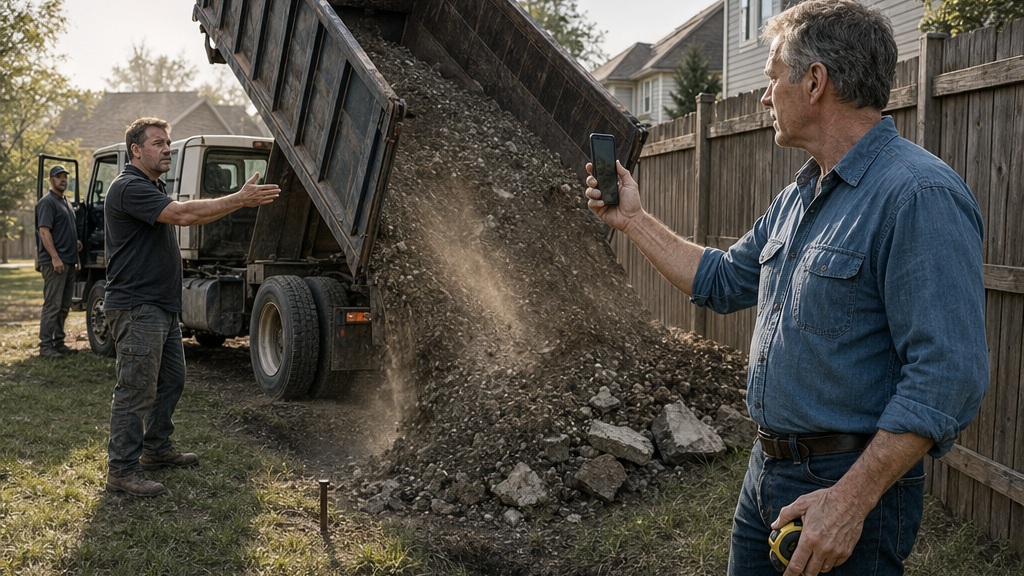
The dump bed was already climbing when Samuel Walker looked through the kitchen window.
For half a second, he thought the truck had stopped in the wrong driveway.
Then the rear wheels settled into the grass beyond his fence, the hydraulic cylinder extended another foot, and fourteen cubic yards of gray-brown fill began sliding toward the narrow strip of land along the east side of his property.
Samuel set his coffee down without drinking it.
Chunks of broken concrete struck the ground first. Gravel followed, then packed soil, spreading outward in a heavy fan. A cloud of pale dust lifted over the fence.
Raymond Nelson stood beside the truck with one hand raised toward the driver.
Samuel had told him no three days earlier.
Not maybe.
Not after he checked something.
No.
He crossed the kitchen, picked up his phone, and went outside.
The truck engine drowned out most of the morning sounds. Raymond saw Samuel approaching and lowered his hand, but he did not signal the driver to stop.
Samuel raised his phone and took three photographs: the truck, the license plate, and the widening pile.
“Raymond.”
Raymond squinted through the dust. “Morning.”
“Tell him to stop unloading.”
Raymond glanced at the truck as though the matter had already passed beyond him. “He’s nearly done.”
“That isn’t what I said.”
The last third of the load slid free.
Samuel felt his jaw tighten.
Raymond had asked the previous Saturday whether he could stage material along the side strip for a landscaping job. He said his yard was full, commercial storage was costing him money, and he only needed the space temporarily.
Samuel had refused.
He had not argued. He had simply said the strip was not available.
Now Raymond stepped closer.
“It’s fill,” he said. “It’s not hazardous waste.”
“It’s on my property.”
Raymond gave a small, humorless laugh. “That strip has never really been yours alone.”
Samuel looked at him.
There it was.
Not an accident.
Not a driver misunderstanding an address.
Raymond had arrived with an argument already prepared.
Samuel walked toward the pile instead of answering.
The strip was roughly forty feet wide at its broadest point, narrower near the rear drainage swale. Most people looking at it saw nothing remarkable: grass, a fence, a slight depression where runoff moved after hard rain, and an open line that HOA maintenance crews occasionally crossed.
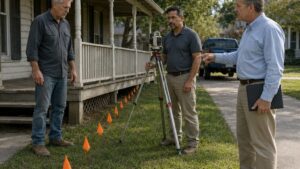
Samuel saw bearings, monument calls, grade transitions, and distances.
He had been a licensed land surveyor for more than thirty years.
He had surveyed this parcel himself three times.
The first was after inheriting the property from his uncle. The second came when the HOA replaced a section of drainage pipe. The third had been two years earlier, after Raymond asked whether the side strip was technically common property.
Samuel knew the answer down to fractions of a foot.
He stopped near the toe of the new pile.
Some of the loose gravel had rolled toward a patch of tall grass.
Samuel pushed it aside with his boot.
A rust-dark iron pin appeared at ground level.
Raymond folded his arms.
“That supposed to impress me?”
“No.”
Samuel crouched and cleared another inch of dirt around the pin with his fingers.
Then he took a measuring tape from the small tool pouch he kept in the garage and stretched it toward the nearest fence post.
Raymond watched him.
“What are you doing?”
“Documenting where your material stopped.”
“You’re making this bigger than it is.”
Samuel photographed the measurement.
“No. I’m making it measurable.”
Raymond shook his head. “You always do that.”
Samuel looked up.
“Do what?”
“Turn everything into lines and numbers like that settles the whole world.”
For the first time, there was something beneath Raymond’s irritation that sounded older than the morning.
Samuel stood.
“The line matters when you put fourteen yards of material across it.”
“The HOA has access through here.”
“For drainage maintenance.”
“So it’s not just yours.”
Samuel almost answered immediately.
That was his habit: identify the false statement, correct it, move on.
But Raymond was too confident.
Samuel knew Raymond well enough to recognize bluffing. This did not feel like bluffing.
“What exactly did they tell you?” Samuel asked.
Raymond’s expression shifted.
“Who?”
“The HOA.”
Raymond looked toward the truck driver, who was lowering the empty bed.
“I’ve seen the map.”
“What map?”
“The maintenance map. This whole corridor is shaded.”
Samuel said nothing.
Raymond took that silence as encouragement.
“You act like that little pin means nobody can step across the grass. Their crews have been through here for years.”
“Access is not ownership.”
“That’s your interpretation.”
“No,” Samuel said. “That’s what those words mean.”
The truck driver walked over, glancing from one man to the other.
“You want me to spread it or leave it piled?”
Samuel answered before Raymond could.
“Don’t move anything.”
Raymond’s face hardened.
“It’s my load.”
“It’s sitting on my land.”
The driver took one look at Samuel’s phone and stepped backward. “I’m staying out of that.”
He climbed into the cab.
Raymond followed the truck to the street, then turned.
“I’m calling Brenda.”
“Good.”
“You might want to check the HOA documents before you make threats.”
“I haven’t threatened you.”
“You will.”
Samuel watched him walk across the neighboring lawn.
The truck pulled away, leaving tire tracks pressed into the grass.
Only when the engine noise faded did Samuel look at the pile properly.
It was worse than he had thought from the kitchen.
Broken concrete sat mixed through the fill. The material extended close to the shallow drainage depression, and the weight had flattened a section where stormwater normally spread before entering the rear swale.
Samuel took photographs from four directions.
Then he photographed the iron pin again.
He could have called his attorney immediately.
He could have called county enforcement.
He could have walked to Raymond’s front door and demanded removal before sunset.
Instead, Samuel went inside and opened the file cabinet in his home office.
His uncle’s deed was in the second drawer.
The recorded plat sat behind it.
Samuel laid both on the desk.
The boundary was exactly where he remembered it.
He traced the eastern line with one finger until it reached the notation for the drainage easement.
There was nothing unusual about that either.
A private parcel could carry an easement. Ownership and limited access coexisted every day.
He was halfway through scanning the plat when his email chimed.
The sender was Brenda Moore, president of the homeowners association.
Samuel opened it.
Her message was brief and carefully worded.
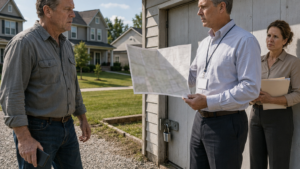
Raymond had reported a dispute involving what he described as an HOA drainage-access corridor. Brenda had reviewed the association’s maintenance records, and according to the map currently held by management, the strip appeared to fall at least partly inside an area used for association access.
Until the board reviewed the matter, she asked both homeowners to avoid “unilateral action.”
Samuel read the phrase twice.
Then he opened the attachment.
A faded map filled the screen.
And running directly through his deeded side yard was a broad shaded band labeled for drainage maintenance access.
Chapter 2: The Map That Made Raymond Confident
Samuel printed Brenda’s attachment and laid it beside the recorded plat.
The two maps seemed to contradict each other.
That was the problem.
One had legal bearings, monument references, recording information, and parcel lines.
The other had thick gray shading that swallowed nearly the entire side strip.
To anyone who did not work with land records, the HOA map looked simpler.
And simple drawings often won arguments before accurate ones had time to catch up.
Samuel placed a ruler along the eastern property line.
The recorded plat was clear. His parcel extended beyond the iron pin and included the grassy strip where Raymond’s fill now sat.
The drainage easement crossed the parcel, but it did not erase the parcel.
The HOA map treated those two ideas as if they were almost the same thing.
Samuel called Brenda.
She answered on the fourth ring.
“Samuel, I was expecting you.”
“I’m looking at the map.”
“I figured.”
“Where did it come from?”
There was a pause.
“Our management archive.”
“That isn’t what I asked.”
“I don’t know yet.”
Samuel leaned back in his chair.
On the desk, the old plat looked almost delicate beside the bold maintenance map.
“Is the board treating this as common property?”
“No.”
“Then tell Raymond to remove the fill.”
“Samuel—”
“Is the association claiming ownership?”
“No.”
“Is it claiming authority to let residents store material there?”
“No.”
“Then what exactly are we waiting for?”
Brenda sighed.
“We’re waiting because Raymond says the corridor has been used for access for years, and our own map supports part of what he’s saying.”
“Access for maintenance.”
“I understand your distinction.”
Samuel’s eyes stayed on the shaded band.
“Do you?”
“That’s not fair.”
Perhaps it wasn’t.
Brenda had volunteered for the board after retiring from a school administration job. She was not a surveyor, attorney, or engineer. Most weeks, her problems involved landscaping complaints, mailbox paint, roof replacements, and residents angry about visitor parking.
A dump truck sitting on top of a questionable maintenance corridor was different.
She continued, “If I order Raymond to remove everything today and we later learn the association has rights affecting the area, I’ve created another problem.”
“You already have another problem.”
“I know.”
Samuel rubbed his forehead.
This was where people expected him to become patient because he understood the paperwork.
Instead, knowing the paperwork made waiting harder.
“I’m coming to the management office,” he said.
“Samuel—”
“I’m not asking you to decide anything on the phone. I want to see the original file.”
An hour later he was sitting across from Brenda and Heather Campbell in a small conference room beside the HOA office.
Heather had several folders open.
She pushed the maintenance map toward Samuel.
“This is the best copy we have.”
Samuel examined the lower corner.
No recording stamp.
No surveyor’s seal.
No drawing number.
“What is it?” he asked.
Heather looked uncomfortable.
“It appears to be an internal maintenance exhibit.”
“Prepared by whom?”
“We don’t know.”
“When?”
“Probably during the drainage work fifteen or sixteen years ago.”
Samuel looked up.
“Probably?”
Heather’s expression tightened. “I’m telling you what the records show, not pretending they’re better than they are.”
That answer softened him slightly.
He turned the map around.
“This shaded band is not a property line.”
“We know that now,” Brenda said.
“Raymond doesn’t.”
“He says association crews have always crossed there.”
“They have.”
Brenda looked at him carefully.
“You never objected?”
“No. Because the recorded easement allows maintenance access.”
Heather tapped the paper.
“That’s the issue. To most homeowners, those facts look contradictory.”
“They aren’t.”
“To you.”
Samuel stopped.
Heather’s tone was not hostile. If anything, it was tired.
She continued, “You see a private parcel burdened by a limited easement. Raymond sees a strip that your uncle let him use, that HOA trucks crossed, and that this map shades as a maintenance corridor.”
Samuel’s attention sharpened.
“My uncle let him use it?”
Heather looked at Brenda.
Brenda frowned. “Raymond mentioned something about that this morning.”
Samuel said nothing.
“He said he used to stage trailers there,” Brenda added. “Years ago.”
“I know he parked there occasionally.”
“He says it was more than occasionally.”
“That doesn’t change title.”
“No,” Brenda said. “But it may explain why he thinks you changed the rules.”
Samuel disliked the phrase because part of him recognized it.
His uncle had been informal about many things.
A neighbor could borrow a trailer.
A mower could cut across the side field.
Someone could stack stone near the garage for a weekend.
Samuel had spent his career watching informal arrangements become expensive when memory outlasted clarity.
That was exactly why he had ended most of them after inheriting the house.
But ending them had meant saying no.
Not explaining.
Not discussing history.
Just no.
Heather pulled another sheet from the folder.
“Here’s the subdivision plat copy we have.”
Samuel moved it beside his own printout.
Same boundary.
Same easement notation.
He pointed.
“This controls the parcel geometry.”
Heather nodded.
“And the easement?”
“Needs its own recorded instrument.”
She flipped through the folder.
“That’s what I’m trying to find.”
Brenda folded her hands.
“Until then, I’m not issuing an HOA directive either way.”
Samuel looked at her.
“Raymond placed fourteen yards of material on my land after I told him not to.”
“I understand.”
“Then your neutrality favors the person who acted.”
Brenda’s jaw shifted.
“That may be true. But if I make a decision based on incomplete records because you’re understandably angry, then I’m doing the same thing you’re accusing Raymond of doing—acting first and sorting authority out later.”
Samuel had no quick answer to that.
He hated that she was partly right.
He gathered his papers.
As he stood, Heather said, “Wait.”
She had stopped on a page near the back of an old binder.
It was not the easement itself.
It was a maintenance invoice from years earlier.
At the bottom, beside a drainage repair notation, was a reference number.
Heather read it aloud.
Samuel recognized the format immediately.
A county recording reference.
She looked at him.
“This isn’t in our packet.”
“No,” Samuel said.
“But it tells us where the original is.”
Samuel took a photograph of the number.
For the first time that afternoon, the HOA map stopped being the most important document in the room.
Chapter 3: What His Uncle Had Allowed
The photograph was tucked behind a drainage-work invoice in the county file.
Samuel almost missed it.
Raymond’s utility trailer sat squarely on the disputed strip.
The image had been taken more than a decade earlier, before Samuel inherited the property. A pallet of retaining-wall block rested beside it. Beyond the trailer, half hidden by weeds, the same iron survey pin was visible near the edge of the frame.
Samuel stared at the picture longer than he needed to.
The county records clerk was waiting on the other side of the counter.
“Is that what you were looking for?”
“Part of it.”
She had brought him the recorded easement, associated drainage plans, and several archived exhibits tied to the reference Heather found.
Samuel had expected technical language.
He had not expected Raymond’s trailer.
He turned the photograph over.
A handwritten note identified temporary contractor access during drainage repairs.
That explained the county file.
It did not explain why Raymond remembered the strip as his to use.
Samuel did.
His uncle had been standing beside that trailer one afternoon, holding a garden hose while Raymond unloaded stone.
Samuel could suddenly hear the conversation.
He had been visiting after a field job.
Raymond had asked how long he could leave the trailer.
His uncle had laughed.
“Long as it’s temporary. I need that side open when the drainage people come through.”
Temporary.
Samuel remembered the word because his uncle had used it twice.
At the time, it had meant nothing.
Now it sat in the middle of the dispute like a missing stake.
He copied the photograph and carried the easement documents home.
In the garage, he spread everything across his workbench.
Old survey notes.
The recorded plat.
HOA maintenance map.
County drainage plan.
The photograph.
Samuel had spent decades resolving other people’s boundary problems. He knew what happened when two versions of history grew separately.
Usually, neither side began with a lie.
One side remembered permission.
The other remembered conditions.
Years passed.
Then someone acted as if memory had become a right.
Samuel looked toward Raymond’s property through the open garage door.
The pile was visible beyond the fence.
He thought about the first year after his uncle died.
Raymond had parked a trailer on the strip twice.
The third time, Samuel had walked over.
“You can’t keep using that area.”
Raymond had looked surprised.
“Your uncle never cared.”
“I do.”
“That it?”
“That’s it.”
Samuel had considered the conversation complete.
Now he saw the flaw in it.
He had never said the previous arrangement had been temporary.
Never explained the drainage easement.
Never shown Raymond the plat.
Never separated HOA access from private ownership.
He had known the legal answer so completely that he had treated explanation as unnecessary.
That did not excuse Tuesday morning.
Raymond had asked again only days before the dump, and Samuel had clearly refused.
But it changed the emotional geometry.
Samuel’s phone rang.
Raymond.
He let it ring twice before answering.
“What?”
“So Brenda told me you went digging through county records.”
“I did.”
“Find your magic paper?”
Samuel looked down at the photograph.
“I found a picture of your trailer.”
Silence.
Then Raymond said, “Exactly.”
“During drainage work.”
“My equipment was there plenty of times besides that.”
“I know.”
Another pause.
Raymond’s voice changed slightly. Less combative.
“Then why are you acting like I made all this up?”
“I never said you made up the old arrangement.”
“You sure acted like it.”
Samuel ran a finger along the edge of the photograph.
“My uncle let you use the strip.”
“Thank you.”
“Temporarily.”
Raymond exhaled.
“There it is.”
“What?”
“That word you people love.”
“You people?”
“Surveyors. Lawyers. HOA boards. Everybody who can find one word on a page and make ten years of real life disappear.”
Samuel felt the old instinct rise: correct the statement, end the conversation.
Instead he said, “I should have explained it when I took over the property.”
Raymond went quiet.
Samuel surprised himself almost as much as he surprised Raymond.
“That doesn’t mean you had permission Tuesday,” Samuel added.
“No.”
“You asked. I said no.”
“I thought you were being difficult.”
“That is not permission.”
“I know what it is.”
“Do you?”
Raymond’s voice hardened again.
“I had a crew sitting idle, Samuel. My storage yard is packed. The commercial lot raised my monthly rate again. I needed somewhere for one load for a week, maybe two. Your uncle would’ve said yes.”
“My uncle isn’t the owner anymore.”
The words landed harder than Samuel intended.
Raymond did not respond for several seconds.
Finally he said, “Yeah. I noticed.”
The call ended soon after.
Samuel stayed at the workbench.
He felt no triumph.
Only the uncomfortable recognition that Raymond’s resentment had roots, even if Raymond had chosen the worst possible way to express it.
Samuel turned back to the easement.
The recorded document was older than the HOA’s maintenance map.
Unlike the broad shaded corridor, its language was precise.
It granted the association and authorized contractors access for inspection, repair, cleaning, replacement, and maintenance of drainage infrastructure.
Nothing about storage.
Nothing about staging.
Nothing about general neighborhood use.
Then Samuel reached the restriction section.
He read it once.
Then again more slowly.
No owner, occupant, contractor, or other party was permitted to place fill, materially alter grade, or obstruct designed drainage flow within the protected area without prior authorization.
Samuel looked toward the pile outside.
The toe of Raymond’s fill extended into the mapped drainage zone.
Not merely across the private boundary.
Into the protected corridor itself.
He pulled out the photographs from Tuesday morning and enlarged one on his phone.
The iron pin was visible.
So was the edge of the pile.
Samuel measured against the drainage plan.
Then he stopped.
The dispute had just changed again.
It was no longer only about who owned the grass beneath Raymond’s load.
The load itself might violate the very easement Raymond had been using to justify putting it there.
Chapter 4: The Easement Was Never a Parking Lot
The county stormwater inspector arrived before Samuel had finished his first cup of coffee.
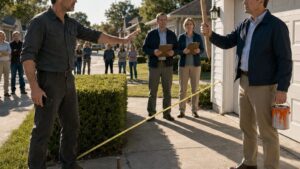
A white utility pickup stopped beside the curb at eight twenty-six Thursday morning, and the inspector stepped out carrying a tablet, a folding measuring rod, and the expression of someone who had already seen too many disputes become drainage problems.
Raymond came outside almost immediately.
Samuel was already standing beside the pile.
The iron survey pin remained exposed where he had cleared the grass two days earlier. He had placed no flag beside it, no paint, nothing theatrical. The rust-dark top was enough.
The inspector walked the edge of the fill without speaking.
She photographed the tire tracks, the concrete chunks, the drainage depression, and the place where the pile feathered into the low ground.
Raymond stayed near his driveway.
Finally he called, “This is really necessary?”
The inspector looked up.
“You asked the association about the corridor?”
“I asked them whether this is HOA access.”
“That isn’t what I asked.”
Raymond’s mouth tightened.
Samuel said nothing.
The inspector opened the recorded easement on her tablet.
“You placed this material?”
“My contractor did.”
“At your direction?”
Raymond hesitated.
“Yes.”
“Did you get approval to alter grade inside the drainage easement?”
“I didn’t alter anything. It’s a temporary stockpile.”
The inspector extended the measuring rod toward the toe of the pile.
“Weight is still weight. Material is still material. And runoff doesn’t care whether you intend to move it next week.”
She walked downhill several yards.
Samuel followed.
The grass there bent into a shallow, almost invisible channel. During ordinary rain it carried little more than sheet flow. In a hard storm, Samuel knew, water spread through the depression before entering the rear swale.
The inspector pointed toward a compressed section beneath the new fill.
“This was designed to stay lower.”
Raymond came closer.
“That dirt is twelve feet from the pipe.”
“The easement isn’t only the pipe.”
Samuel saw Raymond glance at him.
That had been the misunderstanding from the beginning.
Raymond thought in terms of objects: fence, pipe, trailer, pile.
Samuel thought in legal descriptions and surfaces.
The inspector thought in water.
She took several measurements, then asked Samuel to show her the boundary monument.
He led her to the iron pin.
She crouched.
“That original?”
“Matches the recorded plat and my prior field work.”
Raymond gave a short laugh.
“Of course he says that.”
The inspector straightened. “Are you disputing the location?”
“I’m saying he’s treating one pin like it answers everything.”
“It answers the boundary question better than the HOA maintenance sketch does.”
Raymond looked toward Samuel.
Samuel felt the old satisfaction of being vindicated rise in him.
He checked it.
The inspector continued, “The recorded easement answers the drainage question. Those are two separate things.”
That sentence mattered more than Samuel expected.
Two separate things.
For days, the dispute had been tangled because everyone kept trying to make one fact settle all the others.
The pin proved ownership.
The easement granted limited access.
The old permission explained Raymond’s expectations.
None erased the rest.
By six that evening, those distinctions were spread across the folding tables in the HOA clubhouse.
Brenda sat at the center. Heather had assembled copies of the recorded plat, the original easement, the old maintenance sketch, and a revised overlay based on county records.
Two neighboring homeowners sat along the back wall.
Raymond sat across from Samuel.
Brenda opened with less confidence than usual.
“We need to correct something before we discuss the material itself.”
She held up the old HOA map.
“This document has been used for years as an internal maintenance reference. It is not a recorded property map, and the shading on it is broader than the recorded easement.”
Heather turned the revised overlay toward the room.
A narrow parcel line ran vertically through the page. The drainage easement crossed it in a different pattern.
Samuel’s iron pin was marked at one corner.
The pile was marked beside it.
For the first time, all three elements existed on the same drawing.
Raymond leaned forward.
“So the HOA still has access.”
“Yes,” Brenda said.
“Across his property.”
“For drainage purposes.”
“Which is what I’ve been saying.”
Heather shook her head. “No. You’ve been saying access makes the area shared.”
Raymond looked at her.
“That is not the same thing.”
Samuel could have said it.
He had said it repeatedly.
Hearing Heather say it changed the room.
Raymond tapped the map.
“His uncle let me keep trailers there.”
Samuel spoke before anyone else could.
“He did.”
Raymond looked at him sharply.
Samuel continued, “I found the old drainage photograph. Your trailer is in it.”
One of the homeowners in the back shifted.
Raymond sat back.
“There. Finally.”
“But the permission was temporary.”
“According to you.”
“According to what he told both of us.”
Raymond’s face changed.
Not defeat.
Recognition.
Samuel saw it happen and knew Raymond remembered the same conversation.
“Your uncle didn’t care,” Raymond said.
“He cared about keeping the drainage route open.”
“He never measured every tire.”
“No.”
“He never sent me legal language.”
“No.”
“And when you took over, you just walked across one afternoon and told me I couldn’t use it anymore.”
Samuel felt everyone waiting.
He could have defended himself.
He could have said ownership had changed, permission had changed, end of discussion.
Instead he said, “I should have explained why.”
Raymond blinked.
The room became quieter.
Samuel folded his hands.
“I knew what the deed said. I knew what the easement said. I assumed telling you no was enough.”
“It should have been,” Brenda said carefully.
Samuel looked at her.
“For Tuesday morning, yes. He asked. I said no. That part isn’t ambiguous.”
Raymond stared at the table.
Samuel continued, “But the history was more complicated than I admitted.”
For a moment, some of the fight went out of Raymond.
Then Brenda slid the inspector’s preliminary notice across the table.
It came back.
Raymond read the first page.
“What is this?”
Heather answered.
“The county’s finding.”
Raymond scanned further.
His jaw tightened.
The language was restrained but unmistakable: unauthorized placement of fill within a protected drainage corridor, potential alteration of designed drainage flow, corrective action required.
Raymond pushed the paper away.
“You called the county before the board even met.”
Samuel met his eyes.
“Yes.”
“So much for explaining.”
“You had already dumped the load.”
“It could’ve been moved.”
“It still can.”
“Then give me time.”
Brenda leaned forward.
“That is what everyone is trying to do.”
Raymond looked from her to Samuel.
“How much?”
Samuel said, “Remove it voluntarily and restore the grade.”
“And then?”
“That depends on what the county requires.”
“No. I mean between us.”
Samuel understood.
Raymond wanted certainty that removal would end the property fight.
“I’m not asking you to erase ten years of using the strip,” Samuel said. “I’m asking you to stop treating old permission like permanent permission.”
Raymond’s mouth flattened.
“You want me to admit I was wrong.”
“I want the fill gone.”
“That’s not the same thing.”
“No.”
Raymond stood.
Brenda said his name.
He picked up the county notice.
“I’m not moving one yard until somebody gives me a formal order.”
Samuel looked at him.
The admission in the sentence was almost worse than the refusal.
Raymond no longer argued that the pile was obviously allowed.
He was daring the process to force him.
Brenda closed her eyes briefly.
Heather gathered the maps.
Samuel watched Raymond leave the clubhouse carrying the notice folded in half.
The technical argument was finished.
The personal one was not.
And now, because Raymond had refused the easy exit, Samuel had to decide whether he was willing to push the machinery of enforcement all the way to the end.
Chapter 5: Ten Business Days Became Eleven
Day one began with a certified envelope taped inside Samuel’s storm door.
The county compliance notice had been delivered to both properties before nine in the morning.
Samuel opened his copy at the kitchen table.
Ten business days.
Remove the unauthorized fill.
Restore the affected drainage grade.
Document completion.
Failure to comply could result in corrective work being performed by an authorized contractor, with reasonable costs assigned to the responsible party under the applicable enforcement process.
There were also potential daily penalties.
Samuel read that section twice, then folded the notice before the numbers could become satisfying.
Across the side yard, Raymond’s garage door was open.
Two landscaping trailers sat in the driveway.
By noon, one was gone.
The next morning, the second disappeared.
Raymond moved pallets of stone, bags of soil amendment, and a compact loader from the rear of his lot.
He moved everything except the pile.
The fill stayed where it had landed.
The iron pin remained beside it, visible now because Samuel kept the grass trimmed around it.
On Day Three, Brenda called.
“Has he started removal?”
“No.”
“He told management he’s arranging equipment.”
Samuel looked through the window.
Raymond was washing a work truck.
“He owns equipment.”
“Not something large enough for that volume, apparently.”
“He owns a landscaping company.”
“I’m just telling you what he told us.”
Samuel said nothing.
Brenda lowered her voice.
“The board is getting complaints.”
“About the pile?”
“About the dispute.”
Samuel almost laughed.
“That’s efficient.”
“People don’t like uncertainty.”
“Neither does water.”
“Samuel.”
He softened.
“I know.”
By Day Five, the county had confirmed that if Raymond failed to comply, Samuel could use a licensed excavation contractor approved through the enforcement process and seek documented reimbursement.
Samuel requested two estimates.
One came back at forty-six hundred dollars.
The second was forty-two hundred, including removal, disposal, minor regrading, and reseeding.
He chose neither yet.
Instead, he walked next door.
Raymond was repairing a blower on his workbench.
He looked up when Samuel appeared at the garage opening.
“If you’re here to count days, I’ve got a calendar.”
“I got two removal estimates.”
Raymond set down a wrench.
“Congratulations.”
“One contractor can do it for forty-two hundred.”
Raymond gave him a flat look.
“I could do it for half that.”
“Then do it.”
“I’m busy.”
“You have five business days left.”
“I know.”
Samuel held out the estimate.
Raymond did not take it.
“The contractor said if you provide your skid steer and one operator, he’ll reduce the hauling charge.”
That got Raymond’s attention.
Samuel continued, “You use your machine. He provides the truck and disposal. We document the restored grade. Done.”
Raymond wiped his hands on a rag.
“So now you’re doing me favors.”
“No.”
“Sounds like it.”
“I’m trying to keep four thousand dollars from becoming the most expensive pile of dirt either of us has ever looked at.”
Raymond stared at him.
For a moment Samuel thought he might accept.
Then Raymond said, “And afterward you tell everyone I finally admitted that was your land.”
Samuel exhaled.
“It is my land.”
“There. That’s what this is really about.”
“What do you think it’s about?”
“You winning.”
Samuel felt heat move up his neck.
He had spent five days telling himself not to make it personal, and Raymond had managed to touch the exact place where it already was.
“No,” Samuel said. “If I wanted to win, I’d stop offering ways for you to fix it cheaper.”
Raymond tossed the rag onto the bench.
“You think because you found the right document, everything I remember is worthless.”
“I told the board your memory was real.”
“You told them my permission was temporary.”
“It was.”
“According to a dead man.”
Samuel took a breath.
“He told me that while you were standing there.”
Raymond looked away.
That was answer enough.
Samuel lowered the estimate.
“You know he did.”
Raymond said nothing.
“You also know I told you no before the truck came.”
Still nothing.
Samuel felt his patience settle into something harder.
Not anger.
Decision.
“I’m leaving the estimate here.”
He placed it on a storage cabinet near the garage door.
“If you want to use the shared-cost option, call me by tomorrow afternoon.”
Raymond did not answer.
Samuel walked home.
The next day passed without a call.
On Day Seven, Raymond’s wife’s car left early, and his landscaping crew rolled out before sunrise. By six that evening, the pile had not moved.
On Day Eight, rain was forecast.
Samuel covered nothing.
Neither did Raymond.
A brief afternoon shower darkened the fill and sent a narrow ribbon of muddy water toward the drainage depression.
Samuel photographed it.
The runoff did not flood anything, but the image made the problem visible in a way maps had not.
Brown water curved around a concrete chunk before finding the low channel.
He sent the photograph to the county inspector.
Her reply came an hour later.
Maintain documentation. No further disturbance pending compliance.
Raymond crossed the yards after dark.
He stopped near the fence.
“You sent them a picture.”
“Yes.”
“It rained for twenty minutes.”
“Yes.”
“You make everything into evidence.”
Samuel looked at him.
“Because you keep making evidence.”
Raymond’s face tightened.
For a second Samuel regretted the line.
Then Raymond glanced at the pile.
“I’ve got payroll Friday.”
Samuel waited.
“Commercial storage raised me almost nine hundred a month,” Raymond said. “Two customers are late. One crew truck needs a transmission.”
It was the first time Raymond had stated the pressure without turning it into an argument.
Samuel leaned against the fence post.
“You should have told me that Saturday.”
“Would you have said yes?”
“No.”
Raymond laughed once.
“Exactly.”
“But I might have helped you find another place.”
“I didn’t want help.”
“I noticed.”
Raymond looked toward his garage.
“Your uncle didn’t make me explain every time I needed something.”
“No.”
“He just said yes.”
“Until he didn’t.”
Raymond went still.
Samuel did not elaborate.
By Day Ten, nothing had moved.
At four in the afternoon, Samuel called the excavation contractor and scheduled work for the next morning, subject to the county’s authorization.
At five thirty, the authorization arrived.
At six, Brenda called one last time.
“Do you want me to try Raymond again?”
Samuel looked through the window.
Raymond was home.
The pile sat between them.
“No.”
“Are you sure?”
“I’ve already tried.”
He slept badly.
At seven twelve the next morning, a diesel engine turned off the subdivision road.
Samuel was standing in his driveway before the machine came into view.
A low trailer followed a dump truck around the corner.
Strapped to the trailer was a compact excavator.
Day Eleven had arrived.
Chapter 6: Four Thousand Two Hundred Dollars Later
The excavator bucket took its first bite from the exact place Raymond had ordered the truck to unload.
Steel teeth sank into the packed fill.
Gravel rattled against metal.
A broken slab of concrete rolled into the bucket with a dull knock.
Samuel stood several yards away beside the contractor, holding the county authorization and watching the operator work carefully around the drainage depression.
The iron survey pin was less than six feet from the edge of the excavation area.
Samuel had marked it with a temporary wooden stake that morning.
“Don’t touch that,” he had told the operator.
The contractor nodded.
“We’ll work away from it.”
By eight fifteen, the first dump truck was half full.
By eight twenty-three, Raymond came across the yard.
He was not dressed for work.
No company shirt. No boots.
Just jeans and an old sweatshirt.
“Stop.”
The operator could not hear him through the cab.
Raymond raised both hands.
“Samuel, stop them.”
Samuel walked toward him.
“What changed?”
“You made your point.”
“The point was removal.”
“I’ll do it.”
“When?”
“Today.”
“You had ten business days.”
“I know what the paper said.”
“Then why are we having this conversation on eleven?”
Raymond looked toward the excavator.
Another bucket rose.
“Because forty-two hundred dollars is ridiculous.”
“You were offered a cheaper option.”
“I’m offering now.”
Samuel shook his head.
“The contractor is here. The county authorized it. He’s already started.”
Raymond’s voice lowered.
“Call him off.”
Samuel saw something he had not seen before.
Not entitlement.
Fear.
Four thousand two hundred dollars was not an abstract penalty to Raymond. It was payroll, a repair, rent, several weeks of margin on a small operation.
Samuel knew that.
He also knew he had given Raymond chances.
“If I stop him now, I still owe mobilization, hauling, and the work already done.”
“I’ll pay that.”
“And then what? You move half the pile and argue about the grade for another week?”
Raymond looked down.
That silence answered more than his words had.
Samuel stepped closer.
“Why didn’t you take the contractor-sharing option?”
Raymond’s jaw worked.
“Because I didn’t want to use my machine to prove you were right.”
Samuel waited.
Raymond looked at him then.
There was no performance left in his face.
“I knew you’d said no.”
The words were quiet.
Samuel felt the entire dispute narrow around them.
Raymond continued.
“I knew it. I just thought you didn’t have the right to change everything because your name replaced your uncle’s on a deed.”
Samuel said nothing.
“I figured the HOA access gave me enough cover that you’d back down. Or Brenda would make us split the difference.”
“You knew permission had ended.”
“Yes.”
The excavator engine idled behind them.
Samuel looked toward the pile.
For days he had wanted that admission.
Now that he had it, it gave him less satisfaction than he expected.
“You should’ve said that at the meeting.”
Raymond gave a tired laugh.
“And stand there telling everybody I knew better?”
“You stood there telling everybody I didn’t.”
Raymond looked away.
“That was easier.”
The honesty landed heavily.
Samuel nodded toward the excavator.
“This is easier too.”
Raymond looked back.
“What is?”
“Letting the machine finish instead of deciding whether we trust each other to finish it ourselves.”
Raymond had no answer.
The work continued.
By early afternoon, the pile was gone.
The contractor scraped the compressed ground, restored the shallow grade, removed the broken concrete, and spread seed over the disturbed area.
When the machine backed away, the iron pin was still there.
Exposed.
Undamaged.
Almost absurdly small compared with everything that had happened around it.
The final invoice was exactly forty-two hundred dollars.
Samuel carried a copy to the HOA meeting three nights later.
Raymond was already seated when he arrived.
Brenda had placed the county closure notice beside the revised map.
Heather had another document in front of her.
Brenda began.
“The drainage condition has been restored. The county has closed the corrective portion pending final vegetation establishment.”
She looked at Raymond.
“The documented contractor cost is reimbursable under the compliance process.”
Raymond nodded once.
No argument.
Brenda continued, “There is also the matter of additional HOA penalties.”
Samuel looked at her.
“What additional penalties?”
Heather answered.
“Unauthorized use of an easement area, interference with drainage infrastructure, failure to comply after notice, and contractor activity without prior association approval.”
Raymond’s face tightened.
“How much?”
Brenda slid a sheet forward.
Samuel did not look at the total.
Instead he looked at Brenda.
“Are those required?”
“No.”
“County penalties?”
“Separate. None have been assessed yet because corrective work is complete.”
“Then I don’t want the HOA fines.”
Raymond turned toward him.
Brenda frowned slightly.
“Samuel, this isn’t entirely your decision.”
“I know. I’m telling you what I’m asking for.”
Heather folded her arms.
“The board also has to consider precedent.”
“Then correct the map.”
“We are.”
“Create a written access procedure.”
“We’re drafting one.”
“Make sure nobody uses drainage access as an excuse for storage again.”
Brenda watched him.
“And Raymond?”
Samuel looked across the table.
Raymond’s expression was guarded.
“He pays the documented restoration cost.”
“That’s all?”
“That restores what he changed.”
Heather said, “He knowingly ignored your refusal.”
“Yes.”
“Then why not enforce the rest?”
Samuel glanced at the revised map.
For thirty years, lines had been his profession because they were cleaner than people.
This one had not been clean.
Raymond had crossed it knowingly.
But Samuel had also allowed years of ambiguity to sit untouched because the deed made him comfortable.
Punishing Raymond beyond restoration would not make Samuel’s silence disappear.
“I don’t need him punished for every bad decision he made after the first one,” Samuel said. “I need the property restored, the cost covered, and the rules clear enough that this doesn’t happen again.”
Raymond lowered his eyes.
Brenda leaned back.
The room remained quiet for several seconds.
Then she nodded.
“I can support waiving discretionary HOA fines if reimbursement is made and there are no further violations.”
Heather considered it.
“So can I.”
Raymond looked at Samuel.
“You’re still making me pay forty-two hundred.”
“Yes.”
A faint, exhausted smile touched Raymond’s face.
“Just checking.”
Samuel almost smiled back.
Almost.
Brenda gathered the papers.
“Then that’s what we’ll document.”
The meeting moved on to the corrected maintenance map, emergency access, and procedures for future work inside the drainage corridor.
When it ended, Raymond stayed seated.
Samuel was halfway to the door when Raymond spoke.
“I didn’t think you’d drop the fines.”
Samuel turned.
“I didn’t drop the bill.”
“I know.”
Raymond rubbed his hands together.
“Forty-two hundred hurts.”
“It’s supposed to cover the work, not hurt.”
Raymond nodded slowly.
“That may be the difference between us.”
Samuel thought about that.
Then he said, “Maybe.”
Outside, the clubhouse parking lot was nearly empty.
Their houses stood less than a hundred yards apart.
The boundary between them had never moved.
But almost everything else around it had.
Samuel knew Raymond still owed the money.
He knew a corrected HOA map would not repair trust.
And he knew there would be another conversation, because living beside someone made permanent victory impossible.
Before leaving, Samuel turned back toward Brenda.
“One more thing.”
She looked up.
“If the reimbursement comes through, leave the punitive fines off.”
“You’re sure?”
“Yes.”
Samuel opened the door.
“I want the cost of fixing the ground.”
He glanced once toward Raymond.
“Not the cost of making him lose.”
Chapter 7: The Pin Stayed Where Everyone Could See It
Raymond did not mail the reimbursement check.
Three weeks after the excavator left, he walked across the strip just after seven in the morning and placed the envelope on Samuel’s garage workbench.
Samuel was sharpening a mower blade.
The envelope landed beside the vise with a soft slap.
“Forty-two hundred,” Raymond said.
Samuel switched off the grinder.
For a few seconds, neither man touched the envelope.
The grass outside had begun filling back in where the pile had been. Pale green shoots covered the disturbed soil, although the restored drainage depression was still obvious if someone knew where to look.
The iron survey pin remained exposed near the edge.
Raymond nodded toward the envelope.
“You going to count it?”
“It’s a check.”
“You know what I mean.”
Samuel wiped his hands on a shop towel and opened it.
The amount was correct.
He folded the check once and slipped it back into the envelope.
“Thank you.”
Raymond gave him a tired look. “Don’t make it sound like I bought you breakfast.”
Samuel almost answered sharply.
Instead he set the envelope down.
“You came over instead of mailing it.”
“Figured I should.”
That was as close to an invitation as either man was likely to offer.
Samuel leaned against the workbench.
Raymond stared past him at the wall of surveying tools: old range poles, a tripod, cases for equipment Samuel no longer used every week.
“My storage problem didn’t disappear,” Raymond said.
“I know.”
“I moved two trailers to a contractor’s yard across town.”
“How much?”
“More than I wanted.”
Samuel waited.
Raymond rubbed his thumb along the edge of the workbench.
“I wasn’t lying about the business.”
“I didn’t think you were.”
“You acted like I was using it as an excuse.”
“I thought you were using it as a reason to ignore my answer.”
Raymond considered that.
“Maybe I was.”
It was the first admission that did not come under pressure from a board, inspector, deadline, or excavator.
Samuel said nothing.
Raymond looked toward the open garage door.
“My biggest account cut its maintenance contract in the spring. Then the commercial yard raised rates. I kept thinking I’d catch up after summer installs started.”
“But you didn’t.”
“No.”
A truck passed on the subdivision road.
Raymond waited until the sound faded.
“When your uncle was here, if I needed to leave something for a few days, I asked him. Most times he said yes. Sometimes I didn’t even ask until afterward.”
Samuel remembered that too.
His uncle had believed neighborliness worked best with very few written rules.
Most of the time, it had.
Until it had not.
Raymond continued, “When you told me I couldn’t use the strip anymore, I figured you were making a point.”
“I was.”
“I know that now.”
Samuel looked at him.
“I could have handled it better.”
Raymond’s eyebrows lifted slightly.
Samuel went on before pride could stop him.
“I should have told you the old arrangement ended because I wanted the drainage area kept clear. I should have shown you where the easement ran.”
“You shouldn’t have had to give me a survey lesson to say no.”
“No.”
Raymond glanced down.
“But it might have kept me from deciding you were just being difficult.”
Samuel smiled faintly. “I was being difficult.”
“That too.”
It was not reconciliation.
But for the first time in weeks, the silence between them did not feel like another argument waiting for its turn.
That evening, the HOA board held its follow-up meeting.
Heather had replaced the old maintenance map with a corrected exhibit based on the recorded plat and easement.
The broad gray band was gone.
In its place were two distinct sets of lines: Samuel’s private parcel boundary and the limited drainage-access corridor crossing it.
Brenda held up the revised procedure.
“From now on, association access across privately owned easement areas is limited to inspection, maintenance, repair, and emergencies consistent with the recorded instruments.”
Raymond sat two chairs away from Samuel.
“No resident storage?” he asked.
Heather gave him a look.
“No resident storage.”
A couple of people smiled, but nobody laughed.
Samuel was grateful for that.
Brenda continued.
“For scheduled maintenance, management will provide notice to the property owner whenever practicable. Emergency access remains available if immediate drainage work is necessary.”
Samuel read the procedure.
It was ordinary.
Clear.
Almost boring.
That made it valuable.
No one would need to rely on a shaded maintenance sketch and ten-year-old memories the next time a crew needed to cross the strip.
Heather slid a copy toward Samuel.
“You were right about the map.”
Samuel looked at her.
“And you were right that I was treating the problem as simpler than it was.”
Heather nodded once.
Brenda looked between them.
“That may be the closest thing to a productive HOA meeting we’ve had this year.”
When the meeting ended, Raymond caught Samuel near the door.
“One question.”
Samuel waited.
“If a storm knocks something into the swale and the HOA has to get equipment through there at two in the morning, nobody needs your written permission first?”
“No.”
“And if they need to park a machine there for repairs?”
“For the repair itself, yes.”
Raymond pointed at the procedure.
“But not three weeks because somebody doesn’t want to pay for storage.”
Samuel looked at him.
“Correct.”
Raymond nodded.
“Just making sure.”
The next Saturday, Samuel mowed the side strip.
When he reached the iron survey pin, he slowed.
For years, he had cut the grass close enough that the metal nearly disappeared by midsummer. The monument did not need to be visible to remain legally meaningful. Samuel knew exactly where it was.
That had once seemed sufficient.
He stopped the mower.
The pin sat in a small circle of bare earth, rust-dark and unimpressive.
He thought about covering it again.
Instead, he fetched a hand trimmer and cleared the grass around it.
Not enough to turn it into a warning.
Just enough that someone walking the strip could see it.
Raymond was unloading equipment next door.
After a few minutes, he crossed the yard carrying the folded HOA access procedure.
Samuel shut off the mower.
Raymond looked down at the pin.
“That thing was there the whole time.”
“Yes.”
“I must’ve walked past it a thousand times.”
“Probably.”
Raymond crouched, studying it.
“No fence marker?”
“Survey monument.”
“Difference?”
Samuel almost gave him the professional answer.
Monuments, calls, bearings, hierarchy of evidence.
Instead he said, “A fence can be in the wrong place.”
Raymond stood.
“And that?”
“That tells you where somebody measured the line.”
Raymond looked across the grass toward his property.
“So the line isn’t the easement.”
“No.”
“And the easement doesn’t make the land common.”
“No.”
“But the HOA can still cross when the drainage system needs work.”
“Yes.”
Raymond held up the folded procedure.
“Would’ve been useful ten years ago.”
Samuel looked at him.
“Yes.”
Neither man tried to decide whose responsibility that had been.
Raymond handed him the paper.
“I made a copy.”
Samuel took it.
Raymond started back toward his driveway, then stopped.
“For what it’s worth, I really did think you’d back down.”
Samuel smiled.
“I know.”
“Because of the HOA map.”
“Partly.”
Raymond looked embarrassed.
“And because I thought you wouldn’t want the trouble.”
“That too.”
Raymond nodded toward the survey pin.
“You ever think about putting a post there?”
Samuel shook his head.
“No need.”
Raymond studied the small piece of iron one last time.
Then he walked home.
Samuel restarted the mower.
He made another pass along the restored drainage depression, keeping the wheels away from the soft new grass.
When he reached the pin again, he curved around it instead of mowing over it.
The boundary had never required a monument tall enough to intimidate anyone.
It had required people to understand what the monument meant.
Samuel left the pin uncovered.
Beside it, tucked temporarily under a small stone while he finished mowing, lay Raymond’s copy of the new access procedure.
One marked the ownership line.
The other explained when that line could be crossed.
For the first time since Samuel inherited the property, neither fact depended on silence.
The story has ended.