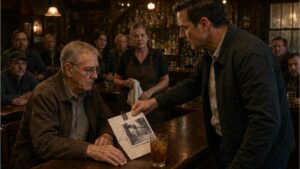
The HOA Blocked His Work Gate Overnight—Then an Old Access File Changed the Entire Dispute
Chapter 1: The Barrier Was Already Across His Gate
Michael Carter knew something was wrong before he turned into his driveway.
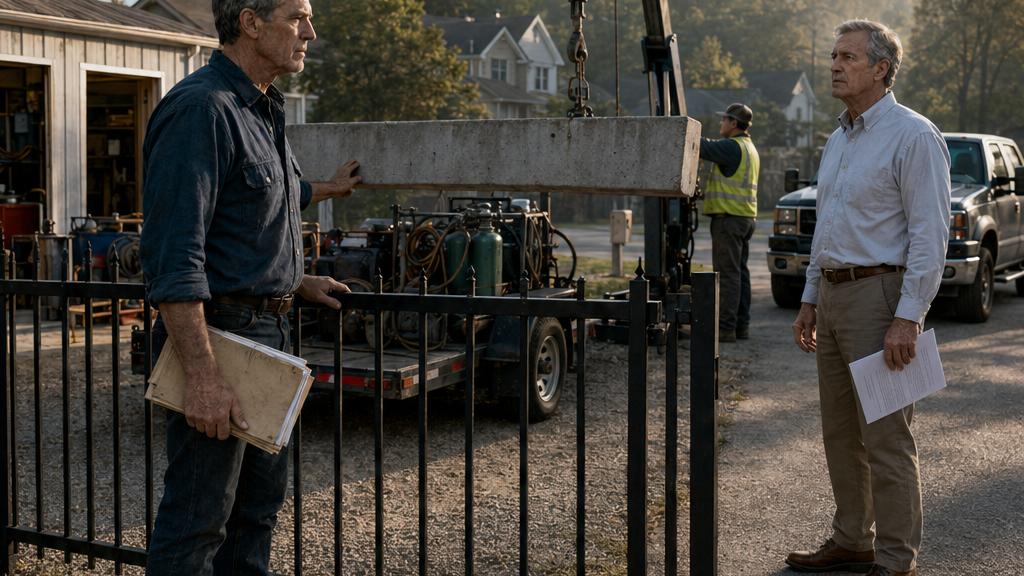
The black steel gate beside his shop was open, but a gray concrete barrier sat squarely across the entrance, close enough that the gate could not swing shut and wide enough that his truck could not pass.
His welding trailer was trapped behind it.
Michael slowed the work truck until the tires barely rolled over the gravel. A contractor in a reflective vest stood beside a small flatbed, winding a chain back onto a hydraulic arm. Richard Hall was ten feet away with a folder tucked under one arm.
Michael stopped the engine.
For a few seconds, nobody spoke.
Then Richard walked toward him.
“You can still use your front drive.”
Michael looked past him at the barrier.
The front drive was wide enough for a pickup. It was not designed for backing a twenty-foot equipment trailer past the corner of the house and between the retaining wall and a row of maples.
“What is that?” Michael asked.
Richard glanced over his shoulder as though the answer were obvious.
“Access restriction.”
Michael got out.
The contractor avoided looking at him.
The neighborhood had grown around Michael’s property in layers. His house sat on one side of the lot, the metal-sided shop behind it, and the side gate opened onto a short stretch of association road near the edge of the subdivision. Michael had used that opening for years because a truck and trailer could enter, turn behind the shop, and leave without backing through the front yard.
Now somebody had decided it was no longer an entrance.
Richard opened the folder.
“The board issued notice last month. Commercial vehicle access through this gate is no longer permitted under the updated traffic rule.”
Michael looked at the concrete again.
“You sent a notice.”
“Several.”
“You didn’t send one saying you were putting a barrier across my gate this morning.”
Richard’s jaw tightened.
“The compliance period expired.”
Michael could feel the old response coming—the one that had cost him more than once. Say nothing. Let the other man finish. Get back to work. Deal with it when there was something worth dealing with.
Instead, he took out his phone.
Richard stopped talking while Michael photographed the barrier from the road, then from inside the property, then from an angle showing the trailer behind it.
“What are you doing?”
“Documenting it.”
Richard gave a small, impatient breath.
“You’ve had plenty of time to respond.”
Michael crouched near the gatepost and photographed the gap between the concrete block and the edge of the pavement.
Richard held out a white sheet.
At the top was the association’s management letterhead. Below that, in bold, was a violation notice.
Michael read only enough to see the amount.
Two hundred fifty dollars.
He looked up.
“That’s today?”
“That’s the initial assessment.”
“And tomorrow?”
“If the violation continues, additional fines can accumulate.”
Michael almost laughed, but there was nothing funny in it.
“You blocked the entrance, and now you’re fining me for the entrance.”
“We’re fining you for continued unauthorized commercial use.”
“My trailer is already inside.”
“That isn’t the board’s responsibility.”
The contractor shifted his weight.
Michael looked at him, then back at Richard.
“Move it long enough for me to get the trailer out.”
Richard shook his head.
“The board’s position is that use of this access has ended.”
Michael’s hand tightened around the paper.
Across the street, one of the neighbors stood beside a mailbox pretending to sort through envelopes. Another curtain moved in a front window.
Michael had lived there long enough to recognize what was happening. By lunchtime, half the subdivision would know that the board had finally done something about his gate.
He folded the notice once.
“Did the board check the recorded plat?”
Richard’s expression changed, but only slightly.
“The current rules are clear.”
“That wasn’t my question.”
“We reviewed the governing documents.”
“The recorded plat.”
Richard looked at him for a beat.
“If you believe you have some exception, you can submit it through the normal process.”
Michael slipped the notice into his shirt pocket.
“Okay.”
That answer seemed to unsettle Richard more than an argument would have.
“You understand the barrier stays.”
“I heard you.”
Michael turned away.
Behind him, Richard said, “Michael, moving it yourself would be considered interference with association enforcement.”
Michael kept walking.
Inside the shop, the trapped trailer sat loaded for an afternoon job: welding leads, generator, steel brackets, two oxygen cylinders secured upright, and a portable vise bolted to the front rack.
He had a repair scheduled at a farm equipment yard twenty miles away.
He stood beside the trailer and measured the problem in his head.
He could unload the smaller equipment into the pickup and make the service call without the trailer. He could postpone the heavier fabrication until Tuesday. What he could not do was keep operating that way every day.
He walked to the front of the property.
The front drive looked even narrower than he remembered.
Backing the trailer through it would mean clearing the corner of the house by inches, then swinging around a utility box and a mature maple. He had done it once years ago when the side drive was being resurfaced.
Once had been enough.
When he returned to the gate, Richard and the contractor were gone.
The barrier remained.
Michael stood with one hand against the black steel tubing.
Near the bottom hinge, something in the gravel caught his eye.
A rust-dark piece of metal sat almost flush with the ground.
He scraped dirt away with the edge of his boot.
Survey pin.
He remembered seeing it years ago, back when he had replaced the old wooden gate with steel. There had been another one farther toward the road. The opening had lined up with markings on a property drawing his father had kept with the closing documents.
Michael looked toward the shop.
He had not opened that file in years.
Maybe ten.
Maybe fifteen.
He spent the afternoon making the service call with only what he could fit into the truck. He told the customer the second part of the repair would have to wait. He did not explain why.
When he returned, the concrete block seemed even larger in the evening light.
He parked, locked the truck, and went into the shop.
At the back wall stood an old steel cabinet with one drawer that had always stuck halfway open.
Michael pulled until the drawer released with a metallic snap.
Inside were manuals, old tax records, receipts for equipment he no longer owned, and a thick brown property folder curled at the corners.
He carried it to the workbench.
The first few pages were closing papers.
Then insurance maps.
Then a folded sheet larger than the rest.
Michael opened it carefully.
Across the faded lines of the subdivision was his lot.
Along its side boundary, exactly where the black gate now stood, was a marked opening to the road.
Michael leaned closer.
Beside it was a notation he had forgotten existed.
Chapter 2: The Old Plat Showed More Than a Driveway
The notation beside Michael’s side gate had been typed so faintly that he had to angle the old plat beneath the shop light to read it.
ACCESS.
Not driveway.
Not service lane.
Access.
Michael spread the sheet flat and placed the HOA’s new violation notice beside it.
The two documents looked as if they belonged to different worlds.
The notice was clean, bright, and full of references to sections and enforcement authority. The plat was yellowing at the folds, with survey marks drawn before several houses on the street had even been built.
But the opening was there.
He took a photograph and enlarged it on his phone.
Then he called the county records office.
The first person transferred him twice. The third told him that if he wanted to confirm the recorded plat and associated instruments, he would need either the subdivision book and page number or the legal description.
Michael looked back at the sheet.
“I’ve got both.”
By early afternoon he was standing beneath fluorescent lights at a public counter while a records clerk scrolled through scanned images on a monitor.
The clerk entered the plat number.
A black-and-white copy appeared.
Michael recognized the shape immediately.
“There.”
The clerk zoomed in.
His lot sat at the edge of the original subdivision, where the association road connected to an older county-maintained lane. The side opening was clearly marked.
“That proves it,” Michael said.
The clerk glanced at him.
“It proves the plat shows something there.”
Michael looked at her.
“It says access.”
“It does.”
“So that’s access.”
“I’m not telling you what rights it gives you.” She moved the mouse. “I can tell you what was recorded.”
Michael folded his arms.
That distinction irritated him more than it should have.
The clerk searched the index using his parcel information.
“There may be another reference.”
She opened an older instrument.
A paragraph appeared on the screen containing a description of the lot boundary and a short clause referencing ingress and egress along the side boundary.
Michael leaned forward.
“Can you print that?”
“I can print anything in the public record.”
He paid for certified copies of the plat and the related instrument.
Walking back to his truck, Michael felt something he had not felt that morning.
Relief.
Richard had acted as though the gate were merely a convenience Michael had invented because it suited his business.
The records said otherwise.
The opening had existed long before the updated vehicle rule.
By the time he reached the shop, relief had hardened into confidence.
He laid the certified pages on the workbench, directly over the violation notice.
The concrete barrier was visible through the open shop door.
For the first time since Monday morning, Michael looked at it without feeling trapped.
He called Katherine Moore.
He had used her office once years earlier for a boundary question involving a drainage strip. She answered after her assistant transferred the call.
“What happened?”
“The HOA blocked my side gate.”
There was a pause.
“Physically?”
“Concrete barrier.”
“That gets my attention.”
Michael described the notices, the updated rule, and the records he had found.
“I’ve got a recorded plat showing the gate.”
“Showing an opening?”
“It says access.”
“And the other document?”
“Ingress and egress.”
Another pause.
“That’s better.”
Michael smiled despite himself.
“So they can’t do this.”
“I didn’t say that.”
The smile disappeared.
Katherine asked him to send photographs of every page, every notice he had received, and the current HOA rules.
Michael stared at the cabinet.
“Every notice?”
“Yes.”
“I don’t know if I kept all of them.”
“Then send what you kept.”
“What matters is the recorded access, right?”
“What matters is the whole record.”
He did not like the answer.
Still, he gathered the papers.
That evening Katherine met him at the shop because her office was nearby and she wanted to see the physical layout before giving him an opinion.
She stood at the gate, looking from the barrier to the road.
“This is close to the corner.”
“It’s always been close to the corner.”
“That doesn’t make the safety issue imaginary.”
“I didn’t say it did.”
She crouched near the survey pin and then looked across the pavement.
“Was this road here when the plat was recorded?”
“Some version of it.”
“And you’ve used this opening how long?”
“Since I bought the place.”
“For what?”
“Trucks. Trailers. Deliveries.”
“Personal and business?”
“Yes.”
She nodded without reacting.
Inside the shop, she examined the documents.
The old plat got her attention.
The ingress-and-egress language got more.
But she kept reading.
Michael waited.
Finally she tapped the printed HOA rule.
“This is the problem.”
“What?”
“They’re not claiming the gate itself never existed. They’re claiming commercial vehicle access through it violates the current rule.”
“They blocked the whole gate.”
“I see that.”
“So they’ve gone too far.”
“Possibly.”
Michael disliked possibly.
Katherine turned the certified instrument toward him.
“This gives us something important. It helps establish that the access was not created recently.”
“Which means they lose.”
“No. It means one part of their story may be wrong.”
He stared at her.
“What part?”
“That you opened some unauthorized route after buying the property.”
Michael leaned back against the workbench.
Katherine continued.
“What this does not automatically tell us is whether the HOA can impose reasonable restrictions on how the access is used.”
“So a recorded access can just disappear because the board writes a rule?”
“That isn’t what I said.”
“It sounds like it.”
She looked at him directly.
“This is why I don’t want you walking into a hearing saying the plat proves everything.”
Michael looked away.
Through the shop door, the black gate framed the concrete block.
That morning, the old plat had felt like a key.
Now it looked more like the first piece of a lock he did not fully understand.
Katherine stacked the documents.
“Send me your purchase documents and every HOA letter you have.”
“I told you, some of those went in the trash.”
“How many?”
Michael hesitated.
Her eyes narrowed slightly.
“That many?”
“They sent letters about trailers. Parking. Noise once. Half of it was nonsense.”
“Did you answer them?”
“Sometimes.”
“Sometimes means what?”
“It means when something needed an answer.”
Katherine said nothing for a moment.
Then she returned to the steel cabinet.
“Let’s look.”
They worked through the drawer.
Michael found old assessments, annual meeting notices, a warning about trash containers, and two letters about trailer parking.
Then Katherine pulled out a page folded inside an equipment receipt.
She read it once.
Then again.
“Michael.”
He recognized the paper before she turned it around.
At the bottom was his signature.
Katherine placed one finger beneath it.
“Why did you sign this?”
Chapter 3: The Notice He Chose Not to Answer
Michael did not need to read the entire letter to remember it.
He remembered the meeting.
He remembered Richard sitting two chairs away from him in the HOA common room.
Most of all, he remembered being tired enough that he would have signed almost anything that ended the argument.
Katherine slid the page across the workbench.
“Read the paragraph above your signature.”
Michael did.
The association had complained about his equipment trailer remaining visible near the side gate overnight. The letter stated that he agreed to comply with restrictions on commercial trailers and vehicle storage.
He looked up.
“This was about parking.”
“Maybe.”
“It was.”
Katherine tapped the page.
“The board may not describe it that way.”
Michael felt his jaw set.
“They knew exactly what it was about.”
“Then we need evidence of that.”
“I was there.”
“So was Richard.”
Michael pushed the paper away.
For the first time since finding the plat, he understood how the hearing could look from the other side of the table.
An HOA sends a resident repeated notices.
The resident ignores some of them.
Then the resident signs a compliance letter involving commercial trailers.
Years later, the board adopts a stricter vehicle rule and the same resident insists an old plat exempts him.
Put that way, Michael did not like how much he resembled the unreasonable man Richard had been describing.
Katherine gathered the papers.
“Did you receive anything after this?”
“Yes.”
“About the gate?”
“Trailers. Vehicles. Noise.”
“Did you answer?”
Michael rubbed the back of his neck.
“Not most of them.”
“Why?”
“Because I got tired of it.”
“That’s not a legal answer.”
“It’s the real one.”
Katherine waited.
Michael walked toward the shop door.
The trailer remained behind the gate, exactly where it had been since Monday. The concrete block beyond it looked almost white under the security light.
“They complained when I brought the first service truck home,” he said. “Then it was the trailer. Then somebody didn’t like a generator running at four in the afternoon. After a while, every envelope felt like the same envelope.”
“So you stopped opening them.”
“I opened them.”
“You stopped answering.”
Michael gave her a look.
She did not soften it.
He turned back toward the gate.
“I figured if they had something serious, they’d come talk to me.”
“And Richard probably figured if you had something serious to say, you’d answer the notices.”
Michael looked at her.
“You taking his side?”
“I’m trying to find out where his side becomes wrong.”
That shut him up.
Tuesday evening, after Katherine left with copies of the documents, Michael carried the remaining stack into his kitchen.
The house was quiet except for the refrigerator motor and the occasional sound of a vehicle passing on the association road.
He opened every HOA envelope he had saved.
There were more than he remembered.
Some were trivial.
One asked him not to leave steel stock visible near the fence.
Another concerned a trailer parked outside the gate after dark.
Another referred generally to commercial activity and requested that he “coordinate with management regarding approved access.”
Michael had never responded to that one.
He remembered reading it at the time and thinking that no manager who had arrived three years earlier was going to tell him which gate he could use after two decades on the property.
So he had put it down and gone back to work.
Now the silence looked different.
His phone rang.
Katherine.
“I just got something from Richard.”
Michael sat straighter.
“What?”
“He circulated your signed compliance letter to the full board.”
Michael closed his eyes.
“When?”
“About twenty minutes ago.”
“How do you know?”
“The management representative copied me because I sent notice that I’m advising you.”
Michael looked down at the letter on his table.
“What did Richard say?”
“That your current challenge is inconsistent with your prior written agreement.”
“That’s garbage.”
“Maybe. But it’s effective garbage if we don’t answer it carefully.”
“He knows that letter was about leaving the trailer overnight.”
“Then we prove that.”
Michael stood and paced once across the kitchen.
“What exactly did he send?”
Katherine read from the email.
“Mr. Carter has previously acknowledged and agreed to association restrictions governing commercial trailers and vehicle use associated with the side entrance.”
Michael stopped pacing.
“Associated with.”
“Yes.”
“That’s not what I signed.”
“You signed the letter. We’re arguing about what it meant.”
“He’s twisting it.”
“He’s interpreting it in the broadest way available to him.”
Michael stared through the dark window toward the shop.
There was a difference between those two things, though at the moment he did not care much about it.
“What happens now?”
“We keep looking.”
“At what?”
“The original complaint behind the agreement. Board minutes. Management correspondence. Anything showing the purpose of that letter.”
“And if there isn’t anything?”
“Then we argue from the language itself.”
Michael sat down again.
For years, he had treated paperwork as noise around the edges of real work.
Steel had weight. Measurements mattered. A bad weld showed itself.
Paper could say almost anything.
Now paper was the only reason his gate might reopen.
Katherine said, “I need you to do something else.”
“What?”
“Stop throwing away anything from the HOA.”
Despite himself, Michael almost smiled.
“Little late.”
“Yes.”
Her tone made him smile less.
After the call, he unfolded the signed compliance letter again.
This time he read every line.
The first paragraph described complaints about an equipment trailer being stored near the side property line overnight.
The second referred to appearance and parking restrictions.
The third contained his agreement to comply.
Michael read it twice.
Then a third time.
Something bothered him.
He called Katherine back before she could have reached home.
She answered with, “What did you find?”
Michael held the page close to the kitchen light.
“The sentence Richard keeps leaning on.”
“Yes?”
“It doesn’t say I agreed to stop using the gate.”
“No.”
“It doesn’t even say access.”
There was a short silence.
Michael moved his finger to the exact words.
“It says ‘overnight storage of commercial trailers and associated equipment.’”
Katherine did not answer immediately.
Then she said, “Send me a clear scan of that page.”
“You already have it.”
“I want this version. Full page, high resolution.”
Michael looked toward the dark shop again.
For the first time all evening, the pressure in his chest eased slightly.
Not because he had won anything.
Because the document Richard had used to make him look dishonest might be narrower than Richard needed it to be.
Michael placed the letter flat on the table and took the photograph.
At the bottom of the page was his signature.
Above it were the words he had ignored for years.
Overnight storage.
Chapter 4: The Safety Complaint Was Not Invented
Cynthia Allen was waiting beside the corner when Michael arrived.
She stood near the curb with one hand resting on the post of the neighborhood information board. Behind her, Michael could see the side of his property through the trees: the black gate, the edge of the shop roof, and the concrete barrier still planted where the access met the road.
“You wanted to show me something?” he asked.
Cynthia nodded toward the intersection.
“Stand here.”
Michael stayed where he was.
“Why?”
“Because that’s where I was.”
Her tone stopped him from arguing.
He stepped beside her.
From that position, the road seemed narrower than it did from behind his steering wheel. A hedge on the neighboring lot blocked part of the view toward Michael’s gate. The curve of the association road hid approaching traffic until it was already close.
Cynthia pointed toward the gate.
“Three months ago, I came around that corner and a trailer was halfway across the road.”
Michael frowned.
“My trailer?”
“Yes.”
“I wasn’t driving it.”
“I know.”
That answer bothered him more.
“Then who was?”
“One of the men helping you.”
Michael thought about it.
He sometimes brought in an extra driver for larger jobs. The driver would pull a service truck while Michael handled the trailer or vice versa. There had been one week in early spring when Michael was finishing fabrication for a commercial railing project and had hired help for several days.
Cynthia continued.
“I hit the brakes hard enough that my groceries came off the passenger seat.”
“Did anybody get hurt?”
“No.”
“Did you tell me?”
“I sent the complaint to management.”
Michael looked at her.
“That’s not the same thing.”
“No, it isn’t.”
He could not tell whether she was agreeing with him or criticizing him.
A car approached from the main entrance. Cynthia waited until it passed.
“The trailer came out nose-first,” she said. “The truck was still inside the gate. Whoever was driving had to pull almost into the opposite lane before he could see around that hedge.”
Michael pictured it.
He did not like the picture.
“He should have had somebody spotting.”
“Yes.”
“I would’ve told him that.”
“But you didn’t know.”
“No.”
Cynthia folded her arms.
“Because you stopped answering.”
There it was again.
Michael looked toward his property.
He had spent two days telling himself Richard had taken a limited problem and turned it into an attack on his livelihood. That remained true.
But Cynthia’s fear did not disappear simply because Richard had chosen the wrong remedy.
“What did you ask the board to do?” Michael said.
“Review the traffic issue.”
“Block my gate?”
“No.”
He turned back to her.
Cynthia looked uncomfortable now.
“I supported restricting commercial access until something changed.”
“That sounds pretty close.”
“I supported doing something.”
Michael gave a short breath.
“And Richard decided what that something was.”
Cynthia did not answer immediately.
Finally she said, “The insurance renewal came up at the same time.”
Michael waited.
“The carrier asked whether the association had any known traffic or access hazards. Richard took that seriously.”
“He should.”
“Yes.”
“So should I.”
Cynthia studied him, perhaps expecting sarcasm.
Michael stepped closer to the corner and looked again toward the gate.
From the road, he could see how a long trailer would need to swing. The route worked, but only if the driver treated the intersection carefully.
He had always treated it carefully.
He had assumed anyone working for him would do the same.
That assumption had not been enough.
“Who was driving?” he asked.
“I don’t know.”
Michael pulled out his phone and scrolled through old job photographs until he found the week he was thinking of.
There it was: his welding trailer attached to a borrowed pickup, parked behind the shop.
He remembered now.
The extra driver had taken the trailer out twice while Michael remained inside finishing brackets.
Cynthia watched his face.
“You know who it was?”
“I know when.”
Michael slipped the phone back into his pocket.
For the first time since Monday, anger was not the simplest emotion available to him.
The gate was old.
The access was recorded.
Richard might have exceeded the board’s authority.
None of that meant every complaint had been invented.
Cynthia said, “I didn’t want your business shut down.”
“It feels that way from behind the barrier.”
“I know.”
“No. You know what it looks like from this side of the road.”
Her expression tightened.
Michael regretted the line almost immediately.
He looked at the corner again.
Then he said, “You were right about one thing.”
“What?”
“That trailer shouldn’t have come out blind.”
Cynthia’s arms lowered slightly.
“I appreciate you saying that.”
“I’m not agreeing the gate should be blocked.”
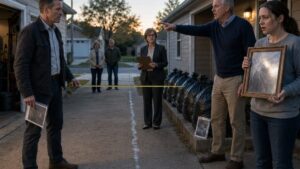
“I didn’t ask you to.”
Michael nodded.
That difference mattered.
At the HOA common room later that afternoon, Richard was less interested in differences.
Michael and Katherine sat at one end of a rectangular table while Richard stood near the association management representative.
Cynthia sat with the board members.
Richard placed a printed incident summary on the table.
“This is precisely why the temporary restriction remains necessary.”
Michael looked at Cynthia.
She did not look away, but she did not appear pleased either.
Katherine said, “Temporary restriction and total physical obstruction are not automatically the same thing.”
Richard folded his hands.
“The board has an obligation to reduce a known hazard.”
“You also have an obligation to understand what property interest you’re restricting.”
“We’ll address that at Friday’s hearing.”
“Then move the barrier until Friday.”
Richard shook his head.
“No.”
Michael felt the old heat rise again.
Katherine glanced at him once.
He stayed silent.
Richard continued.
“If Mr. Carter needs equipment removed, management can coordinate a supervised opening.”
Michael stared at him.
“A supervised opening to my own gate.”
“To the disputed access.”
Cynthia shifted in her chair.
Michael almost answered.
Instead, he reached into his folder and took out the photograph of the old plat.
He laid it flat.
“Then Friday should be interesting.”
Richard looked down but did not touch it.
The meeting ended without movement.
The barrier would stay.
Outside, Michael walked beside Katherine toward their cars.
“I could’ve handled that better,” he said.
“Which part?”
“The last five years.”
Katherine glanced at him.
“That’s unusually specific.”
He ignored the comment.
“The safety complaint is real.”
“Yes.”
“And the gate can still be mine to use.”
“Yes.”
“Both things can be true.”
“That’s generally where difficult property cases live.”
Michael looked back toward the common room.
“I hate that.”
“I know.”
His phone vibrated.
Katherine’s did at almost the same moment.
She stopped walking.
“Management email.”
Michael opened it.
An attachment sat beneath a short message from the management representative: archived correspondence located in prior association files, potentially relevant to Friday’s hearing.
Katherine opened the PDF.
The scan was dated years before Richard became board president.
Michael read the first paragraph.
Then the second.
His attention stopped on one sentence.
The association acknowledged the owner’s existing side access as shown on the recorded subdivision documents.
Michael looked at Katherine.
She had already seen it.
Below that sentence, in a separate paragraph, the letter discussed parking restrictions.
Two different issues.
Two different paragraphs.
Katherine enlarged the scan.
“Well,” she said quietly.
Michael stared at the words.
The board had not merely known the gate existed.
At some point, it had written that fact down itself.
Chapter 5: The Board Had Written It Down Years Ago
“Existing access.”
Michael read the phrase aloud for the third time Thursday morning.
Katherine sat across the workbench from him with the archived letter between them.
“Don’t fall in love with two words,” she said.
“They’re good words.”
“They’re useful words.”
“That sounds less satisfying.”
“It should.”
Michael leaned back.
The concrete barrier was visible through the open shop door.
For most of the week he had imagined the dispute ending with someone from the HOA admitting they had no right to touch the gate at all.
The archived letter came closer to that fantasy than anything they had found.
But Katherine was still reading.
She turned the page.
“Here.”
Michael leaned forward.
The later paragraph stated that commercial trailers could not remain along the side property line overnight unless screened or stored according to association rules.
“That’s the parking issue.”
“Yes.”
“And the access is separate.”
“Yes.”
Michael felt a slow satisfaction spread through him.
“So Richard used a parking agreement to justify blocking an entrance the HOA had already acknowledged.”
“That is a defensible way to describe it.”
“Finally.”
Katherine held up one finger.
“However.”
Michael’s expression flattened.
“There’s always a however with you.”
“That’s why you hired me instead of asking the guy at the hardware store.”
She placed the current HOA traffic rule beside the archived letter.
“The association probably can regulate how the access is used if the regulation is reasonable and consistent with the governing documents.”
Michael looked from one paper to the other.
“Meaning?”
“Meaning you should not go into that hearing asking for the right to do anything you want through that gate.”
“I never asked for that.”
“You’ve been acting like you did.”
He opened his mouth, then stopped.
Katherine continued.
“We have a strong argument that they cannot simply convert an acknowledged access point into a permanently closed boundary because of a later traffic rule. That does not mean they can’t require precautions.”
“Spotters.”
“Possibly.”
“Restricted hours.”
“Possibly.”
“No trailer storage.”
“That issue was already addressed years ago.”
Michael looked toward the gate.
The distinction was becoming clearer.
He had spent days thinking the question was whether Richard could control him.
It was not.
The question was what the board could regulate without erasing something that already belonged to the property.
Katherine slid three photographs across the bench.
The first showed the gate now, with the concrete block across it.
The second came from Michael’s old property file, taken years earlier when he had replaced the wooden entrance with black steel.
The third was a scan attached to the archived HOA letter.
Same opening.
Same location.
Different years.
Michael held the third photograph closer.
The old gate had sagged slightly at one hinge. His shop looked smaller before the rear addition. A work truck sat inside, visible through the opening.
“The board had this photo.”
“Yes.”
“And still said I invented some commercial access.”
“Richard said the current commercial use was unauthorized. Be precise.”
Michael frowned.
“You really don’t let anybody enjoy anything.”
“Enjoy it after the hearing.”
His phone rang.
Richard.
Michael stared at the name.
Katherine said, “Answer it.”
He put the call on speaker.
“Michael,” Richard said. “I saw the archived correspondence.”
“I figured.”
“It doesn’t change the safety concern.”
“No.”
Richard paused.
Perhaps he had expected an argument.
Michael continued.
“It changes what you can do about it.”
“That will be decided tomorrow.”
“Then move the barrier until tomorrow.”
“No.”
Katherine looked at Michael but did not interrupt.
Richard said, “The board cannot knowingly reopen a route we have identified as hazardous before the matter is resolved.”
“You could put temporary conditions on it.”
“We’re not negotiating this by phone.”
“You called me.”
Another pause.
Richard’s voice cooled.
“I called because I wanted to make sure you understand the hearing is not a referendum on whether the gate existed twenty years ago. The issue is current use.”
Michael looked at the archived letter.
“No, Richard. The issue is whether current rules let you erase existing access.”
“That’s your interpretation.”
“It’s the question I’m asking the board.”
Richard ended the call soon afterward.
Michael set the phone down.
For once, he did not feel the need to call back and finish the argument.
Katherine watched him.
“What?”
“That was better.”
“Low standard.”
“Yes.”
They spent the rest of the morning arranging the record chronologically.
Old plat.
Recorded ingress-and-egress reference.
Archived HOA acknowledgment.
Parking complaint.
Michael’s signed compliance letter.
Current traffic rule.
Recent notices.
Photographs of the barrier.
The sequence did something no single page could do.
It showed that the gate’s existence and the HOA’s authority had never been absolute opposites.
The association had recognized access before.
It had regulated parking before.
Michael had complied with some restrictions before.
Then years later, those separate histories had been collapsed into one broad claim: commercial use of the opening itself was unauthorized.
Michael looked at the papers spread across his workbench.
“I should’ve answered those letters.”
Katherine did not comfort him.
“Yes.”
He nodded.
“I thought ignoring them kept me out of pointless arguments.”
“And instead?”
“They got to decide what my silence meant.”
Katherine gathered the copies for the hearing binder.
“That may matter tomorrow.”
Michael looked at her.
“You want me to admit it?”
“I want you not to lie when Richard brings it up.”
“That’s not the same thing.”
“No.”
Michael walked outside.
The barrier cast a short shadow across the pavement.
He put one hand on the black gate.
For days it had felt like evidence of what had been done to him.
Now he saw another part of it.
For years, every time the gate opened, he had assumed the right to use it was self-evident.
That assumption had made him careless about explaining himself, careless about notices, and apparently careless about how one of his drivers had used the corner.
Rights did not erase responsibility.
But responsibility did not erase rights either.
He returned inside.
Katherine had packed the binder.
“I know what I want tomorrow.”
She waited.
“I want the barrier gone.”
“That’s obvious.”
“I don’t want an exemption from every traffic rule.”
She gave a small nod.
“I want the board to separate the two things.”
“Access and use conditions.”
“Yes.”
“That’s a much stronger position.”
Michael looked toward the papers.
“What happens if you present it?”
“I’ll handle the legal framework.”
“That’s not what I asked.”
Katherine studied him.
Michael had always imagined lawyers winning hearings by saying the right thing at the right moment. He could easily let her do that. He could sit there, angry and silent, and blame the board if it went badly.
The thought suddenly felt too familiar.
“I’m speaking,” he said.
Katherine leaned back.
“You sure?”
“No.”
“That’s more convincing than yes.”
He almost smiled.
She handed him a copy of the chronology.
“Then don’t give them a speech. Tell them what happened. Including the parts you don’t like.”
Michael took the pages.
Friday’s hearing notice sat on top.
He folded it once and slid it into the binder.
For the first time since the barrier appeared, he stopped thinking about how badly he wanted Richard proven wrong.
He started thinking about what he was willing to admit in order to prove exactly where the board had gone too far.
Chapter 6: He Asked for the Gate, Not an Exception
Richard began the hearing with Michael’s worst document.
Not the old plat.
Not the archived acknowledgment.
The signed compliance letter.
He placed a copy in front of every board member.
“Mr. Carter has been notified repeatedly regarding commercial trailers and vehicle activity associated with the side entrance,” Richard said. “This is not a new dispute.”
Michael sat beside Katherine at the end of the table.
Across from them were the board members, including Cynthia.
Several homeowners occupied chairs along the wall.
Nobody looked eager to be there.
Richard continued.
“In this document, Mr. Carter agreed in writing to comply with restrictions governing commercial trailers and related equipment.”
Michael could feel attention shift toward him.
Katherine whispered, “Let him finish.”
Richard presented the unanswered notices next.
One.
Then another.
Then another.
Seen in sequence, they looked worse than Michael remembered.
Richard did not exaggerate them.
He did not need to.
“Management repeatedly requested communication,” he said. “Those requests were largely ignored.”
Michael looked down at his copy.
That part was true.
When Richard finished, the board member at the far end of the table asked Katherine whether Michael disputed the authenticity of the letters.
Katherine glanced at him.
This was his opening.
Michael stood.
“No.”
A few heads lifted.
He picked up the signed letter.
“That’s my signature.”
Richard’s expression changed slightly.
Michael held up one of the later notices.
“I received this one too.”
Then another.
“And this.”
He set them down.
“I didn’t answer them.”
The room became quieter than Michael expected.
Richard leaned forward.
“So you acknowledge noncompliance.”
“I acknowledge not answering.”
“Which is part of the problem.”
“It is.”
Katherine did not move.
Michael continued.
“I got tired of letters. Some were reasonable. Some didn’t seem reasonable to me. After a while I treated all of them the same.”
Cynthia watched him closely.
“That was a mistake.”
Richard seemed uncertain now.
Michael had not given him the denial he was prepared to defeat.
Michael opened the binder.
“But that mistake doesn’t answer whether you can block this gate.”
He placed the current photograph on the table.
Black steel gate.
Concrete barrier.
Then the older photograph showing the same opening years earlier.
Then the scanned image attached to the archived HOA letter.
Three versions of the same place.
“This gate is not a new commercial entrance I cut into the fence because it was convenient.”
He put the recorded plat beside the photographs.
“The opening appears here.”
Next came the recorded access reference.
“And here.”
Finally, the archived HOA letter.
“And the association itself called it existing access.”
Richard said, “None of that eliminates current safety authority.”
“I’m not asking you to eliminate it.”
That sentence shifted something.
One board member lowered the rule packet she had been reading.
Michael looked at Cynthia.
“A trailer came out of this gate badly a few months ago. Cynthia nearly hit it.”
There was a murmur among the chairs behind him.
Michael continued before Richard could use the admission.
“She was right to complain.”
Cynthia’s expression softened, but only a little.
“I should’ve known how the person driving for me was using the corner. I didn’t.”
Richard said, “And that is precisely—”
Michael looked at him.
“It is precisely why you can regulate safety.”
Richard stopped.
Michael tapped the photograph of the concrete barrier.
“It is not why you can turn existing access into no access.”
For the first time all week, Michael felt no need to make the point larger than it was.
He did not say the HOA had targeted him.
He did not say Richard had abused power for personal reasons.
He did not ask the board to waive every rule.
He simply walked through the chronology.
Years of acknowledged access.
Later parking restrictions.
Michael’s agreement concerning overnight trailer storage.
Current traffic concerns.
Then the physical barrier.
Katherine followed with the governing documents.
She spoke carefully, emphasizing that the association retained authority over reasonable operational conditions but that nothing in the current rule clearly authorized extinguishing previously recognized access by physical obstruction.
A board member asked, “Could the association require commercial trailers to use another entrance?”
Katherine answered, “That depends on the documents and whether doing so materially interferes with the recorded access. The difficulty here is that the board imposed a complete physical closure before resolving that question.”
Richard pushed back.
“The front driveway remains available.”
Michael answered before Katherine could.
“For my pickup.”
He described the retaining wall, the maple, the turning radius, and the loaded welding trailer.
“Can it be done?” one board member asked.
“Sometimes.”
“Safely?”
“Not as safely as this gate if this gate is used correctly.”
Cynthia nodded once.
The hearing moved into questions.
One board member focused on insurance.
Another focused on the archived letter.
Then the oldest member of the board proposed a compromise.
“Leave the barrier,” he said, “but allow management to remove it temporarily for scheduled business access until we complete a separate review.”
Michael stared at him.
After everything, the gate would still depend on permission.
Katherine whispered, “Your choice.”
Michael stood again.
“No.”
The board member frowned.
“No?”
“I’ll accept hours.”
Richard looked toward him.
“I’ll accept visibility rules. Spotters for long trailers if that’s what the board adopts. I’ll keep commercial trailers from overnight storage where they’re not supposed to be.”
Michael placed his hand on the old plat.
“But I’m not calling management every time I need to use an access the association already recognized.”
No one spoke.
“That’s not access,” Michael said. “That’s permission.”
He sat down.
The board recessed.
Michael and Katherine waited in the hallway while the homeowners talked quietly inside.
Richard remained with the board.
Cynthia came out once for water.
She stopped beside Michael.
“I still think something needs to change at that corner.”
“So do I.”
She looked at him.
“I didn’t expect you to say that tonight.”
“I should’ve said it months ago.”
Cynthia gave a tired half-smile.
“Probably.”
Then she returned inside.
Twenty minutes later, they were called back.
Richard sat rigidly at one side of the table.
The board secretary read the motion.
The association would rescind the access violation.
The concrete barrier would be removed no later than Saturday morning.
The board would conduct a separate review of reasonable safety conditions for commercial trailer movement, but the side access would remain recognized pending that process.
The motion passed.
Michael heard the number but barely registered it.
What mattered was the line after it.
Barrier removed by morning.
Richard did not look at him.
The meeting adjourned without applause.
Chairs scraped across the floor. Papers disappeared into folders. Neighbors left in small groups.
Michael stayed seated for a moment.
Katherine closed the binder.
“You got the gate.”
Michael looked at the three photographs still lying side by side.
Old wood.
Black steel.
Concrete block.
“No,” he said.
Katherine glanced at him.
“I got them to stop pretending the gate was the same thing as the problem.”
Outside, Michael drove home through the neighborhood entrance.
When he turned onto his street, the barrier was still there, pale in the headlights.
For one more night, the gate remained closed.
But taped to Michael’s copy of the board motion was the contractor’s removal order for Saturday morning.
Chapter 7: When the Gate Opened, the Argument Changed
The contractor came back at eight Saturday morning.
Michael heard the flatbed before he saw it. The diesel engine slowed on the association road, then the truck stopped beside the same concrete barrier it had delivered five days earlier.
For a moment, Michael stayed inside the shop.
The black gate stood open behind the block, exactly as it had all week. His welding trailer remained parked beyond it, finally unloaded from the jobs he had been forced to rearrange. The board’s written order sat on the workbench inside, folded beside his keys.
Outside, the contractor climbed down and began attaching the lifting chain.
He looked toward Michael.
“Morning.”
Michael nodded.
Neither man mentioned Monday.
The hydraulic arm tightened. The chain snapped straight. Concrete lifted slowly from the pavement, leaving a pale rectangle of dust beneath it.
Michael watched the space appear.
It should have felt bigger.
Instead, the opening looked ordinary.
That was what he had wanted all week.
Not a monument to winning.
Just an entrance again.
The contractor lowered the barrier onto the flatbed and secured it.
“That everything?” he asked.
“For me.”
The truck pulled away.
Michael walked to the center of the opening.
He looked left toward the neighborhood entrance, then right toward the corner Cynthia had shown him.
From inside his property, the sightline was worse than he had admitted.
He had spent years knowing exactly when to slow, where to stop, and how far a trailer needed to swing. That familiarity had convinced him the gate itself was safe.
But a driver who did not know the corner could make the same opening dangerous in seconds.
Michael went back into the shop.
An hour later, he was bolting a convex safety mirror to a steel post near the inside of the gate.
He had fabricated the bracket himself from scrap stock.
The mirror gave a wider view of approaching vehicles without forcing a trailer nose into the road.
He was marking a temporary stopping line on the pavement when a pickup slowed outside.
Richard Hall got out.
Michael kept working.
Richard stood beside the gate for a few seconds before speaking.
“The barrier’s gone.”
“I noticed.”
Richard looked at the mirror.
“What’s that?”
“Visibility.”
Richard stepped closer.
Michael straightened.
The air between them still carried the board room.
Richard did not offer his hand.
Michael was glad.
“The board is drafting the revised traffic rule,” Richard said.
“Okay.”
“It’ll probably include restrictions on large commercial trailers during the morning school traffic window.”
Michael nodded.
“And no overnight storage near the side boundary.”
“That one already existed.”
“Yes.”
Richard glanced toward him.
There was no argument in Michael’s tone, but there was no concession either.
Richard continued.
“We may require a spotter for trailers above a certain length.”
“That makes sense.”
Another pause.
Richard seemed almost irritated by how easily that answer came.
“You would comply with that?”
“If the rule is about using the gate safely.”
Richard looked at the pavement marking.
“And if it isn’t?”
Michael set the paint can down.
“Then I’ll answer it.”
The words landed differently than Michael expected.
Richard’s expression changed.
Not much.
Enough.
Michael wiped his hands on a rag.
“I should’ve answered before.”
Richard said nothing.
“I’m not saying the barrier was justified.”
“I didn’t think you were.”
“But I let too many letters sit.”
Richard looked toward the shop.
“You did.”
There was no satisfaction in it.
That helped.
Michael nodded toward the corner.
“Cynthia was right about the trailer incident.”
Richard folded his arms.
“That incident scared people.”
“I know now.”
“It wasn’t the only complaint.”
“I’m sure it wasn’t.”
Richard’s eyes narrowed slightly.
Michael almost smiled.
“I’m not agreeing with all of them.”
“That sounds more familiar.”
The tension loosened by a fraction.
Richard looked at the mirror again.
“The board might want something like that included in the safety plan.”
“You can take a picture.”
“I’ll do that.”
Michael expected him to leave.
Instead, Richard stayed.
“The management representative will send you the financial adjustment next week.”
“What adjustment?”
“Your outstanding access fines are being rescinded.”
Michael waited.
Richard continued.
“The board also approved a credit toward documented legal expenses because the physical closure occurred before the access status was fully reviewed.”
“How much?”
“Not everything.”
“I assumed.”
Richard named the amount.
It covered a meaningful part of Katherine’s bill, though not all of it.
Michael nodded once.
“That’s fair.”
Richard looked surprised.
“Fair?”
“You were wrong about the barrier. I was wrong about some other things.”
“That’s a generous way to describe it.”
“No. It’s an accurate one.”
Richard glanced toward the road.
Michael could see the instinct in him to defend the board one more time.
Instead, he said, “The insurer did push us.”
“I believe you.”
“I thought if something happened after the complaints, everyone would ask why we hadn’t acted.”
“So you acted.”
“Yes.”
“Before checking everything.”
Richard looked at him.
“Yes.”
The word was quiet.
Michael did not make him repeat it.
Richard put his hands in his pockets.
“I still think the commercial traffic needs limits.”
“So do I.”
“But the gate stays.”
Michael looked at the black steel tubing.
“The gate stays.”
Richard nodded.
No apology followed.
Michael realized he preferred it that way.
An apology might have asked for a closeness neither of them felt.
What they had was narrower.
Facts acknowledged.
Limits redrawn.
Enough distance to live beside each other.
Richard returned to his pickup.
Before getting in, he said, “The draft rule should be out Tuesday.”
Michael picked up the paint can.
“I’ll read it.”
Richard closed the door.
“I hope so.”
The pickup drove away.
Michael finished the stopping line.
Over the next few weeks, the changes were small.
The association adopted restricted trailer movement during the busiest morning period. Long trailers required a spotter at the side gate. Commercial equipment could not be stored overnight along the exposed side boundary.
Michael accepted all three conditions.
He also trimmed back vegetation near the opening and painted a clearer internal turning path for anyone driving his equipment.
The gate itself remained untouched.
The association’s revised policy included a separate sentence recognizing existing recorded access points and requiring the board to review underlying property documents before physically restricting one.
Michael read that sentence twice.
Then he filed the policy in the brown property folder.
He did not leave it on the workbench.
He did not throw away the envelope.
He added the archived HOA letter, the old plat, the hearing decision, and photographs showing the barrier before and after removal.
The folder had become thicker than it had been when he first pulled it from the steel cabinet.
But it no longer felt like a collection of old paper.
It was a record of what happened when everyone assumed somebody else understood the boundary.
One afternoon, Michael backed the welding trailer toward the side gate.
He stopped at the painted line.
Checked the convex mirror.
Waited for a car to pass.
Then eased forward.
The trailer cleared the corner cleanly.
A few houses down, Cynthia was walking toward her mailbox.
She lifted one hand.
Michael raised his in return.
Nothing more.
That was enough too.
Three weeks after the hearing, another HOA envelope arrived.
Michael found it in the mailbox when he came home from a service call.
For a second, habit took over.
He nearly placed it unopened on the passenger seat with fuel receipts and supplier invoices.
Instead, he opened it before going inside.
The notice concerned placement of temporary steel material beside his shop.
Michael read the rule.
Looked at the material.
Then went to the property file.
The plat showed the storage area clearly inside his lot, but the association rule about screening appeared to apply regardless.
Michael took two photographs, attached the relevant plat page, and wrote a short response explaining when the steel would be removed and what temporary screening he would put up until then.
No anger.
No silence.
No assumption that everyone should simply know.
He sent the response before dinner.
Then he carried the brown folder back to the steel cabinet and closed the drawer.
Outside, the black gate stood open.
The road beyond it was clear.
The story has ended.