My Neighbor Built Twelve Feet Into My Yard, but the Survey Marker He Buried Changed Everything
Chapter 1: Six Weeks Away, Twelve Feet Gone
Jeffrey Carter stopped so abruptly at the corner of his house that the rolling suitcase behind him tipped sideways into the mulch.
There was concrete where his grass used to be.
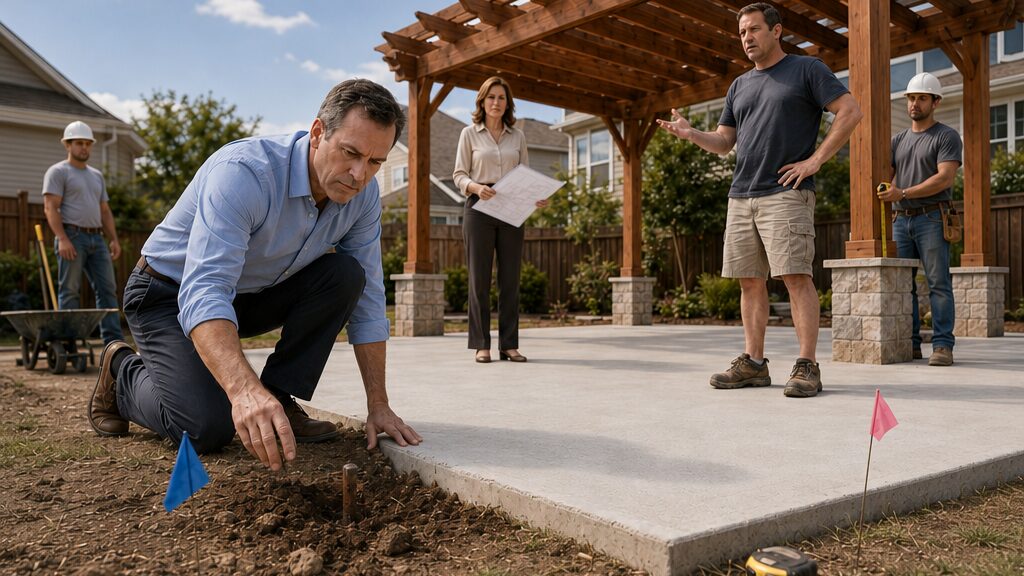
Not a stepping stone. Not a narrow footing. A broad, pale slab stretched across the side yard and disappeared behind a new cedar pergola rising from Michael Adams’s property. Six posts stood in clean metal brackets. Fresh lumber crossed overhead in evenly spaced beams. Two workers were fastening trim along the far edge while a compressor chattered behind the fence.
Jeffrey stared at the nearest corner of the slab.
It was too far over.
He knew that before he measured anything.
For twenty-two years, he had made his living looking at walls, setbacks, foundations, elevations, and the small mistakes that turned into expensive ones. Distance settled into his eye almost automatically. Twelve feet was not a guess he would have trusted in court, but it was enough to make his stomach tighten.
He set down his suitcase.
He had been gone six weeks helping oversee a renovation two states away. Before leaving, the strip between the houses had been grass, a narrow drainage swale, and a few low shrubs near Michael’s side. Now the pergola covered most of it.
One of the workers glanced over.
“Hey,” Jeffrey said. “You know where the property line is?”
The worker looked toward Michael’s house.
“We’re just finishing what we were given.”
“That wasn’t my question.”
The worker set down his drill. “You’ll have to talk to the homeowner.”
Jeffrey walked along the new concrete edge. The slab crossed toward his rear yard farther than he expected. A large planter sat near one corner. Beyond it, stacked patio chairs and unopened boxes waited under the pergola roof.
Michael had not built something that accidentally clipped the line.
He had built as though the strip belonged to him.
Jeffrey took out his phone and photographed the entire structure before touching anything. Wide shots first. Then the posts. The concrete edge. The distance to his fence corner. The drainage inlet he remembered being several feet inside his lot.
He went into the house, left his suitcase in the foyer, and climbed the stairs to the small office over the garage.
The old survey was where he kept it: flattened inside a cardboard tube behind a file drawer.
Three years old.
He spread it across the desk and found the rear iron pins marked on the drawing. The side line ran from the front monument past the house and through the exact strip now covered by the pergola.
Jeffrey took a tape measure outside.
From the side wall of his house to the recorded boundary: twenty-eight feet, four inches.
From the side wall to the edge of Michael’s new slab: sixteen feet, a little less depending on where the concrete bulged.
He measured twice.
Then a third time.
Eleven feet, ten inches.
Close enough to twelve that the distinction did not matter.
He followed the line toward the rear corner looking for the old iron pin.
It should have been near the edge of the swale.
There was no pin.
Only disturbed soil and the clean vertical side of the concrete footing.
Jeffrey crouched and ran his fingers through loose dirt until grit lodged under his nails. He found a torn piece of orange survey ribbon but no iron.
“Looking for something?”
Michael stood on the other side of the pergola with a bottle of water in one hand.
He wore work shorts and an old college T-shirt. He looked mildly amused, not nervous.
“The rear pin.”
Michael took a drink. “There was some old metal back there. Crew ran into all kinds of stuff.”
“Where is it?”
“No idea.”
Jeffrey stood.
“This slab is on my property.”
Michael’s expression changed slightly, not into surprise but irritation.
“No, it isn’t.”
“I just measured off my survey.”
Michael nodded as if Jeffrey had confirmed something predictable. “I wondered if you were going to do that.”
Jeffrey held up the folded survey.
“What does that mean?”
“It means we already went through approval.”
“With who?”
“The HOA.”
“That doesn’t establish a property line.”
“They approved the plans.”
Jeffrey looked past him at the structure. One worker had resumed drilling, slowly this time, clearly listening.
“How far do you think your lot comes?”
Michael pointed to a line that would have put nearly the entire slab on his side.
“Right through there.”
“That’s almost twelve feet inside my surveyed line.”
Michael sighed.
“Jeffrey, I’ve mowed that section since we moved in.”
“That doesn’t make it yours.”
“I’m not saying mowing makes it mine. I’m saying everybody has treated that as the line for years.”
Jeffrey felt the familiar impulse to keep his voice level no matter what the other person did. It had served him on job sites, with inspectors, with furious customers, with subcontractors who swore their mistakes belonged to someone else.
But this was different.
This was home.
“Stop the work until we sort it out.”
Michael glanced at the nearly finished pergola.
“We’re not stopping over an old drawing.”
“It’s a recorded survey.”
“And I have approval.”
“From an HOA architectural committee.”
Michael’s jaw tightened.
“Same HOA you belong to.”
Jeffrey looked toward the workers.
“I’m asking you not to finish anything else over the disputed area.”
“You can ask.”
That landed harder than shouting would have.
Jeffrey folded the survey carefully.
“All right.”
Michael frowned. “All right what?”
“All right. I’ll verify it.”
Jeffrey walked away before the conversation could become the kind he had spent most of his adult life avoiding.
His father had once fought a neighbor for six years over eighteen inches of gravel driveway. Surveyors, attorneys, certified mail, cameras, accusations. By the end, the driveway barely mattered. The two families hated each other, and Jeffrey had learned early that a property line could become the only thing a man saw if he stared at it long enough.
He had promised himself he would never live like that.
But when he reached the rear corner of his yard, something metallic caught the light beneath a hedge.
Jeffrey knelt.
An iron pin, rusted at the top, sat exactly where the survey showed the rear boundary monument should be.
He measured from it toward the missing pin location.
The line ran straight through Michael’s slab.
Jeffrey remained crouched for several seconds.
One surviving marker did not solve everything, but it changed the question.
He was no longer asking whether he remembered the boundary correctly.
He was asking what Michael and the HOA had relied on instead.
That evening, Michael rang his doorbell.
Jeffrey opened the door expecting another argument.
Instead, Michael held a sheet of paper in a clear plastic sleeve.
“I figured you’d want to see this.”
He passed it over.
At the top was the subdivision logo. Beneath it was Michael’s landscaping and pergola plan stamped as approved by the architectural-review committee.
A dotted line marked the side of Michael’s property.
It ran almost exactly where Michael said it did.
Through twelve feet of Jeffrey’s yard.
Chapter 2: The Drawing That Should Not Exist
Sandra Hill placed both hands flat on the conference table and looked at Jeffrey as though he were asking her to reverse gravity.
“We cannot undo approved construction because one homeowner says a line is wrong.”
Jeffrey slid his survey across the table.
“I’m not asking you to accept what I say. I’m asking you to compare your drawing to a recorded survey.”
Sandra did not touch it.
The HOA office occupied two rooms beside the clubhouse gym, decorated with framed photographs of landscaped entrances and seasonal community events. The property manager sat at the end of the table with Michael’s architectural-review file open in front of her.
Michael sat opposite Jeffrey.
He had brought the approved drawing again.
Sandra finally looked down.
“What exactly do you want the association to do today?”
“Tell him to stop work until the boundary is verified.”
Michael leaned back.
“The work is basically finished.”
“That doesn’t make it correct.”
Sandra gave Jeffrey a warning look.
“We’re trying to lower the temperature here.”
“My yard has concrete on it.”
“And Michael has an approval issued by this association.”
“For a structure on his lot.”
Michael tapped the dotted line on the plan.
“According to this, it is.”
Jeffrey pulled the recorded plat and his survey from a folder.
“That dotted line is wrong.”
The property manager turned the architectural sheet toward herself.
Jeffrey leaned forward.
“Where did this line come from?”
Silence.
Sandra looked at the manager.
“Was a survey submitted?”
The manager flipped through the file.
Site photograph. Pergola rendering. Paint sample. Contractor insurance certificate. Landscape plan.
No survey.
“No,” she said.
Michael frowned. “You told me the packet was complete.”
“It was complete for architectural review.”
Jeffrey looked at Sandra. “Did your application require him to certify the improvement stayed inside his property?”
Sandra said, “The homeowner is responsible for property boundaries.”
“That’s not what I asked.”
Her lips pressed together.
The property manager found the checklist.
“Property-line verification isn’t listed.”
Michael turned toward her. “So you approved it without checking?”
“We approved design compliance. We don’t perform surveys.”
Jeffrey felt the first clean piece of ground appear beneath the argument.
“That drawing is not a survey.”
Sandra picked it up.
“It’s a landscape diagram.”
“It has a property line drawn on it.”
“Yes.”
“Based on what?”
No one answered.
Jeffrey knew better than to press too hard when a room had just realized something embarrassing. He had seen inspectors become defensive for less.
He sat back.
“I want the line professionally located before anything else happens.”
Michael shook his head.
“I already paid for construction.”
“And I already paid for my land.”
Sandra closed the file.
“Fine. No additional work in the disputed strip until the parties verify the boundary.”
Michael looked at her sharply.
“You can’t freeze my project after approving it.”
“We can freeze work if there’s a dispute affecting another lot.”
Jeffrey should have felt relieved.
Instead, something about Michael’s certainty bothered him.
Not confidence.
Familiarity.
As if the disputed line had existed in Michael’s mind long before the pergola.
By noon, a small survey crew was standing between the two houses.
Jeffrey watched one technician set a tripod while another compared monuments from the recorded plat.
Michael watched from his patio.
Sandra arrived ten minutes later, still dressed for the office.
Two neighboring homeowners drifted onto their back porches without pretending they were there for anything else.
The crew found the rear iron pin first.
Then they worked toward the side yard.
The missing pin should have been near the fresh concrete.
One technician swept the soil with a locator.
The receiver began to chirp.
He moved closer to the slab.
The chirp sharpened.
Jeffrey crouched before anyone asked him to.
The concrete edge was less than a foot away. He scraped loose soil aside with a small hand shovel.
A dull rust-colored circle appeared.
He brushed harder.
Iron.
The pin had not disappeared.
It had been buried under several inches of disturbed soil beside the footing.
Michael came closer.
Sandra followed.
Jeffrey said nothing.
He stood and handed the survey technician his tape.
“Can you measure from that?”
The technician nodded.
The measurement did not merely favor Jeffrey.
It cut through the finished project.
One pergola post stood well over the line. Most of the slab’s long edge was inside Jeffrey’s property. At its deepest point, the encroachment was just under twelve feet.
Sandra stared from the pin to the structure.
Michael folded his arms.
“That still doesn’t explain your drawing.”
Sandra turned toward him. “It isn’t my drawing.”
“It has the association’s approval on it.”
Jeffrey looked at the pergola.
For one brief moment he thought the dispute had collapsed.
There was the pin.
There was the recorded survey.
There was the measurement.
Then the property manager arrived carrying a larger folder.
“I found the original landscape plan.”
She spread an older subdivision sheet across the hood of her car.
The dotted landscaping boundary matched Michael’s approved plan almost exactly.
Sandra looked at Jeffrey.
“This is what was used.”
Jeffrey studied it.
The sheet was old enough that the shrubs shown along his foundation had been replaced twice. It was clearly not a recorded plat. But someone, years earlier, had drawn a maintenance boundary through the common landscaping layout as though it were a lot line.
Michael pointed at it.
“That’s what I was given when I bought.”
Jeffrey did not answer.
The difference mattered.
Michael had not invented the line from nothing.
The survey crew began placing small flags along the true boundary.
One of the pergola workers stood nearby, waiting to know whether he could resume.
Sandra looked at Jeffrey.
“We need to review this.”
Jeffrey nodded.
But the worker was watching the exposed iron pin.
“You remember that?” Jeffrey asked him.
The man hesitated.
“I wasn’t here for the excavation.”
“Who was?”
“The concrete guys.”
Another worker, carrying trim boards from the trailer, glanced over.
“The footing crew found something metal there.”
Everyone turned.
Jeffrey kept his voice neutral.
“What kind of metal?”
The worker shrugged.
“Old stake, pin, whatever. They worked around it.”
Michael’s face went still.
The worker seemed to realize he had stepped into something larger than construction.
“I just remember because they were complaining it was in the way.”
Jeffrey looked back at the rusted pin beside the fresh concrete.
The argument had changed again.
If the crew had seen it before the slab was poured, then someone had known the ground itself did not match the drawing.
The question was no longer only which document was wrong.
It was who had seen the warning first.
Chapter 3: The Peace Jeffrey Bought With Silence
Michael waited until the survey crew had left before walking across the grass.
“So now the line matters?”
Jeffrey was pulling the temporary flags straight where one had leaned in the soft soil.
He looked up.
“What’s that supposed to mean?”
Michael stopped several feet away.
“You know exactly what it means. I’ve mowed this strip for years. I kept the drainage clear. I stored my trailer there. You watched me do it.”
“That didn’t transfer ownership.”
“I didn’t say it did.”
“You’re acting like it did.”
Michael laughed once, without humor.
“No. I’m acting like you never once told me I was using your property.”
Jeffrey opened his mouth, then closed it.
That was the problem.
Michael was right about that part.
Years earlier, not long after Michael had moved in, Jeffrey had come home from a job to find Michael mowing past what Jeffrey understood to be the boundary. The cut grass continued in one clean sweep from Michael’s lawn across several feet of Jeffrey’s side yard.
Jeffrey had noticed.
He had thought about saying something.
Then he had pictured the conversations his father used to have with neighbors—tape measures in driveways, angry knocks at dinner, folded plats carried around like weapons.
So Jeffrey had let it go.
The next spring, Michael had stacked landscape stone there for two weeks.
Jeffrey had said nothing.
Later came a small utility trailer.
Nothing permanent, Jeffrey told himself.
Nothing worth turning into a fight.
Now a cedar post stood in concrete where that silence had accumulated.
Michael watched his face.
“You did know.”
“I knew you were using part of it.”
“And never objected.”
“I didn’t give it to you.”
“I never said you did.”
“Then why build on it?”
“Because everything I had showed that line on my side.”
“Everything except the actual survey monument.”
Michael’s expression hardened.
“There it is.”
“What?”
“You always do that.”
Jeffrey stared at him.
Michael continued. “You say nothing for years, then when you finally speak, you talk like the answer was obvious to everybody the whole time.”
“That pin is not subtle.”
“It was buried.”
“After excavation.”
Michael looked away.
Jeffrey noticed.
There was the smallest pause, but it was enough.
“You saw it.”
Michael’s eyes came back to him.
“I saw metal in the dirt. That doesn’t mean I knew what it was.”
“The crew knew enough to work around it.”
“I had an approved plan.”
“From the HOA.”
“Yes.”
“Not a surveyor.”
Michael stepped closer.
“I’m twenty-eight thousand dollars into that project.”
Jeffrey had not known the number.
For the first time, he saw something beneath Michael’s stubbornness besides entitlement.
Fear.
Not enough to excuse anything. But enough to explain the way he kept looking at the pergola as though accepting the survey would erase money already spent.
Michael rubbed a hand over his jaw.
“My family has been planning this thing since winter. My daughter’s coming back with her husband next month. We were going to have everybody here. I hired people. Ordered furniture. Paid deposits. The association approved the location.”
Jeffrey looked at the structure.
“And when the ground disagreed with the drawing?”
Michael’s face closed again.
“You don’t get to put all of this on me.”
“I’m not.”
“You sure?”
Jeffrey started to answer, then stopped.
Because until that moment, he had been.
In his mind the story had been clean: he left town, Michael took advantage, Jeffrey came home and corrected him.
But the clean version omitted years.
It omitted Michael mowing the strip while Jeffrey watched through the kitchen window.
It omitted the trailer.
It omitted the times Jeffrey had decided that speaking clearly was somehow more dangerous than allowing misunderstanding.
His father had treated every boundary as a battle.
Jeffrey had responded by treating every boundary as something that could be ignored until it absolutely could not.
Neither habit looked especially wise now.
“I should have said something years ago,” Jeffrey said.
Michael blinked.
Jeffrey continued before he could mistake the admission for surrender.
“I should have told you where I believed the line was the first time I saw you using the strip.”
Michael’s shoulders eased slightly.
“But that does not make the concrete mine to accept.”
The ease disappeared.
“There’s no practical way to move that slab.”
“There is.”
“You’d tear out half the project?”
“If half the project is on my land, yes.”
Michael stared at him.
“You really want to be that guy?”
The question hit exactly where Michael could not have known it would.
Jeffrey saw his father standing in an old driveway with a steel tape stretched across gravel, red-faced over eighteen inches.
For a second, he hated Michael for finding that nerve by accident.
Then he hated himself for letting the comparison matter.
“This isn’t about wanting a fight.”
“Sure looks like one.”
“It’s about the line being where it is.”
Michael gestured toward the pergola.
“And what am I supposed to do with twenty-eight thousand dollars?”
Jeffrey answered carefully.
“That’s something we can discuss after you acknowledge the structure crosses onto my property.”
Michael shook his head.
“I’m not tearing it down.”
“Then we need to put this in writing.”
“Do whatever you think you have to do.”
Michael turned away.
That evening, Jeffrey sat at his kitchen table with the old survey photographs spread around him.
One image stopped him.
It had been taken three years earlier when the survey crew first marked the lot. The iron pin beside the swale was clearly visible, orange ribbon tied around the top.
Behind it, Michael’s lawn mower sat on the disputed strip.
Jeffrey remembered the day.
Michael had waved.
Jeffrey had waved back.
Nothing had been said.
He looked at the photograph for a long time.
Evidence could prove where the line was.
It could not prove Jeffrey had handled the years before this well.
He opened his laptop and drafted a short notice.
No threats.
No accusations about motive.
He attached the recent survey and requested removal of all improvements crossing the established property line within ten days, while offering to meet about scheduling and access.
The next morning, he took the letter to the post office.
The clerk slid the certified-mail form across the counter.
Jeffrey signed it.
When he returned home, a copy of the notice remained on his kitchen table beside the photograph of the old iron pin.
For years he had believed silence preserved peace.
Now a certified envelope was carrying the boundary conversation he should have had himself.
Chapter 4: Ten Days, One Buried Choice
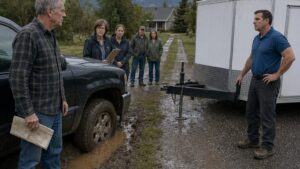
On the morning the ten-day deadline expired, Jeffrey looked through his kitchen window and saw Michael backing a boat trailer onto the disputed strip.
The tires rolled directly over two of the temporary survey flags.
Michael climbed out, checked the trailer angle, then walked inside as if nothing unusual had happened.
Jeffrey stood with his coffee untouched.
The certified letter had been delivered nine days earlier. Michael had signed for it. Jeffrey had the receipt in the folder beside him. He had expected an argument, a counteroffer, perhaps a call from an attorney.
Instead, Michael had answered with silence.
And now a trailer.
Jeffrey went outside.
Michael came back through his side gate carrying a wheel chock.
“You know the deadline was today.”
Michael crouched beside the trailer tire.
“I know what your letter said.”
“It wasn’t an invitation to keep using the property.”
Michael pushed the chock into place. “My attorney says ownership disputes aren’t decided by certified mail.”
Jeffrey felt irritation rise, but he kept his hands loose at his sides.
“Your attorney is right.”
Michael straightened, almost surprised.
“So we agree.”
“We agree that the letter didn’t decide the boundary. The survey did a better job of that.”
“You keep saying that like there’s only one document in the world.”
“And you keep parking things across an actual marked line.”
Michael looked toward the flags.
“The HOA approved my project.”
“We’ve covered that.”
“Not enough for you, apparently.”
Jeffrey glanced at the pergola. Since Sandra’s stop-work instruction, the workers had disappeared. The unfinished trim along one beam made the whole structure look suspended between completion and failure.
“I’m going to the county today,” Jeffrey said.
Michael’s expression changed.
“For what?”
“To check the permit history.”
“You already have your survey.”
“I also have a structure with concrete footings. If everything was done correctly, the records will show it.”
Michael gave a short laugh.
“You really can’t let this go.”
Jeffrey looked at the trailer tire sitting inches from a blue survey flag.
“No. Apparently I can’t.”
The county permit office occupied the first floor of a low brick building beside the planning department. Jeffrey had spent enough of his career in places like it to know that impatience slowed everything down.
He gave the clerk Michael’s address and the parcel number.
“I’m looking for building permits associated with an exterior structure. Pergola, patio cover, possibly concrete footings.”
The clerk searched.
Then searched again.
“What year?”
“This year.”
She frowned at the screen.
“I have an irrigation repair from last spring.”
“That’s it?”
“For this parcel, yes.”
“No structural permit?”
“Not under that address.”
Jeffrey leaned closer but did not touch the counter.
“What about setback review?”
She shook her head.
“Not seeing one.”
“Engineering?”
“Nothing submitted.”
He should have felt triumphant.
Instead, he felt a tightening behind his ribs.
This was the moment the short version of the story would have made simple: no permit, therefore victory.
But Jeffrey knew better.
“Can code enforcement stop use of the structure?”
The clerk looked toward another desk.
“You’d need to file a complaint. An inspector can determine whether permits were required and issue a stop-work order or violation notice.”
“And remove it?”
“That’s different.”
“How different?”
“Code can address unpermitted construction. They don’t determine private property ownership.”
Jeffrey nodded.
Of course.
The missing permit was leverage, not a deed.
He filed the complaint anyway.
By early afternoon, a code-enforcement inspector met him at the property. Michael emerged before Jeffrey could explain anything, already holding the HOA plan.
“This has been approved.”
The inspector barely glanced at it.
“By the association?”
“Yes.”
“I’m asking about county permits.”
Michael looked at Jeffrey.
“You filed this?”
Jeffrey said, “Yes.”
The inspector examined the pergola posts, connections, slab thickness where visible, and proximity to the marked line.
“I’ll need records from the contractor,” he said. “Until then, no additional work.”
Michael folded the HOA sheet.
“So this is what we’re doing now?”
Jeffrey did not answer.
The inspector continued. “And to be clear, I’m not deciding whose property this sits on. I’m deciding whether the construction complies with county requirements.”
Michael looked almost relieved by that distinction.
Jeffrey understood why.
Every institution could address only part of the problem.
The HOA could approve appearance.
The county could regulate construction.
The survey could identify the boundary.
But none of those, alone, would make Michael remove a finished slab.
By evening, Jeffrey’s anger had cooled into something more useful.
He made a list.
Survey.
Recorded plat.
HOA approval file.
Permit search.
Certified notice.
Photographs.
He stopped there.
He would build the case one piece at a time and resist the temptation to treat any single piece as the final answer.
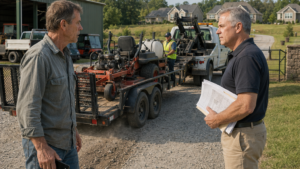
Two days later, the concrete subcontractor returned to retrieve forms stored behind Michael’s fence.
Jeffrey recognized him from the worker’s description and walked over while the man loaded lumber into a pickup.
“Can I ask you something about the footing?”
The subcontractor looked wary.
“Depends.”
“The iron marker by the slab. Was it there before the pour?”
The man stopped lifting.
“Yeah.”
“You knew it was there?”
“We found it during excavation.”
“What did you do?”
“Worked around it.”
“Why?”
The subcontractor looked toward Michael’s house.
Jeffrey waited.
The man lowered his voice.
“Homeowner told us not to pull it.”
Jeffrey felt the surrounding sounds sharpen—the pickup idling, a mower two houses away, the scrape of wood against the truck bed.
“Michael told you that?”
“I’m not getting dragged into whatever this is.”
“I’m not asking you to take sides.”
“He said it might be a property marker. Told us leave it where it was and pour around the area.”
Jeffrey stared toward the pergola.
The marker had not been overlooked.
It had been recognized as potentially important.
“Did he ask anyone to verify it?”
The subcontractor shook his head.
“Not while we were there.”
Then he lifted the last form into his truck.
“I’ve got to go.”
Jeffrey stepped back.
For ten days he had been asking why Michael acted so certain.
Now the question had changed.
If Michael suspected the iron pin marked the real boundary before the concrete set, then the mistake had stopped being innocent at some point.
Jeffrey only needed to know when.
Chapter 5: What Michael Knew Before the Concrete Set
“I saw the pin.”
Michael’s admission landed in the HOA hearing room without drama.
No one spoke.
Sandra sat at the center of the folding tables with the property manager beside her. Jeffrey had expected denials, objections, maybe an attorney doing most of the talking.
Instead, Michael had answered the question himself.
Sandra leaned forward.
“You saw it before the concrete was poured?”
“Yes.”
Jeffrey watched Michael’s hands.
They were clasped tightly enough that his knuckles had gone pale.
“Did you know what it was?” Sandra asked.
“I knew it might be a survey marker.”
Jeffrey felt anger arrive cleanly this time.
Not because the admission surprised him.
Because hearing Michael say it removed the last comfortable excuse.
Sandra looked toward Jeffrey.
He kept his voice measured.
“Why didn’t you stop the pour?”
Michael turned.
“You want the honest answer?”
“Yes.”
“Because stopping it would have cost me thousands.”
The room stayed quiet.
Michael leaned back, jaw tense.
“The footing crew was already there. Concrete was scheduled. I had deposits tied up. Lumber delivered. Furniture ordered. My daughter and her husband are coming next month, and my wife has been planning the whole family gathering around that space since January.”
Jeffrey said nothing.
Michael continued.
“And before you say none of that matters, I know it doesn’t change ownership. But I had an HOA-approved plan showing that strip inside my side. You had never once told me otherwise. Not when I mowed it. Not when I stored things there. Not when I put the trailer there.”
“You had a physical marker in the ground.”
“And a drawing from the association telling me something different.”
“You could have called a surveyor.”
Michael looked down.
“Yes.”
That one word changed the room.
No defensiveness.
No attempt to shift it back onto Jeffrey.
Just yes.
Sandra picked up the photograph Jeffrey had submitted. It showed the rusted iron pin after the dirt had been cleared away, fresh concrete less than a foot from it.
“We need to enter this into the association record,” she said.
Michael looked at her sharply.
“Now you care about the record?”
Sandra stiffened.
“I care about resolving this.”
“You approved the project.”
“The architectural committee approved the design.”
“Using your property line.”
“Our diagram.”
“Which showed the line wrong.”
Jeffrey watched Sandra struggle not to retreat into procedural language.
Then Michael added, “And your manager told me it was probably close enough.”
The property manager looked up.
“What?”
“When I asked about the line before construction.”
Sandra turned slowly.
“You asked?”
Michael nodded.
“I emailed because the old landscaping sheet and my closing documents weren’t perfectly clear.”
The property manager’s face had lost color.
“What did I say?”
Michael gave a tired laugh.
“You said the committee had used that diagram for years and it was ‘probably close enough for architectural review.’”
“I meant the diagram was sufficient for the application.”
“You didn’t say that.”
“I did not tell you it established ownership.”
“No. You just approved a permanent structure against it.”
Sandra closed her eyes briefly.
Jeffrey should have enjoyed watching responsibility spread away from him.
He didn’t.
The story was becoming less satisfying and more accurate.
Michael had made a conscious choice to keep going after seeing the pin.
The HOA had created confidence it should never have created.
And Jeffrey had watched the misunderstanding grow for years because saying nothing felt easier.
Sandra looked at Jeffrey.
“This may expose the association.”
Michael let out a breath.
“Finally.”
Jeffrey said, “It doesn’t change the line.”
“No,” Sandra said. “But it may change how costs are allocated.”
The HOA’s counsel, attending by speakerphone, confirmed what Sandra feared. Architectural approval did not determine ownership, but if an association-issued diagram materially contributed to the placement, the association could face part of the financial responsibility for correction.
Michael’s expression shifted.
For the first time since Jeffrey came home, he no longer looked like a man defending a claim.
He looked like a man calculating how much of the damage he might survive.
Jeffrey did not enjoy that either.
The hearing broke for twenty minutes.
Outside, Michael stood beside the clubhouse wall with his hands in his pockets.
Jeffrey was heading toward his truck when Michael called after him.
“You think I was trying to steal your yard?”
Jeffrey stopped.
“I think you kept building after you had a reason to question it.”
“That isn’t what I asked.”
Jeffrey turned.
“No. I don’t think you started this planning to take my property.”
Michael nodded once.
It seemed to matter.
“But after you found the marker,” Jeffrey added, “you chose the project over the question.”
Michael looked away.
“I was already in too deep.”
“That’s when questions matter most.”
“Easy to say when it isn’t your money.”
Jeffrey almost answered sharply.
Then he thought of all the jobs where clients had spent good money after bad because admitting a mistake felt worse than paying for it.
“I know exactly how hard it is,” he said. “That’s why you stop before the concrete truck arrives.”
Michael gave him a long look.
When the hearing resumed, Sandra asked both men whether they would consider negotiated removal before the association’s counsel formalized anything.
Michael spoke first.
“I’ll cut the pergola back.”
Jeffrey waited.
Michael unfolded a sketch.
“We remove the posts across the survey line, shorten the roof, reframe the side. I’ll pay for that.”
Jeffrey studied the drawing.
“And the slab?”
“It stays.”
Jeffrey looked up.
Michael continued quickly.
“It’s concrete. It isn’t hurting anything. We can cut the pergola back to my side and leave the slab where it is.”
“How much concrete remains on my property?”
“About six feet at the widest section.”
Sandra said, “It would reduce the cost significantly.”
Jeffrey stared at the sketch.
Six feet.
Less than twelve.
Less visible.
Cheaper.
The kind of compromise everyone in the room could call reasonable and go home feeling relieved.
Except the wrong line would still be there, only flatter.
Michael pushed the sketch across the table.
“I’ll remove the structure. You let the concrete go.”
Jeffrey rested his hand on the paper.
The offer would end the public fight.
It would also leave six feet of Michael’s mistake permanently inside Jeffrey’s yard.
Chapter 6: The Deal That Would Leave the Wrong Line
Six feet of concrete looked smaller on paper than it did in Jeffrey’s yard.
That was the danger.
The settlement sketch sat on his kitchen table beside the survey, turning the encroachment into a neat gray rectangle. Michael’s proposal removed the pergola posts beyond the line, trimmed back the roof, and left the slab untouched where demolition would be most expensive.
Jeffrey could sign it and be done.
His attorney had said as much that morning.
“It isn’t a bad settlement.”
“It leaves concrete on my property.”
“Yes.”
“Then it leaves the problem.”
“It leaves a documented license or easement if we draft it correctly.”
Jeffrey looked through the office window toward the parking lot.
“And when I sell?”
“The agreement follows the property.”
“So the next owner gets a six-foot slab that belongs to the neighbor.”
“Legally, we can define it.”
Jeffrey almost laughed.
Define it.
That was how the whole mess had started: one drawing defining something differently from the ground.
His attorney watched him.
“Are you trying to restore your property, or are you trying to make Michael lose?”
The question irritated him because it deserved an answer.
Jeffrey looked down at his hands.
“Restore it.”
“Then make sure every demand serves that.”
On the drive home, he passed his father’s old neighborhood without intending to.
The house had been sold years ago, but the driveway remained. Jeffrey could still picture his father standing there with a steel tape, furious that the neighbor’s gravel crossed eighteen inches over a surveyed line.
His father had eventually won.
The gravel was removed.
The legal bills had cost more than the driveway.
For years afterward, the two men refused to look at each other.
Jeffrey had built his adult life around not becoming that.
But perhaps he had misunderstood the lesson.
The problem had not been that his father defended a boundary.
The problem had been that the boundary became more important than every person around it.
Avoiding every uncomfortable conversation was not the opposite of obsession.
Sometimes it was simply another way of surrendering judgment.
That evening Jeffrey carried a spool of mason’s line into the yard.
The survey flags were still in place.
He tied the line at the rear pin, walked it forward, and pulled it taut toward the second monument.
The string crossed the new slab in a perfectly straight path.
Michael came out through his gate.
“What are you doing?”
“Looking at the actual compromise.”
Michael stared at the line.
“You already have the sketch.”
“The sketch makes six feet look small.”
“It is smaller than twelve.”
“Still on my property.”
Michael’s face tightened.
“So there is no compromise.”
Jeffrey shook his head.
“That isn’t what I said.”
He stepped onto the slab.
“I’ll share part of the removal cost associated with the section the HOA plan clearly misrepresented.”
Michael blinked.
“What?”
“The association should participate too. Their diagram contributed. I contributed by letting the use go unchallenged for years.”
Michael stared at him.
“You’re admitting that?”
“I’ve already admitted it.”
“But you still want all the concrete gone.”
“Yes.”
“Then what exactly are you offering?”
“A way to correct the mistake without pretending only one person created the conditions for it.”
Michael laughed bitterly.
“I’m the one losing a twenty-eight-thousand-dollar structure.”
“You’re also the one who saw a possible survey marker and kept pouring.”
The laughter stopped.
Jeffrey pointed to the string.
“This line has to mean something when we’re finished. Not just on paper.”
Michael stepped closer to it but did not cross.
“If I agree to this, I lose the pergola.”
“You keep whatever portion can legally and safely be rebuilt on your side.”
“That isn’t what we designed.”
“I know.”
“My family was supposed to be here in three weeks.”
Jeffrey heard exhaustion now more than anger.
“I’m sorry.”
Michael gave him a hard look.
“You don’t sound sorry.”
“I am sorry this happened. I’m not sorry the boundary is where it is.”
Neither man spoke for several seconds.
Then Michael said, “I need forty-eight hours.”
Jeffrey nodded.
“That’s reasonable.”
The answer came the next afternoon through their attorneys.
Michael rejected the proposal.
He would remove the pergola framing beyond the line but would not consent to removal of the slab.
Jeffrey read the email twice.
Then he forwarded it to Sandra.
By evening, the association’s counsel invoked the dispute provisions tied to the architectural approval. Code enforcement had already issued a formal notice regarding the unpermitted structure. With the recorded survey established and Michael’s partial admission documented in the HOA hearing, the paths that had been separate began to converge.
Not into instant victory.
Into pressure.
Michael called at nine that night.
“You really filed everything.”
“Yes.”
“You’re going to have a crew come tear this out?”
“If we can’t agree to remove the encroachment, yes.”
“You could stop it.”
“So could you.”
Michael was silent.
Jeffrey expected the call to end.
Instead Michael said, “How much are you actually willing to pay?”
Jeffrey sat down at the kitchen table.
“For the portions tied to the mistaken HOA diagram, I’ll contribute to reasonable removal costs. I won’t pay for reconstruction on your side.”
“And the HOA?”
“They’re discussing their share.”
“You trust them?”
“No.”
That surprised a short laugh out of Michael.
It was the first sound between them in weeks that did not carry an edge.
Then Michael said, “Send me the numbers.”
The following morning they met at Jeffrey’s attorney’s office.
No one called it reconciliation.
They went line by line.
Removal of all framing over the boundary.
Saw-cutting and removal of every section of slab crossing Jeffrey’s surveyed line.
Protection of drainage.
No disturbance of the survey monuments.
Salvage of reusable lumber.
Shared removal costs apportioned among Michael, Jeffrey, and the association without any party admitting broader liability.
Michael objected to three clauses.
Jeffrey objected to two.
They changed language.
They argued about access.
They stopped for coffee.
Then Michael stared at the final page for nearly a minute.
“If I sign this, it all comes out.”
Jeffrey said, “Everything over the line.”
Michael rubbed his thumb against the edge of the paper.
“You know I still think the association created half this mess.”
“They did.”
“And you let me use that strip for years.”
“I did.”
Michael looked at him.
Jeffrey did not look away.
“But I should have asked when the pin showed up,” Michael said.
“Yes.”
Michael signed.
The agreement authorized enforcement if either party refused access after signing, so there would be no second round of uncertainty.
A demolition contractor was scheduled for seven the next morning.
Just before sunset, Jeffrey went outside to remove the mason’s line before the crew arrived.
Michael was already there.
He stood beside the pergola, looking up through the cedar beams.
Jeffrey began winding the string.
Michael said, “Leave it.”
Jeffrey paused.
“The line.”
Michael nodded toward the taut cord crossing the slab.
“Leave it until tomorrow.”
Jeffrey let go of the spool.
For the first time, Michael was not asking him to ignore where the boundary was.
At 6:42 the next morning, the first demolition truck turned into the subdivision.
Chapter 7: By Noon, the Boundary Was Visible Again
At seven that morning, the first cedar beam lifted free above the disputed strip.
Jeffrey stood near his rear steps with both hands in his jacket pockets while the demolition contractor guided the suspended section away from the pergola. The crane moved slowly, almost delicately, carrying something that had dominated the yard for weeks as though it weighed no more than a fence panel.
The mason’s line Michael had asked him to leave remained stretched across the slab.
No one had crossed it by accident.
The contractor had reviewed the survey before starting. The crew marked the section to be removed, protected the drainage inlet, and set plywood around the exposed iron pin so equipment would not strike it.
Michael came outside carrying two patio chairs.
Jeffrey watched him move them to his garage.
There had been a part of Jeffrey, one he did not especially like, that expected Michael to make the morning difficult. He had imagined a last-minute objection, a phone call, a locked gate, perhaps another attempt to delay.
Instead, Michael returned for a table.
Then a planter.
Then a stack of unopened boxes.
When the contractor asked which cedar boards could be salvaged, Michael pointed to the longer roof members.
“If you can keep those whole, I’d appreciate it.”
The contractor nodded. “We can try.”
Jeffrey looked over.
Michael noticed.
“What?”
“Nothing.”
“You thought I was going to tell them to throw everything in a dumpster?”
“I didn’t know what you were going to do.”
Michael rested a hand on the table he was moving.
“Neither did I until this morning.”
The crane operator lowered another section onto blocking near the driveway.
Michael looked at the pile.
“I can rebuild smaller.”
Jeffrey nodded.
“On your side.”
Michael gave him a tired look.
“Yes, Jeffrey. On my side.”
It was not friendly.
But it was different.
By eight-thirty, the pergola no longer looked like a finished structure. Half the roof was gone. Two posts had been unbolted from their brackets, and workers were cutting connections along the surveyed boundary.
A sheriff’s deputy arrived briefly because the enforcement agreement allowed access across both lots and the contractor wanted the signed order on site in case anyone challenged the work. The deputy checked the paperwork, spoke quietly with the foreman, then stood near the driveway drinking coffee.
Two neighbors watched from across the street.
Jeffrey wished they would leave.
He had spent weeks imagining the moment the structure came down. In those private versions, removal felt like proof. Vindication made physical.
Now that it was happening, the public attention felt cheap.
One neighbor raised a phone.
Jeffrey walked toward him.
“Please don’t film over the fence.”
The neighbor lowered it.
“Sorry. Just curious.”
“I know.”
He returned to the yard.
Michael had heard.
“Could’ve let him.”
Jeffrey looked at him.
“Why?”
Michael shrugged. “You won.”
The word bothered Jeffrey.
He looked at the exposed slab, the dismantled cedar, the equipment sitting where grass had been six weeks earlier.
“This doesn’t look like winning.”
Michael’s expression softened for half a second.
“No.”
The concrete work began after nine.
A saw traced the surveyed line through the slab, throwing pale slurry into the containment mats. The sound was harsher than the crane, a high mechanical whine that made conversation impossible.
Jeffrey watched the blade pass within inches of the protected iron pin.
The tiny rusted circle remained visible beneath the plywood guard.
For weeks, everyone had argued over plans, approvals, assumptions, permits, and memory.
The pin had done none of that.
It had simply remained where it was.
When the saw stopped, the crew began breaking the encroaching section into manageable pieces.
Michael stood beside Jeffrey.
“My wife asked me last night why I didn’t stop when they found that thing.”
Jeffrey kept watching the crew.
“What did you tell her?”
“That I thought stopping would make the mistake real.”
Jeffrey turned.
Michael gave a small, embarrassed shake of his head.
“Doesn’t make much sense when I say it out loud.”
“It makes more sense than you think.”
Michael looked at him.
Jeffrey added, “I spent years thinking that if I didn’t mention the line, there wouldn’t be a boundary problem.”
“And how’d that work?”
Jeffrey almost smiled.
“About like this.”
For the first time since Jeffrey returned home, Michael smiled too.
It vanished quickly, but it had been there.
At eleven-fifteen, the last section of pergola crossing the boundary was lifted away.
The crane carried it over the yard while the mason’s line remained below, still marking the place the structure had ignored.
The final pieces of concrete followed.
By noon, the strip looked raw and unfinished. Dirt replaced the slab. The drainage swale was exposed again. Tire tracks crossed the lawn.
But the wrong structure was gone.
The iron pin remained.
Jeffrey crouched beside it.
The contractor had brushed the dirt away after removing the protective plywood. Rust marked the top, and the old orange ribbon was long gone.
Michael stopped nearby.
“You going to put a cover over that?”
“Probably a small marker sleeve. Something visible.”
Michael nodded.
“Good.”
Jeffrey looked up.
Michael seemed to realize what he had said.
Neither mentioned it.
The cost allocation arrived the following week.
Jeffrey did not recover everything.
His share of the removal, legal review, survey update, and restoration was enough to sting. The HOA’s insurer accepted part of the association’s responsibility tied to the misleading landscape diagram, and Michael carried the largest portion because he had continued construction after recognizing the possible marker.
It was fair enough to leave all three parties dissatisfied.
Jeffrey found that strangely reassuring.
Sandra called an HOA meeting three weeks later to adopt new architectural-review procedures.
The clubhouse room was fuller than usual.
David Thompson sat in the back row with an old binder across his knees. He had spent several days helping the board identify where the misleading landscaping diagram had originated.
When Sandra reached that item, David raised his hand.
“That sheet was never meant to identify ownership.”
Sandra nodded. “We understand that now.”
“It was a maintenance sketch. We used it years ago for mowing zones and planting responsibility.”
Michael, seated two chairs from Jeffrey, leaned forward.
“So how did it end up in architectural files?”
David looked uncomfortable.
“Convenience.”
A few people shifted in their seats.
He continued.
“People kept copying it because it already showed fences and landscaping. Eventually the dotted maintenance lines started looking official.”
Sandra said, “Which is why the new procedure requires owners proposing permanent construction near a lot boundary to provide a survey or other acceptable boundary verification.”
There were no objections.
Then the property manager displayed a proposed landscaping update for Jeffrey and Michael’s shared side yard.
Low shrubs.
Fresh sod.
A narrow decorative bed.
Jeffrey studied the drawing.
The survey pins had been hidden beneath two planting symbols.
He raised his hand.
Sandra looked at him.
“Yes?”
“I want the markers left visible.”
The property manager glanced down.
“They’d look cleaner concealed in the landscaping.”
“No.”
The word came out without anger.
Just clear.
Sandra hesitated.
Jeffrey continued.
“Not exposed enough to create a hazard. But accessible. Marked. No shrubs over them.”
Michael turned toward him.
Jeffrey expected resistance.
Instead Michael said, “I agree.”
Sandra looked between them.
“Both homeowners?”
“Yes,” Michael said.
Jeffrey nodded.
“Both.”
The property manager crossed out the two planting symbols.
That was all.
No speech.
No applause.
No dramatic apology.
Just a small correction made before it could become another large mistake.
After the meeting, Jeffrey and Michael walked out at nearly the same time.
At the sidewalk, Michael stopped.
“My daughter came last weekend.”
Jeffrey waited.
“We put folding tables on the part of the patio that’s left.”
“How was it?”
“Crowded.”
Jeffrey smiled.
Michael did too.
“But fine,” he said. “It was fine.”
They stood there for a moment.
Then Michael gestured toward their houses.
“I’m getting a survey before I rebuild anything.”
“That would be smart.”
“You planning to inspect it?”
“No.”
Michael laughed.
“Progress.”
Jeffrey walked home.
The restored strip was still patchy where the crew had removed concrete, but new grass had begun filling the bare soil. Near the swale, the iron pin sat inside a small protective sleeve with a plain cap visible above grade.
Jeffrey stopped beside it.
For years, he had thought peace meant not forcing uncomfortable things into the open.
Now he understood something simpler.
A boundary did not have to become a weapon.
But it did have to be acknowledged.
He stepped over the marked line, onto his own grass, and kept walking toward the house.
The story has ended.