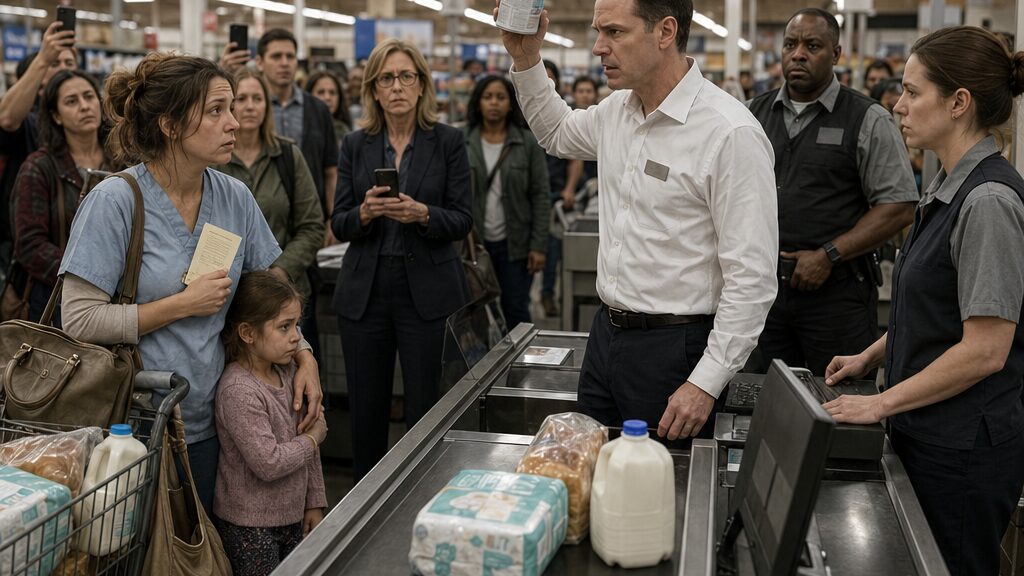
A Tired Nurse’s Aide Was Accused Over Baby Formula Until The Register Logs Exposed The Real Thief
Chapter 1: The Formula On The Checkout Belt
Kimberly Davis counted the items on the checkout belt twice before she let go of the baby formula.
Not because she didn’t know what was there. She knew exactly. One can of formula. One small pack of diapers. A gallon of milk. Store-brand cereal. Two apples because Amy had touched the red ones first. A loaf of bread. Peanut butter. A bag of rice. Chicken thighs with a discount sticker curled at one corner. Nothing extra. Nothing that had not been weighed against the voucher, the coupons, and the folded bills in Kimberly’s pocket.
The belt moved with a rubbery jerk, pulling the formula toward the scanner.
Kimberly put her palm on the can for half a second longer.
“Mom,” Amy whispered, leaning against her hip.
“I know, baby.” Kimberly lifted her hand. “Almost done.”
The grocery store was packed in the thick, impatient way it got on Saturdays, carts wedged crookedly into lanes, people staring over shoulders to judge how long each line would take. The fluorescent lights flattened every tired face. Somewhere near the front doors, a self-checkout machine repeated, “Please place item in bagging area,” as if it had been abandoned mid-argument.
Kimberly could still smell antiseptic on her own sleeves.
Her nurse’s aide uniform had a faint crease where she had slept against the bus window for eleven minutes and woken up two stops early with Amy’s daycare bag sliding off her lap. She had not gone home first because if she went home, she might sit down. If she sat down, the grocery trip would become impossible. So she had picked Amy up, promised cereal, and walked straight into the store with a list written on the back of an old appointment card.
The cashier at Register Four scanned the formula first.
Beep.
Kimberly watched the number appear on the screen, too large even though she had expected it. The can rolled slightly as the cashier placed it at the end of the counter.
“Do you want the diapers bagged separate?” the cashier asked.
Her name tag read Susan Moore. Her smile was thin but not unkind.
“No, together is fine,” Kimberly said quickly, then softer, “Thank you.”
She hated how grateful she sounded for ordinary things. A regular bag. A regular scan. A regular afternoon in which no one looked too hard at her card.
Amy hooked both hands around the cart’s front rail and rose onto her toes. “Can I hold the apples?”
“When we’re done.”
The man behind Kimberly sighed loudly. His cart held soda cases, steaks, and paper towels stacked like bricks. Behind him, a woman in sunglasses stood with one item in her hand and kept checking the other lanes as if Kimberly had personally trapped her there.
Kimberly kept her eyes on the screen.
Beep. Milk.
Beep. Cereal.
Beep. Bread.
The total climbed. Her shoulders tightened with every number, then loosened when she reminded herself the voucher would cover the formula and most of the essentials. The coupons would take off enough. The cash would cover what remained. She had checked the balance before work, then again during her break at 3:10 in the morning while a resident called for water down the hall. Approved, the screen had said. Available immediately.
Susan scanned the last coupon. “Okay. Benefits or voucher first?”
“Voucher first, please.” Kimberly pulled it from the inside pocket of her bag. It was still in the envelope because she had not wanted it bent. “It should already be approved.”
Susan took it carefully and slid it beneath the scanner.
The register made a sound Kimberly did not like.
Not a beep. A blunt little rejection tone.
Susan frowned at the screen. Kimberly felt the people behind her shift before anyone spoke.
“Sometimes it needs the number typed in,” Susan said.
Kimberly nodded too fast. “That’s fine.”
Susan typed. Her finger hovered, then pressed enter.
The same rejection tone came again.
Amy looked up. “Was that bad?”
“No,” Kimberly said. “Just the machine being slow.”
The man behind her muttered, “Of course.”
Heat moved up Kimberly’s neck. She kept her face calm. She had learned that. At the care facility, with residents who cried from pain and families who blamed the nearest uniform. On buses when someone looked at Amy’s shoes, then at Kimberly’s scrubs, then away. At offices where a form missing one mark meant starting over.
Calm made people less likely to decide you were a problem.
Susan bent closer to the screen. “It says transaction not authorized, but that doesn’t make sense if it’s a family voucher. Did you activate it?”
“Yes.” Kimberly opened the envelope and pulled out the printed confirmation. “I checked before coming. It says approved.”
Susan glanced at the paper. Something crossed her face so quickly Kimberly might have missed it if she had not been watching for danger all day.
Recognition.
Not of Kimberly. Of the problem.
Susan lowered her voice. “Let me try one more thing.”
The line behind them breathed as one irritated body.
Kimberly touched Amy’s shoulder. “Stay close, okay?”
“I am.”
Susan rescanned the voucher, then canceled, then tried again through another menu. Her fingers moved carefully, as if choosing the wrong button would summon someone.
The rejection tone sounded a third time.
This time the woman in sunglasses said, “Some of us are in a hurry.”
Kimberly turned halfway. “I’m sorry. It should only take—”
“You people always say that,” the woman said, not loudly enough to become the center of the scene, but loudly enough for Kimberly to hear every word.
Kimberly faced front again. She could feel Amy pressed against her leg. She wanted to explain that she had been on her feet all night helping someone else’s father to the bathroom, changing sheets, checking pulse oxygen, warming blankets. She wanted to say she was not trying to hold anyone up. She wanted to say the formula was not optional.
Instead, she said to Susan, “Could you check the balance again? Or the approval code?”
Susan’s eyes flicked toward the end of the registers, past the impulse candy and the display of batteries.
Kimberly followed her glance.
A man in a white dress shirt and dark tie was walking toward them with a bunch of keys hooked to his belt. He had the quick, clipped stride of someone who enjoyed being called over. The badge on his chest read Mark Lewis, Store Manager.
“What’s the holdup?” he asked before he reached the lane.
Susan straightened. “Voucher issue. I’m checking—”
“We’ve got six lanes backed up,” Mark said. He looked at Kimberly, then at the groceries, then at Amy, then back at Kimberly. His face settled into a shape she recognized too well: polite on the outside, already finished deciding on the inside. “What kind of voucher?”
“Family assistance,” Kimberly said. She held up the paper. “It’s approved. The register isn’t taking it.”
Mark did not take the paper. “Benefits card?”
“Voucher. The card is for the rest if needed, but the formula should—”
“Formula,” Mark repeated.
He reached past Susan and tapped the screen. Susan moved aside without being told. That frightened Kimberly more than the failed tone had.
Mark scrolled through the transaction. The store noise seemed to narrow around them: scanning beeps, cart wheels, a child whining somewhere in the next lane, the man behind her sighing again.
“It declined,” Mark said.
“It shouldn’t have,” Kimberly replied. Her voice came out careful, almost apologetic. She hated that too. “Could you check the transaction logs? Maybe it’s a system error.”
Mark looked at her for the first time as if she had said something amusing. “The register says it declined.”
“I understand that. But the voucher—”
“Ma’am, I can only go by what the system tells me.”
Susan opened her mouth, then closed it.
Kimberly saw it. Mark saw Kimberly see it.
“What?” Kimberly asked Susan quietly.
Susan’s hand tightened on the edge of the counter. “Nothing.”
Mark took the printed confirmation from Kimberly at last, barely glanced at it, and put it on the counter as if it were already irrelevant. “Do you have another form of payment?”
Kimberly knew the answer in exact numbers. Her debit card had enough for milk, bread, rice, and maybe diapers if the coupons applied after the discount. Not the formula. Not the whole cart.
“I have cash and my card for part of it,” she said. “The voucher is for the formula.”
Mark’s eyes moved to the can.
It sat at the end of the counter, separated from the rest of the groceries, white lid bright under the fluorescent light.
Amy reached toward it. “Is that mine?”
Kimberly gently pulled her hand back. “Wait, sweetheart.”
The man behind her said, “Can they suspend it and let us through?”
Susan looked at Mark. “I can move the transaction to customer service and—”
“No,” Mark said.
One syllable. Flat enough to stop her.
He picked up the can of baby formula.
Kimberly’s hand twitched before she could stop it, a small useless reach toward what she had not yet bought but already needed. Mark held the can chest-high, label turned toward the line, like he was showing everyone why they had been waiting.
“Ma’am,” he said, louder now, “were you planning to pay for this?”
Chapter 2: The Manager Holds Up The Can
“If you can’t afford baby formula,” Mark Lewis said, lifting the can high enough for the next two checkout lanes to see, “maybe you shouldn’t have had a kid.”
For one second, the store seemed to lose power without the lights going out.
No scanner beeped. No cart moved. The woman in sunglasses stopped looking at the other lanes. The man with the soda cases stared down at his own hands.
Kimberly felt Amy’s fingers curl into the fabric of her scrub pants.
The sentence did not hit Kimberly like anger at first. It hit like exposure. Like someone had torn open the private place where she kept every fear she refused to say aloud. That the daycare teacher noticed when Amy’s socks didn’t match. That the neighbors heard her counting quarters through the wall. That every form, every voucher, every discounted sticker on meat was a public confession that she was barely holding the shape of a life together.
She looked at the formula in Mark’s hand.
Then at Amy.
Then at Susan, whose face had gone pale.
“I am paying,” Kimberly said. Her voice was quiet. Too quiet. She made it stronger. “The voucher is approved. Please check the logs.”
Mark gave a small laugh without humor. “The logs aren’t going to make money appear.”
“It isn’t money appearing. It’s assistance that was already approved.”
“Assistance,” he repeated, turning the word into something dirty.
A phone rose behind the gum display. Then another, half-hidden near a rack of gift cards. Kimberly saw the black circles of cameras pointing her way, and a sick part of her wanted to disappear more than she wanted to win.
Amy whispered, “Mom, why is he holding it?”
Kimberly bent just enough to touch Amy’s hair. “Because there’s a mistake.”
Mark heard. “The mistake is people thinking they can walk in here with a basket full of merchandise and a story.”
Susan flinched.
Kimberly held up the confirmation paper with both hands so it would not shake. “There’s an approval code. The time is printed right here. If your register rejected it, there should be a record.”
Mark put the can down on the counter, but kept one hand on top of it. Possession. Control.
“I know how my registers work,” he said.
“Then it should be easy to check.”
The words came out before Kimberly could soften them. She felt the change in the air around her, the small intake from someone in line, Susan’s eyes widening, Amy going very still. Kimberly had spent years smoothing herself down so people in charge would not decide she was difficult. She had not meant to sound like a challenge.
Mark smiled.
Not with his eyes.
“Susan,” he said, still looking at Kimberly, “print the failed receipt.”
Susan hesitated. “Mark, I can suspend it and take her to—”
“Print the receipt.”
Susan pressed the key. The machine spat out a thin white strip that curled as it emerged. Mark tore it off sharply.
“Declined,” he said, waving it once. “That’s the log you need.”
“That’s not the full transaction log.”
The words came from Kimberly again. Less accidental this time.
Mark’s jaw tightened. “You work here?”
“No.”
“Then don’t tell me how to run my front end.”
“I’m asking you to review a voucher that your employee seems concerned about.”
Susan looked down.
That look told Kimberly she had stepped too close to whatever Susan was afraid of. Mark turned his head slowly toward the cashier.
“Concerned?” he said.
Susan swallowed. “The voucher screen has been acting up.”
Mark’s hand flattened on the counter. “Has it?”
Susan said nothing.
The line had begun to widen instead of lengthen. People from nearby lanes angled their carts to see. No one wanted to be involved, but everyone wanted to witness. Kimberly could feel their attention on her uniform, her groceries, her child’s small hand gripping her leg.
Mark looked back at Kimberly and raised the failed receipt. “You tried to put through a declined voucher. You don’t have payment for the formula. That means the item stays here.”
“I never tried to leave with it.”
“Not yet.”
The word opened something cold in Kimberly’s stomach.
She glanced at the doors. The exit looked impossibly far beyond the registers and stacked shopping baskets. She pictured walking away without the formula. Then she pictured Amy watching her do it. Not understanding the voucher or the receipt or the policy, only understanding that a man had said her mother should be ashamed and her mother had obeyed.
“Please check the logs,” Kimberly said again.
Mark leaned closer. “You keep repeating that like it changes the facts.”
“It might.”
A murmur ran through the nearby customers.
Mark’s face changed. Not much. Enough. The public scene he thought he was controlling had begun to tilt, and he felt it.
He took the failed receipt and flicked it toward Kimberly. It did not reach her hand. It struck the side of her cart, fluttered down, and landed near her shoes on the white tile.
Amy bent to pick it up.
“No,” Kimberly said quickly, putting a hand against her shoulder. “Stay right here.”
Mark turned away as if done with them. “Anthony.”
A security guard at the end of the checkout row straightened. He had been pretending not to watch. His name tag read Anthony Ward. He was broad-shouldered, with a radio clipped to his vest and a face that looked younger when he was uncertain.
“Yeah?” Anthony asked.
“Check her bag before she leaves.”
Kimberly’s throat closed. Her bag hung from the cart handle, open at the top: wallet, daycare form, a pack of wipes, a folded bus schedule, Amy’s pink sweater. Nothing hidden. Nothing stolen. Still, the idea of a stranger’s hands inside it while everyone watched made her feel suddenly bare.
“I didn’t steal anything,” she said.
“Then you won’t mind,” Mark replied.
“I do mind.”
That stopped Anthony halfway to the cart.
Kimberly heard her own breathing. She heard Amy’s small, frightened inhale. She heard someone whisper, “Record this.”
Mark pointed at the bag. “Anthony.”
Anthony took another step. “Ma’am, I just need to—”
“No,” Kimberly said.
The word surprised her. It was not loud. It did not shake. It simply stood there.
Mark’s eyebrows lifted. “Excuse me?”
“You don’t have evidence to search my bag. You have a voucher failure and a receipt you threw on the floor.”
The woman in sunglasses lowered her phone, then lifted it again, this time openly.
Mark’s face darkened. “You’re refusing a security check?”
“I’m refusing to be treated like I stole baby formula when the formula is on your counter.”
A few people looked at the can. It sat under Mark’s hand, proving Kimberly’s point without meaning to.
Susan gripped the register drawer. Her lips parted. Closed. Opened again.
Mark snapped at her without turning. “Don’t.”
But the word was too late.
Susan’s voice came out thin, almost a whisper. “Mark… this happened at two other registers.”
Anthony stopped moving.
Kimberly turned toward Susan.
Mark turned too, slowly.
Susan looked as if she wished she could take the sentence back, but it was already in the air, already heard, already changing the shape of the scene.
Chapter 3: Three Registers Failed Before Hers
“This happened at two other registers,” Susan said again, because the first time had come out too small and Mark’s stare had tried to crush it.
Mark’s hand left the formula can.
The customers noticed. Kimberly noticed too.
Susan’s cheeks burned red, but she kept going, eyes fixed somewhere between the scanner and Kimberly’s cart. “Register Two rejected a voucher at noon. Register Seven did it after that. Self-checkout had an error code on a pickup order.”
“Enough,” Mark said.
“No,” Kimberly said before Susan could fold back into silence. “Please finish.”
Mark turned on her. “This is an employee matter.”
“It became my matter when you accused me in front of everyone.”
A sharp quiet followed. Not silence exactly; the store still lived around them. Receipt printers chattered, carts squeaked, a child laughed near the produce entrance. But around Register Four, people held still.
Anthony’s hand hovered near Kimberly’s bag, then dropped to his side.
“I’m not searching anything until we know what’s going on,” he said.
Mark looked at him with disbelief. “You don’t decide procedure.”
Anthony’s ears flushed. “Procedure needs a reason.”
Kimberly let out a breath she had not realized she was holding.
Behind her, the woman in sunglasses stepped closer. “I got all that on video.”
Mark pointed at her phone. “Recording employees without permission is against store policy.”
The woman did not lower it. “So is humiliating customers, I hope.”
Another woman moved out from the next lane with a hand basket hooked over her arm. She was older than Kimberly, dressed in a navy blazer despite the heat outside, with reading glasses hanging from a cord at her neck. She had been watching without filming.
“My name is Barbara Scott,” she said. “I’m a customer-rights attorney. Store policy does not override state law or evidence preservation.”
Mark blinked once. “This doesn’t concern you.”
“It concerns everyone in this line if your manager response to a payment error is a public accusation and an attempted bag search.”
Kimberly felt the scene slipping away from her, becoming larger, full of words she did not use in daily life. Evidence preservation. Liability. Policy. For one dizzy second she wanted Barbara to keep talking forever so Kimberly would not have to. Then Amy pressed closer, and Kimberly remembered whose name Mark had put under suspicion.
She bent and picked up the receipt from the floor.
The paper was warm from the printer and dusty from the tile. It had curled at both ends. Mark’s shoe shifted when she took it, as if he had not expected her to keep the thing he had thrown away.
“I want my transaction reviewed,” Kimberly said.
Mark reached for the receipt. “I’ll handle that at customer service.”
Kimberly pulled it back. “No. I’ll hold it.”
His eyes narrowed.
Barbara stepped slightly beside Kimberly, not in front of her. “That is wise.”
Susan swallowed. “The customer-service desk can pull up suspended transactions.”
“I didn’t suspend this,” Mark said.
“No,” Susan said quietly. “You told me to print the failed receipt.”
Mark’s gaze snapped to her again.
Kimberly looked down at the strip of paper. Most of it was ordinary: store number, register number, item list, total, voucher declined. The ink was faint where Susan’s register needed a new roll. Kimberly traced the lines with her eyes, trying to make sense of details she usually ignored because receipts were proof of money leaving, nothing more.
Then she saw the time.
2:43 p.m.
That was wrong.
“It didn’t fail at 2:43,” Kimberly said.
Susan leaned over despite Mark’s glare. “What?”
Kimberly pointed. “It failed just now. After 2:50. I checked my phone when we got in line because Amy’s daycare bag alarm was going off. It was 2:49.”
Mark gave a hard little laugh. “You’re arguing minutes now?”
“Yes,” Kimberly said, because suddenly the minutes felt like a door. “Why does it say 2:43?”
Susan’s face changed again. The same quick flicker Kimberly had seen earlier.
Barbara’s voice sharpened. “Can you print a full transaction history for this register?”
“No,” Mark said.
Susan said, “Yes.”
The two answers collided.
Mark stepped toward her. “Susan.”
She shrank back, but not all the way. “Managers can. Or customer service can.”
“You’re confused.”
“I’m not.”
The man with the soda cases pulled his cart back a few inches, no longer impatient, now interested. The woman in sunglasses whispered something into her phone camera.
Mark snatched the formula can from the counter again, but this time the gesture looked less powerful. More like he needed something in his hand. “This customer attempted to use an invalid voucher. She doesn’t have payment. I’m moving the item to customer service until she can pay.”
Kimberly’s mouth went dry. “You just changed what you said. First you said I intended to leave with it. Now you’re saying the voucher is invalid.”
“It declined.”
“That’s not the same.”
Barbara nodded once, almost approvingly.
Mark saw it and stiffened. “Are you two together?”
Kimberly looked at him, stunned. “I don’t know her.”
“Convenient.”
Anthony frowned. “Mark.”
“What?” Mark snapped.
Anthony glanced at the phone cameras, then at Amy, then at Kimberly’s bag. “Maybe we should just pull the register log.”
Mark said nothing for two seconds too long.
That pause did more than any argument could have done.
Kimberly looked back at the receipt. If the time was wrong, what else was wrong? Her eyes moved lower, past the total, past the voucher code, past the declined line.
Near the bottom, in small block letters almost swallowed by the paper curl, were three words she did not understand.
MANAGER OVERRIDE PENDING.
Her finger stopped there.
“Susan,” she said, holding the receipt toward the cashier without letting it go, “what does this mean?”
Susan’s face drained of color.
Mark moved fast then. “Give me that.”
Kimberly stepped back, pulling Amy with her.
Barbara’s hand shot out, palm open between Mark and the receipt. “Do not touch her.”
The checkout lane erupted in overlapping voices, carts scraping, someone saying, “Whoa,” someone else calling for a supervisor who was already there and suddenly looked less like one.
Kimberly held the receipt against her chest.
Her heart was beating so hard she could feel the paper tremble.
Mark stared at the line near her finger. For the first time since he had arrived, he looked less angry than afraid.
Kimberly read the words aloud, slowly enough for the phones to catch them.
“Manager override pending.”
Chapter 4: The Override Nobody Was Supposed To See
“Manager override pending,” Kimberly said again, because Mark’s face had changed before anyone explained what the words meant.
The receipt shook once in her hand. She steadied it against her palm.
Mark reached across the counter. “That receipt belongs to the store.”
“It landed on the floor,” Kimberly said.
“Because you’re making a scene.”
Barbara Scott stepped closer, not touching Kimberly, not crowding her, just close enough that Mark would have to reach past another witness to grab the paper. “If there’s an override line, she has every reason to keep that receipt.”
Susan’s eyes flicked toward the customer-service desk twenty feet away. There was a tablet mounted there on a stand, its black screen reflecting the overhead lights. A locked drawer sat beneath it. Behind the desk, a shelf held abandoned returns: a coffee maker with tape around the box, a cracked picture frame, a bag of baby socks still clipped together.
The formula can was no longer in Mark’s hand. He had set it behind the counter near the register, out of Kimberly’s reach.
Amy looked from the can to Kimberly. “Can we just go home?”
The question nearly did what Mark had not.
Kimberly looked down at her daughter’s face, at the tired crease between her eyebrows that no child should have had yet, and for one second her body leaned toward leaving. Leaving would end the staring. Leaving would get Amy out of the hot white lights and the ring of phones. Leaving would let Kimberly cry later in the carless dark between the bus stop and their apartment.
But Amy would remember that they left without the formula because a man had said they did not deserve it.
Kimberly folded the receipt once, carefully, and held it in her fist.
“No,” she said softly. “Not yet.”
Mark heard the answer. “Then we’ll move this to customer service.”
“You said you wouldn’t check the full log,” Kimberly said.
“I said I would handle it.”
“That isn’t the same thing.”
A few people murmured. The line at Register Four had stopped pretending to be a line. Carts had formed a crooked half-circle around the confrontation. Susan’s register light blinked overhead, calling for help that no one wanted to be.
Mark leaned toward Kimberly, lowering his voice enough to sound controlled but not enough to be private. “You are disrupting business. I can ask you to leave.”
“You can ask,” Barbara said. “But if you trespass a customer after your employee admits multiple voucher failures and a receipt shows a manager override, you should preserve every record before you do.”
Mark looked at Barbara with open dislike. “You keep saying preserve records like this is court.”
“No,” Barbara said. “I’m saying it because stores often discover too late that deleting small things makes large things worse.”
Susan swallowed.
Anthony stood beside Kimberly’s cart, no longer reaching for the bag. His shoulders were squared, but his eyes kept moving between Mark and the service desk tablet. He looked like a man listening to two rules in his head and not knowing which one would cost him less.
Mark clapped his hands once. The sound made Amy jump.
“Fine,” he said. “Customer service. Now.”
He picked up the formula, not the rest of the groceries, and carried it toward the desk as if the can were contraband. Kimberly pushed the cart after him, one hand on Amy’s shoulder. Susan came from behind the register only after Mark turned and snapped his fingers.
“You too,” he said. “Since you apparently have a lot to say.”
Susan’s face tightened, but she followed.
At the customer-service desk, Mark placed the formula behind the counter, beside the tablet. The distance was small. It felt enormous. Kimberly’s cart held milk, bread, diapers, everything but the one thing that mattered most.
Mark tapped the tablet awake with his employee code. The screen glowed blue-white. He angled his body so Kimberly could not see it.
“Register Four,” Barbara said. “Transaction around 2:50 p.m.”
Mark ignored her.
Kimberly said, “The receipt says 2:43.”
He stopped tapping for half a beat. “The system time can lag.”
Susan’s voice came low. “It doesn’t lag seven minutes.”
Mark did not turn around. “You want to keep working here, Susan?”
Susan went still.
Kimberly heard the threat land. She saw Susan’s hands close into small fists at her sides. For the first time, she understood Susan’s silence as more than weakness. It was rent. Groceries. A schedule posted week by week. A manager with the power to turn one bad moment into missing hours.
Kimberly hated that she had wanted Susan to be braver sooner. She also hated that Susan had not been.
Barbara leaned toward Kimberly. “May I see the receipt?”
Kimberly hesitated.
It was foolish, maybe. Barbara was helping. But the receipt was the first thing in the store that felt like hers because Mark had tried to throw it away. Kimberly did not let it go. She unfolded it and held it where Barbara could read without taking it.
Barbara nodded once. “Keep it.”
The small instruction steadied her.
At the edge of the service desk, Anthony’s radio hissed. He turned it down quickly. His gaze had caught on a monitor mounted high in the corner, split into little squares of security feeds: doors, self-checkout, formula aisle, registers. In one square, Register Four showed a small crowd gathered around empty space where Kimberly had stood minutes earlier.
Another square showed the customer-service desk from above.
Another showed the formula aisle.
Anthony’s eyes narrowed.
“What is it?” Kimberly asked.
He glanced at Mark, then lowered his voice. “Nothing yet.”
Mark tapped hard at the tablet. “There’s no active transaction to review. It declined. That’s the end of it.”
“Then why does my receipt say manager override pending?” Kimberly asked.
“Because Susan printed it wrong.”
Susan looked up. “Receipts don’t print wrong words.”
Mark turned on her. “You want to explain to corporate why you’re arguing with your manager in front of customers?”
“Maybe corporate should hear why vouchers are failing,” Barbara said.
Mark pointed at the front doors. “I have the right to remove anyone interfering with operations.”
Kimberly’s stomach twisted. There it was, official-sounding, wide enough to swallow her. Disrupting business. Interfering. Refusing. Words that could make her look like the problem even when she stood beside a cart of unpaid groceries and a child who wanted to go home.
Amy tugged her sleeve. “Are we in trouble?”
Kimberly’s answer caught behind her teeth.
Because the honest answer was yes. They were in trouble. Not the kind with police lights or handcuffs, maybe, but the kind that followed poor women home and sat beside them for years. The kind where a stranger’s video became a joke online. The kind where Amy might later ask why Kimberly had let him say that.
Kimberly crouched so she was level with her daughter. The floor smelled faintly of spilled soda and bleach.
“We didn’t do anything wrong,” she said.
Amy’s eyes searched hers. “Then why is he mad?”
Kimberly looked up at Mark. He was watching, arms crossed, impatience arranged over fear.
“Because I’m asking him to check,” she said.
She stood before her courage could drain out through her knees. “I am not leaving until the voucher approval and the store log are compared.”
Mark’s face hardened. “Then I’m issuing a trespass warning.”
Anthony moved at that, but not toward Kimberly. He stepped toward the service desk monitor. “Mark, wait.”
Mark snapped, “What now?”
Anthony pointed to one of the security feeds. “That’s you at the tablet.”
The monitor showed a small, silent version of the customer-service desk. Time stamp in the corner. 2:43 p.m. Mark, in his white shirt and tie, stood at the tablet. His finger moved over the screen. Then he looked toward the registers.
Kimberly stepped closer. “That’s before my voucher failed.”
Mark’s voice sharpened. “Security monitors are not for customer review.”
“No,” Anthony said, uneasily. “But she’s right. That’s 2:43.”
Barbara took out her phone, not to film Mark this time, but to dial. “Kimberly, may I see the voucher confirmation number?”
Kimberly handed her the paper this time. Not the receipt. The voucher.
Barbara read the number to an automated line, then waited, one finger pressed to her other ear against the noise of the store. “Yes. I’m calling to verify a family-assistance voucher approval. Customer is present. Store transaction disputed.”
Mark took a step toward her. “You can’t call them on behalf of—”
“I have the customer’s permission,” Barbara said.
Kimberly nodded, though no one had asked her yet. “She does.”
The line clicked. Barbara repeated the number, Kimberly’s last name, the store location printed on the voucher. She listened.
The store seemed to lean toward the phone.
Barbara’s face changed before she spoke.
“Approved,” she said. “At 2:41 p.m. Redemption authorized. No customer-side rejection.”
Kimberly heard Susan inhale.
Barbara looked straight at Mark. “They say the voucher was approved minutes before your system blocked it.”
Mark’s mouth opened, then closed.
The formula can sat behind him on the counter, untouched, bright, and suddenly no longer evidence against Kimberly.
It had become the thing someone inside the store had refused to release.
Chapter 5: The Mothers Who Left Quietly
“You’re not the first mother he made leave without formula,” Susan said.
She had followed Kimberly only halfway down the short hallway near the break room, then stopped as if the words had pulled her backward. The employee door swung behind her, showing a slice of beige wall, a time clock, and a bulletin board crowded with schedules and faded safety notices.
Kimberly turned with one hand still on Amy’s shoulder.
Mark was at the customer-service desk arguing with Barbara, his voice too controlled to be calm. Anthony stood near the monitor, pretending to adjust the radio at his shoulder while keeping his body between Mark and the tablet. Customers hovered at a distance now, trying to look like they were shopping while watching every movement.
Susan’s eyes were wet, but no tears fell. “I should’ve said something sooner.”
Kimberly wanted to answer with grace. She wanted to be the kind of person who could say, It’s okay, I understand, because Susan looked young and frightened and trapped under a manager’s thumb.
But Kimberly thought of the formula can behind the desk.
She thought of Amy asking if they were in trouble.
“How many?” Kimberly asked.
Susan’s mouth trembled. “I don’t know.”
“That’s not an answer.”
“I don’t know because not all of them came through my register.” Susan folded her arms tightly around herself. “Sometimes I only heard him over the radio. Voucher dispute. Formula hold. Customer removed. He’d say it like it was normal.”
Amy leaned into Kimberly’s leg, bored and frightened at the same time, the way children became when adult fear lasted too long. Kimberly smoothed a hand over her hair and kept her eyes on Susan.
“Did they steal?” she asked.
Susan looked ashamed. “I never saw anyone steal.”
The hallway felt narrower.
Kimberly could hear Mark saying her name from the desk. “Kimberly Davis has been causing a disturbance for over twenty minutes.”
Barbara’s voice cut through, crisp. “Because you accused her without checking an approved voucher.”
Susan flinched at both voices.
“Why didn’t you report him?” Kimberly asked.
Susan stared at the floor. “To who? He opens the complaints. He schedules the hours. He told us corporate was already watching shrink numbers and anyone who let bad vouchers through would be responsible.”
“Shrink numbers?”
“Missing inventory.” Susan swallowed. “Baby formula mostly. It’s locked in some stores, but here we keep it behind the service desk after six. People steal it. People resell it. That part is real.”
Kimberly felt the old familiar trap opening: a real problem used as an excuse to punish the easiest person in reach.
Susan rushed on. “He said assistance vouchers were getting abused. He said if we questioned him, we were helping fraud. He made it sound like protecting the store.”
“Did you believe him?”
Susan looked up then, and that was the surprise. The answer was not simple.
“At first,” she said. “Some people do try things. I’ve seen fake coupons. Swapped tags. Receipts from other stores. And Mark knew all the codes, all the policies. He’d come over and fix things before we even asked. It felt like he was the only one keeping the front from falling apart.”
Kimberly heard the fairness in the answer, and it irritated her because she did not want fairness right now. She wanted someone to have known better from the beginning.
“When did it stop feeling that way?” she asked.
Susan wiped her cheek quickly. “When it was always the same kind of customer. Mothers alone. Tired. Formula, diapers, milk. People who wouldn’t argue long because they had kids with them.”
A cold, clean anger passed through Kimberly. Not hot enough to make her reckless. Sharp enough to make everything clearer.
Anthony appeared at the mouth of the hallway. “Mark’s printing an incident form.”
Susan stiffened. “For what?”
“For attempted theft.” Anthony looked at Kimberly, and the shame in his face was new. “He wants me to sign that I approached your bag because you refused to cooperate.”
“I refused an illegal search,” Kimberly said.
“I know.”
The two words changed something between them. Not enough to erase his first step toward her bag. Enough to make him human.
Anthony glanced back toward the desk. “He’s also asking for the security feed to roll over. Says it’s a minor dispute and we shouldn’t save clips unless there’s a police report.”
Susan gave a bitter, frightened laugh. “He told you that before?”
Anthony did not answer immediately.
Kimberly watched him struggle with the cost of truth. He had the same look Susan had worn at the register. The look of a person measuring a paycheck against a conscience and hating the math.
“He said voucher disputes weren’t worth storage,” Anthony admitted. “Said corporate complained about us saving too many clips. But a couple weeks ago, there was a mother at self-checkout. He pulled formula from her cart and told me to escort her to customer service. She left crying. Later, he told me to delete the flagged footage because there was no case.”
“Did you?” Kimberly asked.
Anthony’s jaw flexed. “I thought I did.”
Susan looked at him. “Thought?”
“I saved one wrong,” he said. “Or right. I don’t know. I clipped the formula aisle instead of self-checkout. It showed Mark after she left.”
“What did it show?” Kimberly asked.
Anthony looked over his shoulder again. “Him taking formula from behind the service desk to the back office. Not putting it back on the shelf. Not logging it while I watched.”
Susan pressed a hand to her mouth.
Kimberly thought of the phrase on the receipt. Manager override pending. She thought of Mark at the tablet at 2:43, before her voucher failed. She thought of mothers leaving without formula because leaving was easier than being stared at.
From the customer-service desk, Mark’s voice rose. “Anthony. Now.”
They returned to the front together.
Mark stood with a printed form in his hand. The formula can was still behind him, beside the tablet. The form had Kimberly’s name typed at the top. Seeing it there made her feel as if he had reached into her wallet.
He slapped the paper onto the counter and pushed it toward Anthony with a pen. “Sign the statement.”
Anthony did not take the pen.
Mark’s face tightened. “You approached her bag after she became combative.”
“She wasn’t combative.”
“She refused a security check.”
“Because the item was on the counter.”
Mark stared at him. “You’re confused too?”
Barbara, still near the desk, raised her phone. “Before anyone signs anything, I suggest reading the whole statement aloud.”
Mark’s lips thinned.
Kimberly took one step forward. “Let me see it.”
“This is internal.”
“It has my name on it.”
“Because you caused the incident.”
The word incident sat between them, small and cowardly.
Kimberly picked up the paper before Mark could stop her. It said ATTEMPTED THEFT DISRUPTION in bold near the top. Under description, it claimed she had presented invalid assistance, refused payment, became loud when challenged, and prevented security from checking concealed merchandise.
Concealed.
Her bag had been open the whole time.
Kimberly’s hand tightened. For a second the old habit rose in her: sign something, leave, fix it later, do not make the person in charge angrier. But the form had spaces for Mark, Anthony, and Susan. Once signed, the lie would look neat. Official. Clean enough to travel farther than her voice.
She set the paper flat on the counter.
“Do you have a pen?” she asked.
Mark’s eyes flashed with satisfaction. He slid one toward her. “So you’ll acknowledge refusal?”
Kimberly took the pen.
She did not sign her name.
Across the blank customer statement section, she wrote in careful block letters, pressing hard enough that the paper dented beneath each word.
CHECK THE FORMULA RETURNS.
Then she pushed the form back toward him.
Mark looked down. His face went still.
Not angry first.
Still.
Susan saw it. Anthony saw it. Barbara saw it. Kimberly saw it most clearly of all.
The words had struck something real.
Chapter 6: The Fake Returns Behind The Locked Cabinet
“This appears to be a customer-service breakdown,” Kenneth Torrez said when he arrived, and Kimberly knew from his first sentence that he wanted the problem smaller than it was.
He wore a dark jacket over an open-collar shirt and carried a tablet in a black case. Corporate, someone whispered from the line that had never fully dissolved. Not the police. Not a miracle. Just another man with access to screens Kimberly was not supposed to see.
Kenneth’s eyes moved professionally over the scene: the stopped register, the gathered customers, Susan’s pale face, Anthony by the security monitor, Barbara with her phone, Mark standing too straight, Kimberly with Amy pressed against her side.
Kimberly still held the receipt.
“It became theft,” she said, “when he touched the logs.”
Kenneth looked at her then. Really looked. Not as a disruption. As a person who had answered before being managed.
Mark gave a short laugh. “She’s been coached.”
Kimberly turned to him. “By the receipt you threw on the floor?”
A few customers murmured.
Kenneth held up one hand. “Let’s keep this orderly.”
Barbara stepped forward. “Orderly means preserve the transaction history, register logs, security footage, voucher confirmation, and any formula-return records tied to manager credentials.”
Mark’s jaw tightened at the last phrase.
Kenneth noticed.
The customer-service desk became an improvised office. Kenneth asked for the store tablet. Mark hesitated before unlocking it, claiming he needed to protect employee information. Kenneth did not argue; he simply held out his hand until Mark entered the code.
Kimberly watched the screen’s glow reflect in Kenneth’s glasses.
Amy tugged at the sleeve of her uniform. “Can I sit?”
Kimberly looked around. There was nowhere. The floor was dirty, the nearby bench was full of returned merchandise, and the cart’s child seat was occupied by the daycare bag and bread. Before Kimberly could rearrange it, Susan pulled a small folding stool from behind the service desk.
“She can use this,” Susan said.
Mark snapped, “That’s for employees.”
Susan’s hand tightened on the stool. For a second Kimberly thought she would put it back.
She didn’t.
She unfolded it beside Kimberly’s cart. “She can use it.”
Amy sat carefully, knees together, watching adults from below as if that made the scene even stranger. Kimberly wanted to thank Susan, but the words stuck. The kindness was real. So was the silence before it.
Kenneth scrolled through the tablet. “Register Four. Today. Voucher transaction at 2:43 p.m.”
“Her transaction was after 2:50,” Barbara said.
Kenneth glanced at Kimberly. “Is that correct?”
“Yes. I checked my phone in line at 2:49. Susan scanned my groceries after that.”
Susan nodded. “That’s right.”
Mark folded his arms. “The time stamps can vary between modules.”
Kenneth did not respond. He tapped again. “Voucher number ending in 6182. Provider authorization received at 2:41 p.m.”
Kimberly’s knees almost weakened. It was one thing to hear Barbara say it over the phone. Another to hear it from the store’s own system.
Kenneth continued, slower now. “Manual hold placed at 2:43 p.m. Manager credentials used.”
Mark stepped forward. “That is a standard fraud-prevention hold. We’ve had a serious issue with formula loss.”
“You placed the hold before she checked out,” Barbara said.
“I placed a category hold,” Mark said quickly. “Not on her. On suspicious voucher activity. There’s a difference.”
Kenneth looked at him. “Did you notify front-end staff?”
Mark’s eyes flicked to Susan. “They know our procedures.”
Susan’s voice was small but clear. “I didn’t know that voucher was blocked before she got to my register.”
Mark’s face reddened. “Because you don’t need to know every loss-prevention measure.”
Kimberly looked at the formula behind the counter. It sat beside the tablet now, absurdly ordinary. Powder in a can. Enough for a few days of bottles. Somehow it had become the center of a machinery of suspicion.
“What happens when there’s a hold?” Kimberly asked.
Kenneth hesitated.
“Tell me,” she said. “Please.”
He turned the tablet slightly, not enough to show private records, but enough to acknowledge her. “The register rejects the voucher and prompts staff for review.”
Susan frowned. “I never got a review prompt.”
Kenneth tapped again. His expression flattened. “Because the review prompt was cleared.”
“By who?” Barbara asked.
No one spoke.
Kenneth’s finger moved. “Same manager credentials.”
Anthony exhaled through his nose.
Mark pointed toward him. “This is exactly why we don’t conduct internal reviews in front of customers. They don’t understand context. My team is scared because she turned this into a public spectacle.”
Kimberly felt the accusation shift again. Not thief now. Manipulator. A woman causing trouble and pulling employees into it.
She stepped closer to the counter. “I did not make Susan say three registers failed. I did not make Anthony see you on the monitor. I did not print manager override on the receipt.”
“You don’t even know what you’re looking at,” Mark said.
“No,” Kimberly replied. “But I know you keep asking everyone not to look.”
Kenneth paused.
It was not a victory. It was a pause. But in that pause, he changed menus.
“Formula returns,” Barbara said quietly.
Kenneth looked at her.
Kimberly unfolded Mark’s attempted incident form and laid it beside the receipt. Her own words stared up from the page: CHECK THE FORMULA RETURNS.
“Please,” Kimberly said. “If this is really about missing formula, check what happened after the mothers left.”
Mark’s face hardened. “Absolutely not. Returns include employee data and customer refunds. She has no right—”
Kenneth cut in. “I’m not showing her records. I’m reviewing them.”
Mark’s mouth shut.
The tablet loaded slowly. The store noise filled the waiting: scanners starting again at other lanes, someone’s cart wheel squealing, Amy’s feet tapping softly against the stool. Kimberly watched the progress circle turn and turn.
Kenneth’s thumb stopped.
He scrolled.
Then scrolled back.
“How many formula returns does one store usually process?” Barbara asked.
Kenneth did not answer her. “Susan, were these returns handled at customer service today?”
Susan leaned just enough to see the top of the list. “I didn’t process those.”
“Who did?”
She looked at Mark.
Mark said, “Managers process returns all the time.”
Kenneth tapped one line. “Return for infant formula, no physical item restocked. Refund issued to store credit. Manager approval. Yesterday, 6:12 p.m.”
Mark shrugged. “Damaged product. Disposal.”
Kenneth tapped another. “Same item category. Same approval. Two days ago.”
“Formula gets damaged.”
“Five times this week?”
Mark’s voice rose. “Maybe if corporate staffed us properly, I wouldn’t be the only one catching losses and cleaning up everyone else’s mistakes.”
There it was: not innocence, but the story he told himself. Kimberly heard exhaustion in it, anger sharpened by fear. For a moment he sounded less like a monster than a man cornered by numbers he had decided mattered more than people.
Then he looked at her and ruined even that.
“These programs are full of abuse,” he said. “You know it. I know it. Everyone here knows it, but I’m the only one willing to say it.”
Kimberly’s hands went cold.
Anthony moved to the security monitor. “Kenneth.”
Mark snapped, “Step away from that.”
Anthony did not.
“I saved a clip wrong,” he said, eyes on the monitor controls. “Two weeks ago. Formula aisle, not self-checkout.”
Mark moved toward him, but Barbara raised her phone again. “Do not interfere.”
Anthony pulled up a dated clip. The monitor showed the formula area behind the service desk after closing. Mark entered the frame carrying two cans from the locked cabinet. He looked once toward the front, then carried them through the back office door. No customer. No damaged box. No disposal bin.
Kenneth watched without blinking.
Mark laughed once, but it cracked at the end. “That proves nothing. I was moving stock.”
“Where is the transfer record?” Kenneth asked.
Mark said nothing.
Kenneth tapped the tablet, comparing dates. His face changed with each match. Voucher dispute. Formula hold. Customer left without purchase. Return entered later. Store credit refund. Manager credentials.
Susan covered her mouth.
Anthony looked sick.
Mark’s eyes darted toward the front doors, then the office, then the gathered customers. “They’re blaming me to save themselves. Susan screwed up the transaction. Anthony mishandled footage. Kimberly came in ready to cause a scene because her voucher didn’t work. And now everyone wants a villain.”
Kimberly stepped forward before Barbara could answer, before Kenneth could reduce her to customer complaint number whatever.
“I came in with a list,” she said. “I came in after work. I came in with an approved voucher, coupons, and enough cash for what the voucher didn’t cover. You held up formula in front of my child and told me maybe I shouldn’t have had her.”
Mark’s face twitched.
Kimberly placed the failed receipt beside the tablet. “I’m not asking them to blame you for my feelings. I’m asking you to explain why your manual rejection happened after my voucher was approved.”
Kenneth looked down at the tablet again.
The silence became exact.
“Here,” he said.
He turned the screen so Mark could see first. Then, after a brief hesitation, he angled it enough for Kimberly to see the line without exposing anything else.
Provider authorization: approved, 2:41 p.m.
Manager action: manual rejection, 2:43 p.m.
Credential: M. Lewis.
Kimberly read it once. Then again.
The formula can sat inches away, no longer withheld by a machine, no longer held up as shame.
Kenneth’s voice was quiet, careful, and impossible to unhear.
“Mark, this shows your manual rejection was entered after the voucher was approved.”
Chapter 7: The Apology At Register Four
Kenneth Torrez offered Kimberly the apology in the office first.
The office was barely bigger than a storage closet, with a metal desk, a humming printer, and a wall calendar bent at the corner. From where Kimberly stood in the doorway, she could still see the front lanes through the narrow window. Register Four’s light blinked above the crowd like a warning that had forgotten how to turn itself off.
Kenneth held the tablet against his chest. “Ms. Davis, I want to apologize for the experience you had today. We can process your purchase here privately, provide a gift card for the inconvenience, and—”
“No,” Kimberly said.
The word stopped even her.
Amy stood beside her, one hand in Kimberly’s, the other gripping the small plastic bracelet from daycare. Susan was behind the desk, silent. Anthony waited outside the office door, no longer wearing his radio on his shoulder. Mark had been told to remain near the customer-service counter while Kenneth made calls, but Kimberly could see his reflection in the office window, stiff and furious, watched by customers who no longer pretended not to stare.
Kenneth blinked. “No?”
Kimberly’s throat felt raw, but she kept going. “The apology doesn’t belong in here.”
Barbara, standing near the office door, lowered her chin slightly, watching Kimberly instead of speaking for her.
Kenneth adjusted his grip on the tablet. “I understand that you were embarrassed publicly, but we’re trying to reduce further exposure.”
Kimberly almost laughed. It would have come out ugly, so she held it in.
“Exposure?” she said. “He held up baby formula in front of a checkout line and told me maybe I shouldn’t have had my child. He told security to check my bag. He made a form saying I tried to steal. None of that happened privately.”
Amy looked up at her.
Kimberly felt the look like a hand over her heart. For hours she had been trying to protect Amy from the scene by keeping her voice soft, by explaining only enough, by making her body a wall between her daughter and the worst of it. But Amy had heard the words anyway. Children always heard what adults hoped they had missed.
Kenneth’s face shifted, not fully softening, but losing some of its corporate smoothness. “You’re right.”
Mark’s voice cut from outside the office. “This is absurd. You’re letting a customer dictate internal disciplinary procedure.”
Kenneth stepped to the door. “Mark, you need to remain where I asked you to remain.”
“I’ve worked here eleven years,” Mark said. “I kept this store from bleeding inventory while corporate sent memos and cut hours. You think she’s the first person who came in with a sob story and a voucher problem?”
Kimberly turned before Kenneth could answer.
Mark was near the service desk, arms folded, face shiny under the lights. The formula can sat in a plastic grocery bag now beside Kimberly’s other items, scanned correctly after Kenneth reversed the hold. It looked smaller than it had in Mark’s hand. Less powerful. More real.
“You still think this is about a sob story?” Kimberly asked.
Mark’s gaze flicked to the customers. He lowered his voice, but not enough. “I think people know how to work systems. I think stores lose thousands because everyone is afraid to say no. And I think I got tired of being the only person held responsible when inventory disappeared.”
Kenneth said, “Inventory disappeared because you entered false returns.”
“That’s your interpretation of incomplete data.”
Susan’s head came up. “You told us those returns were damaged product.”
“They were.”
“Then where are the damage logs?” she asked.
Mark’s mouth tightened.
It was not a loud victory. Susan did not look triumphant. She looked scared. But she did not look away.
Kenneth moved fully out of the office. “The preliminary review shows manual voucher rejections, cleared prompts, return entries without restock confirmation, and complaint records closed under your credentials. This is being escalated.”
Mark stared at him. “You’re suspending me?”
“I’m removing your system access immediately. You’ll leave the floor while the investigation continues.”
A stir passed through the front of the store. Not applause. Not joy. Something quieter and sharper: recognition.
Mark’s eyes moved from Kenneth to Anthony. “You too? After everything I let slide for you?”
Anthony flinched as if struck by something private. For a moment Kimberly saw the old obedience return to his posture. Mark knew where to press. Maybe it was schedules. Maybe late arrivals. Maybe the small mistakes managers stored like coins.
Then Anthony looked at Kimberly’s open bag on the cart, the bag he had nearly searched.
“You told me she concealed merchandise,” Anthony said. “The formula was on the counter.”
Mark scoffed. “You’re rewriting it now?”
“No,” Anthony said. “I’m saying I should’ve asked before I moved.”
He turned to Kimberly then. His face was tight with embarrassment. “Ms. Davis, I’m sorry. I reached for your bag because he told me to. I didn’t have evidence. I should’ve stopped sooner.”
Kimberly did not know what to do with the apology at first. Part of her wanted to say it was fine. A trained reflex. Smooth the air. Make him feel less uncomfortable.
But it had not been fine.
She nodded once. “Thank you for saying that.”
Anthony looked down. “I’ll preserve the clips.”
Kenneth nodded. “You’ll send them directly to compliance.”
Susan’s hands were folded so tightly her knuckles had gone white. Kenneth turned to her next.
“Ms. Moore, you’ll be protected under the cooperation policy while this is reviewed. I’ll need a written statement from you, but your hours will not be reduced by anyone at this store for speaking today.”
Susan’s face crumpled before she could stop it. She turned away, pressing her fingers under her eyes.
Kimberly watched her and felt the anger in herself change shape again. It did not vanish. It grew edges. Susan had stayed quiet before. Other mothers had left. But Susan had spoken when it mattered today, and that had cost her something before it saved anyone.
Mark laughed once, low and bitter. “So everyone gets rewarded for blaming me.”
“No,” Kimberly said.
Everyone looked at her.
She stepped toward Register Four, pulling Amy gently with her. The crowd parted, not dramatically, just enough for a woman with a cart to pass through. The belt was empty now, wiped clean after the stalled transaction. The place where the formula had first sat looked ordinary again.
That almost angered Kimberly more.
Kenneth followed. “Ms. Davis?”
“You said you wanted to apologize,” she said. “Do it here.”
He looked at the customers. At the phones. At Mark. At the register light blinking overhead.
Then he stood beside Register Four.
Susan took the grocery bag from the service desk and carried it over. She placed the baby formula on the belt first. Not hidden in the bag. Not behind the counter. On the belt, where Kimberly had placed it when this was supposed to be a normal purchase.
Kenneth’s voice was clear, but not theatrical. “Ms. Davis, this store wrongly rejected your approved voucher. You were accused without proper review. Your bag should not have been questioned, and the comments made to you were unacceptable. I apologize on behalf of the company.”
The words entered the same air as Mark’s insult.
They did not erase it. Kimberly felt that sharply. There were things an apology could not take back. Amy had still heard. Phones had still recorded. Kimberly’s name had still been put on a form with a lie.
But the correction stood where the accusation had stood.
That mattered.
Kenneth continued. “Your groceries are being provided today at no charge. You will receive compensation for the incident. And effective immediately, assistance transactions at this location will not be publicly challenged or escalated without a log review by a second authorized employee.”
Kimberly looked at him. “Written.”
Kenneth paused.
“Not just said here,” she added. “Written. Posted where the cashiers can point to it. And not just for me.”
Barbara watched quietly, one corner of her mouth almost lifting.
Kenneth nodded. “Written. I’ll send you a copy before you leave.”
Mark’s face twisted. “You’re changing policy because one customer made noise?”
Kimberly turned toward him. Her hands were no longer shaking.
“No,” she said. “Because you made silence dangerous.”
For once, he had no fast answer.
Kenneth gestured to Anthony. “Please escort Mr. Lewis to the office to collect his personal items. He is not to access any terminal.”
Mark looked at the customers, as if searching for one face still on his side. The man with the soda cases looked away. The woman in sunglasses kept her phone down now, watching with a frown. Susan stood beside the register, not hiding behind it.
Anthony did not touch Mark. He simply stood to the side, giving him a path.
Mark walked past Register Four.
Past the belt.
Past the formula.
Past Kimberly.
For a moment, his eyes met hers, and she saw no apology there. Only fury at being seen clearly.
Kenneth waited until Mark reached the office door before he spoke to the front-end staff gathering near the lanes.
“Until further notice,” he said, “no assistance voucher failure is to be treated as attempted theft without transaction log review. No public bag checks based only on payment rejection. Call a second reviewer. Document the issue. Treat the customer with respect.”
The words were not dramatic.
But Kimberly saw Susan close her eyes for half a second, as if the rule had arrived too late for some women but not too late for the next one.
Amy tugged Kimberly’s hand. “Can we go now?”
Kimberly looked at the formula on the belt, then at the receipt folded in her palm. Leaving suddenly felt less like escape than a decision she had earned.
“Almost,” she said.
Chapter 8: The Doors Opened Without Applause
The automatic doors opened in front of Kimberly, and she stopped.
For hours, all she had wanted was to leave. To get Amy away from the lights, the phones, the hard white tile, the place where a can of baby formula had been turned into an accusation. Now the exit breathed warm air from the parking lot across her face, and her feet would not move.
Amy stood beside the cart, one hand in Kimberly’s, the other resting on the bag that held the formula.
“Mom?” she asked.
Kimberly looked back.
Register Four was open again. A cashier from another lane had taken Susan’s place while Susan sat with Kenneth near the service desk, writing her statement. Anthony was saving security clips under Kenneth’s watch. Mark was gone from the floor. Only the space he had occupied remained, visible in small gaps: beside the counter, under the blinking register light, in the way people still spoke softly around it.
Kenneth approached with an envelope and a printed page.
“The policy notice,” he said. “Temporary wording for today. Formal version will follow. This is your copy.”
Kimberly took it, not because she trusted paper completely, but because she trusted paper more than promises made under fluorescent lights.
Inside the envelope was a store credit, a complaint number, and a contact for corporate review. Her groceries had been covered. The formula was in the cart. The diapers too. The milk, the bread, the rice, the apples Amy had chosen.
Everything she had come for.
Not everything that had been taken.
“Other mothers,” Kimberly said.
Kenneth looked tired now. Not impatient. Tired. “We’ll review prior complaints.”
“That’s not what I asked.”
Barbara, standing near the exit with her own forgotten hand basket, glanced over.
Kimberly held the envelope against the cart handle. “If you can identify customers who were wrongly denied approved vouchers, contact them. Don’t wait for them to see a video or file a complaint they may be too embarrassed to file.”
Kenneth was quiet.
For a second she thought he would retreat into careful language again. Privacy. Process. Limitations. Internal review.
Instead, he nodded. “I’ll add that to the escalation.”
“Add it in writing.”
He looked at her, then almost smiled, though there was no humor in it. “In writing.”
He took the page back, wrote a note on the bottom, signed his initials, and handed it to her again.
Kimberly folded it into the same pocket as the failed receipt.
The receipt was still there, creased from being gripped too hard. She touched its edge with her thumb. That ugly little strip had been thrown at her feet as proof she did not belong. Now it felt like the first thing she had refused to leave behind.
Barbara stepped closer. “I have the recording from the point where he held up the formula. A few others probably do too.” She lowered her voice. “Do you want it posted? It would get attention.”
Kimberly looked through the glass doors at the parking lot, where cars rolled slowly past the entrance and a shopping cart sat abandoned against a curb. Attention. The word had changed during the day. At first attention had been shame, people staring while Mark made her smaller. Then it had become pressure, witnesses forcing the store to stop looking away.
But viral attention was something else. It could punish Mark. It could also freeze Amy forever in the background of the worst moment of Kimberly’s life.
Amy tugged at the grocery bag. “Is the milk getting warm?”
A laugh almost escaped Kimberly, small and broken, but it softened before it reached her mouth. “A little.”
Barbara waited.
“I want the video saved,” Kimberly said. “I want a copy for the complaint. And if they don’t contact the other mothers, or if they try to say this didn’t happen, then we talk about posting it.”
Barbara nodded. “That’s a strong choice.”
Kimberly did not feel strong. She felt worn thin enough for light to pass through. But she also felt upright.
Amy looked up at her. “Why did that man say you shouldn’t have had me?”
The question moved through Kimberly more quietly than the insult had, and deeper.
Kenneth turned slightly away, giving them privacy he should have understood earlier. Barbara looked toward the parking lot. The doors opened and closed for another customer, letting in a wash of heat and exhaust.
Kimberly crouched beside the cart.
Amy’s face was serious. Not crying. Not scared exactly. Waiting for the world to be explained by the person she trusted most.
Kimberly wanted to say Mark was mean. That he was wrong. That some adults said things they should not say. All true. Too small.
She took Amy’s hands. “He said it because he wanted me to feel ashamed.”
“Why?”
“Because we needed help paying for something important.” Kimberly touched the grocery bag. “But needing help doesn’t make someone bad. And telling the truth doesn’t mean you’re causing trouble.”
Amy thought about that. “Were you causing trouble?”
Kimberly looked at the store behind them: Susan writing, Anthony saving footage, Kenneth holding the signed policy note, Register Four blinking no longer as a warning but as a place where something had been corrected because she had not left.
“I was stopping trouble from staying hidden,” she said.
Amy nodded as if this made practical sense. Then she lifted her chin toward the bag. “Can I help carry it?”
Kimberly opened the grocery bag and took out the can of formula.
For a moment she held it in both hands.
It had been heavier when Mark held it. Heavy with judgment, with accusation, with the eyes of strangers. In Kimberly’s hands it was only what it had always been: food. Care. Another day managed. Not enough to fix everything, but enough to feed a child.
She placed it back in the bag and let Amy hold one handle while Kimberly held the other.
Together, they pushed the cart through the doors.
No one applauded.
Kimberly was grateful for that. Applause would have made the moment belong to the crowd. Silence let it belong to her.
Outside, the late afternoon light was soft against the rows of parked cars. The air smelled of asphalt and groceries and distant rain that had not yet fallen. Kimberly’s feet ached. Her uniform was wrinkled. Her phone had three missed calls from a number she did not recognize and one message from daycare reminding parents about Monday’s schedule.
Life, inconsiderate and waiting.
At the edge of the sidewalk, Amy slipped her hand into Kimberly’s again. The formula rested in the cart beside the milk and diapers. The failed receipt stayed folded in Kimberly’s pocket, not as a wound she planned to keep touching, but as proof.
Proof that she had been accused.
Proof that she had stayed.
Proof that her daughter had watched her mother refuse to disappear.
Kimberly pushed the cart toward the bus stop, one hand on the handle, one hand holding Amy’s.
Behind them, the automatic doors opened for someone else.
This time, Kimberly did not turn around.
The story has ended.