The Neighbor Who Said Nobody Wanted the Whiteboard Never Asked What It Was For
Chapter 1: The Whiteboard Nobody Had Approved
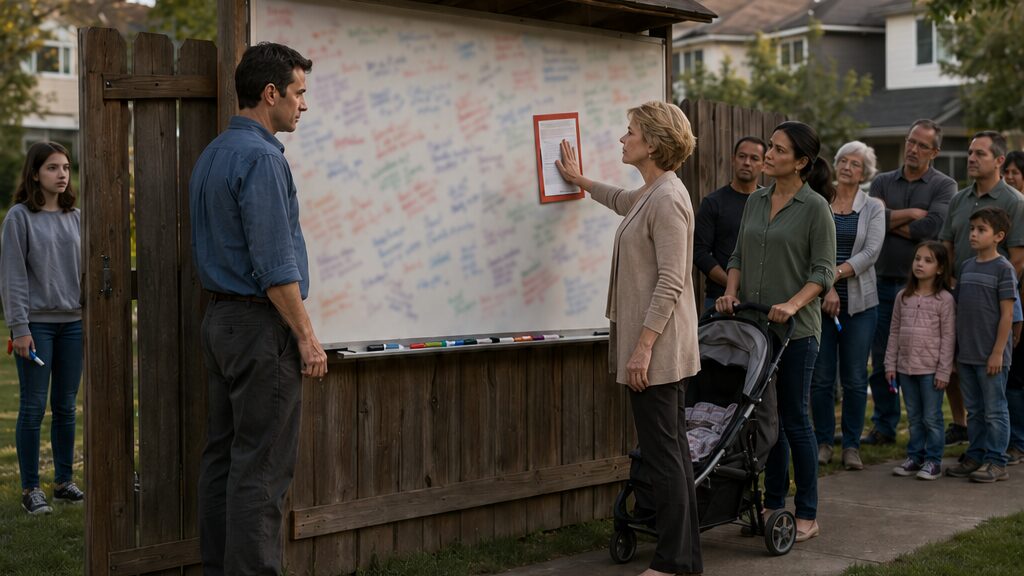
Patricia Thompson slapped the red-bordered notice against the whiteboard so hard that two markers jumped from their clips and landed in the grass.
Joshua Rivera looked down at the yellow and blue cylinders near his shoes, then back at Patricia’s hand. Her palm remained pressed against the paper as if she expected the fence to argue.
“Architectural violation,” she said. “Unauthorized exterior fixture. Possible nuisance use. You need to take it down.”
Behind her, the common green stretched between two rows of detached houses, narrow enough that every conversation carried farther than intended. A pair of children had stopped beside their scooters. A man collecting mail lingered at the curb. Across the path, Stephanie Garcia stood with one hand on a stroller handle and watched without pretending otherwise.
Joshua picked up the markers.
The board was nearly six feet wide, mounted on the inside face of his cedar fence but angled toward the green. He had built a shallow weather cover above it and attached a metal tray beneath. On that morning, the top half carried a riddle in black ink:
What can fill a room but takes up no space?
Under it were three guesses in different colors.
Music.
A smell.
Light.
Patricia tapped the notice. “This is not a classroom.”
“No,” Joshua said. “It’s a whiteboard.”
Her mouth tightened. “You know what I mean.”
He clipped the markers back into place. “People use it.”
“Nobody asked for it.”
Joshua glanced at the answers. The word light had been written in blue, the handwriting narrow and carefully slanted. He knew that hand. He also knew Patricia was watching his face.
She turned slightly, making sure the people nearby could hear. “Nobody wants a giant board hanging on a residential fence.”
One of the children whispered something to the other.
Joshua had spent fifteen years counseling middle-school students before moving into remote student-support work. He knew the moment when an argument stopped being about facts and became a performance. If he defended the board too eagerly, Patricia would turn his enthusiasm into proof of self-importance. If he mentioned the children, she would ask about supervision. If he explained how the first prompt had appeared, he would have to explain Emily.
So he uncapped the blue marker.
Patricia stepped aside as he approached the board. “Writing another riddle does not answer the violation.”
Joshua erased an empty strip beneath the morning’s guesses. In slow block letters, he wrote:
SHOULD ONE PERSON ANSWER FOR EVERYONE?
Then he capped the marker and placed it on the tray.
Patricia stared at the sentence.
“That’s inappropriate,” she said.
“Then don’t answer.”
The younger child abandoned his scooter first. He walked to the board, selected the green marker, and wrote NO, adding his initials in a shaky line. His friend chose red and wrote MAYBE IF THEY ASK FIRST.
Stephanie gave Joshua a look that was half warning, half amusement. Then she wheeled the stroller closer, careful to keep it off the path, and wrote:
SOMETIMES SILENCE IS NOT AGREEMENT.
The man from the mailboxes added:
SOMETIMES PEOPLE ARE JUST BUSY.
More doors opened.
A retired couple crossed the green together. A teenager approached but waited until no one was looking before writing one word in purple: LISTEN. Two children argued over whether the original riddle’s answer was light or air. A woman carrying grocery bags stopped long enough to photograph the board.
Patricia’s claim remained visible beneath the red-bordered notice, contradicted line by line in blue, green, orange, and black.
“Nobody wants it,” Stephanie repeated softly, not looking at Patricia.
Patricia peeled the violation notice from the board and held it by one corner.
“This proves nothing,” she said. “A crowd does not create authorization.”
Joshua felt the satisfaction drain from the scene before anyone else seemed to notice. She was right about that much.
Patricia turned to him. “What is the application number?”
He said nothing.
“The architectural request,” she continued. “What number was assigned when you submitted it?”
A child called out that light was definitely the answer to the riddle. Someone laughed. The sound made Joshua’s silence more obvious.
Patricia folded the notice once, precisely. “You did submit one.”
It was not a question.
Joshua looked at the cedar posts, the metal brackets, the narrow roof he had built over the board. He had measured everything twice. He had checked the municipal setback map. He had chosen coated hardware that would not stain the fence. He had considered wind load, rain, glare, and whether a child could reach the markers.
He had not submitted anything to the HOA.
Three months earlier, Patricia’s committee had rejected a free-standing basketball hoop because the base was visible from the street. The previous summer, it had taken nine weeks to approve a resident’s replacement shutters because the submitted gray was one shade darker than the neighborhood palette. Joshua had read those decisions and decided he already knew what the committee would say.
“No application,” he said.
The people near the board became quieter.
Patricia did not smile. That made her seem more certain.
“Then this is not about whether someone enjoys a riddle,” she said. “It is an unapproved structure being used to draw people into a shared area.”
“It’s attached to my fence.”
“And facing association property.”
“It doesn’t extend over the boundary.”
“You have children gathering beside a walking path.”
“They were already outside.”
“You do not get to decide that every concern is foolish because your intention is kind.”
The sentence landed harder than Joshua expected.
Stephanie moved the stroller a few inches farther from the group.
Patricia unfolded the notice and pressed it back onto the lower corner of the board, covering part of the word agreement.
“You have forty-eight hours to remove it voluntarily,” she said. “After that, management can begin enforcement.”
She walked away across the green, passing between the residents who had just written their answers. No one stopped her. No one applauded Joshua. The crowd loosened and returned to its errands, leaving the board bright with opinions and the path scattered with wheel tracks.
Joshua stayed until only one person remained.
Emily stood inside the Rivera yard near the back steps, visible through the open gate. She wore a gray sweatshirt despite the heat and held her phone against her chest. Her gaze was fixed on the blue answer beneath the riddle.
Light.
Joshua waited for her to speak.
She looked instead at the new question and the crowded answers below it.
“You made it worse,” she said.
“I didn’t use your name.”
“You made them look.”
“They were already looking.”
“At the board,” Emily said. “Now they’re looking for a reason.”
She went inside before he could answer.
Joshua pulled the violation notice free and carried it to the kitchen. By evening, the board had accumulated twenty-three responses. Some supported him. Some supported Patricia. One person had written RULES ARE NOT VOTES. Another had added GOOD THINGS CAN STILL NEED PERMISSION.
At 8:17, his laptop chimed.
The email came from the HOA property manager. Patricia and the architectural committee were copied.
NOTICE OF EXPEDITED COMPLIANCE REQUIREMENT.
Joshua read the first paragraph twice.
Due to the structure’s proximity to a common pedestrian area and its active use as a gathering point, removal was required no later than Wednesday at five in the afternoon.
Attached were photographs taken from three angles.
The final photograph showed Joshua standing beneath the whiteboard with the blue marker in his hand.
Chapter 2: The Answers Appeared Before Sunrise
At 5:42 the next morning, Joshua found a question on the board that he had not written.
WHAT IS SOMETHING YOU MISS BUT WOULD NEVER ASK TO HAVE BACK?
The words were in blue.
The marker lay uncapped on the kitchen table.
Joshua stood between the back door and the counter, looking from the marker to the glass. Outside, the board was pale in the early light, the new question centered with careful precision. Beneath it, there were already two answers.
My old dog.
Having dinner before everyone had a screen.
He picked up the marker. A faint blue stain marked the side of his index finger, transferred from the barrel rather than the ink. He capped it and walked down the hall.
Emily’s bedroom door was closed.
He raised his hand, then lowered it.
By seven, five more answers had appeared. A retired resident missed being able to drive at night. Someone missed a sister but had crossed out the word after writing it. A child missed a tree that had been removed near the playground.
No initials appeared.
Joshua photographed the board before beginning work. The removal deadline sat open in another window on his laptop. He drafted an appeal, deleted it, and drafted another.
Community interest demonstrated.
No permanent encroachment.
Resident-created educational and social benefit.
He stopped at educational. The word sounded like a defense Patricia would dismantle in one sentence.
At ten, Stephanie knocked on the back gate.
“You have company,” she said.
Three older residents stood at the board, talking quietly. None held a marker. They seemed to be reading one another’s answers without asking who had written them.
Stephanie folded her arms. “Are you taking it down?”
“I’m requesting a hearing.”
“That wasn’t my question.”
“No.”
She looked toward the path. “Good.”
Then she added, “Probably.”
Joshua waited.
“My daughter likes it,” she said. “But yesterday there were too many people around the stroller ramp. If this turns into a fight where everyone pretends there’s no problem at all, Patricia wins.”
“I can mark a standing area in the grass.”
“You can. You didn’t.”
Joshua glanced at the board. Kind intentions, he was discovering, created a long list of tasks that intentions did not perform.
Inside, Emily sat at the kitchen island with a bowl of cereal gone soft in front of her. Joshua placed the capped blue marker beside it.
“You wrote today’s question.”
She did not look up. “You left the markers out.”
“You brought this one inside.”
“Then I guess I didn’t leave it out.”
He sat across from her. “Why didn’t you tell me?”
“You didn’t ask.”
“I asked whether you wanted to put something on the board.”
“You asked if I wanted to help with your neighborhood project.”
“It wasn’t mine first.”
That made her look at him.
Weeks earlier, Joshua had found a question written on a sheet of scrap paper beside the printer: What is one thing people misunderstand about quiet people? He had copied it onto a small piece of plywood and leaned it against the fence as a joke, thinking Emily might notice. By afternoon, four neighbors had answered. The next day she left another question near the printer.
He had built the large board after that.
He had never asked whether she wanted him to.
Emily pushed the cereal bowl away. “You made it yours when you built a six-foot frame.”
“I thought more people could answer.”
“They could.”
“They are.”
“That doesn’t mean I wanted to stand beside it and explain myself.”
“I’m not asking you to.”
“You’re trying to keep it by proving it helps me.”
Joshua felt the appeal draft waiting on his laptop.
“I haven’t mentioned you.”
“You keep looking at me like you’re saving the secret for when you need it.”
The accuracy of it silenced him.
Emily took the blue marker and turned it between her fingers. “Some people answer because nobody knows it’s them. That’s the whole point.”
“What answer did you see?”
Her eyes shifted toward the window.
Joshua followed her gaze. A new line had appeared beneath the question:
The version of myself who talked without rehearsing first.
The handwriting was black, cramped, and unfamiliar.
Emily swallowed.
“I didn’t write that,” she said.
“I know.”
She read it again through the glass. Something in her face changed—not relief, exactly, but recognition without exposure.
Joshua understood then that the board’s value was not the crowd. The crowd was the visible part, the easiest part to defend. The value was that someone could place a sentence in public without having to stand beside it.
He opened the appeal again and removed every reference to Emily.
At noon, he submitted a request for an emergency hearing based on resident use and asked management to suspend removal until the board could consider alternatives. He attached photographs of the answers but cropped out the kitchen window and the section where Emily’s handwriting appeared.
Management replied within twenty minutes.
Hearing scheduled Wednesday, 9:00 a.m.
Removal activity temporarily paused pending review.
Joshua exhaled for the first time that morning.
Then another message arrived from Patricia.
Temporary pause does not constitute approval. Please prevent congregation and remove writing instruments from public access.
He looked at the marker tray outside.
Emily had come to stand beside him. “You’re not taking them away.”
“I may have to until the hearing.”
“Then the board is just a blank thing on a fence.”
“That might be safer for one day.”
“For who?”
Joshua reached for an answer and found none that did not sound like Patricia or like himself the day before.
By late afternoon, the question had twenty-nine responses. The neighborhood did not gather all at once. People came singly, wrote quickly, and left. A delivery driver added missing my mother’s cooking, then crossed it out before driving away. An older man stood before the board for ten minutes and wrote nothing.
Joshua began to see that participation was not the same as celebration.
At six, he and Emily ate at opposite ends of the kitchen island.
“I won’t use you at the hearing,” he said.
She kept her eyes on her plate. “Okay.”
“And I should have asked before building it.”
“You would’ve built it anyway.”
He almost denied it.
Instead he said, “Probably.”
That earned the smallest movement at the corner of her mouth.
A metallic knock sounded from the yard.
Joshua stepped outside.
Two men in work clothes stood beside the fence with a tape measure extended between them. A white contractor van idled at the curb. One man photographed the mounting brackets while the other wrote dimensions on a clipboard.
“The hearing is tomorrow,” Joshua said.
The man with the clipboard checked his phone. “We’re not removing it today.”
“Then why are you measuring it?”
“Management asked for an estimate in case removal is authorized.”
The tape snapped back into its housing.
Emily stood in the doorway behind Joshua.
One contractor looked at the colored answers covering the board, then at the official notice taped to its corner.
“Shame,” he said. “My kid would like this.”
He wrote down the final measurement anyway.
Chapter 3: A Good Idea Became a Violation
Patricia had arranged the photographs before Joshua entered the HOA office.
Six printed images lay across the conference table in chronological order: the empty fence, the newly mounted whiteboard, three children writing on it, the Monday crowd, Stephanie’s stroller angled around the group, and the contractors measuring the frame.
The last photograph had been taken less than an hour earlier.
Joshua sat opposite Patricia. Dennis Miller occupied the end of the table with a yellow legal pad. The property manager opened a laptop while two board members joined by video. A speakerphone in the center connected the association attorney.
Patricia touched the photograph of the crowd.
“This is what accelerated the matter,” she said. “Not the content. Not whether a riddle is pleasant. The use changed the impact.”
Joshua set down his folder. “The use is the reason residents want it.”
“The use is also the reason the association has exposure.”
“Exposure to what?”
The attorney’s voice came through the speaker. “Let’s avoid debating legal conclusions before the facts are established.”
Patricia slid a form toward Joshua. The line labeled application number was blank.
“Did you request architectural approval?”
“No.”
“Did you request permission to direct activity toward the common green?”
“No.”
“Did you consult management about pedestrian access?”
“No.”
Each answer sounded worse than the one before it, partly because none was untrue.
Joshua opened his folder and distributed photographs of the board’s questions and responses. “Forty-seven households have participated in four days.”
Patricia did not look at them. “Participation after installation is not prior approval.”
“It does show your statement that nobody wanted it was false.”
Dennis stopped writing.
The property manager glanced between them.
Patricia’s expression remained controlled, but one finger pressed against the corner of the crowd photograph until the paper bent.
“I made a broad statement,” she said. “That does not make the structure compliant.”
Joshua had expected evasion. The simple admission unsettled him more.
Stephanie arrived ten minutes late and sat in the remaining chair. She placed a folded sheet on the table.
“I signed the request to keep the board,” she said. “I still support it.”
Patricia nodded once. “Thank you.”
Stephanie unfolded the paper. “I also wrote down three problems.”
Joshua turned toward her.
“The stroller access was blocked Monday afternoon. Not completely, but enough that I had to move onto the grass. Yesterday, two kids left markers without caps on the path. And no adult seems to be responsible when children gather.”
“They’re not being invited to an event,” Joshua said. “They stop on their own.”
“That distinction won’t matter if somebody trips.”
He heard Patricia’s argument in Stephanie’s words and felt irritation rise before he could stop it.
“So we remove anything people enjoy because it might create responsibility?”
Stephanie’s face hardened. “That is not what I said.”
Joshua looked down at his own hands.
The property manager asked, “Could the board be relocated farther from the walkway?”
“It’s attached to my fence,” Joshua said.
“Could a designated standing area be marked?”
“Yes.”
“Could markers be stored at adult height or checked out during certain hours?”
“Yes.”
Patricia finally looked at the response photographs. “Those controls did not exist when you installed it.”
“No.”
The room quieted.
Joshua had come prepared to prove the board was valuable. Instead, the hearing was forcing him to list everything he had failed to consider because he had assumed value would excuse the process.
The speakerphone crackled.
The association attorney said, “The governing documents are broad enough to require approval for the fixture. The board also has discretion to regulate activities affecting common areas. However, immediate removal may not be the only available remedy.”
Patricia’s eyes shifted toward the phone.
“What alternatives?” Joshua asked.
“Conditional approval, relocation, limited-use authorization, supervision requirements. Those would depend on insurance review and a formal proposal.”
The property manager looked surprised. “We have a limited-use form?”
Dennis stopped writing again.
Patricia answered before the attorney could. “For scheduled events.”
The attorney said, “It has also been used for temporary installations associated with recurring resident activities.”
Joshua looked at Patricia.
She met his gaze without blinking.
Dennis turned a page on his legal pad. “When was that form last updated?”
“Two years ago,” Patricia said.
“And it still applies?”
“That would need review.”
The property manager searched files on the laptop. “I don’t see it in the resident portal.”
“It was never added,” Patricia said. “The committee determined it created confusion.”
Joshua leaned back.
There it was—not permission, not vindication, but an option he had not known existed.
Patricia folded her hands. “A form does not change the fact that Mr. Rivera bypassed the process.”
“No,” Joshua said. “But it changes whether removal was the only process available.”
One of the video board members asked whether the insurer had been contacted. The property manager confirmed that a review request had been sent that morning because photographs showed repeated gathering near the walkway.
The hearing paused while everyone read the email response that arrived during the discussion.
The insurer requested:
Dimensions and mounting details.
Expected hours of use.
Supervision plan.
Pedestrian clearance.
Maintenance responsibility.
Whether the activity was association-sponsored or privately controlled.
The final question held Joshua’s attention.
Privately controlled.
He looked at the photographs again. In every image, the board stood on his fence. His markers. His frame. His decision. Even when neighbors wrote on it, the object remained unmistakably his.
Stephanie tapped the folded paper. “I don’t want it removed. I also don’t want every concern treated like an attack.”
“You’re right,” Joshua said.
She seemed prepared to continue, then stopped.
Patricia watched him carefully.
“The path was blocked,” Joshua said. “I saw the crowd and thought it proved I was right. I didn’t see you moving the stroller.”
Stephanie’s shoulders lowered slightly. “Thank you.”
The admission cost him more than he expected. It also cleared something from the room.
Dennis addressed the property manager. “Can enforcement remain stayed until the insurance questions are answered?”
Patricia said, “The board is still unauthorized.”
“So is the question whether we remove it first and discuss alternatives later,” Dennis replied, “or secure it while we evaluate a temporary use.”
Patricia looked toward the photograph of the children.
For one moment, her face lost its committee composure. Not softness—something closer to alarm. Then it was gone.
“Twenty-four-hour extension,” she said. “Markers removed when no responsible adult is present. No gathering on the paved path. No additional promotion.”
Joshua almost objected to promotion. He had never promoted it.
Then he remembered writing a challenge on the board in front of half the green.
“Agreed,” he said.
The hearing adjourned without approval and without removal.
Outside, Stephanie walked beside him toward the common green.
“You still think Patricia is making this personal,” she said.
“She said nobody wanted it before she asked anyone.”
“That was personal.”
“And the rest?”
Stephanie adjusted the stroller canopy. “The rest may be what happens when people are scared of being responsible.”
“For a whiteboard?”
“For what happens around it.”
At the fence, the markers were gone. Emily had placed them in a clear plastic box on the back steps.
The board still carried the question about what people missed. Someone had erased a small section and written:
BEING INVITED WITHOUT HAVING TO SAY YES.
Joshua read it twice.
Dennis crossed the green holding a thin folder.
“I checked the archived committee files,” he said. “The temporary-use form exists. It was approved by the board and never rescinded.”
“Why isn’t it available?”
Dennis looked toward Patricia’s house.
“That,” he said, “is the question I think you should ask before Monday.”
He handed Joshua a copy.
The form contained spaces for hours, access controls, resident sponsors, cleanup, insurance review, and a responsible organizer.
At the bottom, beneath the revision date, was an approval line.
The printed committee chair was Patricia Thompson.
Chapter 4: Patricia Had Read Every Question
Patricia unfolded the scrap of paper beside her coffee and flattened it against the kitchen table with both hands.
The question had been erased from Joshua’s whiteboard the previous afternoon, but she had copied it before the rain softened the blue ink.
WHAT IS SOMETHING YOU MISS BUT WOULD NEVER ASK TO HAVE BACK?
Below it, in Patricia’s smaller handwriting, she had written one answer and crossed it out so heavily the paper had nearly torn.
Being trusted to keep people safe.
She folded the page again when the insurance representative joined the video call.
Her laptop showed the HOA records room in the background through the open kitchen doorway: two banker’s boxes she had brought home, a binder of architectural decisions, and the old incident file she had avoided opening for nearly three years.
The representative appeared in a headset and asked Patricia to confirm the whiteboard’s dimensions.
“Six feet by four,” Patricia said. “Mounted to a private fence, facing the common green.”
“And the pedestrian route?”
“Approximately eight feet from the board.”
“Any permanent seating?”
“No.”
“Electrical connection?”
“No.”
“Food service, organized instruction, athletic activity?”
“No.”
The representative paused. “Then this is not inherently prohibited.”
Patricia’s fingers tightened around the copied question.
“It is drawing unsupervised children.”
“That can be managed.”
“It is creating congestion.”
“That can also be managed.”
“There is no association sponsor.”
“That is the larger concern.”
Patricia looked toward the old incident box.
The block event had begun with folding tables, lemonade, sidewalk chalk, and a rented inflatable game no one had listed on the original application. The volunteer assigned to monitor it had left to help serve food. A child had climbed where the rules prohibited, fallen badly, and spent two nights in the hospital.
No one had blamed the inflatable company for long.
They had blamed the association. Then the board. Then Patricia, whose signature appeared at the bottom of the permit.
At the emergency meeting afterward, residents who had praised the event called it reckless. One parent said Patricia had treated neighborhood enthusiasm as a substitute for safety. The association paid legal fees for eighteen months. The insurance deductible consumed the reserve planned for drainage repairs.
Patricia had learned that happy crowds became silent when responsibility arrived.
“What controls would you require?” she asked.
The representative listed them without drama: defined hours, pedestrian clearance, adult sponsorship, removal of markers when unsupervised, maintenance checks, and written acknowledgment that the board was an association-approved activity rather than Joshua Rivera’s private program.
“So it could be insured.”
“With conditions.”
Patricia heard the distinction and disliked how little protection it gave her.
“Could the board require removal first?”
“That is a governance decision, not an insurance requirement.”
After the call, Patricia carried the old incident file into the records room.
The temporary-use forms were in the third binder, exactly where she remembered placing them. The board had approved the process after the accident, intending to create a narrow route for managed activities. Patricia had used it twice: once for a seasonal book exchange and once for a temporary shade canopy.
Then residents began submitting requests for everything from weekend exercise classes to private vendor tables. The committee had spent hours explaining why a temporary-use form was not automatic permission. Patricia had removed it from the portal until the policy language could be clarified.
The clarification never happened.
She opened a blank copy.
Hours of operation.
Minimum walkway clearance.
Named resident sponsors.
Cleanup and inspection.
Emergency contact.
The whiteboard could fit inside every line.
Her phone rang. Dennis Miller’s name appeared.
“I spoke to management,” he said. “Joshua has the form.”
“So I assumed.”
“You knew it existed yesterday.”
“I said it required review.”
“You also said the committee determined it created confusion.”
“It did.”
“That is not the same as saying it was unavailable.”
Patricia looked at the folded question beside her ledger. “He installed a structure without permission.”
“I know.”
“He turned the common green into an activity area without asking.”
“I know that too.”
“Then why are you calling?”
“Because if we are enforcing rules, we need to use all of them.”
Patricia closed the binder.
Dennis continued, “You do not have to approve the board. But you cannot make removal sound mandatory if there is a process for conditional use.”
“I have not made a final determination.”
“You signed an expedited enforcement request.”
“The risk increased when people gathered.”
“The insurer says the risk can be managed.”
Patricia glanced at the laptop, where the call summary still displayed the representative’s exact wording.
“You spoke to them?”
“The property manager forwarded the notes.”
Of course she had.
Dennis lowered his voice. “Patricia, what are you afraid will happen?”
The question irritated her because it resembled something from the board.
“I am concerned that everyone will enjoy this until somebody is hurt, offended, or inconvenienced. Then the same people writing cheerful answers will ask why we allowed it.”
“That could happen.”
“And Joshua will say he meant well.”
“Probably.”
“Good intentions do not pay claims.”
“No,” Dennis said. “But fear does not repeal policy.”
Patricia ended the call before she answered too sharply.
At eleven, she drove to the HOA office and reviewed the photographs again. The whiteboard had changed each day. Monday’s answers were argumentative. Tuesday’s were personal. Wednesday’s were sparse because the markers had been removed between supervised periods.
One photograph showed a sentence in black ink:
The version of myself who talked without rehearsing first.
Patricia did not know who had written it.
She knew why she had photographed it.
At noon, the property manager placed the accelerated enforcement authorization on the desk.
“If you sign,” the manager said, “the contractor can remove the board after the extension expires.”
“Has Joshua submitted anything?”
“Not yet.”
“He has until Monday’s hearing.”
“The existing directive permits earlier action if the structure is deemed an immediate hazard.”
Patricia read the wording. The insurer had not called it an immediate hazard. The committee could still argue that unsupervised use created one.
The manager waited.
Patricia remembered the block event’s final hour: the ambulance, parents crowding the path, someone shouting that no adult had been watching. She remembered kneeling beside a child she barely knew while people demanded answers she did not have.
She signed.
The pen left a small hesitation in the middle of her last name.
By late afternoon, Joshua had submitted a records request for prior temporary-use approvals. Patricia saw the notification on her phone while standing at the whiteboard.
No one else was there.
The markers had been locked in the clear box on the Rivera steps. The board displayed only the answers left from supervised hours. Someone had written:
Rules should tell us how, not only no.
Patricia read it twice.
She took the copied question from her purse, unfolded it, and compared the narrow blue lettering with other prompts on the board. The same hand appeared in several places, but never in the answers.
She heard the Rivera back door open and slipped the paper into her ledger.
Joshua stepped outside carrying a folder.
“Looking for a violation?” he asked.
“Checking compliance.”
“The markers are secured.”
“I can see that.”
He held up the folder. “I found the permit.”
Patricia kept her gaze on the board. “A blank form is not approval.”
“No. It is an option.”
“An option subject to committee discretion.”
“Why wasn’t it offered?”
“Because your board was already installed.”
“That is not an answer.”
Patricia faced him. “You decided the committee would reject you, so you skipped it. Now you want the committee blamed for failing to guide you through a process you refused to enter.”
Joshua’s jaw shifted.
For a moment, neither spoke.
Then he said, “That is partly fair.”
The response interrupted the argument Patricia had prepared.
He looked at the board. “But you still knew there was another route.”
“Yes.”
“And you signed removal anyway.”
Patricia’s silence answered him.
Joshua lowered the folder. “I’m not asking you to trust my intentions.”
“Good.”
“I’m asking you to apply the actual policy.”
From the road came the sound of a truck slowing.
The contractor van passed the green, then continued without stopping.
Patricia watched it disappear.
“You have until Monday,” she said.
Joshua looked at her ledger. The folded edge of the copied question protruded from the cover.
His eyes paused there, but he did not ask.
That evening, the accelerated order entered the official record.
Less than an hour later, Joshua’s records search produced the original temporary-use form, the two prior approvals, and the board resolution that had authorized the process.
At the bottom of each document was Patricia’s signature.
Chapter 5: The Crowd Was Not the Community
Forty residents had signed Joshua’s petition.
Only two had written their names under VOLUNTEER SPONSOR.
He stood before the whiteboard on Friday afternoon with a black marker in his hand. He had divided the surface down the middle.
IDEAS filled the left side.
Keep daily riddles.
Add a children’s section.
Post neighborhood resources.
Use weatherproof markers.
Hold a monthly puzzle night.
COMMITMENTS occupied the right side.
Stephanie Garcia — Tuesday, 4–6.
Dennis Miller — Alternate reviewer.
Nothing else.
Joshua had expected the empty column to embarrass the people who supported the board. Instead it embarrassed him.
A resident who had written three ideas approached, read the second column, and slipped the marker back into its clip.
“I travel a lot,” the man said.
“You could take one Saturday a month.”
“My weekends are unpredictable.”
Another neighbor said she did not feel comfortable being responsible for other people’s children. A parent offered to donate markers but declined scheduled supervision. An older resident said he would help erase the board, provided someone else checked the walkway.
By sunset, the petition had forty-three signatures.
The commitment list still had two.
Stephanie arrived after dinner and read both columns.
“You turned it into homework,” she said.
“I turned it into an honest count.”
She looked at her own name. “I said I could help. I did not say I could manage the whole thing.”
“You would not be.”
“Then who would?”
Joshua pointed toward his house.
Stephanie shook her head. “That is the same problem in a different form.”
“What do you mean?”
“The board belongs to you whenever something needs doing. It belongs to everybody whenever you need support.”
He started to answer, then stopped.
Stephanie moved closer to the path and measured the width with her steps.
“The stroller ramp needs to stay clear. Children cannot leave markers on the pavement. Somebody has to inspect the brackets. And if a prompt turns cruel or personal, someone needs authority to erase it.”
“We have never had that problem.”
“You have had the board for less than a week.”
The words sounded like Patricia’s, but Stephanie did not deliver them with satisfaction.
“My daughter cried yesterday,” she said.
Joshua straightened. “Because of something on the board?”
“Not exactly. A boy guessed which answer was hers and repeated it at school.”
“What did it say?”
“That she missed having a best friend.”
Joshua looked at the colored writing. What had seemed anonymous could become identifiable in a neighborhood small enough to recognize handwriting, grief, and family history.
“Is she all right?”
“She will be. But I am not signing a plan that pretends every question is harmless.”
Joshua capped the marker.
“What would you sign?”
Stephanie pointed to the grass beyond the path. “Move the standing area there. Put the markers in a box that an adult opens during listed hours. Have two people review prompts before they go up. No names unless the writer chooses. No guessing aloud about who wrote an answer.”
“That last one is hard to enforce.”
“Then write it as a rule and enforce it when you hear it.”
“You still support the board?”
“I support what it could be. I do not support winning an argument with Patricia.”
Before Joshua could respond, she crossed out her name under commitments.
“I’ll put it back when the plan is real.”
By Saturday morning, the whiteboard had become a planning surface.
Joshua erased the petition count. In its place he drew a simple map of the green, marking the pedestrian route, a waiting space on the grass, and a proposed free-standing location several feet from his fence. Dennis helped him review the temporary-use form but refused to sign as an organizer.
“I can advise,” Dennis said. “I cannot vote on a plan I am managing.”
“You signed as alternate reviewer.”
“I can review content occasionally. That is not the same as carrying liability.”
Joshua gave him a tired look.
Dennis tapped the empty commitment column. “You are learning the difference.”
They drafted limited hours: weekday afternoons, Saturday mornings, no use after dusk. A small weatherproof box would hold markers. Sponsors would inspect the area and photograph the board after closing.
Joshua wrote his own name across three time slots.
Dennis crossed out two.
“You are still trying to make yourself indispensable.”
“I work from home.”
“That is not the point.”
Joshua put the marker down.
On Sunday, he moved two portable planters to create a wider approach from the grass. He added a chalk line showing the required clear path. Stephanie tested it with the stroller, turned once, and nodded.
Then she wrote her name back under Tuesday.
A retired resident accepted one Saturday. A parent agreed to check prompts remotely if someone sent photographs. By evening, the rota had six names—enough for a pilot, barely.
Joshua felt relief until he found Emily in the garage staring at the boards, forms, printed photographs, and colored schedules spread across his workbench.
“What happened to it?” she asked.
“To what?”
“The question board.”
“It is still there.”
“No. Now it has rules, shifts, maps, and a hearing packet.”
“That is what it needs to survive.”
“You made it into a campaign.”
“I’m trying to keep them from removing it.”
“You are trying to prove you were right to build it.”
Joshua leaned against the workbench. “I already admitted I should have applied.”
“To them.”
“And to you.”
“You said you probably would have built it anyway.”
He had no answer that repaired the sentence.
Emily picked up the blue marker. “The first question was on printer paper. Nobody knew where it came from.”
“And only four people saw it.”
“That was enough.”
“For you?”
“For the people who answered.”
Joshua looked toward the open garage door. From there, the whiteboard was visible across the yard, crowded now with logistics instead of questions.
“I thought making it bigger would help.”
“You always think bigger means helping.”
“That is not fair.”
“You made appointments with teachers I did not want. You emailed the counselor after I asked you not to. You started checking every assignment because I missed two weeks.”
“You stopped going to school.”
“I went back.”
“After months.”
“And now every time I am quiet, you treat it like an emergency.”
Joshua felt the old fear rise—the fear of missing something again, of mistaking withdrawal for privacy until the distance became too wide to cross.
“I was scared,” he said.
“So was I.”
The garage held the words without softening them.
Emily looked at the temporary-use form. “Are you going to tell them I started it?”
“Only if you want me to.”
“You need a reason.”
“I have a reason. People use it.”
“They will ask why you built it.”
“I will tell them I saw a question bring neighbors together.”
“And if they ask whose question?”
“I will say it is not mine to disclose.”
Emily studied him, searching for the hidden condition.
“What if that costs you the board?”
Joshua looked at the commitment list. “Then it costs me the board.”
She set the blue marker down.
Late Sunday evening, Joshua restored one clean section at the top of the whiteboard and wrote:
FINAL QUESTION BEFORE MONDAY’S HEARING:
The space beneath remained blank.
He went inside to print the revised pilot proposal.
When he returned, Emily stood at the board alone.
She wrote slowly, shielding the words with her body until she finished. Then she placed the marker in Joshua’s hand.
“You can read this at the hearing,” she said.
He looked at the sentence.
WHEN DID HELPING BECOME DECIDING FOR EVERYONE?
Joshua read it once as a challenge to Patricia.
Then he read it again and understood that it was meant for him.
Chapter 6: One Question Changed the Hearing
Patricia moved to remove the whiteboard before Joshua was invited to speak.
The HOA clubhouse was crowded enough that residents stood along the back wall, but the room remained quiet as she read from the prepared motion.
“Due to unauthorized installation, unresolved control of use, and ongoing impact on common-area access, I move that the structure be removed and that any future proposal begin through the standard review process.”
Joshua sat at the front table beside a portable whiteboard Dennis had helped him carry inside. Across its top, in Emily’s blue handwriting, was the question:
WHEN DID HELPING BECOME DECIDING FOR EVERYONE?
Below it hung the revised site map, sponsor schedule, and maintenance plan.
Patricia did not look at the question.
One board member seconded her motion.
The association attorney raised a hand. “Before discussion, the homeowner must be given an opportunity to respond.”
Patricia’s mouth tightened. “Of course.”
Joshua stood with the temporary-use form inside his folder.
He had imagined several versions of the moment. In one, he exposed Patricia’s omission immediately. In another, he displayed the neighborhood petition and forced the board to confront how many residents supported him.
Both versions had made him feel righteous.
Neither survived Emily’s question.
“I installed the board without approval,” he said.
A murmur passed through the back row and faded.
“I did not submit an architectural request. I did not ask about common-area use. I assumed the committee would reject the idea, and I treated that assumption like permission to skip the process.”
Patricia finally looked at him.
Joshua continued, “The board has value. That does not make the way I installed it acceptable.”
Stephanie stood near the back with one hand on the stroller. She gave no sign of approval, but she did not look away.
Joshua placed photographs on the table: the blocked path, uncapped markers, crowded standing area.
“These are not evidence that the project failed. They are evidence that I had not planned for its success.”
One of the board members asked, “Are you withdrawing your appeal?”
“No.”
Patricia shifted in her chair.
Joshua attached the new site map to the portable board. “I am asking for a six-month conditional pilot under the temporary-use policy.”
Now the room changed.
The property manager looked at Patricia. The two board members exchanged glances. Residents in the back whispered.
Joshua removed the archived form and board resolution from his folder.
“This process was approved two years ago. It allows managed recurring activities with named sponsors, access controls, inspections, and insurance review.”
Patricia said, “That policy was created for temporary events, not permanent exterior fixtures.”
“The proposed pilot uses a free-standing board on association property,” Joshua said. “My fence-mounted board would be removed.”
The statement startled even Stephanie.
Patricia’s gaze moved to him. “You are offering to remove it?”
“I am offering to stop treating my fence as the only place this can exist.”
He displayed a rendering of the proposed location several feet from the walkway. The frame would be portable but secured during approved hours. Markers would remain locked except when a sponsor was present. Prompts would be reviewed by two adults. The standing area would be marked on the grass. The sponsor schedule covered six weeks, with renewal required before the next hearing.
The left side of the room began to nod.
Joshua raised a hand before anyone could applaud.
“This is not community ownership yet.”
He pointed to the schedule. “Six people volunteered. More than forty signed the petition. That difference matters.”
Stephanie stepped forward.
“I withdrew my support Friday,” she said. “Then I signed again after the access and supervision changes.”
A resident behind her asked whether parents would be responsible for children.
“Parents remain responsible for their children,” Stephanie said. “Sponsors are responsible for the board and the marked area. Those are not the same thing.”
Dennis added, “The distinction is included in the proposed rules.”
The board chair asked Patricia whether the temporary-use form had been available when enforcement began.
Patricia’s voice remained even. “The form was not posted on the resident portal.”
“That was not the question.”
“No,” she said. “It was not offered to Mr. Rivera.”
“Why?”
Patricia looked toward the portable board, but not at Emily’s question.
“Because the structure had already been installed in violation,” she said. “And because the use expanded before any controls existed.”
Joshua opened his folder again.
“I also have the insurance representative’s written summary,” he said. “It states that the activity is manageable under conditions.”
The attorney interrupted. “For clarity, the committee’s failure to offer a form does not legalize an unauthorized installation.”
“I understand,” Joshua said.
Several residents turned toward him, disappointed that he had surrendered the clean argument.
He faced them. “Patricia’s omission does not erase mine.”
The attorney nodded. “Correct.”
“But my violation does not make removal the only lawful outcome.”
“Also correct.”
The room settled into a less satisfying truth.
Patricia had withheld a path because she feared what the board might become. Joshua had skipped the path because he believed he already knew her answer. Neither fact canceled the other.
The board chair asked whether anyone wished to address the proposed pilot.
One by one, residents came forward.
A retired man accepted Saturday inspection duty.
A parent agreed to maintain the marker inventory.
Stephanie committed to Tuesday supervision but requested a rule against identifying anonymous writers.
Another resident objected to noise after dinner. Joshua changed the closing time from seven to six.
A woman asked who would erase offensive content. Dennis pointed to the two-reviewer provision.
Each commitment made the plan stronger and the room less emotional. The board was no longer being saved by affection. It was being narrowed into something people could actually maintain.
Then Emily entered through the side door.
Joshua had not expected her to come.
She remained near the wall, gray sweatshirt sleeves pulled over her hands. Patricia noticed her, then followed her gaze to the blue question.
The board chair read it aloud.
“When did helping become deciding for everyone?”
No one answered immediately.
Joshua said, “That question was written by the person whose first prompt led me to build the board.”
Emily’s shoulders stiffened.
He did not turn toward her.
“I do not have permission to identify that person,” he continued. “And the board should not be approved because someone’s private struggle might make the project seem more deserving.”
Emily’s posture loosened by a fraction.
“The question applies to me,” Joshua said. “I decided what the neighborhood needed. I also decided what someone close to me needed, instead of asking. I thought helping gave me the right to choose the form.”
Patricia looked down at her ledger.
A folded scrap of paper protruded from its edge.
The board chair asked her, “Do you want to respond?”
Patricia removed the paper.
“I copied a question from the board,” she said. “The one asking what people missed but would never ask to have back.”
She unfolded it, though she did not read her answer.
“Three years ago, this association approved a neighborhood event. A child was injured. The activity had changed after approval, supervision failed, and people who had supported the event insisted the board should have prevented it.”
No one interrupted.
“I created the temporary-use process afterward,” Patricia said. “Then I restricted access to it when requests became difficult to control.”
Dennis asked, “Without a board vote?”
“Yes.”
The admission moved through the room more quietly than scandal.
Patricia’s hand trembled once before she flattened the paper.
“I believed I was preventing another failure. I also said nobody wanted the whiteboard without asking the residents. That was not a safety determination. It was my judgment presented as theirs.”
Joshua watched several people lean forward, ready for an apology.
Patricia did not give them one.
“The original installation should still be removed,” she said. “The pilot should proceed only if every listed condition is enforceable.”
It was not reconciliation. It was something more useful.
The attorney reviewed the proposal line by line. He required a revocation clause, monthly inspection, written confirmation from the insurer, and removal within twenty-four hours if the board caused repeated obstruction.
The board chair amended Patricia’s motion.
The fence-mounted board would be removed voluntarily. A six-month common-green pilot would be considered in its place.
Two votes favored the pilot.
Two opposed.
Patricia held the deciding vote.
Joshua looked toward Emily. She did not appear hopeful. She looked tired, as though the adults had finally arrived at a question she had asked days ago.
Patricia read the sponsor schedule again.
“If the commitments fail,” she said, “the pilot ends.”
Joshua nodded. “Agreed.”
“If Mr. Rivera controls the board privately, the pilot ends.”
“Agreed.”
“If the activity expands beyond the approved plan, it returns for review.”
“Agreed.”
Patricia set down the page.
“I vote yes.”
No one applauded.
Pens moved. The property manager recorded the conditions. Stephanie checked the Tuesday slot on the rota. Dennis wrote the date of the first inspection.
Joshua turned to the portable whiteboard.
Under Emily’s question, he erased his own name from the line marked OWNER.
He replaced it with:
FIRST RESPONSIBLE SPONSOR.
When the hearing ended, Patricia passed him at the door.
“You still have to remove the fence board,” she said.
“I know.”
“By Wednesday.”
“I know.”
She paused. “The blue question should stay on the new one for the first week.”
Joshua looked across the room at Emily.
“That is not my decision,” he said.
For the first time, Patricia seemed to understand the answer before anyone explained it.
Outside the clubhouse, six residents gathered around the sponsor schedule instead of the board.
The whiteboard had survived the vote.
Whether the community would survive the work had only begun.
Chapter 7: The Board Finally Belonged to Everyone
Joshua knew something had changed before he reached the common green.
His old clear marker box was gone.
For six months it had sat beneath the board during approved hours, its lid scratched from children forcing it open too quickly and its corners marked with blue ink. Now a gray weatherproof case was bolted to the side of the community station. A laminated inventory sheet hung inside the lid. Each marker had a numbered slot.
Joshua stopped with his coffee still in his hand.
On the front of the case, someone had attached a label.
PROPERTY OF THE ASSOCIATION.
He read it twice.
The redesigned station stood farther from his fence than he had imagined when drawing the first site map. Two cedar posts held the whiteboard beneath a narrow metal roof. A strip of crushed gravel marked the standing area, leaving the paved path clear. The sponsor schedule rested in a locked display box beside the inspection log.
Nothing about it looked temporary anymore.
Nothing about it looked like his.
“You’re early,” Stephanie said.
She approached with a folder under one arm and the stroller folded in the back of her vehicle. Her daughter walked beside her carrying a cloth and a bottle of board cleaner.
“Review starts at nine,” Joshua said.
“We’re cleaning first.”
“I usually do that.”
Stephanie opened the new marker case. “Not today.”
Her daughter began wiping yesterday’s answers from the lower half of the board. The question at the top remained:
WHAT IS SOMETHING SMALL THAT MADE THIS WEEK EASIER?
The answers were quieter than the first month’s crowds.
A neighbor brought in my trash cans.
Someone waited for me.
The bus driver remembered my stop.
Three blank spaces separated each line. No one had tried to fill the entire board.
Participation had declined after the first eight weeks. The children who once raced across the green now stopped only when a question interested them. Some afternoons passed without a new answer. Two sponsors quit. One family complained that the prompts were repetitive. A teenager wrote something cruel about another resident, and the board remained closed for three days while the review rules were tightened.
Joshua had expected every setback to feel like evidence Patricia had been right.
Instead each one became work.
Stephanie recruited another sponsor. Dennis revised the incident log. Patricia required the gray case after markers disappeared twice. Joshua learned to attend only the shifts assigned to him.
The board survived by becoming less exciting.
At nine, the property manager set up a folding table near the station. Dennis arrived with inspection records. Two board members joined by video on a laptop shaded beneath the roof.
Patricia came last.
She carried a thick folder and did not greet Joshua before placing it on the table.
The review began with numbers.
Four access complaints during the first month.
One during the next five.
Two missing marker sets.
One content incident.
No injuries.
No insurance claims.
No repeated obstruction after the gravel area was installed.
The property manager asked Dennis whether sponsor requirements had been met.
“Mostly,” he said.
Patricia looked up. “Mostly is not a compliance category.”
Dennis turned a page. “Two scheduled periods were canceled because no sponsor was available. The board remained closed during those times, as required.”
“So the controls worked,” Joshua said.
Patricia glanced at him. “The closure worked.”
He accepted the correction.
Stephanie presented the updated rota. Nine residents now rotated through the schedule, fewer than the petition suggested six months earlier but more than the original six volunteers.
“The people who stayed are reliable,” she said. “The people who left were not punished for leaving.”
One board member asked whether Joshua still performed most of the maintenance.
“No,” Stephanie said before he could answer. “He performed twenty-seven percent.”
Joshua looked at her.
“You kept records,” she said.
“I didn’t calculate a percentage.”
“I did.”
Patricia opened her folder.
“This is the six-month compliance report.”
Joshua expected neutral language. Patricia favored words that could survive dispute: adequate, incomplete, conditional, documented.
She read the first page without expression.
“The pilot met required pedestrian-clearance standards after the initial adjustment period. Sponsor compliance was sufficient. Reported noise remained within existing common-area expectations. Content-review procedures were followed after the single documented violation.”
She turned the page.
“The installation has created no material increase in insurable risk under the approved controls.”
The sentence settled over the table.
Patricia closed the folder.
“My recommendation is approval.”
Stephanie’s daughter stopped cleaning.
Dennis looked at Patricia as if waiting for the second half.
It came.
“Approval should be granted only if the station is designated association property. No household may claim ownership, exclusive control, or permanent sponsorship authority.”
Joshua looked at the label on the marker case.
The property manager asked, “Mr. Rivera, do you object?”
Six months earlier, he would have.
He had built the first frame in his garage. He had measured the fence, purchased the hardware, copied Emily’s question, and defended the board before anyone else understood what it was. The story of the project began with his choice.
But beginning was not the same as owning.
“No,” he said.
Patricia watched him closely. “The original materials were privately purchased.”
“I’ll donate them.”
“The association may replace any component without consulting you.”
“Understood.”
“Future prompts will be selected through the sponsor process.”
Joshua looked at the whiteboard. The remaining question at the top was not one he would have chosen. He found it too gentle.
That was no longer a problem.
“Understood,” he said again.
The board approved the station without dissent.
There was no applause. The property manager began collecting signatures. Dennis closed the inspection binder. Stephanie’s daughter resumed wiping away the final answers.
Joshua felt an unexpected absence as the surface became white.
For the first time since he had mounted the original board, there was nothing on it that came from him. No riddle. No challenge. No defensive question written under a violation notice.
Only a clean surface waiting for someone else.
Emily arrived while the adults were packing the folding table.
She had started wearing her school backpack over both shoulders again instead of carrying it by one strap. Joshua noticed but did not mention it.
“What did they decide?” she asked.
“It stays.”
She looked at the new label. “But not yours.”
“No.”
“How do you feel about that?”
He took a sip of coffee to give himself time.
“Like something worked.”
“That wasn’t what I asked.”
He smiled. “A little replaced.”
Emily nodded as though that answer deserved more trust than a better one.
Stephanie’s daughter handed her the blue marker. “You won the prompt vote.”
Emily looked at the blank board.
Joshua had seen the submitted questions in the locked box but had not checked the tally. The sponsors had voted that morning before the review.
“What did you write?” he asked.
Emily uncapped the marker.
She hesitated long enough that Joshua expected her to hand it back. Then she wrote:
WHAT DID YOU SAY THIS WEEK THAT YOU USUALLY KEEP TO YOURSELF?
At the bottom, smaller than the question, she added:
—Emily
It was the first time she had signed one.
Joshua did not ask why.
A child passing on a bicycle stopped to read it. An older resident crossed the grass from the mailboxes. Neither wrote anything yet.
Patricia remained beside the table, holding the folded scrap she had once kept in her ledger. Six months had softened its creases.
She approached the board after Emily stepped away.
“I submitted a different question,” Patricia said.
Emily held out the marker.
Patricia did not take it immediately.
Then she erased a narrow section beneath Emily’s signed prompt and wrote in smaller letters:
WHAT MAKES A NEIGHBORHOOD YOURS?
She studied the two questions together.
“They may compete,” she said.
“People can answer both,” Emily replied.
Patricia capped the marker and handed it to her.
Joshua watched the exchange without moving closer.
Neighbors began gathering, not as a crowd but in intervals. A parent read the questions while waiting for a child. Dennis wrote that he had admitted not knowing what to do. Stephanie’s daughter wrote that a neighborhood became yours when people saved space for you.
Patricia left without adding an answer.
Near the path, Joshua found the original clear marker box beside the trash container. The association had emptied it but not discarded it.