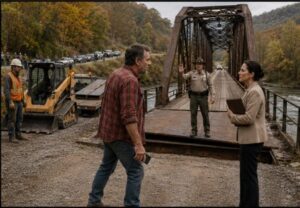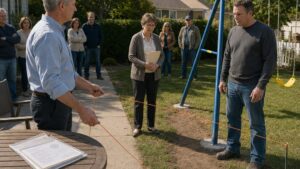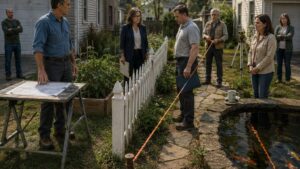
The HOA Ordered Matthew to Remove the Giant Puzzle Before the Neighborhood Finished What His Wife Had Started
Chapter 1: The Violation Notice Beside the Missing Piece
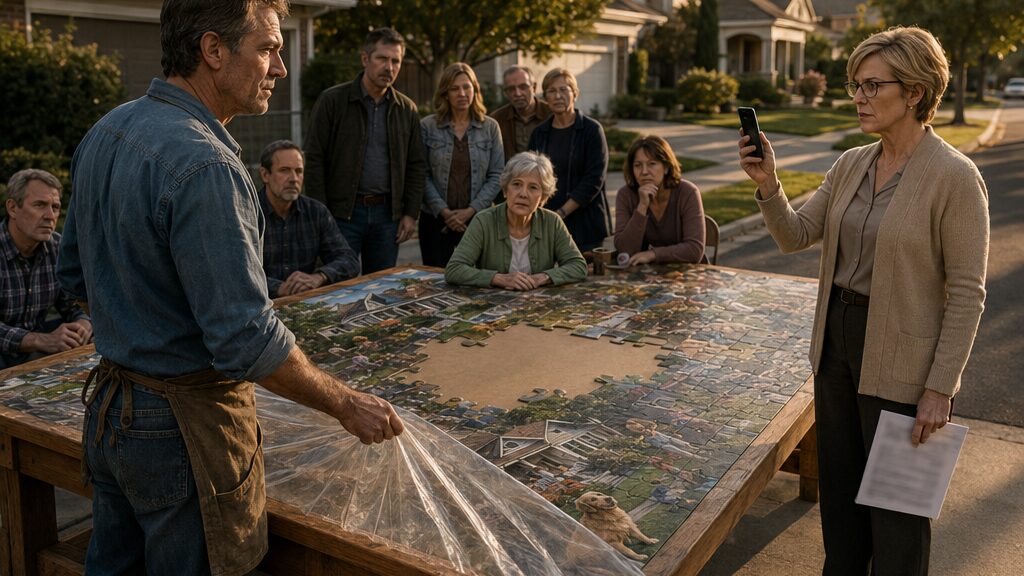
Pamela Clark took the photograph just as Matthew Hall folded the clear weather cover against his chest.
The plastic crackled between his hands. Behind him, the wooden table filled half the driveway, and the nearly completed puzzle spread across it in thousands of interlocking pieces. A white square remained open near the center of the image, no larger than two fingers laid side by side.
Pamela lowered her phone, adjusted her sunglasses, and took another picture.
“Please don’t photograph people without asking,” Matthew said.
“I’m documenting the violation.”
Around the table, conversation stopped. Ruth Flores held a blue puzzle piece above the board. Ryan Davis stood at the far corner with one palm pressed against the table frame. Two older residents sat in folding chairs under the shade of Matthew’s garage. A parent drew a child closer by the shoulder.
Pamela stepped sideways and aimed her phone again.
This time, Matthew heard the shutter while the resident recovering from a stroke was visible in the frame.
“I said the structure,” Pamela replied. “People are standing around the structure.”
“It’s a table.”
“It is an unauthorized temporary installation visible from the street.”
Ryan gave a short laugh. “It’s four legs and a sheet of plywood.”
“It also obstructs normal use of the driveway.”
Matthew set the folded cover on a chair. He had built the table wide enough for six people to reach the center and high enough for anyone using a walker to stand comfortably against the edge. Its cedar frame had rounded corners. The wheels locked. The top could separate into two sections if necessary.
None of that mattered in Pamela’s photograph.
In the photograph, it would look oversized. Improvised. Defiant.
Pamela removed a folded sheet from a manila envelope.
“Matthew Hall, this is formal notice that the table, covering apparatus, chairs, and associated gathering must be removed within seventy-two hours.”
Ruth placed her piece carefully into the puzzle. It fit along the roofline of a red-brick house.
Pamela looked at her. “You heard me.”
“I did,” Ruth said. “I’m finishing this section.”
Matthew unfolded the notice. The paper carried the association letterhead, three cited covenant sections, and a compliance deadline printed in bold. He read past the references to appearance standards and obstruction.
At the bottom, beneath the signature line, was a daily fine.
Fifty dollars per day after the deadline.
He looked toward the puzzle.
From a distance, the image seemed like a collection of roofs, trees, sidewalks, and patches of summer sky. Up close, individual details emerged. The white porch swing on Ruth’s house. Ryan’s dented mailbox before he replaced it. A golden retriever asleep beneath a hydrangea. The small maple tree at the entrance before it grew tall enough to shade the monument sign.
Pamela followed his gaze.
“Is that supposed to be this neighborhood?”
Matthew did not answer.
She moved closer despite herself. Her attention traveled over the assembled sections: the cul-de-sac, the playground, the line of homes beyond the retention pond. Faces appeared in windows and on porches, not posed, but caught in ordinary moments.
A woman carrying grocery bags.
Two children drawing on a driveway.
An older man watering tomatoes.
Near the center, the unfinished white space interrupted the image like a missing tooth.
“Where did this come from?” Pamela asked.
Matthew folded the notice once, then again.
“It belongs to the people working on it.”
“That is not what I asked.”
Ruth reached into a sorting tray. “You could sit down and find out.”
Pamela’s mouth tightened. “This is not personal.”
“It became personal when you photographed everybody,” Ryan said.
“I am responsible for consistent enforcement. If I ignore this because several residents enjoy it, the next homeowner will ask why their trailer, storage pod, or basketball equipment was treated differently.”
“No one is asking you to ignore it,” Matthew said.
Pamela turned toward him. “You were notified informally three days ago.”
“You asked why it was here.”
“And you said it was a neighborhood activity.”
“It is.”
“You did not say you had permission.”
“I didn’t say I did.”
The admission shifted the air. Ryan looked at him sharply. Ruth stopped sorting.
Pamela lifted the notice. “Then you understand the problem.”
Matthew did understand it. That was what irritated him most. The table was too wide to be mistaken for ordinary patio furniture. The gathering had moved beyond a few invited neighbors. Cars had begun slowing at the curb. People had brought coffee, folding chairs, and bags of pieces they had sorted at home.
He had known the board might object.
He had simply believed they would have more time.
Pamela took one final photograph from the end of the driveway. The clear cover lay folded in the foreground. Matthew stood beside it. Behind him, the residents had resumed working.
Not one of them had left.
The recently retired neighbor pushed his chair closer and began separating edge pieces. The parent returned to the table. Ruth slid a tray toward the resident recovering from a stroke, who used his stronger hand to turn each piece upright.
The small sounds returned: cardboard touching cardboard, chair legs scraping concrete, someone murmuring that a patch of green might belong near the park.
Pamela lowered the phone.
“You recruited them after the first warning,” she said.
Matthew looked at her.
“You think I brought people here to make you look unreasonable?”
“I think you knew public pressure would make enforcement harder.”
Ruth gave Matthew a questioning glance. He felt the explanation rise toward his throat and stop there.
He could have told Pamela that the first gathering had begun years before she joined the compliance committee. He could have explained why the table stood on this exact section of concrete. He could have named the person who had chosen the photographs and cut the image into pieces.
Instead, he picked up the weather cover and shook it open.
The clear plastic lifted in the sunlight, briefly blurring the houses and faces beneath it.
“We’re not finished for today,” he said.
Pamela stared at him for a moment, then returned the phone to her handbag.
“The seventy-two hours began at noon.”
She stepped toward the sidewalk.
Matthew looked again at the notice. “Who filed the complaint?”
“That information is confidential.”
“Was it someone here?”
Pamela paused at the curb.
“The board had photographs before I arrived,” she said. “So whoever reported you has been watching longer than you think.”
Chapter 2: The Clubhouse Door That Stayed Locked
Matthew’s key entered the clubhouse lock but would not turn.
He tried again, pressing his shoulder against the metal door as if the pressure might realign something inside. The key was old, stamped with the association’s initials and worn smooth along one edge. For years it had opened the activity room on Saturday mornings.
Now it stopped halfway.
A printed sign had been taped behind the glass.
CLOSED FOR REPAIRS.
No reopening date appeared beneath it.
Ryan stood beside him carrying a tape measure and a paper cup of coffee. “Maybe they changed the locks.”
“Without collecting the old keys?”
“It’s an HOA. They collect money better than keys.”
Matthew withdrew it and looked through the glass. Drop cloths covered several chairs. A strip of ceiling tile had been removed near the far wall. Plastic sheeting blocked the hallway leading to the kitchen.
The activity room itself appeared untouched.
“That room could hold the table,” Ryan said.
“It did before.”
Ryan looked at him. “You never said that.”
Matthew pushed the key into his pocket. “It held card games. Book clubs. Holiday crafts.”
“That isn’t what I asked.”
A car door closed behind them.
Samantha Brown crossed the parking lot with a binder against her hip. She wore running shoes with office clothes, as if she had been called away from something and had not finished changing.
“I saw your truck,” she said. “Pamela told me you might come.”
“Then Pamela knows the clubhouse is closed,” Matthew replied.
“She knows.”
“For how long?”
Samantha glanced at the sign.
Matthew waited.
“Best estimate?” she said. “Four months.”
Ryan let out a low whistle.
“The notice says repairs,” Matthew said. “Not reconstruction.”
“The roof leak reached the insulation. Then the contractor found moisture behind the kitchen wall. The insurance carrier wants remediation before regular access resumes.”
“Four months,” Matthew repeated.
“We have not announced the revised schedule yet.”
“Why not?”
Samantha shifted the binder to her other hand. “Because the reserve study already showed we were behind, and the first estimate was much lower. The board wanted confirmed numbers before sending another assessment letter.”
Ryan looked through the glass again. “So the residents lose the room, nobody tells them, and then Matthew gets fined for using his own driveway.”
“That is not how the rules are written.”
“It’s how it happened.”
Samantha exhaled. “I didn’t come to argue in the parking lot. There may be a temporary-use process.”
Matthew turned toward her. “May be?”
She opened the binder and pulled out a form with a yellow tab.
The title read RESIDENTIAL COMMON-INTEREST ACTIVITY REQUEST.
“It covers short-term gatherings on private lots when association facilities are unavailable,” Samantha said. “Board approval, liability acknowledgment, defined hours, clear access for vehicles.”
Ryan took the form before Matthew could.
“This existed yesterday?”
“Yes.”
“Did Pamela know?”
Samantha’s hesitation answered first.
“She knew the policy existed,” she said. “Whether she believed your table qualified is another question.”
Matthew stared through the clubhouse door at the empty room.
He had spent the previous evening calculating how quickly the table could be dismantled. The top separated into two panels, but moving them would shift hundreds of pieces even with the retaining mesh beneath them. The safest option was to slide each panel into the storage frames he had built in the garage.
It could be done.
That was not the same as finishing.
“When was this form supposed to be offered?” he asked.
“The policy says residents may request it.”
“Residents who know it exists.”
Samantha closed the binder. “You also received an informal warning and chose not to contact management.”
Matthew met her gaze.
That was true.
He had read the first email on his phone while standing beside the puzzle. It asked him to remove any unapproved structures or contact the property manager. He had deleted it from the screen without replying.
Not because he had missed the option.
Because he did not want permission for something that had once happened naturally.
Ryan slapped the form lightly against his palm. “We fill this out today.”
“The compliance notice is already active,” Samantha said. “Pamela can still recommend enforcement pending review.”
“Then she can recommend faster.”
Samantha looked at Matthew. “The board will ask why the activity has to happen in your driveway.”
Matthew put his hand over the key in his pocket.
“It’s available.”
Ryan turned on him. “My patio is available.”
Matthew said nothing.
“It’s covered,” Ryan continued. “The table fits if we remove the side gate. No street visibility. No blocked garage. No fifty-dollar fines.”
“The light is wrong.”
“The light?”
“In the afternoon.”
Ryan stared at him. “I can hang two work lamps.”
Matthew walked toward his truck.
Samantha called after him. “You need a reason stronger than afternoon light.”
He stopped but did not turn around.
Behind the locked door, the clubhouse looked paused rather than damaged. A row of empty tables waited under fluorescent fixtures. Against the far wall stood a cabinet Matthew had repaired years ago, its oak doors reflecting the gray morning.
For a moment he could see other tables there. Smaller ones. Bowls of pieces. Paper cups. Someone laughing from the kitchen because the coffee had boiled down to sludge.
Then the plastic sheeting shifted under an air vent and the room disappeared again.
“The first puzzle nights started at my house,” he said.
Ryan’s voice softened only slightly. “That still doesn’t make the concrete sacred.”
“No.”
But Matthew could not say more with Samantha holding the policy binder and Ryan holding the application like a solution.
They returned to the driveway before noon.
The residents had gone, and the puzzle sat beneath the clear cover. Moisture clouded one corner where the plastic had touched the board overnight. Matthew rolled the cover back and inspected the pieces. Nothing had warped.
Ryan carried the cover into the garage and laid it across the workbench.
“If we’re keeping it outside even temporarily, these seams need reinforcement.”
He cut a strip of transparent repair tape and pressed it over a split near the edge.
Matthew watched his hands move with impatient precision.
“You’re angry,” Matthew said.
“I’m trying to keep your table from becoming expensive trash.”
“That isn’t what I said.”
Ryan looked up. “You want help, but only the kind that lets you do this exactly your way.”
Matthew reached for another strip of tape.
Ryan moved the roll out of reach.
“We can move it to my patio. We can apply for the permit. We can break the puzzle into sections and let people finish indoors at their own homes. You keep saying no without telling anybody what no is protecting.”
Matthew looked past him toward the driveway.
Under the open garage door, the uncovered puzzle was visible from the workbench. The empty space near its center caught the overhead light.
Ruth appeared at the entrance carrying a shallow box of sorted pieces.
“I found the rest of the pond section,” she said.
Ryan returned to the cover. “Great. Maybe you can convince him to be reasonable.”
Ruth set the box down.
Her gaze moved from Ryan’s expression to Matthew’s, then to the old clubhouse key beside the repair tape.
“You showed him the room?” she asked.
“It’s closed for four months,” Matthew said.
“And the patio?”
“He offered.”
Ruth nodded slowly. “You refused.”
Matthew did not answer.
Ryan pressed the tape harder than necessary along the seam.
Ruth moved closer to the workbench. “He doesn’t understand why that driveway matters.”
“He doesn’t need to.”
“Apparently he does.”
Matthew picked up the key.
Ruth’s voice stayed quiet. “Why have you never told Ryan who designed the puzzle?”
Chapter 3: The Photograph Hidden Under the Puzzle Board
Ryan found the photograph because one corner had come loose beneath the removable puzzle panel.
He was crouched beside the table in Matthew’s garage, checking the retaining mesh, when he saw a strip of glossy paper trapped between the plywood and the frame.
“Hold this up,” he said.
Matthew gripped the panel’s edge. Together they lifted it two inches.
Ryan reached beneath and pulled free a photograph secured by yellowed tape.
For several seconds, nobody spoke.
The picture showed Matthew’s driveway at dusk. Three folding tables stood where the giant puzzle table now rested. Neighbors leaned over trays of pieces beneath strings of temporary lights. Ruth was younger, her hair still mostly dark. Ryan himself appeared near the edge, turned toward someone outside the frame.
At the center stood Matthew’s wife.
She held a puzzle piece between two fingers and looked directly at the camera, smiling as if the person taking the photograph had just challenged her.
Ryan stood.
“I remember this night.”
Matthew lowered the panel too quickly. It struck the frame with a wooden knock.
“You came for twenty minutes,” he said.
“I stayed until midnight.”
Ruth sat on a shop stool near the workbench. She had arrived with the design folder tucked under one arm, but she had not opened it.
Ryan turned the photograph over.
A date was written on the back.
Nearly five years earlier.
“You said these were just neighborhood puzzle nights,” he said.
“They were.”
“And she made this one?”
Matthew went to the cabinet where he kept clamps and finishing supplies. He opened it without needing anything inside.
Ruth laid the folder on the bench.
“She spent a year taking the pictures,” Ruth said. “Porches, pets, gardens, people doing ordinary things. She said a neighborhood shouldn’t only remember ribbon cuttings and holiday decorations.”
Matthew closed the cabinet.
Ryan looked toward the covered table. “So the picture we’re assembling—”
“Is hers,” Ruth said.
Matthew felt the old resistance gather in him, familiar and almost useful. It had protected him from casseroles left on the porch, from condolence cards containing memories he did not recognize, from people asking whether he planned to sell the house.
He had learned that silence ended most conversations faster than honesty.
Ryan held up the photograph. “Why didn’t you tell me?”
“Because it doesn’t change the table.”
“It changes why we’re fighting for it.”
“That is exactly why I didn’t tell you.”
Ruth’s expression hardened. “You think letting people care is the same as asking for pity.”
“I don’t need the board approving it because my wife died.”
“No,” Ruth said. “You need them to consider it because residents are using it. But you keep removing every fact that explains why residents showed up.”
Matthew stepped past her and pulled the clear cover from the table.
The puzzle image appeared gradually beneath it.
Most of the sky was finished. The streets curved through the center. The clubhouse sat near the upper edge, its windows lit in the photograph from years before. The empty space remained near the middle, bordered by pieces showing part of a woman’s hand, a red porch rail, and the shoulder of a blue shirt.
Ryan leaned over it.
“What goes there?”
Matthew folded the cover.
“A piece.”
“I can see that.”
Ruth opened the design folder. Inside were contact sheets, handwritten notes, and printed versions of the neighborhood image at different scales. She removed the largest copy and spread it on the workbench.
The complete picture showed a gathering in Matthew’s driveway. Houses filled the background, but the center was occupied by people bent over puzzle tables. Matthew’s wife stood on one side, looking toward him as he carried a tray from the garage.
The missing section should have contained the space between them: her extended hand and part of his chest.
But on Ruth’s printed copy, that section had been marked with a small penciled square.
Ryan compared it with the puzzle.
“That’s the missing piece.”
Ruth looked at Matthew. “Do you still have the cutting plan?”
“No.”
“That isn’t what I asked.”
He met her eyes.
Ryan set the old photograph beside the design print. “How was it supposed to work?”
Ruth answered before Matthew could stop her.
“She wanted the neighborhood to finish it together. Then she wanted the image mounted in the clubhouse for a year. After that, another household would make the next one.”
“An annual puzzle?”
“Yes.”
Ryan looked around the garage, taking in the custom trays, the numbered storage racks, the two-part table top, the mesh designed to hold the pieces during movement.
“You built all this for one puzzle?”
Matthew ran a thumb along the folded cover.
“I built it so people could reach.”
Ruth’s anger softened for a moment, which made it harder to face.
“She had already ordered the image,” Ruth said. “The pieces arrived a few weeks before she went back into the hospital.”
Ryan looked at Matthew.
Matthew kept his eyes on the table.
“She asked me to finish the frame,” he said.
“And?” Ruth prompted.
“And make sure the neighborhood completed it.”
The words sounded smaller aloud than they had inside him.
Ryan glanced at the date on the photograph. “That was almost two years ago.”
“Twenty-two months,” Ruth said.
Matthew looked at her sharply.
“I counted,” she replied. “Somebody had to.”
He moved to the end of the table and checked a locking wheel that did not need checking.
The truth was less noble than either of them wanted. At first he had been unable to open the shipping box. Then he had opened it and could not unfold the design. Months later, he had built the table. He told himself he was waiting for cooler weather, then for the clubhouse schedule, then for the right weekend.
By the time he invited Ruth, the promise had become something he could still technically keep.
As long as the puzzle remained unfinished, he had not failed it.
Ryan studied the complete image again. “Why is that one piece still missing?”
Matthew’s hand tightened around the wheel brake.
“We haven’t found it.”
Ruth closed the folder.
The sound was soft, but it cut through the room.
“That is not true,” she said.
Matthew looked up.
Ruth did not explain. She did not have to. Something in her face told him she had suspected for longer than today.
Before Ryan could ask, a car stopped in the driveway.
Pamela stepped out carrying another envelope. This one was thicker than the first and had been sent by certified mail. She did not take out her phone.
Matthew walked from the garage to meet her.
“I’m delivering the board’s enforcement decision,” she said.
“The board hasn’t met.”
“The compliance committee is authorized to act on active obstructions.”
Ryan came to stand behind Matthew. Ruth remained by the workbench, one hand resting on the closed folder.
Pamela held out the envelope.
Matthew signed the delivery slip and opened it.
The fine remained in effect. If the table was not removed and the balance paid, the association would send a contractor to clear the driveway and charge the cost to his account.
The removal date was Thursday morning.
Two days away.
Pamela glanced past him at the uncovered puzzle.
For the first time, she seemed to recognize the houses in the image. Her gaze paused on the empty central space.
“You could move it before this becomes more expensive,” she said.
Matthew folded the notice.
Behind him, Ryan asked, “Are you going to tell her?”
Matthew knew what he meant.
He looked at Pamela, then at Ruth, then back toward the incomplete image his wife had left behind.
“No,” he said.
Pamela returned to her car.
Ruth waited until the engine started before speaking.
“If they take that table on Thursday,” she said, “it won’t be because Pamela never understood what it was.”
Matthew looked at her.
“It will be because you decided nobody was allowed to understand.”
Chapter 4: The Board Meeting With No Easy Villain
The violation photograph filled the wall before Matthew had even taken his seat.
Pamela had captured him at the edge of the driveway with the folded cover in his arms. Behind him, residents crowded the puzzle table. The image was sharp enough to show the empty white space near the center.
From the back row, someone whispered, “That makes it look bigger than it is.”
“It is that big,” another resident replied.
Samantha Brown sat at the center of the board table with a laptop open in front of her. Pamela occupied the chair to her right. Two compliance committee members sat farther down beside the property manager.
Matthew chose a seat near the aisle. Ruth sat on one side of him, Ryan on the other.
Samantha tapped the microphone.
“We are here to consider the active violation at the Hall residence, the scheduled removal, and a request from residents that the association consider temporary accommodation.”
“I haven’t submitted a request,” Matthew said.
Ryan turned toward him. “You brought the form.”
Matthew had brought it. It remained folded in his jacket pocket.
Pamela looked across the room. “That is part of the difficulty. Mr. Hall was informed of the violation, offered the opportunity to contact management, and chose not to do so.”
“Was he offered the temporary-use form?” Ruth asked.
“This is not an open-floor discussion yet,” Samantha said.
Ruth sat back but did not apologize.
Pamela advanced to the next slide. It showed the driveway from the street. The table occupied one side, leaving Matthew’s garage partly blocked.
“The association has enforced similar restrictions against storage containers, trailers, temporary sports equipment, and construction materials,” Pamela said. “A visible exception creates an enforcement problem beyond one property.”
Ryan raised a hand.
Samantha nodded to him.
“A puzzle table isn’t a trailer.”
“No,” Pamela said. “But the covenant does not list every possible object. It defines obstruction and extended temporary use.”
Matthew watched the photograph more than Pamela.
His wife’s neighborhood image had been reduced to a compliance exhibit. The houses were still visible. Ruth’s porch. Ryan’s mailbox. The clubhouse. The white absence at the center.
He could have changed the room with one sentence.
My wife made it before she died.
He kept his mouth closed.
Samantha asked the property manager to summarize the enforcement sequence. The first email had been sent Wednesday. Pamela had visited Saturday. The formal notice followed. The contractor was scheduled for Thursday morning.
“And the fine?” Samantha asked.
“Begins after the compliance period,” the manager said. “Removal costs are added separately.”
A resident near the front spoke without waiting. “Why not just let us finish Sunday?”
Pamela looked toward Samantha.
This time Samantha allowed the question.
“Because informal permission is still permission,” Pamela said. “If the board grants it, the board must define conditions.”
“Then define them,” the resident replied.
Applause started in one corner and died quickly when Samantha raised her hand.
Matthew felt Ruth shift beside him. She had expected him to speak. So had Ryan.
Samantha opened a second document.
“There is a temporary-use policy,” she said. “It permits limited residential activities when common facilities are unavailable.”
A murmur passed through the room.
Pamela’s face remained still.
Ryan leaned forward. “Did the compliance committee know about that policy before issuing the notice?”
One of the committee members answered first. “It did not clearly apply.”
“That wasn’t the question,” Ryan said.
Pamela placed both hands on the table.
“Yes,” she said. “I knew the policy existed.”
The room quieted.
Matthew looked at her.
Pamela continued before anyone else could. “I also knew the application required advance review, defined hours, clear access, supervision, and a liability acknowledgment. Mr. Hall had none of those.”
“You could have sent him the form,” Samantha said.
“I could have.”
“Why didn’t you?”
Pamela glanced at the photograph on the wall.
“Because the table was already installed, the gathering had already begun, and the first response I received was not cooperation. It was silence.”
The words landed harder because they were accurate.
Ryan looked at Matthew.
Pamela closed the folder in front of her.
“Last year, the association approved an outdoor event beside the clubhouse. A guest tripped over an unsecured extension cord. The claim was settled, but our insurer raised the premium and required additional controls for resident events.”
Several people shifted in their chairs.
Pamela’s voice remained level.
“I was the board member who signed the event approval. I was also the person who spent three months answering why those controls were not in place. So no, I do not treat visible hazards as harmless because the activity is popular.”
The room’s mood changed. Not enough to absolve her, but enough to remove the ease of blaming her.
Samantha turned toward Matthew.
“Did you receive the first email?”
“Yes.”
“Did you respond?”
“No.”
“Why?”
He looked at the puzzle photograph.
“Because I didn’t think I should need permission for neighbors to sit at a table.”
“That is not the same as saying you did not know permission might be required.”
“No.”
Ruth folded her hands tightly in her lap.
Samantha asked, “Can the table be moved?”
“Yes.”
Ryan looked surprised.
“Can the puzzle be preserved during the move?”
“With the storage frames.”
“Can it be completed within one weekend?”
Matthew hesitated.
The honest answer should have been yes. Hundreds of pieces remained, but enough residents had been coming that they could finish if the weather held.
Except for one piece.
The room waited.
“I don’t know,” he said.
Ruth turned her head.
Samantha studied him. “You built the table, designed the transport system, and organized the sessions. Why don’t you know?”
Matthew did not answer.
Pamela looked at him differently now, less like a violator and more like a person withholding a relevant fact.
Samantha leaned back.
“We have failures on both sides. The association did not publicize the clubhouse delay or offer a process that might have reduced conflict. Mr. Hall ignored contact and proceeded without approval.”
“A shared mistake doesn’t require a contractor,” Ruth said.
“No,” Samantha replied. “But it does require a decision.”
The board discussed a short grace period. One committee member wanted immediate removal. Samantha proposed delaying enforcement until Monday if Matthew submitted the form that night. Pamela said the application could not be reviewed without a concrete completion date.
Matthew felt the folded paper in his pocket.
Every option required him to convert the puzzle into something measurable: hours, supervision, insurance, end date. He understood why. He also hated it.
Samantha looked toward him again.
“Mr. Hall, if we grant one weekend, can the puzzle be finished?”
Before he could repeat that he did not know, Ruth stood.
She did not look at the board.
She looked at Matthew.
“Tell them where the last piece is,” she said.
The room went silent.
Ryan’s face tightened.
Pamela’s gaze moved from Ruth to Matthew, then to the white space in the projected photograph.
Samantha lowered her pen.
“Mr. Hall,” she said, “do you already have the missing piece?”
Chapter 5: The Last Piece Was Never Lost
“The piece was never lost,” Matthew told Ruth in the empty parking lot.
The board meeting had ended without a final vote. Samantha had called a recess until morning, giving him one night to submit the temporary-use application or allow the scheduled removal to proceed.
Ryan stood several yards away beside his truck. He had not spoken since they left the room.
Ruth faced Matthew under the parking-lot light.
“Then where is it?”
“At home.”
“Why?”
He looked toward the dark clubhouse windows.
Because putting it in would end the last task his wife had given him.
Because as long as the center remained open, he could still believe he was preparing rather than delaying.
Because completion felt too much like consent.
Instead he said, “She packaged it separately.”
Ruth waited.
Matthew rubbed the folded application between his fingers.
“She left instructions.”
Ryan finally turned from his truck. “You let all of us search for something you knew you had?”
“I never asked anyone to search.”
“That makes it worse.”
“I said there was a piece missing.”
“You knew exactly where it was.”
Matthew looked at him. “Yes.”
Ryan stared for a long moment, then opened his truck door.
“Where are you going?” Ruth asked.
“Home.”
“We need to submit the form.”
“You need Matthew to decide whether he wants help or witnesses.”
The door closed. Ryan drove out of the lot without looking back.
Ruth watched his taillights disappear.
“You hurt him,” she said.
“He’ll get over it.”
“That is the same thing you said about yourself.”
Matthew walked to his truck.
Ruth followed. “I’m coming with you.”
“You don’t need to.”
“No. But apparently needing people has never been your standard.”
At the house, the kitchen light made the rooms beyond it look darker. Matthew placed the application on the counter and went to the drawer beside the refrigerator.
The envelope lay beneath appliance manuals and takeout menus he had not thrown away. Cream paper. His name in his wife’s handwriting.
He had opened it once.
He carried it to the table.
Ruth sat across from him. She did not reach for it.
Matthew removed a small cardboard sleeve. Inside was a puzzle piece wrapped in tissue. Its printed surface showed part of his blue shirt and the edge of his wife’s hand.
Beneath it lay a note.
He unfolded it.
Matthew—
You will want to finish this alone because alone feels safer. Don’t.
Put this piece in when you are ready for them to keep going without us deciding everything.
Let the next puzzle belong to someone else.
He read it twice without moving his lips.
Ruth looked at the piece.
“She knew you.”
“She knew how to leave instructions.”
“That too.”
Matthew placed the note on the table. “I thought she meant when I was ready to finish the picture.”
“What do you think she meant now?”
He looked toward the living room. From where he sat, he could see the edge of a framed photograph on the mantel but not the image inside it.
“She meant I wasn’t supposed to own what came after.”
Ruth’s eyes filled, but her voice did not change.
“And what have you done?”
“Owned it.”
“You hid it.”
“Yes.”
The answer left no defense behind.
His phone rang.
Pamela’s name appeared on the screen.
Ruth nodded toward it.
Matthew answered.
“The contractor is confirmed for eight tomorrow morning,” Pamela said. “The board has not approved a delay.”
“Samantha said we had until morning.”
“You have until seven-thirty to submit a complete application. That does not guarantee consideration.”
“Will you oppose it?”
A pause.
“I will review what is submitted.”
“That isn’t what I asked.”
“No,” Pamela said. “It is what I can tell you.”
The line ended.
Matthew sat with the phone in his hand.
Ruth pulled the application closer. “Hours?”
“Ten to six.”
“Maximum attendance?”
“Twenty at one time.”
“Supervision?”
“Me.”
“Vehicle access?”
“One side of the driveway stays open.”
She wrote while he answered.
The liability section required an applicant to assume responsibility for setup, supervision, and removal. Matthew read it slowly.
For days he had blamed the board for turning neighbors into a risk category. Now the form asked him to accept the responsibility he had already claimed in every other way.
He signed.
Ruth stopped writing.
“What about the final piece?”
Matthew placed it back in the sleeve.
“I keep it until Sunday.”
“That condition is not on the form.”
“It is mine.”
Ruth looked ready to argue, then stopped.
“All right,” she said. “But this time, tell people it exists.”
Matthew took a blank sheet from the printer and wrote a short statement explaining the puzzle’s origin. He did not mention the hospital. He did not describe his wife’s final weeks. He wrote that she had created the image from neighborhood photographs and intended the finished puzzle to begin an annual tradition.
At the bottom, he added one sentence.
I withheld the final piece because I was not ready to complete what she began.
He signed that too.
Ruth read it.
“This is enough,” she said.
He scanned the application, statement, and diagram of the driveway. At 11:42 p.m., he emailed the packet to Samantha, Pamela, the property manager, and the full board.
Then he opened a second message.
Ryan,
I knew where the piece was. You deserved the truth before the meeting. I am sorry.
He attached a photograph of the note but did not send it.
The note was not evidence.
It was not a defense.
He deleted the attachment and sent only the words.
At seven the next morning, Matthew stood beside the covered puzzle with the signed originals in a folder. The contractor’s truck turned into the neighborhood at 7:18.
At 7:21, Samantha called.
“I have enough board members for an emergency vote,” she said. “Do not let them touch the table until I call back.”
Matthew looked at the truck moving toward his house.
“What happens if Pamela votes no?”
“She is not the only vote.”
“That wasn’t what I asked.”
Samantha lowered her voice.
“Then you had better hope she believes your plan protects more than your feelings.”
Chapter 6: One Weekend Under Written Conditions
The contractor stepped out of the truck as Matthew’s phone began ringing again.
Two workers opened the rear doors and pulled out moving blankets, tie-down straps, and a wheeled equipment dolly. One of them checked the address on a clipboard.
Matthew answered.
Samantha spoke quickly. “The vote is in progress. Tell them enforcement is temporarily stayed.”
“Is that official?”
“It will be in three minutes.”
The contractor approached. “Matthew Hall?”
“Yes.”
“We’re authorized to remove an exterior structure.”
“The board is voting now.”
The man looked toward the enormous covered table. “We were told not to delay once on site.”
A sedan stopped at the curb.
Pamela got out carrying a folder.
She walked directly to the contractor and handed him a printed email.
“Enforcement is stayed pending an emergency decision,” she said.
The contractor read it, then looked between them.
“We bill the callout either way.”
“The association will handle it,” Pamela replied.
The workers returned the dolly to the truck.
Matthew watched them drive away.
Pamela did not look relieved.
“The stay lasts until noon,” she said. “If the permit fails, removal is rescheduled.”
“You voted?”
“I did.”
“How?”
“You will hear the decision with everyone else.”
At ten, the board met by video call while Matthew, Ruth, Ryan, and several residents waited in his garage. Ryan had arrived without mentioning the message. He brought a toolbox and set it on the workbench.
Matthew took that as more than he deserved.
Samantha’s voice came through a laptop speaker.
“The board approves a limited residential common-interest activity permit through six p.m. Sunday.”
Several residents cheered.
Samantha continued over them.
“The approval is conditional.”
Pamela read the conditions.
Attendance could not block the sidewalk or street. One side of the driveway had to remain open. No extension cords could cross walking paths. The table wheels had to be secured. A responsible adult had to supervise at all times. The cover had to withstand wind and rain without loose edges.
Then Pamela reached the final condition.
“The table and associated materials must be removed from the driveway by eight p.m. Sunday, regardless of whether the puzzle is complete.”
The garage went quiet.
Ryan looked at Matthew.
Everyone waited for the refusal they had come to expect.
Matthew folded his arms, then let them fall.
“Agreed.”
Pamela paused.
Samantha asked, “You accept all conditions?”
“Yes.”
“And the final removal?”
“Yes. The table can be stored until the clubhouse reopens.”
Ryan stepped closer to the laptop. “It can be modified for indoor display.”
Matthew nodded. “When the room is repaired, I’ll donate it to the association.”
Pamela’s expression changed by less than an inch.
“The association has not agreed to accept it.”
“Then the board can inspect it first.”
“That is reasonable,” Samantha said.
The permit was issued before noon.
Ryan opened his toolbox.
“We need weighted straps.”
“I have sandbags,” Matthew said.
“You have landscaping bags. I mean proper weights.”
For the next several hours, they worked without discussing the previous night.
Ryan installed a narrow aluminum frame along the cover’s edge. Matthew added recessed anchors beneath the table. Together they fitted locking straps that could be released without disturbing the puzzle surface.
Ruth arrived with lunch and a printed sign listing the permitted hours. She taped it inside the garage rather than near the street.
“No need to advertise the fight,” she said.
By Saturday afternoon, the driveway was full again.
The resident recovering from a stroke fitted three pieces into the pond. Two older neighbors completed the line of maple trees. A child found the corner of the clubhouse roof after carrying it around for nearly an hour.
Pamela came once, counted the chairs, checked the open driveway lane, and left without taking a photograph.
Near sunset, only twenty-seven pieces remained.
The white center space looked larger as everything around it filled.
Ryan leaned against the table. “You told them?”
Matthew knew which them he meant.
“Ruth knows. You know.”
“That isn’t everybody.”
“I’ll tell them Sunday.”
Ryan turned a loose piece in his fingers. “Before or after they spend six hours looking for it?”
“Before.”
Ryan placed the piece near the red porch rail. It fit.
“That’s a start.”
The forecast changed overnight.
A line of heavy rain was expected to arrive before dawn and continue through Sunday morning. Wind warnings accompanied it.
Matthew secured the cover twice before going inside. At two a.m., he returned with a flashlight and checked every strap. Water already beaded across the clear surface, distorting the nearly finished image beneath.
By four, rain struck the garage door in hard bursts.
At six-thirty, he opened the front door and found one side of the cover sagging under a wide pool of water.
A strap had held, but the weight pressed dangerously close to the puzzle surface.
Matthew pulled on boots and hurried outside.
Someone was already standing at the far end of the table.
Pamela wore a raincoat over dark pants. Water ran from the edge of her hood. She had placed a plastic storage bin beneath one corner of the cover and was using a push broom to guide pooled water toward the side.
Matthew stopped under the garage light.
“What are you doing?”
“Preventing the cover from collapsing.”
“You came to inspect at six-thirty?”
“I came because the permit says the structure must remain secured.”
A gust drove rain sideways across the driveway. Pamela braced the broom handle with both hands.
Matthew grabbed the opposite edge of the cover and lifted carefully. Water spilled in a heavy sheet into the bin and across the concrete.
Together they cleared the sagging section.
Pamela examined the straps.
“One anchor loosened.”
“I can reset it.”
“I’ll hold the frame.”
Matthew knelt in the rain and tightened the fitting while Pamela kept the clear cover raised above him.
When he finished, she did not leave.
She looked through the water-streaked plastic at the nearly complete neighborhood ima
Chapter 7: What the Neighborhood Chose to Finish
By noon, the rain had weakened to a fine mist, but the empty space at the center of the puzzle looked brighter than ever.
Residents gathered beneath umbrellas and along the open side of Matthew’s garage. Folding chairs formed an uneven row near the wall. The permitted lane remained clear, marked by two orange cones Pamela had brought from the clubhouse storage room.
Matthew stood beside the table with the small cream envelope in his jacket pocket.
Twenty-six pieces had been placed since the cover came off.
Only one remained.
People had begun to notice that no one was searching anymore.
Ruth stood across from him, one hand resting on the edge of the cedar frame. Ryan waited near the garage with the storage racks prepared for the evening removal. Pamela kept herself apart from the group, checking the walkway and the time on her phone.
The resident recovering from a stroke pointed toward the white opening.
“We’re short one.”
Matthew heard several chairs shift.
A child looked under the sorting trays.
Ryan said, “It isn’t under there.”
Ruth kept her eyes on Matthew.
He reached into his jacket.
The envelope made almost no sound when he placed it on the clear plastic tray, but the conversation around the driveway stopped.
“I have the last piece,” he said.
No one answered.
He opened the envelope and removed the cardboard sleeve. His fingers felt too large for it. He slid the piece into his palm.
The printed fragment showed the edge of a blue shirt and a woman’s hand reaching toward it.
Pamela stepped closer.
“You had it the whole time?”
“Yes.”
The child near the trays frowned. “Why didn’t you put it in?”
Matthew looked around the table.
He had imagined this explanation many times during the night, and every version had sounded either defensive or polished beyond honesty. Now, with wet concrete beneath his shoes and rainwater still trapped in the grass, he could find only the plain part.
“My wife made this puzzle,” he said. “She used photographs she took here. She wanted the neighborhood to finish it and start another one the next year.”
Ruth lowered her gaze.
Matthew continued.
“She left this piece separately. I told myself I was waiting for the right time. Then I told myself I was protecting what she started.”
He turned the piece over once between his fingers.
“The truth is, I wasn’t ready for it to be finished. So I let everyone think it was missing.”
Ryan’s jaw tightened, though the anger in his face was no longer new.
Matthew looked toward him. “That was wrong.”
Ryan gave one short nod.
It was not forgiveness. It was enough to let the moment continue.
Pamela folded her arms against the damp cold.
“The board would have considered the project differently if you had explained that from the beginning.”
Matthew met her eyes. “Maybe.”
“You don’t believe me.”
“I believe you would have had more information.”
A few residents exchanged glances.
Pamela’s expression sharpened, but she did not retreat.
“I should have given you the temporary-use form,” she said. “I knew there was a process and decided you were refusing it before I offered it.”
Matthew waited.
She looked at the table.
“That caused unnecessary harm.”
The words were careful. They did not erase the photographs, the fine, or the contractor’s truck. They did not pretend the driveway had been fully compliant.
Matthew nodded. “I should have answered the first email.”
Pamela glanced at him. “Yes. You should have.”
A quiet laugh moved through part of the group, not at either of them exactly, but at the relief of hearing two people admit something without turning it into victory.
Ruth slid the final tray aside.
“Well,” she said, “we have one piece and one place for it.”
Matthew held the piece over the opening.
The shape aligned perfectly. He could see where his wife’s printed fingers would meet the edge of his shirt, completing the space between them.
His hand would not lower.
The driveway seemed to contract around the piece. The people blurred at the edges of his vision, leaving only the white opening and the tiny fragment resting between his thumb and forefinger.
He remembered her note.
Let the next puzzle belong to someone else.
For nearly two years, he had understood the piece as the last thing she had entrusted to him.
Now he saw that it was the first thing she had asked him to release.
Ruth did not urge him.
Ryan did not reach over.
Even Pamela remained still.
Matthew lowered his hand.
The piece touched the board but caught at one corner.
For a second, panic rose in him. He thought the humidity had swollen it, or the surrounding pieces had shifted, or he had waited so long that completion had become physically impossible.
Then the child beside the table pointed.
“Turn it.”
Matthew rotated the piece.
It slipped into place with a soft click.
The image became whole.
No one cheered immediately.
The finished picture held them.
In it, the neighborhood was not clean or symmetrical. Trash cans stood beside garages. A bicycle lay on a lawn. One porch needed paint. People were caught mid-step, mid-conversation, mid-task.
At the center, Matthew’s wife reached toward him while he carried a tray from the garage.
Ruth touched the edge of the table.
“She made us look better by not making us pose,” she said.
Applause began somewhere near the back. It spread unevenly, mixed with laughter and a few people wiping their faces. Matthew kept his hand on the final piece until the sound settled.
Then he removed the storage envelope from his pocket and handed it to Ruth.
Inside were his wife’s note, the design copy, and the instructions for storing the puzzle.
“You should keep these,” he said.
Ruth looked at the envelope but did not take it immediately.
“You’re sure?”
“No.”
She smiled faintly. “That’s more honest.”
She accepted it.
Ryan approached with the small brass key to the table’s locking frame.
Matthew closed Ryan’s fingers around it.
“The modification plans are in the top drawer of my workbench.”
Ryan looked at the key. “You’re giving me homework.”
“I’m giving you control of the wheels.”
“That may be more dangerous.”
By eight that evening, the driveway was empty.
The puzzle rested upright inside its storage frame in Matthew’s garage. The table had been separated into two sections and rolled against the wall. For the first time in weeks, both garage bays were clear.
Matthew stood on the bare concrete where the center of the table had been.
Pamela waited at the sidewalk with the permit checklist.
“The lane is clear,” she said. “The chairs are removed. No damage to common property.”
“Do I pass?”
“The permit does.”
She signed the final line.
Before leaving, she looked toward the garage.
“I attended one of the early puzzle nights,” she said.
Matthew searched his memory.
“I don’t remember.”
“It was before I joined the board. My mother had just moved in with us after surgery. I came because your wife kept inviting me.”
“Why did you stop?”
“My mother’s recovery became complicated. Then the insurance claim happened. After that, every gathering looked like something I might have to defend.”
Matthew understood the sentence without forgiving everything attached to it.
Pamela slipped the checklist into her folder.
“The board will inspect the table when the clubhouse is ready.”
“Ryan will make sure it qualifies.”
“I’m certain he will.”
She walked home without offering an apology beyond the one she had already given.
Several months later, Matthew entered the repaired clubhouse carrying a box of replacement felt pads.
The finished neighborhood puzzle hung behind clear acrylic on the activity-room wall. Beneath it, a small plaque listed no founder, no donor, and no memorial dedication. It simply read: Completed by residents.
Ryan had positioned the restored table beneath it.
A new puzzle covered half the surface.
This one showed the community garden in early spring. Seed trays filled the foreground. Residents stood behind raised beds under a pale sky.
The puzzle was barely begun.
Ruth sat at one end sorting green pieces into shallow trays. Pamela occupied the opposite corner with her glasses low on her nose, studying two nearly identical sections of fence.
Neither woman looked up when Matthew entered.
Ruth pushed an empty chair out with her foot.
Matthew placed the felt pads on the counter.
Then he sat down in the space they had left for him.
The story has ended.