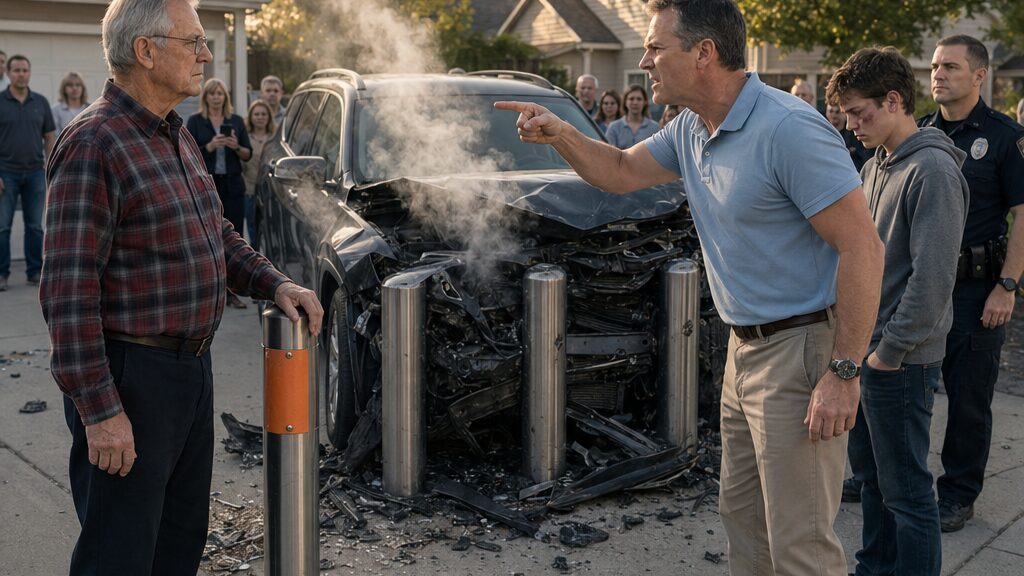
The Bollards Stayed Standing After the HOA President’s Perfect Family Began to Collapse
Chapter 1: The SUV Folded Around Three Steel Posts
Tyler Baker came out of the driver’s-side window on his hands.
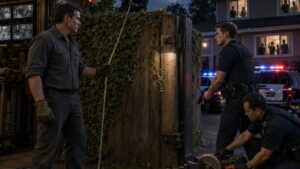
For one confused second, Larry Mitchell thought the boy was crawling through smoke. Then he saw the white cloud hissing from beneath the folded hood and recognized steam from the ruptured radiator. The front of the black SUV had wrapped itself around three stainless-steel posts at the edge of Larry’s driveway. Plastic fragments glittered across the pavement. One headlight blinked weakly through the wreckage.
“Don’t stand up,” Larry called.
Tyler tried anyway. His knees folded beneath him.
Larry set his coffee mug on the porch rail and crossed the yard as quickly as his stiff hip allowed. Before he reached the driveway, Jonathan Baker came running from the house across the cul-de-sac.
“Tyler!”
Jonathan struck the curb badly, recovered, and dropped beside his son. He gripped Tyler by the face, then the shoulders, searching for blood.
“Look at me. Can you hear me? Where does it hurt?”
“I’m okay,” Tyler said, though his voice shook. “I think I’m okay.”
The passenger-side airbag hung inside the SUV like a torn curtain. A horn blared without rhythm until something in the engine compartment clicked and the sound died.
Larry crouched several feet away.
“Don’t move his neck until the paramedics check him.”
Jonathan looked up. Fear still occupied his face, but it rearranged itself quickly.
“What did you do?”
Larry glanced at the wreck.
“I called emergency services.”
“These posts.” Jonathan rose. “You put these here.”
“They’re on my property.”
“You put them exactly where a car would hit them.”
Tyler sat with both palms flat on the pavement, staring at the steel posts. Two carried fresh black paint along their lower sections. None had bent.
Neighbors began emerging from their homes. A woman stood at the end of her walk with a phone held chest-high. Someone asked whether an ambulance was coming.
Jonathan pointed at Larry.
“My son could have been killed.”
Larry looked past him toward the shallow groove the SUV had carved through the grass. It began at the street, crossed the corner of Larry’s lot, and aimed directly toward the side yard shared with Emily’s property.
“He needs to be examined,” Larry said.
“Don’t tell me what he needs.”
Sirens sounded beyond the subdivision entrance.
Jonathan stepped closer. He was still wearing the polo shirt from the charity golf event that morning, the county advisory-board logo stitched above the pocket. His hands trembled.
“These are illegal,” he said. “You cannot install steel barriers beside a residential driveway.”
“They aren’t beside the driveway.”
“Don’t play word games with me.”
“I’m identifying the property line.”
“You created a trap.”
Larry heard the phrase move through the small crowd. A trap. It gave everyone something simple to understand: an old man, steel posts, a teenage driver.
Jonathan turned so the neighbors could hear him.
“I’m president of this association. Those things will be removed under the emergency-hazard provision. By Friday, if not sooner.”
Tyler raised his head.
“Dad.”
“Not now.”
“I—”
“Let the paramedics talk to you.”
The ambulance entered the cul-de-sac with a fire engine behind it. Jonathan moved aside just long enough for the responders to reach Tyler, then returned to Larry while they checked the boy’s pupils and fitted a brace around his neck.
“You’re paying for the vehicle,” Jonathan said quietly. “Every dollar.”
Larry studied him. Jonathan had spent fourteen years building a reputation for measured decisions, clean lawns, and meetings that ended on time. He knew how to lower his voice and make a threat sound administrative.
Larry pointed to the nearest bollard.
An orange plastic sleeve had been bolted to it below knee height. The impact had smeared dirt across the cover but had not dislodged it.
Jonathan looked down.
Inside the sleeve sat the county permit, folded behind clear plastic. The inspection approval occupied the top page. Date, parcel number, setback measurements, engineer’s seal.
Jonathan crouched and read it twice.
“The county does not supersede the covenants,” he said.
“No,” Larry replied. “But the covenants require county approval for permanent protective structures. Section eight, paragraph four.”
“You memorized it?”
“I reviewed it before submitting the application.”
A responder asked Jonathan for Tyler’s medical information. He answered without taking his eyes from Larry.
One of the neighbors lowered her phone.
Jonathan stood again. “Why would the county approve vehicle barriers here?”
Larry looked toward Emily’s side yard. From the driveway, only the upper portion of the pool fence was visible beyond the hedge.
“That question isn’t relevant to whether the permit is valid.”
“It is when you anticipated a collision.”
Larry said nothing.
Jonathan’s expression changed. Not relief, exactly. A new line of attack.
“You expected someone to hit these.”
“I expected them to prevent entry.”
“Entry by whom?”
The paramedics lifted Tyler onto a stretcher. The boy turned his face toward Larry. Beneath the fear was something more focused: a silent appeal Larry understood too well.
Larry had seen that look before.
He kept his answer narrow.
“The posts protect private property.”
Jonathan laughed once, without humor.
“You installed impact-rated steel where children drive, and now you refuse to say why.”
“Tyler is seventeen.”
“He is a kid.”
“He was operating a four-thousand-pound vehicle.”
Jonathan stepped forward, but the responding officer placed an arm between them.
“Gentlemen, separate for now.”
Larry obeyed. Jonathan did not move until the officer repeated the instruction.
The tow truck arrived while the ambulance was still parked at the curb. Its driver walked around the SUV, whistled softly, then photographed the undercarriage before attaching the cable.
Larry retrieved his coffee from the porch. It had gone cold.
Behind the hedge, Emily’s pool gate hung inward at a slight angle. The latch Tyler had struck two weeks earlier no longer aligned with the frame. Larry had told her it was settling from heat. He had even brought his level over and pretended to inspect the post.
Now one of her son’s blue swim goggles lay in the grass beside the bent gate.
Larry gripped the mug until coffee trembled over the rim.
His phone vibrated.
The email came from Melissa Sanchez, the association’s management representative.
EMERGENCY SAFETY REVIEW: LOT 18 VEHICLE BARRIERS.
A formal complaint had already been submitted. Pending review, Larry was instructed not to alter the accident site and to attend a special board hearing Monday evening. The message cited the HOA’s authority to remove an immediate danger even when a structure carried municipal approval.
The tow truck had not yet pulled the SUV free.
Jonathan stood across the street beside the ambulance, phone in hand.
Larry read the final line twice.
Failure to cooperate may result in emergency removal at the owner’s expense.
Chapter 2: The Complaint Arrived Before the Tow Truck Left
The violation notice appeared in Larry’s HOA portal at 6:42 p.m., eleven minutes before the tow truck finally dragged the SUV away.
He printed it because paper could be arranged, compared, and marked. On the kitchen table he placed the notice beside the county permit, engineering drawings, inspection photograph, and the covenant section governing protective structures.
The documents formed a clean rectangle.
Outside, nothing was clean. Absorbent powder covered the coolant stain. Tire marks cut through the lawn. The bollards carried black scars where the bumper had struck them.
Emily came through the back door without knocking.
“Where are the recordings?”
Larry capped his pen.
“Tyler is at the hospital.”
“They released him. Bruised ribs, mild concussion.”
He nodded, relieved despite everything.
“Where are the recordings?” she repeated.
He gestured toward the chair opposite him. “Sit down.”
“No.”
Emily still wore her work clothes, dark slacks and a blouse creased beneath the arms. She had tied her hair back too tightly. In one hand she held the printed violation notice.
“They’re saying you created a hazard.”
“I have the permit.”
“I know about the permit. I want the videos.”
Larry aligned the corner of the inspection report with the table’s edge.
“Emily—”
“How many times?”
He looked at her.
“How many times did Tyler come through that side yard?”
The refrigerator motor clicked on.
“Four before today.”
She stared at him as though he had answered in another language.
“Four.”
“The first did little damage.”
“That isn’t an answer.”
“The second bent the fence panel. The third tore the pool cover. The fourth struck the gate.”
“And you knew who it was?”
“After the second.”
Emily stepped away from the table. “You told me the wind damaged that panel.”
“I repaired it.”
“You told me the cover tore because it was old.”
“It was old.”
“And the gate was settling from heat?”
Larry lowered his eyes to the papers.
She gave a short, disbelieving breath. “You stood in my yard with a level and lied to me.”
“I was trying to resolve it without—”
“Without what? Making Jonathan uncomfortable?”
“Without giving a seventeen-year-old a record before he had a chance to correct himself.”
Emily crossed to the window. Beyond the glass, the three steel posts reflected the porch light.
“My son swims there.”
“I know.”
“He leaves toys by that gate. He runs barefoot from the house. What if Tyler had come through while he was outside?”
“That is why I installed the bollards.”
“No. You installed the bollards because you refused to tell anyone what was happening.”
The sentence landed harder because Larry could not correct it.
He led her outside with a flashlight. The evening air smelled faintly of antifreeze. At the base of the nearest bollard, he showed her the old streaks beneath the fresh black paint: red from a small car, blue from something lower, pale scratches from a metal bumper.
“The approaches were getting closer to the pool,” he said.
Emily walked through the hedge opening into her yard. The pool water moved under the security lights. Near the crooked gate lay her son’s blue goggles, one lens clouded with dust.
She picked them up.
Larry kept his flashlight pointed at the ground.
“You should have told me,” she said.
“Yes.”
The immediate agreement seemed to anger her more.
Inside Larry’s house, she opened the bottom drawer of the filing cabinet while he was rinsing the cold coffee from his mug. She found the receipts before he could stop her.
Fence hardware. Pool-cover patch kit. Replacement latch. Gravel. A landscape repair invoice paid in cash.
Each receipt carried a date in Larry’s handwriting.
Emily spread them across the counter.
“You documented every one.”
“I document repairs.”
“You documented damage you hid from me.”
He dried the mug slowly.
“The first time I spoke to Tyler, he denied it. The second time, I showed him a still image. He asked for a chance to tell Jonathan himself.”
“And you believed him?”
“I believed he was frightened.”
“That wasn’t my question.”
Larry placed the mug beside the sink. “I wanted to believe him.”
Emily’s face softened for only a moment. Then she saw the computer on the desk.
“Show me.”
The camera archive opened by date. Larry had installed the system after Emily moved into the neighboring house, mostly to watch the shared driveway when she worked late. Later he added a camera facing the pool gate.
Four folders appeared beneath the subdivision name.
APRIL 12.
MAY 03.
MAY 19.
JUNE 08.
The crash belonged to July.
Larry opened the first. Headlights crossed the lawn. A small vehicle clipped the fence and reversed. The second showed Tyler outside the car afterward, examining the damage. In the third, laughter came through the microphone before the vehicle accelerated. The passengers’ faces were indistinct.
Emily watched without speaking.
When the fourth clip ended, she held out her hand.
“Copy all of it.”
“Not tonight.”
“Why?”
“Because Tyler has not been questioned formally. Because Jonathan is already making claims. Because once these leave this house, I cannot control how they are used.”
“You shouldn’t control that.”
“I can provide them with context.”
“You mean you can decide how much truth everyone is allowed to have.”
Larry looked toward the window. Across the cul-de-sac, lights burned in every room of the Baker house.
Emily took a flash drive from her purse.
“Copy them, or I will tell the board you concealed evidence.”
“You may tell them.”
Her fingers tightened around the drive.
“You protected the wrong household.”
She left through the back door, taking the receipts with her.
Larry remained at the desk. The archive window cast a pale rectangle across his hands. After several minutes, he inserted his own storage drive and began copying the folders.
The progress bar stopped at seventy-five percent.
An error message appeared.
SOURCE DIRECTORY NOT FOUND.
Larry checked the archive again.
APRIL 12.
MAY 03.
JUNE 08.
The May 19 folder had disappeared.
He searched the recycle bin, the backup directory, and the camera’s internal storage. The index still showed that the file had existed. Access history listed one external transfer six weeks earlier.
Larry read the timestamp.
It was the afternoon Jonathan had stood in this room while Larry showed him a single image and asked him to deal with his son privately.
Chapter 3: The Boy Larry Chose Not to Report
Tyler entered Larry’s garage through the side door while Jonathan spoke to two local reporters at the end of the driveway.
Larry saw the boy’s reflection first in the dark window above his workbench: pale face, hood pulled low, one arm held carefully against his bruised ribs.
“You shouldn’t be here,” Larry said.
Tyler closed the door but did not come farther inside.
“Dad thinks I’m asleep.”
Outside, Jonathan’s voice carried through the open upper vent.
“This was a foreseeable hazard placed beside a roadway used by families.”
Larry turned off the small radio on his bench.
“What do you need?”
Tyler looked at the printed camera stills beside Larry’s untouched coffee. One showed the rear quarter of a sedan entering Emily’s yard. Another showed Tyler kneeling near the damaged fence.
“You still have them?”
“Most of them.”
The boy’s eyes lifted. “Most?”
“The May nineteenth folder is gone.”
“I didn’t delete it.”
“I didn’t say you did.”
“You think I came in here?”
“I think someone copied it.”
Tyler shifted his weight. Pain crossed his face.
Larry pulled out a stool. “Sit.”
“I’m fine.”
“You said that yesterday.”
Tyler sat.
For several seconds, neither spoke. The garage smelled of machine oil, coffee, and the cedar boards Larry used for small repairs. Jonathan’s practiced voice continued outside, describing community standards and child safety.
“Were the brakes defective?” Larry asked.
Tyler looked toward the door.
“No.”
“Did the accelerator stick?”
“No.”
“Did you lose control before leaving the street?”
Tyler swallowed. “Not before.”
Larry waited.
“We were messing around,” Tyler said. “The other times.”
“Who is we?”
“I’m not giving names.”
“I didn’t ask for them yesterday. I’m asking what happened.”
Tyler rubbed the heel of his hand against his knee. “They said the posts were fake. Decorative. One of them said you put them in plastic sleeves to scare us.”
“So you tested them.”
“I wasn’t trying to hit them that hard.”
“You accelerated across a lawn.”
“I thought I’d turn before the driveway.”
“But you didn’t.”
Tyler stared at the concrete floor. “No.”
The admission did not bring Larry satisfaction. It only sharpened the image of Emily’s son running barefoot beside the pool.
“Your father is telling people the brakes failed.”
“I know.”
“Did you tell him that?”
“He told me that’s what happened.”
Larry leaned against the workbench.
The first time he had confronted Tyler, the boy had stood in nearly the same spot. Larry had shown him a still image from the second incursion. Tyler’s face had emptied of color.
Please don’t call the police.
Larry had heard fear and mistaken it for readiness.
He had given Tyler forty-eight hours to tell Jonathan. A week later, Tyler returned with an envelope containing three hundred and eighty dollars in wrinkled bills.
“My savings,” he had said. “For the fence.”
Larry had not accepted it.
“Why did you bring me money if you had no intention of stopping?” Larry asked now.
Tyler’s jaw tightened. “I did stop. For a while.”
“You came back twice.”
“They wouldn’t let it go.”
“You drove the car.”
“I know.”
The words came out harsher than anything Tyler had said before.
Outside, a reporter asked Jonathan whether the HOA had previously received complaints about Larry.
“No formal complaints regarding these barriers,” Jonathan answered. “Because their dangerous nature was not disclosed.”
Tyler flinched.
“Your father knew about May nineteenth,” Larry said.
The boy said nothing.
“He was in this garage.”
“I know.”
“He told me you would be disciplined and the damage repaired.”
Tyler gave a bitter laugh that ended in a wince. “He told me I’d embarrassed him.”
“What happened after that?”
“He took my phone. Made me quit the summer team for two weeks. Then he called someone to fix the fence before the board noticed.”
“Did he see the recording?”
“You showed him part of it.”
Larry glanced at the computer.
Jonathan had stood behind him while the clip played. Larry remembered leaving the room to answer Emily’s call. Less than three minutes. Long enough to connect a drive.
“Did your father copy the file?”
“I don’t know.”
“Tyler.”
“I saw it on his laptop later.”
Larry’s hand settled beside the coffee mug.
“Why?”
“He said he needed to know how bad it looked.”
“And then?”
“He said if anybody asked, it was a landscaping accident.”
Larry closed his eyes briefly.
The boy had not come only to beg for secrecy. He had come carrying a fact capable of damaging his father.
“What do you want me to do?” Larry asked.
Tyler’s answer was immediate. “Don’t give them the videos.”
“Your father is using the HOA to remove the posts.”
“He’s scared.”
“So are you.”
“You don’t understand.”
“I understand the insurer may deny the claim if the impact was intentional.”
Tyler looked up sharply.
“Dad said insurance would handle it.”
“It may not.”
“My mom co-signed the loan.”
There it was: not innocence, but consequence spreading beyond the person who caused it.
Larry pulled the envelope from the locked drawer. He had kept Tyler’s money exactly as the boy had given it to him. He set it on the bench.
Tyler recognized his handwriting.
“You kept that?”
“Yes.”
“Why?”
“I thought returning it would tell you the matter was closed. Keeping it reminded me that it wasn’t.”
“You could have reported me.”
“I should have reported the pattern.”
Tyler’s face hardened. “So you’re going to now.”
“I haven’t decided what form that takes.”
“That means yes.”
“It means your father submitted an emergency complaint based on facts he knows are incomplete.”
Tyler stood too quickly and caught the edge of the stool.
“You promised me.”
“I promised you one chance to tell him.”
“I did tell him.”
“You did not tell Emily. You did not tell the association. You drove into the property again.”
“I didn’t know he’d do all this.”
“Neither did I. That is the problem with private arrangements. They depend on everyone becoming better before anyone is required to.”
Tyler looked toward the reporters’ voices.
“My dad will lose the board seat.”
“That is not mine to decide.”
“He’ll say it is.”
A notification sounded on Larry’s computer.
Melissa Sanchez had uploaded new documents to the emergency review file.
Larry opened the portal. The first page carried Jonathan’s electronic signature beneath a sworn statement.
Prior to the July collision, I had no knowledge of any vehicle-related entry, damage, warning, complaint, or dispute involving my son and the Mitchell property.
Tyler read over Larry’s shoulder.
For a moment, shame gave way to anger.
“He knew,” Tyler said.
Larry looked at the missing folder’s access record, then at Jonathan’s signature.
The promise Larry had made was still real.
So was the lie now carrying it.
Chapter 4: The Hearing Was Never Only About Safety
Larry entered the clubhouse and found a photograph of his driveway stretched across the projection screen.
The wrecked SUV filled the left half. The three steel posts stood on the right, polished and upright. Across the top, in red capital letters, someone had typed:
LETHAL OBSTRUCTION AT LOT 18.
Jonathan stood near the board table arranging folders. He did not look surprised to see Larry reading the screen.
“That wording is prejudicial,” Larry said.
“It describes the concern.”
“It describes a conclusion.”
Melissa Sanchez glanced up from her laptop. “The slide came from the emergency complaint packet.”
“Submitted by the presiding officer,” Larry said.
One of the board members shifted in his chair.
Jonathan closed a folder. “I’m not presiding tonight.”
“You called the meeting.”
“As association president, I was obligated to respond to an immediate hazard.”
“And as the vehicle owner?”
Jonathan’s jaw tightened. “That is why the vice president will conduct the vote.”
The room filled slowly. Residents took folding chairs along the walls. Emily arrived but sat three rows behind Larry instead of beside him. She carried the repair receipts in a manila envelope.
On the front table, Melissa had placed printed copies of the county permit. Larry recognized the engineering drawings reduced to letter size, his careful dimensions squeezed beneath the crash photograph like an apology.
The county inspector joined by video. His face appeared in a small square beside the image of the SUV.
The vice president called the hearing to order.
Jonathan spoke first.
He did not shout. That made him more effective.
He described the impact, Tyler’s concussion, the proximity of the posts to a residential street, and the association’s duty to protect residents from unusual hazards. He acknowledged the county permit, then argued that municipal approval did not answer whether the structure violated the subdivision’s broader safety obligations.
“My son made a driving error,” he said. “Teenagers do. The question is whether that error should have placed his life against three rigid steel columns.”
A murmur moved through the room.
Larry watched Emily’s face. She did not react.
Jonathan continued. “Mr. Mitchell selected impact-rated materials. That means collision was not merely possible. It was contemplated.”
When Larry’s turn came, he carried no prepared speech. He placed the original permit on the table and explained the setbacks, foundation depth, sight lines, and distance from the paved roadway.
The inspector confirmed each point.
“The installation is compliant with the county-approved plan,” the inspector said. “It does not intrude into the public right-of-way.”
“Would the county have issued the permit if it considered the posts dangerous?” Larry asked.
“We evaluate code compliance and declared use. The application identified them as protective barriers for a private residential boundary.”
Jonathan leaned toward his microphone. “Protective against what?”
The inspector paused. “That question would be for the applicant.”
Every face turned toward Larry.
Melissa spoke carefully. “Mr. Mitchell, did you possess information before installation indicating that vehicle contact was likely?”
Larry had expected the question. He had rehearsed three precise answers, each technically true.
None survived the sight of Emily’s envelope.
“I had reason to believe another vehicle might cross the property line,” he said.
Jonathan sat back.
Melissa’s fingers stopped above her keyboard. “What reason?”
“There had been prior damage.”
“Reported to the association?”
“No.”
“To law enforcement?”
“No.”
“Documented?”
Larry looked at Tyler, seated near the rear wall beside Jonathan’s empty chair. The boy’s hood was down tonight. A yellow bruise had spread along his temple.
“Yes,” Larry said.
The room stirred.
Jonathan rose. “Then he admits it. He anticipated a collision and installed an impact barrier without warning the community.”
“I installed a permitted barrier on private property.”
“Knowing a teenager might hit it.”
“Knowing someone had repeatedly entered a yard containing a swimming pool.”
Emily looked up.
The words were true, but incomplete. Larry heard how they sounded: a man willing to reveal danger while withholding its source.
Melissa asked, “Do you have evidence identifying the prior vehicle?”
Larry could have ended the question with one answer.
Instead he said, “I have records that require context.”
Jonathan seized the pause.
“What context could possibly matter more than the fact that you knowingly placed rigid obstacles in a path you expected a vehicle to take?”
“The path was private property.”
“That does not make a collision acceptable.”
“No collision was acceptable.”
“But foreseeable.”
Larry did not answer.
The vice president called for order as several residents began speaking at once. One asked whether children rode bicycles near the posts. Another asked why the HOA had never been informed. A third wanted to know whether Larry had been trying to catch someone.
The inspector’s image remained on-screen, silent now. County compliance had given Larry the small victory he expected. His refusal to explain the prior incidents was taking it back.
Melissa requested a short recess.
In the hallway, Emily approached him.
“You are still doing it,” she said.
“The hearing is about the structure.”
“No. Jonathan made sure it isn’t.”
“I will not expose Tyler in a room full of neighbors without a formal process.”
“He drove toward my yard five times.”
“He is also a minor.”
“He stopped being the only person worth protecting when you knew where he was driving.”
Larry lowered his voice. “I am trying to prevent this from becoming punishment by spectacle.”
Emily held up the envelope of receipts. “Then tell the truth without enjoying it.”
The board reconvened.
Melissa presented the options. Because the county permit remained valid, the association could not permanently remove the bollards that night. It could, however, issue a temporary safety order while requesting an independent review of whether Larry had created a foreseeable impact condition in violation of the nuisance clause.
The vice president asked whether Jonathan had participated in preparing the complaint packet.
Melissa hesitated. “The initial request came through the president’s emergency authority.”
“Was a conflict-of-interest disclosure filed?”
“No.”
Jonathan leaned toward the microphone. “The bylaws permit emergency action when delay could create further risk.”
“Even when the complainant owns the damaged vehicle?” Larry asked.
Jonathan looked directly at him. “Especially when a child has already been injured.”
The vote was four to one.
Larry had forty-eight hours to accept temporary removal or provide the evidence supporting his claim that the bollards served a necessary protective function. The association would pay removal costs initially, reserving the right to charge him later.
The meeting ended without applause.
Residents gathered around Jonathan. Emily left alone.
Larry waited while Melissa shut down the projector. The red words vanished, leaving the screen blank.
“Mr. Mitchell,” she said, “there is something you should see before you decide what to submit.”
She turned her laptop toward him.
Jonathan’s sworn statement filled the screen. Beneath his signature was the claim that he had possessed no prior knowledge of any vehicle entry, damage, warning, complaint, or dispute involving Tyler and the Mitchell property.
Melissa tapped the date.
“He filed this Sunday night.”
Larry read the sentence again.
“If I submit what I have,” he said, “his statement becomes more than inaccurate.”
“Yes.”
“And if I do not?”
“The removal crew arrives Tuesday morning.”
Chapter 5: One Missing Recording Changed Who Looked Guilty
At eight Tuesday morning, a contractor drew white circles around the base of each bollard.
Larry watched from the porch as the man marked the pavement for drilling. The circles looked like instructions for an amputation.
“We are not removing them yet,” Larry said.
The contractor checked his work order. “I was told to prepare the site.”
“The review period has not expired.”
“Preparation isn’t removal.”
A truck idled at the curb with a hydraulic extractor strapped to its bed. Across the cul-de-sac, Jonathan’s curtains moved.
Larry photographed the markings and called Melissa.
She answered on the third ring. “I’m trying to stop the crew.”
“They are already here.”
“They were scheduled through the president’s emergency authority before last night’s vote.”
“Jonathan bypassed the outcome of his own hearing.”
“I said I am reviewing it.”
Larry looked at the white circles. “Review quickly.”
His next call came from the insurance adjuster handling the SUV claim. The adjuster’s tone was neutral, almost gentle.
“We received information suggesting prior contact between the Baker vehicle or another household vehicle and your property.”
“There were prior incidents.”
“Did Mr. Baker know?”
Larry looked at the empty space on his computer screen where the May nineteenth folder should have been.
“Yes.”
“Can you document that?”
“I can document that I showed him a recording.”
The adjuster paused. “That would explain something.”
“What?”
“We were provided a short video clip by Mr. Baker late yesterday. He described it as evidence that your barrier placement invited collision.”
Larry straightened.
“Which date?”
“May nineteenth.”
The missing folder had not been destroyed. Jonathan had copied it.
“What portion did he submit?”
“Approximately twelve seconds. It shows a vehicle entering the edge of your lot and turning away before reaching the posts.”
“The posts were not installed then.”
“That is not apparent in the crop.”
Larry closed his eyes. Jonathan had used the earlier incursion to suggest the property itself created confusion while omitting Tyler’s approach, the laughter, and the fence impact.
“Did he tell you where he obtained it?”
“He said a neighborhood resident shared it.”
“I was that resident.”
The adjuster’s voice sharpened. “Did you authorize him to retain a copy?”
“No.”
“Did he acknowledge the prior damage when he filed the current claim?”
“Not to my knowledge.”
The contractor started a compressor. The sound rattled through the porch boards.
“I will need a written statement,” the adjuster said. “And any complete recordings you possess.”
“If the collision was intentional, what happens to the claim?”
“I cannot make that determination today. But intentional conduct by an insured driver can trigger exclusions. Misrepresentation creates separate issues.”
“Tyler’s mother co-signed the loan.”
“That affects the debt, not the coverage decision.”
Larry ended the call and stood beside the marked posts. For the first time, Jonathan’s fear had a shape larger than reputation. A denied claim would leave a ruined vehicle, a loan, legal fees, and consequences carried by people who had not been behind the wheel.
It did not make the sworn statement true.
Melissa arrived in her sedan twenty minutes later. She stepped out before shutting off the engine and handed the contractor a written suspension.
“No drilling,” she said.
The contractor looked relieved. He packed the compressor hose without argument.
Jonathan crossed the street.
“You have no authority to halt an emergency action approved by the board.”
Melissa faced him. “The board approved a review period. It did not approve advance site work arranged by an interested party.”
“I acted before the hearing.”
“You did not disclose that.”
“I disclosed the danger.”
“You also submitted a sworn statement denying prior knowledge while possessing footage from a prior incident.”
Jonathan’s eyes moved to Larry.
“You called the insurer.”
“The insurer called me.”
“You have no idea what you’re setting in motion.”
Melissa held up one hand. “This discussion is now part of the management record. I suggest both of you communicate in writing.”
She photographed the white circles, the truck, and the work order before leaving.
Jonathan remained at the curb.
For a while, neither man spoke.
Then Jonathan said, “The May clip proves nothing.”
“It proves you knew.”
“It proves I saw a car turn around.”
“You saw the full recording.”
“I saw what you showed me.”
“You copied it while I answered Emily’s call.”
Jonathan looked toward the Baker house.
Larry continued. “You cropped out the impact.”
“I used the relevant portion.”
“Relevant to what?”
“To the fact that your property layout creates a channel from the street.”
“There is no channel. There is grass, a hedge, a fence, and a private yard.”
“There was no warning.”
“The fence was the warning.”
Jonathan’s composure thinned. “My son nearly died.”
“Yes.”
The agreement stopped him.
Larry stepped down from the porch.
“And that frightened you,” he said. “It frightened me too.”
Jonathan’s face shifted, briefly stripped of office and argument.
“The hospital called me into a room before they finished the scan,” he said. “They asked whether Tyler had ever lost consciousness before. I thought they were preparing me for something.”
Larry waited.
“When they said he would be all right, I walked outside and saw those posts.” Jonathan pointed. “All I could think was that three feet in either direction might have changed everything.”
“Three feet toward Emily’s yard might have changed everything too.”
Jonathan rubbed both hands over his face.
Then he became careful again.
“What do you want?”
“The truth entered into the record.”
“That is not an answer.”
“It is the only answer I have.”
Jonathan looked at the bollards, then at the white removal marks.
“I can withdraw the complaint. The posts stay. I resign from the hearing process and state that the emergency action was premature.”
“In exchange for what?”
“You do not release the earlier videos. We handle property restitution privately. Tyler accepts whatever driving restrictions we impose.”
“We?”
“My family.”
“The same family that handled the last incident?”
Jonathan’s mouth tightened.
“This does not need to become criminal. It does not need to destroy his college options or leave his mother paying for a vehicle she never drove.”
Larry heard Tyler’s fear in the offer. He also heard Jonathan’s old certainty that every consequence could be managed if the right men sat in the right room.
“Put it in writing,” Larry said.
Relief appeared too quickly on Jonathan’s face.
“Tonight,” Jonathan said. “Clubhouse. Seven.”
“I did not say I would sign it.”
“You agreed to meet.”
“Yes.”
Jonathan walked back across the street.
Larry went inside. On the kitchen table, he placed the orange permit sleeve beside the blank pad where settlement terms might have gone.
At six forty-five, he left for the clubhouse carrying only the permit, Tyler’s envelope of savings, and a folder containing Jonathan’s sworn statement.
He brought no settlement papers.
Chapter 6: Two Fathers Tried to Decide Tyler’s Future
Jonathan began before Larry had taken his seat.
“I will resign as HOA president tomorrow if you destroy the recordings.”
The clubhouse conference room was empty except for the two men. The overhead lights made the long table look pale and institutional. Jonathan had arranged a proposed agreement in front of each chair.
Larry placed the orange permit sleeve at the center of the table.
It formed a narrow boundary between them.
“Resigning from the HOA does not correct your sworn statement,” Larry said.
“I will amend it.”
“To say what?”
“That I had limited awareness of one prior incident.”
“You paid for the repair.”
Jonathan’s expression hardened. “I arranged for damage to be corrected.”
“Through a third party so the association would not see the invoice.”
“To keep a minor mistake from becoming neighborhood entertainment.”
“It was the second vehicle incursion.”
“It was a stupid dare.”
“You knew that?”
Jonathan looked down at the agreement.
Larry understood the answer.
“You knew it was deliberate,” he said.
“I knew Tyler was with boys who encouraged reckless behavior. I knew he was ashamed. I knew one formal complaint could become a police report, an insurance record, a school disciplinary issue, and the only thing anyone remembered about him.”
“So you concealed it.”
“I parented him.”
“You managed the evidence.”
Jonathan pushed the agreement across the table. “Read it.”
The terms were efficient. Jonathan would withdraw the HOA complaint. Larry’s bollards would remain. The Baker family would pay documented property repairs. Tyler would surrender access to all family vehicles for one year and complete private restitution work.
In return, Larry and Emily would not provide recordings to law enforcement, insurers, the HOA, or third parties unless compelled by court order.
“You included Emily without speaking to her,” Larry said.
“It is a draft.”
“You included Tyler without asking him.”
“He is my son.”
“He is seventeen, not seven.”
“And you are not his father.”
The words struck cleanly.
Larry folded the agreement once and set it down.
“No,” he said. “I am the neighbor who tried to act like consequences were mine to delay.”
Jonathan stared at him.
“I gave Tyler one chance to confess,” Larry continued. “Then another. I kept evidence from Emily because I told myself I was protecting a frightened boy.”
“You were.”
“I was protecting myself from becoming the person who reported him.”
“That is not the same thing.”
“It had the same result.”
The door opened.
Tyler stood in the hallway, one hand pressed to his ribs.
Jonathan rose. “What are you doing here?”
“Melissa let me in.”
“She had no authority—”
“I asked her for the room number.”
“You should be home.”
Tyler looked at the papers. “Is that the deal?”
Jonathan moved between him and the table. “This is an adult discussion.”
“It’s about me.”
“It is about legal exposure.”
“It’s about what you’re going to make me say.”
Jonathan’s voice lowered. “We discussed this.”
“No. You discussed it. I listened.”
Larry remained seated. The resemblance between father and son was clearest when both were angry: the fixed jaw, the effort to keep emotion from sounding like emotion.
Jonathan pointed toward the door. “Go home.”
Tyler did not move.
“You told the insurance company the brakes failed,” he said.
“I told them the cause had not been determined.”
“You told me to say I panicked when the steering pulled.”
“You did panic.”
“After I hit the grass.”
Jonathan glanced at Larry. “He has a concussion.”
“I remember it,” Tyler said. “They dared me to hit the fence again. I said I’d get closer than last time. I thought the posts were hollow.”
The room went still.
Larry asked, “Who told you that?”
“It doesn’t matter.”
“It may matter later.”
“I’m not naming them tonight.”
Jonathan’s shoulders lowered slightly, as if Tyler’s refusal offered something he could still control.
Tyler looked at Larry.
“I drove at them. I turned too late. That’s what happened.”
The admission was plain, almost flat. It carried more force than Jonathan’s documents.
“Why come here?” Larry asked.
“Because both of you keep deciding what my future is supposed to survive.”
Jonathan stepped toward him. “I am trying to keep one reckless act from defining your life.”
“It wasn’t one.”
“I know that.”
“Then stop calling it one.”
Jonathan’s face changed. For a second, he looked less angry than wounded.
Tyler turned to Larry. “And you kept giving me chances because you didn’t want to be responsible if I got arrested.”
Larry did not defend himself.
“You liked being the reasonable one,” Tyler said. “You got to keep the videos and not use them. You got to tell yourself you were helping.”
The untouched coffee mug in Larry’s kitchen came to mind. Receipts aligned in drawers. Files labeled by date. Evidence preserved while action waited.
“You’re right,” he said.
Tyler blinked.
Jonathan said, “Do not encourage this.”
“I am not encouraging him. I am answering.”
“You think admitting fault makes your role noble?”
“No.”
Larry slid Tyler’s old envelope of savings across the table.
“I should have taken this as evidence that you understood damage had a cost. Instead, I treated it as proof you would correct yourself without anyone else knowing.”
Tyler picked up the envelope but did not open it.
“What happens now?” he asked.
Larry looked at the agreement.
“I submit the complete record.”
Jonathan gripped the back of a chair. “Then the insurer denies the claim.”
“Possibly.”
“The loan is in my wife’s name too.”
Larry said nothing.
“She co-signed because I received the better rate through the county credit union. She was not in the vehicle. She did not know about the dares. But she will carry half the debt if coverage disappears.”
Tyler’s anger faltered.
Jonathan pressed on. “There are consequences beyond the person you want to punish.”
“I do not want to punish you,” Larry said.
“Your actions will.”
“So did yours.”
Jonathan looked at Tyler. “Tell him you understand what this means.”
Tyler stared at the envelope.
Larry saw the old pattern forming again: Jonathan turning fear into instruction, Tyler letting another person supply the words.
“I will not destroy the recordings,” Larry said. “I will not sign your agreement. Tomorrow I will tell the board what Tyler did, what you knew, and what I withheld.”
Jonathan’s face went rigid.
“And I will state clearly that my silence contributed to the danger,” Larry continued. “I will ask for proportionate restitution, not spectacle.”
“You do not control proportionality once the files leave your hands.”
“No. That is what accountability means.”
Tyler sat down slowly.
Jonathan gathered the unsigned agreements, aligning their edges with unnecessary force.
“When the insurer comes after us,” he said, “remember that Tyler’s mother will pay for a lie she did not tell.”
Larry looked at the orange permit sleeve between them. It had once proved where one property ended and another began.
Tonight it offered no answer for where one person’s responsibility stopped.
Jonathan left without waiting for Tyler.
The boy remained at the table, holding the envelope he had tried to give Larry months earlier.
Tomorrow, Larry would have to decide how much truth could be spoken without using it as a weapon—and whether that distinction still belonged to him.
Chapter 7: Larry Told the Board What His Papers Could Not
Larry began before Jonathan had finished arranging his notes.
“Jonathan Baker’s sworn statement is false,” he said. “And my handling of the earlier incidents was wrong.”
The room went still enough for Larry to hear the ventilation system click behind the clubhouse wall.
On the table before him sat one file. Inside were the county permit, repair invoices, camera stills, access records from the missing folder, and a written account signed by Larry that afternoon. He had placed his own admission on top.
Jonathan looked toward the vice president. “This is not the order listed on the agenda.”
Melissa Sanchez answered from the management table.
“The order changed when Mr. Mitchell submitted evidence of a material omission by the complainant.”
Jonathan’s chair scraped backward. “Then I request time for counsel.”
“You may request it,” Melissa said. “The board may still consider the emergency removal order tonight.”
Residents filled every row. Some had attended the first hearing. Others had come because photographs of the crash had spread through neighborhood group messages. Emily sat near the aisle, her envelope of receipts on her lap.
Tyler was not beside Jonathan.
Larry gripped the edges of the lectern.
“The first vehicle entry occurred in April,” he said. “The second caused damage to the fence separating my daughter’s pool area from my property. After that incident, I identified Tyler from a camera recording.”
A murmur rose.
Larry did not look toward Jonathan.
“I confronted him privately. He asked for one chance to tell his father. I agreed.”
“Because you did not know the full circumstances,” Jonathan said.
The vice president tapped the table. “You will have a turn.”
Larry continued.
“Tyler brought me money for the repair. I kept it but did not accept it as payment. I took that as evidence that he understood what he had done.”
He opened the file and removed the envelope of wrinkled bills.
“I was mistaken.”
The words cost more than the technical facts. Larry felt Emily’s attention sharpen.
“There were additional entries. I documented them. I repaired damage without notifying my daughter, the association, or law enforcement. I told myself I was protecting a minor from consequences that might define his future.”
Jonathan leaned forward. “Which was a reasonable judgment.”
“No,” Larry said. “It became an excuse.”
The room changed then. The tension did not leave, but it stopped belonging entirely to Jonathan.
Larry displayed the first still image. Headlights crossing the lawn. Then the second: Tyler beside the damaged fence. Then a timestamp from the missing May folder and the external-transfer record.
“The full recording from May nineteenth was copied while Jonathan was in my home. A cropped section was later supplied to the insurer without disclosure that the vehicle struck the fence after the portion provided.”
Jonathan rose.
“You cannot prove who copied that file.”
“No,” Larry said. “I can prove you possessed it while swearing you had no prior knowledge.”
Jonathan looked toward Melissa.
She opened a folder of her own. “Management confirmed that the emergency work order was initiated through the president’s account before the board voted. No conflict disclosure was filed. The complaint package also omitted the prior contact between Mr. Baker and Mr. Mitchell.”
“This association had a duty to act,” Jonathan said. “A teenager was injured.”
“And the president had a duty to disclose his financial and personal interest,” Melissa replied.
Jonathan’s face tightened, but the anger in it no longer looked effortless. He glanced toward the empty chair beside him.
Larry presented the remaining footage without sound. He did not play the boys’ laughter. He did not freeze Tyler’s face on-screen. He showed only what established the pattern: repeated entry, repeated damage, increasing speed, and the route toward Emily’s pool fence.
“The bollards were not installed to punish anyone,” he said. “They were installed because I failed to stop the behavior by speaking plainly.”
Emily lowered her eyes.
One of the board members asked, “Why should we rely on your account now, when you concealed evidence before?”
Larry had expected hostility from Jonathan. The board member’s question cut closer.
“You should not rely on my character,” he said. “Rely on the permit, the inspection, the recordings, the repair dates, and the access logs. My delay does not make the documents false. But it does explain why the situation escalated.”
The rear doors opened.
Tyler entered alone.
Jonathan stood halfway. “You are not required to speak.”
“I know.”
“You should not do this without representation.”
Tyler carried a single folded page. He looked smaller than he had beside the wreck, though the bruising on his face had begun to fade.
He approached the management table and handed the paper to Melissa.
“This is my statement,” he said.
Jonathan moved toward him. “Tyler.”
The boy stepped back.
“I drove onto the property four times before the crash,” he said. “The last three were dares. I knew I wasn’t supposed to be there. The brakes did not fail. The steering did not pull.”
Jonathan’s mouth opened, but no words came.
Tyler looked at Larry.
“Mr. Mitchell gave me a chance to tell the truth. I didn’t. Then he gave me more chances. That made it easier not to.”
Larry felt the truth of it settle without mercy.
Tyler turned to the board.
“My dad knew about one of the earlier times. He paid for repairs and told me it was handled. He was trying to protect me. But he also told me what version to use after the crash.”
Jonathan closed his eyes.
The vice president called a recess.
No one left.
The board conferred in low voices while residents remained seated, unwilling to break the shape of the moment. Through the clubhouse windows, Larry could see the upper sections of the bollards at the far end of the cul-de-sac, catching light from a streetlamp.
When the board returned, Melissa read the findings.
The temporary removal order was suspended. The bollards would remain pending final confirmation of the already approved setback and visibility requirements. Management would recommend a new rule requiring conflict disclosure before emergency authority could be used by any board officer.
Jonathan was removed from the presidency by majority vote. A separate review would determine whether he could remain on the board.
There was no applause.
The vice president then addressed the property damage.
“Association action does not replace legal or insurance proceedings. Restitution must be resolved among the affected parties and relevant authorities.”
Larry stood again.
“I ask that Tyler’s age, voluntary statement, and willingness to repair the damage be considered.”
Emily rose from her seat.
“No.”
Larry turned.
Her voice was steady, not loud.
“You do not get to minimize restitution before asking me what repair requires.”
“I was not trying to—”
“You were. You are still deciding the kindest outcome before the person harmed has spoken.”
The room watched them now.
Larry could have explained his intention. He could have said he wanted proportion, not ruin. He could have hidden behind another carefully chosen distinction.
Instead he stepped away from the lectern.
“You’re right,” he said.
Emily’s expression did not soften, but something in it released.
Jonathan remained seated through the final vote. When the vice president asked whether he wished to respond, he shook his head.
The meeting adjourned.
Residents filed out slowly. Melissa gathered the permit, invoices, and Larry’s admission into one official record. Jonathan stayed in his chair, staring at the table where his nameplate had been removed.
Tyler waited beside the exit.
When Emily approached, he stood straighter despite the pain in his ribs.
“Can I talk to you?” he asked.
Emily stopped.
“Not here.”
“Before the insurance decision. Before court, or whatever happens.”
She looked at Larry, then back at Tyler.
“What do you want to say?”
“I don’t know yet,” Tyler admitted. “But I want to say it without either of them telling me how.”
He glanced first at Jonathan, then at Larry.
Emily studied him for several seconds.
“Tomorrow,” she said. “At my house. You come alone.”
Chapter 8: The Boundary Remained, but Nobody Called It Victory
Six weeks later, Tyler returned to the cul-de-sac on foot carrying a toolbox.
He stopped at the edge of Larry’s driveway, exactly where the public sidewalk met the private concrete, and waited.
The three bollards stood inside the line. The fresh black paint from the SUV had been cleaned away, but shallow scars remained in the steel. Behind them, Emily’s repaired pool fence ran straight across the side yard.
Larry came out holding two pairs of work gloves.
“You can come in,” he said.
Tyler stepped across the line.
His restricted license allowed him to drive only to school, counseling appointments, and required community service, but Jonathan had kept the remaining car keys locked away. The insurance claim was still under review. The family had agreed to sell a second vehicle and begin payments on the uncovered portion of the loss rather than contest every finding.
None of it had produced the dramatic collapse neighbors once predicted.
Consequences had arrived as paperwork, appointments, bills, and silences at the dinner table.
Tyler set down the toolbox.
“Emily said to clean these first.”
He nodded toward the bollards.
Larry handed him a cloth and a container of metal cleaner. “She wants the remaining transfer marks documented before they’re polished.”
“Of course she does.”
There was a trace of irritation in Tyler’s voice.
Larry raised an eyebrow.
Tyler exhaled. “Sorry.”
“You are allowed to dislike the work.”
“That doesn’t mean I don’t have to do it.”
“No.”
Tyler crouched beside the first post. He sprayed the cleaner and worked it into the scratches. The cloth darkened.
Larry sat on the low retaining wall without correcting his technique.
After the public hearing, Emily had met with Tyler twice. The first conversation lasted eleven minutes. The second lasted nearly an hour. She did not forgive him. She did, however, agree that part of his restitution could involve repairing what he had damaged under supervision.
Her conditions were exact: no unscheduled visits, no vehicle on either property, no contact with her son unless she was present, and no assumption that labor erased fear.
Tyler had accepted each one.
Emily came through the side gate carrying a box of replacement fence hardware. Her son followed far enough to place a tray of drinks on the patio table, then returned inside.
Tyler stood.
“You missed a section,” Emily said, pointing to the base of the second bollard.
He looked down. “I’ll get it.”
“This isn’t punishment by detail. The paint hides corrosion.”
“I understand.”
Emily handed Larry a coffee.
Tyler had brought it from the shop near the subdivision entrance. Larry knew because his name was written across the lid in the boy’s uneven block letters.
He took a sip while it was still hot.
Tyler noticed but said nothing.
When the posts were clean, they moved to the gate. The new frame was already anchored. Tyler’s task was to install the latch, reinforce the lower panel, and replace the strip of torn mesh beside the hedge.
Emily showed him the hardware.
“The latch has to close by gravity. No lifting it into place.”
Tyler examined the hinge alignment. “The post is a quarter inch high.”
Larry saw it too.
He waited.
Tyler loosened the bolts, reset the bracket, and tested the swing. The gate closed with a clean metallic click.
A small satisfaction crossed his face before he remembered not to seek praise.
Emily tested it twice.
“That works,” she said.
It was the first approval she had given him.
They continued through the morning. Larry cut the mesh. Tyler fastened it. Emily measured every opening along the bottom where a child’s foot might slip through.
Near noon, a car stopped across the street.
Jonathan got out.
He wore no county-board shirt and no HOA badge. His clothes were ordinary: jeans, a pale button-down shirt, sleeves rolled to his forearms.
He walked to the edge of the property and stopped before the bollards.
Tyler’s shoulders tightened.
Jonathan did not cross.
“I brought lunch,” he said, lifting a paper bag.
Emily remained beside the gate.
No one answered immediately.
Jonathan looked at her, not Larry.
“May I come onto the property?”
Emily considered the question.
“You can leave the bag on the wall.”
Jonathan nodded.
He placed it on the retaining wall without stepping past the line.
Tyler looked down at the drill in his hand.
Jonathan started to turn away.
“Dad,” Tyler said.
He stopped.
“You can stay there if you want.”
Jonathan faced him again.
It was not an invitation inside. It was not rejection either.
He sat on the opposite side of the low wall, feet remaining on the sidewalk. For several minutes, the only sounds were the drill, the pool pump, and the repaired gate clicking shut after each test.
Larry watched Jonathan resist the urge to advise Tyler on the placement of the screws.
That restraint looked difficult.
It also looked new.
When the work was complete, Emily inspected the fence from one end to the other.
Tyler waited near the gate.
“I know fixing it doesn’t make it even,” he said.
“No,” Emily replied.
“And I know saying I’m sorry doesn’t make you trust me.”
“No.”
He nodded.
“I am sorry anyway.”
Emily looked through the mesh toward the pool.
“My son stopped playing outside after the crash,” she said. “He asks whether cars can get through the fence.”
Tyler’s face tightened.
“I didn’t know.”
“You didn’t ask.”
“No.”
She closed the gate. The latch fell into place by its own weight.
“You can come back next Saturday to seal the repaired section,” she said. “Same time. You wait at the line.”
Tyler let out a breath.
“Okay.”
“That is not forgiveness.”
“I know.”
“It is work that still needs doing.”
“I know that too.”
Emily carried the unused hardware toward the house.
Larry followed her as far as the patio.
“Emily.”
She turned.
He had prepared no explanation. For once, he did not reach for one.
“I’m sorry I lied to you,” he said. “I’m sorry I decided what you could bear and called it protection.”
She looked at him for a long moment.
“You should have trusted me with my own fear.”
“Yes.”
“And with my own decision.”
“Yes.”
Her eyes moved toward Tyler, who was packing the tools while Jonathan waited beyond the property line.
“I’m not ready to make this easy for anyone.”
“I’m not asking you to.”
That answer seemed to matter.
Emily touched his arm once, briefly, then went inside.
Larry returned to the driveway. Tyler offered him the empty coffee tray.
“You drank yours,” he said.
“It was hot.”
“I noticed.”
Jonathan stood when Tyler approached the sidewalk. He did not take the toolbox from him until Tyler handed it over.
They began walking home together, not close enough to touch.
At the edge of the driveway, Tyler looked back at the three posts.
“They barely moved,” he said.
“They were not designed to move.”
Tyler nodded. “Maybe that was the point.”
Larry watched him cross the street.
Then he turned toward Emily’s yard. The fence stood repaired behind the unchanged bollards. The gate remained open for another moment while Emily’s son carried the empty drink cups inside.
Emily stepped out, checked the latch, and closed it deliberately.
The metal clicked into place.
The story has ended.