The HOA Tore Down His Father’s Wall Before Dawn, Then the Rain Exposed What It Had Protected
Chapter 1: The Excavator Arrived Before Anyone Could Object
The first strike shook Andrew Miller awake at 5:42 in the morning.
It was not thunder. Thunder rolled and faded. This sound came through the floorboards in a hard metallic jolt, followed by the grinding collapse of stone.
Andrew crossed the bedroom barefoot and pulled aside the curtain. Work lights burned beyond the maple trees at the edge of his property. An excavator sat astride the narrow strip beside the old retaining wall, its yellow arm lifted over the stones his father had laid by hand.
The bucket came down again.
Andrew was outside before he remembered shoes.
“Stop!”
The operator heard him. Andrew saw the man’s head turn inside the cab, but the engine kept growling. A section of wall folded inward, stones dropping into the damp earth with deep, blunt knocks.
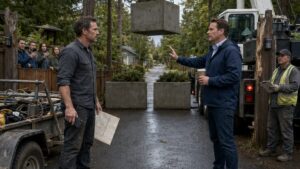
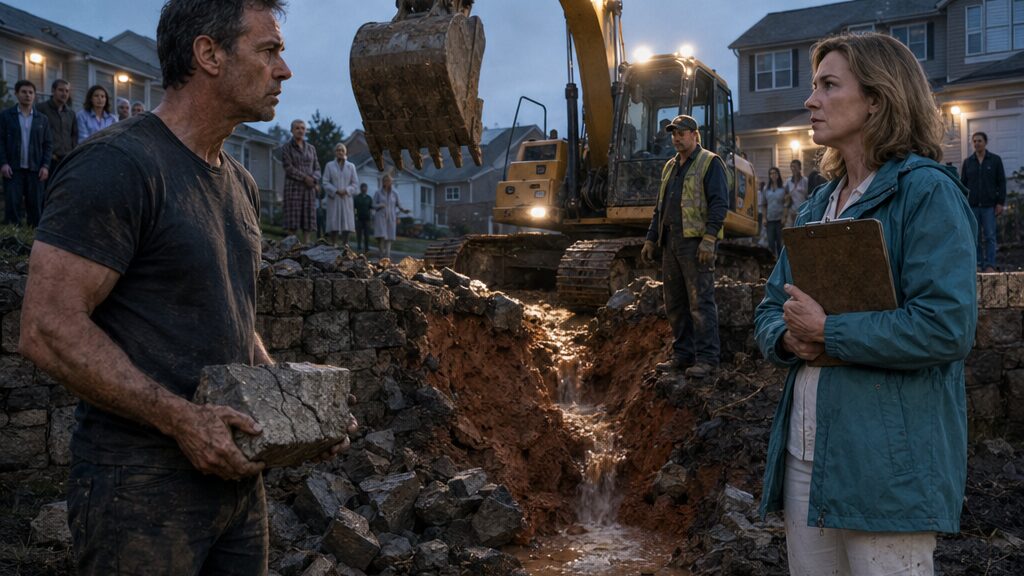
Lisa Roberts stood near the machine in a teal rain shell, white sneakers already spotted with mud. She held a clipboard under one arm and raised her free hand as Andrew approached, as though he were the person creating the disturbance.
“You need to stay clear of the equipment.”
“This is my property.”
“The board authorized removal.”
“At five in the morning?”
“The contractor schedules his own crews.”
Andrew stepped toward the excavator. The operator lifted the bucket and stopped moving.
Lisa pointed to the road. “You cannot enter the work area.”
Andrew looked past her at the broken wall. For fifty-eight years, the stones had held the line between his father’s narrow lot and the newer homes built uphill. The wall was rough and uneven, gray fieldstone mixed with poured sections where Ronald Miller had reinforced weak points. It had never been pretty. Ronald had not built pretty things. He had built things that stayed where he put them.
“You had no permission,” Andrew said.
“We sent notices.”
“You sent violation letters saying the wall needed cosmetic repair.”
“We sent three notices.”
“None of them authorized demolition.”
Lisa’s mouth tightened. “The board voted last night. You declined to attend.”
“I was working.”
“You could have submitted a statement.”
“I asked for the engineering review.”
“And you were told the structure had already been classified as deteriorated.”
“By whom?”
“By the property committee.”
Andrew almost laughed, but the excavator engine drowned the sound before it reached his throat. The property committee was Lisa, the HOA treasurer, and a retired furniture salesman who measured lawn height with a folding ruler.
The operator leaned out of the cab. “Ma’am, you want the whole run taken down?”
“Yes,” Lisa said.
Andrew turned sharply. “No.”
The operator looked from one to the other.
Lisa held up the clipboard. “I have the work order.”
“And I own the land.”
“The easement gives the association access.”
“For maintenance. Not destruction.”
Lisa stepped closer, lowering her voice. “Andrew, this has gone on for eighteen months. The wall is crumbling. Buyers have complained. The lender inspection flagged it. We cannot keep delaying because you refuse every reasonable solution.”
“My solution was to inspect it before touching it.”
“You never provided documentation showing it served any current purpose.”
Andrew’s gaze went to the wall. One section still stood near the old sycamore, six feet long and dark with moss. His father had once made him reset three stones there because the joints were too wide. Andrew had been sixteen and furious at losing a Saturday. Ronald had handed him the trowel and said, Water doesn’t care how tired you are.
At the time, Andrew had thought it was only another one of his father’s work sayings.
Lisa signaled to the operator.
The bucket swung.
It caught the standing section at its center. Stone cracked against steel. A rectangular block near the base split free and rolled into the track rut, its face scraped clean by the movement.
Four numbers showed beneath the dirt.
Andrew’s breath stopped.
His father had pressed the date into the wet mortar with the blunt end of a carpenter’s pencil. Andrew had seen it all his life, but only in pieces through moss and shadow. Now it lay exposed in the glare of work lamps like something uncovered in a grave.
He moved before Lisa could stop him.
“Sir!” the operator shouted.
Andrew entered the churned strip, lifted the block by both sides, and dragged it away from the excavator’s track. One corner had cracked clean through. Mud coated his palms.
Lisa followed to the edge of the disturbed ground. “Put that down. It may be evidence of structural failure.”
“It’s a date.”
“It’s part of the removed material.”
“It’s my father’s.”
“And the association will inventory everything.”
Andrew set the stone beside the sycamore.
A soft gurgling came from the opening behind the demolished wall.
At first he thought it was soil settling. Then the mud shifted in a steady pulse. Water seeped through a dark oval in the earth where the bucket had stripped away stones and roots.
The operator killed the engine.
In the sudden quiet, the sound became unmistakable: water moving through something hollow.
The man climbed down from the cab and crouched near the opening. He scraped loose soil aside with a gloved hand. A curved rim appeared, reddish brown and slick with clay.
“That’s pipe,” he said.
Andrew knelt beside him. It was not modern PVC. The exposed section was old fired clay, wide enough for Andrew to fit both hands inside. Water ran through it in a shallow but constant stream.
Lisa remained behind the safety cones. “There are abandoned lines all over these older lots.”
The operator looked at her. “It’s not dry.”
“Stormwater runoff.”
“That’s what a drainage line carries,” Andrew said.
Lisa’s jaw shifted. “The plans we received did not show an active line.”
“What plans?”
“The site plan attached to your violation file.”
“You mean the landscaping sketch?”
“The board relied on the documents available.”
“I asked you to get the original plat.”
“And you gave us no reason to believe it would change the determination.”
The water pulsed again, clouding the soil below the opening. Andrew followed the direction of the pipe with his eyes. It ran beneath the wall toward the low lots, including Rachel Nelson’s house two doors down.
The newer development rose behind Lisa in neat tiers of pale siding and black shutters. Twelve roofs stepped up the hill. Their gutters fed curb drains. Their streets sloped toward the strip where the wall had stood.
Andrew took out his phone and photographed the clay opening, the moving water, the excavator bucket, and the broken stone marked 1968. He made sure Lisa’s clipboard appeared in one frame.
She noticed.
“You cannot interfere with contracted work by creating a false safety concern.”
Andrew straightened. Mud darkened the knees of his pajama pants.
“Tell him to stop.”
“The board’s authorization remains valid.”
The operator removed his gloves one finger at a time. “I’m not putting the bucket near a live line until somebody tells me what it is.”
Lisa faced him. “Your company accepted a fixed-price removal.”
“And my company doesn’t pay for utility strikes.”
“It is not a utility.”
“You know that?”
The question hung between them.
Lisa looked toward the exposed channel, then toward the waking houses. Porch lights had begun coming on. A man in a robe stood across the street with his phone raised. Lisa lowered her voice.
“Clear the loose material only. Do not disturb the pipe.”
“The wall is the material around the pipe,” Andrew said.
Lisa ignored him.
Andrew scrolled through his contacts. He had not spoken to Joseph Garcia in almost three years, not since the small service after Ronald’s death. Joseph had worked with his father on county drainage projects in the 1980s and later opened a surveying office near the courthouse.
The call went to voicemail.
Andrew sent the photographs with one sentence: They tore down Dad’s wall. What is this line?
The typing indicator appeared almost at once.
Then Joseph called.
Andrew answered without greeting.
Joseph’s voice was rough with sleep. “Where are you standing?”
“At the east property line.”
“Show me the full opening.”
Andrew switched to video and turned the phone toward the demolished section. Joseph said nothing for several seconds.
“Move closer to the clay.”
Andrew did.
“Now pan uphill.”
The twelve newer homes filled the screen.
Joseph inhaled sharply. “Who authorized this?”
“The HOA.”
“Do they have the original subdivision plat?”
“They say they have plans.”
“That is not what I asked.”
Behind Andrew, the excavator engine restarted. The operator was repositioning the bucket above a pile of fallen stone.
Joseph heard it.
“Andrew, listen to me. Do not let them move another stone.”
Chapter 2: The Map Beneath the Board’s Decision
Joseph Garcia arrived twenty-three minutes later with an aluminum map case under one arm and his shirt buttoned wrong at the collar.
He parked half on Andrew’s lawn, stepped over the orange safety tape, and went directly to the exposed clay channel. The excavator operator had shut down again, but the machine remained positioned over the rubble. Lisa stood beside the HOA treasurer, speaking into her phone.
Joseph crouched, touched two fingers to the water, and rubbed the grit between his thumb and forefinger.
“Recent flow,” he said.
“We had rain three days ago,” Andrew told him.
Joseph looked uphill. “And those curb inlets discharge somewhere.”
Lisa ended her call. “Mr. Garcia, this is an active work site.”
“So I see.”
“You cannot conduct an inspection without board approval.”
“I’m not conducting an HOA inspection. I’m looking at a drainage feature on Andrew’s parcel at his request.”
“The association holds an access easement.”
Joseph glanced at the broken wall. “An access easement is not a demolition permit.”
Lisa’s face hardened. “We have legal authorization.”
“Good. Show me the recorded instrument you relied on.”
She held out the clipboard.
Joseph did not take it. “That’s a contractor work order.”
“It cites the board resolution.”
“I asked for the recorded instrument.”
The treasurer shifted his weight. “We have counsel reviewing the documents.”
Joseph opened the aluminum case on the hood of Andrew’s truck. Inside lay several rolled sheets, their edges softened with age. He selected one, spread it across the hood, and pinned the corners with a tape measure, his keys, and two stones from the rubble.
The paper was a county subdivision plat dated 1967.
Andrew had seen copies before, but never this sheet. Faded blue lines divided the hillside into long parcels that predated the newer development. A broad dashed band crossed the rear of Ronald Miller’s lot.
Joseph placed his finger on it.
“Drainage and maintenance easement.”
Lisa stepped closer. “That could have been abandoned.”
“It could have been. Was it?”
“The current title report did not mention a wall.”
“The easement isn’t named for the wall.”
Joseph traced the dashed band toward the hill. Thin arrows converged from several directions, all pointing toward the place where they stood.
Andrew counted silently.
One, two, three.
Then more.
“Twelve lots,” Joseph said. “The original upper subdivision was designed to drain through this corridor.”
Lisa shook her head. “Those lots were regraded when our phase was built.”
“Which means there should be amended drainage plans.”
“There are.”
“Then bring them.”
“The management office opens at eight.”
Joseph checked his watch. “It’s seven twelve. We can wait forty-eight minutes without tearing out anything else.”
Lisa looked toward the street. More residents had gathered, keeping their distance from the machine. The board president in her wanted the scene controlled. Andrew could see her calculating which choice looked weaker: halting the work or allowing an outsider to dictate terms.
She turned to the operator. “Temporary pause pending document verification.”
Joseph rolled his eyes after she looked away.
Andrew said quietly, “You recognize the line.”
“I recognize the system.” Joseph pointed beneath the exposed clay. “That channel carries low flow. The wall slows and spreads overflow when the pipe capacity is exceeded. Your father used stone because the face had to drain without washing out.”
“He never explained it that way.”
“Ronald explained things while expecting you to already understand them.”
That was true enough to sting.
Joseph brushed dirt from the dated block. The crack ran through the lower corner but left the numbers intact.
“He cast this section after the county rejected the first timber design,” Joseph said. “I was a kid, but I remember him complaining about it.”
“You were there?”
“Not when he built it. When we surveyed repairs years later.”
Andrew looked at him. “What repairs?”
Joseph’s hand stopped on the stone.
Before he could answer, Lisa returned with a tablet. “The management company sent the site plan.”
She displayed a color document showing property boundaries, landscaping zones, and the approximate wall location. No drainage corridor appeared.
Joseph studied the revision date. “This is a sales exhibit.”
“It was included in the association turnover package.”
“It shows decorative trees that were never planted.”
“It is still an official document.”
“It is a marketing drawing.”
Lisa tapped the screen. “Our counsel says the wall lies partly inside the association’s maintenance easement.”
“Maintenance,” Andrew said. “You keep skipping that word.”
Lisa ignored him. “The board has authority to correct hazards.”
Joseph leaned over the old plat again. “And the property owner has protection under the covenant.”
“What covenant?”
He opened a second sheet, this one a photocopy of a typed county record. The print was faint, but the heading remained legible: Stormwater Conveyance and Retaining Structure Agreement.
Andrew felt something cold move through him.
Joseph read the relevant paragraph aloud. The structure within the drainage corridor could not be substantially altered or removed without review by a licensed engineer and approval from the county or successor municipal authority. Any party causing unauthorized damage would be responsible for restoration to equivalent capacity and original design intent.
The treasurer lowered his eyes to the rubble.
Lisa said, “That language does not prove the existing wall is the protected structure.”
Joseph aligned the plat with the exposed channel. He used the tape measure to establish the distance from the old sycamore, then followed the bearing line across the paper.
“The protected structure begins thirty-one feet south of the original road pin and follows the drainage band for eighty-four feet.” He pointed to the remaining wall. “That is this wall.”
Lisa’s confidence did not disappear. It changed shape.
“You are making a field conclusion based on incomplete records.”
“Yes,” Joseph said. “Which is why normal people stop before demolishing the rest.”
The municipal inspector arrived shortly after eight, summoned by the excavator operator’s supervisor rather than the HOA. He photographed the live channel, took Joseph’s license information, and asked Lisa for the permit number.
She read it from the work order.
The inspector entered it on his phone, frowned, and tried again.
“That number is not returning this address.”
“It may be under the association parcel.”
He tried the parcel number.
Nothing.
Lisa called the management office. The inspector placed a red stop-work notice on the excavator’s side window while she waited on hold.
For Andrew, the sight should have felt like victory. The machine was silent. The remaining wall stood untouched. The covenant placed the reconstruction cost on whoever had ordered the damage.
Yet the word repairs remained lodged in his mind.
Joseph had said they surveyed repairs years later.
At the county records office, the clerk led them to a table beneath fluorescent lights and brought out the scanned covenant file. Lisa sat opposite Andrew, arms folded tightly. The treasurer remained at the HOA office gathering records.
The covenant bore Ronald Miller’s signature and the signature of the original developer. Attached exhibits described the wall’s maintenance requirements and the distribution of responsibility among future parcels benefiting from the drainage corridor.
The clerk clicked through the digital index.
“There should be an attachment C,” Joseph said.
“I only see A and B.”
“C was the maintenance schedule.”
Lisa leaned toward the monitor. “If it was never recorded, the association could not have known about it.”
Joseph shook his head. “The index references it.”
The clerk searched by instrument number, then by Ronald’s name. A separate scan appeared.
“There it is,” she said. “Filed three weeks later.”
The first page contained a diagram of drainage joints and inspection intervals. The second bore Ronald’s signature beneath a handwritten note directing future owners to report deterioration to any association or municipal body responsible for the upper parcels.
Lisa looked at Andrew.
“You said your father left no maintenance agreement.”
“I said the HOA never showed me one.”
“That is not the same thing.”
The clerk turned to the final page. A routing stamp showed that a certified copy had been issued nine months earlier.
Recipient: Andrew Miller.
Andrew stared at the line.
He remembered the envelope then—not opening it, only carrying it from the mailbox to the kitchen and placing it beneath a stack of electrical catalogs. It had arrived the week after Lisa proposed transferring wall maintenance to the HOA. He had assumed it was another pressure tactic.
Joseph saw the recognition in his face.
The clerk was still reading. “There’s also a signed maintenance attachment from Ronald Miller that does not appear in the HOA’s current file.”
Lisa’s eyes stayed on Andrew.
The question in the room was no longer only what the board had failed to find.
It was what Andrew had received and chosen not to read.
Chapter 3: The Warning Andrew Never Shared
The certified envelope was exactly where Andrew had left it nine months earlier.
It lay beneath two supply catalogs on the far end of his kitchen counter, unopened, the green postal label curling at one corner. His name was typed across the front. The return address belonged to Joseph’s surveying office.
Joseph stood in the doorway while Andrew held it.
“I sent that after Lisa’s management company asked for a boundary clarification,” he said.
“You never called.”
“I did. Twice.”
Andrew remembered seeing the number and letting it ring. At the time, he had been replacing a motor-control panel at a bottling plant, working twelve-hour shifts and sleeping badly. Ronald had been dead six months. Every discussion about the wall felt like someone reaching into a room Andrew had barely managed to close.
He slid a knife beneath the flap.
Inside was a copy of attachment C, a survey sketch, and a one-page letter signed by Joseph. The letter warned that several mortar joints near the east drainage outlet showed displacement. It recommended inspection before the next severe storm season and consultation with all uphill property owners benefiting from the drainage system.
The final paragraph was underlined.
Failure to coordinate maintenance may create shared exposure for downstream damage.
Andrew placed the letter flat on the counter.
Joseph did not soften his voice. “You knew I was concerned.”
“I knew you wanted the HOA involved.”
“I wanted the people sending water toward your property involved.”
“They wanted control.”
“They wanted an agreement.”
“They wanted the right to replace the wall with poured concrete and put a walking path over it.”
“That was one proposal.”
“It was the only proposal Lisa ever mentioned.”
Joseph pulled out a kitchen chair but did not sit. “So you refused to answer.”
“I told her the wall wasn’t theirs.”
“And technically, you were right.”
Andrew looked up.
Joseph tapped the unopened envelope. “Technically right is doing a lot of work in this house.”
The sentence landed harder than anything Lisa had said that morning.
Andrew carried the broken 1968 stone through the utility room to the garage. Ronald’s old workbench still stood against the back wall. Andrew had cleared most of his father’s tools after the funeral but never moved the bench. The surface remained scarred by chisels, oil cans, and the circular burns left by coffee mugs.
He set the stone on it.
Under the brighter light, the crack looked deeper. Mud filled the carved numbers. Andrew cleaned them with a stiff brush, each stroke revealing more of the pale mortar his father had mixed before Andrew was born.
Joseph watched from the doorway.
“My father never said the upper lots owned any part of it.”
“He didn’t say they owned it.”
“He signed a shared maintenance schedule.”
“He understood drainage responsibility. That isn’t the same as giving away the wall.”
“To him, maybe.”
Joseph finally sat on a shop stool. “Ronald called me five years ago, before his health got bad. He wanted the corridor resurveyed because the new phase changed the runoff timing.”
Andrew turned. “You never told me.”
“He asked me to wait until he spoke to you.”
“He didn’t.”
“I know.”
The garage seemed smaller.
Andrew looked at the stone. “He made me promise to keep it standing.”
Joseph’s expression changed, not with surprise but recognition. “That sounds like him.”
“I took it to mean no board, no developer, nobody touched it.”
“And maybe he meant that then.”
“You think I misunderstood my own father?”
“I think your father could turn a maintenance instruction into a family commandment and expect everyone else to sort out the difference.”
Despite himself, Andrew gave a short laugh. It vanished quickly.
His phone buzzed on the bench.
A weather alert covered the screen: severe thunderstorms expected after midnight, with possible rainfall exceeding three inches.
Joseph read it over his shoulder.
“We need temporary protection.”
“The inspector stopped all work.”
“Stopped demolition. Emergency stabilization is different.”
They returned to the HOA office before noon. Lisa sat at the conference table with the treasurer and two board members. Printed emails, contractor invoices, and insurance notices covered the surface.
She pushed a set of meeting minutes toward Andrew.
“Three notices,” she said. “Two requests for access. One certified maintenance letter.”
Andrew did not touch the pages. “I found the letter.”
The room went still.
Lisa leaned back. “You told the clerk you did not receive it.”
“I said I didn’t remember it.”
“You said the board never warned you.”
“The board warned me the wall was ugly, cracked, and noncompliant. It never warned me you planned to tear it down before a drainage review.”
“You had information showing it needed attention.”
“Yes.”
The admission seemed to unsettle her more than another denial would have.
Joseph placed the weather alert on the table. “You can argue about notice after we protect the corridor.”
Lisa looked at Andrew. “Did you know the wall might fail?”
“No.”
“That is not what the letter says.”
“It says joints had shifted. It recommends inspection.”
“And you ignored it.”
Andrew kept his hands at his sides. “I did.”
One board member exhaled through his nose. The treasurer stared at the insurance notice in front of him.
Lisa said, “You let us believe your objections were purely sentimental.”
“You decided they were sentimental because that was easier.”
“You withheld a professional warning.”
“And you ordered demolition without confirming the permit.”
Joseph stepped between the ends of the table. “Both of you can save those sentences for the hearing. Right now, twelve lots drain toward an open corridor, and there is heavy rain coming.”
The board approved emergency stabilization by a narrow vote. Lisa called the contractor and ordered delivery of gravel-filled barriers and plastic sheeting. Joseph objected to the placement proposed in the contractor’s sketch, saying it would concentrate water along the lowest property line.
Lisa’s voice sharpened. “We cannot afford a full engineering design in six hours.”
“Then do not improvise one with the same people who broke the system.”
“We are using the available contractor.”
Andrew studied the sketch. A row of barriers would be placed where the wall had stood, but the ends angled downhill toward Rachel Nelson’s lot.
“This needs an outlet,” he said.
Lisa looked at him coldly. “You have had nine months to contribute.”
The words were deserved, which made them difficult to answer.
Joseph revised the sketch by hand, adding a temporary bypass trench. The contractor agreed to attempt it before dark. Andrew offered to help identify the original channel alignment.
Lisa hesitated, then nodded once.
For the rest of the afternoon, Andrew worked beside men who had demolished his father’s wall. They laid plastic over the exposed earth, positioned gravel bags, and cleared the clay channel of broken mortar. Andrew found himself explaining where the old overflow path curved beneath the sycamore.
He knew more than he had admitted.
That truth followed him with every shovel stroke.
By evening, the corridor looked contained. Not repaired, only covered. The broken 1968 stone rested on Ronald’s workbench, clean on its upper half and dark with damp along the crack.
At 10:17, rain began against Andrew’s kitchen windows.
At 11:02, the gutters overflowed.
At 11:36, his phone rang.
Rachel Nelson’s name lit the screen.
Andrew answered and heard water before he heard her voice.
“It’s coming down the basement stairs,” she said. “The outside window is bending in.”
Andrew stood so quickly the chair struck the wall.
“How high?”
“I don’t know. Six inches. Maybe more.”
Behind her, something hit the floor with a hollow crash.
“Rachel, get upstairs.”
“My breaker panel is down here.”
“Do not touch it. Go upstairs now.”
“What did they do to that wall, Andrew?”
He grabbed his jacket and keys.
Rachel’s voice broke through the sound of rushing water.
“And what did you know before they did it?”
Chapter 4: When the Water Chose the Lowest Homes
Rachel’s basement window bowed inward as Andrew reached the bottom of her driveway.
Brown water pressed against the glass from outside, carrying leaves, mulch, and pale scraps of insulation torn from somewhere uphill. The pane flexed with each new surge.
Rachel stood halfway down the basement stairs in rubber boots, one hand gripping the railing and the other holding a flashlight.
“I told you to stay upstairs.”
“My freezer is down there.”
“So is your electrical panel.”
“The power’s already out.”
“That doesn’t mean the lines are dead.”
Andrew moved past her before she could argue. Water covered the bottom stair and climbed visibly along the painted concrete wall. A dark line marked where it had been only minutes earlier.
He aimed his flashlight through the basement. Storage bins floated against a workbench. A cardboard box softened and collapsed, releasing children’s drawings across the surface. Near the far wall, water streamed around the window frame in narrow jets.
“Where’s your main shutoff?”
“Outside, left side.”
“Call the utility. Tell them water reached the service equipment.”
Rachel did not move.
“What did you know?” she asked.
Andrew turned toward her. Rain hammered the metal window well.
“I knew the wall needed an inspection.”
“When?”
“Nine months ago.”
Her face changed as if he had struck something beside her.
“Nine months?”
“I did not know they would demolish it.”
“That isn’t what I asked.”
A sharp crack came from the window. Andrew climbed two stairs and pushed Rachel ahead of him.
“Up. Now.”
They reached the kitchen as the outer pane failed. Water rushed into the basement with a sound like gravel poured down a chute.
Rachel closed the basement door, though both of them knew it would not stop anything.
Her young son stood in the hallway wrapped in a blanket. He looked at the water spreading beneath the door.
“Is the house falling down?”
“No,” Rachel said quickly.
Andrew could not make himself say the same.
Outside, runoff crossed the street in a continuous sheet. The storm drains at the curb had disappeared beneath swirling water. Andrew called Joseph while walking toward the rear yards.
Joseph answered on the first ring. “I’m at the corridor.”
“How bad?”
“The temporary line is overtopping. Get everyone out of the lowest basements.”
Andrew looked uphill. Porch lights flickered through the rain. Water raced down driveways from the newer homes, gathering speed where the road curved.
“I’m coming.”
Rachel followed him onto the porch.
“You’re not leaving.”
“I have to stop the flow.”
“You have to answer me.”
“If I don’t go now, another house fills.”
She stared at him for half a second, then pulled her hood up. “I’m coming with you.”
“No.”
“My house is already flooding.”
“Stay with your son.”
Her mouth tightened. It was not agreement, only the recognition that there was no time.
Andrew ran through the side yard. By the time he reached the demolished wall, water covered his boots. Work lights reflected from the exposed soil in broken yellow streaks.
Joseph stood beside the gravel barriers, shouting over the rain at the excavator operator and two neighbors holding shovels. The plastic sheeting had torn loose at one end. Water struck the barrier line, turned sharply, and shot along the trench toward Rachel’s lot.
Andrew saw the mistake immediately.
“They angled it downhill.”
“I told them not to,” Joseph said.
“Who changed the layout?”
The operator pointed toward Lisa, who stood under a large umbrella near the road.
“It was blocking access for emergency vehicles,” Lisa called. “The contractor adjusted it.”
“You redirected the overflow.”
“The contractor followed the safest available option.”
“For the road,” Joseph said. “Not the houses.”
Lisa’s umbrella snapped backward in the wind. She caught it with both hands.
“The insurer’s inspector arrives tomorrow,” she said. “We could not leave equipment across the access lane.”
Andrew stared at her. “This was about an inspection?”
Her silence lasted one beat too long.
Joseph heard it too. “What inspection?”
Lisa folded the umbrella and stepped closer, rain flattening her hair against her face.
“Our carrier issued a conditional renewal. The wall was listed among unresolved hazards. We had until this week to show corrective action.”
“So you tore it down,” Andrew said.
“We had estimates for eighteen months. You refused access, repairs, and transfer of maintenance.”
“I requested engineering review.”
“You requested delay after delay while premiums increased for every homeowner.”
“And you moved the barrier to impress an insurance inspector.”
“I moved it to preserve emergency access.”
Water surged against Andrew’s knees. A section of gravel bags shifted, opening a gap. The stream widened at once.
Joseph pointed toward the old clay channel. “We need to give the water somewhere else to go.”
The outlet was clogged with broken mortar and soil from the demolition. Andrew waded to it and reached into the opening. Cold water pressed against his arm.
“There’s stone packed inside.”
The operator brought a pry bar. Together, he and Andrew loosened the debris while Joseph directed two neighbors to deepen the bypass trench. Lisa called the management company, but no one answered.
Andrew pulled free a jagged piece of mortar. Water punched through the opening and knocked him backward.
For several seconds the channel ran brown, then cleared enough to show the pull of the current. The level around the barrier dropped an inch.
“Again,” Joseph said.
They removed three more fragments. The clay pipe began carrying a steady stream, but the overflow remained too great.
A neighbor from the next downhill lot shouted from the fence. Water was backing toward his foundation.
Andrew looked at the slope, then at a shallow swale along the unused common strip beside the road.
“We cut through there.”
Lisa shook her head. “That is landscaped common property.”
“It is grass.”
“It contains irrigation lines.”
“Then shut them off.”
“The board has not authorized excavation.”
Andrew took the excavator operator’s shovel.
“Call a meeting.”
He drove the blade into the sod.
The operator hesitated, then joined him. Joseph marked the route with his flashlight. Two neighbors widened the cut, peeling back turf and opening a temporary path toward the roadside basin.
Lisa stood in the rain watching them cross the common strip she had spent years regulating.
When the trench broke through, water changed direction with sudden force. It rushed away from the low houses, flattening the grass and carrying clumps of soil toward the basin.
The neighbor at the fence shouted that the level was dropping.
It was a small victory. Rachel’s basement remained flooded. Two other homes had already taken water through window wells. But the fourth house, the one nearest the exposed corridor, stayed dry.
By dawn, the storm had weakened to a heavy drizzle.
Andrew sat on the curb outside Rachel’s house with mud dried to his sleeves. Firefighters had pumped several inches from the basement, though more seeped through the walls. A stack of ruined boxes stood beneath a tarp in the driveway.
Rachel came outside holding a plastic folder.
“I found this floating near the stairs.”
Inside were insurance documents, school records, and a photograph of her son as a baby. Water had reached the lower half of the picture, blurring the blanket around him but leaving his face clear.
Andrew looked away.
Rachel sat beside him, leaving a foot of space between them.
“You stopped the water from reaching the next house.”
“We were late.”
“You still stopped it.”
He waited.
She turned the wet photograph over in her hands. “Did you think the letter was wrong?”
“No.”
“Did you think nothing would happen?”
“I thought the wall was mine to handle.”
“That isn’t an answer.”
“It is the only one I have.”
Rachel looked toward the hill. Residents moved among the yards, carrying fans, pumps, and soaked belongings. Lisa stood near the clubhouse entrance speaking to the HOA treasurer.
“What did the letter say?”
“That the drainage joints had shifted. That everyone using the system should coordinate maintenance.”
“And you told no one.”
“I thought if the HOA got control, they would replace it with whatever was cheapest.”
Rachel laughed once, without humor. “So you protected the wall.”
Andrew looked at the water stain inside her open basement door.
“No,” he said. “I protected being the person who owned it.”
Joseph approached carrying a mud-coated binder recovered from the contractor’s truck. Lisa followed several steps behind.
“The residents know about the letter,” Joseph said.
Andrew stood.
“How?”
“The treasurer found it in the management correspondence and forwarded the file to the affected owners.”
Lisa’s expression was exhausted rather than triumphant.
“He thought disclosure was required,” she said.
“It was,” Andrew replied.
Rachel rose beside him. “We’re meeting tonight.”
Lisa rubbed rainwater from her face. “The board will schedule a formal session.”
“No,” Rachel said. “Tonight. The clubhouse. Seven o’clock.”
“There are notice requirements.”
“There are three flooded houses.”
Lisa started to answer, then stopped.
Rachel looked first at Andrew, then at Lisa.
“You both get one chance to explain what you knew, when you knew it, and why the rest of us had to find out with water in our homes.”
Chapter 5: The Meeting Where Both Sides Lost Their Story
Flood-damaged belongings lined the walkway to the clubhouse.
A child’s bookcase leaned against the railing with its lower shelves swollen apart. Rolled carpet sagged beneath a blue tarp. Three black garbage bags had split open, exposing damp clothes and a box of holiday ornaments.
Residents stepped around the debris on their way inside.
Andrew carried the cracked 1968 stone against his chest. It was heavier than he remembered, or perhaps he had been carrying it too long.
Rachel stood at the clubhouse doors checking names against a handwritten list. She did not greet him. She only looked at the stone and said, “Put it where everyone can see it.”
Inside, folding chairs filled the meeting room. The board sat behind a long table crowded with claim forms, contractor records, and water-damaged photographs. Lisa occupied the center seat. Her hair was pulled back, and she wore the same clothes from the storm beneath a dry cardigan.
Andrew placed the stone on the table between himself and Lisa.
Mud remained in the crack. The numbers faced the room.
Conversation quieted.
Lisa opened the meeting without the usual pledge or approval of minutes.
“Three homes sustained confirmed water intrusion,” she said. “The association has notified its carrier and retained counsel.”
A man from the back called, “Who pays before counsel finishes talking?”
Another resident asked whether a special assessment had already been discussed.
Lisa raised one hand. “No assessment has been approved.”
“That’s not what he asked.”
Rachel remained standing beside the front row.
“What did you know about the wall?” she asked.
Lisa looked at Andrew. “We knew it had deteriorated. We knew Mr. Miller had declined multiple proposals for repair or transfer of maintenance responsibility.”
“And the drainage system?”
“We did not have the complete recorded attachment.”
Andrew felt the room shift toward him before anyone spoke.
Rachel asked, “Did he?”
Lisa did not answer. She did not need to.
Andrew stood.
“I received a maintenance letter nine months ago. I did not open it until yesterday.”
Voices broke across the room.
“You expect us to believe that?”
“You ignored certified mail?”
“You knew there was a problem?”
Andrew kept one hand on the back of his chair.
“I knew Joseph Garcia wanted an inspection. I believed the HOA was using the issue to take control of the wall. I refused to cooperate.”
A resident near the window said, “So this is your fault.”
“It is part of it.”
The words did not calm anyone, but they changed the air. Anger lost its single target and spread.
Lisa opened a folder. “The board repeatedly attempted to address the hazard.”
Andrew turned toward her. “You also received Joseph’s request for a drainage review.”
“That request came after the wall was already under enforcement.”
“Did you read it?”
Lisa’s fingers stopped on the folder.
Rachel said, “Answer him.”
“Yes.”
“When?”
“Three weeks before demolition.”
The room went still again.
Joseph stood along the side wall with his arms folded. “I recommended no alteration until the original drainage documents were located.”
Lisa faced him. “You sent a two-paragraph email without the covenant attached.”
“I offered to provide the records.”
“You requested a paid survey.”
“I requested access to determine what records applied.”
Lisa’s voice sharpened. “We had an insurance deadline, complaints from homeowners attempting to refinance, and a visible structure shedding stone onto association property. Andrew would not cooperate. You would not give a conclusion without a contract. The board had to act.”
“You chose to act without the conclusion,” Andrew said.
“And you chose not to tell us what you knew.”
Neither of them could answer the other without repeating the truth.
The clubhouse doors opened. The municipal inspector entered carrying a red file folder. He took the empty chair at the end of the board table and set a printed permit search in front of Lisa.
“I was asked to explain the stop-work order.”
Lisa nodded once.
The inspector addressed the room. “The contractor began demolition under a permit reference listed on the work order. That reference does not correspond to an issued permit.”
The HOA treasurer leaned forward. “The management company gave us that number.”
“It is an application tracking number,” the inspector said. “The application was started. It was never completed or approved.”
Several residents began speaking at once.
Lisa lifted her voice. “We were assured the permit had cleared.”
“By whom?” Rachel asked.
“The management representative.”
“Is that in writing?”
Lisa looked toward the treasurer.
He searched through the papers, then slowly shook his head. “We have an email saying the contractor was ready to proceed.”
The inspector continued. “There is no drainage review, no engineering attachment, and no demolition approval attached to the application. The stop-work order remains in effect until emergency stabilization and a restoration plan are reviewed.”
A resident asked about fines.
“Those are pending.”
“And the flood claims?”
“That is an insurance matter.”
The answer satisfied no one.
The insurance adjuster joined the meeting by speakerphone. Her voice came thinly through the clubhouse sound system.
“The carrier is investigating whether material facts were known but undisclosed before the event.”
Lisa asked, “Which facts?”
“The condition of the wall, prior maintenance recommendations, drainage function, and authorization status of the demolition.”
Andrew looked at the stone.
The adjuster continued. “Coverage may be limited if the association proceeded with known uncertainty. Coverage may also be affected if the property owner failed to disclose a documented maintenance concern.”
Rachel closed her eyes briefly.
“So everyone gets denied?” she asked.
“No determination has been made.”
“That usually means someone is looking for a reason.”
The adjuster did not respond.
After nearly two hours, the board passed three emergency motions. Discretionary spending was frozen. All management correspondence regarding the wall would be released to owners. An independent engineer would design stabilization and reconstruction.
No one applauded.
Residents collected copies of claim instructions and filed past the broken belongings outside.
Andrew remained beside the meeting table after the room emptied. Rachel left without looking at him. Joseph paused at the door.
“You told the truth,” he said.
“After they already knew.”
“It still matters.”
“Not to her basement.”
Joseph glanced at Lisa, who was gathering papers into separate stacks.
“No,” he said. “Not yet.”
When the door closed, Lisa sat down again.
The confidence she had carried at dawn was gone. In its place was a strained precision, as if every movement had to be considered before it created another liability.
“The covenant puts restoration on the party who caused the damage,” she said.
“Yes.”
“The contractor’s insurer may dispute that.”
“They can dispute it.”
“The association cannot pay your reconstruction claim, three flood claims, engineering fees, and penalties without a substantial assessment.”
Andrew picked up the stone.
“That is not my decision.”
“No. But this is.”
She slid an envelope across the table.
Inside was a proposed settlement. The amount covered full reconstruction of the wall to the original design, Andrew’s property damage, temporary stabilization, and legal fees. It was more money than he had expected to recover even if every clause favored him.
In exchange, he would release the association from further claims and sign a statement confirming that the HOA accepted sole responsibility for the demolition and resulting flood event.
Andrew read the sentence twice.
“What about Rachel and the other houses?”
“They retain their own claims.”
“Against an association with no money left after paying me.”
“The settlement removes uncertainty around the covenant.”
“It removes me from the fight.”
“It gives you exactly what you demanded.”
Andrew looked up.
Lisa’s face tightened. “Do not pretend you did not want this. You wanted the board forced to rebuild your father’s wall. You wanted acknowledgment that we had no right to touch it.”
“I did.”
“You have it.”
“What do you get?”
“An end to one claim. A fixed number for the insurer. A chance to keep the association solvent.”
“And the statement saying the HOA alone caused the flood?”
Her gaze moved to the 1968 stone.
“You have your own counsel if you want advice.”
“That is not an answer.”
Lisa gathered the remaining papers into a stack.
“It is a clean settlement, Andrew.”
He folded the proposal and returned it to the envelope.
There had been a time, less than twenty-four hours earlier, when clean was exactly what he wanted: the wall restored, Lisa exposed, his father proven right.
Now Rachel’s blurred photograph sat in his mind beside the carved date.
Lisa pushed the envelope closer to him.
“If you sign by noon tomorrow, the check can be issued immediately.”
Chapter 6: The Settlement That Would Have Left Everyone Else Exposed
The check was already printed.
It lay on Andrew’s kitchen table the next morning beneath the unsigned settlement, the association’s name in the upper left corner and an amount large enough to rebuild the wall twice if he did part of the labor himself.
Lisa had arranged for the treasurer to deliver it before eight. He left without entering the house.
Andrew sat with a cup of coffee growing cold between his hands.
The check represented everything he had demanded and nothing he could now accept without calculation. It would restore his property. It would establish the HOA’s liability. It would keep Ronald’s wall from becoming a cheaper poured barrier chosen by an insurance adjuster.
It would also remove the strongest covenant claim from the common dispute and leave the flooded homeowners fighting over whatever remained.
He carried the settlement into the garage.
The two cracked halves of the 1968 stone rested on Ronald’s workbench. Andrew had separated them to clean the mud from the fracture. He placed them together now. The break ran below the numbers and through the corner, but the pieces still fit.
Something thin protruded from the back edge of the bench drawer.
Andrew pulled it open.
Inside were old masonry pencils, rusted measuring tapes, and a small spiral notebook wrapped in a clear freezer bag. He recognized Ronald’s block printing on the first page.
Drainage wall—inspection notes.
Andrew turned through dates covering four decades. Mortar repairs. Heavy storms. Pipe clearing. Names of original property owners who had helped haul stone or paid for gravel. The wall Andrew had treated as his father’s solitary work had always been maintained by more than one set of hands.
Near the back, a folded sheet had been tucked between two pages.
Andrew unfolded it.
The handwriting was shakier than the earlier entries. Ronald had written it during the final year of his life.
Andy—
Keeping the wall standing does not mean keeping everyone away from it. The wall belongs to the land, and the land belongs to whoever the water reaches. Make them understand before they have to learn wet.
Andrew sat on the shop stool.
His father had made the same mistake he often made: leaving the clearest sentence until there was no time left to explain it.
Or perhaps Andrew had only heard the part he wanted.
A knock sounded at the open garage door.
Rachel stood on the driveway holding a folder against her chest. Her face looked older than it had two days earlier.
“I saw the treasurer leave.”
Andrew folded Ronald’s note.
“He brought a settlement.”
“For you?”
“Yes.”
“How much?”
Andrew told her.
Rachel looked toward the house, then back at him. “That is more than the contractor’s reconstruction estimate.”
“It includes a release.”
“Of course it does.”
She entered the garage and placed her folder beside the stone. Inside was a preliminary damage estimate for her basement, furnace, electrical panel, flooring, and personal property.
At the bottom was a projected special assessment if insurance denied the association’s claim.
Rachel pointed to the monthly payment option.
“I cannot carry that and the repairs.”
“The carrier has not denied anything yet.”
“They sent a reservation-of-rights letter. That means they are preparing to.”
Andrew looked at the estimate.
“What happens if the assessment passes?”
“I sell, assuming anyone buys a house with a flooded basement and an HOA in litigation.”
Her voice remained level, which made the statement more severe.
“My son asked whether we could move back to the apartment we had before this place. He remembers it as the building where the elevator smelled bad. That is what home means to him if we lose this one.”
Andrew did not offer reassurance. Anything he said would have sounded like an attempt to reduce his own discomfort.
Rachel noticed Ronald’s note.
“What is that?”
He handed it to her.
She read it once, then again.
“The land belongs to whoever the water reaches,” she said.
“He meant the wall.”
“No. He meant the responsibility.”
Andrew looked at the check on the workbench.
Rachel followed his gaze. “Are you going to sign?”
“I don’t know.”
“Yes, you do.”
Her certainty irritated him.
“You think I should walk away from compensation after they destroyed my property?”
“I think you already know what signing does to the rest of us.”
“The HOA is responsible.”
“So are you.”
The words came without anger.
Andrew nodded. “I know.”
Rachel seemed unprepared for agreement. She looked down at the cracked stone.
“I was ready to make you the whole reason,” she said. “It was easier than admitting the board we elected did this, or that I voted for Lisa because she promised to protect property values.”
“You didn’t order the demolition.”
“No. But I complained about the wall at two meetings.”
Andrew looked at her.
“It blocked the view from the walking path,” she said. “I called it neglected. I never asked what it did.”
For the first time, the blame between them stopped moving in a straight line.
That afternoon, Andrew attended a conference with the insurance adjuster, Lisa, the HOA treasurer, and Joseph. The adjuster laid out three possible paths: denial and litigation, partial coverage with a special assessment, or negotiated allocation among the HOA, contractor, and affected property owners.
Lisa pushed Andrew’s settlement across the table.
“We can remove one major variable today.”
Andrew placed the unsigned agreement beside it.
“The statement is false.”
Lisa’s eyes narrowed. “The HOA ordered the demolition.”
“Yes.”
“The unauthorized demolition caused the immediate failure.”
“Yes.”
“Then what is false?”
“That the HOA alone created the risk.”
The treasurer stared at him.
Andrew continued. “I withheld the maintenance letter. I refused coordination. That does not excuse the demolition, but I will not sign a statement pretending my silence had no part.”
The adjuster leaned forward. “Are you withdrawing your claim?”
“No. I am rejecting confidentiality and sole-cause language. My claim stays with everyone else’s.”
Lisa closed her eyes for a moment.
“You understand that may reduce your recovery.”
“Yes.”
“And increase the chance of an assessment.”
“Yes.”
“Why?”
Andrew unfolded Ronald’s note and placed it on the table.
Joseph read it first. His mouth tightened at the last line.
Lisa did not touch the paper.
“A handwritten note does not change the covenant,” she said.
“No,” Andrew replied. “It changes what I thought I was protecting.”
The adjuster asked for a copy.
By evening, the settlement check had been voided. The HOA’s immediate finances looked worse, not better. The engineer’s preliminary reconstruction plan exceeded the original estimate because modern drainage standards required a larger overflow path and monitoring access.
The treasurer projected an assessment unless the contractor’s insurer and the HOA carrier funded most of the work.
Lisa stood at the clubhouse window after the conference, watching residents carry dehumidifiers into Rachel’s house.
“You may have made this harder for everyone,” she said.
“I know.”
“You could have secured your wall and still testified later.”
“With a document saying you alone caused everything.”
“You think honesty will make the carrier generous?”
“No.”
“Then what exactly did you accomplish?”
Andrew placed the certified maintenance letter into a clear folder.
“I stopped asking everyone else to pay for the version of me I wanted believed.”
Two days later, the municipal hearing room filled before the doors officially opened. Andrew sat in the front row with the warning letter on his lap. Lisa took the seat behind the HOA’s counsel. Rachel sat with the affected homeowners.
When the hearing officer called the matter, the association’s attorney rose first.
Andrew stood before the attorney could speak.
He walked to the evidence table and placed the warning letter beside the covenant.
“My name is Andrew Miller,” he said. “Before anyone uses this against me, I want it entered into the record.”
Chapter 7: The Wall They Rebuilt With Every Record Open
The hearing officer looked at the letter Andrew had placed on the evidence table, then at Andrew.
“You understand that this document may be used to assign part of the responsibility to you.”
“Yes.”
The association’s attorney remained standing beside him, one hand resting on a closed binder.
“You are not represented today, Mr. Miller?”
“No.”
“Then I suggest you allow the parties to establish the record in order.”
Andrew kept his eyes on the hearing officer. “The order is part of the problem. Everyone has spent four days deciding who gets to reveal what about someone else. I received that warning. I did not open it. When I finally did, I learned the wall needed inspection and shared maintenance.”
A murmur passed through the room.
Andrew continued before he could retreat into the silence that had brought him there.
“I believed the association wanted control of my father’s property. I treated every request as a threat. That was my choice, and it prevented the people downhill from knowing what the letter said.”
Rachel sat in the second row with her hands folded around the strap of her bag. She did not nod or look away.
The hearing officer marked the letter as an exhibit.
“Your admission does not determine legal causation,” she said. “But it is relevant to notice and maintenance history.”
“I understand.”
Andrew returned to his chair.
The municipal inspector testified first. The demolition permit application had been created but never completed. No engineering review had been attached. No authorization had been issued for removal of a drainage structure.
The excavator contractor had relied on the HOA’s signed work order and a permit reference supplied by the management company. The contractor’s supervisor admitted that the operator had questioned the exposed clay channel but was initially instructed to continue clearing loose stone.
Then Joseph unfolded the original subdivision plat across the evidence table.
He explained the dashed drainage corridor, the twelve uphill lots, the clay low-flow channel, and the wall’s role in slowing overflow before it reached the lower properties.
“This was not simply a retaining wall,” he said. “It was a distributed stormwater feature built before the current phase of development. It was old, and parts of it needed maintenance. That did not make it functionless.”
The association’s attorney asked whether the wall might eventually have failed without demolition.
“Yes.”
“Could that failure have caused flooding?”
“Yes.”
“Then the demolition was not the only possible cause of damage.”
“No,” Joseph said. “But possibility is not the same as sequence. The wall stood through prior storms. The demolition removed most of its overflow capacity. The temporary barrier then concentrated runoff toward the lowest homes.”
The attorney glanced at Andrew.
“And Mr. Miller failed to act on your warning.”
“Yes.”
Joseph’s bluntness struck Andrew with almost the same force as it had in the kitchen. This time, Andrew did not resent it.
The HOA treasurer testified next. He described the insurer’s conditional renewal notice, repeated homeowner complaints, and pressure to resolve listed hazards before the inspection deadline.
Under questioning, he confirmed that the board had received Joseph’s request for a drainage review three weeks before demolition.
“Why was the review not commissioned?” the hearing officer asked.
The treasurer looked toward Lisa.
“The president believed the wall’s removal fell under routine hazard correction.”
“Did the board vote on delaying demolition until the permit was confirmed?”
“No.”
“Did the board see the final permit?”
“No.”
Lisa’s chair scraped softly as she stood.
She did not look at Andrew when she took the witness seat.
Her attorney asked about the condition of the wall, the rising insurance premium, and Andrew’s refusal to allow broad access. Lisa answered carefully. She described stones falling onto common ground and residents complaining that the wall made the walking path look neglected. She described the lender’s concern that unresolved maintenance disputes could affect sales.
For several minutes, she sounded like the board president she had been before dawn: controlled, procedural, certain that every choice could be understood if arranged in the proper order.
Then the hearing officer asked one question.
“Did you personally authorize the contractor to proceed without seeing an issued permit?”
Lisa’s attorney rose. “The association objects to the characterization.”
The hearing officer looked at Lisa. “You may answer.”
Lisa folded her hands.
“Yes.”
The room became so quiet that Andrew heard the ventilation system switch on.
“Why?”
Lisa’s gaze moved toward the rear wall, where affected residents stood because every chair was filled.
“The insurer’s deadline was the next morning. The management company said the application was in process. The contractor was available. I believed another delay would increase costs and make the board look incapable of enforcing its own decisions.”
“Did Mr. Garcia’s request for technical review concern you?”
“Yes.”
“Why did you proceed?”
Lisa swallowed.
“Because I believed Andrew was using incomplete records to block everything. He had refused us so many times that I stopped believing any new objection was about safety.”
The admission did not absolve her. It made the harm more recognizable.
She had not ordered the demolition because she knew the wall was useless. She had ordered it because she had decided Andrew could no longer be trusted—and then treated that judgment as evidence.
The hearing officer asked whether Lisa wished to add anything.
Lisa looked at the cracked stone, which Andrew had placed beside the covenant.
“I was responsible for the authorization,” she said. “The board voted to remove the wall, but I chose the timing. I should have waited for the permit and review.”
Her attorney shifted beside her.
Lisa continued anyway.
“I did not.”
The formal findings arrived three weeks later.
The HOA and demolition contractor carried primary financial responsibility for unauthorized removal and the immediate drainage failure. Andrew’s failure to respond to the maintenance warning reduced part of his individual property claim but did not transfer responsibility for the demolition or temporary barrier design.
The insurer agreed to fund most of the reconstruction and covered a negotiated portion of the flood claims. The contractor’s carrier paid toward emergency work and damaged personal property. The HOA imposed a smaller assessment than originally feared, spread over eighteen months.
It still hurt.
Rachel took extra weekend shifts to cover her deductible. One affected homeowner sold rather than wait through repairs. The clubhouse renovation was postponed indefinitely.
There was no version in which everyone emerged untouched.
Lisa resigned as president before the next regular meeting. At her final session, she voted for the engineering plan and for an independent audit of the board’s maintenance records.
She did not apologize to Andrew in public.
Outside the clubhouse, after the vote, she handed him a copy of the approved plan.
“You got the wall back,” she said.
Andrew studied the drawing. The new structure followed Ronald’s original stone face but included a wider overflow path, removable inspection grates, and electronic level sensors.
“Not the same wall.”
“No.”
“That is probably the point.”
Lisa looked toward Rachel’s house, where replacement drywall waited beneath the carport.
“I thought acting fast would protect everyone from a larger cost.”
Andrew folded the plan.
“I thought refusing everyone would protect it.”
Lisa gave a tired nod. It was not forgiveness. It was the first honest agreement they had reached.
Reconstruction began in early spring.
Andrew worked with the foreman to recover usable stones from the demolition pile. He cleaned mortar from each one with a hammer and narrow chisel, setting aside those that had split too deeply.
The 1968 stone required a stainless-steel pin through the fracture. The foreman suggested placing it near the center of the finished wall where it would be visible from the walking path.
Andrew almost refused.
His first instinct was to place it low, close to the old location, where it would belong to him more than to anyone passing.
Instead, he approved the center position.
Beside it, the association installed a small metal plaque listing the drainage corridor, inspection schedule, emergency contact, and responsible parties. No one’s name appeared as owner.
Six months after the storm, Joseph conducted the first annual inspection.
Residents gathered near the wall, though there was no ceremony. The new stonework was rough enough to resemble Ronald’s construction, but the joints were clean and the overflow channel remained visible behind a steel grate.
Joseph ran water through the upper inlet. It moved beneath the wall, spread through the designed outlet, and entered the roadside basin without touching the lower yards.
Andrew watched the water disappear into the ground.
The inspection log rested on a folding table. Under “Responsible representative,” Andrew signed his name.
For a moment, the old promise pressed against him: keep the wall standing.
He had finally understood that standing did not mean unchanged, and keeping did not mean keeping alone.
Rachel approached the table.
Her basement had new walls and a smaller furnace raised on a concrete platform. The water line remained faintly visible on one unfinished section near the stairs because she had chosen not to paint over it yet.
She picked up the pen.
“Where do I sign?”
“Community observer,” Joseph said.
Rachel wrote her name beneath Andrew’s.
Her son stood beside the 1968 stone, tracing the repaired crack with one finger.
“Did this break in the storm?” he asked.
Andrew walked over.
“No. It broke before the rain.”
“Then why did they put it back?”
Andrew looked at the date his father had carved, then at the inspection plaque fixed beside it.
“Because broken things can still tell you where to build.”
Behind them, Rachel closed the inspection binder and handed it to Andrew.
He did not take it.
“Keep it at the clubhouse,” he said. “Where everyone can read it.”
Rachel looked at him, then placed the binder in the weatherproof cabinet built into the wall.
The latch clicked shut.
Water moved quietly through the channel below, carrying runoff from every roof uphill toward a system no longer hidden inside one family’s memory.
The story has ended.