They Fined Him for Questioning the HOA Road, Until the County Records Proved Who Really Controlled It
Chapter 1: The New Road Fee Arrived Without an Answer
The number that caught Benjamin Allen’s eye was not $720.
It was the line beneath it.
FAILURE TO REMIT THE FULL ROAD ASSESSMENT MAY RESULT IN MONTHLY PENALTIES.
Benjamin stood at the kitchen counter with the envelope still torn open beside his coffee. For six years he had paid the same $480 road charge without much thought. The subdivision was clean. The pavement was decent. Somebody occasionally filled cracks, cleared storm debris, and repainted the white line near the entrance.
He had never considered $480 worth arguing about.
Seven hundred twenty dollars was different.
Not because he could not afford it. Because the notice described the increase as his share of “scheduled resurfacing and continued maintenance of the Association-owned private roadway.”
Benjamin read the phrase again.
Association-owned.
He carried the notice to the front window.
From his house, he could see part of the road curving between trimmed lawns and mailboxes before disappearing behind a line of maples. At the far end stood the subdivision’s red-and-white gate arm, raised during daylight hours. Benjamin had driven under it nearly every day since moving there.
He had also spent fourteen years of his working life reading documents that decided who had the right to build, widen, cross, drain, maintain, or restrict roads.
He disliked that old part of himself waking up.
Retirement was supposed to have ended arguments about plats and easements.
He put the notice down.
For almost an hour, he left it there.
Then he went to the hall closet.
His closing papers were inside a gray plastic file box behind tax returns and appliance warranties. He carried the box to the kitchen, found the folder from his purchase six years earlier, and unfolded the photocopied subdivision plat.
The copy was faint. Several lines had blurred during reproduction.
Benjamin reached for his reading glasses.
The road was drawn through the development in a broad strip. Lot boundaries stopped at its edges. Near the bottom of the sheet, a thin notation ran alongside the roadway.
He leaned closer.
Right-of-way.
That by itself meant nothing unusual. Private roads could sit within recorded rights-of-way. So could public roads.
He turned to the easement language included with his title documents.
The HOA notice called the pavement an Association-owned private roadway.
His recorded documents did not.
They referenced access rights, utility rights, drainage rights, and a recorded roadway easement. But Benjamin could not find language conveying fee ownership of the road to the homeowners association.
He checked again.
Then a third time.
His coffee went cold beside him.
A knock sounded against the glass of the back door.
Amanda Nelson stood outside holding gardening gloves and pointing toward his side yard.
Benjamin opened the door.
“Your sprinkler’s hitting the fence again.”
He looked past her. A thin spray was misting the cedar boards.
“Appreciate it.”
Amanda noticed the documents covering his table.
“You get the road bill too?”
Benjamin looked at her.
“You mean the increase?”
“Everybody got it.”
“That confirmed?”
“Three houses on our side, at least. Laura across the loop texted me this morning. Same seven-twenty.”
Benjamin turned the sprinkler valve off.
Amanda waited.
He knew the look. Neighbors had spent six years discovering that Benjamin rarely volunteered information. He was friendly enough, fixed his own mailbox, returned borrowed tools, waved while walking. But he had never joined a committee and had attended exactly two annual meetings.
“Well?” she asked.
“Well what?”
“You’ve got the closing file open like somebody died.”
Benjamin almost smiled.
“I’m checking something.”
“What?”
“I don’t know yet.”
Amanda pulled off one glove.
“Is the fee wrong?”
“I didn’t say that.”
“You made the face.”
“What face?”
“The one you made when they put the speed bump six inches from the storm drain.”
Benjamin closed the plat.
“I just want to understand what we’re paying for.”
Amanda studied him for another second.
“My husband already told me to pay it before we forget. So if you discover we’ve been financing a highway to nowhere, tell me before Friday.”
After she left, Benjamin returned to the table.
Her comment changed something.
Until then, he had been thinking about his own bill.
Now he pictured the other houses along the loop. Forty-seven homes. Some retirees. Some young families. Some people who would pay an extra $240 without blinking. Others who would notice it in the grocery budget.
He disliked the direction his thoughts were taking.
He had spent enough years in public meetings where one person arrived furious about a strip of land and left convinced every government employee was corrupt. He had been shouted at over driveways, utility poles, fences and drainage ditches. Once, a man had followed him into a parking lot because a widening project would take six feet of lawn.
When Benjamin retired, he promised himself he would never again become the man holding the map while everyone else raised their voice.
He opened the file anyway.
This time he searched specifically for conveyances.
Developer deed.
Common-area deed.
Declaration.
Recorded easement.
Amendments.
He made a short list on a yellow pad.
If the HOA owned the road outright, there should be a chain somewhere. Maybe not in his closing packet, but somewhere.
The phrase on the notice bothered him more each time he read it.
Association-owned private roadway.
It was too definite.
Professionally, Benjamin had learned to distrust definite language unsupported by a recording reference.
He pulled the faded plat beside the new assessment notice. The old right-of-way line nearly disappeared beneath a crease in the paper.
Twenty years earlier, he would have marked it immediately.
Now he only traced it with his fingertip.
At the subdivision entrance that afternoon, he stopped beside the raised gate arm instead of driving straight through.
A metal sign identified the neighborhood. Beneath it, smaller lettering warned that access was subject to association rules.
Benjamin looked down the pavement toward the county road outside.
Two surfaces. One continuous strip of asphalt.
He drove home and spent the evening going through every recorded document he possessed.
At 9:17 p.m., he reached the last page.
There was no deed transferring the roadway to the HOA.
No recorded instrument granting the association maintenance authority.
No reference number pointing to one.
Benjamin placed the $720 notice on top of the empty folder.
For the first time since opening the envelope, the money itself no longer seemed important.
If the authority existed, somebody needed to show him where it began.
Chapter 2: The Board Chose a Penalty Over Verification
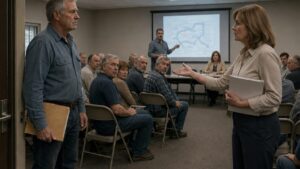
“Two hundred dollars a month.”
Steven Baker said it before Benjamin finished his question.
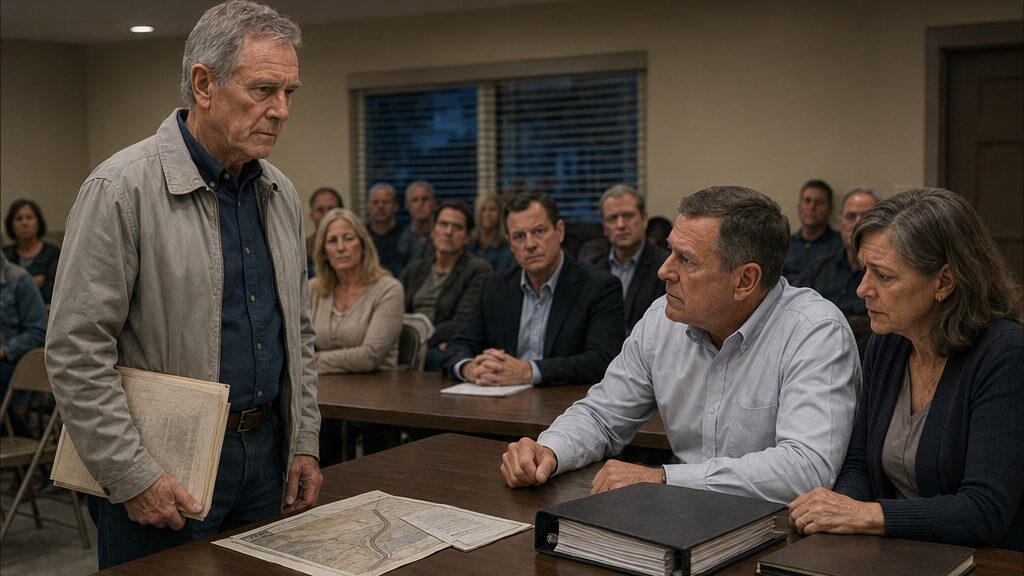
The HOA president sat behind the folding table at the front of the clubhouse, one hand resting on a thick budget packet.
Benjamin remained standing.
“I’m not asking what happens if I refuse to pay,” he said. “I’m asking what recorded instrument establishes the association’s ownership or maintenance authority over the road.”
Steven leaned back.
“And I’m telling you the assessment was properly adopted. If the balance remains unpaid after the deadline, the late penalty is two hundred dollars per month.”
Around them, about twenty residents sat in plastic chairs. Some looked at Benjamin. Others stared deliberately at their agendas.
Benjamin felt the old sensation return—the tightness between his shoulders that had preceded hundreds of contentious transportation meetings.
He had hoped retirement had cured him of it.
Apparently not.
Steven turned toward Linda Thompson.
“Next item?”
Benjamin kept his place.
“Not yet.”
Steven’s expression hardened slightly.
“Benjamin, you had your question.”
“And I haven’t had an answer.”
One of the unnamed board members shifted in his chair.
Linda glanced down at her notes.
Steven folded his hands.
“The association has maintained that road for decades. We have invoices, contracts and annual budgets showing it.”
“That shows payment.”
“It shows responsibility.”
“Not necessarily.”
A few people murmured.
Benjamin wished they would not.
He had not come to perform. He had brought only two pieces of paper: the new assessment notice and the faded copy of his recorded easement.
He placed them side by side on the table.
Steven looked at them but did not touch either.
Benjamin pointed to the road line on the older document.
“This is how the roadway is shown in my recorded property documents. The notice says the association owns the private roadway outright. I’m asking for the instrument that supports that statement.”
Steven gave a short exhale.
“You’re reading a closing copy. Those things are full of easement language.”
“Yes.”
“Then maybe this is being made more complicated than it is.”
Benjamin felt heat rise behind his ears.
It would have been easy to respond sharply. Ten years earlier, he probably would have.
Instead he tapped the narrow line with one finger.
“Which recorded instrument transferred maintenance authority to the association after county acceptance?”
The room changed.
Not dramatically. No one gasped. No chairs scraped.
But Steven stopped looking bored.
Linda looked up.
“After what?” she asked.
“County acceptance.”
Steven frowned.
“You’re assuming there was one.”
“I’m asking whether the board verified there wasn’t.”
“You seem very confident about a photocopy.”
Benjamin let the silence sit.
This was the part he had hoped to avoid.
“I worked right-of-way for fourteen years.”
Someone in the second row turned toward him.
Steven’s posture shifted.
Benjamin continued before the moment could become larger than it deserved.
“Transportation department. Acquisition, easements, recorded plats, access control. I’m not saying this sheet proves the HOA has no obligation. It doesn’t. I’m saying the language doesn’t match the certainty of the notice.”
Linda reached for the plat.
“Can I see that?”
Benjamin slid it toward her.
She followed the roadway line with her eyes.
Steven said, “That still doesn’t change the assessment.”
“No,” Benjamin agreed. “But it should be enough to pause penalties until the underlying record is checked.”
Steven’s jaw tightened.
“The resurfacing contract is scheduled. We can’t suspend collections every time a member decides to reinterpret decades of practice.”
Benjamin heard the distinction immediately.
Practice.
Not title.
Not deed.
Not recorded agreement.
Practice.
Amanda Nelson sat near the aisle. When Benjamin glanced toward her, she was no longer looking skeptical.
Linda turned several pages in the budget binder.
“We do have road maintenance going back a long time.”
“I believe you,” Benjamin said.
“Then what exactly are you alleging?” Steven asked.
“Nothing yet.”
“That’s convenient.”
Benjamin’s patience thinned.
“No. It’s careful.”
Steven’s voice rose a fraction.
“We have a budget approved by the membership. We have contracted work. We have a road everybody here uses. And now, five days after the assessment goes out, you’re suggesting the board has no authority because you found a faint line on an old photocopy.”
“I suggested you verify the authority before penalizing people.”
“People?”
Steven looked around the room.
“So this isn’t just about your bill now?”
Benjamin regretted the opening immediately.
This was exactly what he had feared: becoming the man at the front of a room around whom everyone’s frustration collected.
“It’s about the same notice being sent to every property,” he said.
Steven picked up the assessment sheet.
“The deadline remains the deadline.”
Linda looked toward him.
“Steven, perhaps we could check the county file before—”
“We have legal counsel. We have governing documents.”
“Do we have the road conveyance?” Linda asked.
Steven paused.
Only for a second.
But Benjamin saw it.
“So far,” Steven said, “we have no reason to believe anything is improper.”
Benjamin folded his arms.
“Then finding the document should be easy.”
A board member cleared his throat.
Steven called for a vote to reaffirm collection of the assessment under the existing schedule.
Linda hesitated before raising her hand.
She raised it anyway.
The motion passed.
Benjamin sat down.
The meeting continued through landscaping bids and pool rules, but he heard little of it. The embarrassment had passed. In its place was a colder feeling.
They had been shown a specific discrepancy.
They had chosen enforcement before verification.
When the meeting ended, neighbors clustered around the coffee table.
Benjamin avoided them.
He slipped the plat back into his folder and headed toward the door.
“Benjamin.”
Linda was behind him.
Steven was across the room talking to another board member.
Linda lowered her voice.
“You asked whether we have records.”
“Yes.”
“We do.”
“Recorded ownership?”
“I didn’t say that.”
She looked toward Steven, then back at Benjamin.
“I have road invoices going back decades. Contractor bills. Seal coating. Drainage work. Patching. More than you’ve probably seen.”
Benjamin felt the certainty he had carried into the meeting loosen slightly.
“Decades?”
Linda nodded.
“Come by the records room Tuesday morning.”
“If those invoices show what you think they show—”
“They show this association has been paying for that road longer than either of us has lived here.”
Benjamin looked down at the folder under his arm.
For the first time that night, the evidence pointed in two directions.
Chapter 3: Old Invoices Made the Truth Less Simple
Linda Thompson dropped three binders onto the records-room table hard enough to send a puff of dust off the top one.
“There,” she said. “Your imaginary road.”
Benjamin looked at the labels.
ROAD MAINTENANCE 1998–2007.
ROAD MAINTENANCE 2008–2016.
ROAD MAINTENANCE 2017–CURRENT.
He pulled out a chair.
“I never called it imaginary.”
“You made twenty people think we’ve been inventing charges.”
“I asked for authority.”
Linda folded her arms.
“And I’m showing you responsibility.”
The first binder did not contain sloppy notes or suspicious handwritten receipts.
It contained professional invoices.
Crack sealing.
Drainage clearing.
Shoulder repair.
Resurfacing.
Snow and ice treatment from an unusually cold winter.
Each invoice named the subdivision association as the customer.
Several included work descriptions that clearly referenced the main road.
Benjamin turned pages more slowly.
This was not what he had expected.
He had imagined an administrative assumption repeated in budgets, perhaps a vague line item that had grown over time.
Instead, the HOA had plainly spent real money.
A great deal of it.
Linda sat across from him.
“Still think nobody checked anything?”
Benjamin kept reading.
“I think somebody paid invoices.”
“That’s what maintenance is.”
“It’s evidence of maintenance.”
Linda stared at him.
He knew how maddening he sounded.
He had spent a career making exactly those distinctions.
“Look,” he said, softer. “If the HOA contracted work it was legally responsible for, that matters. If it voluntarily paid for work on a public road it wasn’t responsible for, that matters too. The invoice alone doesn’t tell us which.”
Linda opened the oldest binder.
“You think thirty years of boards all made the same mistake?”
“I think organizations inherit habits.”
“Convenient answer.”
“It’s also common.”
She flipped to a resurfacing bill from years before Benjamin had moved into the subdivision.
“This cost almost forty thousand dollars.”
Benjamin examined the description.
Mill and overlay. Main entrance to east turnaround.
The location matched.
He felt a faint pressure behind his eyes.
The cleaner version of the story was slipping away.
Maybe Steven had been right about one thing: perhaps Benjamin had made the issue more complicated than it needed to be.
He checked another invoice.
Then another.
There were no obvious signs of deception. No padded descriptions. No mysterious vendor. No recent creation of the road category.
The association had been paying contractors long before Steven became president.
“How long have you been treasurer?” Benjamin asked.
“Eleven years.”
“And the road line was already in the budget?”
“When I started.”
“Who explained why?”
“The previous treasurer.”
“What did she show you?”
Linda’s mouth tightened.
“Budgets. Contracts. Records like these.”
“Not ownership.”
“I didn’t ask for a deed every time I paid the landscaper either.”
“That’s different.”
“I know it’s different.”
Her irritation sharpened.
“But you walked into that meeting as though we’d invented a road fee last Tuesday. Some of us have spent years keeping this place running while everyone else complains about mulch.”
Benjamin leaned back.
There it was.
Not greed.
Not conspiracy.
Weariness.
Linda believed the records because the records were old, consistent, expensive and boring—the exact qualities that made administrative practices feel legitimate.
Benjamin understood the trap because he had seen government offices fall into it too.
A procedure survived long enough, and eventually nobody remembered which document had started it.
The records-room door opened.
Amanda stood there holding her phone.
“Sorry. Linda said you were both here.”
Linda sighed.
“What happened?”
Amanda showed the screen to Benjamin.
His HOA account portal was open.
A new line had appeared beneath the road assessment.
DELINQUENCY PENALTY — $200.
Benjamin stared at it.
“That’s yours,” Amanda said. “I checked after somebody posted in the neighborhood group that you weren’t paying.”
He looked at Linda.
She looked genuinely uncomfortable.
“The deadline was yesterday.”
“I know when the deadline was.”
“I told Steven we should hold it.”
“And?”
“He said the vote was clear.”
Amanda put the phone down.
“So now you owe nine-twenty?”
Benjamin hated that the number bothered him.
Not financially.
Symbolically.
Five days earlier, the board had been unable to answer his narrow question. Now the penalty had become real anyway.
Amanda pulled out the empty chair.
“Are we supposed to pay ours?”
Benjamin’s first instinct was the familiar one.
Wait.
Verify.
Say nothing until he could prove every link.
“I can’t tell you not to pay an association assessment.”
Amanda stared at him.
“That isn’t what I asked.”
“It’s the answer I can responsibly give.”
She leaned back.
“So you know enough to challenge them in public, but not enough to tell the rest of us what you actually think.”
Benjamin closed the binder.
“Because what I think is not the same as what I can prove.”
“And meanwhile penalties start.”
Linda said nothing.
Amanda picked up her phone.
“Fine.”
She left without another word.
Benjamin watched the door close.
His caution had always felt like discipline.
For the first time, it felt a little like hiding.
He returned to the binders.
The earliest records were thinner. Several years contained only a handful of invoices. He worked backward until the dates crossed into periods before most of the current board members had owned homes there.
“Steven wasn’t even living here then,” he said.
“No.”
“You?”
“No.”
“So whatever this is, neither of you started it.”
Linda’s shoulders eased slightly.
“That’s what I’ve been trying to tell you.”
Benjamin nodded.
The discovery did not excuse Steven’s penalty vote.
But it changed the shape of the conflict.
If the HOA had been wrong, it might have been wrong for a very long time.
He opened a contractor invoice from the early 1990s.
The paper was yellowed at the edges, copied from something older. The contractor had patched drainage cuts near the subdivision entrance and repaired pavement after utility work.
Benjamin almost turned the page.
Then a phrase in the description stopped him.
He read it once.
Then pulled the binder closer.
Linda noticed.
“What?”
Benjamin pointed.
The line read:
FINAL PRIVATE ROAD REPAIR PRIOR TO COUNTY ASSUMPTION.
Linda leaned over the table.
Neither of them spoke.
Benjamin read the date.
He felt the old professional certainty return, but this time it carried something heavier than satisfaction.
“Do you know what this means?” Linda asked.
Benjamin shook his head slowly.
“Not yet.”
He took out his phone and photographed the invoice.
“What are you doing?”
“Finding out what the county assumed.”
Because if that phrase meant what it usually meant, the association’s decades of invoices were no longer proof against his suspicion.
They were evidence that something had changed—and then been forgotten.
Chapter 4: The 1993 Resolution Changed the Entire Argument
The county records clerk set a thin folder on the counter and said, “This is the only acceptance resolution I found under that subdivision name.”
Benjamin looked at the date before he looked at anything else.
Two years after the recorded subdivision plat.
He felt the same quiet tightening he used to feel when a property file finally produced the document everyone else had been talking around.
“Can I make a copy?”
“You can make ten if you want.”
The clerk slid the folder toward him.
Benjamin did not sit down immediately. He read the first page standing at the counter, one hand resting against the edge.
The resolution was not dramatic. Government records rarely were.
There were no bold declarations, no warning language, no sentence conveniently saying THE HOA DOES NOT OWN THIS ROAD.
Instead there were parcel references, road descriptions, engineering recommendations, meeting dates, and a formal county action approving certain subdivision streets for inclusion in the county-maintained road system.
Benjamin read the road description twice.
Then he took out the photograph he had made of the 1993 contractor invoice.
FINAL PRIVATE ROAD REPAIR PRIOR TO COUNTY ASSUMPTION.
The dates aligned.
Not proof by itself.
But alignment.
He asked the clerk for the original subdivision plat.
“That one’s on microfilm,” she said.
“I know.”
She looked at him.
“You’ve done this before.”
“Too much.”
Ten minutes later, Benjamin sat at a terminal with a scanned image of the 1991 plat enlarged across the screen.
The image was clearer than his closing copy.
The faded line that had nearly disappeared in his kitchen was sharp here.
He traced it visually from the entrance through the subdivision.
Recorded right-of-way.
Lot boundaries terminating outside it.
Drainage and utility references crossing it.
Nothing on the sheet gave the homeowners association fee ownership of the roadway.
Still, Benjamin resisted the conclusion trying to form.
A plat was not enough.
A resolution was not enough.
He needed continuity.
He asked for amendments, road petitions, acceptance minutes, vacations, later jurisdictional changes—anything that could have reversed or limited the 1993 action.
The clerk brought him another folder.
Then nothing.
“No vacation I can find,” she said. “No abandonment either.”
“What about maintenance transfer?”
“To the association?”
“Yes.”
She searched again.
“No.”
Benjamin sat back.
The old instinct in him wanted to say, There it is.
The older, more careful part refused.
One missing document in one office did not settle everything.
He went downstairs to the county engineering department.
A technician at the front desk listened while Benjamin explained the subdivision name and road.
“You checking jurisdiction?”
“Yes.”
The technician turned to a GIS terminal.
A map filled the screen.
Parcel boundaries appeared first, then road centerlines, then jurisdictional layers.
Benjamin watched the technician click the road through his subdivision.
The classification box populated.
County-maintained.
Benjamin said nothing.
The technician glanced at him.
“That what you expected?”
“I expected uncertainty.”
The technician smiled faintly.
“You got a road number too.”
He pointed at the screen.
Benjamin wrote it down.
“Does this database establish legal status?”
“No. It reflects our current maintenance inventory. For the underlying acceptance you’d want the resolution.”
Benjamin placed the copy of the 1993 resolution on the counter.
The technician read the first page.
“Well.”
“That’s my problem.”
“Doesn’t look like your problem.”
“It becomes my problem if forty-seven households have been paying another entity to maintain it.”
The technician’s expression changed.
“That’s between you and the association unless they want an official jurisdiction determination.”
“What would that require?”
“A written request. Supporting documents. Engineering can review the road history.”
Benjamin nodded.
Exactly what he expected.
No dramatic declaration.
No instant rescue.
A process.
He spent another hour comparing maps.
The current GIS right-of-way corresponded almost exactly with the faded line from his original closing copy. The entrance gate sat inside the same corridor.
That detail bothered him.
The gate had always seemed ordinary—something decorative enough that no one questioned it. At night it lowered. Residents used remotes. Visitors called through the intercom. During the day it often stayed raised.
But if the roadway had been accepted into the county system, the gate was no longer merely decorative.
He printed the relevant map.
At a table near the engineering counter, he laid out four documents.
The 1991 plat.
The 1993 contractor invoice.
The 1993 county acceptance resolution.
The current county GIS classification.
For several minutes he simply looked at them.
The story they told was not complicated anymore.
The developer had built the road as private infrastructure.
The association—or its predecessor—had apparently paid for work during that private period.
Then something happened in 1993.
The contractor described the final work as occurring before county assumption.
The county formally accepted the road.
The current county map still listed it as maintained.
Yet the HOA had continued paying contractors long afterward.
Benjamin felt less triumphant than he had imagined he would.
If the association had truly been paying for work the county should have handled, the money did not disappear into somebody’s pocket.
It went into asphalt.
Drainage.
Repairs.
Real work.
The error might be enormous without being fraudulent.
His phone vibrated.
Amanda.
He let it ring once before answering.
“Well?” she asked.
“I found the county acceptance resolution.”
Silence.
Then, “So you were right.”
“I found a resolution.”
“That sounds like being right.”
“It sounds like I need the county to confirm there wasn’t some later transfer.”
Amanda exhaled sharply.
“You always do that.”
“Do what?”
“Turn an answer back into a question.”
Benjamin looked at the documents.
“In my old job, that kept people from taking land they weren’t entitled to take.”
“And here?”
He did not answer immediately.
Amanda continued.
“People are talking about your penalty. Some think you’re refusing to pay because you’re mad about the increase. Some think the HOA is hiding something. Nobody knows because you won’t say what you know until it’s perfect.”
Benjamin stared through the glass doors toward the parking lot.
“I know the county accepted the road in 1993.”
“That’s more than you knew yesterday.”
“Yes.”
“Then say that.”
“I also know the HOA paid for work after 1993.”
“That makes no sense.”
“No. It doesn’t.”
That was the part disturbing him most.
If the county had accepted the road, why had contractors continued billing the HOA?
Had the county failed to maintain it?
Had the HOA voluntarily supplemented work?
Had residents been assessed for improvements outside county standards?
Had a later agreement gone missing?
The clean victory had become a deeper accounting question.
Amanda lowered her voice.
“How much money are we talking about?”
Benjamin glanced at the invoices he had photographed.
“I don’t know.”
“Guess.”
“I don’t guess with numbers.”
“Benjamin.”
He closed his eyes.
“More than my seven hundred twenty dollars.”
After the call, he returned to the recorder’s office and requested certified copies of the resolution and plat.
When he got home, he spread everything across the kitchen table again.
This time the HOA assessment notice looked almost small beside the county records.
He opened Linda’s oldest invoice photographs on his laptop and began building a timeline.
1991: subdivision plat.
Private road construction.
1993: final private-road repair.
1993: county acceptance.
Then HOA-funded maintenance continuing through later years.
He entered dates until evening.
At first he had wanted one answer:
Why should I pay $720?
Now the question had multiplied.
How many years had residents paid?
How much?
For what exact work?
Had the county reimbursed anything?
Had the HOA ever asked the county to perform repairs?
Had somebody once known the road had changed status and failed to pass that knowledge forward?
Benjamin pulled a blank sheet of paper toward him.
At the top he wrote:
FORMAL REQUEST FOR JURISDICTIONAL REVIEW.
Then he stopped.
If the county confirmed his interpretation, this would no longer be a dispute about his bill.
It could reopen years of association budgets.
He looked at the $200 penalty already posted to his account.
That had been Steven’s choice.
But the decades before Steven were something else.
Benjamin glanced down at the old plat.
The thin road line that had first looked like a minor inconsistency now seemed to run straight through every budget the neighborhood had trusted for years.
His refund, he realized, might be the smallest problem in the entire file.
Chapter 5: The Board Finally Understood What Was at Risk
“I’ll remove your penalty today.”
Steven Baker said it before Benjamin had taken his coat off.
The emergency meeting had not been announced to the full membership. Only Benjamin, Linda, Steven, and the other two board members sat around the clubhouse table.
Benjamin remained standing.
“In exchange for what?”
Steven slid a printed account statement toward him.
The $200 delinquency charge was highlighted.
“You pay the original assessment under protest. We waive the penalty. We send the road documents to counsel and handle the review internally.”
Benjamin looked at the paper.
“And I stop contacting the county?”
Steven’s face tightened.
“I didn’t say that.”
“You didn’t have to.”
Linda stared at the table.
Benjamin sat.
Three days had passed since he found the 1993 resolution. In that time, he had copied the board on a short factual summary: plat date, acceptance resolution, GIS classification, and the contractor invoice referring to county assumption.
He had deliberately left out conclusions.
Steven had called within forty minutes.
Now a thick budget packet sat where the faded plat should have been.
Steven tapped it.
“You need to understand the consequences of what you’re pushing.”
Benjamin said nothing.
“The road reserve is not some side account. It’s part of our financial plan. Resurfacing, drainage, entrance repairs—those costs have been built into assessments for years.”
“That doesn’t establish authority.”
“I know what you think establishes authority.”
“This isn’t about what I think.”
Steven opened the budget packet.
“If we freeze the road assessment right now, the resurfacing contract is underfunded.”
“If the county maintains the road, why are you resurfacing it?”
“Because the road needs it.”
“That’s not an answer.”
Steven looked directly at him.
“It is when you’re the person residents blame for potholes.”
There was no sarcasm in the sentence.
Only fatigue.
Benjamin had expected resistance. He had not expected that.
Steven continued.
“People don’t call the county when water sits at the curb. They email us. They don’t ask jurisdiction when pavement cracks. They ask why their dues are so high and why nothing gets fixed.”
Linda said quietly, “He’s right about that.”
Benjamin turned to her.
“Did the board ever submit maintenance requests to the county?”
Linda shook her head.
“Not while I’ve been treasurer.”
“Why not?”
“Because everyone believed it was ours.”
There it was again.
Believed.
Steven pushed the plat out from under the budget packet.
“You’re asking us to overturn thirty years of practice based on records none of us had seen.”
“I asked you to verify those records before penalizing me.”
“That’s separate.”
“No.”
The word came out harder than Benjamin intended.
He lowered his voice.
“That is exactly what separates an inherited mistake from a current decision.”
The room went still.
One of the board members looked away.
Steven’s jaw tightened.
“We had an adopted assessment.”
“You had a credible question.”
“We have obligations.”
“You also have authority limits.”
Linda spoke before Steven could answer.
“We never found it.”
Benjamin looked at her.
“What?”
“The acceptance record.”
Steven turned sharply.
“Linda.”
“No.”
Her face had gone pale, but her voice stayed steady.
“He needs to know.”
She opened a folder beside her.
“I went through everything after the last meeting. Declarations. Amendments. Developer files. Old board minutes. Insurance records. Road contracts. We have no copy of the county acceptance resolution.”
Benjamin waited.
Linda continued.
“We also have no document showing the county later transferred maintenance responsibility back to the association.”
Steven rubbed both hands over his face.
“That doesn’t mean there isn’t one.”
“No,” Linda said. “But it means we’ve never had it.”
The surprise did not feel like victory.
Benjamin had expected Linda to defend the files until the end. Instead she looked embarrassed.
“I became treasurer,” she said, “and the road account already existed. There were invoices. Reserve schedules. Every audit treated it as an association expense. I never asked why.”
One board member said, “None of us did.”
Steven looked at them.
“So now everyone’s suddenly innocent?”
Linda’s eyes sharpened.
“That isn’t what I said.”
Benjamin watched Steven gather himself.
He understood the fear now.
Steven was not merely protecting his pride.
If the board announced that the road assessment might lack legal basis, every homeowner would ask how much they had paid. Resurfacing money already committed could be frozen. Other common-area projects could lose funding. Previous budgets would need review.
Steven’s authority rested partly on the promise that the board knew what it was doing.
Admitting uncertainty threatened more than one fee.
Steven turned back to Benjamin.
“Let’s say the county confirms your interpretation.”
“My interpretation isn’t the issue.”
“Fine. Let’s say they confirm jurisdiction. Do you think forty-seven checks magically appear to refund everybody tomorrow?”
“No.”
“Do you think the contractor tears up the resurfacing agreement?”
“No.”
“Do you think people stop expecting the entrance, drainage and pavement to function while we untangle this?”
Benjamin looked down at the plat.
“No.”
Steven leaned forward.
“That’s what I’m trying to protect.”
“And that’s why the assessment should be suspended until we know what belongs to whom.”
Steven shook his head.
“For everyone?”
“Yes.”
“That could create a cash problem immediately.”
“Then tell the membership the truth.”
The sentence landed badly.
Steven’s face changed.
“You think this is easy because you don’t have to run the association.”
Benjamin almost answered with his own years of public responsibility.
He stopped himself.
Steven was partly right.
Benjamin could identify a jurisdictional problem and walk back to his house. The board would face the accounting mess.
But that did not justify continuing to charge people after the basis had become uncertain.
Linda said, “We can hold new penalties.”
Steven looked at her.
“We already voted.”
“We can vote again.”
“And announce what? That Benjamin found a document none of us understand?”
“I understand it,” Benjamin said.
Steven gave him a hard look.
“That’s the problem.”
Benjamin sat back.
For years, he had avoided exactly this role: the specialist in the room whose knowledge made everyone else defensive.
He could take Steven’s offer.
Penalty erased.
Pay under protest.
Let the board’s attorney sort it out quietly.
His own exposure would disappear.
Amanda and the other residents would keep paying while the review happened out of sight.
Benjamin pictured her saying, You know enough to challenge them in public, but not enough to tell the rest of us what you actually think.
His silence had always protected him from becoming responsible for everyone else’s expectations.
Now it would protect the board too.
He pushed the account statement back toward Steven.
“No.”
Steven stared at it.
“No what?”
“Don’t waive my penalty privately.”
“Benjamin—”
“If the penalty is improper because the underlying assessment is uncertain, address it for everyone. If you believe it’s proper, leave mine where it is.”
One board member whispered, “This is getting ridiculous.”
Benjamin ignored him.
Steven leaned back.
“So you’re going to the county.”
“Yes.”
Linda looked at Benjamin, then at Steven.
“Maybe we should let them answer the jurisdiction question.”
Steven’s mouth tightened.
“And if they answer it against us?”
Benjamin folded the plat carefully.
“Then you stop doing something you had no authority to do.”
For the first time, Steven looked less angry than tired.
“And if correcting it hurts everybody?”
Benjamin paused at the door.
“Then we correct it carefully.”
Outside, he sat in his truck with the formal review packet on the passenger seat.
For several minutes he did nothing.
He thought about the promise he had made when he retired: no more hearings, no more property disputes, no more being the man who knew the regulation everyone else wished would disappear.
Then he signed the request.
He attached the 1991 plat.
The 1993 acceptance resolution.
The contractor invoice.
The GIS classification.
And a copy of the assessment notice carrying the phrase Association-owned private roadway.
Before he could reconsider, he drove to the county engineering office and filed the challenge.
The clerk stamped the first page.
RECEIVED.
Benjamin watched the stamp lift.
From that moment forward, the answer would no longer belong to him or Steven.
Chapter 6: The County Notice Went Up on the Gate
The county truck stopped beneath the subdivision gate just after sunrise.
Benjamin saw it from half a block away.
White utility pickup. County seal on the door. Amber light bar off. No drama.
Still, he slowed his walk.
For eighteen days, nothing visible had happened.
The county had acknowledged his filing, requested one additional plat reference, and assigned a field review. Steven had continued sending routine HOA notices without mentioning the road dispute. Linda had stopped by once to copy two more historical invoices.
Then, at 7:12 on a Thursday morning, the county arrived.
The gate arm was lowered.
A field inspector stood beside the control pedestal while an engineering technician held a tablet.
Steven’s SUV pulled in three minutes later.
He parked crookedly near the entrance and got out before fully closing his door.
“What’s going on?”
The inspector turned.
“Mr. Baker?”
“Yes.”
“We spoke yesterday.”
“You said you were inspecting the road.”
“We are.”
Steven looked at Benjamin.
“You called him?”
The inspector answered first.
“This is a county review.”
Benjamin stayed on the sidewalk.
He had promised himself he would not turn the morning into a confrontation.
The technician walked along the edge of the pavement, comparing the tablet display with survey references and visible improvements. At the entrance, he measured from the roadway centerline toward the gate mechanism.
Benjamin recognized the method.
The same old professional habits.
Different people.
Same questions.
Where does the right-of-way begin?
What lies inside it?
Who has authority there?
Steven folded his arms.
“This gate has been here for years.”
The inspector nodded.
“That’s part of why we’re documenting it.”
“It’s association property.”
“The equipment may be.”
“The entrance is ours.”
The inspector did not argue.
“We’re determining whether the hardware occupies county right-of-way.”
Steven looked toward Benjamin again.
Benjamin said nothing.
The inspection moved down the road.
The county truck followed slowly while the technician photographed drainage inlets, pavement patches, signs, and shoulder conditions. Benjamin walked behind at a distance until the inspector stopped near the curve by his house.
The technician enlarged a map on the tablet.
Benjamin could see the line.
The same line.
Clear and digital now, but following almost precisely the faded mark on his old plat.
The technician pointed.
“Right-of-way here. Lot line here.”
The inspector compared the screen with the certified plat Benjamin had submitted.
“Consistent.”
Benjamin felt something inside him loosen.
Not triumph.
Recognition.
For years he had trusted lines like that because they had to survive more than opinion. Surveyors, recorders, engineers, attorneys, property owners—everybody could argue about what the line meant, but first they had to acknowledge where it was.
Steven approached.
“What are you saying?”
The inspector looked at him.
“We’ve completed the preliminary records review. The 1993 resolution accepted this road into the county system. We found no later vacation or maintenance transfer in the file.”
Steven’s face went still.
“Preliminary?”
“The final letter comes from engineering.”
“So you haven’t confirmed anything.”
“We have confirmed the acceptance record.”
Benjamin looked at Steven.
At the clubhouse meeting, Steven had threatened a $200 penalty before Benjamin finished asking his question.
Now he had no quick answer.
The inspector continued.
“The road is also carried in the county’s current maintenance inventory.”
Steven pointed toward several old pavement patches.
“Then explain why we’ve been paying contractors.”
“I can’t explain your association’s accounting.”
“We’ve maintained this road for decades.”
“That may be something your counsel needs to review.”
Steven’s voice sharpened.
“You’re telling me the county accepted a road and then let us pay for it?”
“I’m telling you what the records show.”
It was almost exactly the sentence Benjamin might once have used.
He looked away.
There was no pleasure in watching somebody discover that years of certainty rested on the wrong foundation.
By midmorning, the county crew had returned to the entrance.
The inspector spent several minutes on the phone.
Then he took a fluorescent notice from the truck.
Steven stepped closer.
“What is that?”
“A notice concerning encroachment within county right-of-way.”
“You’re posting something on our gate?”
“On the hardware adjacent to the right-of-way.”
Steven moved between the inspector and the pedestal.
Not aggressively, but enough to make the technician stop.
“You need to give the board time to contact our attorney.”
“You can contact whoever you need.”
“How much time?”
The inspector checked the notice.
“Seventy-two hours for voluntary removal or deactivation of the obstruction, subject to the instructions here.”
Steven stared at him.
“This gate has never caused a problem.”
“That isn’t the only issue.”
“We paid for it.”
“That doesn’t determine whether it can restrict a county-maintained roadway.”
Benjamin watched the inspector attach the notice.
Bright paper against dark metal.
For years the gate arm had been nothing more than part of the neighborhood landscape. Raised by day. Lowered by night. A small mechanical reminder that the subdivision controlled its entrance.
Now the same object looked different.
Not because it had changed.
Because the line beneath it had.
Amanda arrived on foot with her phone in her hand.
She stopped beside Benjamin.
“You knew they were coming?”
“No.”
“Is that the notice?”
“Yes.”
She looked toward Steven.
“He looks sick.”
Benjamin did not answer.
Steven had stepped away from the gate and was talking rapidly into his phone.
Amanda lowered hers.
“Aren’t you happy?”
Benjamin thought about the binders in Linda’s records room.
The resurfacing contract.
The reserve account.
Forty-seven households.
“I’m relieved they confirmed the road.”
“That isn’t what I asked.”
He looked at her.
“No. I’m not happy.”
By afternoon, the final jurisdiction letter had been emailed to the association and copied to Benjamin.
The county cited the 1993 acceptance resolution, current road inventory, and recorded right-of-way. It instructed the HOA to stop treating access to the county roadway as subject to association-controlled gate restriction without separate lawful authorization.
Benjamin read the letter twice.
Then came the part that mattered just as much:
The county expressed no opinion on private contractual claims between homeowners and the HOA and made no determination regarding refunds, prior assessments, or association accounting.
The road question had been answered.
The money question had not.
Linda called him at four.
“The resurfacing contractor wants to know whether to mobilize next week.”
“What did Steven say?”
“He told them to hold.”
Benjamin leaned against the kitchen counter.
“That’s sensible.”
“The attorney is coming tomorrow.”
“That’s sensible too.”
“You sound disappointed.”
“I’m not.”
Linda was quiet for a moment.
Then she said, “I pulled six years of ledgers.”
Benjamin closed his eyes.
“How bad?”
“I don’t know yet.”
“Road assessment totals?”
“And transfers into reserves. Some expenses were road-only. Some were bundled with entrance work.”
“Separate the categories.”
“I’m trying.”
Her voice sounded exhausted.
“Benjamin, if people start demanding checks before we know what’s refundable, this could get ugly.”
He thought about Steven’s warning.
Correcting it might hurt everybody.
“That’s why you need an accounting before anybody promises anything.”
“You going to tell people that?”
The question caught him.
A week earlier he would have said it was the board’s job.
Now he understood Linda was asking something else.
Would he help explain the truth even if the truth was less satisfying than instant repayment?
“Yes,” he said.
The following morning, the HOA attorney arrived at the clubhouse carrying an empty document case.
Benjamin was not invited to the meeting.
He did not need to be.
At noon, Linda texted him a photograph of a written request the attorney had left behind.
Six years of road assessments.
Six years of road expenditures.
Reserve transfers.
Contracts.
Penalties.
Gate expenses.
Correspondence with contractors.
Benjamin enlarged the image until he could read the final line.
Please preserve all historical records relating to ownership, maintenance responsibility, and member representations concerning the roadway.
He set the phone down.
Outside his window, the county road curved quietly between the houses.
The gate arm at the entrance was now locked in the raised position.
The most visible part of the fight was over.
The expensive part had just begun.
Chapter 7: Winning the Road Dispute Did Not Erase the Damage
The number on the first page made the clubhouse go silent.
Linda Thompson had written it in plain black type beneath six years of reconstructed road assessments, penalties, reserve transfers, and expenses.
No one applauded.
No one even whispered.
Benjamin Allen sat in the second row with the faded subdivision plat closed inside the same folder he had carried to the first board meeting.
Six weeks had passed since the county notice went up on the gate.
The gate arm was gone now.
The control pedestal remained near the entrance, disconnected and wrapped temporarily in a weatherproof cover while the board decided what equipment could legally stay outside the county right-of-way.
Inside the clubhouse, the harder work had finally reached the homeowners.
Steven Baker stood beside Linda at the front table.
He looked older than he had six weeks earlier.
Linda adjusted her glasses.
“The review separated expenses into three categories,” she said. “Roadway work that appears to fall within county maintenance responsibility, entrance or common-area work that remains association responsibility, and expenses that require further legal review.”
A man near the back raised his hand.
“How much are we getting back?”
Linda paused.
“That depends on the year, the property, and how the final categories are approved.”
Someone else said, “That isn’t an answer.”
“It’s the only accurate answer tonight.”
Benjamin recognized the tone.
Linda had learned something from the past six weeks.
So had he.
The HOA attorney had spent days tracing payments through old ledgers. Some invoices that looked like road maintenance also included landscaping beside the entrance. One drainage project extended beyond the county right-of-way. A pavement contractor had performed work the county might have done, but the HOA had separately requested decorative entrance improvements at the same time.
Nothing could simply be added together and divided by forty-seven.
That disappointed people.
Benjamin understood why.
A simple injustice demanded a simple refund.
Real accounting rarely cooperated.
Linda continued.
“The disputed road assessment is suspended. No new road-specific charge will be collected while the correction is implemented.”
That produced the first murmur of relief.
“And penalties attached solely to the disputed assessment,” she added, “will be reversed.”
Amanda Nelson turned in her chair and looked at Benjamin.
He gave a small nod.
His own $200 penalty had already disappeared from the online portal.
Months earlier, that would have felt like the whole victory.
Now it barely registered.
A homeowner stood.
“So when do we get checks?”
Steven answered this time.
“We’re proposing a combination of direct refunds and future assessment credits over several billing cycles.”
The room reacted immediately.
“Credits?”
“You took cash.”
“Why should we finance your mistake?”
Steven waited until the voices dropped.
“Because issuing every possible refund immediately would require pulling money from reserves used for obligations the association still legitimately has.”
Someone laughed bitterly.
“So we protect the board again.”
Steven flinched.
Benjamin saw it.
He also saw Linda glance toward him.
This was the moment she had warned him about.
People knew he had uncovered the problem. Several had begun treating him as if he possessed an answer to everything connected with it.
He disliked that almost as much as he had disliked Steven dismissing him.
A woman across the aisle raised her voice.
“Benjamin, is that true? Do they actually need to spread it out?”
Every head seemed to turn.
His first instinct was still to retreat behind precision.
Ask counsel.
Review the ledger.
Not my decision.
Instead he stood.
“The county answered who maintains the road,” he said. “It didn’t erase the association’s other bills.”
A few faces tightened.
Benjamin continued.
“If money was collected for something the association had no responsibility to fund, it should be corrected. But you can’t refund a dollar twice, and you can’t call every entrance expense a road expense just because the invoices were bundled.”
“So you agree with them?” someone asked.
“I agree with getting the numbers right.”
“That sounds convenient.”
Benjamin almost smiled at the familiarity of the accusation.
“No. Convenient would have been taking my penalty waiver six weeks ago and going home.”
The room settled.
He sat again.
Steven stared at the budget packet for several seconds.
Then he moved it aside.
Underneath was a copy of the old plat.
Benjamin noticed the gesture immediately.
For weeks Steven had seemed to use the budget as a shield against that document.
Now nothing covered it.
Steven placed both hands on the table.
“There’s something I need to say before we vote.”
Linda turned toward him.
Steven looked at the residents rather than Benjamin.
“When Benjamin first raised the ownership question, I believed he was wrong.”
No one interrupted.
“I believed decades of payments, contracts, budgets, and board practice were enough to establish that the road was our responsibility.”
He paused.
“That belief explains my first reaction.”
His jaw tightened.
“It does not explain what I did after he showed us there was a legitimate question.”
Benjamin kept still.
Steven continued.
“I could have suspended penalties for a week while we checked the county record. I didn’t. I treated a challenge to the board’s position as a challenge to the board itself.”
The words seemed difficult for him.
“I was more concerned about appearing uncertain than I was about whether we actually were uncertain.”
No applause followed.
Benjamin was grateful for that.
Steven looked directly at him.
“The penalty decision was mine to defend. It was the wrong decision.”
Benjamin inclined his head once.
That was enough.
A homeowner in the back immediately said, “Then resign.”
Another voice agreed.
Then another.
The room began to divide.
Benjamin watched Steven’s face close again.
This was the easier ending.
Find the person who had been wrong.
Remove him.
Let punishment stand in for repair.
Amanda leaned toward Benjamin.
“You could probably swing the whole room right now.”
“I know.”
“You want him gone?”
Benjamin looked at Steven.
Six weeks earlier, perhaps he had.
Now he remembered the invoices predating Steven, Linda inheriting the same assumptions, previous boards budgeting the same way, auditors accepting the same categories.
Steven had made the worst current decision.
He had not created thirty years of institutional habit.
Benjamin stood again.
“I’m not leading a removal vote.”
Several people began talking at once.
He waited.
When the room quieted enough, he said, “Hold him accountable for what he did. Hold the board accountable for fixing the records. But replacing one president won’t tell the next board where its authority begins.”
His hand rested on the folder containing the plat.
“The problem started because everybody inherited an answer and stopped checking the question.”
This time nobody argued immediately.
The final plan passed after another hour.
Improper penalties would be reversed first.
Confirmed road-only overcollections would be returned through a combination of direct refunds and credits.
The reserve schedule would be rebuilt.
Future budgets would separate county-road issues from association entrance expenses.
And every governing claim about property or maintenance authority would have to identify the supporting recorded document.
It was not dramatic.
It was better.
After the meeting, Linda caught Benjamin near the door.
“You taking that thing home again?”
She nodded toward his folder.
Benjamin opened it.
The plat inside had softened at the folds from weeks of handling.
“I think I’m done with it.”
He slid the copy into the association’s newly organized road-history binder.
Linda raised an eyebrow.
“You trust us with it?”
“It’s a copy.”
She laughed.
Outside, Amanda waited beside the entrance.
The old gate arm had been removed completely that morning. Only two patched mounting points marked where it had stood.
“You notice something?” she asked.
“What?”
“You didn’t tell everybody what to do.”
Benjamin looked at her.
“I told them enough.”
“That’s new.”
He accepted that.
They walked toward their houses.
At the subdivision entrance, Benjamin stepped from the sidewalk onto the edge of the road.
For six years, he had unconsciously glanced toward the gate whenever he passed beneath it, checking whether the arm was up.
He reached the old entrance before realizing he had not looked this time.
There was nothing above him to check.
Only the road continuing outward toward the county intersection, uninterrupted.
Benjamin kept walking.
The story has ended.