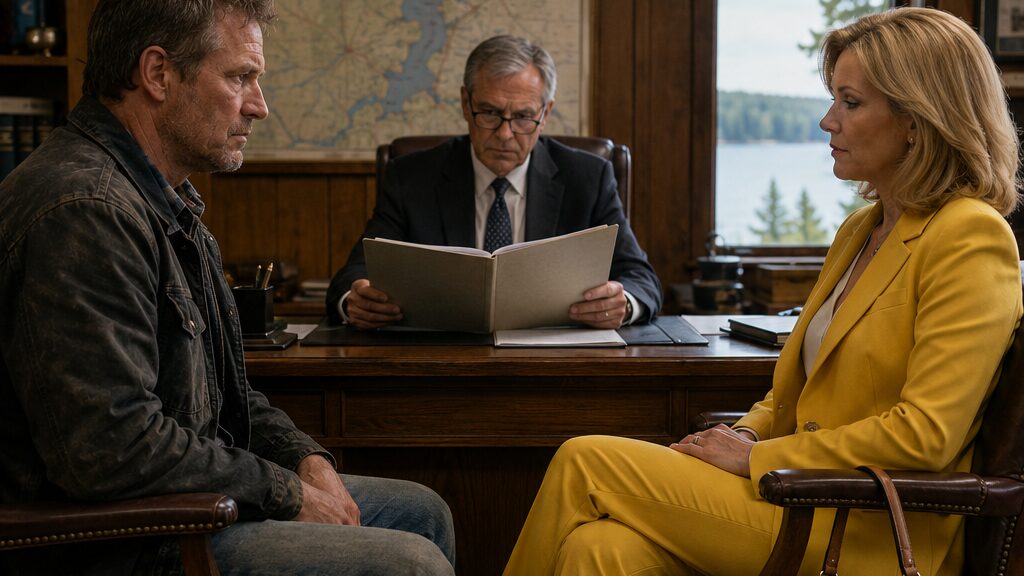
He Locked The Lake Road After The Will Removed His Name Six Weeks Before She Died
Chapter 1: The Gate Stayed Locked Until Court
Laura Mitchell’s car stopped so close to the gate that Michael Martin heard gravel spit against the steel post.
He did not move.
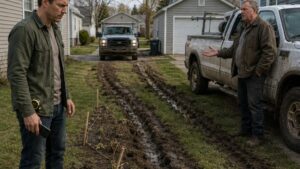
The chain hung between them, looped twice through the gray bars and pulled tight through a padlock scarred by years of rain. Behind Michael, the private road curved down between pines toward the lake, where the old wooden house sat with its back porch facing the water and the dock reaching out like a hand that had forgotten who it was waiting for.
Laura got out wearing a yellow suit bright enough to look misplaced against the mountain dirt. She closed the car door with one sharp slap and lifted a leather handbag from the passenger seat.
“Open the road, Michael.”
Her voice carried cleanly across the cattle guard, across the gate, across the narrow strip of land where he had spread gravel himself last fall while their mother sat on the porch wrapped in a blue blanket and told him he was making the drive too smooth for city people.
Michael rested one hand on the top rail.
“No.”
Laura stared at him as if he had spoken in a language she had not agreed to hear.
“This is not your road to close.”
“Not until a court says that.”
Her jaw tightened. She looked past him toward the house, then back at the chain. “You are really going to stand there like some hired ranch hand and block me from my own property?”
Michael felt that one land where she aimed it. He kept his face still.
The lake house had never been fancy when they were children. It had been boards, leaks, mud, and Mary Roberts saving coffee cans of cash for repairs. It looked expensive now because Michael had replaced the rotted porch, rebuilt the steps, patched the roof, cleared the ditch, graveled the road, and spent three winters arguing with frozen pipes. Laura saw a prize because she had arrived after the work was visible.
“Your paperwork says what it says,” he told her. “It doesn’t open this gate.”
Laura laughed once, too hard. “My paperwork is the will.”
Michael’s fingers tightened around the cool rail before he made them loosen. He did not want to give her that. He did not want the satisfaction of seeing what the word did to him.
She reached into her handbag and pulled out a folder, cream-colored, thick, sealed once and opened many times since. The corner was bent. Joseph Taylor’s office label sat on the front. Michael recognized it even from ten feet away. He had seen that folder on Joseph’s table four days earlier, laid beside a printed map of the lake road as if paper could explain why his name had vanished from his mother’s life.
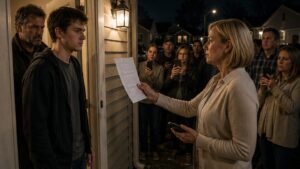
Laura lifted the folder like a badge. “You were there. You heard Joseph. Mom left me the house. She named me executor. You are not on the estate summary, Michael. You don’t get to lock me out because you don’t like what she decided.”
A breeze came off the lake and moved through the pines, carrying the faint wooden knock of a loose board on the dock. Michael had meant to fix it Monday. Then Monday had become the day after the will reading, and boards stopped seeming urgent.
“You want the road opened,” he said, “file it.”
“I already did.”
“Then wait.”
“I’m not waiting while you hide things in that house.”
That brought his eyes to hers.
Laura must have seen the change because she stepped closer, heels sinking slightly into the gravel. “Don’t look at me like that. You’ve had four days alone in there. Four days with Mom’s papers. Four days with keys you shouldn’t have. What am I supposed to think?”
“You’re supposed to think before you accuse me.”
“I’m supposed to protect the estate.”
“You mean sell it.”
Her mouth closed.
There it was. Not proof. Not even a confession. Just the first missed beat in the clean rhythm she had brought to the gate.
Michael looked down the road past his truck to the place where the lake flashed between the branches. The boat was still tied to the dock. The old green tarp had pulled loose at one corner. Mary had hated that tarp, called it ugly, then refused to replace it because it still worked.
Laura followed his gaze and recovered herself. “If I sell, that’s my decision as executor.”
“As beneficiary.”
“As both.”
The words sat there between them, official and ugly.
Michael nodded once. “That’s why the gate stays closed.”
Laura took another step forward and slapped the folder against the steel rail. The sound cracked through the morning. “You do not get to turn grief into trespassing.”
He almost smiled, but there was no humor in it. “That’s not what this is.”
“Then what is it?”
He looked at the lock. The metal had rubbed bright where the chain pulled against it. He had bought that lock years ago after a group of weekend drinkers drove down the road and left bottles in the boat. Mary had stood beside him while he set it, one hand tucked into the crook of his elbow.
Keep the road safe, Michael. People think water means welcome.
He had told her he would.
Now Laura stood on the other side, holding a document their mother had supposedly signed six weeks before she died, and expected him to treat the promise as if it had expired with Mary’s breathing.
“It’s court first,” he said.
Laura’s expression hardened into something almost satisfied, as if he had finally given her the line she came to collect. She tucked the folder under her arm and reached for her phone.
“Say that again.”
“No.”
“You know how this looks?”
“I do.”
“You look bitter. You look unstable. You look like a man who found out he didn’t get what he wanted and decided nobody else could have it either.”
Michael swallowed. The words found places inside him because some part of him feared they were easy to believe. He had locked the gate before filing anything. He had taken the key from the nail beside Mary’s kitchen door and put it in his own pocket. He had told himself that was protection, but protection and possession could look the same from the wrong side of a chain.
Laura lifted her phone anyway.
Michael stepped back from the gate and raised both hands slightly, palms empty. “Record what you want. I’m not touching you. I’m not threatening you. I’m telling you the road stays closed until the court looks at the document.”
“The document has already been looked at.”
“Not at the date.”
Her eyes flickered.
Small. Quick. Gone.
“What date?”
“You know what date.”
Laura lowered the phone halfway. “Mom knew what she was doing.”
Michael heard the dock board knock again. Once. Twice. Like someone tapping from far away.
“Then you won’t mind waiting.”
A white sedan turned off the county road behind Laura’s car and rolled slowly toward them. Michael saw the driver pause at the gate, glance from Laura to him, then park at an angle behind her. A man stepped out carrying a flat envelope.
Laura looked over her shoulder. The anger left her face just long enough for something cooler to settle in its place.
The man in the sedan walked up with the cautious posture of someone paid to deliver trouble and not stay for the argument after it landed.
“Michael Martin?” he asked.
Michael kept one hand near the gate but did not touch it. “Yes.”
The man held out the envelope. “You’ve been served.”
Laura did not smile. That was worse. She only watched as Michael took the papers, and the chain between them gave a small metallic creak in the wind.
Chapter 2: His Name Was Missing From Page Three
Joseph Taylor read the first distribution, turned the page, and did not say Michael’s name.
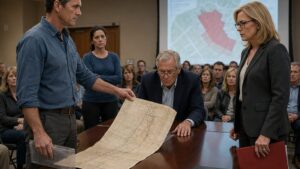
For a moment Michael thought he had missed it. The room had a habit of swallowing sound. Joseph’s law office sat above the old insurance agency on the square, with windows that faced the distant blue of the lake road map pinned to the wall. The air smelled like toner, coffee, and polished wood. A clock ticked above the filing cabinet with the fussy authority of a room where other people’s grief had to stay on schedule.
Joseph cleared his throat.
“To my daughter, Laura Mitchell, I leave my real property commonly known as the lake house, including associated access rights, road interest, dock structure, and contents not otherwise specifically designated.”
Laura sat two chairs away from Michael. She had come in wearing dark blue then, not yellow. Her hands were folded around a tissue she had not used.
Michael waited for the next line.
Joseph moved to the next paragraph.
“To my daughter, Laura Mitchell, I further appoint full authority as independent executor, with power to administer, maintain, transfer, list, or sell estate property as she deems necessary.”
Michael looked at the paper in Joseph’s hand. He could see the black lines but not the words. The map beside the window showed the private road as a thin gray curve, ending at the lake house. Years of gravel, culverts, winter washouts, and fallen branches reduced to a line.
Joseph continued reading about bank accounts, household contents, administrative authority, expenses, taxes.
Still no Michael.
He sat with both hands on his knees and made himself breathe through his nose. Laura did not look at him. That was the first thing he noticed that did not fit. She had always looked when winning. As children, when she beat him at cards, when she got to ride in the front seat, when Mary praised her grades. Laura collected faces when she won.
Now she stared at Joseph’s desk.
“When was this signed?” Michael asked.
Joseph looked up over his glasses. “I’ll finish the reading, then we can address questions.”
“When?”
Laura’s tissue twisted in her fingers. “Michael.”
He did not turn. “Joseph.”
The attorney set the page down, carefully, like the paper might bruise. “This will was executed on March seventeenth.”
The room did not change, but Michael felt the chair under him become less solid.
March seventeenth.
Six weeks before Mary died.
Six weeks before the funeral flowers, before Laura’s black dress, before the casserole dishes, before neighbors told him he had been a good son in voices too soft to bear. Six weeks before all that, Mary had already supposedly signed him out of the road, the house, the dock, the place where he had carried her down the porch steps so she could see the water when walking became too hard.
On March seventeenth, Michael had driven into town for two hours to pick up her medication and a replacement part for the water heater. When he came back, Mary had asked him if his father had finished painting the boat.
Their father had been dead twelve years.
“You said March seventeenth,” Michael said.
“Yes.”
“Where?”
Joseph glanced at Laura before answering. “Here.”
“In this office?”
“Yes.”
Michael turned then. Laura’s eyes were wet, but there was something braced behind the wetness.
“You brought her here?”
Laura’s chin lifted. “Mom wanted to come.”
“She could barely get from the bed to the porch.”
“She had good days.”
“That wasn’t one.”
“You don’t know that.”
“I was there that morning.”
“You were always there,” Laura said, and the words came out sharper than grief alone could make them. “That’s exactly the point.”
Joseph raised one hand. “Let’s keep this civil.”
Michael looked at him. “Was there a doctor’s letter?”
“The signing met legal requirements.”
“That’s not what I asked.”
Joseph sat back. The leather of his chair made a tired sound. “Capacity is presumed unless challenged.”
“Was there a doctor’s letter?”
“No.”
The word was small, but it opened something.
Laura leaned forward. “Mom changed her mind. That was her right.”
Michael turned the sentence over inside him. Changed her mind. Not forgot. Not misunderstood. Not repeated what someone had told her. Changed her mind. The clean phrase people used when they wanted the dead to carry the blame.
“She changed her mind six weeks before she died,” he said, “when she couldn’t remember what year it was.”
Laura’s face flushed. “Don’t do that.”
“Do what?”
“Use her illness because you don’t like her decision.”
Michael looked down at his hands. The left one still had a thin scar across the thumb from replacing the dock railing the year Mary stopped driving. He had bled on three boards that afternoon. Mary had brought him a dish towel and told him not to stain her lake.
He had not asked her for the house. Not once. That mattered to him, though he suddenly understood it might not matter to anyone else.
Joseph slid a copy of the will across the desk. “Michael, I understand this is difficult. But unless you intend to contest, the document controls the estate.”
Michael did not touch the copy.
Laura picked up her handbag from the floor. “I don’t want a fight.”
He nearly laughed then. Not loudly. Not cruelly. Just enough that Laura’s eyes hardened.
“You don’t want delay,” he said.
“I want to do what Mom asked.”
“What did she ask?”
Laura’s hand tightened on the handbag strap. “She wanted me taken care of.”
“And me?”
The question came out before he could stop it. Too bare. Too much like a child standing in a kitchen doorway, waiting to know if there was still room at the table.
Laura looked away.
Joseph spoke into the gap. “There are no specific provisions for you in this version.”
This version.
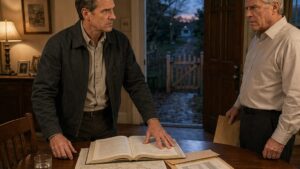
Michael finally reached for the papers. He turned to page three because Joseph had paused there too long. The words waited in stiff paragraphs. Road interest. Dock structure. Contents. Executor. Laura’s name repeated with calm legal patience.
His own name was nowhere.
“What version came before this?” he asked.
Joseph hesitated.
Laura said, “That doesn’t matter.”
Michael kept his eyes on Joseph. “It matters to me.”
“I drafted an earlier estate plan several years ago,” Joseph said. “Different terms. But this document revokes prior wills.”
“What different terms?”
Joseph folded his hands. “The prior will is not operative.”
Michael leaned back. The room had narrowed around the desk, the map, the will, Laura’s untouched tissue. He understood then that grief had tricked him. He had thought the hard part was losing Mary. He had not known someone could take the days after and make him defend what those days had meant.
“Who scheduled the March appointment?” he asked.
Laura stood. “This is pointless.”
Joseph did not answer quickly enough.
Michael turned to him. “Who scheduled it?”
The attorney removed his glasses and set them beside the will.
“Laura called my office,” he said. “She said your mother wanted to make changes.”
Laura walked to the door before Michael could say her name, and Joseph’s clock kept ticking as if time had not just become evidence.
Chapter 3: The Date Nobody Wanted To Explain
The March page was gone from Mary’s kitchen calendar.
Michael stood beneath the humming light over the sink and stared at the two wire loops where it should have hung. February was folded back neatly, its squares crowded with Mary’s shaky handwriting: pills, Linda 10, call Michael, soup, lake window, no salt. April was behind it, mostly blank except for a note in Laura’s smooth print near the bottom: funeral home, 2 p.m.
But March had been torn out.
Not ripped in anger. Removed carefully. The little paper nubs still clung to the spiral, white and clean, like whoever had done it had taken time.
Michael reached up and touched the empty loops.
The house made its small familiar sounds around him: refrigerator buzz, porch board settling, lake water tapping the dock pilings below. Everything else was exactly as Mary had left it because he had not known what he was allowed to move. Her mug sat upside down by the sink. Her reading glasses were in the windowsill. The blanket from her last week was folded over the back of the chair he still could not sit in.
He should have noticed the calendar sooner.
The thought came hard, then stayed. He had walked past it every day after the funeral. He had locked doors, checked pipes, taken out old flowers, answered calls from people who wanted to know what would happen to the house. He had not looked closely at the one thing Mary used because she no longer trusted memory alone.
He took February down, then April, then turned them over as if March might have hidden itself between the months.
Nothing.
His phone buzzed on the counter.
Laura.
He let it ring out.
A message appeared before the screen went dark.
I need the house keys and gate code today. Do not make this uglier.
Michael looked from the phone to the calendar. There had never been a gate code. Laura knew that. There was a key. One brass key on a red float, because Mary had once dropped the old one into a bucket of minnows and laughed for ten minutes.
He pulled the key from his pocket and closed his fist around it until the teeth pressed into his palm.
By noon he was at the county clerk’s office, waiting under fluorescent lights with a paper number in his hand. A clerk behind the glass partition spoke without looking up. “Estate filings are public if they’ve been submitted. Beneficiary designations on private accounts are not.”
“I’m looking for anything recorded around March seventeenth,” Michael said. “Property, deed, road easement, estate-related.”
The clerk tapped at a keyboard. Michael watched her expression change from routine boredom to mild caution.
“There was a filing request initiated that week,” she said. “Not a deed transfer. A notice tied to estate planning. Road access description attached.”
“Can I see it?”
“If you’re an interested party.”
Michael almost answered too quickly. He had been Mary’s son yesterday, her caregiver last month, her road repairman for years. Now he had to prove he was interested.
He slid his identification through the opening.
The clerk examined it, then printed three pages and passed them over. “This doesn’t give you ownership information. It just shows a description was requested and attached.”
The top page held the property’s legal description. The private road was named in dry language, measured by boundary markers Michael knew by sight: the split cedar at the first bend, the old survey pin near Kathleen White’s fence, the culvert Michael had replaced after the flood.
The request date was March eighteenth.
One day after the will signing.
Michael read it twice.
There was no victory in it. No proof that Mary had not understood. No proof Laura had done anything unlawful. But it meant the road had mattered immediately. Not later, not after Mary’s death, not as part of ordinary estate work. The day after the new will, someone had moved to define the road.
He folded the pages carefully.
Outside, Laura was standing beside his truck.
She had changed out of the yellow suit from the gate confrontation and wore a gray coat, but the folder was with her again, tucked under one arm like it belonged there. She looked tired for the first time. Not soft. Tired.
“You’re digging through county records now?” she asked.
Michael stopped three steps away. “You followed me?”
“I called the house. You didn’t answer.”
“That’s not an answer.”
She looked toward the clerk’s office windows. “Joseph told me you were asking questions.”
“Joseph shouldn’t be reporting to you.”
“I’m the executor.”
“You’re my sister first.”
The words landed badly. Laura’s face changed as if he had offered something too late and too cheaply.
“You don’t get to say that only when it helps you,” she said.
Michael took the folded pages from his jacket and held them at his side. “Where’s March?”
“What?”
“Mom’s kitchen calendar. February’s there. April’s there. March is gone.”
Laura’s eyes narrowed. “Are you accusing me of stealing calendar pages now?”
“I’m asking where it is.”
“You’ve had the house.”
“You were there before me. Every week, apparently.”
“Because she was my mother too.”
“Then why didn’t you tell me?”
“Because every time I came, you acted like I was visiting your patient instead of my mother.”
Michael looked away first. He hated that he did. He hated more that part of the accusation had a shape he recognized. He had controlled Mary’s medication schedule, meals, visitors, noise, temperature. He had done it because someone had to. He had also done it because fear made him rigid. Maybe Laura had felt judged every time she crossed the threshold.
That did not explain March.
He held up the county pages. “A road access description was requested the day after she signed.”
Laura glanced at the papers but did not reach for them. “That sounds like estate planning.”
“It sounds like someone knew the road would be a problem.”
“Because you make everything a problem.”
The sentence hit harder than her shouting at the gate. Michael felt his temper move, fast and hot, up through his chest.
He stepped closer.
Laura stepped back at once, and the movement stopped him more effectively than a hand to the chest.
There, in the tiny space between them, was the story she could tell. Angry brother. Bitter son. Man with keys. Man with access. Man standing too close in a parking lot with papers in his fist.
Michael forced himself back one step.
“I’m not giving you that,” he said quietly.
Laura’s eyes shone. “Giving me what?”
“A reason to make this about my temper.”
She looked down, and for a second he thought she might say something true. Then she adjusted the folder under her arm.
“Return the keys,” she said. “Or I’ll document every day you refuse.”
“You already are.”
“Yes,” she said. “I am.”
She walked to her car.
Michael did not follow.
That evening, he returned to the lake house and opened drawers he had already opened, not searching for valuables, only for patterns. Mary kept rubber bands in a teacup, batteries in a cookie tin, old warranty cards in envelopes labeled by appliance. She had never thrown away a calendar page in her life. Past years were stacked in the pantry with recipes, church phone numbers, and reminders that no longer mattered.
March was not in the pantry.
It was not in the desk.
It was not tucked into the cookbook where she stored grocery coupons.
When his phone rang after dark, he almost ignored it. The number was familiar but not saved. He answered with one hand still inside the desk drawer.
“Michael?” a woman said. “It’s Kathleen White.”
He stood still.
Kathleen lived half a mile up the private road, just before the first bend. She had watched the gate longer than anyone except Mary. She also watched people and pretended she did not.
“I heard there’s trouble,” she said.
“There is.”
“I’m not calling to get in the middle.”
People only said that when they were already standing at the edge of it.
Michael waited.
Kathleen exhaled. “I saw Laura’s car at your mother’s place every Wednesday for months. Same time, late afternoon. I figured you knew.”
Michael looked at the empty calendar hooks on the kitchen wall.
“No,” he said. “I didn’t.”
Chapter 4: The Calendar Made The Visits Look Different
“I’m not lying for you, Michael.”
Kathleen White said it before he had both boots on her porch. She stood inside the screen door with one hand on the latch and the other holding a coffee cup, her gray hair pinned up as if she had been expecting him and resenting that expectation at the same time.
Michael stopped on the second step.
“I didn’t ask you to lie.”
“Not yet.” She looked over his shoulder toward the bend in the private road. “People ask gentle before they ask hard.”
Behind him, the road dropped through the trees toward Mary’s house. From Kathleen’s porch, the gate was not visible, but the road was. That was why he had come. Kathleen had lived there thirty years, long enough to know whose tires sounded wrong on gravel, who slowed before the first curve, who stopped where they had no reason to stop.
Michael took off his cap. “I’m asking what you saw.”
Kathleen considered him through the mesh. “You look like a man who already decided what he wants me to say.”
That landed closer than he liked.
He lowered his eyes to the porch boards. Kathleen’s late husband had built them, but Michael had replaced the front step after the wood split beneath a delivery driver. He remembered Mary sitting in his truck that day, waving through the windshield while Kathleen brought out lemonade in jelly glasses. Back then the road had been just a road. Not evidence. Not property language. Not a line dividing the living.
“I’m trying not to decide too early,” he said.
Kathleen opened the screen door, but only enough to step outside. She did not invite him in.
“You and Laura always did that,” she said. “Decided fast. Your mother used to say one of you was a locked gate and the other was a match.”
Michael looked toward the trees. “Which was I?”
Kathleen gave him a tired look. “You know.”
He did. That was the problem.
She leaned against the porch post, cup held at her waist. “I saw Laura’s car on Wednesdays. Late afternoon mostly. Sometimes near supper. Started before Christmas, got regular after New Year’s.”
“Did Mom know she was coming?”
“She came to the door.”
“Mom?”
Kathleen nodded. “Sometimes. Other times Laura let herself in.”
“With a key?”
“I assumed so.”
Michael had given Laura a key two winters ago after Mary slipped on the porch and spent a night in the hospital. He had not taken it back because taking it back would have looked like what Laura accused him of being.
Controlling.
He slid the cap through his fingers. “Was Laura alone?”
“Usually.”
“Usually?”
Kathleen’s eyes moved to the road again, following a memory. “There was one day she had a folder. Yellow. Bright thing. I remember because it was raining and she held it under her coat like it mattered more than her hair.”
Michael felt the small hairs rise on his arms.
“When?”
“March, I think.”
“The seventeenth?”
“I don’t know dates like a court clerk.”
“What day of the week?”
Kathleen frowned, then turned back into the house. “Wait here.”
He heard drawers open, paper scrape, a cabinet shut. He stayed on the porch, looking down at the road, seeing Laura’s car in his mind where Kathleen must have seen it: polished, quiet, arriving when Michael was in town or at the hardware store, when Mary was tired enough not to argue and proud enough not to call him.
Kathleen came back with a small wall calendar from the feed store. Unlike Mary’s missing March, Kathleen’s was intact. She flipped pages with one finger.
“March seventeenth was a Wednesday,” she said.
Michael did not answer.
Kathleen’s voice softened, but not enough to become comfort. “That mean something?”
“It’s the day Mom signed the new will.”
Kathleen looked down at the calendar. “Then yes. She was here.”
“Laura?”
“Laura. And the folder.”
“Anyone else?”
Kathleen hesitated.
Michael caught it. “Kathleen.”
“I don’t want this road turned into a courtroom.”
“It already is.”
She gave him a sharp look. “Because you locked the gate.”
“Because the will took the road.”
“Those can both be true.”
He looked away. He hated how often people were giving him truths that did not help him breathe.
Kathleen closed the calendar, holding her finger inside March to keep the page. “I saw Laura come. I saw her leave. I can’t swear who was in the car after she left.”
“What does that mean?”
“It means I was standing at the mailbox, and when Laura drove back up, your mother was in the passenger seat.”
The porch seemed to tilt under him.
“Was she awake?”
“She was looking out the window.”
“Looking at what?”
“The gate.”
Michael’s mouth went dry. “What did she look like?”
Kathleen pressed the calendar to her chest. “Small.”
The word did more than details would have done.
Michael put his cap back on because his hands needed the work. “Why didn’t you call me?”
Kathleen’s eyes hardened again, not with anger exactly, but with something that had lived too long beside other people’s fights.
“Because your mother told me not to.”
That was worse than anything Laura had said.
Michael stared at her. “When?”
“A few days later. I brought soup. She was on the porch, wrapped in that blue blanket. She said, ‘Don’t tell Michael about the papers. He’ll make a scene.’”
Michael stepped back as if the porch had pushed him.
Kathleen watched him absorb it and did not spare him. “I thought she meant you’d be angry about Laura helping with paperwork. I thought maybe she wanted one thing handled without you standing over it.”
“I never stood over her.”
Kathleen said nothing.
The denial stayed in the air between them, too quick, too thin.
Michael looked down at his hands. He remembered pill bottles lined by breakfast, lunch, dinner. Lists taped to cabinets. Notes on the refrigerator telling Mary not to climb the stairs alone. He remembered taking the checkbook from her when she paid the power bill twice in one week. He remembered telling himself every rule was love.
Maybe Mary had felt protected.
Maybe Mary had felt managed.
Both could be true. That phrase again. He was beginning to hate it.
Kathleen came down one step. “Michael, I don’t think your mother understood everything by then. I also don’t think Laura had to drag her kicking. Mary was tired. She wanted peace. People can sign things for peace.”
“Did she say anything else?”
Kathleen looked toward the trees. “She said she didn’t want the road sold.”
Michael lifted his head.
Kathleen’s voice dropped. “Those words I remember. She said, ‘If the road goes, the house goes next.’ I told her nobody sells a road by itself, and she got upset. Said people sell whatever paper lets them sell.”
The lake wind moved through the pines. Somewhere below, the dock board knocked once.
“Would you write that down?” Michael asked.
Kathleen did not answer quickly. “For who?”
“For Joseph. For court, maybe.”
“I said I don’t want to be in the middle.”
“You’re already holding March.”
Her fingers tightened around the calendar. Not fear. Recognition.
Before she could answer, Michael’s phone buzzed. He looked at the screen and saw a message from Joseph Taylor with an attachment.
Official complaint filed by executor. Call me before you respond.
A second message came in before Michael could open the first.
Laura has alleged intimidation and obstruction related to the locked gate.
Michael looked up from the phone.
Kathleen’s face changed as she read enough from his expression to understand that the road had shifted again beneath them.
“What did she do?” she asked.
Michael looked past her porch to the curve of gravel Laura had traveled every Wednesday, carrying a yellow folder, carrying a story he had not known he was already losing.
“She made the gate the evidence,” he said.
Chapter 5: The Offer Made The Betrayal Plain
“You’re going to tear this family apart over a road.”
Laura stood on the far side of the gate with the yellow folder pressed flat against the chain, as if paper and steel belonged together now. Her car idled behind her. The headlights were off, but the chrome caught the late sun and threw it into Michael’s eyes.
He had not told her to come. He had not answered her calls. Still, there she was, heels planted in the gravel, one hand on the folder, the other wrapped around a white envelope.
Michael stood inside the gate with the key in his jacket pocket.
“This family was already torn,” he said. “You just filed it.”
Laura’s face tightened. “I filed because you left me no choice.”
“You filed because you needed me to look dangerous.”
“You are blocking access to estate property.”
“I’m asking when she signed away everything she told me to protect.”
For the first time that afternoon, Laura looked away.
The road behind her was empty. Kathleen’s house sat beyond the bend, hidden by trees. Downhill, the lake house waited with its windows dark. Michael had shut the main breaker that morning before the county could accuse him of hiding utility records. Every ordinary thing now felt like it might be used by someone.
Laura lifted the white envelope. “I brought you something.”
“If it’s another notice, give it to Joseph.”
“It’s not from Joseph.”
She slid it between the gate bars. Michael did not take it.
Laura sighed through her nose. “For once, could you not act like I’m trying to poison you?”
He looked at the envelope. No return address. His name in Laura’s handwriting.
“What is it?”
“An offer.”
That word moved through him colder than the wind.
Laura pushed the envelope farther through the bars until it bent against the chain. “Open the road, return the house keys, and agree not to contest the will. I’ll authorize a payment from my own share once the estate clears.”
Michael stared at her.
“How much?”
“Twenty-five thousand.”
The number was so small compared to what she was taking that for one second he did not understand it as money. It sounded like a test. Or an insult dressed carefully enough for a lawyer’s table.
He did not reach for it.
Laura’s voice softened in a way that made him more wary. “Michael, you could use it. I know the last few years weren’t easy.”
“The last few years were Mom’s life.”
“I didn’t mean it that way.”
“How did you mean it?”
She pressed her lips together. “You put everything into this place. I know that. But that doesn’t mean Mom owed you the house.”
“I didn’t ask her for the house.”
“Then why are you doing this?”
He stepped closer to the gate. Not fast. Not close enough to touch it. Close enough that she had to meet his eyes.
“Because she knew what year Dad died when she made the earlier will. She knew where the road went. She knew why it mattered. On March seventeenth, she thought Dad was painting the boat.”
Laura flinched. “She had confused moments.”
“She had confused days.”
“You are choosing the worst pieces of her to make your case.”
“No,” he said. “You chose the weakest pieces of her to make yours.”
Color rose in Laura’s face. She shoved the envelope fully through the bars. It fell at Michael’s feet.
“I was there too,” she said. “You keep saying that like I appeared at the end with a pen and a moving truck. I drove up every week. I brought groceries. I sat with her when you were in town. I listened to her cry because she felt like a burden in her own home.”
Michael’s jaw tightened. “She never said that to me.”
“Of course she didn’t. You needed to be needed.”
The words cut cleanly.
He reached for the gate before he decided to. His hand closed around the bar hard enough that the chain jumped.
Laura stepped back. Her eyes widened, but not with surprise alone. There was calculation in how quickly she saw the moment.
Michael released the bar as if it had burned him.
Laura looked at his hand, then at his face. “That. That right there.”
“No.”
“You think I’m the only one who noticed?”
“I didn’t threaten you.”
“You don’t have to say threats for people to feel them.”
He took two steps back and forced his arms to his sides. Heat beat behind his eyes, not tears, not quite. Anger had always been easier to hold than grief. That was why Laura could use it. That was why Mary might have feared it. Not because he had hurt her, never that, but because he could fill a room with silence and make everyone move around it.
Laura saw him fighting himself. Her voice lowered.
“Open the gate, Michael. Let this stop before you become what the complaint says you are.”
He looked at the envelope on the ground.
“Are you selling it?”
She did not answer.
“Laura.”
Her gaze moved toward the lake house. “I’ve spoken to a broker.”
The road seemed to narrow between them.
“When?”
“After the reading.”
“Before the funeral?”
“No.”
He watched her too closely, and she hated it.
“No,” she repeated. “Not before.”
“Why so fast?”
“Because the estate has expenses. Taxes. Maintenance. Insurance. I live three hours away. I can’t keep pouring money into a place because you turned it into a shrine.”
“It was Mom’s home.”
“It was a second house she couldn’t afford.”
“She afforded it because I fixed what broke.”
“And that is exactly the problem.” Laura’s voice cracked, then hardened around the crack. “You fixed everything. You were the good one. You were the one who knew the furnace, the medicine, the neighbors, the road. Do you know what it is like to walk into your mother’s house and feel like a guest because your brother already knows where every cup goes?”
Michael did not answer.
Laura’s hand trembled once against the folder. She stilled it. “Mom wanted me taken care of too.”
“I believe that.”
The answer surprised them both.
Laura’s eyes searched his face.
“I believe she wanted you taken care of,” Michael said. “I don’t believe she wanted you to erase me to do it.”
Laura looked away first.
The wind shifted, pressing the yellow folder harder against the chain. The corner lifted. Michael saw a paper inside, not the will, something with typed paragraphs and blank signature lines. A settlement release.
He bent and picked up the envelope, not because he would accept it, but because leaving it in the dirt felt too much like letting Laura decide what the scene meant. He opened it. A single-page agreement. No contest. No claim. No further objection. Payment after final estate administration.
At the bottom, beneath the signature line, Laura had clipped a sticky note.
Please don’t make me fight you in public.
Michael stared at that longer than the money.
When he looked up, Laura’s eyes were wet.
“You already did,” he said.
A phone rang inside his truck.
He almost ignored it, but the sound kept going. He backed away from the gate, agreement in hand, and opened the truck door. The screen showed a number he did not know.
“Michael Martin?” a woman asked.
“Yes.”
“This is Linda Lopez. I was one of your mother’s hospice nurses.”
His grip tightened on the phone.
“I’m sorry to call like this,” she said. “I heard there may be questions about paperwork from March.”
Michael looked through the windshield at Laura, still standing behind the chained gate.
Linda lowered her voice.
“I remember the afternoon your mother signed something.”
Chapter 6: The Nurse Remembered The Wrong Afternoon
“I remember because your mother asked me why Laura was bringing a lawyer to lunch.”
Linda Lopez said it before the waitress had finished pouring Michael’s coffee.
The diner sat where the county road met the highway, far enough from the lake that no one came in unless they needed gas, eggs, or a place to talk without being seen by everyone who used the private road. Linda had chosen the back booth. She wore a plain gray sweater and kept both hands around her mug, though she had not taken a drink.
Michael did not touch his coffee.
“She said lawyer?”
Linda glanced toward the counter. “She said, ‘Is Laura bringing that lawyer man to lunch?’ I told her I didn’t know.”
“What day?”
“I can’t swear under oath from memory alone.”
“Linda.”
She looked at him then. Her face carried the guarded fatigue of someone who had spent years entering rooms where families whispered around beds. “I checked my notes before I called you. March seventeenth was one of my visit days. I arrived at nine. Your mother was anxious. More confused than usual.”
Michael felt the key in his pocket, the gate key on the red float. He had started carrying it everywhere, as if losing it would mean losing the last thing he still understood.
“What do your notes say?”
Linda opened a small folder. Not dramatically. Carefully. She slid a photocopied page across the table but kept two fingers on it.
“I can’t hand over full records without the proper request,” she said. “This is my visit note summary. I’m showing you because you’re family, and because I don’t like pretending a line on paper has no room around it.”
Michael read the page.
Patient oriented to person intermittently. Confused regarding year. Asked if husband would return for lunch. Repeated concern about road and water.
His throat tightened at husband. Mary had meant his father.
Linda watched him read it. “That doesn’t prove incapacity by itself.”
“I know.”
“I need you to understand that. People can be confused in the morning and lucid later. People can have capacity for one decision and not another. It’s not simple.”
Nothing had been simple since Joseph skipped his name.
“What happened that afternoon?”
Linda drew the paper back an inch. “I wasn’t there when she signed. My shift ended before noon. Laura was expected around lunch. Your mother seemed worried about papers. She asked if she should wear her blue cardigan because Laura said they might go out.”
“To Joseph’s office.”
“I assume.”
Michael looked out the window at the gas pumps. A pickup pulled in, brakes squealing. Ordinary life moved badly around extraordinary pain.
“She knew Laura was taking her somewhere?”
“She knew Laura was coming. Whether she understood why, I can’t say.”
“What else did she say?”
Linda looked at her mug. “She asked if you were still fixing the dock.”
“I was.”
“No. Not that dock.” Linda’s voice softened. “She meant the old storm damage. From years before. She said you shouldn’t be on the ladder in the rain.”
Michael closed his eyes briefly.
The dock storm had been seven years ago. Mary had stood in the kitchen scolding him through the window while he worked in a downpour because the broken rail had fallen toward the boat. He had been forty-six. She had been sharp as a tack and furious with him.
On March seventeenth, she was living inside that memory.
Linda slid the note back into her folder. “I’m not telling you what conclusion to draw.”
“But you called.”
“I called because I heard Laura filed a complaint against you. And because your mother was not a piece of paper to me.”
Michael looked at her hands. Strong hands. Nurse’s hands. Clean nails, no rings.
“Will you tell Joseph?”
“If he sends a proper request, yes. I’ll confirm what my note says.”
“And what you remember?”
Linda hesitated.
There it was again. People standing at the edge of the middle.
“I have to be careful,” she said.
“Because of your job.”
“Because memory becomes something else once families start pulling on it.”
Michael sat back.
Linda’s caution frustrated him, but he understood it. He had been pulling too. Pulling at Kathleen, at Joseph, at Laura, at March itself. If he pulled hard enough, he thought the page might come back whole.
Linda took her first sip of coffee and winced because it had gone cold. “Your mother loved both of you.”
Michael almost looked away. He made himself stay.
“I know.”
“I’m not sure either of you believed that at the same time.”
The sentence entered quietly and stayed.
His phone buzzed on the table. Joseph. Michael answered.
“Where are you?” Joseph asked.
“With Linda Lopez.”
A pause.
“Good,” Joseph said, but his voice held no relief. “Listen carefully. I received a notice from Laura’s attorney this morning. They are pressing the access complaint. They’re arguing your continued lockout could be considered interference with estate administration.”
Michael looked at the red key float peeking from his jacket pocket.
“She offered me money to sign away any objection,” he said.
Joseph exhaled. “Did you sign anything?”
“No.”
“Did you threaten her?”
Michael’s eyes moved to the window, to his reflection in the glass. “I grabbed the gate.”
Joseph was silent just long enough.
“Michael.”
“I let go.”
“That may not matter if she describes it differently.”
Linda looked at him across the table, understanding enough from his face.
Joseph continued, “You need to stop acting like the gate is your whole case. If you contest, contest. If you need emergency relief, file for it. But standing behind a lock while Laura’s attorney builds a record against you is dangerous.”
Michael touched the key through the fabric of his pocket. For days it had felt like the last promise he could physically keep. Now it felt like something Laura could hold up in court and call proof of bitterness.
“I’m not opening it for her to empty the house.”
“Then give me facts, not gestures,” Joseph said.
Michael looked at Linda’s folder. “I may have one.”
“It may not be enough.”
“I know.”
“Come by my office this afternoon. There’s something else.”
Michael straightened. “What?”
“I pulled the old file after our last conversation. There was a prior draft before the will your mother signed in March. Not just an old will. A draft revision from last year.”
“And?”
Joseph’s voice lowered.
“It treated the road parcel separately from the lake house. Your mother wanted the access rights handled differently.”
Michael did not speak.
Linda folded her hands on the table, watching him as if she could see the next weight settling before he felt all of it.
Joseph said, “I don’t know yet why that clause disappeared.”
Michael looked down at the key in his pocket, then out toward the county road that eventually climbed back to the locked gate.
For the first time since Laura waved the will at him, the question was no longer only whether Mary had signed.
It was what someone had removed before she did.
Chapter 7: The Old Will Said More Than Money
“The documents are legal,” Laura’s attorney said. “The signatures are verified.”
The sentence landed in the conference room with the weight of a door closing. Michael sat across from Laura, with Joseph Taylor at his side and a court mediator at the head of the table. Between them lay three versions of Mary’s life: the March will, the prior draft, and a road map with the private lane marked in yellow.
Laura did not look at him.
She wore gray today, not yellow. Her hands were folded on the table, fingers pressed flat as if she were holding herself in place. The yellow folder sat beside her anyway, its edges worn now, less like a weapon than something she had carried too long to set down.
Michael looked at the map. The road curved from the county line through Kathleen White’s property edge and down to the lake house. On paper it looked simple. It did not show the culvert he had replaced in January, the shoulder that washed out each spring, the place Mary used to stop walking when her breath got short and say, “From here I can still see the water.”
Laura’s attorney tapped the March will. “Your client may dislike the outcome, but disappointment is not evidence.”
Joseph leaned forward. “No one is arguing disappointment as evidence.”
“Then what are you arguing?”
Michael answered before Joseph could. “When exactly were they signed, and why was I told she was sleeping that afternoon?”
The room went still.
Laura’s eyes came up.
Her attorney glanced at her, then back at Michael. “Who told you that?”
“You did,” Michael said to Laura.
Her face tightened. “I said she was resting.”
“On March seventeenth?”
“I don’t remember the exact words.”
“I do.”
The mediator, a woman with silver glasses and a quiet voice, raised one hand. “Let’s slow down. Mr. Martin, you have a concern about the timeline.”
“I have more than a concern.”
Joseph opened the folder in front of him and removed Linda’s visit summary, Kathleen’s written statement, the county filing request, and a copy of the prior draft. He did not spread them dramatically. He placed them one by one in a line.
Michael watched Laura’s face as each page touched the table.
Linda’s note did not make her flinch. Kathleen’s statement did. The prior draft made her look away.
Joseph slid the draft toward the mediator. “This version was prepared the previous year. It gives Laura a financial share and a protected interest, but the road parcel and access control are treated separately. Mary Roberts wanted Michael to retain stewardship of the road regardless of what happened to the house.”
Laura’s attorney frowned. “A draft is not a signed will.”
“No,” Joseph said. “But it shows intent close in time before the disputed document.”
“Intent can change.”
Michael looked at Laura. “Did it?”
She lifted her chin. “Yes.”
“Then say how.”
Her attorney shifted. “My client is not required to justify the decedent’s wishes to her brother.”
“She’s required to explain what changed if she wants me to believe Mom chose it freely.”
Laura’s eyes sharpened. “I don’t need you to believe it.”
There it was again. The paper as shield. The law as wall.
Michael felt his old instinct rise: go quiet, let them talk, let their words reveal enough. For years, silence had been his way of keeping peace with Mary’s illness, with Laura’s resentment, with neighbors who asked too much. Silence had also let Laura build the first story before he answered.
He placed his hand on the photograph Joseph had printed from his phone: the gate, chain looped through steel, lake road stretching behind it.
“I locked that gate because I thought if I held the road, I could hold the truth long enough for somebody to look at it,” he said. “That was my mistake. A lock is not proof. So here is what I’m saying without the lock.”
Laura looked at him then, fully.
“On March seventeenth, Linda Lopez documented that Mom was confused about the year and asking for Dad. Kathleen saw you take her down the road with a yellow folder. The next day, a road-access description was requested at the county. The March calendar page is missing from Mom’s kitchen. The prior draft protected your money but left the road with me. The signed version removes that. All of that may not overturn the will today. But it is enough to ask why the one thing Mom always separated disappeared when she was least able to explain it.”
For a moment, no one spoke.
Then Laura said, “You always make it sound noble.”
Her voice was low.
Michael did not answer.
“You say road like it’s sacred,” she continued. “You say lake house like Mom gave you a mission. But do you know what she said to me? She said she was tired of being watched. Tired of asking you before she moved a lamp. Tired of you telling her which bills she could pay and which stairs she could climb.”
Michael felt the words pass through the room and find him. He looked at the table because he could not deny all of it cleanly.
“I was scared,” he said.
Laura laughed once, but it broke halfway. “So was she.”
The mediator leaned in slightly. “Ms. Mitchell, did your mother say she wanted the road sold?”
Laura’s mouth closed.
Her attorney murmured, “You don’t have to answer that.”
But Laura kept looking at Michael. Not with victory now. With something rawer.
“She said she didn’t want to be a burden,” Laura said.
“That isn’t the same thing.”
“She said the house was too much. The road, the repairs, the taxes, all of it. She said you were killing yourself keeping it alive.”
Michael’s hand tightened on the edge of the table.
Laura’s voice trembled, then steadied. “I told her selling might be kinder. To everyone. To you too.”
The room seemed to draw in.
Joseph’s eyes moved from Laura to the March will.
Michael said, “You told her selling was the only way not to be a burden.”
Laura looked down.
The mediator’s pen stopped moving.
“Laura,” Michael said, quieter now, “did she ask to remove the road clause?”
Laura wiped one finger under her eye, angry at the tear more than the question. “She wanted me taken care of.”
“That’s not what I asked.”
“You had everything else.”
“I had work.”
“You had her.” Laura’s voice cracked open. “You had every day. Every call. Every neighbor thanking you. Every doctor knowing your name. I came in and felt like I had to knock on my own mother’s life.”
Michael felt the sharpness in his chest loosen into something worse. He had wanted Laura to be only wrong. It would have been easier. He could fight wrong. He did not know what to do with wounded and wrong sitting in the same chair.
“You should have told me that,” he said.
“You wouldn’t have heard it.”
He wanted to say he would have. He was no longer sure.
The mediator touched the prior draft. “The practical issue is this: the March document may stand while the challenge proceeds, but there is enough dispute here to make immediate sale and unrestricted access risky for both sides.”
Laura’s attorney straightened. “We are not conceding undue influence.”
“No one is asking you to concede it right now,” the mediator said. “I am asking whether your client wants an estate drained by litigation over a road clause that appears in an earlier draft and disappears in a late-stage signing under medically complicated circumstances.”
Laura looked at the road map.
Michael waited.
For the first time since the gate, she seemed to see the line on the page not as a driveway to something she owned, but as a thing Mary had tried to name before words started failing her.
The mediator turned the map so it faced both of them. “A partial correction could preserve review without forcing a full ruling today. Road parcel and access control held separately for Mr. Martin pending final review. Personal lake-house keepsakes inventoried with priority distribution. No sale of the house until the capacity issue is examined.”
Laura’s attorney began to object, but Laura raised a hand.
She looked at Michael. “If I agree to that, you stop locking me out?”
“I stop making the gate the argument,” he said. “I don’t stop asking what happened.”
Her face hardened again, but the hardness was tired now.
Michael looked at the March will, the old draft, the map, the photograph of the gate. He thought of Mary on the porch telling Kathleen she did not want the road sold. He thought of Mary telling Laura she did not want to be a burden. Both truths could stand in the same room. One did not give Laura the right to bury the other.
The mediator wrote three lines on a blank sheet and slid it to the center of the table.
Michael read them silently.
Road parcel and access control to Michael, pending final review.
Sale frozen.
Personal keepsakes preserved.
Laura did not sign. Not yet. She stared at the page as if it were a punishment, or a rescue, or the first honest thing anyone had put in front of her.
Then the mediator placed a pen between them.
Chapter 8: The Road Opened For The Truth
Michael stood at the gate with the court-stamped agreement in his hand and the key on its red float in his pocket.
The chain was cold from the morning shade. It hung exactly as it had on the day Laura drove up in yellow and demanded the road, but it no longer felt like the only thing keeping Mary’s life from being taken apart. The paper in Michael’s hand was not a victory. It was three pages, temporary language, limited correction, pending review. It did not undo March seventeenth. It did not put his name back where it should have been. It did not make Laura innocent or monstrous.
It simply stopped the sale, separated the road, and admitted that the document was not the whole story.
A car slowed on the county road.
Michael did not turn until he heard tires on gravel.
Laura parked farther back this time.
She stepped out wearing jeans and a dark coat. No yellow suit. No raised folder. No sharp slap of a door. She carried a small cardboard box with both hands, and for one second Michael felt the old instinct to walk toward her and take the weight before he remembered they were no longer those people without effort.
She stopped on the other side of the gate.
“I signed the inventory addendum,” she said.
Michael nodded. “Joseph told me.”
Laura looked at the chain. “So this is where you make your point?”
He took the key from his pocket. “No.”
Her eyes lifted.
“I already made too many points with this gate.”
He put the court-stamped agreement under one arm, fitted the key into the lock, and turned it. The click was smaller than he expected. After weeks of lawyers, accusations, copies, signatures, and memory being weighed like evidence, the thing itself opened with a sound barely louder than a spoon against a cup.
He unwound the chain from the bars.
Laura watched him without speaking.
When he pulled the gate open, it moved stiffly at first, then swung inward over the gravel. The road lay clear between them, bending down toward the lake house and the dock where the loose board still knocked when the wind came from the west.
Michael stepped aside.
Laura did not drive through.
Instead, she lifted the cardboard box slightly. “These were in Mom’s bedroom closet. Joseph said we should inventory them. I thought you should see before they go on a list.”
Michael did not reach for the box. “What’s in it?”
“Photos. Some letters. Her blue cardigan.” Laura’s mouth tightened. “And the lake frame.”
That made him look at her.
Mary’s lake frame had sat on her dresser for twenty years: a photograph of the water taken from the dock at dawn, with Michael and Laura as teenagers standing at the edge of the picture, both half-blurred because they had been arguing when Mary snapped it. She had refused to replace it with any nicer photo.
Laura looked down at the box. “She kept it wrapped in tissue.”
Michael took the box then. It was lighter than he expected.
Inside, beneath the cardigan, was the frame. The glass was dusty. Laura and Michael stood on the old dock in the photograph, younger and careless with the kind of closeness people assume they can damage later and still recover. Mary’s handwriting was on the back of the frame, visible through a torn strip of brown paper.
Both of them, before they learned corners.
Michael stared at the words until they blurred.
Laura saw him reading. Her face changed.
“I didn’t know she wrote that,” she said.
He believed her.
The belief did not heal anything. It only made the moment harder to hate.
Laura looked down the open road. “Do you think she hated me?”
Michael closed the box.
The easy answer would have been useful. It would have hurt Laura. It might have satisfied the part of him that had stood behind the gate imagining that truth would feel clean once it arrived.
He looked at his sister instead.
“No,” he said. “I think she was tired. I think you were scared. I think I was scared. And I think you used that against her.”
Laura’s face tightened, but she did not deny it.
“She wanted you taken care of,” Michael said. “I believe that. But not like this.”
Laura’s eyes filled. She turned away before the tears fell, looking toward the lake house as if distance could save her from being seen.
“The review may still go badly for me,” she said.
“It might.”
“You’ll keep going?”
“Yes.”
She nodded once, as if she had expected no less and resented him less for saying it plainly.
After a while, she walked back to her car but did not start it. Michael carried the box through the open gate and down the road on foot. He could have driven. He wanted to feel the gravel under his boots, the slope of the land, the places his hands had repaired.
At the dock, he set the box on the bench Mary used to sit on and pulled the loose board free enough to see the bent nail beneath. He would fix it later. Not because the house was his. Not because the paper had finally said enough. Because Mary had loved the sound of water against wood, and because some promises did not need a perfect legal sentence to remain true.
Laura came down after a few minutes and stopped at the porch, keeping distance between them.
Michael lifted the lake frame from the box and set it on the bench facing the water.
The gate stood open behind them up the hill, no longer a threat, no longer proof, only a boundary that had done what it could until words were ready to do the rest.
The story has ended.