At Eight O’Clock Every Night, the Whole Street Blamed the Quiet Kid Next Door
Chapter 1: The Street Went Dark at Exactly Eight
At exactly 8:00 p.m., every phone on Laurel Ridge Court lost its connection.
Jacob Taylor saw it happen on his screen before he heard anyone complain. One second, his headset carried the low voices of his classmates from a group project call; the next, their words broke into a sharp digital stutter and vanished. His laptop froze on a shared document. His phone, propped against an empty soda can, dropped from full Wi-Fi bars to nothing.
Across the top of the screen appeared the small gray sentence he had come to hate.
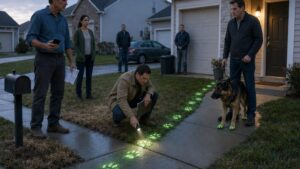
No Internet Connection.
Jacob stared at it, then at the clock in the corner of his monitor.
8:00.
Again.
He leaned back in his chair, pulled one side of his headset off, and listened. His bedroom was quiet except for the low whir of his computer fans and the soft blink of the router lights on the small shelf near his closet. Blue, green, green, blue. Normal. Alive. Accused-looking, somehow, now that half the street had decided the problem had to be inside his house.
From downstairs, his father called, “Jacob?”
“I know,” Jacob answered.
Samuel Davis’s footsteps moved slowly across the kitchen. He had the heavy walk he got before his overnight shift, when his boots were already on and his back had not yet forgiven him for the last one.
“The TV cut out again,” Samuel said from the bottom of the stairs.
Jacob opened a network status window. He did not need to. He already knew what it would show. Local connection active. Internet unavailable. Gateway reachable. Signal strong. Something upstream dying on a schedule.
“I’m checking,” he said.
His phone buzzed against the desk, not from Wi-Fi but through a weak cellular signal that always struggled inside the house. A message from the neighborhood group appeared, then another, then another.
Anyone else down?
Ours too. Every night now.
This is ridiculous.
At exactly eight again.
Jacob did not open the thread. He had read enough of it the past three nights. Adults who had ignored him for years now knew how to tag his house number without typing his name.
He stood and crossed to the window.
Laurel Ridge Court looked the way it always did after dinner: porch lights on, garage doors closed, sprinkler mist shining under landscape lights, identical mailboxes standing in a neat row like little judges. The homes were not mansions, but they were the kind of houses that came with rules about fence colors, trash cans, basketball hoops, and how long a car could sit in a driveway with a flat tire.
Jacob’s house sat near the bend, smaller than the two on either side, with faded shutters Samuel kept meaning to repaint. Their lawn was trimmed but thin in places. The porch railing had one spindle Samuel had fixed with the wrong shade of white. None of that had mattered much until the HOA started sending “friendly reminders” with photographs attached.
A curtain moved in the house across the street.
Catherine Clark stood behind her front blinds, face half-lit by the lamp behind her. Jacob could not make out her eyes, but he knew she was looking at his window. She had been looking every night since the outages started. Not openly. Not like a neighbor checking on a problem. Like someone waiting for a suspect to reveal himself.
Jacob let the curtain fall back.
His phone buzzed again.
This time the notification preview showed Catherine’s name.
Catherine Clark: I believe we all know where the interference is coming from. I’ve observed unusual late-night computer activity at the Taylor residence. This needs to be addressed.
Jacob read the sentence twice, his thumb hovering over the screen.
Unusual late-night computer activity.
He looked at his desk: a secondhand monitor, a keyboard with two missing keycaps, an old desktop tower he had rebuilt from parts customers had thrown away, and the soldering mat where he fixed phone charging ports for extra cash. His “unusual activity” was homework, repair jobs, and sometimes a game after work when he could not sleep.
Another message appeared.
Are you saying someone is doing this on purpose?
Then another.
That boy is always online.
Jacob’s face warmed.
He typed, My internet is out too.
He deleted it.
He typed, That’s not how routers work.
He deleted that too.
The problem with defending yourself in a neighborhood group was that the reply already looked guilty. Too fast, too technical, too emotional, too quiet. Catherine could write “I believe” and sound responsible. Jacob could write the truth and sound like a kid arguing.
Downstairs, Samuel’s phone rang. Jacob heard him answer, then go silent.
“No,” Samuel said after a moment. “No, he’s not doing anything.”
Jacob closed his eyes.
There was a pause. Then Samuel’s voice changed, lowered the way it did when he was trying not to get angry before work.
“I understand people are frustrated. But you don’t come at my son like that.”
Jacob stepped into the hall. “Dad.”
Samuel looked up from the entryway, phone pressed to his ear, lunch bag on the floor beside him. His face was tired, not old, but worn in the places where worry sat every month when bills came due.
“I’ll talk to him,” Samuel said into the phone. “That’s all I’m saying right now.”
He hung up.
Jacob came halfway down the stairs. “Who was that?”
“HOA president.”
“What did he say?”
Samuel rubbed the bridge of his nose. “Said Catherine’s gotten six complaints. Said people are upset. Said we should cooperate before this becomes a formal issue.”
Jacob laughed once, without humor. “Cooperate with what? I didn’t do anything.”
“I know that.”
“Do you?”
Samuel looked up sharply. “Don’t start.”
Jacob stopped. He hated that tone in his own voice, hated how quickly he could sound like he was accusing the one person still on his side.
Samuel picked up his lunch bag. “I know you didn’t do it. But you also know how this place works. They get something in their heads, and suddenly there’s a letter, then a fine, then some meeting I can’t attend because I’m working.”
“So I’m supposed to just let them say whatever?”
“You’re supposed to not make it worse.”
Jacob looked back toward his room. On his shelf, the router lights continued their steady blinking, indifferent to the whole street going dark.
His phone buzzed again.
Catherine Clark: I’m going over there. Someone needs to ask directly.
Jacob’s stomach tightened.
Outside, porch lights flicked on one after another, not because anyone needed more light, but because people wanted to be seen stepping out. A garage door rumbled open. A woman’s voice drifted across the street. A man answered. Shoes scuffed on driveways.
Samuel followed Jacob’s gaze toward the front window.
“Jacob,” he said quietly, “let me handle it.”
But Jacob was already moving down the stairs. He did not know what he planned to say. Maybe nothing. Maybe that was the problem. Maybe his whole life in this neighborhood had been nothing: no loud parties, no speeding, no fence arguments, no barking dog, no complaints. Just a quiet house where people assumed quiet meant hiding something.
The doorbell rang.
Then came three firm knocks.
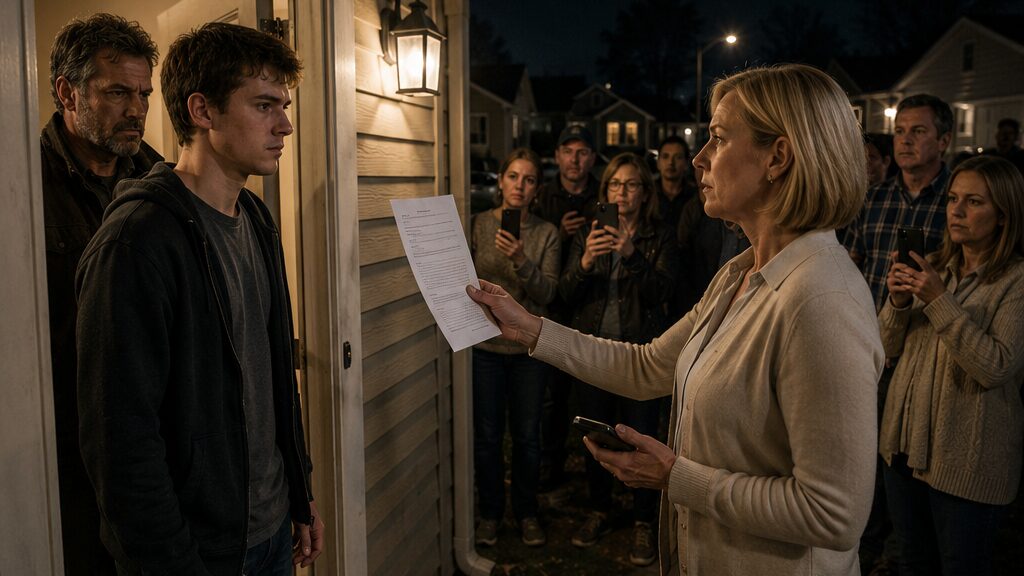
Through the narrow glass beside the door, Jacob saw Catherine Clark standing on the porch with her phone in one hand and a white paper in the other. Behind her, half a dozen neighbors waited under the porch light, their faces arranged into concern, annoyance, and something worse: certainty.
Chapter 2: The Router Lights Were Still Blinking
Catherine Clark held the paper up before Jacob had fully opened the door.
“This is not a fine,” she said, with the careful tone of someone who had practiced sounding reasonable. “It’s a notice of concern.”
Jacob looked past the paper to the neighbors behind her. Two stood on the walkway. Another hovered near the hedge, phone in hand, recording or pretending not to. A man in slippers kept glancing at his dead phone like Jacob might restart the internet by feeling ashamed enough.
Samuel stepped beside Jacob. “A notice of concern at eight-fifteen at night?”
Catherine’s mouth tightened. She wore a pale cardigan over a blouse, her hair pulled back, earrings small and neat. Everything about her looked prepared for a meeting, not a porch confrontation.
“We have a community-wide service disruption,” she said. “It has happened at the same time for several nights. Residents are asking for action.”
“Then call the provider,” Jacob said.
Several faces shifted toward him.
Catherine did not look surprised. She looked satisfied that he had spoken first.
“We have,” she said. “And while we wait for a technician, we have to address possible sources of interference.”
Jacob’s fingers curled against the door edge. “My house isn’t a source of interference.”
“Then you won’t mind showing us your router.”
Samuel said, “Absolutely not.”
A neighbor on the walkway spoke up. “Come on, Sam. Nobody’s accusing anybody. We just want to know why our stuff keeps cutting out.”
“You are accusing somebody,” Samuel said. “You came to my porch.”
Catherine lowered the paper a few inches. “Jacob, if your equipment is clean, this clears things up.”
Jacob almost smiled at the word clean. As if his router were a backpack being searched in the principal’s office. As if he were twelve again, standing outside a classroom while adults decided the missing thing had to be in his pocket because he was the quiet one who knew how to take things apart.
He should have said no.
He knew it even then.
But Samuel had work in less than an hour, and Catherine had a paper, and the neighbors had that restless group energy that made one person’s doubt weaker than everyone else’s impatience. If Jacob refused, the story would become refusal. If he let them look, maybe the blinking lights would speak for him.
“Fine,” he said.
Samuel turned. “Jacob.”
“I’ll show the router,” Jacob said. “Not my room. Not my computer. The router.”
Catherine nodded as though granting him a favor.
Jacob opened the door wider and led them into the living room. The house was clean but plain: a couch with a worn arm, a coffee table Samuel had sanded down twice, a stack of mail near the lamp. Jacob felt the neighbors noticing all of it, not rudely enough to be called rude, just enough.
The router sat on a shelf near the hallway, where Jacob had moved it months ago to improve the signal. Its lights blinked in a steady pattern: power, downstream, upstream, internet, Wi-Fi. Normal. Beautifully, annoyingly normal.
Catherine stepped closer. “Is that the only router?”
“Yes.”
“No extender? Booster? Signal device?”
“No.”
A neighbor lifted his phone. “Then why do I have no Wi-Fi?”
Jacob glanced at the screen. “Because your phone isn’t connected to your internet.”
“I know that.”
“I mean it’s not connected to mine either.”
The man frowned, as if Jacob had dodged something.
Catherine looked at the router. “Can you log in and show the device list?”
“No,” Jacob said.
The room went still.
Catherine turned. “Why not?”
“Because that shows our devices. My dad’s phone, my laptop, stuff that’s private.”
“If there’s nothing improper—”
“I said I’d show you the router. I didn’t say you could inspect my whole network.”
Samuel’s eyes moved to him, surprised.
Jacob felt his pulse in his neck, but his voice stayed level. He had apologized automatically when Catherine arrived. Sorry, what’s going on? Sorry, I don’t know why it’s down. Sorry, let me check. The word had slipped out three times before he caught it. Now he held his mouth closed until he was sure another apology would not escape.
Catherine noticed.
“This is exactly the kind of defensiveness that concerns people,” she said.
“No,” Jacob said. “It concerns you.”
One of the neighbors shifted on the carpet. The man with the phone stopped pretending not to record. Samuel drew in a slow breath.
Then, from the porch, a woman’s voice called, “Wait—Ruth’s is down too.”
Everyone turned.
A neighbor stood at the open door, phone pressed to her ear. “Her daughter’s trying to call the medical alert company. It says Ruth’s base unit isn’t responding.”
The room changed.
Until then, the outage had been irritating. Frozen shows. Dropped games. Kids complaining about homework uploads. Now the silence on everyone’s phones felt heavier.
Catherine recovered first. “That’s why this has to be resolved tonight.”
Jacob looked at her. “Then stop wasting time in my living room.”
“Excuse me?”
“My router’s working. The lights are normal. My internet is out too. Whatever is happening is outside this shelf.”
“You expect us to take your word for that?”
Jacob pointed to the router, then to his laptop on the small desk by the hall. “You can see it. Local network up. Internet down. That means the router is talking inside the house but not getting a connection out.”
The neighbor in slippers muttered, “Sounds convenient.”
Jacob looked at him. “It’s not convenient. I have an assignment due at midnight.”
Catherine folded the paper against her phone. “Jacob, people have noticed patterns. Your computer lights are on late. Your window faces the street. You work with electronics. You can understand how that appears.”
“How it appears isn’t proof.”
“No, but it’s a reason to ask questions.”
“You didn’t ask questions. You brought people.”
For a moment, no one spoke. The router lights blinked on in the little silence: green, blue, green. Jacob watched Catherine watch them, and for the first time since she arrived, he saw doubt flicker across her face. Not enough to stop her. Enough to annoy her.
Samuel stepped forward. “You’ve seen what you came to see. Now everybody out.”
The neighbor with the phone lowered it. The man in slippers mumbled something about just wanting answers. Catherine remained near the shelf.
“The HOA will still need documentation,” she said.
“Document this,” Samuel said. “You entered my house, looked at the router, and found nothing.”
“I didn’t enter without permission.”
“And you didn’t find anything.”
Catherine’s face flushed lightly. She turned toward Jacob instead of Samuel. “If this continues tomorrow, we’ll need a formal response.”
Jacob wanted to ask why she needed one from him. He wanted to explain the difference between interference and outage, between a router and the provider line, between suspicion and evidence. But the porch light caught the faces outside, and he saw that most of them had not changed their minds. They had only changed the shape of their doubt.
Not guilty yet, their expressions said. Not cleared.
Then Ruth Hall’s front porch light flickered across the street.
It was a small motion, barely noticeable, but Jacob saw an older woman’s silhouette near the window. Ruth lived alone, kept her trash cans cleaner than anyone, and waved at Jacob when other neighbors looked past him. Her daughter visited Sundays with groceries. A white medical alert base unit sat by Ruth’s kitchen phone; Jacob knew because he had once helped her reconnect it after a power strip failed.
The neighbor on the porch spoke into her phone again. “Yes, I’m here. No, she’s standing. She says the button didn’t connect.”
Jacob moved toward the door. “I can check on her.”
Catherine blocked him with a glance more than a step. “Let’s not overwhelm her.”
Jacob stared. “You just brought six people to my house.”
Samuel said, “Jacob.”
The warning in his voice was soft, but it landed. Don’t make it worse.
Jacob stopped at the threshold.
Across the street, Ruth’s porch light stayed on. Inside Jacob’s house, the router lights kept blinking, normal and useless.
Catherine gathered the neighbors with a few low sentences and guided them off the porch as though the visit had been a difficult but necessary civic duty. Samuel closed the door harder than he needed to.
Jacob’s phone buzzed in his hand.
This time it was not the HOA group. It was a call routed through cellular from Ruth’s daughter, whose number he had saved after fixing the power strip.
When Jacob answered, her voice was thin with fear.
“Jacob, I’m sorry to call so late, but Mom said the whole street is out again. Her alert button didn’t go through. Do you know what’s happening?”
Jacob looked at the router.
“No,” he said, and the word felt different now. “But I’m going to find out.”
Chapter 3: A Fine for Something He Did Not Do
The violation notice was taped to the front door before Jacob came downstairs for breakfast.
He saw it through the glass first: a white sheet sealed inside a clear plastic sleeve, squared neatly at eye level, as if whoever placed it there had measured the shame. His father had not left for bed yet. Samuel stood in the kitchen in his warehouse jacket, one hand around a mug of coffee he had forgotten to drink.
Jacob opened the door and pulled the notice free.
The top line read: Laurel Ridge Homeowners Association — Formal Notice of Interference Complaint.
His name appeared in the first paragraph. Not Samuel’s. His.
Resident Jacob Taylor is hereby requested to cease any activity that may interfere with community internet access or shared residential service stability pending review.
Jacob read the line twice. The words were soft enough to deny blame and pointed enough to assign it.
“They can’t do this,” he said.
Samuel set the mug down. “They did.”
Jacob scanned the rest. Forty-eight hours. Failure to cooperate. Potential fines. Board review. Resident safety concerns. No technical report attached. No provider statement. No proof.
Just complaint screenshots and Catherine’s name at the bottom as communications chair.
Jacob’s jaw tightened. “She wrote this after seeing my router.”
Samuel leaned against the counter. His face had the gray, emptied look he got after a night shift under fluorescent lights. “I called the HOA president on my break. He said it’s procedural.”
“Procedural means they can accuse me in a nicer font?”
“It means they’re covering themselves.”
“They’re covering Catherine.”
Samuel did not answer.
Jacob walked to the kitchen table, spread the notice flat, and smoothed the creases with the side of his hand. The paper smelled faintly of toner. Attached behind it were printed screenshots from the neighborhood group: time-stamped complaints, cropped names, little warning icons from phones, a photo someone had taken of Jacob’s bedroom window glowing blue.
His room. His light. His life, made into evidence.
Samuel watched him. “Don’t go over there angry.”
“I’m not angry.”
“That’s not true.”
Jacob looked up. “Fine. I’m angry. But I’m also right.”
“Being right doesn’t stop late fees.”
The words hit harder than Samuel meant them to. Jacob saw it in his father’s face the second after he said it. Money had a way of entering every argument in their house even when nobody invited it. The HOA fine listed on the notice was not huge to some people on Laurel Ridge Court. To them, it was groceries, gas, part of a utility bill, the difference between paying something now and apologizing to someone over the phone later.
Samuel rubbed his eyes. “I’m not saying you take the blame. I’m saying don’t give them a reason to add more.”
“So I stay quiet?”
“I’m saying we answer carefully.”
Jacob heard the “we,” but it did not comfort him. On the page, only his name was printed.
At ten, they went to the community clubhouse because Samuel refused to let Jacob go alone. The building sat at the entrance to the subdivision, all beige stone and tinted glass, with a little sign reminding residents that clubhouse reservations required seventy-two hours’ notice. Inside, the HOA office was not really an office, just a corner of the meeting room with a locked file cabinet, a printer, and a table where board members could look official on Saturdays.
Catherine was there already.
She looked surprised to see Samuel, then quickly arranged her face into concern. The HOA president sat at the table with a folder open, his reading glasses low on his nose. Two board members occupied the far side, quiet and watchful.
Jacob placed the notice on the table. “I want the technical report this is based on.”
Catherine folded her hands. “Good morning, Jacob.”
“The report?”
The HOA president cleared his throat. “There isn’t a completed provider report yet. This notice is a preliminary action based on resident complaints.”
“So no report.”
“Not yet.”
“No inspection?”
Catherine’s eyes moved to Samuel. “We inspected the relevant household equipment last night.”
Jacob felt heat rise in his face. “You looked at a router after bringing half the street to my porch.”
The president lifted one hand. “Let’s keep this civil.”
Jacob almost laughed. Civil was what people asked for after they had already made things ugly in writing.
Samuel touched the back of the chair beside him but did not sit. “What exactly are you asking my son to do?”
Catherine slid another sheet forward. “Until the provider completes its review, Jacob needs to refrain from any high-volume network activity during the affected window.”
Jacob stared at her. “You want me to not use my computer at eight?”
“As a temporary courtesy to the neighborhood.”
“My computer isn’t causing this.”
“We don’t know that.”
“You don’t know it is.”
One board member shifted. The president glanced down at the folder.
Jacob looked at the printed complaints again, and this time he noticed what anger had hidden from him before. Every screenshot showed the same minute. 8:00 p.m. Not 8:01. Not 7:59. Exactly 8:00. People had different providers, different routers, different houses, different devices, but the complaint times lined up like a ruler.
He pulled the screenshots closer.
Catherine kept talking. “No one wants to escalate this. But when a resident’s equipment or activity may affect others, the association has an obligation—”
“Do you have the original messages?” Jacob interrupted.
Catherine blinked. “Excuse me?”
“The screenshots are cropped. Do you have the original complaint logs?”
The president frowned. “Why?”
“Because they’re all exactly 8:00.”
Catherine exhaled. “That’s the point, Jacob.”
“No. That’s the clue.”
For the first time, one of the board members leaned forward.
Jacob tapped the papers. “If this were me streaming or gaming or whatever you think I’m doing, it wouldn’t knock everyone out at the exact same second every night. Something scheduled is happening. A timer. A reset. A system task.”
Catherine’s face closed. “That is speculation.”
“So is blaming me.”
The room went quiet.
Samuel looked at Jacob, not warning him this time. Just watching.
The HOA president removed his glasses. “We’ll ask the provider about scheduled outages.”
“Ask about shared equipment too,” Jacob said.
Catherine’s head turned a little too quickly. “There is no shared internet equipment managed by the HOA.”
Jacob caught it. Not the words, but the speed.
“How do you know?”
“Because I handle communications, not infrastructure.”
“That’s not an answer.”
The president slid the notice back into the folder. “The forty-eight-hour window stands while we gather more information. Jacob, avoid unnecessary network activity tonight. Catherine, contact the provider again.”
Jacob wanted to refuse right there. Instead he picked up his copy of the notice and walked out before his mouth could get ahead of him.
At home, Samuel went upstairs to sleep. Jacob sat at the kitchen table with the screenshots spread in front of him and searched his old email. He had lived on Laurel Ridge Court since middle school. The HOA sent everything to residents whether they wanted it or not: pool closures, mailbox repainting, tree trimming, outage notices, lost cats, speed reminders, landscaping bids.
He searched “internet.” Too many results.
He searched “signal.” Then “temporary.”
One email from three years earlier appeared.
Subject: Temporary Signal Support During Provider Service Transition.
Jacob opened it.
The message was short, dull, and easy to miss. During a neighborhood-wide service upgrade, the HOA had approved temporary signal support equipment near the clubhouse utility area to assist affected residents until provider work was complete.
Jacob read the sentence again.
Temporary signal support equipment.
He scrolled to the bottom.
The email had gone to the board, the maintenance volunteer list, and Catherine Clark.
Jacob sat very still
Chapter 4: The Closet Nobody Wanted to Open
At 7:59 on Tuesday evening, Jacob stood in the clubhouse utility hallway with his ear close to a locked door, listening to something hum.
It was not loud. The building’s air conditioner covered most of it, and voices from the exercise room drifted through the wall, but underneath both sounds was a thin electrical buzz that rose and fell like a device waking itself up. Jacob held his phone in one hand, the old HOA email open on the screen, and watched the clock change minute by minute.
7:59.
The hallway smelled like floor cleaner and warm dust. A metal door marked Maintenance stood between the bathrooms and a storage room full of folding chairs. Jacob had walked past it a hundred times without thinking about what might be behind it. Now he could see a faint green flash through the narrow gap under the door.
Blink.
Pause.
Blink.
His own router did that. So did half the equipment he fixed at the repair shop. Little lights, doing their quiet work until someone decided they meant something.
A voice behind him said, “You’re not supposed to be back here.”
Jacob turned.
Catherine Clark stood at the end of the hallway with a key ring in her hand and her phone tucked against her palm. She had changed from her work clothes into jeans and a sweater, but she still had the posture of someone chairing a meeting.
“I’m not inside anything,” Jacob said.
“You’re standing outside a locked maintenance closet at night.”
“It’s 7:59.”
“That doesn’t help your case.”
Jacob lifted his phone. “The old email said temporary signal support equipment was installed near the clubhouse utility area. This is the clubhouse utility area.”
Catherine did not move closer. “That was years ago.”
“So it was removed?”
“I assume so.”
“Who removed it?”
Her expression tightened at the edges. “Jacob, you need to stop treating every sentence like a cross-examination.”
“You sent me a violation notice without a technical inspection.”
“And you are now wandering around HOA property after hours.”
“The clubhouse closes at nine.”
“This hallway is not for residents.”
“Then unlock it and show me there’s nothing in there.”
Catherine looked at the door, then back at him. In that half second, Jacob knew she had heard the hum too.
“That requires board approval,” she said.
Jacob almost laughed. “To open a closet?”
“To access maintenance equipment.”
“So there is equipment.”
“I didn’t say that.”
Behind the maintenance door, the green light blinked again. Catherine’s eyes moved down despite herself.
Jacob heard footsteps approaching from the lobby. For one uneasy moment, he thought Catherine had called someone. Then Frank Ramirez appeared around the corner holding a folded grocery receipt and wearing a faded baseball cap low on his forehead.
“Thought that was you,” Frank said to Jacob. “Saw your bike out front.”
Catherine’s shoulders stiffened. “Frank, this isn’t a good time.”
Frank looked from her to Jacob, then to the locked door. He was in his late sixties, compact and careful in his movements, the kind of man who still carried a small flashlight clipped to his belt. He had fixed cable lines before retirement, according to neighborhood legend, and still volunteered when the HOA needed someone to tell a contractor where old conduit ran.
Jacob stepped aside. “Do you remember temporary signal support equipment from the provider transition?”
Frank’s face changed so slightly Catherine might not have noticed. Jacob did. Recognition first. Then reluctance.
“Maybe,” Frank said.
Catherine said, “There’s no reason to dig through old projects right now.”
Frank kept looking at the door. “What kind of problem are we having?”
“The same one,” Jacob said. “Whole street drops at eight.”
“I know that part.”
“My router’s fine.”
“I figured.”
Catherine turned sharply. “You figured?”
Frank glanced at her. “A home router wouldn’t take down the whole court at the same second unless everyone was routing through it, and they’re not.”
Jacob felt a small, unwanted surge of relief. Someone had said it out loud. Someone old enough for the neighborhood to hear.
Catherine folded her arms. “Then why didn’t you say that last night?”
Frank’s jaw worked once. “Wasn’t asked.”
“You were in the group thread.”
“So were you.”
The air in the hallway tightened.
Jacob looked back at the gap under the door. The green light blinked again, steady and patient.
“What’s behind there?” he asked Frank.
Frank moved closer to the door and bent slightly, listening. Catherine did not stop him, but her hand closed around the key ring.
After a moment, Frank said, “Could be a booster. Could be an old switch. Hard to tell through a door.”
“A Wi-Fi extender?”
He looked at Jacob then. “Maybe.”
Catherine shook her head. “Even if there were old equipment, it wouldn’t explain anything. Temporary support was for residents near the entrance when the provider dug up the main line. It was not connected to individual homes.”
Jacob kept his voice quiet. “Then open the door.”
“I already told you.”
“Board approval.”
“Yes.”
“Can you call the president?”
“Not because you heard a hum.”
Jacob took a breath, feeling anger press at the back of his throat. He wanted to push past her, to demand the key, to make the locked door as embarrassing for her as his living room had been for him. Instead he looked at Frank.
“Ruth’s alert dropped last night,” he said.
Frank’s face softened. “I heard.”
“It’s not just people missing shows.”
“I know.”
Catherine’s voice lost some of its edge. “Everyone knows Ruth matters. That’s why we’re handling this carefully.”
Jacob turned to her. “Carefully would have been checking this before taping my name to a violation notice.”
For the first time, Catherine had no immediate answer.
A phone alarm chimed in the hallway.
Not Jacob’s. Not Catherine’s. Frank pulled his from his shirt pocket and silenced it. “Eight o’clock,” he said.
The hum behind the door stopped.
For one second, the hallway seemed to hold its breath. Then the green light under the door went dark.
Jacob’s phone vibrated in his hand. The weak clubhouse Wi-Fi dropped. His cellular signal remained barely alive. Messages began to appear in fragments.
Down again.
Same time.
Anyone else?
Then, through the wall and down the hall, a sharp beeping sounded.
Jacob turned. “What’s that?”
Frank was already moving. “That’s from Ruth’s.”
Catherine followed, her face pale now beneath the controlled expression.
They crossed the clubhouse lobby and hurried outside. Ruth Hall lived two houses past the clubhouse, in a small single-story home with flowerpots along the rail and a ramp her daughter had installed the previous winter. Her porch light was on. Through the front window, Jacob saw Ruth standing near her kitchen table, one hand pressed to the base unit of her medical alert system.
The unit emitted a repeated tone, not loud enough to panic the street, but sharp enough to make Jacob’s skin prickle.
Ruth opened the door before they knocked. She was dressed in a cardigan and house slippers, hair pinned carefully back as though receiving visitors at eight at night were still something to prepare for.
“I’m all right,” she said immediately. “I pushed the button to test it, and it didn’t connect.”
Frank stepped up to the threshold. “Ruth, did it do this last night too?”
She hesitated, eyes moving from Frank to Catherine to Jacob. “Only for a little while.”
Jacob heard what she did not say: I did not want to make trouble.
Catherine came forward. “Ruth, you should have told us it failed again.”
“I did tell the group it was spotty,” Ruth said softly. “I didn’t want everyone arguing.”
The base unit beeped again. Jacob looked from it across the lawn toward the clubhouse. From where he stood, he could see the utility hallway window, a narrow rectangle of darkness near the back of the building.
“That closet light went out at the same time,” Jacob said.
Catherine’s lips pressed together. “That does not prove causation.”
“No,” Jacob said. “It proves we should open the door.”
Frank looked at Catherine. “He’s right.”
Something in Catherine’s face shifted—not surrender, but calculation. The kind of pause people took when they saw the ground moving under them and wanted to decide where to stand before anyone noticed.
“I will request an emergency board vote tomorrow,” she said.
“Tomorrow?” Jacob said.
“The bylaws require—”
“Ruth’s alert is offline right now.”
Ruth lifted her hand. “It comes back after a few minutes.”
Nobody spoke.
The beeping stopped.
The base unit’s light turned steady again.
Ruth gave a small relieved breath, but Jacob did not feel relieved. He looked back toward the clubhouse, toward the locked closet, toward the place where the light had blinked until the exact second everyone’s phones died.
Catherine slipped the key ring into her pocket.
“Tomorrow,” she said again, as if the word were a solution.
Jacob watched Ruth touch the medical alert button with two fingers, testing whether the little box that promised help was listening again. He had come to the clubhouse wanting to clear his name. Now, standing on Ruth Hall’s porch while the old woman pretended not to be frightened, he realized the question had changed.
Someone had installed that device. Someone had forgotten it. And someone would rather leave it locked behind a door than admit Jacob might be right.
Chapter 5: The Timer Clicked Before the Phones Died
Frank Ramirez showed Jacob the timer log in his garage with the door only halfway open.
“Don’t make a whole production out of this,” Frank said, holding his phone under the yellow light above his workbench. “I’m showing you because Ruth called me this morning, not because I want my name thrown around.”
Jacob stood beside a pegboard lined with old tools, cable splitters, labeled jars of screws, and three dead routers stacked like evidence from another life. The garage smelled of cut wood, dust, and motor oil. Outside, Wednesday evening settled over Laurel Ridge Court with the ordinary sounds of sprinklers and garage doors. Inside, Frank’s phone displayed a plain app screen with a list of scheduled actions.
Every entry showed the same time.
8:00 p.m. Reset outlet.
8:00 p.m. Reset outlet.
8:00 p.m. Reset outlet.
Jacob leaned closer. “That’s connected to the closet?”
“I didn’t say that.”
“Frank.”
The older man sighed and locked the phone screen. “It may be connected to a smart plug in the maintenance closet. May be. I haven’t opened that closet in a while.”
“Catherine won’t unlock it.”
“I know.”
“Then how do you have the timer log?”
Frank turned away and began rearranging a row of pliers that did not need rearranging. “Because I helped set it up.”
Jacob let the sentence settle between them.
Three houses down, a dog barked once. Somewhere, a kid bounced a basketball in a driveway. Normal neighborhood sounds. Nobody outside knew that the first real answer to the whole street’s problem was glowing on Frank’s phone beside an oil-stained rag.
“You installed it?” Jacob asked.
“Helped,” Frank said. “During the provider transition. Main line was a mess. People near the entrance had bad signal. HOA wanted something temporary until the provider finished work.”
“So you put a Wi-Fi extender in the clubhouse?”
“Not exactly a home extender. More like a bridge setup. Booster, little switch, smart plug so it could reset if it froze.” Frank winced at his own words. “It was supposed to be temporary.”
“Why would it still be running?”
Frank did not answer right away.
Jacob looked at the stacked routers on the shelf. “You forgot?”
Frank’s face hardened. “I retired from real cable work fourteen years ago. HOA asks for favors like it’s still 1998. ‘Frank, can you look at the sprinkler controller? Frank, can you meet the contractor? Frank, can you help with the clubhouse TV?’ I helped. Then the provider finished, people stopped yelling, and the board stopped talking about it.”
“That’s not an answer.”
“It’s the only one I’ve got.”
Jacob felt anger rise, but it was different from the anger he felt toward Catherine. Frank was not standing on his porch with a violation notice. He looked smaller now than he had in the clubhouse hallway, shoulders rounded under a faded work shirt, pride leaking out of him one sentence at a time.
“So why didn’t you say something when they blamed me?” Jacob asked.
Frank rubbed his thumb over the edge of the phone case. “Because I wasn’t sure.”
“You were sure enough to show me this.”
“After I checked.”
“When?”
“This morning.”
Jacob stared at him.
Frank looked away first. “I heard what Catherine was saying. I didn’t like it. But if I opened my mouth and it turned out not to be that old setup, then I’m the old fool dragging the board into a closet over nothing.”
“And if you stayed quiet, I’m the kid interfering with the whole street.”
“I know.”
The words were low.
Jacob wanted them to feel like enough. They did not.
Frank unlocked his phone again and showed the log. “The timer was set to reset every night at eight. Back then, that made sense. The connection used to freeze around dinner when everyone got home. Resetting it cleared the bridge.”
“Now it’s interrupting something?”
“Maybe. If the provider changed how the line is configured, old equipment could be creating a loop or grabbing leases or just confusing devices near the node. I’d need to see inside.”
Jacob’s mind moved through the pieces: the exact time, the locked closet, the green light, Ruth’s alert failing, his own router still working locally while the connection outside died. Not proof in the courtroom sense. Enough to stop blaming his bedroom.
“Can you disable the timer?” he asked.
Frank hesitated.
Jacob understood before he answered. “It’s HOA inventory.”
“The plug is tied to the maintenance account,” Frank said. “I had access because I helped set it up. I’m not sure I’m supposed to still have it.”
“Then turn it off.”
“And if something else goes wrong?”
“Something is already wrong.”
Frank looked toward the garage opening. Across the street, Catherine’s house sat with its blinds closed. The same blinds Jacob had seen her behind on Monday night.
“You don’t know Catherine like I do,” Frank said.
“I know enough.”
“No. You know what she did to you. That’s not the same.” Frank set the phone down. “She wasn’t always like this. Before she joined the board, people ignored every email, every notice, every maintenance problem. Then when something broke, they blamed whoever had tried to warn them. She got tired of being the only person answering messages at midnight.”
Jacob said nothing.
“That doesn’t make what she did right,” Frank added. “But it explains why she grabs the first clean answer she can find. Residents want someone’s name. A person is easier than an old closet.”
“My name was easy.”
Frank nodded slowly. “Yes.”
The garage fell quiet.
Then Frank picked up a small black device from the workbench, turned it in his hand, and set it down again. “Come with me.”
They walked out through the side door and crossed the back edge of the clubhouse property, avoiding the main walkway. Jacob knew how it looked: the quiet kid and the retired maintenance volunteer sneaking around the building at dusk. He almost stopped twice. Then he thought of Ruth touching her alert button with careful fingers and kept going.
Frank did not unlock the closet. He crouched near an exterior utility box behind the clubhouse, where conduit entered the wall. A small weatherproof cover sat beside it, secured with a clip instead of a lock. Frank opened it and shone his flashlight inside.
“There,” he said.
A smart plug sat in a junction outlet, its tiny indicator glowing.
Jacob checked the time.
7:58.
Frank held his phone, thumb hovering over the app. “If I disable it now, we see what happens.”
“And if Catherine finds out?”
“She will.”
Frank’s thumb still did not move.
Jacob looked at him. “You’re afraid she’ll blame you.”
“I’m afraid she’ll be right to ask why I didn’t close this out years ago.”
“That’s different from what she did to me.”
“Yes,” Frank said. “But it still isn’t nothing.”
The admission hung there, plain and uncomfortable.
Jacob glanced across the lawn toward Ruth’s house. Her porch light was already on. He imagined her waiting for a little box to fail again, telling herself not to bother anyone unless she had to.
“Don’t disable it yet,” Jacob said.
Frank looked surprised. “I thought you wanted proof.”
“I do. But if you turn it off now, Catherine says we messed with equipment without approval. Then it becomes about that.”
“It may still.”
“Then we document it.”
Jacob took out his phone and began recording—not Frank’s face, not himself, just the time on his screen, the smart plug light, and the exterior box. He kept his voice flat.
“Wednesday, 7:59 p.m. Exterior utility box behind clubhouse. Smart plug active.”
Frank gave him a wary look but did not stop him.
At 8:00, the smart plug clicked.
It was small, almost polite.
Inside the wall, something powered down. Through the clubhouse utility window, the green blink vanished. A heartbeat later, Jacob’s phone dropped the clubhouse Wi-Fi. A message from the neighborhood group appeared over cellular.
Down again.
Jacob stopped recording.
Frank stared at the plug as if it had betrayed him personally.
“That’s it,” Jacob said.
“That’s part of it,” Frank corrected, but his voice had lost conviction.
The light on the smart plug came back. Somewhere inside, the old equipment restarted. Jacob saved the recording and looked at Frank.
“We need the original installation email,” he said. “Not the general notice. The one with the equipment list.”
Frank’s shoulders sank.
“You have it,” Jacob said.
Frank nodded once. “Printed in a folder somewhere. Maybe digital too.”
“Was Catherine on it?”
The older man closed the utility cover carefully, as if delaying the answer might soften it.
“She was copied,” he said. “Catherine, the president, me, two board members who moved away.”
Jacob looked toward Catherine’s house. Her upstairs blinds were open now, just a narrow bright line across the darkening street.
Frank stood beside him, phone in hand, no longer looking like an ally or an opponent. Just a man who had remembered too late that forgetting could hurt someone else.
“She knew the closet existed,” Jacob said.
Frank did not defend her this time.
“She knew enough,” he said.
Chapter 6: The Email Catherine Did Not Mention
Catherine called Jacob’s evidence “a distraction” before he had even sat down.
The word landed across the clubhouse meeting room with the smoothness of something chosen in advance. Jacob stood near the end of the long folding table with his phone, a printed timer log from Frank, and the old email tucked inside a folder Samuel had found in a kitchen drawer. Catherine sat opposite him, shoulders square, a notebook open in front of her. The HOA president was at the head of the table. Two board members sat along the side, avoiding everyone’s eyes.
Ruth Hall had come too.
That changed the room.
She sat near the door in a blue cardigan, both hands around the strap of her purse, looking apologetic for taking up space at a meeting called partly because her safety had finally become inconvenient enough to matter.
Catherine glanced at Ruth, then back at Jacob. “No one disputes that the outage is frustrating. But unauthorized investigation of HOA utility areas complicates the issue.”
Jacob set the printed timer log on the table. “The issue was already complicated when you blamed my house.”
“I issued a preliminary notice based on resident complaints.”
“You issued it after seeing my router was working.”
The president cleared his throat. “Let’s proceed in order.”
Jacob looked at him. “Then start with why no one checked the maintenance closet.”
Catherine’s pen tapped once against her notebook. “Because the alleged equipment was temporary and believed removed.”
“Believed by who?”
“By the association.”
“That’s not a person.”
One board member shifted in his chair.
Samuel stood behind Jacob rather than sitting. He had come straight from sleeping after his shift, hair still damp from a shower, work boots unlaced. Before they left the house, he had said, Let me do the talking if they start twisting things. But now he remained quiet, and Jacob understood the gift of it. His father was not stepping in front of him.
Jacob opened the folder and slid the old email forward.
“Temporary signal support equipment,” he said. “Clubhouse utility area. Maintenance volunteer access. Smart reset plug. Copied to the board and communications.”
Catherine did not look at the paper.
The president did. His mouth tightened as he read.
Frank stood near the wall with his cap in both hands. Jacob had expected him to sit, but Frank seemed unable to make himself comfortable. “I helped install it,” he said. “I should’ve made sure it got removed.”
Catherine seized on that. “Then this is a maintenance oversight, not a communications matter.”
Jacob turned to her. “You were copied.”
“Copied on an email three years ago during a provider transition.”
“And when I asked about shared equipment yesterday, you said there wasn’t any.”
“I said I handled communications, not infrastructure.”
“You said there was no shared internet equipment managed by the HOA.”
Catherine’s eyes flashed. “Because to the best of my knowledge, there wasn’t active equipment.”
“But you didn’t check before putting my name on a notice.”
The room went still.
Catherine’s face flushed, but when she spoke, her voice stayed controlled. “Jacob, residents were scared. Ruth’s alert system failed. Parents were complaining that homework portals were dropping. People wanted accountability. You have to understand how this looked.”
There it was again.
Looked.
Jacob heard the porch in that word. His bedroom window. His computer lights. His age. His silence. All of it arranged into a shape other people recognized more easily than truth.
Ruth’s small voice interrupted. “I wasn’t scared of Jacob.”
Everyone turned.
She looked embarrassed by the attention, but she continued. “I was scared because when I pressed the button, no one answered. And then I was scared to say how much it frightened me because everyone was already angry.”
Catherine’s expression softened, and for a moment Jacob saw the person Frank had described: the woman who answered late messages, who tried to make order out of complaints, who maybe believed leadership meant absorbing panic and giving it a target.
“Ruth,” Catherine said gently, “that’s exactly why we needed immediate action.”
Ruth looked down at her purse strap. “Immediate isn’t always the same as correct.”
No one seemed to know what to do with that.
Jacob felt something shift in himself too. He had walked in ready to fight Catherine. Ruth’s voice made the room bigger than the fight. If this became only about clearing his name, then the street would fix one unfairness and leave the machine that made it untouched.
Frank stepped forward. “The timer resets at eight. Jacob recorded the plug. I checked the app log. It lines up.”
The president looked at Catherine. “Do we have the closet key?”
Catherine’s hand moved toward her purse, then stopped. “Yes.”
“Then we inspect it.”
She straightened. “With respect, we should not let a resident and an unofficial volunteer conduct a technical inspection of HOA equipment without a provider technician present.”
Jacob nearly snapped. He caught himself just in time. “Then call the provider technician.”
“He can’t come until tomorrow morning,” the president said.
“Ruth’s alert failed two nights in a row.”
The president looked toward Ruth. She did not speak, but her silence had weight now.
One board member said, “We can at least verify what’s in the closet.”
Catherine turned to him. “And if residents start opening maintenance areas every time they have a theory?”
“They won’t,” he said. “We’re opening it.”
For the first time since Jacob had known her, Catherine looked outnumbered.
She reached into her purse and removed the key ring.
But before she stood, she looked directly at Jacob. “If this equipment is unrelated, I expect you to acknowledge that your actions created unnecessary panic.”
Jacob stared at her. “My actions?”
“You circulated a theory involving HOA equipment before confirmation.”
“You circulated my name before proof.”
“And now you’re doing the same thing in reverse.”
He felt the trap in it. If he argued too hard, she would call him reckless. If he stayed silent, she would shape the room again.
Samuel shifted behind him, but still did not speak.
Jacob placed both hands flat on the table. “I will apologize for any fact I get wrong. I will not apologize for checking the thing you should have checked before accusing me.”
Catherine held his gaze. Something unreadable crossed her face—not victory, not defeat. Maybe recognition. Maybe resentment at recognition.
The president stood. “Let’s open the closet.”
They moved as a group into the utility hallway. Ruth walked slowly, and Jacob held the door from the meeting room without making a show of helping. Frank came last, eyes on the floor.
At the maintenance door, Catherine sorted through the keys. The hallway seemed smaller with everyone in it. Jacob could hear the hum behind the door again, steady and faint. Underneath it, the green light blinked through the gap.
The key turned.
The door opened inward with a stale breath of warm dust.
Inside were paint cans, stacked folding signs, a rolled-up banner from an old community picnic, and a gray metal shelf crowded with forgotten equipment. On the middle shelf, plugged into a smart outlet, sat a dusty black extender with two antennas angled like tired arms.
A strip of masking tape curled on its side.
Frank stepped closer and shone his flashlight.
The label was faded, but still readable.
TEMP SIGNAL SUPPORT — CLUBHOUSE NODE.
Jacob opened the folder and held the old email beside it. The equipment ID matched.
No one spoke.
The little green light on the extender blinked once, then again, as if it had been waiting years for someone to notice it.
Chapter 7: No One Apologized Until the Lights Stayed On
At 7:57 on Thursday night, everyone in the clubhouse utility hallway watched the old extender like it might confess.
The closet door stood open now. The dusty black device sat exposed on the metal shelf, its two antennas tilted unevenly, its green light blinking with the same stubborn rhythm Jacob had seen under the door. Beside it, the smart plug glowed in the outlet. Frank had printed the timer log and taped it to a clipboard because the HOA president said the board needed “clear documentation,” though Jacob noticed no one had needed clear documentation to put his name on a violation notice.
Catherine stood near the door with her arms folded, not blocking anyone, but still positioned like a person guarding territory. Samuel stood beside Jacob, close enough that their sleeves nearly touched. Ruth waited in the lobby where a board member had brought her a chair, her medical alert base unit sitting on the table in front of her, connected to a backup battery Frank had found in his garage.
The provider technician had come that morning, inspected the closet, frowned at the old equipment, and said what Jacob had already said in simpler words: the extender should not have been there. It was old, misconfigured, and tied into a node that no longer worked the way it had during the service transition. The timer restart at eight was not the only problem, but it was the trigger everyone could see.
Still, Catherine had insisted on one more test.
“One controlled observation,” she had said. “So the board can record the result.”
Jacob knew what she meant. If the lights stayed on, the HOA could say the matter was confirmed by process, not by him.
Frank checked his phone. “Two minutes.”
The president looked at Jacob. “Walk us through what you changed.”
Jacob looked at the closet shelf. “Nothing permanent. The technician disconnected the old extender from the active line and disabled the eight o’clock reset schedule. Frank and I documented the smart plug, the equipment ID, and the timer logs. Ruth’s alert is connected through her own service, and we’re watching whether it drops when the old device would have reset.”
Catherine’s jaw moved slightly at the words Frank and I.
“We should be careful,” she said, “not to suggest a resident performed unauthorized repair work.”
Jacob turned to her. “I didn’t touch the HOA equipment until the technician said it was safe and you all watched.”
“I’m saying the minutes should reflect collaborative troubleshooting.”
Frank gave a short laugh under his breath.
Catherine glanced at him. “Something funny?”
“No,” Frank said. “Just a fancy phrase for being wrong.”
The president said, “Frank.”
But the damage was done. Catherine looked away first.
Jacob expected satisfaction to come. It did not. He had imagined this moment while lying awake the night before: Catherine cornered by proof, neighbors embarrassed, his name cleared. But standing there now, he mostly felt tired. The closet was smaller than the story people had built around him. A dusty extender, a smart plug, a forgotten reset. That was all it had taken.
At 7:59, Ruth’s alert unit gave a soft ready tone from the lobby. Everyone turned toward it.
Ruth sat very straight in her chair, hands folded around the pendant button she wore against her sweater. She was not looking at Catherine or the board. She was watching Jacob.
He nodded once.
She pressed the button.
A clear voice came through the base unit. “Emergency response service. This is a test?”
Ruth leaned toward it. “Yes, thank you. This is Ruth Hall. Just testing.”
“Connection is clear.”
The board member beside her exhaled audibly. Ruth released the button and pressed her lips together, blinking fast.
Jacob looked at the clock on his phone.
8:00.
No click came from the smart plug.
The green light on the old extender remained dark because it was no longer connected. Down the hallway, the clubhouse Wi-Fi stayed alive. Jacob’s phone held its signal. Messages did not flood the group thread. In the lobby, Ruth’s base unit remained steady.
Samuel’s phone buzzed once. He looked at it, then showed Jacob the screen.
Still connected.
For a few seconds, nobody spoke. The absence of failure filled the hallway more completely than the outage ever had.
Then Catherine said, “Good. So the issue appears resolved.”
Jacob looked at her.
That was it. That was the whole sentence. No mention of his porch. No mention of the violation. No mention of his router lights blinking under a roomful of suspicion while people stared at his life like they had a right to inspect it.
The president seemed to sense the same gap. He cleared his throat. “We will update residents that the service disruption was caused by obsolete HOA-maintained equipment and has been corrected.”
Catherine said, “We should avoid language that creates unnecessary liability.”
Samuel finally spoke. His voice was low, rough from sleep and work and three days of swallowing anger. “You didn’t avoid my son’s name.”
Catherine’s face tightened. “The notice was preliminary.”
“It had his name on it.”
The hallway went quiet again.
Jacob felt everyone waiting for him to erupt. Maybe part of him wanted to. He wanted to tell Catherine exactly what it felt like to stand in his own living room while adults treated the blinking lights beside his desk like fingerprints at a crime scene. He wanted to ask the neighbors why they believed the worst so quickly. He wanted to ask his father why “don’t make it worse” had sounded so much like “take it quietly.”
But Ruth’s alert light was steady now.
That mattered more than winning the perfect argument.
Jacob reached into his folder and pulled out the violation notice. The paper had softened from being handled too many times.
“I want this withdrawn in writing,” he said.
The president nodded. “We can do that.”
“Not just voided. Withdrawn. With the reason.”
Catherine inhaled. “Jacob, the association can note that the matter was resolved.”
“No,” Jacob said. “The notice says I may have interfered with community internet access. The withdrawal should say the outage came from HOA-maintained equipment and that no evidence showed my household caused it.”
One board member looked at the president. “That’s fair.”
Catherine’s eyes flashed, but she did not object immediately. Jacob realized she was calculating again. Liability. Minutes. Reputation. The cleanest way out.
“And Ruth needs something in writing too,” Jacob said.
Ruth looked startled. “Oh, I don’t need—”
“Yes,” Jacob said, gently enough that she did not shrink from it. “Not an apology. A plan. If anyone in the neighborhood has safety equipment depending on a connection, the HOA should know what to do before people start blaming windows.”
Frank lowered his head, but Jacob saw the corner of his mouth move.
The president rubbed his forehead. “We can draft an emergency communications policy.”
“Draft is good,” Samuel said. “Date it.”
The president looked at him, then nodded. “We’ll date it.”
Catherine opened her notebook. Her pen hovered above the paper. For once, she did not appear fully in control of the sentence forming in front of her.
“The association,” she said carefully, “will withdraw the preliminary notice issued to Jacob Taylor pending correction to reflect the provider technician’s finding regarding obsolete HOA-maintained equipment.”
Jacob said nothing.
She looked up.
“And,” she added, each word costing her something, “the notice will state that no household equipment at the Taylor residence was found responsible.”
The words were not warm. They were not generous. But they were real enough to be written down.
The president tore a sheet from a legal pad and began drafting a short statement. He wrote slowly, asked the board member to read it, then signed at the bottom. Catherine signed after a pause. Frank signed as witness, his handwriting slanted and tight.
The president slid the paper toward Jacob. “This is an interim written withdrawal. Formal minutes next week.”
Jacob looked at the page. His name sat there again, but differently now. Not as a suspect. As a person who had been wrongly named.
He picked up the pen.
Samuel reached for it first.
Jacob looked at him.
His father’s hand stopped above the paper, then shifted. He did not take the pen from Jacob. Instead, Samuel rested his palm flat on the table beside the line where Jacob would sign.
“Your call,” Samuel said.
Jacob signed.
Then Samuel signed beneath him as witness, pressing hard enough that the pen dented the page.
When they walked out of the clubhouse, the street was still connected. Porch lights glowed. Televisions flickered behind curtains. Somewhere, a child laughed at something streaming without interruption.
At Jacob’s house, his own router lights blinked in the front window, steady and ordinary.
For the first time all week, no one was watching them like they were evidence.
Chapter 8: After Eight, the Street Sounded Different
The HOA president read Jacob’s withdrawn violation into the meeting minutes one week later, and nobody on Laurel Ridge Court knew where to look.
The folding chairs in the clubhouse meeting room were nearly full. People who had ignored budget meetings and landscaping votes for years had shown up because the internet outage had become something larger than a service issue. A few neighbors stared at their laps. One man studied the ceiling fan as though it contained legal advice. Catherine sat at the front table with her notebook open, her pen lined neatly beside it.
Jacob sat in the second row with Samuel on one side and Ruth on the other.
The president adjusted his glasses and read from the paper in front of him. “The preliminary notice issued to resident Jacob Taylor regarding possible interference with community internet access has been formally withdrawn. Provider inspection found no household equipment at the Taylor residence responsible. The service disruption was traced to obsolete HOA-maintained signal support equipment in the clubhouse utility area and an outdated smart reset schedule.”
The room did not react loudly. No one clapped. No one gasped. Real embarrassment, Jacob discovered, was quieter than accusation.
The president continued. “The board will update maintenance inventory procedures and establish an emergency contact list for residents whose safety equipment relies on connectivity.”
Ruth’s hands tightened around her purse strap. Jacob saw it from the corner of his eye. Not fear this time. Something closer to relief, though she was trying not to show too much of that either.
Catherine wrote something in her notebook.
When public comments opened, the first neighbor apologized without standing fully from his chair. “I said things in the group chat I shouldn’t have,” he muttered. “About the Taylor house. I was frustrated.”
Jacob nodded once. He did not rescue the man from the discomfort.
Another neighbor said she had only been worried about her kids’ homework. Another said everyone had been confused. Someone else said the whole thing had gotten out of hand.
Out of hand.
The phrase floated around the room like a way to describe something that had happened without anyone holding it.
Samuel leaned close and murmured, “You don’t have to make them feel better.”
Jacob almost smiled.
Then Catherine stood.
The room settled before she spoke. She did not hold a paper. That surprised Jacob. Catherine liked papers. Papers let people sound official when their voice might not behave.
“I want to address Jacob directly,” she said.
Every chair seemed to turn without moving.
Jacob looked up.
Catherine faced him, but she kept one hand resting on the table, fingers lightly touching the edge of her notebook. “The notice should not have named you before the equipment history was reviewed. I believed I was responding to a legitimate neighborhood concern, especially after Ruth’s alert failed. But I allowed an assumption to move faster than verification.”
It was careful. Very Catherine. No dramatic confession, no collapse of pride. Still, Jacob heard the difference. The sentence did not hide completely behind procedure.
She took a breath. “I apologize for that.”
The room waited for Jacob to accept it in a way that would let everyone go home cleaner.
He looked at Catherine, then at the front table, then at the neighbors who had come to his porch and into his living room. He thought about the first night: his door open, his router blinking, Catherine’s paper held up like proof. He thought about Samuel telling him not to make it worse. He thought about all the times he had believed quietness was a shield, when sometimes it was only an empty space where other people placed their own story.
“Thank you,” Jacob said.
Catherine’s shoulders lowered slightly.
Then he added, “I don’t want my name used in an HOA notice again without evidence.”
A few people shifted.
Catherine nodded once. “That is reasonable.”
“And I don’t want to be the neighborhood tech support because I figured this out.”
This time, a nervous laugh moved through the room. Jacob did not laugh with it.
He continued, “I’ll help Ruth set up a backup because I already told her I would. After that, the HOA needs to pay a technician like everyone else.”
The president wrote that down quickly.
Ruth leaned toward him and whispered, “I was going to ask you after the meeting.”
“I know,” Jacob whispered back.
“I can pay.”
“I know that too.”
Her eyes softened, and she looked away before it became too much.
After the meeting, people approached Jacob in small, awkward waves. A neighbor apologized for recording in his living room and promised he had deleted the video. Another asked if a mesh router was better than a range extender, then caught himself and said, “Sorry. Not tonight.”
Frank waited near the doorway with his cap in his hands.
“You did good,” he said.
Jacob leaned against the wall beside him. “You helped.”
“Late.”
“Still helped.”
Frank nodded, accepting only that much. “I gave the board the old maintenance folder. Everything I had. Told them I shouldn’t be the unofficial guy anymore.”
“Are they mad?”
“Probably. But they asked for free work long enough.” He looked toward Catherine at the front table. “I also told her I should’ve spoken sooner.”
Jacob followed his gaze.
Catherine was gathering papers into a folder. For a moment she looked less like the woman from the porch and more like someone who had built a wall out of procedures and now had to carry each brick away by hand.
“She apologized,” Frank said.
“She did.”
“You believe her?”
Jacob considered that. “I believe she didn’t like being wrong.”
Frank gave a soft chuckle. “That may be as close as some people get the first week.”
Outside, the evening had cooled. Samuel waited near the truck, hands in his jacket pockets. As Jacob approached, his father looked toward the clubhouse windows.
“You okay?” Samuel asked.
“Yeah.”
Samuel nodded. Then, after a pause, he said, “I should’ve backed you faster.”
Jacob looked at him.
“I was trying to keep the fine off us,” Samuel said. “Trying to keep things from turning into a mess. But when I told you not to make it worse, I left you standing there by yourself a little.”
Jacob swallowed. The apology was rough, unfinished, and more than he had expected.
“You were tired,” he said.
“That’s not a full excuse.”
“No.”
Samuel’s mouth twitched. “You could let me have half of one.”
Jacob smiled despite himself. “Half.”
They drove Ruth home first. Jacob carried her medical alert base unit inside and checked the signal near her kitchen table while Samuel waited on the porch. Ruth’s house smelled like tea and lemon dish soap. Family photos lined the hallway: Ruth younger beside a man in a suit, Ruth’s daughter at graduation, a small child with missing front teeth.
Jacob connected a simple cellular backup unit the HOA had agreed to reimburse, then tested it twice. Both times, the response came through clearly.
Ruth stood beside him, watching closely. “I didn’t want to be the reason everyone fought.”
“You weren’t.”
“I know.” She touched the pendant at her chest. “But knowing a thing and feeling it are not always neighbors.”
Jacob looked up from the device.
She smiled faintly. “Old woman sentence. You’ll understand later.”
“I understand now.”
“No, you understand some.” She handed him an envelope.
He did not take it. “Ruth.”
“It’s not payment. It’s the receipt for the backup unit. You’re giving it to the HOA, because if I hand it to them, they’ll tell me not to worry and then worry for me.”
Jacob accepted the envelope.
At the door, Ruth touched his sleeve. “You were very patient with us.”
Jacob shook his head. “I was scared to talk.”
“That can look like patience from far away.”
He did not know what to say to that.
Back home, Samuel went inside to make coffee before work. Jacob stayed on the porch.
Laurel Ridge Court settled into its usual evening rhythm. A delivery driver moved slowly past the mailboxes. A garage door closed. Someone’s TV played too loudly through a cracked window, then lowered. Across the street, Catherine’s blinds were open, not wide, but open enough that her living room light spilled softly across the front bushes.
Jacob’s phone chimed.
8:00 p.m.
He looked through the front window at the shelf in the hall. His router lights blinked in their steady pattern: power, downstream, upstream, internet, Wi-Fi. Blue, green, green, blue.
This time, no messages flooded the group thread. No neighbors stepped onto porches. No one crossed the street with a paper in hand. Ruth’s alert stayed connected. Samuel’s phone remained online inside the house. The whole street kept moving through the minute that had held it hostage all week.
Jacob sat down on the porch step.
For months, maybe years, he had mistaken being left alone for being respected. They were not the same. Respect had boundaries. Respect had written withdrawals. Respect had the right to say no when someone asked too much after believing too little.
His phone chimed again, a private message.
Catherine Clark: The board approved reimbursement for Ruth’s backup device. Also, the equipment inventory review begins Monday.
Jacob read it twice. Then another message appeared.
Catherine Clark: I should have checked the closet first.
It was not everything. It did not erase the porch or the notice or the way the neighbors had looked at his bedroom. But it was a sentence with no committee language inside it.
Jacob typed, Yes, you should have.
He waited, then sent it.
Across the street, Catherine looked down at her phone behind the open blinds. She did not close them.
Inside Jacob’s house, Samuel called, “Still connected?”
Jacob watched the router lights blink, ordinary and steady.
“Yeah,” he called back. “Still connected.”
At 8:01, the street sounded different not because anything dramatic happened, but because nothing failed. No alarms dropped. No accusation formed. No one turned a quiet kid’s window into an answer.
Jacob leaned back against the porch rail and let the minute pass without defending himself to anyone.
The story has ended.