The Salute in the Lunch Line
The Salute in the Lunch Line
Part I — The Plate That Wasn’t His
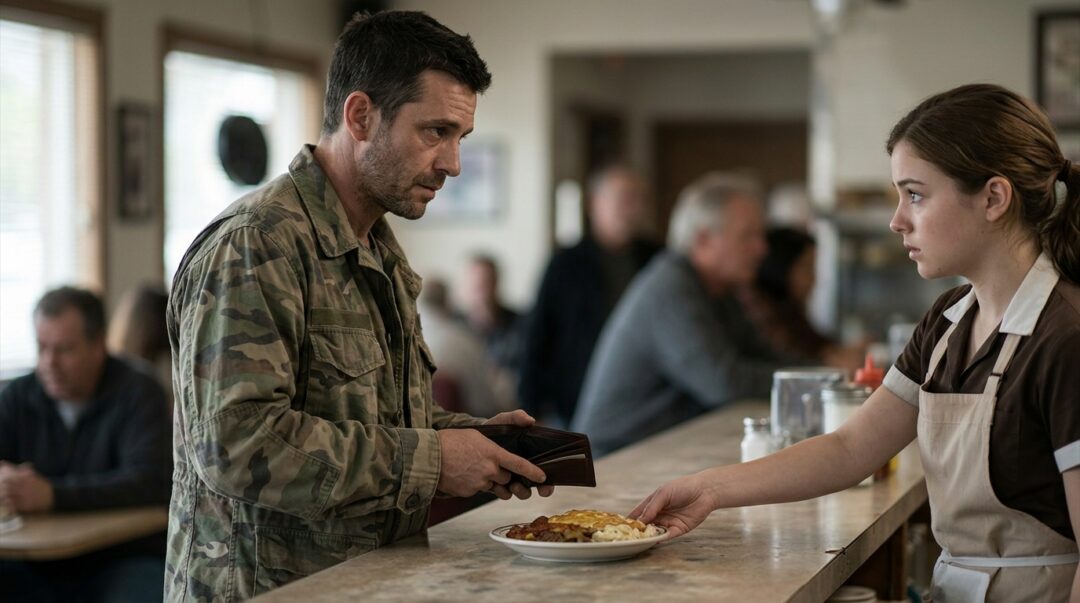
The first thing people noticed about the man at the counter was the jacket.
Camouflage always changed the temperature in a room. Even in a diner full of strangers, it made people look twice. Some did it with admiration, some with curiosity, and some with the careful distance of people who did not know what to say to a man who looked like he had come from somewhere harder than their own lives.
But the second thing they noticed was worse.
The wallet in his hand was empty.
Not the kind of empty that meant a forgotten card tucked in another pocket. Not the kind of empty that could be solved with a sheepish laugh and a quick trip to the car. This was the still, staring kind of empty. The kind that made a man go quiet in front of a tray of hot food he could smell but no longer claim.
The lunch rush at Marcy’s Diner moved around him anyway. Coffee poured. Plates clattered. Someone laughed too loudly in a booth near the window. The neon OPEN sign buzzed faintly in the glass.
At the counter, the man lowered his eyes and checked the wallet again, as if money might have appeared from the force of wanting it badly enough.
It hadn’t.
His name was Nolan Pierce, and he had spent most of his adult life learning how not to flinch in public.
He had learned it in basic training, when weakness was something other men smelled before you did. He had learned it in heat and dust and long nights where fear had to be folded small and tucked under routine. He had learned it again after he came home, when uniforms earned polite nods but not jobs, not stability, not sleep.
Now, standing in a diner just off the highway outside San Diego, Nolan used that same hard discipline to keep his face still while the cashier waited for him to say something.
The plate in front of him was simple: eggs, toast, hash browns, and sausage. Cheap by most standards. Too expensive for him that morning.
He had not meant to end up here without enough cash. He had counted twice before coming in. Then he had paid for gas because the truck needed it more than he did, and somewhere between the pump and the register he had made the kind of calculation pride never forgave.
“I’m sorry,” he said quietly. “I thought I had enough.”
The young server behind the counter glanced toward the cashier, then at the line gathering near the door. She did not look annoyed. If anything, she looked embarrassed for him, which was somehow harder to bear.
“It’s okay,” she said, reaching gently for the plate. “We can just take it back.”
Nolan stepped away before she could touch his sleeve or soften it further. “No problem,” he said. “That’s on me.”
He said it with the calm of a man trying to keep the moment from turning into an event.
But it already had.
At the nearest booth, a boy in a yellow T-shirt had stopped mid-bite with a fry halfway to his mouth. Across from him, his mother followed his gaze to the man at the counter. Her fork lowered. Her face changed in one quiet, unmistakable shift.
The boy was ten, maybe eleven, all elbows and alert eyes. His name was Wyatt Bennett, and like many children, he had not yet learned the elaborate adult skill of watching suffering while pretending not to.
“Mom,” he whispered, though not softly enough. “Why are they taking his food?”
His mother, Elise, looked from Nolan to the plate and understood more than she wanted to. She had come in with Wyatt after soccer practice, both of them hungry and flushed from the sun, expecting the easy comfort of grilled cheese and fries and no heavier decision than whether to split a milkshake.
Now a man stood ten feet away, holding himself together by posture alone.
“He probably can’t pay,” she murmured.
Wyatt frowned. “Then why doesn’t somebody help him?”
It was an honest question, which made it dangerous.
Elise had no answer she wanted to hear out loud. Because helping a stranger in public could feel awkward. Because adults hesitated. Because people were often kind in theory and motionless in real life. Because there was always that fatal pause—the one where everyone assumed someone else would step in first.
“I don’t know,” she said.
Nolan heard none of this directly, but he could feel the room changing. A hush never arrived all at once in places like this. It spread in pockets. A turned head. A silence at one booth. A line of people suddenly interested in the pie case while still seeing everything.
He hated it.
Not the hunger. Hunger was familiar.
The audience was what hurt.
He slid the wallet back into his pocket and gave the server a short nod. “Sorry for the trouble.”
Then he turned toward the door.
That should have been the end of it.
A man walks in hungry. A man leaves hungry. The room moves on.
Instead, Wyatt shoved his plate away, nearly climbing out of the booth in one fast motion.
“Elise—” his mother began, but she had already seen the look on his face. It was not tantrum or impulse. It was decision.
Wyatt picked up his plate with both hands.
“Whyatt,” she said, softer now, because the room had sharpened around them.
“He can have mine.”
By then Nolan had almost reached the door.
The server froze. The cashier blinked. A couple in line shifted aside without meaning to, making a path down the center of the diner as if the boy’s certainty had more force than any adult voice there.
Wyatt crossed the room carefully, his sneakers squeaking once on the tile.
“Sir,” he called.
Nolan stopped.
The boy held out the plate like it was the most obvious solution in the world. “You can take this one.”
For a second, Nolan only stared.
There were offers a man could deflect with humor, with refusal, with the practiced phrases that preserved both sides from discomfort. But this was a child standing in front of him, holding out lunch with both hands and no trace of pity.
Just sincerity.
Nolan swallowed once. “No, buddy. That’s yours.”
Wyatt shook his head. “I can get more food later.”
The whole diner seemed to lean in without moving.
“It’s okay,” the boy added. “Please take it.”
Something in Nolan’s expression shifted then—not broken, exactly, but opened. The armor didn’t fall off. It loosened.
From the booth, Elise stood halfway, one hand over her mouth now, eyes bright with the kind of emotion parents feel when their children reveal a version of goodness they themselves had hesitated to become.
Nolan looked at her. She gave one small nod.
Take it.
Not because he was helpless. Not because he was a spectacle. Because refusing the gift would turn the boy’s courage into awkwardness, and accepting it would honor what the child had already understood: dignity was not damaged by kindness. Sometimes it was restored by it.
Nolan reached for the plate with both hands.
“Thank you,” he said, and his voice was rougher than before.
Wyatt grinned then, but only for a second. Something about the man’s face made him grow serious again.
Nolan set the plate on the nearest table, then straightened.
The room had gone almost entirely quiet.
And in that silence, he did the only thing that felt large enough to answer the moment.
He raised his hand in a formal salute.
Not to the room. Not to the people who had watched. To the boy.
Wyatt went still.
Every conversation in the diner stopped.
Nolan held the salute for one breath, then another. It was crisp, deliberate, and full of meaning the child could not entirely know yet but could still feel. Respect. Gratitude. Recognition.
When Nolan lowered his hand, he offered Wyatt his right hand instead.
Wyatt took it.
The handshake was small. The silence around it was not.
In a room full of adults, a child had been the first one brave enough to move.
Part II — What Hunger Really Costs
The truth was, Nolan had not been hungry only for food.
He had been hungry for nearly everything a man could lose without dying.
Work. Rest. Steadiness. A reason not to feel embarrassed by every ordinary transaction. A place where needing something did not feel like failure.
He had left the Army eight years earlier with a shoulder that never healed right and a sleep pattern that belonged to no civilian schedule. At first, he told himself the transition would settle. He took warehouse jobs, security work, delivery shifts. He lasted as long as he could in each place.
The problem was never effort.
The problem was the thousand invisible things other people did without thinking. Crowded rooms. Sudden noise. Supervisors who barked from behind. The smell of diesel on a hot afternoon. The strange humiliation of being thanked for service by people who would not have lasted one week inside the life they were praising.
Then came the layoffs. Then the overdue notices. Then the truck became both transportation and shelter often enough that he stopped pretending it was temporary.
He kept the jacket because it was sturdy and because he could not make himself throw it away.
That morning had started with an interview for a maintenance position at a shopping center twenty miles north. He had shaved in a gas station sink before dawn, changed in the cab, and practiced answering questions he already knew by heart.
Reliable. Hardworking. Team-oriented.
The manager had been polite. Too polite. Nolan recognized rejection before it arrived. The man kept looking at his résumé, then at the gap years, then at Nolan’s shoulder when he moved too carefully reaching for the offered pen.
“We’ll be in touch,” he said.
They never were.
By noon Nolan had spent the last of his cash on gas, because an empty tank was the kind of emergency that multiplied fast. He told himself he’d eat later. But the smell from the diner parking lot had drifted through the open truck window, warm and human and ordinary. For five minutes he had wanted, with almost unbearable force, to be just another customer buying lunch on an unremarkable day.
So he went inside.
And got caught by the arithmetic of being poor in public.
After the salute, the manager of the diner emerged from the kitchen, wiping his hands on a towel, having clearly heard enough to piece things together. He was a stocky man in his fifties named Marcy’s ex-husband Dean, though everyone still called the place Marcy’s because some names outlived marriages and stayed on buildings anyway.
Dean looked from Nolan to Wyatt to the untouched plate on the table.
“Sir,” he said, clearing his throat. “You sit down. Lunch is on us.”
Nolan almost refused from reflex.
Then he saw Wyatt’s face. The boy was watching him like this mattered, like accepting generosity properly was part of the test.
Nolan gave a short nod. “Thank you.”
Dean pointed toward an empty booth by the front window. “Take that one.”
This time, when Nolan sat, he was no longer alone.
Not exactly.
The room resumed in pieces, but quieter than before. People kept eating. Someone laughed again, though softer. The line moved. Yet a current remained under everything, the feeling that something small and clean had happened in public and had made everyone see themselves a little more clearly.
Wyatt returned to the booth with Elise, who immediately pulled him into a one-armed hug he pretended to resist.
“You didn’t even ask me,” she said.
“You were thinking too slow,” he answered.
She laughed once through tears she did not bother hiding. “Apparently.”
Their replacement order came a few minutes later, this one paid for by a woman at the counter who claimed she was “just covering a kid’s bravery tax.” Then a man near the window picked up Nolan’s coffee. Then someone else quietly paid for pie no one had ordered yet.
Kindness, Elise noticed, was strangely contagious once one person risked beginning it.
Nolan ate slowly, not because he wanted to stretch the meal, though he did, but because he needed a minute to settle the pressure behind his ribs.
The food was good. Better than good. It tasted like warmth, and salt, and the fragile return of self-respect.
When he looked over once, Wyatt immediately straightened in his booth like a soldier at inspection, which nearly made Nolan smile into his coffee.
Nearly.
After a while, Elise stood and crossed to his table.
“I’m sorry if that embarrassed you,” she said.
Nolan looked up. “It didn’t.”
That surprised both of them.
He considered the sentence, then corrected it. “It did. At first. But not because of him.”
Elise sat only when he gestured to the seat across from him.
“He’s a good kid,” she said.
“He’s a brave one.”
She nodded. “That too.”
For a moment neither of them spoke. Outside, cars slid past the window in bands of sunlight. Inside, the diner had regained its normal rhythm, but some soft afterimage of the earlier silence remained.
“My husband died three years ago,” Elise said finally. “Wyatt was smaller then. I used to worry that he was becoming too serious too young.”
Nolan listened.
“But sometimes,” she continued, glancing back toward the booth, “I think children get serious at exactly the age the world asks them what kind of people they want to be.”
Nolan looked down at his hands.
There were things he had never said in public. Not to strangers. Not in diners. Not in daylight.
“He reminded me of someone,” he said.
Elise waited.
“My little brother.” Nolan’s voice stayed even, but only just. “He used to be the one in our family who stepped in first. Fights, arguments, somebody crying in a grocery store aisle—it didn’t matter. He always moved before the rest of us figured out what was happening.”
“Where is he now?”
Nolan let out a breath that was not quite a laugh. “Arizona. Married. Three kids. Better at staying in touch than I am.”
There was more to say. That he had not answered the last two calls. That shame made even love feel expensive sometimes. That once you drifted long enough, the people who cared about you became mirrors you avoided.
But Elise seemed to hear the shape of those unsaid things anyway.
“Maybe call him today,” she said.
Nolan looked toward Wyatt again.
Maybe.
Part III — The Boy in the Yellow Shirt
By the time Nolan finished eating, the hardest part of the day had already passed.
Not the interview. Not the hunger. Not even the humiliation at the counter.
The hardest part had been the second before he accepted the plate.
That tiny terrible second when pride told him to refuse and leave, even if leaving meant protecting nothing except the illusion that he did not need anyone.
He paid for nothing when he walked to the register, because there was nothing left to pay. Dean waved him off. Elise smiled from the booth. Wyatt gave him a solemn nod like they shared a secret now.
Nolan paused at the door.
“Wyatt,” he said.
The boy looked up.
“I’m going to remember this.”
Wyatt shrugged in that awkward way children did when they were embarrassed by praise. “Okay.”
Nolan stepped outside into the hot early afternoon. The sunlight hit hard after the dim cool of the diner. He stood beside his truck for a while, one hand on the door, letting the day reorganize itself.
Then he did something he had delayed for months.
He took out his phone and called his brother.
Caleb answered on the third ring, suspicious and cheerful at once. “Well, I’ll be damned. You alive?”
Nolan smiled before he meant to. “Yeah.”
They talked for nearly half an hour. About nothing important at first. Heat. Traffic. Caleb’s youngest losing a tooth. Then about the maintenance interview. Then about how Nolan was doing, which was a dangerous question until, unexpectedly, it wasn’t.
He did not tell the story cleanly. He stumbled through it. A diner. A kid. A plate of food. A salute he had not planned.
Caleb was silent for a long moment after.
“Sounds like you needed that,” he said.
Nolan leaned against the truck and closed his eyes. “Yeah.”
A week later, Dean called the number Nolan had scrawled on a napkin before leaving Marcy’s. A dishwasher had quit. Then another. It wasn’t glamorous work, and the pay was modest, but it was steady and came with shift meals.
“You still looking?” Dean asked.
Nolan was.
The job turned into mornings at the diner, then afternoons fixing loose hinges and broken stools because Nolan knew how to mend things even when no one had hired him specifically for that. Dean noticed. By the end of the month, Nolan had more hours. By the end of the season, he had enough saved to rent a room over a mechanic’s garage two blocks away.
Sometimes life did not change in one grand turn.
Sometimes it changed because a child carried a plate across a tiled floor and made a grown man choose not to disappear.
Wyatt and Elise kept coming in on Saturdays after soccer. Wyatt would slide into a booth and ask Nolan ridiculous questions while Nolan refilled ketchup bottles or wiped down menus.
Had he ever jumped out of a plane?
No.
Did he know how to fight with a knife?
None of your business.
Was a salute harder than it looked?
Only if you meant it.
Over time, the story of that day spread the way small-town stories always did—half accurate, half polished by retelling. But Nolan never let it become something cheap. He would not allow himself to be turned into a symbol of sadness, and he would not let Wyatt become a prop in an adult lesson.
When people brought it up, he said the same thing every time.
“The kid saw someone needing help and didn’t wait for permission.”
That was all.
By winter, Wyatt’s school announced a community assembly on kindness and civic responsibility. Elise nearly didn’t tell Nolan about it, because she knew he hated public attention. But Wyatt had one request and would not let it go.
“He wants you there,” she said. “You can say no.”
Nolan looked at the invitation in her hand, then at the diner windows reflecting the late afternoon sky.
“When is it?”
The school gym smelled like varnish and folding chairs. Children fidgeted. Teachers shuffled papers. Parents filmed everything. Wyatt stood near the front in a collared shirt that clearly made him uncomfortable.
His short speech was only a minute long.
He talked about how people always said respect mattered, but sometimes they acted like respect was only for uniforms, trophies, or grown-ups with money. Then he said he thought respect also meant noticing when someone was having a hard moment and stepping in before they had to ask.
The gym went very still.
At the end, Wyatt looked straight at Nolan in the third row and said, “Sometimes the bravest person isn’t the one people think. Sometimes it’s just the one who moves first.”
Nolan did not realize he was already standing until he felt the eyes on him.
He did not speak. He did not need to.
He raised his hand in the same salute he had given in the diner.
This time, Wyatt returned it.
The room erupted after that—applause, whistles, the delighted chaos of children who loved any excuse to be loud. But Nolan barely heard it. He was looking at the boy in the yellow shirt—older by a season now, taller by maybe an inch, still absurdly serious when it mattered—and thinking of the day a stranger’s child had interrupted his fall.
Years later, Wyatt would remember the salute.
Nolan would remember the plate.
And everyone else who had been in that diner that afternoon would remember the uncomfortable little miracle of it: how a room full of adults had paused, how one child had crossed the distance, and how respect had stopped being an abstract word and turned, for one unforgettable moment, into action.
Because hunger was never only hunger.
And dignity, once returned to a person at the exact moment they were losing it, could feed them for much longer than a meal.