The Suitcase No One Wanted to Touch
The Suitcase No One Wanted to Touch
Part I — The Wrong Kind of Customer
The first thing Nolan Pierce noticed was the suitcase.
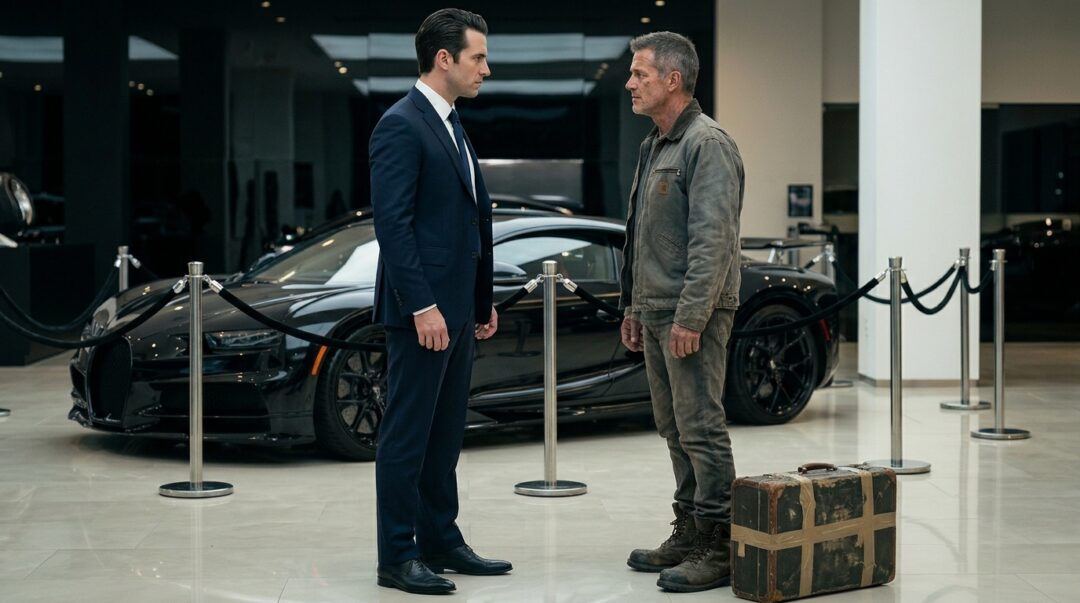
It sat beside the man’s leg like something pulled from the back of a flooded garage—metal corners rusted brown, leather straps cracked white, the handle wrapped in old black tape. It looked absurd against the polished stone floor of Viridian Motor Gallery, where every surface reflected light and money. Even the silence inside the showroom felt expensive.
The man holding it looked no better.
He stood near the velvet rope around the gallery’s centerpiece car, a black hand-built hypercar so costly most people only asked for photos beside it. His jacket was scuffed at the sleeves. His boots were caked in dust. His face carried the weathered exhaustion of someone who had spent years working outdoors, not shopping in rooms where the air smelled faintly of leather, coffee, and citrus wax.
Nolan crossed the floor before the receptionist even had time to decide whether to intervene.
“Sir,” he said, stopping two feet short of the rope, “step away from the car.”
The man turned toward him with a calmness Nolan did not like. He was older than Nolan had expected—late forties, maybe early fifties—with short hair threaded with gray at the temples and eyes that seemed too steady for someone so badly dressed.
“I’m here to buy it,” the man said.
Nolan almost smiled. The gallery was quiet enough that the words carried.
Across the room, a couple pretending to study a silver coupe glanced over. At the far espresso bar, a private client advisor stopped mid-sentence. The receptionist looked down very quickly, as if that might spare her from being part of the moment.
“Not dressed like that,” Nolan replied.
The man rested one hand on the suitcase handle. “I said I’m ready.”
That calm tone irritated Nolan more than anger would have. Angry people could be dismissed. Embarrassed people usually left. But this man stood there as if he had every right to remain.
Nolan had worked too hard to tolerate that kind of disruption.
Viridian was not just another dealership. It was a stage, and Nolan understood his role on it. His suits were tailored, his shoes mirror-bright, his smile measured for every tax bracket. He had spent years learning how to identify buyers in seconds—the genuine ones, the dreamers, the time-wasters, the men who wanted to sit in a car and post a picture before disappearing forever.
He looked again at the dusty jacket, the heavy boots, the taped handle.
He made his decision.
“Rafe,” he called without turning.
The security guard emerged from his stillness near the wall. Broad-shouldered and silent, Rafe moved with the contained gravity of someone who never needed to raise his voice. The effect was immediate. The room tightened.
“Do you need help leaving?” Rafe asked the man.
The stranger did not even glance at him. His attention stayed on Nolan.
“Just open the paperwork,” he said.
A few people heard that too. Nolan caught the flicker of curiosity around the room and felt something sharp coil in his chest. Curiosity was dangerous. Curiosity turned moments into scenes, and scenes into stories clients remembered.
He took a step closer.
“Put that junk away,” he said, nodding toward the suitcase.
The man lifted it and set it gently on the desk between them.
“Careful with that case,” he said.
There was no challenge in his voice. No threat. Somehow that made Nolan feel mocked.
He saw the scraped metal edges, the cracked lid, the old latch held together by a bent strip of brass. He imagined stale tools inside. Or scraps. Or something worse. Suddenly the very sight of it on his immaculate desk felt offensive.
“You’re wasting my time,” Nolan said.
And with one irritated shove, he knocked the suitcase off the desk.
It hit the stone floor hard.
The sound cracked through the showroom like a gunshot.
Then came a second sound—the sharp metallic pop of a broken latch.
The case split open.
For a beat, nobody moved.
Inside, beneath the battered lid Nolan had dismissed as trash, were stacks of cash wrapped cleanly in bank bands. Thick, square bundles. Not messy. Not theatrical. Real. Tucked beside them sat a cream-colored bank envelope, a purchase authorization packet, and a leather folder embossed with the name of a private wealth office Nolan recognized instantly.
The room changed.
It did not happen slowly. It happened all at once.
The air in the showroom seemed to lose its artificial ease. The couple by the silver coupe turned fully now. The receptionist stared. Even Rafe stopped advancing.
The man crouched and placed one hand on the open case as if steadying something delicate, not dangerous. There was no panic in him. No scramble to hide the money. No embarrassment. He looked, Nolan realized with a chill, exactly as calm as he had looked before.
Only now the calm meant something else.
Nolan’s mouth went dry.
The man straightened, lifting the bank envelope from the floor. “No,” he said quietly. “You wasted yours.”
Part II — The Shape of Humiliation
The man’s name, Nolan learned thirty seconds later, was Elias Voss.
He had not offered it. The receptionist found it first, fumbling through the incoming client file with shaking hands after seeing the crest on the leather folder. Her face turned pale before she spoke.
“Mr. Voss,” she said. “Your appointment was at noon.”
Nolan heard the words and felt the blood drain from his own face.
Noon.
He knew the file now. A private buyer. Custom acquisition. Discretion requested. Full same-day purchase. The transaction value alone would have been the largest commission of Nolan’s quarter. Maybe his year.
And he had thrown the man’s suitcase onto the floor.
Elias tucked the bank letter back into the folder and closed the broken suitcase with slow, economical movements. He did not rush, which only made the silence feel worse. Every second stretched, giving everyone in the room more time to understand what had happened.
Nolan opened his mouth. “Mr. Voss, I—”
Elias looked at him, and Nolan stopped.
There was no fury in the older man’s face. No smugness either. That absence was worse than either would have been. Anger might have made this a clash. Smugness might have made it a game. But Elias looked at him with the clean, devastating clarity of a man who had already seen exactly what he needed to see.
Nolan felt, for the first time in years, like a child who had spoken too soon in front of adults.
Rafe stepped back from Elias, a subtle retreat that would have gone unnoticed by anyone not watching closely. Nolan noticed. So did everyone else.
The line of power in the room had reversed.
“Sir,” Nolan said again, but the word sounded different now—too late, too polished, too obviously repaired. “There’s been a misunderstanding.”
“No,” Elias said. “There wasn’t.”
He said it softly, yet the words settled over the showroom with the weight of something final.
Behind him, the black hypercar gleamed under its overhead lights, all sharp edges and dark reflections. Nolan had sold three cars that month by calling that display piece predatory, elegant, untouchable. Now he understood the irony. The untouchable thing in the room had not been the car.
It had been the man he had judged in a single glance.
Nolan tried again. “If you’ll give me a moment, I can have the paperwork brought over immediately.”
Elias lifted the broken suitcase. “You had your moment.”
The couple by the coupe exchanged a look. At the espresso bar, a client advisor quietly walked away, either out of tact or to avoid watching the rest. The receptionist stood frozen behind her counter, one hand covering her mouth. Nolan could feel each witness like a light turned toward him.
He had spent years managing rooms like this—controlling pace, tone, perception. Suddenly he could not even control his own face.
Elias did not storm out. He did not raise his voice. He simply waited.
That was when Nolan understood the true scale of what he had done. This was not only about a sale. It was about dignity, and dignity was the one thing wealthy people never needed to beg for in places like Viridian. The moment Nolan had looked at Elias’s clothes and decided who he was, he had stripped that dignity from him in public.
Money could fix a transaction. It could not erase that.
“Rafe,” Elias said, turning slightly, “would you open the rope?”
Rafe looked once at Nolan.
Nolan said nothing.
The guard moved to the velvet barrier and unhooked it with practiced hands. The gesture was small. It might have seemed procedural to an outsider. But in that room, after what had happened, it felt ceremonial. The same man who had been summoned to remove Elias was now clearing his path.
Elias walked toward the black car.
Nolan remained by the desk, hands useless at his sides, watching the scene reorganize itself without him.
The irony landed in stages, each one worse than the last. The dusty jacket. The work boots. The taped suitcase. Nolan had mistaken every visible detail for a complete story. He had never asked why a man dressed like that might still carry himself like he belonged nowhere and everywhere at once. He had never considered that money did not always announce itself in tailored fabric and rehearsed confidence. Sometimes it arrived carrying old wounds. Sometimes it traveled in silence.
The receptionist, still pale, whispered to Nolan, “He requested a low-profile arrival.”
Of course he had.
Nolan closed his eyes for half a second.
When he opened them, Elias was standing beside the hypercar with one hand resting lightly on the roof, as if grounding himself in something long imagined. The severity in his face had softened, but not toward Nolan. Toward the car.
For the first time, Nolan wondered what the purchase meant to him.
Not what it cost.
What it meant.
That question should have come first. It had not come at all.
Part III — Before the Showroom
If Nolan had asked, he would have learned that Elias had not planned to arrive looking like that.
He had spent the morning at a machine yard on the south edge of the city, standing in red dust and hydraulic smoke beside men who still called him boss even though he no longer needed to work with his own hands. The old jacket had been in his truck for years. The boots too. When a line burst on a drilling rig just after dawn, Elias went himself because some habits outlast wealth.
By the time he left the yard, he was late.
He could have gone home to change. He had thought about it while stopped at a light, one hand on the wheel, the custom appointment card sitting on the passenger seat. But going home would have meant another hour. Maybe more. And he had waited too long for this day already.
The black car was not an impulsive purchase. It was the first thing Elias had ever decided to buy for no practical reason at all.
For thirty years, every dollar had a job. Keep the lights on. Cover payroll. Replace a failed engine. Rebuild after a bad quarter. Bury his brother. Help his mother keep her house. Start over. Keep going.
There had been a time, long before the machine yards and contracts and warehouses, when he had been a teenager standing outside a glass dealership with grease on his hands, staring through the window at a car he could never name, only want. Back then, want had been an embarrassing thing. Want belonged to other people. Elias learned early to speak in terms of need.
Need was respectable. Need got you through winter.
Want was dangerous.
Somewhere over the years, after the company finally stopped wobbling, after the last bank loan was paid, after he sat one evening in a house far larger than any house he had grown up in and felt nothing like victory, he realized something strange: he had built a life sturdy enough to hold everyone except himself.
The car became a test.
Not of wealth. Of permission.
Could he want something simply because it thrilled him? Because it was beautiful? Because, for once, he did not need to explain it?
He had almost laughed when Viridian’s concierge called him “sir” on the phone with velvet-soft precision. The woman had asked whether he wanted champagne prepared for his arrival. Elias had looked down at his scarred hands and said no, thank you, just the paperwork.
He preferred things plain.
He had not expected plainness to be mistaken for poverty.
As he stood beside the black car now, the memories of the morning passed through him in quiet fragments—the machine yard, the burst line, the red dust on his sleeves, the split second at the traffic light when he chose not to go home first. Each detail suddenly seemed absurdly consequential, as if an entire humiliation had been built out of a delayed decision and an old jacket.
He should have felt furious.
Instead, he felt tired.
That surprised him.
Humiliation had a way of reaching backward. Standing in Viridian’s white light, Elias felt not only Nolan’s contempt but older versions of it too: store clerks who watched him too closely as a young man, bankers who looked past him toward cleaner clients, men who mistook quiet for inferiority because they had never had to earn their confidence through work.
Maybe that was why he had stayed so calm. He had seen this kind of judgment before. Only now it had collided with the one thing people like Nolan were supposed to understand best.
Money.
And even then they had failed.
Part IV — The Cost of a Glance
By the time the gallery manager arrived from the second floor, summoned in a panic by two separate employees, the room had regained its shape but not its ease.
Nolan had recovered enough to stand straight again, though the effort showed. The manager—a silver-haired man with flawless manners and the instincts of someone who could smell financial disaster—crossed the showroom with an apology already prepared.
Elias listened without interruption.
The speech was polished. Deep regret. Unacceptable conduct. Immediate internal action. Full personal assistance. A private lounge prepared if he preferred discretion. The words came smoothly. The manager was good at his job.
But even he understood the limit of what language could do.
Elias set the repaired-but-crooked suitcase beside his leg and asked one question.
“Would you have spoken to me this way if I’d walked in wearing your suit?”
The manager did not answer.
He did not need to.
The truth had already filled the room.
Nolan stood a few steps back, every muscle in his face fixed in the discipline of someone trying not to unravel publicly. At last he spoke, and when he did, the confidence was gone.
“I was wrong,” he said.
It was the simplest sentence he had offered all afternoon, and because of that, it carried more weight than the others.
Elias looked at him for a long moment.
Then he nodded once—not in forgiveness, but in acknowledgment. There was a difference.
“The easiest commission in the building,” Elias said quietly, “and you threw it on the floor.”
No one in the showroom would forget that line.
Not because it was loud. Because it was true.
The sale went through, though not through Nolan. The manager handled it personally. The documents were signed in a private office with no champagne, no ceremony, and no attempt at friendliness beyond what the moment could bear. Elias accepted the keys only after the paperwork was complete. His hands were steady.
When he returned to the main floor, the showroom had thinned. The couple was gone. The receptionist was back at her desk, moving carefully, as if the day had become fragile. Rafe stood near the entryway and gave Elias a short nod that carried something close to respect.
Elias nodded back.
He paused beside Nolan on his way out.
Nolan looked as though he wanted to say something larger than apology—something about assumptions, ambition, image, the habits of an industry built on surfaces. But perhaps for the first time in his professional life, he understood that words were not always owed a stage.
“I hope you remember this one,” Elias said.
Then he kept walking.
Outside, late sunlight lay across the boulevard in long bands of gold. Elias slid into the black car and sat for a moment with his hands on the wheel, not starting the engine yet. The cabin smelled of new leather and cold metal. Through the windshield, the glass face of Viridian reflected the city back at itself.
He should have felt triumphant.
What he felt instead was something quieter and more durable.
Relief, perhaps.
Not because he had proven he could afford the car, but because the moment had clarified something he had spent years half-knowing. Money could open a door. It could buy beauty, speed, ease, silence. But it could not teach grace to people who measured worth too quickly. And it could not protect a person from being underestimated if that person refused to dress wealth in the costume others expected.
Elias started the engine.
The sound rose low and controlled, expensive without needing to announce itself. He pulled away from the curb and let the car ease into traffic, the city opening ahead in ribbons of light and shadow.
At the next red light, he looked down at his cuff. Dust still clung to the fabric of his old jacket. He smiled at that.
He had walked into Viridian carrying the whole story of where he had come from on his sleeves, and they had mistaken history for lack. They had seen the wear, but not the years. The boots, but not the road. The suitcase, but not what it had taken to fill it.
Behind him, the showroom receded into distance and reflection.
Ahead, the road widened.
And for the first time in a very long while, Elias let himself enjoy something for no reason beyond the fact that it was his.