The Morning Virginia Finally Asked for What Everyone Had Quietly Taken
Part I — The Brunch Went Quiet
“You don’t get to embarrass my family and then stand here like you’re the victim.”
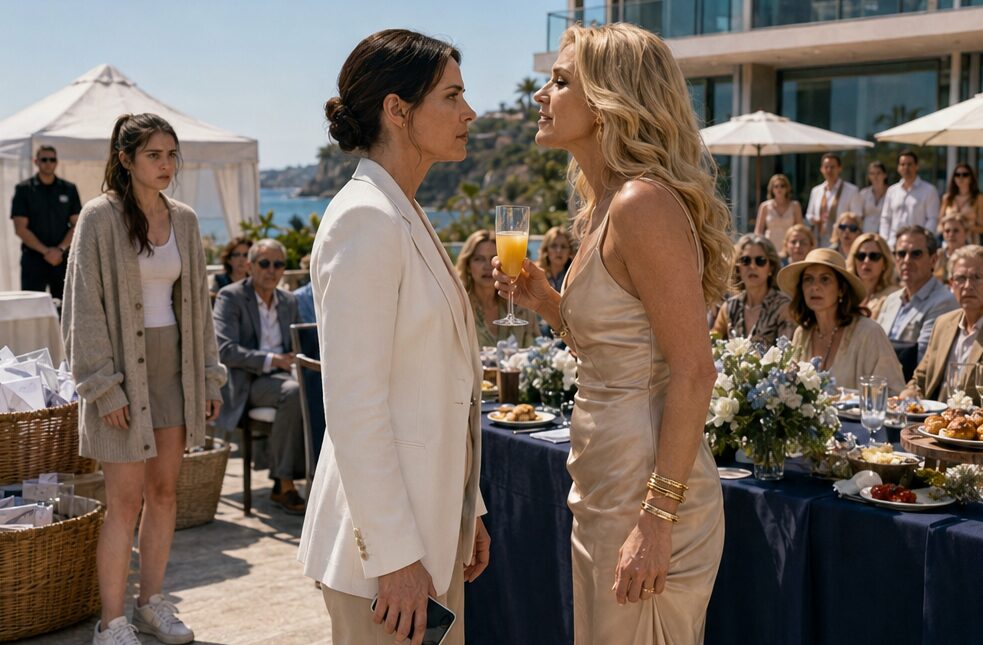
The mimosa in Michelle Bennett’s hand caught the sun as she said it. Orange, bright, trembling slightly. Not because Michelle was nervous. Michelle never looked nervous. She looked polished even when she was cruel.
Virginia Carter stood in front of the long brunch table in her white blazer and beige pants, one hand closed around her phone, the other hanging loose at her side like she had forgotten what hands were for.
Behind Michelle, twenty-seven neighbors pretended not to stare.
A donor in a linen hat lowered her fork halfway to her plate. Someone’s iced tea sweated onto a navy tablecloth. At the far edge of the patio, the hired security guard shifted his weight beneath the white rental tent, watching without yet deciding to move.
The ocean was too blue for the moment. The flowers were too perfect. The villa’s glass walls threw back a version of the scene that looked almost elegant, if you didn’t know what was being said.
Michelle stepped closer.
Her champagne satin dress shimmered around her knees. Her gold bracelets clicked softly as she lifted the glass toward Virginia’s face, not enough to touch her, just enough to make everyone imagine it.
“You were invited into this community,” Michelle said, smiling the way women smile when they want witnesses to think they’re still in control. “You don’t get to use us and then cause a scene.”
Virginia felt her daughter somewhere behind her before she saw her.
Carolyn was sixteen, standing near the donation baskets with her dark ponytail pulled tight, an oversized cardigan slipping off one shoulder. Her eyes were wide and furious and embarrassed all at once.
That was the part that cut deepest.
Not Michelle’s voice. Not the neighbors. Not the unpaid invoices sitting open on Virginia’s phone.
Carolyn watching.
Virginia swallowed.
“Michelle,” she said, quietly, “move back.”
A few people heard. That was enough. The patio inhaled.
Michelle laughed once, a hard little sound.
“Or what?”
Virginia did not answer.
That was the mistake Michelle had always made about her. She thought silence meant permission. She thought restraint meant fear. She thought a woman who had learned how to stand still had never imagined stepping forward.
Michelle leaned in again, close enough for Virginia to smell citrus and expensive perfume.
“You need to apologize before the donors leave,” she said. “To me. To Christopher. To everyone.”
Virginia looked down.
Her phone buzzed in her palm.
Another payment reminder.
Michelle followed her eyes and smiled wider.
“Of course,” she said. “Still thinking about money.”
Something shifted in Virginia then. Not loudly. Not dramatically. Something quiet unclipped itself inside her.
Across the patio, Carolyn took one step forward.
The guard did too.
And Michelle, still holding her mimosa like a trophy, lifted her free hand.
Part II — The Name Missing From the Program
That morning, Virginia had woken before sunrise with a cramp in her left hand from tying ribbon around donation cards until midnight.
She had slept four hours.
The kitchen table in their rental duplex was still buried under evidence of other people’s generosity: handwritten bidder numbers, folded place cards, a list of silent auction items, and six centerpiece sketches that Michelle had approved after rejecting the first eleven.
Carolyn came in wearing socks and a sweatshirt, hair half-tied, still soft with sleep.
“Are we poor enough yet to stop volunteering for rich people?” she asked.
Virginia did not look up from the stack of programs.
“We are not volunteering,” she said.
Carolyn leaned over the table, picked up a program, and read the front. “Harbor View Annual Coastal Brunch. Hosted by Michelle and Christopher Bennett.”
Virginia kept tying ribbon.
Carolyn flipped the card open.
Then she stopped.
“Mom.”
Virginia heard the change in her voice and knew before she looked.
There was the donor list. There was the committee list. There were the Bennetts, of course, printed in tasteful charcoal ink. Michelle Bennett, Event Chair. Christopher Bennett, HOA President. There were the names of women who had shown up twice and taken selfies near the flowers.
Virginia’s name was nowhere.
She reached for the program and read it herself, as if the letters might rearrange under pressure.
They did not.
Carolyn’s mouth tightened. “She took your name off.”
Virginia placed the program flat on the table.
“She probably used the old file.”
“She used your layout.”
Virginia said nothing.
“She used your vendors. Your flowers. Your silent auction spreadsheet. Your stupid gold ribbon.”
“It’s not stupid.”
“It is if they pretend it tied itself.”
Virginia set the ribbon down.
Her phone buzzed beside the coffee cup she had reheated three times.
Final reminder: linen deposit due today. Card ending 4182 declined.
She closed her eyes.
The linens had been ordered under Virginia’s vendor account because Michelle said the HOA card was “being annoying,” and Virginia, exhausted and trying to keep the event moving, had agreed to put it through temporarily. Temporarily had become a week. Then ten days. Then Michelle stopped answering texts unless they were about centerpieces.
Virginia opened her email.
The invoice chain was already there. Linens. Flowers. Extra umbrellas. The rush charge for printed programs. The revised table rentals Michelle had requested after deciding the original setup looked “too ordinary.”
At the bottom was Christopher Bennett’s address, added two days earlier when Virginia had finally stopped asking Michelle and started asking the treasurer.
No response.
Carolyn watched her.
“Don’t go,” she said.
Virginia touched the edge of the printed program. The paper was heavy. Expensive. The kind people used when they wanted virtue to feel luxurious.
“If I don’t go,” Virginia said, “I don’t get paid.”
“They’re not paying you anyway.”
“They will.”
Carolyn gave her a look too old for sixteen. “You always say that.”
Virginia opened a new message.
Michelle, I can’t cover any additional event costs. The outstanding invoices need to be paid today before the brunch closes. I’ve forwarded the full chain to Christopher.
She stared at the message for a long time.
Carolyn read it over her shoulder. “Send it.”
Virginia’s thumb hovered.
In the three years since she had moved into Harbor View’s least impressive address—the duplex behind the tennis courts, technically outside the main gate but close enough for the HOA to claim her when they needed things—Virginia had learned the local language.
No one said servant.
They said lifesaver.
No one said unpaid.
They said community spirit.
No one said you do not belong here.
They said we’re so glad you could help.
Virginia pressed send.
For a few seconds, nothing happened.
Then Michelle replied with three gray dots.
Then nothing.
That silence felt worse than an insult.
Carolyn picked up two donation baskets. “Fine. Let’s get your money.”
Virginia almost smiled.
But in the hallway mirror, she saw herself: dark hair pinned low, blazer clean but not new, face composed from years of needing it to be. She looked like a woman who could be trusted with other people’s emergencies.
She wondered when that had become the same thing as being available to be used.
Part III — Volunteer Helper
By ten-thirty, the Bennett patio looked like a magazine spread about effortless goodness.
White umbrellas lined the terrace. Peonies and citrus branches spilled from low vases. Donor cards sat folded beside plates dusted with powdered sugar. The ocean beyond the railing glittered like it had been hired too.
Virginia parked two blocks away because the guest spaces were reserved for donors.
Carolyn carried the auction baskets from the trunk. Her sneakers squeaked against the polished stone when they reached the patio.
Two women from the committee glanced over.
One smiled at Virginia’s blazer, then at Carolyn’s cardigan, then past them both.
“Can you put those by the gift table?” the woman asked, already turning away.
Carolyn’s jaw tightened.
Virginia took one basket from her. “We’re almost done.”
“That’s what you said last year.”
Virginia did not answer because Michelle had seen them.
For one second, the hostess mask slipped.
Then Michelle floated toward them in champagne satin, arms wide, smile bright enough to hurt.
“Virginia,” she said, like they had not exchanged silence all morning. “There you are.”
“Michelle.”
“And Carolyn, sweetheart. How nice of you to help your mother.”
Carolyn stared at her.
Virginia stepped in before her daughter could speak. “The baskets are here. The revised bid sheets are clipped underneath. I need Christopher to sign the check for the centerpieces and reimburse the vendor charges before the auction opens.”
Michelle’s smile froze by half an inch.
“Let’s not make today about logistics.”
“Today is logistics.”
A man nearby laughed, thinking it was a joke.
Michelle touched Virginia’s sleeve.
Not affectionately. Possessively.
“Just give me a little grace today,” she said. “We have donors arriving.”
There it was. Grace. The word people used when they wanted someone else to absorb consequences.
Virginia removed Michelle’s hand from her sleeve without making it look like removal.
“I’ve already given you three weeks.”
Michelle’s eyes sharpened, but her voice stayed warm.
“Don’t be difficult in front of Carolyn.”
The words landed exactly where Michelle aimed them.
Carolyn’s face flushed.
Virginia felt the old reflex rise: smooth it over, protect the child, make everyone comfortable. She had done it at school meetings, at committee pickups, at grocery store conversations where women asked if she was “still doing little events” as if rent could be paid in encouragement.
But before she could answer, a donor approached with outstretched hands.
“Michelle, this is gorgeous.”
Michelle turned instantly, glowing.
“Thank you. It took a village.”
She looked back at Virginia.
“Our volunteer helper has been wonderful.”
Carolyn inhaled sharply.
Virginia held very still.
Volunteer helper.
The words were soft. Polite. Perfectly shaped. They erased thirty-seven emails, four late nights, twelve unpaid calls, a discount begged from the florist, two overdraft notices, and Carolyn eating cereal for dinner while Virginia compared rental quotes.
Michelle did not even look at her when she said it.
That was how erasure worked best. Casually.
A server appeared at Virginia’s elbow. “Sorry. The caterer’s asking for you.”
Michelle laughed lightly. “See? We’d be lost without her.”
Virginia walked away before Carolyn could see her face.
The caterer, a tired woman named Lisa whom Virginia had worked with twice before, stood near the side gate with a clipboard pressed to her chest.
“I hate to ask you this,” Lisa said.
Virginia already knew.
“The final deposit never cleared,” Lisa continued. “Michelle said you were handling vendor payments.”
“She said that?”
Lisa looked ashamed. “She said everything was under your account.”
Virginia opened her banking app with fingers that suddenly felt distant from her body.
Available balance: $143.22.
Rent due in six days.
Lisa lowered her voice. “I can keep serving for now. But my boss is calling.”
Virginia nodded, because women like them nodded first and panicked later.
“I’ll handle it.”
Carolyn appeared beside her. “No.”
Virginia turned.
“No,” Carolyn said again, quieter. “You don’t have to handle everything.”
Virginia almost snapped at her. Not because Carolyn was wrong, but because she was right in a place where being right was expensive.
Across the patio, Michelle raised her mimosa glass and laughed at something a donor said.
The sound traveled cleanly through the salt air.
Part IV — The Request To Be Reasonable
Christopher Bennett found Virginia near the side of the house, where the patio stones met a strip of decorative grass no one was allowed to step on.
He was sunburned in the tidy way of men who owned boats. Linen shirt. Expensive watch. Boat shoes without socks. He always looked casual, but never cheap.
“Virginia,” he said. “Can we talk?”
She slipped her phone into her palm. “Yes. The invoices—”
He lifted both hands. “I saw them.”
That stopped her.
“You saw them?”
“I’m aware.”
The word made her stomach cool.
Aware.
Not surprised. Not confused. Aware.
Christopher glanced toward the patio, where Michelle was greeting donors as if her laughter held the event together.
“Today is important,” he said. “For Michelle. For the board. For the children’s arts program.”
“For the children’s arts program,” Virginia repeated.
“I’m not minimizing your concerns.”
Concerns. Another soft word.
Virginia looked at him carefully. “Then pay them.”
“I will sort it out next week.”
“The vendors need payment today.”
“Virginia.” His voice lowered, sympathetic now, which was worse. “You know how Michelle gets when she feels cornered.”
Virginia said nothing.
“She cares about this community,” he went on. “Sometimes she takes on too much. Sometimes details get messy.”
“Details?”
He smiled, like a man helping a child step away from a curb. “Let’s just get through the event. Give her grace.”
There was that word again.
Virginia felt something inside her go very quiet.
All this time, she had thought she was trying to make Michelle understand.
But Christopher understood.
He understood the invoices. He understood the missing credit. He understood that Michelle had used Virginia’s vendor account and social position and fear of seeming difficult. He understood all of it.
He simply preferred the version where Virginia stayed manageable.
Carolyn appeared at the patio door, arms crossed over her cardigan.
Christopher saw her and smiled. “Hey, Carolyn. You look nice.”
Carolyn did not smile back.
Virginia said, “I need a check today.”
Christopher’s expression tightened.
“Let’s not do this here.”
“Where would be better?”
He looked briefly annoyed, then pleasant again. “I’m asking you to be reasonable.”
Virginia almost laughed.
Reasonable meant quiet.
Reasonable meant later.
Reasonable meant no one important should have to feel uncomfortable while you were being underpaid.
Behind Christopher, Michelle tapped a spoon against a glass.
“Friends,” she called, voice ringing over the patio, “if we could gather for just a moment.”
The donor toast.
Christopher looked relieved. “We’ll talk after.”
“No,” Virginia said.
He blinked.
She did not raise her voice. “Before I leave today, this gets paid.”
His smile returned, thinner. “Let’s not turn this into something it isn’t.”
Carolyn stepped closer to her mother once Christopher walked away.
“Can we please go?” she whispered.
Virginia looked at her daughter.
Carolyn’s face was red, not from sun. From holding too much in.
“They’re never going to treat us like we belong,” Carolyn said.
Virginia wanted to say something comforting. Something motherly. Something untrue.
Instead, she looked at the patio.
At the women in linen dresses. At the donors sipping from glasses. At Michelle standing beneath the white umbrella, glowing as if no one had ever carried a box for her.
“We’re not staying because we belong,” Virginia said.
“Then why?”
Virginia’s throat tightened.
“Because I don’t want you to think leaving quietly is the only way to have dignity.”
Carolyn looked away first.
The spoon tapped again.
Everyone turned toward Michelle.
Part V — What She Was Owed
Michelle stood at the head of the long table, one hand resting lightly over her heart, the other wrapped around her mimosa stem.
“Every year,” she began, “I am overwhelmed by the generosity of Harbor View.”
Soft applause.
Virginia stood near the side, half in sun, half in shade.
Carolyn stood beside the donation baskets, watching her mother more than Michelle.
Michelle thanked the donors by name. She thanked the board. She thanked Christopher for his “steady leadership,” which made him dip his head modestly, as if leadership had not looked five minutes ago like asking someone poorer to wait longer.
She thanked the florist.
Virginia had found the florist.
She thanked the caterer.
Virginia had negotiated the menu.
She thanked “the Bennett family team” for “bringing everything together.”
A few people clapped harder.
Michelle’s eyes moved to Virginia, then away.
“And of course,” Michelle said, with a laugh light enough to pass as gracious, “we’re grateful for everyone who pitched in. Sometimes people confuse helping with being owed, but that’s what community is, isn’t it? Showing up without keeping score.”
The patio made the sound a room makes when everyone knows something has happened and no one wants to be first to admit it.
Virginia felt Carolyn’s eyes on her.
For years, Virginia had believed there were only two choices: swallow it or spill it.
She had never considered a third.
Set it down.
She stepped forward.
Not far. Just enough.
“I’m not owed thanks,” she said.
Her voice was quiet, but the silence carried it.
Michelle’s smile held.
Virginia looked at Christopher, then at the donors, then back to Michelle.
“I’m owed payment.”
A fork touched a plate with a small bright click.
Michelle stared at her as if Virginia had knocked over a table.
Christopher moved first. “Virginia—”
“No,” she said, still calm. “The linens, the umbrellas, the printing rush, and the centerpieces were charged through my accounts. The invoices were sent to both of you. I asked privately. Several times.”
Michelle laughed.
It was the wrong laugh. Too sharp. Too late.
“Oh my goodness,” she said. “I think we can all see what’s happening here.”
No one answered.
Michelle turned toward the donors. “Virginia has been under a lot of stress. We’ve tried to include her—”
“Include me?” Virginia asked.
There was no anger in it. That was what made it land.
Michelle’s face changed.
For the first time all morning, she looked less like a hostess and more like a woman who had misplaced the room.
Christopher stepped toward Virginia. “Let’s take this offline.”
Carolyn made a small sound.
Virginia did not look at her. If she did, she might lose what little courage had finally come.
“I sent the invoice chain this morning,” Virginia said. “You both have it.”
Michelle’s cheeks flushed beneath her makeup.
“This is tacky,” she said.
Virginia nodded once. “Yes.”
That single word did more damage than a speech.
Michelle set her mimosa down.
Then picked it back up, as if her hand needed proof it was still elegant.
“We’re not doing this,” Michelle said.
“We already are,” Virginia replied.
No one clapped now.
No one pretended to eat.
Even the ocean seemed too loud.
Michelle moved around the end of the table, still smiling, but her body had lost the smile’s instructions.
“Come with me,” she said through her teeth.
Virginia did not move.
Michelle leaned closer. “You need to apologize before people leave.”
“For asking to be paid?”
“For humiliating my family.”
Virginia finally looked at Christopher.
He was staring at the table.
Not at his wife. Not at the invoices he knew existed. Not at Virginia.
The reasonable man had found the safest place to put his eyes.
Michelle stepped into Virginia’s space.
“You are jealous,” she said softly. “You are ungrateful. And you are desperate.”
Carolyn started forward.
Virginia lifted one hand behind her without looking.
Stay back.
Michelle saw the gesture and smiled.
“Oh, look,” she said. “Still performing for your daughter.”
Virginia’s fingers tightened around her phone.
Michelle’s free hand flicked toward it, maybe to point, maybe to knock it away. The movement was quick and careless.
The phone slipped from Virginia’s hand and hit the patio stone face-up.
The screen lit.
Invoice chain open.
For a second, everyone near them could see the subject line.
Outstanding Event Charges — Immediate Payment Needed.
The security guard stepped away from the tent.
Michelle saw him move. Saw the phone. Saw the donors looking down.
Her smile vanished.
“Pick that up,” she said.
Virginia did not.
Michelle’s voice sharpened. “Pick it up.”
“No.”
It was the smallest word Virginia had said all day.
It changed the air more than any of the longer ones.
Michelle lifted her hand.
Part VI — The Check
Later, people would disagree about whether Michelle meant to do it.
Some would say she only raised her hand because Virginia had startled her. Some would say she slipped before anything happened. Some would say Virginia pushed too hard. Some would say the sun was in their eyes, or they were looking away, or it all happened so fast.
But Carolyn saw it.
Virginia saw it.
Michelle’s palm came toward Virginia’s face.
Virginia caught her wrist.
Not hard enough to hurt her. Hard enough to stop her.
The patio froze.
Michelle’s mimosa trembled in her other hand. A drop of orange slid down the outside of the glass and fell onto the stone.
For one impossible second, the whole neighborhood stood inside the truth.
Michelle had crossed the line.
Virginia had not moved it.
She had only stopped pretending it wasn’t there.
“Don’t,” Virginia said.
Michelle’s eyes flashed.
She pulled back, then lunged forward again, more embarrassed than angry now, which made her clumsy. Her wedge heel caught on the edge of the outdoor rug curled near the brunch table.
Virginia stepped forward instinctively, palm out—not to strike, only to keep Michelle off her.
Michelle’s balance broke.
The mimosa stayed in her hand.
That was the absurd thing. The human thing. The image no one would forget.
She went backward in a shimmer of champagne satin, knees folding, bracelets clattering, drink sloshing but not quite spilling, and landed hard on the patio beside the table she had spent all morning ruling.
Gasps rose around them.
The security guard arrived too late and too carefully.
“Ma’am,” he said, to both of them and neither.
Christopher rushed to Michelle, his face finally stripped of diplomacy.
“Michelle, are you okay?”
Michelle sat on the stone, dress crumpled beneath her, mimosa still gripped in one hand. She looked less injured than stunned. Not by the landing.
By the witnesses.
Virginia stood over her, breathing hard.
Her own hands were shaking now.
She lowered them.
Carolyn moved before anyone else did.
She picked up Virginia’s phone.
For a moment, Virginia thought her daughter would hand it back to her. Hide the evidence. Make the moment smaller. Protect them from what came next.
Instead, Carolyn looked at the open screen.
Then she walked to the brunch table and placed the phone face-up between the folded donor cards and the untouched pastries.
The treasurer leaned in.
So did the donor in the linen hat.
Christopher saw and went pale.
Michelle’s voice cracked. “Carolyn.”
Carolyn looked at her.
“You don’t get to say my name like you know us.”
No one breathed.
Virginia closed her eyes once.
When she opened them, the ocean was still blue. The flowers still perfect. The glasses still bright. Nothing had changed.
Everything had.
Christopher stood slowly.
“Virginia,” he said, his voice careful, “we can resolve this.”
She looked at him.
“Good.”
He waited, perhaps expecting anger. Tears. A scene he could manage.
Virginia gave him none of it.
“I need the check before I leave.”
Michelle made a sound from the ground. “Are you serious?”
Virginia looked down at her.
There were so many things she could have said. So many true things. About unpaid work. About being called lucky while being used. About how some people mistook access to beauty for ownership of everyone inside it.
Instead, she said, “Yes.”
Christopher wrote the check in the kitchen while two donors watched from the doorway.
No one called it supervision.
People in neighborhoods like Harbor View had nicer words for everything.
Michelle remained on a patio chair with a napkin pressed to her wrist though nothing seemed wrong with it. A friend crouched beside her, murmuring comfort. The guard stood nearby, hands folded, pretending this was still an event and not an ending.
Virginia took the check.
She did not thank Christopher.
Carolyn handed her the phone.
For a second, their fingers touched.
Neither of them said anything until they reached the car two blocks away, where the donation baskets had left gold glitter on the back seat and the parking pass still hung from the mirror like permission.
Virginia started the engine.
Carolyn stared straight ahead.
“I hated that,” she said.
Virginia’s hands tightened on the wheel.
“I know.”
“I hated everyone looking.”
“I know.”
“I hated you standing there while she talked to you like that.”
Virginia nodded, once.
Carolyn’s voice changed.
“But I think I hated it more when you used to let them.”
Virginia could not speak.
A week later, the Harbor View group chat filled with soft sentences.
Unfortunate misunderstanding.
Heightened emotions.
A difficult moment for everyone.
Going forward, clearer vendor procedures.
Michelle did not apologize.
Christopher mailed a second check for the late fees with no note.
Two clients stopped calling Virginia. Three new ones did. One donor sent an email that said only, I’m sorry I didn’t say something sooner.
Virginia read it twice and did not reply.
Some mornings, she still felt the old urge to smooth things over. To write one graceful message. To make everyone comfortable again so she could go back to being useful, liked enough, almost included.
Then she would remember Michelle’s hand lifting.
Not the hand itself.
The silence around it.
That was what stayed.
On the first Saturday after the brunch, Carolyn came into the kitchen and found Virginia sorting invoices at the table.
There were no ribbons that morning. No gold cards. No charity programs with someone else’s name on work she had done.
Carolyn opened the fridge. Closed it. Looked at her mother.
“Are we still poor enough to avoid rich people?”
Virginia laughed before she could stop herself.
It came out small and tired and real.
“Probably.”
Carolyn leaned against the counter.
“Good.”
Virginia looked at her daughter, at the cardigan sleeves pulled over her hands, at the girl trying not to look proud because pride felt too close to fear.
“I’m sorry you had to see that,” Virginia said.
Carolyn shrugged, but her eyes softened.
“I’m not.”
Outside, beyond the kitchen window, the neighborhood sprinklers clicked on in perfect little arcs, watering lawns that had never once wondered who paid for the water.
Virginia folded the paid invoice and slid it into a clean folder.
For once, she did not label it volunteer.
She labeled it work.