The Scrap She Carried
The Scrap She Carried
Part I — The Dog in the Rain
By the time the dog came for the third time that week, the rain had already turned the sidewalk into a dull gray mirror, reflecting the food stand’s harsh lights in long, trembling streaks.
She always appeared at the same hour.
Just before the evening rush. Just when the smell of hot meat and fried bread grew thick enough to reach the alley behind the row of storefronts. Just when the people hurrying home were too tired to notice one more hungry thing in the city.
Marlon noticed her because she was impossible not to notice.
Not loud. Not aggressive. Not the kind of stray that barked at customers or knocked over bins. She simply sat near the edge of the stand, rain soaking her pale fur until it clung to her ribs, and looked up with the terrible patience of an animal that had run out of pride before it ran out of hope.
He hated that look.
Marlon hated many things by that hour of the evening. He hated the wet cuffs of his hoodie under the orange apron. He hated customers who changed their orders twice. He hated the way steam from the grill mixed with drizzle and turned the whole front window into a greasy fog. Most of all, lately, he hated anything that reminded him he was one unpaid bill away from losing the stand he had spent twelve years building.
So when the dog appeared beneath the service opening, eyes fixed on the scraps by the prep tray, something in him tightened.
“Again?” he muttered.
The woman waiting for her food glanced down and made a soft sound in her throat, the kind people made when pity cost them nothing.
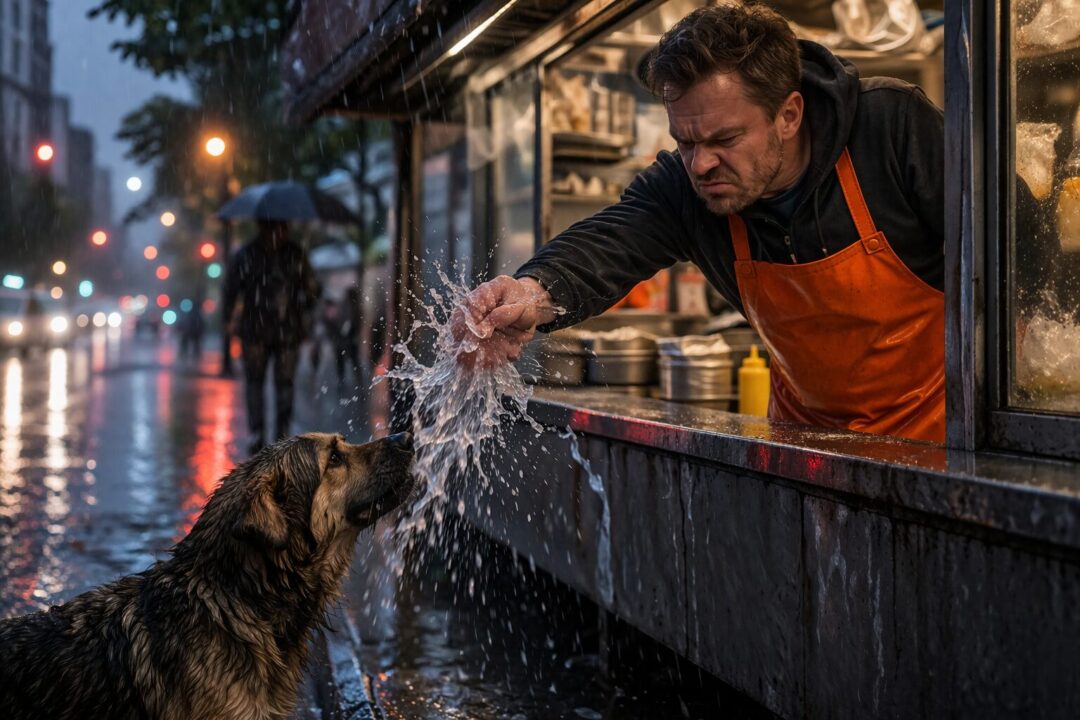
Marlon grabbed the rinsing cup from the sink.
“Move,” he snapped, leaning out. “Go away.”
The dog flinched before the water even hit the pavement. It splashed her paws, darkening the concrete around her. She sprang back two quick steps, then paused as though she couldn’t quite understand why the world kept answering hunger with punishment.
A man standing a few yards from the stand turned at the sound.
Marlon noticed the navy patrol jacket before he noticed the face. The officer had been there a minute already, maybe more, waiting for coffee from the kiosk next door. Tall enough to be noticeable, broad enough to look unmovable, he held himself with the calm stillness of somebody trained not to waste motion.
Their eyes met for a second.
Marlon looked away first.
“She keeps stealing scraps,” he said, louder than he needed to, as if explanation could scrub the ugliness from what he had just done.
The officer didn’t answer.
The dog had already retreated from the curb. But instead of disappearing into the rain, she darted toward the gutter where a piece of soggy bread had landed among the runoff. She snatched it up gently, almost delicately, and turned away with it clenched in her mouth.
The officer watched her go.
“For who?” he said quietly.
Marlon pretended not to hear him.
The officer set his coffee on the kiosk ledge without taking a sip. Then he followed the dog.
Marlon busied himself with the grill. He flattened patties, turned buns, wrapped sandwiches in paper he never properly folded when he was angry. Still, the image stuck in his head: wet fur, thin flanks, those patient eyes.
He told himself he had seen too much to be sentimental. He’d fed one stray once, years ago, and by the end of the week there had been four. Customers complained. The owner of the dry cleaner next door threatened to report him. Kindness, in places like this, had a way of multiplying into trouble.
That was what he told himself.
It had nothing to do with the fact that hunger in another creature could make him remember his own.
He had grown up with that kind of hunger. Not the kind that sharpened dinner, but the kind that sat in a room with you and changed the way everybody spoke. The kind that made adults brittle. The kind that turned small setbacks into public shame. He had spent most of his life building walls between himself and that old feeling.
Maybe that was why he couldn’t bear the dog’s eyes. They saw too much.
He wrapped another order. Called a number. Took cash with wet fingers. The rain drummed harder on the awning.
Then, for no reason he cared to name, he stepped away from the stand and looked toward the narrow side passage that ran behind the building.
The officer had not come back.
Part II — Behind the Crates
The side passage was barely more than a service gap between the stand and the brick wall behind it. People didn’t use it unless they worked there. Broken pallets leaned against one side. Plastic crates were stacked in uneven towers. Rainwater ran along the edge in a dark line before disappearing into a clogged drain.
Marlon stopped at the corner, unseen.
The dog was there.
She had carried the scrap into a shallow nook where an old tarp drooped from a rusted hook and formed the only dry pocket in the passage. Inside that dim shelter, curled against one another on a bed of flattened cardboard, were five puppies.
For a moment the whole scene felt unreal, like something composed too neatly to be true.
The mother lowered the soaked bread and nudged it forward. The puppies, all round paws and trembling bodies, lifted their heads in unsteady little motions, whining soundlessly. They were too young to understand scarcity, too young to know what their mother had crossed the rain to bring them.
The officer stood a few feet away, staring.
His face had changed. That was what struck Marlon first. Whatever detached alertness he wore out on the sidewalk was gone. In its place was something rawer, quieter, and infinitely harder to dismiss.
“Oh,” he said, almost to himself. “She’s feeding babies.”
The dog stiffened when she noticed him fully. She placed herself between him and the litter, not aggressive, only braced—one more thin creature trying to become a wall.
The officer lowered his hands at once.
“It’s okay,” he said softly.
Marlon should have left. Instead he stood in the rain, half-hidden behind the corner like a man afraid of being caught by his own conscience.
The officer turned his head slightly, just enough to project his voice toward the front of the stand without looking away from the dog.
“You drove her off?”
The question landed with more force than if he had shouted it.
Marlon felt heat rise under his collar despite the cold.
He could have answered with any of the things he’d prepared over the years. Health code. Business. Customers. Liability. All the polished little shields people used when they wanted necessity to excuse a failure of tenderness.
But none of them survived the sight of the puppies.
The smallest one kept trying to climb over the others, nosing clumsily toward the mother’s chest. Another had a pale patch over one eye. They looked less like animals than like handfuls of life someone had forgotten to protect.
The officer crouched slowly, careful not to crowd them. From a paper bag tucked under his arm, he took out a wrapped sandwich, broke off pieces, then set down the lid from a takeout cup and poured water into it from a bottle he pulled from his belt pouch.
“Easy,” he murmured. “Eat first.”
The mother dog did not move.
The officer stayed where he was, one knee soaking through on the concrete, his body lowered not in fear but in respect. He let the food sit between them. He didn’t reach. Didn’t push. Didn’t demand trust simply because he meant well.
That, more than anything, undid Marlon.
Because he recognized the difference.
There were people who performed kindness like a mirror, always watching themselves do it. And there were people who understood that care began with making room for fear.
The dog took one cautious step, then another. She sniffed the food, looked at the officer, looked back at her puppies. Finally she ate.
The officer exhaled.
The puppies crowded toward the makeshift water dish and the softened crumbs. Their little bodies pressed together with frantic urgency. The mother kept one flank turned toward them, as if even while eating she had not surrendered the work of guarding.
Marlon became abruptly aware of the sandwich in his own hand, still warm through the paper. He had wrapped it for a customer who never returned after taking a phone call.
Without thinking too much about it, he walked into the passage.
The dog tensed again.
The officer looked up, not hostile exactly, but watchful.
Marlon stopped a safe distance away. Water slid from his apron hem. He held out the wrapped sandwich awkwardly.
“I was going to throw this out,” he said.
Even to his own ears it sounded weak.
The officer said nothing.
Marlon crouched—not as gracefully, not as naturally—and unwrapped the sandwich with fingers that suddenly felt much too large. He tore off a piece and set it down near the others.
The puppies kept eating.
The mother dog flicked a glance at him, then back to the food. She did not forgive him. She did not need to. But neither did she refuse what he offered.
For a strange moment, that was worse.
Or better.
He wasn’t sure.
“I didn’t know,” he said at last.
The officer’s gaze shifted to him. “You didn’t ask.”
No anger in the words. No sermon. Just the simple shape of the truth.
Marlon looked away.
Rain ticked softly off the tarp overhead. Beyond the passage, city noise rolled on as if the whole world had not just split open in a space no wider than a hallway.
“I can call animal services,” Marlon said, but already he knew that wasn’t enough. It sounded like passing responsibility down the line.
The officer shook his head once. “At this hour? They’ll take forever.”
One of the puppies sneezed, tiny and violent. The officer’s expression tightened.
Marlon rubbed the back of his neck. “What do you need?”
It was the first honest thing he had said all evening.
Part III — The Weight of Small Lives
The officer’s name was Callum. Marlon learned it when the radio on his shoulder crackled and a dispatcher asked for his status.
He answered with quick efficiency, then unhooked the radio and turned the volume low.
“Off duty in ten,” he said. “Close enough.”
It was not, Marlon suspected, what regulations had in mind. But Callum had the look of a man who knew which rules mattered and which ones existed mostly to protect people from the inconvenience of caring.
Together they moved with a strange, unspoken coordination.
Marlon fetched an old clean towel from the stand and a cardboard produce tray from the back. He filled another shallow container with water. He found himself choosing the softest scraps, tearing meat into tiny pieces, checking them for bone as carefully as if he had done this all his life.
Callum stayed close to the dog family, never crowding them, his large hands moving with astonishing gentleness. He spoke very little. When he did, his voice stayed low and even.
“You’re okay, girl,” he murmured once.
The mother dog looked at him with exhausted suspicion that was slowly, reluctantly softening.
Marlon wondered how long she had been doing this. How many nights she had crossed wet streets to gather food. How many times she had been kicked away, shouted at, ignored. He thought of the patience in her eyes and felt something sharp turn over inside him.
There was no dramatic revelation, no sudden burst of self-hatred. Change was quieter than that. It came in humiliating increments. In the realization that cruelty often looked ordinary from the inside. In the sick knowledge that he had mistaken hardness for competence so many times it had begun to feel like wisdom.
“What happens now?” he asked.
Callum glanced toward the mouth of the alley. “Now we get them warm.”
His patrol car was parked half a block away. It took three trips to bring everything they needed: an old wool blanket from the trunk, a plastic storage bin lined with a spare jacket, another bottle of water, a packet of emergency gloves.
When Callum returned with the blanket, the smallest puppy had curled into the fold of Marlon’s apron where he held it against his chest, clumsy and frightened and absurdly warm.
Marlon stared down at it in disbelief.
Its eyes were barely open. Its ears were folded like soft paper. Every breath seemed too small for the life it was trying to sustain.
“I’m going to drop it,” he said.
“You’re not,” Callum replied.
There was the ghost of a smile in his voice.
The other puppies were tucked carefully into the lined bin. The mother paced in a tight circle, refusing to get too far from them.
Callum crouched by her. “Listen,” he said, though of course she could not understand the words. “We’re taking the babies. You can come too, or you can fight me, but I’d rather you came.”
Marlon almost laughed, not because it was funny, but because the tone was so earnest it brushed against tenderness.
The dog stood still. Rain pearled on her whiskers. Then, slowly, she stepped toward the open car door.
Callum let out a breath through his nose. “Good girl.”
The ride to the emergency veterinary clinic took twelve minutes.
Marlon went too.
He told himself it was because Callum needed another pair of hands. Because the stand was nearly out of stock anyway. Because there was no point reopening for the last half hour.
But the truth sat somewhere else.
He went because leaving would have been its own kind of cowardice.
Inside the car, the smell of wet fur, old blanket, and takeout grease mingled into something oddly intimate. The mother dog settled in the backseat with the puppies nestled in the makeshift carrier at her side. She kept one paw hooked over the edge as if touching them was the only way she could believe they were still there.
At a red light, Callum reached back carefully and rested his hand near her shoulder, not forcing contact.
“You’re safe now,” he said.
Marlon looked out the window.
He had heard people say things like that before. At hospitals. At shelters. At funerals, even. Usually the words sounded ceremonial, thin with overuse.
In that moment, they did not.
They sounded like a promise the speaker intended to keep.
Part IV — What Kindness Costs
The clinic was small, too bright, and understaffed, which made it perfect for the hour.
A tired veterinarian with silver in her hair took one look at the soaked blanket, the shivering puppies, and the dog whose body seemed held together by vigilance alone, and waved them through without paperwork.
For the next hour, Marlon fetched whatever he was asked to fetch.
Clean towels. A bottle warmer. A stack of forms. A mop after one of the puppies knocked over a dish with its tiny kicking feet. He stood where he was useful and kept quiet where he wasn’t.
Callum handled the rest with the same steady competence he had shown in the alley. He answered questions. Made calls. Arranged temporary foster placement through a rescue contact he apparently knew from an old case. When the veterinarian explained that the mother was underfed but healthy enough, that the puppies were chilled but recoverable, something unclenched in his face.
Marlon sat in a plastic waiting-room chair with his elbows on his knees and stared at the floor.
He thought of all the moments in life that looked small from the outside. A hand lifted in irritation. A door closed. A voice gone hard. A creature sent away.
How many of those moments changed the shape of another life?
And how often had he called that power nothing?
Near midnight, the veterinarian came out carrying the smallest puppy wrapped in a towel like a folded scrap of moonlight.
“This one likes your friend,” she said, nodding toward Marlon.
He looked up too quickly. “He’s not—”
But the puppy had already been set into his hands.
It slept there instantly.
Something fragile and aching moved through him. Not joy. Not exactly. Joy would have been too easy, too clean. This was closer to grief with warmth in it—a grief for all the hard versions of himself he had mistaken for necessary.
Callum sat beside him.
“You okay?” he asked.
Marlon let out a laugh that failed halfway to becoming one. “Not really.”
Callum nodded as if that were a sensible answer.
After a while Marlon said, “I used to think if I stopped being hard, everything would fall apart.”
Callum leaned back in the chair, tiredness finally visible in the set of his shoulders. “Sometimes things fall apart anyway.”
Marlon glanced down at the sleeping puppy. “That supposed to help?”
“No,” Callum said. “Just true.”
They sat with that.
Through the half-open treatment-room door, Marlon could see the mother dog lying on a blanket while the other puppies fed. One of the technicians had put a heated pad beneath them. For the first time since he had seen her, the dog’s body looked less like a wound and more like a body—still tired, still wary, but not braced against immediate disaster.
When Callum rose to leave, Marlon stood too.
“What happens after tonight?” he asked.
The rescue had found a foster for the puppies until they were old enough to be adopted. The mother would stay with them. Later, if she adjusted well to people, they would find her a home too.
Callum shrugged into his jacket. “That part depends.”
“On what?”
“On whether people mean it when they say they care.”
Marlon looked toward the treatment room again.
The next morning he opened the stand late.
He spent the first hour bleaching the side passage, clearing the broken pallets, and setting a covered plastic tub beneath the overhang at the back with an old blanket inside, though he knew the dog family was no longer there. He left a bowl of water beside it anyway.
The dry cleaner owner next door came out and demanded to know what he was doing. Marlon said, “Fixing something,” and did not explain.
By afternoon he had printed nothing, posted nothing, told no one. That made the change feel more real somehow. No performance. No audience.
A week later he drove across town to the rescue center on his day off.
He brought food.
The mother dog recognized him before he reached the gate. He saw it in the stillness that came over her, in the way her head tilted slightly as though fitting his face against a memory she hadn’t decided what to do with yet.
Then one of the puppies—bigger already, absurdly confident—waddled toward him and chewed his shoelace.
The laugh that escaped him this time was real.
The volunteer asked if he wanted to hold one.
Marlon said yes.
What he did not say, because saying it aloud would have turned it too quickly into a declaration, was that for the first time in years he could imagine a future that wasn’t made only of bracing. A life not built entirely around fear of shortage. A life with softness in it that did not automatically become weakness.
He visited again the next week.
And the week after that.
By the end of the month, Callum was there too, leaning on the fence with coffee in hand, watching Marlon fail heroically to keep three puppies from climbing his apron at once.
“Looks bad for your reputation,” Callum said.
Marlon looked up, one puppy under each arm. “I think I can live with that.”
Callum smiled.
Some stories changed with thunder. With public apologies. With dramatic gestures large enough to be mistaken for transformation.
This one changed in smaller ways.
A bowl of water kept filled.
A shelter made where there had been none.
A man who had once met need with impatience now learning to recognize it before it asked.
Months later, when the rain came again, people passing the stand noticed a hand-painted sign tucked discreetly near the back, too small to advertise, too plain to invite praise. It wasn’t even aimed at customers.
It simply marked the covered space by the alley wall where no creature would be driven off for being hungry.
And on evenings when the city turned gray and cold and the lights trembled in puddles across the sidewalk, Marlon sometimes thought of the mother dog carrying that soaked scrap through the rain as if it were treasure.
He understood now that it had been.
Not because of the bread itself.
Because of what it revealed.
A life can look like a nuisance when you refuse to ask what it’s carrying.
A moment can look ordinary when you don’t understand what hangs in the balance.
And kindness, he learned too late to be innocent and just in time to matter, was rarely a grand thing.
More often it was this:
To pause.
To look again.
To follow the frightened creature into the narrow passage behind your certainty.
And once you see the truth waiting there, to let that truth change you.